
Ultimo aggiornamento: Marzo 2026
Reviewed for: 2025–2026 oil & gas procurement relevance
Most “top 10 ball valve manufacturer” articles only repeat familiar brand names. They rarely help buyers answer the questions that actually determine whether a supplier belongs on the shortlist: Which standards matter for this project? Which valve design fits the duty? What documents must be verified before RFQ? Which manufacturer is strong for pipeline isolation, and which is more practical for customized mid-sized supply?
This guide is written to solve that procurement problem. It is designed for EPC contractors, procurement teams, project engineers, distributors, and plant decision-makers who need to compare ball valve manufacturers based on application fit, standards relevance, documentation discipline, and sourcing practicality, not reputation alone.
Use this page as a working shortlist tool. Start with the comparison table, then check the standards section, application matching logic, valve-type selection guidance, and manufacturer profiles before finalizing your RFQ list.
How This List Was Evaluated: NTGD’s Oil & Gas Procurement Review Logic
This article is reviewed from a manufacturer and project-supply perspective, not as a media popularity ranking. The evaluation logic reflects the filters that real oil and gas buyers use when qualifying ball valve suppliers:
- relevance to oil and gas ball valve applications
- depth of product capability in floating, trunnion-mounted, pipeline, and severe-service ball valves
- pressure, size, and material suitability
- standards and certification relevance
- documentation and traceability support
- customization and delivery practicality
- buyer fit for actual project conditions
From a project-supply perspective, the winning supplier is rarely the one with the biggest catalog alone. In actual oil and gas procurement, the more important question is whether a manufacturer can provide the right valve design, the right documentation package, the right standards alignment, and the right delivery response for a defined service condition.
About NTGD’s review perspective
NTGD Valve supports industrial valve supply for export-oriented projects and customized sourcing requirements across multiple industrial applications. In oil and gas ball valve procurement, the review logic used in this article is based on practical supplier-screening factors such as:
- application-specific valve design suitability
- standards relevance to the exact service
- documentation readiness before RFQ and order placement
- sourcing flexibility for customized project requirements
- communication efficiency for technical clarification and document confirmation
Technical review note: This article is reviewed from a practical procurement and engineering-support perspective. Final valve selection must always be confirmed against actual service conditions, project specifications, applicable standards, and buyer approval requirements.
Selection Criteria Behind This Top 10 List
This list prioritizes manufacturers with meaningful relevance to oil and gas ball valve applications rather than companies known mainly for unrelated valve categories.
The ranking logic is based on seven practical screening criteria.
1. Ball Valve Product Focus
Manufacturers with stronger specialization in trunnion-mounted, floating, severe-service, or pipeline ball valves are generally more relevant than companies known primarily for other valve types.
2. Oil & Gas Application Relevance
A supplier should be evaluated based on realistic fit for upstream production, transmission pipelines, gas processing, LNG, refinery service, and corrosive or high-pressure duties.
3. Pressure, Size, and Material Coverage
Stronger candidates should support a meaningful range of pressure classes, larger diameters where required, and materials suitable for sour service, low temperature, or aggressive media.
4. Standards and Compliance Relevance
Ball valve procurement in oil and gas often depends on standards such as API 6D, API 608, API 607, ASME B16.34, ISO 15848, and NACE MR0175 / ISO 15156.
5. Documentation and Traceability
Real project qualification often depends on MTCs, hydrostatic and pneumatic test reports, NDT records, fire-safe evidence, fugitive emission test reports, inspection records, and material traceability.
6. Customization and Delivery Practicality
Some suppliers are best suited to highly specified major projects. Others are more competitive for customized export orders, flexible documentation packages, OEM work, or shorter communication cycles.
7. Buyer Fit, Not Just Brand Reputation
A globally recognized brand is not automatically the best choice for every project. In many mid-sized, schedule-sensitive, or customization-heavy projects, responsiveness and practical sourcing support matter as much as brand legacy.
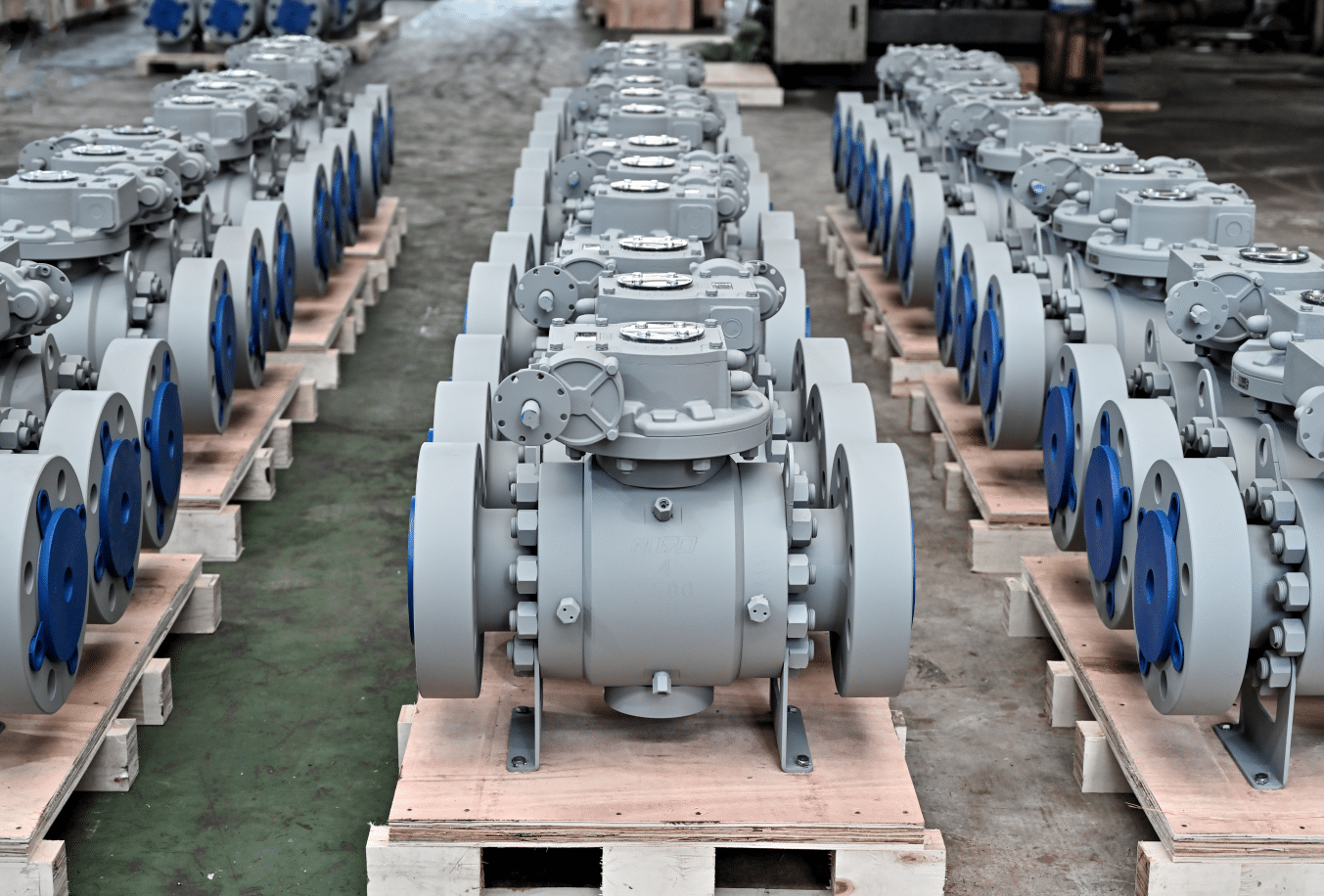
Quick Comparison of the 10 Manufacturers
| Produttore | Il migliore per | Core Ball Valve Strength | Typical Oil & Gas Fit | Standards / Engineering Relevance | Not Ideal For |
|---|---|---|---|---|---|
| Emerson | automation-heavy systems | control-integrated and automated ball valve solutions | gas processing, process facilities, automated packages | strong actuation and control ecosystem | upstream pipeline isolation where automation is not required, or projects seeking simple manual valves without control integration |
| Flowserve | large global EPC projects | trunnion-mounted and severe-service ball valves | upstream, midstream, downstream | strong project support and global service network | small-scale or budget-driven projects where global service coverage is unnecessary |
| Cameron (SLB) | pipeline and high-pressure isolation | API 6D pipeline ball valves, large-diameter systems | transmission pipelines, major oil & gas infrastructure | strong pipeline engineering credibility | mixed-category, lower-budget sourcing where AVL-grade pipeline pedigree is not required |
| KSB | broader industrial energy applications | engineering-led industrial valve supply | energy, utility, and process-related oil and gas service | solid engineering reputation | buyers seeking a highly focused pipeline-ball-valve specialist |
| SAMSON | control-oriented industrial systems | precision control and automation-focused valve solutions | process-heavy plants, automation-intensive systems | strong instrumentation and control engineering background | buyers seeking standard manual isolation packages or pure pipeline valve sourcing |
| Valvola NTGD | flexible project supply and customization | export-oriented industrial ball valve solutions | customized project sourcing, OEM/export, mid-sized project packages | practical documentation support and sourcing flexibility | projects strictly restricted to major IOC/EPC approved vendor lists with no exception process |
| Spirax Sarco | process and thermal systems | process control and flow management know-how | steam-related, thermal, and selected process-side oil and gas service | strong thermal/process engineering background | buyers looking for a broad pipeline-centered ball valve specialist |
| Böhmer | specialist ball valve performance | premium specialist ball valve positioning | demanding industrial and energy applications | strong long-term specialist focus | low-budget fast-delivery sourcing where specialist premium positioning is unnecessary |
| Velan | severe service and engineered projects | robust engineering for critical conditions | refinery, severe service, high-integrity duties | strong engineering and materials reputation | lower-complexity commodity applications |
| Bonney Forge | forged steel and standards-driven service | forged construction and formal manufacturing discipline | severe industrial service, high-integrity applications | strong materials, testing, and standards positioning | broad low-cost package sourcing where forged construction value is not central |
Buyer note: No single manufacturer is ideal for every oil and gas project. Premium global brands are often stronger in major EPC environments and highly specified severe-service packages. Flexible export-oriented suppliers can be more practical in customized, mid-sized, or communication-sensitive project supply.
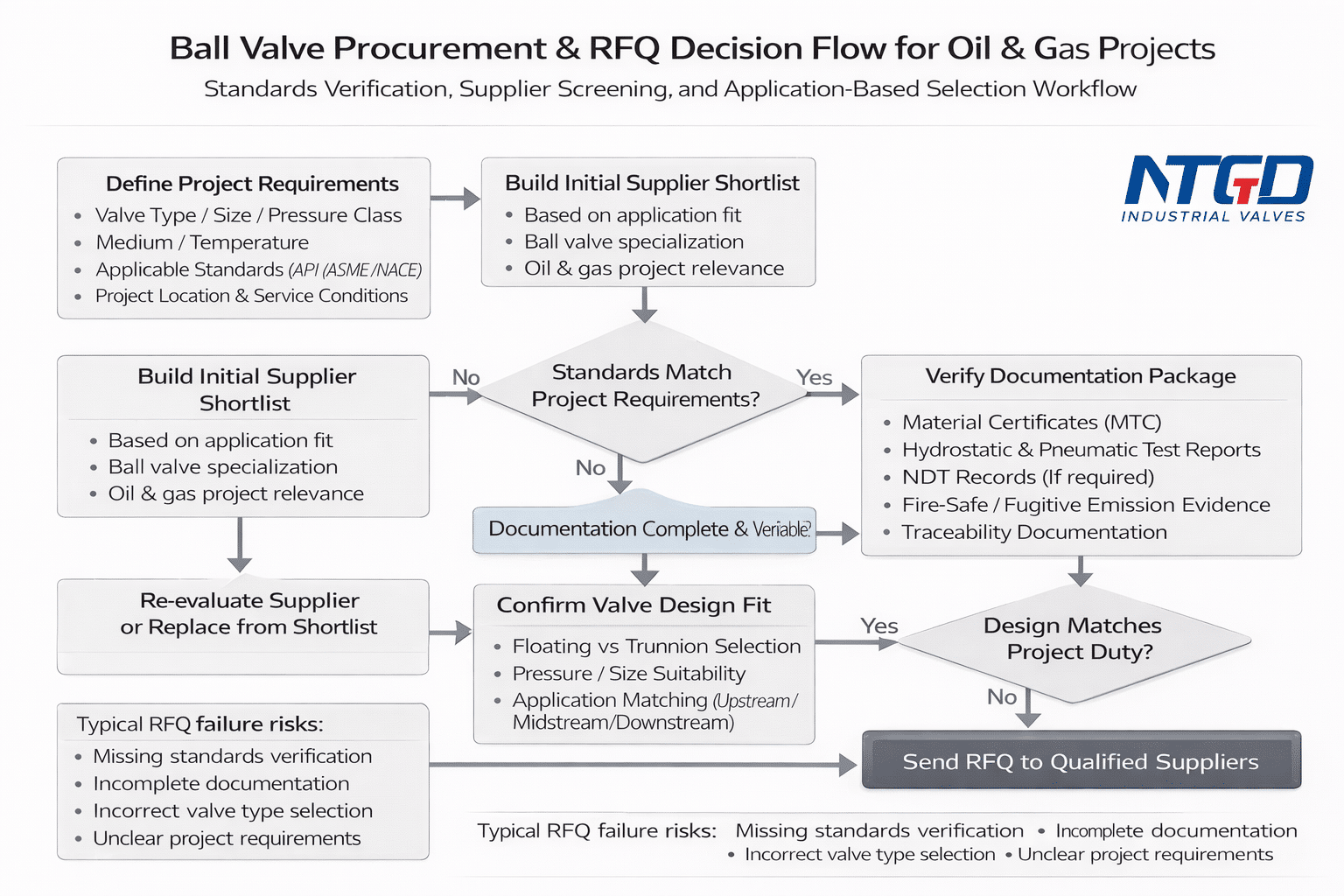
How to Use This Guide in a Real Procurement Process
This guide works best as a shortlist tool, not as a final award document.
Step 1: Build a shortlist
Use the comparison table to identify 3–5 manufacturers that broadly match your project type, budget level, approval environment, and application conditions.
Output: an initial shortlist of realistic supplier types.
Step 2: Confirm technical fit
Use the standards section and application matching section below to verify pressure class suitability, material compatibility, design logic, and documentation requirements.
Output: a technically filtered shortlist.
Step 3: Confirm RFQ readiness
Before sending RFQs widely, confirm whether shortlisted suppliers can support the exact valve type, standards, testing scope, lead time, document package, and end connection required.
Output: an RFQ-ready supplier list.
Procurement warning: Do not send final RFQs before confirming the exact valve design basis, applicable standard, material requirement, and document scope. Many supplier lists shrink quickly at this stage.
Standards Buyers Should Actually Check Before Shortlisting a Supplier
Many articles mention standards, but procurement teams need more than standard names and should understand how valve requirements are interpreted in practice under engineering valve standards.
Standard Priority by Project Type
| Project Type | Mandatory Standards | High Priority Standards | Additional Standards Depending on Duty |
|---|---|---|---|
| Pipeline transmission | API 6D, ASME B16.34 | API 607, traceability documentation | ISO 15848 if emission control is required |
| Upstream wellhead / production | ASME B16.34, material suitability | API 607, NACE MR0175 where sour service applies | API 6D where pipeline-style isolation is specified |
| Refinery / process facilities | API 608, ASME B16.34 | API 607, ISO 15848 | NACE MR0175 if H₂S or sour conditions apply |
| Gas processing plants | ASME B16.34, application-specific design basis | API 607, automation compatibility, low-emission requirements | NACE MR0175 depending on medium |
| Sour gas / H₂S service | NACE MR0175 / ISO 15156, ASME B16.34 | API 6D or API 608 depending on service type | ISO 15848 if emission control is specified |
| LNG / low-temperature service | low-temperature material suitability, ASME B16.34 | cryogenic design evidence, test documentation | API 6D or API 608 depending on valve category |
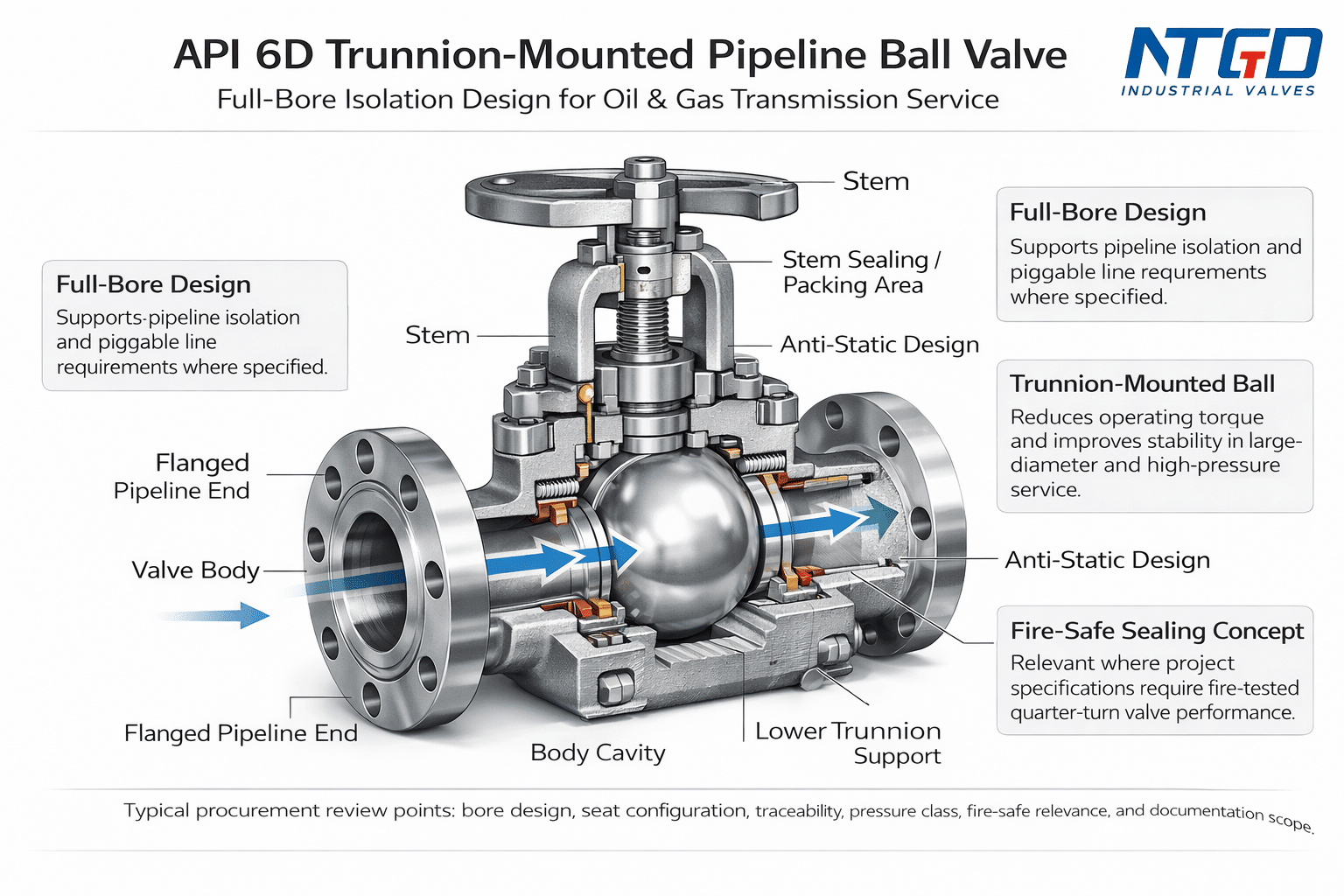
1. API 6D – Pipeline Valves
What it is for:
API 6D is the primary standard associated with pipeline valves used in oil and gas transmission service.
What buyers should check:
- whether the valve is genuinely intended for pipeline isolation
- full-bore or reduced-bore suitability if pigging matters
- testing and inspection scope
- anti-static, fire-safe, and sealing configuration where specified
Core documents to request:
- manufacturer’s relevant API 6D-related certification evidence
- hydrostatic and pneumatic test reports
- inspection records
- material traceability documents for the supplied valve
Additional documents where required:
- GA drawing or dimensional drawing
- seat and sealing design documentation
- project-specific inspection plan
Perché è importante:
For pipeline projects, API 6D ball valve relevance is often one of the first supplier filters. A supplier may claim oil and gas capability broadly, but transmission projects usually require stronger design and documentation discipline.
If missing, consider:
If the supplier cannot provide API 6D-related test records or traceability documents for a pipeline-specified valve, they may not be suitable for transmission service. Unless the application is clearly non-pipeline, that supplier should usually be downgraded or removed from the shortlist.
2. API 608 – Metal Ball Valves, Threaded, Flanged, and Welding Ends
What it is for:
API 608 is highly relevant to general industrial metal ball valves used in refinery, process, and broader oil and gas service.
What buyers should check:
- whether the offered valve type matches the intended service
- size and pressure range suitability
- end connection compatibility
- seat and sealing design fit for the process condition
Core documents to request:
- product data sheet
- pressure test records
- certificati di materiale
- dimensional and standards compliance documentation
Additional documents where required:
- Disegno GA
- seat material confirmation
- stem sealing details
Perché è importante:
Not every oil and gas project is a pipeline project. Many refinery and process services rely more on correct API 608-aligned selection than on pipeline-oriented standards.
If missing, consider:
If the supplier cannot clearly document API 608 relevance, pressure class coverage, or the exact valve configuration being offered, the risk of mismatch in process service increases. Keep that supplier off the final RFQ list until the documentation is clarified.
3. API 607 – Fire-Safe Design Relevance
What it is for:
API 607 relates to fire testing for quarter-turn valves and actuators and is highly relevant where fire-safe design is specified.
What buyers should check:
- whether fire-safe performance is required by project specification
- whether testing evidence applies to the exact valve design being offered
- whether seat and sealing design are suitable for the service hazard profile
Core documents to request:
- fire-safe test evidence
- supporting model or series documentation
- seat and sealing configuration details
Additional documents where required:
- project-specific fire-safe compliance statement
- quality or inspection reference tied to the offered valve series
Perché è importante:
In hydrocarbon service, fire-safe ball valve design is often not optional. It may be a mandatory project or end-user requirement.
If missing, consider:
If fire-safe evidence is required by the project but the supplier can only provide general marketing claims instead of model-relevant supporting documents, do not treat the valve as technically qualified.
4. ASME B16.34 – Valves Flanged, Threaded, and Welding End
What it is for:
ASME B16.34 covers pressure-temperature ratings, materials, design, and testing considerations for valves.
What buyers should check:
- pressure class suitability
- pressure-temperature rating basis
- compatibilità dei materiali
- alignment with system design requirements
Core documents to request:
- pressure-temperature data
- material specifications
- inspection or test records
- dimensional or product drawings if needed
Additional documents where required:
- trim and bolting details
- low-temperature or high-temperature suitability notes
Perché è importante:
Many selection mistakes happen because buyers confirm “oil and gas use” in general terms but do not verify the actual pressure-temperature design basis carefully enough.
If missing, consider:
If the supplier cannot provide clear pressure-temperature rating data or material details for the offered configuration, the valve should not move to final technical comparison.
5. ISO 15848 – Fugitive Emissions
What it is for:
ISO 15848 is relevant when low-emission performance is required, especially in regulated facilities or environmentally sensitive service.
What buyers should check:
- whether fugitive emission control is part of project requirements
- stem sealing and packing design suitability
- whether test evidence applies to the proposed valve configuration or design family
Core documents to request:
- fugitive emission test reports
- sealing system details
- maintenance or packing guidance where relevant
Additional documents where required:
- project-specific low-emission confirmation
- packing material specifications
Perché è importante:
For some refinery, chemical, and regulated gas applications, low-emission performance affects compliance, safety, and environmental acceptance.
If missing, consider:
If low-emission performance is specified but the supplier cannot provide relevant fugitive emission evidence, that supplier should not remain on the qualified list for emission-sensitive projects.
6. NACE MR0175 / ISO 15156 – Sour Service
What it is for:
These standards are critical for materials used in H₂S-containing environments and other sour-service conditions.
What buyers should check:
- whether the project genuinely requires sour-service compliance
- wetted materials and hardness controls
- body, stem, trim, bolting, and seat-adjacent material suitability
- whether the supplier can support documentation for the exact offered configuration
Core documents to request:
- certificati di materiale
- hardness test records where applicable
- sour-service compliance documentation
- procurement-specific material data tied to the exact valve configuration
Additional documents where required:
- corrosion allowance or metallurgical review notes
- trim and bolting material breakdown
Perché è importante:
A valve suitable for standard hydrocarbon service may still be unacceptable in sour gas or H₂S-containing media. This is one of the most important procurement filters in actual oil and gas supply.
If missing, consider:
If the supplier cannot provide material certificates and hardness control evidence tied to the exact offered configuration, do not assume “sour-service capable” is sufficient. For H₂S-containing service, that is usually grounds to reject or suspend qualification.
Which Ball Valve Type Fits Which Oil & Gas Application?
Not all oil and gas applications require the same valve design or the same supplier type. Matching the supplier to the service condition is more practical than ranking brands in the abstract.
Upstream Production and Wellhead Service
Typical priorities:
- high pressure capability
- robust isolation
- resistenza alla corrosione
- material suitability
- documentation reliability
Often preferred:
- valvole a sfera con montaggio a cerniera
- forged or heavy-duty constructions
- sour-service-compatible materials where required
Manufacturers often considered:
- Cameron (SLB)
- Flowserve
- Velan
- Bonney Forge
- NTGD Valve when the project requires customized material configuration, flexible documentation support, or non-standard end connections outside rigid AVL-driven sourcing
Buyer screening tip:
For upstream and wellhead service, confirm pressure class, material metallurgy, and sour-service documentation before comparing price.
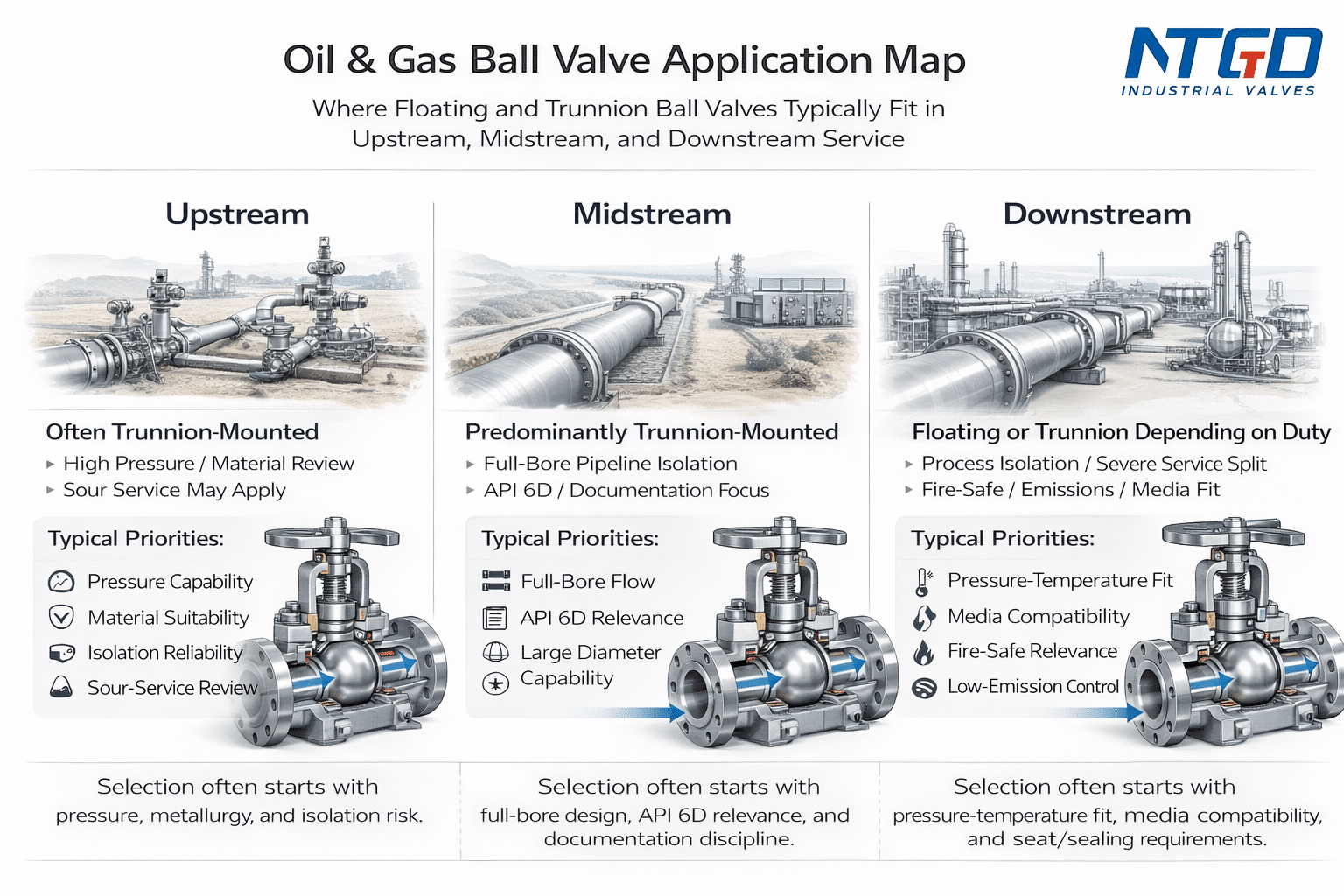
Midstream Pipeline Transmission
Typical priorities:
- Full-port ball valve isolation is often a priority in midstream pipeline transmission.
- API 6D relevance
- piggable design where required
- larger diameter and higher pressure support
- affidabilità della tenuta a lungo termine
Often preferred:
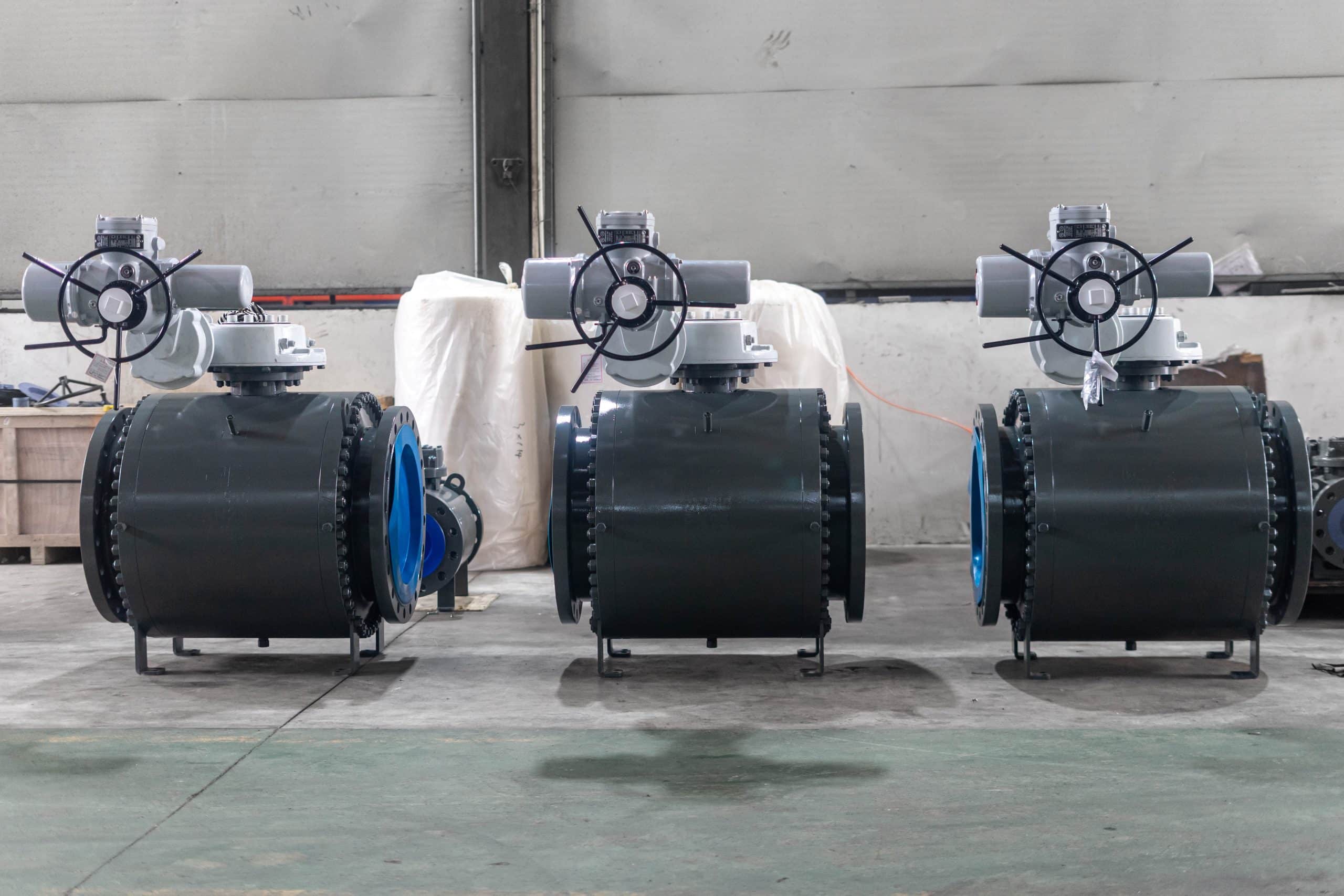
- trunnion-mounted pipeline ball valves
- anti-static and fire-safe design where specified
- strong traceability and testing documentation
Manufacturers often considered:
- Cameron (SLB)
- Flowserve
- Böhmer
- Emerson for automation-related packages
- NTGD Valve when the project volume is mid-range, customized lead time or documentation packages are required, and a major pre-approved EPC vendor list is not mandatory
Buyer screening tip:
For pipeline projects, verify API 6D-related documentation and traceability first. General “oil and gas use” language is not enough.
Downstream Refinery and Process Facilities
Typical priorities:
- pressure-temperature fit
- media compatibility
- leakage control
- fire-safe relevance
- manutenibilità
Often preferred:
- floating or trunnion-mounted ball valves depending on size and class
- Metal seated ball valve designs are often preferred in severe conditions.
- low-emission sealing options where required
Manufacturers often considered:
- Emerson
- Flowserve
- Velan
- SAMSON in control-oriented contexts
- KSB in broader industrial energy applications
- NTGD Valve where project supply requires practical customization, export communication efficiency, and flexible documentation support
Buyer screening tip:
For refinery and process duties, screen suppliers on actual service conditions: temperature, media, cycling, sealing requirement, and emissions requirement.
Gas Processing Plants
Typical priorities:
- automation compatibility
- clean shut-off
- actuator integration
- accesso alla manutenzione
- system-level engineering support
Often preferred:
- automated ball valve packages
- floating or trunnion designs depending on duty
- control-integrated solutions
Manufacturers often considered:
- Emerson
- SAMSON
- Flowserve
- NTGD Valve when the buyer needs customized package-oriented export supply, faster communication on actuator/package coordination, or practical support on document scope
Buyer screening tip:
For gas processing plants, supplier selection should include valve package integration, not only valve body selection.
Sour Gas and Corrosive Service
Typical priorities:
- NACE relevance
- material hardness control
- corrosion-resistant trim and body materials
- documentation discipline
- exact configuration verification
Often preferred:
- trunnion-mounted valves for higher pressure severe service
- carefully reviewed material combinations
- strong technical document support
Manufacturers often considered:
- Cameron (SLB)
- Flowserve
- Velan
- Bonney Forge
- NTGD Valve when verified material capability, material traceability, and configuration-level documentation can be confirmed for the exact project requirement
Buyer screening tip:
Do not evaluate sour-service suitability at brand level only. Evaluate it at configuration level.
LNG and Low-Temperature Service
Typical priorities:
- cryogenic suitability
- material behavior at low temperature
- stem extension design where needed
- testing evidence
- thermal contraction considerations
Often preferred:
- cryogenic-capable ball valves
- specialist engineering support
- precise low-temperature documentation
Manufacturers often considered:
- Velan
- Flowserve
- selected specialist suppliers depending on actual configuration requirement
Buyer screening tip:
For LNG and low-temperature service, the question is not just whether the manufacturer is known. The question is whether the exact valve configuration is documented for cryogenic duty.
Floating vs Trunnion Ball Valves for Oil & Gas Projects
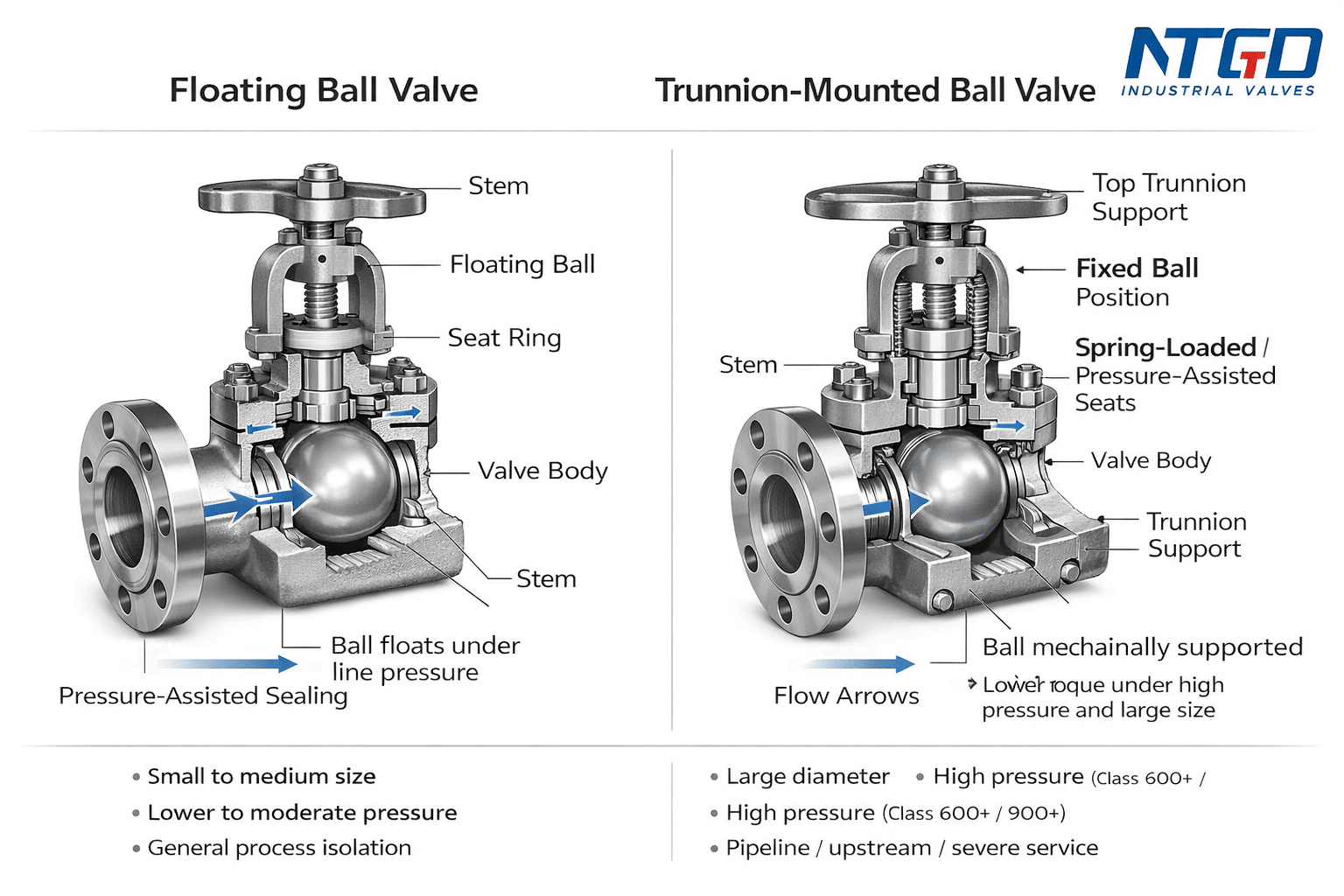
One of the most practical questions in oil and gas procurement is whether the application is better suited to a valvola a sfera galleggiante or a trunnion-mounted ball valve.
Valvole a sfera flottanti
In a floating design, the ball is not mechanically anchored at both ends. Line pressure helps push the ball against the downstream seat to create sealing.
Best suited for:
- smaller sizes
- lower to medium pressure duties
- general process isolation
- applications where compact design and cost efficiency matter
Vantaggi:
- simpler structure
- lower cost in many standard applications
- suitable for a broad range of general industrial duties
Limitations:
- less ideal for very large diameters or higher pressure classes
- operating torque can become a concern as size and pressure increase
Valvole a sfera a cerniera
In a trunnion-mounted design, the ball is mechanically supported, which reduces operating torque and improves stability under higher loads.
Best suited for:
- higher pressure service
- larger diameter pipeline valves
- severe service
- demanding upstream and midstream applications
Vantaggi:
- lower operating torque at large sizes and higher pressures
- stronger suitability for pipeline and major oil and gas isolation duty
- better fit for engineered severe-service applications
Limitations:
- more complex and often more expensive
- may be excessive for simpler low-pressure duties
Quick Selection Rule of Thumb
- If size is 6″ or below, pressure is Class 600 or below, and the duty is general process isolation, a floating ball valve is often sufficient.
- If size is 8″ or above, pressure is Class 900 or above, or the application is pipeline, wellhead, or severe service, a trunnion-mounted ball valve is usually the stronger choice.
Nota importante:
This is a quick screening rule, not a substitute for a full trunnion vs floating ball valve review. Final selection should still be confirmed against torque requirement, sealing requirement, cycling frequency, project specification, media condition, and end-user approval criteria.
Top 10 Ball Valve Manufacturers for Oil & Gas in 2025
1. Emerson
Il migliore per
Automation-heavy oil and gas systems, process facilities, and projects where valve performance must integrate closely with actuation and control.
Typical Oil & Gas Applications
- gas processing facilities
- automated process skids
- refinery control-related isolation service
- plant environments where instrumentation and valve actuation are tightly linked
Relevant Ball Valve Strengths
Emerson is widely recognized for combining valve technology with automation, controls, and broader plant integration. This makes it especially relevant where the buyer is not only purchasing a manual isolation valve, but a broader functional system.
Standards / Documentation Relevance
Emerson is especially relevant in projects where engineering support, actuation packages, and system-integration documentation form part of the purchasing decision.
Not Ideal For
Projects focused on simple manual isolation where automation is unnecessary, especially in pipeline or utility applications that do not benefit from control integration.
Engineering Selection Note
Compared with manufacturers that are stronger in pure pipeline isolation or large-diameter mechanical severe service, Emerson becomes more competitive when automation architecture matters.
2. Flowserve
Il migliore per
Large international oil and gas projects requiring broad engineering support, serious trunnion capability, and strong global service coverage.
Typical Oil & Gas Applications
- upstream facilities
- midstream pipeline service
- refinery and downstream operations
- demanding project environments with formal engineering and documentation requirements
Relevant Ball Valve Strengths
Flowserve has strong recognition in severe service, project supply, and trunnion-mounted ball valve applications. It is frequently shortlisted where reliability, engineering credibility, and service footprint influence award decisions.
Standards / Documentation Relevance
Flowserve is especially relevant in projects where documentation quality, specification alignment, and established project support are central to supplier selection.
Not Ideal For
Small or budget-sensitive projects where a premium global support structure is unnecessary.
Engineering Selection Note
Flowserve is often a strong shortlist candidate for major projects, but buyers should still compare lead time, document turnaround, and total package practicality against actual project scale.
3. Cameron (SLB)
Il migliore per
Pipeline isolation, high-pressure service, and major oil and gas infrastructure projects where API 6D logic is central.
Typical Oil & Gas Applications
- transmission pipelines
- large-diameter isolation service
- upstream and midstream high-integrity valve packages
- major infrastructure projects
Relevant Ball Valve Strengths
Cameron has strong recognition in pipeline service and high-pressure applications. It is one of the most natural fits for a list focused specifically on oil and gas ball valve manufacturers.
Standards / Documentation Relevance
Cameron is especially relevant when buyers prioritize pipeline-grade engineering logic, API 6D orientation, and infrastructure-scale credibility.
Not Ideal For
Mixed-category, lower-flexibility sourcing where the project does not require major pipeline pedigree.
Engineering Selection Note
If the project centers on transmission pipeline isolation or large-diameter, high-pressure service, Cameron deserves close review. Its value is strongest in technically demanding, standards-driven environments.
4. KSB
Il migliore per
Industrial energy users and buyers seeking a broader engineering brand with relevance to energy-sector valve requirements.
Typical Oil & Gas Applications
- energy-related industrial facilities
- process and utility systems with oil and gas overlap
- selected engineered industrial applications
Relevant Ball Valve Strengths
KSB’s broader industrial and energy-sector footprint gives it relevance where oil and gas duty intersects with power, utilities, and process infrastructure.
Standards / Documentation Relevance
KSB benefits from a strong engineering reputation, although buyers should confirm exact ball valve depth and project relevance for specialized oil and gas requirements.
Not Ideal For
Projects where the shortlist requires a strongly pipeline-focused specialist.
Engineering Selection Note
KSB is credible in broader energy and industrial discussions, but buyers should verify exact product suitability for highly specific oil and gas ball valve duties.
5. SAMSON
Il migliore per
Control-oriented systems and projects where precision, instrumentation, and process responsiveness matter more than basic manual isolation.
Typical Oil & Gas Applications
- process-heavy plant environments
- industrial automation systems
- facilities where control precision and valve-response logic matter
Relevant Ball Valve Strengths
SAMSON’s strength is more control-oriented than commodity isolation-oriented. That makes it more relevant in engineered process settings than in generic supplier rankings.
Standards / Documentation Relevance
Its value is strongest where instrumentation logic, control performance, and process accuracy affect supplier selection.
Not Ideal For
Buyers seeking a conventional pipeline ball valve specialist or low-complexity manual valve sourcing.
Engineering Selection Note
SAMSON can be highly relevant in automation-heavy plant environments, but it should not be treated as a universal substitute for dedicated pipeline or severe-duty isolation specialists.
6. NTGD Valve
Il migliore per
Flexible export-oriented project supply, customized sourcing, OEM/private-label work, and mid-sized oil and gas projects that require responsiveness and practical engineering support.
Typical Oil & Gas Applications
- project-driven export supply
- distributor and OEM sourcing
- customized isolation valve packages
- applications where communication speed, documentation support, and delivery flexibility matter
Relevant Ball Valve Strengths
NTGD’s practical value lies in combining manufacturing-oriented ball valve supply with customization support, export responsiveness, and flexibility for non-standard project requirements.
Standards / Documentation Relevance
NTGD is most relevant where the buyer needs practical support on drawings, basic test records, materials clarification, document-package coordination, or configuration confirmation for project sourcing. Final qualification should still be based on the exact offered valve type, applicable standard, and verified documentation scope.
Not Ideal For
Projects that are strictly restricted to major IOC or EPC approved vendor lists with no exception process. In those cases, buyers should prioritize manufacturers already listed on the required AVL.
Engineering Selection Note
NTGD becomes more competitive when the project values customization, communication efficiency, practical document support, and sourcing flexibility more than legacy brand status. That is often where mid-sized buyers and urgent project packages need more than a rigid catalog.
Need a customized ball valve recommendation for your project? Send your size, pressure class, medium, temperature, end connection, and required standard for technical review.
7. Spirax Sarco
Il migliore per
Process and thermal-system users whose valve decisions intersect with steam, process efficiency, and broader flow-management priorities.
Typical Oil & Gas Applications
- process-related facilities
- steam-associated systems
- thermal and utility-side applications within oil and gas environments
Relevant Ball Valve Strengths
Spirax Sarco’s process and thermal engineering background gives it relevance in selected oil and gas systems where the process side matters as much as pure isolation duty.
Standards / Documentation Relevance
Its value depends heavily on the actual application. Buyers should confirm exact product fit rather than assume broad equivalence with dedicated pipeline or severe-service ball valve specialists.
Not Ideal For
Buyers who need a broad pipeline-centered, large-diameter, high-pressure ball valve shortlist.
Engineering Selection Note
Spirax Sarco may fit selected process-side applications well, but it is not the first name most buyers prioritize for pure pipeline ball valve procurement.
8. Böhmer
Il migliore per
Buyers seeking specialist ball valve expertise, long-term performance orientation, and strong category-specific engineering positioning.
Typical Oil & Gas Applications
- demanding industrial service
- energy-sector duties
- applications where specialist ball valve reputation matters
Relevant Ball Valve Strengths
Böhmer’s value comes from specialist ball valve focus rather than broad all-category catalog breadth. That can be a real advantage for buyers who want deeper category-specific positioning.
Standards / Documentation Relevance
Its specialist image is strongest where the buyer prioritizes product depth, engineering seriousness, and long-term service confidence.
Not Ideal For
Low-budget sourcing where price sensitivity and fast availability outweigh specialist premium positioning.
Engineering Selection Note
Böhmer is a strong example of why product specialization matters. Buyers comparing “top manufacturers” should compare not only brand size, but also category-specific engineering depth.
9. Velan
Il migliore per
Severe service and critical-duty applications where materials, engineering integrity, and demanding operating conditions drive supplier selection.
Typical Oil & Gas Applications
- refinery severe service
- critical isolation applications
- high-pressure and high-temperature duties
- engineered project environments
Relevant Ball Valve Strengths
Velan is widely associated with engineered performance and critical industrial service. In oil and gas, that makes it particularly relevant for buyers focused on reliability under harsh operating conditions.
Standards / Documentation Relevance
Velan’s engineering reputation gives it strong positioning where buyers care about technical seriousness, application-specific design suitability, and materials performance.
Not Ideal For
Simple commodity applications that do not justify a more engineered premium solution.
Engineering Selection Note
Velan deserves close attention in critical-service comparisons, especially where the specification extends beyond standard isolation into severe-duty conditions.
10. Bonney Forge
Il migliore per
Forged steel and standards-driven service where materials, strength, and formal manufacturing discipline influence the buying decision.
Typical Oil & Gas Applications
- demanding upstream and downstream duties
- severe industrial service
- applications requiring strong material credibility
Relevant Ball Valve Strengths
Bonney Forge is recognized for forged steel expertise and strong manufacturing discipline, which makes it relevant where material traceability and construction integrity are high-priority factors.
Standards / Documentation Relevance
Its standards-led positioning can be valuable for buyers who prioritize formal manufacturing discipline and strong documentation alignment.
Not Ideal For
Broad, mixed-category sourcing where price and catalog simplicity outweigh forged construction value.
Engineering Selection Note
Bonney Forge stands out when the project places strong weight on materials, testing, and formal engineering discipline rather than on pure commercial convenience.
Which Manufacturer Fits Your Project Type?
If you need a faster practical shortlist, use this simplified framework.
Choose Emerson if:
you need stronger automation integration, control compatibility, and plant-level system coordination.
Choose Flowserve if:
you need a global project-experienced supplier with strong severe-service and trunnion capability.
Choose Cameron (SLB) if:
your project centers on pipeline isolation, API 6D logic, and high-pressure infrastructure credibility.
Choose NTGD Valve if:
you need flexibility, export responsiveness, customization support, and practical project-oriented sourcing outside rigid AVL-only environments.
Choose Böhmer or Velan if:
your priority is engineering depth, specialist positioning, or severe-duty performance.
Choose Bonney Forge if:
forged construction, materials credibility, and formal manufacturing discipline matter most.
What Buyers Should Request Before Sending a Final RFQ
- product datasheet for the exact valve type
- pressure-temperature rating details before sending a final RFQ.
- certificati di materiale
- hydrostatic and pneumatic test records
- NDT records where applicable
- fire-safe evidence if required
- fugitive emission evidence if required
- sour-service material confirmation if required
- GA drawing or dimensional drawing if needed
- lead time by size, class, and material
- origin and manufacturing details
- warranty and after-sales scope
Practical RFQ filter
If a supplier cannot clearly confirm the exact valve type, applicable standard, material basis, document scope, and lead time for your requested configuration, they may not be ready for final RFQ comparison.
Recommended document split
Mandatory before final RFQ comparison:
- datasheet
- applicable standards confirmation
- certificati di materiale
- pressure test records
- lead time confirmation
Additional for deeper technical review:
- NDT records
- GA drawings
- fire-safe evidence
- low-emission evidence
- sour-service supporting documents
- inspection coordination details
Still Evaluating Supplier Options?
Download the Ball Valve RFQ Preparation Template
If you are still comparing manufacturers, a structured RFQ template can help you evaluate suppliers more consistently before you send inquiries.
A useful RFQ template should include:
- tipo di valvola
- size and pressure class
- materiale della carrozzeria e delle finiture
- tipo di sedile
- standard applicabile
- connessione finale
- ambito di prova
- document package requirements
- lead time requirement
- destination country
- project approval notes
- supplier comparison scoring section
Download the Ball Valve RFQ Preparation Template to compare manufacturers on standards, materials, documentation, and delivery readiness before RFQ.
FAQs About Ball Valve Manufacturers for Oil & Gas
1. Who are the top 10 ball valve manufacturers for oil and gas in 2025?
The top 10 ball valve manufacturers commonly considered for oil and gas projects in 2025 include Emerson, Flowserve, Cameron (SLB), KSB, SAMSON, NTGD Valve, Spirax Sarco, Böhmer, Velan, and Bonney Forge. The right choice depends on project type, standards, delivery practicality, and documentation requirements rather than brand recognition alone.
2. What standards should oil and gas ball valve manufacturers comply with?
Ball valve manufacturers should be evaluated against the standards relevant to the actual application, not by standard names alone. In many projects, buyers review API 6D for pipeline service, API 608 for industrial metal ball valves, API 607 for fire-safe relevance, ASME B16.34 for pressure-temperature design basis, ISO 15848 for fugitive emissions, and NACE MR0175 / ISO 15156 for sour-service suitability. The correct mix depends on whether the project is pipeline transmission, gas processing, refinery isolation, or corrosive service.
3. Which manufacturers are more relevant for sour gas service?
Manufacturers are generally stronger candidates for sour gas service when they can support configuration-level material suitability and documentation, not merely general brand claims. Buyers usually look for NACE-related material evidence, hardness control where applicable, and exact metallurgy support for the offered configuration. The key procurement question is not “Does this brand mention sour service?” but “Can this supplier document sour-service suitability for the exact valve I am buying?”
4. Which is better for oil and gas service, floating or trunnion ball valves?
Valvole a sfera montate su traliccio are generally better for higher pressure, larger size, pipeline, and severe-duty applications because they reduce operating torque and offer stronger stability under load.
Valvole a sfera flottanti are often more practical for smaller sizes, moderate pressure service, and general process isolation.
The correct choice depends on size, pressure class, media, duty cycle, and project requirement.
5. Do sour gas applications require NACE MR0175 compliance?
In many H₂S-containing applications, yes. Buyers should verify whether the project specification requires NACE MR0175 / ISO 15156 and request material certificates, hardness evidence where applicable, and supporting documentation for the exact offered valve configuration. A general claim of “sour-service capable” is not enough.
6. Are Chinese ball valve manufacturers reliable for oil and gas projects?
They can be, but reliability should be judged by the same criteria used for any supplier: standards relevance, document readiness, materials control, testing support, and communication quality. For export-oriented sourcing, Chinese manufacturers can be competitive when the buyer needs customization, responsive communication, and practical document coordination. However, buyers should still verify the exact valve configuration, applicable standards, and approval requirements before qualification.
7. How should buyers compare premium global brands and export-oriented manufacturers?
Buyers should compare them based on project fit rather than prestige alone. Premium global brands are often stronger for major EPC projects, global approvals, and highly engineered severe-service environments. Export-oriented manufacturers can be more competitive in customization, communication speed, delivery flexibility, and practical project sourcing for mid-sized or schedule-sensitive packages. The correct choice depends on whether the project is approval-driven, schedule-driven, customization-driven, or budget-driven.
8. What documents should buyers request before placing an order?
At minimum, buyers should request datasheets, material certificates, hydrostatic and pneumatic test records, pressure-temperature information, standards confirmation, and any application-specific evidence such as fire-safe, low-emission, or sour-service documentation. For critical projects, exact configuration confirmation and traceability are just as important as commercial pricing.
9. When is a metal seated ball valve required?
Metal seated ball valves are often required when service conditions involve higher temperature, abrasive particles, severe cycling, or operating conditions that make soft-seat damage more likely. They are commonly considered in severe-duty oil and gas and process applications where sealing integrity must be maintained under harsher wear conditions.
10. How should buyers evaluate lead time and delivery reliability?
Lead time and delivery reliability are often as important as technical compliance in oil and gas procurement. Buyers should ask each shortlisted supplier for:
- standard lead time by size, pressure class, and material
- whether expedited options are available
- document preparation lead time for test reports and certificates
- inspection coordination timing where third-party inspection is required
- communication response speed on technical clarifications
A manufacturer that meets the technical specification but cannot align with the project schedule may still be commercially impractical to select.
Final Recommendation: How to Shortlist the Right Supplier
Il migliore ball valve supplier choice for oil and gas is not the one with the biggest name in every case.
If the project is driven by major pipeline standards and high-pressure infrastructure logic, manufacturers such as Cameron (SLB) and Flowserve deserve close attention. If the project is more automation-oriented, Emerson and SAMSON may be more relevant. If the project requires flexible customization, export communication efficiency, and practical engineering support, NTGD Valve may offer better sourcing value than a rigid premium-brand route.
The most reliable procurement approach is to compare manufacturers through four filters:
- applicazione adatta
- standards and document readiness
- design and material suitability
- commercial and delivery practicality
When these four filters are used together, the shortlist becomes far more useful than any generic “top 10” ranking.
Request a Technical Review and Quotation
If you are sourcing ball valves for an oil and gas project, send the following details for a technical recommendation and quotation review:
- tipo di valvola
- dimensione
- classe di pressione
- materiale del corpo
- trim or seat requirement
- medio
- temperatura
- standard required
- quantità
- connessione finale
- destination country
- any sour-service, fire-safe, emission, or inspection requirement
Need a reliable ball valve supplier for your oil and gas project? Send your project parameters to receive a technical review, documentation check, and quotation recommendation.
Author / Reviewer
Recensito da: Team di ingegneri di valvole NTGD
Review perspective: Industrial valve supply and project-sourcing review
Review date: Marzo 2026
Reviewer note: This article is intended as a practical procurement reference for oil and gas ball valve selection. Final supplier approval and valve selection should always be confirmed against actual service conditions, project specifications, end-user requirements, and applicable standards.
