
Dernière mise à jour : mars 2026
Critique rédigée pour : Pertinence des marchés publics dans le secteur du pétrole et du gaz pour la période 2025-2026
La plupart des articles consacrés au “ top 10 des fabricants de vannes à bille ” se contentent de citer les marques les plus connues. Ils aident rarement les acheteurs à répondre aux questions qui déterminent réellement si un fournisseur doit figurer sur la liste restreinte : quelles normes sont pertinentes pour ce projet ? Quelle conception de vanne est adaptée à l’application ? Quels documents faut-il vérifier avant de lancer un appel d’offres ? Quel fabricant est le plus performant pour l’isolation des canalisations, et lequel est le plus adapté pour des livraisons sur mesure de taille moyenne ?
Ce guide a été rédigé pour résoudre ce problème lié à l'approvisionnement. Il s'adresse aux entrepreneurs EPC, aux équipes d'approvisionnement, aux ingénieurs de projet, aux distributeurs et aux responsables d'usine qui ont besoin de comparer les fabricants de vannes à bille en fonction de adéquation de l'application, pertinence des normes, rigueur documentaire et facilité d'approvisionnement, et pas seulement la réputation.
Utilisez cette page comme outil pour établir une présélection. Commencez par consulter le tableau comparatif, puis examinez la section consacrée aux normes, la logique de correspondance des applications, les conseils de sélection des types de vannes et les profils des fabricants avant de finaliser votre liste de demandes de devis.
Comment ce classement a été établi : la logique d'évaluation des marchés publics dans le secteur pétrolier et gazier de NTGD
This article is reviewed from a manufacturer and project-supply perspective, not as a media popularity ranking. The evaluation logic reflects the filters that real oil and gas buyers use when qualifying ball valve suppliers:
- relevance to oil and gas ball valve applications
- depth of product capability in floating, trunnion-mounted, pipeline, and severe-service ball valves
- pressure, size, and material suitability
- standards and certification relevance
- documentation and traceability support
- customization and delivery practicality
- buyer fit for actual project conditions
From a project-supply perspective, the winning supplier is rarely the one with the biggest catalog alone. In actual oil and gas procurement, the more important question is whether a manufacturer can provide the right valve design, the right documentation package, the right standards alignment, and the right delivery response for a defined service condition.
À propos de l'approche d'évaluation de NTGD
NTGD Valve supports industrial valve supply for export-oriented projects and customized sourcing requirements across multiple industrial applications. In oil and gas ball valve procurement, the review logic used in this article is based on practical supplier-screening factors such as:
- application-specific valve design suitability
- standards relevance to the exact service
- documentation readiness before RFQ and order placement
- sourcing flexibility for customized project requirements
- communication efficiency for technical clarification and document confirmation
Technical review note: This article is reviewed from a practical procurement and engineering-support perspective. Final valve selection must always be confirmed against actual service conditions, project specifications, applicable standards, and buyer approval requirements.
Critères de sélection à l'origine de ce classement des 10 meilleurs
This list prioritizes manufacturers with meaningful relevance to oil and gas ball valve applications rather than companies known mainly for unrelated valve categories.
The ranking logic is based on seven practical screening criteria.
1. Présentation des vannes à bille
Manufacturers with stronger specialization in trunnion-mounted, floating, severe-service, or pipeline ball valves are generally more relevant than companies known primarily for other valve types.
2. Pertinence pour les applications dans le secteur pétrolier et gazier
A supplier should be evaluated based on realistic fit for upstream production, transmission pipelines, gas processing, LNG, refinery service, and corrosive or high-pressure duties.
3. Pression, dimensions et matériaux couverts
Stronger candidates should support a meaningful range of pressure classes, larger diameters where required, and materials suitable for sour service, low temperature, or aggressive media.
4. Normes et conformité : pertinence
Ball valve procurement in oil and gas often depends on standards such as API 6D, API 608, API 607, ASME B16.34, ISO 15848, and NACE MR0175 / ISO 15156.
5. Documentation et traçabilité
Real project qualification often depends on MTCs, hydrostatic and pneumatic test reports, NDT records, fire-safe evidence, fugitive emission test reports, inspection records, and material traceability.
6. Personnalisation et facilité de livraison
Some suppliers are best suited to highly specified major projects. Others are more competitive for customized export orders, flexible documentation packages, OEM work, or shorter communication cycles.
7. L'adéquation avec l'acheteur, et pas seulement la réputation de la marque
A globally recognized brand is not automatically the best choice for every project. In many mid-sized, schedule-sensitive, or customization-heavy projects, responsiveness and practical sourcing support matter as much as brand legacy.
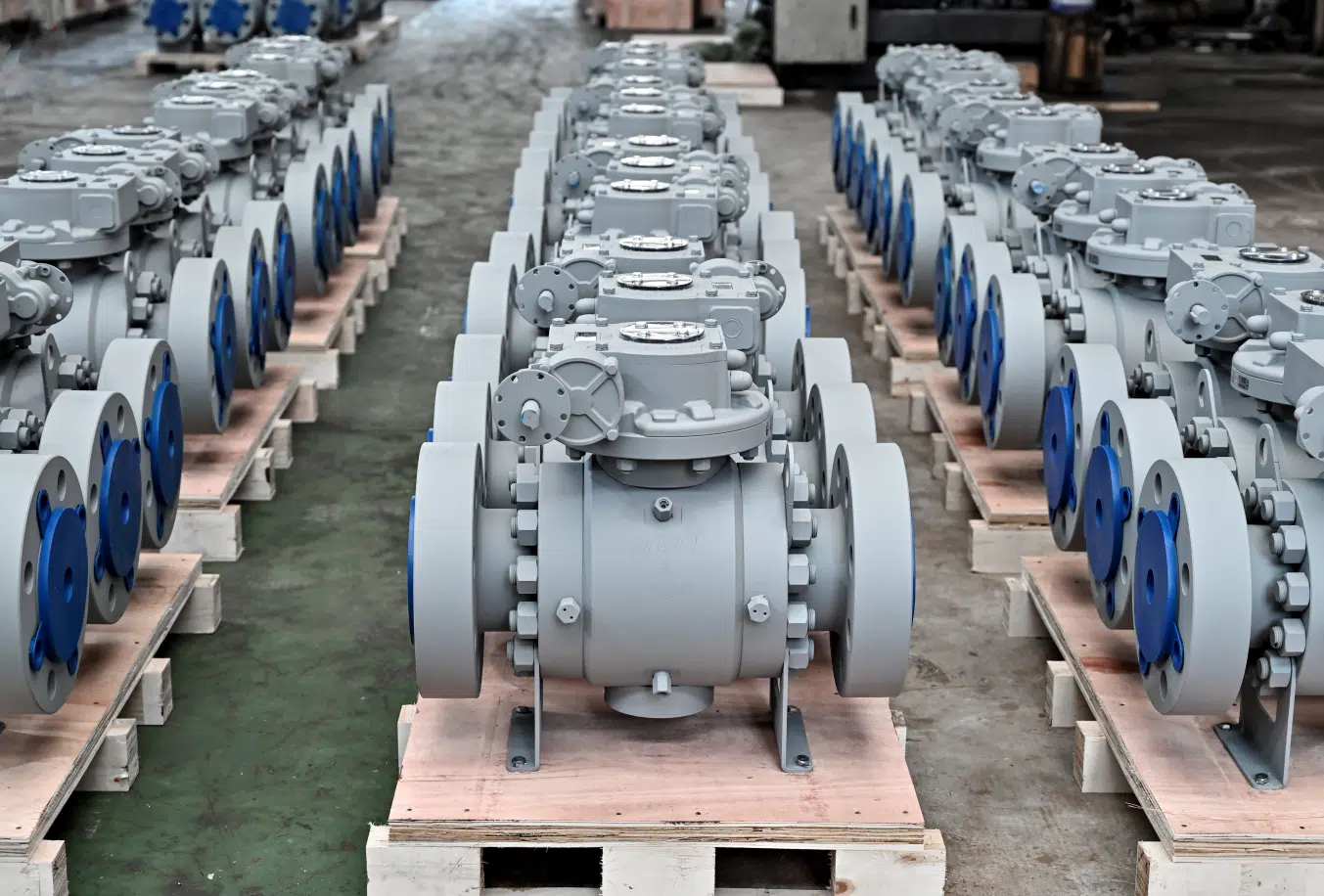
Comparaison rapide des 10 fabricants
| Fabricant | Meilleur pour | Core Ball Valve Strength | Typical Oil & Gas Fit | Standards / Engineering Relevance | Ne convient pas à |
|---|---|---|---|---|---|
| Emerson | automation-heavy systems | control-integrated and automated ball valve solutions | gas processing, process facilities, automated packages | strong actuation and control ecosystem | upstream pipeline isolation where automation is not required, or projects seeking simple manual valves without control integration |
| Flowserve | large global EPC projects | trunnion-mounted and severe-service ball valves | upstream, midstream, downstream | strong project support and global service network | small-scale or budget-driven projects where global service coverage is unnecessary |
| Cameron (SLB) | pipeline and high-pressure isolation | API 6D pipeline ball valves, large-diameter systems | transmission pipelines, major oil & gas infrastructure | strong pipeline engineering credibility | mixed-category, lower-budget sourcing where AVL-grade pipeline pedigree is not required |
| KSB | broader industrial energy applications | engineering-led industrial valve supply | energy, utility, and process-related oil and gas service | solid engineering reputation | buyers seeking a highly focused pipeline-ball-valve specialist |
| SAMSON | control-oriented industrial systems | precision control and automation-focused valve solutions | process-heavy plants, automation-intensive systems | strong instrumentation and control engineering background | buyers seeking standard manual isolation packages or pure pipeline valve sourcing |
| Soupape NTGD | flexible project supply and customization | export-oriented industrial ball valve solutions | customized project sourcing, OEM/export, mid-sized project packages | practical documentation support and sourcing flexibility | projects strictly restricted to major IOC/EPC approved vendor lists with no exception process |
| Spirax Sarco | process and thermal systems | process control and flow management know-how | steam-related, thermal, and selected process-side oil and gas service | strong thermal/process engineering background | buyers looking for a broad pipeline-centered ball valve specialist |
| Böhmer | specialist ball valve performance | premium specialist ball valve positioning | demanding industrial and energy applications | strong long-term specialist focus | low-budget fast-delivery sourcing where specialist premium positioning is unnecessary |
| Velan | severe service and engineered projects | robust engineering for critical conditions | refinery, severe service, high-integrity duties | strong engineering and materials reputation | lower-complexity commodity applications |
| Bonney Forge | forged steel and standards-driven service | forged construction and formal manufacturing discipline | severe industrial service, high-integrity applications | strong materials, testing, and standards positioning | broad low-cost package sourcing where forged construction value is not central |
Note à l'attention de l'acheteur : No single manufacturer is ideal for every oil and gas project. Premium global brands are often stronger in major EPC environments and highly specified severe-service packages. Flexible export-oriented suppliers can be more practical in customized, mid-sized, or communication-sensitive project supply.
Comment utiliser ce guide dans le cadre d'un véritable processus d'approvisionnement
This guide works best as a shortlist tool, not as a final award document.
Étape 1 : Établir une liste restreinte
Use the comparison table to identify 3–5 manufacturers that broadly match your project type, budget level, approval environment, and application conditions.
Output: an initial shortlist of realistic supplier types.
Étape 2 : Vérifier la compatibilité technique
Use the standards section and application matching section below to verify pressure class suitability, material compatibility, design logic, and documentation requirements.
Output: a technically filtered shortlist.
Étape 3 : Vérifier que l'appel d'offres est prêt
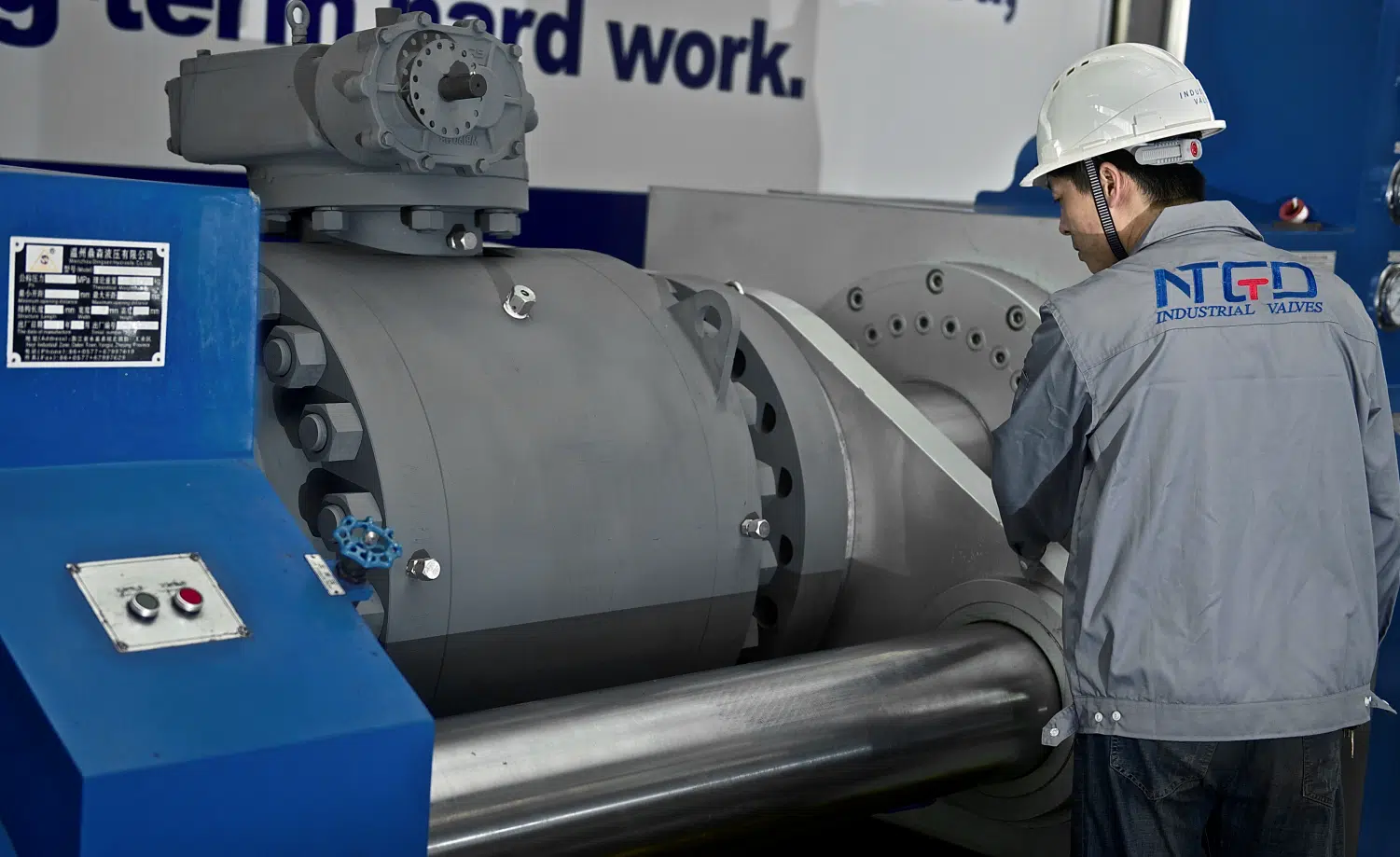
Before sending RFQs widely, confirm whether shortlisted suppliers can support the exact valve type, standards, testing scope, lead time, document package, and end connection required.
Output: an RFQ-ready supplier list.
Procurement warning: Do not send final RFQs before confirming the exact valve design basis, applicable standard, material requirement, and document scope. Many supplier lists shrink quickly at this stage.
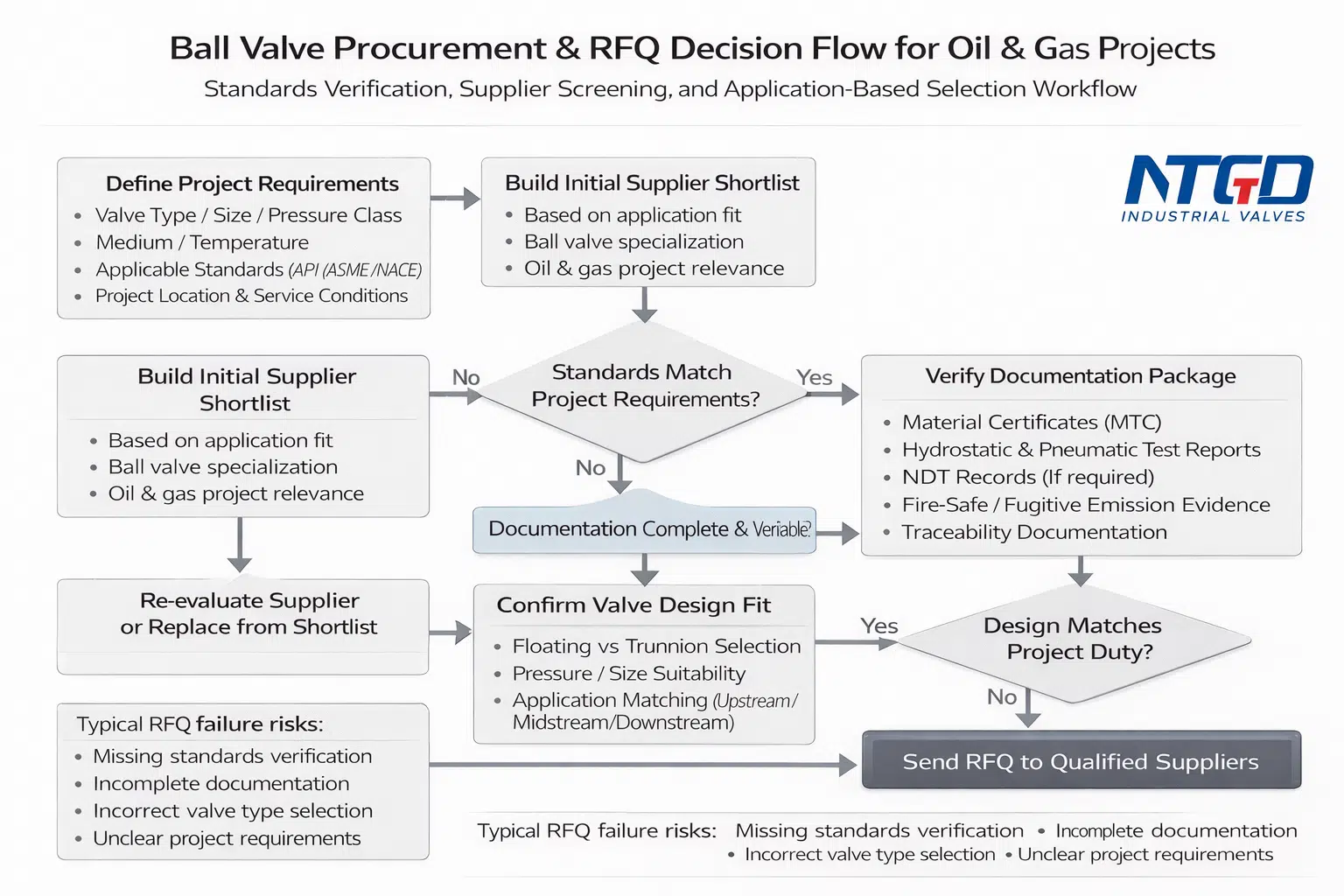
Les critères que les acheteurs devraient réellement vérifier avant de présélectionner un fournisseur
Many articles mention standards, but procurement teams need more than standard names and should understand how valve requirements are interpreted in practice under engineering valve standards.
Priorité standard par type de projet
| Project Type | Mandatory Standards | High Priority Standards | Additional Standards Depending on Duty |
|---|---|---|---|
| Pipeline transmission | API 6D, ASME B16.34 | API 607, traceability documentation | ISO 15848 if emission control is required |
| Upstream wellhead / production | ASME B16.34, material suitability | API 607, NACE MR0175 where sour service applies | API 6D where pipeline-style isolation is specified |
| Refinery / process facilities | API 608, ASME B16.34 | API 607, ISO 15848 | NACE MR0175 if H₂S or sour conditions apply |
| Gas processing plants | ASME B16.34, application-specific design basis | API 607, automation compatibility, low-emission requirements | NACE MR0175 depending on medium |
| Sour gas / H₂S service | NACE MR0175 / ISO 15156, ASME B16.34 | API 6D or API 608 depending on service type | ISO 15848 if emission control is specified |
| LNG / low-temperature service | low-temperature material suitability, ASME B16.34 | cryogenic design evidence, test documentation | API 6D or API 608 depending on valve category |
1. API 6D – Vannes pour pipelines
What it is for:
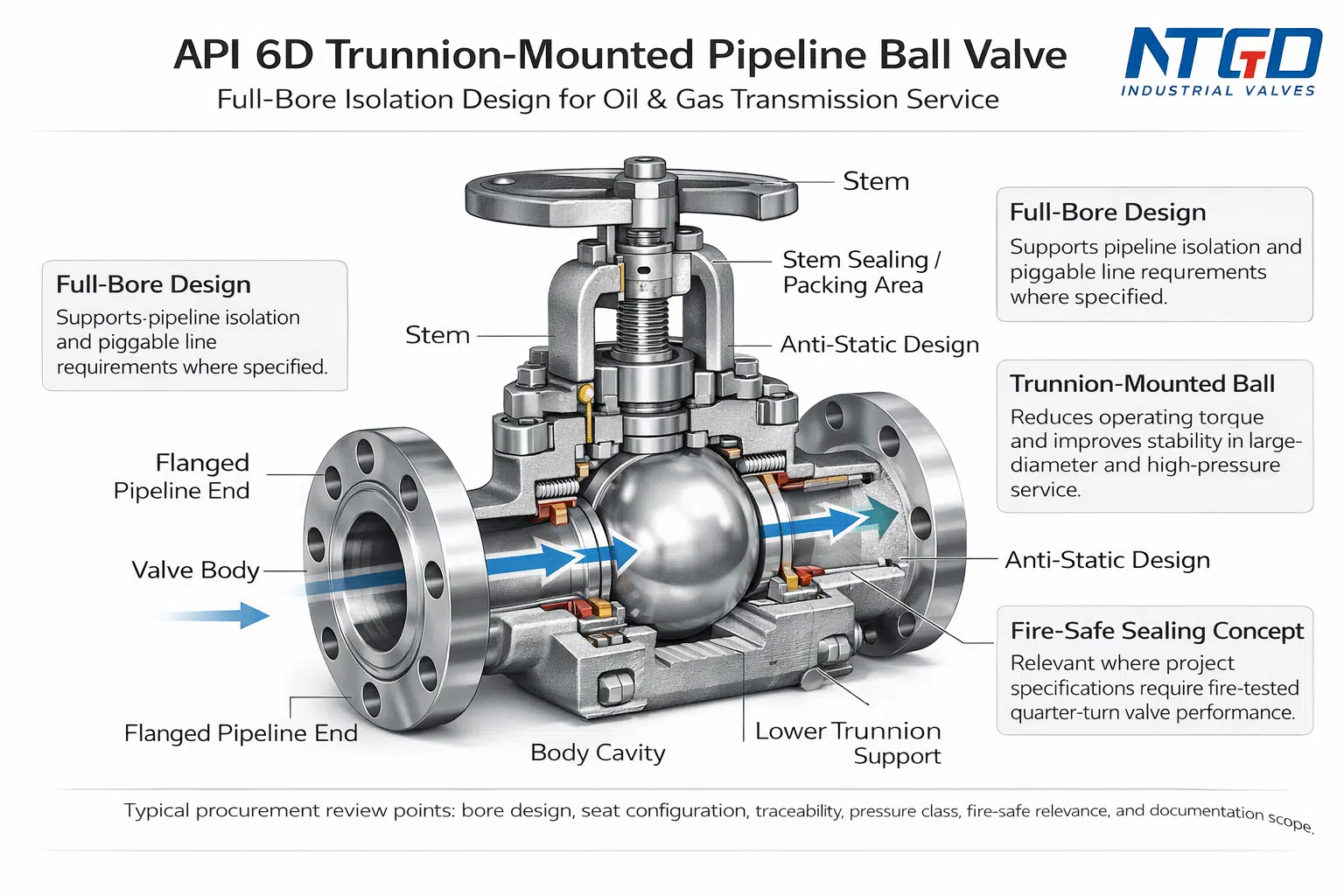
API 6D is the primary standard associated with pipeline valves used in oil and gas transmission service.
What buyers should check:
- whether the valve is genuinely intended for pipeline isolation
- full-bore or reduced-bore suitability if pigging matters
- testing and inspection scope
- anti-static, fire-safe, and sealing configuration where specified
Core documents to request:
- manufacturer’s relevant API 6D-related certification evidence
- hydrostatic and pneumatic test reports
- inspection records
- material traceability documents for the supplied valve
Additional documents where required:
- GA drawing or dimensional drawing
- seat and sealing design documentation
- project-specific inspection plan
Pourquoi c'est important :
For pipeline projects, API 6D ball valve relevance is often one of the first supplier filters. A supplier may claim oil and gas capability broadly, but transmission projects usually require stronger design and documentation discipline.
If missing, consider:
If the supplier cannot provide API 6D-related test records or traceability documents for a pipeline-specified valve, they may not be suitable for transmission service. Unless the application is clearly non-pipeline, that supplier should usually be downgraded or removed from the shortlist.
2. API 608 – Robinets à bille métalliques, à raccords filetés, à brides et à souder
What it is for:
API 608 is highly relevant to general industrial metal ball valves used in refinery, process, and broader oil and gas service.
What buyers should check:
- whether the offered valve type matches the intended service
- size and pressure range suitability
- end connection compatibility
- seat and sealing design fit for the process condition
Core documents to request:
- product data sheet
- pressure test records
- certificats de matériaux
- dimensional and standards compliance documentation
Additional documents where required:
- Dessin de l'AG
- seat material confirmation
- stem sealing details
Pourquoi c'est important :
Not every oil and gas project is a pipeline project. Many refinery and process services rely more on correct API 608-aligned selection than on pipeline-oriented standards.
If missing, consider:
If the supplier cannot clearly document API 608 relevance, pressure class coverage, or the exact valve configuration being offered, the risk of mismatch in process service increases. Keep that supplier off the final RFQ list until the documentation is clarified.
3. Norme API 607 – Pertinence de la conception en matière de sécurité incendie
What it is for:
API 607 relates to fire testing for quarter-turn valves and actuators and is highly relevant where fire-safe design is specified.
What buyers should check:
- whether fire-safe performance is required by project specification
- whether testing evidence applies to the exact valve design being offered
- whether seat and sealing design are suitable for the service hazard profile
Core documents to request:
- fire-safe test evidence
- supporting model or series documentation
- seat and sealing configuration details
Additional documents where required:
- project-specific fire-safe compliance statement
- quality or inspection reference tied to the offered valve series
Pourquoi c'est important :
In hydrocarbon service, fire-safe ball valve design is often not optional. It may be a mandatory project or end-user requirement.
If missing, consider:
If fire-safe evidence is required by the project but the supplier can only provide general marketing claims instead of model-relevant supporting documents, do not treat the valve as technically qualified.
4. ASME B16.34 – Vannes à raccords à brides, filetés et à souder
What it is for:
ASME B16.34 covers pressure-temperature ratings, materials, design, and testing considerations for valves.
What buyers should check:
- pressure class suitability
- base de calcul pression-température
- compatibilité des matériaux
- alignment with system design requirements
Core documents to request:
- pressure-temperature data
- material specifications
- inspection or test records
- dimensional or product drawings if needed
Additional documents where required:
- trim and bolting details
- low-temperature or high-temperature suitability notes
Pourquoi c'est important :
Many selection mistakes happen because buyers confirm “oil and gas use” in general terms but do not verify the actual pressure-temperature design basis carefully enough.
If missing, consider:
If the supplier cannot provide clear pressure-temperature rating data or material details for the offered configuration, the valve should not move to final technical comparison.
5. ISO 15848 – Émissions fugitives
What it is for:
ISO 15848 is relevant when low-emission performance is required, especially in regulated facilities or environmentally sensitive service.
What buyers should check:
- whether fugitive emission control is part of project requirements
- stem sealing and packing design suitability
- whether test evidence applies to the proposed valve configuration or design family
Core documents to request:
- fugitive emission test reports
- sealing system details
- maintenance or packing guidance where relevant
Additional documents where required:
- project-specific low-emission confirmation
- packing material specifications
Pourquoi c'est important :
For some refinery, chemical, and regulated gas applications, low-emission performance affects compliance, safety, and environmental acceptance.
If missing, consider:
If low-emission performance is specified but the supplier cannot provide relevant fugitive emission evidence, that supplier should not remain on the qualified list for emission-sensitive projects.
6. NACE MR0175 / ISO 15156 – Service en milieu acide
What it is for:
These standards are critical for materials used in H₂S-containing environments and other sour-service conditions.
What buyers should check:
- whether the project genuinely requires sour-service compliance
- wetted materials and hardness controls
- body, stem, trim, bolting, and seat-adjacent material suitability
- whether the supplier can support documentation for the exact offered configuration
Core documents to request:
- certificats de matériaux
- hardness test records where applicable
- sour-service compliance documentation
- procurement-specific material data tied to the exact valve configuration
Additional documents where required:
- corrosion allowance or metallurgical review notes
- trim and bolting material breakdown
Pourquoi c'est important :
A valve suitable for standard hydrocarbon service may still be unacceptable in sour gas or H₂S-containing media. This is one of the most important procurement filters in actual oil and gas supply.
If missing, consider:
If the supplier cannot provide material certificates and hardness control evidence tied to the exact offered configuration, do not assume “sour-service capable” is sufficient. For H₂S-containing service, that is usually grounds to reject or suspend qualification.
Quel type de vanne à bille convient à quelle application dans le secteur pétrolier et gazier ?
Not all oil and gas applications require the same valve design or the same supplier type. Matching the supplier to the service condition is more practical than ranking brands in the abstract.
Services liés à la production en amont et aux têtes de puits
Typical priorities:
- high pressure capability
- robust isolation
- résistance à la corrosion
- material suitability
- documentation reliability
Often preferred:
- robinets à tournant sphérique montés sur tourillon
- forged or heavy-duty constructions
- sour-service-compatible materials where required
Manufacturers often considered:
- Cameron (SLB)
- Flowserve
- Velan
- Bonney Forge
- NTGD Valve when the project requires customized material configuration, flexible documentation support, or non-standard end connections outside rigid AVL-driven sourcing
Buyer screening tip:
For upstream and wellhead service, confirm pressure class, material metallurgy, and sour-service documentation before comparing price.
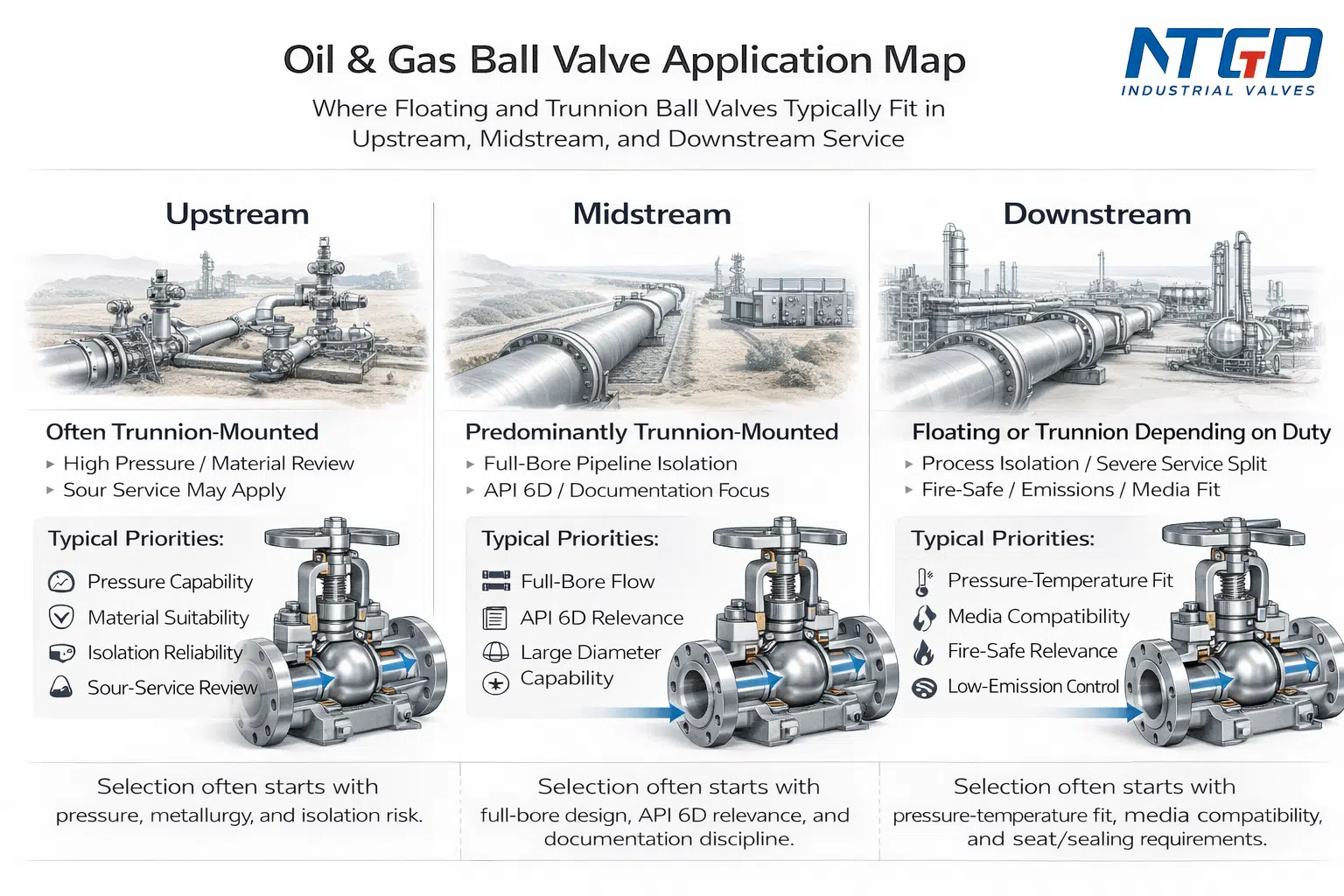
Transport par pipeline (segment intermédiaire)
Typical priorities:
- Full-port ball valve isolation is often a priority in midstream pipeline transmission.
- API 6D relevance
- piggable design where required
- larger diameter and higher pressure support
- fiabilité de l'étanchéité à long terme
Often preferred:
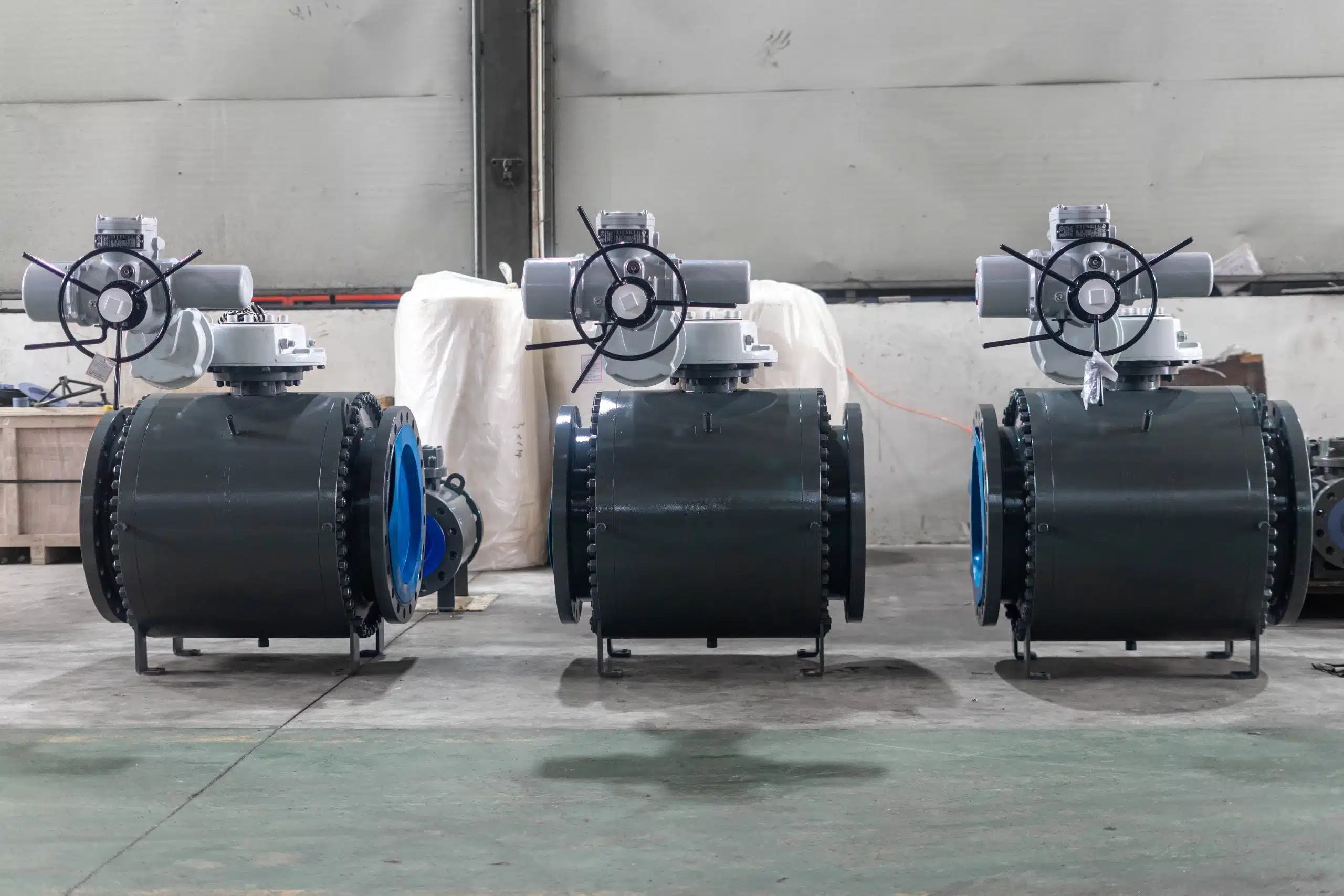
- trunnion-mounted pipeline ball valves
- anti-static and fire-safe design where specified
- strong traceability and testing documentation
Manufacturers often considered:
- Cameron (SLB)
- Flowserve
- Böhmer
- Emerson for automation-related packages
- NTGD Valve when the project volume is mid-range, customized lead time or documentation packages are required, and a major pre-approved EPC vendor list is not mandatory
Buyer screening tip:
For pipeline projects, verify API 6D-related documentation and traceability first. General “oil and gas use” language is not enough.
Installations de raffinage et de traitement en aval
Typical priorities:
- pressure-temperature fit
- compatibilité avec les supports
- leakage control
- fire-safe relevance
- la maintenabilité
Often preferred:
- floating or trunnion-mounted ball valves depending on size and class
- Metal seated ball valve designs are often preferred in severe conditions.
- low-emission sealing options where required
Manufacturers often considered:
- Emerson
- Flowserve
- Velan
- SAMSON in control-oriented contexts
- KSB in broader industrial energy applications
- NTGD Valve where project supply requires practical customization, export communication efficiency, and flexible documentation support
Buyer screening tip:
For refinery and process duties, screen suppliers on actual service conditions: temperature, media, cycling, sealing requirement, and emissions requirement.
Installations de traitement du gaz
Typical priorities:
- automation compatibility
- clean shut-off
- actuator integration
- l'accès à la maintenance
- system-level engineering support
Often preferred:
- automated ball valve packages
- floating or trunnion designs depending on duty
- control-integrated solutions
Manufacturers often considered:
- Emerson
- SAMSON
- Flowserve
- NTGD Valve when the buyer needs customized package-oriented export supply, faster communication on actuator/package coordination, or practical support on document scope
Buyer screening tip:
For gas processing plants, supplier selection should include valve package integration, not only valve body selection.
Gaz acide et environnements corrosifs
Typical priorities:
- NACE relevance
- material hardness control
- corrosion-resistant trim and body materials
- documentation discipline
- exact configuration verification
Often preferred:
- trunnion-mounted valves for higher pressure severe service
- carefully reviewed material combinations
- strong technical document support
Manufacturers often considered:
- Cameron (SLB)
- Flowserve
- Velan
- Bonney Forge
- NTGD Valve when verified material capability, material traceability, and configuration-level documentation can be confirmed for the exact project requirement
Buyer screening tip:
Do not evaluate sour-service suitability at brand level only. Evaluate it at configuration level.
GNL et exploitation à basse température
Typical priorities:
- cryogenic suitability
- material behavior at low temperature
- stem extension design where needed
- testing evidence
- thermal contraction considerations
Often preferred:
- cryogenic-capable ball valves
- specialist engineering support
- precise low-temperature documentation
Manufacturers often considered:
- Velan
- Flowserve
- selected specialist suppliers depending on actual configuration requirement
Buyer screening tip:
For LNG and low-temperature service, the question is not just whether the manufacturer is known. The question is whether the exact valve configuration is documented for cryogenic duty.
Vannes à bille à siège flottant ou à tourillon pour les projets pétroliers et gaziers
One of the most practical questions in oil and gas procurement is whether the application is better suited to a vanne à bille flottante ou un robinet à boisseau sphérique monté sur tourillon.
Robinets à bille flottants
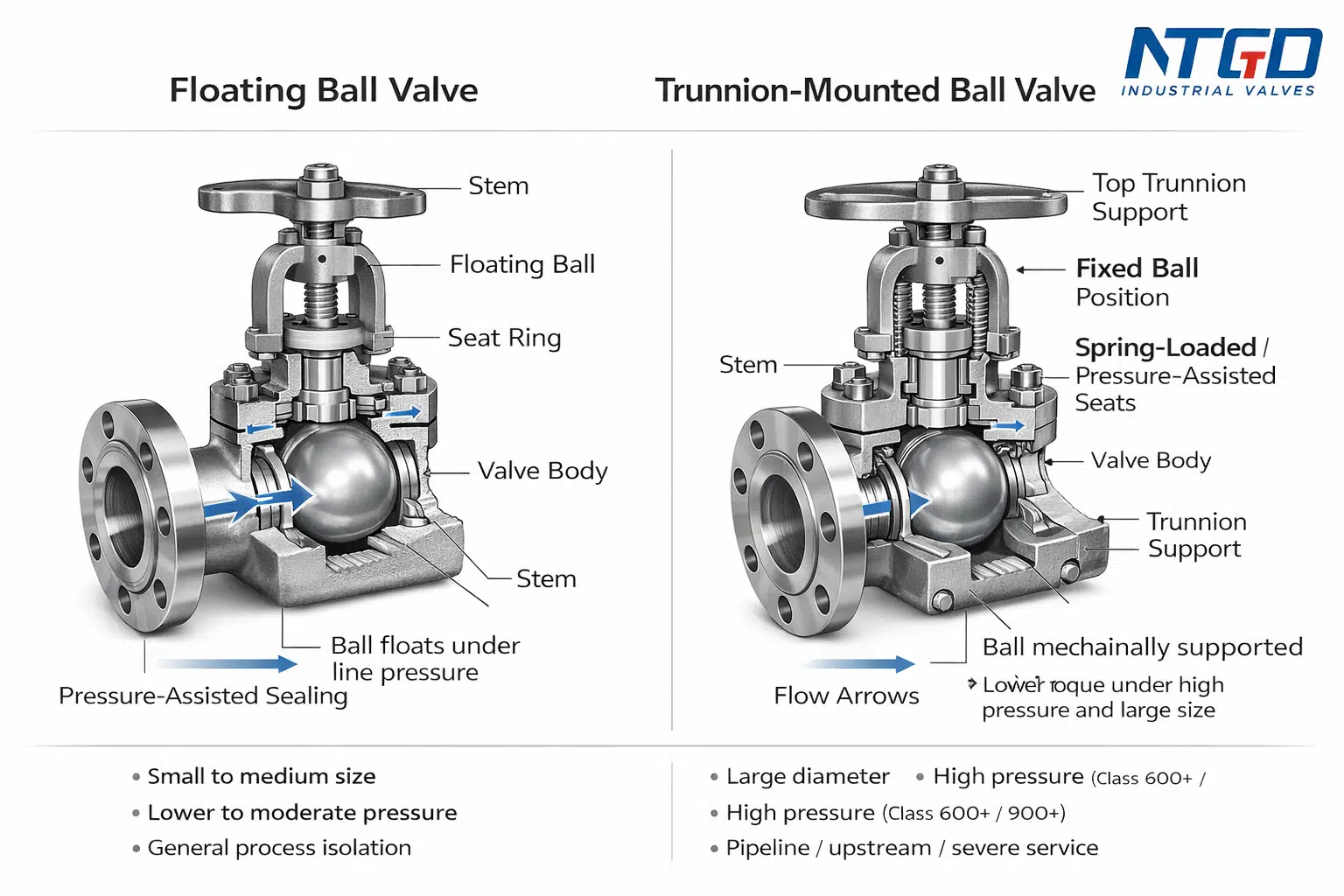
In a floating design, the ball is not mechanically anchored at both ends. Line pressure helps push the ball against the downstream seat to create sealing.
Best suited for:
- smaller sizes
- lower to medium pressure duties
- general process isolation
- applications where compact design and cost efficiency matter
Avantages :
- simpler structure
- lower cost in many standard applications
- suitable for a broad range of general industrial duties
Limitations:
- less ideal for very large diameters or higher pressure classes
- operating torque can become a concern as size and pressure increase
Robinets à tournant sphérique
In a trunnion-mounted design, the ball is mechanically supported, which reduces operating torque and improves stability under higher loads.
Best suited for:
- higher pressure service
- larger diameter pipeline valves
- severe service
- demanding upstream and midstream applications
Avantages :
- lower operating torque at large sizes and higher pressures
- stronger suitability for pipeline and major oil and gas isolation duty
- better fit for engineered severe-service applications
Limitations:
- more complex and often more expensive
- may be excessive for simpler low-pressure duties
Règle empirique pour une sélection rapide
- If size is 6″ or below, pressure is Class 600 or below, and the duty is general process isolation, a floating ball valve is often sufficient.
- If size is 8″ or above, pressure is Class 900 or above, or the application is pipeline, wellhead, or severe service, a trunnion-mounted ball valve is usually the stronger choice.
Remarque importante :
This is a quick screening rule, not a substitute for a full trunnion vs floating ball valve review. Final selection should still be confirmed against torque requirement, sealing requirement, cycling frequency, project specification, media condition, and end-user approval criteria.
Les 10 principaux fabricants de vannes à bille pour le secteur pétrolier et gazier en 2025
1. Emerson
Meilleur pour
Automation-heavy oil and gas systems, process facilities, and projects where valve performance must integrate closely with actuation and control.
Applications typiques dans le secteur pétrolier et gazier
- gas processing facilities
- automated process skids
- refinery control-related isolation service
- plant environments where instrumentation and valve actuation are tightly linked
Points forts des vannes à bille
Emerson is widely recognized for combining valve technology with automation, controls, and broader plant integration. This makes it especially relevant where the buyer is not only purchasing a manual isolation valve, but a broader functional system.
Normes / Pertinence de la documentation
Emerson is especially relevant in projects where engineering support, actuation packages, and system-integration documentation form part of the purchasing decision.
Ne convient pas à
Projects focused on simple manual isolation where automation is unnecessary, especially in pipeline or utility applications that do not benefit from control integration.
Note de sélection technique
Compared with manufacturers that are stronger in pure pipeline isolation or large-diameter mechanical severe service, Emerson becomes more competitive when automation architecture matters.
2. Flowserve
Meilleur pour
Large international oil and gas projects requiring broad engineering support, serious trunnion capability, and strong global service coverage.
Applications typiques dans le secteur pétrolier et gazier
- upstream facilities
- midstream pipeline service
- refinery and downstream operations
- demanding project environments with formal engineering and documentation requirements
Points forts des vannes à bille
Flowserve has strong recognition in severe service, project supply, and trunnion-mounted ball valve applications. It is frequently shortlisted where reliability, engineering credibility, and service footprint influence award decisions.
Normes / Pertinence de la documentation
Flowserve is especially relevant in projects where documentation quality, specification alignment, and established project support are central to supplier selection.
Ne convient pas à
Small or budget-sensitive projects where a premium global support structure is unnecessary.
Note de sélection technique
Flowserve is often a strong shortlist candidate for major projects, but buyers should still compare lead time, document turnaround, and total package practicality against actual project scale.
3. Cameron (SLB)
Meilleur pour
Pipeline isolation, high-pressure service, and major oil and gas infrastructure projects where API 6D logic is central.
Applications typiques dans le secteur pétrolier et gazier
- transmission pipelines
- large-diameter isolation service
- upstream and midstream high-integrity valve packages
- major infrastructure projects
Points forts des vannes à bille
Cameron has strong recognition in pipeline service and high-pressure applications. It is one of the most natural fits for a list focused specifically on oil and gas ball valve manufacturers.
Normes / Pertinence de la documentation
Cameron is especially relevant when buyers prioritize pipeline-grade engineering logic, API 6D orientation, and infrastructure-scale credibility.
Ne convient pas à
Mixed-category, lower-flexibility sourcing where the project does not require major pipeline pedigree.
Note de sélection technique
If the project centers on transmission pipeline isolation or large-diameter, high-pressure service, Cameron deserves close review. Its value is strongest in technically demanding, standards-driven environments.
4. CSK
Meilleur pour
Industrial energy users and buyers seeking a broader engineering brand with relevance to energy-sector valve requirements.
Applications typiques dans le secteur pétrolier et gazier
- energy-related industrial facilities
- process and utility systems with oil and gas overlap
- selected engineered industrial applications
Points forts des vannes à bille
KSB’s broader industrial and energy-sector footprint gives it relevance where oil and gas duty intersects with power, utilities, and process infrastructure.
Normes / Pertinence de la documentation
KSB benefits from a strong engineering reputation, although buyers should confirm exact ball valve depth and project relevance for specialized oil and gas requirements.
Ne convient pas à
Projects where the shortlist requires a strongly pipeline-focused specialist.
Note de sélection technique
KSB is credible in broader energy and industrial discussions, but buyers should verify exact product suitability for highly specific oil and gas ball valve duties.
5. SAMSON
Meilleur pour
Control-oriented systems and projects where precision, instrumentation, and process responsiveness matter more than basic manual isolation.
Applications typiques dans le secteur pétrolier et gazier
- process-heavy plant environments
- industrial automation systems
- facilities where control precision and valve-response logic matter
Points forts des vannes à bille
SAMSON’s strength is more control-oriented than commodity isolation-oriented. That makes it more relevant in engineered process settings than in generic supplier rankings.
Normes / Pertinence de la documentation
Its value is strongest where instrumentation logic, control performance, and process accuracy affect supplier selection.
Ne convient pas à
Buyers seeking a conventional pipeline ball valve specialist or low-complexity manual valve sourcing.
Note de sélection technique
SAMSON can be highly relevant in automation-heavy plant environments, but it should not be treated as a universal substitute for dedicated pipeline or severe-duty isolation specialists.
6. Vanne NTGD
Meilleur pour
Flexible export-oriented project supply, customized sourcing, OEM/private-label work, and mid-sized oil and gas projects that require responsiveness and practical engineering support.
Applications typiques dans le secteur pétrolier et gazier
- project-driven export supply
- distributor and OEM sourcing
- customized isolation valve packages
- applications where communication speed, documentation support, and delivery flexibility matter
Points forts des vannes à bille
NTGD’s practical value lies in combining manufacturing-oriented ball valve supply with customization support, export responsiveness, and flexibility for non-standard project requirements.
Normes / Pertinence de la documentation
NTGD is most relevant where the buyer needs practical support on drawings, basic test records, materials clarification, document-package coordination, or configuration confirmation for project sourcing. Final qualification should still be based on the exact offered valve type, applicable standard, and verified documentation scope.
Ne convient pas à
Projects that are strictly restricted to major IOC or EPC approved vendor lists with no exception process. In those cases, buyers should prioritize manufacturers already listed on the required AVL.
Note de sélection technique
NTGD becomes more competitive when the project values customization, communication efficiency, practical document support, and sourcing flexibility more than legacy brand status. That is often where mid-sized buyers and urgent project packages need more than a rigid catalog.
Need a customized ball valve recommendation for your project? Send your size, pressure class, medium, temperature, end connection, and required standard for technical review.
7. Spirax Sarco
Meilleur pour
Process and thermal-system users whose valve decisions intersect with steam, process efficiency, and broader flow-management priorities.
Applications typiques dans le secteur pétrolier et gazier
- process-related facilities
- steam-associated systems
- thermal and utility-side applications within oil and gas environments
Points forts des vannes à bille
Spirax Sarco’s process and thermal engineering background gives it relevance in selected oil and gas systems where the process side matters as much as pure isolation duty.
Normes / Pertinence de la documentation
Its value depends heavily on the actual application. Buyers should confirm exact product fit rather than assume broad equivalence with dedicated pipeline or severe-service ball valve specialists.
Ne convient pas à
Buyers who need a broad pipeline-centered, large-diameter, high-pressure ball valve shortlist.
Note de sélection technique
Spirax Sarco may fit selected process-side applications well, but it is not the first name most buyers prioritize for pure pipeline ball valve procurement.
8. Böhmer
Meilleur pour
Buyers seeking specialist ball valve expertise, long-term performance orientation, and strong category-specific engineering positioning.
Applications typiques dans le secteur pétrolier et gazier
- demanding industrial service
- energy-sector duties
- applications where specialist ball valve reputation matters
Points forts des vannes à bille
Böhmer’s value comes from specialist ball valve focus rather than broad all-category catalog breadth. That can be a real advantage for buyers who want deeper category-specific positioning.
Normes / Pertinence de la documentation
Its specialist image is strongest where the buyer prioritizes product depth, engineering seriousness, and long-term service confidence.
Ne convient pas à
Low-budget sourcing where price sensitivity and fast availability outweigh specialist premium positioning.
Note de sélection technique
Böhmer is a strong example of why product specialization matters. Buyers comparing “top manufacturers” should compare not only brand size, but also category-specific engineering depth.
9. Velan
Meilleur pour
Severe service and critical-duty applications where materials, engineering integrity, and demanding operating conditions drive supplier selection.
Applications typiques dans le secteur pétrolier et gazier
- refinery severe service
- critical isolation applications
- high-pressure and high-temperature duties
- engineered project environments
Points forts des vannes à bille
Velan is widely associated with engineered performance and critical industrial service. In oil and gas, that makes it particularly relevant for buyers focused on reliability under harsh operating conditions.
Normes / Pertinence de la documentation
Velan’s engineering reputation gives it strong positioning where buyers care about technical seriousness, application-specific design suitability, and materials performance.
Ne convient pas à
Simple commodity applications that do not justify a more engineered premium solution.
Note de sélection technique
Velan deserves close attention in critical-service comparisons, especially where the specification extends beyond standard isolation into severe-duty conditions.
10. Bonney Forge
Meilleur pour
Forged steel and standards-driven service where materials, strength, and formal manufacturing discipline influence the buying decision.
Applications typiques dans le secteur pétrolier et gazier
- demanding upstream and downstream duties
- severe industrial service
- applications requiring strong material credibility
Points forts des vannes à bille
Bonney Forge is recognized for forged steel expertise and strong manufacturing discipline, which makes it relevant where material traceability and construction integrity are high-priority factors.
Normes / Pertinence de la documentation
Its standards-led positioning can be valuable for buyers who prioritize formal manufacturing discipline and strong documentation alignment.
Ne convient pas à
Broad, mixed-category sourcing where price and catalog simplicity outweigh forged construction value.
Note de sélection technique
Bonney Forge stands out when the project places strong weight on materials, testing, and formal engineering discipline rather than on pure commercial convenience.
Quel fabricant correspond le mieux à votre type de projet ?
If you need a faster practical shortlist, use this simplified framework.
Choose Emerson if:
you need stronger automation integration, control compatibility, and plant-level system coordination.
Choose Flowserve if:
you need a global project-experienced supplier with strong severe-service and trunnion capability.
Choose Cameron (SLB) if:
your project centers on pipeline isolation, API 6D logic, and high-pressure infrastructure credibility.
Choose NTGD Valve if:
you need flexibility, export responsiveness, customization support, and practical project-oriented sourcing outside rigid AVL-only environments.
Choose Böhmer or Velan if:
your priority is engineering depth, specialist positioning, or severe-duty performance.
Choose Bonney Forge if:
forged construction, materials credibility, and formal manufacturing discipline matter most.
What Buyers Should Request Before Sending a Final RFQ
- product datasheet for the exact valve type
- pressure-temperature rating details before sending a final RFQ.
- certificats de matériaux
- hydrostatic and pneumatic test records
- NDT records where applicable
- fire-safe evidence if required
- fugitive emission evidence if required
- sour-service material confirmation if required
- GA drawing or dimensional drawing if needed
- lead time by size, class, and material
- origin and manufacturing details
- warranty and after-sales scope
Practical RFQ filter
If a supplier cannot clearly confirm the exact valve type, applicable standard, material basis, document scope, and lead time for your requested configuration, they may not be ready for final RFQ comparison.
Recommended document split
Mandatory before final RFQ comparison:
- datasheet
- applicable standards confirmation
- certificats de matériaux
- pressure test records
- lead time confirmation
Additional for deeper technical review:
- NDT records
- GA drawings
- fire-safe evidence
- low-emission evidence
- sour-service supporting documents
- inspection coordination details
Still Evaluating Supplier Options?
Download the Ball Valve RFQ Preparation Template
If you are still comparing manufacturers, a structured RFQ template can help you evaluate suppliers more consistently before you send inquiries.
A useful RFQ template should include:
- type de vanne
- taille et classe de pression
- matériau de la carrosserie et de la garniture
- type de siège
- norme applicable
- connexion finale
- portée des tests
- document package requirements
- lead time requirement
- destination country
- project approval notes
- supplier comparison scoring section
Download the Ball Valve RFQ Preparation Template to compare manufacturers on standards, materials, documentation, and delivery readiness before RFQ.
FAQs About Ball Valve Manufacturers for Oil & Gas
1. Who are the top 10 ball valve manufacturers for oil and gas in 2025?
Parmi les dix principaux fabricants de vannes à bille généralement pris en compte pour les projets pétroliers et gaziers en 2025, on trouve Emerson, Flowserve, Cameron (SLB), KSB, SAMSON, NTGD Valve, Spirax Sarco, Böhmer, Velan et Bonney Forge. Le choix approprié dépend du type de projet, des normes, des conditions de livraison et des exigences en matière de documentation, plutôt que de la seule notoriété de la marque.
2. What standards should oil and gas ball valve manufacturers comply with?
Ball valve manufacturers should be evaluated against the standards relevant to the actual application, not by standard names alone. In many projects, buyers review API 6D for pipeline service, API 608 for industrial metal ball valves, API 607 for fire-safe relevance, ASME B16.34 for pressure-temperature design basis, ISO 15848 for fugitive emissions, and NACE MR0175 / ISO 15156 for sour-service suitability. The correct mix depends on whether the project is pipeline transmission, gas processing, refinery isolation, or corrosive service.
3. Which manufacturers are more relevant for sour gas service?
Manufacturers are generally stronger candidates for sour gas service when they can support configuration-level material suitability and documentation, not merely general brand claims. Buyers usually look for NACE-related material evidence, hardness control where applicable, and exact metallurgy support for the offered configuration. The key procurement question is not “Does this brand mention sour service?” but “Can this supplier document sour-service suitability for the exact valve I am buying?”
4. Which is better for oil and gas service, floating or trunnion ball valves?
Robinets à tournant sphérique montés sur tourillon are generally better for higher pressure, larger size, pipeline, and severe-duty applications because they reduce operating torque and offer stronger stability under load.
Robinets à tournant sphérique flottants are often more practical for smaller sizes, moderate pressure service, and general process isolation.
The correct choice depends on size, pressure class, media, duty cycle, and project requirement.
5. Do sour gas applications require NACE MR0175 compliance?
In many H₂S-containing applications, yes. Buyers should verify whether the project specification requires NACE MR0175 / ISO 15156 and request material certificates, hardness evidence where applicable, and supporting documentation for the exact offered valve configuration. A general claim of “sour-service capable” is not enough.
6. Are Chinese ball valve manufacturers reliable for oil and gas projects?
They can be, but reliability should be judged by the same criteria used for any supplier: standards relevance, document readiness, materials control, testing support, and communication quality. For export-oriented sourcing, Chinese manufacturers can be competitive when the buyer needs customization, responsive communication, and practical document coordination. However, buyers should still verify the exact valve configuration, applicable standards, and approval requirements before qualification.
7. How should buyers compare premium global brands and export-oriented manufacturers?
Buyers should compare them based on project fit rather than prestige alone. Premium global brands are often stronger for major EPC projects, global approvals, and highly engineered severe-service environments. Export-oriented manufacturers can be more competitive in customization, communication speed, delivery flexibility, and practical project sourcing for mid-sized or schedule-sensitive packages. The correct choice depends on whether the project is approval-driven, schedule-driven, customization-driven, or budget-driven.
8. What documents should buyers request before placing an order?
At minimum, buyers should request datasheets, material certificates, hydrostatic and pneumatic test records, pressure-temperature information, standards confirmation, and any application-specific evidence such as fire-safe, low-emission, or sour-service documentation. For critical projects, exact configuration confirmation and traceability are just as important as commercial pricing.
9. When is a metal seated ball valve required?
Les vannes à bille à siège métallique sont souvent nécessaires lorsque les conditions d'utilisation impliquent des températures élevées, la présence de particules abrasives, des cycles de fonctionnement intensifs ou des conditions de fonctionnement susceptibles d'endommager les sièges souples. Elles sont généralement utilisées dans les applications pétrolières et gazières ainsi que dans les applications industrielles à usage intensif, où l'étanchéité doit être maintenue dans des conditions d'usure particulièrement difficiles.
10. How should buyers evaluate lead time and delivery reliability?
Lead time and delivery reliability are often as important as technical compliance in oil and gas procurement. Buyers should ask each shortlisted supplier for:
- standard lead time by size, pressure class, and material
- whether expedited options are available
- document preparation lead time for test reports and certificates
- inspection coordination timing where third-party inspection is required
- communication response speed on technical clarifications
A manufacturer that meets the technical specification but cannot align with the project schedule may still be commercially impractical to select.
Final Recommendation: How to Shortlist the Right Supplier
Les meilleurs ball valve supplier choice for oil and gas is not the one with the biggest name in every case.
If the project is driven by major pipeline standards and high-pressure infrastructure logic, manufacturers such as Cameron (SLB) and Flowserve deserve close attention. If the project is more automation-oriented, Emerson and SAMSON may be more relevant. If the project requires flexible customization, export communication efficiency, and practical engineering support, NTGD Valve may offer better sourcing value than a rigid premium-brand route.
The most reliable procurement approach is to compare manufacturers through four filters:
- l'adéquation de l'application
- standards and document readiness
- design and material suitability
- commercial and delivery practicality
When these four filters are used together, the shortlist becomes far more useful than any generic “top 10” ranking.
Request a Technical Review and Quotation
If you are sourcing ball valves for an oil and gas project, send the following details for a technical recommendation and quotation review:
- type de vanne
- taille
- classe de pression
- matériau du corps
- trim or seat requirement
- moyen
- température
- standard required
- quantité
- connexion finale
- destination country
- any sour-service, fire-safe, emission, or inspection requirement
Need a reliable ball valve supplier for your oil and gas project? Send your project parameters to receive a technical review, documentation check, and quotation recommendation.
Author / Reviewer
Révisé par : Équipe d'ingénierie des vannes NTGD
Review perspective: Industrial valve supply and project-sourcing review
Review date: mars 2026
Reviewer note: This article is intended as a practical procurement reference for oil and gas ball valve selection. Final supplier approval and valve selection should always be confirmed against actual service conditions, project specifications, end-user requirements, and applicable standards.
