
Quick Answer
Butterfly valve pressure drop is the pressure difference between the upstream and downstream sides of a butterfly valve when fluid passes through it. Even when a butterfly valve is fully open, the disc and stem still remain in the flow path, so the valve creates some flow resistance and pressure loss.
Butterfly valve Cv, also called the flow coefficient, is used to describe how much flow can pass through the valve at a given pressure drop under defined test conditions. A higher Cv generally means the valve can pass more flow for the same pressure drop, but Cv is not a fixed universal value for all butterfly valves. It depends on valve size, disc position, opening angle, body design, seat design, fluid properties, and the manufacturer’s tested data.
For selection work, do not use a generic butterfly valve Cv value as the final sizing basis. Use the manufacturer’s Cv chart, pressure drop chart, datasheet, or sizing confirmation for the specific valve design and opening position. This is especially important for throttling service, high velocity flow, viscous media, or services where cavitation, flashing, noise, or control stability may become a concern.
Correctly reviewing butterfly valve pressure drop and Cv helps avoid undersized flow capacity, excessive pump energy loss, poor control behavior, and wrong valve selection. This article explains the pressure drop principle, Cv relationship, opening-angle effect, chart-reading method, and RFQ data requirements; it does not provide a universal butterfly valve Cv table or an online pressure drop calculator.
For the product-family context behind this article, see NTGD’s industrial butterfly valves before narrowing the design by Cv, opening position, and service conditions.
What Is Butterfly Valve Pressure Drop?
Butterfly valve pressure drop is the loss of pressure that occurs as fluid passes through the valve body and around the disc. In a piping system, the upstream side of the valve has one pressure, and the downstream side has a lower pressure after the flow passes through the restriction. The difference between these two values is the valve pressure drop.
In practical valve selection, pressure drop matters because it affects system energy loss, pump head, flow capacity, control behavior, and the ability of the piping system to meet the required process flow. A butterfly valve is often selected because it is compact, relatively lightweight, and suitable for many isolation and moderate throttling services, but it is still a flow restriction inside the pipeline.
Pressure Drop vs Pressure Loss vs Flow Resistance
These terms are closely related, but they are not always used in exactly the same way.
| Term | Meaning in Valve Selection | How It Relates to Butterfly Valves |
|---|---|---|
| Pressure drop | The pressure difference across the valve from inlet to outlet | Used for sizing, pump head review, and Cv calculation |
| Pressure loss | A general expression for the loss of pressure caused by flow resistance | Often used as a synonym for pressure drop |
| Flow resistance | The restriction created by the valve geometry, disc, seat, and flow path | The physical reason why pressure drop occurs |
| Cv / flow coefficient | A value that indicates valve flow capacity under defined conditions | Used to estimate flow or pressure drop when the correct data is available |
| Kv | Metric flow coefficient commonly used outside the U.S. system | Related to Cv, but not the same unit system; metric projects should confirm whether the datasheet uses Cv or Kv before comparing values |
For most B2B valve discussions, pressure drop and pressure loss can be treated as closely related terms. The more important issue is whether the pressure loss is acceptable for the process and whether the selected butterfly valve has enough flow capacity for the required operating condition.
Why Pressure Drop Matters in Valve Selection
Pressure drop is not only a calculation item. It affects the actual operation of the system. If pressure drop is too high, the pump may need to work harder, the required flow may not be reached, or the system may lose efficiency. If pressure drop is underestimated, the selected valve may look correct on paper but create problems during commissioning.
If butterfly valve pressure drop is underestimated, the system may fail to reach the required flow, the pump may not have enough available head, or energy consumption may become higher than expected. If pressure drop is overestimated, the project may select an oversized valve, oversized pump, or unnecessarily conservative design, increasing cost and reducing controllability.
In isolation service, pressure drop is usually reviewed at the fully open position. In throttling service, pressure drop must be reviewed at the expected operating opening, not only at the fully open position. This is one reason why butterfly valve Cv charts often show different Cv values at different opening angles.
Why Does a Butterfly Valve Create Pressure Drop?
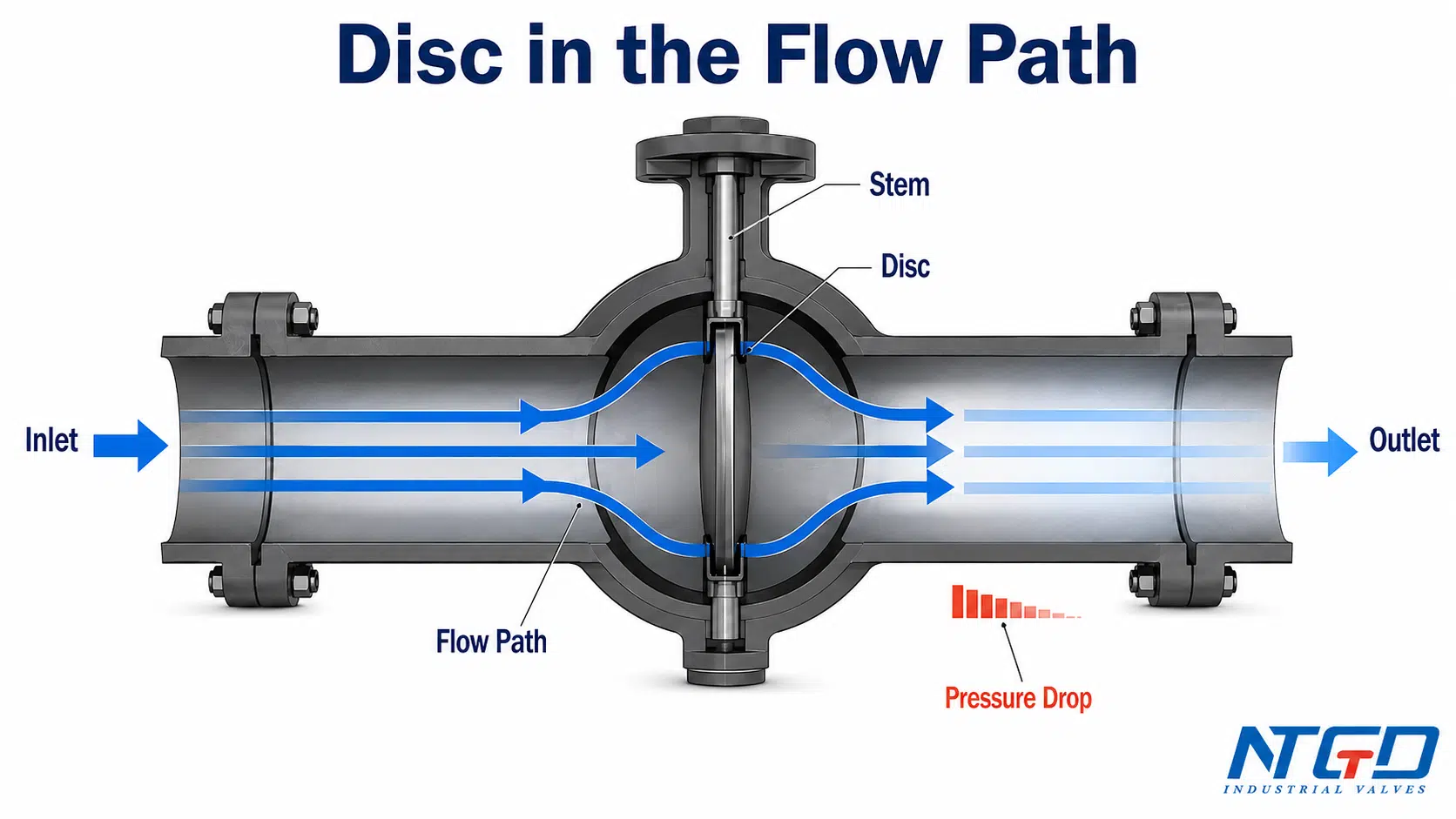
A butterfly valve creates pressure drop because the flow must pass around the valve disc and stem. Unlike a full-bore ball valve or a fully open gate valve, a butterfly valve does not create a completely clear bore when it is open. The disc rotates into a position that allows flow to pass, but the disc remains inside the pipe bore.
This internal geometry changes the flow path and creates local resistance. The result is a pressure difference across the valve.
Disc and Stem Remain in the Flow Path
The most important reason for butterfly valve pressure drop is the disc. When the valve is open, the disc is turned parallel or nearly parallel to the flow. However, it still has thickness and surface area. The stem and disc connection also remain in the flow path.
This means the flow must divide and pass around the internal components. Depending on the disc profile, seat design, and body geometry, this can create turbulence, velocity changes, and local pressure loss.
Turbulence, Velocity Change and Local Resistance
As fluid moves through the valve, it may accelerate around the disc and then recover downstream. This change in flow pattern can create turbulence and energy loss. The pressure loss may be small in some fully open, low-velocity applications, but it should not be assumed to be zero.
The actual pressure drop depends on several factors:
| Factor | Effect on Pressure Drop |
|---|---|
| Disc position | A smaller opening usually creates more restriction and requires opening-specific Cv data |
| Flow velocity | Higher velocity usually increases pressure drop and may raise noise, vibration, or erosion concerns |
| Valve size | Larger valves may have lower velocity for the same flow rate, depending on pipe size and system design |
| Valve design | Concentric, double offset, triple offset, and high-performance designs may have different flow paths and Cv behavior |
| Fluid properties | Density, viscosity, and phase condition affect pressure loss and formula reliability |
| Pipe layout | Upstream and downstream disturbances can affect installed performance and pressure recovery |
Why Fully Open Does Not Mean Zero Resistance
A fully open butterfly valve can have a relatively low pressure drop compared with more restrictive valve types, but “fully open” does not mean “no pressure drop.” The disc is still present in the flow path. The body, seat, shaft, and disc shape still influence the flow.
Compared with a full-bore ball valve or a fully lifted gate valve, a butterfly valve has a disc and stem remaining in the bore even when open; this is why its fully open Cv should still be checked rather than assumed to represent a clear pipe. For this reason, fully open Cv values should be understood as flow capacity values under defined conditions, not as proof that the valve creates no resistance.
For a related internal comparison of clear-bore flow capacity, NTGD’s guide to full-port ball valve pressure drop and flow capacity explains why port geometry changes pressure loss behavior.
What Is Cv or Flow Coefficient in a Butterfly Valve?
Cv is a valve flow coefficient. In simple terms, it describes the flow capacity of a valve under a defined pressure drop condition. In many valve references, Cv is used to indicate the amount of water flow through a valve at a specified pressure drop under standard reference conditions.
For a butterfly valve, Cv is not only related to valve size. It is also related to opening angle, disc geometry, body design, and the manufacturer’s tested data.
Cv as a Flow Capacity Indicator
A higher Cv means that, under the same basic conditions, the valve can pass more flow with less pressure drop. A lower Cv means the valve creates more restriction for the same flow.
For selection purposes, Cv helps answer questions such as:
- Can this valve pass the required flow?
- What pressure drop should be expected at the required flow rate?
- Is the valve suitable for isolation service only, or will it be used for throttling?
- Is the selected opening position within a reasonable operating range?
- Does the manufacturer’s chart support the required flow and pressure drop?
Cv is useful, but it is not a complete sizing decision by itself. It must be interpreted with the correct service conditions.
Flow Coefficient, Cv and Kv: What Buyers Should Know
In many engineering discussions, “flow coefficient” is the general concept. Cv is the common U.S. flow coefficient, while Kv is the metric flow coefficient. They are related, but they are not the same expression.
| Term | Buyer-Level Meaning | Practical Use |
|---|---|---|
| Flow coefficient | General term for valve flow capacity | Used broadly in technical discussions |
| Cv | U.S. flow coefficient | Common in valve datasheets and sizing discussions using U.S. customary units |
| Kv | Metric flow coefficient | Common in metric datasheets and European references; confirm the unit system before comparing with Cv |
| K / Zeta | Pressure loss coefficient | More advanced hydraulic calculation term, not usually needed for basic RFQ review |
For a neutral unit reference, Engineering ToolBox defines Cv as water flow in U.S. gallons per minute at a 1 psi pressure drop and Kv as the metric flow factor, so project datasheets should not compare the two without confirming units: Cv and Kv flow coefficient reference.
If the project datasheet uses metric flow data, confirm whether the manufacturer is providing Cv or Kv before comparing charts or calculating pressure drop. For most industrial RFQs, buyers should provide the required flow rate, operating pressure, temperature, medium, pipe size, and service type. The valve manufacturer or engineer can then confirm the suitable Cv, pressure drop, and valve design.
Why Cv Data Must Match the Valve Design and Opening Position
Cv data should not be mixed between different valve designs or brands. A Cv value for one valve series may not apply to another valve series, even if both valves have the same nominal size. A concentric resilient seated butterfly valve, a high-performance butterfly valve, and a triple offset butterfly valve may have different flow characteristics.
The Cv must also match the opening position. A fully open Cv value is not the same as the Cv at a partially open position. This is especially important when the valve is used for throttling or flow control.
Mixing Cv data from another manufacturer, valve series, pressure class, seat design, or opening angle can lead to an incorrect pressure drop estimate. In a project, that error may cause the selected valve to miss the required flow condition or operate outside the expected control range.
How Opening Angle Affects Butterfly Valve Cv and Pressure Drop
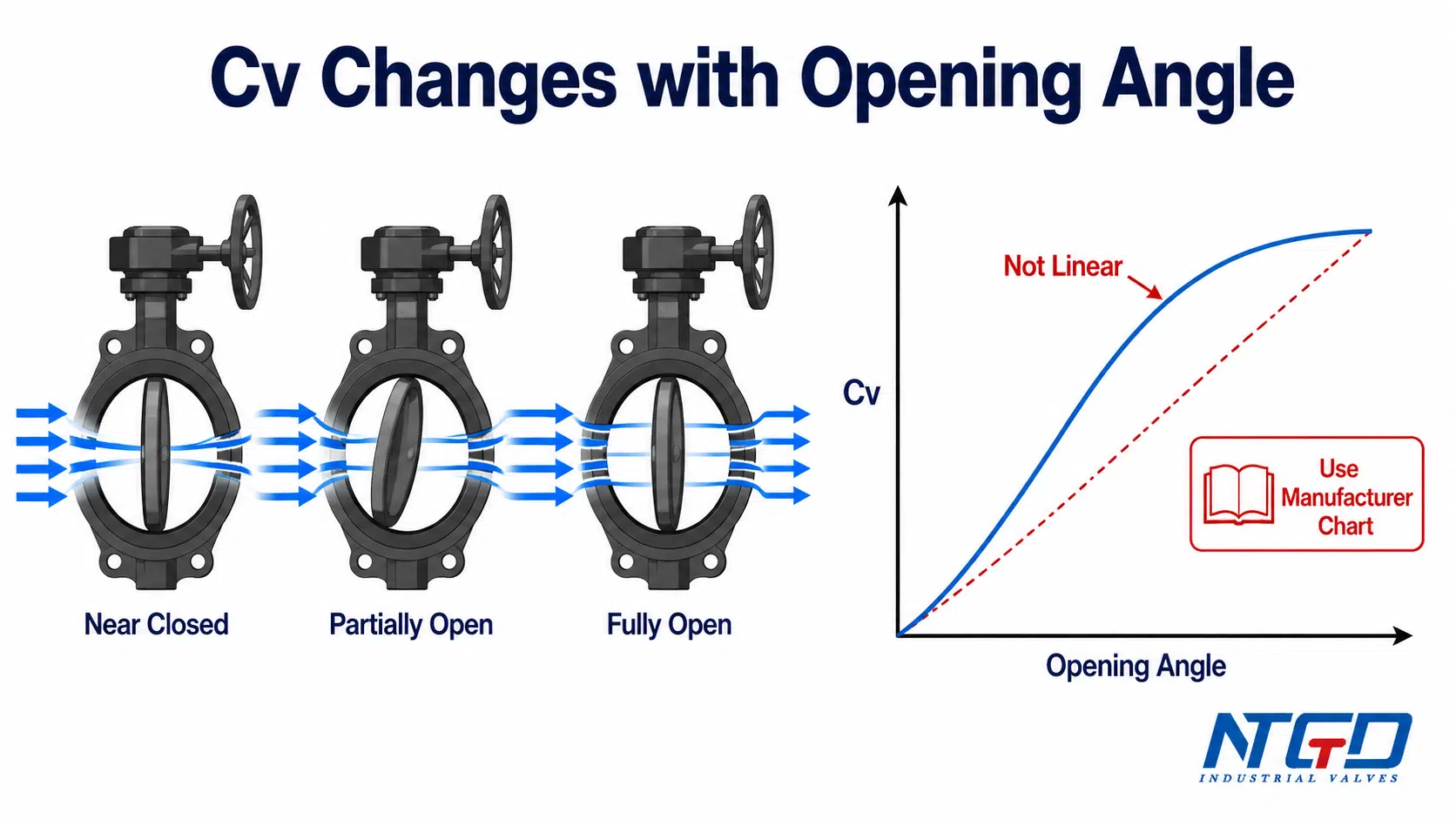
Opening angle is one of the most important factors in butterfly valve pressure drop. As the disc rotates from closed toward open, the available flow area changes. The flow coefficient increases, but it does not normally increase in a simple straight-line pattern.
This is why many butterfly valve Cv charts show Cv values at different opening angles or percent-open positions.
Cv Is Not Linear from Closed to Fully Open
A common mistake is to assume that a valve that is 50% open has about 50% of its fully open Cv. For a butterfly valve, this is usually not a safe assumption. The relationship between disc angle and flow coefficient is non-linear.
The disc creates a changing flow path as it rotates. At small openings, a small movement can create a large change in local velocity and pressure loss. At larger openings, the flow path becomes more open, but the disc still remains inside the bore.
A typical opening-Cv curve should be read as a trend guide, not as a universal data source. Buyers should pay attention to how quickly Cv changes in different opening zones and should avoid assuming that percent open equals percent Cv. The final review should still use the manufacturer’s opening-angle chart for the actual valve series.
| Opening Condition | Typical Interpretation | Selection Caution |
|---|---|---|
| Near closed | High restriction and sensitive flow change | Do not assume stable throttling from generic data; review noise, vibration, and control risk if the valve will operate near closed |
| Partially open | Cv changes strongly with disc angle | Use manufacturer opening-angle data for the expected operating point |
| Mostly open | Lower restriction than small opening positions | Useful for preliminary low-resistance review, but still check actual pressure drop, velocity, and chart basis |
| Fully open | Highest Cv for that valve configuration | Suitable for isolation pressure drop review, but not enough to represent throttling conditions |
This table explains behavior only. It is not a substitute for a manufacturer’s Cv table.
Fully Open Cv vs Throttling Cv
Fully open Cv is useful when the butterfly valve is mainly used for isolation and normally operates open or closed. In that case, the buyer may want to know the pressure drop when the valve is open in the pipeline.
Throttling Cv is different. If the valve is used to regulate flow, the important Cv is the Cv at the actual operating opening. A valve may have a good fully open Cv but still be unsuitable for a specific throttling duty if the required control point falls in a sensitive or unstable opening range.
For throttling service, the RFQ should state the expected minimum, normal, and maximum flow conditions, along with the expected pressure drop and operating opening if known.
Why Manufacturer Opening-Angle Data Matters
Manufacturer opening-angle data helps the buyer and engineer avoid guessing. A proper butterfly valve Cv chart may show Cv values by size and opening position. Some charts may also separate different valve designs, pressure classes, or body styles.
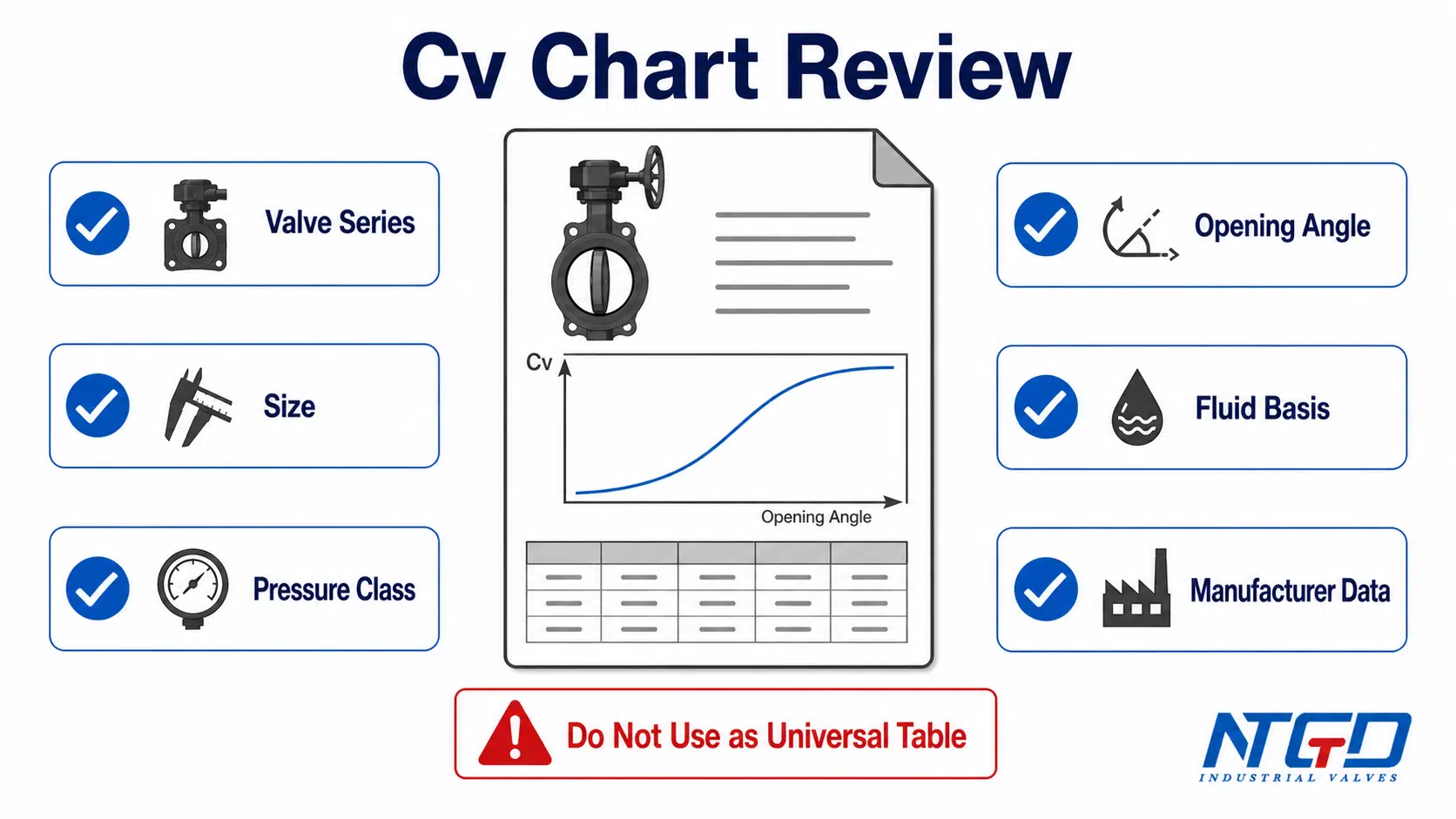
When reviewing butterfly valve pressure drop, the chart should be treated as design-specific data. It should not be used as a universal table for all butterfly valves.
A butterfly-valve Cv reference table that lists values by disc angle also notes that manufacturer data should be checked before actual use; use it only as background for chart-reading practice: butterfly valve Cv by opening position.
How to Estimate Butterfly Valve Pressure Drop Using Cv
Cv can be used to estimate pressure drop when the correct valve Cv and service inputs are available. For liquid service, the basic relationship is commonly expressed using flow rate, Cv, and specific gravity.
The practical concept is simple: for a given flow rate, a higher Cv usually means a lower pressure drop; a lower Cv usually means a higher pressure drop.
Basic Liquid Formula Inputs: Flow Rate, Cv and Specific Gravity
For a basic liquid pressure drop estimate, the main inputs are:
| Input | Meaning | Why It Matters |
|---|---|---|
| Q | Flow rate | Determines how much fluid must pass through the valve |
| Cv | Valve flow coefficient | Indicates flow capacity at the selected valve design and opening position |
| SG | Specific gravity of the fluid | Corrects the estimate for liquid density relative to water |
| ΔP | Pressure drop | The pressure difference across the valve |
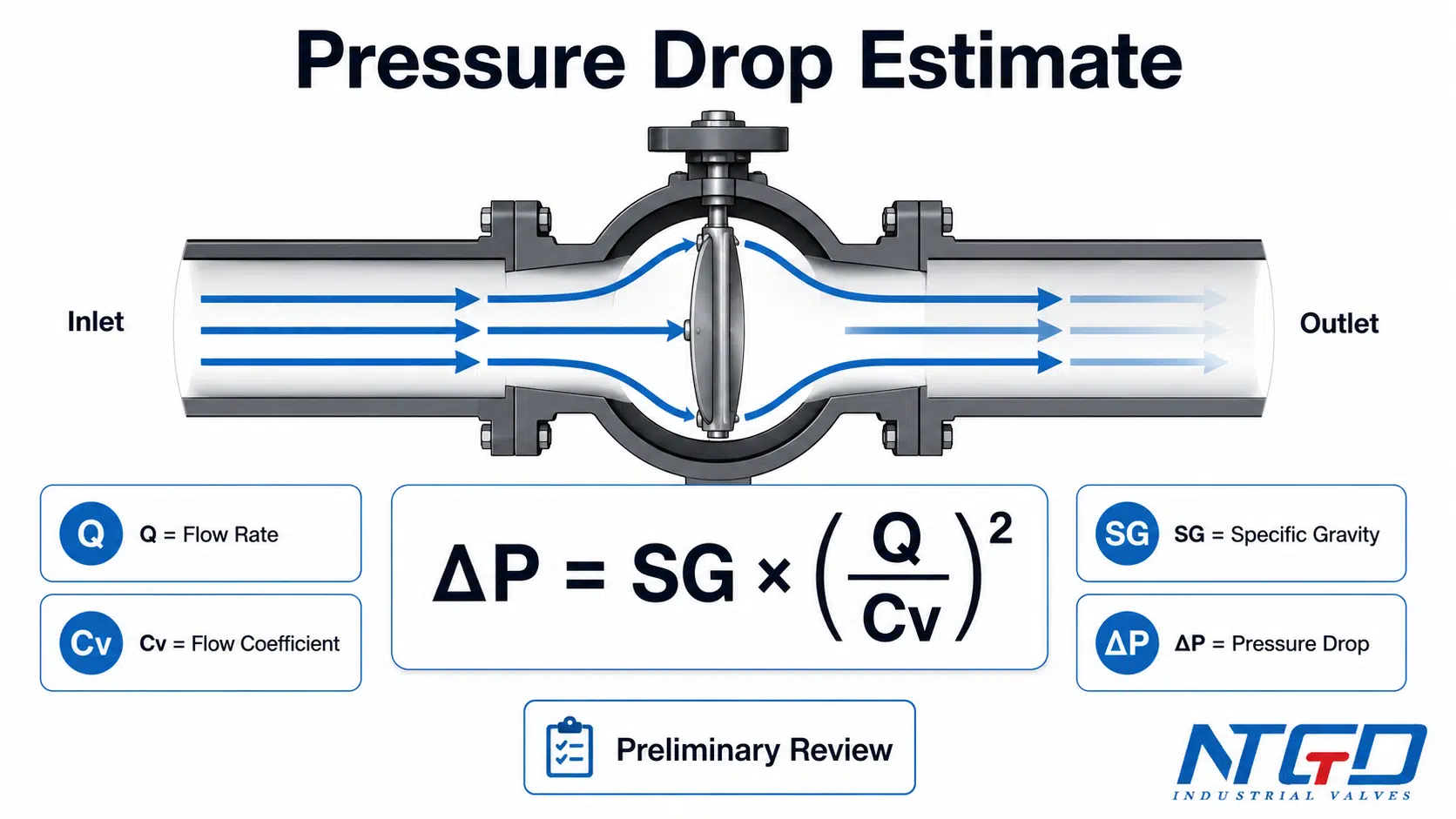
For preliminary liquid service review, the common relationship is:
ΔP = SG × (Q / Cv)²
Where Q is flow rate, Cv is the selected valve flow coefficient, SG is specific gravity, and ΔP is pressure drop. The Cv used in this equation must match the actual valve design and opening position. If the Cv is taken from the wrong valve design, wrong opening angle, or wrong datasheet, the pressure drop estimate will be unreliable.
For the formula boundary, Pipe Flow’s Cv/Kv guide shows how Cv relates flow rate, pressure loss, and specific gravity for liquid service, supporting this article’s use of the equation only as a preliminary review tool: Cv and Kv pressure loss calculation reference.
This equation is useful for understanding the relationship between flow, Cv, and pressure drop. It should not be treated as final sizing approval for every service condition.
When the Formula Is Useful
The formula is useful for preliminary pressure drop review when the fluid is a clean liquid, the flow rate is known, the specific gravity is available, and the Cv comes from the correct manufacturer data for the expected valve opening.
For early RFQ work, the formula helps the buyer understand why Cv and pressure drop must be reviewed together. It can also help identify whether a proposed valve size is worth checking further before requesting detailed sizing confirmation.
When Cv Calculation Is Not Enough
Cv calculation alone is not enough when the service is complex or when the operating condition may create special risks. Additional review is needed for:
- High velocity service: high velocity can increase noise, vibration, erosion risk, and actual pressure loss.
- Viscous fluids: viscosity can make the real pressure drop differ from a simple clean-water-based estimate.
- Slurry or dirty media: solids can affect valve suitability, seat wear, flow behavior, and long-term pressure loss.
- Gas, steam, or vapor service: compressible flow requires a different sizing review and should not rely only on a simple liquid Cv equation.
- Flashing or cavitation risk: a basic Cv estimate cannot confirm whether pressure recovery or local pressure conditions are acceptable.
- Two-phase flow: mixed-phase behavior needs application-specific review.
- Severe throttling service: the valve may operate in a sensitive opening range and require control stability review.
- Unusual upstream or downstream pipe layout: elbows, reducers, pump outlets, or short straight runs can change installed performance.
- Noise or vibration concerns: these may indicate that pressure drop, velocity, or operating position needs deeper review.
In these cases, the buyer should not rely only on a simple Cv equation. The valve manufacturer or engineering team should review the application conditions.
How to Read a Butterfly Valve Cv or Pressure Drop Chart
A butterfly valve Cv chart or pressure drop chart should be read carefully. The goal is not only to find a number, but to confirm whether that number applies to the actual valve and service condition.
A practical chart review should follow a sequence: first match the valve series, size, pressure class, body style, seat, and disc design; then check the opening angle or percent open; then verify the fluid assumptions and test conditions; finally use the manufacturer’s data for the final pressure drop and sizing review.
Do not treat a chart from one manufacturer, valve series, pressure class, or seat design as a universal chart for all butterfly valves.
Check Valve Size, Design and Pressure Class
Start by confirming that the chart matches the valve being selected. Check:
- nominal size;
- pressure class or PN rating;
- body style;
- seat type;
- disc design;
- valve series;
- end connection;
- applicable standard or datasheet reference.
A chart for a concentric resilient seated butterfly valve should not automatically be applied to a triple offset butterfly valve. A chart for one pressure class should not be assumed to apply to another pressure class unless the manufacturer confirms it.
Check Opening Angle or Percent Open
For pressure drop review, the opening position matters. If the chart only shows fully open Cv, it may be useful for isolation service but not enough for throttling service.
For throttling or flow control, the buyer should check Cv values at the expected operating openings. The chart should be reviewed against the normal, minimum, and maximum flow points.
Check Fluid Assumptions and Test Conditions
Many Cv charts are based on water or defined test conditions. The buyer should check whether the chart assumptions match the actual process.
Important items include:
| Chart Field or Assumption | Why It Matters |
|---|---|
| Test medium | Water-based values may need correction when the actual medium has different density, viscosity, or phase behavior |
| Temperature | Temperature can change fluid properties and may also affect seat or material selection |
| Specific gravity | Required for liquid pressure drop estimation and Cv review |
| Valve opening | A partially open valve can have a very different Cv from the fully open position |
| Valve design | Different body, disc, and seat designs require their own manufacturer chart |
| Pressure class | Body and disc geometry may differ by rating or series, so chart applicability must be confirmed |
| Flow direction or installation condition | Some designs or service conditions may require additional confirmation of installed behavior |
Use Manufacturer Data for Final Selection
Generic Cv references can help with early understanding, but final selection should use manufacturer data. For a project RFQ, the buyer should ask for the manufacturer’s Cv, pressure drop, and sizing confirmation for the actual valve design and operating condition.
This protects the project from using a chart that looks correct but does not match the valve being supplied.
Factors That Change Butterfly Valve Pressure Drop
Butterfly valve pressure drop is affected by both valve design and system conditions. The same nominal size can behave differently depending on valve geometry, flow velocity, fluid properties, and installation conditions.
| Factor | How It Can Affect Pressure Drop | Selection Note |
|---|---|---|
| Valve design | Disc profile, stem arrangement, body bore, and seat design change the flow path | Use design-specific Cv data from the correct valve series |
| Opening angle | Smaller openings usually increase restriction and change the flow coefficient | Use opening-angle Cv values for throttling or control review |
| Flow velocity | Higher velocity usually increases pressure loss and may increase noise or vibration | Check velocity limits and pressure drop at normal and maximum flow |
| Fluid density | Denser liquids affect pressure drop calculation | Provide specific gravity for liquid pressure drop review |
| Viscosity | More viscous fluids may not follow simple clean-water assumptions | Request application review instead of relying only on generic Cv |
| Pipe layout | Elbows, reducers, pumps, or short straight runs can disturb flow | Review installed conditions if the valve is near a disturbance |
| Service type | Isolation and throttling require different Cv review methods | State whether the valve is normally fully open, partially open, or modulating |
| Valve size | Affects flow area and velocity | Confirm pipe size, valve size, and whether the valve is full-size or reduced in the system |
| Seat and disc geometry | Influences flow capacity, pressure recovery, and operating behavior | Confirm the exact valve series, seat design, and disc material |
Valve Design: Concentric, Offset and High-Performance Designs
Different butterfly valve designs can have different flow coefficients. A concentric resilient seated valve, a double offset valve, a triple offset valve, and a high-performance butterfly valve may not share the same Cv behavior.
Concentric, offset, high-performance, and triple offset butterfly valves should not be assumed to have the same Cv or pressure drop behavior, even at the same nominal size. The key selection rule is simple: use the Cv data for the exact valve series and service condition being reviewed.
When the application requires a more specialized offset or severe-service configuration, the high-performance butterfly valve page can help separate product configuration questions from the general Cv review in this article.
Flow Velocity and Pipe Layout
High velocity can increase pressure drop and may also increase the risk of noise, vibration, erosion, or unstable operation. Pipe layout can also influence installed performance. A valve installed close to elbows, reducers, pumps, or other disturbances may not perform exactly like a valve tested under controlled conditions.
For important services, the buyer should provide piping information or a basic sketch during RFQ review.
Fluid Density, Viscosity and Service Conditions
Fluid properties matter. Water-like liquids are easier to review with basic Cv formulas. Viscous fluids, slurry, gas, vapor, steam, flashing service, or two-phase conditions require more careful review.
The RFQ should clearly state the medium, temperature, pressure, phase condition, and any solids or corrosive components.
Seat, Disc and Body Geometry
Seat and disc geometry can change the internal flow path. The shape and thickness of the disc, the seat profile, and the body bore all influence flow resistance. This is another reason why generic Cv values should be used only for preliminary understanding.
On/Off Service vs Throttling Service: Why It Changes the Cv Review
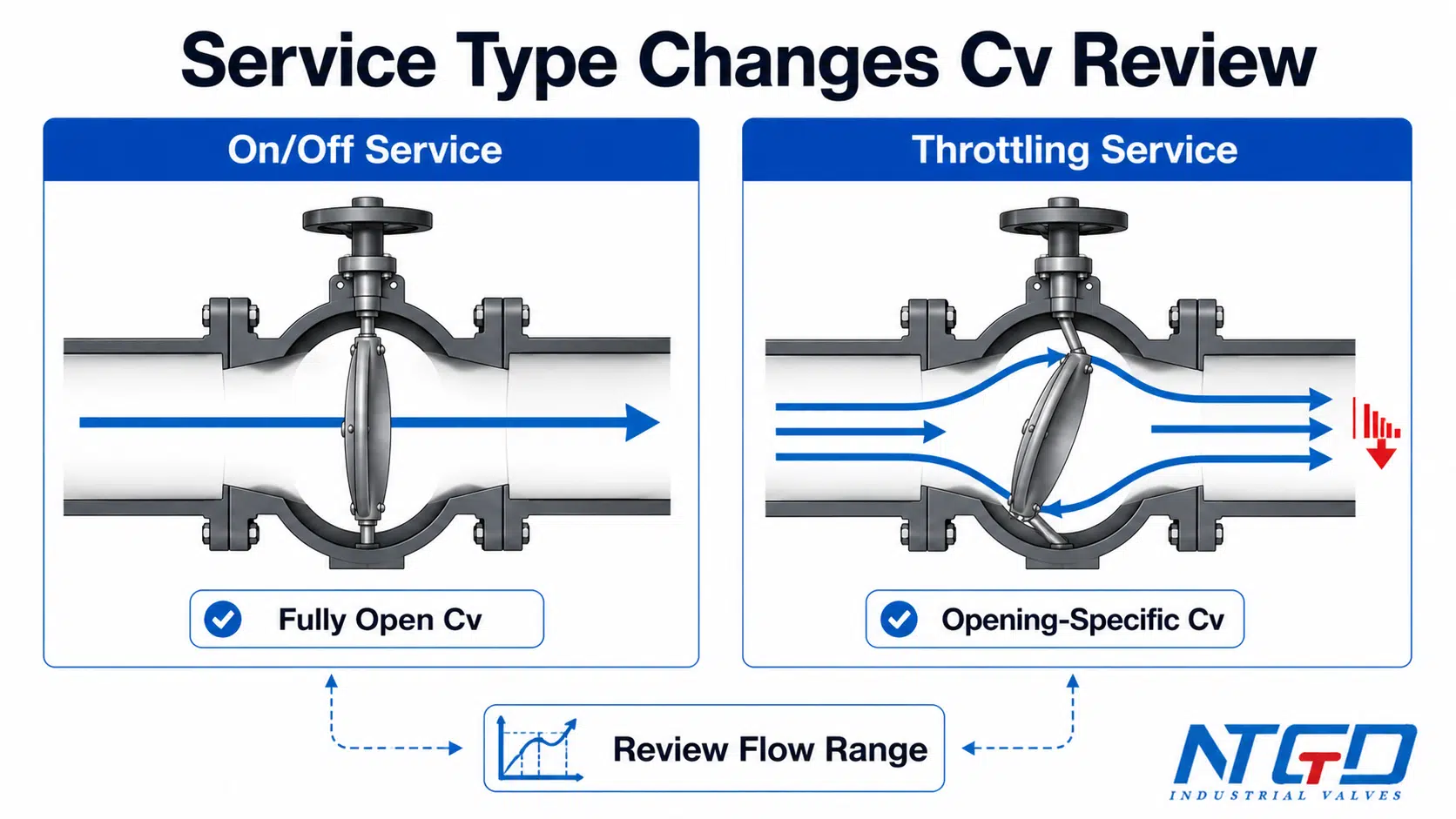
A butterfly valve used only for on/off isolation is reviewed differently from a butterfly valve used for throttling. The service type changes which Cv data matters.
On/Off Isolation Service
In on/off service, the valve normally operates fully open or fully closed. The pressure drop review focuses mainly on the fully open condition. The buyer wants to confirm that the open valve does not create too much flow resistance for the piping system.
For many general isolation services, a butterfly valve can be a compact and efficient choice. However, the fully open pressure drop still should be checked when flow capacity, pump head, or system efficiency is important.
Throttling or Flow Control Service
In throttling service, the valve operates at intermediate positions. The pressure drop and Cv must be reviewed at the actual operating opening, not only at full open.
Throttling service may require more data, including:
- minimum, normal, and maximum flow;
- upstream and downstream pressure;
- expected pressure drop;
- fluid properties;
- allowable noise or vibration limits;
- actuator type and control requirement;
- expected operating opening range.
A butterfly valve can be used in some throttling applications, but it should not be selected only because it fits the pipeline size. The required control behavior and operating range must be reviewed.
Why Control Duty Needs More Application Data
Control duty introduces more uncertainty than simple isolation duty. A valve that is acceptable for open/close service may not be ideal for accurate flow control. The valve may operate in a sensitive opening range, or the pressure drop may not match the process requirement.
If a valve is selected only from fully open data but later used for throttling, it may operate most of the time in an unsuitable opening range. This can cause unstable flow response, excessive pressure drop, poor control performance, or actuator selection problems.
For this reason, the RFQ should clearly state whether the valve is for isolation, manual throttling, or automated control.
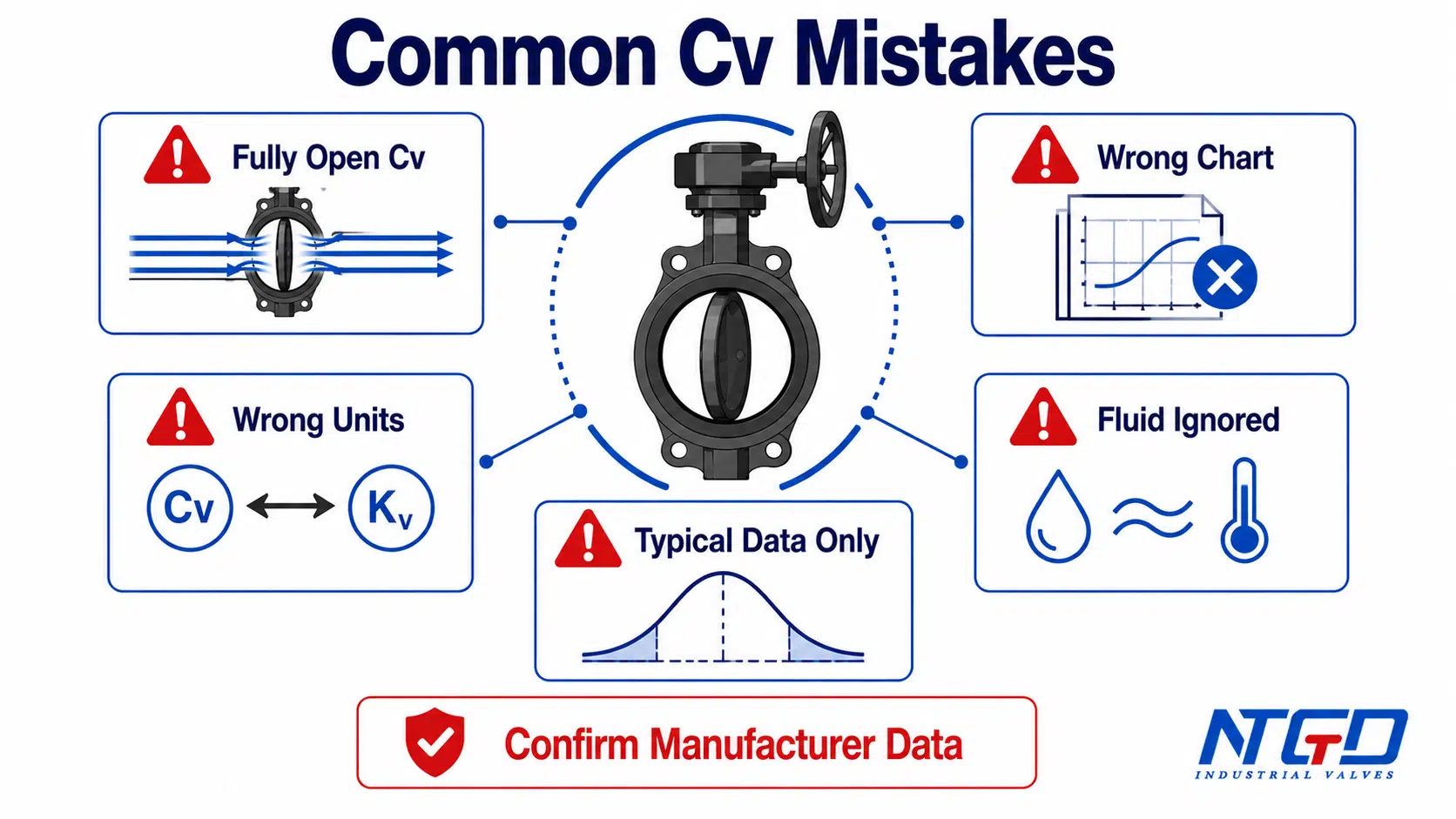
Common Mistakes When Using Butterfly Valve Cv or Flow Coefficient
Cv is useful, but it is often misused. Many selection errors come from applying the wrong Cv value to the wrong service condition.
Using Fully Open Cv for a Throttled Valve
Fully open Cv should not be used as the only basis for a throttling application. A valve used at 40%, 50%, or 60% open may have a different Cv than the fully open value. Using fully open Cv can underestimate pressure drop in a partially open position and may lead to a valve that cannot meet the required control point.
Correct action: use the manufacturer’s Cv data for the expected operating opening, not only the fully open position.
Using the Wrong Manufacturer Chart
A chart from a different valve manufacturer or valve series may not match the selected valve. Even if the nominal size is the same, the disc, body, seat, pressure class, and design type may be different.
Using the wrong chart can create a significant sizing error because the selected Cv may not belong to the valve being supplied. Use the chart for the actual valve series whenever possible.
Ignoring Specific Gravity or Fluid Properties
A simple pressure drop calculation may assume water-like behavior. If the actual medium has different density, viscosity, solids content, or phase condition, the result may not represent the real operating condition.
Ignoring fluid properties can make a pressure drop estimate look acceptable while the installed system behaves differently. Always provide fluid data in the RFQ.
Treating Typical Cv Values as Final Sizing Data
Typical Cv values can support early comparison, but they should not replace manufacturer sizing. Final pressure drop review should be based on the valve that will actually be supplied.
Treating typical values as final data can lead to wrong pump head review, incorrect valve selection, or poor commissioning results. Use typical Cv only as a preliminary reference.
Mixing Cv, Kv and Loss Coefficient Without Checking Units
Cv, Kv, and loss coefficient are related to flow and pressure loss, but they are not identical. If the project uses metric data, confirm whether the datasheet uses Cv or Kv. If a hydraulic model uses K or Zeta, confirm the meaning and units before comparing values.
Mixing these values without checking units can create calculation errors even when the valve data itself is correct.
RFQ and Sizing Data Checklist for Butterfly Valve Pressure Drop Review
A clear RFQ helps the valve manufacturer or engineering team confirm the correct butterfly valve pressure drop and Cv data. If the RFQ only says “DN size and pressure class,” the selection may be incomplete.
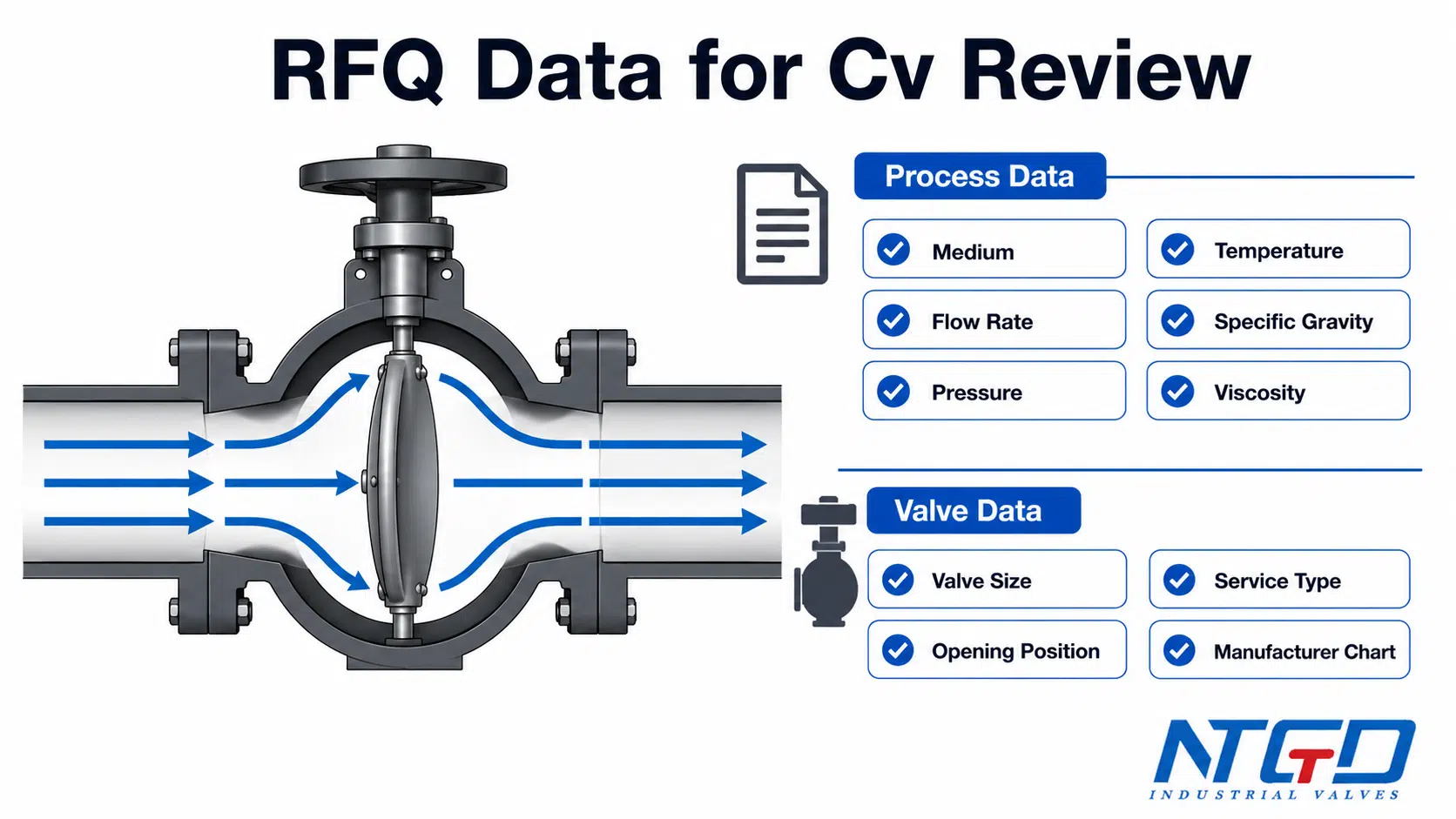
Process Data to Provide
| RFQ Item | Why It Is Needed |
|---|---|
| Medium | Determines density, viscosity, corrosion, solids, phase condition, and service suitability |
| Flow rate | Used to estimate expected pressure drop and required Cv |
| Normal / minimum / maximum flow | Helps review throttling point, opening range, and control stability |
| Operating pressure | Needed for valve rating review and pressure drop context |
| Downstream pressure, if known | Helps confirm actual ΔP across the valve |
| Operating temperature | Affects material selection, seat suitability, and fluid properties |
| Specific gravity | Required for liquid pressure drop calculation using Cv |
| Viscosity | Helps decide whether a simple liquid Cv estimate is reliable |
| Solids or slurry content | May affect valve design, seat selection, wear risk, and flow behavior |
Valve and Pipeline Data to Provide
| RFQ Item | Why It Is Needed |
|---|---|
| Pipe size | Confirms flow velocity and whether the valve size matches the system |
| Valve size | Helps confirm whether the selected valve can meet the required flow and pressure drop |
| Pressure class / PN rating | Confirms body rating and whether the selected chart applies |
| Connection type | Wafer, lug, flanged, or other connections affect product selection and installation scope |
| Valve design | Concentric, offset, triple offset, or high-performance designs require the correct Cv chart |
| Seat and disc material | Affects service compatibility, flow path, and available valve series |
| Flow direction requirement | Important for designs or services with preferred installation direction |
| Installation layout | Helps identify upstream or downstream disturbances that may affect installed behavior |
| Actuation method | Manual, gear, pneumatic, electric, or hydraulic operation affects service and control review |
| Service type | Distinguishes fully open Cv review from throttling Cv review |
For connection-type decisions in the RFQ, compare wafer-type vs flanged butterfly valve requirements before finalizing the pipeline connection and installation data.
Chart or Cv Data to Confirm with the Manufacturer
Ask the manufacturer or supplier to confirm:
- Cv at fully open position;
- Cv at expected throttling opening, if applicable;
- pressure drop at normal and maximum flow;
- chart basis and test conditions;
- whether values apply to the selected valve design;
- whether the service requires additional review for cavitation, flashing, noise, or high velocity;
- whether the valve is suitable for the expected operating position.
This information helps avoid selecting a valve based only on nominal size.
FAQ About Butterfly Valve Pressure Drop and Cv
What is Cv in a butterfly valve?
Cv is the valve flow coefficient. It indicates the flow capacity of the butterfly valve under defined conditions. In selection work, Cv is used to relate flow rate and pressure drop, but it must match the correct valve design and opening position.
Does higher Cv mean more flow?
Yes, under the same basic conditions, a higher Cv means the valve can pass more flow with less pressure drop. However, Cv must be interpreted carefully because it depends on valve size, design, opening angle, and manufacturer data.
How do you calculate pressure drop across a butterfly valve?
For a basic liquid estimate, the common relationship is ΔP = SG × (Q / Cv)², where Q is flow rate, Cv is the selected valve flow coefficient, SG is specific gravity, and ΔP is pressure drop. Use the Cv for the correct valve design and opening position. This formula is useful for preliminary review, not final sizing approval for every service.
What is the difference between pressure drop and pressure loss?
In many valve selection discussions, pressure drop and pressure loss are used in a similar way. Both refer to the loss of pressure as fluid passes through the valve. Pressure drop is often expressed as the difference between upstream and downstream pressure.
How does opening angle affect butterfly valve Cv?
Opening angle changes the available flow area around the disc. As the valve opens, Cv increases, but not in a simple linear pattern. A partially open butterfly valve should be reviewed using opening-angle Cv data, not only fully open Cv.
Can I use a butterfly valve for throttling or flow control?
A butterfly valve can be used for some throttling or flow control services, but it should not be selected only by pipe size or fully open Cv. Flow range, pressure drop, opening position, actuator type, media properties, and control requirements should be reviewed before confirming the valve.
Should I use a manufacturer Cv chart?
Yes. A manufacturer Cv chart or pressure drop chart should be used for final selection because Cv values vary by valve design, size, opening angle, pressure class, and product series. Generic charts are only useful for preliminary understanding.
What data is needed to estimate butterfly valve pressure drop?
At minimum, provide flow rate, medium, specific gravity, operating pressure, temperature, pipe size, valve size, service type, and expected opening position if the valve is used for throttling. For complex service, also provide viscosity, solids content, downstream pressure, and piping layout.
What is the difference between Cv and Kv for butterfly valves?
Cv and Kv both describe valve flow capacity, but they use different unit systems. Do not compare Cv and Kv directly without conversion or manufacturer confirmation. For RFQ review, confirm which coefficient the datasheet uses before comparing charts or estimating pressure drop.
Conclusion: Confirm Butterfly Valve Pressure Drop with Cv, Chart Data and Service Conditions
Butterfly valve pressure drop is not a fixed value. It depends on the valve design, disc position, opening angle, flow rate, fluid properties, and piping conditions. Butterfly valve Cv, or flow coefficient, is a useful way to understand flow capacity, but it must be matched to the correct valve series and operating position.
For isolation service, fully open Cv may be enough for a preliminary pressure drop review. For throttling or control service, the review should include Cv at the expected opening range, allowable pressure drop, fluid properties, and manufacturer chart data.
Before confirming a butterfly valve for a project, prepare the required flow rate, pressure, temperature, medium, specific gravity, valve size, connection type, service type, and operating position. This allows the valve manufacturer or engineering team to review whether the selected butterfly valve can meet the required pressure drop and flow capacity.
Application / Specification Support
If you are not sure whether to use fully open Cv, partially open Cv, or a specific manufacturer Cv chart for your butterfly valve application, NTGD can review the application conditions before RFQ confirmation.
For project selection, NTGD can help check the butterfly valve design, expected pressure drop, Cv data requirements, opening condition, and service suitability. To support a more accurate review, provide the medium, flow rate, operating pressure, temperature, pipe size, pressure class, valve design preference, and whether the valve will be used for isolation or throttling service.
You can send the project conditions through NTGD’s contact page for application review before confirming the final butterfly valve specification.
