By NTGD Valve Engineering Team
Reviewed by Bruce Tseng, Senior Valve Application Engineer (15+ years in industrial flow control)
Last updated: March 2026
At a Glance (Engineer-Verified Quick Answer)
-
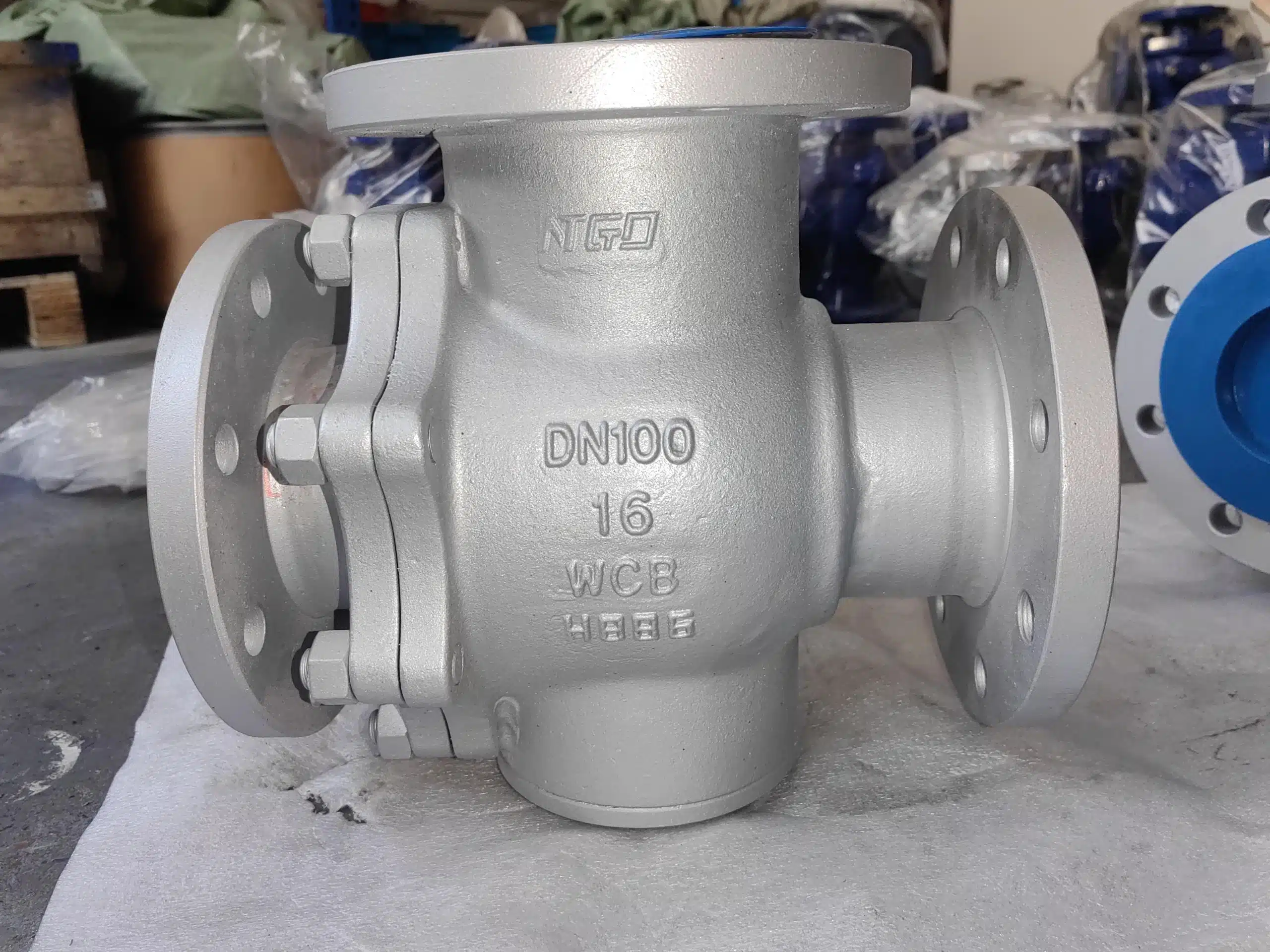
A 3-way ball valve is a quarter-turn valve with three ports used to divert, mix, split, or isolate flow.
-
The two main designs are L-port and T-port.
-
L-port valves are mainly used for switching or diverting flow.
-
T-port valves are mainly used for mixing, splitting, or multi-port communication.
-
The wrong port pattern can cause incorrect flow routing, failed mixing, or unintended shutoff.
A correctly selected 3-way ball valve can replace multiple standard valves and fittings, simplify piping layout, reduce leak points, and improve operating flexibility in industrial systems.
Need help choosing between L-port and T-port? Talk to our engineers for technical selection support.
Introduction
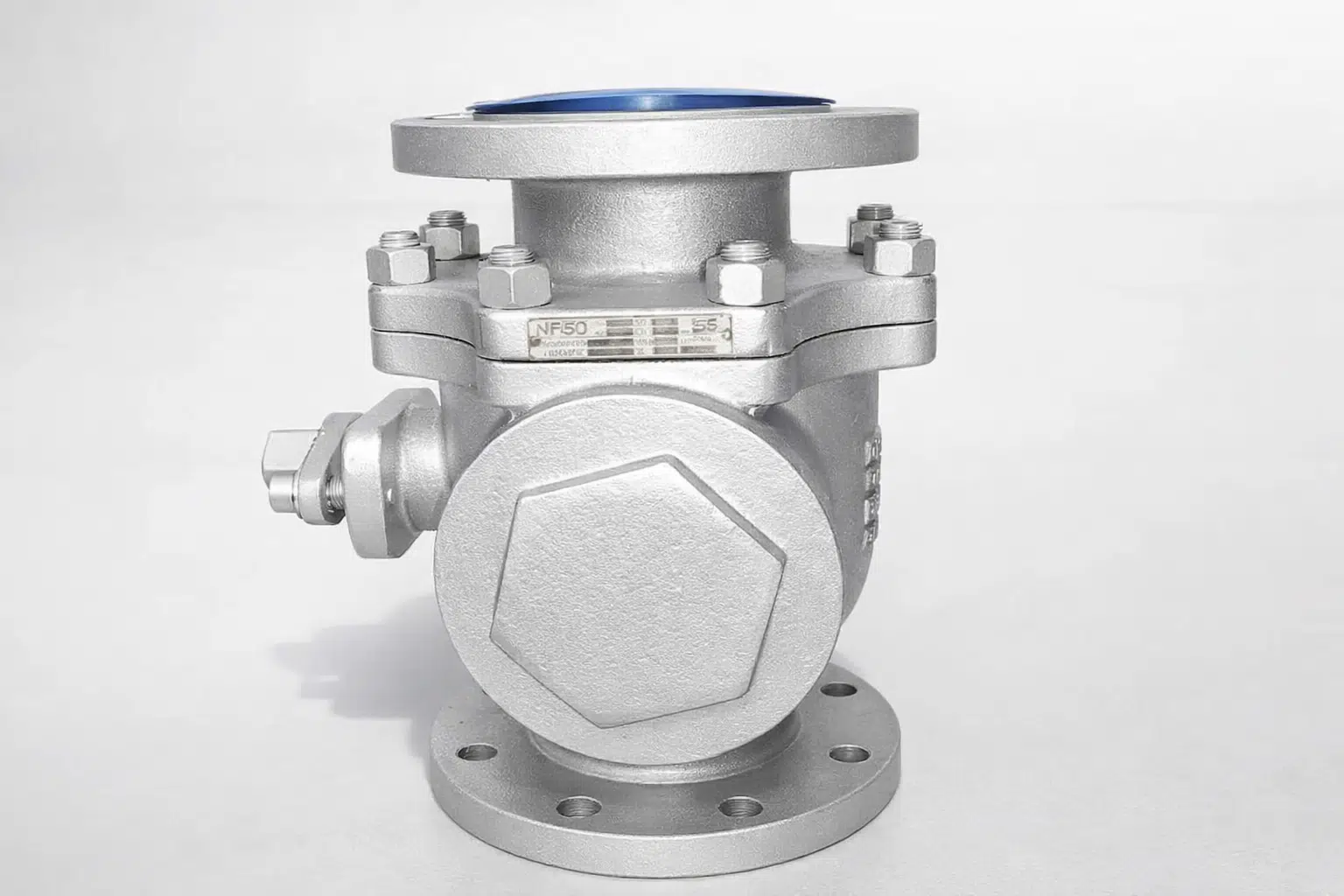
A 3-way ball valve is used when a piping system needs more than simple on/off isolation. Unlike a standard 2-way ball valve within a broader ball valve system, which only opens or closes one flow path, a 3-way ball valve can redirect flow, combine streams, split one stream into multiple paths, or isolate selected ports depending on the ball pattern and operating position.
That is why 3-way ball valves are widely used in industrial systems where piping space is limited and flow logic is more complex. In many practical layouts, one 3-way ball valve can replace two or more standard valves together with extra tees and fittings, helping reduce installation space, simplify maintenance, and lower the number of possible leak points.
This guide explains what a 3-way ball valve is, how it works, the difference between L-port and T-port designs, common flow patterns, selection logic, common mistakes, and how to request the right valve for your operating conditions.
What Is a 3-Way Ball Valve?
A 3-way ball valve is a quarter-turn valve with three ports and a bored ball inside the valve body. When the ball rotates, different ports are connected or isolated, allowing the valve to perform functions such as diversion, mixing, splitting, or switching between flow paths.
In industrial service, 3-way ball valves are commonly used where the system needs:
-
flow diversion
-
flow mixing
-
line switching
-
bypass operation
-
compact multi-function control
Compared with multiple separate 2-way valves, a properly selected 3-way ball valve can simplify piping layout and reduce system complexity.
Core components of a 3-way ball valve
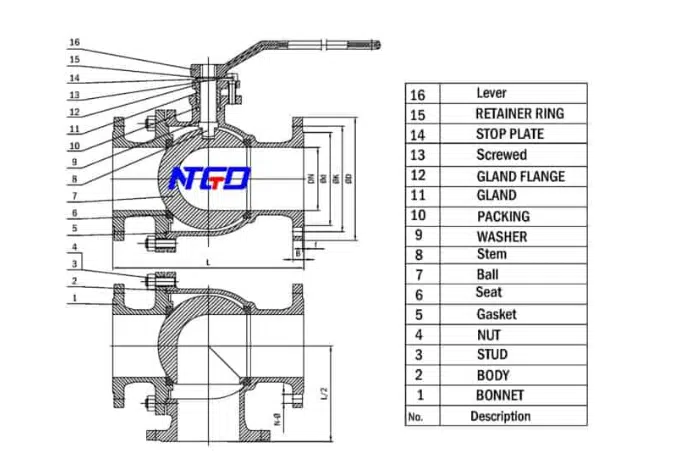
A typical 3-way ball valve includes:
-
valve body
-
ball with L-port or T-port bore
-
stem
-
seats
-
body seals
-
end connections
-
handle, gear, pneumatic actuator, or electric actuator
Why 3-way ball valves are widely used
3-way ball valves are widely used because they offer:
-
compact design
-
quarter-turn fast operation
-
flexible flow control
-
easy automation
-
reduced piping complexity
In many industrial systems, a single 3-way ball valve can reduce installation space significantly compared with using multiple 2-way valves and additional fittings.
How Does a 3-Way Ball Valve Work?
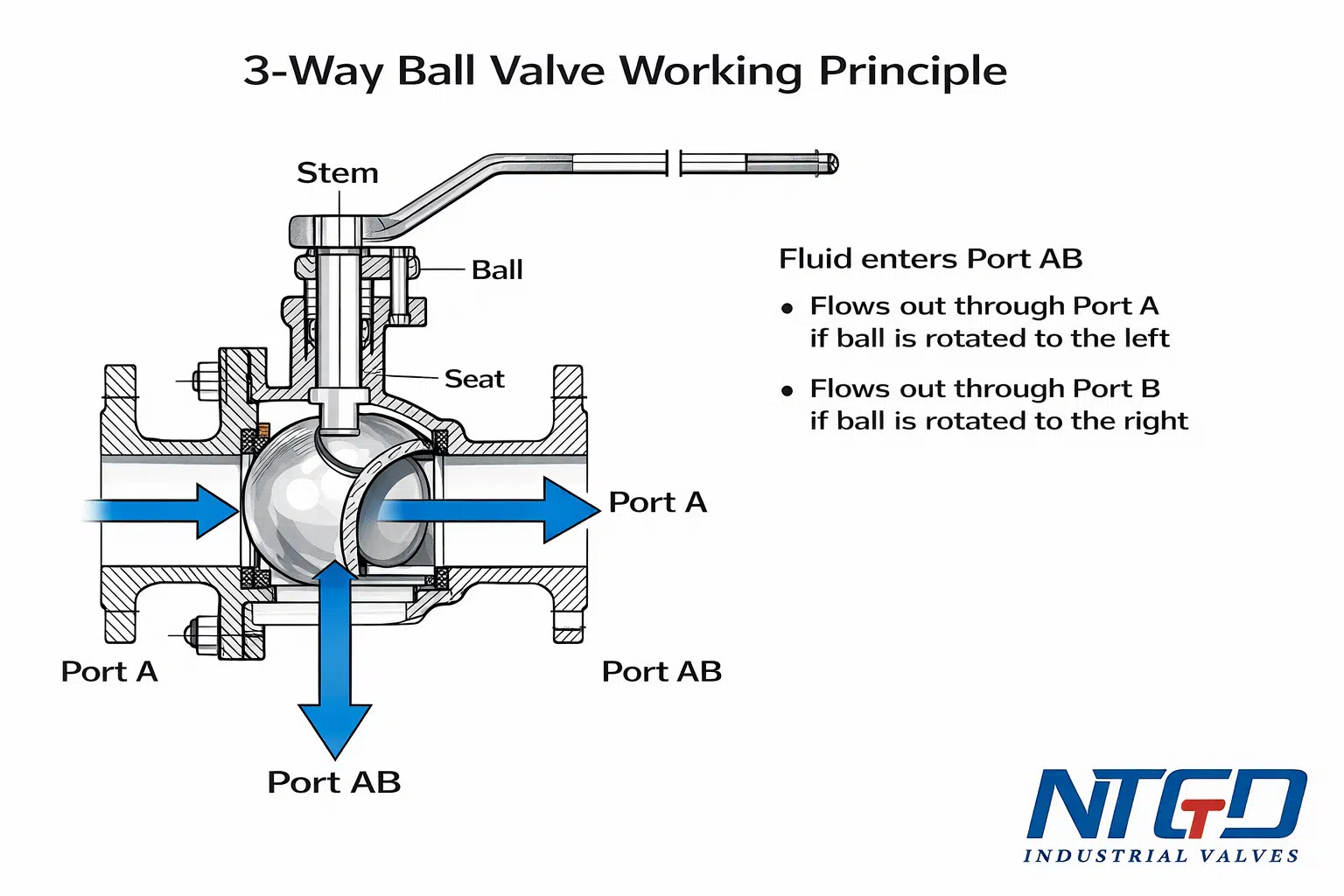
A 3-way ball valve works by rotating a bored ball inside the valve body. The shape of the bore determines which ports communicate in each operating position.
When the handle or actuator turns the stem, the ball rotates by 90 degrees. This changes the flow path by aligning or blocking selected ports.
Step-by-step operating principle
1. Fluid enters the valve
The medium enters one or more ports depending on the system design.
2. The ball rotates into position
The bored ball aligns with selected ports according to the valve position.
3. Ports communicate
The fluid is diverted, mixed, split, or blocked depending on the bore shape and rotation angle.
4. The valve changes flow path with a quarter turn
A 90-degree turn shifts the communication path between ports quickly and efficiently.
Why bore design matters
The actual valve function depends mainly on the ball bore pattern:
-
L-port = switching or diverting
-
T-port = mixing, splitting, or more flexible multi-port communication
Actuated 3-way ball valve operation
In automated systems, 3-way ball valves are often supplied as actuated ball valves :
-
pneumatic actuators
-
electric actuators
This is common where the valve must switch automatically based on:
-
temperature
-
pressure
-
PLC commands
-
timed sequence control
-
remote operation
Engineering note: actuator torque margin
In automated service, actuator torque should not be selected too close to the valve’s minimum operating torque. In many practical applications, actuator output torque is chosen with a safety margin above valve break torque. More demanding service conditions such as dirty media, low temperature, infrequent operation after long idle periods, or higher pressure may require a larger safety factor.
A torque margin that is too low is one of the most common field causes of actuator failure or incomplete switching.
Where precise remote positioning or electrically driven automation is required, you can also review our electric ball valve solutions. For faster on/off control in automated service, our pneumatic ball valve range may be more appropriate.
L-Port vs T-Port 3-Way Ball Valve
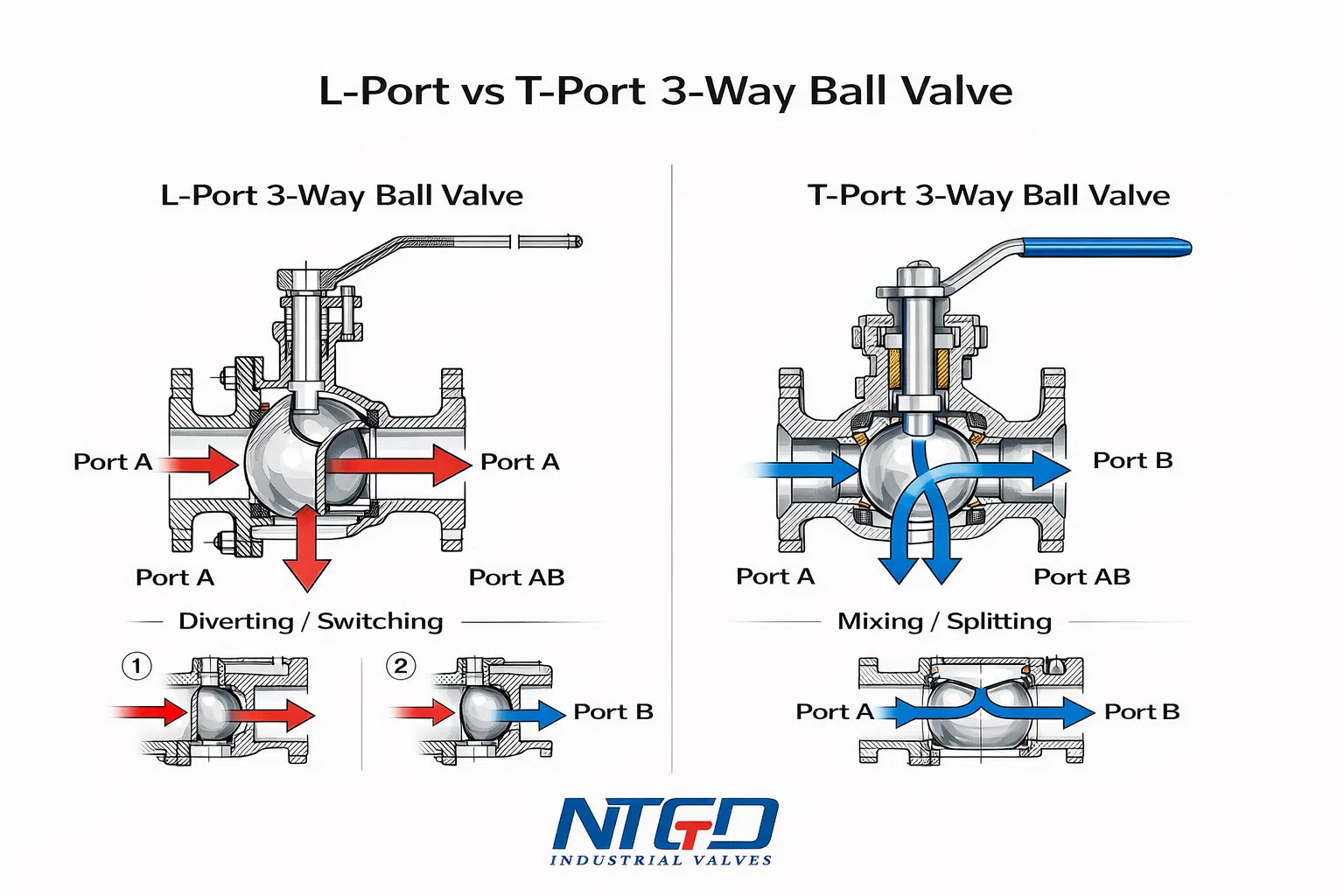
This is the most important selection decision for most buyers.
Many 3-way ball valve problems are not caused by poor manufacturing. They are caused by selecting the wrong ball pattern for the required flow logic.
30-Second Decision Shortcut
-
Need to switch or divert one flow path between two lines? → Choose L-port
-
Need to mix two streams or split one stream into two paths? → Choose T-port
What Is an L-Port 3-Way Ball Valve?
An L-port 3-way ball valve has an L-shaped bore inside the ball. It is mainly designed to connect one common port to one of two side ports.
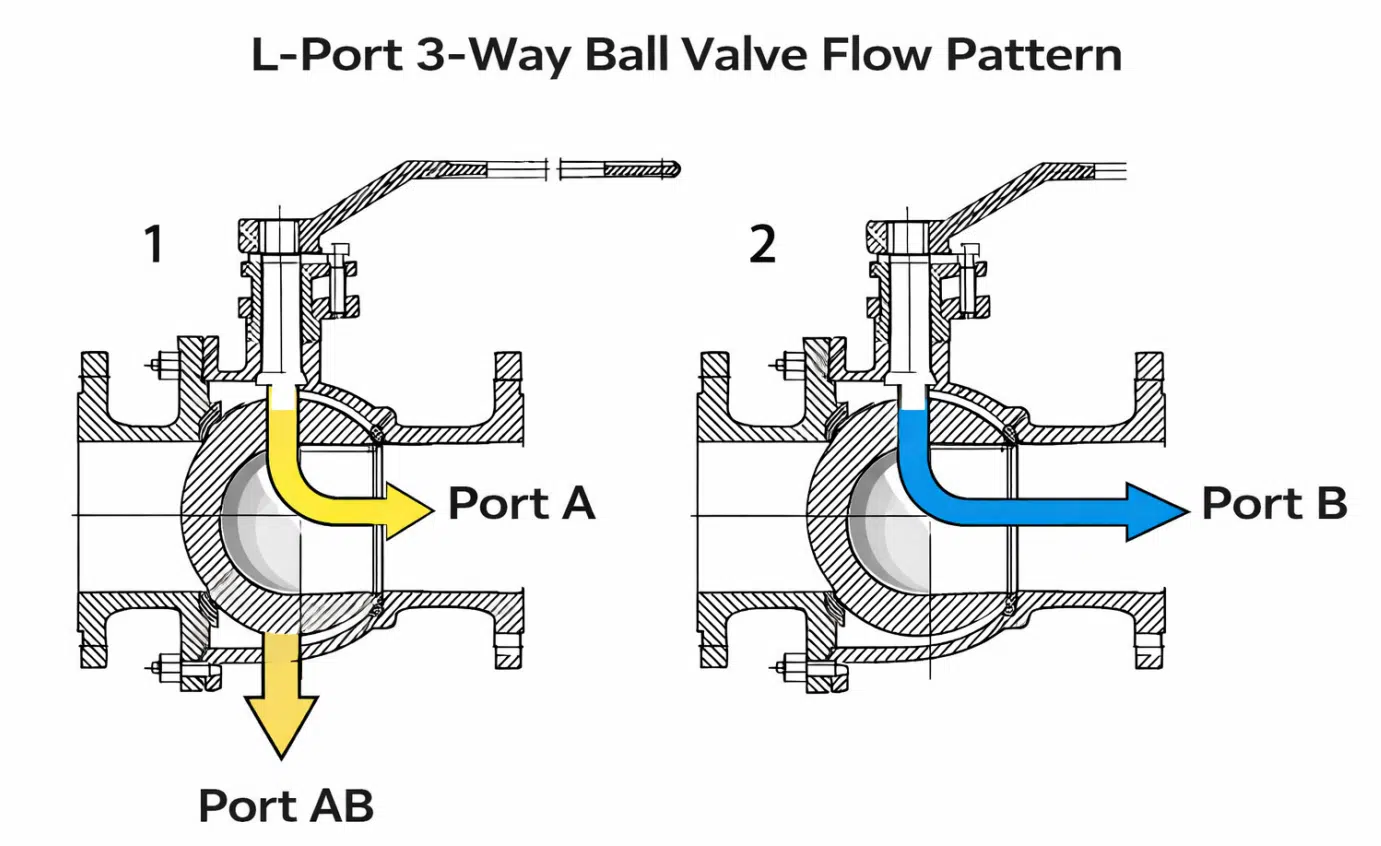
Typical function
-
flow diversion
-
switching between two lines
-
non-mixing changeover
Example flow logic
Using port numbering such as Port A, Port B, and Port AB:
-
AB → A
-
AB → B
This means one common port is connected to one of two ports at a time.
Typical applications
-
tank switching
-
pump changeover
-
utility line diversion
-
alternate supply routing
Important limitation
An L-port valve is not the right choice for true continuous mixing of two inlet streams.
What Is a T-Port 3-Way Ball Valve?
A T-port 3-way ball valve has a T-shaped bore inside the ball. It offers more flexible communication between ports than an L-port design.
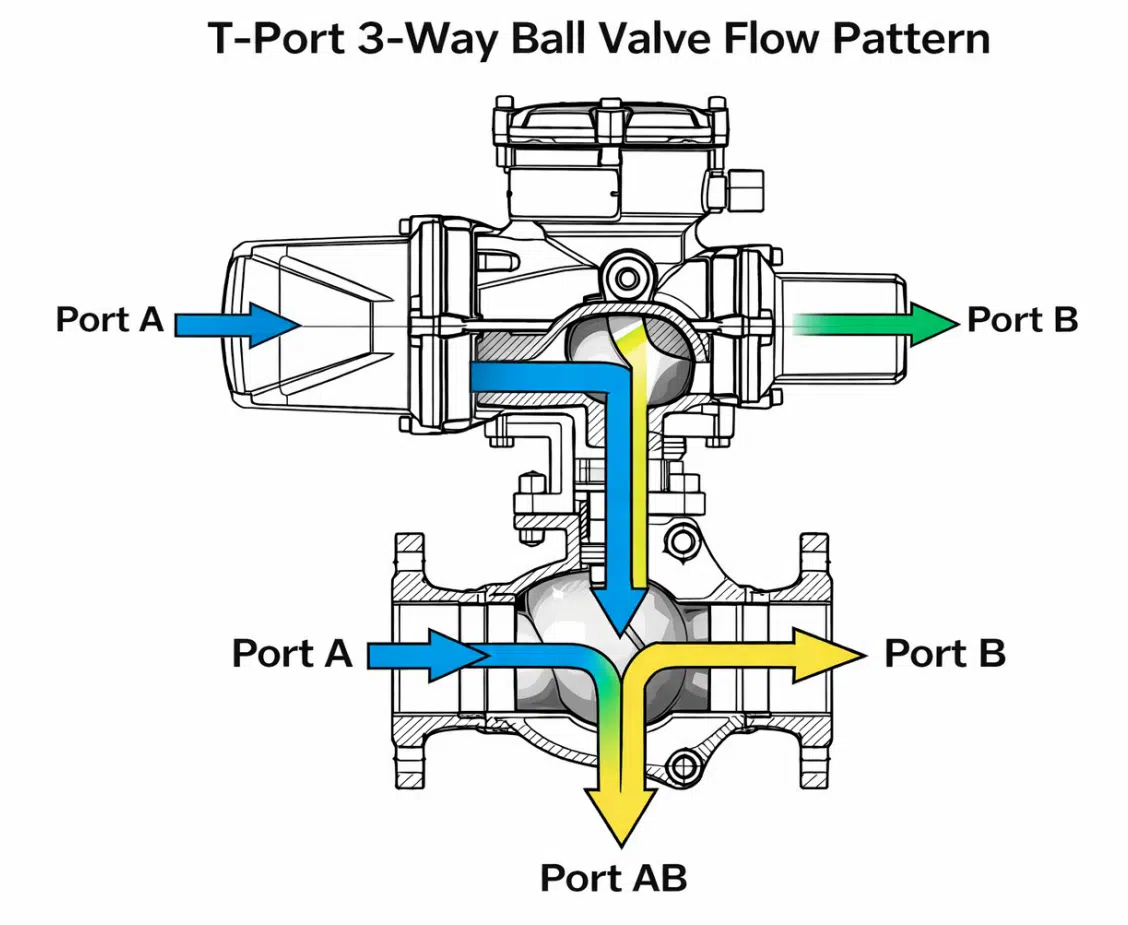
Typical function
-
mixing
-
splitting
-
bypass logic
-
multi-port communication
-
straight-through flow in some positions
Example flow logic
Depending on ball orientation, the flow may allow:
-
A + B → AB
-
AB → A + B
-
straight-through communication
-
selective shutoff of one port
Typical applications
-
blending systems
-
flow splitting
-
temperature control loops
-
bypass and recirculation systems
-
more complex process routing
Important limitation
A T-port valve is more flexible, but it must be selected and positioned carefully. If the intended flow logic is not verified in advance, unwanted port communication may occur.
Port Numbering and Flow Logic
To avoid confusion, engineers often define 3-way ball valve flow paths using standard port references:
-
Port A
-
Port B
-
Port AB (common port)
This makes it easier to define the required communication path during selection and quotation.
L-port example
-
Port AB connected to Port A
-
Port AB connected to Port B
-
one path active at a time
T-port example
-
Port A and Port B mix into Port AB
-
Port AB splits into Port A and Port B
-
or one straight-through path remains open depending on the ball position
Head-to-Head Comparison Table
| Feature | L-Port 3-Way Ball Valve | T-Port 3-Way Ball Valve |
|---|---|---|
| Ball bore pattern | L-shaped | T-shaped |
| Main function | Diverting / switching | Mixing / splitting / multi-port flow |
| Can it mix two inlet streams? | No | Yes |
| Can it split one stream into two outlets? | Limited / not true split logic | Yes |
| Simultaneous multi-port communication | Usually no | Yes, depending on ball position |
| Best for | Tank switching, changeover, diversion | Blending, bypass, distribution, complex routing |
| Main selection risk | Wrong choice if mixing is required | Wrong choice if strict one-path switching is required |
Engineer’s Recommendation: Which One Should You Choose?
Choose L-port if:
-
you need one inlet or common port to switch between two different flow paths
-
you do not need simultaneous communication between all three ports
-
your application is primarily diversion or changeover
Choose T-port if:
-
you need to mix two streams
-
you need to split one stream
-
you need more flexible communication between multiple ports
Engineer warning
Using an L-port valve where mixing is required can result in incorrect routing, failed process performance, or complete loss of the intended mixing function.
Using a T-port valve where strict one-path diversion is required can create unwanted communication paths if the ball pattern and operating positions are not verified carefully.
Still unsure which port pattern fits your piping system? Send us your service conditions for a custom recommendation.
Common Flow Patterns of 3-Way Ball Valves
The same valve body can behave very differently depending on the ball bore and rotation position.
The most common flow patterns are:
1. Diverting
One common flow path is directed to one of two outlets.
This is usually an L-port application.
2. Mixing
Two inlet streams combine into one outlet.
This is usually a T-port application.
3. Splitting
One inlet stream is distributed into two outlets.
This is also usually a T-port application.
4. Shutoff or isolation position
Depending on port pattern and ball position, selected ports may be isolated.
Why flow diagrams matter
For a 3-way ball valve, the name alone is not enough.
A proper flow diagram showing which ports communicate in each handle or actuator position is often the safest way to confirm that the valve matches the intended piping logic.
How to Choose the Right 3-Way Ball Valve
Choosing the right 3-way ball valve requires more than matching nominal size and pressure class.
In 3-way ball valves, incorrect flow logic selection is often more serious than a simple size mismatch.
Important
To ensure the valve matches your real operating conditions, confirm the actual process function, media, pressure, temperature, and connection details before requesting quotation.
Step 1 — Confirm the required function
Ask first:
-
Do you need diverting?
-
Do you need mixing?
-
Do you need splitting?
-
Do you need bypass?
-
Do you need one-path-at-a-time switching?
This usually determines whether you need L-port or T-port.
Step 2 — Confirm media and temperature
The valve must match the actual process fluid and operating temperature.
Check:
-
water
-
oil
-
gas
-
steam
-
corrosive chemicals
-
contaminated or abrasive media
Also confirm:
-
maximum temperature
-
minimum temperature
For general service, soft seats are common. For higher temperature or more demanding service, reinforced or metal seat options may be required.
Step 3 — Confirm pressure rating
Pressure rating affects:
-
body strength
-
seat load
-
torque requirement
-
sealing reliability
-
long-term performance
For general industrial service, floating ball valve designs are common because they are widely used in low-to-medium pressure applications and offer a practical balance between sealing performance and cost. For higher-duty conditions, trunnion ball valve constructions or other heavier-duty designs may be more suitable where pressure, valve size, or torque demand is significantly higher.
Step 4 — Confirm body and seat materials
Typical body materials include:
-
WCB carbon steel
-
stainless steel 304
-
stainless steel 316
-
duplex stainless steel
-
brass for selected services
Typical seat materials include:
-
PTFE
-
RPTFE
-
PEEK
-
metal seat options
Material compatibility guide
| Process Media | Recommended Body Material | Recommended Seat Material |
|---|---|---|
| Water | WCB / SS304 / SS316 | PTFE / RPTFE |
| General oil and gas service | Carbon steel / SS316 / Duplex | RPTFE / PEEK |
| Corrosive chemicals | SS316 / Duplex / special alloys | PTFE / PEEK |
| High-temperature service | Carbon steel / stainless steel | PEEK / metal seat |
| More abrasive service | Duplex / harder alloys | reinforced or metal seat |
For corrosive or higher-duty service, NTGD can support material selection based on actual media compatibility and pressure-temperature conditions.
Step 5 — Confirm full port or reduced port
This directly affects flow capacity and pressure drop.
-
Full port = lower pressure drop and better flow capacity
-
Reduced port = more compact and potentially lower cost, but higher pressure drop
If the system is sensitive to pressure loss, reduced port designs should be checked carefully before selection.
Not sure whether full port or reduced port is suitable for your system? Send us your flow and pressure-drop requirements for quick review.
Step 6 — Confirm actuation method
Choose from:
-
manual handle
-
gear operator
-
pneumatic actuator
-
electric actuator
Actuation depends on:
-
switching frequency
-
automation level
-
available utilities
-
required response speed
-
torque demand
In automated service, actuator sizing should always be verified against actual operating torque.
Step 7 — Confirm end connection
Typical end connections include:
-
threaded
-
socket weld
-
butt weld
-
flanged
Always confirm that the valve connection matches the piping standard used on site.
Step 8 — Match the valve to the real failure risk
The best 3-way ball valve is not the one with the longest datasheet.
It is the one that best reduces the main risk in the system.
Ask:
-
Is wrong flow logic the biggest risk?
-
Is pressure drop the biggest risk?
-
Is leakage the biggest risk?
-
Is actuator mismatch the biggest risk?
-
Is seat wear the biggest risk?
Engineer-verified selection checklist
Use this before sending inquiry:
-
required function
-
L-port or T-port
-
valve size
-
pressure rating
-
operating temperature
-
media type
-
end connection
-
manual or actuated operation
-
full port or reduced port preference
-
seat material requirement
-
any project or compliance requirement
If these details are clear, valve selection becomes faster, more accurate, and more reliable.
Common 3-Way Ball Valve Selection Mistakes & Engineer Warnings
This section is often more useful than a generic “advantages” list because many failures start from incorrect selection.
Mistake 1: Using L-port for mixing service
Risk level: High
Consequence:
Incorrect flow routing, failed mixing function, or unintended shutoff.
Better choice:
Use a T-port valve where true mixing or simultaneous communication is required.
Mistake 2: Ignoring pressure drop in reduced port designs
Risk level: Medium
Consequence:
Higher pressure loss, reduced downstream flow, lower system efficiency.
Better choice:
Use a full port design where pressure drop matters.
Mistake 3: Using standard soft seats in unsuitable temperature service
Risk level: High
Consequence:
Seat deformation, leakage, shortened valve life, or unstable shutoff.
Better choice:
Verify seat material against the actual temperature and media conditions before selecting a standard soft-seated valve.
Mistake 4: Ignoring actuator torque requirements
Risk level: High
Consequence:
Incomplete switching, actuator overload, seat damage, or position failure.
Better choice:
Check actuator torque against valve break torque and actual service conditions.
Mistake 5: Selecting by size and pressure only
Risk level: High
Consequence:
The valve may fit the line but still fail functionally because the port logic is wrong.
Better choice:
Confirm flow function first, then confirm pressure and size.
Mistake 6: Underestimating cycle life in automated service
Risk level: Medium to High
Consequence:
Faster seat wear and earlier maintenance if the valve cycles frequently under load.
Better choice:
For higher-cycle service, check seat design, material, and expected cycle duty before final selection.
Mistake 7: Ignoring anti-static or hazardous-service requirements
Risk level: High
Consequence:
Safety and compliance issues in demanding oil, gas, or chemical environments.
Better choice:
Where required, specify anti-static, blowout-proof, or project-specific compliance features during inquiry.
Proven Industrial Applications of 3-Way Ball Valves
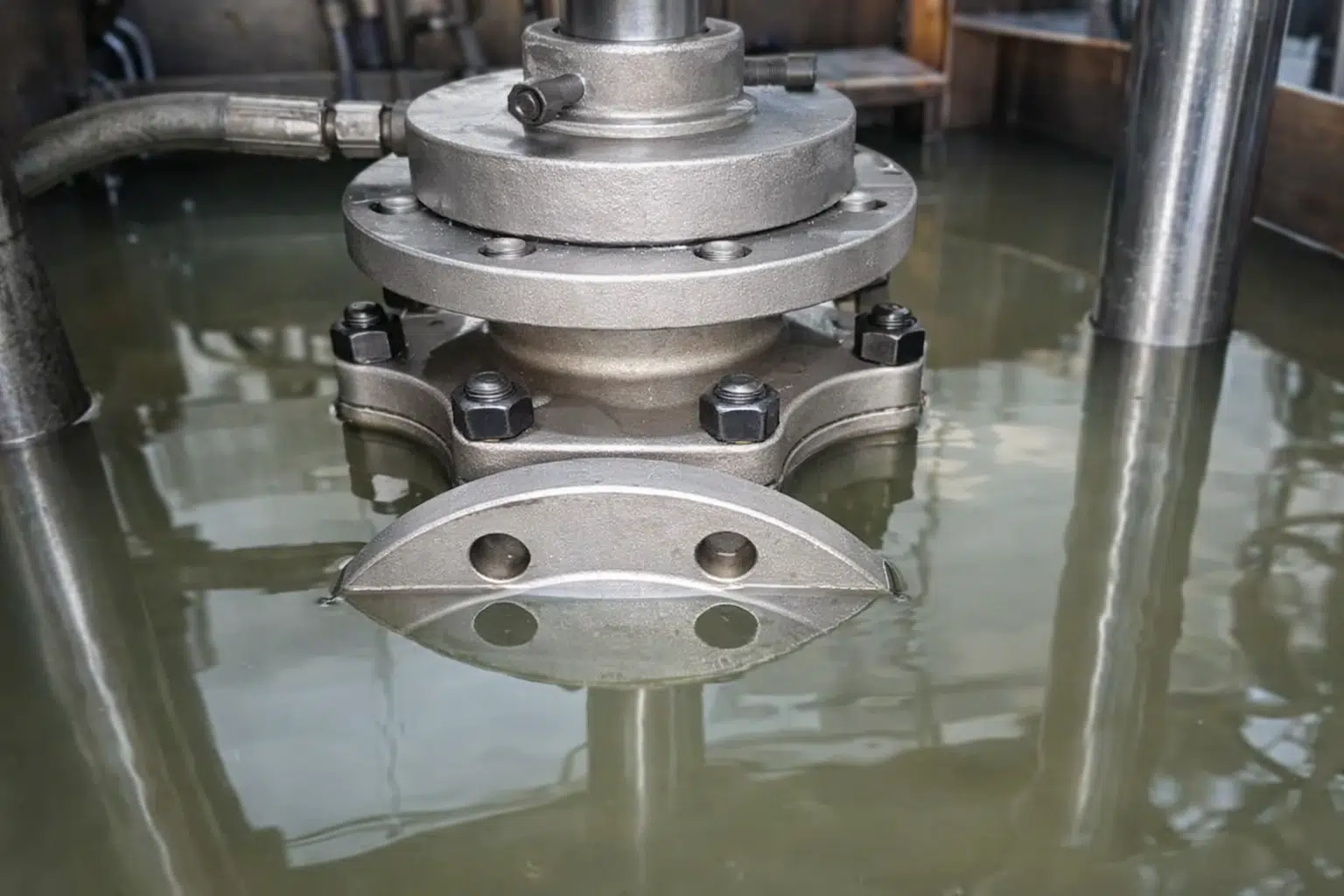
3-way ball valves are used in many industrial systems, but correct performance always depends on proper flow logic.
HVAC bypass and blending loops
T-port valves are often used to mix or bypass flow in heating and cooling loops for more stable temperature control. For a broader system-level comparison, see our guide to 2-way vs 3-way ball valves in HVAC systems.
Typical configuration: T-port 3-way ball valve with electric actuator for temperature-based control.
Tank changeover service
L-port valves are commonly used where one feed line must switch between two tanks, vessels, or process branches.
Typical configuration: L-port 3-way ball valve with manual or pneumatic operation.
Chemical processing lines
T-port valves are used where mixing, rerouting, or flexible multi-port communication is needed in process systems.
Typical configuration: T-port 3-way ball valve in stainless steel with media-compatible seat material.
Water treatment distribution
3-way ball valves are used where diversion, bypass, or compact distribution control is required.
Typical configuration: L-port or T-port valve depending on whether the service is switching or blending.
Automated process routing
Actuated 3-way ball valves are common where the system requires PLC integration, remote switching, or scheduled flow path changes.
Typical configuration: pneumatic or electric actuated 3-way ball valve with torque-matched actuator.
NTGD 3-Way Ball Valve Support Highlights
When selecting an industrial 3-way ball valve, buyers often need more than a catalog. They need confirmation of flow logic, materials, torque, and configuration.
NTGD can support:
-
L-port and T-port selection
-
body and seat material recommendations
-
manual, pneumatic, and electric configurations
-
pressure and temperature confirmation
-
end connection selection
-
application-based recommendation for compact, automated, or higher-duty service
Where required, support can also include drawing review, quotation guidance, and configuration confirmation before final purchase.
Advantages of 3-Way Ball Valves
When correctly selected, 3-way ball valves offer several practical benefits:
-
compact multi-function design
-
fewer fittings and fewer separate valves
-
reduced potential leak points
-
quarter-turn fast operation
-
actuator-friendly operation
-
flexible flow routing
-
lower overall system complexity
Limitations of 3-Way Ball Valves
They also have limitations that should be understood clearly:
-
wrong port pattern can make the valve unusable for the intended function
-
reduced port designs may create unwanted pressure drop
-
torque requirements increase under higher pressure and larger sizes
-
standard soft seats are not suitable for every temperature or media condition
-
port communication must be verified carefully before purchase
The limitation is usually not the valve concept itself.
The limitation is usually a mismatch between flow logic and service requirements.
Frequently Asked Questions
1. What is a 3-way ball valve?
A 3-way ball valve is a quarter-turn valve with three ports used to divert, mix, split, or isolate fluid flow.
2. What is the difference between L-port and T-port 3-way ball valves?
L-port valves are mainly used for diverting or switching. T-port valves are mainly used for mixing, splitting, or flexible multi-port communication.
3. Which is better for mixing, L-port or T-port?
T-port is generally the correct choice for true mixing applications.
4. Which is better for diverting flow?
L-port is usually preferred where one common stream must switch between two lines.
5. Can a 3-way ball valve be actuated?
Yes. 3-way ball valves can be supplied with pneumatic or electric actuators for automated operation.
6. What is the difference between a 3-way ball valve and a 3-way plug valve?
3-way ball valves usually offer lower operating torque and quarter-turn tight shutoff, while 3-way plug valves may be preferred in some heavier or more specialized service conditions depending on media and sealing requirements.
7. Can a 3-way ball valve be used for steam service?
Yes, but seat and body materials must be selected according to the actual steam temperature and pressure conditions.
8. What end connections are available for 3-way ball valves?
Common options include threaded, flanged, socket weld, and butt weld connections.
9. How do I install a 3-way ball valve correctly?
Confirm the port pattern, verify the intended flow path, align the valve correctly, and check that the operating position matches the required piping logic before startup.
10. What pressure ratings are available for industrial 3-way ball valves?
Available pressure rating depends on valve size, body design, and project requirements. General service and higher-duty configurations are both possible depending on specification.
11. How do I choose the right seat material?
Seat material should be selected based on media, pressure, temperature, cycle duty, and shutoff requirement.
12. What information should I provide for quotation?
Provide the required function, L-port or T-port preference, valve size, pressure, temperature, media, end connection, and actuation requirement.
Need Help Selecting the Right 3-Way Ball Valve?
To recommend the correct 3-way ball valve for your project, we usually need the following:
-
required function: diverting, mixing, splitting, or bypass
-
L-port or T-port requirement
-
valve size
-
working pressure
-
operating temperature
-
media type
-
seat material requirement
-
end connection type
-
manual, pneumatic, or electric operation
-
any project or compliance requirement
NTGD can review your application and help confirm the right flow pattern, material combination, and operating method before quotation.
If you are comparing broader ball valve constructions beyond 3-way flow logic, you may also review our ball valves types and selection guide.
Request support for:
-
L-port vs T-port selection
-
port pattern confirmation
-
material recommendation
-
actuator selection
-
pressure and temperature review
-
custom quotation support
Send your service conditions for a custom recommendation and quotation.
Request a Quote for Industrial 3-Way Ball Valves
Looking for the right 3-way ball valve for your project?
Send us your application details and required flow function.
NTGD can help you evaluate:
-
the right port pattern
-
body and seat material options
-
full port or reduced port design
-
manual or actuated configuration
-
compact, automated, or higher-duty solutions