
By Bruce Tseng, Valve Engineer at NTGD Valve
Technically reviewed by NTGD Engineering Team
Last updated: March 2026
A pressure reducing valve (PRV) is used to reduce a higher and often fluctuating upstream pressure to a lower, controlled downstream pressure. In industrial piping systems, this function is essential for protecting downstream equipment, improving process stability, and maintaining safe operating conditions.
If you are selecting a PRV valve for steam, water, compressed air, or industrial process service, the key question is not simply what a PRV is. The more important question is whether the valve is suitable for your pressure range, flow variation, control accuracy requirement, medium, and installation conditions.
This guide explains how a PRV valve works, how direct-acting and pilot-operated designs differ, how a PRV compares with a pressure relief valve, what data is needed for proper selection, and how to troubleshoot common pressure control problems in real service.
Request PRV Datasheet & Technical Support
Need detailed specifications, material options, dimensional drawings, or application support?
Contact NTGD Valve to request PRV datasheets, technical review, and project-based selection support.
What Is a PRV Valve?
A PRV valve, or pressure reducing valve, is an automatic control valve used to maintain a lower downstream pressure when upstream pressure is higher or unstable. It is widely used in steam systems, water systems, compressed air systems, and industrial process piping.
The main purpose of a PRV is to protect downstream equipment and maintain stable operating conditions. Instead of allowing full line pressure to pass through uncontrolled, the PRV automatically throttles the flow to hold the outlet pressure near a preset value.
In practical applications, a properly selected PRV helps:
-
protect downstream equipment and instruments
-
stabilize process pressure
-
reduce leakage risk caused by excess pressure
-
improve operating consistency
-
support safer piping system operation
A PRV is not simply a valve that “reduces pressure once.” It is a control device that continuously adjusts flow restriction to keep downstream pressure under control during operation.
In steam and process systems, pressure reducing valves are part of a broader category of self-acting pressure controls used to maintain downstream pressure under changing operating conditions.
How Does a PRV Valve Work?
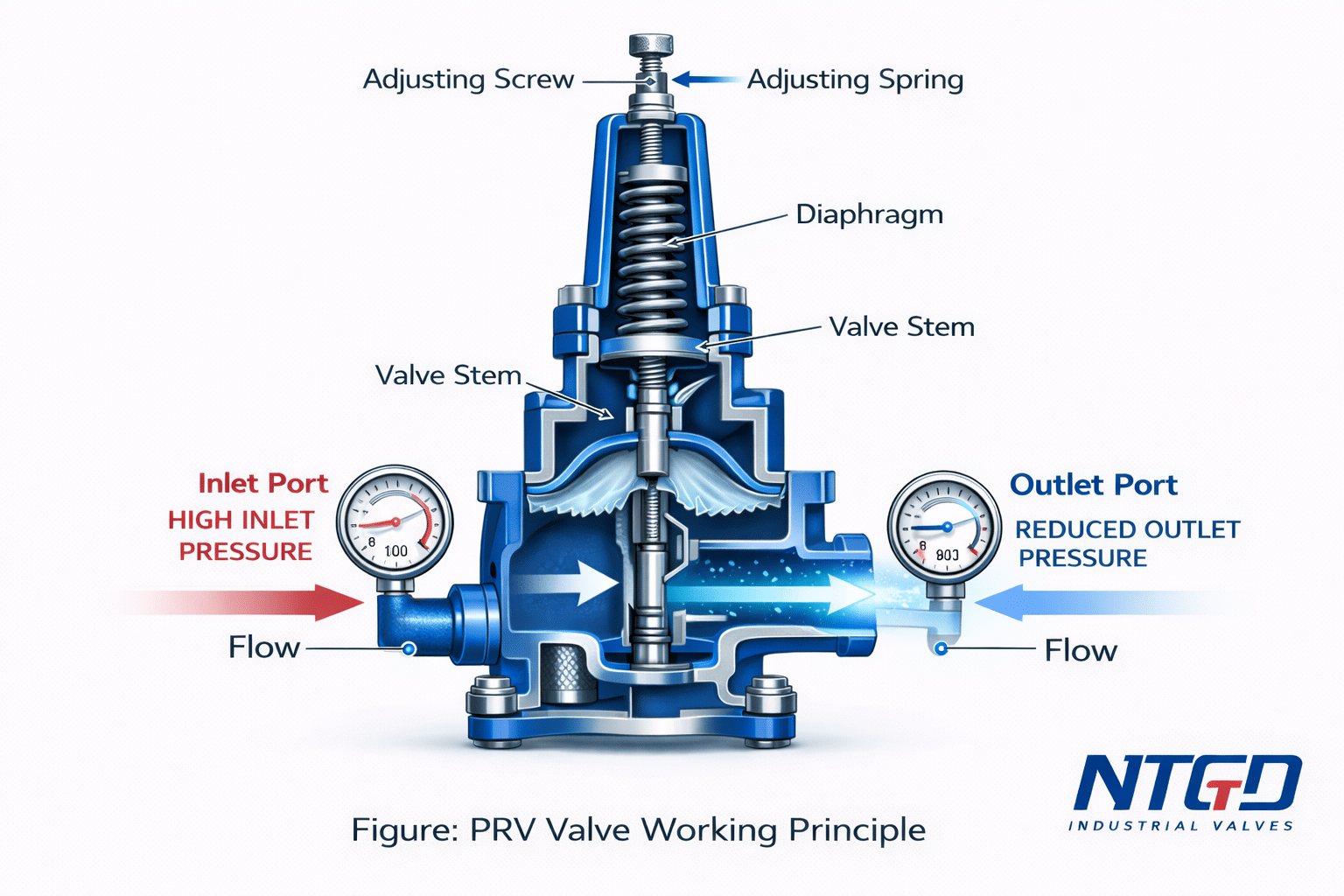
A PRV valve works by balancing spring force, downstream pressure feedback, and valve opening position.
When downstream pressure drops below the set pressure, the internal mechanism opens further, allowing more fluid to pass through. When downstream pressure rises toward or above the set pressure, the valve throttles down and reduces flow.
The exact mechanism depends on the valve type, but the control logic is the same:
the PRV modulates automatically to maintain the required downstream pressure.
Basic operating sequence
-
High-pressure fluid enters the valve inlet.
-
The internal trim throttles the flow.
-
Downstream pressure acts on a diaphragm, piston, or pilot control system.
-
The valve adjusts its opening to maintain the preset outlet pressure.
This process continues automatically during operation.
How to adjust a PRV valve to set correct outlet pressure
In general, the outlet pressure is adjusted by changing the spring force or pilot setting.
-
Tightening the adjusting screw usually increases the downstream set pressure.
-
Loosening the adjusting screw usually decreases the downstream set pressure.
However, adjustment should always be done with:
-
pressure gauges installed
-
stable operating flow if possible
-
reference to the manufacturer’s instructions
-
attention to system safety and downstream limits
For industrial service, pressure setting should never be done by guesswork alone. The actual downstream pressure must be checked under realistic operating conditions.
Why PRV Stability Matters in Real Systems
Many low-quality descriptions say that a PRV “reduces pressure,” but that is only the starting point.
In real industrial systems, a good PRV must also:
-
maintain stable downstream pressure during load changes
-
respond correctly to upstream pressure fluctuation
-
avoid pressure overshoot
-
minimize hunting
-
remain stable across the expected operating range
For example:
-
In steam service, unstable downstream pressure can affect heat transfer, process consistency, condensate behavior, and control valve performance.
-
In water systems, unstable pressure can damage fixtures, increase leakage, and create noise.
-
In compressed air systems, poor regulation can affect tools, actuators, and pneumatic equipment.
NTGD Engineering Note
In PRV applications, stable control is often more important than simply choosing the lowest-cost valve. In many systems, the real issue is not whether the valve can reduce pressure, but whether it can do so smoothly and predictably under changing demand.
That is why proper PRV selection must consider flow variation, accuracy requirement, and application behavior, not only nominal size.
PRV Valve vs Pressure Relief Valve

This is one of the most common sources of confusion.
A pressure reducing valve (PRV) is designed to control downstream pressure during normal operation.
A pressure relief valve is designed to open when pressure exceeds a safety limit, protecting the system from overpressure.
These valves do not solve the same problem.
Comparison Table: PRV vs Pressure Relief Valve
| Decision Factor | Pressure Reducing Valve (PRV) | Pressure Relief Valve |
|---|---|---|
| Main function | Controls and maintains outlet pressure | Protects system from overpressure |
| Operating mode | Modulates during normal service | Opens only when pressure exceeds limit |
| Control target | Stable downstream pressure | Maximum allowable system pressure |
| Typical location | Upstream of process equipment or controlled branch | On vessels, boilers, pipelines, or protected equipment |
| Flow behavior | Throttling control | Pressure release / discharge |
| Purpose in system design | Pressure regulation | Safety protection |
Selection insight
A PRV should not be used as a substitute for a relief valve, and a relief valve should not be used as a normal downstream pressure control device. In many industrial systems, both are required because they perform different engineering functions.
Main Types of PRV Valves
The two most common PRV categories are direct-acting and pilot-operated designs.
Direct-Acting PRV
A direct-acting PRV uses spring force and a diaphragm or piston to control the valve opening directly. It is simpler in structure and is often used where the load is relatively small or pressure control does not need to be extremely tight.

Typical features
-
compact design
-
simple installation
-
lower cost
-
suitable for smaller loads
-
common in point-of-use applications
Typical limitations
-
wider pressure variation under changing load
-
lower control precision than pilot-operated designs
-
less suitable for large or rapidly varying demand
Direct-acting PRVs are often used in smaller water systems, compressed air lines, and simple pressure reduction duties.
Pilot-Operated PRV
A pilot-operated PRV uses a smaller pilot valve to control pressure acting on the main valve. This allows the main valve to respond more precisely and handle larger flow capacity.
Typical features
-
better downstream pressure control
-
faster response to load variation
-
larger flow handling capability
-
suitable for industrial steam and process systems
-
better for demanding pressure control duty
Typical limitations
-
larger installation footprint
-
higher initial cost
-
more complex arrangement
-
more sensitive to contamination in pilot passages or sensing lines
Pilot-operated PRVs are often preferred in steam systems, industrial process pressure control, and applications where stable downstream pressure is more important.
Direct-Acting vs Pilot-Operated PRV
This is one of the most important selection decisions.

Comparison Table: Direct-Acting vs Pilot-Operated PRV
| Decision Factor | Direct-Acting PRV | Pilot-Operated PRV |
|---|---|---|
| Structure | Simpler | More complex |
| Pressure control accuracy | Moderate | Better |
| Response to load change | Slower / wider variation | Faster / tighter control |
| Flow capacity | Smaller to medium | Medium to large |
| Installation complexity | Lower | Higher |
| Maintenance complexity | Lower | Higher |
| Initial cost | Lower | Higher |
| Best-fit use | Point-of-use, smaller systems, simpler duty | Steam systems, process duty, variable loads |
NTGD Engineering Recommendation
If the application has relatively stable flow and does not require tight downstream pressure control, a direct-acting PRV may be sufficient. If the load varies significantly, the downstream pressure must remain more stable, or the service is more demanding, a pilot-operated PRV is usually the better engineering choice.
Main Components of a PRV Valve
Although designs vary, most industrial PRVs include the following key functional elements.

Valve body
The valve body forms the pressure boundary and houses the internal control elements. Body material depends on pressure, temperature, and medium.
Adjusting screw or adjustment mechanism
This part is used to set the required downstream pressure by changing spring compression or pilot setting.
Spring case
The spring case contains the adjustment spring and forms part of the pressure control mechanism.
Diaphragm or piston
This component responds to downstream pressure and helps position the valve trim.
Main valve trim
The plug, seat, and throttling components regulate the flow and pressure drop across the valve.
Pilot valve assembly
In pilot-operated designs, the pilot valve controls pressure acting on the main valve.
Sensing line or feedback passage
This transmits downstream pressure information to the pilot system or control element.
Strainer
An upstream strainer is often essential to protect the PRV and pilot passages from debris and blockage.
Common PRV Applications
PRV valves are used in many industries, but application logic matters more than simply listing sectors.
Steam systems
A PRV reduces boiler or header pressure to a lower controlled pressure for process equipment, heating systems, tracing lines, and plant distribution.
Water systems
A PRV controls downstream pressure in municipal, commercial, or industrial water systems to protect equipment and reduce leakage risk.
Compressed air systems
PRVs regulate pressure for tools, actuators, and pneumatic devices where stable downstream pressure improves performance.
Industrial process lines
In process plants, PRVs help protect downstream equipment and maintain controlled pressure where fluctuation would otherwise affect stability.
HVAC and building services
PRVs are used where downstream heating or water systems require a lower and more stable pressure level.
For steam-specific requirements, users should also review a steam pressure reducing valve solution. For water control service, a water pressure reducing valve may be more application-specific.
PRV Valve Standards and Compliance
In industrial procurement, function alone is not enough. Compliance, testing, and documentation are often equally important.
Depending on the application, PRV valves may need to align with:
-
pressure and piping requirements under relevant ASME codes
-
project-specific API-related valve requirements where applicable
-
EN or ISO requirements depending on region and customer standards
-
material certification and pressure testing requirements
-
customer-specific inspection and documentation requirements
For industrial projects, always confirm:
-
valve pressure class
-
body and trim material
-
connection standard
-
testing requirements
-
documentation package
-
project compliance requirements
Trust and documentation matter
For real project procurement, a PRV is rarely purchased only as a valve body. It is often purchased together with the technical documents needed for review, approval, and installation.
How to Select a PRV Valve
A PRV should never be selected by nominal size alone.
Correct selection depends on pressure, flow, medium, control requirement, and installation conditions.
1. Confirm the medium
Is the fluid steam, water, compressed air, gas, oil, or chemical media? Medium type affects material, trim, sealing, and valve type.
2. Define inlet pressure conditions
Record the maximum, normal, and minimum upstream pressure. A valve selected only on nominal pressure may perform poorly if actual inlet pressure varies significantly.
3. Define required outlet pressure
The target downstream set pressure must be clearly stated. This is the controlled pressure the PRV must maintain.
4. Confirm normal and maximum flow rate
Flow matters as much as pressure. An oversized or undersized PRV may hunt, control poorly, or fail to meet system demand.
5. Check temperature range
Temperature affects material compatibility, trim, seat design, and whether the valve is suitable for steam or only for water service.
6. Confirm control accuracy requirement
Some systems tolerate wider downstream variation, while others require tighter control. This affects the choice between direct-acting and pilot-operated designs.
7. Check installation space and station layout
Pilot-operated PRVs and complete stations may require more piping space, gauges, strainers, and maintenance access.
8. Consider protection requirements
A PRV reduces pressure during normal operation, but separate relief protection may still be required depending on system design.
How to calculate Cv value for PRV sizing
For proper PRV sizing, capacity should be based on the required flow and pressure conditions rather than pipe size alone. In practical project work, Cv sizing should be confirmed using the manufacturer’s sizing method and the actual medium characteristics.
For steam, water, and gas applications, the calculation basis differs. For that reason, accurate PRV selection usually starts with sending the real application data rather than guessing by nominal size.
What Information Should You Send for PRV Selection?
To receive more accurate PRV sizing and quotation support, prepare the following:
-
medium type
-
inlet pressure: maximum / normal / minimum
-
required outlet set pressure
-
normal and maximum flow rate
-
operating temperature
-
valve size or pipeline size
-
connection type and standard
-
body and trim material preference
-
application type: steam, water, compressed air, process duty, etc.
-
any special requirements such as low noise, oxygen service, corrosive media, or stricter shutoff needs
Need help with PRV sizing?
If you are unsure about sizing, send your flow and pressure data to NTGD Valve for a free application review and selection recommendation.
Common PRV Sizing Mistakes and How to Avoid Them
Many PRV problems begin during selection, not during operation.
Mistake 1: Selecting by pipe size only
A PRV must be selected using actual pressure and flow conditions, not just line diameter.
Mistake 2: Ignoring flow variation
If the operating range varies widely, the valve may hunt or fail to maintain stable pressure.
Mistake 3: Ignoring medium differences
Steam, water, gas, and air behave differently. A valve suitable for one service may be unsuitable for another.
Mistake 4: Omitting upstream strainer protection
Blocked pilot passages, poor control, and seat damage often start with dirt entering the valve.
Mistake 5: Treating relief protection as the same as pressure reduction
A PRV controls downstream pressure. It does not automatically replace dedicated overpressure protection.
Selection insight
In many industrial systems, poor PRV performance is not caused by a defective valve. It is caused by incomplete input data, wrong sizing logic, missing strainers, or poor station design.
PRV Installation Best Practices
Even a correctly selected valve can perform poorly if the installation is wrong.

Key installation recommendations
-
install an upstream strainer where required
-
provide pressure gauges upstream and downstream
-
follow the correct flow direction
-
allow access for adjustment and maintenance
-
verify sensing line arrangement for pilot-operated designs
-
confirm correct station design for steam applications
-
avoid piping layouts that create unstable feedback conditions
Key installation recommendations include an upstream Y strainer to protect the PRV and pilot passages from dirt, rust, and pipeline debris.
NTGD Engineering Note
In real service, the PRV station arrangement often matters as much as the valve itself. A good valve installed in a poor station can still produce unstable pressure, noise, or maintenance problems.
PRV Maintenance Best Practices
Regular inspection helps maintain stable control and reduce unplanned shutdowns.
Routine maintenance points
-
inspect the upstream strainer
-
verify downstream pressure stability
-
check for leakage, overshoot, or hunting
-
inspect pilot passages and sensing lines
-
inspect diaphragms, springs, and trim wear
-
confirm that set pressure remains correct after service
How to test PRV valve performance and seal integrity
PRV performance should be checked under realistic operating conditions whenever possible. Testing typically includes:
-
confirming downstream set pressure
-
checking pressure stability under changing load
-
checking for seat leakage or poor shutoff
-
confirming pilot and sensing line response
-
verifying that the valve opens and modulates correctly
For industrial projects, the exact test method should follow the manufacturer’s instructions and project requirements.
Common PRV Problems and Troubleshooting
Symptom: Outlet pressure overshoots
Possible causes
-
dirt in the pilot seat or main seat
-
blocked sensing passage
-
unstable pilot control
-
bypass leakage
Recommended actions
-
inspect and clean pilot components
-
inspect the main valve seat
-
verify sensing line condition
-
check whether the bypass is leaking or partially open
Symptom: Downstream pressure hunts or fluctuates
Possible causes
-
oversized valve
-
unstable low-load operation
-
blocked or poorly installed sensing line
-
contamination affecting pilot response
Recommended actions
-
review actual flow versus selected valve size
-
inspect pilot and sensing line cleanliness
-
verify installation arrangement
-
confirm whether another valve size or type is more suitable
How to prevent PRV hunting in steam systems
To reduce the risk of hunting in steam service:
-
size the valve using actual operating flow, not only line size
-
avoid oversized PRVs in highly variable load service
-
protect the valve with a correctly selected upstream strainer
-
ensure the sensing arrangement is correct
-
verify the station layout and condensate handling
Symptom: Valve does not open
Possible causes
-
blocked strainer
-
blocked orifice or pilot passage
-
damaged diaphragm
-
incorrect adjustment setting
Recommended actions
-
inspect and clean the strainer
-
inspect pilot passages and orifices
-
inspect diaphragm condition
-
recheck adjustment setting
Symptom: Delivery pressure is too low
Possible causes
-
incorrect set pressure adjustment
-
undersized valve
-
excessive demand
-
upstream pressure lower than expected
Recommended actions
-
verify actual inlet pressure
-
confirm the adjustment setting
-
compare valve capacity with actual demand
-
review whether a larger valve or different PRV type is needed
Symptom: Valve does not close tightly
Possible causes
-
dirt on seat
-
damaged seat or trim
-
pilot failure
-
bypass leakage
Recommended actions
-
inspect and clean seat surfaces
-
inspect trim wear
-
inspect pilot function
-
confirm bypass tight shutoff
Real-World PRV Application Perspective
In real projects, PRV selection is rarely a matter of “choose the same size as the line.”
The more important questions are:
-
How stable must the downstream pressure be?
-
How much does the flow vary?
-
Is the service steam, water, gas, or compressed air?
-
How clean is the medium?
-
Is a simple valve sufficient, or is tighter control required?
-
Is the station complete, including strainer, gauges, and protection logic?
Example application logic
In variable-load steam systems, direct-acting PRVs may become unstable when actual flow drops far below rated capacity. In those cases, a pilot-operated design is often a better engineering choice. In water applications, poor upstream cleanliness or incorrect station layout can cause control problems that users initially mistake for valve defects.
When those questions are answered correctly, PRV performance becomes more predictable and long-term maintenance problems are reduced.
Why Choose NTGD for PRV Valves?
NTGD supports industrial valve projects where pressure control, material suitability, and application matching are more important than generic catalog descriptions.
Application-focused support
We review operating conditions such as inlet pressure, outlet set pressure, flow rate, medium, and temperature before recommending a suitable PRV configuration.
Product and documentation support
Datasheets, technical information, dimensional confirmation, and project-oriented documentation are often essential for industrial procurement.
Support for steam, water, and industrial applications
Different media and duty conditions require different PRV solutions. Application matching is critical for performance and reliability.
Project-based communication
For better PRV selection, the most useful next step is not just requesting a price. It is sending the actual application data so the valve can be reviewed properly.
For projects that require a complete pressure control station, users often review both the PRV and the matching industrial strainer configuration during selection.
Need Technical Support for PRV Selection?
To help confirm the right PRV valve for your project, please share:
-
medium
-
inlet pressure range
-
required outlet pressure
-
normal and maximum flow rate
-
temperature
-
valve size or line size
-
connection type
-
application details
Send your project requirements to NTGD Valve for technical review, datasheet support, and quotation assistance.
Frequently Asked Questions
What is a PRV valve?
A PRV valve is a pressure reducing valve used to lower and maintain a controlled downstream pressure when upstream pressure is higher or fluctuating.
How does a pressure reducing valve work?
A pressure reducing valve works by balancing spring force and downstream pressure feedback to modulate the valve opening and maintain a preset outlet pressure.
What is the difference between a PRV and a pressure relief valve?
A PRV controls downstream pressure during normal operation, while a pressure relief valve protects the system by opening when pressure exceeds a safety limit.
What is the difference between direct-acting and pilot-operated PRVs?
Direct-acting PRVs are simpler and usually used for smaller loads or less demanding service. Pilot-operated PRVs offer better pressure stability and higher flow capacity for more demanding applications.
Can a PRV be used for steam service?
Yes. PRVs are widely used in steam systems, but proper selection of type, material, pressure class, and station arrangement is essential.
What causes a PRV to hunt?
Hunting is often caused by oversizing, unstable low-load conditions, blocked sensing passages, pilot contamination, or incorrect installation.
Why is an upstream strainer important for a PRV?
A strainer helps protect the PRV and pilot passages from debris, reducing the risk of blockage, poor control, and internal damage.
How do I choose the right PRV valve?
Selection should be based on medium, inlet pressure range, outlet pressure, flow rate, temperature, control requirement, and installation conditions.
Does a PRV replace a relief valve?
Not always. A PRV controls pressure during normal operation, but separate relief protection may still be required depending on system design.
What information should I send for PRV quotation support?
You should send medium, inlet pressure, outlet pressure, flow rate, temperature, size, connection type, and any special application requirements.
What is the normal pressure drop across a PRV valve?
The acceptable pressure drop depends on the medium, valve type, and application duty. In practice, a PRV should be selected so that it can control pressure stably across the expected operating range rather than by using a single rule for all services.
Can a PRV valve increase pressure?
No. A PRV reduces and controls downstream pressure. It does not increase pressure above the available inlet pressure.
What happens if a PRV valve is installed backwards?
Backward installation can prevent correct operation and may cause pressure control failure or equipment damage. Always follow the valve flow direction marking and installation instructions.
How long does a PRV valve last?
Service life depends on medium cleanliness, pressure conditions, temperature, maintenance, and whether the valve is properly selected. A correctly selected and maintained PRV usually lasts much longer than one installed in the wrong service conditions.
Conclusion
A PRV valve is much more than a simple pressure control component. In industrial systems, it is a key part of safe and stable pressure management.
A well-selected pressure reducing valve helps protect downstream equipment, improve process reliability, and maintain controlled operating conditions in steam, water, compressed air, and industrial piping systems. However, good performance depends on more than valve size alone. Medium, pressure range, flow variation, installation design, and valve type all matter.
If you are selecting a PRV valve for a new project, replacement, or system upgrade, NTGD can help review your application and support a more suitable technical solution.
Contact NTGD Valve for PRV datasheets, technical review, and quotation support.
