
By Bruce Tseng | Reviewed by NTGD Valve Engineering Team
Last updated: March 2026
Quick Answer
-
NRV valve full form is Non-Return Valve.
-
In industrial piping, an NRV valve is also called a check valve or one-way valve.
-
Its main function is to allow forward flow and automatically prevent reverse flow.
-
Common industrial NRV valve types include swing, spring-loaded inline, ball, dual plate, diaphragm, and duckbill designs.
An NRV valve is used to protect pumps, prevent backflow contamination, maintain flow direction, and reduce the risk of reverse-flow damage in industrial piping systems.
Introduction
In industrial piping, reverse flow is more than a small operating problem. It can damage pumps, destabilize process conditions, contaminate upstream media, increase maintenance frequency, and shorten equipment life. That is why NRV valves are used across water treatment, wastewater systems, boiler lines, pump discharge service, chemical transfer systems, utility piping, and many general industrial applications.
Although the term NRV valve is widely used in project discussions, maintenance teams, and procurement documents, it usually refers to the same basic function commonly described as a check valve. The valve opens automatically when fluid flows in the intended direction and closes automatically when flow slows down or reverses.
This guide explains what an NRV valve is, how it works, the main parts, the common industrial types, how to compare designs, how to select the right valve, and what causes common field problems.
NRV Valve Full Form and Meaning
NRV stands for Non-Return Valve.
A non-return valve is an automatic valve designed to allow fluid flow in one direction only. When forward flow creates enough opening force, the closure element moves away from the seat. When flow stops or reverse pressure develops, the closure element returns to the seat and blocks backflow.
In industrial piping, the following terms are often used interchangeably:
-
NRV valve
-
Non-return valve
-
Check valve
-
One-way valve
In most industrial contexts, the function is the same: automatic backflow prevention.
For a broader overview of industrial check valve categories and functions, see our check valve range.
Why is an NRV valve important?
A properly selected NRV valve helps:
-
protect pumps from reverse rotation
-
prevent reverse flow contamination
-
maintain directional flow in pipelines
-
reduce equipment damage during shutdown
-
reduce process instability caused by backflow
-
help protect upstream equipment and instruments
Industrial piping context matters
Outside the valve industry, the abbreviation NRV can mean other things. In this guide, NRV valve specifically refers to the Non-Return Valve used in industrial piping systems.
For industrial projects, the most important question is not just what NRV stands for, but which NRV design matches the actual service conditions.
How Does an NRV Valve Work?
An NRV valve works based on differential pressure.
When upstream pressure becomes high enough to overcome the closing force of the internal element, the valve opens. When the pressure difference drops or reverse flow begins, the internal element returns to the seat and closes the valve.
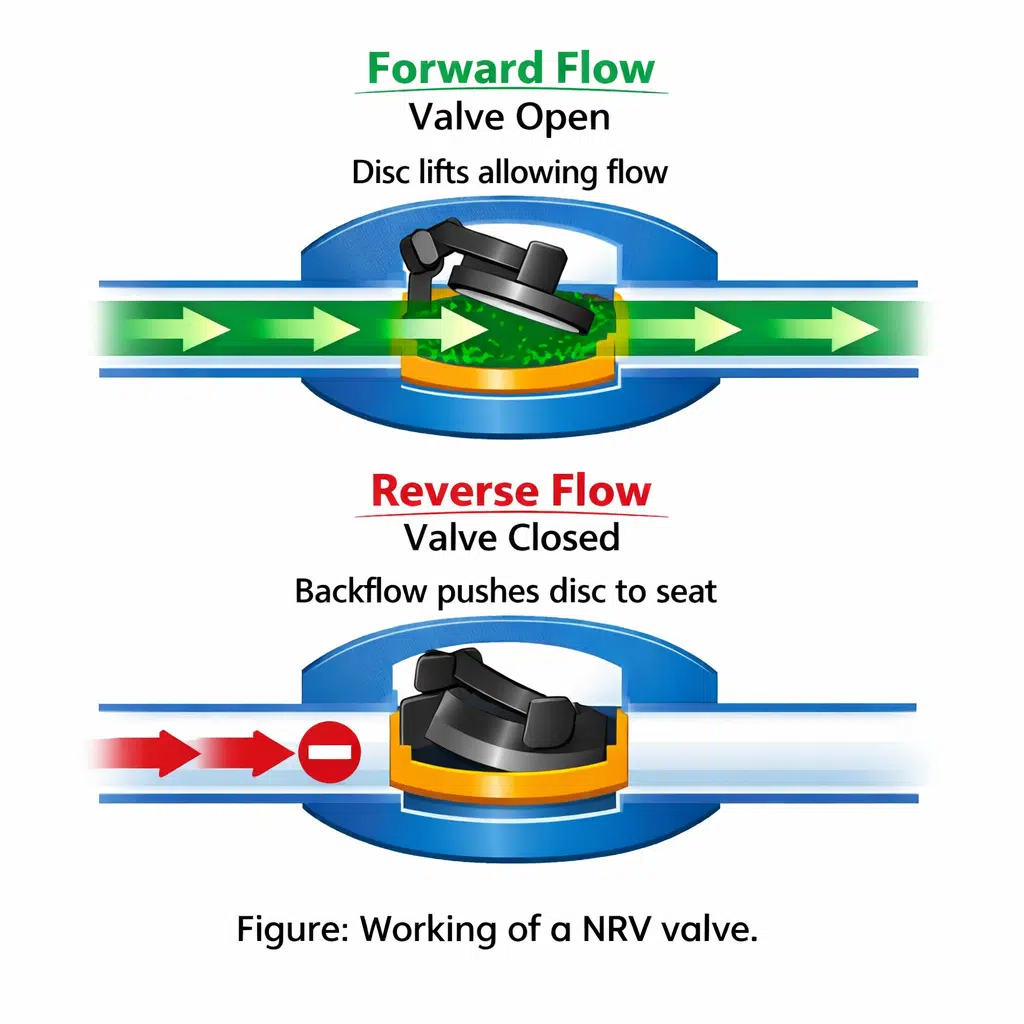
Basic working sequence
1. Forward flow begins
Fluid enters the inlet side of the valve in the correct direction.
2. The closure element lifts or moves
The disc, poppet, ball, or diaphragm moves away from the seat when forward pressure is strong enough.
3. The valve opens
Fluid continues through the valve as long as the opening force remains greater than the closing force.
4. Flow slows down or stops
As upstream pressure decreases, the closure element starts returning toward the seat.
5. Reverse flow is blocked
If downstream pressure becomes higher than upstream pressure, the valve closes and stops the fluid from flowing backward.
What is cracking pressure?
Cracking pressure is the minimum upstream pressure needed to begin opening the valve.
For many spring-loaded industrial NRV valves, cracking pressure may fall within a relatively low range such as approximately 0.1 to 5 psi, depending on valve size, spring selection, internal design, and service conditions.
This is important because:
-
if cracking pressure is too high, the valve may not open properly in a low-pressure system
-
if the valve is oversized, the closure element may move unstably
-
if the valve is poorly matched to the service, it may chatter, open incompletely, or close unreliably
What affects NRV valve performance?
Actual NRV valve behavior depends on:
-
valve type
-
internal geometry
-
spring force
-
line orientation
-
pressure fluctuation
-
flow velocity
-
fluid density
-
solids content
-
viscosity
-
pump start/stop behavior
-
available straight pipe run
NTGD field note
In low-pressure utility or gravity-fed systems, one of the most common selection mistakes is choosing an NRV valve with too much cracking pressure. The result is incomplete opening, unnecessary pressure loss, unstable internal movement, and earlier wear of the closure element.
NRV Valve Parts Name and Function (With Labeled Diagram)
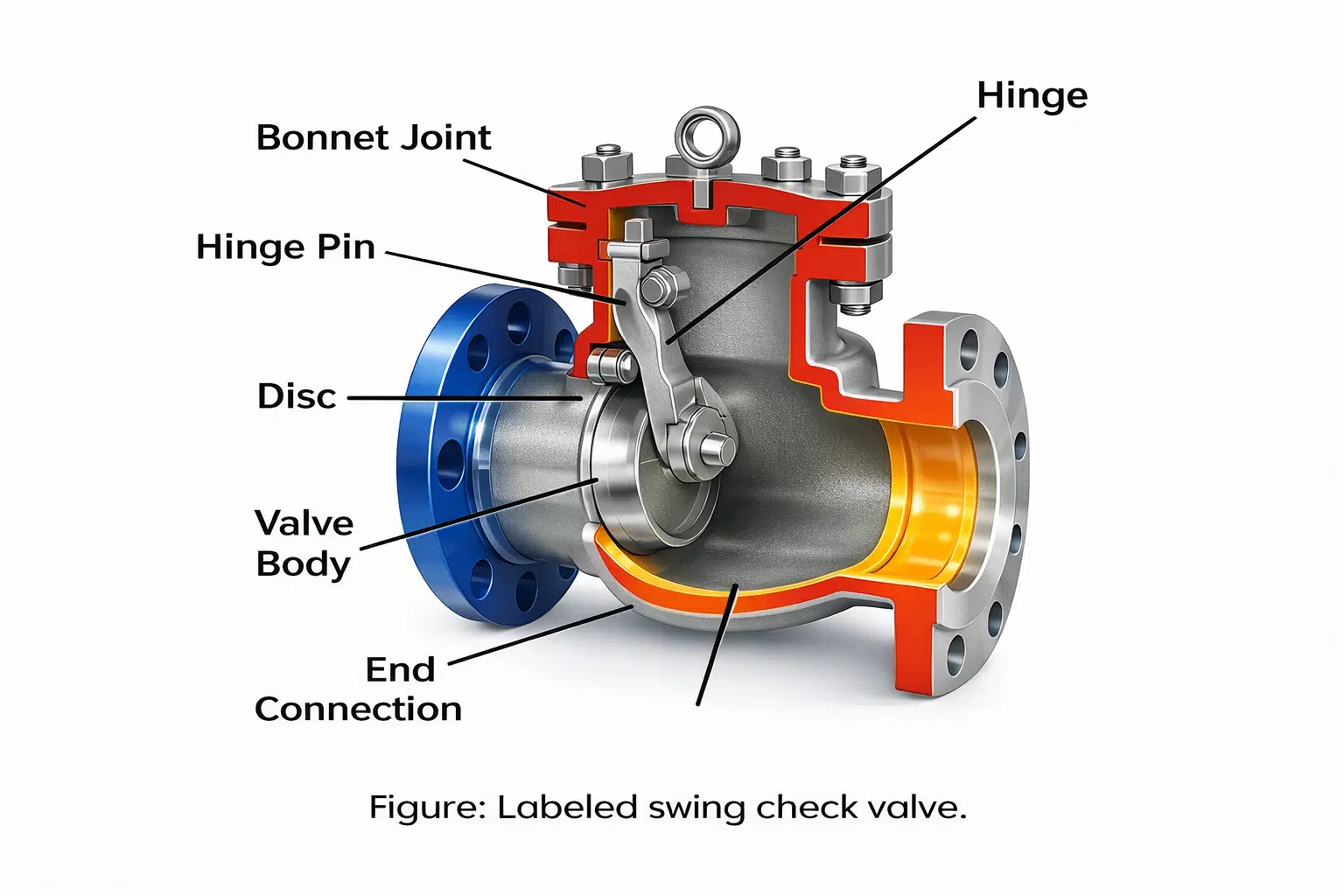
The exact internal construction depends on the valve design, but the following are the most common NRV valve parts names used in industrial service.
Main parts of an NRV valve
| Part | Function |
|---|---|
| Body | Main pressure-containing shell of the valve |
| Cover / Bonnet | Provides access to internal parts on some designs |
| Seat / Seat Ring | Sealing surface for shutoff |
| Disc / Poppet / Ball / Piston | Main closure element |
| Spring | Helps provide faster or more controlled closing |
| Hinge Pin / Arm | Supports disc movement in swing designs |
| Guide | Keeps the internal element aligned in inline designs |
| Gasket | Prevents leakage at body-cover joints |
| Fasteners | Hold pressure-containing parts together |
Part-by-part explanation
1. Body
The body forms the main flow passage and contains internal pressure.
Its material must match the pressure, temperature, and corrosion conditions of the service.
2. Cover or bonnet
Some NRV valves include a removable cover or bonnet for assembly access and maintenance.
3. Seat or seat ring
The seat is the sealing area where the internal closure element shuts against the body.
Seat condition is critical to reliable reverse-flow shutoff.
4. Disc, poppet, piston, or ball
This is the moving part that opens under forward flow and closes under reverse flow.
Different designs use different closure elements:
-
disc in swing designs
-
guided poppet in inline spring-loaded designs
-
ball in ball check valves
-
piston in lift or piston-type designs
-
flexible diaphragm in diaphragm NRV valves
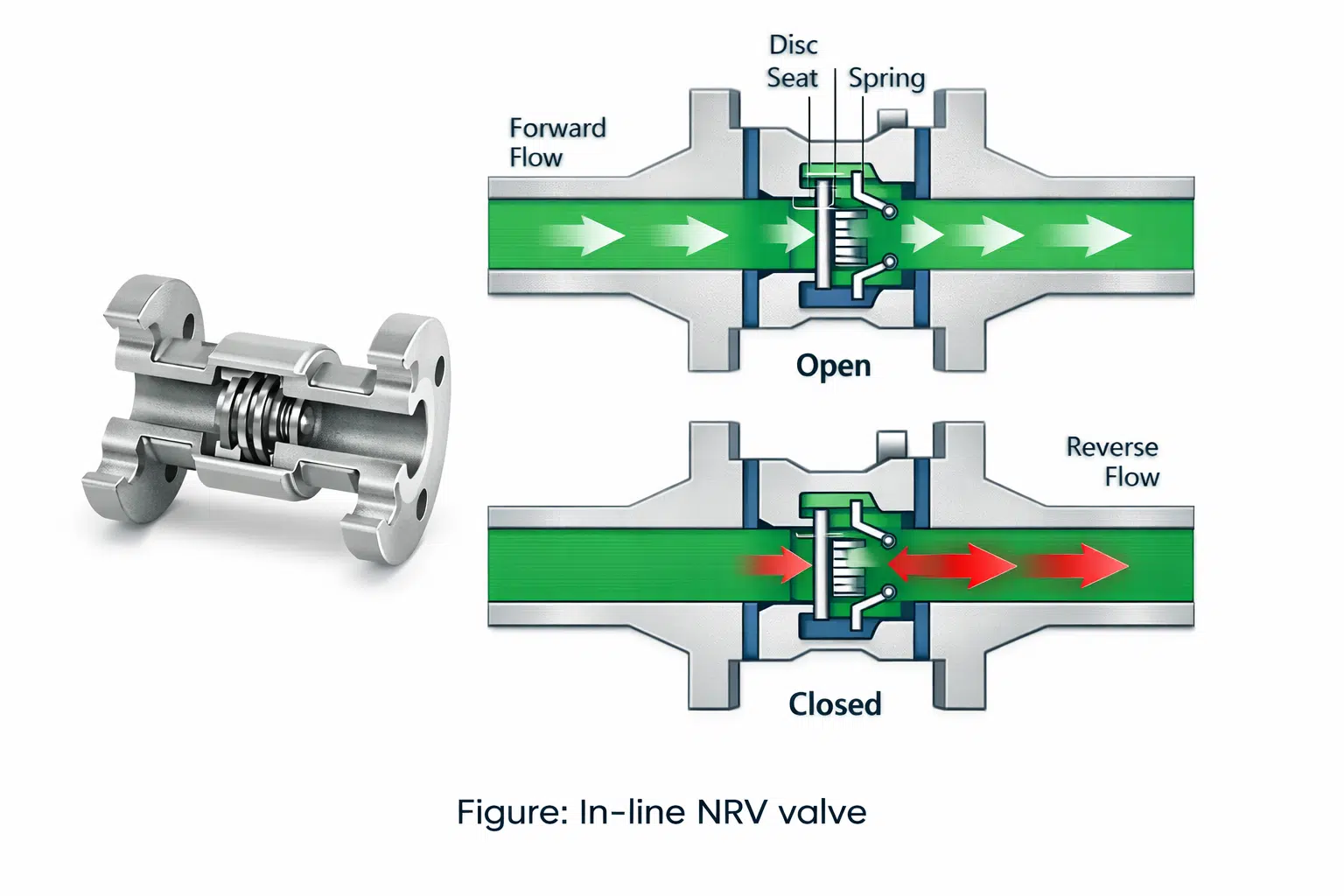
5. Spring
A spring helps the valve close faster and more positively.
This is especially important in services where reverse flow develops quickly.
6. Hinge pin or arm
In swing NRV valves, the disc rotates around a hinge arrangement.
7. Guide
Guides keep the internal moving parts aligned and reduce unstable movement.
8. Gasket
The gasket seals the body-cover joint and prevents external leakage.
9. Fasteners
Bolts, studs, and nuts hold the valve body assembly together.
Design variation matters
A swing NRV valve and an inline spring-loaded NRV valve do not use the exact same parts layout.
For example:
-
a swing NRV valve typically uses a body, seat, disc, hinge pin, cover, and gasket
-
a spring-loaded inline NRV valve typically uses a body, seat, spring, guided poppet or disc, retainer, and cover
-
a ball NRV valve typically uses a body, seat, ball, and service cover
That is why a labeled parts diagram is especially useful when users search for NRV valve parts name or NRV parts diagram.
Common Types of NRV Valves
Not all NRV valves behave the same way in service.
The correct design depends on the actual fluid, piping layout, flow reversal behavior, solids content, and pressure-loss tolerance.
Below are the most common industrial NRV valve types.
1. Swing NRV Valve
A swing NRV valve uses a hinged disc that swings away from the seat during forward flow and swings back to close when flow slows or reverses.
Best for
-
larger pipelines
-
low pressure-drop service
-
water systems
-
general industrial utility lines
Main strengths
-
simple structure
-
relatively low flow resistance
-
widely used in many sizes
-
easy to understand and maintain
Limitations
-
slower closing than spring-assisted designs
-
can be less suitable for rapid reversal service
-
may be more exposed to slam risk in some systems
Typical applications
-
water distribution
-
general utility service
-
larger process lines
-
stable-flow pump discharge systems
Selection warning
If a standard slow-closing swing NRV is used in a pump discharge line with rapid reverse-flow development, the system may face higher slam risk, stronger reverse shock, and greater piping stress than with a faster-closing spring-assisted design.
NTGD capability note
NTGD can support industrial swing NRV valve configurations for water, utility, and general process applications, with material and connection options selected according to project requirements.For product details and configuration options, see our swing check valve solutions.
2. Spring-Loaded Inline NRV Valve
This design uses a spring to help a guided disc or poppet return quickly to the seat. In pump discharge service where rapid reverse flow must be controlled, a spring-loaded check valve is often selected as a non-slam solution.
Best for
-
pump discharge service
-
systems requiring faster shutoff
-
compact inline piping layouts
-
services where reverse-flow shock must be controlled
Main strengths
-
faster closing response
-
compact body pattern
-
better suited for rapid reversal than many swing designs
-
useful where space is limited
Limitations
-
pressure drop is usually higher than swing designs
-
guided internals may be more sensitive to dirty media
-
spring design must match actual operating conditions
Typical applications
-
booster systems
-
clean utility lines
-
pump protection
-
compact process piping
Selection warning
If the spring force is too high for the available operating pressure, the valve may not open fully, causing unnecessary pressure drop and unstable operation.
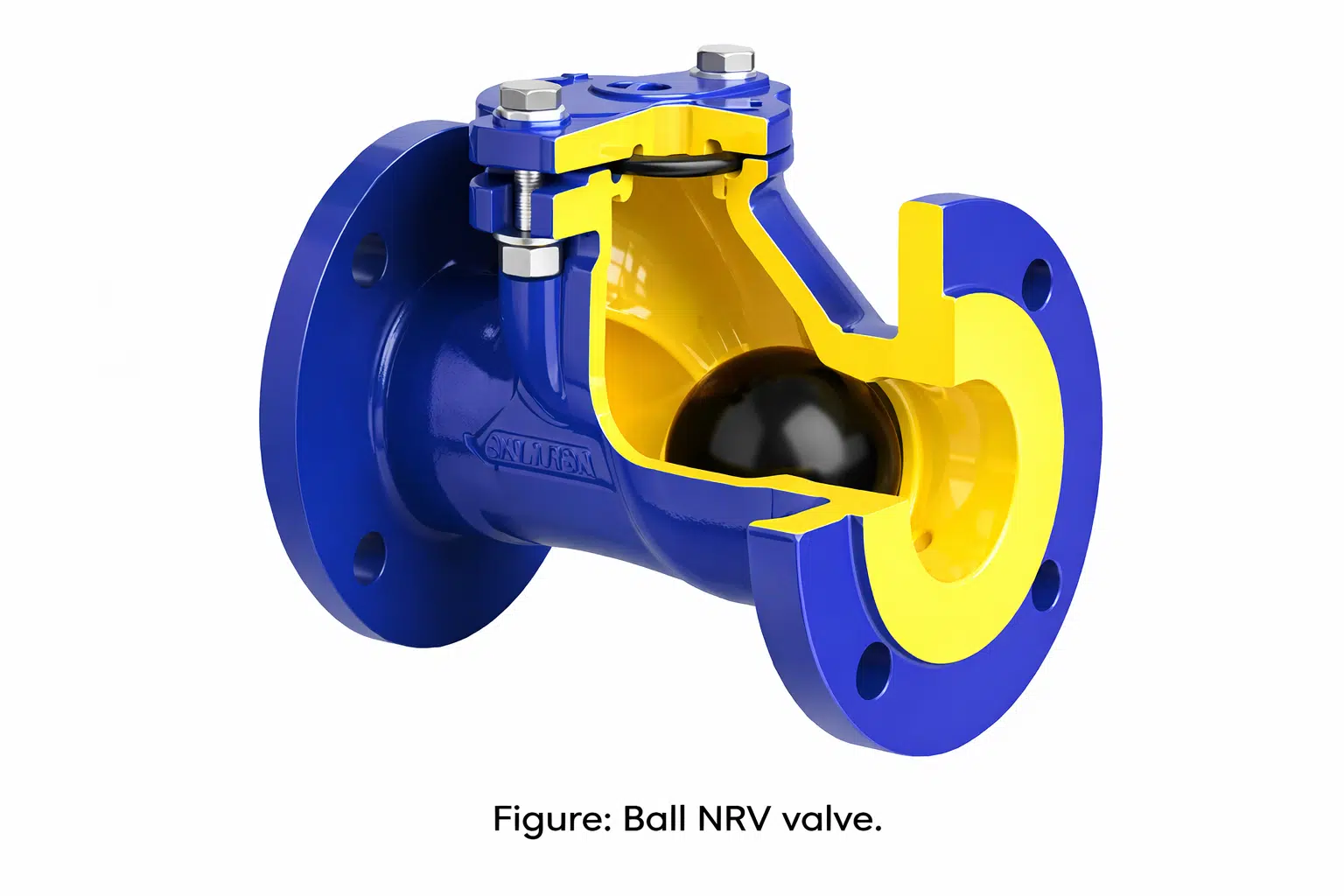
3. Ball NRV Valve
A ball NRV valve uses a ball-shaped closure element that moves away from the seat under forward flow and returns to the seat under reverse flow.
Best for
-
wastewater
-
viscous media
-
sludge service
-
solids-bearing liquids
Main strengths
-
simple internal movement
-
often better tolerance for dirty media
-
useful where fouling resistance matters
-
relatively maintenance-friendly in suitable services
Limitations
-
not ideal for every clean, high-performance service
-
sealing depends on seat condition and internal wear
-
not always the best choice where very fast closure is required
Typical applications
-
sewage lines
-
sludge transfer
-
viscous process fluids
-
wastewater pumping systems
NTGD field note
In solids-bearing wastewater service, a ball-type NRV is often more forgiving than a guided spring-loaded design. In practice, many clogging complaints come from using a clean-service check valve in dirty service rather than using a valve intended for solids.
4. Dual Plate NRV Valve
A dual plate NRV valve uses two spring-assisted plates in a compact wafer-style body.
Best for
-
compact piping layouts( “If installation space is limited, you can also review our broader wafer check valve range for compact piping layouts.)
-
industrial process lines
-
utility systems with limited face-to-face space
-
services needing faster closure than standard swing designs
Main strengths
-
compact and lightweight
-
relatively fast closure
-
common in modern process piping
-
suitable where installation space is limited
Limitations
-
internal components can be more sensitive to fouling than open swing designs
-
requires correct orientation and clean enough conditions
-
spring and hinge performance are critical
Typical applications
-
process piping
-
cooling water lines
-
industrial utility systems
-
compact skid-mounted systems
Additional terminology
A dual plate NRV valve is often also referred to as a wafer-style industrial check valve. For pressure class and size details, see our dual plate check valve page.
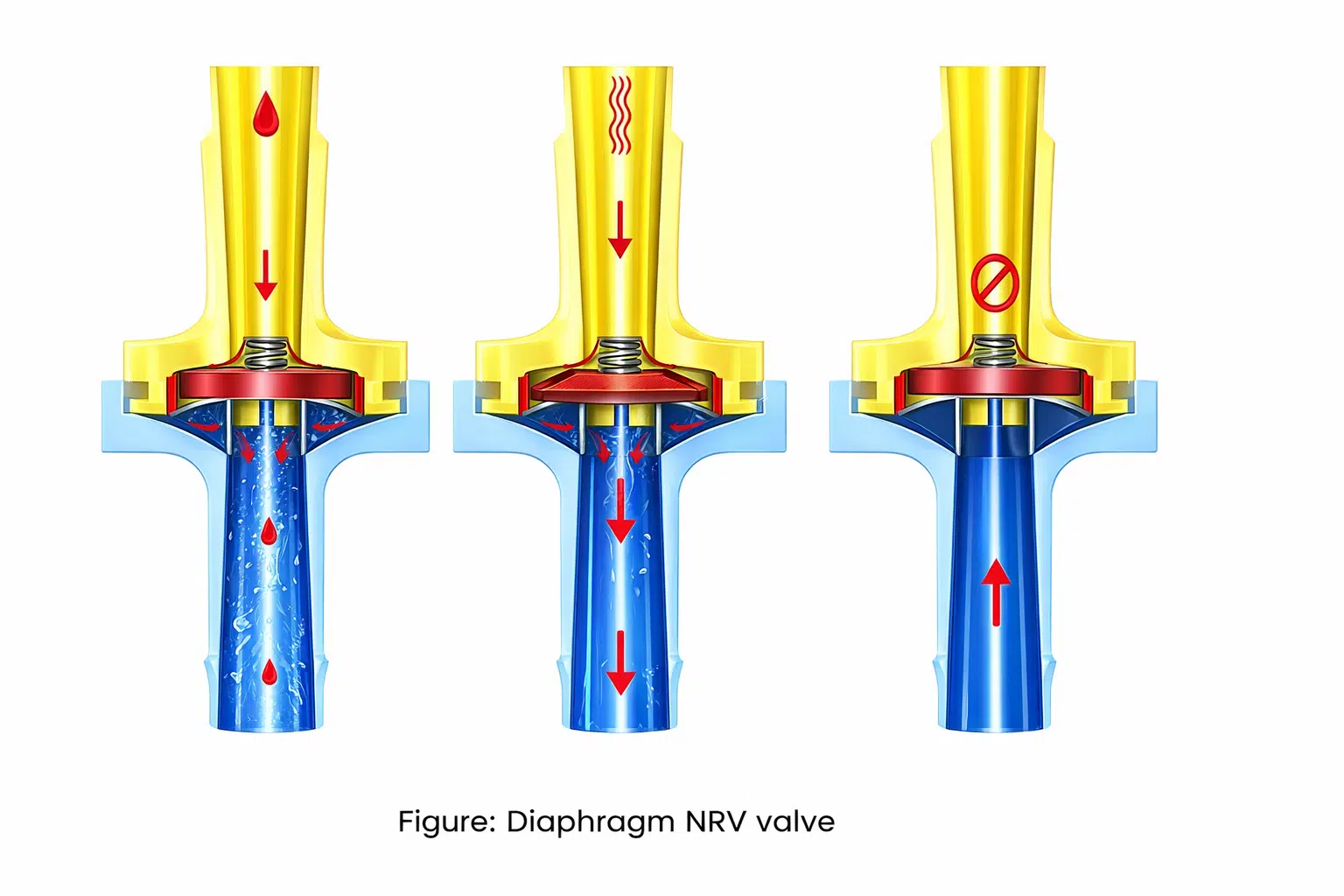
5. Diaphragm NRV Valve
A diaphragm NRV valve uses a flexible diaphragm as the closure element.
Best for
-
low-pressure systems
-
specialty chemical service
-
contamination-sensitive applications
-
selected clean process duties
Main strengths
-
smooth closure movement
-
simple internal concept
-
suitable for certain specialized media
Limitations
-
diaphragm life depends heavily on media and temperature
-
not suitable for every high-pressure industrial service
-
material compatibility is critical
Typical applications
-
dosing systems
-
selected chemical lines
-
low-pressure specialty service
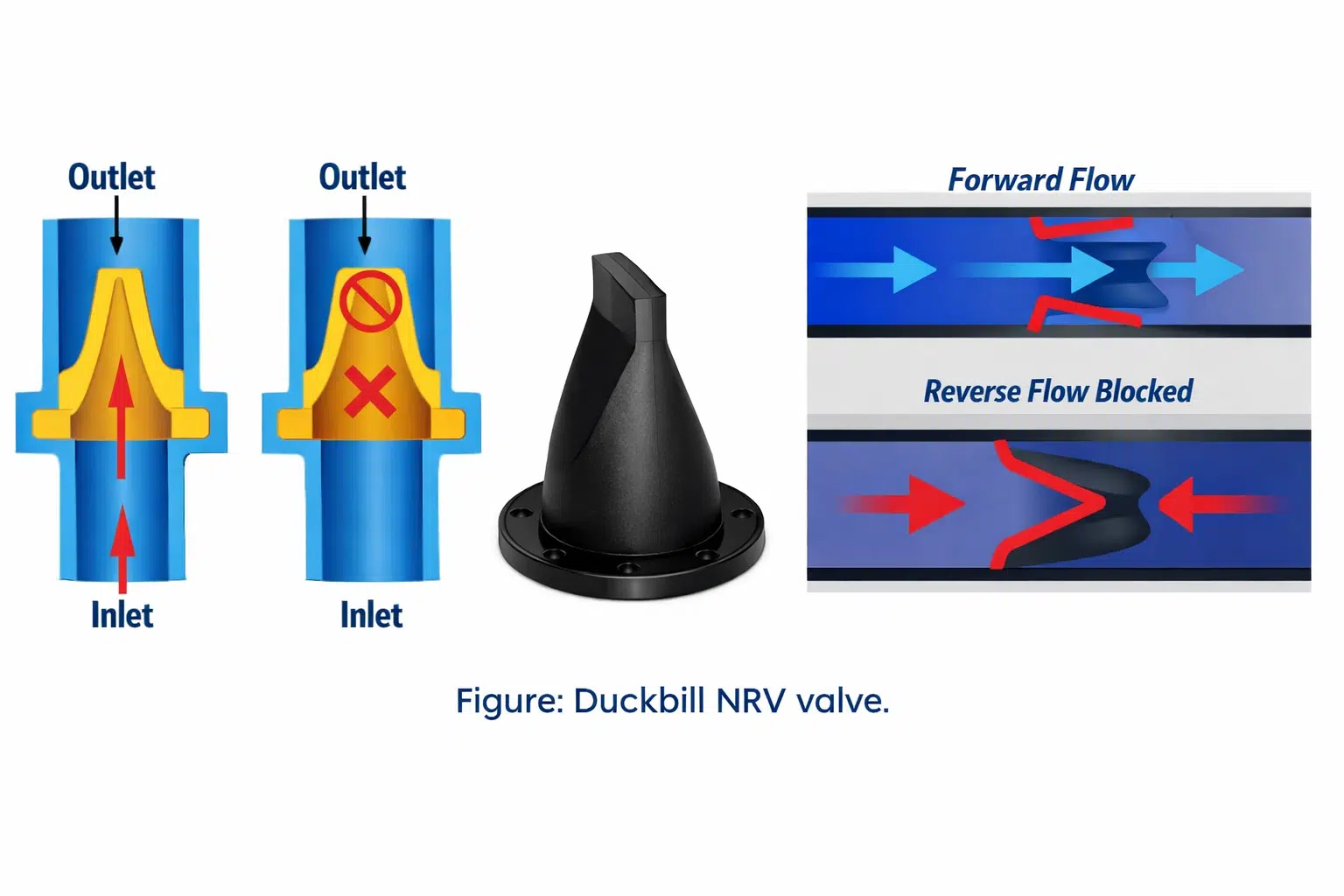
6. Duckbill NRV Valve
A duckbill NRV valve uses a flexible elastomer sleeve that opens under forward flow and collapses closed under reverse pressure.
Best for
-
drainage systems
-
wastewater discharge
-
low-head service
-
corrosive or abrasive media in suitable elastomer designs
Main strengths
-
no metal hinge or spring
-
simple operating concept
-
low maintenance in the right service
-
quiet operation
-
often self-draining
Limitations
-
not suitable for every pressure class
-
elastomer choice is critical
-
not a universal replacement for metal-bodied NRV valves
Typical applications
-
sewage outfall
-
low-pressure discharge systems
-
drainage and effluent lines
Other Specialized NRV Designs
Some NRV valve designs are more specialized and are not usually the first choice for general industrial service.
Stop NRV Valve
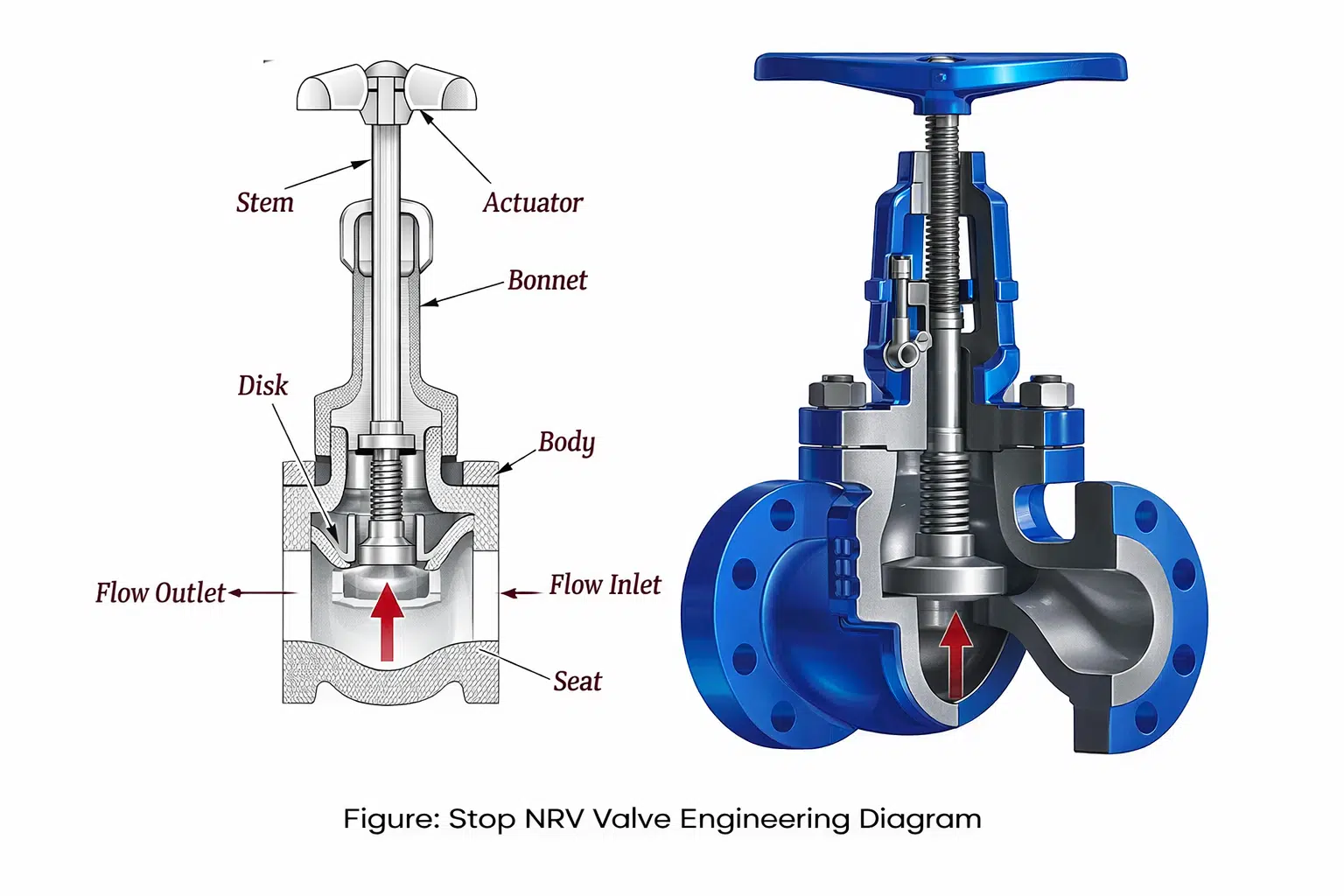
A stop NRV valve combines non-return function with a manual shutoff mechanism.
It can be useful in certain boiler or equipment-protection services, but it is more specialized than the standard NRV types above.
For a general NRV valve guide, the most important designs remain:
-
swing
-
spring-loaded inline
-
ball
-
dual plate
-
diaphragm
-
duckbill
NRV Valve Type Comparison for Industrial Service
Below is a practical comparison of common industrial NRV valve types.
| Valve Type | Best-Fit Service | Typical Pressure Drop | Closing Speed | Dirty Media Tolerance | Main Selection Note |
|---|---|---|---|---|---|
| Swing NRV | Large lines, low-resistance flow | Low | Moderate | Medium | Good when low pressure drop matters more than fast closure |
| Spring-Loaded Inline NRV | Pump discharge, fast shutoff | Medium | Fast | Low to medium | Better where rapid reversal must be controlled |
| Ball NRV | Wastewater, viscous or solids-bearing media | Medium | Moderate | High | More tolerant of fouling in dirty service |
| Dual Plate NRV | Compact industrial piping | Low to medium | Fast | Medium | Good where installation space is limited |
| Diaphragm NRV | Specialty low-pressure service | Low to medium | Moderate | Medium | Material compatibility is critical |
| Duckbill NRV | Low-head drainage and wastewater | Low | Passive fast closure | High | Best in suitable pressure range and elastomer service |
How to read this comparison
There is no universal best NRV valve.
-
Choose swing NRV if low pressure drop is the main priority.
-
Choose spring-loaded inline NRV if quick closure matters more than pressure loss.
-
Choose ball NRV if the media contains solids, sludge, or viscous components.
-
Choose dual plate NRV if space is limited and a compact body is preferred.
-
Choose duckbill or diaphragm designs only when the pressure range, media, and material compatibility are suitable.
If your project is specifically comparing compact wafer-style designs with conventional swing designs, see our wafer check valve vs swing check valve guide.
How to Select the Right NRV Valve
Choosing the right NRV valve requires more than matching line size and pressure class.
In real projects, long-term reliability depends on whether the valve behavior fits the actual operating conditions.
1. Define the fluid or media
Start with the medium.
Ask:
-
Is it clean water?
-
Is it wastewater?
-
Is it chemical media?
-
Is it viscous?
-
Does it contain solids, fibers, or scale?
A valve that works well in clean water may fail early in sludge, slurry, or fouling-prone service.
2. Confirm pressure and temperature
The body, seat, spring, and internal trim must be suitable for the actual pressure-temperature range.
This affects:
-
body strength
-
seat performance
-
corrosion resistance
-
spring stability
-
shutoff reliability
For corrosive industrial applications, NTGD can support NRV valve material options based on media compatibility, including stainless steel and other project-specific material selections where required.
3. Review pressure-drop limits
Some systems cannot tolerate much pressure loss.
If low pressure drop is the priority, a swing design is often considered first.
If faster closure is more important than low pressure drop, a spring-assisted design may be the better choice.
4. Review reverse-flow behavior
This is one of the most important selection steps.
Ask:
-
Does reverse flow occur suddenly?
-
Does the pump stop quickly?
-
Is the line long?
-
Is hydraulic shock a concern?
If reverse flow develops quickly, a slow-closing design may not be the best option.
5. Check installation orientation
Some NRV valves are more sensitive than others to installation position.
Before selection, confirm:
-
horizontal or vertical installation
-
actual flow direction
-
gravity effect on closure
-
available straight pipe run
NTGD field note
One common field failure is installing a standard swing NRV in a vertical upward flow line where the closure behavior is unstable for that design. When flow stops, incomplete closure may allow damaging reverse flow.
6. Review solids and fouling risk
Dirty media often causes more NRV failures than pressure rating problems.
If the service contains:
-
solids
-
sludge
-
fibers
-
scale
-
sticky deposits
then the internal movement and seat arrangement must be chosen accordingly.
7. Review maintenance access
If the system is difficult to shut down, maintenance access matters.
Compact inline designs save space, but service-friendly body styles may be more practical where inspection frequency is higher.
8. Match the valve to the real failure risk
The best valve is not the one with the longest catalog description.
It is the one that best reduces the main risk in the system.
For example:
-
if your main risk is pressure drop, choose accordingly
-
if your main risk is slam, choose accordingly
-
if your main risk is fouling, choose accordingly
-
if your main risk is maintenance difficulty, choose accordingly
Step-by-step industrial selection checklist
Use the checklist below before requesting quotation:
Core operating data
-
Line size
-
Operating pressure
-
Operating temperature
-
Flow rate
Media data
-
Media type
-
Viscosity
-
Solids content
-
Corrosiveness
Performance requirements
-
Pressure-drop limit
-
Required closure speed
-
Cracking pressure sensitivity
-
Anti-slam requirement
Installation details
-
Horizontal or vertical line
-
Available face-to-face space
-
End connection type
-
Straight pipe availability
Material requirements
-
Body material
-
Seat or trim material
-
Elastomer requirements where applicable
If these details are clear, NRV valve selection becomes much more reliable.
Common Applications of NRV Valves
NRV valves are used anywhere reverse flow could damage equipment, contaminate media, or destabilize the system.
Common applications include:
-
water treatment systems
-
wastewater and sewage transport
-
pump discharge lines
-
condensate and utility systems
-
irrigation lines
-
chemical transfer lines
-
food and beverage processing
-
pharmaceutical process service
-
oil and gas auxiliary systems
-
power plant utility piping
Example: pump protection
In a vertical pump installation, the NRV valve on the discharge line helps prevent liquid from flowing backward through the pump when the pump stops. Without that protection, the pump may rotate in reverse and suffer damage to the motor, impeller, or related equipment.
Example: wastewater service
In wastewater pumping systems, a ball NRV or duckbill NRV may be preferred where solids tolerance is more important than precision closure behavior. In these systems, selecting a fouling-tolerant design often reduces cleaning frequency and downtime.
Advantages of NRV Valves
NRV valves are widely used because they provide several practical advantages.
-
automatic operation
-
no external actuator required in most cases
-
equipment protection against reverse flow
-
reduced contamination risk
-
broad industrial applicability
-
relatively simple operating principle
-
useful across multiple body styles and sizes
-
helps maintain system flow direction
Limitations of NRV Valves
NRV valves are highly useful, but they are not universal solutions.
-
wrong selection can cause unstable operation
-
some designs are more exposed to slam than others
-
internal wear cannot always be seen externally
-
some valves are sensitive to fouling or incorrect orientation
-
an NRV valve does not replace isolation or control valves
-
one-direction service only
The limitation is usually not the concept of the NRV valve itself.
The limitation is often mismatch between valve behavior and actual service conditions.
Common Problems, Installation Mistakes, and Troubleshooting
Many NRV valve problems are not caused by basic manufacturing defects.
In the field, they are more often linked to incorrect selection, poor installation, unstable flow, debris, or unsuitable service conditions.
1. Leakage at the body or connection
Possible causes
-
loose fasteners
-
damaged gasket
-
flange misalignment
-
incorrect installation torque
-
body damage
What to check
-
verify bolt tightening
-
inspect gasket condition
-
inspect flange faces
-
check for cracks or impact damage
2. No flow through the valve
Possible causes
-
pipeline blockage
-
internal debris
-
insufficient upstream pressure
-
wrong installation direction
-
valve stuck closed
What to check
-
confirm the flow arrow on the body
-
check upstream pressure
-
inspect for internal blockage
-
confirm that cracking pressure is not too high for the system
3. Reverse flow is not fully stopped
Possible causes
-
seat wear
-
damaged closure element
-
debris on sealing surface
-
incorrect valve type for the service
-
slow closure under rapid reversal
What to check
-
inspect the seat
-
inspect the disc, poppet, or ball
-
check for solids or scale buildup
-
review whether a faster-closing design is needed
4. Chatter, noise, or unstable movement
Possible causes
-
oversized valve
-
unstable flow velocity
-
insufficient velocity to hold the valve open
-
pulsating service
-
poor installation location
What to check
-
review actual flow conditions
-
verify sizing
-
inspect internal guiding parts
-
check whether the valve is installed too close to turbulence sources
Field symptom
In practice, chatter often sounds like repeated metallic tapping or rapid internal knocking. This happens when the disc or poppet opens and closes repeatedly under unstable flow conditions.
5. Slam or hydraulic shock concerns
Possible causes
-
slow-closing valve used in a rapid reversal system
-
pump shutdown causing sudden reverse flow
-
unsuitable valve type
-
poor placement in the piping layout
What to check
-
review how quickly reverse flow develops
-
consider faster-closing spring-assisted designs
-
review pump stop behavior
-
check whether the valve is located appropriately in the system
“For systems where water hammer control is a primary concern, a silent check valve may be a better fit than a conventional slow-closing design.
6. Frequent maintenance or jamming
Possible causes
-
dirty media in a clean-service valve
-
solids accumulation
-
scale buildup
-
sticky deposits
-
poor maintenance access
What to check
-
review the real media condition
-
confirm whether the valve design is suitable for solids
-
inspect for internal fouling
-
consider a more fouling-tolerant valve type
Practical engineering note
A very common project mistake is selecting an NRV valve based only on line size and pressure class, while ignoring:
-
reversal speed
-
solids content
-
orientation
-
available pressure
-
turbulence level
In real industrial service, these factors often determine whether the valve performs reliably over the long term.
NRV Valve vs Check Valve
In most industrial situations, NRV valve and check valve refer to the same function.
The difference is usually terminology, not operating principle.
-
NRV valve emphasizes non-return function
-
check valve is often the more common catalog and engineering term
-
both describe a valve that automatically prevents reverse flow
So if a buyer asks for an NRV valve while a specification refers to a check valve, the technical solution is usually the same: choose the correct valve design for the service.
NTGD can support the correct industrial valve solution regardless of whether the project language uses NRV valve, check valve, or one-way valve.
Need Help Selecting the Right NRV Valve?
To recommend a suitable industrial NRV valve, the following information is usually needed:
-
fluid or media
-
line size
-
operating pressure
-
operating temperature
-
flow direction and installation orientation
-
clean or solids-bearing service
-
preferred body material
-
end connection type
-
pressure-drop limitation
-
anti-slam or fast-closing requirement
If your project requires confirmation of material, pressure class, compact face-to-face dimensions, or closure performance, NTGD can review the application before quotation.
Request technical support for:
-
NRV valve type selection
-
material recommendation
-
pressure class confirmation
-
compact piping layout review
-
pump discharge valve recommendation
-
dirty-media or wastewater NRV solutions
Send your application details for technical selection support and quotation.
Frequently Asked Questions
1. What is NRV valve full form?
NRV valve full form is Non-Return Valve.
2. Is an NRV valve the same as a check valve?
In most industrial piping systems, yes. NRV valve and check valve usually refer to the same function: automatic prevention of reverse flow.
3. How does an NRV valve work?
It opens when forward pressure overcomes the closing force and closes automatically when flow slows or reverses.
4. What are the main parts of an NRV valve?
Common parts include the body, seat, disc or poppet, spring, guide or hinge pin, gasket, and cover.
5. Which NRV valve is best for pump discharge lines?
That depends on system behavior, but spring-loaded inline or other faster-closing designs are often preferred where rapid reverse flow may occur.
6. Can NRV valves be installed vertically?
Some can, but not all. Installation suitability depends on valve design, closure mechanism, and manufacturer guidance.
7. What causes an NRV valve to leak or fail to close?
Common causes include worn seats, debris, incorrect valve type, unstable flow, wrong installation direction, or unsuitable service conditions.
8. How do I choose the right NRV valve for industrial service?
Select based on media, pressure, temperature, solids content, installation orientation, pressure-drop limits, and reverse-flow behavior.
Request Industrial NRV Valve Support
Looking for the right NRV valve for your project?
Send us your application details, including media, size, pressure, temperature, and installation orientation.
NTGD can help you evaluate:
-
the right NRV valve type
-
material and trim options
-
pressure class and end connection
-
anti-slam or fast-closing requirements
-
solutions for dirty, viscous, or solids-bearing media
