
If you are selecting a check valve for a pump discharge line, circulating water system, or other industrial piping sensitive to reverse flow and valve slam, understanding the difference between a tilting disc check valve and a conventional swing check valve is critical.
A tilting disc check valve is designed to close faster than a standard swing check valve because its disc rotates on an offset pivot and travels a shorter closing distance. In properly selected applications, this helps reduce reverse flow distance, lower slam tendency, and improve shutdown stability after pump trip or flow decay.
This guide explains how a tilting disc check valve works, where it is used, how it compares with a swing check valve, what its engineering limitations are, and how to choose the right design for your system.
Request Datasheet & Technical Support
Need detailed specifications, material options, dimensional drawings, or application support?
Contact NTGD Valve to request the tilting disc check valve datasheet and project-based selection support.
What Is a Tilting Disc Check Valve?
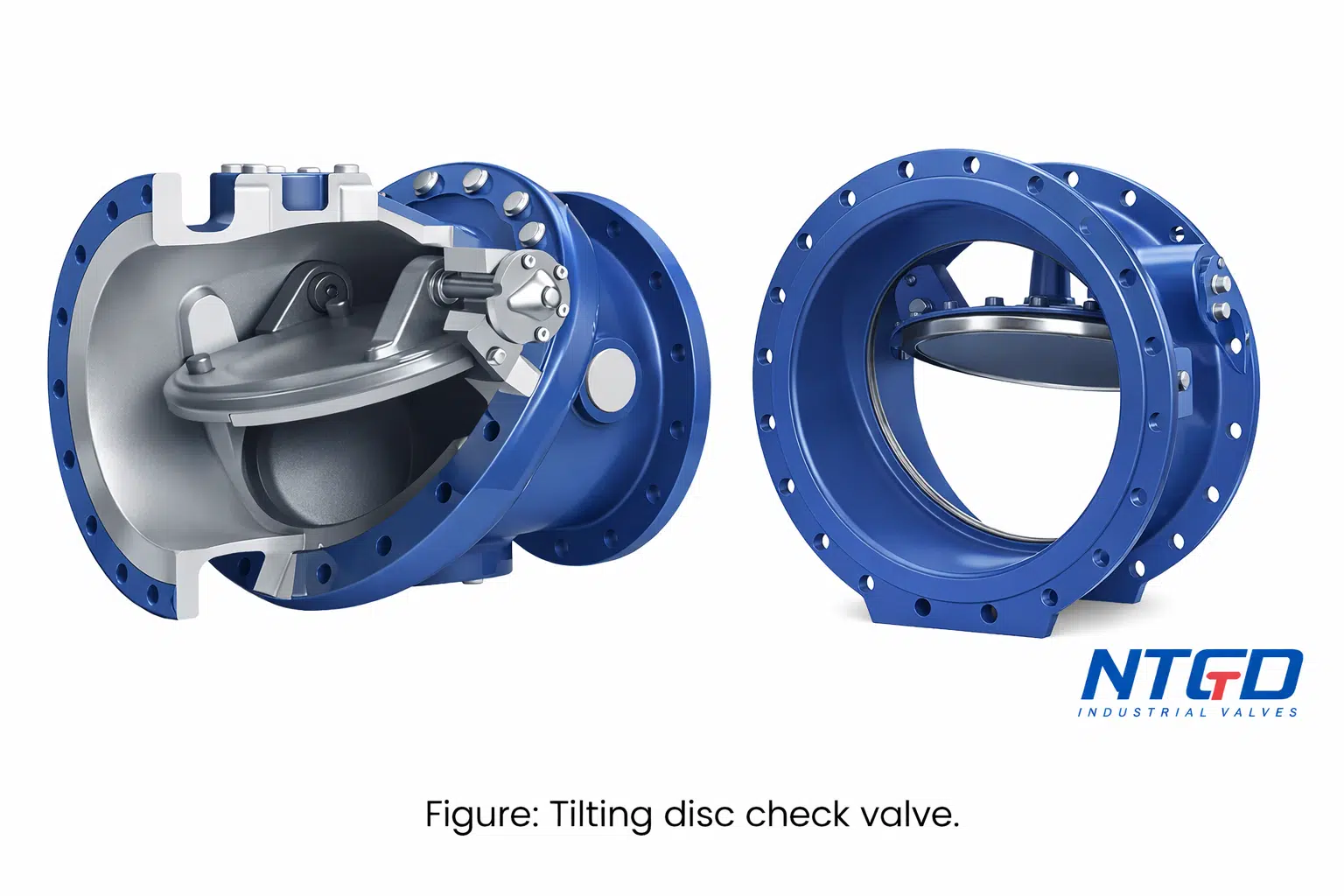
A tilting disc check valve is an automatic non-return valve used to prevent reverse flow in industrial piping systems. It opens when upstream pressure and forward flow are sufficient to move the disc away from the seat, and it closes as flow decays or reverses.
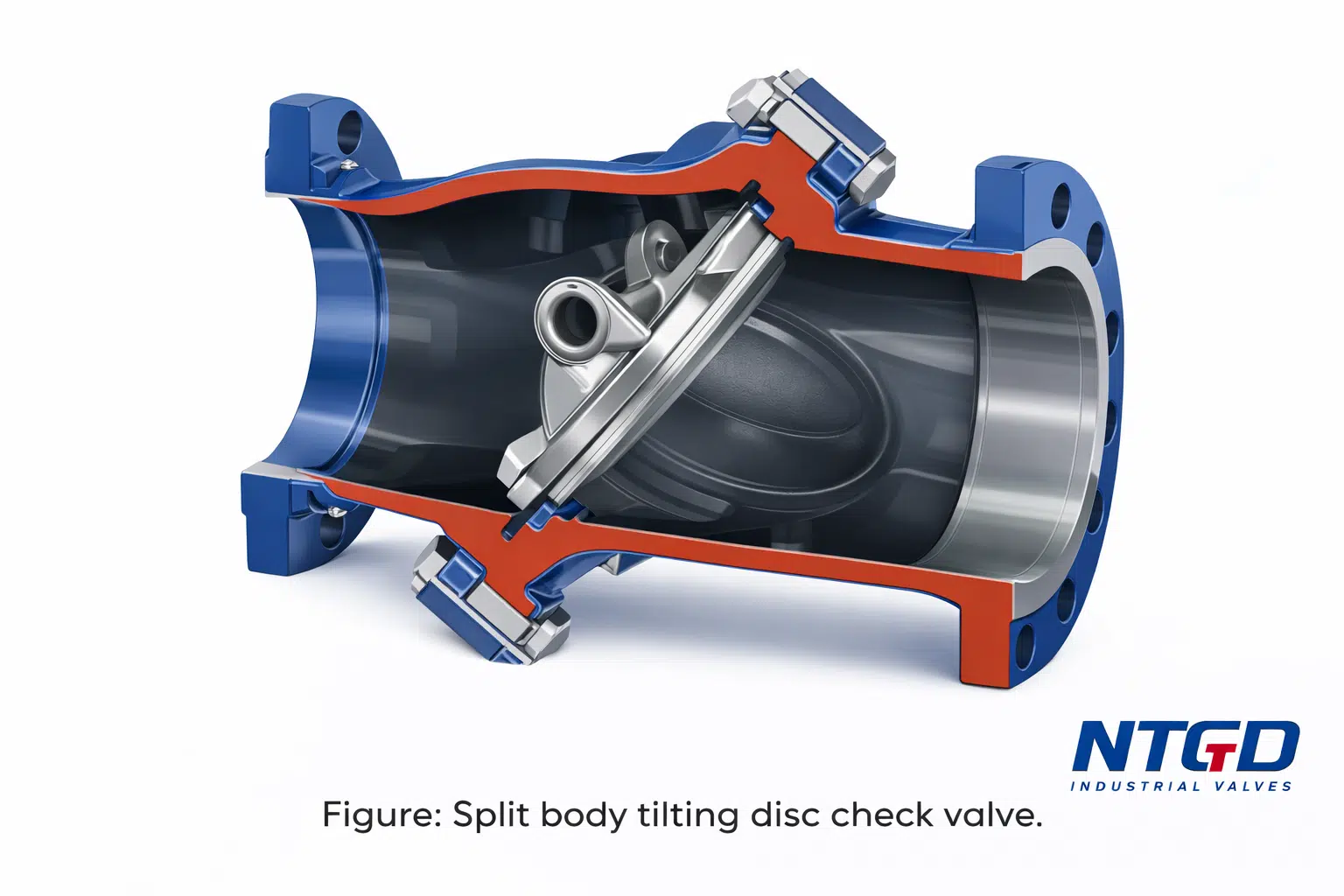
Unlike a conventional swing check valve, which uses a full swinging motion, a tilting disc check valve uses a disc mounted on an offset pivot shaft. This design shortens the disc travel during closing and allows a quicker response to reverse-flow conditions.
Because of this geometry, tilting disc check valves are commonly selected for pump discharge lines, circulating water systems, HVAC systems, cooling water service, and other applications where reducing slam tendency is important.
How Does a Tilting Disc Check Valve Work?
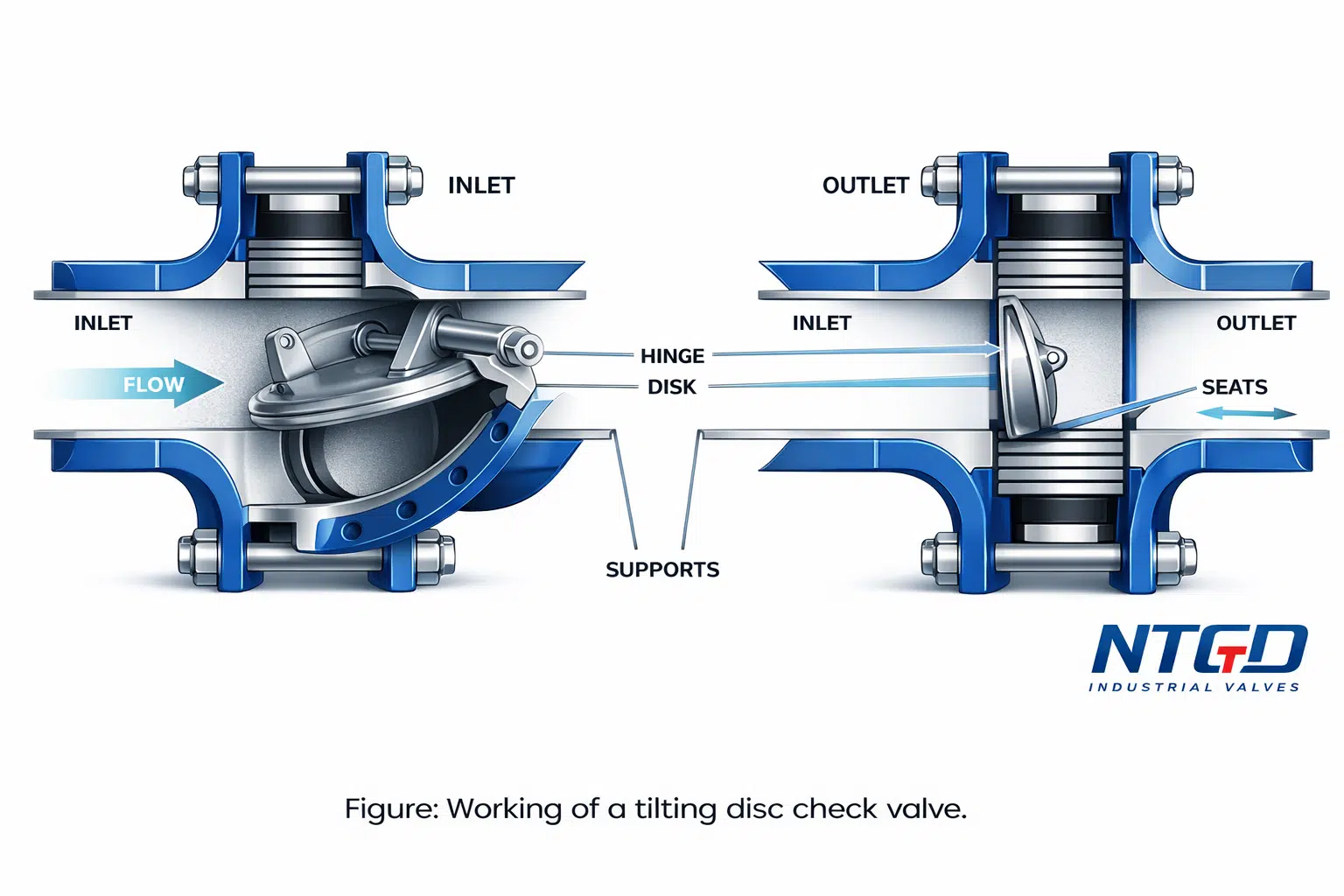
A tilting disc check valve works by differential pressure.
When upstream pressure becomes greater than downstream pressure and the forward flow force is high enough, the disc tilts away from the seat and allows fluid to pass through the valve. As long as the system remains in stable forward flow, the disc stays open or partially open depending on actual operating conditions.
When the pump slows down, the flow rate drops, or reverse flow starts to develop, the force holding the disc open decreases. The disc then returns toward the seat under the combined effect of gravity, reverse-flow force, disc geometry, and in some designs spring or damping assistance.
Because the pivot is offset and the disc closing distance is shorter than in a conventional swing check valve, the valve can close faster and reduce the amount of reverse flow that develops before shutoff.
Key operating features
-
Opens automatically under forward differential pressure
-
Closes as flow decays or reverses
-
Uses shorter disc travel than a conventional swing check valve
-
Helps reduce slam tendency in suitable pump and process applications
-
Performance depends on correct sizing, installation, and system conditions
Why Dynamic Closing Characteristics Matter
Many articles simply say that a tilting disc check valve “closes faster,” but in real engineering practice, the issue is more important than speed alone.
A valve should not just close quickly. It should close in a way that matches the pump rundown behavior, system deceleration rate, and reverse-flow development of the piping system. If a valve closes too slowly, excessive reverse flow may develop before shutoff, resulting in slam, seat damage, vibration, and possible pump reverse rotation. If it closes too aggressively in the wrong system, hydraulic shock can still occur.
In critical pump discharge service, the real objective is to achieve controlled closure that reduces reverse flow and limits seat impact. That is why tilting disc check valves are often preferred over conventional swing check valves in transient-sensitive systems.
In projects where lower slam tendency and pump protection are important, users also compare non slam check valve options and silent check valve comparison guidance.
Why Is a Tilting Disc Check Valve Used?
A tilting disc check valve is mainly used where users need more controlled and faster closure than a conventional swing check valve can provide.
Typical reasons for selecting this design include:
-
reducing reverse flow distance after pump shutdown
-
lowering slam tendency in pump discharge systems
-
improving shutdown stability in circulating water lines
-
maintaining relatively low pressure loss compared with some other check valve types
-
improving reliability in systems where repeated swing check valve seat damage has occurred
A tilting disc check valve should not be described as a universal solution for all water hammer problems. However, in properly selected systems, it is often a better choice than a standard swing check valve when anti-slam performance matters.
Tilting Disc Check Valve vs Swing Check Valve
This is one of the most important decisions in check valve selection.
A swing check valve is widely used because it is simple, proven, and economical. However, its disc usually travels through a longer arc, which can result in slower closure under changing flow conditions.
A tilting disc check valve uses an offset pivot and shorter disc travel. This often makes it a better option for pump discharge service and other systems where backflow control and reduced slam tendency are more important than minimum initial cost.
Comparison Table: Tilting Disc Check Valve vs Swing Check Valve
| Decision Factor | Tilting Disc Check Valve | Swing Check Valve |
|---|---|---|
| Disc motion | Tilting disc on offset pivot | Full swing motion on hinge |
| Closing response | Faster in many services | Usually slower |
| Reverse flow before closure | Lower in suitable systems | Often greater |
| Slam tendency | Lower in transient-sensitive systems | Higher in many pump shutdown conditions |
| Pressure drop | Generally low | Also low when fully open |
| Pump discharge suitability | Often preferred | Common, but may be less effective against slam |
| Initial cost | Higher | Lower |
| Best-fit application | Anti-slam duty, pump discharge, circulating systems | General non-return duty with stable flow |
For general reverse-flow service, you can also review our swing check valve solutions and broader check valve product range.
Selection insight
If your system mainly needs low-cost reverse-flow prevention under stable operating conditions, a swing check valve may still be acceptable. If pump shutdown, reverse flow, or slam tendency is a concern, a tilting disc check valve is often the more appropriate engineering solution.
Need help choosing between tilting disc and swing check?
Send NTGD Valve your flow rate, pressure class, medium, temperature, and installation orientation for application review and selection support.
Clarification: Tilting Disc Check Valve vs Dual Plate Check Valve
These two valve types are often confused, but they are not the same.
A tilting disc check valve uses one solid disc mounted on an offset pivot shaft. It is commonly chosen for medium- to large-diameter lines where controlled closure and anti-slam performance are important.
A dual plate check valve, also called a double door wafer check valve, uses two half-discs mounted on a central hinge pin with springs. It is compact and lightweight, which makes it useful where space is limited, but its structure and application logic are different from a tilting disc design.
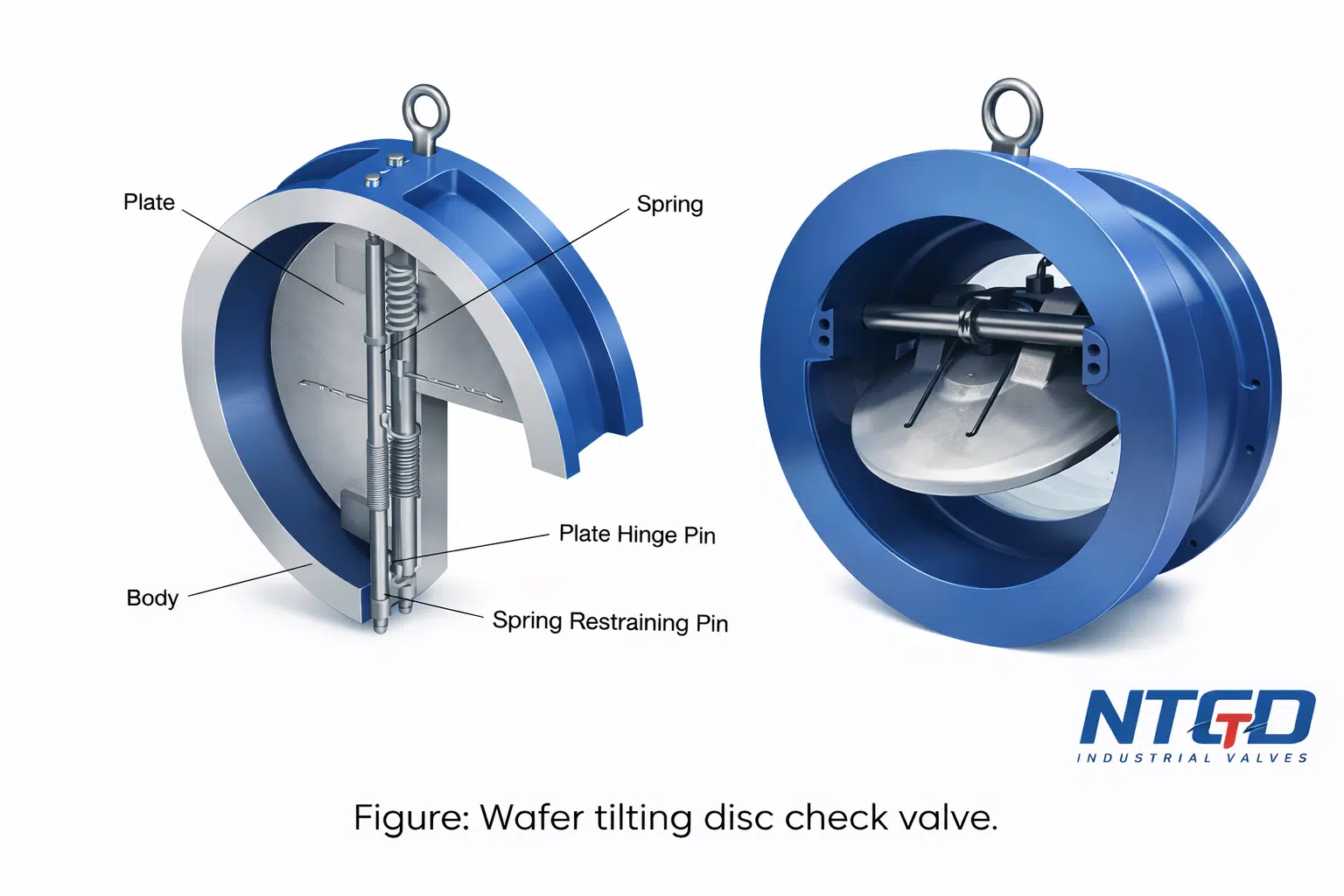
Key difference
-
Tilting disc check valve: single disc, offset pivot, short closing travel, often selected for pump discharge anti-slam duty
-
Dual plate check valve: two spring-loaded half-discs, compact wafer body, often used where face-to-face length and installation space are limited
This distinction matters because using a compact dual plate valve in a large, high-flow pump discharge system may not deliver the same closure behavior or durability expected from a properly selected tilting disc check valve.
Key Advantages of Tilting Disc Check Valves
Faster closure than conventional swing check valves
The shorter disc travel allows faster response as forward flow decreases.
Lower slam tendency in suitable applications
This is one of the main reasons the valve is selected in pump discharge and circulating systems.
Good flow performance
Tilting disc check valves usually provide relatively low pressure loss compared with some other non-return valve types.
Suitable for medium- and large-diameter lines
They are often used where both flow efficiency and controlled closure are required.
Available in multiple configurations
Depending on service requirements, the valve may be supplied with bolted cover, pressure seal bonnet, welded body, spring assistance, lever and weight, or damping arrangements.
Limitations and Boundary Conditions
A strong engineering page should explain not only where a valve works well, but also where it may not.
Low flow can cause unstable disc behavior
If actual operating flow is too low, the disc may not fully open. This can lead to chatter, turbulence, wear, and unstable operation.
Oversizing is a common selection mistake
Choosing the valve by pipe size alone can cause poor performance if the normal operating flow is not high enough to keep the disc in a stable open position.
Installation orientation must be confirmed
Some designs are intended mainly for horizontal pipelines. Vertical installation may be possible for certain configurations, but it must always be verified against the actual valve design and manufacturer recommendation.
Additional anti-slam devices may still be required
In severe transient conditions, a standard tilting disc check valve alone may not be enough. A spring-assisted design, hydraulic dashpot, or system surge review may still be necessary.
Higher initial cost than a swing check valve
The structure is usually more complex, and the purchase cost is often higher. However, this may be justified when lifecycle cost, maintenance, or repeated slam damage is considered.
Critical note
A tilting disc check valve can help reduce slam tendency, but actual performance depends on system conditions such as pump shutdown characteristics, reverse-flow development, valve sizing, flow velocity, and installation layout.
Main Components of a Tilting Disc Check Valve
Valve body
The body forms the pressure boundary and houses all internal components. Common materials include ductile iron, carbon steel, stainless steel, and alloy steel.
Cover or bonnet
The cover allows access to the valve internals and may be bolted, pressure sealed, or welded depending on design and pressure class.
Disc
The disc is the main closing element. It tilts away from the seat in forward flow and returns to the seat as flow decays or reverses.
Seat
The seat is the sealing surface. It may be metal seated or resilient seated depending on service conditions.
Pivot shaft or hinge assembly
This component supports the disc and creates the offset tilting motion that distinguishes the valve from a conventional swing check valve.
Gaskets and sealing elements
These prevent external leakage at the body-cover joint and other sealing interfaces.
Optional accessories
Some designs may include spring assistance, external lever and weight, or hydraulic damping for improved control in demanding applications.
Common Design Variations
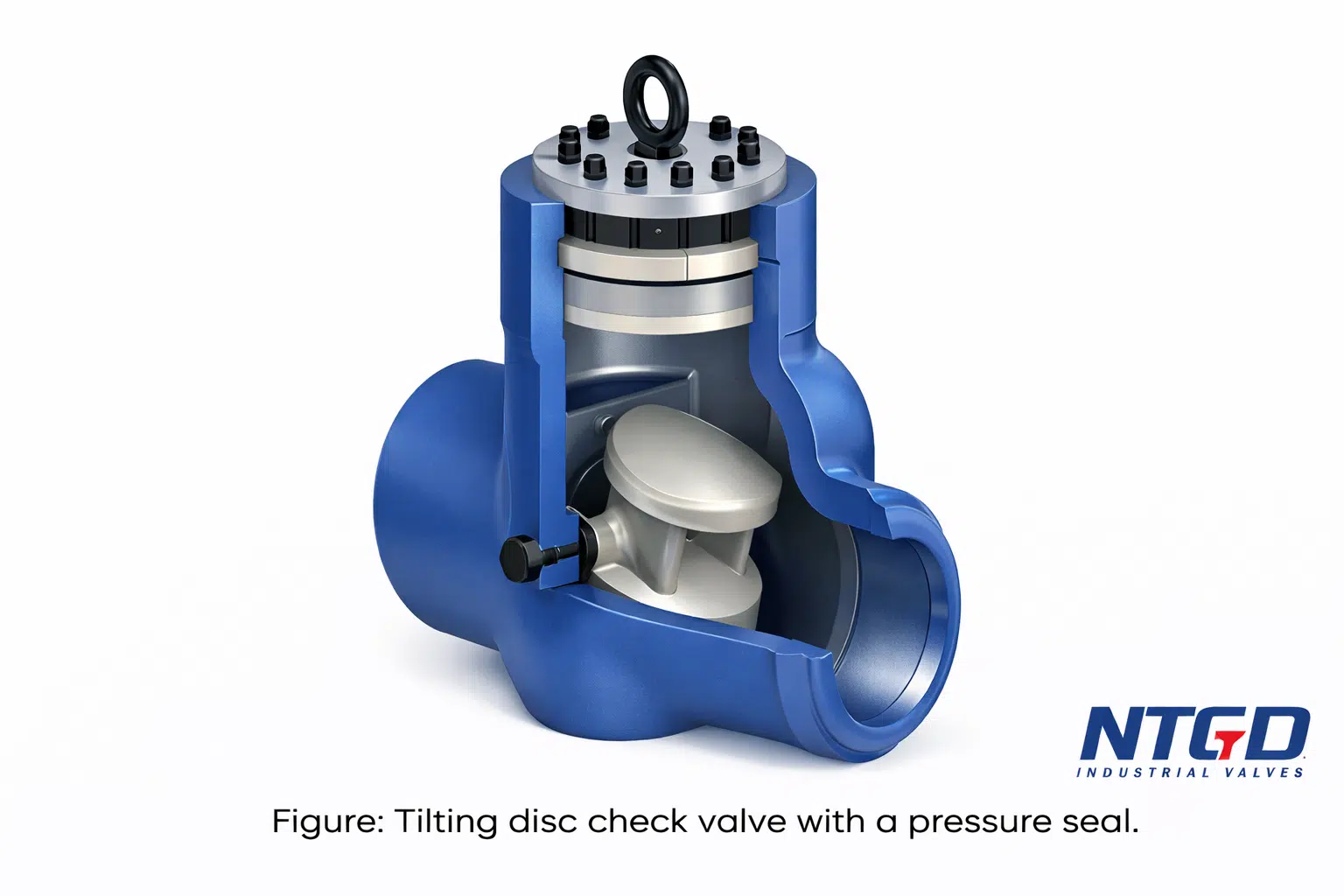
Bolted cover design
This design allows easier inspection and maintenance access and is commonly used where serviceability is important.
Pressure seal bonnet design
Often selected for higher-pressure and higher-temperature service, especially where stronger body-bonnet sealing performance is needed.
Welded body design
Common in hazardous, high-pressure, or high-temperature service where minimizing external leak paths is important.
Spring-assisted or damped design
Used in applications where faster or more controlled closure is required due to severe transient conditions.
Typical Materials, Sizes, Pressure Classes, and End Connections
Actual product ranges vary by manufacturer and project scope, but typical options may include:
Body materials
-
ductile iron
-
WCB carbon steel
-
CF8 stainless steel
-
CF8M stainless steel
-
alloy steel for elevated temperature service
For corrosive or higher-temperature service, users often compare stainless steel check valve options or consider high pressure check valve designs depending on the application.
Seat options
-
metal seated
-
resilient seated for selected low-temperature clean services
-
hard-faced seating for severe-duty applications
Pressure classes
-
PN10 to PN100
-
Class 150 to Class 600 or higher depending on design
End connections
-
flanged
-
butt weld
-
project-specific end preparation where required
Standards
Depending on design and supply scope, projects may reference standards such as API, ASME, EN, or customer-specific specifications. Always confirm actual compliance using the manufacturer’s datasheet, drawing, and project documentation.
Typical Applications of Tilting Disc Check Valves
Pump discharge lines
One of the most important applications. Faster closure helps reduce reverse flow after pump shutdown.
In pump station projects where noise control is also important, engineers may compare this design with silent check valve options.
Circulating water systems
Common in power plants, industrial cooling systems, and utility water networks.
HVAC and district energy systems
Used where dependable reverse-flow prevention and stable system operation are required.
Water treatment and distribution
Suitable for municipal and industrial water service where low pressure loss and reliable non-return duty matter.
Power generation
Applied in auxiliary water and selected process systems depending on design and material requirements.
Oil and gas / petrochemical service
Used where controlled closure, material compatibility, and reliable reverse-flow prevention are required.
Real Project Cases for Tilting Disc Check Valve Applications
The following examples show the kind of application logic typically used when selecting a tilting disc check valve for demanding systems.
Case 1: Pump discharge retrofit in a circulating water system
A circulating water line originally used a conventional swing check valve and experienced repeated slam and seat wear after pump shutdown. The replacement solution used a tilting disc check valve selected for the actual flow conditions and shutdown behavior of the system. After retrofit, shutdown stability improved and repeated impact-related maintenance was reduced.
Case 2: Higher-pressure industrial process line
For a project requiring stronger body-bonnet sealing and more controlled reverse-flow protection, a pressure seal tilting disc check valve was selected instead of a standard swing check valve. The decision was based on system pressure, operating temperature, and service reliability requirements.
Case 3: Large-diameter cooling water service
In large-diameter cooling water service, a tilting disc design was chosen because the user wanted lower slam tendency than a standard swing check arrangement, without moving to a more compact but less application-specific dual plate solution.
Important note
Actual results depend on valve design, line size, operating flow, pump behavior, installation layout, and transient conditions. For project selection, real operating data should always be reviewed.
Engineering Selection Guide
This is the most important part for engineers and buyers.
1. Do not size by pipe diameter alone
A check valve must be matched to actual operating flow, not just the nominal line size.
2. Check real operating flow conditions
Normal flow, minimum flow, maximum flow, and partial-load operation all affect disc stability and closing behavior.
3. Review pump trip and shutdown behavior
A valve that performs well in steady-state operation may still experience slam if the reverse-flow development after pump trip is too fast.
4. Confirm installation orientation
Never assume a design is suitable for vertical installation without confirming it with the manufacturer.
5. Match materials to medium and temperature
Material selection must reflect corrosion risk, temperature range, pressure class, and seat requirements.
6. Evaluate shutoff requirements
If the application requires tighter shutoff or severe-duty service, seat design and facing materials become more important.
7. Consider dynamic service conditions
In critical systems, disc closing characteristics matter more than static catalog descriptions.
8. Decide whether anti-slam accessories are needed
Spring assistance, hydraulic damping, or additional surge review may be necessary for difficult systems.
If your project requires lower noise or additional protection against reverse flow shock, review our non slam check valve options before final selection.
5 Critical Mistakes to Avoid When Buying a Tilting Disc Check Valve
1. Choosing by pipe size only
This often leads to oversizing and unstable disc operation.
2. Ignoring pump shutdown behavior
Many valve problems appear during transient conditions, not during steady flow.
3. Selecting the wrong seat design
Low-temperature clean service and high-temperature severe-duty service require very different seat solutions.
4. Assuming all designs can be installed vertically
Installation orientation depends on actual design, not just valve type name.
5. Comparing valves by purchase price alone
A lower-cost valve may result in higher lifecycle cost if slam, leakage, or repeated maintenance occurs.
Common Failure Causes and Troubleshooting
Problem: Noise or chatter during operation
Possible causes
-
low flow rate
-
oversized valve
-
unstable operating conditions
-
turbulent upstream flow
Recommended actions
-
verify actual flow rate
-
review valve sizing
-
check upstream piping arrangement
-
confirm whether the valve is operating in a partially open unstable range
Preventive action
Select the valve based on actual operating flow and not only nominal size. Stable approach flow helps reduce disc instability.
Problem: Valve does not fully close
Possible causes
-
debris on seat or disc
-
incorrect installation orientation
-
damaged internal parts
-
disc movement obstruction
Recommended actions
-
inspect internal sealing surfaces
-
clean foreign material
-
verify installation arrangement
-
repair or replace worn parts
Preventive action
Confirm installation direction and inspect line cleanliness before commissioning.
Problem: Leakage when valve is closed
Possible causes
-
seat wear
-
disc damage
-
trapped debris
-
seat design not suitable for service conditions
Recommended actions
-
inspect seat and disc
-
clean sealing surfaces
-
repair or replace worn components
-
confirm whether the seat material is correct for the service
Preventive action
Match seat type to actual medium, temperature, and shutoff requirements.
Problem: Severe slam after pump shutdown
Possible causes
-
reverse flow develops too quickly
-
valve closing response not fast enough for the system
-
oversized valve
-
severe transient conditions
Recommended actions
-
review actual shutdown behavior
-
check whether spring assistance or damping is required
-
assess system surge conditions
-
verify whether the chosen valve type is appropriate
Preventive action
Review pump shutdown and system transient behavior during selection stage, not only after installation.
Preventive Maintenance Guide for Tilting Disc Check Valves
Proper maintenance can improve service life and reduce unplanned shutdowns.
Routine inspection
-
check for external leakage
-
listen for abnormal noise or vibration
-
confirm that pressure and temperature remain within rated limits
Periodic checks
-
inspect bolting condition
-
check external corrosion or coating damage
-
review operating performance for signs of instability
Shutdown inspection
-
inspect disc and seat for wear
-
check pivot shaft condition
-
replace damaged gaskets or seals
-
verify internal cleanliness before reassembly
Storage guidance
-
store in a dry and clean environment
-
protect end connections from dust and moisture
-
inspect periodically if stored for extended periods
Why Choose NTGD for Tilting Disc Check Valves?
NTGD focuses on industrial valve applications where reverse-flow control, operating reliability, and project-based selection are more important than generic catalog claims.
Application-focused support
We help review actual project conditions such as valve size, pressure class, medium, temperature, installation orientation, and service scenario before recommending a suitable configuration.
Manufacturing and testing support
Depending on project requirements, we can support documentation related to materials, dimensional confirmation, inspection, and testing.
Project-oriented documentation
For industrial procurement and export projects, customers often need more than a valve price. Datasheets, drawings, material information, and inspection documentation are all important parts of the supply process.
Support for replacement and new projects
Whether the requirement is for a new installation, a pump discharge retrofit, or replacement of an existing swing check valve arrangement, application review is essential for correct selection. You can also explore our broader check valve product range for related solutions.
Need Technical Support to Confirm Valve Selection?
To help confirm whether a tilting disc check valve is suitable for your project, please share:
-
medium
-
working pressure and temperature
-
normal and maximum flow rate
-
installation direction
-
pump shutdown conditions or other special operating details
-
required size and pressure class
-
end connection type
The more accurate your project data is, the more accurately the valve can be selected. For datasheet requests, technical review, or quotation support, please contact NTGD Valve.
Frequently Asked Questions
What is the difference between a tilting disc check valve and a swing check valve?
A tilting disc check valve uses an offset pivot and shorter disc travel, so it usually closes faster than a conventional swing check valve and can help reduce slam tendency in suitable systems.
Is a tilting disc check valve good for pump discharge service?
Yes. Pump discharge service is one of the most common applications because controlled closure can help reduce reverse flow and seat impact after pump shutdown.
Does a tilting disc check valve reduce water hammer?
It can help reduce check valve slam in many systems compared with a standard swing check valve, but actual water hammer behavior depends on system conditions, sizing, and shutdown characteristics.
Can a tilting disc check valve be installed vertically?
Some designs can be used in vertical service, but installation orientation must be confirmed against the actual valve design and manufacturer guidance.
What is the difference between a tilting disc check valve and a dual plate check valve?
A tilting disc check valve uses one disc on an offset pivot. A dual plate valve uses two spring-loaded half-discs on a central hinge. Their structure, application range, and closure behavior are different.
What causes a tilting disc check valve to chatter?
Chatter is usually caused by low flow, unstable partial-open operation, oversizing, or unsuitable operating conditions.
When should I choose a pressure seal tilting disc check valve?
A pressure seal design is commonly considered when higher-pressure or higher-temperature service requires stronger body-bonnet sealing performance.
Can a tilting disc check valve be used for steam service?
Yes, depending on valve design, pressure class, and material selection. High-temperature service usually requires suitable metallic materials and seat design.
What information is needed to select a tilting disc check valve?
Key inputs include valve size, pressure class, medium, temperature, flow rate, installation orientation, and shutdown or transient operating conditions.
What is the main benefit of a tilting disc check valve?
Its main benefit is more controlled and often faster closure than a conventional swing check valve, which can help reduce reverse flow distance and slam tendency in suitable systems.
Conclusion
A tilting disc check valve is not just another non-return valve. In the right system, it is a more appropriate engineering solution than a conventional swing check valve when faster closure, lower slam tendency, and better pump shutdown behavior are required.
Its real value is not simply that it “opens and closes automatically.” Its value lies in how its disc geometry, pivot arrangement, and closing behavior help control reverse flow in demanding services such as pump discharge lines, circulating water systems, and other transient-sensitive industrial applications.
However, correct selection is essential. Flow conditions, system shutdown behavior, installation orientation, material compatibility, and pressure class all influence performance.
If you are evaluating a tilting disc check valve for your project, NTGD can help review your application and support a more suitable selection.
Send us your project details for technical review, datasheet request, or quotation support.
Written by: NTGD Valve Content Team
Technically reviewed by: NTGD Engineering Team
Last updated: March 2026
