
Nombre del autor: Bruce Zheng
Función del autor: Cofundador e ingeniero de válvulas en NTGD Valve
Biografía del autor: Bruce Zheng es cofundador e ingeniero de válvulas en NTGD Valve, donde se dedica a la selección y aplicación de válvulas industriales, así como a la elaboración de contenido técnico para compradores B2B de todo el mundo.
Última actualización: 22 de junio de 2026
Respuesta rápida: ¿Qué es el par de apriete de una válvula de bola?
El par de una válvula de bola es la fuerza de rotación necesaria para girar la bola dentro de la válvula a lo largo de su ciclo de funcionamiento. Es la fuerza requerida para mover la válvula de la posición cerrada a la abierta, de la abierta a la cerrada, o a través de una posición intermedia de funcionamiento. Cuando un ingeniero necesita verificar el funcionamiento manual, seleccionar una caja de engranajes o dimensionar un actuador neumático o eléctrico, el par de la válvula de bola es uno de los primeros datos que se deben confirmar.
En la selección industrial, el par de una válvula de bola no debe considerarse como un valor fijo. El par de arranque, el par de funcionamiento, el par final, el par de asiento y el par de reasentamiento pueden variar, ya que la bola, los asientos, la empaquetadura del vástago, los cojinetes, la carga de presión y las condiciones de servicio no generan la misma resistencia en todos los puntos de rotación. Ignorar estas diferencias en las etapas de par de giro puede provocar que el actuador sea de tamaño insuficiente, que el recorrido de la válvula sea incompleto, que el cierre sea deficiente o que se aplique un par de giro excesivo al vástago.
Los datos de par son especialmente importantes a la hora de seleccionar una manija manual, una caja de cambios, un actuador neumático o un actuador eléctrico. Una tabla de par o una estimación aproximada pueden ser útiles durante la fase inicial de análisis, pero la selección final del actuador debe basarse en los datos de par confirmados por el fabricante para el tamaño exacto de la válvula, la clase de presión, el material del asiento, el diseño, el fluido, la temperatura y la presión diferencial. Este artículo explica los niveles de par, los factores de par, la interpretación de las tablas y los conceptos básicos para la selección de actuadores; no proporciona una tabla universal de valores de par ni una calculadora de par en línea.
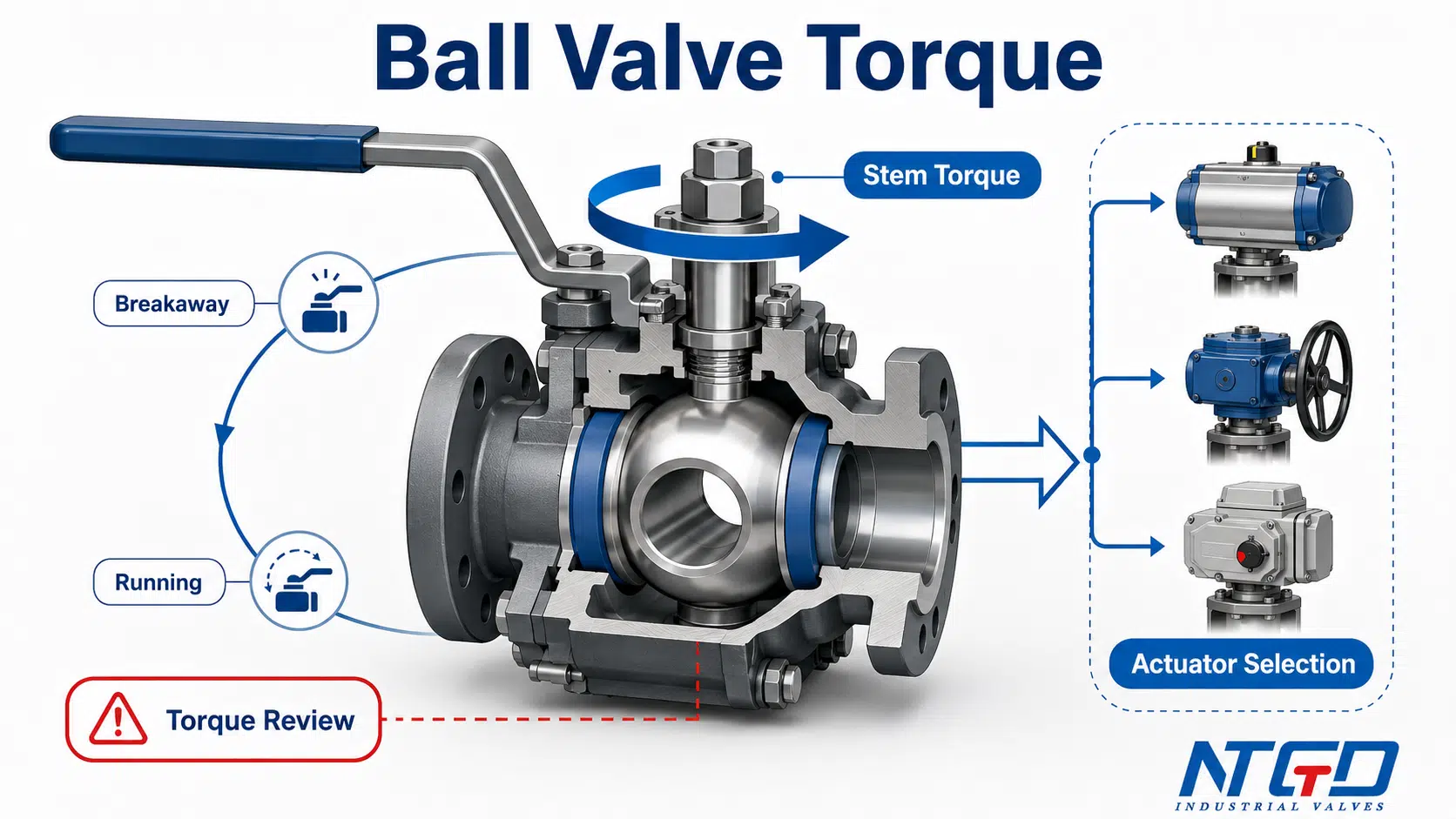
¿Qué es el par de apriete de una válvula de bola?
El par de la válvula de bola debe considerarse un criterio de selección, no solo un dato del catálogo. Describe la fuerza de giro necesaria para hacer girar la bola dentro del cuerpo de la válvula. En una válvula de bola típica de cuarto de vuelta, la bola gira aproximadamente 90 grados entre las posiciones de completamente cerrada y completamente abierta. Durante esta rotación, el vástago transfiere el par desde una manija, una caja de engranajes o un actuador a la bola.
En términos sencillos, el par responde a una pregunta práctica:
¿Cuánta fuerza de giro se requiere para operar esta válvula de bola de manera segura y confiable en las condiciones de servicio especificadas?
Esa pregunta es importante porque una válvula que es fácil de girar en una aplicación puede requerir un par de giro mucho mayor en otra. Una válvula de bola pequeña con asiento blando utilizada en sistemas de agua limpia no es lo mismo que una válvula de bola más grande con asiento metálico utilizada en aplicaciones de alta presión, gas seco, lodos o altas temperaturas.
Par de apriete de la válvula de bola frente al par de operación
En muchas discusiones sobre proyectos, los términos par de apriete de la válvula de bola y par de operación de una válvula de bola se utilizan muy cerca unas de otras. Sin embargo, deben manejarse con cuidado.
Par de apriete de la válvula de bola Es el tema general. Puede referirse a cualquier valor de torque asociado a la válvula.
Par de funcionamiento Por lo general, se refiere al par necesario para accionar la válvula a lo largo de su carrera en una condición definida. Puede incluir el par de arranque, el par de funcionamiento y el par de cierre o de asentamiento, dependiendo de cómo presente los datos el fabricante.
Para la selección de un actuador, no basta con preguntar únicamente por el “par de operación” sin contexto. La especificación debe aclarar si el valor se refiere al par de arranque, al par de funcionamiento, al par final, al par máximo de operación o a un requisito de par definido por el fabricante.
Por qué es importante el par en las válvulas de bola manuales, de engranaje y accionadas
El par influye en varias decisiones prácticas:
| Método de funcionamiento | Por qué es importante el par motor | Repercusiones de la selección |
|---|---|---|
| Mango manual | Determina si la válvula se puede accionar de manera segura con la mano | Una válvula de alto par puede requerir una manija más larga, una caja de engranajes o un actuador |
| Operador de engranajes | Reduce el esfuerzo manual, pero añade requisitos de selección mecánica | La selección de la caja de cambios debe ajustarse al par de la válvula y a las condiciones de servicio |
| Actuador neumático | La salida del actuador varía en función del suministro de aire, la fuerza del resorte y el diseño del actuador | Se debe verificar el par de la válvula en función de la salida del actuador a la presión de alimentación requerida |
| Actuador eléctrico | El par de salida, la velocidad, el voltaje y el tipo de control deben ser adecuados para la válvula | Los actuadores eléctricos de tamaño insuficiente pueden atascarse o dispararse bajo carga |
| Paquete automatizado | El par de la válvula afecta la confiabilidad, la respuesta y la función de seguridad ante fallas | Antes de confirmar el pedido, se deben revisar el margen de par y el factor de servicio. |
Si el proyecto requiere que la válvula y el actuador se suministren como un solo paquete automatizado, consulta la revisión del par de apriete que se incluye en este artículo antes de pasar a un válvula de bola accionada especificación.
El par no es solo una cuestión relacionada con el actuador. También afecta la seguridad del operador, la confiabilidad de la apertura, el apagado de emergencia, el ciclo de trabajo y el riesgo de sobrecargar el vástago o el tren de transmisión.
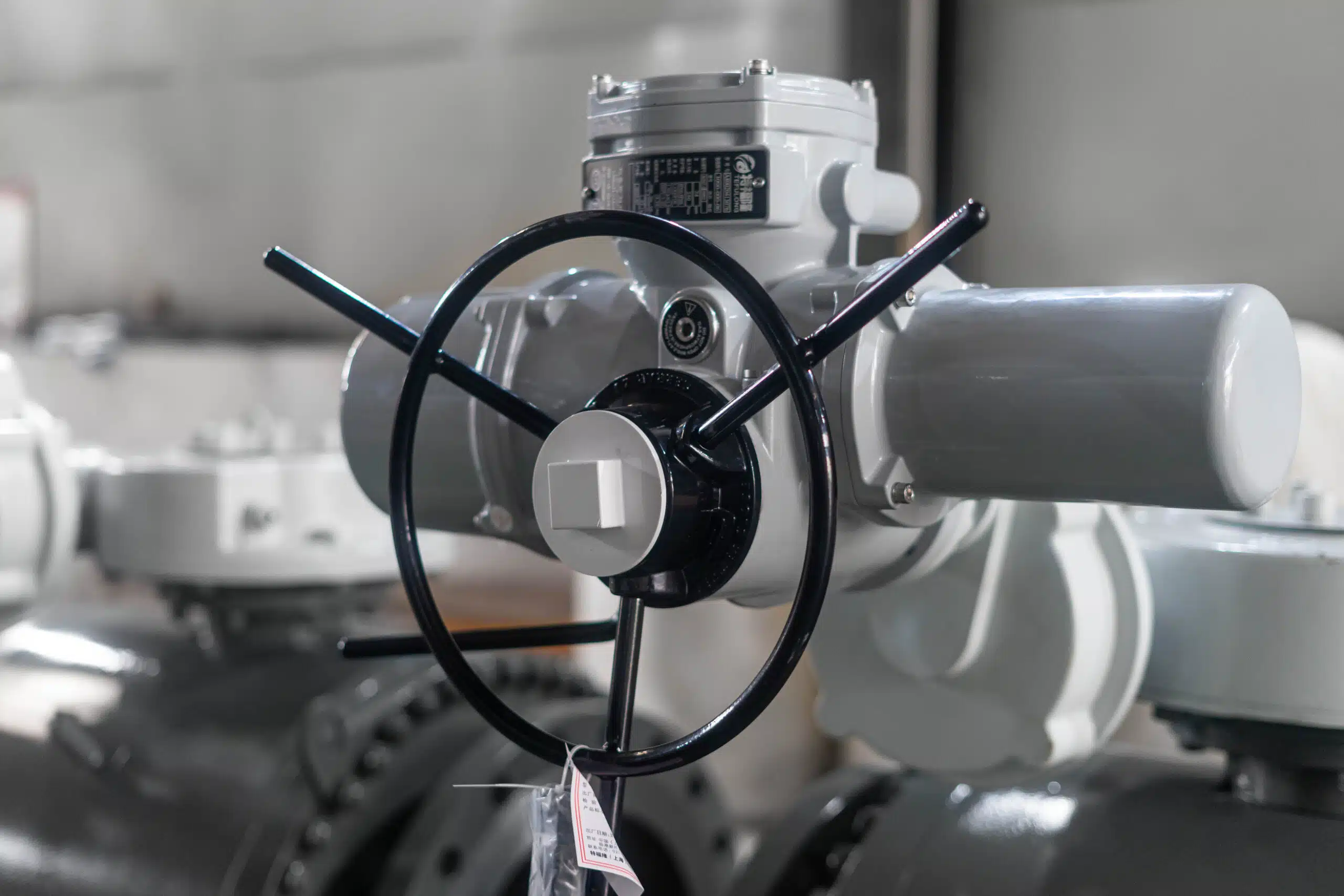
Datos de par publicados frente al par de funcionamiento real
Los datos de par publicados suelen basarse en condiciones de prueba o de referencia definidas. El par de funcionamiento real puede variar después de la instalación, ya que la válvula queda expuesta a condiciones reales de servicio.
El valor del par puede verse afectado por:
- carga de presión a través de la bola cerrada;
- material del asiento y precarga del asiento;
- limpieza, viscosidad o sequedad del medio;
- efectos de la temperatura en los asientos y las juntas;
- corrosión, incrustaciones, depósitos o polimerización;
- fricción de la empaquetadura del vástago;
- la frecuencia de funcionamiento y los largos períodos de inactividad;
- si la válvula es de bola flotante o montada sobre muñón.
Los datos de torque publicados son útiles para la selección inicial y la evaluación preliminar de los actuadores, pero no deben considerarse como el valor definitivo para todos los servicios. La selección final debe basarse en los datos de torque confirmados por el fabricante para la configuración exacta de la válvula y en los datos reales del servicio, incluyendo el fluido, la temperatura, la presión diferencial máxima, el material del asiento y la frecuencia de operación.
Para obtener una visión general más amplia del sector, esto Resumen del par de apriete de las válvulas de cuarto de vuelta explica por qué es posible que los valores de torque publicados no reflejen plenamente las condiciones reales de instalación y funcionamiento.
Par de desprendimiento, par de funcionamiento y par de reajuste
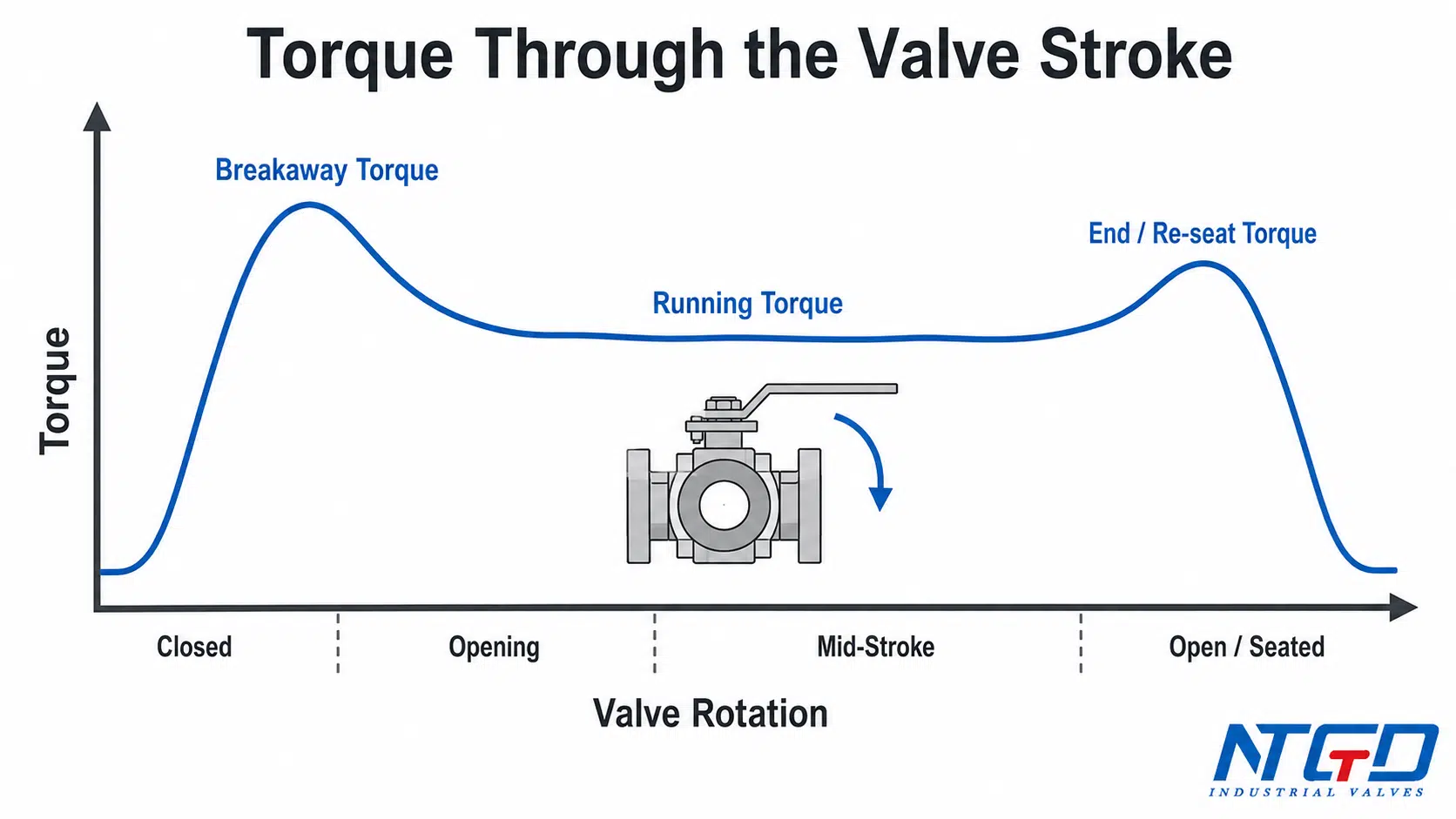
Una válvula de bola no suele requerir el mismo par en todos los puntos de su rotación de 90 grados. El perfil de par cambia a medida que la bola comienza a moverse, continúa girando y llega a la posición final de sellado.
Los términos más importantes son par de desprendimiento, par de funcionamiento, par de cierre, par de apriete y par de apriete para volver a colocar.
Par de desprendimiento / Par de apertura
Par de desprendimiento es el par necesario para poner la bola en movimiento desde una posición de reposo. En muchos análisis de dimensionamiento de actuadores, este es uno de los valores más importantes, ya que la válvula debe superar primero la fricción estática antes de que la bola comience a girar.
El par de apertura puede ser elevado debido a que la bola y los asientos se han comprimido entre sí bajo una presión diferencial. Si la válvula ha permanecido cerrada durante mucho tiempo, los depósitos, la compresión de los asientos o los efectos del fluido también pueden aumentar la fuerza inicial necesaria para mover la bola.
A la hora de seleccionar un actuador, el par de arranque es un parámetro clave para evaluar su capacidad de arranque. Si el actuador no puede superar el par de arranque requerido al inicio de la carrera, es posible que la válvula no se abra o no se cierre, incluso si, según las especificaciones del catálogo, el actuador parece adecuado.
Par de funcionamiento / Par de marcha
Par de funcionamiento es el par necesario para mantener la bola en movimiento una vez que ya ha comenzado a girar. Suele ser menor que el par de arranque, pero esta relación no es universal. El valor exacto depende del diseño de la válvula, el material del asiento, el fluido, la presión y los datos de par proporcionados por el fabricante.
El par de funcionamiento es importante porque el actuador debe seguir haciendo girar la bola a lo largo de toda la carrera, no solo iniciar el movimiento. Si un actuador tiene suficiente par de arranque pero un par insuficiente durante la parte media de la carrera, la válvula podría detenerse antes de alcanzar la posición de apertura o cierre requerida.
Par final, par de apriete y par de reapriete
Al final de la carrera, la bola alcanza la posición totalmente abierta o totalmente cerrada. Dependiendo de la dirección de funcionamiento y de la terminología del fabricante, el par requerido puede describirse como par de cierre, par de apriete, par de apriete o par de apriete para volver a colocar.
En el caso de una válvula de bola con asiento blando, el par de apriete para el asentamiento o reasentamiento puede verse afectado por la forma en que la bola se comprime contra el asiento. En el caso de una válvula de bola con asiento metálico, la interfaz de sellado final puede requerir un comportamiento de par diferente, especialmente en aplicaciones a altas temperaturas o con medios abrasivos.
En el caso de las aplicaciones de cierre, no se puede pasar por alto el par de apriete final. Si el actuador no proporciona suficiente par cerca del final de la carrera, es posible que la válvula no alcance completamente la posición de sellado requerida, lo que puede provocar un cierre deficiente, riesgo de fugas o tensión excesiva en la superficie de sellado.
Explicación de BTO, RTO, ETO, BTC, RTC y ETC
Algunas tablas de par y documentos de dimensionamiento de actuadores utilizan abreviaturas para describir el par en diferentes puntos del ciclo de apertura o cierre.
| Abreviatura | Significado común | Dirección de funcionamiento | Lo que representa | Por qué es importante |
|---|---|---|---|---|
| BTO | Romper para abrir | Apertura | Par necesario para comenzar a abrir desde la posición cerrada | Fundamental para la capacidad de arranque del actuador |
| RTO | Correr para abrir | Apertura | Par necesario mientras la válvula sigue abriéndose | Confirma la salida del actuador a lo largo de la carrera |
| ETO | De un extremo al otro | Apertura | Par cerca de la posición de apertura total | Ayuda a confirmar la capacidad total de desplazamiento |
| BTC | Descanso hasta el cierre | Cierre | Par necesario para comenzar a cerrar desde la posición abierta | Importante para el modo de cierre en caso de falla o el servicio de cierre |
| RTC | Correr hasta el cierre | Cierre | Par necesario mientras la válvula sigue cerrándose | Relevante para el ciclo y la secuencia de control |
| ETC | Fin para cerrar | Cierre | Par de apriete cerca de la posición de cierre total / asentada | Importante para el cierre definitivo y el asentamiento |
La terminología puede variar según el fabricante. Siempre verifica las definiciones de las abreviaturas en la tabla de par de apriete específica de la válvula o en el documento de selección del actuador.
Para seleccionar un actuador, se debe comparar el par requerido por la válvula en los puntos críticos de par con la salida del actuador en las posiciones correspondientes de la carrera. Esto es especialmente importante en el caso de los actuadores de retorno por resorte y en los diseños de actuadores en los que la salida de par no es constante a lo largo de toda la carrera.
¿Por qué cambia el par de la válvula de bola durante su funcionamiento?
El par de la válvula de bola varía debido a que, durante el ciclo de funcionamiento, actúan diferentes fuerzas de resistencia sobre la bola y el vástago. Los principales factores que influyen son la fricción del asiento, la carga por presión diferencial, la fricción de la empaquetadura del vástago y la fricción de los cojinetes o los muñones.
Fricción entre la bola y el asiento
La bola debe girar contra el área de contacto del asiento. Este contacto genera fricción. El material del asiento, la precarga del asiento, el diseño del sellado y el estado de la superficie influyen en la cantidad de par necesario.
Los asientos blandos, como los fabricados con materiales a base de PTFE, pueden presentar una menor fricción en algunos servicios de limpieza, pero el par exacto sigue dependiendo de la presión, la temperatura, el diseño del asiento y la construcción del fabricante. Los asientos reforzados, los de nylon y los metálicos pueden comportarse de manera diferente.
Si el asiento está dañado, hinchado, desgastado o contaminado con partículas sólidas, el par de operación puede aumentar.
Carga de presión diferencial sobre la bola
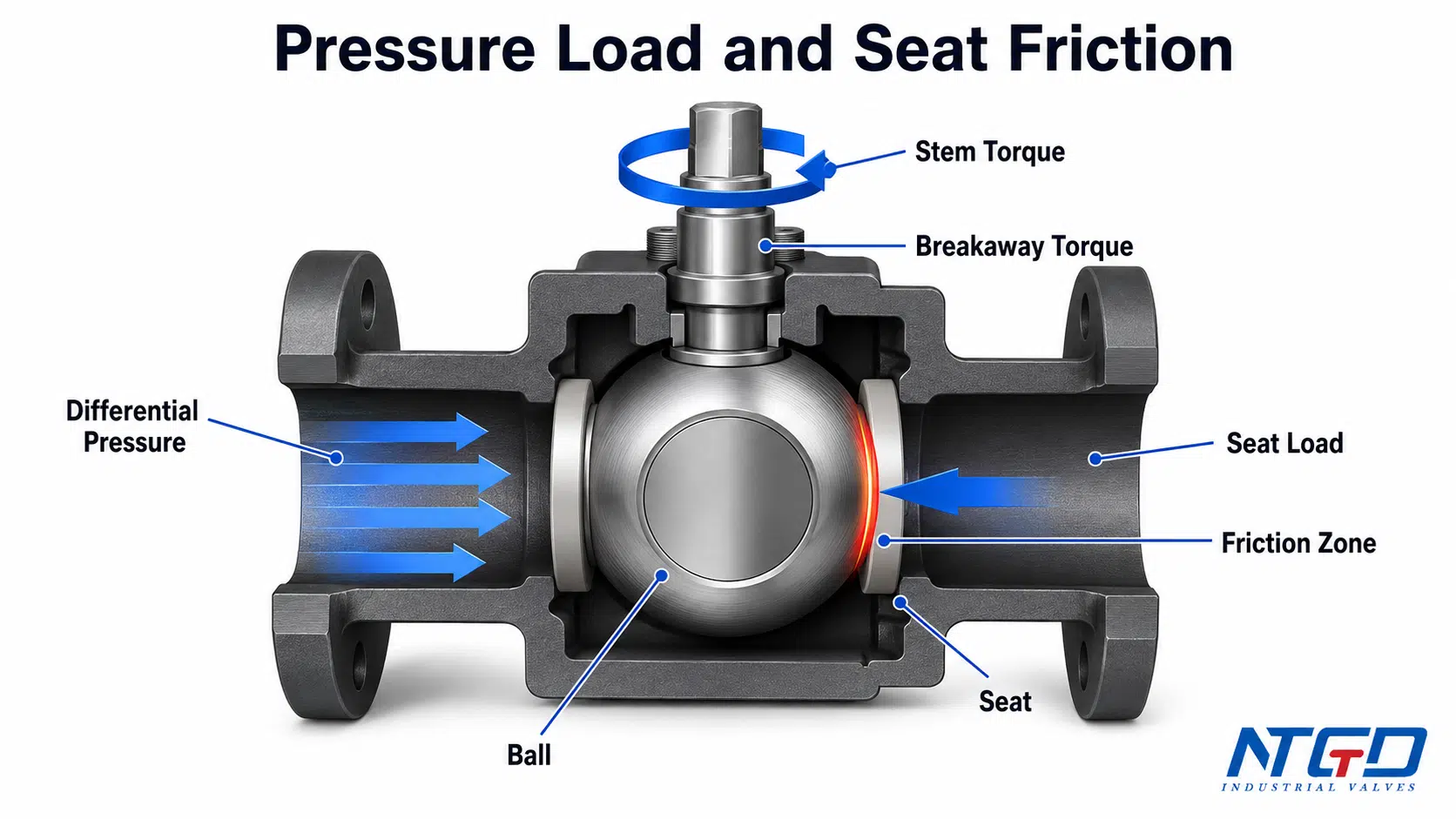
Cuando la válvula está cerrada y existe una diferencia de presión a ambos lados de la bola, la presión aguas arriba puede empujar la bola hacia el asiento aguas abajo. Esta carga de presión aumenta la fuerza de contacto en la interfaz de sellado.
En muchos diseños de válvulas de bola flotante, una presión diferencial más alta puede aumentar la carga sobre el asiento y, por lo tanto, aumentar el par de arranque. En los diseños con montaje en muñones, la bola se apoya en los muñones, pero la carga sobre el asiento y el diseño del sellado siguen afectando el par.
La clave es sencilla: Una mayor presión puede aumentar el par, pero la relación exacta depende del diseño de la válvula.
Empaque del vástago, cojinetes y fricción del muñón
El par no se genera únicamente en la interfaz entre la bola y el asiento. La empaquetadura del vástago también genera fricción alrededor del vástago giratorio. Los cojinetes, las arandelas de empuje, los soportes de muñón y los componentes de transmisión pueden añadir resistencia.
En una válvula nueva y en buen estado, estas fuentes de fricción pueden ser predecibles. Sin embargo, en condiciones reales de servicio, el ajuste de la empaquetadura, el desgaste por el paso del tiempo, los depósitos, la corrosión o la falta de ciclos de funcionamiento pueden alterar la fuerza necesaria para accionar la válvula.
Por qué el par suele ser mayor al inicio del movimiento
El inicio del movimiento suele requerir un par más alto, ya que la válvula debe superar la fricción estática. La bola y el asiento han estado en contacto sin moverse, y es posible que la presión esté ejerciendo carga sobre la superficie de sellado. Por eso, el par de arranque suele considerarse un valor crítico para la selección del actuador.
Sin embargo, esto no debe simplificarse como una regla universal aplicable a todas las válvulas. Algunos servicios, tipos de actuadores o diseños de válvulas pueden otorgar diferente importancia al par final, al par de asiento o al funcionamiento de seguridad.
¿Qué factores influyen en el par de apriete de una válvula de bola?
El par de apriete de una válvula de bola depende del diseño de la válvula y de las condiciones de servicio. Dos válvulas con el mismo tamaño nominal pueden requerir un par de apriete diferente si utilizan asientos, clases de presión, diseños de paso o condiciones de operación distintos.
La siguiente matriz resulta útil para una evaluación preliminar. Ayuda a identificar qué factores de diseño y servicio podrían modificar los requisitos de par antes de que el fabricante confirme los datos exactos de par.
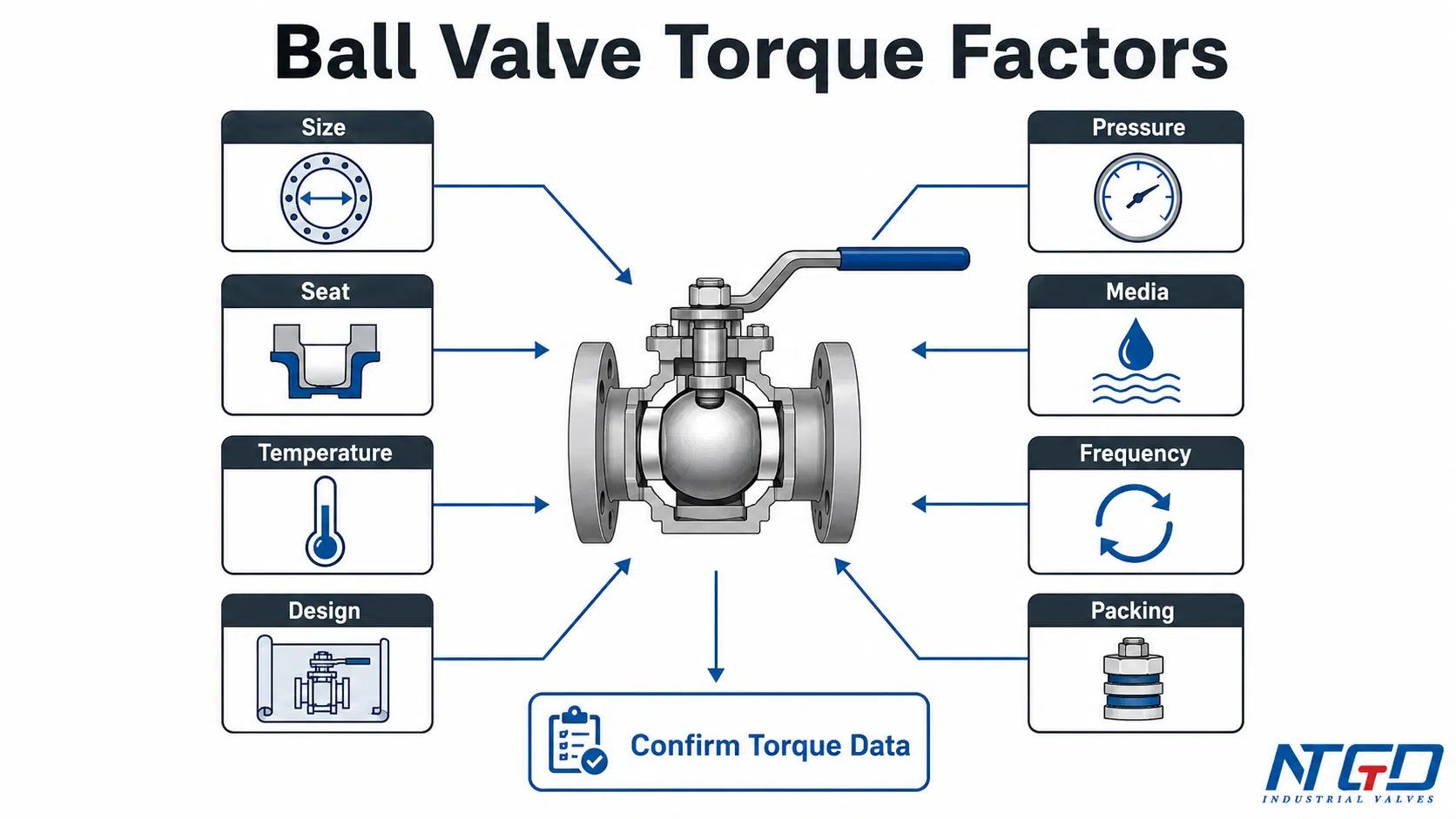
Tamaño de la válvula, tipo de paso y clase de presión
El tamaño de la válvula es un factor básico, pero no debe ser el único criterio a considerar. Las válvulas más grandes suelen tener superficies de sellado más amplias y fuerzas de contacto más elevadas, pero el par de apriete también depende del diseño del asiento, el tipo de paso y la clase de presión.
Una válvula de bola de paso total puede tener una geometría de la bola y el asiento diferente a la de un diseño de paso reducido. Una válvula de clase de presión más alta también puede tener una construcción más resistente y un comportamiento de carga del asiento diferente.
Material del asiento: PTFE, asiento reforzado, asiento de nailon y metal
El material del asiento influye directamente en la fricción y la fuerza de sellado.
Los asientos blandos pueden ofrecer un par más bajo en muchas aplicaciones de servicio normal, mientras que los asientos reforzados, de nylon o metálicos pueden seleccionarse para condiciones de servicio con presiones y temperaturas más altas, o en entornos abrasivos o severos. Estos materiales pueden modificar los requisitos de par.
Los asientos metálicos o reforzados pueden presentar un comportamiento diferente en cuanto a la tensión de contacto y la fricción en comparación con los asientos blandos estándar. Por eso, el material del asiento debe evaluarse junto con su diseño, la precarga del asiento y los datos de par proporcionados por el fabricante, y no solo basándose en el nombre del material.
La selección de la sede no debe basarse únicamente en un par bajo. También debe ajustarse al fluido, la temperatura, la presión, los requisitos de cierre y las expectativas de vida útil.
Cuando el criterio principal de selección es el diseño del asiento y no solo el par motor, el NTGD de Válvulas de bola con asiento metálico frente a válvulas de bola con asiento blando Esta guía puede ayudarte a comparar los límites del servicio.
Presión diferencial, presión de línea y temperatura
La presión diferencial a través de la válvula cerrada puede aumentar la fuerza entre la bola y el asiento. La presión de la línea, la dirección de la presión y las características de equilibrio de presión pueden afectar el par.
La temperatura también puede afectar el par de apriete, ya que los materiales de los asientos y las juntas reaccionan de manera diferente a altas o bajas temperaturas. El funcionamiento en frío, el funcionamiento a altas temperaturas y los ciclos térmicos deben analizarse de acuerdo con los datos proporcionados por el fabricante de la válvula.
Para aplicaciones con altas presiones diferenciales, revise el par de apriete junto con la clase de presión, el diseño y los materiales de sellado; los modelos NTGD de válvula de bola de alta presión La guía ofrece información adicional para la selección.
Tipo de medio: líquido limpio, gas, lodo, fluido viscoso o servicio en seco
El tipo de medio puede influir considerablemente en el par.
Los líquidos lubricantes limpios pueden comportarse de manera diferente al gas seco, las suspensiones, los fluidos polimerizantes, los medios cristalizantes o los servicios viscosos. Los sólidos pueden aumentar la fricción o provocar acumulaciones. El servicio en seco puede reducir la lubricación en las superficies de contacto. Los medios pegajosos o que forman incrustaciones pueden aumentar el par de arranque después de un período de inactividad.
Por esta razón, la revisión del par de apriete debe incluir el medio real, y no solo el tamaño de la válvula y la clase de presión.
Frecuencia de funcionamiento, tiempo de inactividad y ciclo de trabajo
Una válvula que se acciona una vez al mes puede comportarse de manera diferente a una válvula que se acciona varias veces al día. Los largos períodos de inactividad pueden aumentar el par de arranque si los asientos permanecen comprimidos o si se forman depósitos de medios cerca de la bola y el asiento.
El uso frecuente también puede afectar el desgaste del asiento, el comportamiento de empaque y la selección del actuador. Para el servicio automatizado, la frecuencia de uso debe incluirse en los datos de la solicitud de cotización.
Válvula de bola flotante vs. válvula de bola montada sobre muñón
Las válvulas de bola flotante y las válvulas de bola montadas sobre muñón no ejercen la misma carga sobre la bola.
En un diseño de bola flotante, la bola puede moverse ligeramente bajo presión y ejercer carga sobre el asiento aguas abajo. A medida que aumenta la presión diferencial, la bola puede presionar con mayor fuerza contra el asiento, lo que aumenta la fricción inicial que el actuador debe superar.
En un diseño con montura de muñón, la bola se apoya mecánicamente sobre los muñones, y el diseño del asiento suele desempeñar un papel fundamental en el sellado y el comportamiento frente al par. Los diseños con montura de muñón son comunes en tamaños más grandes y en aplicaciones de alta presión, pero el par exacto sigue dependiendo del diseño del fabricante.
El diseño influye en la forma en que la carga de presión se transfiere a la bola y al asiento. Por esta razón, no se deben intercambiar los pares de torque de las válvulas de bola flotante y de las válvulas de bola con muñón sin la confirmación del fabricante.
| Factor | Cómo puede afectar al par motor | Qué hay que verificar antes de la selección |
|---|---|---|
| Tamaño de la válvula | Una mayor área de sellado suele aumentar la demanda de par, pero los detalles de diseño siguen siendo importantes | Tamaño nominal, tipo de paso, diseño real de la válvula |
| Clase de presión | Un diseño para presiones más altas puede modificar la construcción, la carga sobre el asiento y el comportamiento de separación. | Clase de presión y presión diferencial máxima |
| Material del asiento | Los distintos materiales presentan diferentes comportamientos de fricción y compresión | PTFE, asiento reforzado, nylon, asiento metálico o asiento especial |
| Tipo de soporte | La presencia de sólidos, la sequedad, la viscosidad o los depósitos pueden aumentar el par de operación real | Tipo de fluido, limpieza, sólidos, viscosidad |
| Temperatura | El comportamiento de los asientos y las juntas puede variar a temperaturas altas o bajas | Temperatura de funcionamiento normal, mínima y máxima |
| Frecuencia de funcionamiento | El ciclismo y la inactividad afectan el comportamiento de las escapadas | Funcionamiento manual, ocasional, frecuente o automático |
| Diseño de válvulas | Los diseños flotantes y con muñón transfieren la carga de presión de manera diferente | Flotante, montado sobre muñón, con asiento blando, con asiento metálico |
| Empaquetadura del vástago | La fricción de las juntas aumenta el par de operación | Diseño del embalaje y condiciones de servicio |
| Condiciones del servicio | Las condiciones de servicio exigentes pueden requerir una revisión adicional y un margen mayor | Corrosión, incrustaciones, lodos, gas seco, medios de polimerización |
Estos factores influyen directamente en los requisitos de rendimiento del actuador, el factor de seguridad y la selección del modelo definitivo del actuador. Elegir un actuador basándose únicamente en el tamaño nominal de la válvula puede dar lugar a un tamaño insuficiente, a un sobredimensionamiento innecesario o a un conjunto de actuador que no se adapte a las condiciones reales de servicio.
Cálculo del par de apriete de una válvula de bola: qué se puede y qué no se puede calcular
El cálculo del par de apriete de las válvulas de bola resulta útil durante las primeras etapas de revisión de ingeniería, pero no debe considerarse un sustituto de los datos de par de apriete confirmados por el fabricante.
La razón es que el par de una válvula de bola no se determina mediante una simple fórmula geométrica. Depende de la fricción, el diseño del asiento, la carga de presión, la empaquetadura del vástago, la resistencia de los cojinetes o los muñones, el comportamiento del fluido y la temperatura.
Por qué no existe una fórmula universal para calcular el par de apriete de las válvulas de bola
Una fórmula universal para calcular el par de una válvula de bola requeriría hacer suposiciones sobre el área de contacto entre la bola y el asiento, el coeficiente de fricción del asiento, la carga de presión, la fricción de la empaquetadura del vástago, la fricción de los cojinetes, la precarga del asiento y las condiciones de servicio. Estos valores no son los mismos entre los distintos fabricantes de válvulas ni entre los distintos diseños de válvulas.
Por eso, dos válvulas con el mismo tamaño nominal y la misma clase de presión pueden tener requisitos de par diferentes.
Un cálculo aproximado puede ayudar a estimar si el par motor es bajo, medio o alto para una revisión inicial, pero no debe utilizarse como dato definitivo para el dimensionamiento del actuador sin la confirmación del fabricante.
Lo que puede revelar una estimación aproximada del par
Una estimación aproximada del par de torque puede ayudar a identificar:
- si la válvula requiere accionamiento manual, una caja de engranajes o un actuador;
- si una presión diferencial elevada podría aumentar el par de arranque;
- si los medios de alto impacto o el material de los asientos pueden requerir un factor de servicio más alto;
- si se debería revisar con mayor detenimiento el rendimiento del actuador;
- si se requiere la tabla de pares del fabricante antes de confirmar el pedido.
En la práctica, una estimación aproximada del par suele tener en cuenta la carga de contacto entre la bola y el asiento, la carga por presión diferencial, el comportamiento de la fricción en el asiento, la fricción de la empaquetadura del vástago y la resistencia de los cojinetes o los muñones. Estas variables pueden servir de apoyo para la selección inicial, la preselección del actuador y la identificación de riesgos, pero no pueden sustituir a los datos confirmados de par correspondientes al diseño exacto de la válvula y a las condiciones de servicio.
Una estimación aproximada resulta útil para la selección inicial. No constituye una garantía definitiva del par de operación.
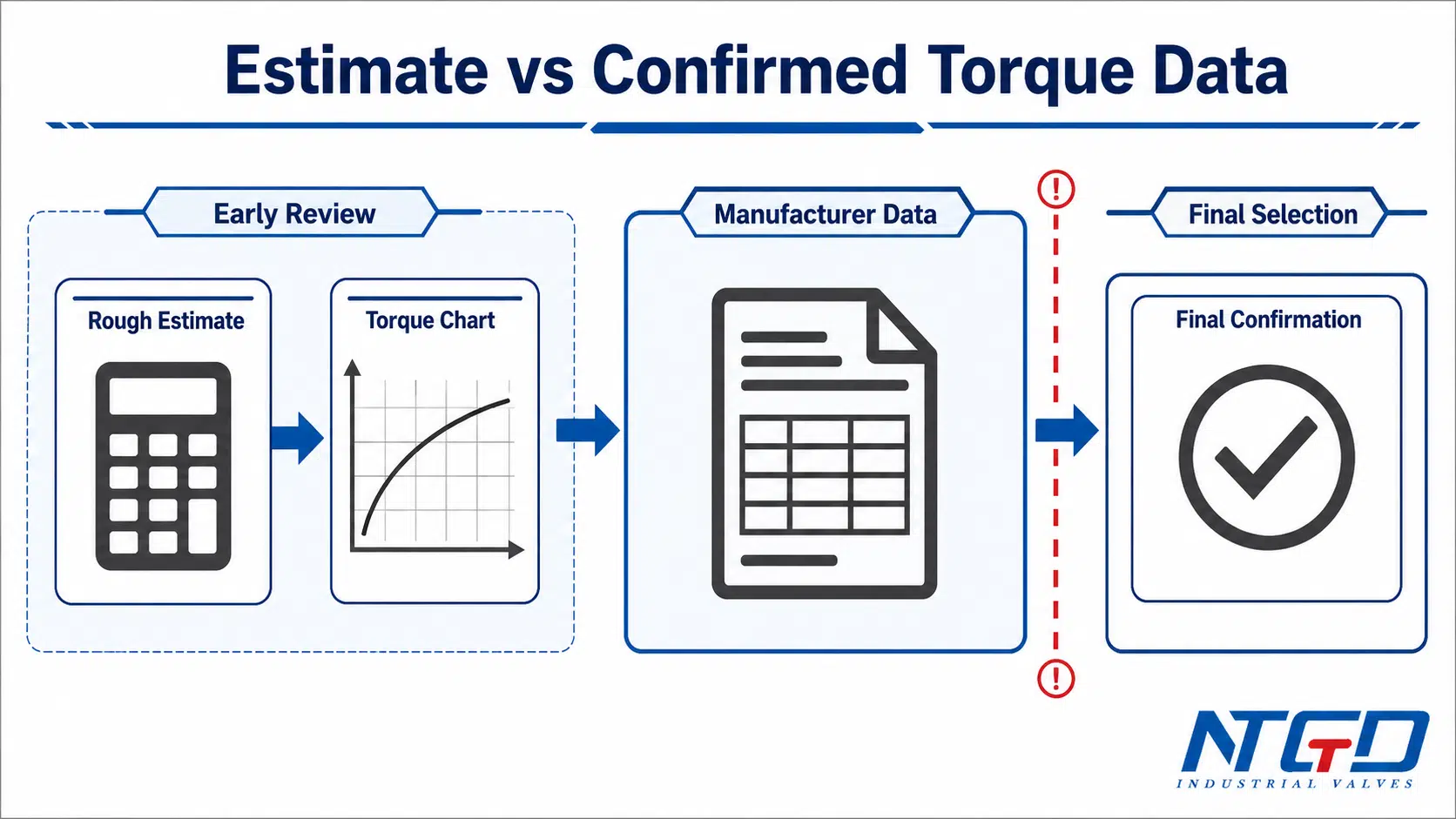
Lo que debe confirmar el fabricante de la válvula
Para la selección final, el fabricante de la válvula debe confirmar los datos de par de apriete correspondientes a la configuración exacta de la válvula.
| Artículo | ¿Se puede estimar durante la revisión inicial? | ¿Es necesario confirmarlo para la selección final? | Por qué es importante |
|---|---|---|---|
| Tamaño y diámetro interior de la válvula | Sí | Sí | El tamaño y el diámetro interior influyen en la geometría de la bola y el asiento |
| Clase de presión | Sí | Sí | La clase de presión influye en la construcción y en la carga sobre el asiento |
| Material del asiento | En parte | Sí | Los asientos de PTFE, reforzados, de nailon y de metal presentan diferentes comportamientos de fricción, precarga y dependencia del diseño; se requieren los datos del fabricante para determinar el par final |
| Presión diferencial | Sí | Sí | Una presión diferencial más alta puede aumentar el par de arranque |
| Tipo de soporte | En parte | Sí | Los sólidos, la sequedad, la viscosidad y los depósitos afectan el funcionamiento |
| Temperatura | En parte | Sí | El comportamiento del asiento y la junta varía con la temperatura |
| Par de desprendimiento | No existe una estimación universal confiable | Sí | Fundamental para la capacidad de arranque del actuador |
| Par de funcionamiento | No existe una estimación universal confiable | Sí | Necesario para el movimiento durante la fase de recorrido |
| Par de apriete final / de reajuste | No existe una estimación universal confiable | Sí | Importante para el asentamiento final y el cierre |
| Factor de seguridad / servicio | Depende del proyecto | Sí | Depende del servicio, del tipo de actuador y de los requisitos del proyecto |
| Límite MAST | No | Sí | Evita la sobrecarga del vástago de la válvula |
Cómo se utiliza el par de desprendimiento en el dimensionamiento de los actuadores
El par de arranque suele ser uno de los valores clave que se utilizan para dimensionar un actuador, ya que este debe ser capaz de iniciar el movimiento de la válvula desde el reposo. Sin embargo, la selección del actuador no debe basarse únicamente en el par de arranque.
Una revisión adecuada debe tener en cuenta lo siguiente:
- par de desprendimiento;
- par de funcionamiento;
- par de apriete final o de fijación;
- sentido de apertura y cierre;
- curva de salida del actuador;
- la presión de suministro de aire o la señal de salida del actuador eléctrico;
- retorno por resorte o función de doble acción;
- factor de seguridad o factor de servicio;
- requisito de apertura o cierre en caso de falla;
- par máximo permitido en el vástago.
El actuador debe proporcionar el par suficiente donde la válvula lo requiera, sin aplicar un par peligroso al vástago de la válvula ni a los componentes de accionamiento.
Cómo leer una tabla de par de apriete de una válvula de bola
Una tabla de par de apriete para válvulas de bola es un documento de referencia que ayuda a los ingenieros a revisar los requisitos de par de apriete para una serie específica de válvulas, tamaño, clase de presión, material del asiento y condiciones de servicio. Puede presentarse en forma de tabla, gráfico o hoja de datos.
Un gráfico de par debe leerse con atención, ya que suele ser específico para cada fabricante y cada configuración.
Campos comunes en una tabla de par de apriete de una válvula de bola
Una tabla de pares de apriete para válvulas de bola puede incluir:
| Campo de gráfico | Lo que suele significar | Por qué es importante |
|---|---|---|
| Tamaño de la válvula | Diámetro nominal de la válvula | El par de apriete suele variar según el tamaño de la válvula |
| Clase de presión | Clasificación o clase de presión de la válvula | Una clase de presión más alta puede modificar los requisitos de par de giro |
| Presión diferencial | Diferencia de presión a través de la válvula cerrada | A menudo, un factor importante en el par de arranque |
| Material del asiento | PTFE, asiento reforzado, nylon, asiento metálico o asiento especial | La fricción del asiento afecta el par motor |
| Diseño de válvulas | Con bola flotante o montado sobre muñón | El diseño modifica la carga de presión y el soporte |
| Unidad de par | Nm, in-lb o ft-lb | Los errores en la conversión de unidades pueden provocar errores en el dimensionamiento de los actuadores |
| Etapa de par | BTO, RTO, ETO, BTC, RTC, ETC o similares | Las distintas etapas requieren una revisión diferente de los actuadores |
| Nota sobre el factor de servicio | Instrucciones sobre el margen del fabricante o del proyecto | Podría afectar los requisitos de par final del actuador |
| Nota sobre la temperatura | Temperatura de referencia o límites de servicio | El comportamiento del asiento puede variar según la temperatura |
| Nota para los medios | Fluido limpio, gas seco, lodo u otras condiciones | El medio utilizado puede modificar el par |
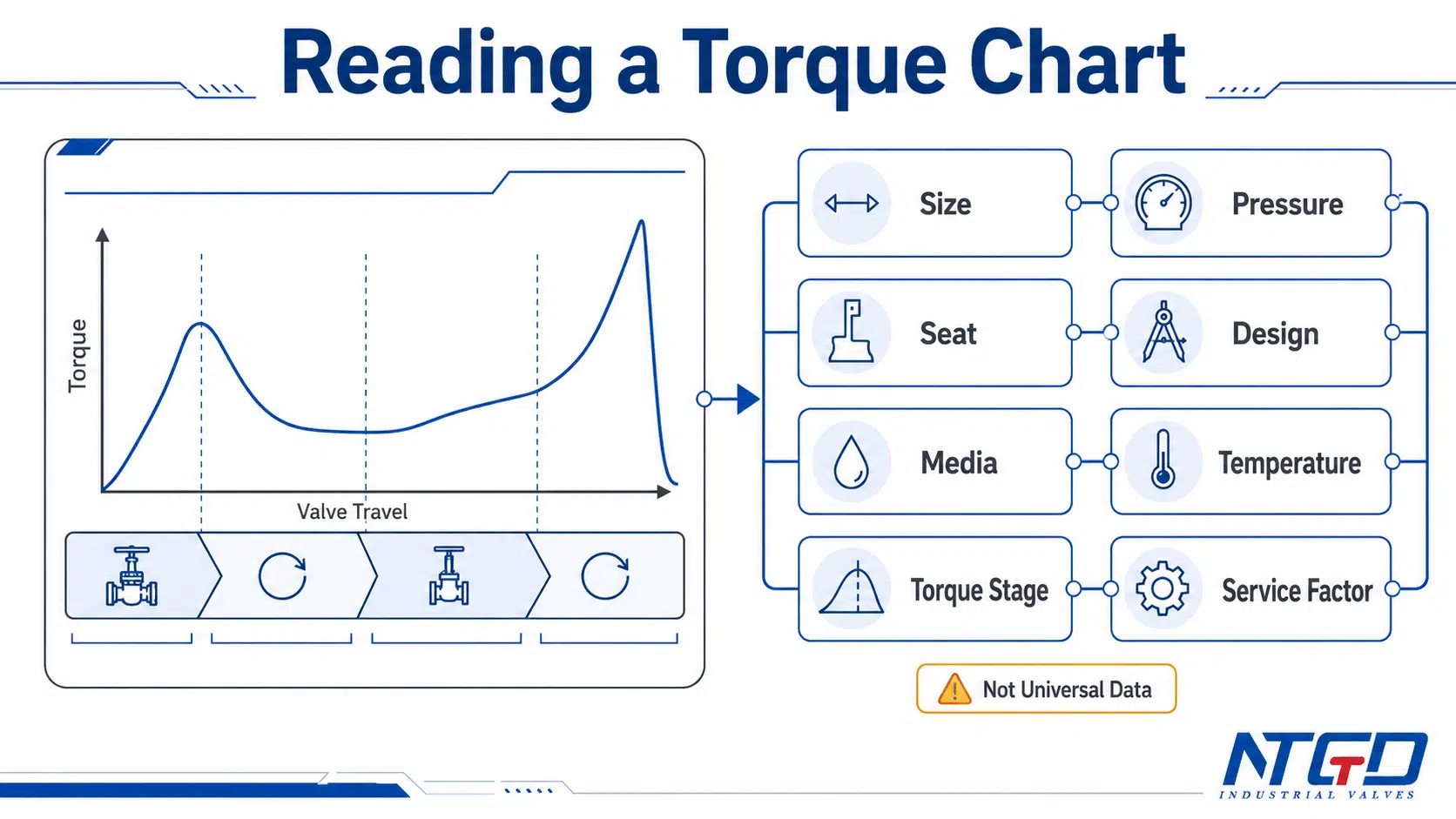
Lo que suelen mostrar los gráficos de torque
Una tabla de par de torsión suele mostrar los valores de par en condiciones definidas. Estos valores pueden basarse en el diseño de la válvula, los datos de prueba, la presión de referencia, el material del asiento y las suposiciones del fabricante.
Una tabla de torque útil puede ayudar al comprador a identificar:
- el rango de par esperado para un tamaño de válvula determinado;
- cómo varía el par con la presión diferencial;
- si el par de desprendimiento es mayor que el par de funcionamiento;
- si el material del asiento afecta el par;
- si la selección del actuador requiere un margen adicional.
Lo que no muestran las gráficas de par motor
Una tabla de torque no siempre refleja la realidad completa del servicio.
| El gráfico puede mostrar | Es posible que el gráfico no se muestre |
|---|---|
| Tamaño de la válvula y clase de presión | Acumulación o contaminación real del medio |
| Material del asiento | Efectos a largo plazo de la paralización |
| Condición de presión diferencial | Servicio contra la corrosión, las incrustaciones o la polimerización |
| Valor de par de referencia | Ajuste de la empaquetadura después de la instalación |
| Unidad de par | Todos los efectos de la temperatura |
| Datos de la serie de válvulas | Diferencias de diseño de otros fabricantes |
| Algunas etapas de par | Curva completa de salida del actuador |
| Supuestos del fabricante | Factor de seguridad específico del proyecto |
Ignorar estas limitaciones puede dar lugar a que el actuador sea demasiado pequeño, a un sobredimensionamiento innecesario o a un funcionamiento poco confiable cuando las condiciones reales de servicio difieran de los supuestos de la tabla.
Por qué las tablas de par son específicas de cada fabricante y configuración
Los valores de par están estrechamente relacionados con la construcción de la válvula. La geometría de la bola, el diseño del asiento, la precarga del asiento, el empaque del vástago, el acabado de la superficie, la estructura de los cojinetes y el soporte del muñón pueden variar de un fabricante a otro.
Incluso dentro de la gama de productos de un mismo fabricante, el par puede variar entre:
- diseños flotantes y montados sobre muñón;
- válvulas de paso completo y de paso reducido;
- válvulas de asiento blando y de asiento metálico;
- diseños de baja presión y alta presión;
- paquetes manuales y accionados;
- diseños para condiciones de servicio estándar y severas.
Las tablas de par son útiles para realizar comparaciones iniciales, la preselección de actuadores y la revisión del rango de servicio. La confirmación final del pedido debe basarse en los datos de par correspondientes a la configuración exacta de la válvula y a las condiciones de servicio, y no en una tabla genérica de la serie ni en una tabla del fabricante que no sea relevante.
Conceptos básicos sobre el par de apriete de las válvulas de bola y la selección de actuadores
La selección del actuador comienza con el par de la válvula, pero no termina ahí. Es necesario verificar que el actuador cumpla con los requisitos de par de la válvula a lo largo de todo el ciclo de apertura y cierre.
El objetivo no es simplemente elegir el actuador más grande. El objetivo es seleccionar un actuador que pueda accionar la válvula de manera confiable en condiciones de servicio, sin rebasar los límites mecánicos de la válvula.
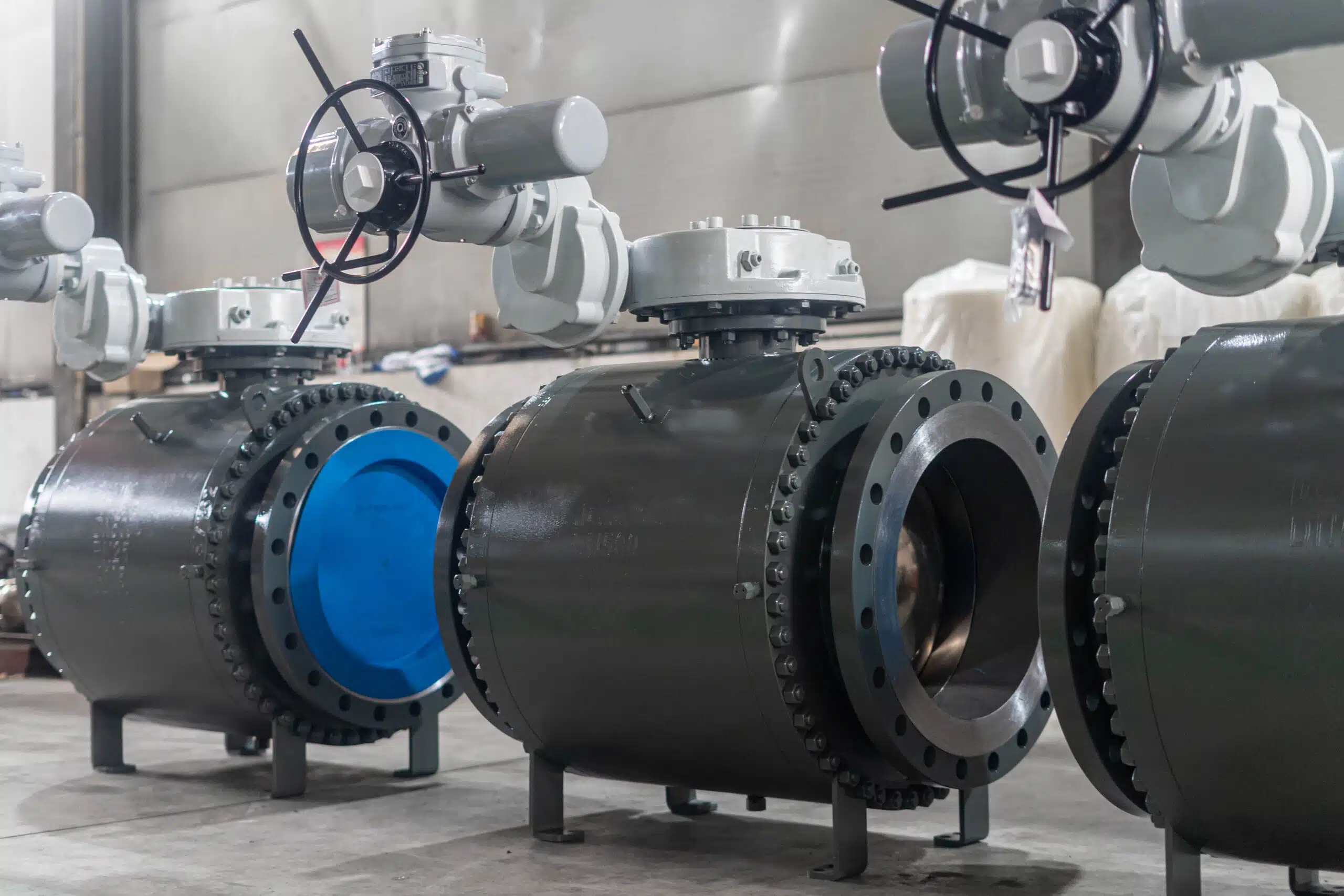
Requisitos de par de la válvula frente al par de salida del actuador
La válvula genera un requisito de par. El actuador proporciona el par de salida.
Para garantizar una combinación segura, compare el par de apriete requerido de la válvula en cada punto crítico con el par disponible del actuador en el mismo punto de la carrera.
| Datos de selección | Qué hay que confirmar | Por qué es importante |
|---|---|---|
| Par de desprendimiento | Par necesario para iniciar el movimiento | El actuador debe poner en marcha la válvula desde el estado de reposo |
| Par de funcionamiento | Par necesario durante la rotación | El actuador debe seguir moviéndose a lo largo de la carrera |
| Par de apriete final / par de apriete de los asientos | Par cerca de la posición final | El actuador debe abrir o cerrar completamente la válvula |
| Sentido de apertura/cierre | El par puede variar según la dirección | Las funciones de «apertura en caso de falla» y «cierre en caso de falla» pueden no ser las mismas |
| Presión de suministro de aire | El rendimiento de un actuador neumático depende de la presión de alimentación | Una presión de suministro baja puede reducir el par disponible |
| Función de retorno de resorte | La potencia de los golpes de resorte puede diferir de la potencia de los golpes de aire | Se debe verificar la dirección de seguridad ante fallas |
| Salida del actuador eléctrico | Par nominal, modo de control y voltaje | Evita que el motor se cale o que el recorrido sea incompleto |
| Factor de servicio | Margen adicional para derechos de aduana o servicios | Ayuda a tener en cuenta las condiciones operativas reales |
| MAST | Par máximo permitido en el vástago | Evita que el actuador sobrecargue el vástago |
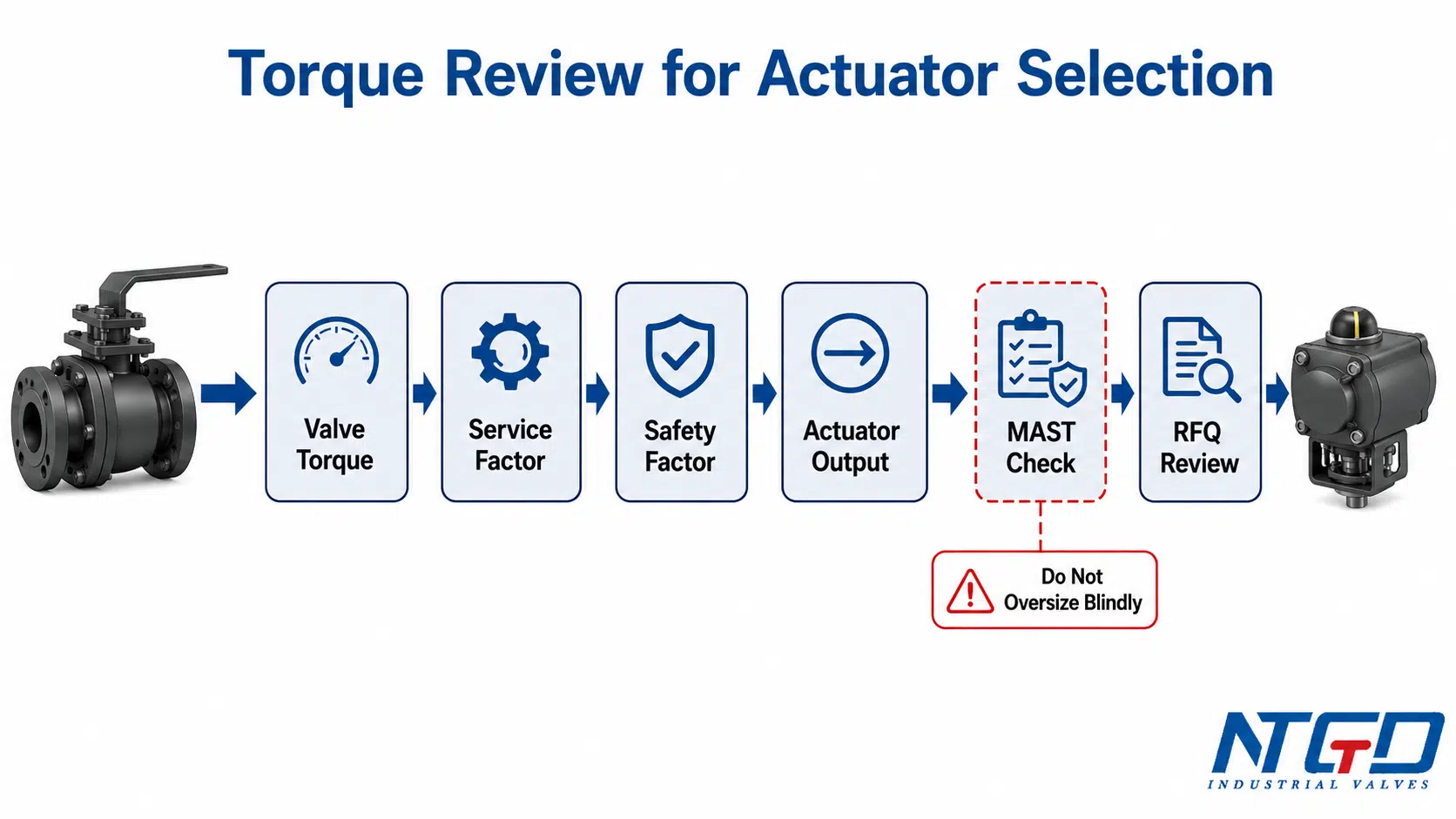
Factor de seguridad y factor de servicio
A menudo se aplica un factor de seguridad o factor de servicio, ya que las condiciones reales de servicio pueden ser más exigentes que los datos de par de referencia. Este factor puede tener en cuenta los efectos de los medios, la temperatura, la frecuencia de los ciclos, el tiempo de inactividad o los requisitos del proyecto.
Sin embargo, no se debe aplicar un factor de seguridad a ciegas. Un margen demasiado pequeño puede provocar una falla del actuador o un funcionamiento incompleto. Una salida excesiva del actuador puede generar un riesgo si el actuador supera el límite del vástago de la válvula o del tren de transmisión.
El margen adecuado debe consultarse con el fabricante de la válvula, el proveedor del actuador y las especificaciones del proyecto.
Si reducir el tamaño del actuador o la carga de automatización es una prioridad del proyecto, el artículo aparte sobre válvulas de bola de bajo par para sistemas de automatización explica esa orientación de diseño sin sustituir el proceso de confirmación del torque descrito en esta guía.
Actuadores neumáticos de retorno por resorte frente a los de doble acción
Un actuador neumático de doble efecto utiliza la presión de aire para accionar tanto la apertura como el cierre. Un actuador con retorno por resorte utiliza la presión de aire en una dirección y la fuerza del resorte en la dirección de seguridad.
Esta diferencia es importante porque la salida del actuador puede no ser la misma en ambas direcciones. Se debe revisar cuidadosamente la carrera de seguridad de un actuador de retorno por resorte, especialmente si la válvula requiere un alto par de arranque o de cierre.
Al seleccionar un actuador neumático, asegúrese de:
- presión de suministro de aire disponible;
- requisito de apertura o cierre en caso de falla;
- par de apriete de la válvula en ambas direcciones;
- curva de salida del actuador;
- factor de servicio;
- condiciones ambientales y de proceso.
Par y voltaje del actuador eléctrico / Requisitos de control
La selección de un actuador eléctrico debe tener en cuenta el par de salida, el tiempo de recorrido, el ciclo de trabajo, el voltaje, la señal de control y los requisitos de protección. El par debe ajustarse a las necesidades de la válvula, pero el actuador también debe ser compatible con el sistema de control y la frecuencia de operación.
En el caso de las válvulas de bola accionadas eléctricamente, la revisión del par de giro debe incluir:
- par de apriete requerido de la válvula;
- par nominal del actuador;
- requisito de control manual;
- control de apertura/cierre o control modulador;
- tensión y señal de control;
- ciclo de trabajo;
- protección del medio ambiente;
- límite de torque del vástago.
Si aún no se ha decidido el tipo de actuador, compare la lógica de control, la respuesta, el suministro de aire y los requisitos del sitio en el Válvula de bola eléctrica vs. válvula de bola neumática Siga estas instrucciones una vez que se haya confirmado el par de apriete requerido para la válvula.
MAST: Par máximo permitido en el vástago como límite de seguridad
MAST significa par máximo permitido en el vástago. Es el límite de par que el vástago de la válvula puede soportar de manera segura en condiciones definidas.
MAST es importante porque la selección de un actuador no se reduce únicamente a contar con suficiente par. El actuador también debe evitar aplicar un par excesivo que pueda dañar el vástago, la conexión de transmisión o los componentes internos.
Al seleccionar el actuador, se deben tener en cuenta ambos extremos del rango de torque: la potencia del actuador debe ser suficiente para el torque requerido por la válvula, incluyendo el factor de servicio; sin embargo, el conjunto de actuador seleccionado o la configuración de limitación de torque también deben evitar que se exceda el torque máximo permitido en el vástago de la válvula.
En aplicaciones de alta presión, automatizadas o de condiciones de servicio extremas, se debe verificar el valor de MAST en relación con la salida del actuador y las especificaciones del proyecto. Este artículo no sustituye un cálculo completo de MAST ni una revisión estándar; solo destaca el MAST como un límite de seguridad durante la selección del actuador.
En cuanto al límite de seguridad del tallo, esto Revisión del par máximo permitido en el vástago explica por qué se debe verificar la salida del actuador con respecto al MAST de la válvula al seleccionar el actuador.
Errores comunes en la selección del par de apriete de las válvulas de bola
Los errores relacionados con el par de apriete pueden provocar un funcionamiento incompleto, fallas en el actuador, sobrecarga del vástago o problemas inesperados en el campo. Los tres errores de mayor riesgo son: utilizar una tabla de pares genérica como dato definitivo, sustituir la presión diferencial máxima por la presión nominal y seleccionar un actuador basándose únicamente en el tamaño de la válvula.
| Error | Posible consecuencia | Cómo evitarlo |
|---|---|---|
| Utilizar una tabla de torque genérica como datos definitivos | Es posible que el actuador sea demasiado pequeño o demasiado grande | Utilice los datos de par de apriete del fabricante para la configuración exacta de la válvula |
| Sin tener en cuenta el material del asiento | El par motor podría ser mayor de lo esperado | Revisa el factor de torque del material del asiento y confirma el diseño exacto del asiento con el fabricante de la válvula |
| Sin tener en cuenta las condiciones de los medios de comunicación | Los depósitos, la sequedad o los sólidos pueden aumentar el par de giro | Incluye el tipo de medio, la viscosidad, el contenido de sólidos y el grado de limpieza en la solicitud de cotización |
| Dimensionamiento basado únicamente en el tamaño nominal de la válvula | Las válvulas del mismo tamaño pueden tener un par de apriete diferente | Utilice los datos sobre el diseño de la válvula, el asiento, la presión y las condiciones de servicio que figuran en la lista de verificación de la solicitud de cotización |
| Sin tomar en cuenta la presión diferencial | Es posible que se subestime el par de desprendimiento | Confirme la presión diferencial máxima de operación, no solo la clase de presión |
| Sin tener en cuenta la frecuencia de funcionamiento | Un tiempo prolongado de inactividad o ciclos frecuentes pueden modificar los requisitos de mantenimiento | Define las condiciones de funcionamiento cíclico y de inactividad |
| Tratar de la misma manera los diseños flotantes y los de muñón | El comportamiento del par motor podría interpretarse erróneamente | Confirma el diseño de la válvula antes de determinar el tamaño del actuador |
| Aumentar el tamaño sin consultar MAST | Los componentes del eje o del sistema de transmisión podrían estar sobrecargados | Compara la salida del actuador con el par máximo permitido del vástago |
| Sin tener en cuenta la presión de suministro de aire | La potencia de salida del actuador neumático puede ser menor de lo esperado | Verifica la presión mínima disponible del suministro de aire |
| Considerar la selección del actuador como una búsqueda en un catálogo | Es posible que la válvula no funcione de manera confiable en condiciones reales de servicio | Revisa el par de la válvula, la potencia de salida del actuador, el factor de servicio y la acción de seguridad ante fallas de manera conjunta |
Lista de verificación para la solicitud de cotización (RFQ) sobre el par de apriete y la selección del actuador de una válvula de bola
Para realizar una evaluación precisa del par de apriete de una válvula de bola y seleccionar el actuador adecuado, la solicitud de cotización debe incluir datos suficientes sobre la válvula, el servicio y el actuador. Cuanto más completos sean los datos, más fácil le resultará al fabricante confirmar el par de apriete y recomendar un método de operación adecuado.
Datos de válvulas por confirmar
| Datos de la válvula | Por qué es importante |
|---|---|
| Tipo de válvula | Confirma que la solicitud es para una válvula de bola, no para otra válvula de cuarto de vuelta |
| Talla | Referencia básica de par |
| Tipo de orificio | La geometría de puerto completo o de puerto reducido puede afectar el par motor |
| Clase de presión / clasificación | Afecta a la construcción y a la carga de presión |
| Material de la carrocería | Importante para la confirmación del servicio y el diseño |
| Material del asiento | Influye directamente en la fricción y el par motor |
| Diseño con asiento blando o con asiento metálico | Modifica el comportamiento del par y la idoneidad para su aplicación |
| Diseño flotante o montado sobre muñón | Afecta la carga de presión y el soporte |
| Conexión final | Ayuda a confirmar la configuración completa de la válvula |
| Vástago / interfaz de montaje | Importante para la conexión del actuador o la caja de cambios |
Datos del servicio que se deben confirmar
| Datos del servicio | Por qué es importante |
|---|---|
| Medios de comunicación | La presencia de sólidos, gases, líquidos, lodos o sustancias viscosas afecta el par de giro |
| Temperatura | El comportamiento del asiento y la junta varía con la temperatura |
| Presión normal | Ayuda a verificar el estado del servicio |
| Presión diferencial máxima | Importante para el par de arranque |
| Dirección del flujo / dirección de la presión | Podría afectar la capacidad de carga de los asientos en algunos diseños |
| Frecuencia de funcionamiento | El funcionamiento ocasional y los ciclos frecuentes son diferentes |
| Tiempo de inactividad | Los períodos prolongados de inactividad pueden aumentar el par de arranque |
| Servicio de limpieza / suciedad | Los depósitos o la incrustación pueden aumentar el par |
| Servicio en entornos corrosivos o abrasivos | Puede que se requieran materiales especiales o márgenes específicos |
Datos del actuador que se deben confirmar
| Datos del actuador | Por qué es importante |
|---|---|
| Accionamiento manual, por engranajes, neumático o eléctrico | Determina el método de funcionamiento |
| Posición de fallo | Los modos de fallo abierto, fallo cerrado o fallo en posición influyen en la selección del actuador |
| Presión de suministro de aire | El rendimiento del actuador neumático depende del suministro |
| De doble acción o con retorno por resorte | El par de salida varía según el tipo y la dirección del actuador |
| Tensión / señal de control | Información necesaria para la selección del actuador eléctrico |
| Modo de funcionamiento de apertura-cierre o modulado | Influye en el tipo de actuador y el ciclo de trabajo |
| Velocidad de funcionamiento requerida | Puede afectar el dimensionamiento y el control del actuador |
| Entorno del sitio | Requisitos de temperatura ambiente, recinto y protección |
| Factor de seguridad / factor de servicio | Requerido para el margen del proyecto |
| MAST / límite de par del vástago | Evita daños por exceso de torque |
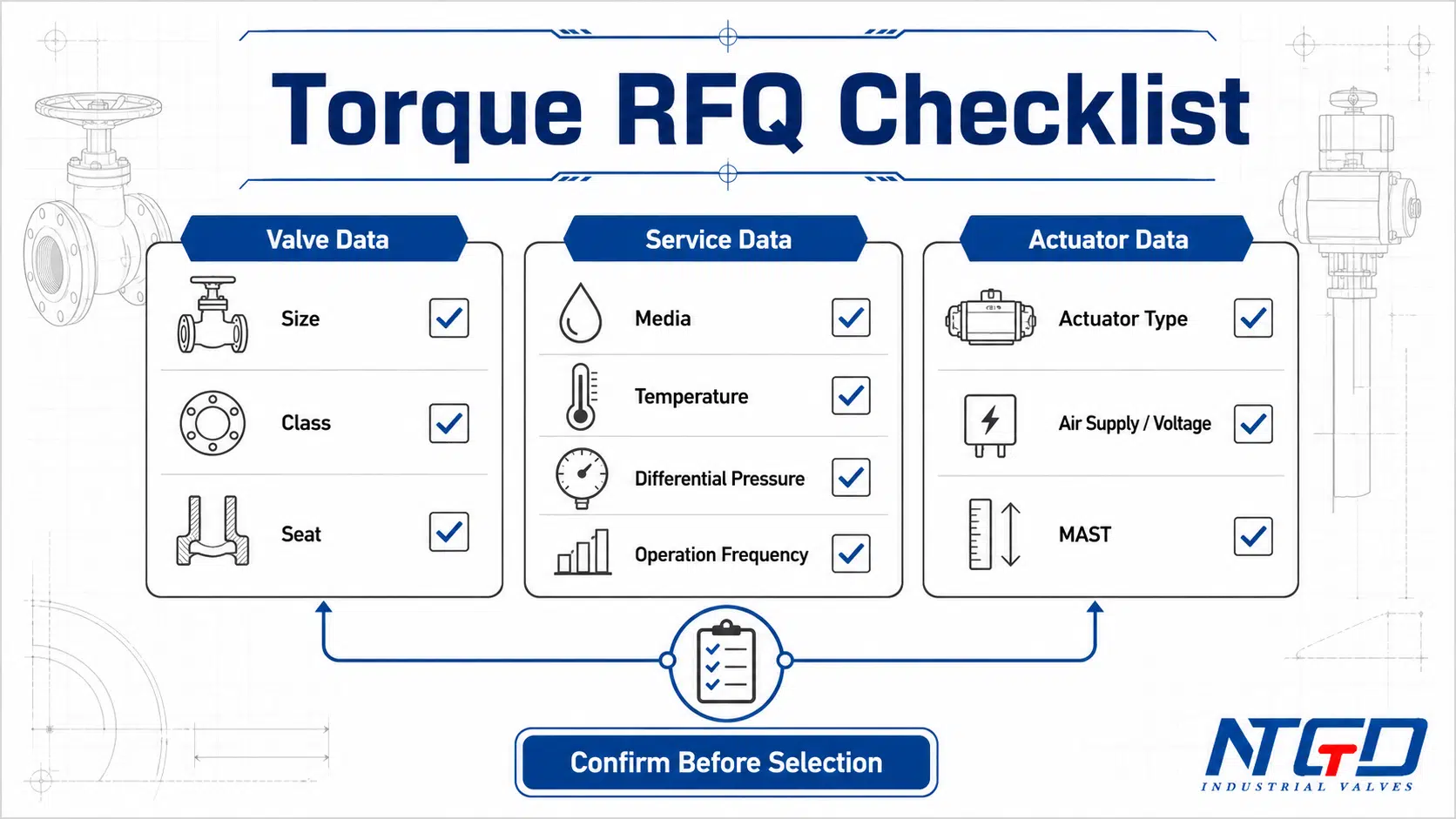
Cuando la solicitud de cotización incluye detalles sobre el montaje del actuador, el ISO 5211:2026, norma sobre la fijación de actuadores de cuarto de vuelta es una referencia útil para la terminología relacionada con las interfaces y los requisitos de conexión.
Datos de par del fabricante y revisión de seguridad
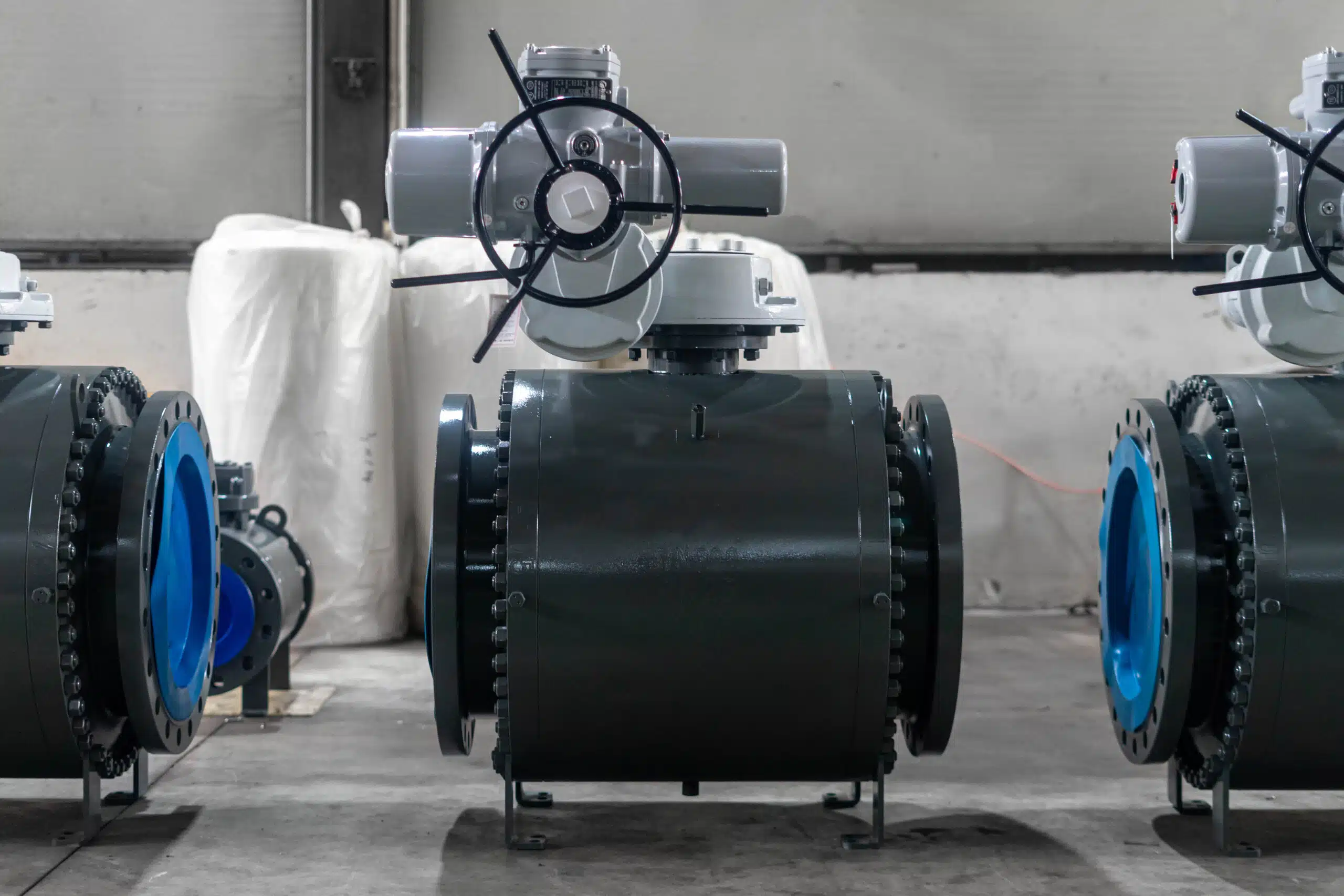
Antes de confirmar un conjunto de válvula de bola con actuador, solicite los datos de par de apriete confirmados por el fabricante para la configuración exacta de la válvula. En la revisión se deben verificar conjuntamente los requisitos de par de apriete de la válvula, la potencia de salida del actuador, el factor de servicio, la dirección de seguridad en caso de falla y el límite MAST.
Una solicitud de cotización completa no tiene por qué incluir el cálculo del par de torque. Debe proporcionar la información necesaria para una confirmación técnica correcta.
Con estos datos, el fabricante puede confirmar el par de la válvula, verificar la compatibilidad del actuador y revisar los límites de seguridad antes de la producción o la aprobación del empaque.
Preguntas frecuentes sobre el par de apriete de las válvulas de bola
¿Qué es el par de apriete de una válvula de bola?
El par de la válvula de bola es la fuerza de rotación necesaria para girar la bola dentro de una válvula de bola. Se utiliza para evaluar el funcionamiento manual, la selección de la caja de engranajes y la selección del actuador.
¿Qué es el par de ruptura en una válvula de bola?
El par de arranque es el par necesario para comenzar a mover la bola desde una posición de reposo. Suele ser importante porque la válvula debe superar la fricción estática y la carga de presión antes de que comience la rotación.
¿Qué es el par de giro o par de inercia en una válvula de bola?
El par de marcha es el par necesario para mantener la bola en movimiento una vez que ha comenzado a girar. En ocasiones se utiliza de manera informal el término “par de inercia” para referirse al par de marcha, pero se debe verificar el término exacto consultando los datos de par proporcionados por el fabricante.
¿El par de funcionamiento es lo mismo que el par de arranque?
No. El par de funcionamiento es un término general que puede abarcar varias etapas de par. El par de arranque se refiere específicamente al par necesario para iniciar el movimiento desde el reposo.
¿Cómo se calcula el par de apriete de una válvula de bola?
En ocasiones, el par de apriete de una válvula de bola puede estimarse de manera aproximada durante la revisión inicial, tomando en cuenta la fricción del asiento, la carga de presión diferencial, la fricción de la empaquetadura del vástago y el diseño de la válvula. Sin embargo, no existe una fórmula universal que sirva para todas las válvulas de bola. El par de apriete definitivo debe ser confirmado por el fabricante de la válvula, de acuerdo con la configuración exacta y las condiciones de servicio.
¿Puedo usar una sola tabla de par de apriete para todas las válvulas de bola?
No. Una tabla de par de apriete para válvulas de bola suele ser específica para cada fabricante, serie de válvulas, tamaño, clase de presión, material del asiento y condiciones de servicio. Utilizar una tabla de par de apriete genérica como dato definitivo para el dimensionamiento del actuador es uno de los errores de selección más comunes. Para la confirmación final, se deben utilizar datos de par de apriete que coincidan con la configuración real de la válvula.
¿Qué par de torque se debe utilizar para el dimensionamiento del actuador?
Para dimensionar un actuador, se debe tomar en cuenta el punto de par máximo relevante requerido a lo largo del ciclo de operación, incluyendo el par de arranque, el par de funcionamiento y el par final o de cierre. También se debe verificar la curva de salida del actuador, el factor de servicio, la dirección de seguridad en caso de falla y el par máximo permitido en el vástago.
¿Por qué se utiliza un factor de seguridad para el dimensionamiento de los actuadores?
Un factor de seguridad ayuda a tener en cuenta las condiciones reales de servicio que pueden aumentar el par, tales como los depósitos de sustancias, los cambios de temperatura, los largos períodos de inactividad, el servicio en seco o el funcionamiento cíclico. El factor debe seleccionarse cuidadosamente para que el actuador no sea demasiado pequeño ni excesivamente grande.
¿Cómo afecta el material del asiento al par de apriete de una válvula de bola?
El material del asiento influye en el comportamiento de fricción, compresión y sellado. Los asientos de PTFE, los asientos reforzados, los de nylon y los metálicos pueden tener distintos requisitos de par de apriete. El efecto exacto depende del diseño de la válvula y de las condiciones de servicio.
¿El par de apriete es el mismo en las válvulas de bola flotantes y en las de muñón?
No. Las válvulas de bola flotante y las válvulas de bola montadas sobre muñón soportan y cargan la bola de manera diferente. Su comportamiento frente al par de torsión puede variar, especialmente bajo presiones diferenciales más altas o en válvulas de mayor tamaño.
¿Qué datos debo enviar para seleccionar el actuador de una válvula de bola?
Indique el tamaño de la válvula, la clase de presión, el tipo de paso, el material del asiento, el material del cuerpo, el fluido, la temperatura, la presión normal, la presión diferencial máxima, la frecuencia de operación, el tipo de actuador, el suministro de aire o el voltaje, la posición de falla y cualquier factor de seguridad del proyecto o requisito MAST.
Conclusión: Verifique el par antes de seleccionar el actuador
La selección del par de una válvula de bola debe seguir tres principios: abarcar toda la carrera, relacionar los factores de par con las condiciones reales de servicio y verificar tanto el margen de par del actuador como el límite de par del vástago.
El par de una válvula de bola no es un valor único y fijo. Varía a lo largo del ciclo de funcionamiento y depende del par de arranque, el par de funcionamiento, el par final, la fricción del asiento, la presión diferencial, el medio, la temperatura, la frecuencia de operación y el diseño de la válvula.
Una tabla de par o un cálculo aproximado pueden servir de apoyo para una revisión inicial, pero no deben sustituir a los datos de par confirmados por el fabricante. Para la selección definitiva del actuador, se debe comparar el par requerido por la válvula con la salida del actuador, el factor de servicio, la dirección de seguridad en caso de falla y el par máximo permitido en el vástago.
Lo más seguro es considerar el par de apriete como parte de las especificaciones completas de la válvula. Confirme el diseño de la válvula, los datos de servicio y los requisitos del actuador antes de ordenar un conjunto de válvula de bola con accionamiento manual, por engranajes, neumático o eléctrico.
Soporte técnico para aplicaciones y especificaciones
NTGD Valve puede revisar el par de apriete de la válvula de bola y la compatibilidad con el actuador como parte de la confirmación de las especificaciones. Para la revisión de la solicitud de cotización, proporcione el tamaño de la válvula, la clase de presión, el material del asiento, el fluido, la temperatura, la presión diferencial, la frecuencia de operación y los requisitos del actuador, de modo que se puedan verificar los requisitos de par de apriete y los criterios de selección del actuador antes de confirmar la producción.
