
Nom de l'auteur : Bruce Zheng
Rôle de l'auteur : Cofondateur et ingénieur en vannes chez NTGD Valve
Bio de l'auteur : Bruce Zheng est cofondateur et ingénieur en vannes chez NTGD Valve, qui se concentre sur la sélection des vannes industrielles, les applications et le contenu technique pour les acheteurs B2B mondiaux.
Dernière mise à jour : June 8, 2026
A check valve is a self-acting valve that allows flow in one direction and helps prevent reverse flow in a pipeline. To understand how it works, engineers and buyers need to understand the main check valve parts and how these components interact inside the valve body.
The main check valve parts usually include the body, cover or bonnet, seat, closure element, gasket, bolting and trim. Depending on the design, the closure element may be a disc, poppet, flapper, ball, piston or dual plate. Some check valves also use a spring, hinge, shaft, pin or guide to control movement and closing response.
This guide explains industrial check valve parts and components from a functional and specification perspective. It is not a spare parts catalog, repair kit list or product SKU page. The goal is to help buyers, engineers and maintenance teams understand what each component does, why it matters, and what should be checked before selecting or specifying an industrial check valve.
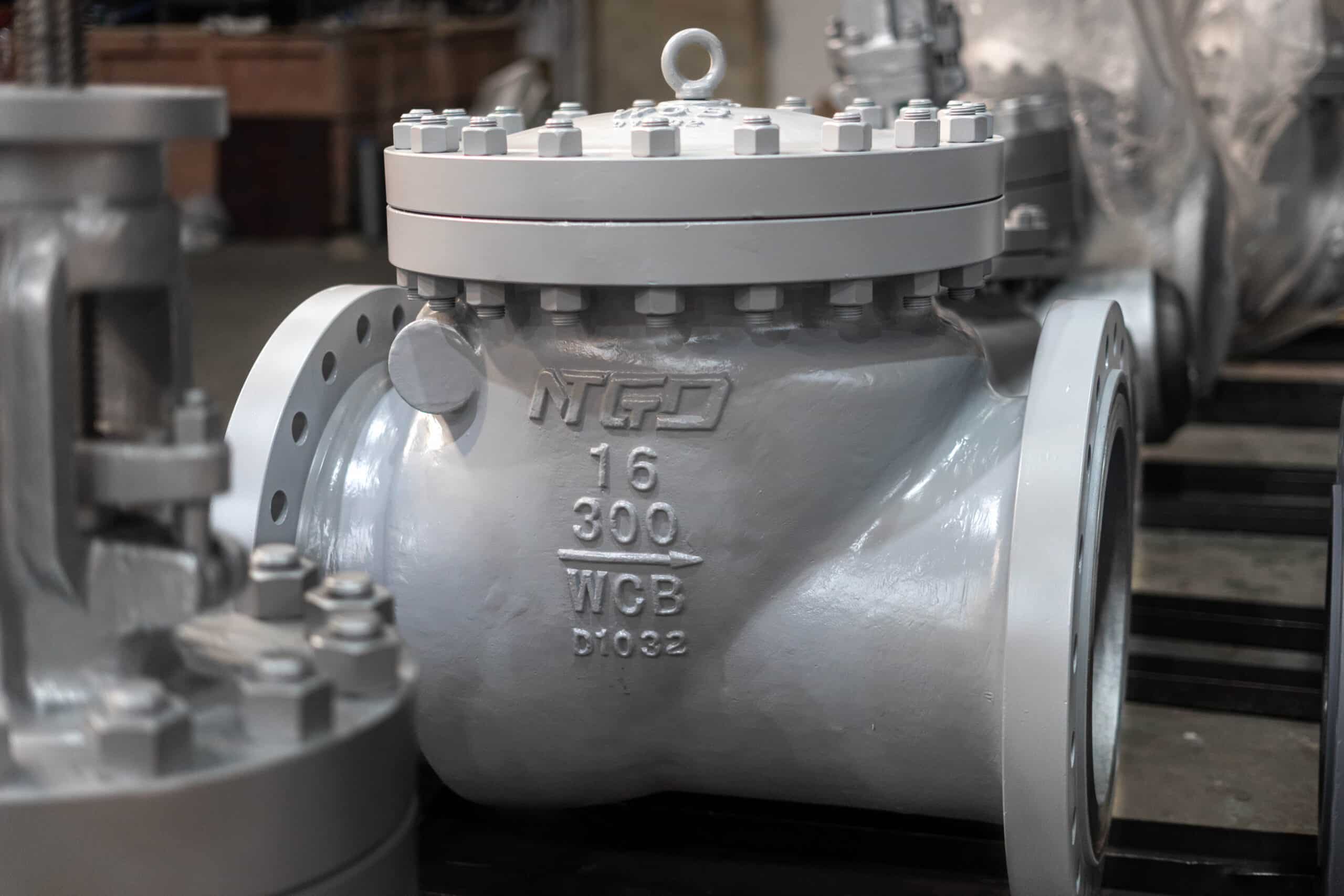
Quick Answer: What Are the Main Check Valve Parts?
When engineers and buyers search for check valve parts, they usually need to understand how the components affect sealing, closing response, flow behavior and specification decisions — not only identify a replacement item.
The main parts of a check valve are the corps, cover or bonnet, siège, closure element, joint, bolting et garniture. The closure element may be a disque, poppet, flapper, balle, piston ou double plaque. A check valve may also include a spring, hinge, shaft, pin ou guide, depending on the valve type.
In simple terms, the body contains the pressure and flow path. The seat provides the sealing surface. The closure element opens under forward flow and closes when reverse flow or back pressure occurs. Springs, hinges or guides help control how the closure element moves, but these parts are design-dependent and are not present in every check valve.
For industrial selection, check valve parts should not be viewed only as names on a diagram. The disc, seat, spring, hinge, gasket and trim can affect leakage risk, closing response, pressure drop, wear, material compatibility and maintenance access. Understanding these differences helps avoid selecting a valve only by name while overlooking the parts that actually determine service performance.
Check Valve Parts vs Components: Scope of This Guide
Industrial Components, Not a Spare Parts Catalog
In industrial valve discussions, “check valve parts” may refer to the physical components inside the valve, while “check valve components” often emphasizes their function in the valve assembly. This article uses both terms in an engineering sense.
The focus is on how the valve is built and how each component affects flow control, backflow prevention and specification review. It does not provide replacement part numbers, repair kits, brand-specific spare parts, pricing or stock information.
For procurement or engineering review, this distinction matters. A buyer who asks for “check valve parts” may need to understand the body, seat, disc and spring arrangement before confirming the correct valve type, material and drawing. A maintenance team may also need to identify which internal component is likely to affect sealing or closing performance, but that is different from ordering a model-specific spare part.
Why Check Valve Parts Vary by Design
Not every check valve uses the same internal construction. A swing check valve normally uses a hinged disc or flapper. A lift check valve may use a guided disc or piston-like closure element. A ball check valve uses a ball as the moving element. A dual plate check valve uses two plates, springs and hinge pins. A spring-loaded check valve may use spring force to assist closing.
For a broader type-level overview, compare the main Types de clapets anti-retour before treating a generic parts diagram as a universal parts list.
This is why a generic check valve parts diagram should be read as a structural reference, not as a universal parts list for every valve design. The exact arrangement must always be verified against the manufacturer’s drawing, datasheet or project specification.
Main Check Valve Parts and Their Functions
The table below summarizes the most common industrial check valve components and how they affect performance and specification decisions.
For an independent industry overview of typical check valve construction and flow-sensitive internals, see Valve Magazine’s check valve application guidance.
| Check Valve Part / Component | Fonction principale | Found In | Specification Impact |
|---|---|---|---|
| Corps | Contains pressure and forms the flow passage | All industrial check valves | Affects pressure class, end connection, body material, corrosion resistance and installation envelope |
| Capot | Provides access to internal parts and closes the pressure boundary | Many swing, lift, piston and large industrial designs | Affects maintenance access, gasket sealing and pressure-boundary integrity |
| Siège ou anneau de siège | Provides the sealing surface for the closure element | Most check valve designs | Affects leakage performance, wear resistance, material compatibility and shutoff reliability |
| Disc, poppet, flapper, ball or piston | S'ouvre dans le sens du débit et se ferme dans le sens inverse | Design-dependent | Affects closing response, flow resistance, backflow prevention and wear pattern |
| Printemps | Helps return the closure element toward the seat | Spring-loaded, dual plate and some non-slam designs | Affects cracking pressure, closing speed, fatigue risk and material selection |
| Hinge, shaft or pin | Supports pivoting movement of a disc or plate | Swing and dual plate designs | Affects disc alignment, movement, wear and long-term reliability |
| Guide | Keeps a lift disc, piston or poppet aligned during movement | Lift, piston and guided designs | Affects smooth movement, sticking risk and closing accuracy |
| Joint d'étanchéité | Seals between body and cover / bonnet or other pressure-boundary joints | Valves with bolted covers or assembled pressure joints | Affects external leakage control and maintenance requirements |
| Boulonnage | Clamps pressure-boundary parts together | Bolted body-cover or body-bonnet designs | Affects joint integrity and must match pressure and service requirements |
| Garniture | Refers to important internal wetted or moving parts; exact scope varies by design | Industrial valve specifications | Affects material compatibility, corrosion resistance, erosion resistance and service life |
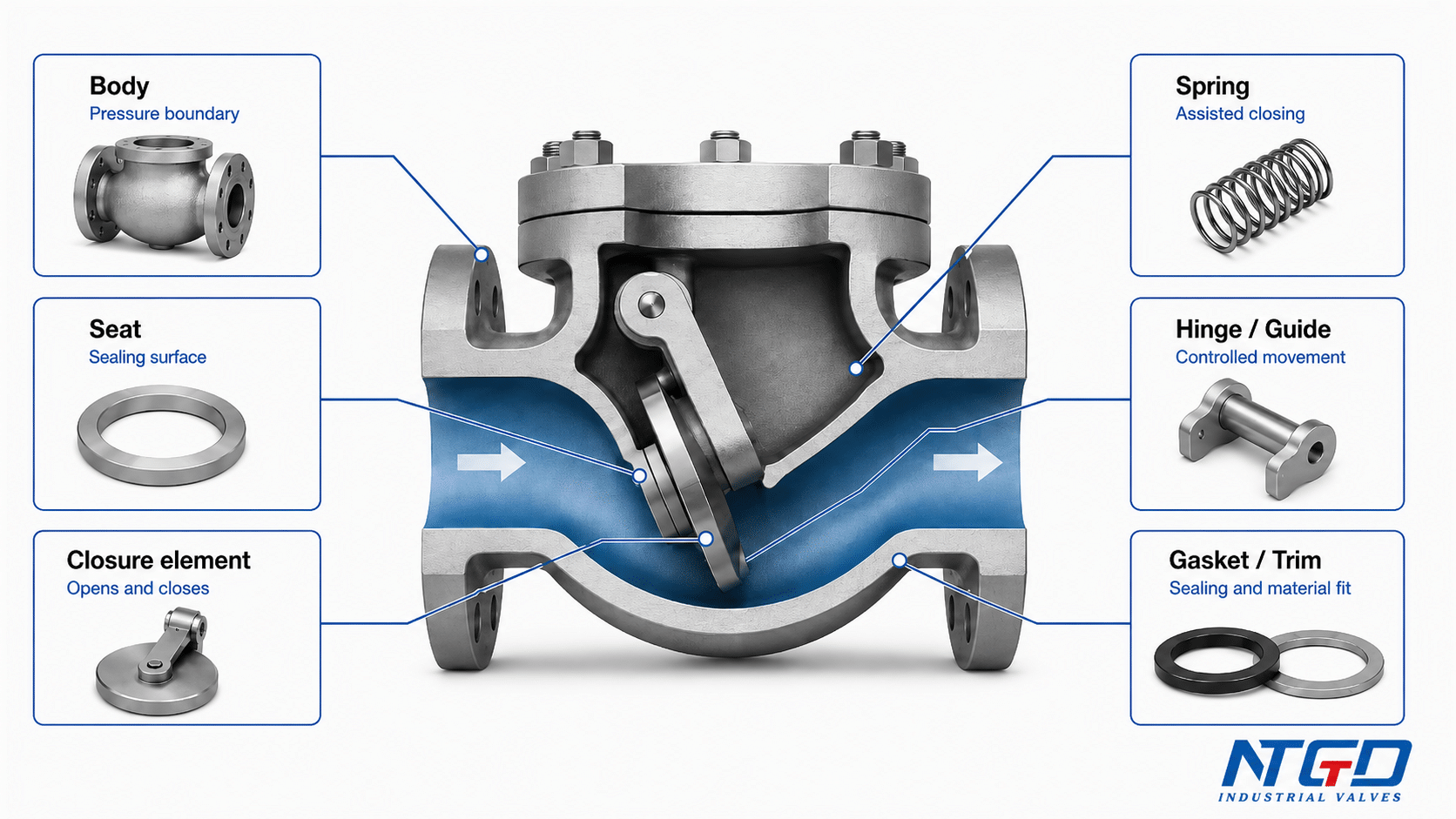
Corps
The body is the pressure-retaining shell of the check valve. It forms the main flow path and connects the valve to the pipeline through flanged, wafer, threaded, welded or other end connections.
For industrial applications, the body is not just a housing. Its material, pressure rating, end connection and internal geometry influence whether the valve can match the project specification. Carbon steel, stainless steel, cast iron, ductile iron, alloy steel and other materials may be used depending on medium, temperature, pressure and corrosion conditions.
The internal body shape also affects how the closure element moves. A swing check valve body provides space for the disc to pivot. A lift check valve body guides vertical or axial movement. A dual plate valve body is usually more compact and is often installed between flanges.
If the body design is poorly matched to the service, it may increase flow resistance, accelerate wear on internal parts, or contribute to unstable closure element movement in some operating conditions. This is why body design should be reviewed together with valve type, line orientation, flow condition and medium characteristics.
Couvercle ou bonnet
The cover or bonnet closes part of the pressure boundary and may provide access to internal components such as the disc, hinge, spring, piston or seat area. In many large industrial check valves, the cover is bolted to the body with a gasket between the two pressure-boundary surfaces.
This component is important for maintenance access and pressure containment. If the valve design allows inspection or replacement of internal components through the cover, the cover arrangement affects how easily the valve can be serviced. However, whether a valve is maintainable in-line depends on the manufacturer’s design and the installation conditions.
For industrial projects, the cover or bonnet should be checked not only as an access point, but also as part of the pressure boundary. The gasket, bolting and body-cover joint must match the pressure, temperature and medium requirements of the service.
Seat or Seat Ring
The seat is the surface against which the closure element seals when reverse flow occurs. In some designs, the seat is integrated into the body. In others, a separate seat ring or replaceable seat may be used.
The seat is one of the most important check valve components because it directly affects sealing. Seat material and geometry should be checked against the medium, temperature, pressure, solids content and expected wear conditions. A soft seat may improve shutoff in some clean services, while a metal seat may be preferred for high temperature, abrasive or severe service conditions.
Choosing the wrong seat type for the service may lead to early leakage, rapid wear or seat damage, especially when the medium contains solids, operates at high temperature or cycles frequently. The exact seat choice should be confirmed against the valve design, service condition and project specification.
Disc, Poppet, Flapper, Ball or Piston
The moving closure element is the part that opens and closes the flow path. Many users call this part the “disc,” but the correct term may vary by valve design.
A swing check valve typically uses a disc or flapper that pivots away from the seat. A lift check valve may use a guided disc or piston-like element. A ball check valve uses a ball that moves away from and back to the seat. A piston check valve uses a guided piston-style closure element. A dual plate check valve uses two spring-assisted plates.
This component affects how quickly the valve opens, how it closes, how much flow resistance it creates, and how it wears against the seat. For this reason, the closure element should be reviewed together with the seat, spring, hinge and flow conditions, not as an isolated part.
A closure element that is too heavy, poorly guided, misaligned or unsuitable for the flow condition may increase closing delay, vibration, seat impact or wear. The manufacturer’s drawing or sectional view should be checked when the closure element design is critical to the application.
Printemps
A spring is not present in every check valve. It is commonly used in spring-loaded, dual plate and some non-slam check valve designs to help the closure element return toward the closed position.
The spring can influence cracking pressure, closing speed and response to flow reversal. In services where fast closing is required, spring assistance may help reduce reverse flow before closure. However, spring design, material and fatigue resistance must match the operating conditions.
When spring force, cracking pressure or non-slam behavior is central to the application, review the dedicated clapet anti-retour à ressort selection guide instead of treating the spring as a generic component.
If spring force weakens over time, the closure element may not return quickly enough, which can increase reverse flow before the valve fully closes. For corrosive media, high temperature or frequent cycling, spring material and fatigue resistance should be confirmed carefully.
Hinge, Shaft, Pin or Guide
Hinges, shafts and pins are common in swing check and dual plate check valves. They support the pivoting movement of the disc, flapper or plates. Guides are more common in lift, piston or poppet-style check valves, where the closure element must move along a controlled path.
These components affect alignment. Poor alignment or worn moving parts can prevent the closure element from seating correctly. In abrasive or dirty services, hinge pins, shafts or guides may be wear-sensitive areas, especially when solids or deposits restrict movement.
Worn hinges, shafts or pins may cause the disc or plate to sit unevenly against the seat. Guide contamination may restrict poppet, piston or lift-disc movement. Both conditions can reduce sealing reliability even when the seat material itself is suitable for the service.
Gasket, Bolting and Pressure-Boundary Seals
Gaskets and bolting help maintain external sealing at body-cover, body-bonnet or other pressure-boundary joints. They do not control reverse flow directly, but they are still important check valve components because they affect pressure containment and external leakage control.
The gasket material should match the fluid, temperature and pressure conditions. Bolting must be suitable for the pressure-boundary design and project requirements. In most industrial projects, these details should be verified against the valve datasheet, applicable specification and manufacturer documentation.
A valve may have acceptable internal sealing at the seat but still create external leakage risk if the cover gasket, bolting condition or pressure-boundary joint is not suitable. These parts should be treated as part of the complete valve specification, not as minor hardware.
Trim and Material-Sensitive Parts
In valve specifications, “trim” usually refers to key internal wetted or moving parts, but the exact scope can vary by manufacturer and valve type. For check valves, trim may include the seat, disc, shaft, hinge pin, spring or other internal components exposed to fluid or movement.
Trim material matters because internal parts often face direct flow, corrosion, erosion, impact or repeated movement. When selecting a check valve, the buyer should not only confirm the body material. The seat, closure element, spring and hinge materials may be equally important for reliable service.
For corrosive, abrasive, high-temperature or frequent-cycling service, trim should be reviewed as a functional material package. A body material that matches the pipeline specification does not automatically mean the seat, disc, spring or hinge materials are suitable for the actual medium and operating cycle.
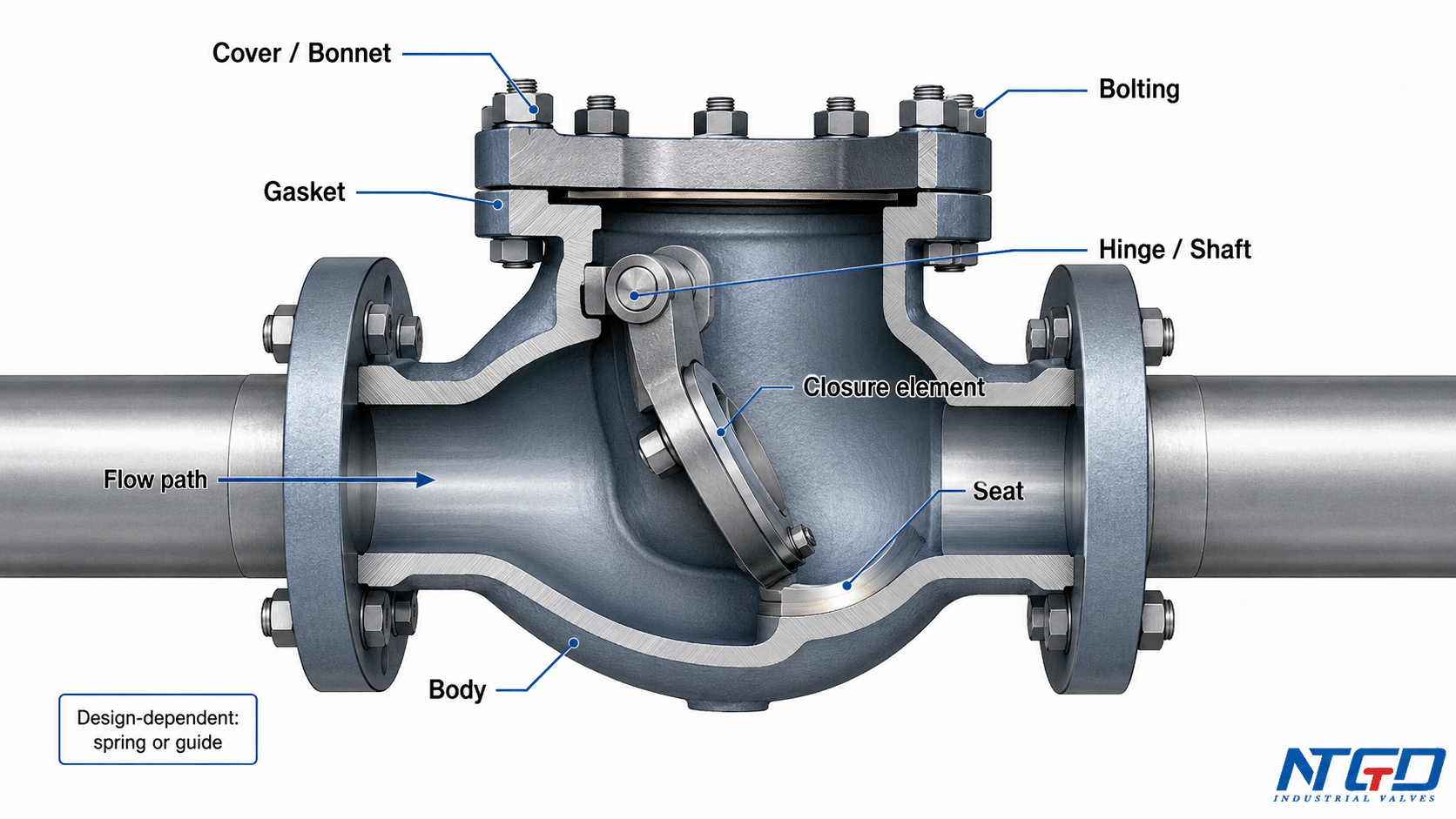
Check Valve Parts Diagram: What Each Component Shows
A labeled check valve parts diagram in this section should show how the main components sit inside a typical industrial check valve assembly. It should explain physical construction, not just show a simplified flow symbol.
For an industrial parts guide, a useful diagram should identify the body, flow path, seat, closure element, cover or bonnet, gasket, bolting and any design-dependent parts such as a spring, hinge, shaft, pin or guide.
The most important point is to understand the relationship between the closure element and the seat. Forward flow lifts, swings or pushes the closure element away from the seat. When flow stops or reverses, the closure element returns to the seat to block reverse flow.
A parts diagram may also show a restrained flow direction arrow, but this article does not replace the valve installation manual. For installation direction, always check the body arrow, nameplate, drawing and manufacturer instructions. A P&ID symbol or hydraulic schematic is a different topic because it shows system logic or drawing representation, not the physical parts inside the valve.
How Check Valve Components Work Together
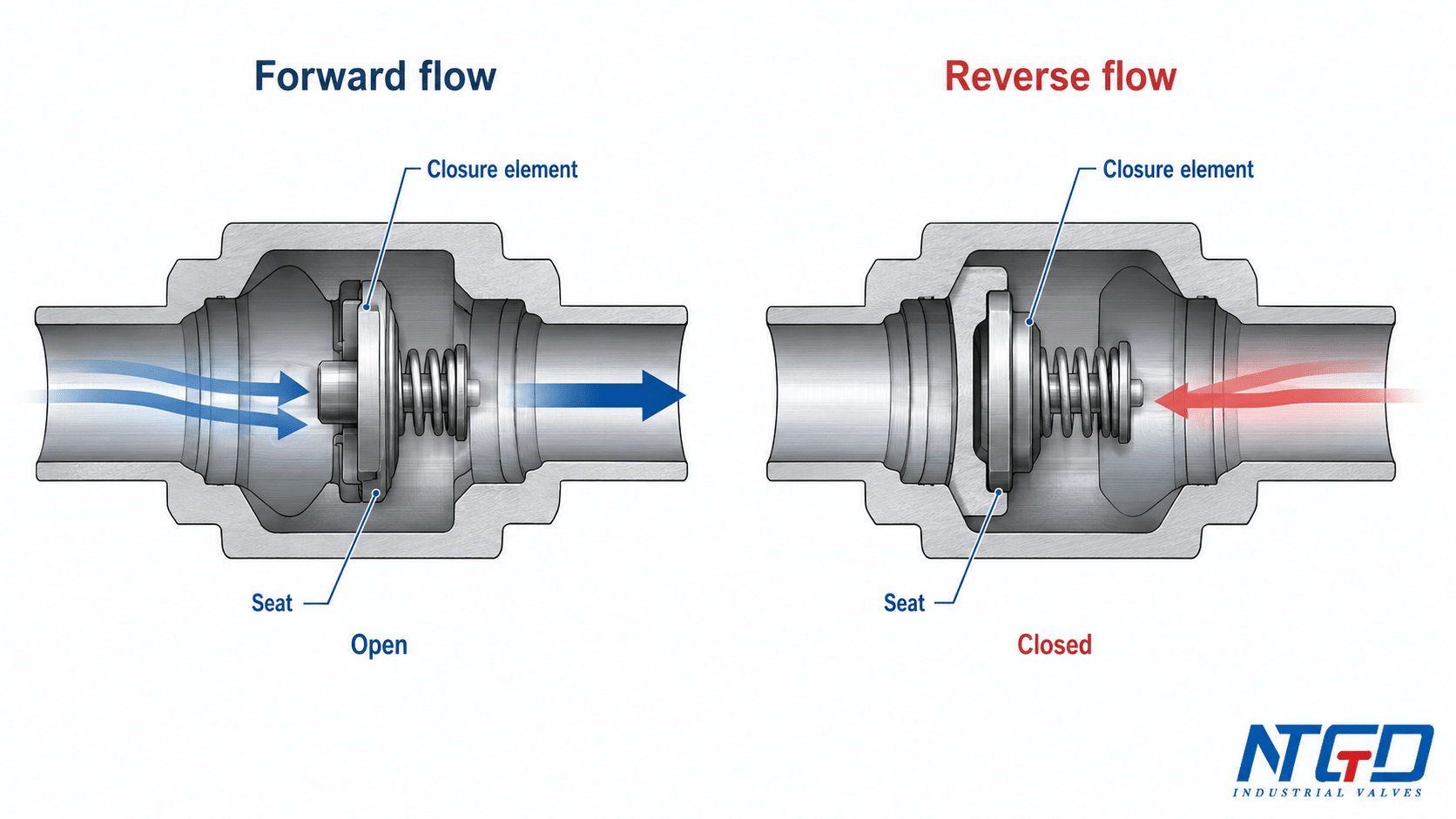
Forward Flow Opens the Closure Element
During forward flow, the fluid pressure creates enough force to move the closure element away from the seat. In a swing check valve, the disc pivots open. In a lift check valve, the guided disc or piston lifts. In a ball check valve, the ball moves away from the seat. In a dual plate check valve, the plates open against spring force.
The body and internal flow path guide the fluid through the valve. The closure element must move freely enough to allow forward flow, but it must also remain stable enough to avoid excessive vibration or chatter.
Reverse Flow Pushes the Closure Element Back to the Seat
When the flow slows, stops or reverses, the closure element moves back toward the seat. Reverse pressure helps press the closure element against the seat, blocking backflow.
The effectiveness of this action depends on the fit between the closure element and the seat. If the seat is worn, damaged or contaminated, the valve may not seal properly. If the closure element is misaligned, restricted or damaged, it may not return fully to the closed position.
Spring, Gravity and Back Pressure as Closing Forces
Different check valve designs use different closing forces. A swing check valve may rely mainly on gravity and reverse flow. A spring-loaded or dual plate design may use spring force to assist closure. A lift or piston design may depend on guided movement and back pressure.
This is why spring and hinge details should not be generalized across all check valves. A design without a spring can still function correctly if it is intended to close by gravity or reverse pressure. A spring-assisted design can close faster, but spring material and fatigue resistance become more important.
Cracking Pressure and Closing Response
Cracking pressure is the minimum upstream pressure required to start opening the closure element. The exact cracking pressure depends on the valve design, size, spring force, orientation and manufacturer construction.
For procurement, cracking pressure should not be guessed from a generic parts list. It should be verified from the manufacturer’s datasheet or project specification.
This is especially important for low-pressure systems, pump discharge lines, vertical installations or services where pressure loss and closing response are critical. In these cases, the spring, closure element weight, line orientation and available pressure differential should be reviewed together instead of being treated as separate details.
Basic vs Optional Check Valve Components
Not all check valves contain the same components. The table below separates common parts from design-dependent components.
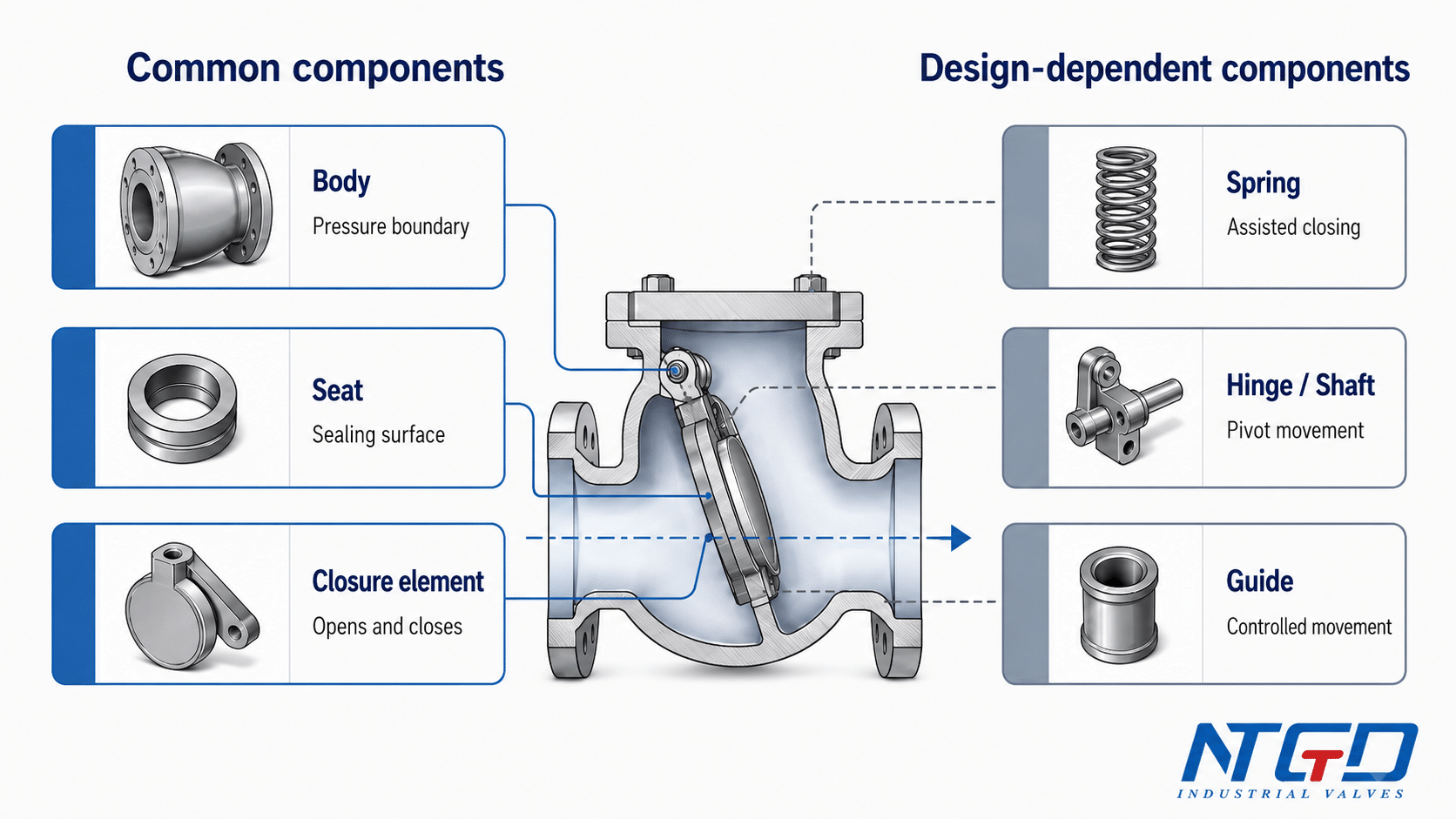
| Composant | Common or Optional? | Dépend de | Pourquoi c'est important |
|---|---|---|---|
| Corps | Communs | All check valve designs | Pressure boundary, flow path and pipeline connection |
| Siège | Common in most designs | Sealing design | Main sealing interface for reverse flow prevention |
| Élément de fermeture | Communs | Type de vanne | S'ouvre dans le sens du débit et se ferme dans le sens inverse |
| Capot | Common in many industrial designs | Construction de la vanne | Maintenance access and pressure-boundary closure |
| Joint d'étanchéité | Common where bolted joints exist | Body-cover / bonnet arrangement | External sealing and pressure-boundary integrity |
| Printemps | Optional | Spring-loaded, dual plate or non-slam design where assisted closing is required | Closing response, cracking pressure and fatigue consideration |
| Hinge / shaft / pin | Optional | Swing and dual plate designs | Pivot movement, alignment and wear |
| Guide | Optional | Lift, piston or poppet designs | Controls axial or vertical movement |
| Boulonnage | Design-dependent | Bolted pressure joints | Joint integrity and maintenance access |
| Garniture | Common as a specification concept | Manufacturer definition | Material compatibility and internal part performance |
Common Parts Found in Most Check Valves
Most industrial check valves have a body, a seat, a moving closure element and some form of pressure-boundary sealing. These parts define the basic function of the valve: allow forward flow and restrict reverse flow.
Even when the internal structure differs, the body-seat-closure relationship remains central. If the body is not suitable for the pressure or medium, the valve cannot meet the project requirements. If the seat and closure element do not match the service, leakage or wear can occur.
Design-Dependent Parts
Springs, hinges, shafts, pins and guides are design-dependent. They should be checked only in the context of the specific valve type.
For example, a swing check valve may need hinge and disc alignment review. A dual plate check valve may need spring and pin material review. A lift check valve may need guide clearance and movement review. A ball check valve may need ball and seat material review.
The key point is not whether a part name appears in a generic list. The key point is whether the actual valve design uses that part and whether the part is suitable for the pressure, medium, orientation and operating cycle.
Disc, Poppet, Flapper, Ball and Piston: Closure Element Terminology
The word “disc” is often used broadly, but different check valve designs use different closure elements.
| Durée | Typical Design Context | Mouvement | Sealing Interface |
|---|---|---|---|
| Disque | Swing, lift and many general check valves | Pivots, lifts or moves depending on design | Contact entre le disque et le siège |
| Flapper | Swing-type or simple flap-style designs | Pivots on a hinge | Flapper-to-seat contact |
| Poppet | Spring-loaded or guided check valve designs | Moves axially or vertically | Poppet-to-seat contact |
| Boule | Ball check valve | Moves away from and back to the seat | Ball-to-seat contact |
| Piston | Clapet anti-retour à piston | Guided piston-like movement | Piston or disc surface-to-seat contact |
| Dual plates | Dual plate / dual disc check valve | Two plates pivot open and close | Plate-to-seat contact |
This terminology matters because a “check valve disc” in a generic article is not the same as a disc check valve product type. In this guide, disc is treated as a closure element, not as a separate product page.
For the separate product-style topic, see the clapet anti-retour à disque page; in this guide, “disc” remains a closure-element term.
The closure element term also affects the expected seat interface, movement style and type-specific design that should be confirmed with the manufacturer. A poppet, flapper, ball, piston and dual plate arrangement may all prevent reverse flow, but they do not move or seal in the same way.
How Parts Vary by Check Valve Type
Different types of check valves use different parts to achieve the same basic function. Understanding these differences helps avoid assuming that a part arrangement in one check valve type applies to another design.
The table below gives a simplified comparison without turning this guide into a full check valve types article.
| Type de clapet anti-retour | Typical Closure Element | Typical Closing Force | Key Parts to Check |
|---|---|---|---|
| Clapet anti-retour à battant | Hinged disc or flapper | Gravity and reverse flow | Disc alignment, hinge / shaft wear, seat contact and cover gasket |
| Clapet anti-retour de levage | Guided disc | Back pressure and gravity / flow condition | Disc movement, guide clearance, seat condition and cover gasket |
| Clapet anti-retour à piston | Guided piston-style closure element | Back pressure and guided movement | Piston movement, guide clearance, seat contact and spring if used |
| Ball check valve | Boule | Back pressure and ball movement | Ball material, seat condition, body cavity and material compatibility |
| Dual plate check valve | Deux plaques à ressort | Spring force and reverse flow | Plates, springs, hinge pins, seat contact and free movement |
| Spring-loaded check valve | Disc, poppet or other spring-assisted closure | Spring force and reverse flow | Spring force, closure element, seat interface and guide condition |
| Clapet anti-retour | Check closure plus stop function | Design-dependent | Disc, stem / stop mechanism, seat and body construction |
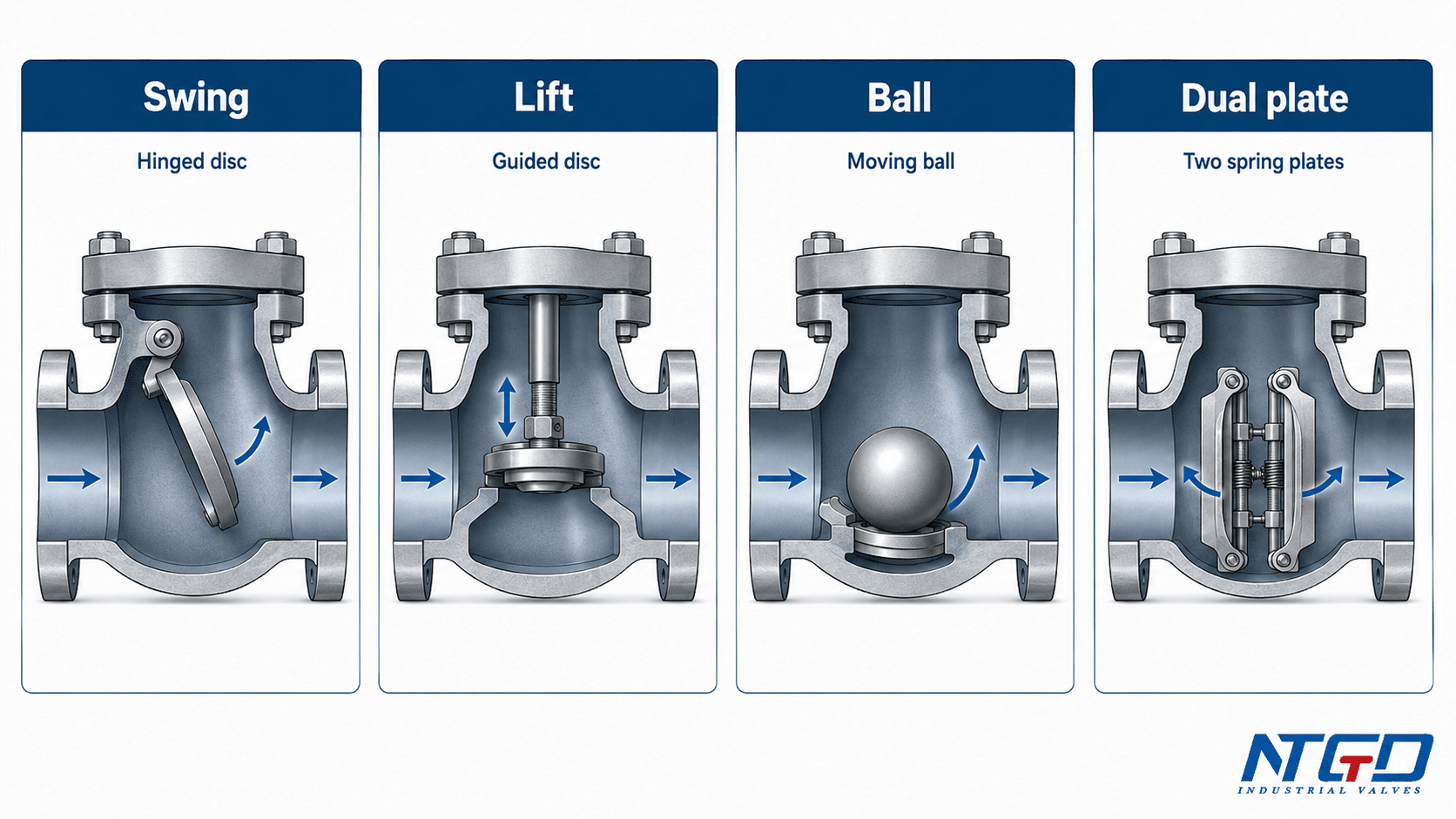
If the design uses two spring-assisted plates, the clapet anti-retour à double plaque page is the better reference for plate, spring and hinge-pin configuration.
This type variation should be used as a parts reference only. For detailed selection between swing, lift, piston, dual plate, spring-loaded or stop check valves, the specific valve type page or datasheet should be reviewed.
Which Parts Affect Sealing, Closing and Wear?
Closure Element and Seat Interface
The most important sealing area is usually the contact between the closure element and the seat. If the disc, poppet, ball or piston does not contact the seat correctly, reverse leakage may occur.
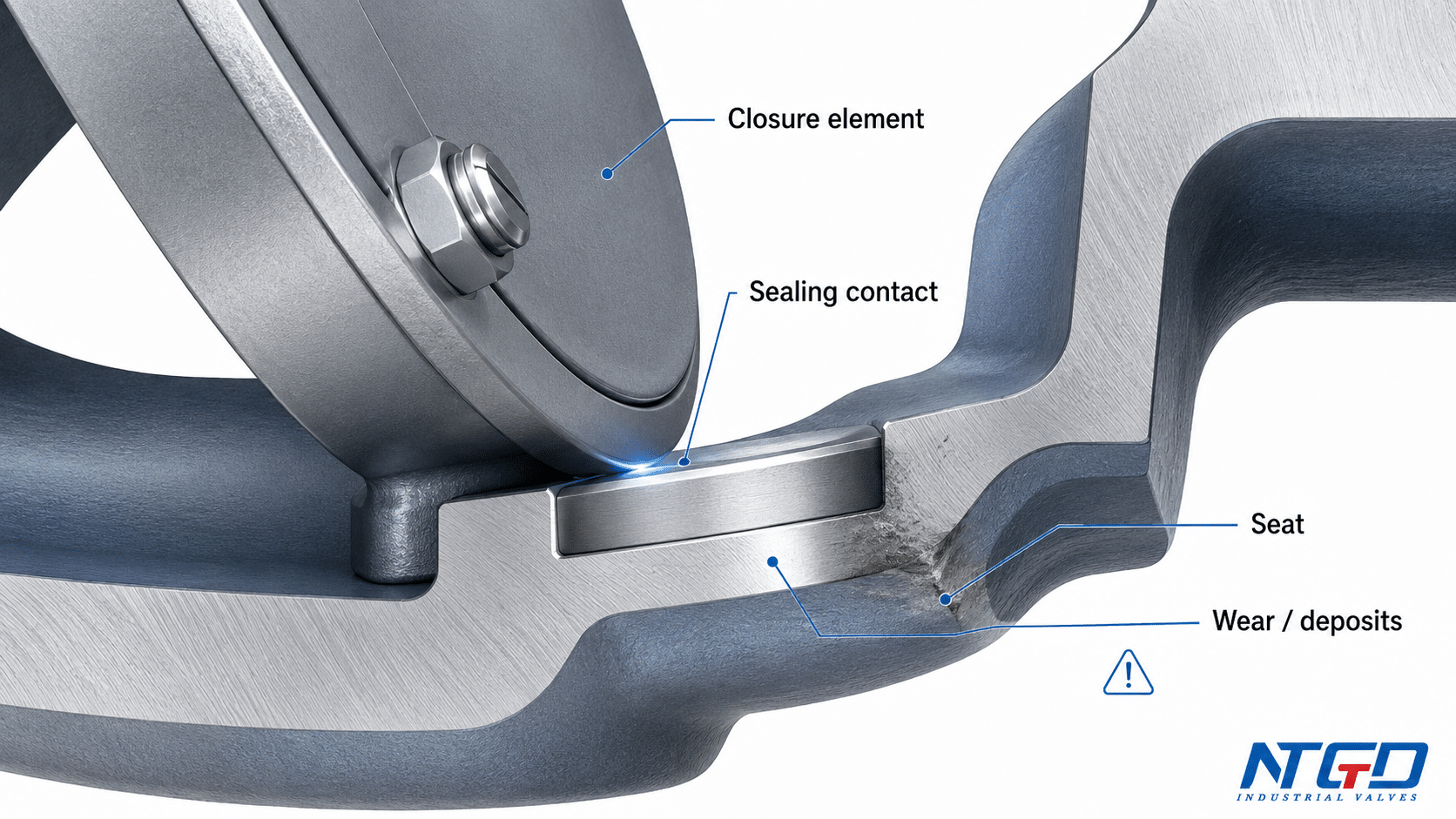
The sealing interface can be affected by wear, corrosion, deposits, misalignment, impact, vibration or unsuitable material selection. In abrasive or dirty services, the closure element and seat should be checked carefully because particles can damage or block the sealing surface.
For specification review, the closure element and seat should be considered as a pair. A suitable seat material may still perform poorly if the closure element is misaligned, unstable or damaged by the medium.
Gasket, Seal and Pressure-Boundary Leakage Points
Gaskets and pressure-boundary seals do not stop reverse flow through the valve seat, but they help prevent external leakage. Body-cover joints, bonnet joints and other assembled pressure-boundary areas must be suitable for the service conditions.
A valve may have acceptable internal sealing but still create an external leakage risk if the gasket material, bolting condition or cover joint is not suitable. For industrial projects, gasket and bolting details should be reviewed against the applicable valve specification and manufacturer documentation.
Spring Fatigue, Hinge Wear and Restricted Movement
Moving parts are often wear-sensitive. Springs can fatigue over time, especially in frequent cycling or corrosive service. Hinges, pins and shafts can wear or become restricted. Guides can accumulate deposits or suffer from abrasion.
When spring force weakens, the closure element may not return quickly enough, which can increase reverse flow before the valve fully closes. Worn hinges or pins may cause disc misalignment, preventing the closure element from seating squarely.
When these parts do not move freely, the closure element may close slowly, chatter, fail to seat fully or create higher wear at the seat interface. This does not mean every check valve problem is caused by a spring or hinge. It means the moving mechanism should be reviewed according to the valve type.
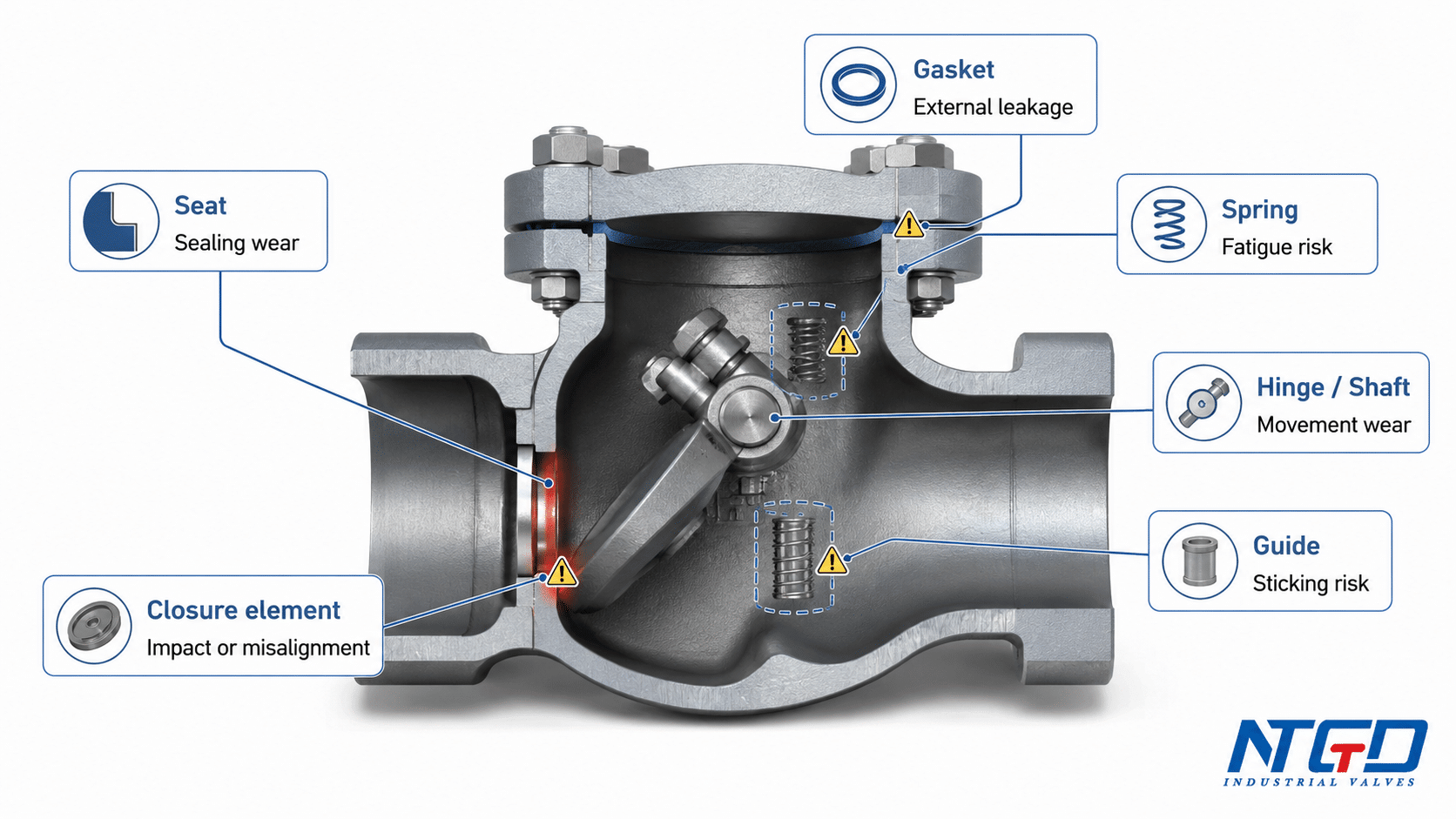
Material Compatibility for Body, Seat, Disc, Spring and Trim
Material selection should not stop at the body. The internal parts may face different stress than the outer shell. Seats and closure elements face repeated contact. Springs face cycling and corrosion exposure. Hinges and pins face movement and wear.
For industrial applications, the buyer should check body material, seat material, disc or closure element material, spring material and trim material against the medium, temperature, pressure, solids content and corrosion conditions. If the service is abrasive, corrosive, high-temperature or frequent-cycling, internal component materials become especially important.
| Partie | Possible Risk | Common Cause | Specification Check |
|---|---|---|---|
| Siège | Fuite inverse | Wear, corrosion, deposits, solids or poor closure contact | Seat material, seat design, service cleanliness and solids content |
| Élément de fermeture | Poor closing, unstable movement or wear | Misalignment, impact, erosion, vibration or unsuitable material | Closure element material, alignment, movement path and contact pattern |
| Printemps | Slow or failed closing response | Fatigue, corrosion, wrong spring design or unsuitable cycling condition | Spring material, spring force, cracking pressure and expected cycling condition |
| Hinge / shaft / pin | Restricted movement or disc misalignment | Wear, deposits, corrosion or poor support | Hinge material, pin design, disc alignment and free movement |
| Guide | Sticking or unstable movement | Deposits, abrasion or poor clearance | Guided design, guide clearance, medium cleanliness and maintenance access |
| Joint d'étanchéité | Fuites externes | Material mismatch, thermal cycling or joint issue | Gasket material, pressure and temperature suitability |
| Garniture | Shortened service life | Corrosion, erosion or incompatible material | Trim scope, wetted material, moving part material and service condition |
These checks should be confirmed before RFQ or drawing approval when leakage, valve slam, frequent cycling, abrasive media or strict shutoff expectations are important to the project.
What to Confirm Before RFQ or Specification Review
Before requesting a quotation or reviewing a check valve specification, confirm the parts that affect function, sealing and service compatibility. A clear RFQ helps the manufacturer confirm the correct design instead of only matching a valve name.
| RFQ / Specification Item | Ce qu'il faut confirmer | Pourquoi c'est important |
|---|---|---|
| Type de vanne | Swing, lift, piston, ball, dual plate, spring-loaded, stop check or other design | Determines the closure element, spring / hinge arrangement and installation suitability |
| Taille et classe de pression | Nominal size, pressure rating and end connection | Confirms body strength, flange compatibility and project fit |
| Matériau du corps | Carbon steel, stainless steel, ductile iron, alloy or other material | Affects pressure boundary, corrosion resistance and service compatibility |
| Matériau du siège | Metal seat, soft seat or specified seat material | Affects leakage performance, temperature suitability and wear resistance |
| Closure element material | Disc, poppet, ball, piston or plate material | Affects corrosion, erosion, impact resistance and service life |
| Spring / hinge / shaft design | Whether spring, hinge, pin, shaft or guide is used | Affects closing response, movement and wear points |
| Matériau de garniture | Internal wetted / moving parts included in the trim definition | Helps avoid material mismatch in critical internal parts |
| Moyen | Water, steam, oil, gas, slurry, chemical or other fluid | Affects material selection, seat choice and wear risk |
| Température | Température de fonctionnement normale et maximale | Affects body, seat, gasket and spring material |
| Solids or abrasives | Clean fluid, slurry, particles or deposits | Affects seat wear, movement restriction and valve type suitability |
| Flow direction and installation condition | Horizontal / vertical line, pump discharge, orientation requirements | Affects closure behavior and whether the selected design is suitable; vertical or low-pressure installations may also affect cracking pressure and closing response |
| Drawing or datasheet | GA drawing, section drawing, datasheet or project specification | Confirms actual component arrangement and avoids assuming generic parts |
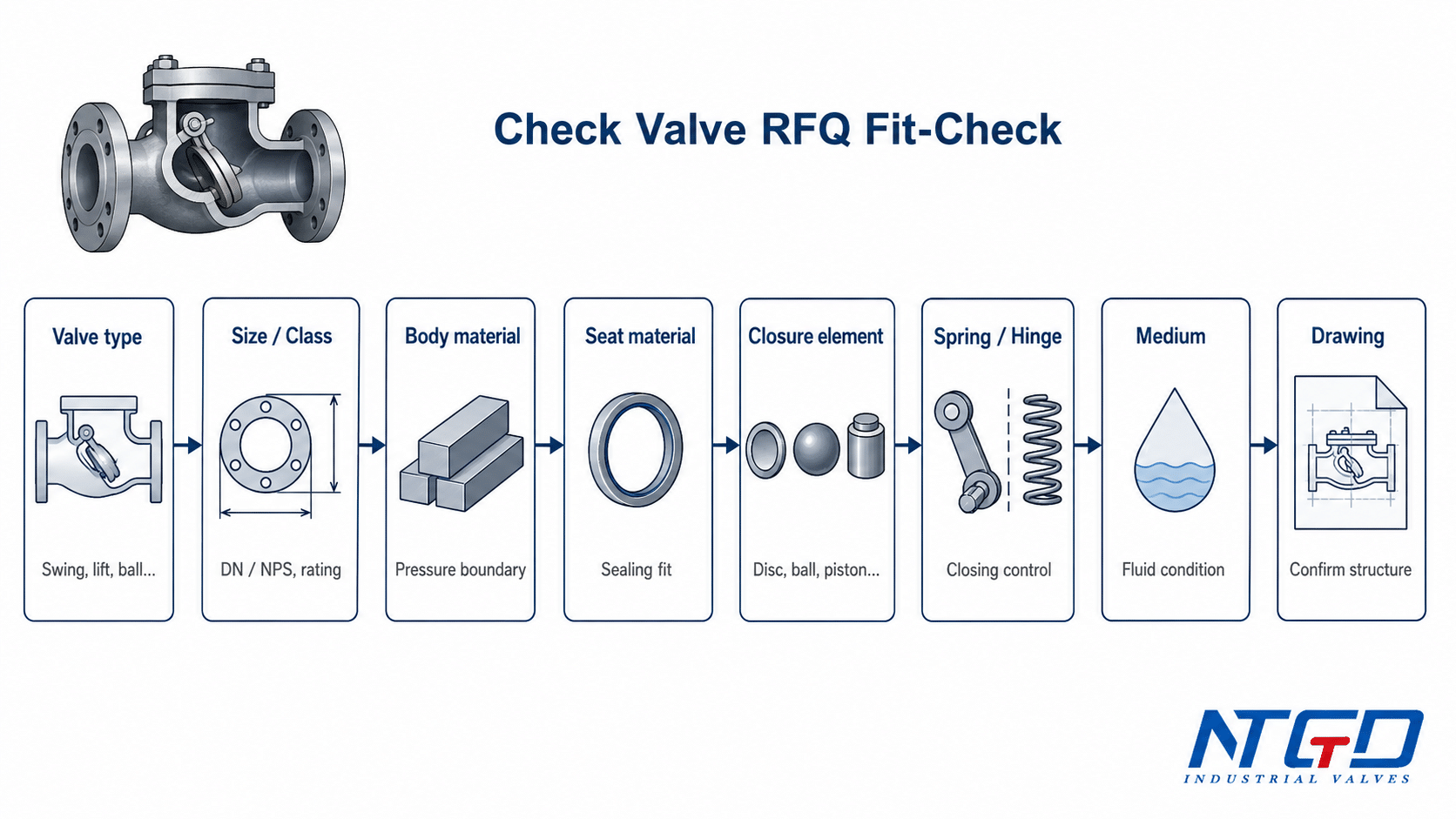
For product-level specification review, start from NTGD’s industrial check valve range, then confirm the exact component arrangement in the drawing or datasheet.
For system-level selection context, Valve Magazine’s check valve performance considerations also emphasize valve style, media, sizing and installation conditions.
A good check valve specification should identify more than the valve size and body material. The seat, closure element, spring, hinge, gasket and trim may determine whether the valve performs reliably in the actual service.
Questions fréquemment posées
What are the main parts of a check valve?
The main check valve parts are the body, cover or bonnet, seat, closure element, gasket, bolting and trim. Depending on the design, the valve may also include a spring, hinge, shaft, pin or guide.
What are the components of a check valve?
Check valve components include the pressure-retaining body, the sealing seat, the moving closure element, pressure-boundary seals and any movement-control parts such as springs, hinges, shafts or guides. The exact components depend on the valve type.
Does every check valve have a spring?
No. A spring is design-dependent. Spring-loaded, dual plate and some non-slam check valves use springs to assist closing, while other designs may rely mainly on gravity, reverse flow or back pressure.
What is the disc in a check valve?
The disc is a type of closure element that opens under forward flow and closes against the seat when reverse flow occurs. In this article, “disc” refers to an internal moving part, not to a separate disc check valve product type.
What is the difference between disc, poppet and flapper?
A disc is a general term often used for a moving closure element. A poppet usually refers to a guided closure element that moves axially or vertically. A flapper is usually a hinged closure element in a swing or flap-style check valve.
When specifying or asking about a check valve, confirming the closure element type helps the manufacturer match the correct design and seat interface.
What is shown in a check valve diagram?
A physical check valve diagram should show the valve body, flow path, seat, closure element, cover or bonnet, gasket and movement-control parts such as a spring, hinge, shaft or guide.
If you are looking for a P&ID check valve symbol, that is a different topic. This article focuses on physical check valve components, not symbol representation in a piping drawing.
Are NRV parts the same as check valve parts?
In many industrial contexts, an NRV, or non-return valve, performs the same basic function as a check valve: allowing flow in one direction and restricting reverse flow.
For detailed NRV-specific parts names and terminology, use the Guide de soupape NRV together with the project drawing or manufacturer’s datasheet.
The general component logic is similar, but detailed NRV-specific parts names should be checked in a dedicated non-return valve guide or the manufacturer’s drawing. This article focuses on generic industrial check valve parts and components.
Which parts affect check valve sealing?
The closure element and seat are the main internal sealing parts. Gaskets and pressure-boundary seals affect external leakage. Springs, hinges, shafts and guides can also affect sealing indirectly if they prevent the closure element from returning correctly to the seat.
Conclusion
Check valve parts should be understood as functional components, not just names on a parts list. The body contains the pressure and flow path. The seat provides the sealing surface. The closure element opens under forward flow and closes against reverse flow. Springs, hinges, shafts, pins and guides control movement in design-dependent ways. Gaskets, bolting and trim support pressure integrity and service compatibility.
For industrial applications, the most important question is not only “what are the parts of a check valve?” but also “which parts affect sealing, closing response, wear and material suitability in this service?” The answer depends on valve type, medium, pressure, temperature, orientation, solids content and manufacturer design.
Before selecting or specifying a check valve, always review the actual datasheet, drawing and project requirements instead of relying only on a generic diagram. Confirming these component details with the manufacturer early can help avoid specification errors or late-stage design changes.
Need Help Matching Check Valve Components to Your Service Conditions?
After identifying the relevant check valve parts, prepare the service conditions and component requirements for technical review. Useful information includes the valve type, size, pressure class, end connection, body material, seat material, closure element material, spring or hinge design, medium, temperature and installation condition.
NTGD Valve can help review these details against the required check valve design and service conditions, especially when the application involves corrosion, high temperature, slurry, pump discharge, frequent cycling or special sealing requirements.
