
Имя автора: Брюс Чжэн
Роль автора: Соучредитель и инженер по клапанам в NTGD Valve
Био автора: Брюс Чжэн - соучредитель и инженер по клапанам в компании NTGD Valve, специализирующейся на выборе промышленных клапанов, их применении и техническом контенте для глобальных покупателей B2B.
Последнее обновление: June 29, 2026
Quick Answer: What Ball Valve Standards Should Buyers Check?
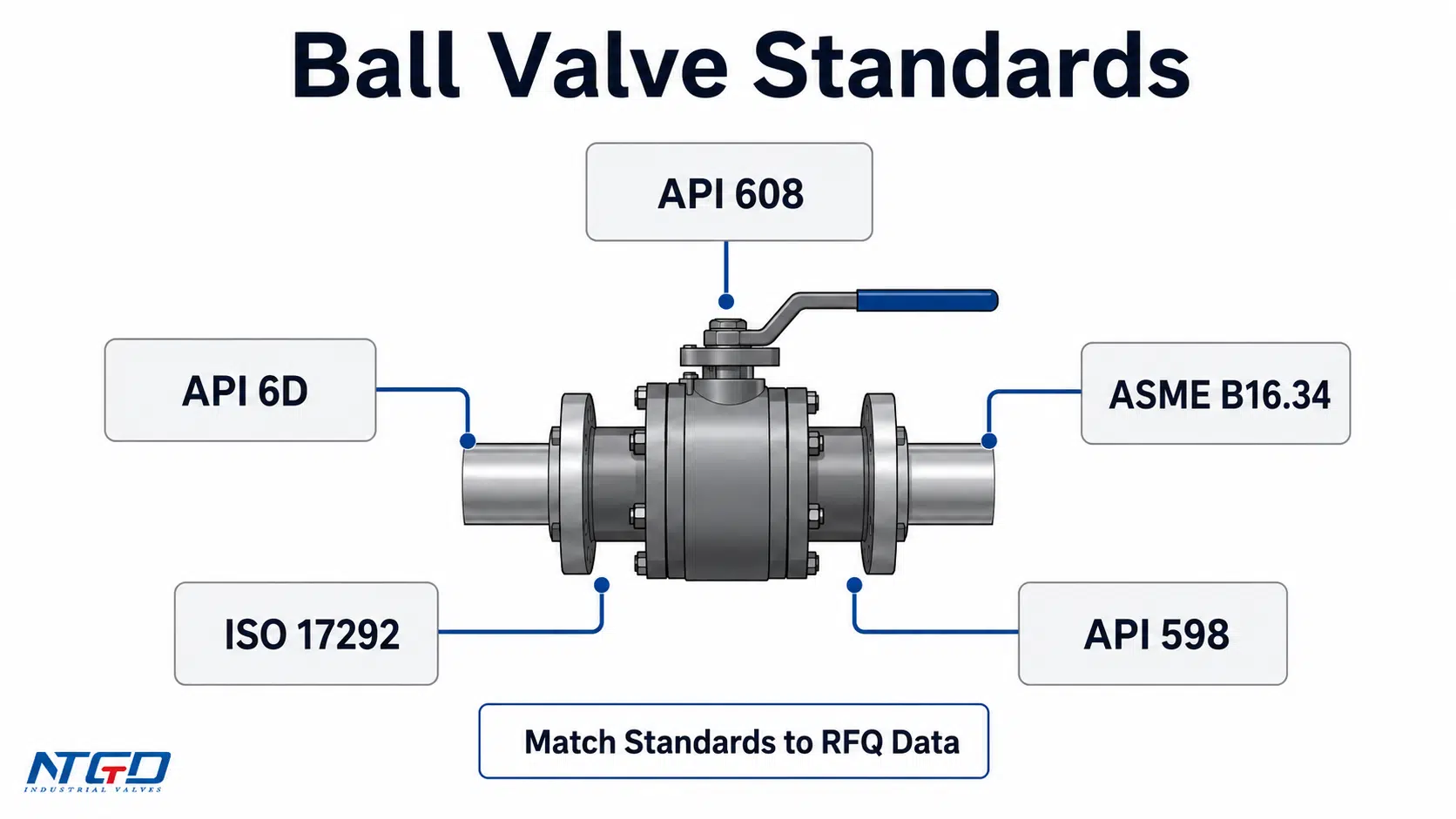
Ball valve standards are not a single rule that applies to every project. In industrial purchasing, the correct standard depends on the valve application, pressure class, body material, end connection, bore type, testing requirement, documentation requirement and project specification.
For many metal ball valve RFQs, buyers commonly see several standards used together. API 608 is often referenced for metal ball valves used in process and industrial services. API 6D applies to pipeline-service valves and is not a default specification for every ball valve. ASME B16.34 supports pressure-temperature rating, materials and construction requirements for valves with flanged, threaded and welding ends. ISO 17292 is an international metal ball valve standard used in petroleum, petrochemical, natural gas plant and related industrial applications. API 598 is used for finished-valve inspection and testing, including shell and seat / closure testing.
Choosing the wrong standard combination can affect cost, lead time and technical acceptance. Specifying API 6D for a non-pipeline process valve may add unnecessary documentation and project requirements, while ignoring the relationship between pressure class, material and service temperature can create pressure-temperature rating mismatches.
A good RFQ should not simply say “standard ball valve” or “API compliant.” It should state the required valve standard, pressure class, size, material, end connection, seat / seal material, service medium, design temperature, design pressure, testing standard and required documents such as test reports, MTCs and inspection records.
What Do Ball Valve Standards Actually Cover?
A ball valve standard may define or influence several different parts of a valve specification. Some standards focus on valve design and construction. Some support pressure-temperature ratings or material selection. Some focus on finished-valve inspection and testing. Others are special-service requirements, such as fire-safe testing or sour service material control.
For this reason, buyers should treat ball valve standards as a specification system, not as a single label.
Standards vs Codes vs Project Specifications
A standard usually defines technical requirements for a product, test, material or design scope. A piping code may define requirements for the broader piping system, such as system-level piping rules that valve specifications must align with. A project specification or datasheet then tells the supplier which standard, material, pressure class, testing requirement and documentation package apply to a specific order.
For example, a ball valve may be specified with a ball valve standard, a pressure-temperature basis, a testing standard and a project datasheet at the same time. These are not interchangeable. One document may define the valve construction, another may define testing, and another may define what the project owner wants to receive before shipment.
The project specification or datasheet is the final purchasing carrier that turns multiple standards into executable procurement requirements. Without it, even a correctly named standard can still lead to manufacturing, inspection or documentation differences.
Why a Standard Name Alone Is Not Enough in an RFQ
A standard name alone does not fully define the valve. Two ball valves referencing the same standard can still be technically different in several RFQ-critical dimensions:
- размер и класс давления;
- full bore or reduced bore design;
- floating or trunnion-mounted construction;
- flanged, threaded, socket weld or butt weld ends;
- carbon steel, stainless steel or alloy material;
- soft seat or metal seat design;
- manual, gear, pneumatic, electric or hydraulic operation;
- fire-safe, anti-static, fugitive emission or sour service requirements;
- inspection, testing and document package.
For RFQ work, the standard gives the technical framework. The datasheet gives the project-specific details.
Common Ball Valve Standards Comparison Table
The table below gives a practical standards map for buyers preparing a ball valve RFQ. Use it to understand each standard’s role before deciding what must appear in the project datasheet.
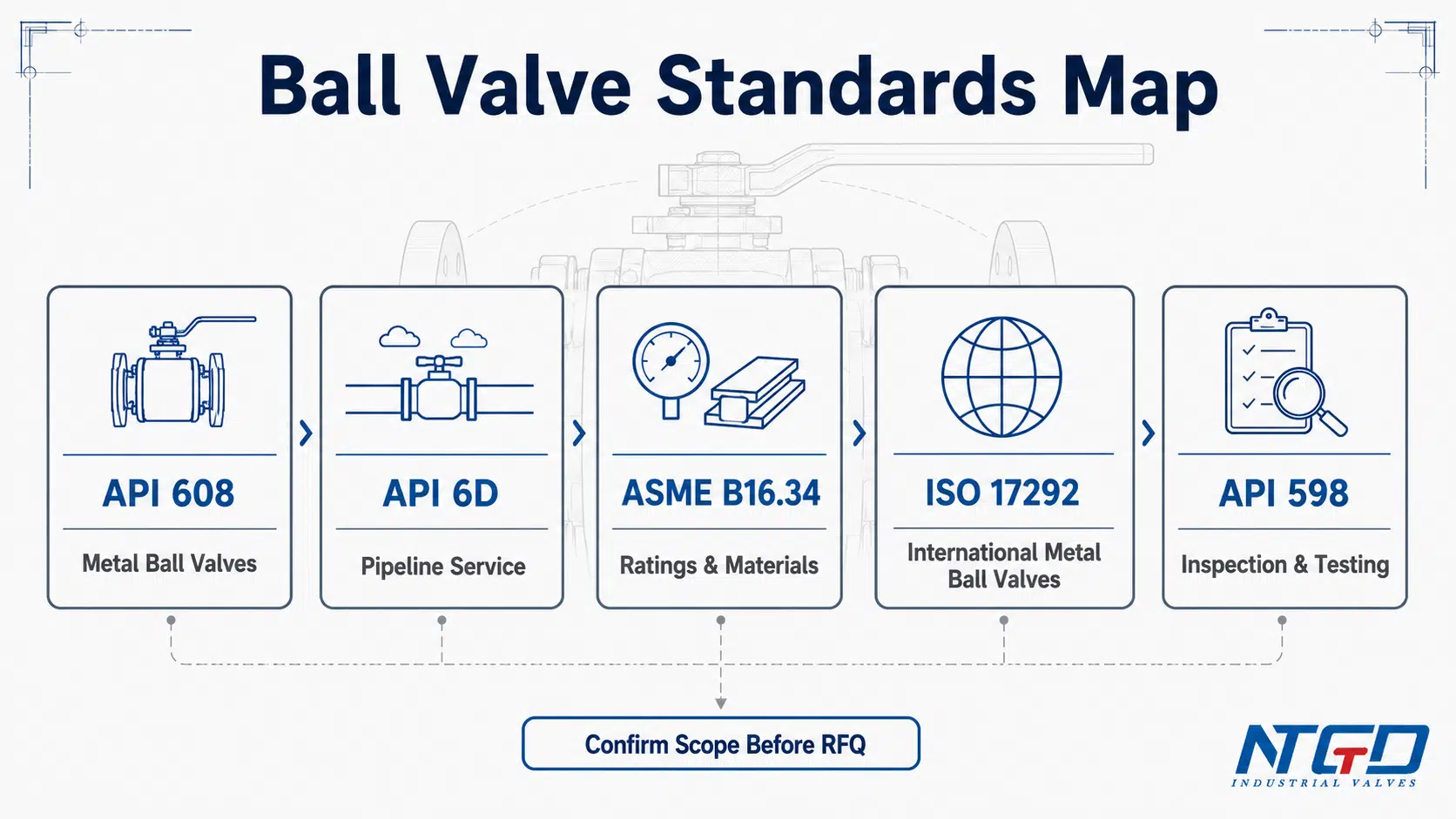
| Стандарт / Требование | Главная роль | Applies To / Common Context | What It Does Not Replace | RFQ Note |
|---|---|---|---|---|
| API 608 | Metal ball valve design and construction reference | Process, petroleum, petrochemical and industrial metal ball valves | Does not replace all pipeline-service requirements or project datasheets | Use when specifying metal ball valves for applicable industrial service; confirm end connection, bore type, pressure class and material |
| API 6D | Pipeline / piping valve specification | Pipeline service, long-distance transmission and pipeline isolation | Should be reserved for pipeline-service requirements and not used as a default specification for general industrial process valves | Confirm pipeline service, acceptance rules and project documentation requirements before specifying API 6D |
| ASME B16.34 | Pressure-temperature, material, construction and marking basis for valves | Flanged, threaded and welding-end valves in ASME-related piping systems | Does not replace a ball-valve-specific design standard by itself | Confirm pressure class, material group, design temperature and end connection |
| ISO 17292 | International metal ball valve standard | Petroleum, petrochemical, natural gas plant and related industrial applications | Does not replace every API 6D pipeline-service requirement | Useful when the project references ISO-based metal ball valve specifications |
| API 598 | Inspection and pressure testing standard | Finished-valve inspection, shell test, seat / closure test and leakage acceptance | Does not define the full ball valve design | Specify the testing standard and required test report in the RFQ |
| API 607 / ISO 10497 | Fire-safe testing requirement | Fire-safe ball valve applications where fire exposure performance must be verified | Does not mean every API 608 valve is automatically fire-safe | Ask for fire-safe certificate only when required by the project |
| NACE / ISO 15156 | Sour service / material requirement | H₂S or sour service where material cracking risk must be controlled | Does not replace ball valve design or pressure testing standards | Confirm medium, H₂S content and material requirements before quotation |
| ISO 5208 / EN 12266 | International valve testing references | International valve pressure testing and leakage acceptance contexts | Does not automatically replace the project-specified test standard | Use only when required by the project specification or regional standard package |
This table is a quick map, not a substitute for the official standards or the project datasheet. The actual RFQ still needs to be checked against service condition, project specification, material, temperature, pressure class, testing documents and required inspection records.
API 608 Ball Valve Standard
API 608 is one of the most common standards buyers ask about when specifying industrial metal ball valves. In a ball valve standards map, API 608 is important because it is directly connected with metal ball valve construction and typical industrial valve requirements.
What API 608 Covers
For RFQ purposes, API 608 is commonly associated with metal ball valves, including requirements related to design, end connections, bore type, stem retention, anti-static features and other construction details depending on the valve design and project requirement.
To verify the official standard scope before finalizing a project specification, check the API 608 standard page rather than relying on a catalog title alone.
Buyers often reference API 608 for flanged, threaded or welding-end ball valves used in petroleum, petrochemical and industrial service. The exact applicability still needs to be checked against the valve size, pressure class, end connection, body material, seat material and project standard list.
API 608 and ASME B16.34 Relationship
API 608 and ASME B16.34 often appear together in industrial ball valve specifications. They do not serve the same function.
API 608 is more directly connected with metal ball valve requirements. ASME B16.34 supports the broader valve pressure-temperature, material and construction basis. In many RFQs, the buyer may need both the ball valve standard and the pressure-temperature / construction basis to make the specification complete.
A practical RFQ should therefore avoid a vague sentence such as “API 608 ball valve required” without class, material, temperature and end connection. The standard name is only one part of the specification.
When API 608 Is Not Enough by Itself
API 608 does not replace every other project requirement on its own. For many process metal ball valve RFQs, API 608 may be the correct starting point, but the buyer still needs to confirm ASME B16.34 pressure-temperature basis, testing standard, seat / seal material, fire-safe requirement, sour service requirement and documentation package.
For pipeline-service ball valves, the project may require API 6D instead of relying only on API 608. For fire-safe service, API 607 or ISO 10497 may need to be specified separately. For H₂S or sour service, NACE / ISO 15156 requirements may need to be checked. For inspection records, the RFQ should clearly state the testing standard and document package.
API 608 is a strong design reference for metal ball valves, but it is not a complete project specification by itself.
API 6D Ball Valve: Pipeline-Service Boundary
API 6D is important in the ball valve standards conversation, but it belongs to a specific service context. It is not a default specification for general-purpose ball valves.
API’s publication announcement for Спецификация API 6D identifies it as a pipeline and piping valve specification covering ball, check, gate and plug valves, which is why this article treats it as a pipeline-service boundary rather than a general ball-valve default.
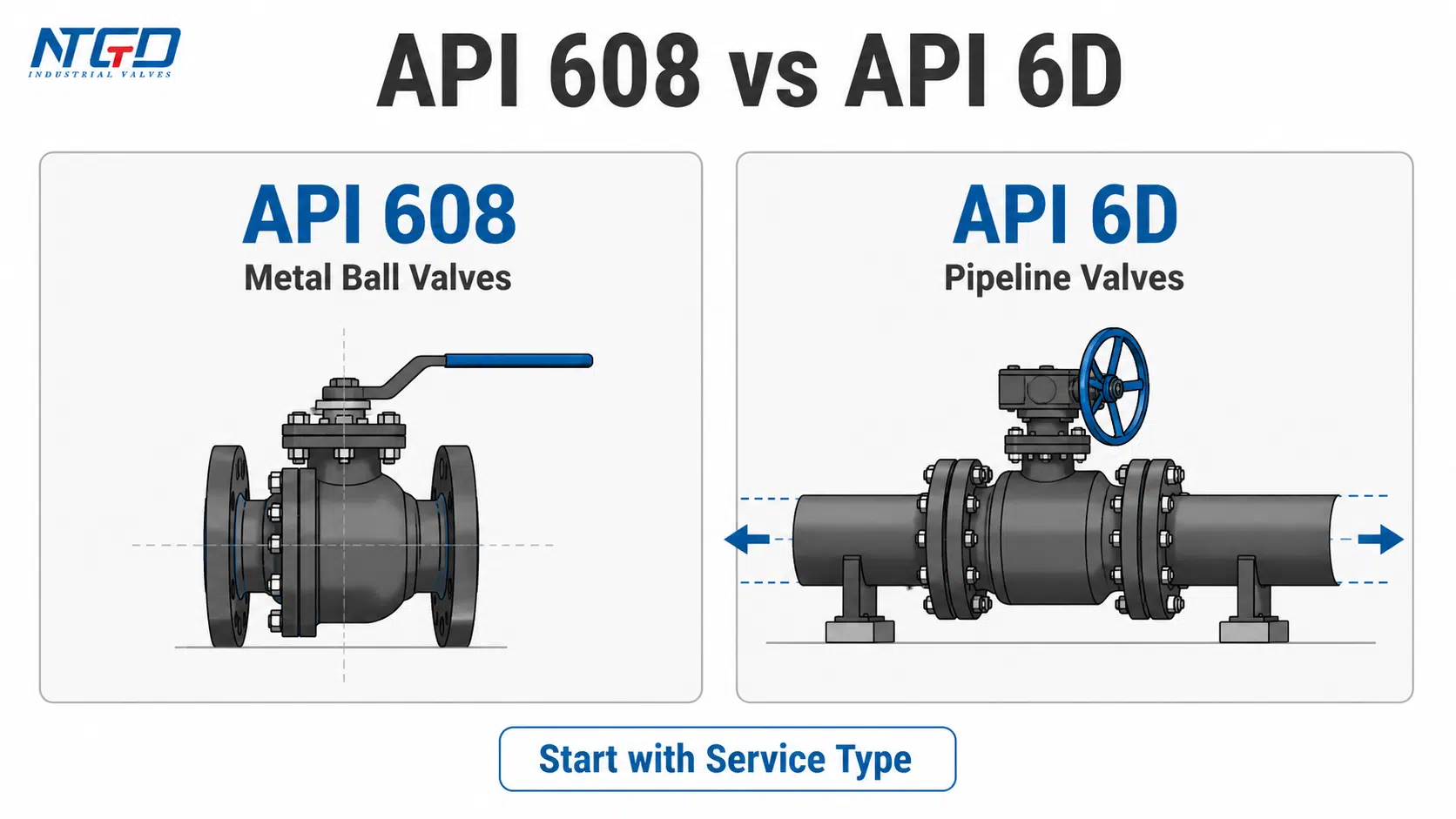
In a standards map, API 6D belongs to pipeline-service valves. It is commonly used when the valve is part of a pipeline system where pipeline isolation, documentation, pressure testing and service conditions require a pipeline valve specification. It also covers more than ball valves, so it is broader than a ball-valve-only standard.
What API 6D Means in a Ball Valve Standards Map
An API 6D ball valve is usually associated with pipeline service. The project may involve oil, gas or other pipeline media, and the valve may require specific documentation, pressure testing and traceability expectations.
For a general process ball valve, API 608 together with ASME B16.34 may be more relevant than specifying API 6D by default. For a pipeline-service ball valve, API 6D may be a critical project requirement.
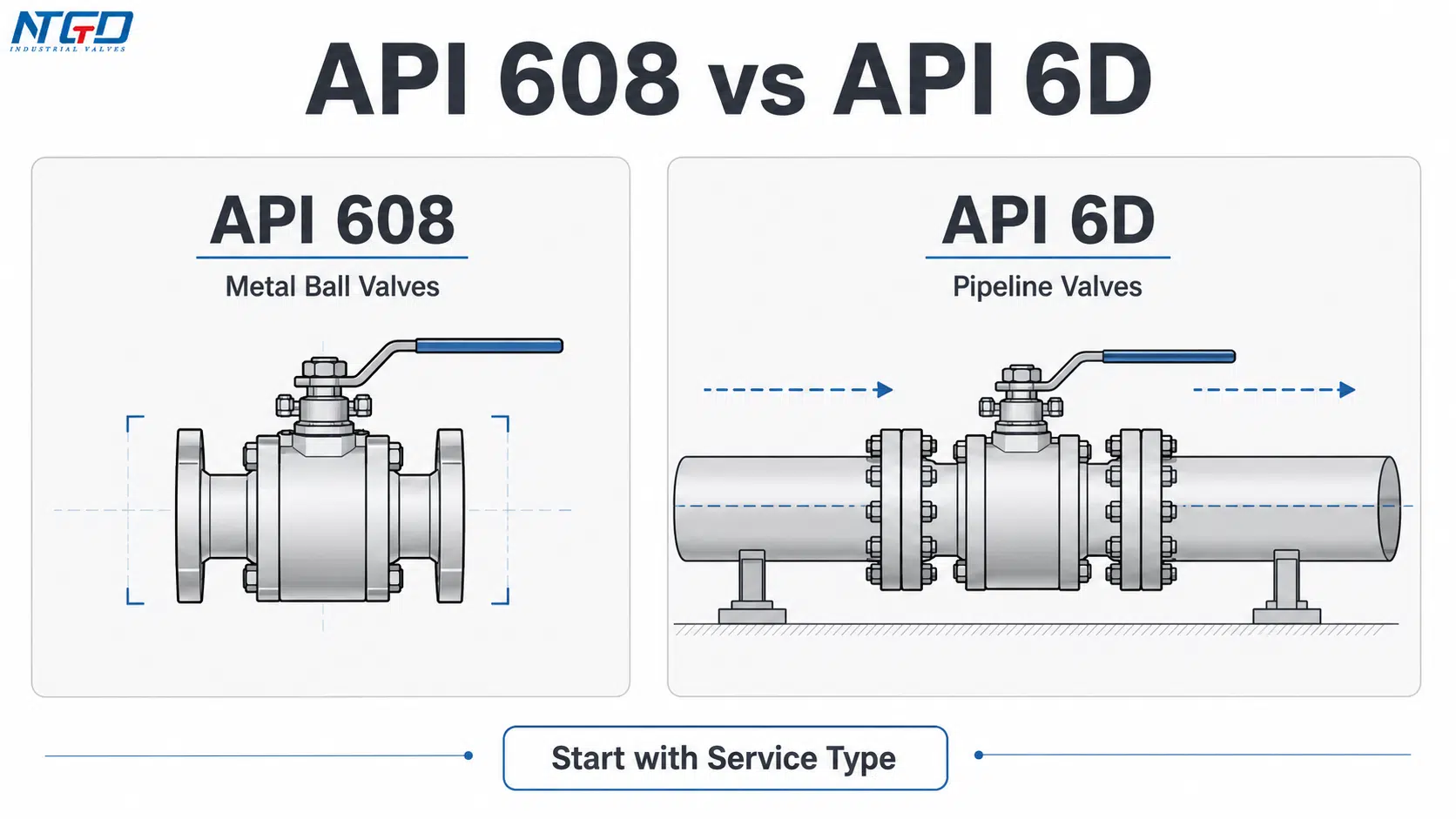
API 608 vs API 6D in One View
| Точка сравнения | API 608 | API 6D | Примечание покупателя |
|---|---|---|---|
| Основное внимание | Metal ball valves | Pipeline / piping valves | Start with service type before selecting the standard |
| Общее использование | Industrial process and related service | Обслуживание трубопроводов | For non-pipeline process service, do not specify API 6D by default |
| Valve scope | Шаровые краны | Multiple pipeline valve types, including ball valves | API 6D is broader than a ball-valve-only standard |
| RFQ risk | Missing class, material, testing or fire-safe requirement | Over-specifying API 6D for non-pipeline service | API 608 + ASME B16.34 may be more relevant for many process metal ball valve RFQs |
| Документация | Depends on project and inspection requirements | Often tied to stronger project documentation expectations | For pipeline projects, confirm API 6D documentation, test report, MTC and inspection records |
When to Review a Dedicated API 6D Ball Valve Guide
A dedicated API 6D ball valve guide is more appropriate when the project involves pipeline service, long-distance transmission, pipeline isolation, project documentation packages or specific pipeline valve acceptance requirements.
In this article, API 6D is only explained as part of the overall standards map. Detailed API 6D ball valve construction, testing, documentation, DBB / DIB, pipeline project acceptance and RFQ preparation should remain with a dedicated API 6D ball valve guide, not this general ball valve standards guide.
For deeper construction, testing, documentation and RFQ details, review NTGD’s API 6D ball valve guide instead of expanding those pipeline-specific details in this standards overview.
ASME B16.34 and ISO 17292 in Ball Valve Specifications
ASME B16.34 and ISO 17292 both appear in ball valve specifications, but they play different roles. They help complete the standards map, but neither should turn this article into a full ASME or ISO standard commentary.
ASME B16.34: Pressure-Temperature and Construction Basis
ASME B16.34 is not a ball-valve-only standard. In ball valve specifications, it is commonly relevant to pressure-temperature ratings, materials, construction, dimensions, tolerances, marking and related valve requirements for flanged, threaded and welding-end valves.
ASME’s official B16.34 standard page should be used when confirming the pressure-temperature, material, testing and marking basis referenced by the project specification.
For a buyer, the most important point is that a pressure class alone is not enough. Under the same pressure class, different body materials and service temperatures can lead to different allowable pressure-temperature limits, so class, material and temperature must be checked together.
A Class 150, Class 300 or Class 600 valve still needs material, temperature, end connection and seat / seal information before the supplier can confirm suitability. ASME B16.34 should be considered together with the ball valve standard, the piping code, the project datasheet and any testing or special-service requirements.
ISO 17292: International Metal Ball Valve Standard
ISO 17292 is an international standard for metal ball valves used in petroleum, petrochemical, natural gas plant and related industrial applications. It is useful when the project specification follows ISO-based standards or when the buyer wants an international metal ball valve standard instead of an API-centered specification set.
For ISO-based projects, verify the scope against the official ISO 17292:2015 standard page, which identifies the standard as covering metal ball valves for petroleum, petrochemical, natural gas plant and related industrial applications.
In practice, ISO 17292 may appear with requirements related to end connections, bore type, materials, testing and inspection. It does not replace pipeline-specific requirements on its own, and it does not remove the need for project-specific pressure class, material, service temperature, seat / seal and testing information.
How These Standards Work with API 608 or API 6D
A project may reference API 608 or ISO 17292 for metal ball valve construction, ASME B16.34 for pressure-temperature and construction basis, API 598 for inspection and testing, and additional requirements for fire-safe or sour service.
ISO 17292 is a metal ball valve product standard, while API 6D is a pipeline-service valve specification. They may overlap in some projects, but one should not be treated as a direct replacement for the other.
The correct combination depends on the project specification. A clear RFQ should tell the supplier which standard is mandatory, which standard is optional, which standard is used for testing, and which documents must be supplied after inspection.
Ball Valve Testing Standards: API 598, Shell Test, Seat Test and Test Reports
A ball valve testing standard answers a different question from a design standard. API 598 works at the finished-valve inspection and testing level, not as the design basis for selecting the ball valve itself.
API 598 is commonly associated with valve inspection and pressure testing. It helps define how finished valves are inspected and tested, including shell testing and seat / closure testing. It works alongside the design standard and project datasheet; it does not replace API 608, API 6D, ASME B16.34 or ISO 17292.
API 598 as an Inspection and Testing Standard
For buyers, API 598 is important because it connects the RFQ to finished-valve test expectations. If the project requires pressure test records, leakage acceptance confirmation or inspection documentation, the RFQ should state the testing standard and the documents required before shipment.
For third-party confirmation of API 598 scope, the API Std 598 standard page can be used to verify that it addresses valve inspection, examination, supplementary examinations and pressure test requirements.
A vague statement such as “valve must be tested” is not enough. The supplier needs to know the test standard, inspection scope, report format and whether third-party inspection is required.
Shell Test and Seat / Closure Test
In general terms, a shell test checks the pressure-containing boundary of the valve body and related pressure-retaining parts. A seat or closure test checks sealing performance across the closed valve seats. The exact test pressure, duration, medium and acceptance criteria must be verified against the applicable standard, valve design and project specification.
Buyers should not request informal pressure testing without defining what test evidence they need. A test report is often more useful than a simple statement that the valve has been tested.
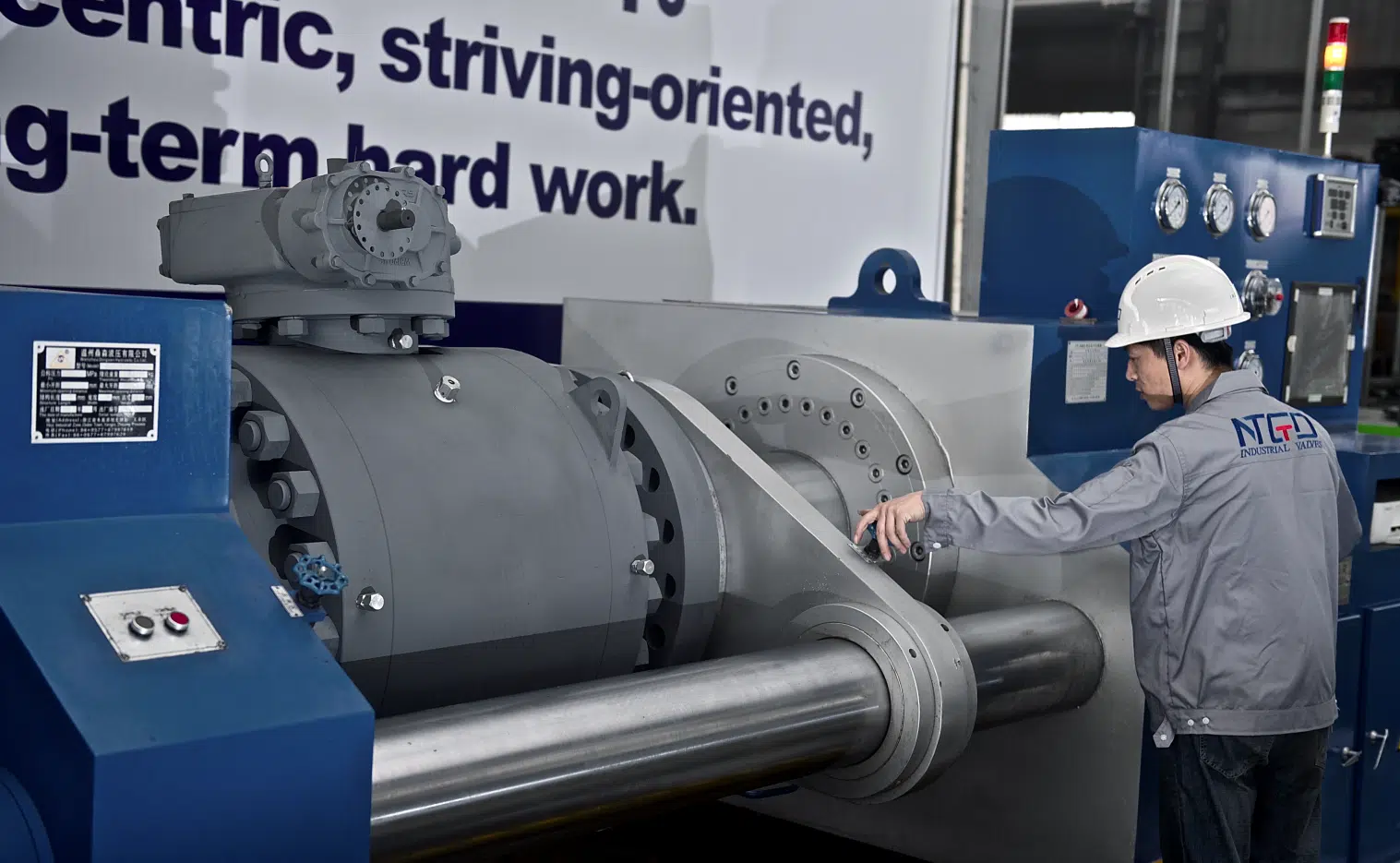
Test Reports, MTC and Inspection Records
| Test / Document | What It Checks or Supports | Buyer Should Request |
|---|---|---|
| Испытание корпуса | Pressure boundary integrity of the valve body and pressure-retaining parts | Shell test report according to the specified test standard |
| Seat / closure test | Sealing performance of the closed valve | Seat / closure test report with test medium and result |
| Visual and dimensional inspection | General conformance to drawing, datasheet and manufacturing requirements | Inspection record or final inspection report |
| Material test certificate / MTC | Material traceability and chemical / mechanical data | MTC for pressure-retaining parts; specify certificate type, such as EN 10204 3.1, if the project or code requires material traceability |
| Fire-safe certificate | Fire exposure performance for specified designs | Certificate only when fire-safe service is required |
| Third-party inspection record | Independent verification when required by project | TPI release note or inspection witness record |
Testing requirements should be written in the RFQ and checked against the project datasheet before manufacturing and shipment. This article only covers the test-standard role and RFQ document requirements; detailed pressure test methods and execution procedures should be handled in a dedicated pressure testing guide.
For step-by-step valve pressure testing practices by valve type, use NTGD’s industrial valve pressure testing guide instead of expanding the procedure in this standards overview.
How to Choose the Right Ball Valve Standard for an RFQ
The easiest way to choose the right ball valve standard is to start with the service condition, not the standard name. Before quotation, confirm what the valve will do, where it will be installed, what medium it will handle, what pressure and temperature it will see, and what documentation the project owner requires.
| Service / Requirement | Standard to Check First | Дополнительные заметки | Необходимые данные RFQ |
|---|---|---|---|
| General industrial metal ball valve | API 608 or ISO 17292 | Confirm whether the project follows API or ISO standard system; blindly specifying API 6D may add unnecessary cost, documentation and lead time | Size, class / PN, material, end connection, bore, seat |
| Обслуживание трубопроводов | API 6D | Use when the project requires pipeline valve specification; using only a general process valve standard may fail to meet pipeline documentation or acceptance expectations | Pipeline service data, size, class, bore, operation, documentation |
| Номинальное давление-температура | ASME B16.34 | Check material and temperature together, not pressure class alone | Body material, design temperature, pressure class |
| Finished-valve pressure testing | API 598 or project-specified testing standard | Define reports and witness requirements; an unclear test standard may result in reports that do not match project acceptance | Test standard, test report, inspection level |
| Fire-safe service | API 607 or ISO 10497 | Required only when the service or project specification demands it; if not stated separately, the supplier may quote a standard non-fire-safe configuration | Fire-safe requirement, certificate, seat / seal design |
| Кислый сервис | NACE / ISO 15156 or project requirement | Material suitability must be verified for the service; if not stated separately, the quotation may follow ordinary service assumptions | Medium composition, H₂S content, material requirement |
| International metal ball valve specification | ISO 17292 | Useful for ISO-based petroleum, petrochemical and gas plant requirements | Standard edition, material, end connection, test requirement |
| Project documentation package | Project specification / datasheet | Standards do not replace the datasheet; unclear document requirements can delay inspection and release | MTC, test report, inspection record, tag data |
The RFQ should also state whether the buyer requires the latest edition of the standard, a specific edition, or compliance with the project owner’s standard list.
Ball Valve RFQ Standards Checklist
A complete RFQ reduces technical back-and-forth and helps the supplier confirm whether the requested ball valve can be offered under the required standards.
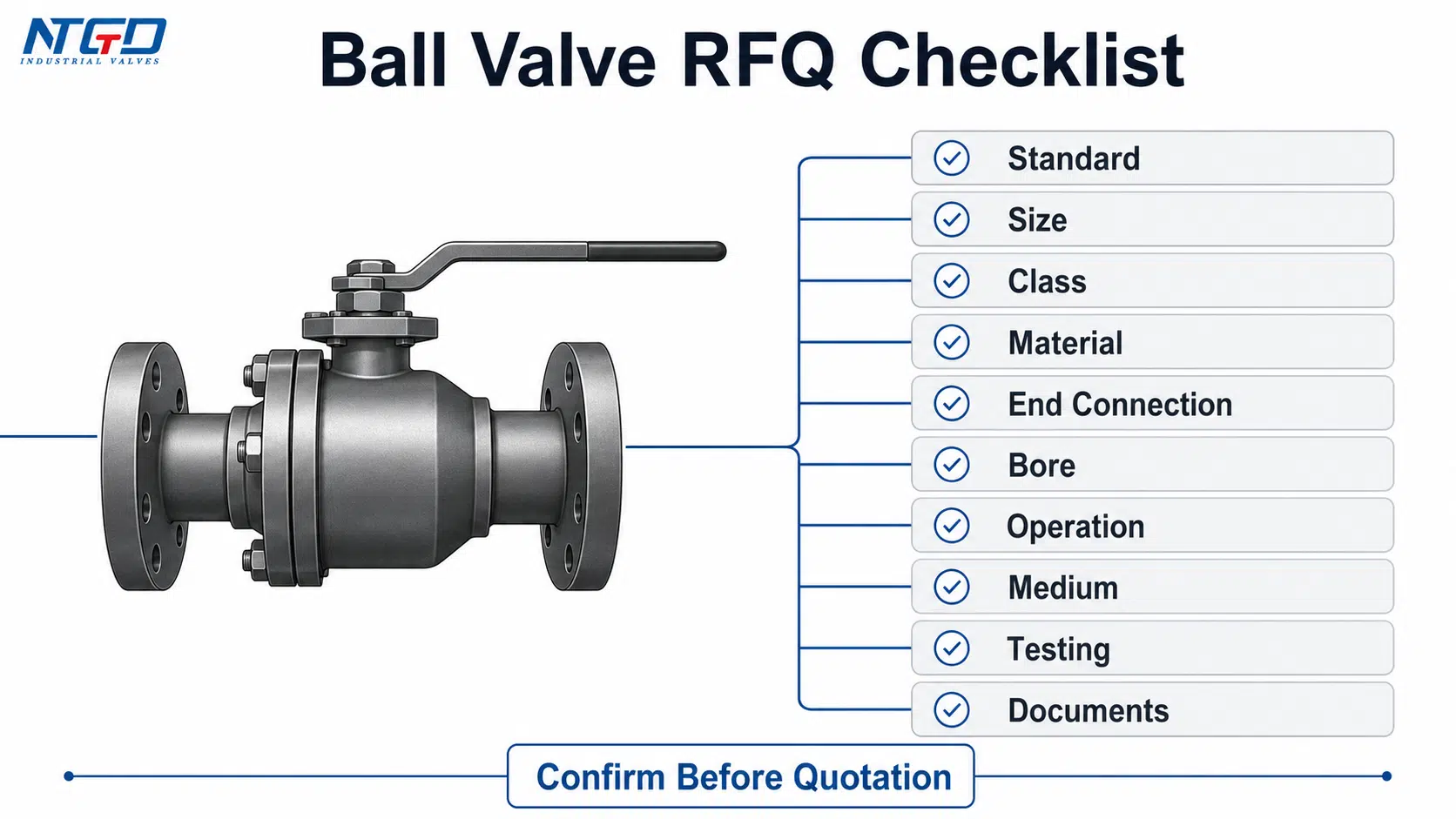
| Поле RFQ | Почему это важно | Example Input Needed |
|---|---|---|
| Required valve standard | Defines the main technical framework | API 608, API 6D, ISO 17292 or project standard |
| Standard edition | Avoids mismatch between buyer and supplier expectations | Latest edition or project-specified edition |
| Тип клапана | Clarifies floating, trunnion, two-piece, three-piece or other design | Floating ball valve, trunnion-mounted ball valve, 2-piece body, 3-piece body |
| Размер | Defines valve nominal size | NPS 2, DN50, NPS 6, DN150 |
| Класс давления / PN | Defines pressure rating system | Class 150 / 300 / 600, PN16 / PN25 / PN40 |
| Материал корпуса | Affects pressure-temperature rating and corrosion suitability | ASTM A216 WCB, ASTM A351 CF8M, ASTM A105, ASTM A182 F316 |
| Материал обшивки / сиденья / уплотнения | Affects sealing, temperature and media compatibility | PTFE, RPTFE, PEEK, metal seat, graphite |
| Концевое соединение | Affects piping compatibility | ASME B16.5 RF flange, RTJ, NPT, SW, BW |
| Тип отверстия | Affects flow, pigging and pressure drop | Полное или уменьшенное отверстие |
| Операция | Affects torque, automation and installation space | Рычажные, зубчатые, пневматические, электрические, гидравлические |
| Средний | Affects material, seat and special requirements | Water, oil, gas, steam, chemical, sour gas |
| Расчетная температура | Affects material and seat selection | Minimum and maximum design temperature |
| Расчетное давление | Confirms pressure condition beyond nominal class | Рабочее давление и расчетное давление |
| Стандарт тестирования | Defines pressure test and inspection basis | API 598 or project-specified test standard |
| Test report | Provides evidence of finished-valve testing | Shell test + seat / closure test report according to the specified standard |
| MTC / material certificate | Supports material traceability | EN 10204 3.1 or project-required certificate type if applicable |
| Inspection record | Supports final inspection and release | Final inspection report, dimensional record or TPI record |
| Fire-safe certificate | Required only for fire-safe service | API 607 / ISO 10497 certificate when specified |
| NACE / sour service requirement | Required for sour service material control | NACE / ISO 15156 requirement if applicable |
| Project specification / datasheet | Resolves conflicts and special requirements | Datasheet, tag list, project standard list |
If sizing, port design, Cv or installation data is still incomplete, review NTGD’s Руководство по подбору размеров и монтажу шаровых кранов до завершения подготовки RFQ.
Attach the checklist to the RFQ before price comparison. Without these details, two quotations may look similar but represent different valve designs, testing levels and documentation packages.
Common Mistakes When Specifying Ball Valve Standards
Writing “API Compliant” Without Naming the Standard
“API compliant” is too vague. It does not tell the supplier whether the buyer means API 608, API 6D, API 598, API 607 or another API document. This can cause suppliers to quote on different technical assumptions, making price and delivery comparisons unreliable.
Using API 6D When the Service Is Not Pipeline-Related
API 6D is important for pipeline service, but it is not the default requirement for all industrial ball valves. Over-specifying API 6D may increase cost, lead time and documentation requirements without improving fit for a non-pipeline service.
Treating API 598 as a Design Standard
API 598 is related to inspection and pressure testing. It defines finished-valve testing expectations, not the valve design basis. If the RFQ only names API 598, the design standard may remain unclear.
Assuming API 608 Automatically Means Fire-Safe
API 608 and fire-safe testing are different requirements. If fire-safe performance is required, the RFQ should clearly state the fire-safe standard or certificate requirement. Do not assume it is included unless the datasheet or quotation confirms it.
Selecting Only by Pressure Class
A pressure class is not enough by itself. Material, temperature, seat design, end connection and service medium must also be checked. A valve that looks acceptable by class may not be suitable for the actual temperature, corrosion condition or sealing requirement.
Confusing Standard Port with Ball Valve Standards
A standard port ball valve refers to bore / port design. It is not the same as a ball valve standard. If the buyer needs to discuss full port versus standard port, that should be handled as a bore selection question, not as a standards / compliance question.
Requesting a PDF Instead of a Project Specification
A standard PDF is not a substitute for a project datasheet. The supplier needs the actual RFQ data: service, size, pressure class, material, end connection, testing standard, documentation and inspection requirements. Without those details, manufacturing and inspection documents may not match the project owner’s acceptance requirements.
ЧАСТО ЗАДАВАЕМЫЕ ВОПРОСЫ
Какой стандарт применяется к шаровым кранам?
Единого стандарта, применимого ко всем шаровым кранам, не существует. К числу наиболее часто упоминаемых стандартов относятся API 608 для металлических шаровых кранов, API 6D для кранов, используемых в трубопроводных системах, ASME B16.34, определяющий требования к давлению, температуре и конструкции, ISO 17292, устанавливающий международные технические условия на металлические шаровые краны, а также API 598, касающийся осмотра и испытаний.
Что такое стандарт API 608 для шаровых кранов?
Стандарт API 608 широко применяется к металлическим шаровым кранам в нефтяной, нефтехимической и промышленной отраслях. В запросе предложений его следует указывать вместе с такими деталями, как размер, класс давления, материал, тип соединения, тип прохода, материал седла, стандарт испытаний и необходимые документы.
В чём заключается разница между стандартами API 608 и API 6D?
API 608 is mainly associated with metal ball valves. API 6D is a pipeline / piping valve specification and covers more than ball valves. API 6D is typically used when the valve is for pipeline service, while API 608 is often used for industrial metal ball valves outside dedicated pipeline-service requirements.
В чём заключается разница между стандартами API 608 и ASME B16.34?
Стандарт API 608 более непосредственно касается требований к металлическим шаровым кранам. Стандарт ASME B16.34 определяет основы, касающиеся соотношения давления и температуры, материалов и конструкции клапанов. Эти стандарты часто используются совместно в рамках единой спецификации, однако их не следует рассматривать как взаимозаменяемые.
Является ли ASME B16.34 стандартом для шаровых кранов?
Стандарт ASME B16.34 не относится исключительно к шаровым кранам. Он широко используется в качестве стандарта для арматуры, касающегося номинальных значений давления и температуры, материалов, конструкции, размеров, допусков и маркировки арматуры с фланцевыми, резьбовыми и приварными соединениями. Он может служить основой для технических характеристик шарового крана, но не заменяет собой стандарта на конструкцию шарового крана или проектного технического задания.
Что такое стандарт ISO 17292 для шаровых кранов?
ISO 17292 — это международный стандарт, касающийся металлических шаровых кранов, применяемых в нефтяной, нефтехимической и газоперерабатывающей промышленности, а также в смежных отраслях. Его можно использовать в тех случаях, когда проект реализуется в соответствии со спецификациями на основе стандартов ISO или требует применения международного стандарта на металлические шаровые краны.
В чём заключается разница между стандартами ISO 17292 и API 6D?
ISO 17292 — это международный стандарт на металлические шаровые краны. API 6D — это спецификация на арматуру для трубопроводных систем. Сфера их применения различается, и один стандарт не заменяет другой автоматически.
Какой стандарт регулирует испытания шаровых кранов?
API 598 is commonly referenced for valve inspection and pressure testing, including shell tests and seat / closure tests. The exact testing requirement should be stated in the RFQ and checked against the project specification.
Стандарт API 598 — это то же самое, что и API 6D?
No. API 598 is related to inspection and testing. API 6D is a pipeline / piping valve specification. A project may reference both, but they do not serve the same function.
Стандарт API 608 — это то же самое, что и API 607?
Нет. Стандарт API 608 касается требований к металлическим шаровым кранам. Стандарт API 607 касается испытаний на пожаробезопасность. Если в рамках проекта требуется обеспечение пожаробезопасности, в запросе предложений следует отдельно указать соответствующее требование.
Может ли шаровой кран соответствовать требованиям более чем одного стандарта?
Да, шаровой кран может соответствовать более чем одному стандарту, если это подтверждается его конструкцией, результатами испытаний и документацией. Например, в запросе предложений может указываться стандарт проектирования шарового крана, базовая диаграмма «давление-температура» по ASME B16.34, испытания по API 598, а также требования к пожаробезопасности или эксплуатации в условиях сернистой среды. Поставщик должен подтвердить соответствие требованиям и предоставить необходимые документы.
Что следует указать в запросе предложений на поставку шаровых кранов?
A ball valve RFQ should include the required standard, standard edition, size, pressure class, material, end connection, bore type, seat / seal material, operation, medium, design temperature, design pressure, testing standard, test report, MTC, inspection requirement and any fire-safe or sour service requirement.
Стандартный шаровой кран — это то же самое, что и шаровой кран, соответствующий стандарту?
No. A standard port ball valve refers to the bore size through the valve. A ball valve standard refers to a design, construction, pressure-temperature, testing or compliance requirement.
For bore selection details, the separate NTGD guide on standard port vs full port ball valves explains this as a port-design issue, not a compliance-standard issue.
If a buyer writes “standard port” when they actually mean a design or compliance standard such as API 608, the supplier may interpret the request as a bore-size requirement instead of a standard requirement. This can lead to quotations that do not match the intended valve specification.
Заключение
Ball valve standards should be selected as a specification system, not as a single label. API 608, API 6D, ASME B16.34, ISO 17292 and API 598 each answer different questions in the valve selection and RFQ process.
API 608 is important for metal ball valves. API 6D should be reserved for pipeline-service requirements. ASME B16.34 helps define pressure-temperature and construction basis. ISO 17292 supports international metal ball valve specifications. API 598 supports finished-valve inspection and testing.
Before ordering, confirm the required standard, pressure class, material, end connection, seat / seal material, service medium, design pressure, design temperature, testing standard and document package.
Поддержка приложений / спецификаций
If you are not sure which ball valve standards should be listed in your RFQ, prepare the valve datasheet, service data and project standard list before quotation. NTGD Valve can review the specified standards, material, pressure class, testing level and documentation package to help confirm whether they fit the intended service.
