
Имя автора: Брюс Чжэн
Роль автора: Соучредитель и инженер по клапанам в NTGD Valve
Био автора: Брюс Чжэн - соучредитель и инженер по клапанам в компании NTGD Valve, специализирующейся на выборе промышленных клапанов, их применении и техническом контенте для глобальных покупателей B2B.
Последнее обновление: 6 июля 2026 года
Butterfly valve torque is one of the key values used when selecting a manual operator, gearbox, pneumatic actuator, electric actuator, or automated valve package. It tells the engineer how much turning force is needed to start moving the disc, keep it moving, and seat or unseat the valve under the specified service conditions.
A butterfly valve torque value is not a fixed number. The required torque changes with valve size, differential pressure, seat material, disc design, media condition, temperature, operating frequency, and how long the valve has remained in one position. A torque chart or calculation can support preliminary actuator sizing, but the final actuator selection should be based on the valve design, manufacturer data, and the actual operating conditions.
For engineers and buyers, the purpose of reviewing butterfly valve torque is not only to find a number. It is to choose the correct torque basis, avoid actuator under-sizing or unnecessary over-sizing, and prepare the service data that a valve supplier needs before confirming the actuator package.
This guide explains how butterfly valve torque is defined, which torque types matter, how torque is estimated, how to read a butterfly valve torque chart, and what data should be included in an RFQ before actuator sizing is confirmed.
What Is Butterfly Valve Torque?
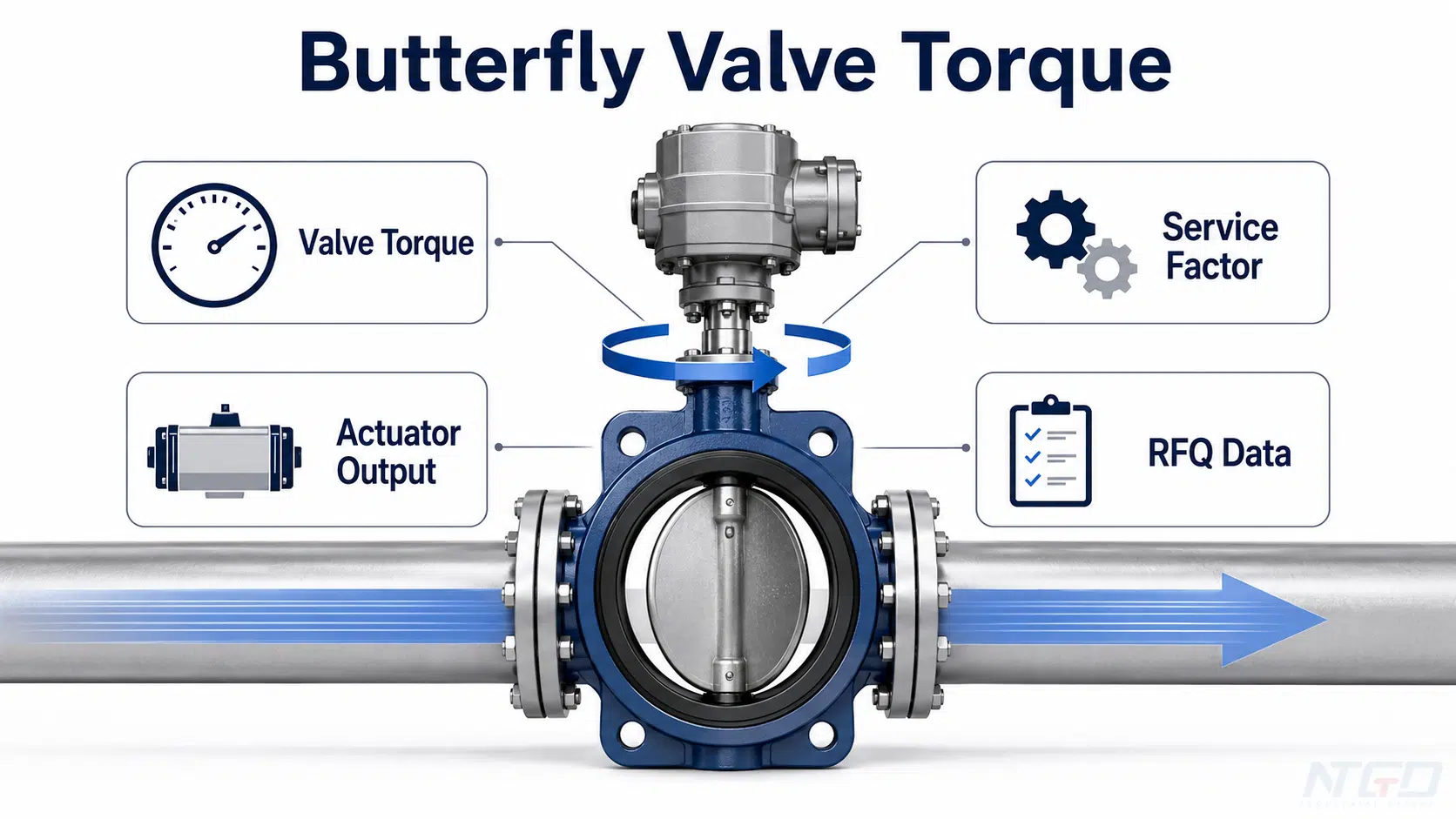
Quick answer: butterfly valve torque is not one fixed value
Butterfly valve torque is the turning effort required at the valve shaft or stem to operate the disc. In practical selection work, it is used to determine whether a lever, gearbox, pneumatic actuator, electric actuator, or other operator can move the valve reliably.
The value changes because a butterfly valve is not operating in an ideal unloaded condition. The disc interacts with the seat, the shaft rotates through bearings and packing, and the fluid can apply force to the disc. These conditions are different from one valve size, seat design, pressure condition, and service application to another.
For this reason, a statement such as “a 16 inch butterfly valve needs X torque” is incomplete unless the service conditions are also known. The useful question is: which torque value should be used for this valve, under this differential pressure, with this seat material, in this medium, for this actuator type?
Where torque acts in a butterfly valve
In a butterfly valve, torque is applied to the shaft or stem. The shaft rotates the disc, and the disc moves between the closed, partially open, and fully open positions.
The torque demand can come from several areas:
| Torque source | What it means in the valve |
|---|---|
| Контакт диска с сиденьем | Resistance from the seat as the disc starts moving or reseats |
| Stem and bearing friction | Resistance in the shaft support and bearing area |
| Packing or seal friction | Friction around the stem sealing area |
| Fluid force on the disc | Hydrodynamic force created by pressure differential and flow |
| Service condition effects | Added resistance from temperature, corrosion, deposits, seat aging, or long standstill |
A reliable torque estimate should consider these sources instead of treating the valve as a simple rotating plate.
For a more detailed breakdown of how the body, disc, stem, seat, packing and actuator affect sealing and operating behavior, see NTGD’s butterfly valve parts and components guide.
Why valve size, pressure differential, seat material and service condition matter
A larger valve normally has a larger disc and greater contact area. Higher differential pressure can increase the force acting on the disc and seat. A tighter shutoff requirement or a more aggressive seat material can change the seating and unseating torque. Dry gas, powder, slurry, viscous media, scaling, or infrequent operation may increase operating resistance compared with clean water service.
The most important point is simple: butterfly valve torque belongs to a specific valve design and service condition. It should not be copied from another brand, another seat material, or another pressure condition without engineering review.
Why Butterfly Valve Torque Matters for Operation and Actuator Sizing
Butterfly valve torque is not only a calculation value. It directly affects reliability, actuator selection, operating speed, manual operation, and long-term service.
Undersized actuator risk
If the actuator output torque is lower than the required valve torque under the worst expected operating condition, the valve may fail to open, fail to close, stop at a partially open position, overload the actuator, or fail to reach the required fail-safe position.
This risk is especially important for automated systems, emergency shutdown functions, remote operation, and valves that remain in one position for long periods before being operated again. Worst-case differential pressure, long standstill, dry or sticky media, scaling, and deposits can make the actual torque higher than a normal running estimate.
Oversized actuator risk
Selecting an actuator that is much larger than necessary can also create problems. It may increase cost, add unnecessary weight, require more installation space, or apply excessive force to the valve components during operation. In some systems, excessive actuator output can increase stress on the shaft, disc, seat, or mechanical stops.
A larger actuator is not automatically the safer choice. The valve shaft, seat design, mechanical stops, actuator duty, and fail-safe function should all be checked against the actuator output torque.
The goal is not to choose the largest actuator. The goal is to match actuator output torque to confirmed valve torque with a suitable service factor.
Manual, gear, pneumatic and electric operation boundaries
Torque also helps decide whether the valve should use a lever, gear operator, pneumatic actuator, electric actuator, or motorized assembly.
A small resilient seated butterfly valve in low-pressure service may be operated by a lever. A larger valve, higher shutoff pressure, metal seat, or difficult service may require a gearbox or automated actuator. Pneumatic actuators must be checked against available air supply and fail-safe requirements. Electric actuators must be checked against output torque, duty, speed, power supply, and control requirements.
When manual operation becomes difficult, the next design check is often whether a поворотный клапан с редуктором can provide enough stem torque while keeping handwheel effort practical.
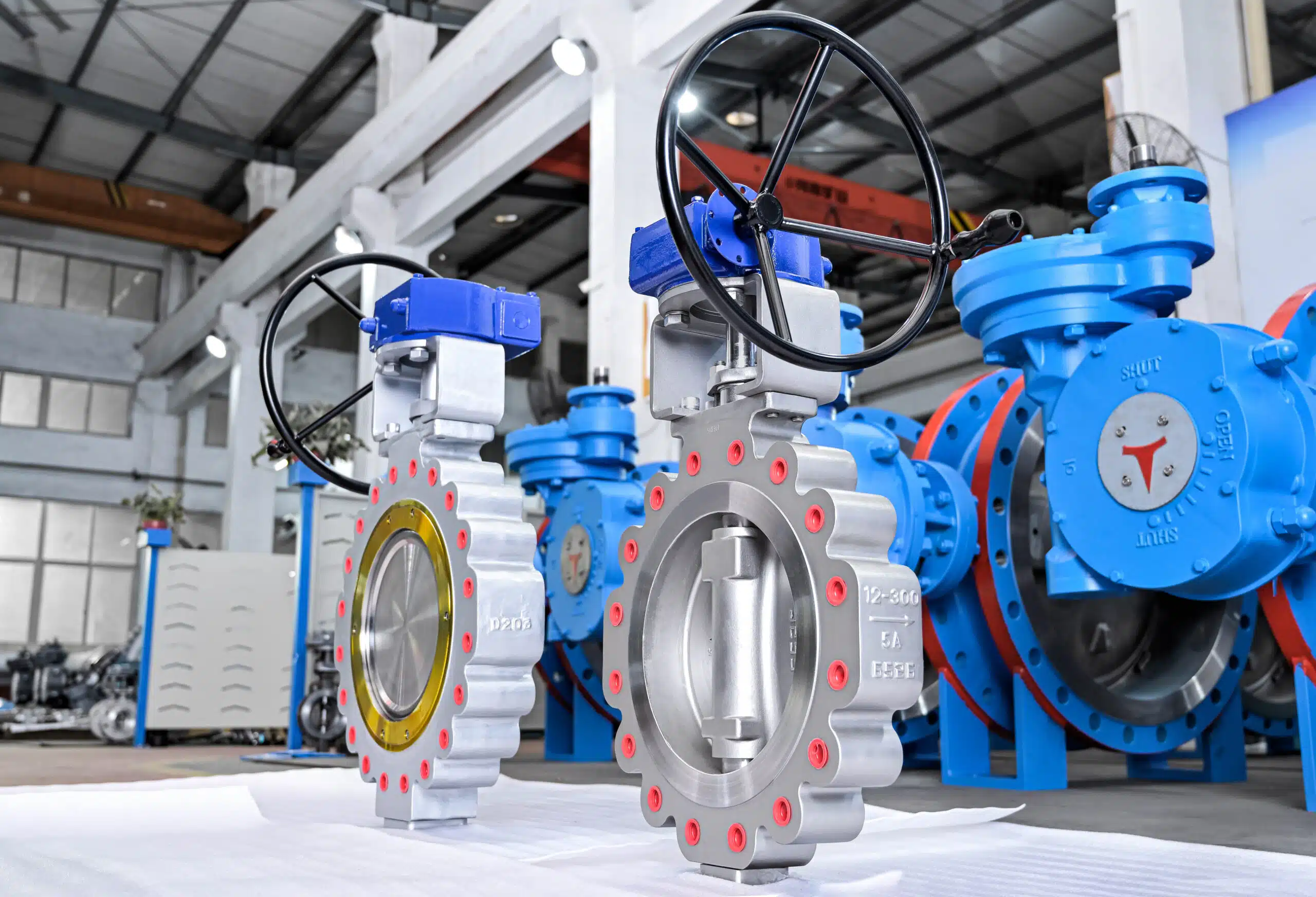
Why torque data belongs in the RFQ stage
Torque should be discussed before the valve and actuator are ordered. If actuator sizing is left until the final purchasing stage, the supplier may not have enough information to confirm the correct operator. A good RFQ should include size, pressure class, maximum differential pressure, medium, temperature, seat material, valve design, operation type, cycling frequency, fail position, and actuator preference.
Main Torque Types Used in Butterfly Valve Selection
Different torque terms describe different operating conditions. Confusing them can lead to incorrect actuator sizing.
| Torque type | Значение | Почему это важно | Typical use in selection |
|---|---|---|---|
| Breakaway torque | Torque needed to start moving the disc from the closed or seated position | Often critical after the valve has been closed for a long time | Important for actuator starting torque |
| Seating torque | Torque needed to push the disc into the seat and achieve shutoff | Important for sealing performance | Important for closing and shutoff |
| Unseating torque | Torque needed to pull the disc away from the seat | Can be higher than running torque | Important when opening from closed |
| Running torque | Torque needed while the disc is already moving | Usually lower than breakaway or seating torque, but depends on flow | Used to understand movement through travel |
| Dynamic torque | Torque caused by fluid force on the disc during flow | Important in high velocity, control, or partially open service | Must be considered when flow force is significant |
| Bearing / stem / packing friction torque | Resistance from shaft support, bearings, packing, or stem seals | Adds to the total operating torque | Included in complete torque evaluation |
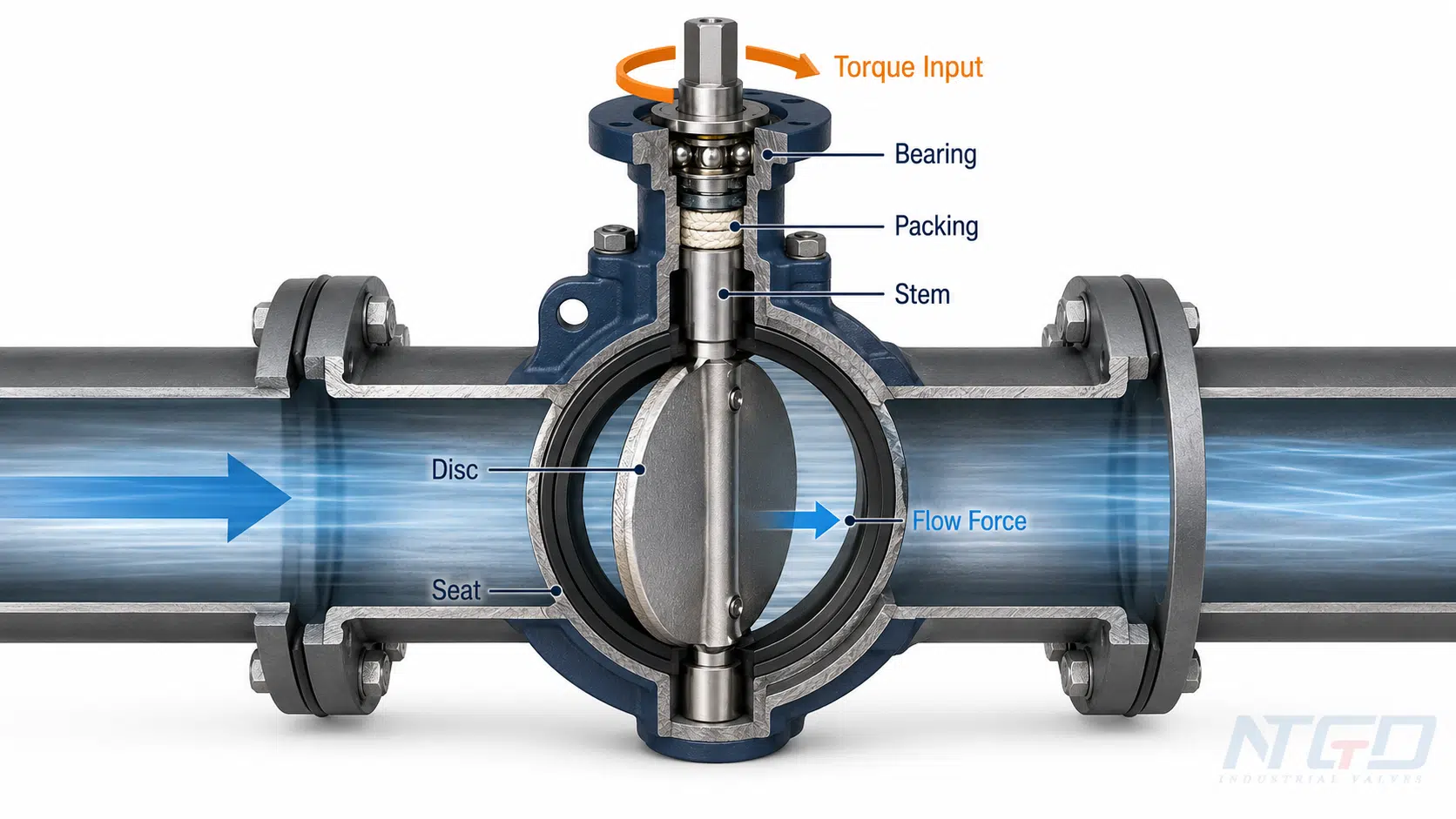
For a neutral industry overview of how seating, bearing, packing and dynamic torque can vary through butterfly valve travel, see Valve Magazine’s actuator sizing torque discussion.
These values together form the butterfly valve torque profile or torque curve through the valve travel. The actuator must be checked against the key torque points across the full stroke, not only against a single running value.
Breakaway torque
Breakaway torque is the torque required to start disc movement, especially from the closed position. It can be affected by seat compression, pressure differential, long standstill time, temperature, aging, deposits, and media condition.
For actuator sizing, breakaway torque is often one of the first values to confirm. If a valve stays closed for long periods or handles sticky, scaling, or particle-laden media, breakaway torque should not be treated as a minor start-up detail.
Seating and unseating torque
Seating torque is related to the effort needed to close the disc against the seat. Unseating torque is related to the effort needed to release the disc from the seat. In resilient seated butterfly valves, the seat design and seat material strongly influence these values. In high-performance or metal seated designs, the torque profile can differ because the sealing mechanism and disc offset are different.
For on-off isolation service, seating and unseating torque often become more important than average running torque because the actuator must close and reopen the valve reliably under pressure.
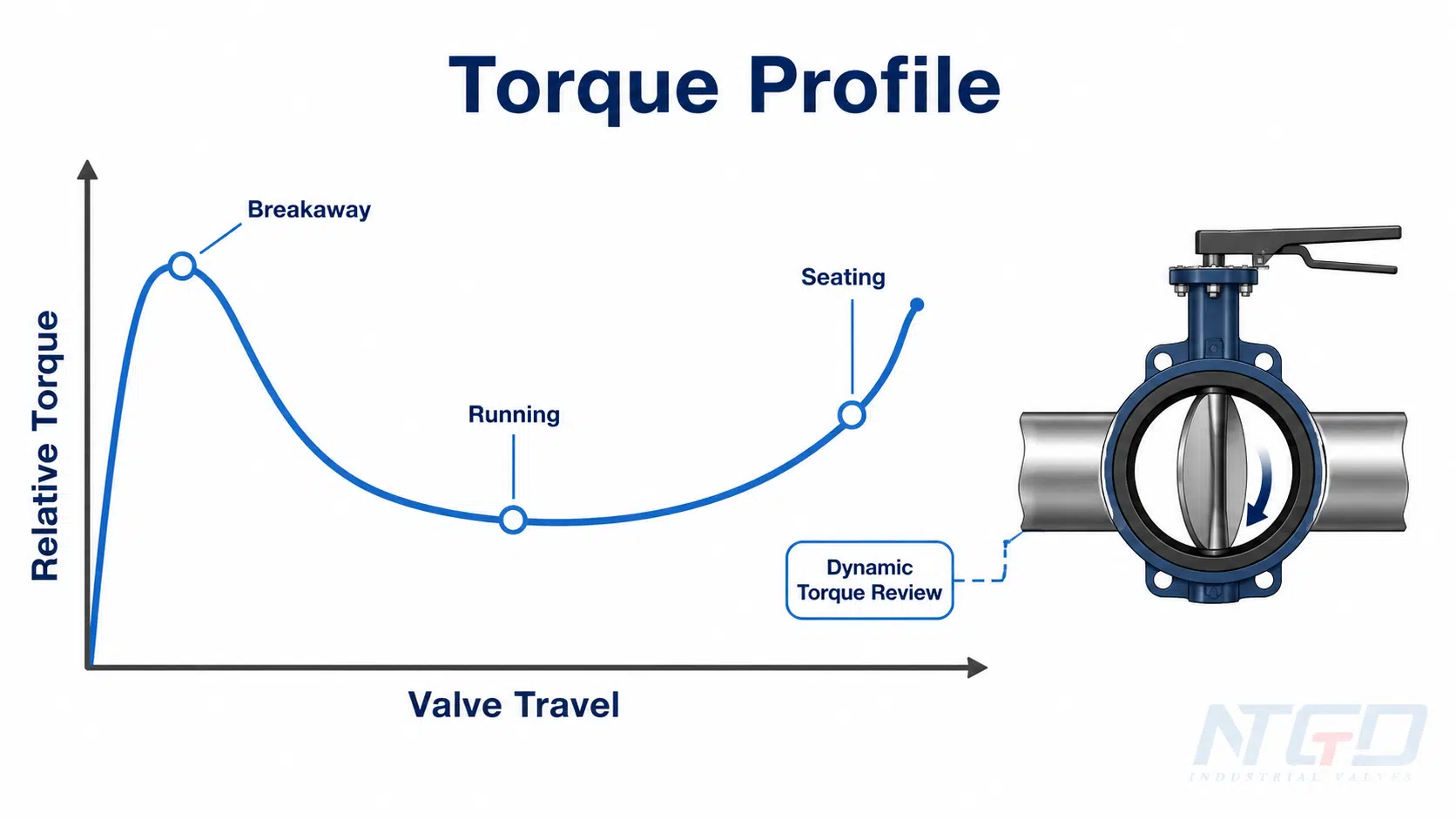
Running torque
Running torque describes the torque required while the valve is already moving through its travel. It is useful, but it should not be the only sizing value. A valve that runs easily after movement begins may still need higher torque to break away from the seat or to close tightly.
Dynamic torque from flow
Dynamic torque is generated by fluid force acting on the disc. It becomes more important when the valve operates under flow, in partially open positions, or in high-velocity service.
For modulating, throttling, high-velocity, large-diameter, or high-differential-pressure service, dynamic torque should be checked as a separate sizing risk. Ignoring it can make an actuator look adequate at the seat but overloaded during travel.
If dynamic torque is related to throttling duty or opening position, also review butterfly valve pressure drop and Cv, because flow resistance and opening angle can change the operating point that the actuator must handle.
Bearing, stem and packing friction torque
The shaft, bearings, bushings, packing, and stem seals also add resistance. These components may be influenced by material selection, temperature, corrosion, lubrication condition, service age, and manufacturing tolerances.
Which torque value should be used for actuator sizing?
The actuator should be selected against the highest credible torque demand for the required operating condition, with an appropriate service factor if the manufacturer’s chart or project specification requires one. The selected torque basis should be documented clearly: breakaway, seating, unseating, running, dynamic, or a manufacturer-defined maximum operating torque.
For on-off isolation service, start by confirming breakaway, seating, and unseating torque under the maximum expected pressure condition. For modulating, throttling, high-velocity, or large-diameter service, dynamic torque should be reviewed in addition to the seating and unseating values.
Factors That Affect Butterfly Valve Torque
Butterfly valve torque changes because the valve, media, and operating condition change. The following matrix can be used as a practical selection guide.
| Фактор | How it affects torque | What to confirm before sizing |
|---|---|---|
| Valve size and disc diameter | Larger disc area usually increases torque demand | DN / NPS, valve series, disc design |
| Перепад давления | Higher differential pressure can increase seating, unseating, or dynamic torque | Maximum shutoff pressure and operating ΔP |
| Материал сиденья | Softer, harder, reinforced, PTFE, elastomer, or metal seats behave differently | Seat material and shutoff requirement |
| Состояние СМИ | Clean water, dry gas, powder, slurry, viscous fluid, or corrosive service may require different torque assumptions | Medium, solids content, viscosity, wet / dry condition, lubrication condition, corrosion risk |
| Температура | High or low temperature can affect seat behavior, friction, and packing | Minimum / maximum operating temperature |
| Тип конструкции | Concentric, double offset, and triple offset valves have different torque profiles | Valve design and sealing mechanism |
| Standstill time | A valve that remains closed for a long time may need higher breakaway torque | Operation frequency and long idle periods |
| Cycling frequency | Frequent operation may affect seat wear and actuator duty | Open / close cycles per day or month |
| Corrosion, scaling and deposits | Deposits can increase friction and prevent smooth movement | Media cleanliness, maintenance condition, cleaning cycle |
| Packing and bearing condition | Worn, dry, or tight components can increase friction | Valve age, packing design, bearing material |
Valve size and disc diameter
As valve size increases, the disc area and contact area generally increase. This is one reason large diameter butterfly valves usually require gear operators or automated actuators instead of simple lever handles.
Pressure differential across the valve
Differential pressure is one of the most important inputs. A valve operating with low line pressure but high shutoff differential pressure can still require significant torque. The RFQ should clearly state the maximum differential pressure the valve may need to open or close against.
Seat material and shutoff tightness
Seat design has a direct effect on torque. A resilient seat may create different seating and unseating behavior than a metal seat. Tight shutoff requirements may also increase the force needed to seat the disc properly. Seat material should therefore be included in the torque review.
Media condition: water, dry gas, powder, slurry and viscous service
Torque charts are often based on defined test or reference conditions. If the actual medium is dry gas, powder, slurry, viscous fluid, or a non-lubricating service, the torque may differ from a chart based on clean water or lubricating conditions. This is why media details should be included in actuator sizing discussions.
In the RFQ, do not only write the fluid name. State whether the service is wet or dry, lubricating or non-lubricating, clean or particle-laden, corrosive, viscous, crystallizing, or prone to deposits.
Temperature, corrosion, scaling and seat aging
Temperature can change seal behavior and friction. Corrosion and scaling can increase resistance. Seat aging and long service periods can also change breakaway torque. These effects are not always visible in a simple torque chart, so they should be reviewed for difficult services.
Design type: concentric, double offset and triple offset
A concentric resilient seated butterfly valve, a double offset high-performance butterfly valve, and a triple offset metal seated butterfly valve do not have the same torque behavior. Offset geometry, seat type, shutoff mechanism, and pressure class can all influence the torque profile.
A torque chart for one butterfly valve design should not be used as a universal chart for all butterfly valve designs. The chart must match the selected valve series and sealing mechanism.
This article does not become a butterfly valve types guide, but design type must be considered during torque review.
For a broader comparison of concentric, double-offset, triple-offset, wafer, lug and flanged designs, use NTGD’s Руководство по типам поворотных затворов as a design-selection reference before applying torque data.
Standstill time and cycling frequency
A valve that is cycled frequently and a valve that remains closed for a long time may not require the same breakaway torque. Long standstill time can increase the risk of higher initial torque, especially when the media can dry, deposit, crystallize, or cause corrosion.
Infrequent operation or long idle periods should be reported during torque review, especially when the actuator must operate the valve after extended standby.
The first torque inputs to confirm are usually valve size, maximum differential pressure, seat material, and valve design type. Media condition, temperature, aging, scaling, and cycling frequency then help determine whether service factor, dynamic torque, or factory confirmation needs closer review.
Butterfly Valve Torque Calculation: Framework and Limits
Butterfly valve torque calculation is useful for preliminary selection, but it should not be treated as a universal answer. The torque coefficients, seat behavior, disc geometry, and service factors are design-specific.
A practical calculation framework
A practical butterfly valve torque calculation normally considers several components:
Estimated valve operating torque = seating / unseating torque + stem, bearing and packing friction torque + dynamic torque when flow conditions require it
This expression is a framework, not a universal formula. The final value should be checked against manufacturer data.
For early-stage selection, use this workflow:
| Шаг | What to do | Output |
|---|---|---|
| 1. Define the operating case | Confirm maximum differential pressure, opening / closing condition, medium, temperature, and operating mode | The service condition for torque review |
| 2. Identify the torque basis | Decide whether breakaway, seating, unseating, running, dynamic, or maximum operating torque controls the selection | The torque value category to check |
| 3. Obtain reference data | Use manufacturer torque chart, preliminary supplier data, or a carefully limited similar-design estimate | A preliminary torque basis |
| 4. Apply the review boundary | Check whether service factor, media correction, dynamic torque, actuator output, or factory confirmation is required | A decision on whether the estimate can be used or must be confirmed |
This workflow supports preliminary actuator screening. It does not replace the confirmed torque value for the selected valve model.
Seat torque, friction torque and dynamic torque
| Компонент | Значение | Typical data source | Внимание |
|---|---|---|---|
| Seating / unseating torque | Torque related to disc and seat interaction | Manufacturer torque chart or test data | Strongly depends on seat design and pressure |
| Stem / bearing / packing friction | Torque from rotating components and sealing friction | Manufacturer design data | Can change with temperature, age and service condition |
| Dynamic torque | Torque from fluid force on the disc | Engineering review, manufacturer guidance, flow condition data | Important in high velocity or partially open operation |
| Коэффициент обслуживания | Margin applied for operating uncertainty | Project requirement, actuator supplier review, manufacturer guidance | Do not apply blindly if the chart already includes margin |
| Confirmed actuator torque | Final actuator output torque after review | Actuator data and valve supplier confirmation | Must match operating condition and fail-safe requirement |
Why one universal formula is not enough
A simple formula may show the relationship between diameter, pressure, and torque, but it cannot fully represent every seat material, disc design, bearing arrangement, shaft geometry, media condition, temperature, and operating history.
A generic estimate becomes especially weak when the valve is large, metal seated, exposed to dry gas, powder, slurry, high differential pressure, long standstill, or critical automated service. In those cases, the calculation should be replaced or corrected by manufacturer torque data, factory confirmation, or a defined testing review.
Preliminary estimate vs final actuator sizing data
A calculation is useful when the project is still in the early selection stage. It can help compare manual, gear, pneumatic and electric operation. It can also help identify whether the application may need a larger actuator or more detailed torque confirmation.
However, final actuator sizing should be based on:
- manufacturer torque chart or confirmed engineering data;
- actual maximum differential pressure;
- actual medium and temperature;
- valve design and seat material;
- operating mode and cycle frequency;
- required fail position;
- actuator output torque under available air pressure or power supply;
- project safety and reliability requirements.
When a calculation should be replaced by manufacturer data or testing
A calculation should not be the only basis when the valve is large, automated, high pressure, metal seated, used in dry gas or slurry service, installed in a critical shutdown line, or expected to operate after long standstill periods. In these cases, manufacturer confirmation or torque testing may be required before final actuator selection.
How to Read a Butterfly Valve Torque Chart
A butterfly valve torque chart is usually a product-specific table. It may list torque values by valve size, pressure differential, seat material, valve series, pressure class, or service condition.
The main risk is using the chart without reading the assumptions.
What a butterfly valve torque chart usually shows
A typical chart may include:
- valve size or DN / NPS;
- pressure differential or shutoff pressure;
- Материал сиденья;
- wet or dry service condition;
- torque units;
- valve series or design type;
- whether the value is seating, unseating, running, or maximum operating torque;
- whether a safety factor is already included;
- whether dynamic torque is included or excluded.
Many torque charts are built around stated reference assumptions. If a chart does not clearly state the reference medium, temperature, valve condition, seat material, safety factor treatment, and whether dynamic torque is included, it should be used only for preliminary comparison, not as the final actuator sizing basis.
Chart reading table
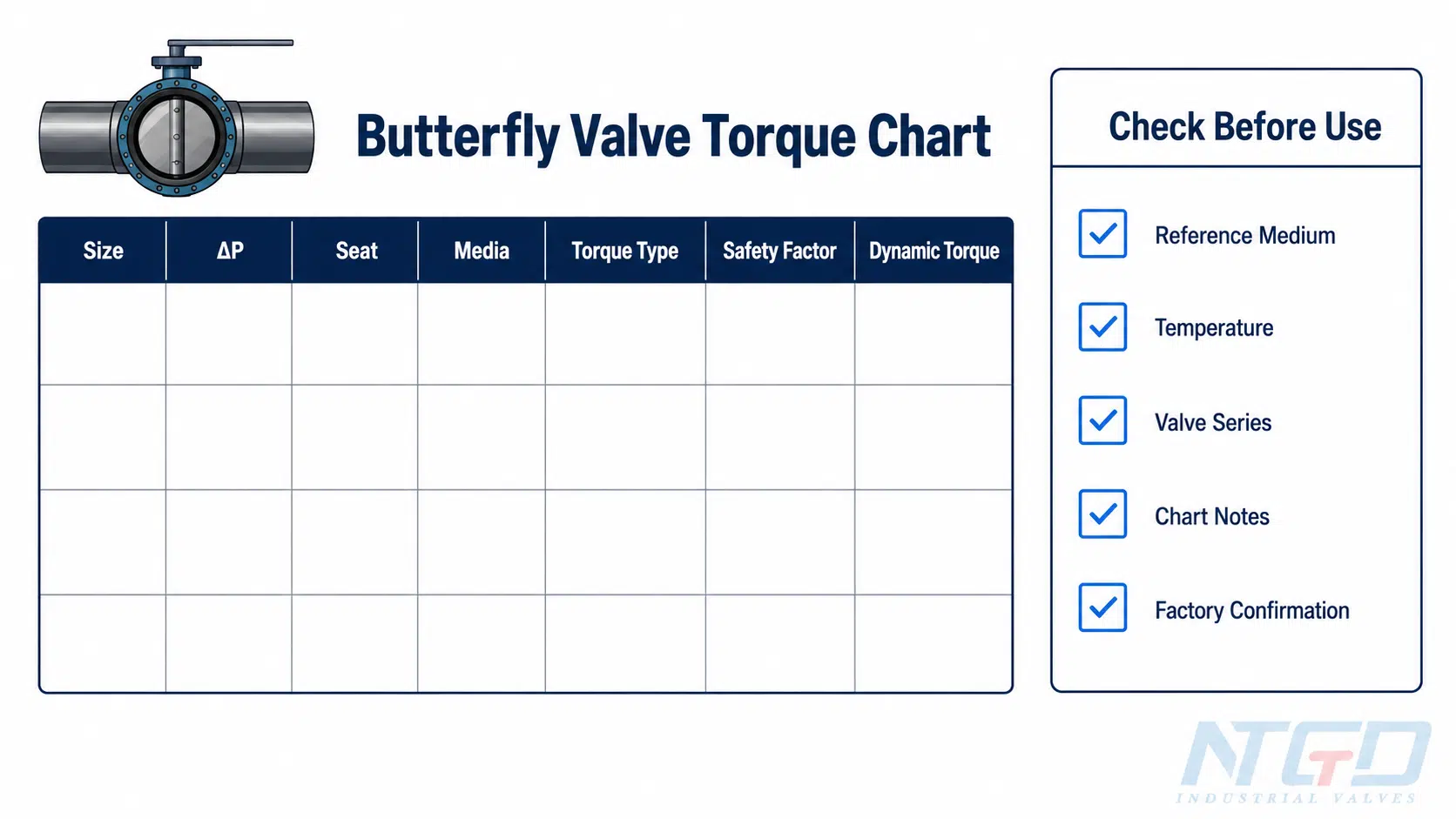
| Chart field | Что это значит | What to verify before use |
|---|---|---|
| Valve size / DN / NPS | Nominal valve size | Confirm exact valve series and pressure class |
| Перепад давления | Pressure the valve opens or closes against | Use maximum expected ΔP, not only normal line pressure |
| Материал сиденья | Material or sealing design used in the chart | Confirm actual seat material in the ordered valve |
| Wet / dry service | Reference media condition | Check if actual media is dry gas, powder, slurry, viscous, corrosive, or non-lubricating |
| Torque unit | Nm, in-lb, ft-lb or other unit | Convert correctly before actuator sizing |
| Torque type | Seating, unseating, breakaway, running or maximum torque | Use the correct torque basis for the actuator |
| Safety factor note | Whether margin is already included | Avoid both under-sizing and double-counting margin |
| Dynamic torque note | Whether flow-induced torque is included | Review high velocity, throttling or partially open service |
| Valve series | Specific product design | Do not use another manufacturer’s chart directly |
| Application note | Conditions or exclusions | Follow manufacturer confirmation for special service |
Does the chart include safety factor?
Do not assume that a butterfly valve torque chart already includes a safety factor. Some charts may include a margin for actuator sizing, while others may show base valve torque only. The difference matters. If a service factor is added twice, the actuator may be oversized. If no margin is added where required, the actuator may be undersized.
Only follow a safety factor assumption when the chart notes, manufacturer datasheet, or supplier confirmation clearly states how the value should be used.
Does the chart include dynamic torque?
Do not assume that dynamic torque is included in a standard seating or unseating torque chart. Some charts focus on seating and unseating torque, while flow-induced torque may be separate.
Control service, throttling service, high flow velocity, large diameter valves, and high differential pressure conditions should be reviewed for dynamic torque before final actuator sizing.
Why another manufacturer’s chart should not be reused directly
A torque chart belongs to a specific valve design. A chart from another manufacturer may be based on a different disc geometry, shaft design, seat material, pressure condition, testing method, or safety factor. It can be useful for rough comparison, but it should not be used as the final basis for selecting an actuator for a different valve.
Torque chart vs torque calculator vs final factory confirmation
A torque chart provides manufacturer data for a specific valve range. A torque calculator may provide a preliminary estimate. Factory confirmation connects the selected valve, actuator, and service conditions.
For procurement, the final decision should be based on the actual valve design and operating data, not only a generic calculation or third-party chart.
Actuator Sizing from Butterfly Valve Torque
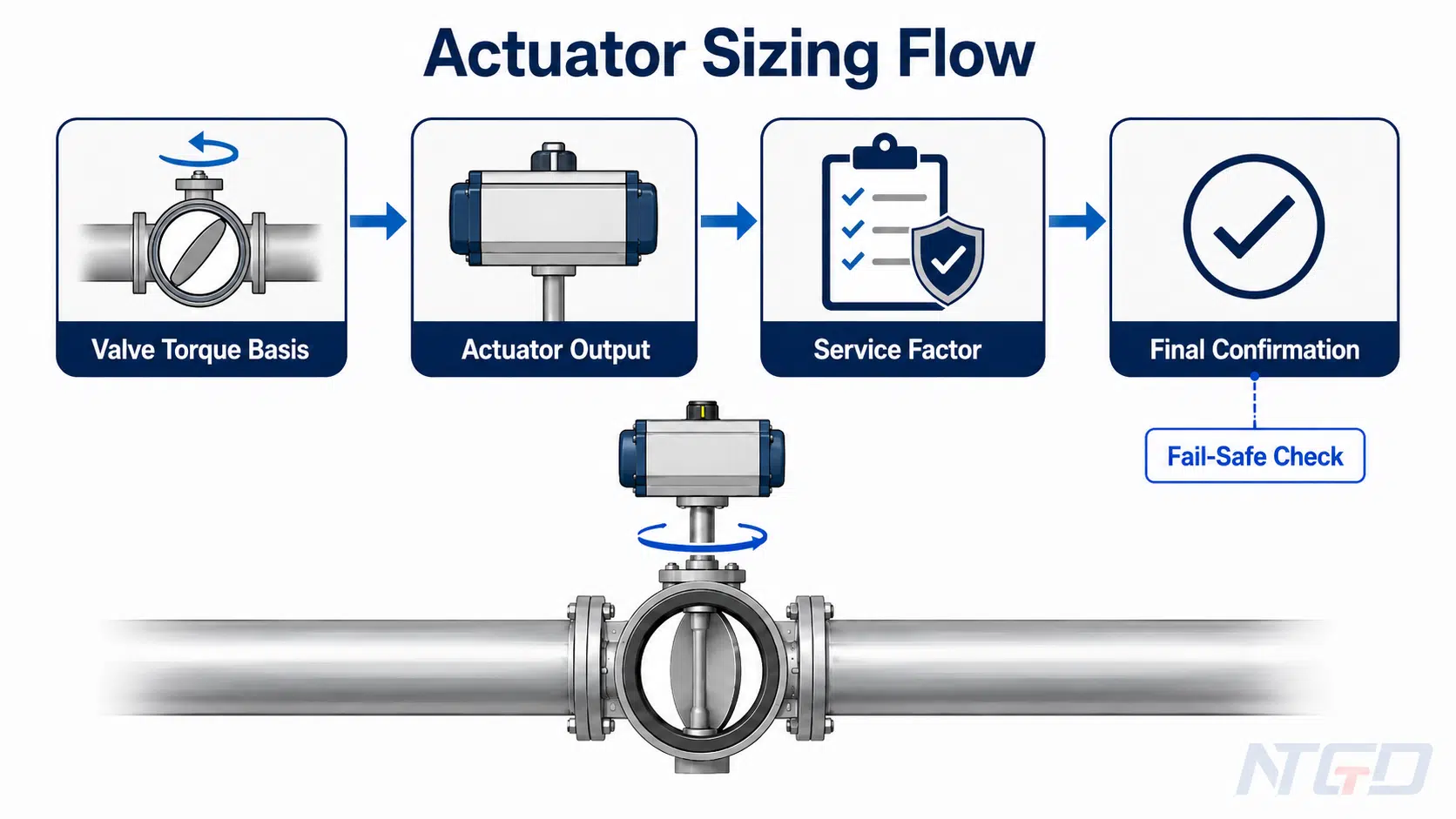
Actuator sizing starts with the required valve torque, but it does not stop there. The actuator must deliver enough output torque under the actual available power or air supply, in the required direction, through the required operating range, and under the specified service condition.
A practical sizing decision chain is:
| Шаг | Decision point | Что необходимо подтвердить |
|---|---|---|
| 1. Confirm valve torque basis | Identify the maximum valve torque under the worst expected service condition | Breakaway, seating, unseating, dynamic or maximum operating torque |
| 2. Confirm actuator minimum output | Check output torque under real site air pressure or power supply | Pneumatic air supply, electric actuator torque, gear ratio or manual effort |
| 3. Compare with required margin | Match actuator output to required valve torque and any required service factor | Do not double-count chart margin |
| 4. Verify fail-safe and full-stroke needs | Check emergency, spring return, fail-open / fail-close and full-stroke torque | Confirm actuator performance through the complete operation |
When valve and actuator interfaces must be standardized, ISO 5211:2026 provides requirements for part-turn actuator attachments to industrial valves, including flange/interface dimensions and reference torque values for interface components.
Valve torque vs actuator output torque
Valve torque is the torque required to move the valve. Actuator output torque is the torque the actuator can provide. These two values must be compared under realistic conditions.
For pneumatic actuators, output torque depends on available air pressure and actuator design. For electric actuators, output torque depends on motor, gearing, duty and control settings. For gear operators, handwheel effort and gearbox ratio affect manual operation.
Service factor and safety factor
A service factor may be required to account for friction variation, pressure changes, seat aging, deposits, media effects, or operation after long standstill. The correct factor depends on the application and the manufacturer’s sizing method.
The key rule is not “always add the same factor.” The key rule is: check whether the valve torque chart already includes margin and then size the actuator according to the confirmed valve torque and project requirement.
Pneumatic actuator sizing considerations
For pneumatic butterfly valves, confirm:
- available air supply pressure;
- spring return or double acting design;
- fail-open or fail-close position;
- torque output at the weakest part of the stroke;
- valve breakaway and seating torque;
- частота циклов;
- emergency operating conditions.
A pneumatic actuator may appear adequate at one air pressure but become undersized if the actual site air pressure is lower.
For pneumatic packages, the valve torque review should be paired with the application limits described in NTGD’s пневматический поворотный клапан гид.
Electric actuator sizing considerations
For electric actuated butterfly valves, confirm:
- required output torque;
- operating speed;
- duty cycle;
- power supply;
- управляющий сигнал;
- seating torque limit;
- manual override requirement;
- environmental condition.
An electric actuator should be matched to the valve torque and service duty, not selected only by valve size.
For electric automation, the same torque basis should be checked against actuator output, duty and control requirements before selecting an поворотный клапан с электроприводом package.
Gear operator and manual operation limits
A gear operator is often used when the torque is too high for comfortable lever operation. The gearbox reduces manual effort, but it also adds travel time and mechanical complexity. For large valves or high torque service, manual operation should be reviewed carefully for operator safety and practicality.
Fail-open, fail-close and emergency operating conditions
Fail-safe requirements can change actuator sizing. A spring return actuator must provide enough torque in the required fail direction. Emergency shutdown applications may require additional review because the valve must operate reliably even under abnormal conditions.
Common actuator sizing mistakes
Most actuator sizing mistakes do not come from arithmetic alone. They come from using the right-looking torque value under the wrong service condition.
| Ошибка | Риск | Better approach |
|---|---|---|
| Selecting actuator only by valve size | May ignore pressure, seat and media effects | Use confirmed torque data |
| Using running torque instead of breakaway or seating torque | Actuator may fail at start or close | Review all relevant torque types |
| Ignoring dry gas, slurry or deposits | Field torque may exceed estimate | Include media condition in RFQ |
| Ignoring dynamic torque in throttling, high-velocity or large-diameter service | Actuator may overload during travel | Request dynamic torque review or manufacturer confirmation |
| Applying safety factor without checking chart notes | May oversize actuator | Check whether margin is already included |
| Using another brand’s torque chart | Data may not match valve design | Use manufacturer-specific data |
| Ignoring air supply pressure | Pneumatic actuator may underperform | Confirm minimum site air pressure |
| Treating calculator output as final | May miss design-specific factors | Use calculator only for preliminary review |
Estimated Torque vs Confirmed Torque
Torque estimation is useful, but confirmed torque is what should guide the final valve and actuator package.

Manufacturer torque chart
The manufacturer torque chart is usually the first formal reference for valve torque. It should match the valve series, size, pressure, seat material, and service condition. If the chart assumptions do not match the project, the supplier should confirm the correct value.
Factory confirmation
Factory confirmation is important when the application is large, automated, critical, high pressure, high temperature, abrasive, corrosive, dry, or infrequently operated. The confirmation should state the valve torque basis and the actuator output basis.
Torque testing and measurement
For critical applications, torque testing or factory testing may be required. The test method, pressure condition, media or test fluid, direction of operation, and acceptance criteria should be defined before ordering.
Critical applications may also require written confirmation of test conditions, differential pressure, operating direction, acceptance criteria, and documentation requirements before the valve-actuator package is released for procurement.
This V2 article does not claim a specific testing method or standard requirement. Those details should be verified in the evidence and standards stage before publication.
Field conditions that may increase torque
Field torque may rise because of:
- deposits or scaling;
- corrosion;
- seat aging;
- dry service;
- temperature variation;
- damaged packing or bearings;
- long idle periods;
- misalignment or installation stress;
- operation under higher-than-expected differential pressure.
These conditions should be reviewed during maintenance planning and actuator selection.
How to document torque assumptions before procurement
Before procurement, document the assumptions used for actuator sizing:
| Assumption | Почему это важно |
|---|---|
| Valve size and design | Defines basic geometry and torque profile |
| Maximum differential pressure | Defines worst operating condition |
| Материал сиденья | Influences seating and unseating torque |
| Среда и температура | Influences friction and service factor |
| Рабочая частота | Affects duty and standstill risk |
| Положение отказа | Affects actuator direction and spring sizing |
| Torque chart source | Confirms data is manufacturer-specific |
| Safety / service factor | Prevents hidden under-sizing or double-counting |
| Требование к тестированию | Supports final acceptance and documentation |
RFQ Data Checklist for Butterfly Valve Torque and Actuator Sizing
A clear RFQ helps the valve supplier and actuator supplier confirm the correct torque basis. The following checklist can be used before requesting a valve-actuator package.
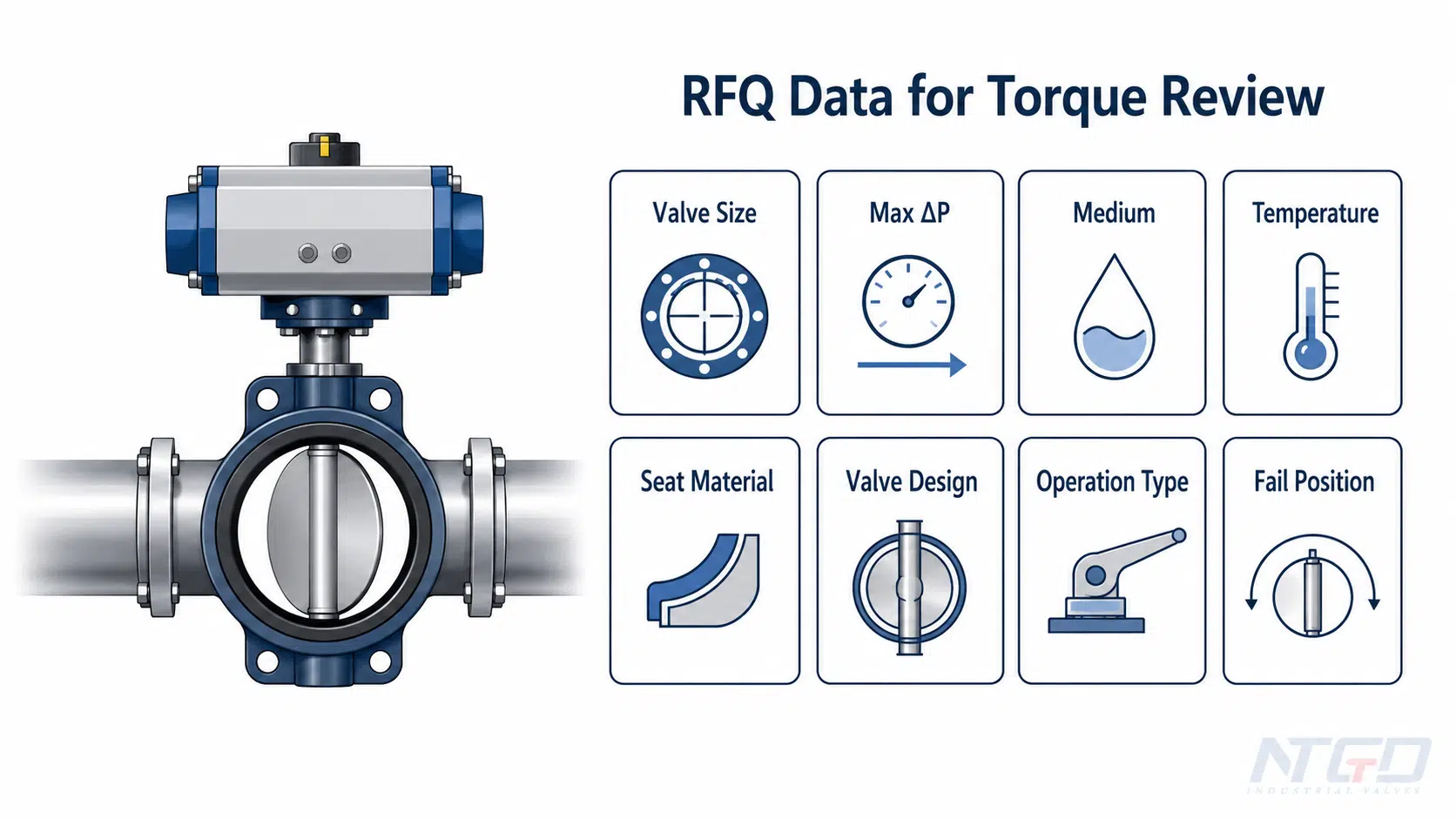
| Пункт RFQ | Что необходимо предоставить | Почему это важно |
|---|---|---|
| Размер клапана | DN / NPS | Defines disc size and chart range |
| Класс давления / номинальное значение | Class, PN or project pressure rating | Supports pressure boundary and design selection |
| Maximum differential pressure | Highest ΔP during opening, closing or shutoff | Critical for torque and actuator sizing |
| Средний | Water, gas, steam, slurry, powder, chemical, viscous fluid, etc.; state whether it is lubricating or non-lubricating, wet or dry, clean or particle-laden | Media condition affects torque |
| Температура | Minimum, normal and maximum operating temperature | Affects seat, packing and friction |
| Материал сиденья | EPDM, NBR, PTFE, metal seat or other material | Strong influence on seating torque |
| Конструкция клапана | Concentric, double offset, triple offset, resilient seated, metal seated | Design changes torque profile |
| Тип операции | Manual, gear, pneumatic, electric, hydraulic, motorized | Determines torque output requirement |
| Cycling frequency | Frequent, occasional, emergency only, long standstill | Affects breakaway and duty |
| Положение отказа | Fail open, fail close, fail last position | Critical for spring return actuator sizing |
| Available air supply / power | Site air pressure or electrical supply | Determines actual actuator output |
| Control mode | On-off, modulating, throttling, emergency shutdown | Dynamic torque and duty may differ |
| Требование к тестированию | Pressure test, functional test, torque confirmation, inspection record | Supports acceptance and documentation |
| Documentation needs | Datasheet, torque confirmation, drawing, certificate, tag data | Helps purchasing and engineering review |
The more complete the RFQ data, the lower the risk of actuator under-sizing, over-sizing, or late-stage rework.
FAQ About Butterfly Valve Torque
Как рассчитать крутящий момент клапана «бабочка»?
Start by defining the service case: valve size, maximum differential pressure, medium, temperature, opening / closing condition, and operating mode. Then identify the torque basis, such as breakaway, seating, unseating, running, or dynamic torque. Use manufacturer torque data or a preliminary supplier estimate, and treat the result as a screening value until the selected valve and actuator are confirmed.
Можно ли с помощью одной формулы рассчитать все значения крутящего момента для дроссельных клапанов?
Нет. Формула позволяет провести предварительный отбор, но не может окончательно определить размеры привода для каждой конкретной конструкции дроссельной заслонки. На окончательное значение крутящего момента влияют такие факторы, как материал седла, геометрия диска, конструкция вала, перепад давления, состояние рабочей среды, температура, время простоя, а также допущения, заложенные в таблицах.
В чём заключается разница между пусковым моментом и рабочим моментом?
Момент разгона — это момент, необходимый для начала движения диска, как правило, из закрытого или прижатого положения. Момент работы — это момент, необходимый после того, как диск уже пришёл в движение. При расчёте размеров привода момент разгона или прижатия может иметь большее значение, чем момент работы, особенно при работе в режиме «включено-выключено».
Какие факторы влияют на крутящий момент клапана-бабочки?
Основными факторами являются размер клапана, максимальный перепад давления, материал седла, состояние рабочей среды, температура, конструкция клапана, время простоя и частота циклов работы. При эксплуатации в сложных условиях — например, при работе с сухим газом, суспензией, порошком, в условиях коррозии, образования накипи или длительных периодов простоя — об этом следует сообщить до утверждения размеров привода.
Включает ли таблица моментов затяжки клапанов-бабочек коэффициент безопасности?
Не следует предполагать, что коэффициент безопасности учтён, если это явно не указано в примечаниях к таблице. В некоторых таблицах коэффициент безопасности может быть уже учтён, тогда как в других может быть указан только базовый момент затяжки клапана. Перед добавлением какого-либо дополнительного коэффициента нагрузки необходимо ознакомиться с примечаниями к таблице.
Можно ли использовать таблицу моментов затяжки другого производителя?
Таблица другого производителя может использоваться лишь для приблизительного сравнения. Её не следует принимать за окончательное основание для расчёта размеров, поскольку конструкция диска, конструкция вала, материал седла, условия давления и допущения, заложенные в таблице, могут значительно отличаться от характеристик выбранного клапана.
Какой крутящий момент необходим для открытия 16-дюймового дроссельного клапана?
Значение момента затяжки 16-дюймового клапана «бабочка» невозможно определить, исходя только из его размера. Необходимо также учитывать конструкцию клапана, перепад давления, материал седла, рабочую среду, температуру, режим работы, допущения, заложенные в таблицах, и тип привода. Для данного диапазона размеров часто требуется пересмотреть вариант привода с помощью шестерни или автоматического привода вместо того, чтобы исходить из простого рычажного привода.
Какие данные необходимы для расчета размеров привода?
Как минимум, укажите размер клапана, класс давления, максимальный перепад давления, рабочую среду, температуру, материал седла, конструкцию клапана, тип привода, частоту циклов, положение в случае отказа, а также наличие пневматического или электрического питания.
Момент затяжки клапана-бабочки совпадает ли с моментом затяжки болтов фланца?
Нет. Момент затяжки клапана-бабочки — это усилие, необходимое для поворота диска клапана. Момент затяжки болтов фланца — это усилие, прилагаемое при затяжке болтов во время монтажа. Это разные технические величины, и их не следует путать.
В каких случаях необходимо подтвердить значение крутящего момента с помощью заводских испытаний?
Torque confirmation or testing should be considered for large valves, critical shutdown service, automated packages, high differential pressure, metal seated valves, dry gas, slurry, corrosive media, long standstill service, or applications where actuator failure would create serious process risk.
Is a torque calculator enough for actuator selection?
A torque calculator can help with preliminary screening, but it is not enough for final actuator selection. The final selection should be confirmed with manufacturer data, actual service conditions, and actuator output information.
Заключение
Butterfly valve torque is a practical engineering value used to connect the valve design, service condition and actuator selection. It is not a fixed value based only on valve size. Breakaway torque, seating torque, running torque, dynamic torque and friction torque can all influence the final operating requirement.
A torque calculation can support early selection, and a torque chart can help interpret manufacturer data. However, final actuator sizing should be based on the specific valve series, seat material, pressure differential, media, temperature, operating frequency and fail-safe requirement.
For B2B valve procurement, the safest approach is:
- define the service conditions and maximum differential pressure;
- obtain manufacturer-specific torque data or a confirmed preliminary estimate;
- match actuator output with required valve torque, service factor, fail-safe function and verification needs.
This process reduces the risk of under-sized actuators, unnecessary over-sizing, and late-stage changes after the valve and actuator have already been selected.
Поддержка приложений / спецификаций
For butterfly valve actuator sizing, provide the RFQ data listed above before the valve-actuator package is selected. NTGD can use the service conditions to review the torque basis, check actuator output margin, recommend a suitable operation method, and flag service conditions that may require additional torque confirmation.
