
Nombre del autor: Bruce Zheng
Función del autor: Cofundador e ingeniero de válvulas en NTGD Valve
Biografía del autor: Bruce Zheng es cofundador e ingeniero de válvulas en NTGD Valve, donde se dedica a la selección y aplicación de válvulas industriales, así como a la elaboración de contenido técnico para compradores B2B de todo el mundo.
Última actualización: 6 de julio de 2026
El par de la válvula de mariposa es uno de los valores clave que se utilizan al seleccionar un operador manual, una caja de engranajes, un actuador neumático, un actuador eléctrico o un conjunto de válvula automatizado. Indica al ingeniero cuánta fuerza de giro se necesita para comenzar a mover el disco, mantenerlo en movimiento y cerrar o abrir la válvula bajo las condiciones de servicio especificadas.
El valor del par de una válvula de mariposa no es una cifra fija. El par requerido varía según el tamaño de la válvula, la presión diferencial, el material del asiento, el diseño del disco, las condiciones del fluido, la temperatura, la frecuencia de operación y el tiempo que la válvula ha permanecido en una misma posición. Una tabla de par o un cálculo pueden servir de apoyo para el dimensionamiento preliminar del actuador, pero la selección final del actuador debe basarse en el diseño de la válvula, los datos del fabricante y las condiciones reales de operación.
Para los ingenieros y compradores, el objetivo de analizar el par de apriete de una válvula de mariposa no es solo obtener un número. Se trata de elegir la base de par correcta, evitar que el actuador sea demasiado pequeño o innecesariamente grande, y preparar los datos de servicio que necesita el proveedor de la válvula antes de confirmar el paquete del actuador.
Esta guía explica cómo se define el par de una válvula de mariposa, qué tipos de par son importantes, cómo se calcula el par, cómo leer una tabla de pares para válvulas de mariposa y qué datos deben incluirse en una solicitud de cotización antes de confirmar el tamaño del actuador.
¿Qué es el par de apriete de una válvula de mariposa?
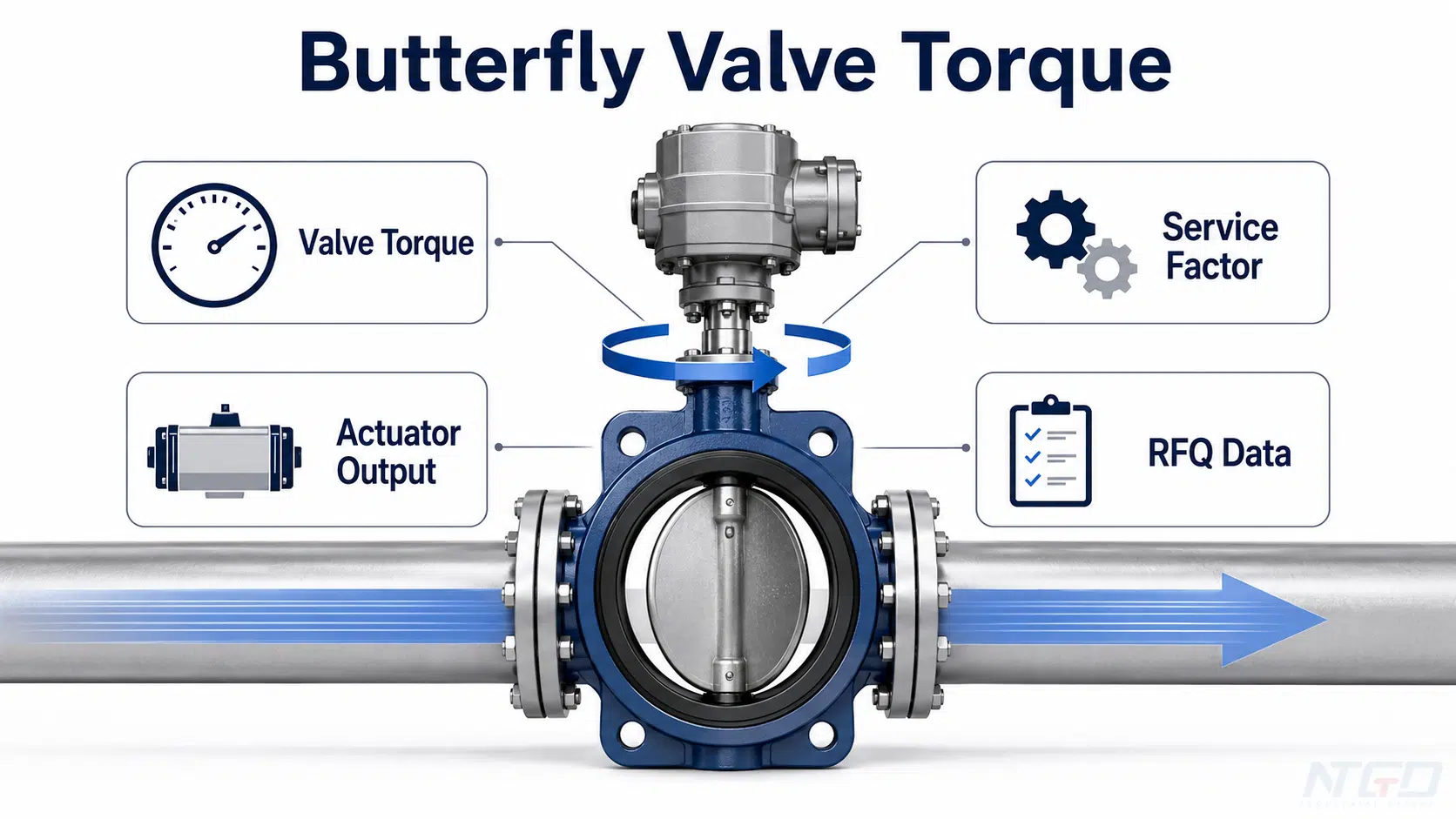
Respuesta rápida: el par de apriete de una válvula de mariposa no es un valor fijo
Butterfly valve torque is the turning effort required at the valve shaft or stem to operate the disc. In practical selection work, it is used to determine whether a lever, gearbox, pneumatic actuator, electric actuator, or other operator can move the valve reliably.
The value changes because a butterfly valve is not operating in an ideal unloaded condition. The disc interacts with the seat, the shaft rotates through bearings and packing, and the fluid can apply force to the disc. These conditions are different from one valve size, seat design, pressure condition, and service application to another.
For this reason, a statement such as “a 16 inch butterfly valve needs X torque” is incomplete unless the service conditions are also known. The useful question is: which torque value should be used for this valve, under this differential pressure, with this seat material, in this medium, for this actuator type?
Dónde actúa el par en una válvula de mariposa
In a butterfly valve, torque is applied to the shaft or stem. The shaft rotates the disc, and the disc moves between the closed, partially open, and fully open positions.
The torque demand can come from several areas:
| Torque source | What it means in the valve |
|---|---|
| Contacto entre el disco y el asiento | Resistance from the seat as the disc starts moving or reseats |
| Stem and bearing friction | Resistance in the shaft support and bearing area |
| Packing or seal friction | Friction around the stem sealing area |
| Fluid force on the disc | Hydrodynamic force created by pressure differential and flow |
| Service condition effects | Added resistance from temperature, corrosion, deposits, seat aging, or long standstill |
A reliable torque estimate should consider these sources instead of treating the valve as a simple rotating plate.
For a more detailed breakdown of how the body, disc, stem, seat, packing and actuator affect sealing and operating behavior, see NTGD’s butterfly valve parts and components guide.
Por qué son importantes el tamaño de la válvula, el diferencial de presión, el material del asiento y las condiciones de servicio
A larger valve normally has a larger disc and greater contact area. Higher differential pressure can increase the force acting on the disc and seat. A tighter shutoff requirement or a more aggressive seat material can change the seating and unseating torque. Dry gas, powder, slurry, viscous media, scaling, or infrequent operation may increase operating resistance compared with clean water service.
The most important point is simple: butterfly valve torque belongs to a specific valve design and service condition. It should not be copied from another brand, another seat material, or another pressure condition without engineering review.
Por qué es importante el par de apriete de la válvula de mariposa para su funcionamiento y para el dimensionamiento del actuador
Butterfly valve torque is not only a calculation value. It directly affects reliability, actuator selection, operating speed, manual operation, and long-term service.
Riesgo de un actuador de tamaño insuficiente
If the actuator output torque is lower than the required valve torque under the worst expected operating condition, the valve may fail to open, fail to close, stop at a partially open position, overload the actuator, or fail to reach the required fail-safe position.
This risk is especially important for automated systems, emergency shutdown functions, remote operation, and valves that remain in one position for long periods before being operated again. Worst-case differential pressure, long standstill, dry or sticky media, scaling, and deposits can make the actual torque higher than a normal running estimate.
Riesgo de un actuador sobredimensionado
Selecting an actuator that is much larger than necessary can also create problems. It may increase cost, add unnecessary weight, require more installation space, or apply excessive force to the valve components during operation. In some systems, excessive actuator output can increase stress on the shaft, disc, seat, or mechanical stops.
A larger actuator is not automatically the safer choice. The valve shaft, seat design, mechanical stops, actuator duty, and fail-safe function should all be checked against the actuator output torque.
The goal is not to choose the largest actuator. The goal is to match actuator output torque to confirmed valve torque with a suitable service factor.
Límites de funcionamiento manual, por engranajes, neumático y eléctrico
Torque also helps decide whether the valve should use a lever, gear operator, pneumatic actuator, electric actuator, or motorized assembly.
A small resilient seated butterfly valve in low-pressure service may be operated by a lever. A larger valve, higher shutoff pressure, metal seat, or difficult service may require a gearbox or automated actuator. Pneumatic actuators must be checked against available air supply and fail-safe requirements. Electric actuators must be checked against output torque, duty, speed, power supply, and control requirements.
When manual operation becomes difficult, the next design check is often whether a válvula de mariposa accionada por engranajes can provide enough stem torque while keeping handwheel effort practical.
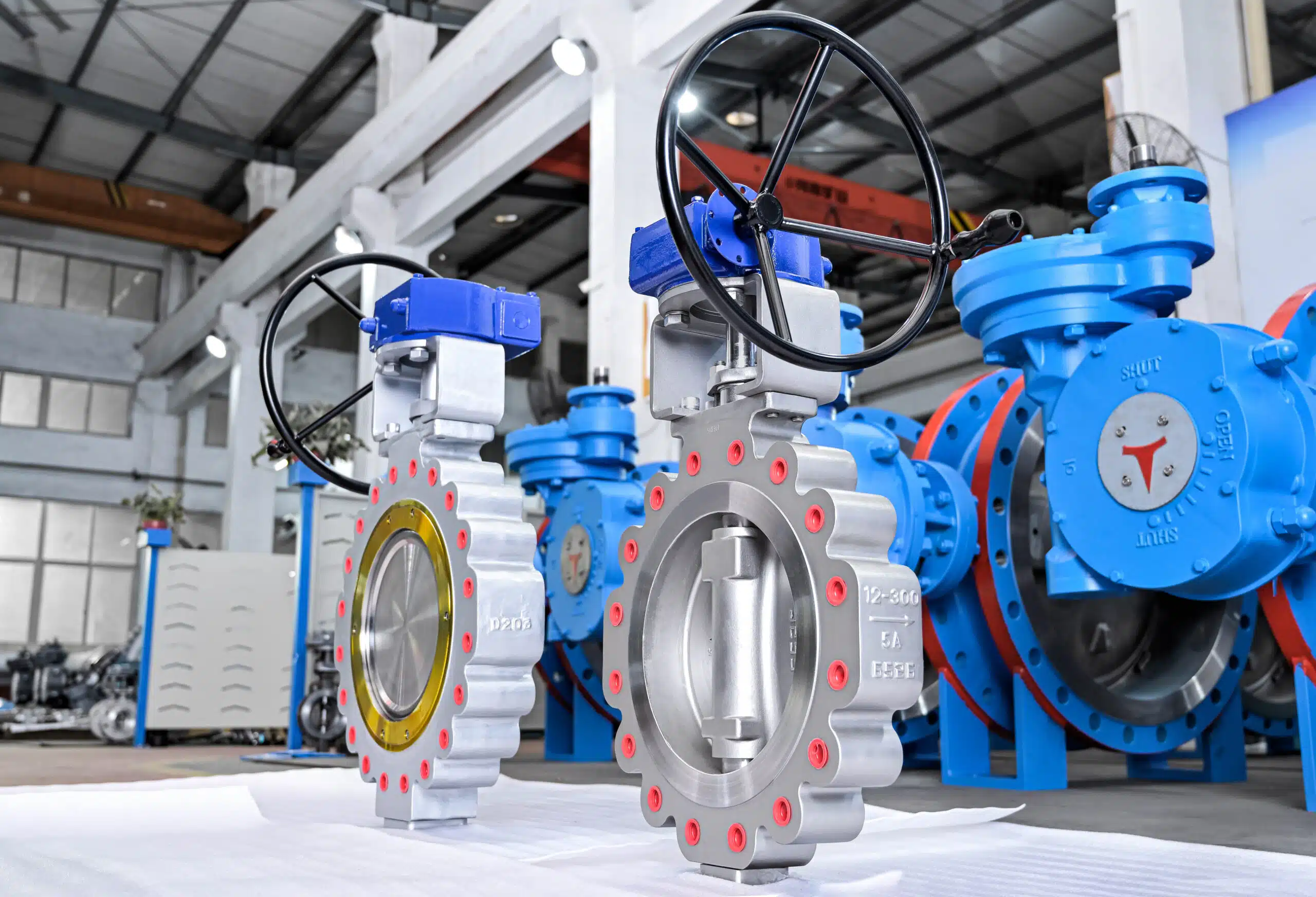
Por qué los datos de torque deben incluirse en la etapa de solicitud de cotización
Torque should be discussed before the valve and actuator are ordered. If actuator sizing is left until the final purchasing stage, the supplier may not have enough information to confirm the correct operator. A good RFQ should include size, pressure class, maximum differential pressure, medium, temperature, seat material, valve design, operation type, cycling frequency, fail position, and actuator preference.
Principales tipos de par utilizados en la selección de válvulas de mariposa
Different torque terms describe different operating conditions. Confusing them can lead to incorrect actuator sizing.
| Torque type | Significado | Por qué es importante | Typical use in selection |
|---|---|---|---|
| Par de desprendimiento | Torque needed to start moving the disc from the closed or seated position | Often critical after the valve has been closed for a long time | Important for actuator starting torque |
| Seating torque | Torque needed to push the disc into the seat and achieve shutoff | Important for sealing performance | Important for closing and shutoff |
| Unseating torque | Torque needed to pull the disc away from the seat | Can be higher than running torque | Important when opening from closed |
| Par de funcionamiento | Torque needed while the disc is already moving | Usually lower than breakaway or seating torque, but depends on flow | Used to understand movement through travel |
| Dynamic torque | Torque caused by fluid force on the disc during flow | Important in high velocity, control, or partially open service | Must be considered when flow force is significant |
| Bearing / stem / packing friction torque | Resistance from shaft support, bearings, packing, or stem seals | Adds to the total operating torque | Included in complete torque evaluation |
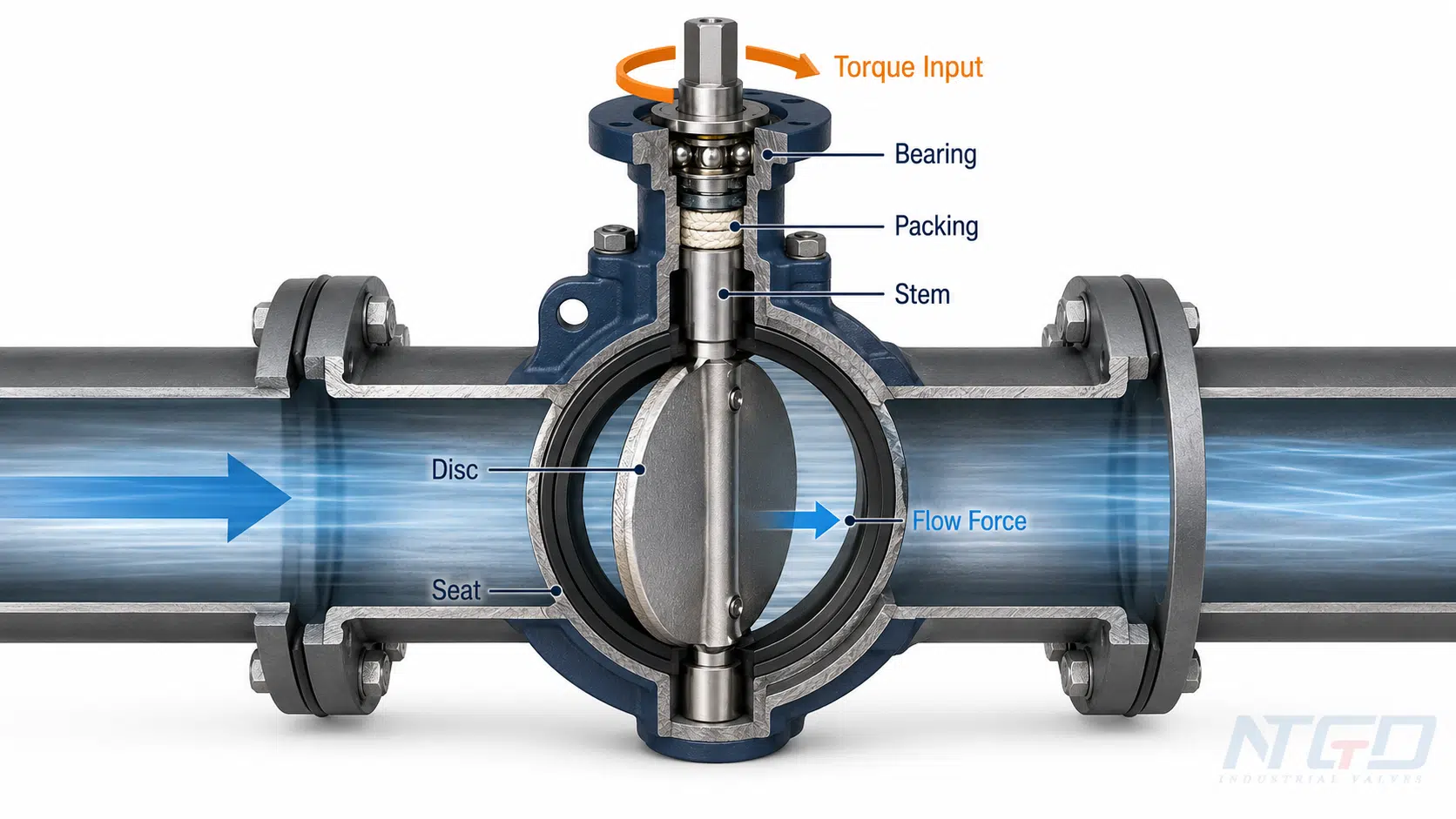
For a neutral industry overview of how seating, bearing, packing and dynamic torque can vary through butterfly valve travel, see Valve Magazine’s actuator sizing torque discussion.
These values together form the butterfly valve torque profile or torque curve through the valve travel. The actuator must be checked against the key torque points across the full stroke, not only against a single running value.
Par de desprendimiento
Breakaway torque is the torque required to start disc movement, especially from the closed position. It can be affected by seat compression, pressure differential, long standstill time, temperature, aging, deposits, and media condition.
For actuator sizing, breakaway torque is often one of the first values to confirm. If a valve stays closed for long periods or handles sticky, scaling, or particle-laden media, breakaway torque should not be treated as a minor start-up detail.
Par de apriete y desapriete
Seating torque is related to the effort needed to close the disc against the seat. Unseating torque is related to the effort needed to release the disc from the seat. In resilient seated butterfly valves, the seat design and seat material strongly influence these values. In high-performance or metal seated designs, the torque profile can differ because the sealing mechanism and disc offset are different.
For on-off isolation service, seating and unseating torque often become more important than average running torque because the actuator must close and reopen the valve reliably under pressure.
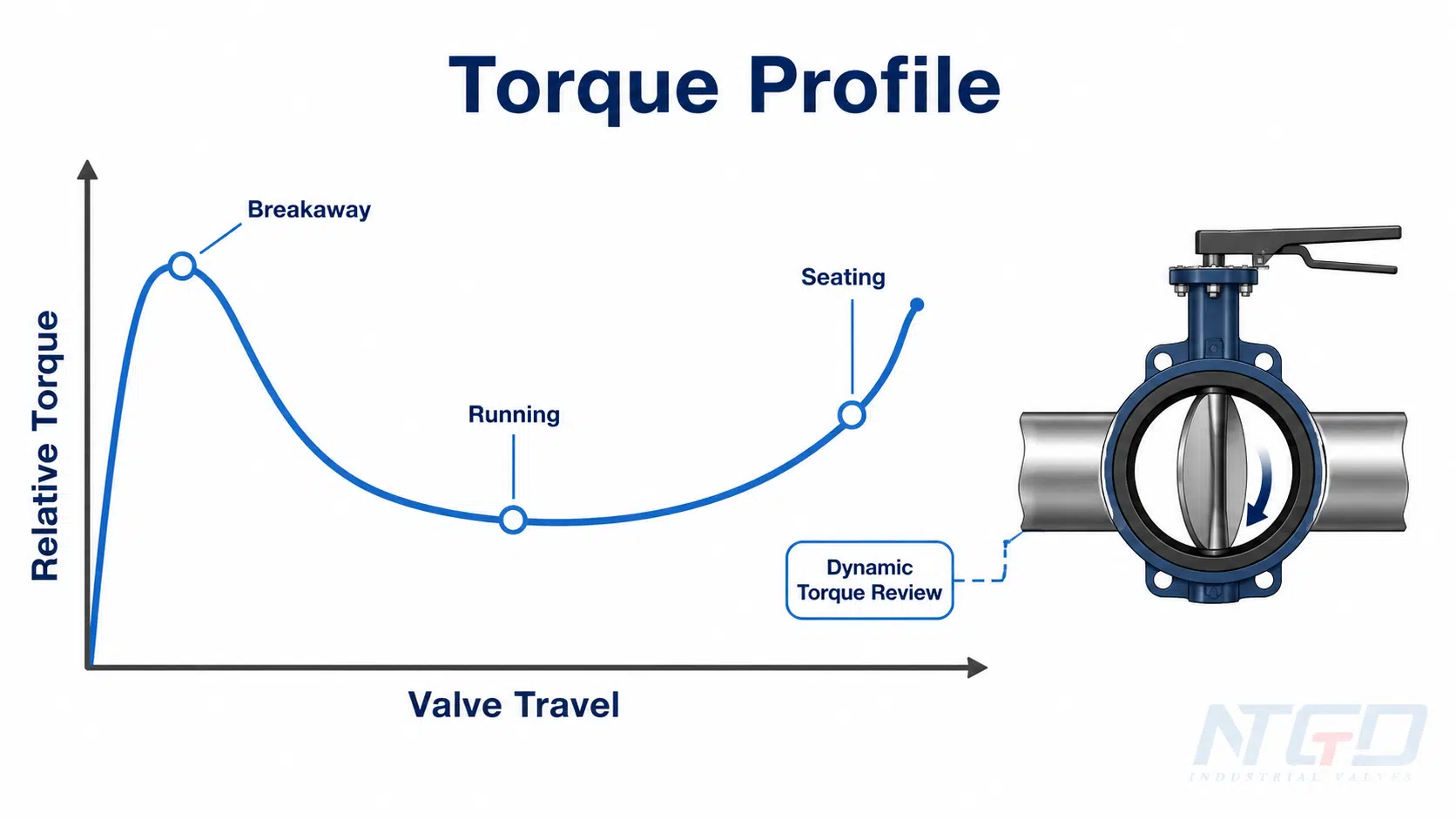
Par de funcionamiento
Running torque describes the torque required while the valve is already moving through its travel. It is useful, but it should not be the only sizing value. A valve that runs easily after movement begins may still need higher torque to break away from the seat or to close tightly.
Par dinámico derivado del flujo
Dynamic torque is generated by fluid force acting on the disc. It becomes more important when the valve operates under flow, in partially open positions, or in high-velocity service.
For modulating, throttling, high-velocity, large-diameter, or high-differential-pressure service, dynamic torque should be checked as a separate sizing risk. Ignoring it can make an actuator look adequate at the seat but overloaded during travel.
If dynamic torque is related to throttling duty or opening position, also review butterfly valve pressure drop and Cv, because flow resistance and opening angle can change the operating point that the actuator must handle.
Par de fricción del cojinete, el vástago y la empaquetadura
The shaft, bearings, bushings, packing, and stem seals also add resistance. These components may be influenced by material selection, temperature, corrosion, lubrication condition, service age, and manufacturing tolerances.
¿Qué valor de par se debe utilizar para el dimensionamiento del actuador?
The actuator should be selected against the highest credible torque demand for the required operating condition, with an appropriate service factor if the manufacturer’s chart or project specification requires one. The selected torque basis should be documented clearly: breakaway, seating, unseating, running, dynamic, or a manufacturer-defined maximum operating torque.
For on-off isolation service, start by confirming breakaway, seating, and unseating torque under the maximum expected pressure condition. For modulating, throttling, high-velocity, or large-diameter service, dynamic torque should be reviewed in addition to the seating and unseating values.
Factores que influyen en el par de la válvula de mariposa
Butterfly valve torque changes because the valve, media, and operating condition change. The following matrix can be used as a practical selection guide.
| Factor | How it affects torque | What to confirm before sizing |
|---|---|---|
| Tamaño de la válvula y diámetro del disco | Larger disc area usually increases torque demand | DN / NPS, valve series, disc design |
| Diferencial de presión | Higher differential pressure can increase seating, unseating, or dynamic torque | Maximum shutoff pressure and operating ΔP |
| Material del asiento | Softer, harder, reinforced, PTFE, elastomer, or metal seats behave differently | Seat material and shutoff requirement |
| Condición del soporte | Clean water, dry gas, powder, slurry, viscous fluid, or corrosive service may require different torque assumptions | Medium, solids content, viscosity, wet / dry condition, lubrication condition, corrosion risk |
| Temperatura | High or low temperature can affect seat behavior, friction, and packing | Minimum / maximum operating temperature |
| Tipo de diseño | Concentric, double offset, and triple offset valves have different torque profiles | Valve design and sealing mechanism |
| Tiempo de inactividad | A valve that remains closed for a long time may need higher breakaway torque | Operation frequency and long idle periods |
| Cycling frequency | Frequent operation may affect seat wear and actuator duty | Open / close cycles per day or month |
| Corrosion, scaling and deposits | Deposits can increase friction and prevent smooth movement | Media cleanliness, maintenance condition, cleaning cycle |
| Packing and bearing condition | Worn, dry, or tight components can increase friction | Valve age, packing design, bearing material |
Tamaño de la válvula y diámetro del disco
As valve size increases, the disc area and contact area generally increase. This is one reason large diameter butterfly valves usually require gear operators or automated actuators instead of simple lever handles.
Diferencial de presión a través de la válvula
Differential pressure is one of the most important inputs. A valve operating with low line pressure but high shutoff differential pressure can still require significant torque. The RFQ should clearly state the maximum differential pressure the valve may need to open or close against.
Material del asiento y hermeticidad del cierre
Seat design has a direct effect on torque. A resilient seat may create different seating and unseating behavior than a metal seat. Tight shutoff requirements may also increase the force needed to seat the disc properly. Seat material should therefore be included in the torque review.
Condiciones del fluido: agua, gas seco, polvo, lodo y fluidos viscosos
Torque charts are often based on defined test or reference conditions. If the actual medium is dry gas, powder, slurry, viscous fluid, or a non-lubricating service, the torque may differ from a chart based on clean water or lubricating conditions. This is why media details should be included in actuator sizing discussions.
In the RFQ, do not only write the fluid name. State whether the service is wet or dry, lubricating or non-lubricating, clean or particle-laden, corrosive, viscous, crystallizing, or prone to deposits.
Temperatura, corrosión, formación de incrustaciones y envejecimiento de los asientos
Temperature can change seal behavior and friction. Corrosion and scaling can increase resistance. Seat aging and long service periods can also change breakaway torque. These effects are not always visible in a simple torque chart, so they should be reviewed for difficult services.
Tipo de diseño: concéntrico, de doble desplazamiento y de triple desplazamiento
A concentric resilient seated butterfly valve, a double offset high-performance butterfly valve, and a triple offset metal seated butterfly valve do not have the same torque behavior. Offset geometry, seat type, shutoff mechanism, and pressure class can all influence the torque profile.
A torque chart for one butterfly valve design should not be used as a universal chart for all butterfly valve designs. The chart must match the selected valve series and sealing mechanism.
This article does not become a butterfly valve types guide, but design type must be considered during torque review.
For a broader comparison of concentric, double-offset, triple-offset, wafer, lug and flanged designs, use NTGD’s Guía de tipos de válvulas de mariposa as a design-selection reference before applying torque data.
Tiempo de inactividad y frecuencia de ciclos
A valve that is cycled frequently and a valve that remains closed for a long time may not require the same breakaway torque. Long standstill time can increase the risk of higher initial torque, especially when the media can dry, deposit, crystallize, or cause corrosion.
Infrequent operation or long idle periods should be reported during torque review, especially when the actuator must operate the valve after extended standby.
The first torque inputs to confirm are usually valve size, maximum differential pressure, seat material, and valve design type. Media condition, temperature, aging, scaling, and cycling frequency then help determine whether service factor, dynamic torque, or factory confirmation needs closer review.
Cálculo del par de una válvula de mariposa: marco y límites
Butterfly valve torque calculation is useful for preliminary selection, but it should not be treated as a universal answer. The torque coefficients, seat behavior, disc geometry, and service factors are design-specific.
Un marco de cálculo práctico
A practical butterfly valve torque calculation normally considers several components:
Estimated valve operating torque = seating / unseating torque + stem, bearing and packing friction torque + dynamic torque when flow conditions require it
This expression is a framework, not a universal formula. The final value should be checked against manufacturer data.
For early-stage selection, use this workflow:
| Paso | What to do | Output |
|---|---|---|
| 1. Define the operating case | Confirm maximum differential pressure, opening / closing condition, medium, temperature, and operating mode | The service condition for torque review |
| 2. Identify the torque basis | Decide whether breakaway, seating, unseating, running, dynamic, or maximum operating torque controls the selection | The torque value category to check |
| 3. Obtain reference data | Use manufacturer torque chart, preliminary supplier data, or a carefully limited similar-design estimate | A preliminary torque basis |
| 4. Apply the review boundary | Check whether service factor, media correction, dynamic torque, actuator output, or factory confirmation is required | A decision on whether the estimate can be used or must be confirmed |
This workflow supports preliminary actuator screening. It does not replace the confirmed torque value for the selected valve model.
Par de asiento, par de fricción y par dinámico
| Componente | Significado | Typical data source | Precaución |
|---|---|---|---|
| Seating / unseating torque | Torque related to disc and seat interaction | Manufacturer torque chart or test data | Strongly depends on seat design and pressure |
| Stem / bearing / packing friction | Torque from rotating components and sealing friction | Manufacturer design data | Can change with temperature, age and service condition |
| Dynamic torque | Torque from fluid force on the disc | Engineering review, manufacturer guidance, flow condition data | Important in high velocity or partially open operation |
| Factor de servicio | Margin applied for operating uncertainty | Project requirement, actuator supplier review, manufacturer guidance | Do not apply blindly if the chart already includes margin |
| Confirmed actuator torque | Final actuator output torque after review | Actuator data and valve supplier confirmation | Must match operating condition and fail-safe requirement |
Por qué una fórmula universal no es suficiente
A simple formula may show the relationship between diameter, pressure, and torque, but it cannot fully represent every seat material, disc design, bearing arrangement, shaft geometry, media condition, temperature, and operating history.
A generic estimate becomes especially weak when the valve is large, metal seated, exposed to dry gas, powder, slurry, high differential pressure, long standstill, or critical automated service. In those cases, the calculation should be replaced or corrected by manufacturer torque data, factory confirmation, or a defined testing review.
Estimación preliminar frente a datos definitivos de dimensionamiento del actuador
A calculation is useful when the project is still in the early selection stage. It can help compare manual, gear, pneumatic and electric operation. It can also help identify whether the application may need a larger actuator or more detailed torque confirmation.
However, final actuator sizing should be based on:
- manufacturer torque chart or confirmed engineering data;
- actual maximum differential pressure;
- actual medium and temperature;
- valve design and seat material;
- operating mode and cycle frequency;
- required fail position;
- actuator output torque under available air pressure or power supply;
- project safety and reliability requirements.
Cuando un cálculo deba sustituirse por datos del fabricante o por resultados de pruebas
A calculation should not be the only basis when the valve is large, automated, high pressure, metal seated, used in dry gas or slurry service, installed in a critical shutdown line, or expected to operate after long standstill periods. In these cases, manufacturer confirmation or torque testing may be required before final actuator selection.
Cómo leer una tabla de torque para válvulas de mariposa
A butterfly valve torque chart is usually a product-specific table. It may list torque values by valve size, pressure differential, seat material, valve series, pressure class, or service condition.
The main risk is using the chart without reading the assumptions.
Lo que suele mostrar una tabla de par de apriete de una válvula de mariposa
A typical chart may include:
- valve size or DN / NPS;
- pressure differential or shutoff pressure;
- material del asiento;
- wet or dry service condition;
- torque units;
- valve series or design type;
- whether the value is seating, unseating, running, or maximum operating torque;
- whether a safety factor is already included;
- whether dynamic torque is included or excluded.
Many torque charts are built around stated reference assumptions. If a chart does not clearly state the reference medium, temperature, valve condition, seat material, safety factor treatment, and whether dynamic torque is included, it should be used only for preliminary comparison, not as the final actuator sizing basis.
Tabla de interpretación de gráficos
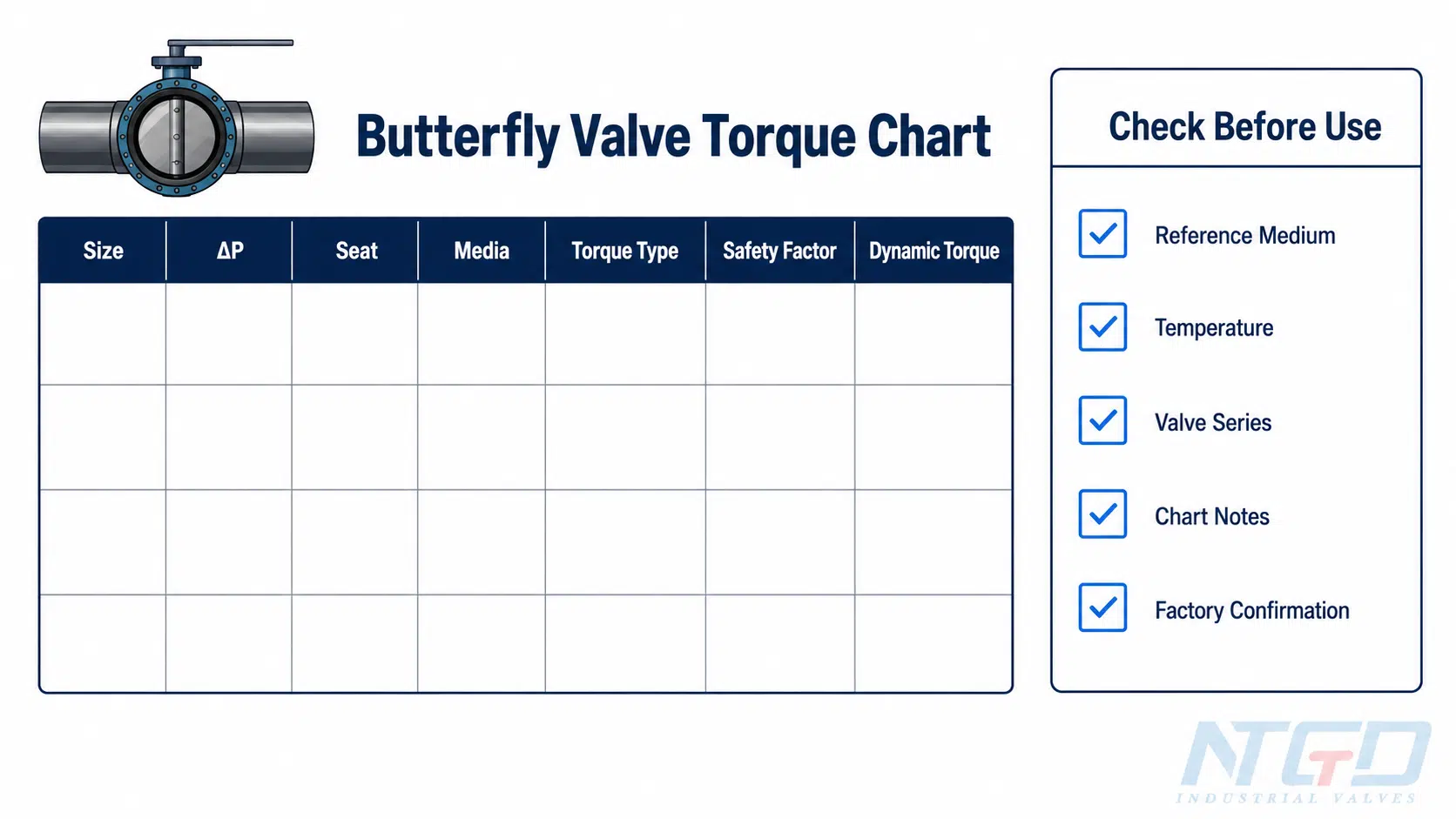
| Campo de gráfico | Qué significa | What to verify before use |
|---|---|---|
| Tamaño de la válvula / DN / NPS | Diámetro nominal de la válvula | Confirm exact valve series and pressure class |
| Diferencial de presión | Pressure the valve opens or closes against | Use maximum expected ΔP, not only normal line pressure |
| Material del asiento | Material or sealing design used in the chart | Confirm actual seat material in the ordered valve |
| Wet / dry service | Reference media condition | Check if actual media is dry gas, powder, slurry, viscous, corrosive, or non-lubricating |
| Unidad de par | Nm, in-lb, ft-lb or other unit | Convert correctly before actuator sizing |
| Torque type | Seating, unseating, breakaway, running or maximum torque | Use the correct torque basis for the actuator |
| Safety factor note | Whether margin is already included | Avoid both under-sizing and double-counting margin |
| Dynamic torque note | Whether flow-induced torque is included | Review high velocity, throttling or partially open service |
| Valve series | Specific product design | Do not use another manufacturer’s chart directly |
| Application note | Conditions or exclusions | Follow manufacturer confirmation for special service |
¿La tabla incluye el factor de seguridad?
Do not assume that a butterfly valve torque chart already includes a safety factor. Some charts may include a margin for actuator sizing, while others may show base valve torque only. The difference matters. If a service factor is added twice, the actuator may be oversized. If no margin is added where required, the actuator may be undersized.
Only follow a safety factor assumption when the chart notes, manufacturer datasheet, or supplier confirmation clearly states how the value should be used.
¿El gráfico incluye el par dinámico?
Do not assume that dynamic torque is included in a standard seating or unseating torque chart. Some charts focus on seating and unseating torque, while flow-induced torque may be separate.
Control service, throttling service, high flow velocity, large diameter valves, and high differential pressure conditions should be reviewed for dynamic torque before final actuator sizing.
Por qué no se debe reutilizar directamente el gráfico de otro fabricante
A torque chart belongs to a specific valve design. A chart from another manufacturer may be based on a different disc geometry, shaft design, seat material, pressure condition, testing method, or safety factor. It can be useful for rough comparison, but it should not be used as the final basis for selecting an actuator for a different valve.
Tabla de par vs. calculadora de par vs. confirmación final de fábrica
A torque chart provides manufacturer data for a specific valve range. A torque calculator may provide a preliminary estimate. Factory confirmation connects the selected valve, actuator, and service conditions.
For procurement, the final decision should be based on the actual valve design and operating data, not only a generic calculation or third-party chart.
Dimensionamiento del actuador a partir del par de la válvula de mariposa
Actuator sizing starts with the required valve torque, but it does not stop there. The actuator must deliver enough output torque under the actual available power or air supply, in the required direction, through the required operating range, and under the specified service condition.
A practical sizing decision chain is:
| Paso | Decision point | Qué hay que confirmar |
|---|---|---|
| 1. Confirm valve torque basis | Identify the maximum valve torque under the worst expected service condition | Breakaway, seating, unseating, dynamic or maximum operating torque |
| 2. Confirm actuator minimum output | Check output torque under real site air pressure or power supply | Pneumatic air supply, electric actuator torque, gear ratio or manual effort |
| 3. Compare with required margin | Match actuator output to required valve torque and any required service factor | Do not double-count chart margin |
| 4. Verify fail-safe and full-stroke needs | Check emergency, spring return, fail-open / fail-close and full-stroke torque | Confirm actuator performance through the complete operation |
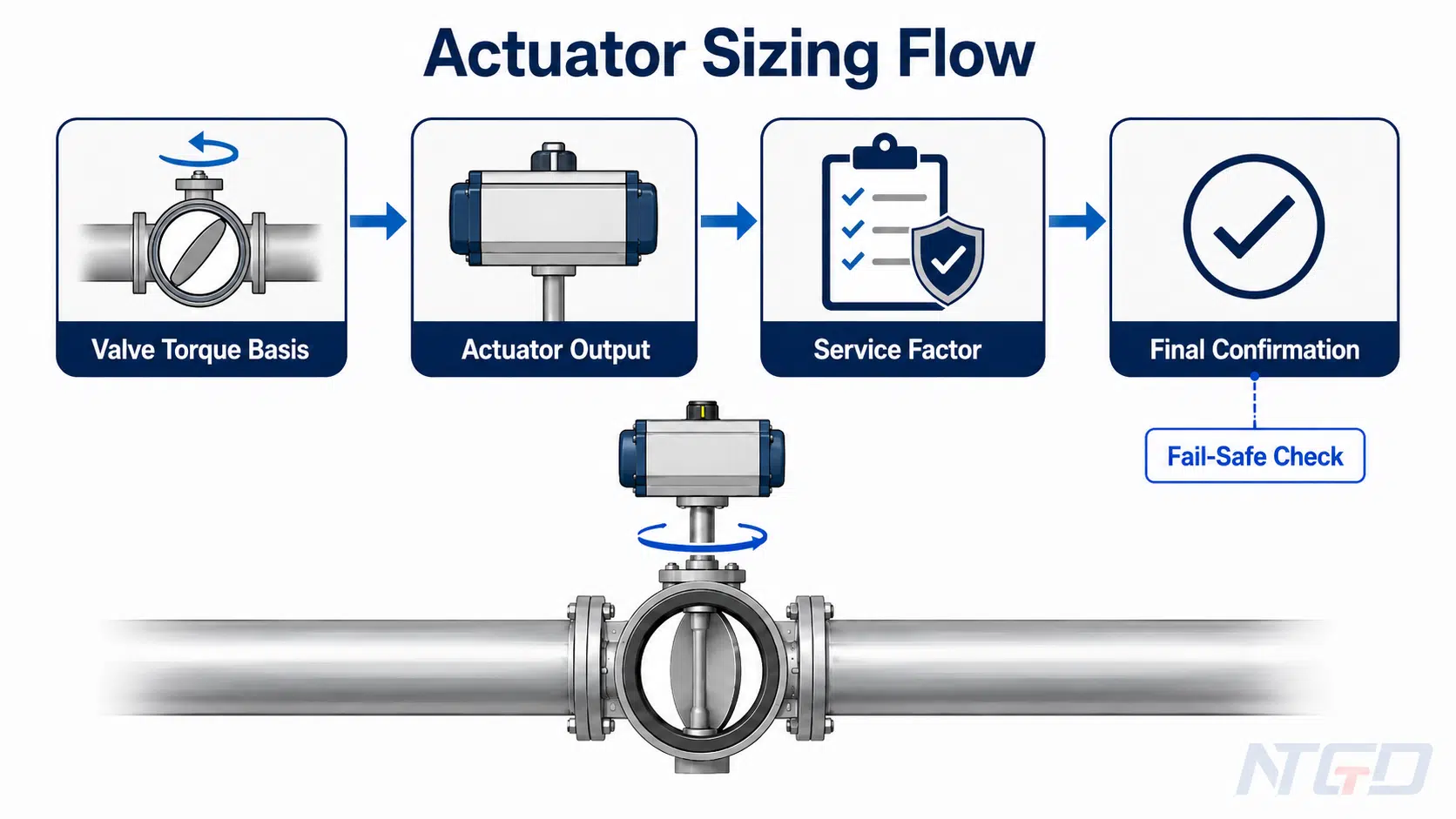
When valve and actuator interfaces must be standardized, ISO 5211:2026 provides requirements for part-turn actuator attachments to industrial valves, including flange/interface dimensions and reference torque values for interface components.
Par de la válvula frente al par de salida del actuador
Valve torque is the torque required to move the valve. Actuator output torque is the torque the actuator can provide. These two values must be compared under realistic conditions.
For pneumatic actuators, output torque depends on available air pressure and actuator design. For electric actuators, output torque depends on motor, gearing, duty and control settings. For gear operators, handwheel effort and gearbox ratio affect manual operation.
Factor de servicio y factor de seguridad
A service factor may be required to account for friction variation, pressure changes, seat aging, deposits, media effects, or operation after long standstill. The correct factor depends on the application and the manufacturer’s sizing method.
The key rule is not “always add the same factor.” The key rule is: check whether the valve torque chart already includes margin and then size the actuator according to the confirmed valve torque and project requirement.
Consideraciones para el dimensionamiento de actuadores neumáticos
For pneumatic butterfly valves, confirm:
- presión de suministro de aire disponible;
- spring return or double acting design;
- fail-open or fail-close position;
- torque output at the weakest part of the stroke;
- valve breakaway and seating torque;
- frecuencia del ciclo;
- emergency operating conditions.
A pneumatic actuator may appear adequate at one air pressure but become undersized if the actual site air pressure is lower.
For pneumatic packages, the valve torque review should be paired with the application limits described in NTGD’s válvula de mariposa neumática guía.
Consideraciones para el dimensionamiento de actuadores eléctricos
For electric actuated butterfly valves, confirm:
- required output torque;
- operating speed;
- ciclo de trabajo;
- power supply;
- señal de control;
- seating torque limit;
- requisito de control manual;
- environmental condition.
An electric actuator should be matched to the valve torque and service duty, not selected only by valve size.
For electric automation, the same torque basis should be checked against actuator output, duty and control requirements before selecting an válvula de mariposa de accionamiento eléctrico package.
Límites del operador de engranajes y del funcionamiento manual
A gear operator is often used when the torque is too high for comfortable lever operation. The gearbox reduces manual effort, but it also adds travel time and mechanical complexity. For large valves or high torque service, manual operation should be reviewed carefully for operator safety and practicality.
Condiciones de funcionamiento de apertura en caso de falla, cierre en caso de falla y emergencia
Fail-safe requirements can change actuator sizing. A spring return actuator must provide enough torque in the required fail direction. Emergency shutdown applications may require additional review because the valve must operate reliably even under abnormal conditions.
Errores comunes en el dimensionamiento de actuadores
Most actuator sizing mistakes do not come from arithmetic alone. They come from using the right-looking torque value under the wrong service condition.
| Error | Riesgo | Better approach |
|---|---|---|
| Selecting actuator only by valve size | May ignore pressure, seat and media effects | Use confirmed torque data |
| Using running torque instead of breakaway or seating torque | Actuator may fail at start or close | Review all relevant torque types |
| Ignoring dry gas, slurry or deposits | Field torque may exceed estimate | Include media condition in RFQ |
| Ignoring dynamic torque in throttling, high-velocity or large-diameter service | Actuator may overload during travel | Request dynamic torque review or manufacturer confirmation |
| Applying safety factor without checking chart notes | May oversize actuator | Check whether margin is already included |
| Using another brand’s torque chart | Data may not match valve design | Use manufacturer-specific data |
| Sin tener en cuenta la presión de suministro de aire | Pneumatic actuator may underperform | Confirm minimum site air pressure |
| Treating calculator output as final | May miss design-specific factors | Use calculator only for preliminary review |
Par estimado frente a par confirmado
Torque estimation is useful, but confirmed torque is what should guide the final valve and actuator package.

Tabla de par de apriete del fabricante
The manufacturer torque chart is usually the first formal reference for valve torque. It should match the valve series, size, pressure, seat material, and service condition. If the chart assumptions do not match the project, the supplier should confirm the correct value.
Factory confirmation
Factory confirmation is important when the application is large, automated, critical, high pressure, high temperature, abrasive, corrosive, dry, or infrequently operated. The confirmation should state the valve torque basis and the actuator output basis.
Torque testing and measurement
For critical applications, torque testing or factory testing may be required. The test method, pressure condition, media or test fluid, direction of operation, and acceptance criteria should be defined before ordering.
Critical applications may also require written confirmation of test conditions, differential pressure, operating direction, acceptance criteria, and documentation requirements before the valve-actuator package is released for procurement.
This V2 article does not claim a specific testing method or standard requirement. Those details should be verified in the evidence and standards stage before publication.
Field conditions that may increase torque
Field torque may rise because of:
- deposits or scaling;
- corrosion;
- seat aging;
- dry service;
- temperature variation;
- damaged packing or bearings;
- long idle periods;
- misalignment or installation stress;
- operation under higher-than-expected differential pressure.
These conditions should be reviewed during maintenance planning and actuator selection.
How to document torque assumptions before procurement
Before procurement, document the assumptions used for actuator sizing:
| Assumption | Por qué es importante |
|---|---|
| Valve size and design | Defines basic geometry and torque profile |
| Presión diferencial máxima | Defines worst operating condition |
| Material del asiento | Influences seating and unseating torque |
| Medios y temperatura | Influences friction and service factor |
| Frecuencia de funcionamiento | Affects duty and standstill risk |
| Posición de fallo | Affects actuator direction and spring sizing |
| Torque chart source | Confirms data is manufacturer-specific |
| Factor de seguridad / servicio | Prevents hidden under-sizing or double-counting |
| Requisitos de prueba | Supports final acceptance and documentation |
RFQ Data Checklist for Butterfly Valve Torque and Actuator Sizing
A clear RFQ helps the valve supplier and actuator supplier confirm the correct torque basis. The following checklist can be used before requesting a valve-actuator package.
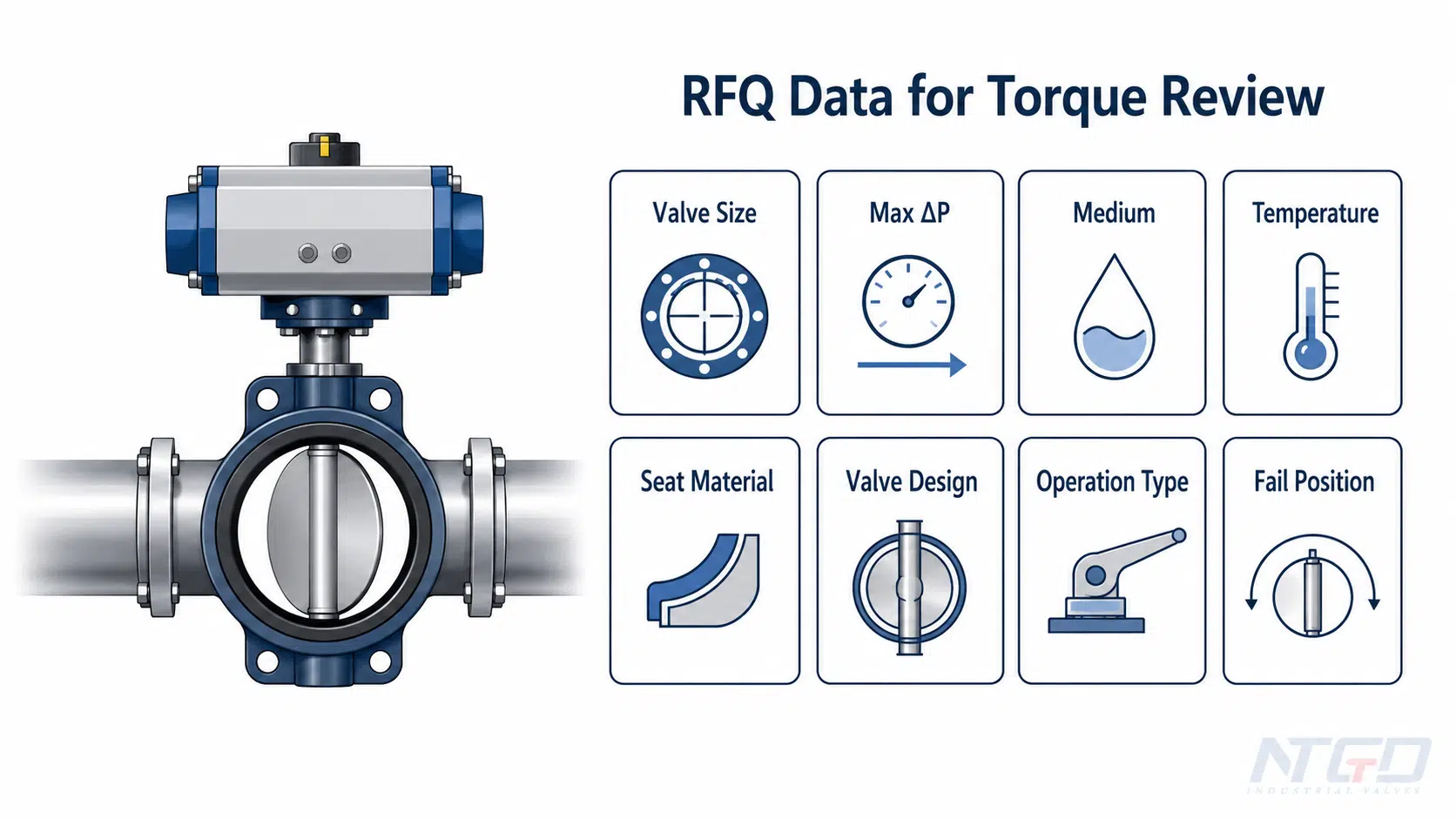
| Partida de la solicitud de cotización | Qué hay que presentar | Por qué es importante |
|---|---|---|
| Tamaño de la válvula | DN / NPS | Defines disc size and chart range |
| Clase de presión / clasificación | Class, PN or project pressure rating | Supports pressure boundary and design selection |
| Presión diferencial máxima | Highest ΔP during opening, closing or shutoff | Critical for torque and actuator sizing |
| Medio | Water, gas, steam, slurry, powder, chemical, viscous fluid, etc.; state whether it is lubricating or non-lubricating, wet or dry, clean or particle-laden | Media condition affects torque |
| Temperatura | Minimum, normal and maximum operating temperature | Affects seat, packing and friction |
| Material del asiento | EPDM, NBR, PTFE, metal seat or other material | Strong influence on seating torque |
| Diseño de válvulas | Concentric, double offset, triple offset, resilient seated, metal seated | Design changes torque profile |
| Tipo de operación | Manual, gear, pneumatic, electric, hydraulic, motorized | Determines torque output requirement |
| Cycling frequency | Frequent, occasional, emergency only, long standstill | Affects breakaway and duty |
| Posición de fallo | Fail open, fail close, fail last position | Critical for spring return actuator sizing |
| Available air supply / power | Site air pressure or electrical supply | Determines actual actuator output |
| Control mode | On-off, modulating, throttling, emergency shutdown | Dynamic torque and duty may differ |
| Requisitos de prueba | Pressure test, functional test, torque confirmation, inspection record | Supports acceptance and documentation |
| Documentation needs | Datasheet, torque confirmation, drawing, certificate, tag data | Helps purchasing and engineering review |
The more complete the RFQ data, the lower the risk of actuator under-sizing, over-sizing, or late-stage rework.
FAQ About Butterfly Valve Torque
¿Cómo se calcula el par de apriete de una válvula de mariposa?
Start by defining the service case: valve size, maximum differential pressure, medium, temperature, opening / closing condition, and operating mode. Then identify the torque basis, such as breakaway, seating, unseating, running, or dynamic torque. Use manufacturer torque data or a preliminary supplier estimate, and treat the result as a screening value until the selected valve and actuator are confirmed.
¿Existe una fórmula que permita calcular todos los valores de par de las válvulas de mariposa?
No. Una fórmula puede servir para una selección inicial, pero no puede determinar el dimensionamiento definitivo del actuador para todos los diseños de válvulas de mariposa. El material del asiento, la geometría del disco, el diseño del eje, la presión diferencial, las condiciones del fluido, la temperatura, el tiempo de inactividad y los supuestos de las tablas influyen en el valor final del par.
¿Cuál es la diferencia entre el par de desprendimiento y el par de funcionamiento?
El par de arranque es el par necesario para iniciar el movimiento del disco, generalmente desde la posición cerrada o asentada. El par de funcionamiento es el par necesario una vez que el disco ya está en movimiento. Para el dimensionamiento del actuador, el par de arranque o de asentamiento puede ser más crítico que el par de funcionamiento, especialmente en servicio de todo o nada.
¿Qué factores influyen en el par de apriete de una válvula de mariposa?
Los factores principales son el tamaño de la válvula, la presión diferencial máxima, el material del asiento, las condiciones del fluido, la temperatura, el tipo de diseño de la válvula, el tiempo de inactividad y la frecuencia de ciclo. En el caso de aplicaciones difíciles, se debe informar sobre la presencia de gas seco, lodos, polvo, corrosión, incrustaciones o largos períodos de inactividad antes de confirmar el dimensionamiento del actuador.
¿La tabla de par de apriete de una válvula de mariposa incluye un factor de seguridad?
No des por sentado que se incluye el factor de seguridad a menos que las notas de la tabla lo indiquen claramente. Es posible que algunas tablas ya incluyan un margen de dimensionamiento, mientras que otras solo muestren el par de apriete básico de la válvula. Lee las notas de la tabla antes de agregar cualquier factor de servicio adicional.
¿Puedo usar la tabla de torque de otro fabricante?
Las tablas de otros fabricantes solo pueden utilizarse como referencia aproximada. No deben servir como base definitiva para el dimensionamiento, ya que el diseño del disco, el diseño del eje, el material del asiento, las condiciones de presión y los supuestos de las tablas pueden diferir significativamente de los de la válvula seleccionada.
¿Cuánto par de giro se necesita para abrir una válvula de mariposa de 16 pulgadas?
El valor del par de una válvula de mariposa de 16 pulgadas no se puede determinar solo a partir de su tamaño. También se necesita conocer el diseño de la válvula, el diferencial de presión, el material del asiento, el medio, la temperatura, el modo de operación, los supuestos de la tabla y el tipo de actuador. Para este rango de tamaños, a menudo es necesario revisar el funcionamiento por engranajes o la accionamiento automatizado, en lugar de suponer un simple funcionamiento por palanca.
¿Qué datos se necesitan para dimensionar un actuador?
Como mínimo, indique el tamaño de la válvula, la clase de presión, la presión diferencial máxima, el medio, la temperatura, el material del asiento, el diseño de la válvula, el tipo de accionamiento, la frecuencia de ciclo, la posición de falla y la fuente de alimentación de aire o eléctrica disponible.
¿El par de apriete de una válvula de mariposa es el mismo que el de los pernos de una brida?
No. El par de apriete de una válvula de mariposa se refiere a la fuerza de giro necesaria para accionar el disco de la válvula. El par de apriete de los pernos de brida se refiere al apriete de los pernos durante la instalación. Son valores de ingeniería distintos y no deben confundirse.
¿Cuándo se debe verificar el par motor mediante pruebas de fábrica?
Se debe considerar la confirmación o prueba del par de apriete en el caso de válvulas grandes, servicios de cierre crítico, sistemas automatizados, alta presión diferencial, válvulas con asiento metálico, gas seco, lodos, medios corrosivos, servicio con largos períodos de inactividad o aplicaciones en las que una falla del actuador podría generar un riesgo grave para el proceso.
¿Es suficiente una calculadora de torque para elegir un actuador?
Una calculadora de par puede servir para una evaluación preliminar, pero no es suficiente para la selección definitiva del actuador. La selección definitiva debe confirmarse con los datos del fabricante, las condiciones reales de servicio y la información sobre el rendimiento del actuador.
Conclusión
Butterfly valve torque is a practical engineering value used to connect the valve design, service condition and actuator selection. It is not a fixed value based only on valve size. Breakaway torque, seating torque, running torque, dynamic torque and friction torque can all influence the final operating requirement.
A torque calculation can support early selection, and a torque chart can help interpret manufacturer data. However, final actuator sizing should be based on the specific valve series, seat material, pressure differential, media, temperature, operating frequency and fail-safe requirement.
For B2B valve procurement, the safest approach is:
- define the service conditions and maximum differential pressure;
- obtain manufacturer-specific torque data or a confirmed preliminary estimate;
- match actuator output with required valve torque, service factor, fail-safe function and verification needs.
This process reduces the risk of under-sized actuators, unnecessary over-sizing, and late-stage changes after the valve and actuator have already been selected.
Soporte técnico para aplicaciones y especificaciones
For butterfly valve actuator sizing, provide the RFQ data listed above before the valve-actuator package is selected. NTGD can use the service conditions to review the torque basis, check actuator output margin, recommend a suitable operation method, and flag service conditions that may require additional torque confirmation.
