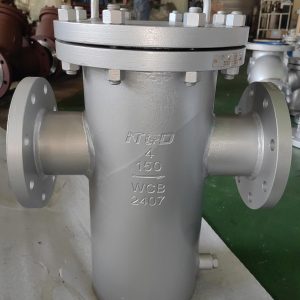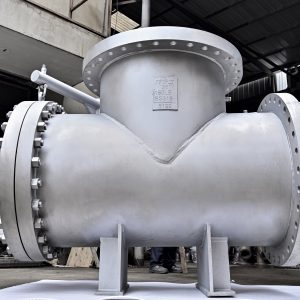

Standard Series vs Custom Engineering Capability
Standard Series
Pressure Class: ANSI Class 150 / 300 / 600 (Flanged)
Design Standard: ASME B16.34
Flange Standard: ASME B16.5 (up to NPS 24) / ASME B16.47 (for larger sizes upon request)
Test / Inspection: API 598
Typical Materials: WCB / CF8 / CF8M
Temperature Range: Depends on material and service conditions (to be confirmed during quotation).
Construction: Y Pattern, Bolted Bonnet, Removable Perforated or Mesh-Lined Screen
Installation: Horizontal (screen leg down is recommended). Vertical installation is possible but must be confirmed based on flow direction and debris behavior to ensure debris collects properly in the leg and does not re-enter the pipeline.
If vertical installation is required, please confirm flow direction and service debris characteristics with our engineering team before installation.
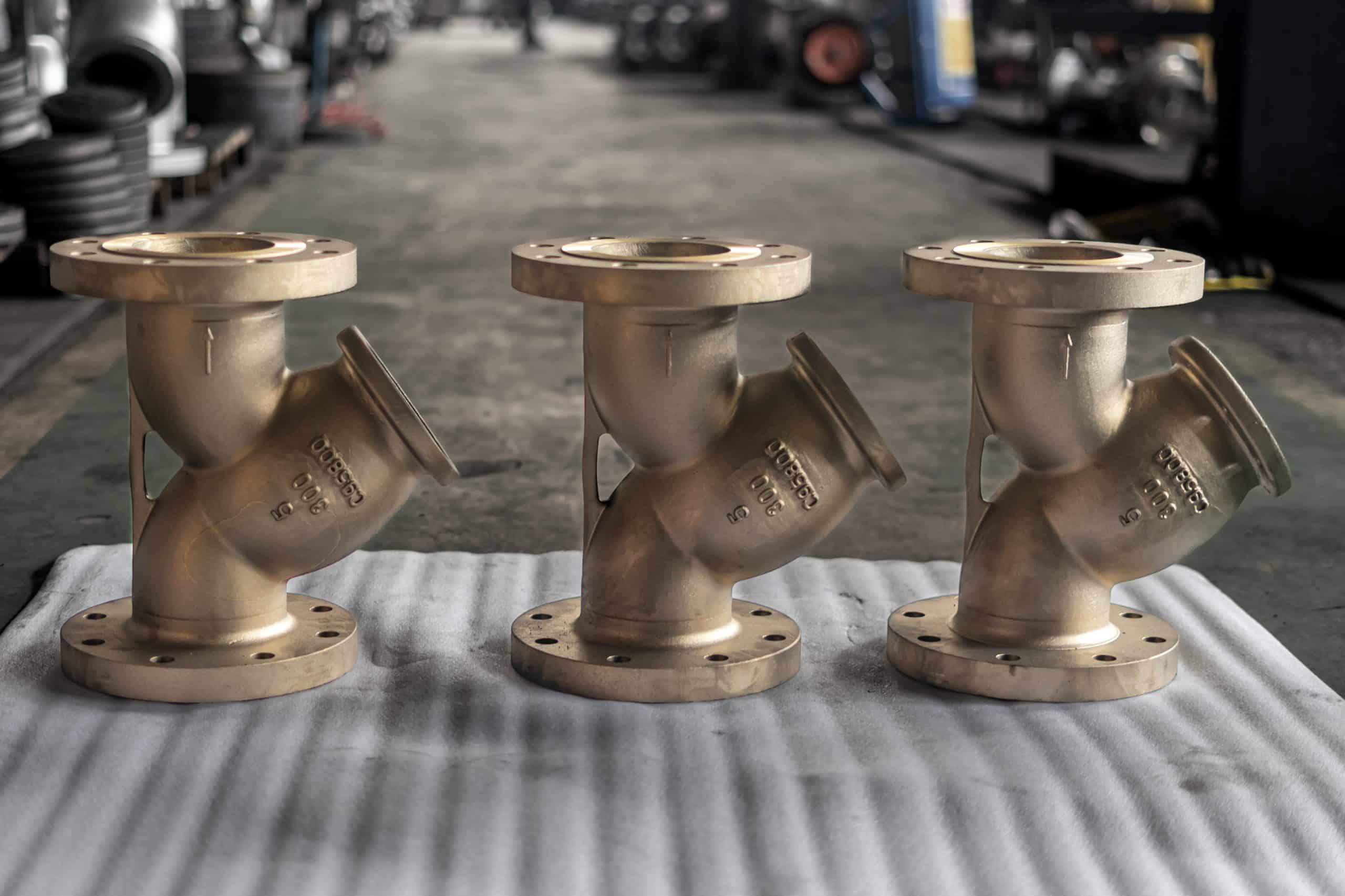
Engineered / Custom Options
Larger sizes up to NPS 32
Special alloys (Duplex, Super Duplex, chrome-moly, etc.)
Blow-off connection for in-line cleaning
Differential pressure (DP) tapping ports
Custom end connections (Butt Weld, Threaded, etc.)
For pricing and technical confirmation, Request a Quote.
For detailed dimensions and material data, Download the Y Strainer Catalogue (PDF).
Y Strainer vs Basket Strainer vs T-Type Strainer
| Feature | Y Strainer | Basket Strainer | T-Type Strainer |
| Installation Footprint | Compact, inline | Larger, top-entry | Straight-through layout |
| Dirt-Holding Capacity | Low–Medium | High | Medium |
| Cleaning Frequency | More frequent | Less frequent | Moderate |
| Typical Application | Steam, high-pressure lines, space-limited systems | High flow, high debris load | Straight piping configurations |
| Orientation | Horizontal (leg down) / Vertical (subject to confirmation) | Horizontal only | Horizontal / Vertical |
See also:
→ Basket Strainer
→ T-Type Strainer
→ Strainer Selection Hub
60-Second Selection Guide
Choose a Y Strainer when:
-
Installation space is limited
-
Steam or high-pressure service is involved
-
Debris load is low to moderate
-
Inline compact design is preferred
Choose a Basket Strainer when:
-
High flow rate and high dirt-holding capacity are required
-
Reduced cleaning frequency is important
Choose a T-Type Strainer when:
-
Straight-through piping layout is preferred
RFQ Checklist – Get an Accurate Quote
To help us provide correct sizing and quotation, please include:
-
Line size (e.g., NPS 4″ / DN100)
-
Pressure class or design pressure (e.g., Class 300)
-
Media and temperature (e.g., saturated steam, 250°C)
-
Required filtration (e.g., 40 mesh / 1.0 mm perforation)
-
End connection type (RF / BW / Threaded)
-
Body and screen material (e.g., WCB body + 316 screen)
-
Optional features (blow-off, DP taps, special alloy, etc.)
Not sure about some details? Submit what you have—our engineering team will follow up with sizing support.
Documentation available: EN 10204 3.1/3.2 MTR, hydro test report, inspection records (upon request).
What is a Y Strainer?
A Y strainer is a pressure-rated pipeline filtration device designed to remove solid debris from steam, gas, and liquid lines. It protects downstream equipment such as pumps, control valves, steam traps, flow meters, regulators, and instrumentation from clogging, erosion, and premature wear.
The device consists of:
-
Pressure-containing body
-
Removable perforated or mesh screen
-
Bolted cap or cover
-
Optional blow-off port
Unlike basket strainers, Y strainers offer a compact inline configuration suitable for space-constrained installations.
How Does a Y Strainer Work?
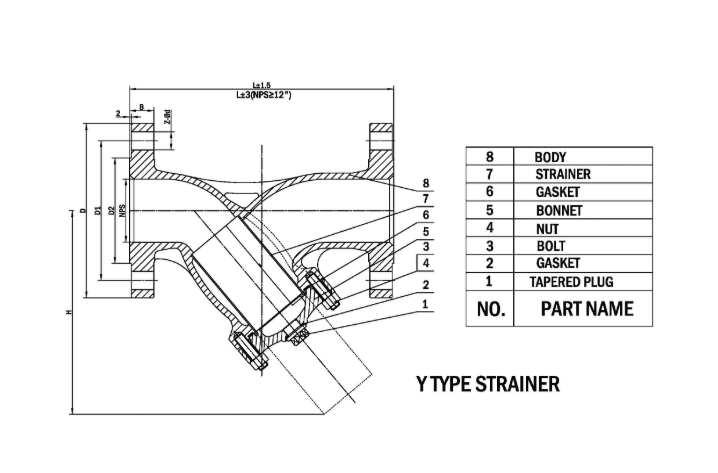
Fluid enters the strainer body and passes through the perforated or mesh-lined screen. Solid particles larger than the screen openings are retained inside the screen chamber.
Clean fluid exits the outlet while debris accumulates in the leg section.
As debris builds up, differential pressure (ΔP) increases. Cleaning is typically recommended when ΔP reaches 5–15 psi depending on system requirements.
Common Y Strainer Selection & Installation Mistakes to Avoid
❌ Installing the screen leg upward – debris must collect downward.
✅ Screen leg down is recommended for most horizontal installations.
-
Choosing too coarse mesh to reduce pressure drop – may allow damaging particles downstream.
-
Ignoring material compatibility in high-temperature steam service.
-
Failing to install isolation valves for safe maintenance.
Mesh / Perforation Selection Reference
| Mesh Size | Micron Rating | Typical Application |
| 20 mesh | ~840 μm | Large debris, general water service |
| 40 mesh | ~420 μm | Standard pump & steam protection |
| 60 mesh | ~250 μm | Light chemical / compressed air |
| 100 mesh | ~149 μm | Instrument protection |
| 200 mesh | ~74 μm | Fine filtration applications |
If you provide particle size or downstream equipment tolerance, we can recommend the most appropriate screen specification.
Typical Applications
Y strainers are widely used in:
-
Steam systems
-
Cooling water lines
-
Natural gas pipelines
-
Chemical processing
-
Compressed air systems
They are considered the standard filtration solution for steam applications due to their compact, pressure-rated design.
Installation & Maintenance Guidelines
-
Install horizontally with the leg pointing downward
-
Vertical installation must be confirmed based on flow direction and debris behavior
-
Install upstream and downstream isolation valves
-
Monitor differential pressure regularly
Always fully depressurize before removing the cap.
FAQ
What is a Y strainer used for?
To remove debris from steam, liquid, and gas pipelines and protect downstream equipment.
Y strainer vs basket strainer – how do I choose?
Choose Y for compact, high-pressure, space-limited systems. Choose basket for higher dirt capacity and reduced cleaning frequency.
Can a Y strainer be installed vertically?
Yes, but installation must be confirmed based on flow direction and debris behavior to ensure proper debris collection.
How do I select mesh size?
Mesh depends on particle size and downstream equipment sensitivity. Provide system details for accurate recommendation.
When should I clean a Y strainer?
When differential pressure reaches 5–15 psi depending on system design.
Can you provide MTR and hydro test reports?
Yes. EN 10204 material certifications and inspection records are available upon request.
Summary
A properly sized Y strainer ensures reliable protection of steam and industrial pipeline systems while minimizing downtime and maintenance risk.
Our engineering team can review your system parameters and recommend the optimal screen specification and configuration.
For pricing and technical confirmation, please submit your application details below. Our engineering team will review and respond promptly.
Explore more Industrial Valve Products including ball valves, gate valves, steam traps, and more.