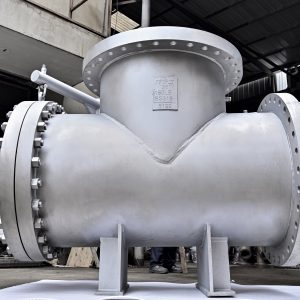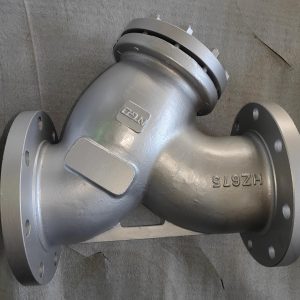

Basket Strainer | ASME Flanged Design | Standard & Custom Series | NTGD Valve
ISO documentation, MTRs, hydro test reports and inspection records can be provided upon request. 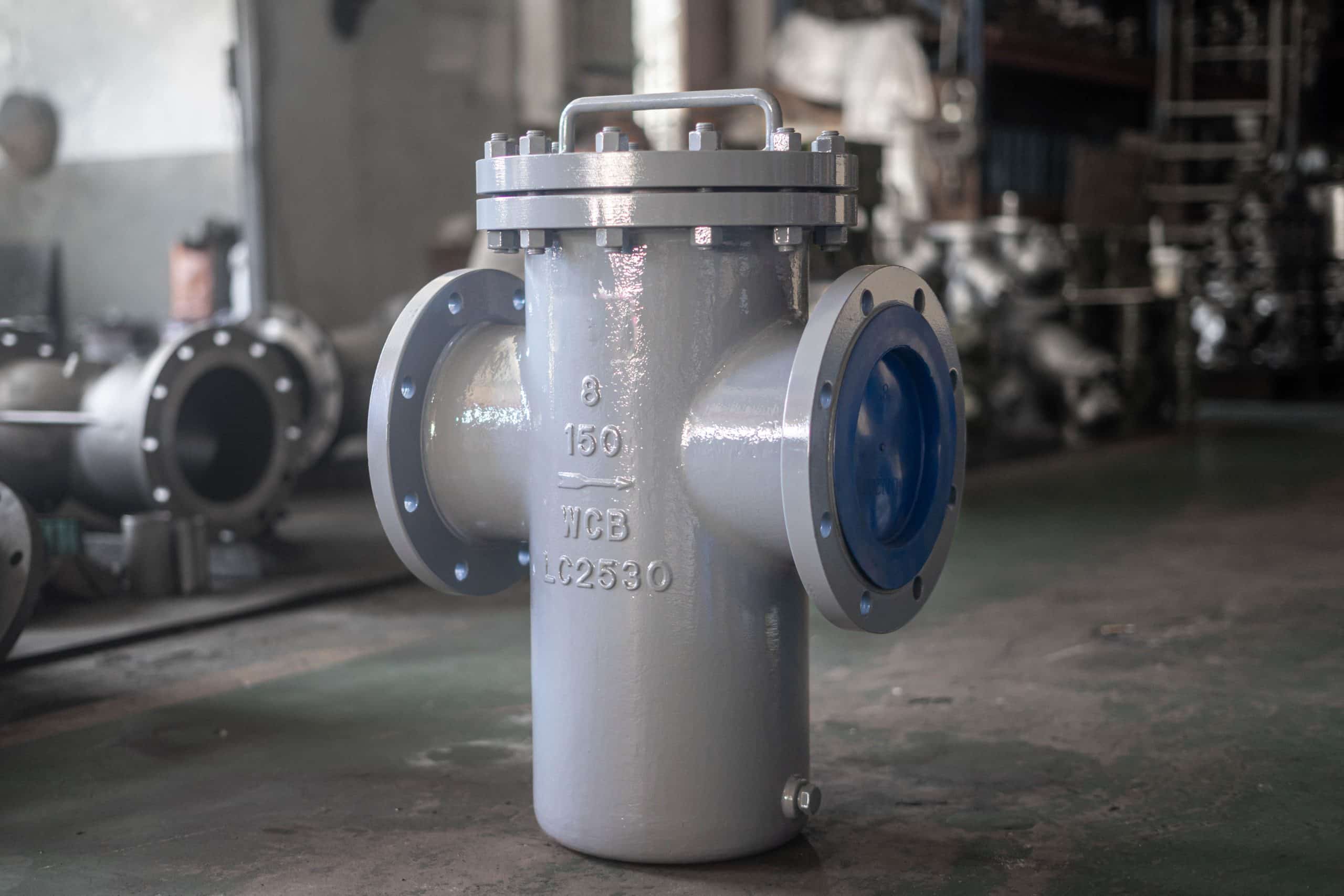
Basket Strainer Overview: Definition, Uses and Main Components
A basket strainer is one of the most widely used filtration devices in industrial strainer systems.
An industrial basket strainer serves as the first line of defense for pumps, control valves, heat exchangers, and other critical equipment by removing solid contaminants from process fluids.
This section explains what a basket strainer is, how its core components function, where it is used in industrial systems, and how it differs from finer filtration devices. The goal is to provide a clear engineering foundation before moving into working principles, selection guidance, and detailed design considerations later in this page.
NTGD Valve manufactures ASME B16.34 compliant industrial basket strainers for global projects, including both standard Class 150 / 300 series and application-specific custom designs.
What Is a Basket Strainer?
A basket strainer is a pressure-containing pipeline device designed to remove solid contaminants from process fluids by capturing debris inside a removable, basket-shaped filtration element.
In industrial piping systems, a basket strainer is used as a primary filtration device to protect downstream equipment from solid particles. In most engineering contexts, a basket strainer refers to a top-entry, pressure-rated basket strainer with a removable basket element designed for coarse to medium filtration.
An industrial basket strainer is typically installed upstream of critical equipment such as centrifugal pumps, control valves, flow meters, spray nozzles, and shell-and-tube heat exchangers to prevent damage caused by debris.
Without proper straining, contaminants such as weld slag, rust, scale, sand, and process solids can:
- Damage pump impellers and valve sealing surfaces
- Block instrumentation and small orifices
- Accelerate wear in heat exchangers and rotating equipment
- Lead to unplanned shutdowns and increased maintenance cost
Basket strainers are engineered to intercept these solids before they enter sensitive equipment, improving system reliability and extending service life.
In engineering documentation, this device may also be referred to as a basket type strainer or basket strainer valve, particularly in P&ID drawings and procurement specifications.
Main Components of a Basket Strainer
The main components of a basket strainer determine its filtration performance, pressure integrity, and maintenance accessibility in industrial piping systems:
- Pressure-Rated Housing / Body
The main pressure-containing structure, designed in accordance with ASME B16.34. It defines the allowable pressure-temperature rating and ensures safe operation under system conditions. - Removable Basket Element
The primary filtration component, typically constructed with perforated plate or mesh-lined support. It captures solid particles and determines filtration level based on perforation size or mesh rating. - Positive Sealing Arrangement
A gasketed sealing interface that ensures all process fluid passes through the basket. Proper sealing prevents bypass, which would otherwise allow unfiltered contaminants to pass downstream. - Bolted Bonnet or Quick-Opening Cover
Provides top-entry access for inspection, cleaning, and replacement of the basket. Quick-opening designs are often used in systems requiring frequent maintenance. - Inlet and Outlet Connections
Usually flanged (ASME B16.5), allowing integration into standard piping systems and ensuring compatibility with upstream and downstream equipment.
Engineering insight:
Filtration performance is not determined by the basket alone. The interaction between basket surface area, sealing integrity, and housing design directly affects pressure drop, dirt-holding capacity, and maintenance frequency.
What Is an Industrial Basket Strainer Used For?
An industrial basket strainer is used to provide reliable removal of solid contaminants in piping systems where flow rates are high and debris loading is moderate to heavy.
Typical functions include:
- Protection of Critical Equipment
Prevents solids from damaging pumps, valves, meters, and heat exchangers. - Stabilization of Process Operation
Reduces the risk of blockage, flow instability, and unexpected performance deviation. - Reduction of Maintenance Frequency
Large basket volume allows higher dirt-holding capacity compared with smaller inline strainers, reducing cleaning intervals. - Pre-Filtration for Downstream Systems
Often installed upstream of finer filtration devices to extend their service life.
Typical application scenarios include:
- Cooling water and raw water systems
- Oil & gas and petrochemical service conditions
- Power generation auxiliary systems
- Paint, coatings, and chemical processing lines
- Water treatment and industrial utility systems
A basket strainer is generally preferred when:
- Debris load is relatively high
- Flow rate is large
- Maintenance access from the top is available
If your application matches these conditions, you can submit operating parameters through the RFQ Checklist to receive selection support based on line size, media, and expected debris profile.
Key Engineering Advantages of Basket Strainers
- High Dirt-Holding Capacity
Basket strainers provide significantly higher debris capacity than inline strainers such as Y-strainers, reducing cleaning frequency in high solids applications. - Top-Entry Maintenance Design
Bolted bonnet construction allows direct access to the basket, enabling faster cleaning and safer maintenance compared with inline designs. - Zero-Bypass Sealing Performance
Proper basket seating and gasket design ensure that all process fluid passes through the filtration element, minimizing bypass risk. - Full Documentation & Traceability Support
Material certifications (EN 10204 3.1/3.2), hydrostatic testing reports, and inspection records are available for EPC and project requirements.
Basket Strainer vs Line Filter
A common source of confusion is the difference between a basket strainer and a line filter. While both are used to remove contaminants from process fluids, they serve fundamentally different roles.
In this context, a line filter refers to fine filtration devices such as cartridge or bag filters used for smaller particle removal.
| Parameter | Basket Strainer | Line Filter |
|---|---|---|
| Filtration Range | Coarse to medium (typically ≥50–1000 μm) | Fine filtration (typically <50 μm) |
| Primary Purpose | Equipment protection | Fluid polishing / final filtration |
| Dirt-Holding Capacity | High | Lower |
| Maintenance Method | Reusable, cleanable basket | Replaceable filter elements |
| Pressure Drop Behavior | Stable under high debris load | Increases rapidly as filter loads |
| Typical Installation | Upstream in piping system | Downstream or final stage |
Key engineering takeaway:
Basket strainers are designed for durability and low-maintenance operation in industrial pipelines, while line filters are used where higher fluid cleanliness is required.
In many systems, a basket strainer is installed upstream of a line filter to reduce loading on fine filtration elements and improve overall system efficiency.
For detailed particle size selection, see the Basket Mesh and Perforation Selection Guide.
For strainer-type comparisons, continue to Basket Strainer vs Y Strainer.
How Does a Basket Strainer Work?
Understanding how a basket strainer works is critical for proper selection, reliable operation, and cost-effective maintenance of a basket strainer in industrial piping systems. The basket strainer working principle directly affects downstream equipment protection, cleaning frequency, and long-term pressure drop performance.
A standard basket strainer operates on mechanical surface filtration. Solid contaminants are physically retained inside the basket element while process fluid continues downstream. In industrial service, this operating principle is used to protect pumps, control valves, heat exchangers, flow meters, and other critical equipment from debris-related damage.
This section explains the basket strainer working principle, internal flow path, debris accumulation behavior, and pressure drop monitoring logic so engineers and buyers can evaluate whether the design fits their system conditions.
Basic Operating Principle
The working principle of a basket strainer is straightforward, but the performance of a basket strainer depends on correct internal design, proper basket fit, and positive sealing.
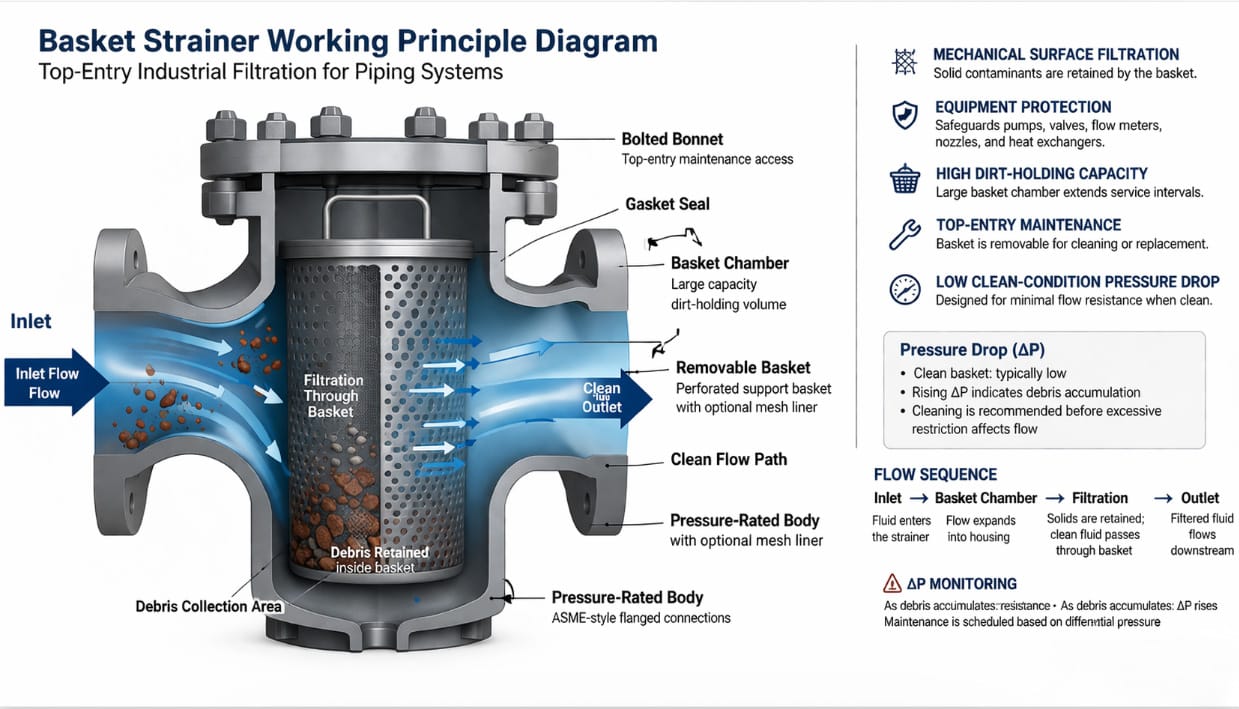
A standard top-entry basket strainer works as follows:
- Process fluid enters the strainer body through the inlet connection.
- Flow expands into the basket chamber, where velocity is reduced compared with the line.
- Solid particles larger than the basket perforation or mesh opening are retained inside the basket. Typical basket configurations may use perforations such as 1/32″ to 1/8″ or mesh linings such as 20 to 400 mesh, depending on service requirements.
- Filtered fluid passes through the basket wall.
- Clean fluid exits through the outlet connection and continues to downstream equipment.
Key engineering point: sealing integrity
Effective filtration depends on a positive sealing arrangement between the basket and the strainer body. If fluid bypasses the basket, downstream equipment is no longer fully protected. In practice, basket seating accuracy, gasket quality, and bonnet fit are as important as the filtration size itself.
In NTGD basket strainers, the sealing arrangement is designed to minimize bypass risk and maintain consistent filtration under industrial operating conditions. For a visual reference of basket position, flow direction, and sealing layout, see the Basket Strainer Diagram, Drawing and Piping Arrangement section.
This operating principle directly affects how the strainer should be sized and selected for different debris loads, flow rates, and maintenance intervals.
Flow Path Through the Basket
In a standard top-entry basket strainer, the internal flow path is designed to combine high dirt-holding capacity with relatively low initial pressure drop.
The typical internal flow path is:
- Fluid enters the lower portion of the strainer body
- Flow fills the basket chamber and distributes across the basket surface
- Filtration occurs through the basket wall
- Clean fluid collects in the outlet side of the body and exits downstream
This geometry offers two important operating advantages:
- Large effective filtration area
A larger basket surface reduces fluid velocity through the filtration openings and delays clogging under the same debris load. - Lower initial pressure drop
Because the flow is distributed across a wider area, resistance is typically lower than in more compact strainer designs.
In most standard basket strainers, the internal layout is optimized for maintenance-friendly top-entry access and stable flow through the basket chamber. For a clear annotated view of the inlet → basket chamber → filtration area → outlet flow path, see the Basket Strainer Flow Direction Diagram in the Diagram section above.
What Happens as Debris Accumulates
As solids accumulate inside the basket, the open filtration area gradually decreases. This changes internal flow behavior in a predictable way:
- The available flow area becomes smaller
- Velocity through the remaining open area increases
- Resistance rises
- Differential pressure (ΔP) across the strainer increases
A basket strainer does not usually fail instantly. Instead, performance degrades progressively as debris loading increases. If the condition is not monitored, several operating problems can develop:
- Reduced downstream flow rate
- Increased pump load and energy consumption
- Higher risk of pump cavitation in sensitive systems
- Unstable process control due to restricted flow
- Basket deformation in severe clogging conditions
The effect is especially important in services with continuous solids loading.
Example by application:
- In oil and gas or petrochemical systems, accumulated debris can restrict pump suction, interfere with control valves, or trigger unplanned maintenance.
- In cooling water systems, sediment buildup can reduce exchanger performance and increase pumping demand.
From an engineering standpoint, debris accumulation behavior should be considered during initial selection, not only during maintenance planning. Basket material strength, filtration fineness, and whether duplex operation is required all depend on expected solids loading.
For selection guidance related to basket opening size, see the Basket Mesh and Perforation Selection Guide. For continuous operation without shutdown, see Installation and Maintenance Best Practices → When Duplex Design Is Preferred.
Pressure Drop (ΔP) — What to Monitor
Pressure drop (ΔP) is the most important operating indicator of basket strainer condition. It is the clearest real-time signal of how much resistance the basket is adding to the system and when maintenance should be performed.
1. Clean Condition (Baseline ΔP)
With a clean basket, pressure drop is typically low.
Typical reference values for water-like fluids at normal velocities are often in the range of:
- ~1–3 psi for many standard applications
- Higher values where flow rate is higher, viscosity increases, or finer mesh is used
This clean-condition value should be recorded during startup as the baseline ΔP for future comparison.
2. How ΔP Is Calculated
Differential pressure is calculated as:
ΔP = P inlet − P outlet
This is why pressure gauges or transmitters are commonly installed on both the inlet and outlet sides of the strainer.
3. What Happens as ΔP Rises
As debris accumulates, ΔP increases gradually. The rate of increase depends on:
- Debris load and particle type
- Flow rate
- Fluid viscosity
- Basket perforation or mesh size
Finer baskets generally produce a faster rise in ΔP under the same solids load.
4. Recommended Cleaning Threshold
In most industrial services, cleaning is typically recommended when:
- ΔP reaches approximately 5–15 psi, or
- ΔP rises materially above the clean baseline and begins to affect system performance
In more sensitive services, cleaning may be required earlier if flow stability, pump condition, or downstream process performance is affected.
Practical reference:
For example, in a moderate-flow clean-water service, a standard basket strainer may begin with a low baseline ΔP and require cleaning once the reading rises enough to indicate significant loss of filtration area. The exact threshold should always be set according to the actual system, not a generic number alone.
5. Why ΔP Monitoring Matters
Uncontrolled pressure drop can lead to:
- Higher pumping energy cost
- Reduced equipment efficiency
- Flow instability
- Excessive maintenance frequency
- Premature wear of upstream or downstream equipment
For this reason, many users install differential pressure gauges or pressure transmitters across the strainer to schedule cleaning before performance declines too far.
If you need assistance selecting suitable pressure instrumentation or determining an appropriate cleaning threshold for your application, submit your operating conditions through the RFQ Checklist and our engineering team can review the expected ΔP behavior.
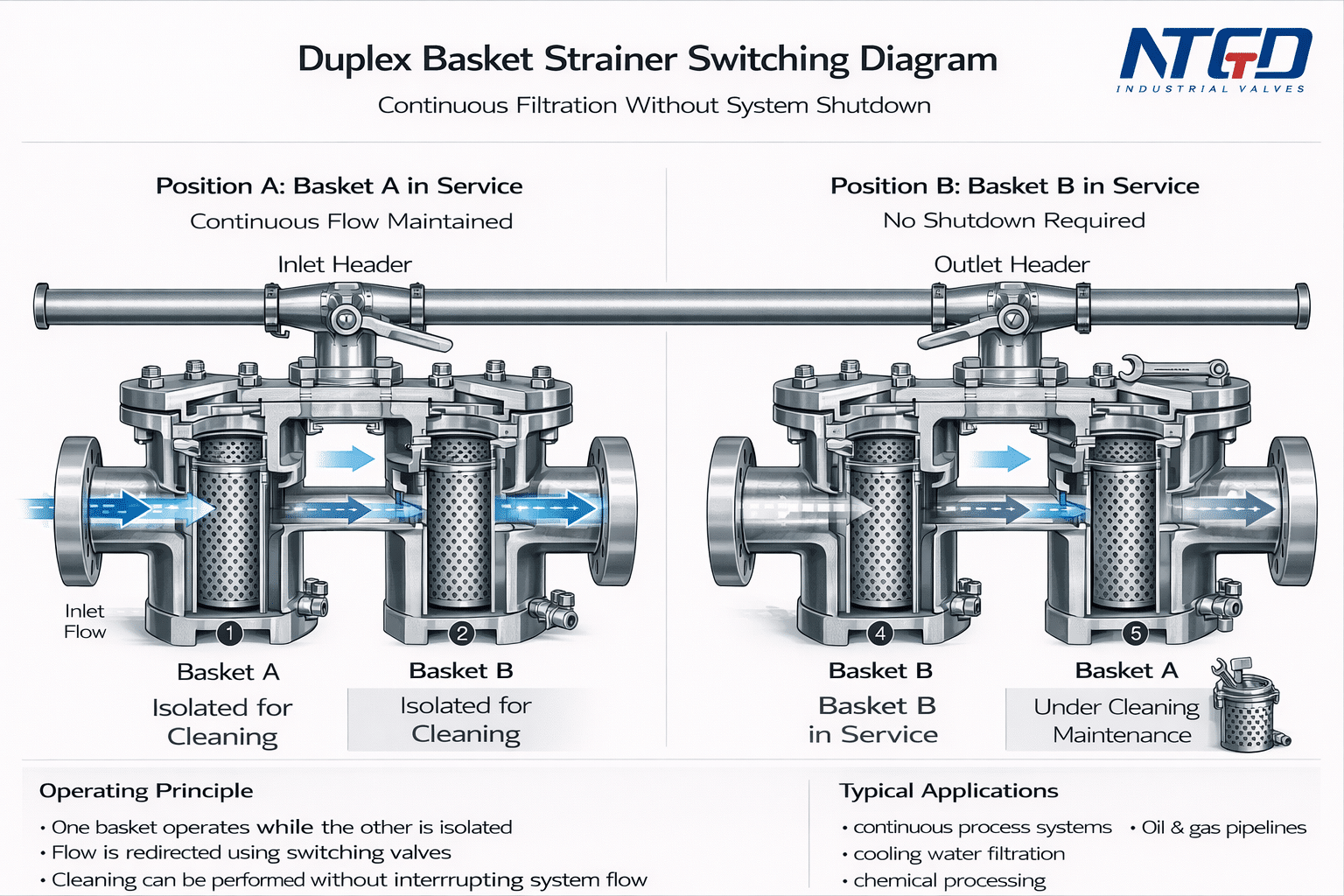
6. Continuous Operation Solution
When shutdown is not acceptable, a duplex basket strainer allows one basket to remain in service while the other is cleaned. This configuration is often selected for continuous-process systems where interruption is costly.
For duplex configuration guidance, see Installation and Maintenance Best Practices → When Duplex Design Is Preferred.
Basket Strainer Diagram, Drawing, P&ID and Piping Arrangement
Basket strainer drawings and piping arrangement references are essential for engineers evaluating equipment layout, maintenance clearance, flow direction, and project documentation requirements. For industrial projects, this section supports the use of basket strainers in piping systems by explaining how sectional drawings, flow direction diagrams, and P&ID representations are used during engineering review, installation planning, and procurement.
This section provides a complete basket strainer diagram, basket strainer drawing reference, and basket strainer P&ID representation used in industrial piping systems.
Engineers searching for “basket strainer diagram”, “basket strainer drawing”, or “basket strainer P&ID” can use the following references for engineering design review, installation planning, piping layout review, and procurement documentation.
📐 Engineering drawings, dimensional references, and P&ID-ready documentation can be provided upon request for project review and quotation support.
Basket Strainer Sectional Drawing
A basket strainer sectional drawing (also referred to as a basket strainer internal diagram or basket strainer construction drawing) shows the internal construction of the strainer and how the main components are arranged inside the pressure-containing body. It is one of the most useful references for checking flow path, basket accessibility, sealing arrangement, and maintenance requirements before installation.
Our standard Class 150 and Class 300 basket strainer drawing packages can include sectional views, dimensional drawings, and configuration details for engineering evaluation. These drawings are commonly used during project submittal, internal review, and procurement confirmation.
Typical elements shown in a basket strainer drawing include:
- Inlet and outlet connections
- Pressure-rated body / housing
- Removable basket (perforated or mesh-lined)
- Cover / bonnet (bolted or quick-opening)
- Gasket sealing area to prevent bypass
- Optional features such as blow-off connection or differential pressure taps
- Body dimensional and pressure class reference details
- Material identification points for documentation and traceability review
In a standard top-entry basket strainer, fluid enters through the inlet, fills the basket chamber, and passes through the basket element where solid particles are retained. Clean fluid then exits through the outlet.
A basket strainer sectional drawing is particularly useful for:
- Verifying internal clearance and basket removal space
- Confirming sealing arrangement and bypass prevention
- Reviewing body layout for piping coordination
- Supporting engineering review and procurement approval
- Communicating the selected configuration in project documentation
See the sectional drawing on this page for a clear view of the inlet, outlet, basket chamber, and bolted bonnet arrangement.
For full dimensional drawings of our standard series, download the 150/300 Series Catalogue (PDF). For project-specific basket strainer drawing packages, including custom dimensions or optional features, contact our engineering team through the RFQ section below.
This type of basket strainer drawing is often referred to as a basket strainer construction drawing or basket strainer engineering drawing in project documentation.
Basket Strainer Flow Direction Diagram
A basket strainer flow direction diagram explains how fluid flows through a basket strainer and how filtration occurs inside the basket strainer. This is important because incorrect flow direction can reduce filtration efficiency, increase differential pressure, and make cleaning more difficult. This type of basket strainer flow diagram is commonly used in engineering design and troubleshooting.
The following flow direction sequence illustrates the basic process:
- Fluid enters the strainer through the inlet connection
- Flow expands into the basket chamber
- Solid particles are captured by the basket perforation or mesh
- Clean fluid passes through the basket wall
- Fluid exits through the outlet connection
Typical flow direction in a basket strainer:INLET → Basket Chamber → Debris Captured → Clean Fluid → OUTLET
Unlike compact inline strainers, basket strainers are typically selected where the application requires:
- Low pressure drop in clean condition
- Higher dirt-holding capacity
- Stable flow through a relatively large filtration area
- Easier top-entry maintenance access
As debris accumulates inside the basket, differential pressure (ΔP) increases. That is why flow direction review is closely tied to pressure drop monitoring and maintenance planning.
Flow direction must always follow the manufacturer’s marking and drawing. Incorrect installation may:
- Reduce filtration effectiveness
- Cause abnormal pressure drop behavior
- Increase the risk of bypass or debris misplacement
- Make basket cleaning more difficult
If fluid enters from the wrong side of the basket arrangement, debris may collect in the wrong area of the housing, which can complicate maintenance and reduce expected filtration performance.
For more details on flow-related pressure drop monitoring, see the Pressure Drop (ΔP) — What to Monitor section in this page.
Basket Strainer in Piping Systems
In industrial piping systems, basket strainers are typically installed upstream of critical equipment to prevent damage caused by solid contaminants. They are commonly used where higher flow rate, larger debris load, and easier maintenance access are required.
Common installation positions include:
- Upstream of centrifugal pumps to reduce the risk of impeller damage from weld debris, scale, sand, or other solid particles
- Upstream of control valves and pressure regulators to reduce seat wear, blockage, and unstable control behavior
- Upstream of flow meters, spray nozzles, and dispensing equipment to prevent clogging and performance loss
- Before shell-and-tube heat exchangers to reduce fouling and loss of heat transfer efficiency
Typical piping considerations include:
- Basket strainers are commonly installed in horizontal pipelines with the cover facing upward
- Sufficient clearance must be reserved above the strainer for basket removal and maintenance
- Isolation valves should be installed on both inlet and outlet sides for safe service access
- Differential pressure gauges or DP instrumentation are recommended to monitor clogging condition
- Blow-off connections may be considered where debris discharge or maintenance efficiency is important
Compared with compact inline strainers, basket strainers are preferred in piping systems where:
- Higher flow rate is required
- Moderate to high dirt load is expected
- Lower clean-condition pressure loss is preferred
- Maintenance access is available
For piping systems with limited installation space or relatively low debris load, a Y-strainer may be more suitable. For certain straight-through piping layouts, a T-type strainer may also be considered. See also our Basket Strainer vs Y Strainer comparison section for selection guidance.
For industry-specific installation context, see the Typical Industrial Applications section below.
Need help confirming piping arrangement, maintenance clearance, or strainer location for your project? Submit your line size, media, temperature, and installation details through the RFQ Checklist below, and our engineering team can review the arrangement with you.
Basket Strainer P&ID Symbol, Drawing and Installation Considerations
A basket strainer P&ID symbol is used to represent a basket strainer in piping and instrumentation diagrams for process design and documentation.
In P&ID drawings, a basket strainer is represented as an inline filtration device installed in the pipeline and coordinated with surrounding valves, instruments, and maintenance requirements. The exact symbol representation may vary depending on the project drafting standard and symbol library, but the engineering intent is the same: to identify the strainer’s location, function, and associated accessories within the system.
In many projects, the basket strainer P&ID reference is reviewed together with:
- Isolation valves for maintenance access
- Differential pressure indicators or transmitters
- Blow-off connections for debris removal
- Drain or vent provisions where required by the system design
- Notes covering pressure class, material, and special configuration requirements
Key points to consider in P&ID and installation design include:
- Position the strainer upstream of sensitive equipment that requires protection
- Match the basket strainer representation to the project’s symbol library and drafting standard
- Include isolation valves to support safe maintenance
- Consider adding differential pressure indicators or transmitters
- Allow for blow-off connections if debris discharge is required
- Ensure installation orientation matches the actual design, especially for top-entry access
- Specify optional features such as quick-opening cover, magnetic insert, or jacketed construction in project notes when procurement clarity is needed
From a project engineering perspective, basket strainer drawings and P&ID layouts are used to:
- Confirm correct equipment placement in the system
- Coordinate with piping layout and maintenance space
- Define installation, inspection, and maintenance requirements
- Support procurement specifications and technical review
- Align the selected configuration with project documentation and site conditions
Proper interpretation of basket strainer drawings and P&ID layouts helps improve reliability, simplify maintenance, and protect downstream equipment over the long term.
If you need a P&ID-ready basket strainer specification, dimensional drawing, or configuration recommendation for your project, our engineering team can support:
- Sectional drawings with dimensions
- Pressure class and material callouts
- Optional feature confirmation
- Drawing support for project review and quotation preparation
These references may also be referred to as basket strainer schematic diagrams or basket strainer layout drawings in engineering documentation.

Basket Strainer vs Y Strainer: How to Choose
When engineers search for “basket strainer vs y strainer” or the difference between basket strainer and Y-strainer, the goal is not theoretical comparison—it is to determine which option will deliver stable operation, manageable maintenance, and acceptable pressure drop in a real piping system.
From an engineering selection perspective, the key difference between a basket strainer and a Y-strainer lies in four factors: dirt-holding capacity, installation footprint, maintenance access, and pressure drop performance.
Selecting the wrong strainer type can lead to:
- Frequent clogging and unplanned shutdowns
- Excessive pressure drop affecting system efficiency
- Increased maintenance labor and operating cost
- Premature damage to pumps, valves, and downstream equipment
The sections below break down these differences based on real operating conditions to support practical selection decisions.

Dirt-Holding Capacity and Filtration Area
The most fundamental difference between a basket strainer and a Y-strainer is effective filtration area and dirt-holding capacity—the primary factor influencing maintenance frequency and operational reliability.
Basket strainers use a cylindrical, top-entry basket element housed in a wide body chamber. This design provides several times the effective filtration area of a comparable Y-strainer, allowing significantly more debris to be retained before cleaning is required.
Y-strainers use a compact, angled screen element aligned with the pipeline axis. The available filtration surface is much smaller, meaning debris accumulates more quickly and cleaning intervals are shorter.
Engineering implication:
- Basket strainers are preferred when debris load is moderate to high and maintenance shutdowns must be minimized
- Y-strainers are suitable when debris load is consistently low or filtration is only required during commissioning
Installation Space and Piping Layout
Installation constraints often determine strainer selection as much as filtration performance.
Basket strainers are typically installed in horizontal pipelines with top-entry access, requiring sufficient vertical clearance for basket removal. This makes them more suitable for systems where space is available and maintenance access is planned.
Y-strainers are designed for compact piping layouts and can be installed in both horizontal and vertical lines (depending on flow direction and application).. Their smaller footprint makes them the preferred option in skid-mounted systems, tight pipe racks, and space-limited installations.
Engineering implication:
- If piping space is constrained, a Y-strainer is often selected even if it results in higher maintenance frequency
- If layout allows, a basket strainer provides better long-term operational stability
Maintenance Access and Cleaning Frequency
Maintenance strategy is often the deciding factor in continuous-process systems.
Basket strainers use a top-entry bolted bonnet (or optional quick-opening cover), allowing direct access to the basket without removing the strainer from the pipeline. Combined with higher dirt capacity, this significantly reduces cleaning frequency and downtime.
For systems requiring uninterrupted operation, a duplex basket strainer allows flow to be switched between two baskets, enabling online cleaning without shutdown.
Y-strainers require removal of an end cap or blow-off plug to access the screen. In larger sizes or high-pressure systems, this process is more labor-intensive and time-consuming. Because of their lower dirt capacity, cleaning is required more frequently.
Engineering implication:
- Basket strainers are preferred where shutdown cost is high or maintenance access must be simplified
- Y-strainers are acceptable for small lines or low-debris systems where maintenance impact is limited
Pressure Drop Considerations
Pressure drop (ΔP) is a critical parameter that directly affects pump loading, energy consumption, and maintenance interval.
Due to their larger filtration area and more direct flow path, basket strainers typically exhibit lower initial pressure drop compared to Y-strainers under similar flow conditions.
Typical clean-condition reference (water-like fluids):
- Basket strainer: approximately 1–3 psi
- Y-strainer: approximately 3–8 psi
Actual values vary with size, flow rate, mesh, and media.
Y-strainers create higher flow resistance because of their angled flow path and smaller filtration area. As debris accumulates, the effective flow area reduces quickly, causing ΔP to rise faster than in a basket strainer.
Engineering implication:
- Higher ΔP increases energy consumption and reduces pump efficiency
- Rapid ΔP rise leads to more frequent cleaning and unstable system performance
For monitoring limits and maintenance thresholds, see Pressure Drop (ΔP) — What to Monitor.
Typical Use Cases: When to Choose Each
In real industrial systems, selection depends on operating conditions rather than preference.
Choose a Basket Strainer when:
- Cooling water / HVAC systems → high flow, moderate debris
- Oil & gas / petrochemical → protection of pumps, heat exchangers, meters
- Water and wastewater → high solids load
- Paint and coatings → need for consistent filtration and easy cleaning
Choose a Y-Strainer when:
- Compact skid systems → limited installation space
- Steam or gas service → low debris, high pressure
- Commissioning / temporary filtration → short-term use
- Small line sizes (≤ NPS 2”) → low flow, minimal solids
Quick Selection Summary
| Priority | Recommended Type |
|---|---|
| High debris load / reduced maintenance | Basket Strainer |
| Tight piping space | Y-Strainer |
| Continuous operation without shutdown | Duplex Basket Strainer |
| Straight-through compact layout | T-Type Strainer |
For full product options, see:
- Basket Strainer product range
- Y-Strainer solutions
- T-Type Strainer configurations
Basket Mesh and Perforation Selection Guide
Selecting the correct basket strainer mesh or perforation size is one of the most critical decisions in strainer specification. Basket strainer mesh size and perforation selection directly affects filtration efficiency, pressure drop (ΔP), cleaning frequency, and downstream equipment protection.
A wrong selection can lead to:
- Frequent clogging and unplanned shutdowns
- Excessive pressure drop affecting pump performance
- Insufficient protection of downstream equipment
- Increased maintenance cost and unstable operation
This section provides a practical basket strainer mesh size selection guide, including mesh vs perforation differences, quick reference data, and selection logic based on real service conditions.
Mesh vs Perforation: What Is the Difference?
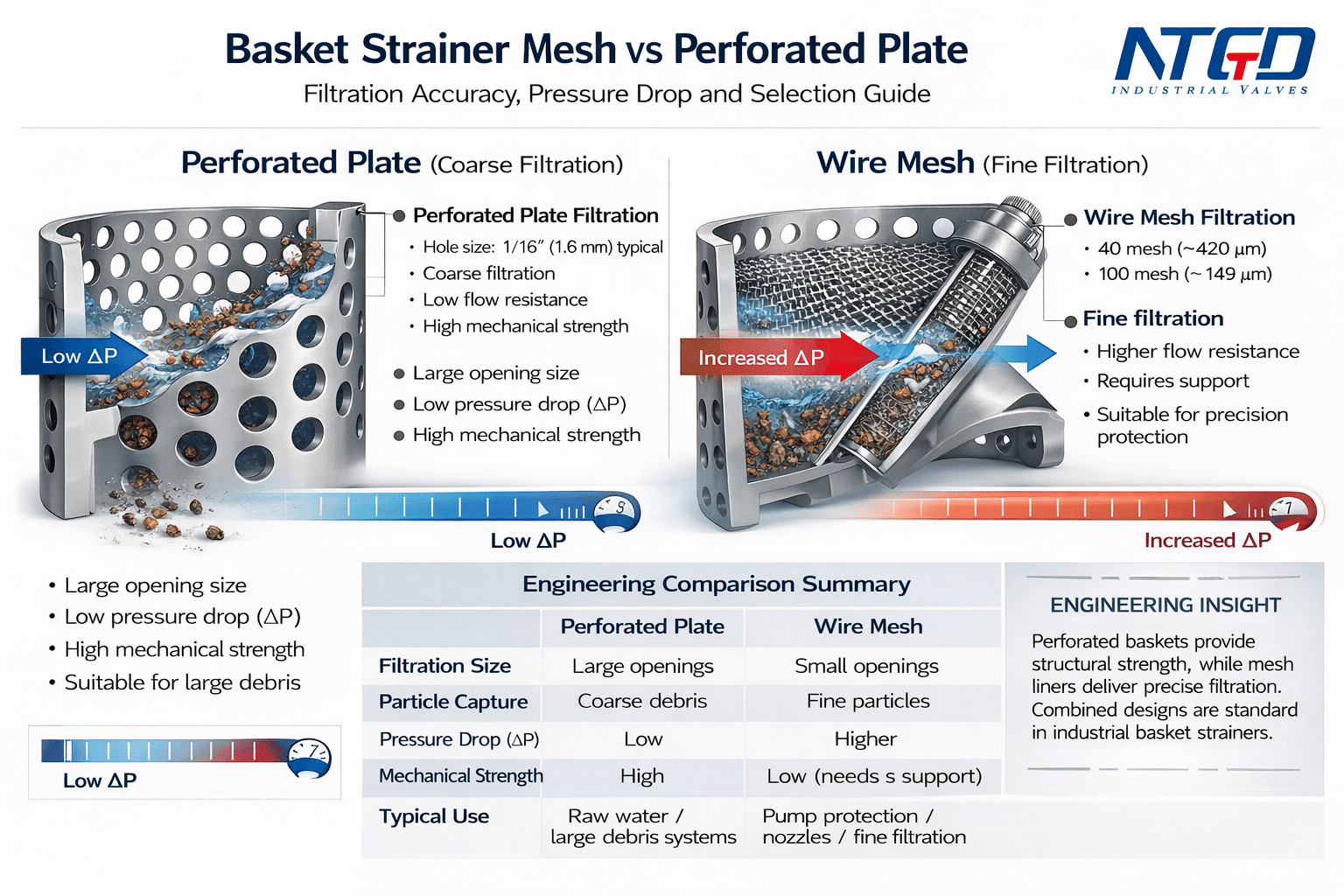
Basket strainers use either perforated plates, wire mesh liners, or a combination of both.
Perforated Plate
- Defined by hole diameter (e.g., 1/32″, 1/16″, 1/8″)
- Provides high mechanical strength under pressure and flow
- Suitable for large or irregular solids
- Lower resistance → lower pressure drop
Wire Mesh Liner
- Defined by mesh count (e.g., 20 mesh, 40 mesh, 100 mesh)
- Provides finer filtration accuracy
- Typically installed inside a perforated support basket
- Higher resistance → higher pressure drop and faster clogging
Engineering Insight
Industrial basket strainers typically use a perforated support basket + mesh liner configuration to balance strength and filtration accuracy.
Basket Strainer Mesh Size & Perforation Chart (Quick Selection Guide)
| Filtration Size | Approx. Opening | Typical Use Case | Relative ΔP Impact |
|---|---|---|---|
| 20 mesh | ~840 μm | Large debris, raw water, cooling water | Low |
| 40 mesh | ~420 μm | General pump protection, process water | Low–Medium |
| 60 mesh | ~250 μm | Coatings, light chemical processes | Medium |
| 100 mesh | ~149 μm | Spray nozzle protection, finer filtration | Medium–High |
| 200 mesh | ~74 μm | Precision fluids, tighter protection | High |
Common Perforation Sizes
- 1/8″ (3.2 mm) → coarse solids, high debris service
- 1/16″ (1.6 mm) → general industrial service
- 1/32″ (0.8 mm) → finer pre-filtration
Note: Finer mesh increases pressure drop. In many systems, selecting a slightly coarser size provides better overall performance.
How to Match Filtration to Service Condition
Correct selection should be based on downstream equipment requirements, debris characteristics, and acceptable pressure drop, not simply the smallest opening.
1. Identify downstream sensitivity
- Pumps → 20–40 mesh
- Control valves / flow meters → 40–100 mesh
- Spray nozzles / precision equipment → 100–200 mesh
2. Assess debris characteristics
- Large or irregular solids → perforation may be sufficient
- Fine or fibrous particles → mesh liner required
- Sticky or viscous media → avoid overly fine mesh
3. Balance protection vs pressure drop
- Finer mesh → better protection, higher ΔP
- Coarser mesh → lower ΔP, longer cleaning intervals
In most cases, the correct choice is the coarsest filtration that still protects downstream equipment.
4. Consider actual operating conditions
- High flow → avoid fine mesh
- High solids load → consider larger basket or duplex design
- Continuous operation → prioritize stable ΔP
Common Selection Mistakes in Basket Specification
1. Selecting overly fine mesh
- Leads to rapid clogging and high ΔP
- Increases maintenance frequency
2. Ignoring downstream equipment requirements
- Allows particles to pass
- Causes pump wear and valve damage
3. Underestimating debris load
- Basket clogs too quickly
- Frequent shutdowns
4. Overlooking pressure drop limits
- Reduces flow and efficiency
- Increases operating cost
5. Using unsupported mesh
- Mesh may deform or tear under pressure
- Filtration becomes unreliable
Correct approach:
Always use a perforated support basket with mesh liner in industrial applications to ensure structural strength and stable filtration performance.
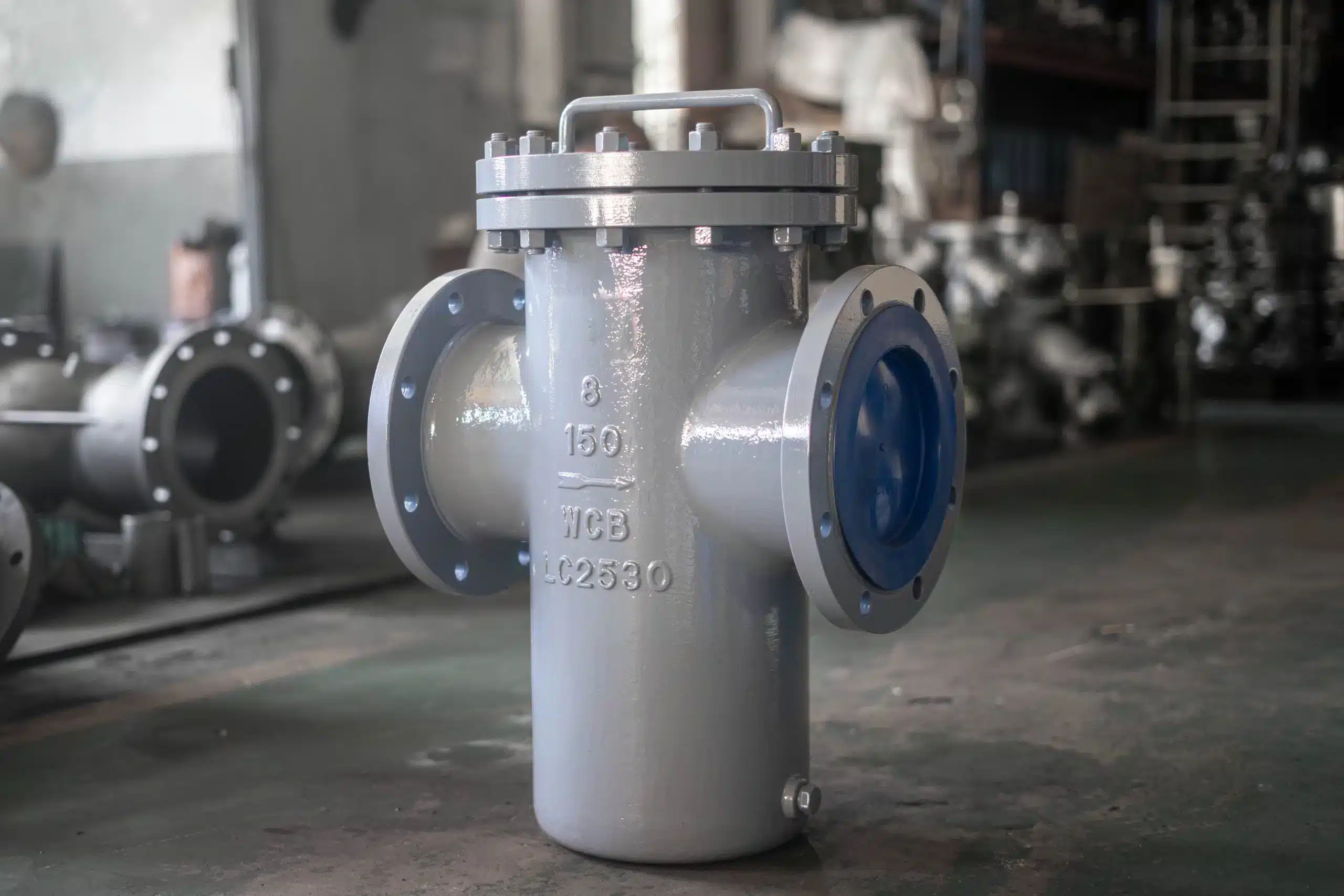
Standard Catalogue Series (Class 150 / 300)
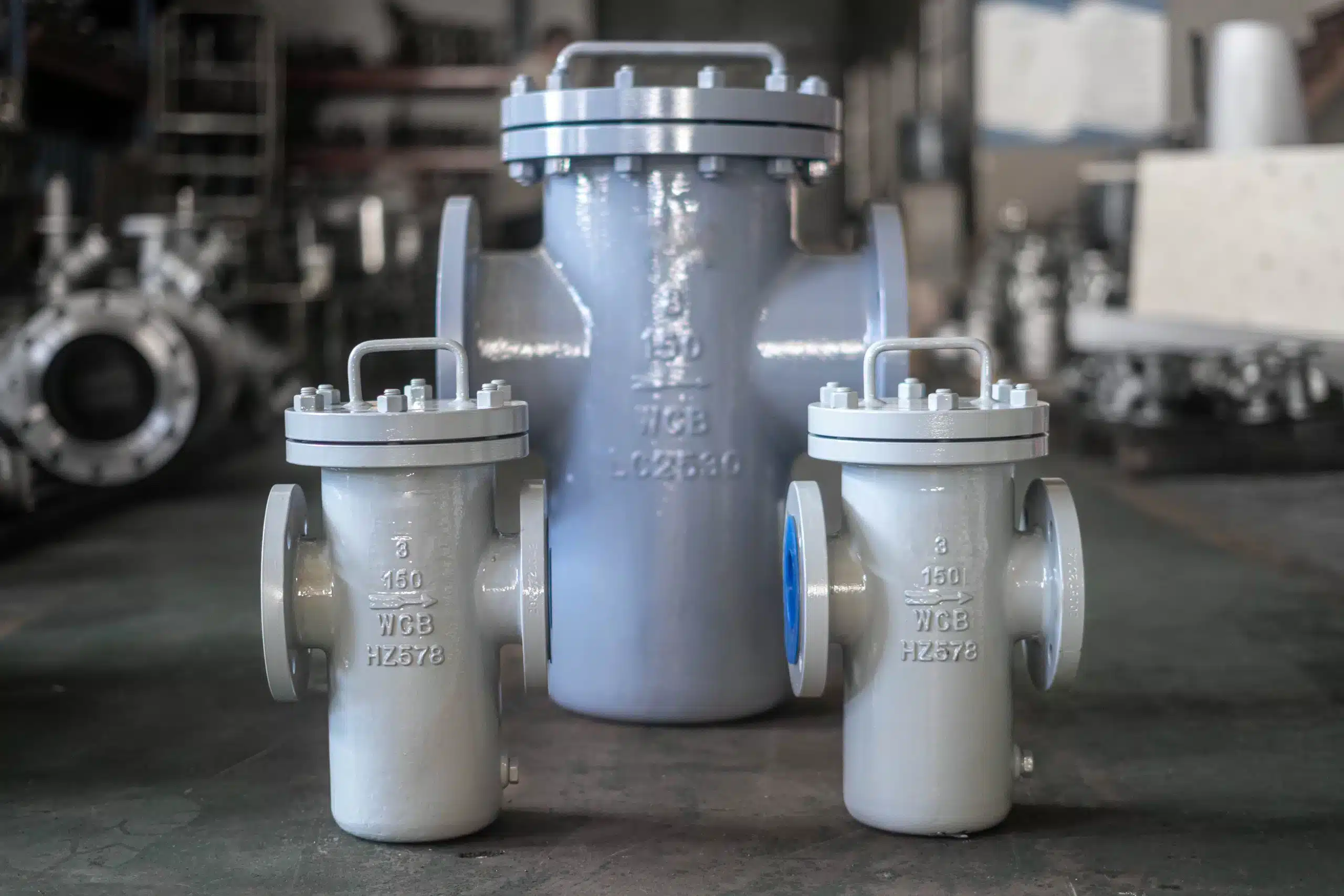
NTGD standard basket strainers are designed for general industrial filtration applications, covering the most common configurations required for basket strainer sizing, selection, and specification in ASME piping systems.
These standard units are widely used in:
- pump protection systems
- process water filtration
- oil & gas pipelines
- cooling water systems
Design Standard: ASME B16.34
Flange Standard: ASME B16.5
Test / Inspection: API 598 (available upon request)
Typical Materials:
- WCB (carbon steel basket strainer)
- CF8 (304 stainless steel basket strainer)
- CF8M (316 stainless steel basket strainer)
Construction Features:
- Top-entry bolted bonnet basket strainer design
- Removable basket (perforated basket or mesh-lined basket strainer)
- Designed for stable operation under standard pressure drop (ΔP) conditions
- Compatible with basket strainer mesh selection and perforation size configurations described in the section above
Engineering Positioning:
Standard Class 150 / 300 basket strainers are the most commonly specified solution for industrial basket strainer selection, where operating conditions fall within standard pressure-temperature ranges.
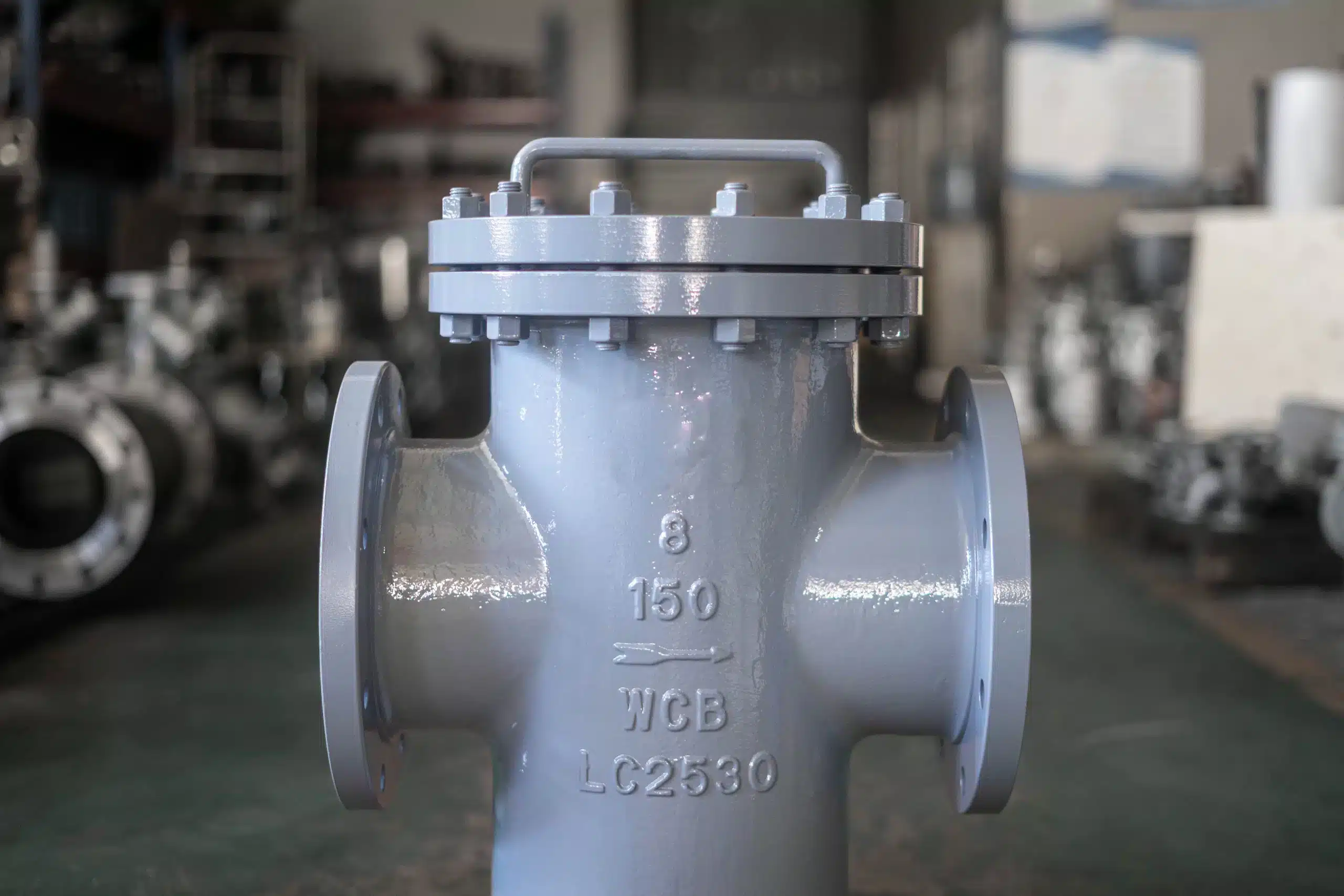
- ASME flanged basket strainer front view showing bolted bonnet and pressure-rated body design
Engineered / Custom Options (On Request)
For applications where standard basket strainer configurations are not sufficient, NTGD provides custom-engineered basket strainers based on project-specific operating conditions and filtration requirements.
Typical scenarios requiring custom basket strainer design include:
- high flow rate systems with strict pressure drop (ΔP) limits
- high solids loading or unstable debris conditions
- corrosive media requiring special alloy materials
- continuous operation systems where shutdown is not acceptable
Available Customization Scope:
- Large size basket strainers: up to NPS 32
- High pressure basket strainers: up to Class 2500
- Duplex basket strainer design: enables online cleaning without system shutdown
- Quick-opening cover: for high-frequency maintenance applications
- Differential pressure (DP) taps: for monitoring clogging and maintenance timing
- Blow-off connection: for flushing accumulated debris
- Magnetic basket insert: for ferrous particle removal
- Jacketed / insulated basket strainers: for temperature-sensitive media
- Special alloys: Duplex, Super Duplex, and corrosion-resistant materials
Engineering Capability Insight:
Custom basket strainers are designed based on:
- flow rate and allowable pressure drop (ΔP)
- basket strainer mesh size selection or perforation size requirement
- piping layout and installation constraints
- maintenance strategy (single vs duplex configuration)
All custom designs are subject to technical validation and application-specific engineering review.
Documentation and Traceability Support
For EPC projects, industrial procurement, and critical service applications, NTGD provides full basket strainer documentation and material traceability support in line with international standards.
Available Documentation Package:
- Material Test Certificates (EN 10204 3.1)
- Hydrostatic and leakage test reports (API 598)
- Basket strainer GA drawing and dimensional drawings
- Pressure-temperature rating verification (ASME B16.34)
- Welding documentation (WPS / PQR, if applicable)
- PMI (Positive Material Identification) reports (optional)
- NDT reports (RT / UT / PT / MT upon request)
Traceability Coverage:
- Full heat number traceability for pressure-containing components
- Material identification linked to inspection documentation
- QA/QC records aligned with EPC and project specifications
Project Support Capability:
Documentation can be prepared according to:
- oil & gas project requirements
- EPC contractor specifications
- third-party inspection standards (SGS / BV / TUV
60-Second Basket Strainer Selection Guide for Engineers and Buyers
Use this quick guide to determine when to use a basket strainer, duplex basket strainer, Y-strainer, or T-type strainer based on flow rate, debris load, maintenance strategy, and installation constraints.
Choose a Basket Strainer when
- High flow rate systems require stable filtration with low pressure drop (ΔP)
- High dirt-holding capacity is needed to extend cleaning intervals
- Top-entry basket removal is preferred for fast and safe maintenance
- System design allows for planned maintenance shutdown
- Typical applications include cooling water, process water, and pump protection systems
👉 Best choice for most industrial basket strainer selection and sizing scenarios
Choose a Duplex Basket Strainer when
- Continuous (24/7) operation is required with no shutdown allowed
- Frequent cleaning cycles are expected due to high debris load
- System reliability is critical and redundant filtration paths are required
- Pressure drop (ΔP) must be controlled while maintaining uninterrupted flow
👉 Recommended for oil & gas, chemical processing, and critical utility systems
(We can propose duplex basket strainer configurations based on your flow rate and operating conditions.)
Consider a Y-Strainer when
- Installation space is limited (compact inline design required)
- Pipeline size is relatively small and debris load is low to moderate
- Maintenance frequency is lower and shutdown cleaning is acceptable
- Used in steam lines, gas service, and small-diameter piping systems
→ See: https://ntgdvalve.com/y-strainer/
Consider a T-Type Strainer when
- A straight-through flow path is preferred for specific piping layouts
- Lower pressure drop is required compared with angled configurations
- Used in larger pipelines or custom piping arrangements
- Suitable when system design prioritizes flow efficiency and layout flexibility
→ See: https://ntgdvalve.com/t-type-strainer/
Typical Industrial Applications of Basket Strainers (Scenario-Based)
Basket strainers are widely used in industrial piping systems across process industries for filtration and equipment protection to protect pumps, control valves, heat exchangers, and other critical equipment.
They are typically installed upstream in the pipeline to remove solid contaminants and ensure stable system operation.
The following are the most common basket strainer applications across key industries, based on actual field use:
Oil & Gas / Petrochemical
- Removing weld slag, pipe scale, sand, and solid particles during commissioning and operation
- Protecting centrifugal pumps, flow meters, and control valves in upstream and downstream systems
- Used in pipeline filtration, refinery units, and process systems
Typical configuration: 40–60 mesh liner with perforated support basket (depending on debris load and ΔP limits)
Cooling Water Systems
- Controlling sediment, rust particles, and biological debris in open or closed-loop systems
- Preventing heat exchanger fouling and blockage
- Maintaining stable flow and reducing cleaning frequency in continuous operation
Key selection focus: low pressure drop (ΔP) + high dirt-holding capacity
Paint & Coatings
- Removing agglomerates, gels, and contamination particles from process fluids
- Ensuring consistent product quality and spray performance
- Preventing nozzle blockage in coating and finishing systems
Typical configuration: 60–100 mesh basket strainer for fine filtration control
Power Generation
- Protecting auxiliary cooling systems, condensate lines, and service water systems
- Preventing debris ingress into heat exchangers and turbine support systems
- Ensuring reliable operation under continuous load conditions
Common use: cooling water filtration and auxiliary system protection
Water & Wastewater Treatment
- Removing sand, organic debris, and suspended solids from raw or process water
- Preventing clogging of pumps, spray nozzles, and treatment equipment
- Used in intake systems, pre-filtration stages, and distribution pipelines
Typical configuration: 20–40 mesh or perforated basket depending on solids load
Chemical Processing
- Handling corrosive media with appropriate material selection (e.g., CF8M, Duplex), often alongside diaphragm valve solutions for corrosive service
- Protecting sensitive equipment while maintaining process stability and safety
- Supporting filtration requirements across batch and continuous processes in chemical processing systems
Key selection factors: material compatibility + mesh/perforation sizing + ΔP control
Engineering Selection Insight
Basket strainer application selection should always consider:
- required filtration level (mesh or perforation size)
- system flow rate and allowable pressure drop (ΔP)
- debris type, size, and concentration
- maintenance strategy and cleaning frequency
Common Basket Strainer Selection Mistakes to Avoid (Real-World)
Incorrect basket strainer selection and sizing is one of the leading causes of pressure drop issues, equipment damage, and unplanned maintenance in industrial systems.
The following are the most common basket strainer specification mistakes observed in real projects — and how to avoid them.
1. Choosing Too Coarse Filtration to Reduce ΔP
Lower pressure drop (ΔP) is not always better.
Oversizing the opening (mesh or perforation) allows damaging particles to pass downstream, leading to:
- accelerated pump wear
- control valve seat damage
- nozzle clogging and process instability
Correct approach:
Select filtration based on downstream equipment protection requirements, not only ΔP.
A slightly higher ΔP is acceptable if it ensures reliable protection.
2. Ignoring Material Compatibility
Incorrect material selection (body or basket) can result in:
- corrosion of basket or perforated plate
- structural weakening and premature failure
- risk of debris bypass due to basket damage
Typical risk scenarios:
- stainless steel required but carbon steel selected
- corrosive chemical service without alloy upgrade
Correct approach:
Match materials (e.g., WCB, CF8, CF8M, Duplex) to fluid properties, temperature, and corrosion conditions.
3. Underestimating Dirt Load
If actual solids load is higher than expected, the basket can clog rapidly in high-solids industrial service, causing:
- sharp increase in pressure drop (ΔP)
- reduced flow rate and system instability
- frequent shutdown for cleaning
Correct approach:
- increase basket size or filtration area
- consider duplex basket strainer design for continuous operation
- evaluate real debris concentration, not theoretical assumptions
4. No Maintenance Clearance Considered
Basket strainers require top-entry access for cleaning.
If installation space is not properly planned, maintenance becomes difficult or unsafe.
Typical issue:
- insufficient vertical clearance for basket removal
- inability to service strainer without dismantling piping
Correct approach:
Ensure adequate maintenance clearance and lifting space during piping layout design.
Installation and Maintenance Best Practices
Proper basket strainer installation and maintenance is essential to ensure stable filtration performance, controlled pressure drop (ΔP), and long service life in industrial piping systems.
Incorrect installation layout or maintenance planning can lead to leakage, excessive ΔP, frequent shutdowns, and reduced equipment reliability.
Typical Installation Orientation
Standard top-entry basket strainers are typically installed horizontally with the bonnet facing upward, allowing safe and efficient basket removal during maintenance.
Key installation points:
- Maintain correct flow direction based on body marking
- Install in a position that allows easy access for basket removal
- Ensure sufficient vertical clearance above the bonnet (see Maintenance Clearance in Selection Mistakes section)
- Avoid installation in locations where debris may settle unevenly and affect flow distribution
Correct orientation ensures uniform flow through the basket and stable ΔP performance
Isolation Valves and DP Gauges
Proper auxiliary components are critical for safe operation and maintenance of basket strainers.
Recommended configuration:
- Install isolation valves upstream and downstream to allow safe shutdown and maintenance
- Install differential pressure (ΔP) gauges at inlet and outlet to monitor clogging
- Use ΔP readings to determine actual cleaning intervals, rather than fixed schedules
Engineering insight:
- Rising ΔP indicates basket clogging and reduced effective flow area
- Excessive ΔP can impact pump efficiency and downstream flow stability
ΔP monitoring is the most reliable method for basket strainer maintenance planning
Safe Basket Cleaning Procedure
WARNING: Always fully isolate and depressurize the system before opening the strainer.
Failure to follow proper procedure may result in serious injury or equipment damage.
Standard cleaning procedure:
- Close upstream and downstream isolation valves
- Fully relieve internal pressure before opening the bonnet
- Remove bonnet and carefully extract the basket
- Remove accumulated debris from the basket
- Clean using a compatible solution and soft brush only
- Avoid sharp tools that may damage mesh or perforation
- Inspect basket, gasket, and sealing surfaces for wear or deformation
- Replace damaged components if necessary
- Reassemble and return to service gradually, checking for leakage
Cleaning frequency should be based on ΔP trend, not fixed time intervals
When Duplex Design Is Preferred
A duplex basket strainer is recommended when system operation cannot be interrupted for cleaning.
Typical conditions requiring duplex design:
- Continuous (24/7) operation with no shutdown allowed
- High dirt load systems requiring frequent cleaning
- Critical processes where flow interruption is unacceptable
- Applications with unstable debris conditions causing rapid clogging
Engineering advantages:
- Allows switching between baskets without stopping flow
- Maintains stable system pressure and avoids downtime
- Improves operational reliability in demanding industrial service
Duplex configuration is often selected in oil & gas, chemical processing, and power generation systems
Standard 150/300 Series Reference and Technical Documentation
Standard 150/300 Series Reference (Catalogue Offering)
This page summarizes our standard offering. Detailed dimension tables are available in the catalogue.
Other sizes/classes are available upon technical confirmation.
Detailed dimensions are available in the 150/300 Series Catalogue (PDF).
RFQ Checklist (Get an Accurate Quote Faster)
To provide a correct selection and quotation, please include:
-
Line size: e.g., NPS 4″ (DN100)
-
Pressure class / design pressure: e.g., Class 300
-
Media & temperature: e.g., cooling water, 60°C
-
Required filtration: e.g., 40 mesh / 1.0 mm perforation
-
End connection: RF flanged / BW / other
-
Body & basket material: e.g., WCB body + 316 basket (or CF8M)
-
Options (if needed): blow-off, DP taps, quick-opening cover, magnetic insert, jacketed, etc.
Not sure about some details? Submit your RFQ now — we can follow up with sizing support.
Frequently Asked Questions (Basket Strainer)
What is a basket strainer?
A basket strainer is a pressure-rated pipeline filtration device used to remove solid contaminants from process fluids. It captures debris inside a removable basket element to protect downstream equipment such as pumps, valves, and heat exchangers.
How does a basket strainer work?
A basket strainer works by directing fluid into a basket chamber where flow passes through a perforated or mesh-lined basket. Solid particles are retained inside the basket while clean fluid exits downstream. As debris accumulates, differential pressure (ΔP) increases, indicating the need for cleaning.
What is the difference between a basket strainer and a Y-strainer?
A basket strainer provides higher dirt-holding capacity, lower clean-condition pressure drop, and easier top-entry maintenance. A Y-strainer is more compact and suitable for smaller lines or installations with limited space. See our Basket Strainer vs Y Strainer section above for detailed selection guidance.
What mesh size should I use for a basket strainer?
Mesh size selection depends on particle size, debris type, and downstream equipment sensitivity. Typical ranges are 20–40 mesh for pump protection and 100–200 mesh for finer filtration such as nozzles or precision equipment. For exact selection, refer to the Basket Mesh and Perforation Selection Guide above.
How do I choose between mesh and perforation?
Perforated baskets are used for coarse filtration with lower pressure drop and higher strength, while mesh liners provide finer filtration accuracy. In most industrial applications, a perforated support basket with a mesh liner is used to balance strength and filtration performance.
What happens if the mesh is too fine?
If the mesh is too fine, the basket will clog quickly, increasing differential pressure (ΔP), reducing flow rate, and requiring frequent cleaning. In severe cases, excessive ΔP can affect pump performance and system stability.
Can you provide pressure drop (ΔP) evaluation?
Yes. We can provide pressure drop evaluation based on your flow rate, fluid properties, and selected basket configuration. This helps ensure the selected mesh or perforation size meets system ΔP limits.
When should I use a duplex basket strainer?
A duplex basket strainer should be used when continuous operation is required and shutdown for cleaning is not acceptable. It allows one basket to be cleaned while the other remains in service.
Where should a basket strainer be installed?
Basket strainers are typically installed upstream of critical equipment such as pumps, control valves, flow meters, and heat exchangers to prevent damage caused by debris in the pipeline.
What maintenance is required for a basket strainer?
Routine maintenance includes monitoring differential pressure, removing and cleaning the basket, inspecting seals and gaskets, and replacing damaged components when necessary.
Can you supply documentation and certifications?
Yes. We can provide material certifications (EN 10204 3.1 / 3.2 if required), hydrostatic test reports, inspection records, and project documentation to support procurement and compliance requirements.
Can you help select the right basket strainer for my application?
Yes. Provide your line size, flow rate, fluid type, temperature, pressure, debris characteristics, and downstream equipment requirements. Our engineering team will recommend the optimal basket strainer configuration, including mesh or perforation size and pressure drop evaluation.
In Summary
A properly sized basket strainer is one of the most cost-effective ways to protect critical pipeline equipment and reduce unplanned downtime.
For pricing and technical confirmation, please submit your application details below. Our engineering team will review and respond promptly.