
Author Name: Bruce Zheng
Author Role: Co-Founder and Valve Engineer at NTGD Valve
Author Bio: Bruce Zheng is Co-Founder and Valve Engineer at NTGD Valve, focusing on industrial valve selection, application, and technical content for global B2B buyers.
Last Updated: April 22, 2026
A parallel slide gate valve is not just a generic power plant gate valve with a different label. It is a specific shutoff design used where sealing stability, high temperature, high pressure, and cycling behavior matter more than simple familiarity with gate-valve categories.
In power-plant service, that distinction is practical. Choosing the wrong shutoff route for high-energy steam or feedwater duty can lead to thermal binding, difficult hot operation, unstable shutoff performance, and maintenance exposure that costs far more than the valve line item itself. The real question is not whether a valve sounds robust. It is whether its sealing route fits the duty better than the alternatives.
This article focuses on that question from an engineering perspective:
- why a parallel slide gate valve is considered for demanding power duties,
- how its sealing mechanism changes hot-service behavior,
- where it fits in steam, feedwater, and turbine-isolation service,
- and where the real boundary sits between a parallel slide gate valve vs wedge gate valve decision.
What a Parallel Slide Gate Valve Means in Power-Plant Service
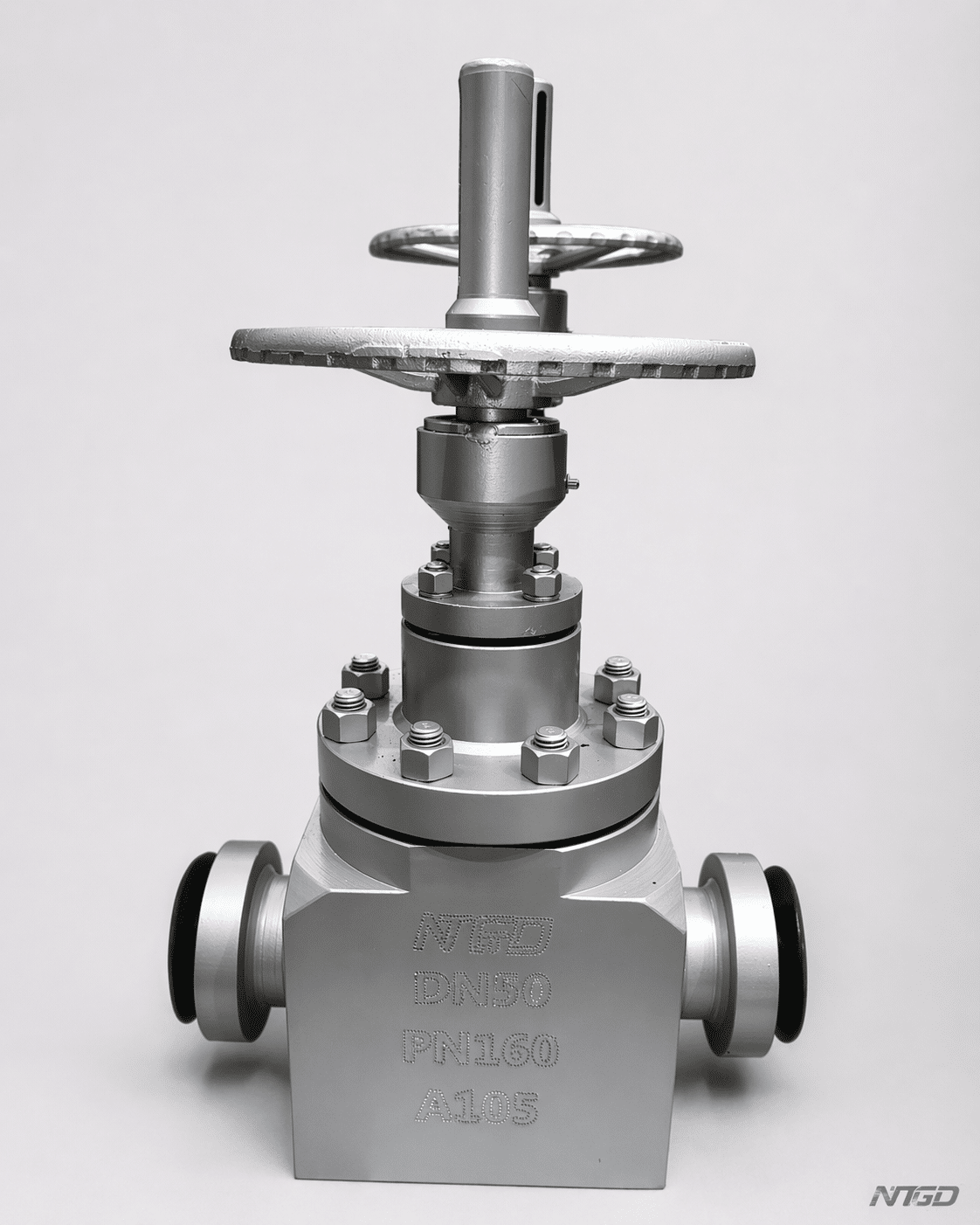
A parallel slide gate valve uses parallel-faced closure members rather than a wedge-shaped gate that relies primarily on wedging force to create shutoff. In many industrial contexts, the term parallel gate valve is used as a related or overlapping term. On this page, the focus is the parallel slide route used for demanding shutoff duty in power-plant service.
That distinction matters because the phrase power plant gate valve is broad. It can include wedge gate valves, pressure-seal routes, and other high-energy isolation designs. This page is narrower. It is about the parallel slide gate valve in power-plant service, especially where steam, feedwater, or turbine-related isolation duty pushes the buyer to look beyond a generic gate-valve label.
What makes it a parallel slide gate valve
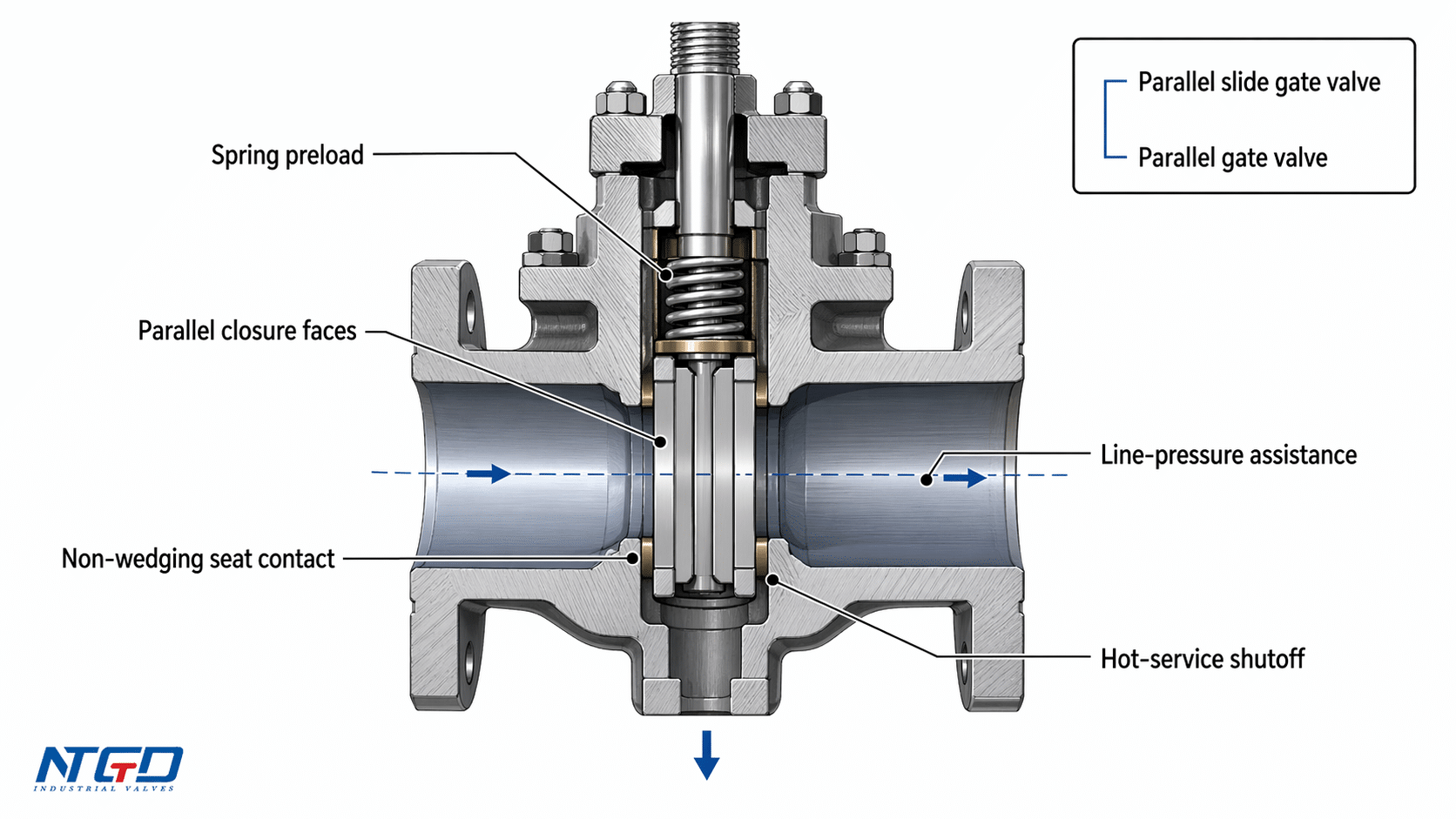
The defining feature is the closure arrangement. Instead of forcing a wedge tightly between seats, a parallel slide design uses parallel closure surfaces and a sealing logic that depends on spring assistance, line pressure, or both, depending on the design route.
That difference changes how the valve behaves under load. It affects opening force, shutoff stability, response to thermal growth, and long-term wear behavior.
Parallel slide gate valve vs parallel gate valve terminology
In practice, many buyers and engineers use parallel slide gate valve, parallel gate valve, and sometimes parallel slide valve in related ways. The terminology is not always handled consistently across vendors and industries.
For selection work, the important point is not the label alone. It is whether the design actually follows a parallel slide shutoff mechanism associated with this valve family. For procurement and specification, the safest check is to confirm that the valve uses a parallel-faced, non-wedging closure route with preload and pressure-assisted sealing behavior rather than relying mainly on wedge force.
Why this valve appears in power-plant service
Power plants place shutoff valves in severe duties. Temperature can be high. Pressure can be high. Cycling may be repeated. Leakage consequences can be operationally serious even when the valve is not serving a control function.
That is why the parallel slide route is evaluated in power service. It is not because it is automatically the best gate valve in every case. It is because certain high-energy isolation duties reward its sealing behavior and operating characteristics. In steam, feedwater, and other hot shutoff points, a non-wedging route is often considered precisely because thermal cycling, operating difficulty, and shutoff instability can become the real problem—not the valve category printed on the datasheet.
How a Parallel Slide Gate Valve Seals and Operates
Understanding parallel slide valve operation is the key to understanding why this valve appears in power service at all. The value of the design comes from how it shuts off, not from a generic claim that it is simply “stronger” or “better.”
Twin-disc and parallel-faced closure logic
A typical parallel slide gate valve uses parallel-faced closure members that move into the shutoff position without relying on wedging action to generate the main sealing load. That is the core structural difference.
Because the closure members remain parallel rather than wedged, the valve’s shutoff behavior is tied more directly to seat-contact logic and line conditions than to forcing a tapered gate into place.
Spring preload and line-pressure-assisted sealing
Many parallel slide designs use spring assistance to maintain disc positioning and promote early contact. That preload matters because it helps establish basic seat contact before full system pressure is available.
As system pressure builds, line pressure then reinforces sealing contact. In other words, preload supports the initial sealing relationship, while service pressure strengthens it under operating conditions. That is an important distinction in startup, low-differential, or changing-pressure phases, where the valve must still behave in a controlled way before full pressure assistance is established.
That is why the design is often associated with stable shutoff in high-energy service. The sealing route is not just mechanical forcing. It is a combination of geometry, preload, and service-pressure behavior.
Why no wedging action changes torque, binding, and shutoff behavior
The absence of primary wedging action does not make a parallel slide valve universally superior to every wedge design. It changes the valve’s operating behavior, and that change matters in the right duty.
First, it can reduce the mechanical tendency toward thermal binding when hot-service temperature changes affect internal dimensions. Second, it can reduce operating-force demands compared with situations where a wedge must be driven hard into sealing surfaces under load. Third, it can support stable shutoff behavior in duties where sealing reliability matters more than throttling precision.
The point is not that one route wins by definition. The point is that the sealing route is fundamentally different, and that difference changes the selection logic.
Why This Valve Design Matters in High-Energy Power Service
The performance value of a parallel slide gate valve comes from its shutoff route. Buyers should judge the design by what that route changes in service, not by generic claims about durability.
Stable shutoff and lower mechanical stress
A parallel slide gate valve is primarily a shutoff valve. In high-energy power service, that matters because leakage risk, thermal distortion, and repeated cycling can turn a familiar isolation point into a maintenance problem.
When the sealing route avoids heavy wedging as the primary mechanism, the valve can reduce some of the mechanical stress associated with opening, closing, and thermal exposure. In practical power duty, that can mean more predictable hot operation and lower exposure to shutoff instability at critical isolation points.
Low pressure drop and service suitability
Like other full-bore or near-full-bore isolation routes, a parallel slide gate valve is attractive where the valve should disappear from the flow path when open rather than behave like a throttling device.
So “efficiency” here should not be read as precision flow control. It means the valve suits open-or-closed isolation duty while keeping flow resistance low in the open position. That is valuable in steam and feedwater service because the design is being judged as an isolation route, not as a control valve substitute.
Why reduced wear can lower maintenance burden
Maintenance benefit is a result, not a slogan. If operating force is lower, if shutoff remains stable, and if the seat route is appropriate for the service, wear exposure can become more manageable over time.
For a power plant, that matters because reduced wear is not just a component-life issue. It can lower exposure to unplanned shutoff problems, difficult hot restarts, and maintenance work at lines where isolation reliability matters operationally. Maintenance does not disappear, but the design route can materially change the burden the plant must carry.
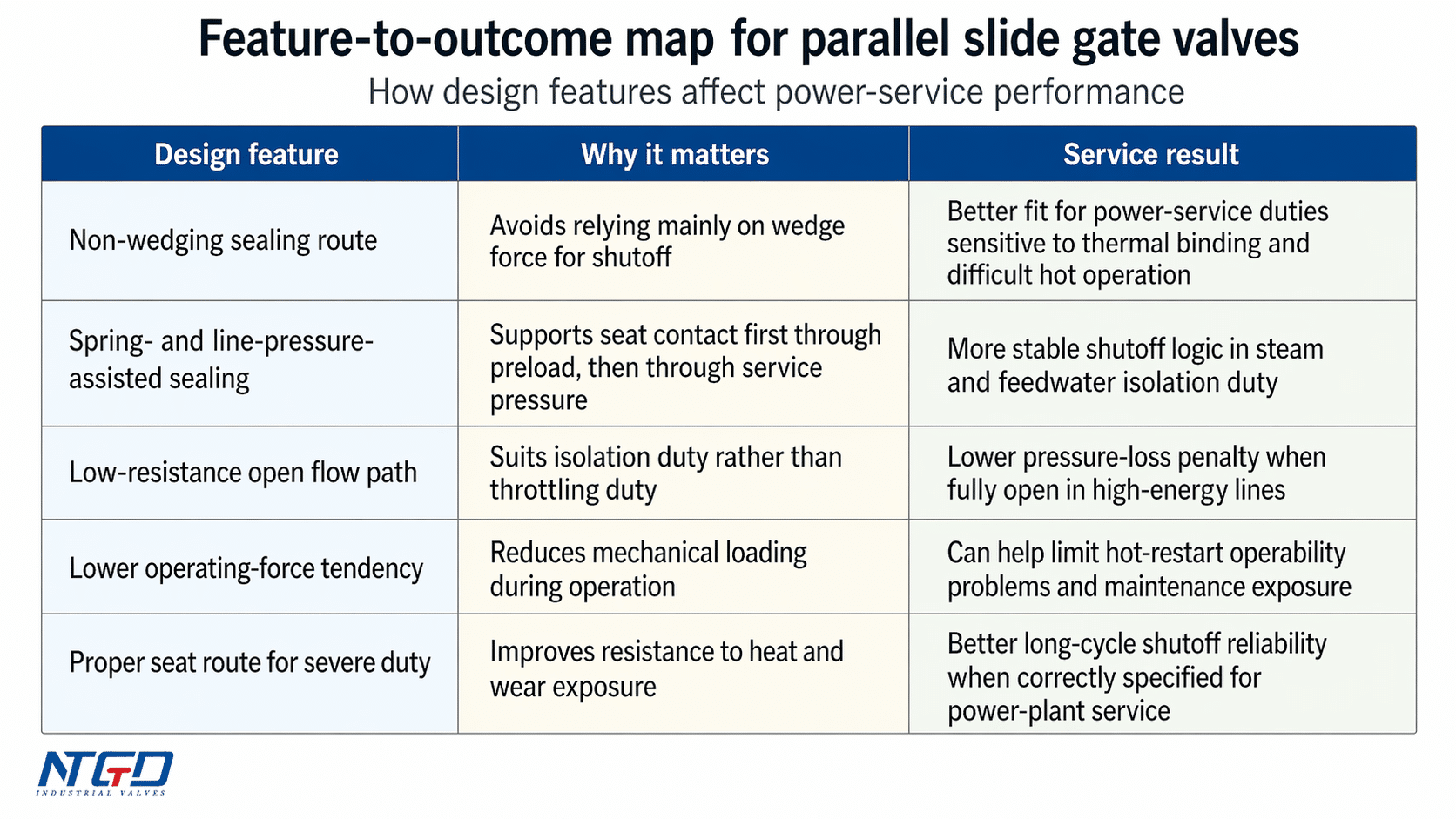
| Design feature | Why it matters | Service result |
|---|---|---|
| Non-wedging sealing route | Avoids relying mainly on wedge force for shutoff | Better fit for power-service duties sensitive to thermal binding and difficult hot operation |
| Spring- and line-pressure-assisted sealing | Supports seat contact first through preload, then through service pressure | More stable shutoff logic in steam and feedwater isolation duty |
| Low-resistance open flow path | Suits isolation duty rather than throttling duty | Lower pressure-loss penalty when fully open in high-energy lines |
| Lower operating-force tendency | Reduces mechanical loading during operation | Can help limit hot-restart operability problems and maintenance exposure |
| Proper seat route for severe duty | Improves resistance to heat and wear exposure | Better long-cycle shutoff reliability when correctly specified for power-plant service |
Mapping Power-Plant Duties to Parallel Slide Gate Valve Fit
The right way to use the broad phrase power plant gate valve on this page is to map it back to actual duties. This article is not about all power-plant valves. It is about where the parallel slide route fits.
High-pressure steam systems
High-pressure steam duty is one of the clearest fit scenarios. The valve is evaluated here because shutoff reliability under heat, repeated thermal cycling, and hot operating behavior matter more than general-purpose familiarity.
In this duty, the buyer should look past generic “high-temperature capable” language. The real questions are whether the valve can maintain shutoff confidence across thermal swings, whether the sealing route reduces sensitivity to thermal binding, and whether hot-service operation remains manageable after repeated cycles.
Boiler feedwater service
Boiler feedwater isolation is not just another liquid-service line item. Shutoff integrity, differential loading, cycling pattern, and wear behavior can all matter, especially where isolation reliability must remain stable over time.
A parallel slide gate valve may be considered when the service places a premium on dependable shutoff, controlled operating behavior, and long-term seat performance. The key is to evaluate the actual feedwater duty rather than assume that any gate valve route will behave the same way under repeated isolation demand.
Turbine isolation and shutoff protection
This is where the wording must stay precise. A parallel slide gate valve should not be presented as a precision control valve. In turbine-related duty, its value is tied to isolation and shutoff protection, not throttling performance.
That means the selection logic is about leakage consequence, isolation reliability, and dependable shutoff behavior when the system demands it. In turbine-related service, the wrong shutoff route can become a system-protection issue, not just a valve-maintenance issue.
Where steam headers and similar high-energy duties fit
Steam headers and similar high-energy shutoff points often follow the same logic. If the line sees demanding thermal conditions, repeated cycling, or tight shutoff expectations, the buyer may need to look closely at whether the parallel slide route offers a better behavioral fit than a more conventional wedge-based route.
The point is not to expand this page into every power-plant subsystem. It is to show that steam headers and similar hot isolation points often raise the same engineering questions seen in high-pressure gate valve applications.
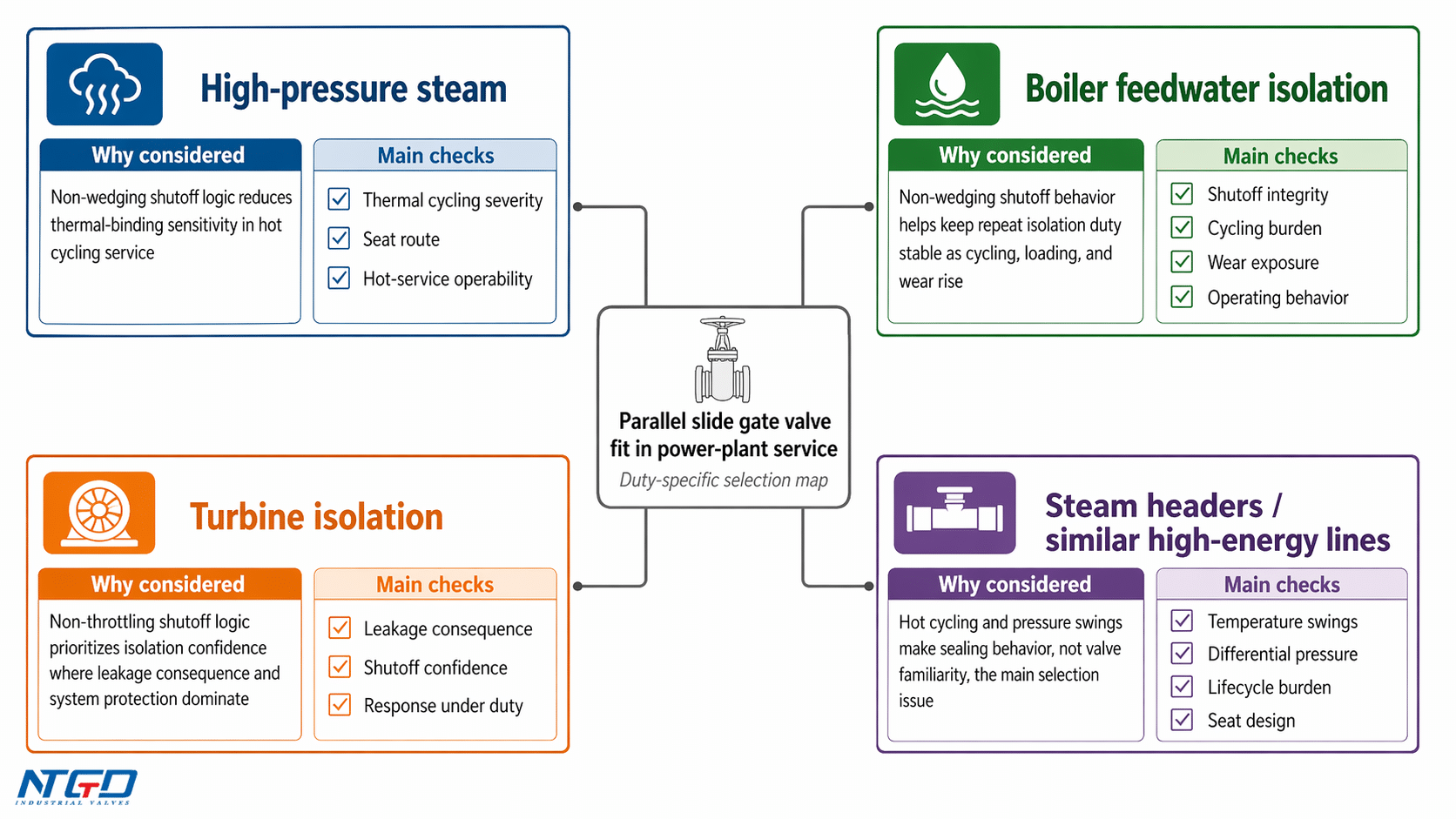
| Power-plant duty | Why the parallel slide route is considered | Main checks before specifying |
|---|---|---|
| High-pressure steam | Non-wedging shutoff logic can reduce thermal-binding sensitivity in hot cycling service | Thermal cycling severity, seat route, hot-service operability |
| Boiler feedwater isolation | Non-wedging shutoff behavior can help keep repeat isolation duty stable when cycling, loading, and wear rise | Shutoff integrity, cycling burden, wear exposure, operating behavior |
| Turbine isolation | Non-throttling shutoff logic prioritizes isolation confidence where leakage consequence and system protection dominate | Leakage consequence, shutoff confidence, response under duty |
| Steam headers / similar high-energy lines | Hot cycling and pressure swings can make sealing behavior, not valve familiarity, the main selection issue | Temperature swings, differential pressure, lifecycle burden, seat design |
Parallel Slide Gate Valve vs Wedge Gate Valve: Where the Boundary Really Is
The most useful comparison on this page is not parallel slide gate valve vs every other valve family. It is parallel slide gate valve vs wedge gate valve.
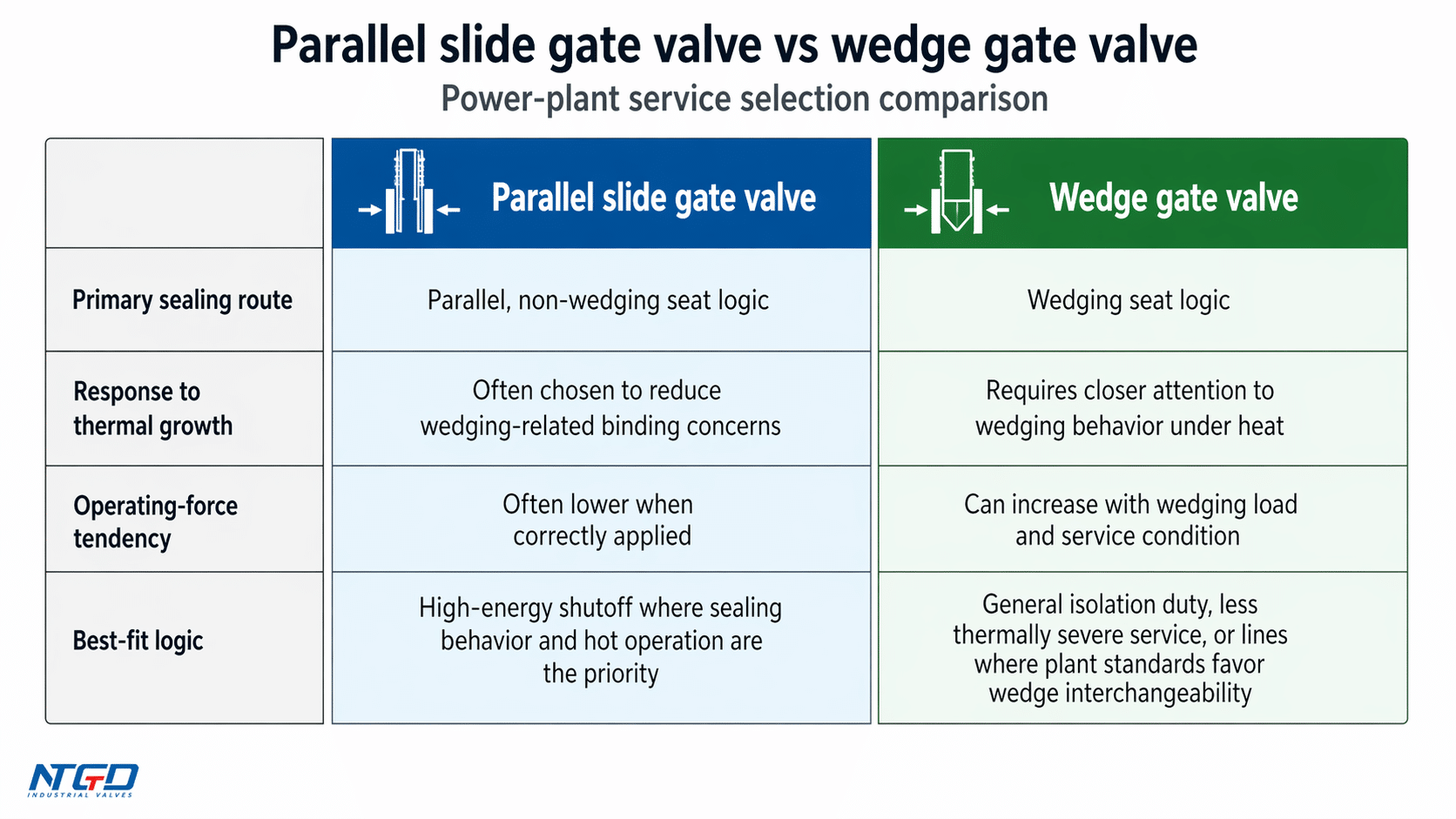
Sealing logic: wedging vs non-wedging
A wedge gate valve creates shutoff through wedging geometry. A parallel slide gate valve relies on a parallel sealing route supported by preload and service-pressure behavior rather than primary wedging force.
That difference is not academic. It changes how the valve responds under thermal load, how much operating force may be needed, and how the sealing surfaces are stressed in service.
Thermal binding, operating torque, and shutoff stability
This is where the comparison becomes practical. Wedge routes can be highly effective, but the buyer must pay close attention to how heat, expansion, and operating force interact in the actual duty. A parallel slide route is often considered where thermal binding becomes a problem rather than a detail.
The decision is not “parallel slide is newer” or “wedge is outdated.” The decision is which sealing route is more stable for the duty. A parallel slide valve is attractive because it may reduce exposure to wedging-related hot-operation problems—but that advantage belongs to specific duties, not to every installation with a gate valve in it.
When parallel slide has an advantage—and when not to overgeneralize
A parallel slide gate valve tends to become attractive when the service has a stronger need for:
- stable shutoff in high-energy duty,
- lower sensitivity to wedging-related hot-operation issues,
- lower operating-force tendency,
- and lifecycle behavior that justifies the route.
But it should not be sold as a universal replacement for every wedge gate valve. Plant standards, seat route, specification history, duty pattern, and maintenance philosophy still matter. In many plants, wedge routes remain practical for more general isolation duty, less thermally severe service, or lines where the solid-vs-flexible wedge tradeoff matters more than optimizing around hot-duty behavior.
A short role boundary is also useful here: if the real duty is continuous throttling, the comparison may no longer be parallel slide vs wedge. It may be gate valve vs a control-oriented route entirely.
| Decision factor | Parallel slide gate valve | Wedge gate valve | Why it changes selection |
|---|---|---|---|
| Primary sealing route | Parallel, non-wedging seat logic | Wedging seat logic | Changes shutoff behavior under load |
| Response to thermal growth | Often chosen to reduce wedging-related binding concerns | Requires closer attention to wedging behavior under heat | Important in high-temperature duty |
| Operating-force tendency | Often lower when correctly applied | Can increase with wedging load and service condition | Affects operability and actuator demand |
| Best-fit logic | High-energy shutoff where sealing behavior and hot operation are the priority | General isolation duty, less thermally severe service, or lines where plant standards favor wedge interchangeability | Keeps the comparison duty-specific rather than absolute |
Severe-Service Boundaries: Seat Route, Hard-Facing, and Reliability Under Stress
In severe power duty, seat design often influences service life more directly than body style alone. Buyers do not just choose a valve family. They choose a sealing route that must remain credible under heat, pressure, differential loading, cycling, and wear exposure.
Why seat and seal route matter in high-temperature duty
In high-energy isolation duty, the question is whether the sealing system will remain stable as pressure, temperature, and repeated cycling accumulate. That is why seat and seal design deserve explicit attention. A good severe-duty decision cannot be made from body style alone.
When the service is demanding, seat route becomes part of the selection logic itself. It is no longer a minor detail after the valve type has been chosen.
Metal-to-metal, hard-facing, and wear resistance
Where shutoff must remain reliable under harsh service, buyers often look at metal-seated routes, hard-facing options, and welded seat constructions rather than treating seat detail as a minor specification line.
The purpose is not to make the valve sound tougher. The purpose is to protect shutoff performance when heat, wear, or repeated cycling would otherwise attack the sealing route. In severe duty, seat detail is a reliability decision.
Differential pressure, thermal cycling, and long-cycle reliability
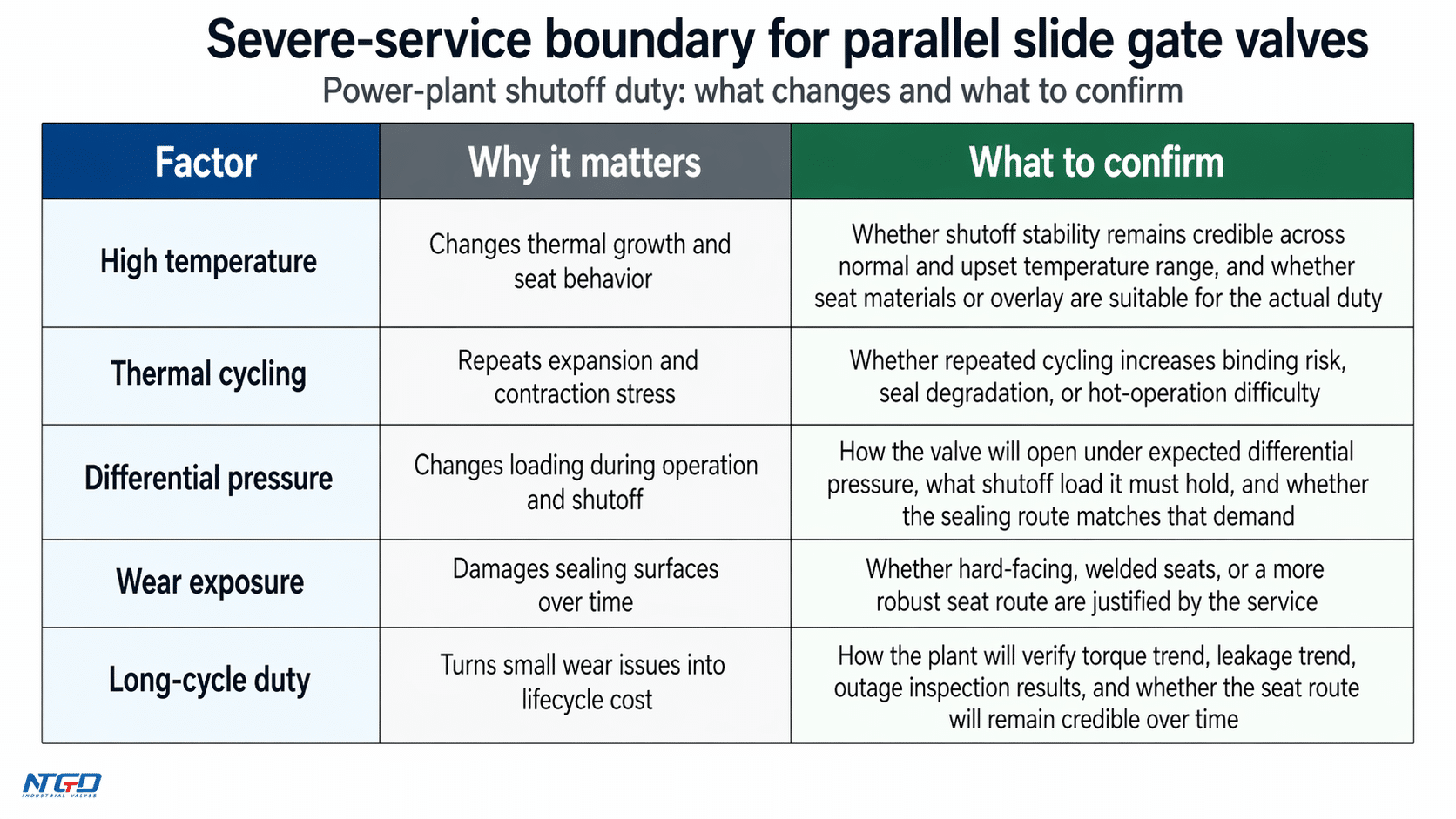
Severe-service judgment is rarely about a single variable. Thermal cycling changes internal relationships over time. Differential pressure affects opening behavior and shutoff demand. Long-cycle service turns small sealing and wear problems into maintenance cost.
Buyers commonly check whether the specification aligns with recognized design, pressure-rating, and testing frameworks such as API 600 or ASME B16.34, along with plant-specific requirements and testing expectations. Standards do not replace duty analysis, but they help confirm that the valve route being considered is grounded in recognized engineering practice.
| Severe-service factor | Why it matters | What to confirm |
|---|---|---|
| High temperature | Changes thermal growth and seat behavior | Whether shutoff stability remains credible across normal and upset temperature range, and whether seat materials or overlay are suitable for the actual duty |
| Thermal cycling | Repeats expansion and contraction stress | Whether repeated cycling increases binding risk, seal degradation, or hot-operation difficulty |
| Differential pressure | Changes loading during operation and shutoff | How the valve will open under expected differential pressure, what shutoff load it must hold, and whether the sealing route matches that demand |
| Wear exposure | Damages sealing surfaces over time | Whether hard-facing, welded seats, or a more robust seat route are justified by the service |
| Long-cycle duty | Turns small wear issues into lifecycle cost | How the plant will verify torque trend, leakage trend, outage inspection results, and whether the seat route will remain credible over time |
Lifecycle, Maintenance, and Final Fit Check
A parallel slide gate valve should not end its evaluation at “it fits the duty.” It also has to fit the plant’s maintenance reality.
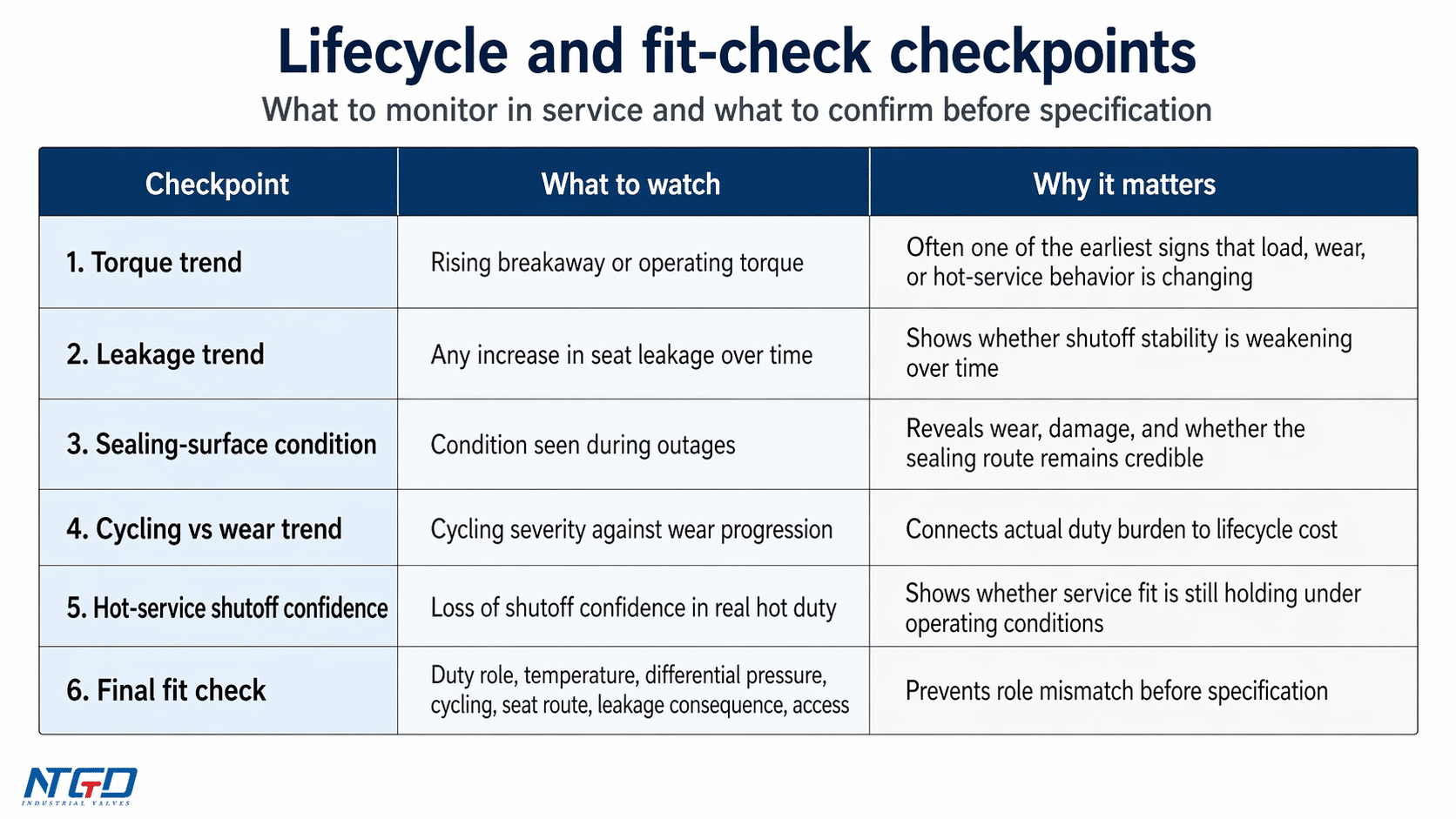
What to monitor in service
The monitoring focus should be tied to the design route, not a generic gate valve maintenance checklist. In practice, that means:
- tracking any increase in seat leakage over time,
- monitoring for gradual or sudden changes in breakaway or operating torque,
- checking sealing-surface condition during outages,
- comparing cycling severity against wear trend,
- and watching for any loss of shutoff confidence under actual hot-service conditions.
Those signals matter more than a generic instruction to lubricate parts or inspect regularly.
Maintenance burden and reliability implications
Lifecycle cost usually comes from instability, not from a single dramatic failure. A valve that becomes harder to operate, leaks more often, or needs repeated attention at critical shutoff points can create far more operating burden than the initial specification suggested.
That is why maintenance discussion belongs in the selection logic. It is not a separate housekeeping topic. The buyer is not just choosing whether the valve can work; the buyer is choosing what kind of maintenance burden the shutoff route is likely to create over time.
Final fit check before specifying this valve for power duty
Before specifying a parallel slide gate valve for power service, the buyer should follow a disciplined gate valve selection process.
| Final fit-check item | Why it matters |
|---|---|
| Is the duty primarily shutoff, not throttling? | Prevents role mismatch that can accelerate wear and weaken isolation performance |
| What are the normal and upset temperature conditions? | Affects seat route, thermal behavior, and hot-service shutoff stability |
| What differential pressure will the valve see during operation? | Changes opening demand, shutoff loading, and operability under duty |
| How severe is the cycling pattern? | Influences wear rate, hot restart behavior, and lifecycle burden |
| What seat route is appropriate for the duty? | Determines whether the sealing system is credible for severe-service reliability |
| What leakage consequence does the plant consider acceptable? | Clarifies how demanding the shutoff expectation really is |
| What maintenance access and monitoring discipline are realistic? | Connects valve selection to how the plant will actually live with the valve |
If those answers support a non-wedging shutoff route under demanding power duty, the parallel slide option becomes easier to justify. If they do not, the page should not force the reader toward it anyway. Its purpose is to avoid role mismatch, not to justify a parallel slide valve everywhere.
FAQ
1. Is a parallel gate valve the same as a parallel slide gate valve?
They are often used as closely related terms, and many industrial sources use them with substantial overlap. For selection work, the important issue is the actual sealing route and closure design, not the label alone. This page focuses on the parallel slide, non-wedging shutoff route used in demanding power service. For procurement and specification, always verify the actual sealing design rather than assuming the terminology means the same thing across suppliers.
2. How does line-pressure-assisted sealing help a parallel slide valve?
It helps reinforce seat contact as service pressure acts on the internal sealing system. That matters because shutoff behavior is not created only by forcing a wedge into place. In lower-pressure or startup conditions, spring preload helps create the initial sealing relationship before full pressure assistance is available. Line pressure then strengthens that contact as operating conditions build, so pressure assistance should be understood as a sealing enhancer, not the only source of shutoff behavior.
3. Is a parallel slide gate valve always better than a wedge gate valve?
No. The better choice depends on duty. A parallel slide route may offer advantages where thermal behavior, operating-force tendency, and shutoff stability are major concerns. But wedge gate valves remain valid and widely used. The correct comparison is duty-specific, not absolute.
4. Can a parallel slide gate valve be used for throttling?
It should not be treated as a control-oriented throttling valve just because the flow path looks favorable when open. Its main value in this context is shutoff and isolation performance. If throttling is the real duty, the buyer may need a different valve route altogether.
5. Can a parallel slide gate valve make sense in low-pressure auxiliary power-plant service?
It can, but that does not mean it is automatically the most practical choice. The core advantages of the parallel slide route become most meaningful in high-energy, high-temperature, or cycling-sensitive isolation duty. In lower-pressure auxiliary systems, a wedge gate valve may remain the more practical and economical route if the service does not justify the additional focus on non-wedging shutoff behavior.
6. What should maintenance teams pay attention to first?
Start with breakaway or operating-torque trend. A steady increase in torque is often one of the earliest signs that hot-service behavior, wear, deposit buildup, or shutoff stability is beginning to change. After that, watch leakage trend, cycling severity, and sealing-surface condition. Those signals reveal lifecycle behavior far earlier than a generic maintenance checklist.
7. When should seat route and hard-facing receive extra attention?
Give them extra attention whenever the valve will see high temperature, repeated thermal cycling, differential pressure, or wear-sensitive service. Under those conditions, seat route stops being a secondary specification detail and becomes part of the shutoff-reliability decision.
Conclusion
A parallel slide gate valve earns its place in power-plant service when the duty calls for dependable shutoff under demanding conditions and the sealing route matters as much as the valve category. The design should be understood as a non-wedging isolation route, not as a generic better gate valve and not as a control-valve substitute.
The most useful way to judge it is to work from the duty outward: define the shutoff role, examine the sealing mechanism, map the actual steam or feedwater service, compare it honestly against wedge behavior, and then confirm whether the seat route and lifecycle burden support the choice. In practice, this valve is most justified in high-pressure, high-temperature, or frequently cycled isolation duties where shutoff stability and hot-service behavior are top priorities. For more general isolation service, less thermally severe duty, or lines where existing plant standards favor wedge interchangeability, a wedge gate valve may still remain the more practical route.
Final Application Check
If you are reviewing a high-pressure steam, boiler feedwater, or turbine-isolation duty and need to confirm the sealing route, cycling fit, or boundary between parallel slide and wedge gate valves, NTGD Valve can support a duty-specific fit check and specification review before you finalize the valve direction.
