
The difference between solid wedge gate valve and flexible wedge gate valve is not a naming detail. It changes what happens when shutoff geometry stops behaving like an ideal drawing and starts reacting to real service conditions. In practice, buyers get into trouble when a rigid wedge route is specified for a duty that needs more tolerance for thermal change, seat relationship drift, or difficult reopening after closure.
For most isolation duties, the split is straightforward:
- A solid wedge gate valve is the cleaner route when the service keeps shutoff geometry stable and predictable.
- A flexible wedge gate valve becomes more attractive when thermal variation or slight seat movement makes rigid seating less tolerant.
- If the service does not need that extra tolerance, treating flexible as the default “better” option can add cost and route complexity without improving the outcome.
| Decision factor | Solid wedge direction | Flexible wedge direction | Why it matters |
|---|---|---|---|
| Service stability | Better fit when pressure, temperature, and geometry stay predictable | Better fit when conditions move during operation | Service movement changes selection risk. The less stable the duty, the more tolerance becomes a real engineering need. |
| Seat relationship | Favors stable seat alignment | Favors services where slight seat drift can occur | When the seat relationship moves, shutoff behavior can shift with it. That directly affects sealing consistency. |
| Thermal response | Less tolerant of thermal distortion or rapid change | More tolerant of moderate thermal change and seat variation | Thermal change can alter wedge-to-seat contact and raise gate valve thermal binding exposure if the route depends on rigid geometry. |
| Reopening risk | More sensitive to distortion after closure | More tolerant where thermal movement is expected | Reopening force, sticking risk, and post-shutoff operability matter just as much as initial closure. |
| Maintenance logic | Simpler route if service remains stable | Can reduce wrong-fit maintenance exposure in variable service | Maintenance burden is shaped by service fit. A route mismatch creates troubleshooting, rework, and avoidable downtime exposure. |
| Buying logic | Strong choice when simplicity matches the duty | Strong choice when tolerance is worth paying for | Service fit outranks label-driven buying. The right route is the one that matches the duty, not the one that sounds more advanced. |
Solid vs. Flexible Wedge Gate Valves: The Primary Selection Boundary
The primary selection boundary is not price, not generic robustness, and not which valve sounds more sophisticated in a catalog. It is whether the valve will operate in an isolation service where shutoff geometry stays stable, or in a service where temperature change, seat movement, or line distortion makes rigid seating more sensitive to disturbance.
A solid wedge gate valve is the better direction when the seating relationship remains predictable enough for a rigid one-piece wedge to shut off cleanly without needing compensation from the closure element itself.
A flexible wedge gate valve becomes more attractive when the service is not static. If the valve is expected to see temperature swings, thermal expansion effects, or slight shifts in seat relationship, the flexible route can offer more sealing tolerance and lower post-shutoff operability risk.
What changes the choice more than price or simplicity
Cost still matters, but it should not lead the decision. A lower-cost wedge route that does not tolerate the actual service is not a cheaper answer once sticking, sealing inconsistency, or repeated maintenance review enters the picture.
The more useful question is this: Will the valve see enough thermal or geometric variation to punish a rigid seating relationship? If yes, flexible deserves serious consideration. If no, solid may remain the cleaner and more economical route.
When stable service favors one route, and when changing conditions favor the other
Stable service favors solid wedge logic because the design does not need to compensate for much movement. Changing service favors flexible wedge logic because the design is intended to tolerate a degree of variation instead of assuming ideal geometry all the time.
In practical buyer language, the selection line is simple: solid rewards stable geometry; flexible rewards tolerance to change.
How the Wedge Route Changes Sealing Behavior, Thermal Response, and Reopening Risk
The solid wedge vs flexible wedge sealing difference is not cosmetic. It comes from the wedge-to-seat sealing mechanics, the thermal response of the closure route, and what happens after shutoff when service conditions move away from geometric ideality.
A solid wedge uses a rigid one-piece closure element. That simplicity is valuable when the body, seats, and wedge maintain a predictable relationship. The trade-off is that the route is more dependent on geometry remaining where the design expects it to be.
A flexible wedge uses a groove or comparable design feature to permit limited elastic movement in the wedge. That does not make it universally better. It means the route can absorb a degree of seat relationship drift or thermal effect that would otherwise be transferred more directly into a rigid shutoff condition.
For the common opening-and-closing sequence behind both designs, see NTGD’s guide to gate valve wedge movement and seating, including stem travel, closure movement, and final seat contact.
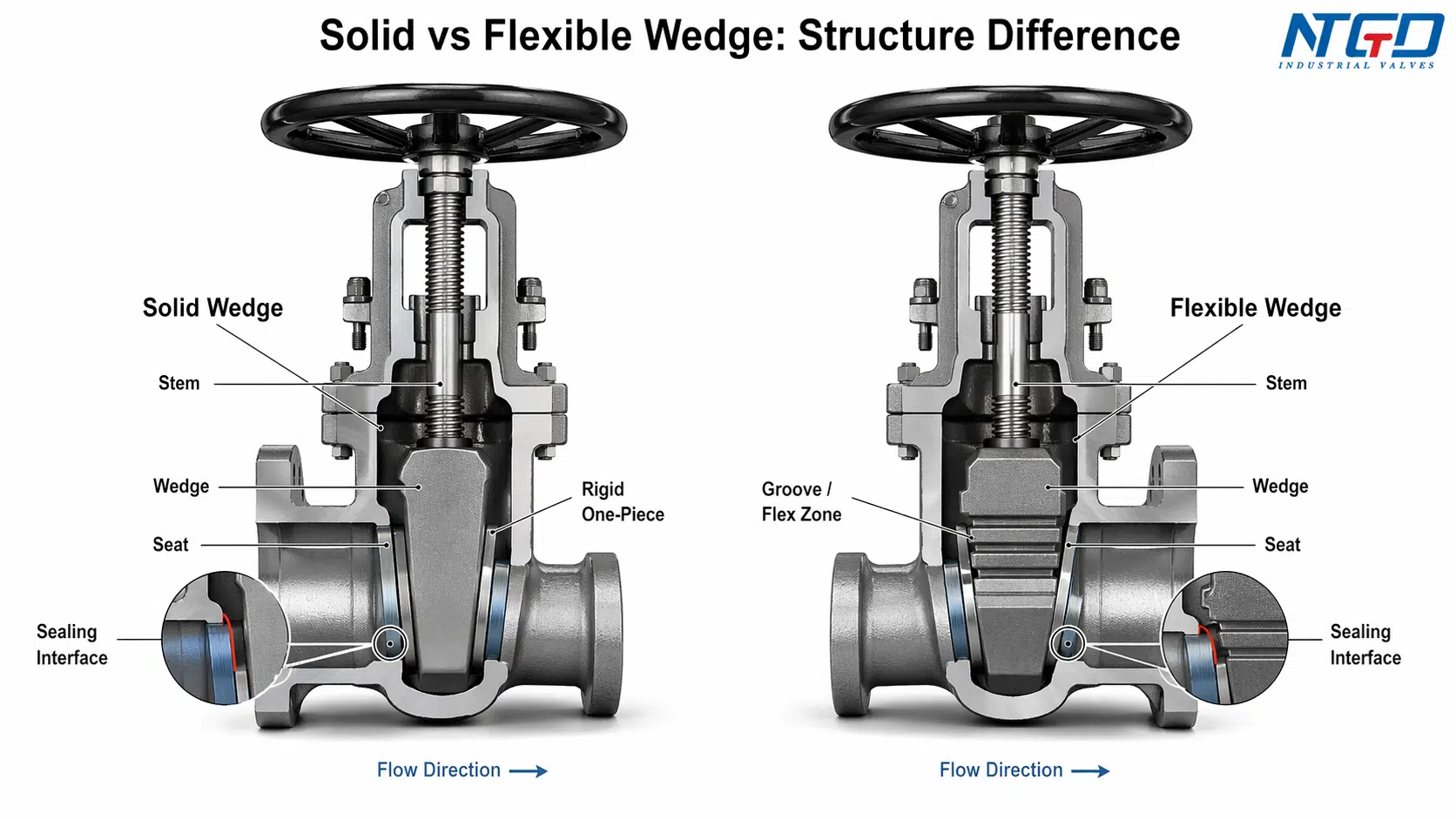
Rigid one-piece wedge: geometry dependence and sealing stability
The strength of a solid wedge route is that it stays straightforward when the service stays straightforward. In a stable system, the rigid wedge can seat predictably and shut off cleanly with fewer closure-element variables.
The weakness appears when service conditions disturb the seating relationship. A rigid wedge does not compensate for that disturbance. If temperature gradients, body distortion, or seat movement alter the contact geometry enough, the result may be higher seating stress, less consistent shutoff behavior, and harder operation after closure.
That is why a solid wedge gate valve should be understood as a more geometry-dependent route, not simply as a stronger valve.
Grooved flexible wedge: compensation logic under thermal or seat variation
The value of a flexible wedge is not that it is “more advanced” in a marketing sense. Its value is that the wedge route has a limited ability to absorb seat relationship drift, thermal variation, and small changes in shutoff geometry that can otherwise punish a rigid seating condition.
In selection terms, that compensation matters when the valve cycles through temperature changes, when the seat relationship is not perfectly static, or when thermal growth makes shutoff geometry less predictable at the moment of closure.
This is the mechanism behind the common field conclusion that flexible wedge routes often perform better under changing conditions. The benefit does not come from a generic label. It comes from the fact that the closure route is less dependent on perfect geometric stability at shutoff.
Why thermal binding, jamming, and reopening difficulty occur
Gate valve thermal binding matters because it affects valve usability after shutoff, not just shutoff itself.
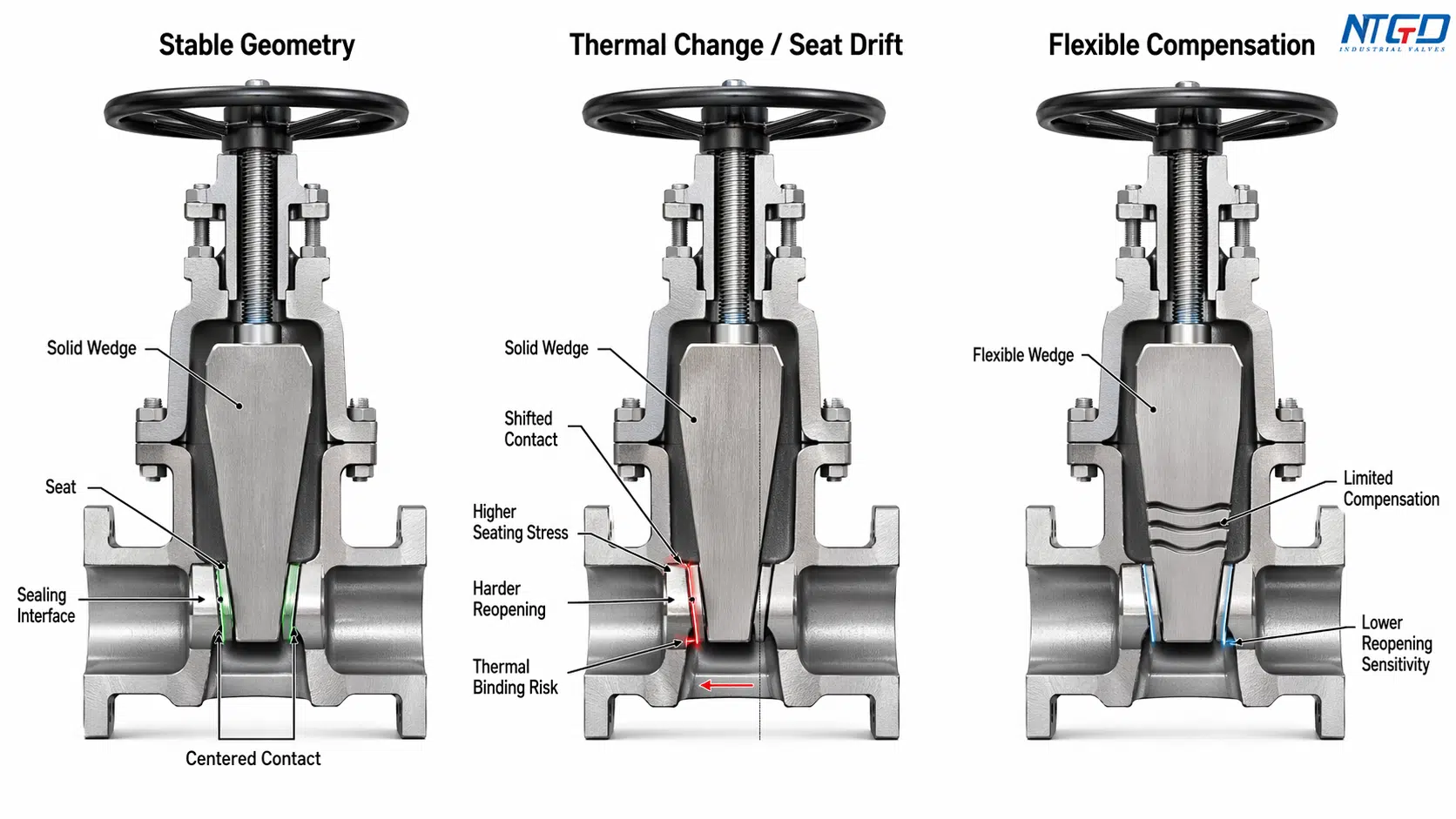
When temperature change alters the relationship between wedge and seat, the valve can become harder to reopen or may require significantly more breakaway effort after closure. In a rigid wedge route, that risk rises when thermal change or distortion creates more geometry shift than the seat relationship can comfortably absorb.
A flexible wedge does not eliminate all reopening difficulty. What it can do is reduce sensitivity to moderate thermal or seating variation in services where that variation is part of normal operation.
In practical terms, this means a wedge route that looked acceptable on a cold or idealized basis may become much less comfortable to operate after thermal soaking or system movement. That is why thermal binding should be read as a selection-relevant service risk, not just a maintenance phrase.
Where a Solid Wedge Gate Valve Fits Best—and Where It Becomes Less Tolerant
Among common solid wedge gate valve applications, the best fits are services where the valve can rely on stable shutoff geometry. That generally means cleaner service, more predictable operating conditions, and a seat relationship that is not expected to move materially during normal duty.
That is the narrower and more accurate statement. A solid wedge should not be described as the automatic answer for every severe or high-temperature service. A better statement is this: it is a strong fit when the duty is demanding but still stable enough to preserve predictable seating behavior.
Service conditions that favor a solid wedge
A solid wedge gate valve is usually the stronger direction when:
- shutoff duty is the main task
- temperature change is limited or predictable
- seat relationship is expected to remain stable
- service cleanliness supports repeatable seating
- design simplicity and lower initial cost are real advantages
That can include many utility, process isolation, and general shutoff services where service variability is not the dominant engineering risk.
Conditions where a solid wedge loses tolerance
A solid wedge becomes less tolerant when the service asks for more compensation than the rigid route is designed to provide.
Watch for these conditions:
- meaningful thermal cycling
- temperature change that alters shutoff geometry
- greater sensitivity to seat movement or distortion
- higher concern about reopening force after shutoff
- operating conditions where geometry stability cannot be assumed
In those duties, the issue is not that the solid wedge is weak. The issue is that the service is asking a rigid seating route to absorb change it was not meant to absorb.
| Service condition | Solid wedge direction | Why |
|---|---|---|
| Clean, stable shutoff duty | Strong fit | Predictable geometry supports repeatable rigid seating. |
| Predictable temperature profile | Strong fit | The route does not need much compensation logic. |
| Stable seat relationship | Strong fit | Shutoff performance depends on geometry staying consistent, and that condition is present. |
| Frequent thermal change or distortion risk | Weaker fit | The route becomes more sensitive when shutoff geometry shifts during service. |
| High concern about sticking after shutoff | Weaker fit | Reopening exposure rises when rigid contact must absorb thermal or geometric change. |
Where a Flexible Wedge Gate Valve Fits Best—and Why It Is Not the Default Better Option
Among common flexible wedge gate valve applications, the best fits are services where the wedge route must remain effective even when thermal change or slight seat variation makes shutoff less static than an ideal case.
That does not make flexible the default better option. It makes flexible the better option when the service actually needs more tolerance in the closure route.
Service conditions that favor a flexible wedge
A flexible wedge gate valve becomes more attractive when:
- the service sees meaningful temperature variation
- thermal expansion can affect seat relationship
- sealing tolerance under changing conditions matters
- reopening behavior after shutoff is a practical concern
- the duty profile is less geometrically stable than a simple utility isolation case
This is why flexible wedge routes are frequently discussed in hot-water, steam-adjacent, or other thermally variable isolation services. Their value comes from compensation under change, not from a generic “better valve” label.
The negative boundary: where flexibility does not mean universal suitability
This is the point many comparison pages miss: flexibility is not a free upgrade.
If the service is already stable, clean, and predictable, a flexible wedge may add cost and route complexity without changing the shutoff result in any meaningful way. The buyer pays for tolerance that the service may never ask the valve to use.
The same logic applies when buyers assume “more tolerant” automatically means “safer.” It does not. If the service does not create meaningful thermal or geometric instability, the flexible route may solve a problem that is not actually present.
For dirty, deposit-prone, or otherwise difficult duties, the answer should not be forced from a slogan in either direction. Those services still require closer review of actual closure behavior, service history, and application details.
So the real comparison is not “solid versus improved solid.” It is stable-service efficiency versus variable-service tolerance.
| Service condition | Flexible wedge direction | Why |
|---|---|---|
| Thermal variation is expected | Strong fit | Compensation becomes relevant when service movement is part of normal duty. |
| Seat relationship may drift slightly | Strong fit | The route is more tolerant of moderate change at shutoff. |
| Reopening after shutoff is a concern | Strong fit | Lower sensitivity to thermal disturbance can improve post-shutoff operability. |
| Service is already stable and predictable | Not automatically better | Extra tolerance may add little practical value if geometry already remains stable. |
| Buyer assumes “more flexible means universally safer” | Wrong comparison | Route value must be proven by service need, not by label. |
What Happens When the Wrong Wedge Route Is Chosen
A wrong wedge-route choice does not stay on paper. It shows up in shutoff behavior, reopening effort, maintenance exposure, and how much time the team spends diagnosing a valve that was misfit before it was ever called a maintenance issue.
A familiar field symptom is a valve that closes acceptably in one condition and then reopens reluctantly after the system thermally settles. That is not automatically proof of weak manufacture. It may be proof that the selected wedge route did not match the service boundary.
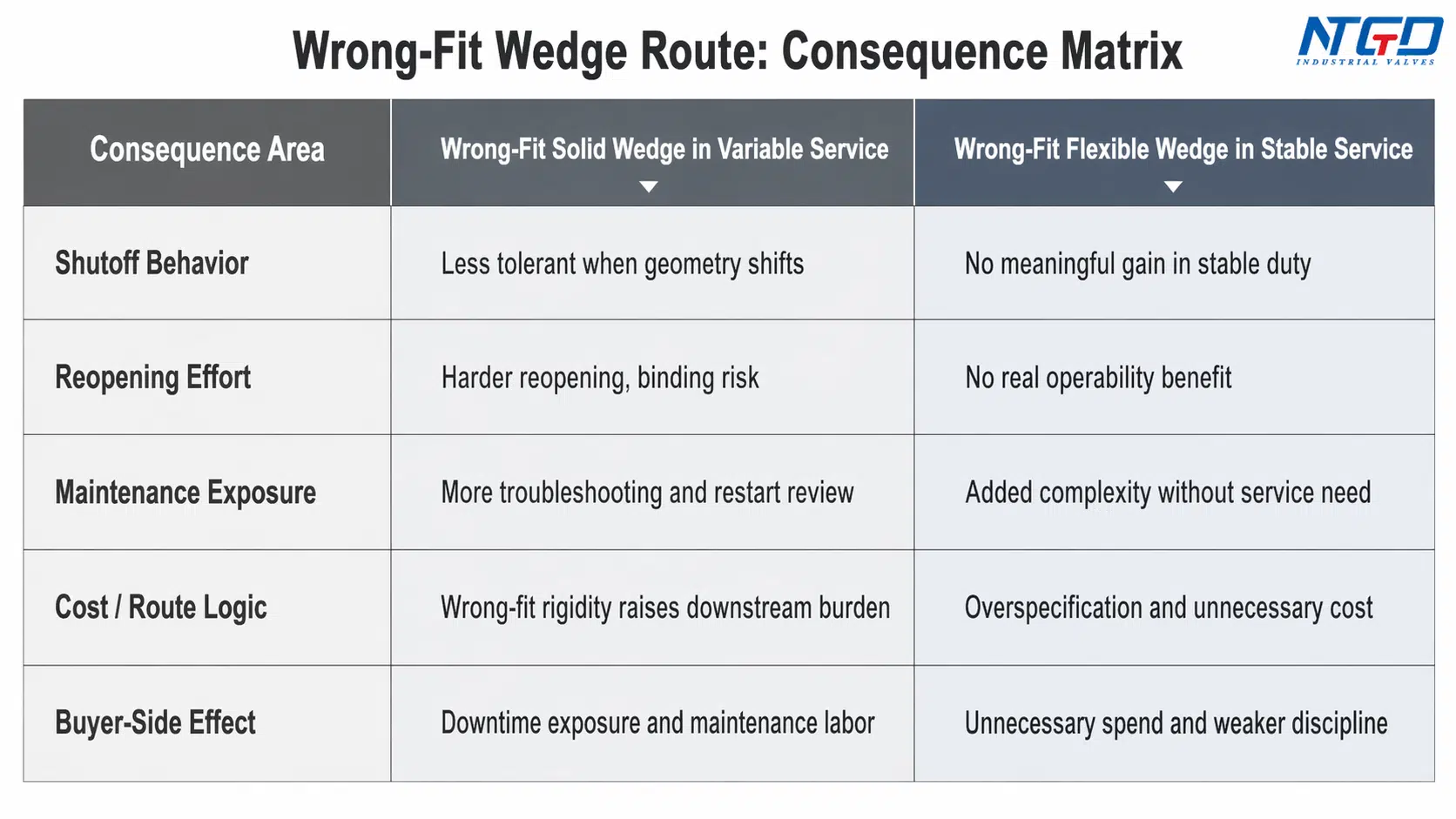
What can go wrong when a solid wedge is used in a low-tolerance service
A wrong-fit solid wedge can show up as:
- higher reopening force after thermal change
- greater sensitivity to seat relationship drift
- less consistent shutoff under distortion
- higher exposure to sticking or gate valve thermal binding after closure
- maintenance effort driven by service mismatch rather than poor build quality
For the buyer, that can mean more troubleshooting, more review of actuator or operating margin, and more downtime exposure during restart or recovery activity.
The common mistake is to describe these as random failures. Many are selection failures first and maintenance problems second.
What can go wrong when a flexible wedge is treated as the safer default
A wrong-fit flexible wedge shows up differently:
- higher cost with little improvement in service outcome
- added route complexity where a stable service did not need it
- weaker buying discipline because the route was chosen by label rather than service condition
- poorer clarity about the real cause if later operating issues appear
For the buyer, that means overspecification without corresponding performance benefit. The issue is not that flexible was wrong in principle. The issue is that service variation was never shown to make its compensation value relevant.
| Wrong-fit route | Typical consequence | Buyer-side effect |
|---|---|---|
| Solid wedge used where geometry does not stay stable | Binding, harder reopening, less tolerant shutoff | More troubleshooting, higher restart risk, and more maintenance labor tied to wrong service fit |
| Flexible wedge chosen by default in a stable service | Cost and route complexity without meaningful gain | Overspecification, weaker selection discipline, and unnecessary spend |
| Either route chosen by label rather than service | Poor fit, confusing maintenance history, weak lifecycle result | Time lost diagnosing a selection mismatch that should have been screened earlier |
Lifecycle and Maintenance Trade-Offs Before Final Selection
A useful comparison does not stop at which route looks simpler on a datasheet. The lifecycle question is whether the selected wedge route keeps maintenance exposure low after startup, thermal change, and repeated shutoff demand begin revealing how stable the service really is.
A solid wedge can be the lower-burden route when the service stays stable. In that case, simplicity keeps its value because the valve is not being asked to absorb recurring thermal or geometric disruption.
A flexible wedge can be the lower-burden route when service variation is significant enough that wrong-fit rigidity would create repeated operating difficulty. In that case, additional tolerance can reduce downstream disruption even if the route is not the cheapest upfront.
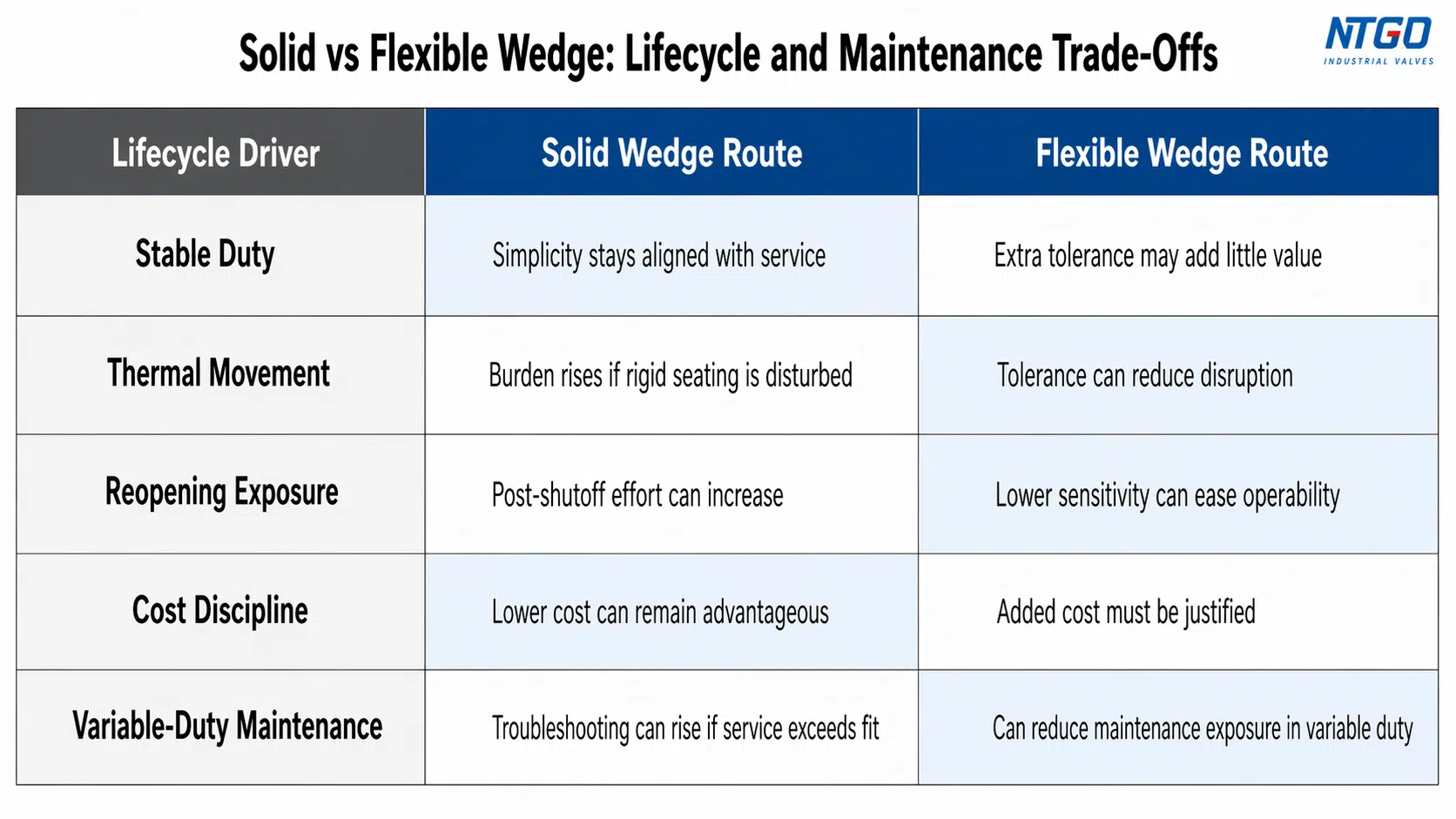
Simplicity is not always the same as lower lifecycle exposure
Simple geometry is an advantage only when it matches the service. If the service punishes rigid seating behavior, the lower-cost route can become the more expensive route over time.
Lifecycle logic therefore has to stay tied to service fit, not to a generic belief that fewer closure-element variables always mean less risk.
How service stability changes maintenance burden
Lifecycle exposure is shaped by:
- whether stable duty preserves repeatable shutoff without recurring troubleshooting
- whether thermal movement pushes reopening effort into a more sensitive range
- whether the selected route avoids overspecification in stable service
- whether the duty pattern keeps long-term operability aligned with the route chosen
| Lifecycle driver | Solid wedge route | Flexible wedge route |
|---|---|---|
| Repeated shutoff in a stable duty | Often favorable because simplicity stays aligned with service reality | Extra tolerance may not materially change lifecycle outcome |
| Reopening exposure after thermal movement | Operating burden can rise if rigid geometry is disturbed | Added tolerance may reduce wrong-fit operability issues |
| Cost discipline in a predictable service | Lower initial cost can remain a true lifecycle advantage | Added route cost may not return value if service remains stable |
| Maintenance exposure in a variable-duty service | Troubleshooting and restart review can rise if service exceeds fit | Can lower lifecycle disruption when service variation makes tolerance useful |
Final Fit-Check: How to Choose the Right Wedge Route for Your Service
At this stage, the question should no longer be “Which one sounds better?” It should be “Which route matches the service boundary I actually have?”
Use the following fit-check before final selection.
A service-condition checklist before final selection
| Fit-check question | If the answer trends this way | Likely direction |
|---|---|---|
| Does the valve operate in a geometrically stable shutoff service? | Yes | Lean solid wedge |
| Does the service see meaningful thermal change or cycling? | Yes | Lean flexible wedge |
| Is seat relationship expected to stay predictable? | Yes | Lean solid wedge |
| Is sealing tolerance under changing conditions a key concern? | Yes | Lean flexible wedge |
| Is reopening after thermal disturbance a practical concern? | Yes | Lean flexible wedge |
| Is the main buying priority simplicity in a stable service? | Yes | Lean solid wedge |
| Is the buyer assuming flexible is automatically better without proving service need? | Yes | Recheck the basis before choosing |
When to stay with solid, when to move to flexible
The screening order matters.
Start with geometry stability. If shutoff geometry stays predictable, the argument for solid remains strong. Next check thermal variation and seat relationship movement. If either one materially affects the closure condition, flexible deserves closer consideration. Only after those screens are clear should simplicity be treated as a deciding advantage.
Stay with a solid wedge gate valve when stable geometry makes rigid seating predictably effective and when the extra tolerance of a flexible route would not materially improve the shutoff result.
Move toward a flexible wedge gate valve when the service introduces enough thermal or geometric variability that rigid seating becomes more sensitive and compensation becomes practically valuable.
The fit-check should end there: screen service movement first, then choose the route whose level of tolerance actually matches it.
FAQ
1) What is thermal binding in a gate valve?
Thermal binding is a condition where temperature change alters the wedge-to-seat relationship enough to make the valve harder to reopen after shutoff. In this comparison, it matters because a rigid wedge route is more dependent on stable geometry than a flexible wedge route.
2) Is a flexible wedge gate valve always better for high-temperature service?
No. High temperature by itself does not decide the route. The more important question is whether the service creates enough thermal change, seat movement, or reopening risk to make compensation valuable. Stable high-temperature service and thermally variable service are not the same selection case.
3) Can a solid wedge gate valve still be the right choice in a high-pressure service?
Yes. Pressure alone does not move the decision toward flexible. A solid wedge gate valve can still be the right choice if the service remains geometrically stable and does not create the kind of thermal or seating variation that would make rigid shutoff more sensitive.
4) Does a flexible wedge gate valve always require more maintenance?
No useful comparison can be made from the label alone. In a stable duty, a flexible wedge may add cost without reducing lifecycle exposure. In a changing duty, that same tolerance may reduce wrong-fit operating trouble and lower maintenance burden over time.
5) Should I choose between solid and flexible wedge gate valves mainly by price?
No. Price is a secondary filter. The first filter is service fit. A lower-cost route that does not tolerate the actual operating condition can create more cost later through harder reopening, sealing inconsistency, or avoidable maintenance exposure.
6) How do solids, dirty media, or deposit-prone services affect the decision?
They should trigger a deeper application review, not a faster label-based decision. In those services, the key question is whether deposits, entrainment, or difficult closure behavior could make one wedge route more vulnerable to sealing damage or operating difficulty than the other. That review has to be tied to actual duty, not to a simplified “solid versus flexible” slogan.
7) Can you switch from a solid wedge route to a flexible wedge route without rechecking the service boundary?
No route change should be treated as a label swap only. If you move from solid to flexible, you should recheck service stability, thermal behavior, seat relationship risk, and specification basis to confirm that the added tolerance solves a real duty problem rather than introducing unnecessary complexity.
Conclusion
The difference between solid wedge gate valve and flexible wedge gate valve is a service-fit decision, not a naming preference. One route asks the service to stay stable enough for rigid shutoff predictability to remain reliable; the other is selected because the duty needs more tolerance when temperature, seat relationship, or reopening exposure move away from ideal geometry. If the service preserves stable shutoff conditions, solid remains the disciplined answer. If it does not, flexible earns its place. The better choice is the one that matches the real service boundary before specification locks the route in.
Final Application Check
If your team is deciding between a solid wedge gate valve and a flexible wedge gate valve for an isolation duty, submit the service conditions for an application check. NTGD valve engineers can review service stability, thermal behavior, reopening risk, and specification basis so the final selection reflects the real duty rather than a default assumption.
