
Nombre del autor: Bruce Zheng
Función del autor: Cofundador e ingeniero de válvulas en NTGD Valve
Biografía del autor: Bruce Zheng es cofundador e ingeniero de válvulas en NTGD Valve, donde se dedica a la selección y aplicación de válvulas industriales, así como a la elaboración de contenido técnico para compradores B2B de todo el mundo.
Última actualización: 10 de junio de 2026
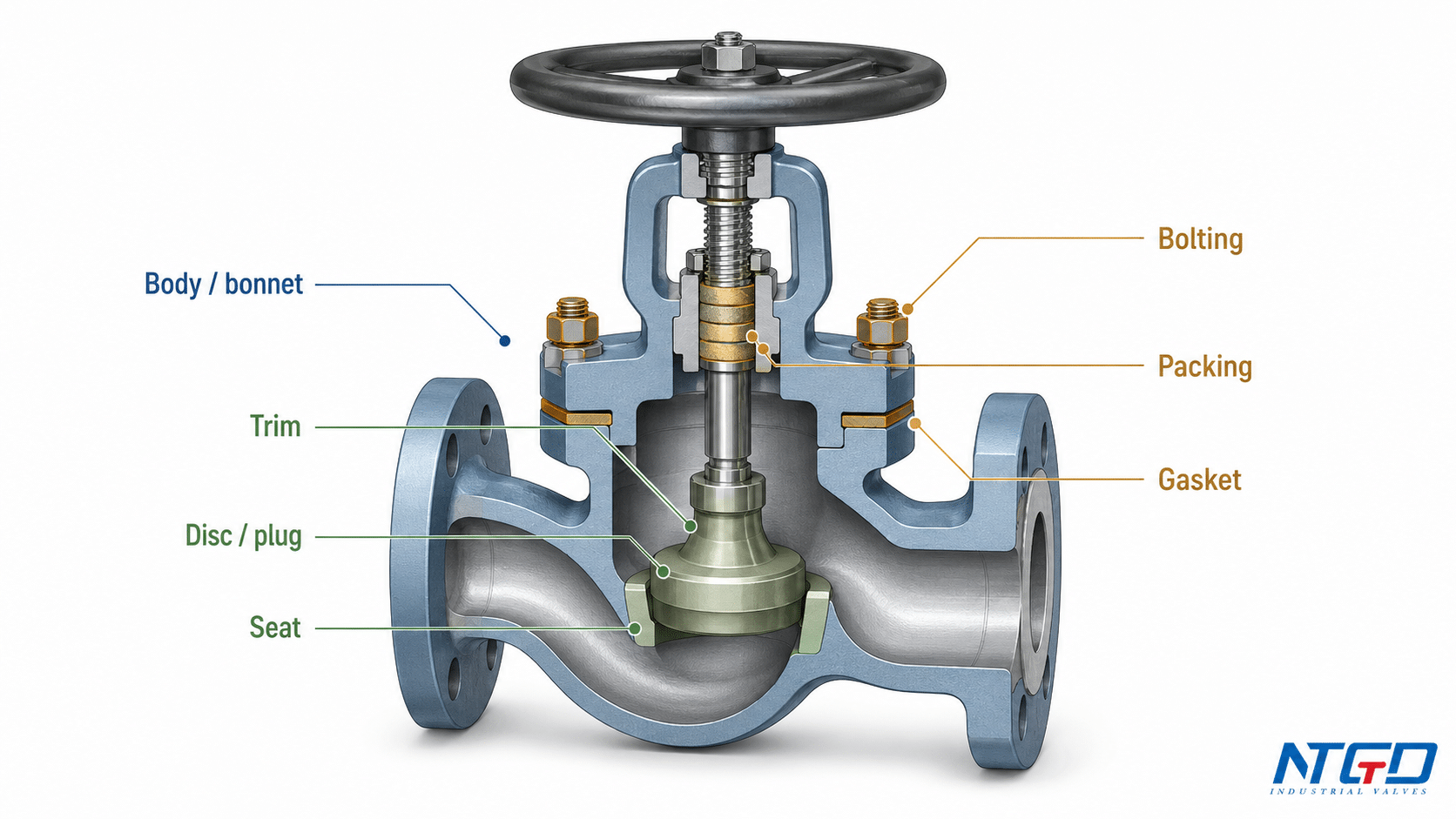
Globe valve materials should be selected as a complete material package, not as a single body material. For an industrial globe valve, the body and bonnet define the pressure boundary, the trim handles flow contact and throttling wear, the seat supports shutoff, and the packing, gasket and bolting must remain compatible with the service conditions.
In practical globe valve material selection, the most important inputs are the fluid media, pressure, temperature, corrosion risk, erosion risk, throttling duty, shutoff requirement, applicable standard and project specification. A carbon steel globe valve body may be suitable for many general industrial services, but it may not be enough for corrosive media, high-temperature service, sour service, abrasive flow or leakage-sensitive applications. Likewise, a stainless steel body does not automatically solve every trim, seat, packing or gasket problem.
This guide explains how to review globe valve materials from a project specification point of view. It focuses on body, bonnet, trim, seat and sealing-related materials. It does not replace a detailed globe valve trim selection guide, a soft seat vs metal seat guide, an API trim chart or a product datasheet.
Quick Answer: How to Select Globe Valve Materials
The short method is to select the globe valve body material first for pressure, temperature and media compatibility, then confirm the trim, seat, packing, gasket and bolting materials according to flow contact, shutoff, corrosion, erosion and leakage requirements.
Una forma práctica de seleccionarlo es:
- Start with the service media. Confirm whether the fluid is clean, corrosive, abrasive, toxic, steam, oil, gas, chemical or mixed-phase.
- Check pressure and temperature. These conditions affect the body, bonnet, bolting, gasket, seat and packing.
- Select the body and bonnet material. This is the main pressure-retaining material choice.
- Confirm trim material. The disc, stem, seat surface and related trim areas may need better wear, corrosion or throttling resistance than the body.
- Confirm seat and sealing materials. Shutoff performance, temperature and leakage risk often depend on the seat, packing and gasket package.
- Match the full material of construction to the project specification. The final choice should be checked against the datasheet, applicable standards and service conditions.
The short selection logic
For many industrial projects, the basic logic is:
| Selection layer | Main question | Typical material direction |
|---|---|---|
| Carrocería / capó | Can the valve safely contain the pressure and temperature of the service? | Carbon steel or cast steel may suit general service; stainless steel may be reviewed for corrosion resistance; alloy or special materials may be needed for high-temperature, high-pressure or severe service. |
| Trim / disc / stem | Can the internal working parts resist wear, corrosion and throttling contact? | Stainless steel trim may suit moderate service; hardfacing or corrosion-resistant trim may be needed for throttling, abrasive, erosive or corrosive service. |
| Asiento | Can the valve provide the required shutoff under the service conditions? | Metal seats, soft seats, hardfaced seats or corrosion-resistant seating surfaces should be selected according to shutoff requirement, temperature, media and service severity. |
| Empaque / junta | Can the sealing materials tolerate the fluid and temperature? | Graphite, PTFE-based materials, elastomers, spiral wound gaskets or project-specific sealing materials may be reviewed according to temperature, pressure and media compatibility. |
| Atornillado | Can the bolting match the pressure boundary and temperature requirement? | Carbon steel, alloy steel, stainless steel or specified bolting grades should match the body / bonnet pressure-temperature service and corrosion environment. |
In most projects, the body and bonnet material first define the pressure-temperature envelope of the valve. However, in throttling, abrasive, corrosive, tight-shutoff or leakage-sensitive service, the trim, seat, packing or gasket may drive the full material package upgrade even after the body material looks acceptable.
The exact material limits depend on the valve design, pressure class, temperature, standard, manufacturer construction and project specification.
Qué incluye esta guía y qué no incluye
This article covers the overall globe valve material package: body, bonnet, trim, seat, packing, gasket, bolting and service condition mapping.
It does not provide a full API trim chart, a complete seat material comparison, a globe valve parts guide, a product catalog or a price guide. Those topics require separate pages or project-specific datasheets.
What Is Included in a Globe Valve Material Package?
A globe valve material package includes all materials that affect pressure containment, flow control, shutoff, sealing and long-term compatibility with the service. In many RFQs and datasheets, this may be described as the valve material of construction.
The material package can be understood as several functional layers working together: the pressure boundary, the flow-contact and throttling parts, and the shutoff / sealing package. A weakness in any one layer can affect the final valve fit.
If the reader needs a component-level refresher before reviewing materials, the Guía de piezas y componentes de válvulas de bola can be used as the supporting reference, while this page stays focused on material selection.
For a basic inquiry, buyers often focus only on the globe valve body material. That is understandable, because the body is the largest pressure-retaining part. However, the body material alone does not confirm whether the valve will perform well in throttling service, corrosive media or leakage-sensitive applications.
Body and bonnet materials
The body and bonnet form the pressure boundary of the valve. Their material must be suitable for the design pressure, temperature, fluid and applicable standard. Common choices may include carbon steel, cast steel, stainless steel, cast iron, ductile iron, bronze, alloy steel or special alloys.
In industrial service, the body material is usually the first material decision because it affects the valve’s pressure-temperature suitability and basic compatibility with the pipeline system. Body material selection should be reviewed as part of the pressure-boundary package, not as an isolated casting or forging choice.
Trim, disc and stem materials
The trim is the set of internal parts that interact with the flow and shutoff area. In a globe valve, this usually includes the disc or plug, seat or seating surface, stem and related internal contact surfaces.
Trim materials must resist corrosion, erosion, galling, throttling wear or high-velocity flow contact under the actual flow conditions. In some applications, the trim material is more critical to performance than the body material because the trim is exposed to flow restriction and sealing contact.
This article gives an overview of trim material responsibility. Detailed trim selection, API trim numbers and disc-seat-stem combinations should be handled in a dedicated trim selection review.
Seat, packing, gasket and bolting materials
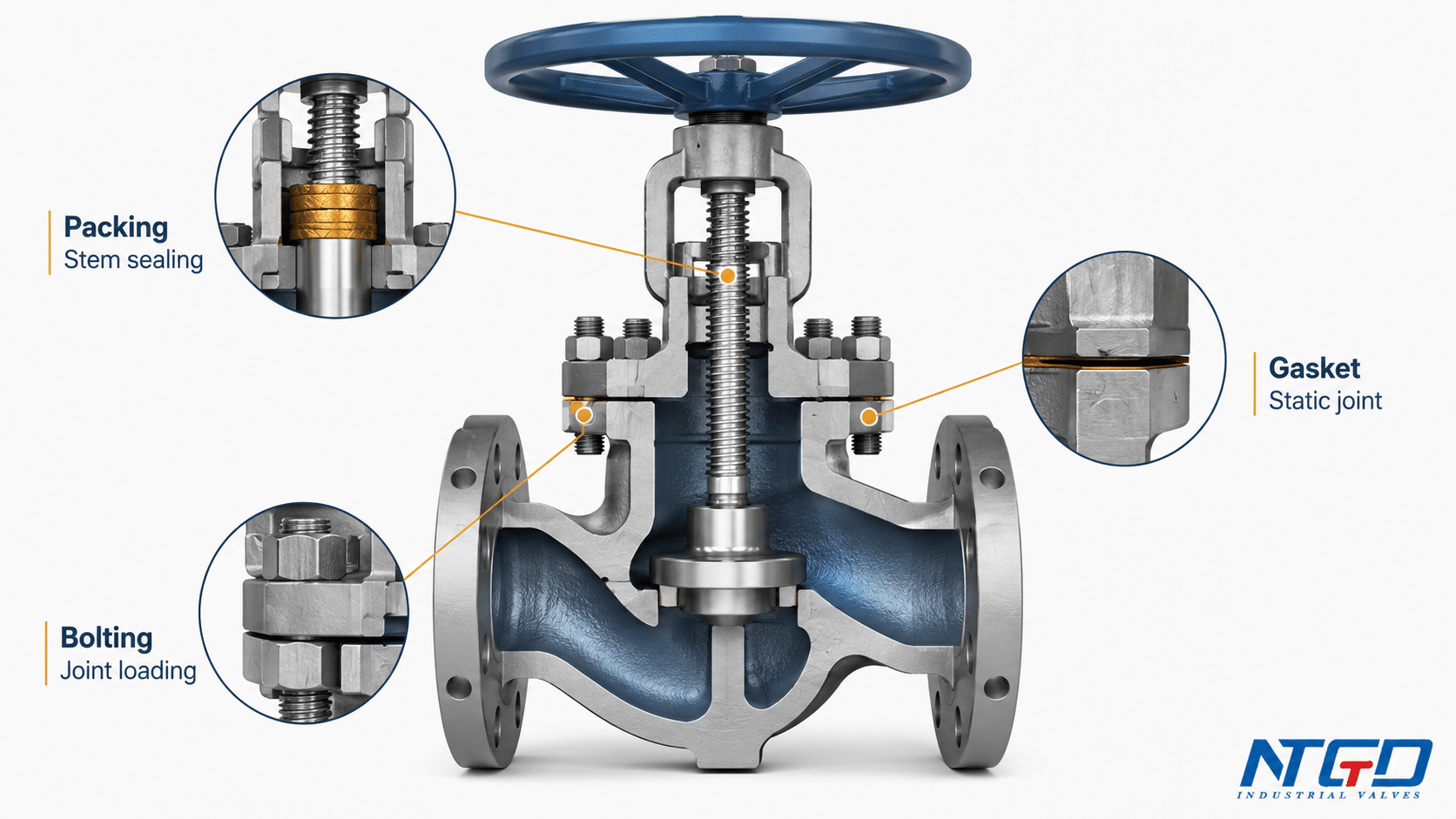
The seat controls the shutoff interface. Packing controls stem sealing. Gaskets seal body-bonnet or flange interfaces. Bolting holds the pressure boundary together.
These materials are sometimes treated as secondary details, but they can become critical in high-temperature, corrosive, sour, abrasive, toxic or leakage-sensitive service. A valve may have a suitable body material but still fail to meet the application if the seat, packing, gasket or bolting is not compatible with the media, temperature and joint loading requirements.
Globe Valve Body and Bonnet Materials: Pressure Boundary Selection
The globe valve body material should be selected first because the body and bonnet contain the pressure. They must match the operating pressure, temperature, fluid media, pipe class and project specification.
In normal engineering review, the body material is not selected only by “stronger” or “more expensive.” It is selected by service fit.
Why body material is selected first
The body and bonnet are pressure-retaining parts. If the body material is not suitable for the service, changing only the trim or seat will not solve the main pressure-boundary problem.
Body material affects:
- pressure-temperature suitability;
- corrosion resistance against the process media;
- compatibility with the piping material;
- suitability for cast, forged or fabricated construction;
- body-bonnet sealing requirements;
- bolting and gasket selection;
- inspection and specification requirements.
For general industrial service, carbon steel or cast steel may be common. For corrosive media, stainless steel or special alloys may be required. For some low-pressure utility services, cast iron or ductile iron may be considered if allowed by the project specification. For high-pressure or high-temperature service, forged or alloy materials may be reviewed depending on valve size, class and design.
For body construction decisions, especially when pressure class, size and manufacturing route affect the material package, compare Válvulas de globo de acero fundido frente a acero forjado before finalizing the body / bonnet specification.
How pressure, temperature and media affect body material
Pressure and temperature define the loading conditions for the pressure boundary. Media defines the chemical and physical compatibility risk.
A body material that works in clean water may not work in a corrosive chemical. A material that is acceptable at moderate temperature may not be suitable at higher temperature. A material that resists corrosion may still require trim, gasket or bolting changes if the service includes high velocity, flashing, erosion or sour gas.
If the media contains corrosive constituents, sour-service risk, high chloride content, abrasive solids or special contaminants, the body material should be rechecked before the valve specification is finalized. If the pressure-boundary material is mismatched to the service, later trim or seat changes usually cannot correct the fundamental body / bonnet selection problem.
The body material should therefore be checked together with:
- design pressure and operating pressure;
- design temperature and operating temperature;
- pressure class or rating;
- fluid chemistry;
- corrosion allowance or corrosion risk;
- cyclic operation or thermal cycling;
- inspection, testing and standard requirements.
Body, bonnet, gasket and bolting as a pressure-boundary package
The body and bonnet do not work alone. The gasket and bolting help maintain the pressure boundary. If the body and bonnet are selected for a severe service but the gasket or bolting is not suitable, the valve may still face leakage, relaxation, corrosion or joint integrity problems.
For this reason, body material selection should be reviewed as a pressure-boundary package:
| Pressure-boundary item | Selection role | Qué hay que confirmar |
|---|---|---|
| Cuerpo | Main pressure-retaining part | Material, pressure class, temperature range, media compatibility |
| Capó | Pressure-retaining closure | Same or compatible material with body, design type, gasket interface |
| Junta | Static sealing interface | Temperature, media compatibility, compression behavior, body-bonnet joint requirement |
| Atornillado | Joint loading and pressure retention | Material grade, temperature suitability, corrosion risk, compatibility with body / bonnet service |
| Flanges / end connections | Pipeline interface | Standard, rating, facing, gasket compatibility |
Bolting material must match the body / bonnet pressure-temperature service and corrosion environment. A bolting mismatch can lead to joint relaxation, leakage or pressure-boundary integrity risk even when the body material itself is correctly selected.
The final material package should be confirmed from the manufacturer’s datasheet, project specification and applicable standard.
Common Globe Valve Material Options
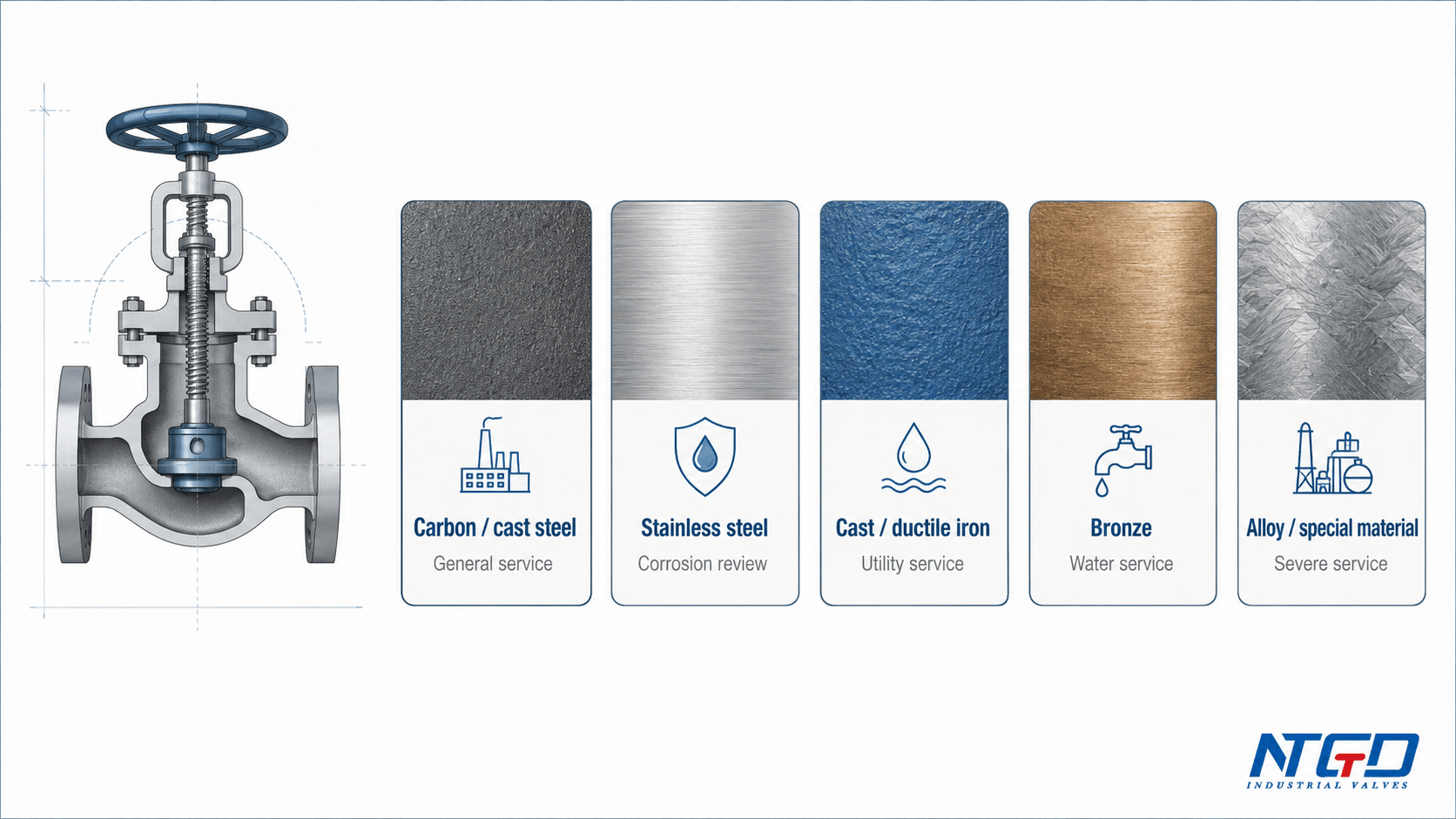
Common globe valve materials include carbon steel, cast steel, stainless steel, cast iron, ductile iron, bronze, alloy steel and special alloys. The best choice depends on the fluid, pressure, temperature, corrosion risk, shutoff requirement and project specification.
The table below is a selection overview, not a final material rating chart.
| Material option | Common service direction | Main advantage | Advertencia sobre la selección | RFQ note |
|---|---|---|---|---|
| Carbon steel / cast steel | General industrial water, oil, gas, steam and non-corrosive service | Good general industrial strength and availability | May corrode in acidic, sour, high-chloride, oxygen-rich or otherwise aggressive media; verify corrosion allowance and media compatibility | Confirm pressure class, temperature, media chemistry and corrosion risk |
| Acero inoxidable | Corrosive or clean service where corrosion resistance is needed | Better corrosion resistance than carbon steel in many services | Stainless grade must match chemical concentration, chloride exposure, temperature and contamination risk | Confirm grade, media chemistry, concentration and temperature |
| Hierro fundido | Low-pressure utility service where allowed | Economical for some non-severe services | Limited by pressure class, thermal shock risk, service severity and project permission | Confirm whether cast iron is allowed by the applicable project specification |
| Hierro dúctil | Utility or moderate service where allowed | Better toughness than gray cast iron | Still limited by pressure-temperature rating, corrosion data and service severity | Confirm rating, media, temperature and standard requirement |
| Bronze / copper alloy | Water, seawater-related or specific non-ferrous service depending on specification | Useful where copper alloy compatibility is required | Confirm chemical compatibility, dezincification risk and temperature limits where relevant | Confirm fluid chemistry and project material limits |
| Acero aleado | High-temperature, high-pressure or severe service | Improved strength or temperature resistance depending on alloy | Requires exact grade, heat treatment and service verification | Confirm standard, grade, heat treatment and service conditions |
| Special material / high alloy | Highly corrosive or special process service | Can address severe corrosion or special media | Higher cost and longer lead time; selection must be project-specific | Confirm exact material grade, media, temperature, pressure and inspection requirements |
Carbon steel and cast steel
Carbon steel and cast steel globe valve materials are often used in general industrial service where the media is not strongly corrosive and the pressure-temperature conditions fit the selected valve rating. They are common for many water, oil, gas and steam applications.
The caution is that carbon steel is not a universal material. If the media contains corrosive chemicals, sour components, chlorides, oxygen, acids or other aggressive elements, the body material and trim package should be reviewed carefully.
For many projects, carbon steel or cast steel is the baseline material choice, but corrosive, sour, high-temperature or leakage-sensitive service should trigger a full material package review rather than a body-only decision.
Acero inoxidable
Stainless steel globe valves are often considered when corrosion resistance, cleanliness or material compatibility is more important than basic cost. Stainless steel may be suitable for many chemical, food, water treatment or corrosive service environments, depending on grade and media.
However, stainless steel is not automatically the best material for every globe valve. Chloride-related corrosion risk, high temperature, specific chemicals, erosion and galvanic compatibility may still require a more detailed review.
For stainless body selection, chloride exposure should be treated as a grade-selection risk; the British Stainless Steel Association notes that chloride ions are a common cause of stainless steel pitting, so chloride-related pitting corrosion should be checked before assuming stainless steel is a universal upgrade.
Stainless steel should be treated as a material option that needs grade and service verification, not as a universal upgrade from carbon steel.
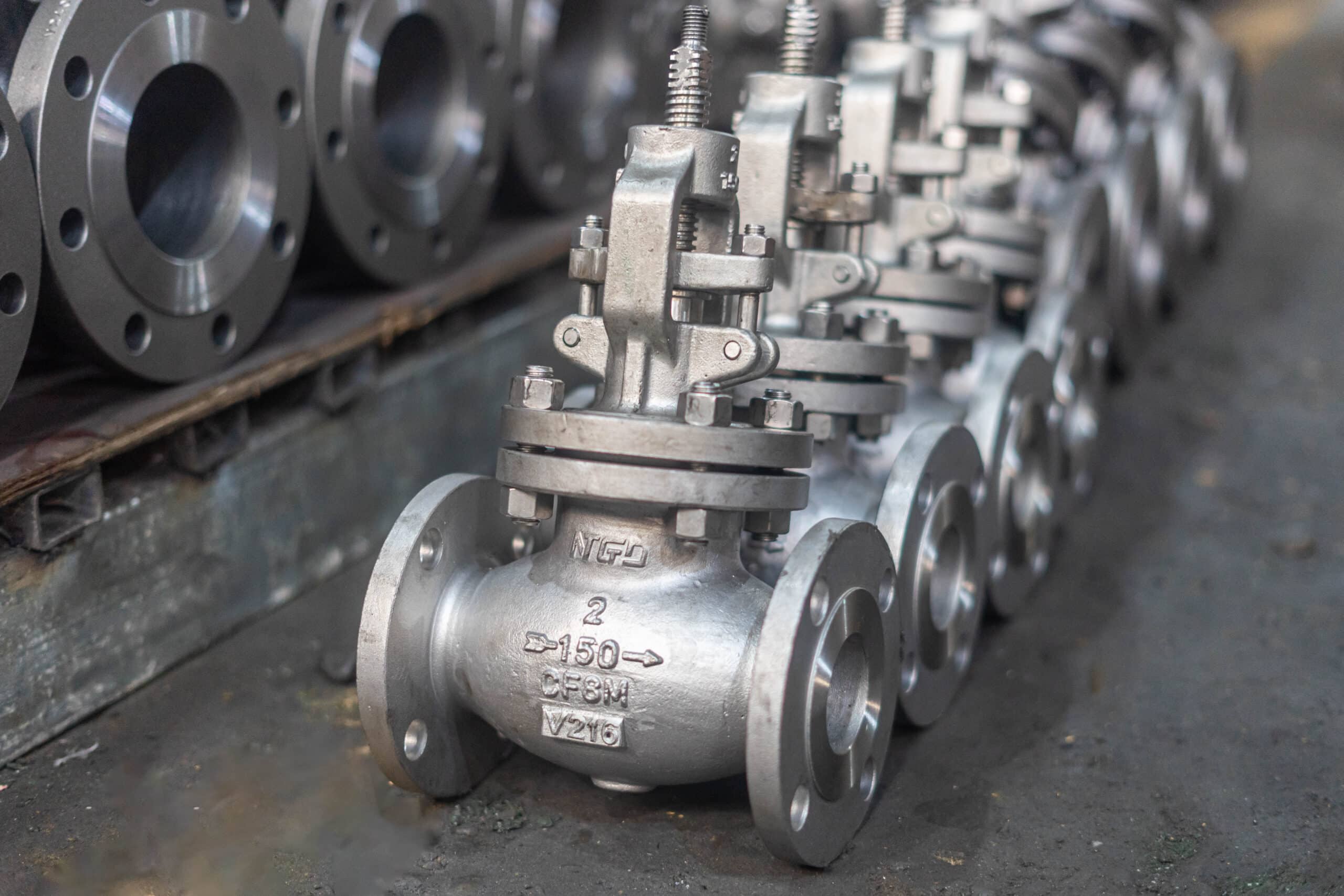
For corrosive or clean-service projects where stainless grades are being reviewed, NTGD’s stainless steel globe valve options can be checked after the media chemistry and temperature are defined.
Cast iron and ductile iron
Cast iron and ductile iron may appear in some utility or low-pressure services. Ductile iron generally offers better toughness than gray cast iron, but both must be checked against the project specification, pressure class, temperature and service risk.
For severe industrial service, high temperature, thermal cycling, hazardous fluid or high-pressure applications, these materials may not be acceptable.
The practical question is not only whether cast iron or ductile iron is available, but whether the project standard, pressure-temperature condition and service risk allow its use.
Bronze and copper alloys
Bronze and other copper alloys may be used in certain water, marine, low-pressure or non-ferrous applications. The suitability depends strongly on the fluid chemistry, temperature and project requirement.
These materials should not be selected only because they are corrosion resistant in some water services. Chemical compatibility and dezincification risk must be considered where relevant.
Bronze or copper alloy globe valves should therefore be reviewed by service chemistry first, not by general corrosion-resistance reputation alone.
Alloy steel and special materials
Alloy steel and special materials may be required for high-temperature, high-pressure, corrosive, sour, erosive or special process conditions. These materials can solve problems that standard carbon steel or stainless steel cannot handle, but they also require more careful specification.
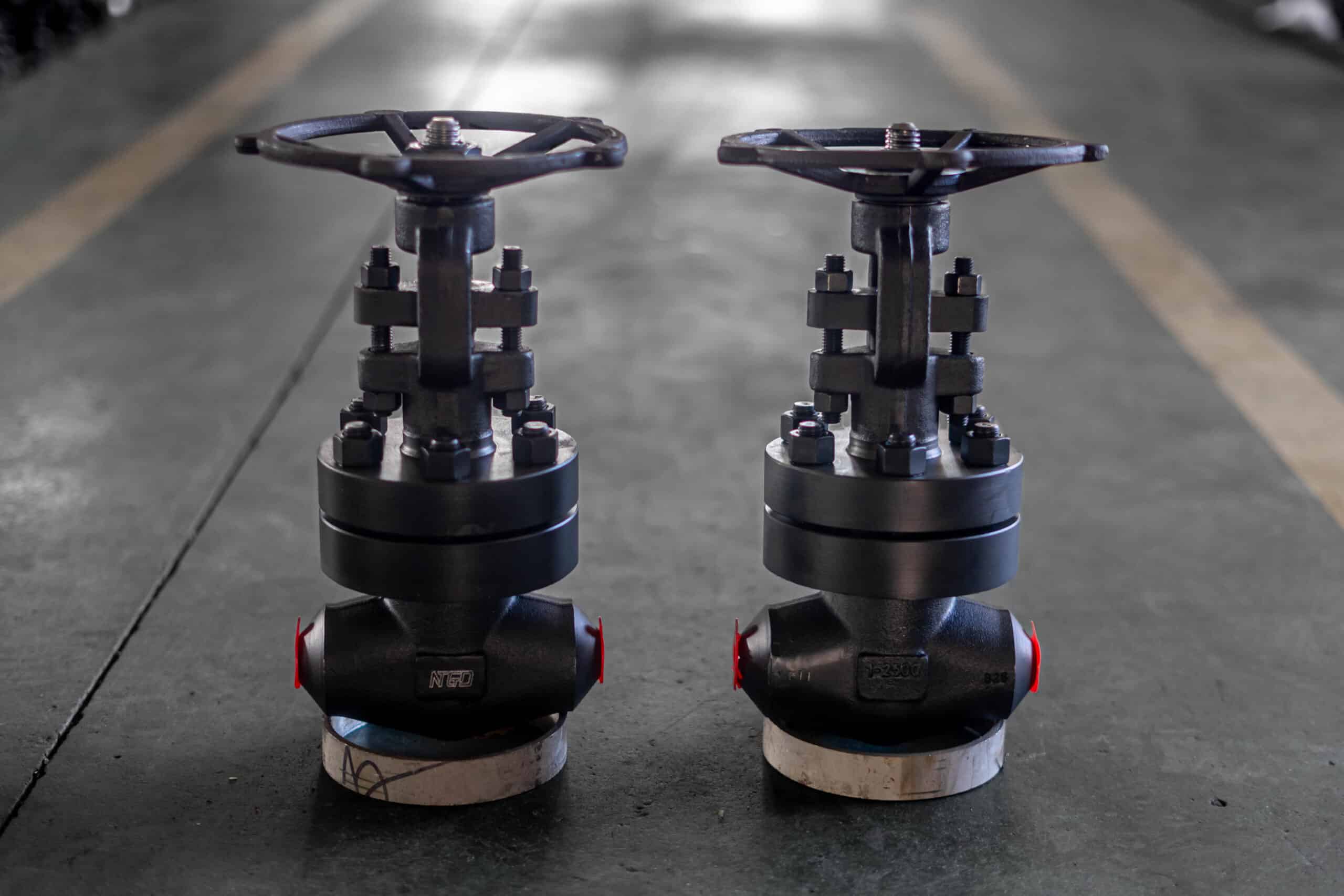
For special material globe valves, the inquiry should include media composition, temperature, pressure, corrosion risk, applicable standard and required inspection level.
The more severe the service, the more important it becomes to define the exact material grade instead of using broad terms such as “alloy” or “special material.”
Trim, Disc and Stem Materials: Wear, Throttling and Flow Contact
Globe valve trim materials are selected for the internal parts that contact the flow and sealing area. In many globe valves, trim includes the disc or plug, seat or seating surface, stem and related internal guiding or contact surfaces.
The trim is important because globe valves are often used for throttling or flow regulation. When flow is restricted through the seat area, the trim may experience velocity, turbulence, erosion, cavitation risk, corrosion or repeated seating contact.
What trim materials control in a globe valve
Trim material affects:
- resistance to wear at the seating surface;
- resistance to corrosion at the flow-contact area;
- stem strength and corrosion resistance;
- galling risk between moving or contact surfaces;
- shutoff durability after repeated operation;
- performance under throttling or pressure drop.
A globe valve body may be carbon steel while the trim uses stainless steel, hardfacing or another corrosion-resistant material. This is common because the body and trim do not always face the same mechanical and flow conditions.
When a globe valve is used for throttling, handles abrasive media, operates under high pressure drop or sees frequent operation, trim material selection can determine valve life more directly than body material selection. In these services, the trim should be reviewed before the full material package is finalized.
When hardfacing or corrosion-resistant trim may be needed
Hardfacing or corrosion-resistant trim may be reviewed when the service involves high pressure drop, frequent throttling, erosive media, high temperature, flashing, cavitation risk or aggressive fluids. The exact requirement depends on the valve design, service data and shutoff expectation.
This article does not provide a full API trim chart or complete trim number selection. For detailed disc, seat, stem and API trim selection, the trim package should be reviewed separately.
For disc, seat, stem, hardfacing and API trim decisions, use the dedicated globe valve trim selection guide rather than expanding the current material overview into a trim chart.
Why detailed trim selection should be handled separately
Trim selection can involve disc type, seat surface, stem material, backseat, hardfacing, API trim number, erosion risk, pressure drop and shutoff requirement. Those choices require a more detailed trim review than an overall globe valve materials guide can provide.
If the application involves frequent throttling, high-velocity flow, cavitation risk, erosive media or a specific API trim requirement, the trim selection should be reviewed in a dedicated trim material or trim selection guide. In this page, trim is treated as one part of the material package so that it is not ignored during early material selection.
Seat, Packing and Gasket Materials: Shutoff, Leakage and Temperature Boundary
The seat, packing and gasket materials define important sealing boundaries inside the valve. These materials may not be as visible as the body casting or forging, but they often decide whether the valve can meet shutoff, temperature and leakage expectations.
Seat material and shutoff performance
The seat is the sealing interface between the disc or plug and the valve body or seat ring. Seat material affects shutoff performance, wear resistance, temperature capability, corrosion resistance and long-term leakage risk.
In some globe valves, the seat may be metal. In other designs, soft seat materials may be used depending on temperature, pressure, media and shutoff requirement. Soft seats may be reviewed where tighter shutoff is needed and the temperature and media permit. Metal seats are often reviewed for high-temperature, abrasive, erosive or severe service where soft materials may not survive.
The choice between soft seat and metal seat should be reviewed carefully, because it can affect leakage performance, temperature limits and service life. Detailed options such as PTFE, PEEK, metal seat and Stellite-facing should be handled in a dedicated globe valve seat material review rather than expanded into this overall materials guide.
For soft seat, metal seat, PTFE, PEEK and Stellite-facing decisions, review the dedicated Guía para la selección del material del asiento de las válvulas de bola before specifying the final shutoff package.
Packing and gasket compatibility
Packing seals around the stem. Gaskets seal static joints such as the body-bonnet connection or flanged connection. If packing or gasket material is not compatible with the media or temperature, leakage may occur even if the body and trim materials are suitable.
Packing and gasket selection should consider:
- compatibilidad con los medios;
- temperatura;
- presión;
- stem movement;
- emission or leakage requirement;
- fire-safe or special service requirement if applicable;
- whether the service is toxic, corrosive or hazardous.
Why detailed soft seat vs metal seat selection should be handled separately
Seat selection can involve PTFE, PEEK, graphite, metal seat, hardfacing, Stellite-facing, elastomeric materials, leakage class, temperature, pressure and chemical resistance. These details can easily become a separate seat material topic.
For this overall globe valve material selection guide, the key point is simple: the seat material must be confirmed as part of the complete material package, not assumed from the body material alone.
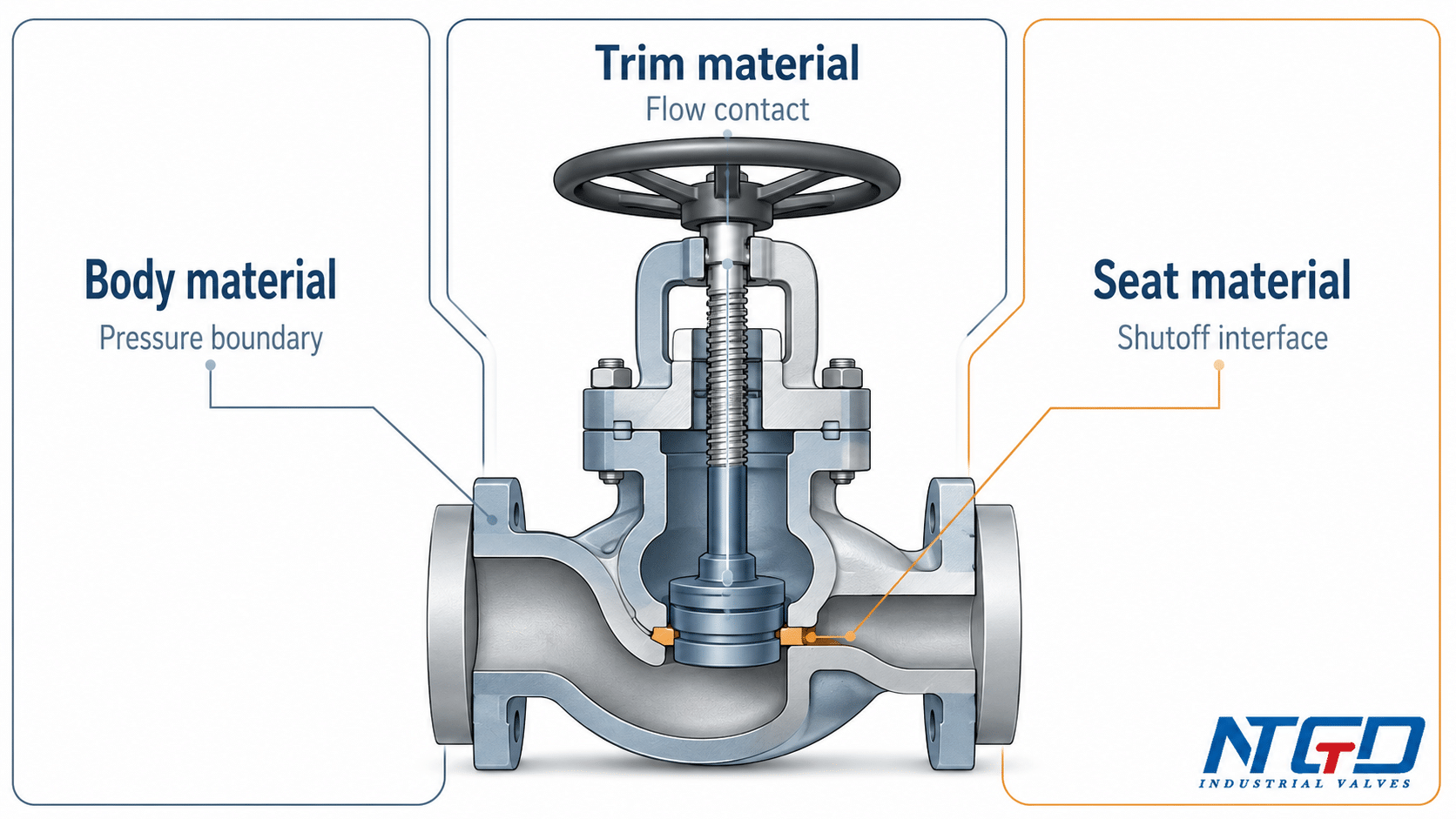
Body Material vs Trim Material vs Seat Material
Body material, trim material and seat material do different jobs. They may be the same in some simple services, but they often differ in industrial globe valve specifications.
The material responsibility boundary can be viewed as three major functions: pressure containment, flow contact and shutoff / sealing. A good specification separates these responsibilities instead of treating the valve as one material grade.
| Material area | Main responsibility | Main selection concern | When to review separately |
|---|---|---|---|
| Carrocería / capó | Límite de presión | Pressure, temperature, media compatibility, standard | When pressure, temperature, corrosion or body construction is critical |
| Trim / disc / stem | Flow contact and movement | Wear, corrosion, throttling, galling, erosion | When the valve throttles, sees pressure drop or handles erosive media |
| Asiento | Shutoff interface | Leakage, temperature, wear, corrosion | When tight shutoff, high temperature or soft vs metal seat choice matters |
| Embalaje | Sellado del vástago | Leakage, temperature, media compatibility | When emissions, toxic service or frequent operation matter |
| Junta | Static sealing | Joint sealing, temperature, chemical compatibility | When body-bonnet or flange sealing is critical |
| Atornillado | Joint integrity | Load, temperature, corrosion | When high temperature, corrosion or special standard applies |
Different materials, different responsibilities
The body material is selected mainly for the pressure boundary. The trim material is selected for internal working surfaces. The seat material is selected for shutoff and sealing contact. Packing and gasket materials are selected for leakage control.
These materials should be reviewed together, but they should not be treated as identical decisions.
Why these materials do not always match
A valve may use carbon steel for the body, stainless steel for trim and graphite for packing or gasket service. Another valve may use stainless steel for the body but require hardfaced trim due to throttling wear. A third valve may need a special seat material because shutoff or temperature requirements are more severe than the body service alone suggests.
Mismatched body, trim, seat or sealing materials can lead to early leakage, accelerated trim wear, repeated maintenance or unplanned downtime. The correct package depends on the actual service conditions, not only the valve name.
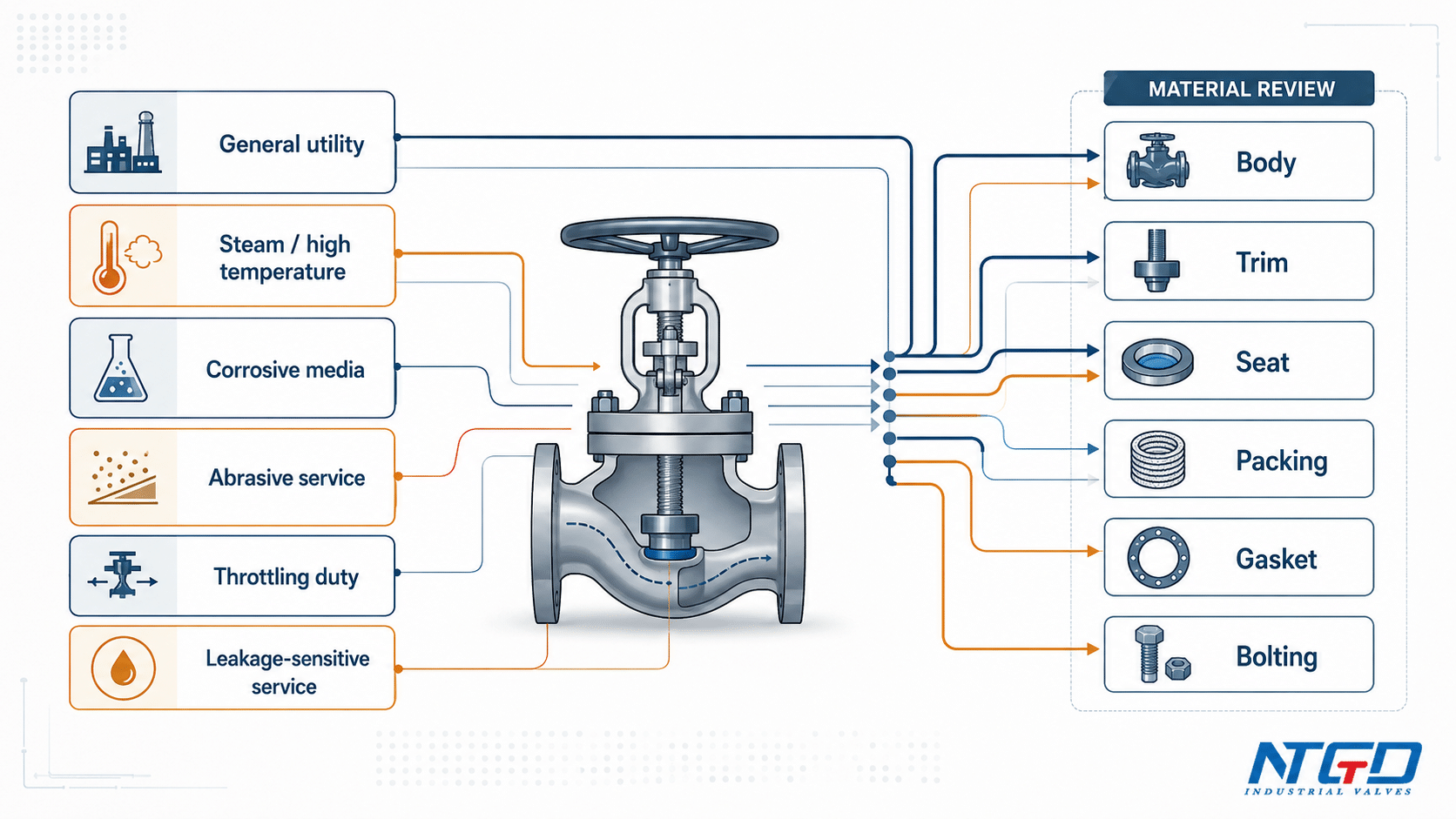
Service Condition Mapping for Globe Valve Material Selection
Globe valve material selection should be mapped from the service conditions. A material that works well in one service can fail quickly in another.
| Condiciones del servicio | Main risk | Material area to confirm | Typical material direction | Precaución |
|---|---|---|---|---|
| Clean water, oil or general utility | General pressure containment and basic corrosion | Body, bonnet, seat, packing | Carbon steel, cast steel, ductile iron or stainless steel depending on specification | Check water quality, oxygen content, temperature and pressure cycling instead of assuming utility service is always low risk |
| Steam and high-temperature service | Temperature, oxidation, gasket relaxation, seat wear | Body, bonnet, trim, seat, packing, gasket, bolting | Carbon steel, alloy steel, stainless steel or specified high-temperature materials | Packing, gasket, seat and bolting limits may decide suitability together with body pressure-temperature rating |
| Medios corrosivos | Chemical attack, pitting, stress corrosion | Body, trim, seat, gasket, bolting | Stainless steel, alloy or special materials depending on media | Confirm media concentration, temperature, contaminants, chlorides, acids or other aggressive components |
| Abrasive or erosive service | Trim wear, seat damage, flow path erosion | Trim, seat, disc, body flow area | Hardened trim, hardfacing or erosion-resistant materials may be reviewed | Review solids, flow velocity, pressure drop and whether the seat area is exposed to high wear |
| Throttling / flow-control duty | High velocity, turbulence, pressure drop, trim wear | Trim, seat, stem, guiding surfaces | Wear-resistant or hardfaced trim may be needed | Do not select by body material alone; trim and seat life may control the final choice |
| Servicio sensible a las fugas | Stem leakage, body-bonnet leakage, seat leakage | Seat, packing, gasket, bonnet design | Suitable seat, packing and gasket materials | Confirm leakage requirement, service hazard, packing arrangement and gasket compatibility |
Clean water, oil and general utility service
For clean water, oil or general utility service, the material decision may be relatively straightforward. Carbon steel, cast steel, ductile iron, cast iron or stainless steel may be considered depending on pressure, temperature and project standard.
Even in utility service, the material package should still be checked. Water quality, oxygen content, temperature, pressure cycling and installation environment can affect corrosion and sealing performance.
Steam and high-temperature service
Steam and high-temperature service require careful review of body, trim, seat, packing, gasket and bolting materials. Temperature can affect strength, sealing behavior and material compatibility.
For steam globe valve material selection, the correct material depends on steam pressure, temperature, valve class, shutoff requirement and standard. It should not be reduced to a single material name without checking the datasheet.
In many high-temperature services, packing and gasket behavior can become as important as the body material because sealing materials may relax, oxidize or lose compatibility before the pressure boundary itself becomes the only concern.
When pressure-temperature conditions move the project into severe service, NTGD’s válvula de globo de alta presión page can support the product-level review after the material package is defined.
Medios corrosivos
Corrosive media require more than a quick stainless steel assumption. The actual chemical, concentration, temperature, contaminants, oxygen content and flow conditions all matter.
In corrosive service, the body, trim, seat, gasket and bolting may all need review. If only the body is upgraded while the trim or gasket remains incompatible, the valve can still fail.
For corrosive media, the material review should start with the full media chemistry and then check each contact and sealing area against the same service data.
Abrasive or erosive service
Abrasive or erosive service may damage the trim and seat faster than the body. Globe valves used for throttling can expose the seat area and trim to high-velocity flow. Solids, slurry, flashing or high pressure drop can increase wear.
In these services, trim material and seat surface are often more important than a simple body material upgrade.
A body upgrade alone may improve pressure-boundary compatibility, but it will not necessarily protect the seating surface or disc area from erosion.
Throttling and flow-control duty
Globe valves are often selected because they provide better throttling control than many on-off valve types. However, throttling creates flow restriction, velocity and turbulence near the trim.
For throttling duty, material selection should review pressure drop, frequency of operation, expected control range, trim wear and seat durability. A body material that is suitable for pressure containment may not be enough for long trim life.
When throttling duty is frequent or severe, trim material, seat surface and guiding surfaces should be treated as primary selection items, not secondary details.
Leakage-sensitive or emission-sensitive service
For toxic, hazardous, volatile or emission-sensitive media, packing, gasket and seat material become critical. A valve may be pressure-rated correctly but still unsuitable if stem leakage, body-bonnet leakage or seat leakage is not controlled.
In these services, the material package should be reviewed together with valve design, packing arrangement, bonnet type and inspection requirements.
The selection should focus not only on whether the valve can contain pressure, but also on whether the full sealing package can control leakage over the expected operating conditions.
What Can Go Wrong If the Material Package Is Selected Incorrectly?
Incorrect globe valve materials can cause more than early replacement. They can create leakage, corrosion, trim damage, pressure-boundary risk, poor shutoff or unstable operation. In severe applications, a poor material package can also increase maintenance frequency and downtime risk.
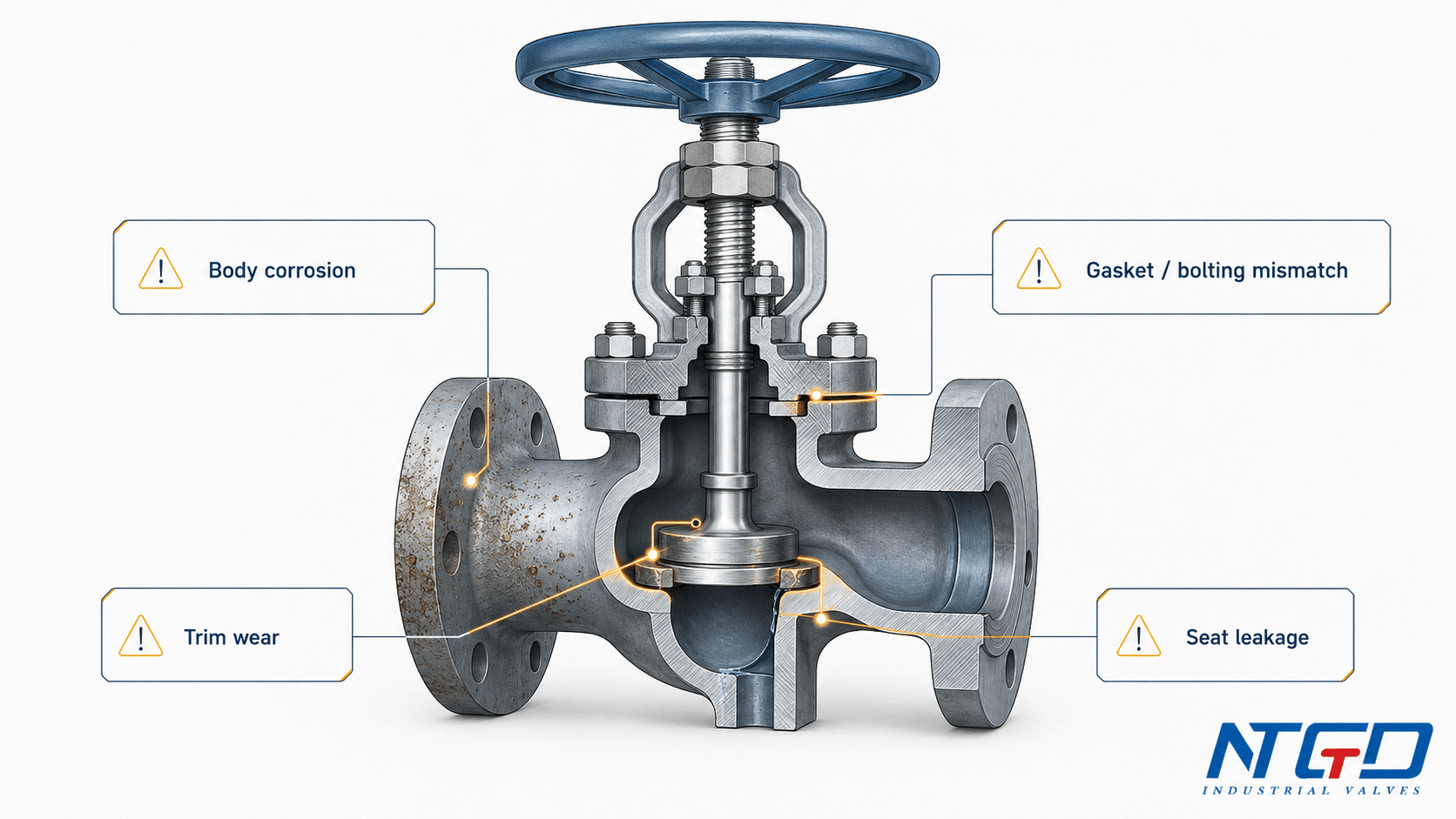
| Wrong selection | Posible consecuencia | Affected area | Prevention check |
|---|---|---|---|
| Body material not compatible with media | Corrosion, wall loss, pressure-boundary risk | Carrocería / capó | Confirm full media chemistry, concentration, contaminants, temperature and corrosion allowance |
| Body material not suitable for temperature | Strength loss, thermal cracking, creep-related damage or gasket / bolting issue | Body / bonnet / bolting | Verify both design and operating pressure-temperature suitability |
| Trim material too soft for throttling | Seat wear, disc damage, unstable control | Trim / seat | Review pressure drop, throttling duty, flow velocity and operation frequency |
| Seat material not suitable for temperature | Leakage, deformation or seat damage | Asiento | Confirm seat material limit, shutoff requirement and service severity |
| Packing not compatible with media | Fugas en el tallo | Packing / stem area | Confirm packing material, media compatibility, temperature and emission requirement |
| Gasket not suitable for service | Body-bonnet or flange leakage | Gasket joint | Confirm gasket type, media, temperature and compression behavior |
| Bolting not suitable for temperature or corrosion | Joint integrity risk | Atornillado | Confirm bolting material, temperature suitability and corrosion environment |
| Material package selected only by body material | Hidden trim, seat or sealing failure | Whole valve | Review the full material of construction, not only the body grade |
Corrosion, cracking and pressure-boundary risk
If the body or bonnet material is not suitable for the media, corrosion can reduce wall thickness or attack critical areas. If the material is not suitable for temperature or cycling, thermal damage or joint problems may occur. These risks affect the pressure boundary and must be reviewed before ordering.
Seat leakage, trim wear and unstable throttling
If trim or seat materials are not suitable for the flow conditions, the valve may leak, wear quickly or lose stable control. This is especially important in throttling applications, abrasive media or high pressure drop services.
Packing, gasket and bolting mismatch
Packing, gasket and bolting are sometimes missed during early material selection. This can create leakage or joint integrity issues even when the body and trim materials are correct. For severe service, these items should be included in the RFQ and datasheet review.
Material Specification and Standards Notes
Material specification should be clear enough for engineering review, procurement and manufacturing confirmation. In many valve datasheets, this may appear as material of construction, body material, bonnet material, trim material, seat material, packing material, gasket material and bolting material.
Material of construction in RFQ and datasheet language
A clear RFQ should not simply say “stainless steel globe valve” or “carbon steel globe valve” without service details. It should specify the required material areas or ask the valve manufacturer to recommend the material package based on the process conditions.
Useful RFQ information includes:
- tamaño de la válvula y clase de presión;
- medios de comunicación;
- operating and design pressure;
- operating and design temperature;
- body and bonnet material requirement if known;
- trim material or trim requirement;
- seat material or shutoff requirement;
- packing and gasket requirement;
- bolting requirement;
- applicable standard;
- corrosion, sour service, oxygen service, chlorine service or other special condition.
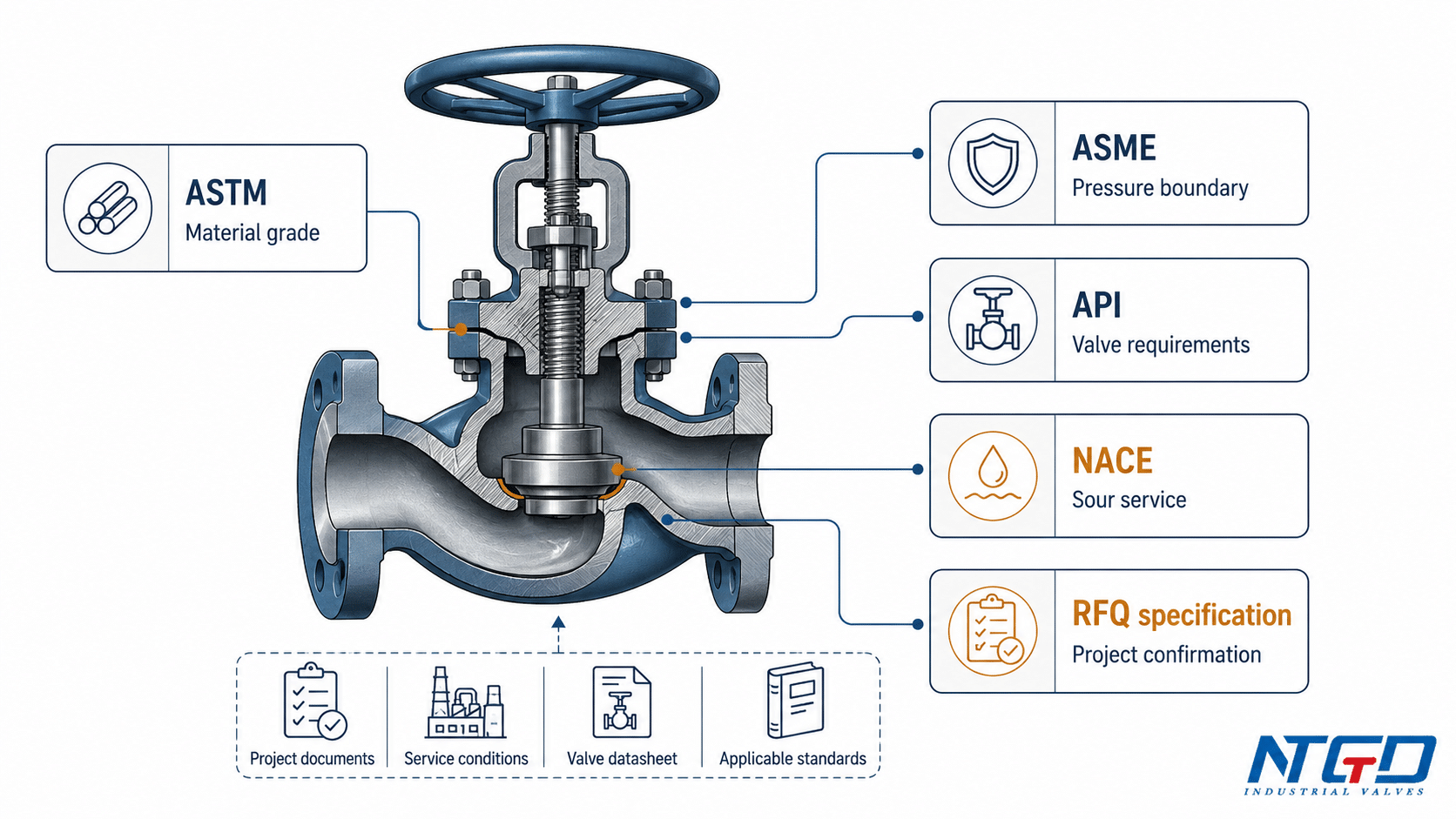
ASTM, ASME, API and NACE as light specification references
Industrial globe valve materials may be specified with reference to material standards, pressure-temperature ratings, testing requirements or special service requirements. Common specification references may involve ASTM material grades, ASME pressure boundary requirements, API valve requirements, and NACE or sour service requirements where applicable.
For pressure-boundary and specification language, ASME B16.34 is a suitable light reference because it covers pressure-temperature ratings, materials, testing and marking for flanged, threaded and welding-end valves.
This article does not interpret specific clauses. The exact standard, material grade and acceptance requirement should be verified against the project specification, valve datasheet and applicable code.
Why final material confirmation should follow project service conditions
Material selection should never rely only on a generic chart. A chart may help early comparison, but final confirmation requires real operating data.
The final material package should be checked against:
- actual media, including concentration and contaminants;
- presión y temperatura de diseño;
- corrosion and erosion risk;
- pressure drop and throttling duty;
- required shutoff or leakage performance;
- project standard and inspection requirements;
- manufacturer datasheet and construction details.
Specific standard clauses, material grades and acceptance requirements should be verified against official project documents and applicable industry sources before final procurement.
RFQ Checklist: Material Information to Confirm Before Ordering
Before ordering a globe valve, the buyer should prepare enough information for material review. The more complete the service data, the better the body, trim, seat and sealing package can be confirmed.
| Partida de la solicitud de cotización | What to provide | Por qué es importante |
|---|---|---|
| Medios de comunicación | Fluid name, concentration, contaminants, solids, gas or liquid phase | Determines corrosion, erosion and compatibility |
| Presión | Operating pressure, design pressure, pressure class | Affects body, bonnet, bolting and gasket selection |
| Temperatura | Temperatura de funcionamiento y de diseño | Affects body, trim, seat, packing and gasket |
| Valve size and end connection | NPS / DN, flange or other connection | Affects product configuration and pressure boundary |
| Body / bonnet material | Required material or open for recommendation | Main pressure-boundary material |
| Material de acabado | Required trim or service condition for recommendation | Affects wear, throttling and flow contact |
| Material del asiento | Shutoff requirement and temperature / media compatibility | Affects leakage and durability |
| Material de embalaje | Standard or special packing requirement | Affects stem leakage and emission risk |
| Material de la junta | Required gasket or service data | Affects static sealing |
| Bolting material | Required bolting grade or environment | Affects joint integrity |
| Throttling duty | On-off, regulating, frequent operation, pressure drop | Affects trim and seat selection |
| Servicio especial | Sour service, oxygen service, chlorine service, toxic media, hazardous media | May require special materials and inspection |
| Standards / inspection | Applicable standard, test requirement, documentation | Confirms compliance and project acceptance |
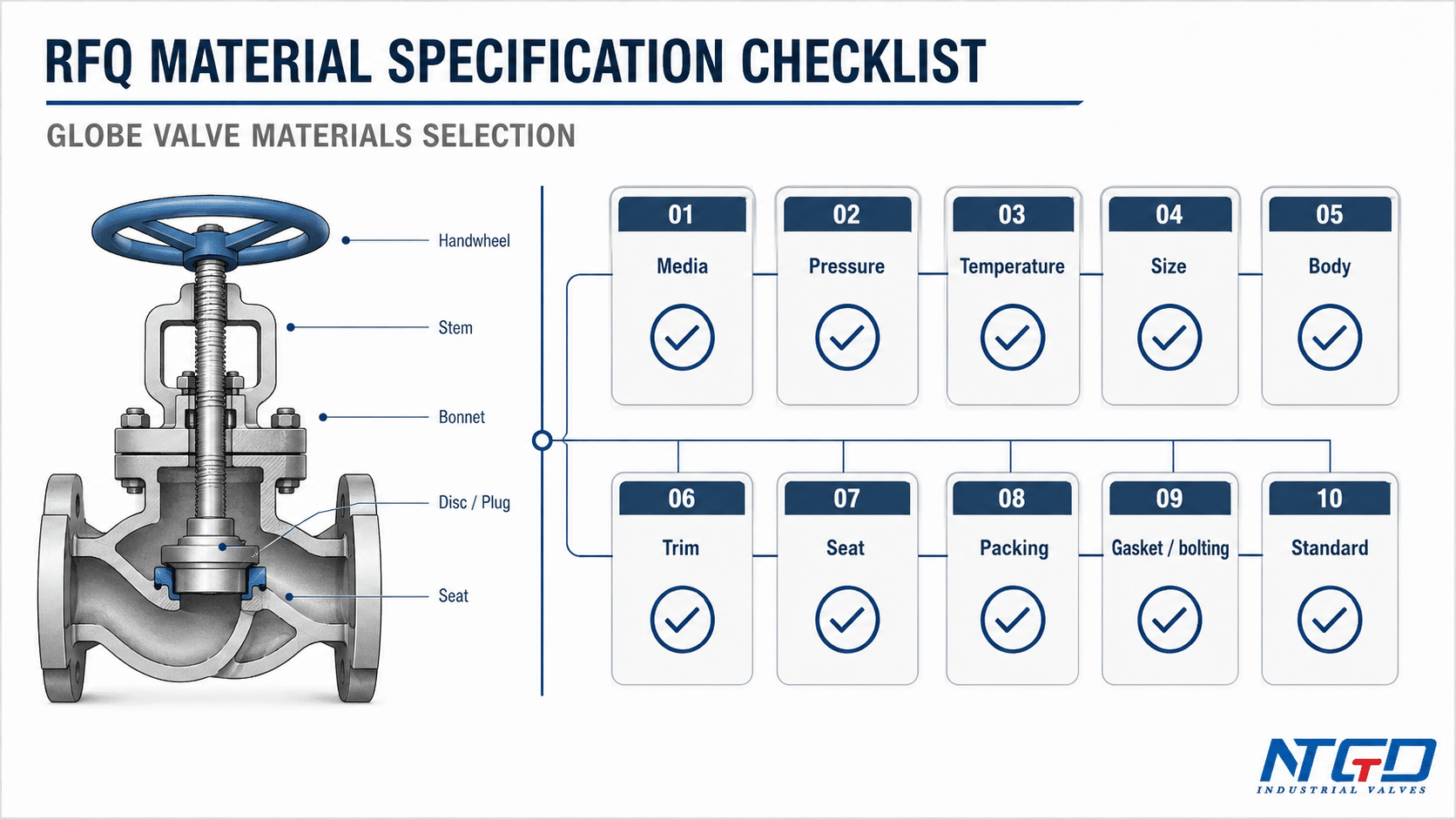
Service and operating data
The most useful information is the actual service condition. Media, pressure and temperature should be supplied before final material confirmation. If the service involves corrosive chemicals, steam, sour gas, oxygen, abrasive solids or high pressure drop, that information should be clearly stated.
Body, trim, seat and sealing material data
If the project already has a material specification, the RFQ should list the required body, bonnet, trim, seat, packing, gasket and bolting materials. If the material is not fixed, the buyer should provide service data and ask for a recommended material package.
Standards, inspection and special service requirements
If the project requires specific standards, inspection documents, NACE compliance, fire-safe design, low-emission packing or special testing, these should be included early. Adding them after quotation may change the valve material package, cost, lead time and documentation scope.
For sour-service or H2S-containing oil and gas service, material selection should be checked against the project standard and sour-service guidance such as MR0175 / ISO 15156 sour-service material guidance, instead of assuming a normal carbon steel or stainless package is suitable.
FAQ About Globe Valve Materials
What material is a globe valve made of?
In real projects, a globe valve is rarely treated as one single material. It is usually specified as a material package. The body and bonnet may be carbon steel, cast steel, stainless steel, cast iron, ductile iron, bronze, alloy steel or special alloy, while the trim, seat, packing, gasket and bolting may use different materials because they perform different functions.
What material is used for a globe valve body?
Common globe valve body materials include carbon steel, cast steel, stainless steel, cast iron, ductile iron, bronze and alloy steel. The correct globe valve body material depends on pressure, temperature, media compatibility, corrosion risk and project specification.
What is globe valve material of construction?
Globe valve material of construction means the material package used for the valve, including the body, bonnet, trim, seat, packing, gasket, bolting and sometimes other pressure-retaining or flow-contact parts. In RFQ or datasheet language, it should be confirmed clearly before ordering so that the valve is not selected by body material alone.
What is the difference between body material and trim material?
Body material is mainly selected for pressure containment and media compatibility. Trim material is selected for internal flow contact, wear, corrosion, throttling and shutoff performance. The body and trim materials may be different because they face different service conditions inside the valve.
Does globe valve seat material need to match body material?
Not always. The seat material should match the shutoff requirement, temperature, media and wear conditions. It may be different from the body material. For example, a valve may have a carbon steel body with stainless or hardfaced seating surfaces, depending on the service. Detailed soft seat, metal seat and seat-facing material choices should be handled in a dedicated globe valve seat material review.
Which globe valve material is used for steam?
Steam globe valve material depends on steam pressure, temperature and project standard. Carbon steel, alloy steel or stainless steel may be considered depending on the conditions. The trim, seat, packing, gasket and bolting must also be checked for the steam temperature and pressure.
Which material is used for corrosive media?
Corrosive media may require stainless steel, alloy materials or special materials, depending on the chemical, concentration, temperature and contaminants. The body material alone is not enough; trim, seat, gasket, packing and bolting compatibility should also be reviewed.
What does WCB mean in globe valve body material?
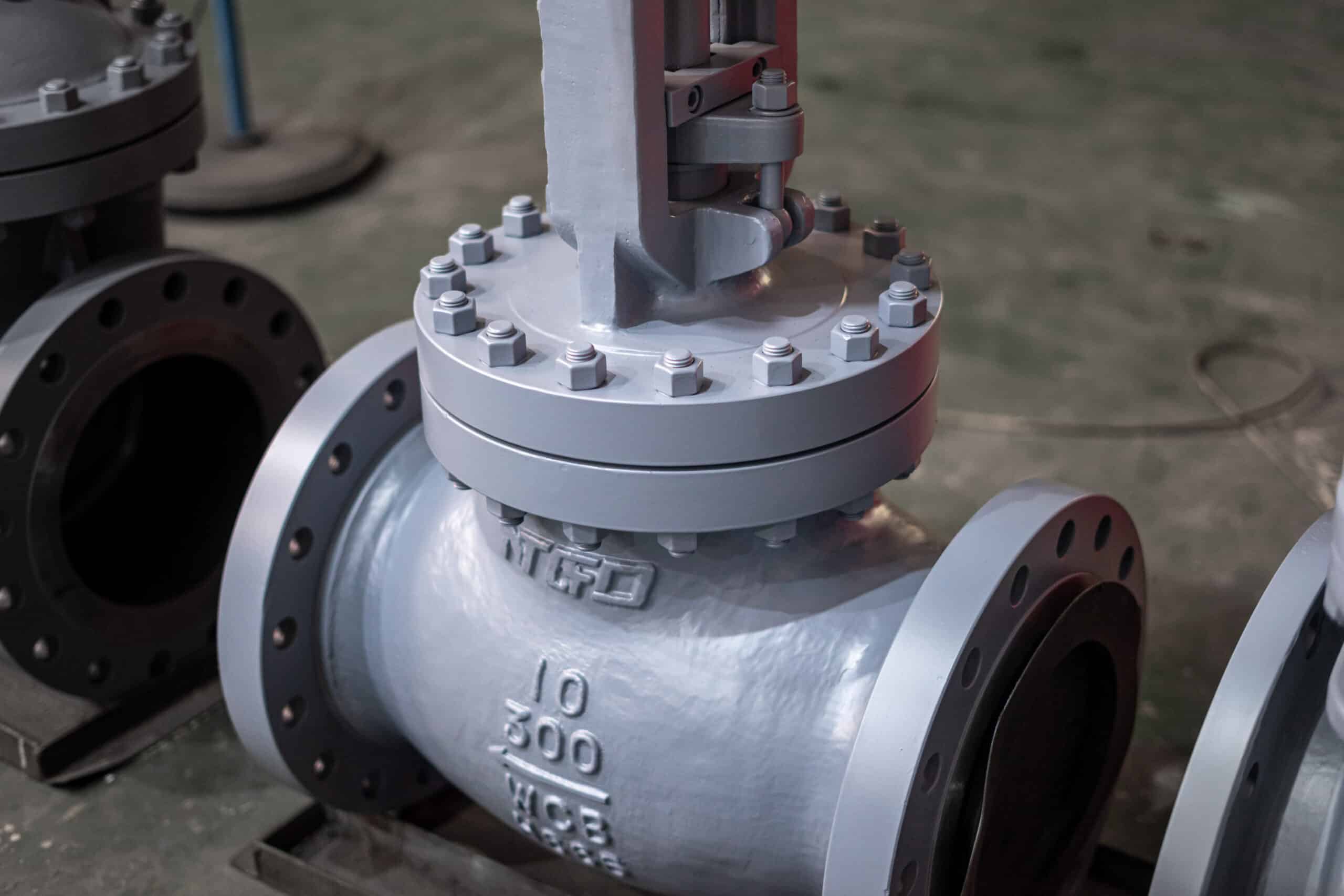
WCB is a common cast carbon steel material used in many industrial valve bodies. Whether it is suitable for a globe valve depends on the pressure, temperature, fluid media and applicable project specification. WCB should not be assumed suitable for corrosive, sour or high-temperature service without verification against the actual media and project requirements.
When WCB, WCA or WCC appears in the project specification, check the ASTM A216/A216M carbon steel casting specification because those grades are defined for valves, flanges, fittings and other pressure-containing parts.
Is stainless steel always better than carbon steel for globe valves?
No. Stainless steel can offer better corrosion resistance in many services, but it is not automatically better for every globe valve. Carbon steel may be suitable and economical for many general industrial services. The correct choice depends on media, pressure, temperature, corrosion risk and project requirements.
Conclusión
Globe valve materials should be reviewed as a complete material package. The body and bonnet define the pressure boundary, but the trim, disc, stem, seat, packing, gasket and bolting can determine wear resistance, shutoff performance, leakage control and service compatibility.
For early selection, start with the service media, pressure and temperature. Then confirm the body material, trim material, seat material and sealing materials according to corrosion, erosion, throttling duty and shutoff requirements. For final procurement, the material of construction should be checked against the project specification, applicable standards and the manufacturer’s datasheet.
A good globe valve material selection process does not simply ask, “What is the valve body made of?” It asks whether the full valve material package fits the actual industrial service.
Soporte técnico para aplicaciones y especificaciones
Use the RFQ checklist above to organize your service data before submitting a globe valve inquiry. If the service conditions, material requirements or project specifications are not fully defined, the full material package should be reviewed before the valve order is finalized.
After the RFQ checklist is complete, buyers can use NTGD’s industrial globe valve specifications page as the product bridge for size, class, body pattern, end connection and documentation review.
For corrosive, high-temperature, abrasive, sour, toxic or leakage-sensitive service, confirm the process media, pressure, temperature, valve size, pressure class, body material, trim material, seat requirement, packing, gasket, bolting and applicable standards before final selection.
NTGD Valve can support globe valve material package review based on media, pressure, temperature, body material, trim, seat, packing, gasket, bolting and applicable standard requirements.
