
Nom de l'auteur : Bruce Zheng
Rôle de l'auteur : Cofondateur et ingénieur en vannes chez NTGD Valve
Bio de l'auteur : Bruce Zheng est cofondateur et ingénieur en vannes chez NTGD Valve, qui se concentre sur la sélection des vannes industrielles, les applications et le contenu technique pour les acheteurs B2B mondiaux.
Dernière mise à jour : 16 juin 2026
Une vanne à soupape et une vanne à bille peuvent toutes deux être utilisées dans les réseaux de tuyauterie industriels, mais elles ne sont pas choisies pour les mêmes applications. La principale différence réside dans la manière dont chacune de ces vannes contrôle le passage du fluide. Une vanne à soupape utilise un mouvement linéaire de la tige pour rapprocher ou éloigner un disque ou un obturateur du siège, tandis qu’une vanne à bille utilise un mouvement rotatif d’un quart de tour pour aligner ou bloquer le passage à travers la bille.
Dans la plupart des applications industrielles, on opte pour une vanne à soupape sphérique lorsque le processus nécessite une régulation du débit, un étranglement ou un contrôle progressif. On choisit une vanne à bille lorsque le processus nécessite une fermeture rapide, un fonctionnement simple de type « tout ou rien », une faible perte de charge et un débit élevé.
Cette comparaison entre les vannes à soupape et les vannes à bille porte sur les vannes à soupape industrielles standard et les vannes à bille industrielles standard. Les vannes à bille à passage en V, segmentées ou à caractéristiques spécifiques sont des modèles spéciaux destinés au contrôle et ne doivent pas être assimilées à une vanne à bille standard de type « tout ou rien ».
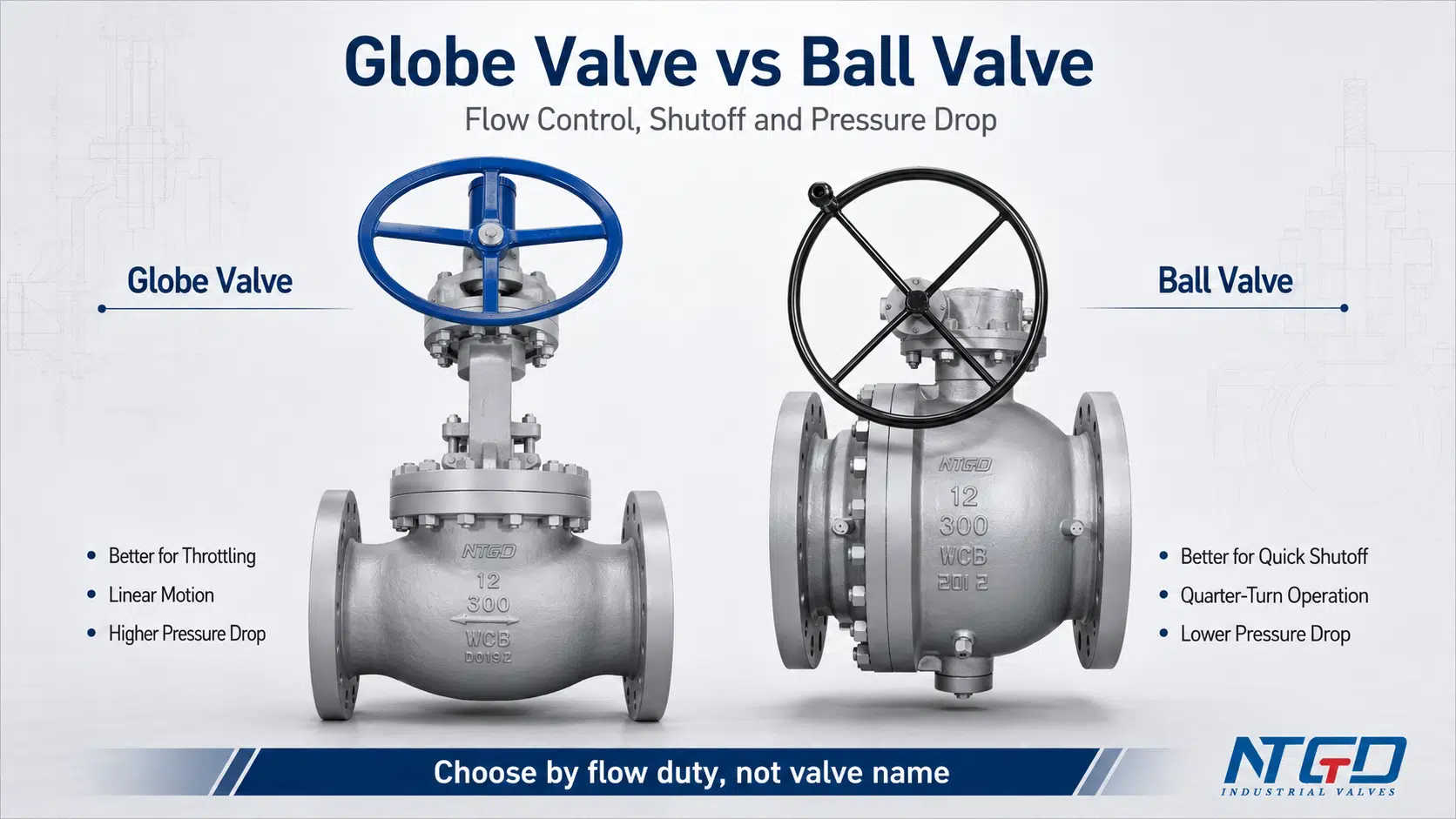
Réponse rapide : vanne à soupape vs vanne à bille
Choisir un robinet à soupape lorsque la conduite nécessite un contrôle précis du débit, un étranglement ou une régulation. Son circuit interne et le mouvement linéaire de son disque le rendent plus adapté à un réglage progressif du débit, même s’il entraîne généralement une perte de charge plus importante qu’un robinet à bille.
Choisir un vanne à bille lorsque la conduite nécessite une fermeture rapide, un fonctionnement en position entièrement ouverte ou entièrement fermée, une faible résistance à l'écoulement et un encombrement réduit. La conception à bille quart de tour de ce robinet offre un passage plus rectiligne et une isolation rapide, mais un robinet à bille standard n'est généralement pas le meilleur choix pour un réglage continu du débit.
En termes simples :
- Robinet à soupape: plus adapté à la régulation de la puissance, au contrôle du débit et à la stabilité de la commande.
- Vanne à bille: idéal pour une fermeture rapide, un fonctionnement en mode marche/arrêt et une perte de charge réduite.
- Principale différence structurelle: le mouvement linéaire de la vanne à soupape permet un réglage progressif du débit, tandis que le mouvement quart de tour de la vanne à bille permet une ouverture et une fermeture rapides.
- Limite importante: Les vannes à bille à orifice en V constituent un type particulier de vannes à bille de régulation et doivent être examinées séparément des vannes à bille ordinaires.
Avant de choisir l'une ou l'autre de ces vannes, il convient de définir au préalable le débit requis. Le fait de maintenir une vanne à bille standard partiellement ouverte pendant de longues périodes peut accroître l'usure des sièges, générer du bruit ou entraîner une régulation instable, tandis que l'utilisation d'une vanne à soupape lorsque l'isolation à faibles pertes est la principale exigence peut entraîner une perte de charge inutile.
Tableau comparatif rapide : vanne à soupape vs vanne à bille
| Facteur | Robinet à soupape | Soupape à bille | Signification de la sélection |
|---|---|---|---|
| Fonction principale | Régulation du débit et limitation | Isolation marche-arrêt et coupure rapide | Commencez par déterminer le débit requis avant de choisir le type de vanne. |
| Mouvement de fonctionnement | Mouvement linéaire de la tige | Mouvement rotatif d'un quart de tour | Les vannes à soupape permettent un réglage progressif ; les vannes à bille permettent un fonctionnement rapide. |
| Élément interne | Le disque ou le clapet se déplace contre un siège | Une bille dotée d'un alésage tourne à l'intérieur des sièges | La géométrie interne influe sur le contrôle du débit, le comportement à la fermeture et la perte de charge. |
| Contrôle du débit | Une meilleure maîtrise | Limité aux modèles à passage intégral ou à passage réduit | Les vannes à boisseau sphérique sont généralement plus adaptées lorsque la vanne doit rester dans des positions intermédiaires stables. |
| L'étranglement | Couramment utilisé pour la limitation du débit | N'est généralement pas recommandé pour une régulation continue de l'accélération | Les vannes à bille standard utilisées en service prolongé en position partiellement ouverte peuvent présenter une usure des sièges, générer du bruit ou présenter un contrôle instable. |
| Fermeture | Permet de couper le débit, mais plus lentement | Idéal pour une fermeture rapide | Les vannes à bille sont généralement privilégiées lorsque la fonction principale consiste à isoler rapidement le circuit. |
| Perte de charge | Généralement plus élevé | Généralement inférieur | Les vannes à bille offrent souvent un passage plus droit et moins restrictif. |
| Débit nominal / capacité de débit | Généralement inférieur pour un même calibre nominal | Généralement plus élevée, en particulier dans les modèles à passage intégral | La valeur Cv doit être vérifiée en fonction du débit réel, de la conception des orifices et des conditions d'utilisation. |
| Vitesse de fonctionnement | Plus lents, à plusieurs tours ou actionnés par un actionneur | Fonctionnement rapide à 90 degrés | Les vannes à bille sont utiles lorsqu'une ouverture ou une fermeture rapide est nécessaire. |
| L'accent mis sur la maintenance | Garnitures, siège, joint de tige et zone du chapeau | Sièges, surface de la bille et joint de tige | Les points d'usure varient en fonction de la structure de la vanne, du fluide et des conditions de fonctionnement. |
| Utilisation typique | Régulation de la vapeur, contrôle de la dérivation, régulation du débit de process, service d'équilibrage | Isolation, fermeture des conduites de gaz ou de liquide, conduites à faible perte de charge, service à haut débit | Le meilleur choix dépend de l'application, et pas seulement du nom de la vanne. |
| Risque de sélection | Perte de charge plus importante en cas d'utilisation dans des applications où une faible résistance est essentielle | Risque de perte de contrôle ou d'endommagement du siège en cas d'utilisation prolongée à plein régime | Un mauvais choix de vanne peut entraîner une instabilité de la régulation, une perte de charge inutile ou une usure prématurée du siège et de l'organe de régulation. |
Qu'est-ce qu'un robinet à soupape ?
Une vanne à globe est une vanne à mouvement linéaire utilisée pour démarrer, arrêter ou réguler le débit dans une canalisation. À l'intérieur du corps de vanne, un disque ou un obturateur se rapproche ou s'éloigne du siège lorsque la tige monte ou descend. Ce mouvement modifie la section de passage au niveau du siège et permet un contrôle plus progressif qu'une simple vanne tout ou rien.
Dans une vanne à siège droit, le flux est généralement redirigé à travers le corps de vanne. Cela rend la vanne utile pour la régulation, mais augmente également la résistance à l'écoulement. C'est pourquoi on opte souvent pour une vanne à siège droit dans le cadre d'une application de régulation plutôt que pour des applications où une perte de charge aussi faible que possible est la priorité absolue.
Structure de base d'une vanne à soupape
Une vanne à soupape classique comprend un corps, un chapeau, une tige, un disque ou un obturateur, un siège, une garniture d'étanchéité et un volant ou un actionneur. Le corps forme l'enveloppe sous pression et canalise le débit à travers la zone du siège. Le disque ou le clapet constitue l’élément principal de fermeture et de régulation. La tige transmet le mouvement du volant ou du servomoteur au disque. Le siège assure l’étanchéité et la régulation du débit.
Ces éléments sont importants car le contrôle du débit dépend de la relation entre le disque, le siège et la position de course. Si l'application implique une pression différentielle élevée, de l'érosion, du flashing, de la cavitation, de la vapeur ou des fluides corrosifs, la conception des composants internes et le choix des matériaux doivent être soigneusement examinés au regard du cahier des charges du projet.
Pourquoi utilise-t-on des vannes à soupape pour la régulation ?
Les vannes à disque sont couramment utilisées pour la régulation du débit, car la section d'ouverture varie progressivement au fur et à mesure que le disque se déplace. Cela permet d'obtenir une relation plus contrôlable entre la course de la tige et la variation du débit.
Cela ne signifie pas pour autant que toutes les vannes à siège sphérique conviennent automatiquement à toutes les applications de régulation. Les conditions de service difficiles, les vitesses élevées, le flash, la cavitation, les températures élevées ou les fluides abrasifs peuvent nécessiter un ensemble interne spécial, une réévaluation des matériaux ou une conception de vanne différente. Toutefois, lorsqu'on compare une vanne à siège droit standard à une vanne à bille standard, la vanne à siège droit s'avère généralement le meilleur choix pour un contrôle précis du débit.
Qu'est-ce qu'un robinet à boisseau sphérique ?
Une vanne à bille est une vanne à mouvement rotatif qui utilise une bille percée pour ouvrir ou obturer le passage. Lorsque l'alésage de la bille est aligné avec la canalisation, la vanne est ouverte. Lorsque la bille pivote de 90 degrés, la partie pleine de la bille bloque le débit.
Les vannes à bille sont largement utilisées pour les applications de type « tout ou rien » car elles sont rapides, compactes et simples à utiliser. Dans de nombreux modèles, le passage du fluide est relativement rectiligne lorsque la vanne est entièrement ouverte, ce qui contribue à réduire la perte de charge par rapport à des types de vannes plus restrictifs.
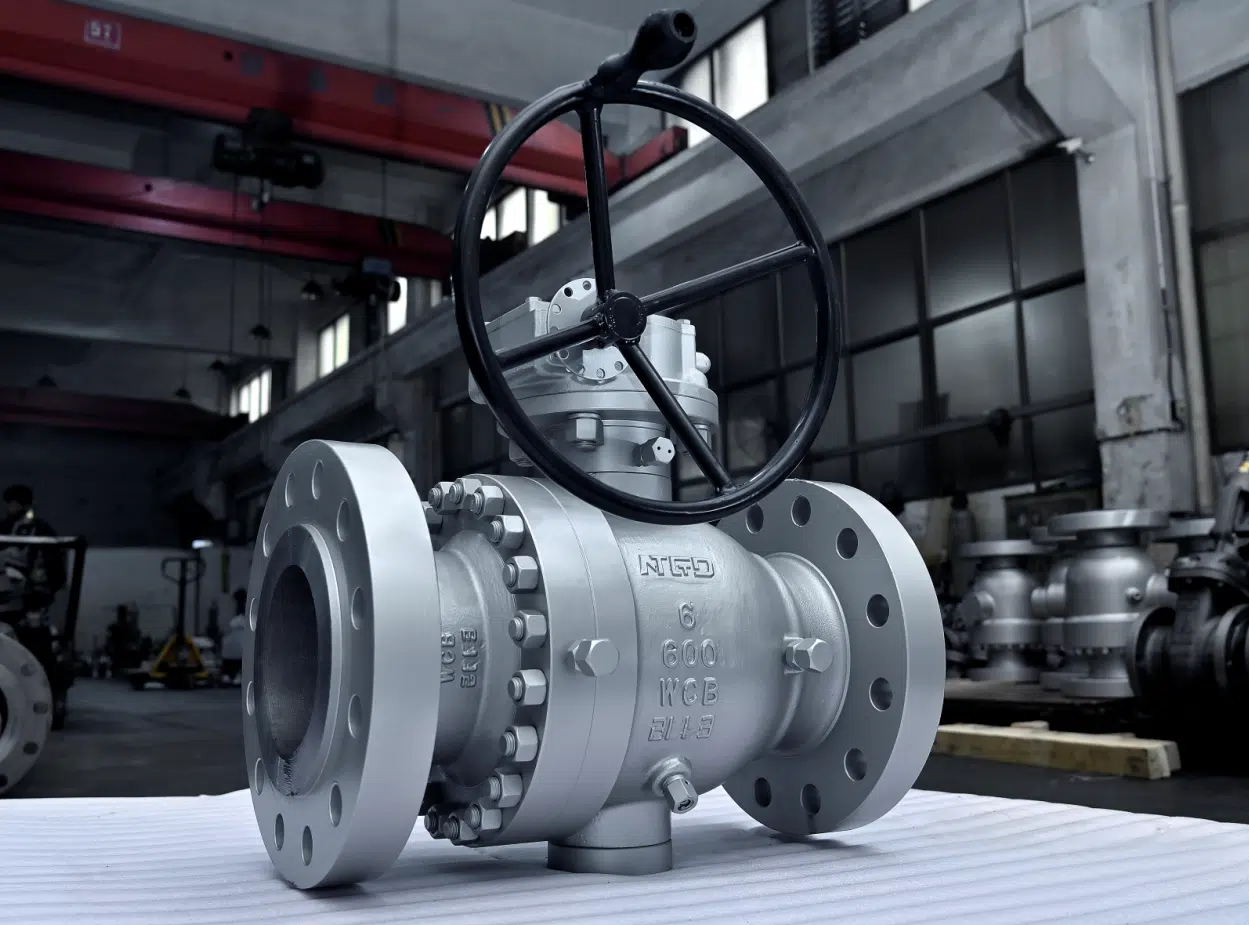
Structure de base d'un robinet à boisseau sphérique
Une vanne à bille classique comprend un corps, une bille, des sièges, une tige, des joints d'étanchéité ainsi qu'une poignée, un mécanisme à engrenages ou un actionneur. La bille est le principal élément rotatif d'obturation. Les sièges soutiennent la bille et assurent l'étanchéité. La tige relie la bille au mécanisme de commande.
Les performances d'une vanne à bille dépendent de la conception des orifices, du matériau du siège, du type de joint d'étanchéité, de la pression, de la température et du fluide transporté. Une vanne à bille à passage intégral offre un passage proche du diamètre intérieur de la conduite, tandis qu'une vanne à bille à passage réduit entraîne une plus grande restriction. Ces détails doivent être vérifiés lorsque la perte de charge ou le débit sont des critères importants.
Pourquoi utilise-t-on des robinets à boisseau sphérique pour la coupure d'alimentation ?
Une vanne à bille peut passer de la position entièrement ouverte à la position entièrement fermée grâce à une rotation de 90 degrés. Elle est donc particulièrement adaptée aux coupures rapides, aux isolations d'urgence, aux cycles fréquents d'ouverture et de fermeture, ainsi qu'aux réseaux de tuyauterie compacts.
Pour les applications d'isolement, la vanne est généralement exploitée en position entièrement ouverte ou entièrement fermée. C'est dans ces conditions que les vannes à bille classiques offrent les meilleures performances. Lorsqu'une vanne à bille standard est laissée partiellement ouverte pendant de longues périodes, le fluide peut s'écouler à grande vitesse au niveau des sièges, ce qui augmente le risque d'usure, de bruit, de vibrations ou d'instabilité de la régulation.
Principe de fonctionnement : mouvement linéaire vs mouvement rotatif d'un quart de tour
Le principe de fonctionnement constitue l'une des différences les plus importantes entre une vanne à bille et une vanne à siège droit. La différence ne réside pas uniquement dans le mode de déplacement de la poignée ou de l'actionneur. Elle a également une incidence sur le contrôle du débit, la vitesse de fermeture, la perte de charge et la planification de la maintenance.
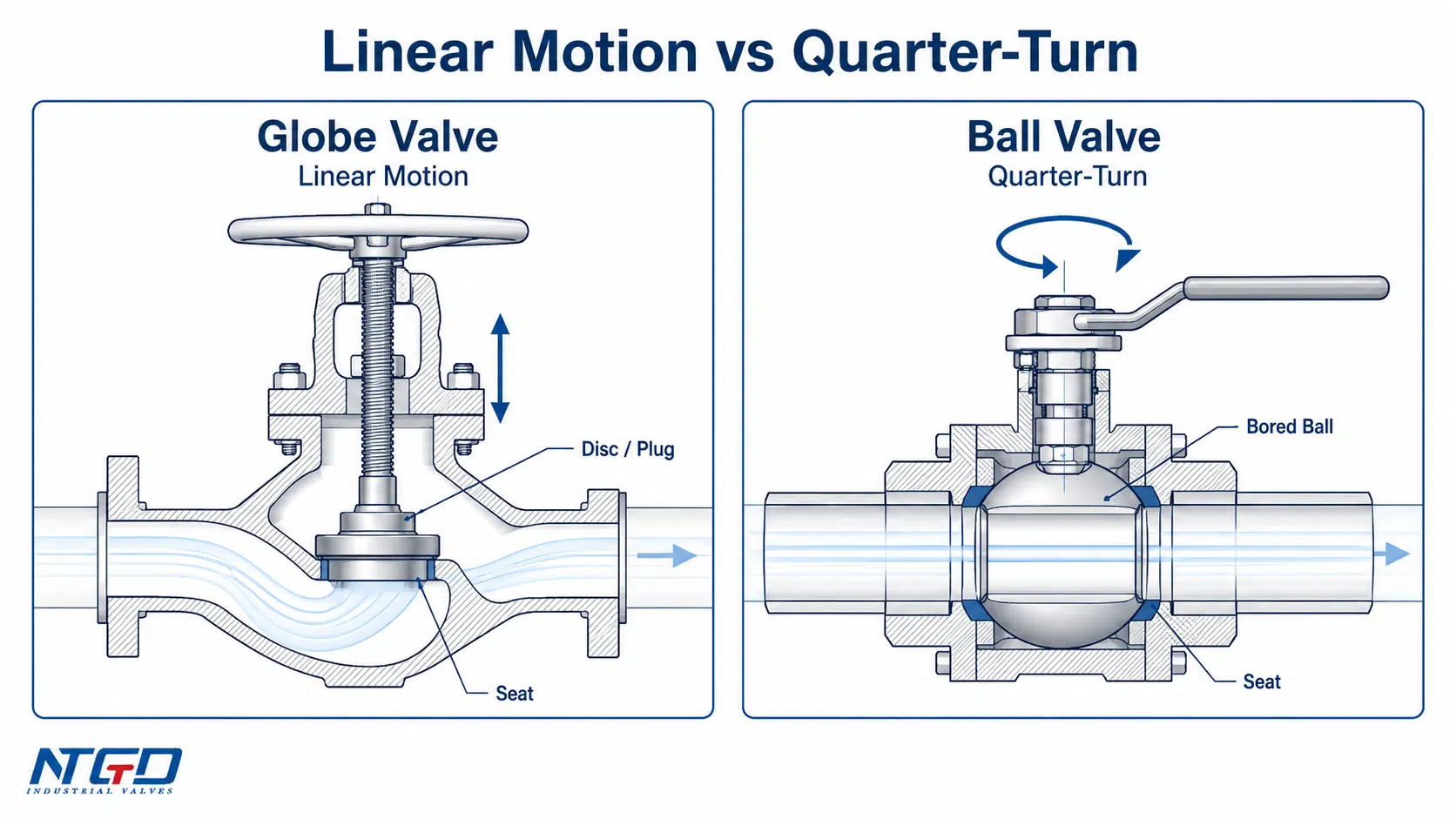
Comment une vanne à soupape contrôle le débit
Dans une vanne à soupape, le fait de tourner le volant ou d'actionner le servomoteur entraîne un déplacement linéaire de la tige. La tige rapproche ou éloigne le disque ou le clapet du siège. Lorsque le disque se soulève, la section de passage disponible augmente. À mesure que le disque se rapproche du siège, la section de passage diminue.
Ce mouvement linéaire permet à l'opérateur ou au système de commande d'effectuer un réglage plus progressif. Il permet également à la vanne de maintenir des positions intermédiaires plus efficacement qu'une vanne à bille classique. C'est pourquoi les vannes à soupape sont souvent utilisées lorsque le processus nécessite une régulation, un équilibrage ou un étranglement plutôt qu'une simple isolation.
Comment s'ouvre et se ferme un robinet à boisseau sphérique
Dans une vanne à bille, la bille tourne autour de l'axe de la tige. Lorsque l'alésage de la bille est aligné avec la canalisation, le fluide peut circuler. Lorsque l'alésage est perpendiculaire à la canalisation, le débit est bloqué.
Ce mouvement d'un quart de tour est rapide et direct. Il est idéal pour les applications où la vanne doit être soit ouverte, soit fermée. Il est moins adapté lorsque le processus nécessite un réglage fin et continu passant par de nombreuses positions intermédiaires, à moins que la vanne ne soit une vanne à bille de régulation à orifice en V, segmentée ou présentant d'autres caractéristiques spécifiques.
Pourquoi la différence de mouvement est-elle importante ?
La différence de mouvement influe sur le comportement de chaque vanne au sein du système :
| Différence de mouvement | Impact de la vanne à soupape | Impact des vannes à bille | Signification de la sélection |
|---|---|---|---|
| Type de voyage | Le mouvement linéaire permet un réglage progressif de l'ouverture | Le mouvement par quart de tour permet une ouverture et une fermeture rapides | Le déplacement linéaire permet d'obtenir une bonne résolution de contrôle ; le mouvement rotatif permet une isolation rapide. |
| Position intermédiaire | Plus adapté à une régulation contrôlée de l'accélération | Les modèles classiques ne sont généralement pas privilégiés pour une ouverture partielle prolongée | Adaptez le type de vanne à la fonction de régulation, et pas uniquement au diamètre de la conduite. |
| Vitesse de fonctionnement | Plus lent, mais plus facile à maîtriser | Plus rapide et plus simple | Une action rapide privilégie les vannes à boisseau sphérique ; un réglage progressif privilégie les vannes à soupape. |
| Trajet d'écoulement | Plus orienté et plus restrictif | Plus droit lorsqu'il est complètement ouvert | Le parcours du fluide influe sur la perte de charge et la consommation énergétique de la pompe. |
| Impact de la sélection | Meilleur pour la gestion du service | Idéal pour l'isolation et les applications à faible perte de charge | La différence de mouvement influe directement sur l'application la mieux adaptée. |
Contrôle du débit et régulation : quelle vanne choisir ?
Pour le contrôle du débit et la limitation de débit, une vanne à soupape est généralement le meilleur choix. La configuration du disque et du siège permet à la vanne de modifier la section de passage de manière plus progressive, ce qui la rend adaptée à la régulation du débit, de la pression, de la température ou de l'équilibre du procédé.
Un robinet à boisseau sphérique standard n'est généralement pas le premier choix pour un réglage continu du débit. Il peut certes être partiellement ouvert, mais cela ne signifie pas pour autant qu'il soit conçu pour assurer un réglage stable du débit sur de longues périodes.
Pourquoi les vannes à soupape sont-elles plus adaptées à la régulation du débit ?
Une vanne à disque régule le débit en modifiant la position du disque par rapport au siège. La course étant linéaire, de légères variations de la position de la tige permettent d'obtenir des variations plus précises de la section de passage. Cette caractéristique est utile dans les systèmes où la vanne n'est pas simplement ouverte ou fermée.
Parmi les exemples courants, on peut citer les conduites de régulation de vapeur, les boucles de régulation de refroidissement ou de chauffage, les conduites de dérivation, ainsi que les conduites d'équilibrage et les conduites de process où le débit doit être ajusté pendant le fonctionnement. Dans ces applications, la capacité à maintenir une position intermédiaire stable peut s'avérer plus importante que le fait d'obtenir la perte de charge la plus faible possible.
Pour une analyse plus approfondie de cette voie de contrôle-mission, consultez le guide de NTGD consacré à régulation par vanne à soupape dans les systèmes à haut débit.
Pourquoi les vannes à bille standard ne sont pas idéales pour la régulation en continu
Une vanne à bille standard est principalement conçue pour fonctionner en position entièrement ouverte ou entièrement fermée. Lorsqu'elle est utilisée en position partiellement ouverte pendant de longues périodes, le débit peut se concentrer sur une petite zone de la bille et du siège. Cela peut entraîner une augmentation de la vitesse locale et provoquer une usure du siège, de l'érosion, du bruit, des vibrations ou un contrôle instable du débit.
Ce risque s'accentue lorsque le service est caractérisé par une forte différence de pression au niveau de la vanne, la présence de fluides encrassés, de particules abrasives ou de longues périodes de fonctionnement avec une ouverture réduite. Dans ces conditions, il convient d'examiner attentivement la conception du siège, la surface de la bille, le système de commande de l'actionneur et le risque d'érosion.
Cela ne signifie pas pour autant qu'une vanne à bille ne peut jamais moduler le débit. Cela signifie simplement qu'une vanne à bille standard de type « tout ou rien », à passage total ou à passage réduit, ne doit pas être automatiquement considérée comme une vanne de régulation. Si l'application nécessite une modulation contrôlée, la conception doit être examinée avec soin, et il peut s'avérer nécessaire d'utiliser une vanne à passage en V, segmentée ou tout autre type de vanne caractérisée.
Pour plus de détails techniques, ceci Référence relative à la régulation du débit d'une vanne à bille classique explique pourquoi un fonctionnement à débit partiel peut entraîner une exposition à des vitesses élevées au niveau de la bille et du joint.
Fermeture et commande marche/arrêt : les avantages des vannes à bille
Pour une fermeture rapide et une utilisation en mode « ouvert/fermé », le robinet à boisseau sphérique présente généralement un avantage. Son mouvement rotatif à 90 degrés permet une manœuvre rapide, et son passage droit peut réduire la résistance lorsque le robinet est entièrement ouvert.
Dans les applications où la vanne reste principalement ouverte pendant le fonctionnement et n'est fermée que pour l'isolation, une vanne à bille constitue souvent la solution la plus pratique. C'est notamment le cas de nombreuses conduites de gaz, d'eau, d'huile, de produits chimiques et de process en général, où la priorité est donnée à une isolation fiable plutôt qu'à une régulation continue du débit.
Intervention rapide et mise hors service
Une vanne à bille peut être ouverte ou fermée rapidement à l'aide d'une poignée, d'un mécanisme à engrenages ou d'un actionneur. Cela s'avère utile lorsqu'une isolation rapide est nécessaire pendant le fonctionnement, la maintenance ou un arrêt d'urgence. Une vanne à passage droit peut également être fermée, mais cela nécessite généralement une course plus longue et prend plus de temps.
En cas de commande manuelle, le mouvement d'un quart de tour d'un robinet à bille est plus facile à repérer sur le terrain, car la position de la poignée indique souvent si le robinet est ouvert ou fermé. Pour les systèmes motorisés, les robinets à bille sont couramment utilisés lorsque seule une commande simple d'ouverture/fermeture est requise.
Les performances d'étanchéité dépendent de la conception
Les vannes à bille sont souvent choisies pour leur capacité à assurer une fermeture étanche, mais les performances d'étanchéité dépendent néanmoins de la conception spécifique de la vanne. Le matériau du siège, la conception du corps, la pression, la température, le fluide, la fréquence de fonctionnement et les exigences d'essai ont tous une incidence sur le résultat final.
Une vanne à bille à siège souple peut assurer une étanchéité élevée dans de nombreuses applications avec des fluides propres, tandis que des modèles à siège métallique ou destinés à des conditions d'utilisation difficiles peuvent s'avérer nécessaires en cas de températures élevées, de fluides abrasifs ou de conditions de fonctionnement exigeantes. Les exigences en matière d'étanchéité doivent toujours être vérifiées par rapport à la fiche technique et au cahier des charges du projet.
Dans quels cas une vanne à soupape peut-elle encore être utilisée pour la coupure ?
Une vanne à siège droit peut servir à interrompre le débit, et de nombreux modèles de ce type sont adaptés à une utilisation en tant que vanne d'arrêt. Il est toutefois important de noter que la fonction d'arrêt n'est généralement pas la principale raison qui motive le choix d'une vanne à siège droit plutôt que d'une vanne à bille.
Si le système nécessite à la fois un réglage du débit et une coupure totale, une vanne à soupape peut convenir. Si l'objectif principal est une isolation rapide avec une faible perte de charge, une vanne à bille constitue généralement le choix le plus efficace.
Perte de charge, perte de hauteur et Cv
La perte de charge est l'une des différences les plus marquées entre les vannes à siège droit et les vannes à bille. Dans de nombreuses applications, une vanne à bille présente une perte de charge moindre, car le trajet de l'écoulement est plus rectiligne lorsque la vanne est entièrement ouverte. Une vanne à siège droit présente généralement une perte de charge plus importante, car le flux est dévié à travers le corps et la zone du siège.
Toutefois, la détermination de la perte de charge ne doit pas se résumer à une seule phrase. Le résultat réel dépend de la taille, de la conception des orifices, de la conception des éléments de régulation, de la position d'ouverture, du débit, des propriétés du fluide et des conditions du système.
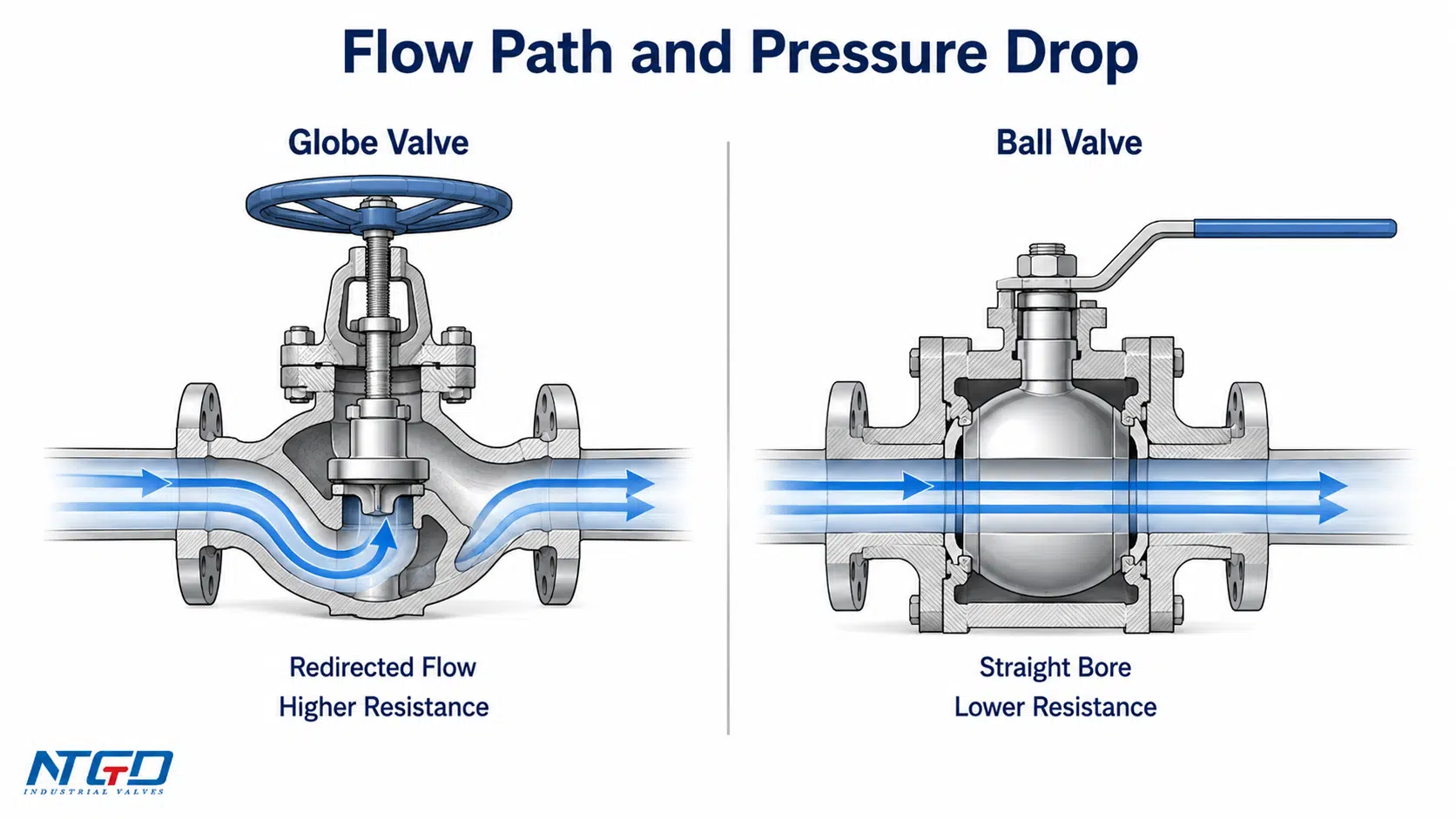
Pourquoi les vannes à bille présentent-elles généralement une perte de charge plus faible ?
Une vanne à bille entièrement ouverte permet au fluide de circuler à travers l'alésage de la bille. Dans une conception à passage intégral, cet alésage peut être proche de celui de la canalisation. Cela réduit les pertes de charge et contribue à maintenir un débit plus élevé.
Les vannes à bille à passage réduit présentent une résistance plus importante que les modèles à passage total, mais elles peuvent néanmoins offrir une perte de charge inférieure à celle de nombreuses vannes à soupape dans des applications à débit libre comparables. Lorsque de faibles pertes de charge et une capacité de débit élevée sont des critères importants, les vannes à bille sont souvent envisagées dès le début du processus de sélection.
En ce qui concerne le côté de la vanne à bille, les produits NTGD Guide sur la perte de charge et le coefficient Cv des vannes à bille explique comment les conceptions à passage intégral, à passage réduit et à alésage réel influent sur la résistance à l'écoulement.
Pourquoi les robinets à soupape ont généralement une perte de charge plus importante
Une vanne à soupape modifie le sens d'écoulement à l'intérieur du corps de la vanne. Le fluide doit passer par la zone du siège, où le disque ou le clapet contrôle l'ouverture. Ce trajet d'écoulement génère davantage de résistance qu'un alésage droit.
Cette résistance plus élevée n'est pas toujours un inconvénient. Dans les applications de régulation de débit, la vanne est utilisée à dessein pour contrôler le débit et absorber la perte de charge. La question est de savoir si cette perte de charge est acceptable pour le système et si l'organe de régulation de la vanne est adapté aux conditions de fonctionnement.
Les lecteurs qui souhaitent obtenir des explications détaillées sur la perte de charge du côté de la vanne à soupape peuvent consulter le document de NTGD intitulé Guide sur la perte de charge et le coefficient Cv des vannes à soupape sphérique.
Le débit volumique et la capacité de débit sont des critères de sélection, et non des réponses en soi
Le coefficient Cv est un critère utile pour comparer les débits, mais il ne doit pas être le seul facteur de sélection. Un coefficient Cv plus élevé ne signifie pas automatiquement que la vanne est mieux adaptée à l'application. Si l'application nécessite un étranglement stable, une vanne à bille de plus grand débit peut tout de même s'avérer être un mauvais choix si elle ne permet pas d'obtenir le comportement de régulation requis.
La valeur Cv doit être examinée en tenant compte du fluide, du débit, de la position d'ouverture, de la conception des orifices, de la conception des éléments de régulation, de la perte de charge admissible et de la conception globale du système. Lors du choix d'une vanne, la question n'est pas seulement de savoir “ quelle vanne présente la valeur Cv la plus élevée ”, mais aussi si celle-ci est capable d'assurer les performances requises en matière de régulation, de coupure et de durée de vie dans les conditions réelles d'exploitation.
Pour obtenir de l'aide sur la terminologie, ce Définition du coefficient de débit Cv d'une vanne explique pourquoi le Cv doit être considéré comme une valeur de capacité de débit liée à la perte de charge, et non comme un critère de sélection à part entière.
| Facteur de sélection | Robinet à soupape | Soupape à bille | Note technique |
|---|---|---|---|
| Trajet d'écoulement | Redirigé par le corps et le siège | Plus droit à travers l'alésage de la bille | Le tracé du circuit a une forte incidence sur la perte de charge et la consommation d'énergie. |
| Perte de charge | Généralement plus élevé | Généralement inférieur | Il convient de vérifier ces valeurs par rapport à la conception du système et à la perte de charge admissible. |
| CV / capacité | Souvent inférieure pour un même calibre nominal | Souvent plus élevée, en particulier sur les modèles à passage intégral | Un Cv plus élevé n'est pas toujours préférable lorsque la tâche nécessite un contrôle stable. |
| Adéquation de la limitation de débit | Une autorité de régulation plus forte | Limité aux modèles standard à marche/arrêt | La stabilité des commandes est tout aussi importante que la capacité. |
| Profondeur de calibrage | Nécessite une vérification de la finition et de l'entretien | Nécessite un examen du port, des sièges et des services | Les caractéristiques de débit, de perte de charge et de comportement au débit doivent être vérifiées lors de l'étude de dimensionnement ou de l'examen des spécifications, et ne doivent pas être déduites uniquement à partir du type de vanne. |
Différences en matière d'étanchéité, d'entretien et de cycle de vie
Les aspects liés à l'étanchéité et à la maintenance doivent être examinés une fois que les exigences de base ont été clairement définies. Le meilleur type de vanne n'est pas seulement celui qui présente le coût initial le plus bas ou le fonctionnement le plus rapide. C'est celui qui correspond au débit requis, à la marge de perte de charge, au plan de maintenance et au niveau de risque de l'application.
Complexité interne et points d'usure
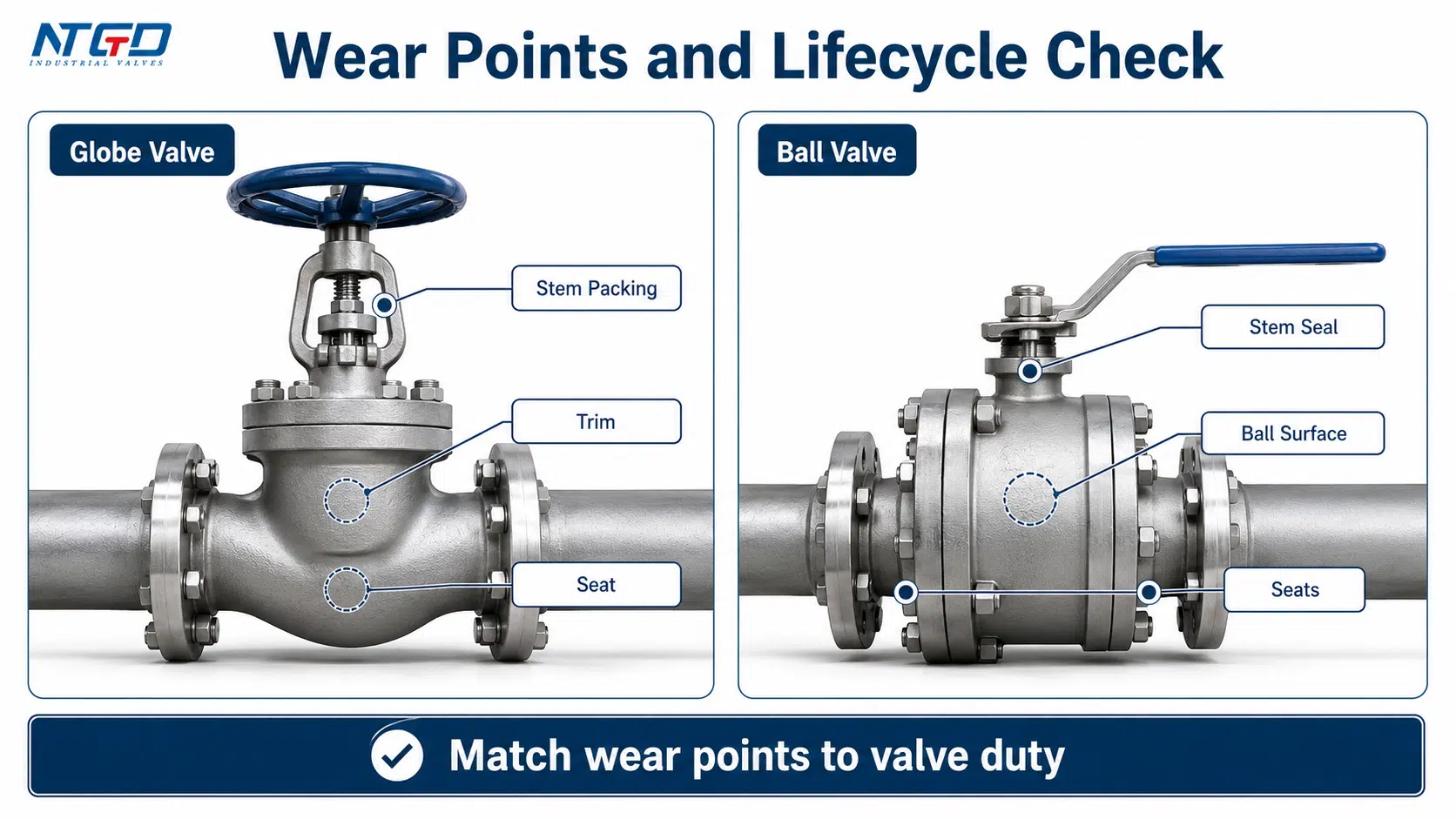
Une vanne à soupape est davantage exposée au niveau du disque, du siège, de la garniture de tige et du chapeau. En service de régulation, les éléments internes peuvent être soumis en permanence à la vitesse d'écoulement et à la perte de charge. C'est pourquoi le matériau des éléments internes, la conception du siège et l'état de la garniture revêtent une importance particulière.
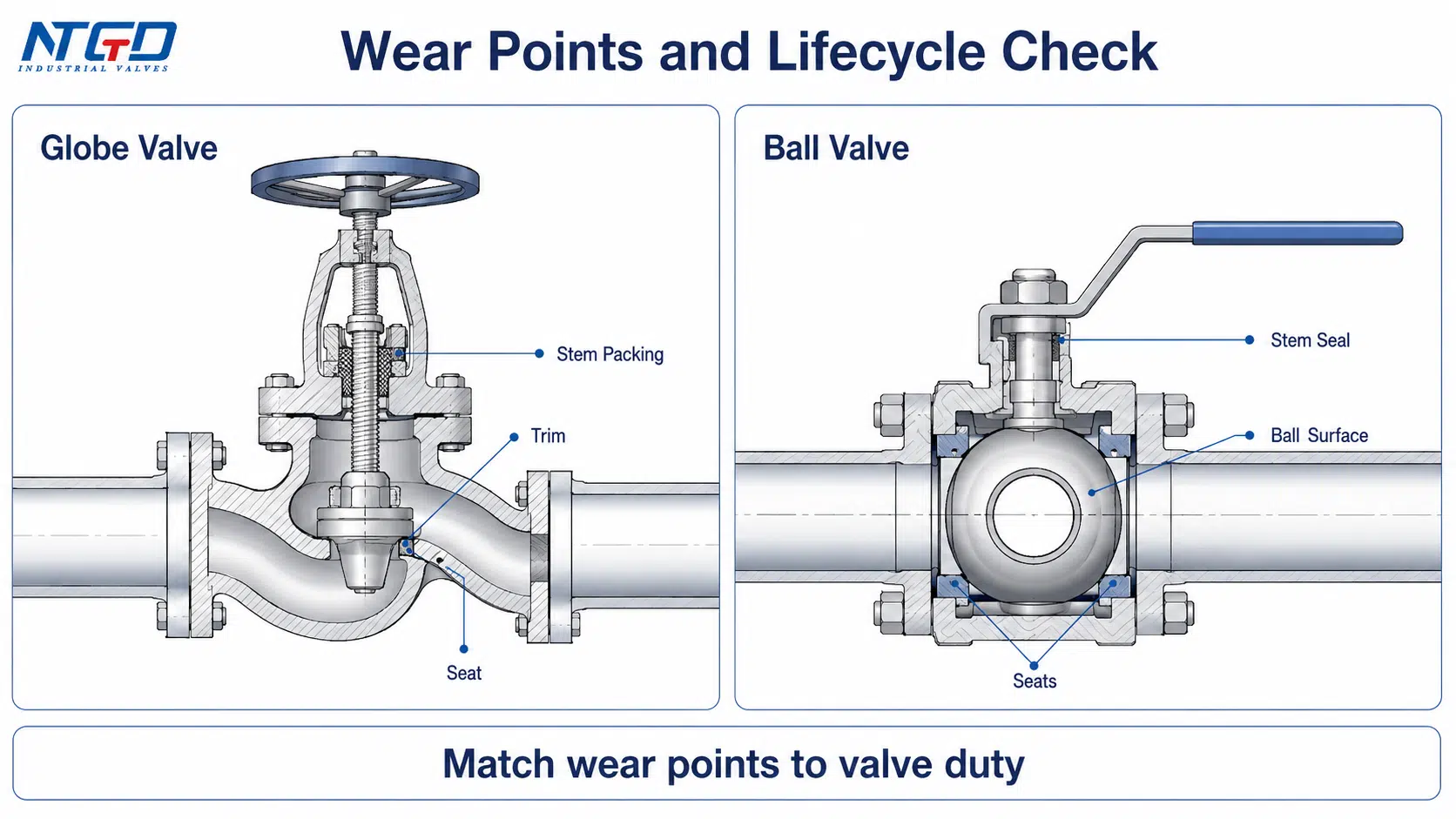
Une vanne à bille présente moins de variations dans le parcours du fluide, mais la surface de la bille, les sièges et le joint de tige revêtent une importance cruciale. Dans le cadre d'une utilisation « tout ou rien » avec un fluide propre, l'entretien peut s'avérer relativement simple. En cas d'utilisation dans des environnements abrasifs, à haute température ou corrosifs, le choix du matériau des sièges et du revêtement de la bille, ou encore celui du matériau de la bille elle-même, revêtent une importance accrue.
Conditions d'accès et d'intervention pour la maintenance
La difficulté d'entretien dépend de la conception spécifique de la vanne, et pas seulement de sa catégorie. Une petite vanne à bille filetée, une grande vanne à bille montée sur tourillon, une vanne à soupape à chapeau boulonné et une vanne à soupape de régulation motorisée présentent des exigences d'entretien très différentes.
Les conditions d'utilisation ont également leur importance. Des fluides encrassés, une fréquence de cycle élevée, une pression différentielle élevée, une température élevée ou des fluides corrosifs peuvent modifier les priorités en matière d'entretien. En cas d'utilisation en régulation, l'état de l'organe de régulation, du siège et de la garniture de la vanne à soupape devient plus important, tandis qu'en cas d'utilisation en marche/arrêt à cycle élevé, la durée de vie du siège de la vanne à bille, l'étanchéité de la tige et le cycle de fonctionnement de l'actionneur revêtent une importance accrue.
Le choix d'un produit ne se limite pas à son coût initial
Le coût ne doit pas être considéré uniquement comme le prix d'achat. Une vanne qui entraîne une perte de charge inutile peut augmenter la consommation d'énergie du pompage. Une vanne utilisée en dehors de sa plage de régulation appropriée peut s'user plus rapidement. Une vanne difficile d'accès peut allonger les temps d'arrêt lors de la maintenance.
Pour choisir entre une vanne à soupape et une vanne à bille, la question du cycle de vie revêt un aspect pratique : la vanne fonctionnera-t-elle la plupart du temps comme élément de régulation ou comme élément d'isolement ? La réponse à cette question détermine généralement quel type de vanne constitue le meilleur choix de départ.
Applications : quand utiliser une vanne à soupape ou une vanne à bille ?
Les applications doivent être classées en fonction de leur utilisation, et non uniquement en fonction du secteur d'activité. Une même usine peut utiliser des vannes à bille pour l'isolement et des vannes à soupape pour la régulation. Le choix approprié dépend de la fonction que la vanne doit remplir sur cette conduite.
Applications dans lesquelles les vannes à soupape sont généralement privilégiées
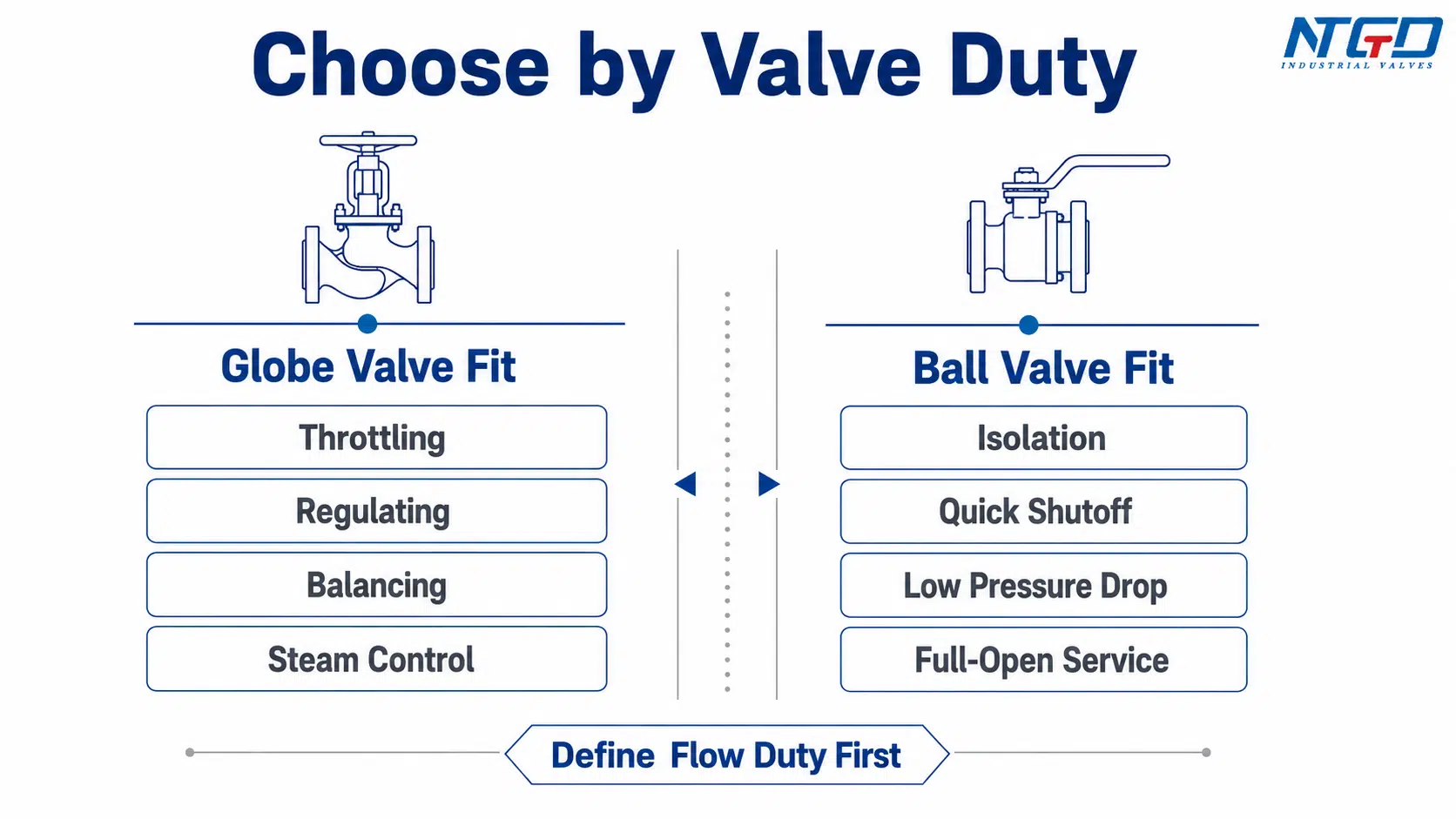
Les vannes à soupape sont généralement privilégiées lorsque le processus nécessite un réglage contrôlé du débit plutôt qu'une simple isolation de type « tout ou rien ».
Voici quelques exemples typiques de missions de service :
- régulation de la vapeur ou réglage de la distribution de la vapeur ;
- boucles de régulation de refroidissement ou de chauffage ;
- conduites de dérivation et d'équilibrage ;
- lignes de production nécessitant un réglage progressif du débit ;
- les points de régulation de la pression ou du débit où la stabilité prime sur une faible perte de charge ;
- fonctions de régulation dans lesquelles la vanne doit rester dans des positions intermédiaires pendant de longues périodes.
La conception finale de la vanne à boisseau sphérique dépend toujours du fluide, de la température, de la pression, de la pression différentielle, du matériau de l'intérieur de la vanne et du mode de fonctionnement.
Applications dans lesquelles les vannes à bille sont généralement privilégiées
Les vannes à bille sont généralement privilégiées lorsque le processus nécessite une isolation rapide, une faible résistance et un fonctionnement en position entièrement ouverte ou entièrement fermée.
Voici quelques exemples typiques de missions de service :
- principales lignes d'isolation ;
- conduites à faible perte de charge ;
- service à plein débit ;
- fermeture d'une conduite de gaz ou de liquide ;
- service de nettoyage avant et après le service ;
- dispositions compactes des canalisations ;
- les systèmes nécessitant une commande manuelle ou motorisée rapide ;
- des conduites à haut débit et à faibles pertes, où un réglage précis du débit n'est pas nécessaire.
Une vanne à bille est particulièrement utile lorsque celle-ci est normalement entièrement ouverte et ne se ferme que pour des opérations d'isolement, d'entretien ou d'urgence.
Demandes nécessitant un examen complémentaire
Certaines applications nécessitent une analyse plus approfondie avant de choisir l'un ou l'autre de ces types de vannes.
| Conditions de service | Orientation initiale | Pourquoi cela doit-il faire l'objet d'un réexamen ? |
|---|---|---|
| Régulation continue | Vanne à boisseau sphérique ou conception axée sur la régulation | Les vannes à bille standard peuvent ne pas assurer un étranglement stable à long terme et peuvent exposer les sièges à un écoulement concentré à grande vitesse. |
| Exigence de faible perte de charge | Vanne à bille | La conception des orifices et leur débit admissible doivent encore être vérifiés par rapport au débit réel et à la perte de charge admissible. |
| Pression différentielle élevée | Au cas par cas | La régulation par vanne à soupape peut nécessiter une vérification des éléments internes en cas de cavitation, de vaporisation ou d'usure ; l'ouverture et la fermeture d'une vanne à bille sous une pression différentielle élevée peuvent nécessiter une vérification du siège et du couple. |
| Supports abrasifs ou sales | Au cas par cas | Les surfaces d'appui et d'étanchéité peuvent s'user rapidement si la conception n'est pas adaptée au fluide. |
| Haute température | Au cas par cas | Le matériau du siège, celui du corps et la conception du joint doivent être validés. |
| Milieux corrosifs | Au cas par cas | Les matériaux de la carrosserie, des garnitures, des sièges et des joints doivent être adaptés à l'environnement. |
| Cyclage fréquent ou commutation marche-arrêt à haute fréquence | Robinet à bille pour commande tout ou rien ; robinet à soupape s'il est associé à un dispositif de régulation | La fréquence de cycle influe sur le garnissage de la tige, la durée de vie du siège, le cycle de service de l'actionneur et la planification de la maintenance. |
| Automatisation modulable | Vanne à passage droit ou à passage en V / vanne caractérisée | La réponse de commande, l'ensemble des actionneurs, la conception du siège et les conditions d'exploitation doivent être examinés conjointement. |
Qu'en est-il des vannes à bille à passage en V ?
Les vannes à bille à passage en V, segmentées et caractérisées constituent des cas particuliers. Elles ne sont pas identiques aux vannes à bille ordinaires de type « tout passage » ou « passage réduit » destinées à la commande tout ou rien.
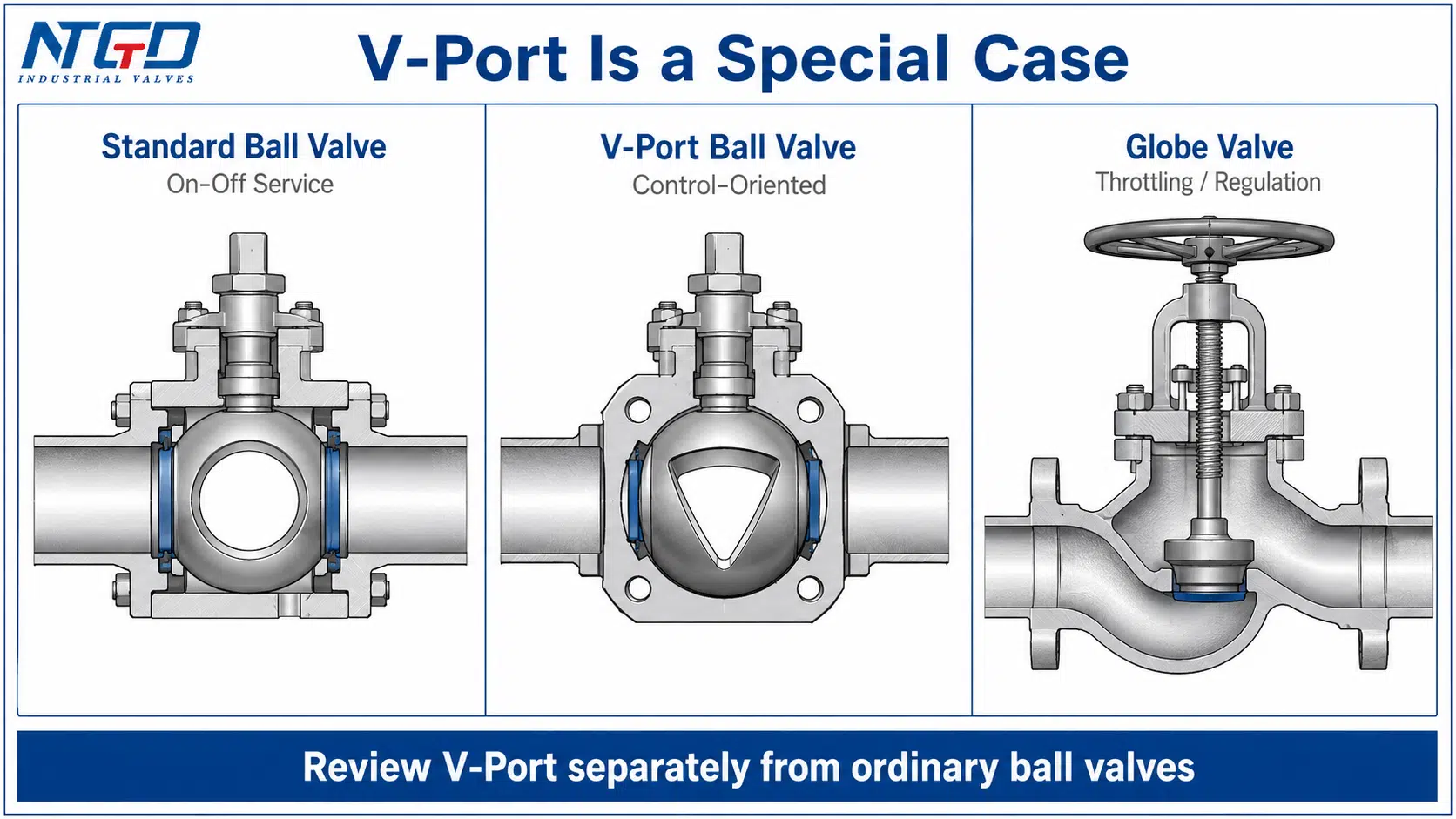
On opte généralement pour une vanne à bille standard pour les opérations de fermeture et d'isolement. Une vanne à bille à orifice en V est dotée d'une ouverture profilée qui permet un réglage plus précis du débit. Elle peut donc s'avérer utile dans certaines applications de modulation ou de régulation où une vanne à bille standard ne serait pas adaptée.
Pour une analyse plus approfondie de ce cas particulier, consultez le document de NTGD intitulé Guide de régulation du débit des vannes à bille à passage en V.
Toutefois, le choix entre une vanne à bille à orifice en V et une vanne de régulation à siège droit constitue un sujet distinct dans le cadre de la sélection des vannes de régulation. Cela peut concerner la plage de régulation, la courbe de débit, le choix de l’actionneur, les conditions du fluide, la perte de charge, le risque de cavitation et les exigences en matière de contrôle des procédés. Si l’application implique une pression différentielle élevée, des fluides abrasifs ou une modulation fréquente, même une vanne à bille à orifice en V ou à caractéristique définie nécessite tout de même une analyse de la conception du siège, du risque d’érosion et de l’ensemble actionneur.
Dans cet article, les vannes à bille à orifice en V doivent être considérées comme un cas particulier, et non comme la définition par défaut du terme “ vanne à bille ” dans une comparaison classique entre une vanne à siège droit et une vanne à bille.
Comment choisir entre une vanne à glissière et une vanne à bille
Pour faire le bon choix, il faut commencer par déterminer l'utilisation prévue de la vanne. La question n'est pas simplement de savoir quelle vanne est “ la meilleure ”. Il faut plutôt se demander : quel rôle la vanne doit-elle remplir dans cette conduite ?
Optez pour une vanne à soupape lorsque…
Optez pour une vanne à passage droit lorsque l'application nécessite :
- service de régulation ou de limitation précise ;
- réglage progressif du débit ;
- équilibrage des processus ;
- des positions intermédiaires stables de la vanne ;
- contrôle de la vapeur, de l'eau de refroidissement ou du débit de process ;
- perte de charge admissible dans la conception du système ;
- configuration des garnitures et des sièges adaptée au fluide et aux conditions de fonctionnement.
Si la régulation du débit est la principale raison justifiant le choix d'une vanne à soupape, il convient également de vérifier la perte de charge admissible, la conception de l'organe de régulation, le matériau du siège, les caractéristiques du fluide ainsi que les exigences relatives à l'actionneur ou à la commande.
Une vanne à soupape est le choix le plus judicieux lorsque la qualité de la régulation prime sur la rapidité de fonctionnement ou sur une perte de charge aussi faible que possible.
Optez pour un robinet à boisseau sphérique lorsque…
Optez pour un robinet à boisseau sphérique lorsque l'application nécessite :
- fermeture d'urgence ;
- fonctionnement en position entièrement ouverte / entièrement fermée ;
- faible perte de charge ;
- grande capacité de débit ;
- fonctionnement de la vanne compacte ;
- isolation simple, manuelle ou motorisée ;
- un fonctionnement marche-arrêt fiable dans des conditions d'environnement appropriées.
Si la fonction d'isolement est la principale raison du choix d'un robinet à boisseau sphérique, il convient également de vérifier la configuration des orifices, le matériau du siège, les limites de pression et de température, les exigences en matière de fermeture et la fréquence de fonctionnement.
Une vanne à bille constitue le choix le plus judicieux lorsque la vanne sert principalement de vanne d'isolement et n'a pas besoin d'assurer un réglage continu du débit.
Ne vous fiez pas uniquement au nom de la vanne
Le choix d'une vanne ne doit pas se limiter aux termes “ vanne à siège ” ou “ vanne à bille ”. Le cahier des charges définitif doit tenir compte des conditions réelles d'utilisation.
Parmi les principaux critères de sélection, on peut citer :
- médias ;
- la pression et la température ;
- débit ;
- perte de charge admissible ;
- fonction de contrôle ;
- l'obligation de fermeture ;
- dimension de la vanne et dimension de la canalisation ;
- connexion finale ;
- matériau de la carrosserie et de la garniture ;
- le matériau du siège et du joint ;
- fonctionnement manuel, à engrenages, pneumatique ou électrique ;
- espace d'installation ;
- fréquence du cycle ;
- cahier des charges du projet concerné ;
- spécifications techniques et exigences en matière de plans.
Si cette comparaison s'inscrit dans le cadre d'une analyse plus large des différents types de vannes, celle de NTGD… guide de sélection des vannes industrielles peut aider à recenser les données relatives au fonctionnement des vannes, au fluide, à la pression, à la température, à l'étanchéité et aux demandes de devis avant la définition du cahier des charges définitif.
Liste de contrôle pour les appels d'offres et les cahiers des charges
Avant de demander un devis ou de confirmer le type de vanne, préparez les données relatives à l'application. Cela permet d'éviter de choisir une vanne qui correspond à la désignation de l'application, mais pas aux conditions réelles d'exploitation.
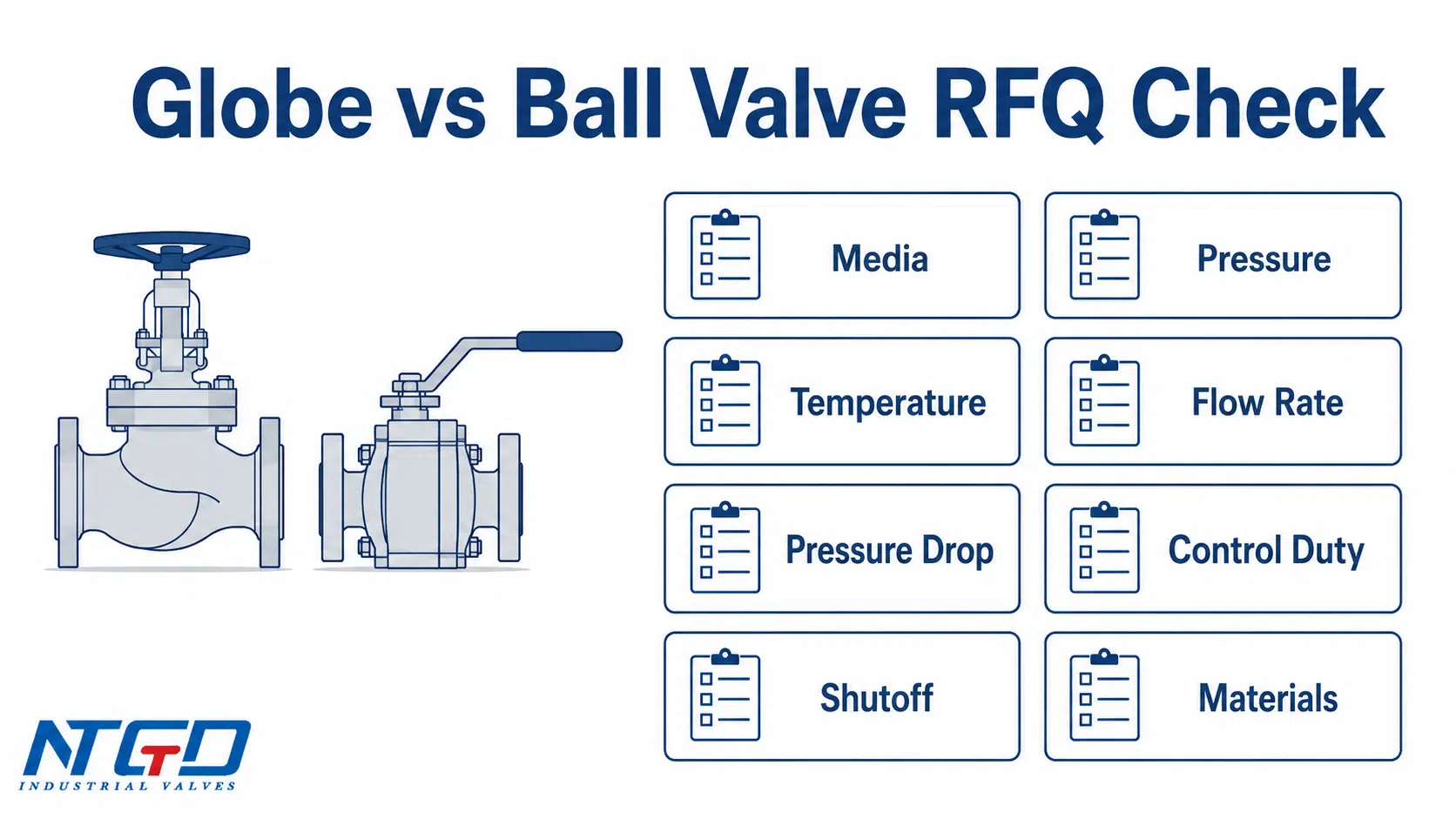
| Point de l'appel d'offres | Pourquoi c'est important | Remarques concernant le choix entre une vanne à soupape et une vanne à bille |
|---|---|---|
| Les médias | Permet de vérifier la compatibilité de la carrosserie, des garnitures, des sièges et des joints | Les applications impliquant des fluides corrosifs, abrasifs, propres, sales, de la vapeur ou des gaz peuvent nécessiter des conceptions différentes. |
| Pression | Cela a une incidence sur la classification du corps, la conception de l'étanchéité et les exigences relatives à l'actionneur | Vérifiez la pression normale, la pression maximale et la pression différentielle. |
| Température | Cela a une incidence sur le choix du siège, du joint, de la garniture et du matériau | Les températures élevées peuvent limiter les options de sièges à garniture souple. |
| Débit | Éléments nécessaires à l'analyse de la capacité et du dimensionnement | Ne vous fiez pas uniquement au diamètre nominal du tuyau. |
| Perte de charge admissible | Permet de déterminer si la résistance d'une vanne à soupape est acceptable | Dans les applications où la perte de charge doit être faible, on privilégie souvent les vannes à bille. |
| Obligation de contrôle | Indique si la vanne est de type tout ou rien, à débit régulé ou modulante | On privilégie généralement les vannes à soupape pour la régulation du débit, et les vannes à bille pour l'isolement. |
| Exigences en matière de fermeture | Cela a une incidence sur la conception du siège et les prévisions en matière de fuites | Vérifiez que les performances d'étanchéité requises sont conformes au cahier des charges du projet. |
| Taille de la vanne et taille de la canalisation | Cela a une incidence sur le débit, l'installation et le fonctionnement | Le choix entre une vanne à bille à passage total ou à passage réduit peut avoir son importance. |
| Raccordement final | Détermine l'interface d'installation | Les raccords à bride, filetés, soudés ou autres doivent être adaptés à la conception de la tuyauterie. |
| Matériau de la carrosserie et des garnitures | Influence la résistance à la corrosion, à l'érosion et l'aptitude à la température | Il convient de vérifier la compatibilité du matériau avec les fluides et les conditions d'utilisation. |
| Matériau du siège | Facteurs essentiels pour l'étanchéité, la température et l'usure | Les options « siège souple » et « siège métallique » se comportent différemment. |
| Mode opératoire | A un impact sur la vitesse, l'automatisation et l'accessibilité | Le mode de fonctionnement (manuel, à engrenages, pneumatique ou électrique) doit être adapté aux exigences du site. |
| Espace d'installation | Important pour l'accès à la poignée, à l'engrenage, à l'actionneur et pour l'entretien | Les configurations compactes peuvent privilégier les vannes à bille, mais la performance reste la priorité absolue. |
| Fréquence du cycle | A un impact sur l'usure, la durée de fonctionnement des actionneurs et la planification de la maintenance | Les cycles fréquents de mise en marche et d'arrêt, ainsi que la modulation continue, imposent des contraintes différentes. |
| Fiche technique / Cotes techniques requises | Évite tout décalage entre la sélection et le cahier des charges du projet | Vérifiez les dimensions, le matériau, la puissance nominale et le mode de fonctionnement avant l'achat. |
FAQ
Quelle est la principale différence entre une vanne à glissière et une vanne à bille ?
La principale différence réside dans le fonctionnement et l'utilisation en matière de débit. Une vanne à soupape utilise un mouvement linéaire du disque ou du clapet et est généralement plus adaptée au contrôle du débit et à la régulation. Une vanne à bille utilise un mouvement rotatif d'un quart de tour et est généralement plus adaptée à une fermeture rapide, à un fonctionnement tout ou rien et à une faible perte de charge.
Une vanne à bille, c'est la même chose qu'une vanne à soupape ?
Non. Une vanne à bille et une vanne à soupape présentent des structures internes différentes et des critères de sélection distincts. Une vanne à bille fait tourner une bille creuse pour ouvrir ou fermer la conduite. Une vanne à soupape rapproche ou éloigne un disque ou un obturateur d’un siège pour réguler le débit.
Quel est le meilleur choix pour la régulation du débit : une vanne à glissière ou une vanne à bille ?
Une vanne à soupape est généralement plus adaptée à un étranglement prolongé, car elle permet un réglage plus progressif du débit au niveau du disque et du siège. Une vanne à bille standard peut être partiellement ouverte, mais elle n'est généralement pas choisie comme vanne d'étranglement continu, sauf si sa conception est axée sur la régulation, comme c'est le cas des vannes à bille à orifice en V ou segmentées.
Quelle vanne présente la plus faible perte de charge : la vanne à siège droit ou la vanne à bille ?
Une vanne à bille présente généralement une perte de charge plus faible lorsqu'elle est entièrement ouverte, car le trajet de l'écoulement est plus rectiligne. Une vanne à soupape entraîne généralement une perte de charge plus importante, car le flux est dévié à travers le corps et la zone du siège. La perte de charge réelle dépend toutefois de la taille de la vanne, de la conception des orifices, de la position d'ouverture et des conditions d'utilisation.
Un robinet à boisseau sphérique peut-il être utilisé pour le contrôle du débit ?
Une vanne à bille standard peut modifier le débit lorsqu’elle est partiellement ouverte, mais la modulation du débit n’équivaut pas à un contrôle stable et continu. Une ouverture partielle prolongée peut entraîner une usure accrue des sièges, du bruit, des vibrations ou un débit instable, en particulier en cas de pression différentielle élevée ou d’utilisation dans un milieu abrasif. Si l’application nécessite une modulation, il peut être nécessaire d’envisager l’utilisation d’une vanne à bille à orifice en V, segmentée ou caractérisée.
Pourquoi utiliser une vanne à passage droit plutôt qu'une vanne à bille ?
Utilisez une vanne à boisseau sphérique lorsque le procédé nécessite un étranglement, un réglage progressif ou une meilleure stabilité de régulation. Elle est souvent privilégiée pour la régulation du débit, les applications à vapeur, la commande de dérivation et l'équilibrage des procédés lorsque la perte de charge est acceptable.
Pourquoi utiliser un robinet à boisseau sphérique plutôt qu'un robinet à soupape ?
On utilise une vanne à bille lorsque le processus nécessite une fermeture rapide, une faible perte de charge, un débit élevé ou un fonctionnement simple en position « entièrement ouverte » ou « entièrement fermée ». Les vannes à bille sont souvent privilégiées pour les applications d'isolement et les réseaux de tuyauterie compacts.
Qu'en est-il des vannes à bille à passage en V ?
Les vannes à bille à passage en V sont des vannes à bille spécialement conçues pour la régulation. Elles permettent une meilleure modulation du débit que les vannes à bille classiques, mais leur analyse doit être effectuée séparément de celle des vannes à bille standard de type « tout ou rien ». La comparaison entre une vanne à bille à passage en V et une vanne de régulation à siège droit relève d'un sujet plus spécifique lié au choix des vannes de régulation.
Dans quels cas une vanne à boisseau sphérique n'est-elle pas le meilleur choix ?
Une vanne à glissière n'est pas forcément le meilleur choix lorsque la conduite nécessite avant tout une faible perte de charge, un fonctionnement marche-arrêt rapide, un encombrement réduit ou un débit élevé en position entièrement ouverte. Dans ces cas-là, une vanne à bille correctement choisie peut constituer un meilleur point de départ, à condition que le fluide, la pression, la température, le matériau du siège et les exigences en matière d'étanchéité soient adaptés.
Conclusion
Lorsqu'il s'agit de choisir entre une vanne à passage droit et une vanne à bille, le choix de la meilleure vanne dépend de l'application visée. Une vanne à passage droit est généralement préférable pour un contrôle précis du débit, l'étranglement et la régulation. Une vanne à bille est généralement préférable pour une fermeture rapide, un fonctionnement tout ou rien, une faible perte de charge et un débit élevé.
Le principal compromis technique réside dans le choix entre régulation et résistance. Une vanne à soupape offre une meilleure régulation, mais entraîne généralement une perte de charge plus importante. Une vanne à bille permet une isolation plus rapide et présente une résistance moindre, mais n’est généralement pas le premier choix pour un étranglement prolongé. Le choix d’une vanne à bille standard pour une application de régulation de débit peut entraîner une usure du siège ou une mauvaise stabilité de régulation, tandis que l’utilisation d’une vanne à soupape dans une conduite d’isolement à faibles pertes peut entraîner une perte de charge inutile tout au long de la durée de vie de la vanne.
Il ne faut pas confondre les vannes à bille standard avec les vannes à bille à passage en V ou à caractéristique définie. Si l'application nécessite une modulation, il convient d'examiner attentivement la conception de la vanne, l'ensemble actionneur, la caractéristique de débit et les conditions d'utilisation.
Soutien aux applications et aux spécifications
Vous avez besoin d'une analyse des spécifications pour votre application ? Commencez par définir les conditions d'utilisation, le fluide, la pression, la température, le débit, la perte de charge admissible, les exigences en matière de régulation, les exigences en matière de fermeture, les matériaux souhaités et le mode de fonctionnement.
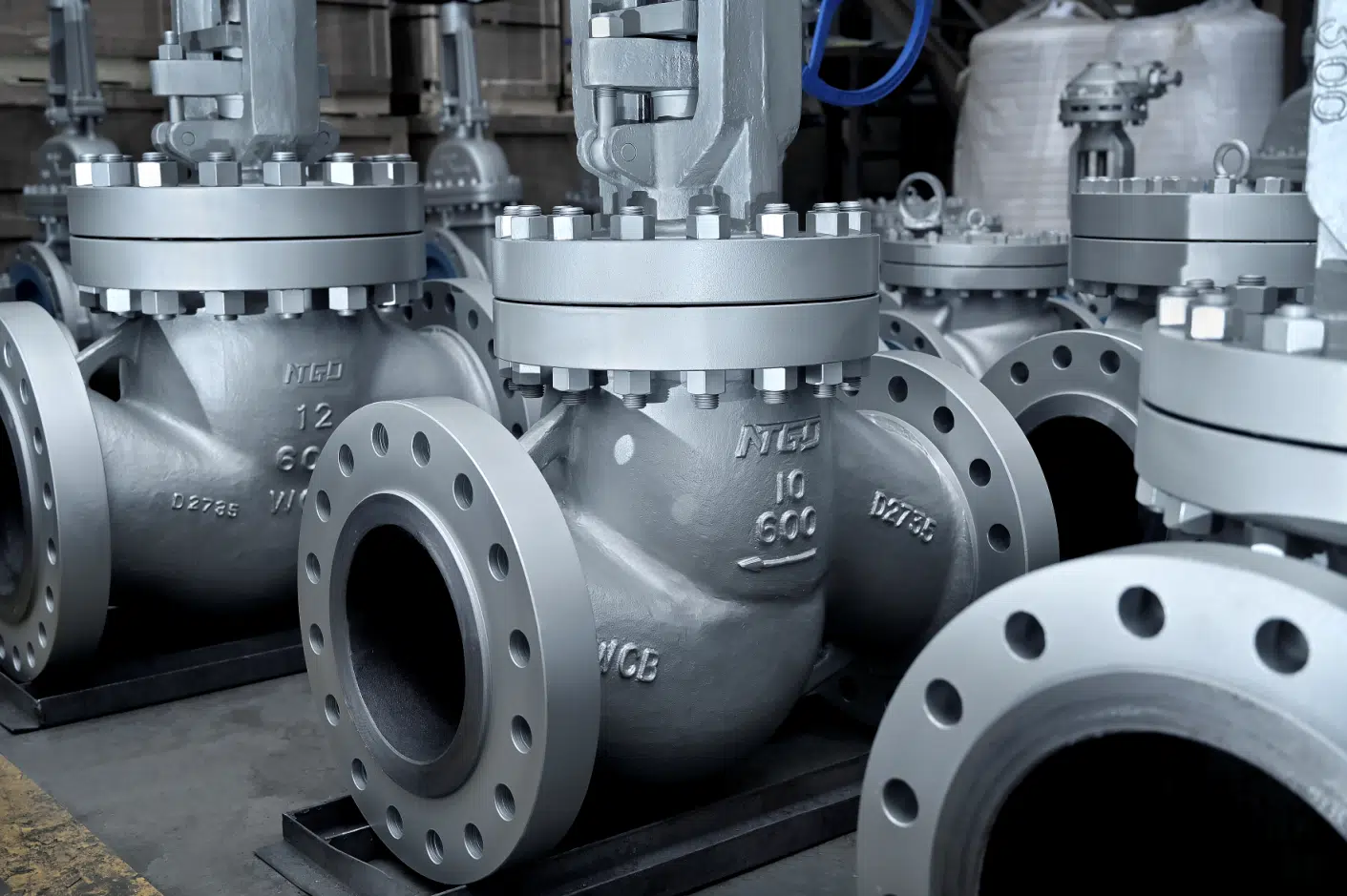
Une fois les formalités douanières réglées, comparez les offres disponibles robinet à soupape industriel et vanne à bille industrielle les options en fonction de la fiche technique du projet plutôt que de se baser uniquement sur le nom de la vanne.
NTGD Valve peut vous accompagner dans l'analyse des applications et la définition des spécifications pour les vannes à siège droit, les vannes à bille et les ensembles de vannes associés destinés à un usage industriel, en fonction des conditions de fonctionnement réelles et des exigences du projet. Grâce à des données techniques claires, les ingénieurs peuvent déterminer si une vanne à siège droit, une vanne à bille ou une vanne spéciale axée sur le contrôle constitue la solution la mieux adaptée à la conduite concernée.
