
Author Name: Bruce Zheng
Author Role: Co-Founder and Valve Engineer at NTGD Valve
Author Bio: Bruce Zheng is Co-Founder and Valve Engineer at NTGD Valve, focusing on industrial valve selection, application, and technical content for global B2B buyers.
Last Updated: May 19, 2026
Gate Valve vs Globe Valve: Quick Answer
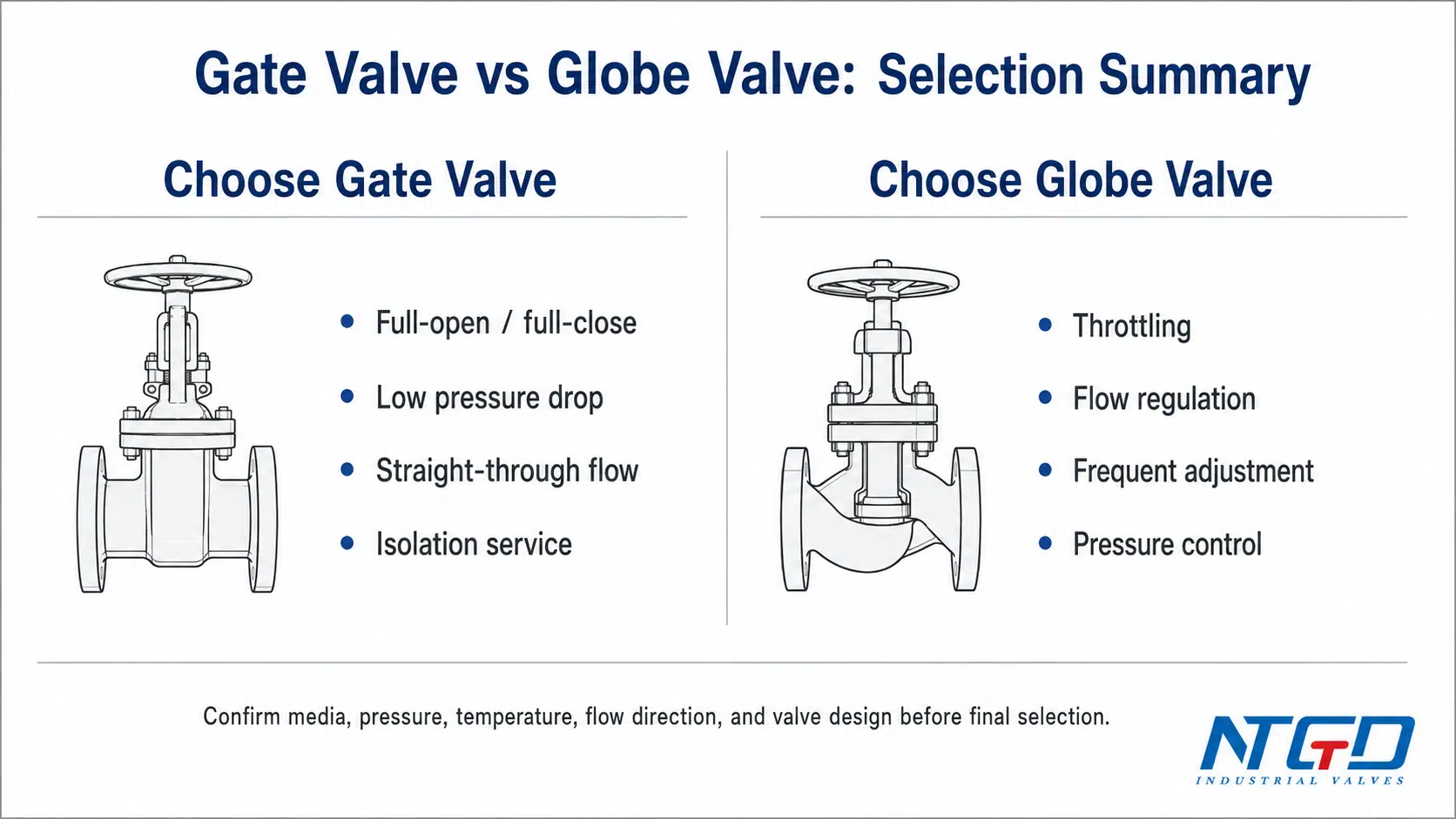
The main difference between a gate valve and a globe valve is their primary function. A gate valve is mainly used for full-open or full-close isolation, while a globe valve is mainly used for throttling, regulating, or adjusting flow.
Use a gate valve when the line normally stays fully open or fully closed and low pressure drop is important. Use a globe valve when the system needs controlled flow, frequent adjustment, or pressure regulation, even if the valve creates more flow resistance.
In simple terms:
- Gate valve = isolation and low resistance
- Globe valve = regulation and better flow control
- Gate valve partially open = not recommended
- Globe valve in low-pressure-drop service = often not the best fit
Although media, pressure, temperature, material, end connection, and manufacturer design all matter, the first selection question is functional: is the valve used to isolate flow or to control flow? In high-pressure, high-flow, or critical process lines, choosing the wrong valve type can increase pressure loss, energy use, maintenance exposure, or control instability.
Gate Valve vs Globe Valve Core Comparison Table
| Comparison Point | Gate Valve | Globe Valve |
|---|---|---|
| Main function | Full-open / full-close isolation | Throttling, flow regulation, and control |
| Typical service | On-off service where flow is either allowed or stopped | Control service where flow needs to be adjusted |
| Flow path | Usually straight-through when fully open | Diverted or tortuous path through the seat area |
| Pressure drop | Low when fully open | Higher than a comparable gate valve in similar service |
| Flow direction | Often less direction-sensitive, but design must be verified | Usually directional; follow the body arrow or manufacturer instructions |
| Throttling ability | Not recommended for throttling | Suitable for throttling and frequent adjustment |
| Shutoff logic | Gate or wedge moves across the flow path | Disc or plug moves toward or away from the seat |
| Visual difference | Commonly has a more straight-through body profile, with rising-stem or non-rising-stem designs depending on construction | Commonly has a rounder body chamber, a disc-seat control area, and often a visible flow-direction arrow |
| Maintenance concern | Seat and gate wear can occur if used partially open | Disc, seat, and trim wear must be checked in control service |
| Cost logic | Usually simpler and often lower upfront cost | Usually more complex and often higher cost |
| Best fit | Isolation, full-flow service, low pressure drop priority | Flow control, pressure adjustment, throttling service |
| Misapplication risk | Partial opening may cause vibration, erosion, leakage, or loss of shutoff reliability | Using it only for isolation may add unnecessary pressure loss and operating cost |
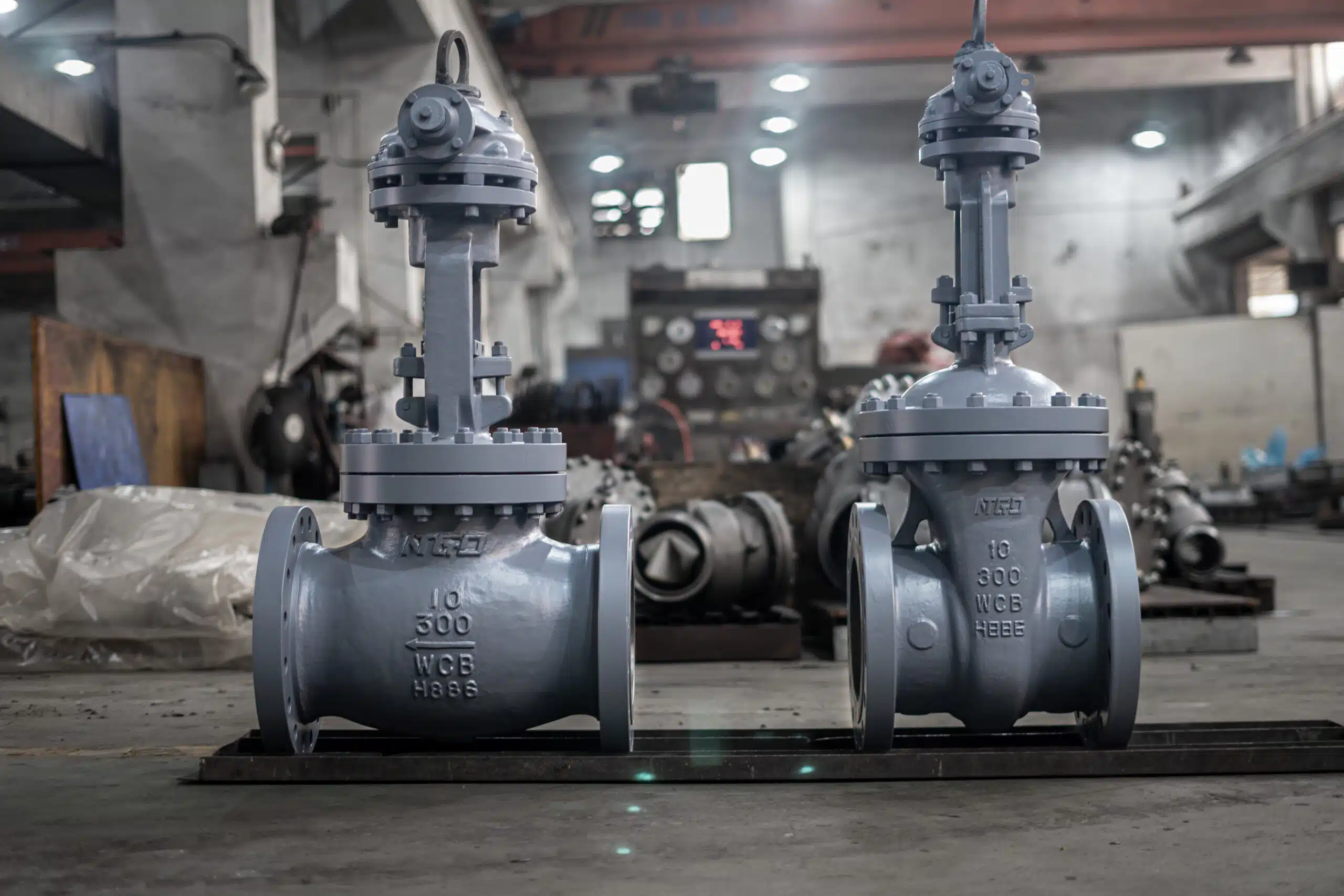
A gate valve and a globe valve may look similar from a distance because both can use a handwheel, bonnet, stem, and flanged body. Internally, however, they solve different engineering problems. The gate valve clears the flow path when fully open. The globe valve forces flow through a controlled seat area so the operator can adjust the flow more accurately.
For field identification, do not rely on appearance alone. Check the body profile, bonnet and stem arrangement, flow arrow, nameplate, valve marking, and datasheet. A visual difference can support identification, but the final confirmation should come from the valve design and manufacturer information.
How Gate Valves and Globe Valves Work
How a Gate Valve Works
A gate valve uses a gate, wedge, or parallel disc that moves up and down across the flow path. When the gate is fully raised, the flow path is mostly open, allowing fluid to move through the valve with relatively low resistance. When the gate is lowered, it blocks the flow and provides isolation.
This design makes gate valves suitable for pipelines where the valve is normally either fully open or fully closed. Common examples include water lines, utility systems, oil and gas pipelines, and other industrial lines where the main requirement is to start or stop flow rather than control it.
A gate valve should not be treated as a regulating valve. If it is kept partially open, the media can pass through a narrow opening at high velocity. This can create vibration, turbulence, erosion, and damage to the gate and seat surfaces. Over time, the valve may lose its ability to shut off properly.
For the complete stem-to-gate sequence, including gate travel, seat contact, and fully open, partially open, and closed states, see NTGD’s guide to how a gate valve works.
How a Globe Valve Works
A globe valve uses a disc or plug that moves toward or away from a seat. As the disc moves closer to the seat, the opening becomes smaller and the flow is restricted. As the disc moves away from the seat, the flow increases.
This disc-and-seat arrangement gives the globe valve better control over flow rate. It is useful in systems where the operator needs to adjust flow, balance pressure, control steam, or regulate process conditions.
The trade-off is pressure drop. The flow path inside a globe valve is not as direct as the flow path inside a fully open gate valve. Because the media changes direction and passes through the seat area, the valve creates more resistance.
Why Flow Path Changes the Selection Logic
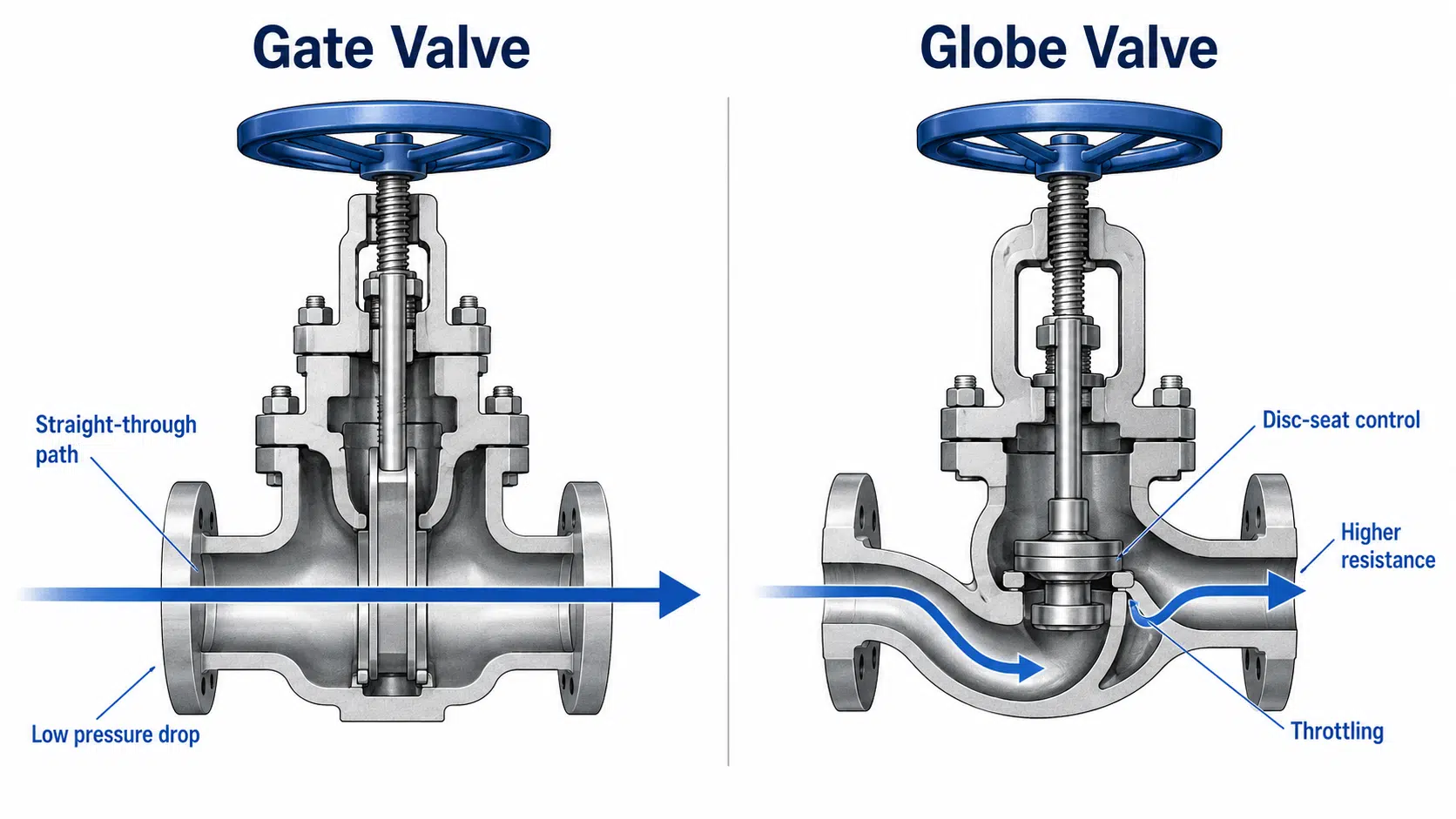
The flow path is the mechanical reason gate valves and globe valves behave differently. A gate valve’s straight-through path reduces restriction when the valve is fully open, while a globe valve’s redirected, seat-controlled path creates more resistance but gives the operator better throttling control.
A gate valve is selected when the priority is open flow with minimal restriction. A globe valve is selected when the priority is controllability. This is why a gate valve may be the better fit for isolation on a large pipeline, while a globe valve may be the better fit for steam control, bypass regulation, pump discharge adjustment, or process flow control.
A simple rule is:
| If the system needs… | Usually consider… |
|---|---|
| Full open or full closed service | Gate valve |
| Low pressure drop when open | Gate valve |
| Frequent flow adjustment | Globe valve |
| Throttling or regulation | Globe valve |
| Directional control with disc-seat regulation | Globe valve |
| Simple isolation in a straight pipeline | Gate valve |
This rule is useful as a starting point, but final selection should still be checked against the project specification, media characteristics, pressure class, temperature, material, end connection, and manufacturer datasheet. If the system does not need regulation, extra pressure drop becomes an operating burden; if the system does need regulation, controllability may matter more than minimum pressure loss.
Key Engineering Differences Between Gate Valves and Globe Valves
Throttling vs Isolation
The biggest difference between gate valves and globe valves is the difference between isolation and throttling.
A gate valve is an isolation valve. It is designed to be fully open or fully closed. In the fully open position, the gate is lifted out of the flow path, which allows flow with low resistance. In the fully closed position, the gate blocks the flow.
A globe valve is a regulating valve. It is designed to change the opening between the disc and the seat. This makes it much more suitable for throttling, flow balancing, and pressure adjustment.
For this reason, a gate valve is usually not the correct choice when the operator needs to control flow continuously. A globe valve is usually a better choice when flow adjustment is part of normal operation.
Pressure Drop and Flow Efficiency
Pressure drop is a key selection factor in gate valve vs globe valve decisions.
A fully open gate valve usually creates lower pressure drop because the flow path is relatively straight. This helps maintain flow efficiency in pipelines where the valve is normally open.
A globe valve usually creates higher pressure drop because the media passes through a more restricted and redirected path. This makes the valve less efficient for simple full-flow service, but more effective when the purpose is to control or reduce flow.
The exact pressure loss depends on valve size, internal design, opening position, media, flow velocity, and piping arrangement. It should be checked against the project calculation or manufacturer data rather than assumed from valve type alone.
In large-flow systems, long-distance lines, pump discharge service, or energy-sensitive processes, excessive pressure drop may increase pump load, reduce downstream flow, or make the system harder to stabilize. This is why pressure drop is not only a performance number; it is part of the operating cost and process reliability decision.
Flow Direction and Installation
Flow direction is another important difference.
Many gate valve designs are less sensitive to flow direction and are often suitable for bidirectional flow. However, this should still be confirmed from the specific valve design and manufacturer instructions.
Globe valves are usually directional. The body often has a flow arrow, and the valve should be installed according to that direction. Installing a globe valve in the wrong direction can affect control performance, sealing behavior, pressure drop, and service life.
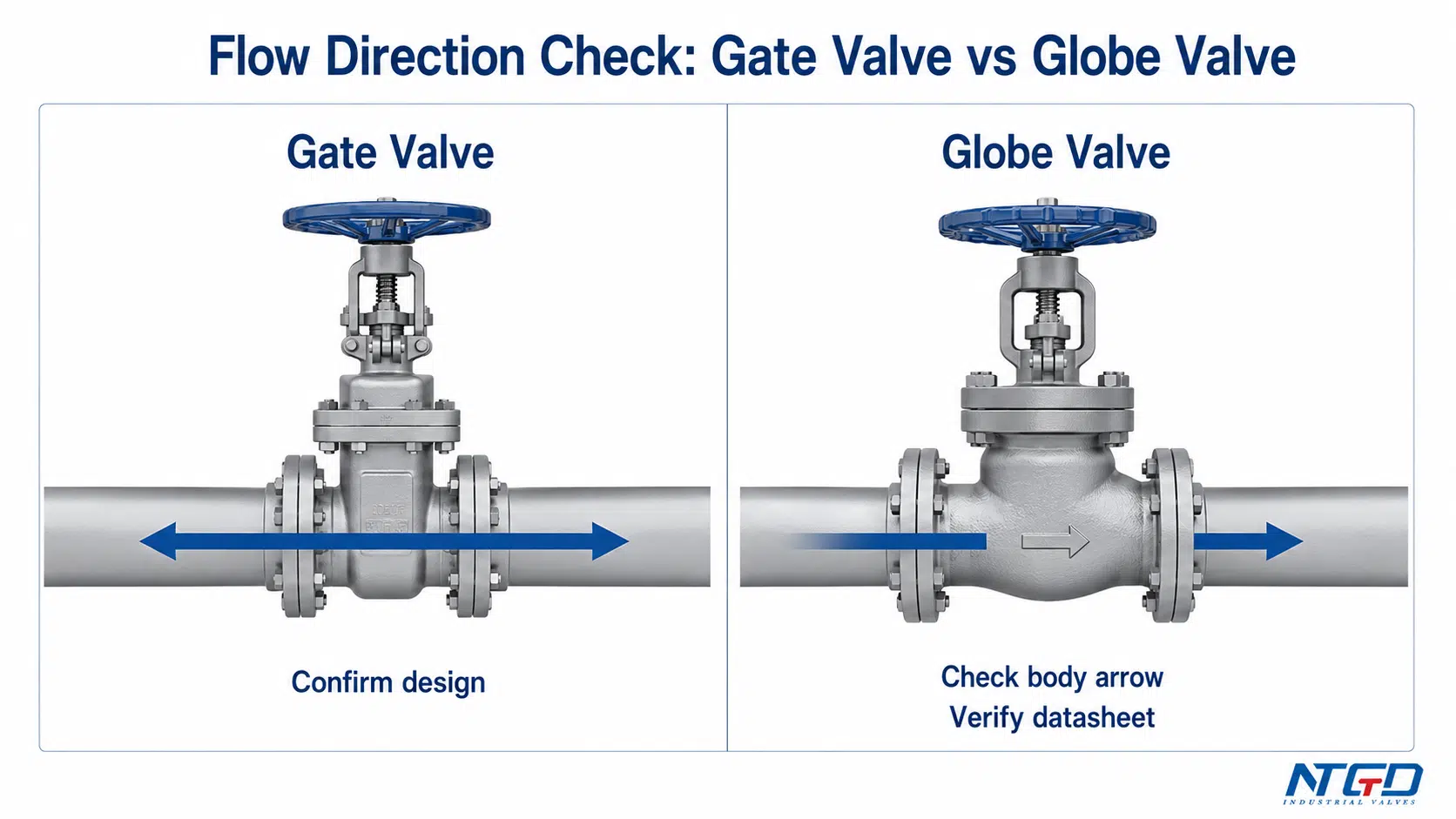
This is especially important in steam, high-pressure, or frequent-control service, where the valve disc, seat, stem, and actuator loads must match the intended flow direction. For industrial installations, flow direction and orientation should be checked against the applicable project specification, valve datasheet, and manufacturer installation instructions before commissioning.
Sealing, Wear, and Maintenance
Both gate valves and globe valves can provide reliable service when selected and operated correctly, but their wear patterns are different.
A gate valve works best when it is kept fully open or fully closed. If used partially open, high-velocity flow may cut across the gate and seat surfaces. This can cause vibration, erosion, and incomplete shutoff.
A globe valve is designed for controlled restriction, so its disc and seat are expected to interact with the flow. In throttling service, globe valve maintenance should pay close attention to disc, seat, and trim wear according to the service conditions. Abrasive media, flashing, cavitation, high temperature, or corrosive service can increase wear and may require special trim, material selection, or a different valve design.
The wear focus changes with the service. In clean water or general utility service, operation frequency and seat condition may be the main maintenance concerns. In abrasive, slurry, steam, corrosive, or high-temperature service, the material, trim, seat design, and flow velocity become more important. Gate valve risk is often concentrated around partial-open gate and seat erosion, while globe valve risk is often concentrated around disc, seat, and trim wear in throttling service.
It is not accurate to say that one valve “always lasts longer” than the other. Service life depends on design, material, pressure class, temperature, media, operating frequency, and maintenance practice.
Cost and Lifecycle Considerations
Gate valves are often simpler in construction and may have a lower upfront cost for basic isolation service. They can also be cost-effective in large pipelines where low pressure drop is important.
Globe valves are usually more complex and may cost more. However, that cost can be justified when the system needs flow control, pressure regulation, or frequent adjustment. In such cases, using a gate valve to save upfront cost may create higher long-term costs through wear, leakage, poor control, or repeated maintenance.
When comparing cost, the question should not only be “Which valve is cheaper?” The better question is:
Which valve reduces operating risk, pressure loss, control problems, and maintenance cost for this service?
When to Use a Gate Valve
Use a Gate Valve for Full-Open / Full-Close Isolation
A gate valve is a strong choice when the line needs simple isolation. If the valve is normally open during operation and closed only during shutdown, maintenance, or system isolation, a gate valve is often suitable.
Typical gate valve applications include:
- Long-distance oil or gas line isolation
- Water treatment plant inlet and outlet mains
- Power plant circulating water lines
- Storage tank inlet and outlet isolation
- General industrial utility lines
- Large-diameter pipelines
- Lines where low flow restriction is important
These applications share the same selection logic: the valve normally stays fully open or fully closed, and the system benefits from straight-through flow with low pressure drop. If the application requires regular flow adjustment, the fit-check should move toward a globe valve or another control-suitable valve.
Use a Gate Valve When Low Pressure Drop Matters
If the system requires low pressure drop, a gate valve is often preferred. When fully open, the gate is removed from the main flow path, allowing the media to move through the valve with less resistance than a globe valve in comparable service.
This makes gate valves suitable for long pipelines, high-flow systems, and services where unnecessary pressure loss would increase pump load or reduce system efficiency.
Use a Gate Valve for Large Flow or Straight Pipeline Service
Gate valves are commonly used in larger pipelines where the valve must pass a large volume of media. Their straight-through flow path supports flow capacity better than a globe valve used in the same isolation role.
However, large size alone is not enough to select a gate valve. The final choice must also consider operating frequency, shutoff requirement, media cleanliness, pressure class, temperature, and maintenance access.
Avoid Using a Gate Valve for Throttling
A gate valve should generally not be used as a throttling valve. Keeping it partially open can expose the gate and seat to concentrated flow velocity. This can lead to:
- Vibration
- Erosion
- Seat damage
- Gate damage
- Noise
- Incomplete shutoff
- Shorter service life
If flow adjustment is part of normal operation, a globe valve or another control-suitable valve type should be evaluated instead.
When to Use a Globe Valve
Use a Globe Valve for Throttling and Flow Regulation
A globe valve is suitable when the process requires controlled flow. The disc and seat design allows the valve opening to be adjusted more gradually than a gate valve.
Common globe valve applications include:
- Boiler feedwater regulation
- Steam pressure reduction or control
- Chemical process flow adjustment
- Pump discharge flow control
- Cooling water control
- Bypass lines
- Pressure control lines
- Systems requiring frequent adjustment
The globe valve is not chosen for low resistance. It is chosen because it gives the operator better control.
Use a Globe Valve for Frequent Adjustment
If the valve will be adjusted regularly, a globe valve is usually more appropriate than a gate valve. Its internal design is intended for repeated control movement. This makes it useful in process systems where the flow rate changes during operation.
For automated systems, globe valves can also be equipped with suitable actuators, depending on the control requirement and valve design. The actuator, stem load, seat design, and flow direction should be checked together during selection.
Use a Globe Valve When Directional Control Is Acceptable
Because globe valves are usually directional, they are suitable when the piping layout allows correct installation according to the flow arrow or manufacturer instructions. This is not a weakness if it is considered during design and installation.
In return, the globe valve provides better regulation through the disc and seat. For many control services, this trade-off is acceptable.
Avoid a Globe Valve When Low Pressure Drop Is the Main Priority
A globe valve is often not the best choice when the only requirement is full-open flow with minimum pressure loss. In that situation, its internal flow path may add unnecessary resistance.
If the system does not need throttling, frequent adjustment, or regulation, a gate valve may be the more efficient choice.
What Happens If You Choose the Wrong Valve?
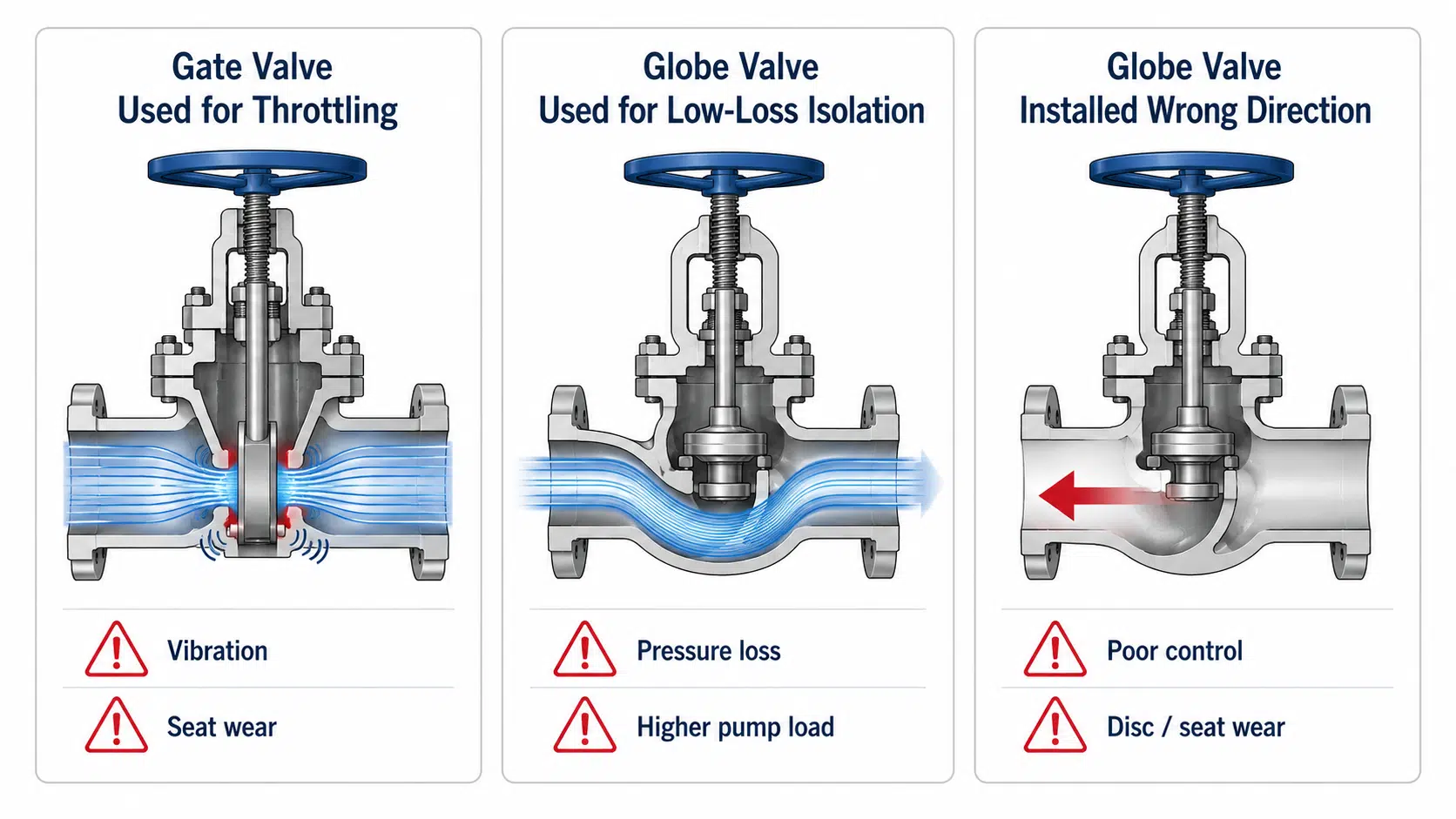
Using a Gate Valve for Throttling
Using a gate valve for throttling is one of the most common misapplications.
When a gate valve is partially open, the flow passes through a narrow gap. This can create high velocity across the gate and seat. In clean water service, this may first appear as noise or unstable flow. In steam, slurry, abrasive, or high-pressure service, the vibration and erosion risk can be more serious.
Possible results include:
- Gate vibration
- Seat erosion
- Leakage after closing
- Stem or gate wear
- Reduced shutoff reliability
- More frequent maintenance
If the system requires flow control, the valve should be selected for that purpose from the beginning. Otherwise, the short-term attempt to use a gate valve as a control valve may become a long-term reliability problem, especially if erosion or seat damage prevents tight isolation during shutdown.
Using a Globe Valve Where Low Pressure Drop Is Critical
A globe valve can control flow well, but it also creates more pressure drop than a fully open gate valve in comparable service. If the line only requires isolation, using a globe valve may reduce flow capacity or increase pumping cost.
This is especially important in large pipelines or systems where flow efficiency is a major design requirement. In those cases, unnecessary pressure loss can increase pump load, reduce available flow, and make the process less stable than expected.
Ignoring Globe Valve Flow Direction
A globe valve should normally be installed according to the specified flow direction. Ignoring the body arrow or installation instructions can affect operation and sealing behavior.
Possible consequences include:
- Poor control response
- Higher operating force
- Disc or seat wear
- Noise or unstable flow
- Reduced service reliability
Flow direction should be confirmed before installation, especially in steam, high-pressure, and automated control applications. A wrong-direction installation can create commissioning problems, poor control response, and accelerated seat wear before the valve ever reaches stable long-term operation.
Final Selection Checklist Before RFQ
Before choosing between a gate valve and a globe valve, convert the comparison into RFQ-ready service data. A valve that looks correct by type may still be wrong if the material, pressure class, flow direction, or operating method does not match the project.
| Selection Question | Why It Matters |
|---|---|
| Is the valve for isolation or flow control? | Gate valves are mainly for isolation; globe valves are for regulation. |
| Will the valve normally be fully open / fully closed? | This favors a gate valve. |
| Will the valve be adjusted frequently? | This favors a globe valve. |
| Is low pressure drop a priority? | A fully open gate valve usually performs better. |
| Is accurate throttling required? | A globe valve is usually more suitable. |
| What is the media? | Clean, abrasive, corrosive, steam, gas, or slurry service may require different designs. |
| What are the pressure and temperature conditions? | Material, trim, seat, body rating, and sealing design must match the service. |
| What is the flow direction? | Globe valves usually require a specified flow direction. |
| What is the pipe size and end connection? | Size, flange standard, weld end, or threaded end affects valve selection. |
| What operation method is required? | Manual, gear, pneumatic, electric, or hydraulic operation may change the valve choice. |
| What shutoff level is expected? | Shutoff requirement must match the valve design and seat arrangement. |
| Is maintenance access available? | Disc, seat, stem, bonnet, and packing access should be considered. |
For an industrial project, the RFQ should include media, working pressure, temperature, pipe size, flow-control requirement, end connection, material preference, operation method, and any shutoff or leakage requirement. These details help an engineering review confirm not only the valve type, but also the pressure class, material, trim, seat design, end connection, and operation method.
A good RFQ does more than request a price. It gives enough service information to verify whether the valve selection fits the pipeline before manufacturing, procurement, or installation decisions are made.
FAQ About Gate Valve vs Globe Valve
What is the main difference between a gate valve and a globe valve?
A gate valve is mainly used for full-open or full-close isolation. A globe valve is mainly used for throttling, regulating, or controlling flow. The reason is internal flow path: a gate valve provides a straighter path when fully open, while a globe valve uses a disc-and-seat path that creates more resistance but allows better flow adjustment.
Can a gate valve be used for throttling?
A gate valve is generally not recommended for throttling. Partial opening can create vibration, erosion, seat wear, and leakage risk. If regular flow adjustment is required, a globe valve is usually the better choice.
When should you use a globe valve?
Use a globe valve when the system needs flow regulation, pressure adjustment, frequent operation, or controlled throttling. It is common in steam, process, cooling water, and control services where accurate flow adjustment is more important than minimum pressure drop.
Can a globe valve replace a gate valve?
A globe valve can sometimes provide shutoff, but it is not always a direct replacement for a gate valve. In a small line or occasional isolation point where pressure drop is acceptable, a globe valve may be usable. In large-flow service, long pipelines, or systems where low pressure drop is a key requirement, a gate valve is usually the better isolation choice.
Which valve has lower pressure drop, a gate valve or a globe valve?
A fully open gate valve usually has lower pressure drop than a comparable globe valve. A globe valve has a more restricted internal flow path, which creates more resistance but allows better flow control.
How do you visually identify a gate valve vs a globe valve?
Start with the body shape and flow markings. A gate valve commonly has a straighter body profile and a gate or wedge that moves across the flow path. A globe valve usually has a more rounded body chamber, a disc-seat control area, and often a flow-direction arrow. For final identification, check the nameplate, body marking, flow arrow, valve drawing, and datasheet.
Can gate valves be used in steam service?
Gate valves can be used for steam isolation when the valve design, pressure class, material, seat arrangement, and end connection match the service. They should not be used as steam throttling valves. For steam regulation or frequent adjustment, a globe valve or a control-suitable valve design should be evaluated.
Which valve is easier to maintain, a gate valve or a globe valve?
Maintenance depends on service conditions. A gate valve may be simpler in full-open/full-close isolation service, but partial-open operation can damage the gate and seat. A globe valve is built for regulation, but its disc, seat, and trim may require more attention in throttling, abrasive, high-temperature, or corrosive service.
Are globe valves more expensive than gate valves?
Globe valves are often more complex and may cost more than gate valves in comparable size and rating. However, cost should be evaluated as lifecycle cost, not only purchase price. A lower-cost valve can become more expensive if it causes poor control, high pressure loss, leakage, or frequent maintenance.
Do gate valves and globe valves have the same flow direction requirements?
No. Gate valves are often less sensitive to flow direction, depending on design. Globe valves are usually directional and should be installed according to the body arrow or manufacturer instructions.
Conclusion
Gate valves and globe valves are not interchangeable in most industrial valve selection decisions. A gate valve is the better fit when the line needs full-open or full-close isolation with low pressure drop. A globe valve is the better fit when the system needs throttling, flow regulation, or frequent adjustment.
The safest selection method is to start with the operating function. If the valve only needs to isolate flow, evaluate a gate valve. If the valve needs to control flow, evaluate a globe valve. Then confirm the media, pressure, temperature, flow direction, material, valve size, end connection, and maintenance conditions before final specification.
If the application includes both isolation and regulation needs, or if pressure drop, flow direction, or frequent adjustment may affect system performance, complete the service-condition review before RFQ.
Need help checking the valve selection?
If you are comparing gate and globe valves for an industrial pipeline, prepare the media, pressure, temperature, pipe size, flow-control requirement, end connection, material requirement, and operation method before RFQ. These details help confirm whether a gate valve or globe valve is the safer fit for the service.
NTGD can review these service conditions with your valve specification so the final selection is checked against the actual pipeline duty rather than the valve name alone.
