
Имя автора: Брюс Чжэн
Роль автора: Соучредитель и инженер по клапанам в NTGD Valve
Био автора: Брюс Чжэн - соучредитель и инженер по клапанам в компании NTGD Valve, специализирующейся на выборе промышленных клапанов, их применении и техническом контенте для глобальных покупателей B2B.
Последнее обновление: 14 июля 2026 года
Быстрый ответ
Давление растрескивания обратного клапана составляет минимальный перепад давления в прямом направлении, при котором начинается первый обнаруживаемый поток в прямом направлении. Речь идет о разнице между давлением на входе и на выходе, а не только о давлении на входе.
В большинстве общих технических дискуссий, давление открытия обратного клапана означает тот же порог начала пропускания. Однако в официальном техническом паспорте “давление открытия” может определяться как момент начала движения, момент появления первого обнаруживаемого расхода, заданный ход клапана или другое условие расхода. Поэтому перед сравнением значений для разных клапанов необходимо уточнить определение и критерии испытаний.
Достижение давления открытия не означает, что клапан полностью открыт или способен пропускать расчетный расход. Клапан, работающий лишь незначительно выше порога открытия, может оставаться едва приоткрытым, что приводит к высокому сопротивлению потоку, нестабильному движению, вибрации или ускоренному износу седла.
Универсального оптимального значения давления разрыва не существует. Выбранное значение должно обеспечивать надежное открытие при минимальном доступном перепаде давления в системе, а также стабильную работу при минимальном расходе, закрытие, повторную герметизацию и требуемые показатели герметичности.
Что такое давление раскрытия обратного клапана?
Давление растрескивания как перепад давления в направлении движения потока
Обратный клапан остается закрытым до тех пор, пока усилие, создаваемое перепадом давления в направлении потока, не станет достаточным для преодоления сил, удерживающих запорный элемент на седле.
Основная зависимость давления выглядит следующим образом:
ΔP = P (вверх по потоку) − P (вниз по потоку)
Клапан начинает приоткрываться, когда этот перепад давления создает усилие открытия, достаточное для преодоления соответствующего сопротивления закрытию.
Что касается внешнего инженерного определения, ScienceDirect описывает давление растрескивания — перепад давления между входной и выходной сторонами, при котором обратный клапан начинает открываться.
Значение давления на входе не имеет большого значения без учета давления на выходе. Высокое давление на входе не гарантирует открытие клапана, если на выходе давление практически такое же. Такая ситуация может возникнуть в системах с замкнутым контуром, в параллельных нагнетательных линиях насосов или в трубопроводах, подключенных к резервуару на выходе, расположенному на возвышении или находящемуся под давлением.
И наоборот, относительно низкое давление на входе может оказаться достаточным, если давление на выходе значительно ниже, а имеющийся перепад давления превышает пороговое значение открытия.
Поэтому давление, вызывающее растрескивание, следует рассматривать как параметр перепада давления, а не в качестве отдельного номинального значения давления на входе.
Чтобы ознакомиться с более подробной последовательностью действий по автоматическому открытию и закрытию, прочитайте, как Обратный клапан срабатывает при перепаде давления и обратном потоке.
Является ли давление открытия тем же, что и давление крекинга?
Во многих технических условиях на обратные клапаны, начальное давление и давление растрескивания описывают одно и то же общее явление: момент, когда элемент закрытия начинает двигаться и становится заметным прямой поток.
Не следует считать, что эти понятия абсолютно взаимозаменяемы во всех технических паспортах. Производитель может определять давление открытия следующим образом:
- дифференциал при появлении первого видимого или обнаруживаемого потока;
- дифференциал при начальном движении диска или тарелки;
- давление, необходимое для достижения заданной степени частичного открытия;
- или дифференциал, связанный с более устойчивым рабочим положением.
Два опубликованных значения следует напрямую сравнивать только в том случае, если они используют одно и то же:
- определение параметра;
- испытательная среда;
- ориентация установки;
- температура;
- критерий обнаружения потока;
- и указанный допуск.
Результат, полученный на основе первого пузырька при испытании с низким расходом, не эквивалентен результату, полученному на основе постоянного расхода или заданного хода клапана. При выборе клапанов разных марок или моделей не следует руководствоваться исключительно номинальным значением.
От закрытого состояния до первого разрыва, частичного открытия и стабильной работы
Обычно обратный клапан не переходит из полностью закрытого положения в полностью открытое за одно действие. Его поведение лучше рассматривать как последовательность действий.
| Состояние клапана | Состояние замыкающего элемента | Состояние потока | Вопрос по инженерной тематике |
|---|---|---|---|
| Закрытый | Диск, шарик, тарелка, пластина или поршень остаются на месте | Отсутствие намеренного прямого потока | Какие силы удерживают клапан в закрытом положении? |
| Первоначальная трещина | Закрывающий элемент начинает подниматься или поворачиваться | Первый обнаруживаемый прямой поток | Достигнут ли порог давления растрескивания? |
| Частичное открытие | Расход увеличивается по мере роста перепада давления и расхода | Ограниченный или формирующийся поток | Работает ли клапан стабильно или он близок к состоянию, при котором может возникнуть вибрация? |
| Стабильный режим работы или режим с более полным открытием | Закрывающий элемент принимает рабочее положение | Нормальный рабочий расход | Каков перепад давления при требуемом расходе? |
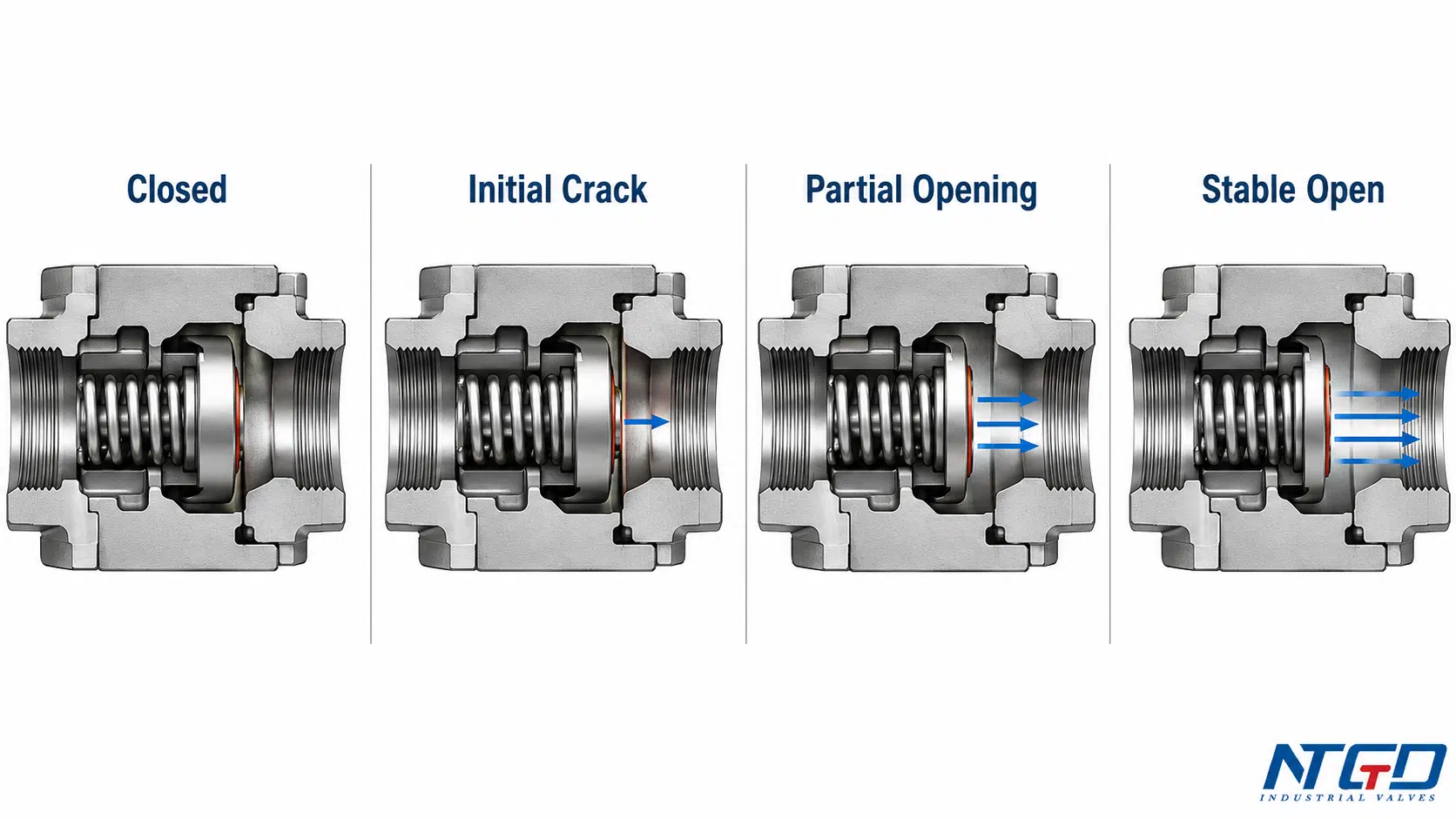
Давление растрескивания подтверждает лишь переход от закрытого состояния к начальному открытию. Оно не определяет расход при первом растрескивании, перепад давления, необходимый для значительного открытия, полную пропускную способность клапана или перепад давления при нормальном расходе.
Эти последующие условия зависят от кривой открытия клапана, его геометрии, сил, действующих на поток, характеристик пружины, а также от значений Cv или Kv. Технические условия, в которых соответствие требованию к давлению начала открытия рассматривается как подтверждение пропускной способности, могут допустить к применению клапан, который начинает открываться, но не способен пропускать требуемый расход без возникновения чрезмерного перепада давления.
Что определяет давление открытия обратного клапана?
Предварительная нагрузка пружины и другие механические силы, обеспечивающие закрытие
В обратном клапане с пружинным приводом пружина сжимается, когда клапан закрыт. Это предварительное напряжение создает усилие закрытия, которое должно быть преодолено дифференциальным давлением в направлении потока.
Более жесткая пружина, большее начальное сжатие или неблагоприятная механическая конструкция, как правило, увеличивают усилие, необходимое для открытия. Более легкая пружина может снизить начальный порог, но при этом также может уменьшить усилие, необходимое для закрытия и повторного уплотнения.
Предварительная нагрузка пружины составляет один из возможных источников сопротивления закрытию, что не является универсальной характеристикой всех обратных клапанов. В зависимости от конструкции усилие открытия может также потребовать преодоления:
- вес элемента закрытия;
- момент, вызванный силой тяжести;
- момент, создаваемый шарниром или торсионной пружиной;
- управляющее трение;
- прилипание сиденья;
- сжатие уплотнения;
- статическое трение после длительного закрытия;
- и сопротивление, вызванное отложениями или загрязнением.
Номинальное значение уставки пружины не следует автоматически рассматривать как полное требование к давлению срабатывания в установленном состоянии.
Структура, границы установки и роль приложения конструкции пружинных обратных клапанов рассматриваются отдельно, чтобы в данном руководстве можно было сосредоточиться на параметре давления растрескивания.
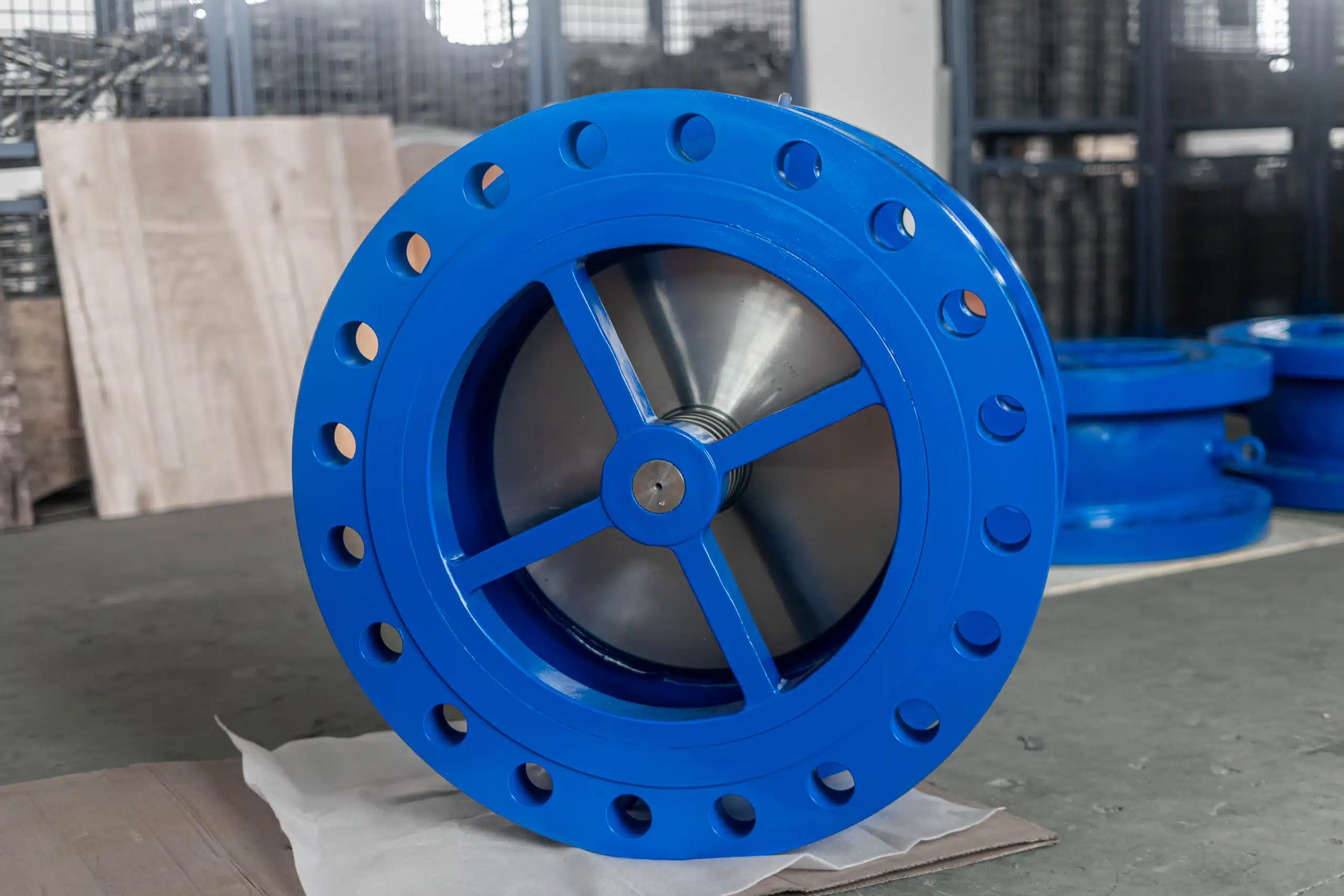
Дисковый, шаровой, тарелковый, пластинчатый и уравновешивающий груз
На пороговое значение открытия влияют масса, направление движения и положение движущегося элемента.
В подъемном или поршневом обратном клапане перепад давления в пропускном направлении может потребовать отрыва направляемого элемента от седла. Когда сила тяжести препятствует этому движению, вес закрывающего элемента увеличивает усилие, необходимое для открытия.
В клапане обратного хода типа «качалка» жидкость должна создавать вокруг шарнира момент, достаточный для поворота диска. Соответствующее сопротивление зависит не только от общей массы диска, но и от:
- положение центра тяжести;
- положение шарнира;
- угол диска;
- и эффективный рычаг момента.
В шаровом обратном клапане на начальное открытие могут влиять вес шара, геометрия седла, плавучесть и ориентация. В конструкции с двумя пластинами взаимодействуют торсионные пружины, масса пластин, трение вала и угол наклона пластин.
Таким образом, клапан одного и того же номинального размера может демонстрировать существенно отличающиеся характеристики открытия при изменении его внутренней геометрии или механизма закрытия.
Сила тяжести, момент в шарнире, трение и сопротивление опоры
Сила тяжести может способствовать открытию, препятствовать открытию или действовать в основном во время закрытия, в зависимости от конструкции клапана и направления его установки.
К практическим проявлениям также относятся сопротивления, которые упрощённое уравновешивание сил может не учитывать, например:
- определять величину трения в конструкции поршня или сопла;
- трение подшипника или шарнира в поворотном клапане;
- сжатие упругого сиденья;
- прилипание после длительного нахождения в закрытом положении;
- и отложения, которые увеличивают начальное усилие отрыва.
Клапан, который в течение длительного времени находился в закрытом положении, может потребовать более высокого перепада давления для первого открытия, чем клапан, только что завершивший рабочий цикл. Этот эффект приобретает важное значение, когда в конкретной установке предусмотрен лишь небольшой запас перепада давления.
Как конструкция клапана влияет на механизм открывания
Различные механизмы обратных клапанов по-разному реагируют на давление и расход.
| Клапанный механизм | Основное сопротивление на закрытии | Поведение при открытии | Основное ограничение расчёта |
|---|---|---|---|
| Пружинный тарельчатый, поршневой или осевой запорный механизм | Предварительная нагрузка пружины плюс масса подвижного элемента, трение и сопротивление седла | В основном — перевод движения | Упрощённая схема уравновешивания сил может оказаться полезной, однако необходимо уточнить эффективную площадь, коэффициент трения и геометрию пружины |
| Поворотный обратный клапан | Момент, создаваемый силой тяжести диска вокруг шарнира, трение в шарнире и любой крутящий момент, создаваемый пружиной | Вращательное движение вокруг шарнира | A linear force-over-area calculation does not represent the full torque balance |
| Dual-plate check valve | Torsion-spring torque, plate inertia, shaft friction, and gravity effects | Two rotating plates | Plate angle and hydrodynamic moment change throughout travel |
| Lift or ball check valve | Moving-element weight plus guide, seat, buoyancy, and gravity effects | Vertical or guided movement | Installed orientation may materially change the net opening requirement |
| Nozzle or silent check valve | Spring preload, guided-disc mass, friction, seat resistance, and flow force | Axial translating movement | Static cracking pressure does not describe the complete dynamic opening curve |
The comparison shows why a single universal cracking-pressure formula cannot deliver the same accuracy across all check-valve designs.
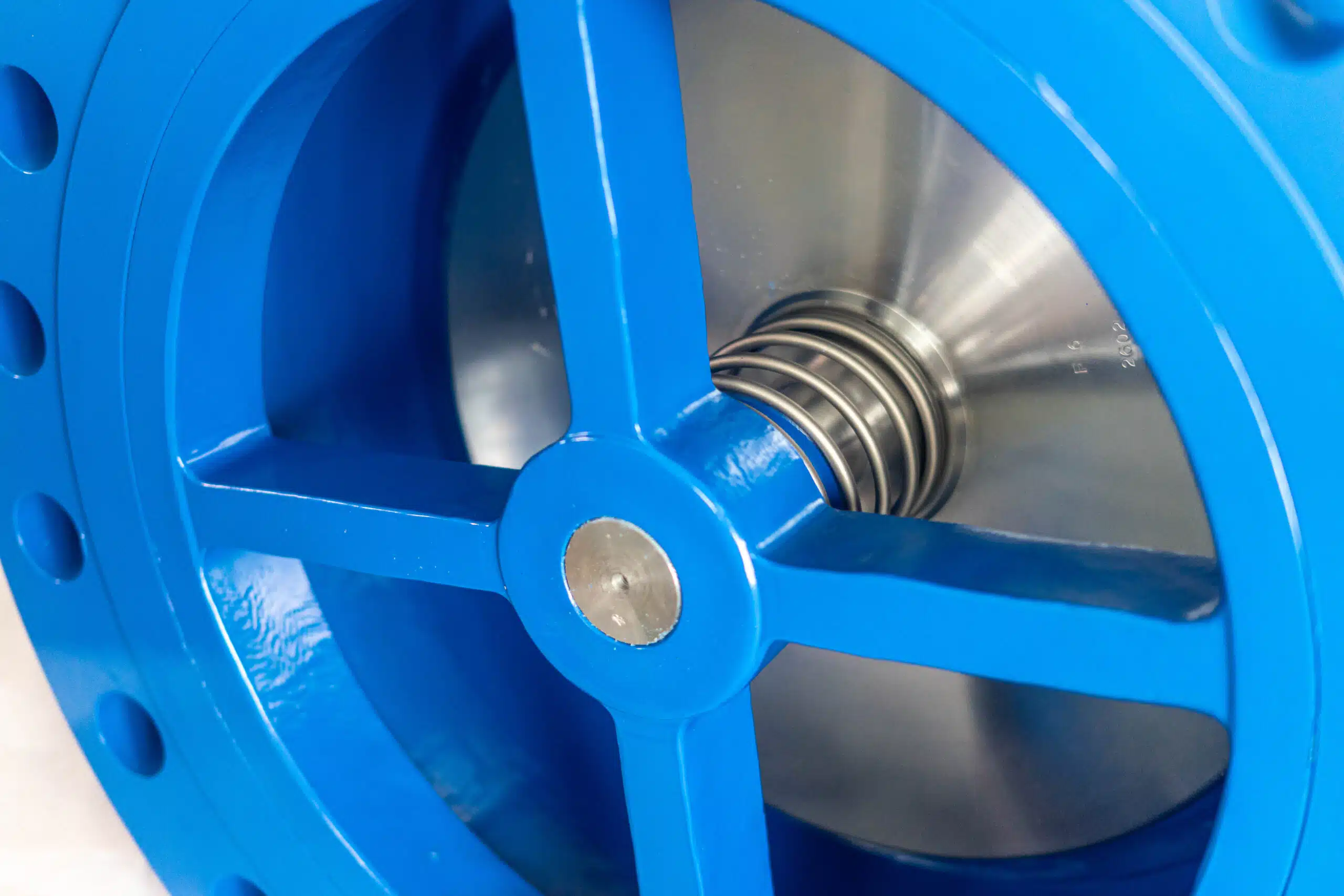
Как износ, загрязнение и состояние уплотнения могут повлиять на фактическое поведение
Cracking pressure can change after installation because the actual closing mechanism no longer behaves as it did under the original test condition.
Potential causes include:
- spring fatigue or permanent set;
- corrosion or deposits on a guide;
- particulate contamination at the seat;
- increased bearing or hinge friction;
- seal swelling or hardening;
- повреждение сиденья;
- несоосность;
- and product buildup around the moving element.
Spring fatigue may reduce closing and resealing force. Fouling, guide wear, or hinge damage may increase the opening threshold or make it inconsistent. Seal aging or swelling may change both breakaway force and leakage behavior.
When a measured threshold shifts, first confirm that the test medium, orientation, temperature, and detection method have not changed. Then review the spring or closing mechanism, seat condition, guides or hinges, seal condition, contamination history, thermal cycling, and any extended period of inactivity.
The deviation should not be attributed to spring setting alone.
Номинальное и чистое давление растрескивания в установленном клапане
Сравнение значений «Весенняя настройка» и «Требования к установленному просвету» в каталоге
A nominal spring setting or published cracking-pressure value is usually based on defined reference conditions. These may include:
- a specified test medium;
- a particular installation orientation;
- a defined temperature;
- a controlled rate of pressure increase;
- and a stated method for detecting first flow.
The installed valve may experience forces that differ from those reference conditions.
For engineering review, it is useful to distinguish between:
- nominal cracking pressure: the stated or tested value under defined reference conditions;
- net installed opening requirement: the differential required after orientation, trim weight, fluid-column effects, friction, and service condition are considered.
“Net cracking pressure” is an engineering description rather than a universally standardized datasheet term. Project documentation should use the manufacturer’s defined terminology while still accounting for the installed force balance.
Установка в горизонтальном положении, с вертикальным потоком вверх и с вертикальным потоком вниз
Orientation changes how gravity acts on the moving element.
In a horizontal line, the effect depends on the valve geometry and the direction of closure-element travel.
In vertical flow-up service, the fluid may need to lift the moving element against gravity. For some lift, ball, piston, or spring-assisted designs, this increases the net opening requirement.
In vertical flow-down service, gravity may assist opening but oppose reliable return to the seat. A low restoring force may allow easy initial opening while providing insufficient closure or resealing force as flow decays.
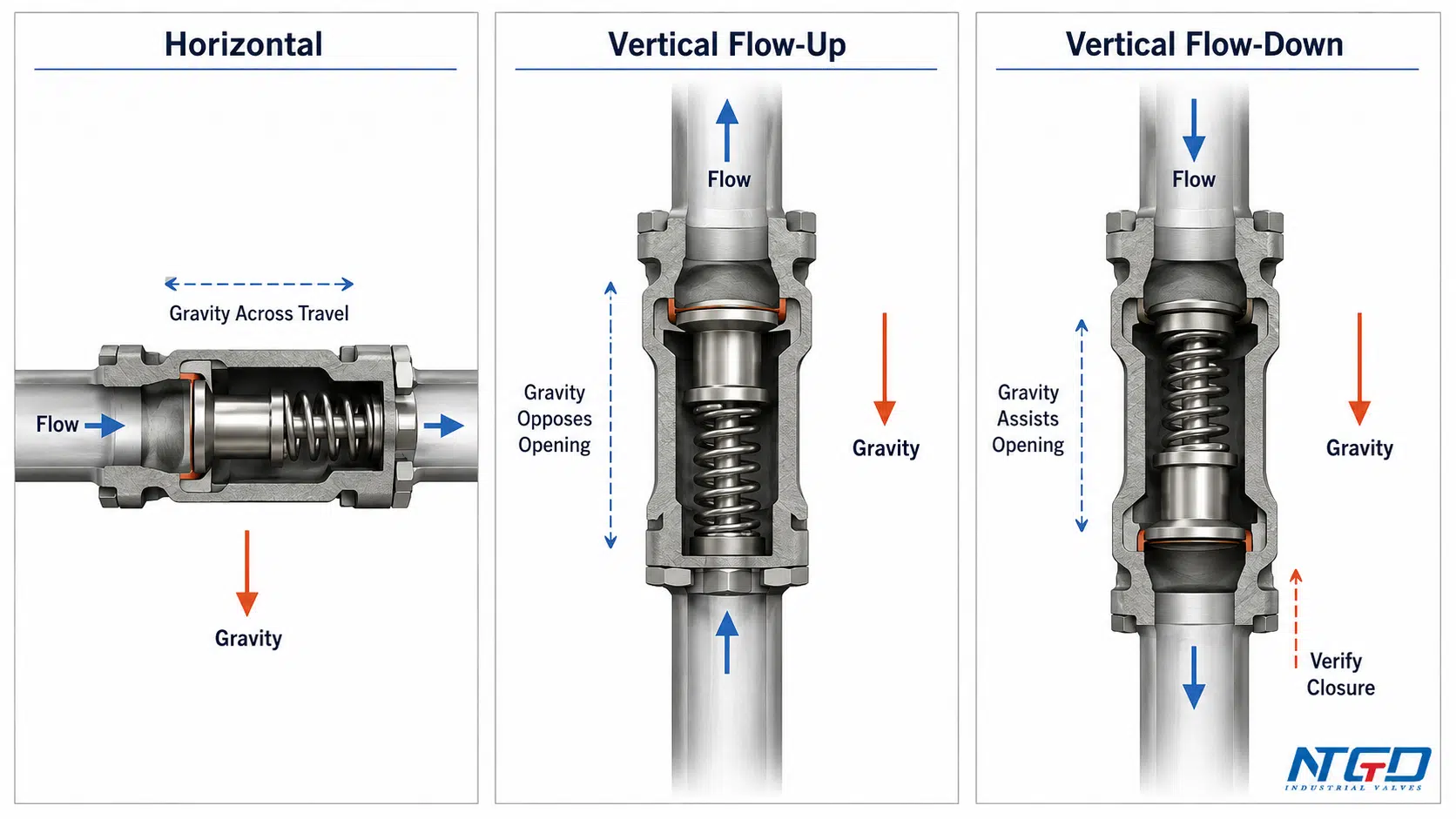
These relationships cannot be converted into one universal correction factor. The effect depends on:
- конструкция клапана;
- moving-element travel direction;
- center of gravity;
- spring arrangement;
- internal geometry;
- and any retained liquid column.
Вес обрезанной части, столб удерживаемой жидкости и направление силы тяжести
The installed force balance may include more than disc or poppet weight.
A retained fluid column can create static head that assists or opposes opening. This may matter in vertical piping, elevated systems, or arrangements where liquid remains trapped above or below the valve.
Trim weight and fluid-column effects must be evaluated in the same direction as the intended opening movement. A value demonstrated in horizontal testing may not represent the installed requirement in a vertical line.
| Фактор | Possible effect on installed behavior | What should be confirmed |
|---|---|---|
| Closure-element or trim weight | May assist or oppose opening | Travel direction and center of gravity |
| Spring preload | Adds closing resistance | Nominal setting, tolerance, and orientation basis |
| Retained fluid column | May add static head in either direction | Piping arrangement and elevation |
| Guide or hinge friction | May raise or destabilize breakaway differential | Design, condition, and service cleanliness |
| Seat or seal resistance | May increase first-opening force | Seat material, compression, temperature, and condition |
| Gravity direction | Changes the net force balance | Horizontal, vertical flow-up, or vertical flow-down installation |
The final opening check should use the maximum permitted cracking pressure for the offered valve in the actual installation orientation, including the stated tolerance. A value tested in another orientation should not be substituted without documented confirmation that it remains applicable.
For broader flow-arrow, vertical-flow, pump-discharge, and spacing checks, use the Руководство по установке обратного клапана together with the offered valve’s IOM and datasheet.
If the supplier’s published data do not cover the project orientation, the datasheet review should request an orientation-specific confirmation or test basis.
Почему важны тестовая среда, температура и критерии приемки
A cracking-pressure value is meaningful only when its test basis is clear.
The test medium may influence:
- buoyancy;
- viscous drag;
- seal wetting;
- leakage visibility;
- and the sensitivity of the detection method.
Temperature may affect spring behavior, elastomer properties, viscosity, and seat friction. These effects are material- and design-specific and should not be converted into a universal correction percentage.
The acceptance criterion is equally important. “Valve opens” may mean:
- the first bubble appears;
- the first measurable flow is recorded;
- the closure element visibly moves;
- or a defined minimum flow is achieved.
Two otherwise similar valves may show different published values because their detection criteria differ. Their numbers should not be treated as directly equivalent until the complete test basis is aligned.
Как рассчитывается давление разрыва обратного клапана?
Упрощённая зависимость между усилием закрытия и эффективной площадью
For a simplified translating closure, a preliminary estimate may begin with:
ΔP(crack, est.) ≈ F(closing) / A(effective)
The conceptual rearrangement follows the basic relation that pressure is force per unit area; the valve-specific challenge is identifying the actual closing resistance and effective pressure area.
where:
- ΔP(crack, est.) is the estimated forward differential pressure;
- F(closing) is the total closing resistance included in the model;
- A(effective) is the projected pressure area that produces opening force.
The closing-force term may be expressed conceptually as:
F(closing) = F(spring) + F(weight) + F(friction) + F(seat) + F(other)
The sign and direction of each term depend on the installation. A weight term that opposes opening in one orientation may assist it in another.
This is a conceptual force balance, not a certified universal calculation.
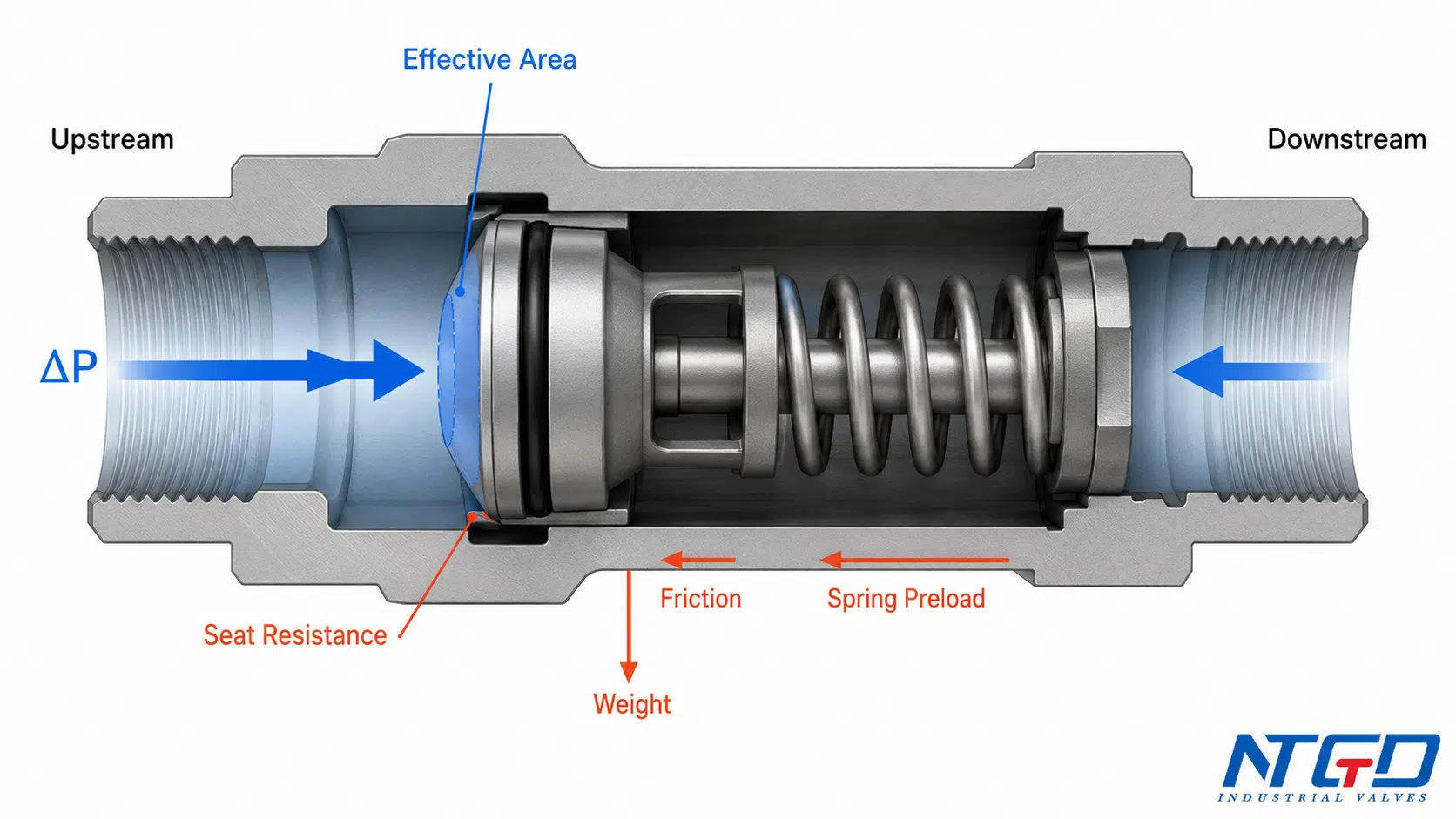
Пример расчета с контролируемой пружинной нагрузкой
For a simplified spring-loaded translating closure:
F(spring) = k × x
where:
- k is the spring rate;
- x is the initial spring compression.
Consider a hypothetical example used only to demonstrate the calculation method:
- spring rate: 20,000 N/m;
- initial compression: 0.005 m;
- other estimated closing resistance: 20 N;
- effective pressure area: 0.003 m².
The spring preload is:
F(spring) = 20,000 × 0.005 = 100 N
The simplified total closing force is:
F(closing) = 100 + 20 = 120 N
The estimated cracking differential is:
ΔP(crack, est.) = 120 / 0.003 = 40,000 Pa
This equals approximately 40 kPa, or 0.40 bar.
Engineering limitation: This example applies only to a simplified translating spring-loaded mechanism with an assumed effective area and closing-force model. It must not be applied directly to swing, dual-plate, or other rotational designs, to valves with unknown effective area or friction, or as the final basis for project approval.
Manufacturing tolerance, actual seat friction, installation orientation, spring variation, and the test criterion may cause the installed opening requirement to differ measurably from this single-point estimate.
The offered valve should be verified using its drawing, spring data, orientation basis, test definition, tolerance, and actual rated or tested value.
Почему эффективная площадь не всегда совпадает с номинальной площадью проходного сечения
A common calculation error is to use the nominal pipe bore area without checking the actual pressure-loaded geometry.
The opening force may act over:
- the seat projection;
- a poppet face;
- an annular area;
- a piston area;
- a differential area between pressure surfaces;
- or another geometry defined by the internal design.
The effective area may also change as the closure element begins to move.
Using nominal pipeline diameter can therefore overestimate or underestimate the true opening force. The area should be taken from the valve design, sectional drawing, calculation note, or supplier-confirmed geometry.
Почему для конструкций типа «Swing», «Dual-Plate» и других требуются разные модели
A swing check valve is governed primarily by a torque balance around its hinge.
A design-specific rotational model may need to consider:
- fluid-force moment;
- disc-weight moment;
- hinge friction;
- spring torque, if fitted;
- угол диска;
- and the location of the pressure resultant.
A dual-plate design similarly involves torsion-spring torque, plate angle, shaft friction, gravity, and changing hydrodynamic moments.
These designs cannot be represented accurately by one fixed linear force divided by one fixed area. A conceptual comparison may help explain the physics, but final values require manufacturer testing or an appropriate design-specific model.
Когда следует отказаться от собственных расчетов и использовать данные, проверенные производителем
A preliminary estimate can help identify:
- which forces control opening;
- which application inputs are missing;
- whether the available differential and expected threshold are of a similar scale;
- and whether a proposed value appears physically plausible.
Stop relying on the simplified estimate when:
- the internal geometry is unknown;
- the effective area cannot be confirmed;
- a rotational or torsion-spring mechanism dominates;
- the available differential is close to the expected threshold;
- the project requires a tightly controlled maximum value;
- the installed orientation differs from the test basis;
- the medium is highly viscous, dirty, or temperature-sensitive;
- resealing or leakage is critical;
- or transient behavior materially affects selection.
When the model boundary is unclear, the pressure margin is small, or cracking pressure is a project acceptance parameter, use test data for the offered configuration rather than extending the hand calculation.
Давление растрескивания в зависимости от степени открытия, повторного уплотнения, противодавления и падения рабочего давления
The related terms describe different stages or duties of valve behavior. Treating them as interchangeable can produce an incorrect specification.
| Параметр | What it describes | When it applies | What should confirm it | Распространенная ошибка |
|---|---|---|---|---|
| Давление растрескивания | Minimum forward differential at first detectable flow | Initial opening | Test medium, orientation, criterion, and tolerance | Assuming first crack proves full opening or flow capacity |
| Opening pressure | Often the same initial threshold, but the definition may vary | Initial movement, first flow, or another stated opening condition | Exact datasheet definition and test basis | Comparing values based on different lift or flow criteria |
| Full-open differential | Differential associated with a more developed opening position | Higher flow or greater valve travel | Opening curve or test data | Applying a universal multiplier to cracking pressure |
| Resealing pressure | Differential at which detectable forward flow stops and the valve returns toward closure | Decreasing forward differential | Test method and leakage criterion | Assuming it equals cracking pressure despite friction and hysteresis |
| Back pressure | Downstream pressure opposing forward flow or acting in reverse | Opening calculation, closure, and reverse-pressure service | System pressure profile and seat design | Counting downstream pressure twice after it is already included in ΔP |
| Operating pressure drop | Differential across the valve at a stated forward flow | Normal flowing operation | Cv, Kv, flow curve, or test data | Assuming it has a fixed relationship to the near-zero-flow cracking threshold |
| Номинальное давление | Allowable pressure boundary of pressure-containing parts | Mechanical integrity | Applicable standard and datasheet | Confusing pressure class with opening threshold |
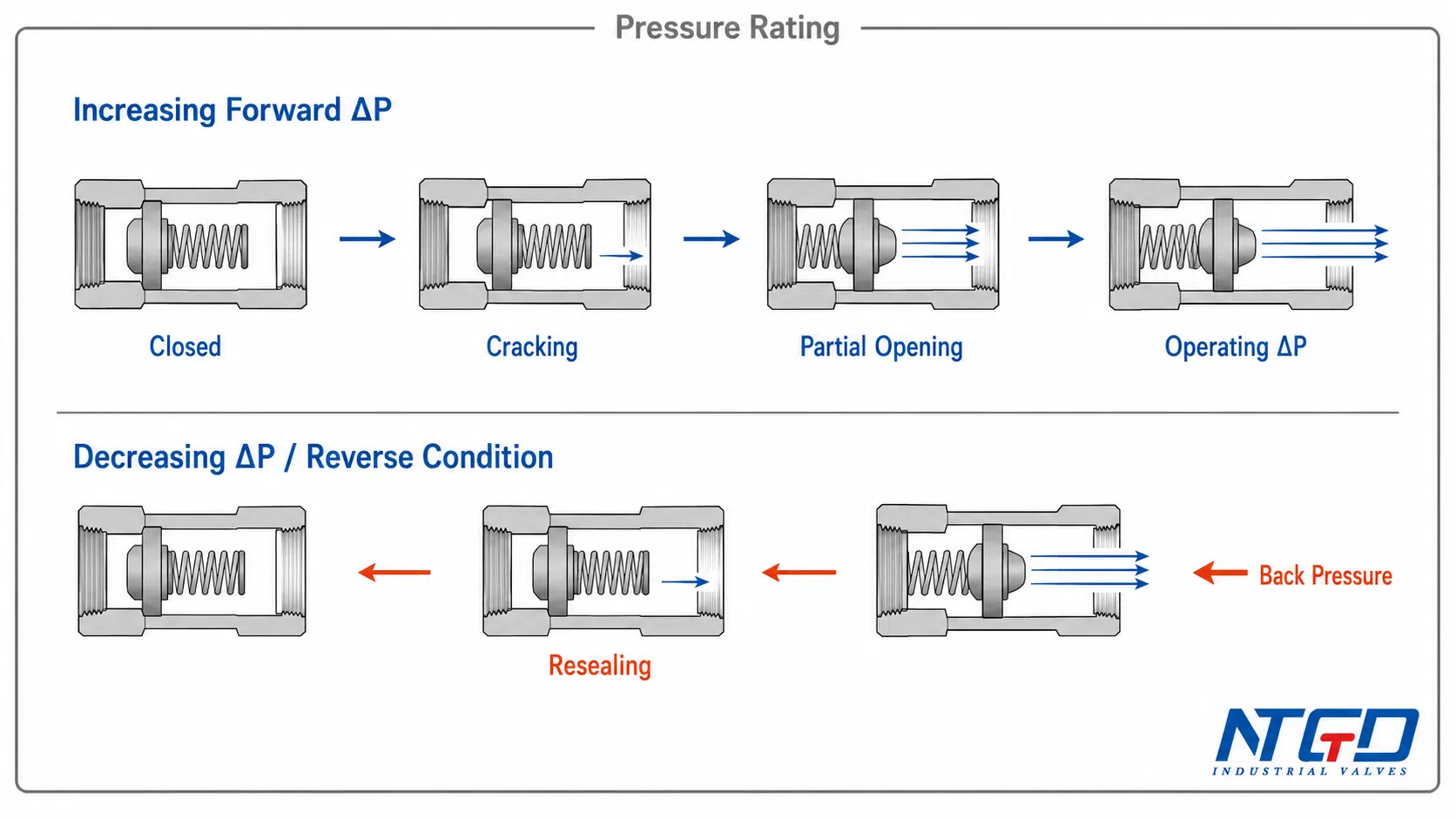
Дифференциал «начального зазора» и «полного открытия»
At initial crack, the opening may be extremely small. Forward flow may be detectable while the flow path remains highly restricted.
As differential and flow increase, the valve moves toward a more developed operating position. The pressure required for that position depends on the opening curve, spring characteristic, geometry, and hydrodynamic forces.
There is no universal ratio between cracking pressure and full-open differential. Capacity approval requires valve-specific opening or flow-performance data.
Давление растрескивания и давление повторного уплотнения
Cracking pressure describes the opening event as forward differential rises.
Resealing pressure describes the condition during decreasing differential when forward flow stops and the valve returns toward a closed or sealed state.
The two values may differ because of:
- spring behavior;
- friction;
- hysteresis;
- closure-element momentum;
- seat contact;
- and the test method.
A valve may crack open at one differential and reseal at another. The relationship should be confirmed against the required closure and leakage duty rather than assumed from the opening value.
Давление растрескивания и противодавление
Back pressure is the pressure acting on the downstream side of the valve.
During forward operation, it is already included in:
ΔP = P (вверх по потоку) − P (вниз по потоку)
It should not be added again as a separate fixed resistance when cracking pressure is already stated as a differential.
Some older or project-specific specifications separately state the maximum downstream pressure against which the valve must still open. That is a system operating requirement used to establish the available differential; it is not an additional cracking-pressure term to be counted twice.
During reverse-flow conditions, downstream pressure can force the closure element toward its seat and affect sealing. Back pressure is therefore important to closure and resealing, but it is not the same parameter as cracking pressure.
Давление разрыва в сравнении с перепадом рабочего давления и коэффициентом Cv
Cracking pressure is an initial opening threshold at zero or very low flow.
Operating pressure drop is the differential across the valve while it passes a specified forward flow. It is normally evaluated using:
- Cv or Kv;
- a manufacturer pressure-drop curve;
- tested flow coefficients;
- or an application-specific hydraulic calculation.
The relationship is not generally represented by:
ΔP(operating) = ΔP(cracking) + ΔP(Cv)
Spring force, valve travel, geometry, and hydrodynamic forces may all change after first crack.
The two required checks are therefore separate:
- Opening check: Will the valve begin to open under the minimum available differential?
- Flow-performance check: How much differential will it consume at the specified operating flow?
For Cv, Kv, head-loss, and normal-flow calculations, continue with the check valve pressure drop and Cv guide.
Confusing these checks can approve a valve that opens at startup but produces unacceptable operating pressure loss—or a valve with favorable Cv that cannot open under the worst startup condition.
Давление разрыва и номинальное давление клапана
Pressure rating defines the pressure-containing capability of the valve body, cover, ends, and other pressure-boundary parts under specified conditions.
It does not define the differential required to open the valve.
A high-pressure-class valve can have a low cracking pressure, while a lower-pressure-class valve can have a higher opening threshold. Pressure class and cracking pressure must be specified and reviewed independently.
For the pressure-boundary review, ASME B16.34 covers valve pressure-temperature ratings, materials, testing, and marking; the cracking-pressure requirement must still be specified separately for the offered check-valve design.
Что происходит, если давление растрескивания слишком высокое или слишком низкое?
Риски, связанные с чрезмерным давлением растрескивания
If the available forward differential does not reliably exceed the valve’s maximum opening requirement, the valve may:
- remain closed during startup;
- open intermittently;
- operate at very small lift;
- restrict required flow;
- create excessive startup resistance;
- become unstable near the threshold;
- chatter or repeatedly contact the seat;
- experience accelerated wear;
- or prevent the system from reaching the intended capacity.
The risk is particularly relevant when:
- pump startup differential is limited;
- minimum flow is low;
- upstream and downstream pressures are nearly balanced;
- or the offered valve has a relatively strong closing mechanism.
Pressure-containing capability alone does not prove suitability. The valve must also pass the worst-case opening check.
Риски, связанные со слишком низким давлением крекинга
A lower threshold may help in systems with limited differential, but reducing closing resistance can create other problems.
Возможные последствия включают:
- slower or less decisive closure;
- reduced resealing force;
- increased reverse-leakage risk;
- greater orientation sensitivity;
- instability at very low flow;
- repeated movement around the seat;
- or insufficient restoring force in an unfavorable installation direction.
The result depends on the mechanism. A gravity-loaded swing valve, spring-loaded nozzle valve, and guided lift check do not respond in the same way.
Почему более низкое давление растрескивания не всегда является лучшим вариантом
The selected value must balance reliable opening with stable closure and sealing.
| Состояние | Possible benefit | Possible risk | What should be verified |
|---|---|---|---|
| Higher cracking pressure | May provide stronger closing bias in some spring-assisted designs | Delayed opening, restricted startup flow, chatter, or insufficient capacity | Minimum available differential, startup condition, and minimum flow |
| Lower cracking pressure | Easier initial opening when available differential is limited | Weaker closure, reverse leakage, orientation sensitivity, or threshold instability | Resealing, leakage requirement, installation direction, and closing mechanism |
| Very small pressure margin | Efficient use of the available pressure budget | Normal variation in pressure, friction, temperature, or fouling may cause opening failure | Maximum cracking value including tolerance and worst-case system condition |
| Large available-pressure margin | Improves confidence that initial opening can occur | Does not by itself prove minimum-flow stability or acceptable operating pressure drop | Opening curve, minimum stable flow, and full flow-performance data |
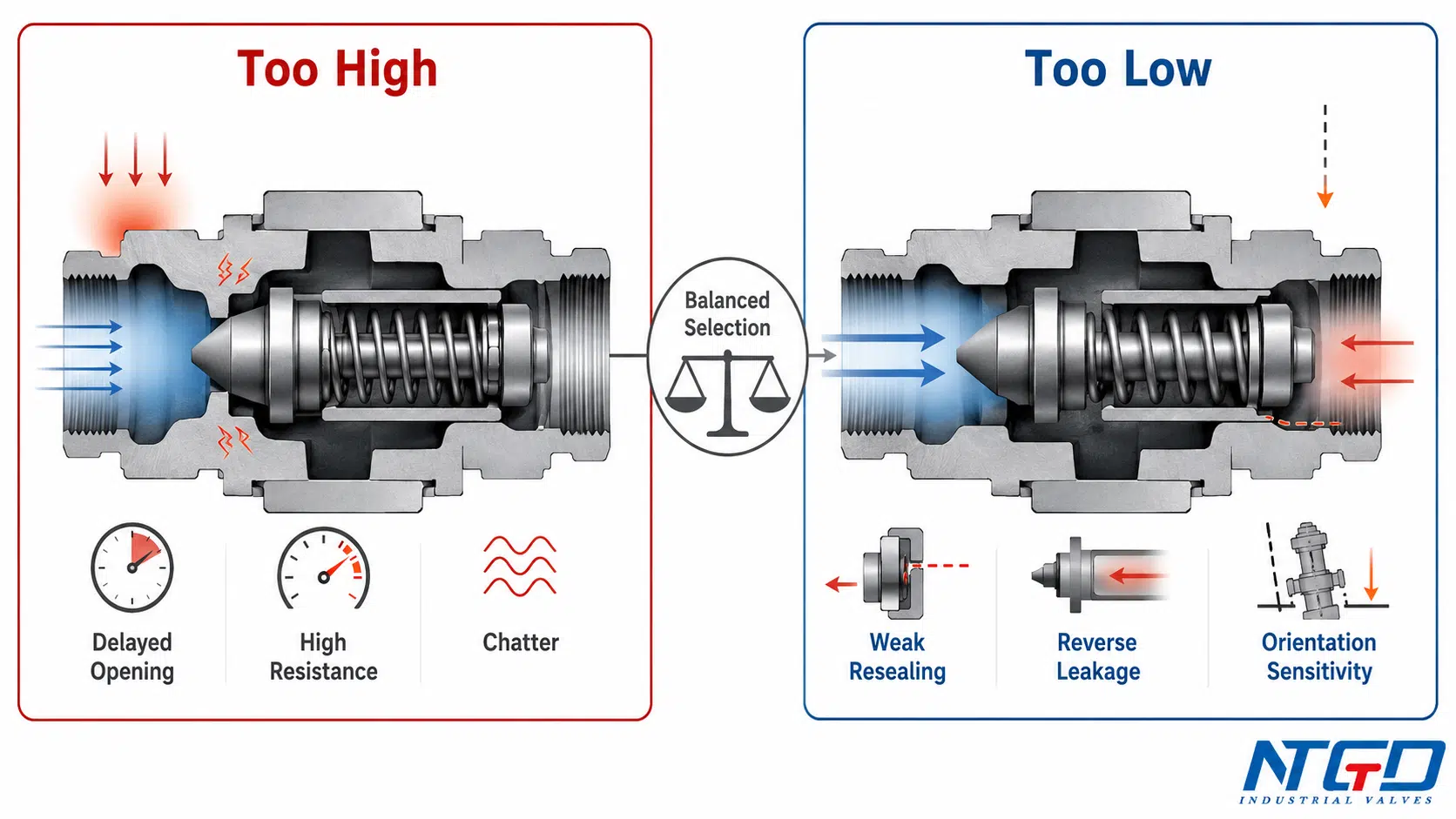
A suitable offered range must pass three checks:
- The valve opens at the minimum available forward differential.
- It remains stable at the required minimum flow.
- It closes, reseals, and meets the leakage requirement as flow decays or reverses.
The engineering objective is not the lowest available number. It is a cracking-pressure range that satisfies all three conditions for the offered valve and actual installation.
Признаки того, что указанное значение не соответствует условиям применения
Possible indicators include:
- delayed downstream pressure buildup;
- flow beginning only after an unexpected pressure rise;
- intermittent flow during startup;
- audible or measurable chatter;
- repeated opening and closing at minimum flow;
- higher-than-expected valve differential;
- reverse leakage after flow stops;
- or different behavior after a change in installation orientation.
These symptoms do not prove that cracking pressure is the only cause. Valve sizing, pressure-drop performance, flow pulsation, contamination, seat condition, installation, and system transients should also be reviewed.
Как правильно подобрать давление раскрытия для обратного клапана
A practical review sequence is:
- Establish the minimum available forward differential.
- Confirm the actual installation orientation and closing mechanism.
- Review startup, minimum-flow, and normal-flow conditions.
- Check media, temperature, viscosity, solids, and fouling effects where relevant.
- Confirm resealing, reverse leakage, and shutoff requirements.
- Compare the system minimum differential with the offered valve’s maximum cracking pressure, then review operating pressure drop separately.
Cracking pressure is one part of the wider check valve selection process, which also reviews valve type, flow direction, pressure drop, installation, closing response, and RFQ data.
This is a review sequence rather than a universal priority formula. Project risk, data quality, and failure consequences may require some checks to be performed in parallel.
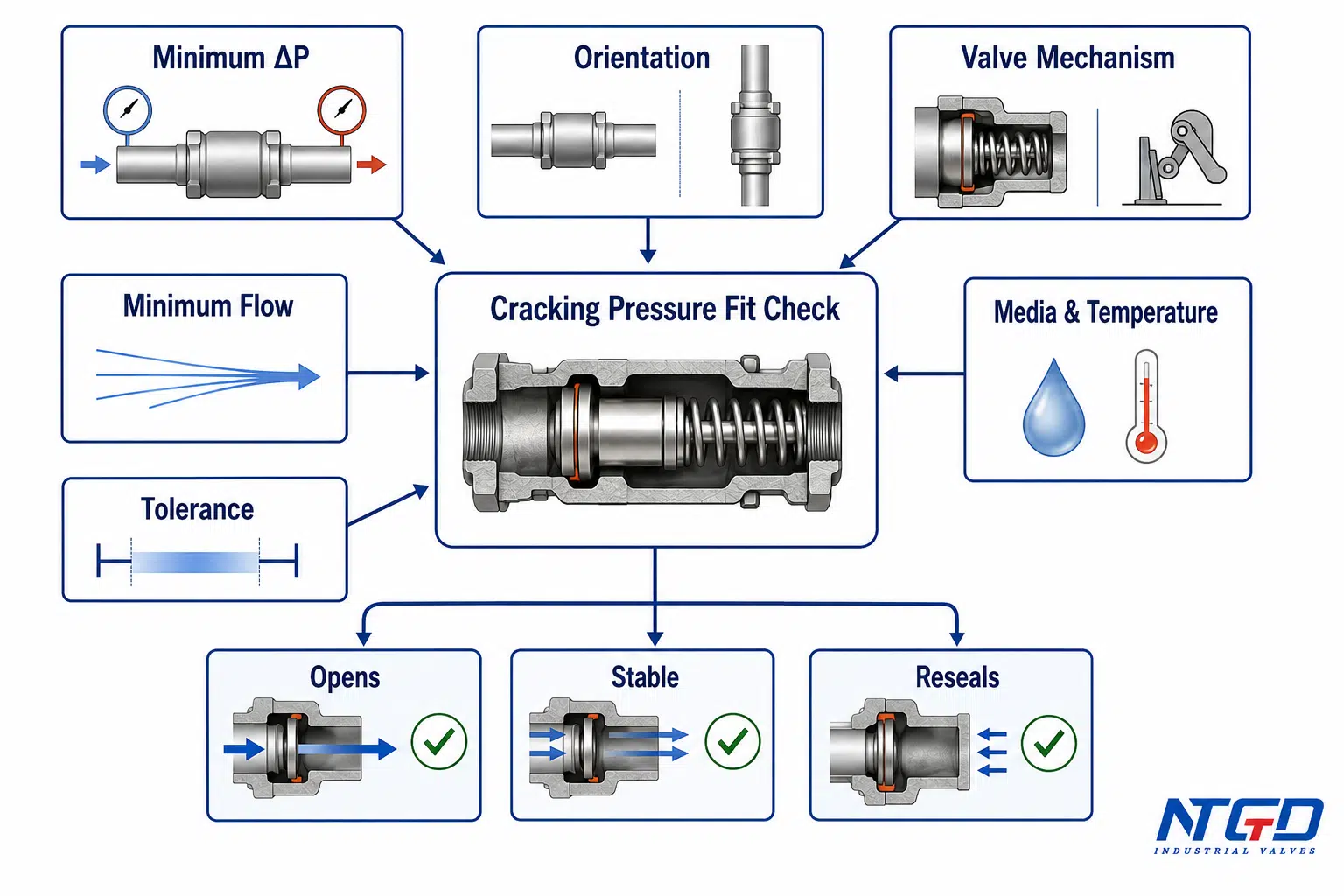
Начните с минимального доступного дифференциала форварда
Selection should begin with the lowest differential the system can reliably provide when the valve must open.
The review should consider:
- the lowest credible upstream pressure;
- the highest concurrent downstream pressure;
- startup conditions;
- minimum-flow operation;
- elevation and static-head effects;
- and normal process variability.
The maximum permitted cracking pressure of the offered valve—including tolerance and installed effects—must remain below the available differential after the project-required engineering allowance is applied.
That allowance should be based on system variability, instrument uncertainty, manufacturing tolerance, consequence of failure to open, and the project specification. It should not be replaced by a universal percentage.
Обзор режимов запуска, работы с минимальным расходом и работы с нормальным расходом
A valve may perform acceptably at normal flow and still fail to open reliably during startup or low-flow operation.
Review at least three conditions:
- Startup: Is sufficient differential available before meaningful flow is established?
- Minimum flow: Will the closure element remain open and stable at the lowest required flow?
- Normal or maximum flow: Is operating pressure drop acceptable, and does the valve reach an appropriate operating position?
Cracking pressure primarily affects the first two conditions. Cv, Kv, and flow-curve data become increasingly important as flow rises.
Учитывайте влияние среды, температуры, плотности и вязкости, если это необходимо
Media properties may affect installed behavior through:
- closure-element buoyancy;
- static liquid-head effects;
- viscous drag at small openings;
- seal compatibility and swelling;
- deposit formation;
- and the sensitivity of the detection method.
Density is relevant when closure-element weight or liquid-column head contributes to the force balance. Viscosity can influence low-flow behavior and the differential needed to produce a measurable indication.
These effects are design-specific. When the available pressure margin is small, they should be evaluated using applicable valve data or service-representative testing.
Соответствие механизма клапана и ориентации при установке
The selection must match the pressure requirement and the physical closing mechanism.
A spring-loaded axial valve may provide controlled closure but require enough differential to overcome spring preload and other resistance.
A swing valve may show a low static opening threshold in a favorable orientation, while its minimum-flow stability, dynamic response, and reverse-flow behavior remain the controlling concerns.
A lift or piston valve may be strongly affected by travel direction and moving-element weight.
A dual-plate valve requires review of torsion-spring torque, plate movement, and flow stability.
Selection should therefore be based on the complete operating condition—not on the smallest published cracking-pressure number.
Проверьте герметичность, наличие утечек и требования к отключению
The application may require:
- prevention of reverse flow;
- rapid closure;
- stable closure after pump trip;
- a defined leakage limit;
- or bubble-tight performance under stated conditions.
A low cracking pressure does not automatically provide the required resealing or leakage performance.
Clarify:
- the reverse pressure available during closure;
- whether the valve must seal with little downstream pressure;
- metal or resilient seat construction;
- the applicable leakage criterion;
- and whether closure speed is critical.
These requirements may influence spring setting, seat design, closure-element mass, and the acceptable cracking-pressure range.
Раздельное рассмотрение порогового значения открытия и рассмотрение по перепаду давления в процессе работы
The offered valve must pass two independent checks:
- Opening check: Can the system exceed the valve’s maximum cracking pressure under the worst startup and minimum-flow condition?
- Flow-performance check: Is the operating pressure drop acceptable at the required flow?
Do not approve the valve based on only one check.
A low cracking pressure does not guarantee low operating pressure drop. A high Cv does not guarantee opening under the minimum startup differential.
Параметры выбора и их значение
| Ввод данных для выбора | Почему это важно | Risk if omitted | Preferred source |
|---|---|---|---|
| Minimum upstream pressure | Establishes the lowest driving pressure | The offered valve may fail to open during the weakest supply condition | Process design basis |
| Maximum concurrent downstream pressure | Determines the minimum available forward differential | The opening differential may be overstated | System pressure profile |
| Startup condition | Defines the pressure available before flow develops | Initial flow may be delayed or prevented | Pump or process startup analysis |
| Minimum and normal flow | Establishes stability and flow-performance requirements | The valve may chatter or create unacceptable pressure loss | Process flow data |
| Среда и температура | Affect seals, viscosity, buoyancy, and deposit formation | Reference test data may not represent the service condition | Fluid datasheet |
| Ориентация при установке | Changes gravity and the net force balance | The installed opening requirement may exceed the nominal value | Piping layout or GA |
| Клапанный механизм | Determines whether force, torque, spring, weight, or flow effects dominate | An unsuitable calculation model or valve design may be selected | Valve design data |
| Resealing and leakage expectation | Defines closure duty | A low opening threshold may not provide the required shutoff behavior | Спецификация проекта |
| Cracking-pressure tolerance | Establishes the worst permitted opening value | The system may pass a nominal check but fail at the tolerance limit | Manufacturer data |
| Cv, Kv, or flow curve | Defines normal-flow pressure loss | The valve may open but consume excessive differential at operating flow | Tested valve data |
Что следует указать в техническом паспорте обратного клапана или в запросе предложений
Данные заявки, которые должен предоставить покупатель
The buyer should provide enough system data for the supplier to evaluate both initial opening and normal operation.
The application package should identify:
- рабочая среда;
- composition and solids content where relevant;
- operating temperature range;
- upstream and downstream pressure conditions;
- minimum available forward differential;
- startup, minimum, normal, and maximum flow;
- valve size and end connection;
- ориентация установки;
- направление потока;
- piping elevation or retained-column concerns;
- требуемые характеристики по герметичности или утечке;
- and transient or pump-trip conditions that materially affect selection.
A requested cracking-pressure number without this context may not produce a reliable valve selection.
Определение давления растрескивания и условия испытаний для его подтверждения
The datasheet or technical clarification should state exactly what the quoted value represents.
Подтверждаю:
- whether the value is a differential or an incorrectly stated gauge pressure;
- whether it represents first movement, first bubble, first measurable flow, or another criterion;
- испытательная среда;
- test temperature;
- ориентация установки;
- pressure-application direction;
- rate of pressure increase, where relevant;
- and whether the result applies to a new, conditioned, or cycled valve.
Without this information, nominal values from different suppliers may not be directly comparable.
Допуск, ориентация и номинальное значение, указанное производителем
A single nominal number is insufficient when the system has limited differential-pressure margin.
Request:
- nominal cracking pressure;
- positive and negative tolerance, or the complete allowable range;
- orientation basis;
- installed-orientation limitations;
- spring-setting identification, if applicable;
- and the rated or tested value for the offered configuration.
The worst-case opening check should compare:
- the project’s minimum available forward differential, after the project-required allowance;
- with the maximum permitted cracking pressure, including manufacturing and test tolerance;
- for the actual installation orientation and stated test criterion.
No universal allowance percentage should be assumed. The project allowance should reflect pressure variability, instrument uncertainty, consequence of opening failure, and specification requirements.
Данные по Cv, Kv, кривой расхода и рабочему перепаду давления
Cracking-pressure confirmation does not replace flow-performance review.
The offered valve should also include, where applicable:
- Cv or Kv;
- a pressure-drop curve;
- flow rate at a stated differential;
- an opening or lift curve, if available;
- minimum stable flow guidance;
- and orientation-related performance limits.
This data separates the initial opening threshold from the differential consumed during normal flow.
Заключительная проверка соответствия техническим требованиям перед утверждением
| Review item | Buyer input | Подтверждение поставщика | Evidence expected |
|---|---|---|---|
| Cracking-pressure definition | Required initial-opening condition | Exact definition used for the offered value | Datasheet or technical clarification |
| Worst-case opening check | Minimum available differential and project-required allowance | Maximum cracking pressure including tolerance for the actual orientation | Rated or tested value and technical calculation |
| Ориентация | Horizontal, vertical flow-up, or vertical flow-down | Suitability and orientation basis | GA, installation note, or datasheet |
| Механизм закрытия | Application preference or constraint | Spring, weight, hinge, torsion, or guided design | Sectional drawing or product data |
| Test medium and criterion | Project requirement where applicable | Test fluid, temperature, and detection method | Test procedure or technical note |
| Resealing and leakage | Required shutoff behavior | Resealing basis and leakage performance | Datasheet or test documentation |
| Operating pressure drop | Minimum, normal, and maximum flow | Cv, Kv, pressure-drop curve, or flow data | Tested flow data |
| Material and temperature suitability | Medium and temperature range | Body, trim, seat, and seal compatibility | Material list and datasheet |
| Tolerance | Maximum acceptable opening threshold | Manufacturing and test tolerance | Written technical confirmation |
| Final configuration | Size, class, ends, orientation, trim, and service | Exact offered valve configuration | Approved datasheet and GA |
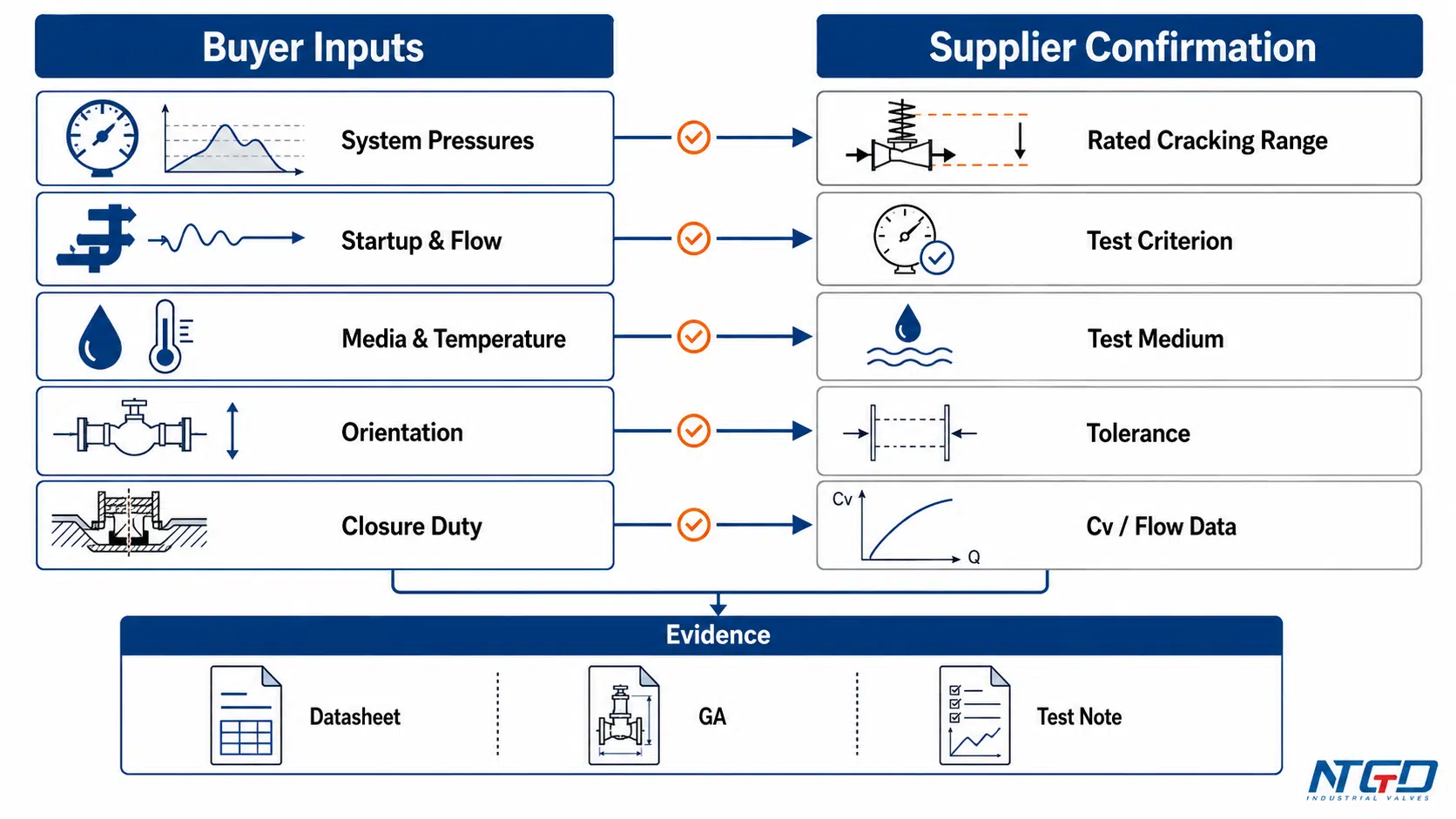
The final approval must be based on the complete offered configuration. A cracking-pressure value from another size, spring, trim, orientation, test medium, or detection method should not be assumed to apply.
Часто задаваемые вопросы о давлении растрескивания обратного клапана
Что такое давление разрыва обратного клапана?
Это минимальный перепад давления в прямом направлении, при котором начинается первый обнаруживаемый поток в прямом направлении. Он измеряется между входной и выходной сторонами клапана и не означает, что клапан полностью открыт.
Является ли начальное давление тем же, что и давление крекинга?
Как правило, эти термины обозначают один и тот же порог начального открытия. В техническом паспорте, однако, давление открытия может определяться при определённом ходе, подъёме или режиме потока, поэтому перед сравнением значений необходимо уточнить определение и условия испытаний.
Что означает давление растрескивания 1 psi?
It means that, under the stated test conditions, upstream pressure must exceed downstream pressure by approximately 1 psi before the defined first-opening or first-flow criterion is reached.
The value should be compared with another valve only when the test medium, orientation, temperature, criterion, and tolerance are compatible. It does not mean that 1 psi is suitable for every application.
Всегда ли более низкое давление растрескивания лучше?
Нет. Более низкое пороговое значение может способствовать открытию клапана при ограниченном перепаде давления, но при этом может снизить усилие закрытия, способность к повторной герметизации или стабильность. Это значение должно одновременно удовлетворять требованиям к открытию, стабильности при минимальном расходе, закрытию и утечке.
Как инженеры определяют необходимое давление растрескивания для промышленного обратного клапана?
Engineers first establish the minimum forward differential available during startup and minimum-flow operation. They then account for orientation, valve mechanism, media, closure requirements, and tolerance.
A preliminary force-balance estimate may help, but final approval should use the maximum rated or tested cracking pressure for the offered configuration.
Является ли давление разрушения тем же, что и перепад давления?
No. Cracking pressure is evaluated at the onset of flow, near zero flow. Operating pressure drop is measured or calculated at a stated flow rate.
A valve can have a low cracking pressure and still create a high operating pressure drop, or have favorable Cv while requiring more differential than the system can provide at startup.
В чём заключается разница между давлением растрескивания и давлением повторного уплотнения?
Cracking pressure is associated with increasing forward differential as the valve begins to open. Resealing pressure is associated with decreasing differential as flow stops and the valve returns toward closure.
The two values may differ because of friction, spring behavior, hysteresis, seat contact, and the test criterion.
Можно ли изменить давление срабатывания пружинного обратного клапана?
Some spring-loaded designs can be supplied with different factory spring options or settings. That does not mean every valve can be adjusted in the field.
Changing the spring can also affect closure, resealing, leakage, travel, and operating stability. Any change should be evaluated and confirmed for the offered valve design.
Заключение
Check valve cracking pressure confirms the initial opening threshold; it does not by itself confirm full-opening capacity or complete valve performance.
A complete evaluation must distinguish:
- first detectable flow from stable or more fully open operation;
- nominal spring setting from installed behavior;
- cracking pressure from resealing pressure and back pressure;
- opening threshold from operating pressure drop;
- and rated pressure boundary from opening differential.
The required value is governed by closing force or torque, effective pressure area, internal geometry, orientation, seat condition, service medium, and test definition.
A simplified force-over-area relationship can explain a translating mechanism, but it cannot replace rated or tested data for the offered configuration.
The correct cracking pressure is the range that enables reliable opening at the minimum system differential while also satisfying minimum-flow stability, operating pressure drop, closure, resealing, and leakage requirements.
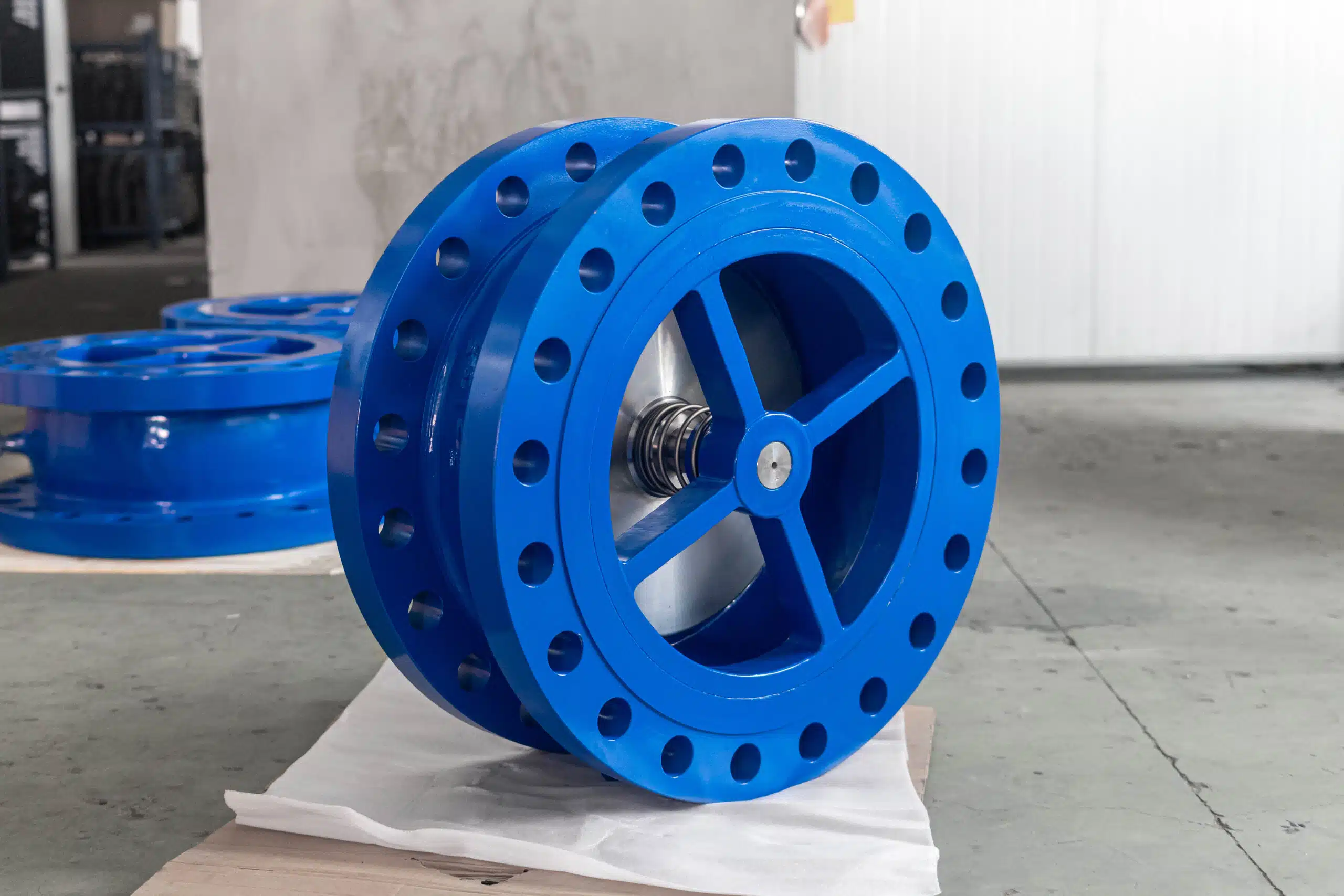
Поддержка приложений / спецификаций
Prepare the service medium, temperature, startup pressure profile, minimum and normal flow, installation orientation, required opening condition, resealing expectation, leakage requirement, and operating pressure-drop limit before reviewing a cracking-pressure requirement.
The engineering review should then:
- compare the system’s minimum available differential with the offered valve’s maximum cracking pressure, including tolerance;
- confirm that the stated value applies to the actual orientation and test basis;
- review minimum-flow stability, resealing, leakage, and operating pressure drop as one package.
NTGD can use these application inputs to review whether a proposed check-valve configuration and cracking-pressure basis are consistent with the stated service conditions. The review should be completed against the offered valve’s actual datasheet, test basis, and approved configuration rather than an isolated nominal value.
After the application data and verification basis are defined, the relevant industrial check valve product family can be reviewed against the approved service conditions.
