
Author Name: Bruce Zheng
Author Role: Co-Founder and Valve Engineer at NTGD Valve
Author Bio: Bruce Zheng is Co-Founder and Valve Engineer at NTGD Valve, focusing on industrial valve selection, application, and technical content for global B2B buyers.
Last Updated: May 5, 2026
How to Maintain and Troubleshoot Globe Valves for Optimal Performance
Globe valve maintenance is more than basic cleaning. In industrial piping systems, a globe valve must regulate flow, close reliably, move smoothly, and maintain sealing performance while exposed to pressure, temperature, media, and operating-cycle changes.
Small defects usually appear first around the packing area, stem movement, seat and disc sealing surfaces, body-to-bonnet joint, or valve operating torque. If these early signs are ignored, the result can be external leakage, internal leakage, poor shutoff, stiff operation, repeated packing failure, or an unplanned shutdown.
This guide explains how to maintain globe valves, inspect key components, troubleshoot common globe valve problems, verify maintenance results, and decide whether a valve can be adjusted, repaired, or should be reviewed for replacement.
Quick Engineering Summary
Reliable globe valve maintenance follows a simple engineering sequence: inspect the valve safely, check the components that control sealing and movement, adjust the maintenance frequency according to service severity, diagnose symptoms by likely failure path, and verify the valve before it returns to service. For industrial users, the most important areas are packing, gland, gasket, stem, yoke, seat, disc, body, and bonnet condition. A maintenance plan should not stop at cleaning and lubrication; it should also identify leakage source, poor shutoff causes, repeated operation issues, and the point where field adjustment is no longer enough.
Why Globe Valve Maintenance Matters in Industrial Service
Globe valves are often used where flow control, throttling, or frequent adjustment is required. That service pattern exposes the internal sealing area and operating parts to pressure drop, fluid velocity, temperature cycling, vibration, and mechanical wear. A valve that looks acceptable from the outside may still have internal seat damage, disc wear, stem binding, or packing leakage.
The main purpose of maintenance is to stop small defects from becoming system-level problems. A dry stem thread can become stiff operation. Slight packing leakage can become persistent external leakage. Minor seat scoring can become poor shutoff. Debris buildup can affect flow control and increase pressure drop. In severe service, these issues develop faster.
This article focuses on practical globe valve maintenance and troubleshooting for industrial service. It does not expand into globe valve selection, full installation procedure, or working principle explanation.
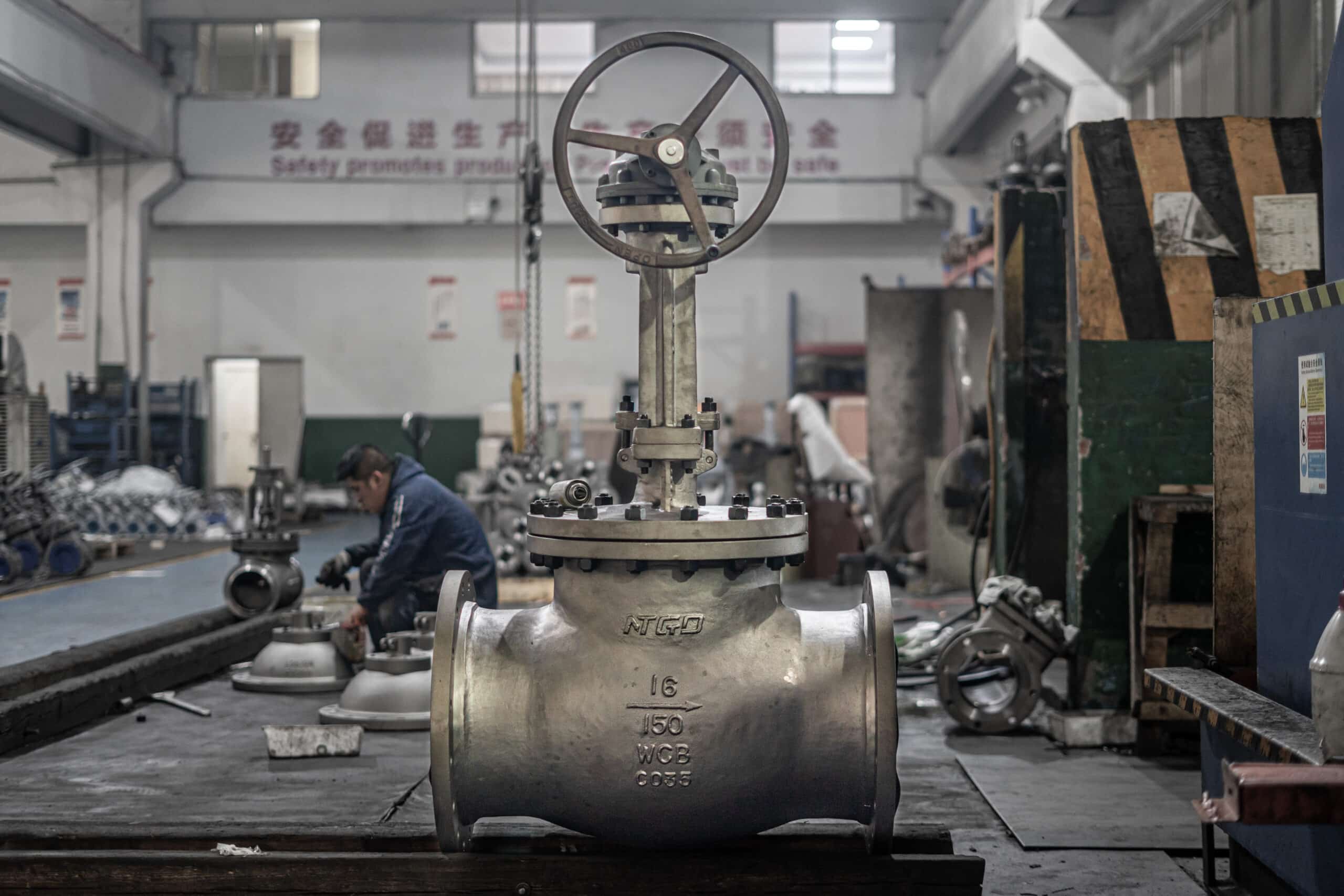
Failure Modes Maintenance Should Prevent
Good maintenance should reduce the risk of:
- External leakage around the packing, bonnet, flange, or body joint — because small leakage paths can develop into safety, environmental, and maintenance-reliability problems.
- Internal leakage caused by worn seat or disc sealing surfaces — because the valve may look dry externally but still fail to isolate or control flow.
- Stiff or stuck operation caused by stem, yoke, thread, or packing problems — because forcing the handwheel can damage the operating mechanism or internal sealing parts.
- Poor shutoff after repeated throttling or dirty-media service — because seat and disc wear can prevent reliable closure.
- Abnormal noise, vibration, cavitation, or unstable pressure drop — because these symptoms may indicate operating conditions that are damaging the trim.
- Repeated gasket, packing, or sealing surface failure — because recurring failures usually point to service severity, incorrect adjustment, material mismatch, or hidden component damage.
- Unexpected shutdown caused by a valve that can no longer be safely adjusted or isolated — because maintenance issues often become critical only after the valve is needed for control or isolation.
Why Seat, Disc, Stem, and Packing Need Regular Attention
A globe valve depends on controlled contact between the disc and seat. If that sealing surface becomes scratched, eroded, cracked, or contaminated with debris, the valve may no longer shut off properly. The packing and gland area control leakage along the stem. If packing is worn, compressed unevenly, chemically attacked, or overheated, external leakage can appear even when the valve body remains sound.
The stem, yoke, and handwheel mechanism control movement. If these parts are dry, corroded, misaligned, overloaded, or damaged, the valve may become difficult to operate. For manual globe valves, rising stem designs make this movement easier to observe, but inspection is still needed to confirm that stem travel and disc response remain normal.
Globe Valve Maintenance Checklist Before Inspection
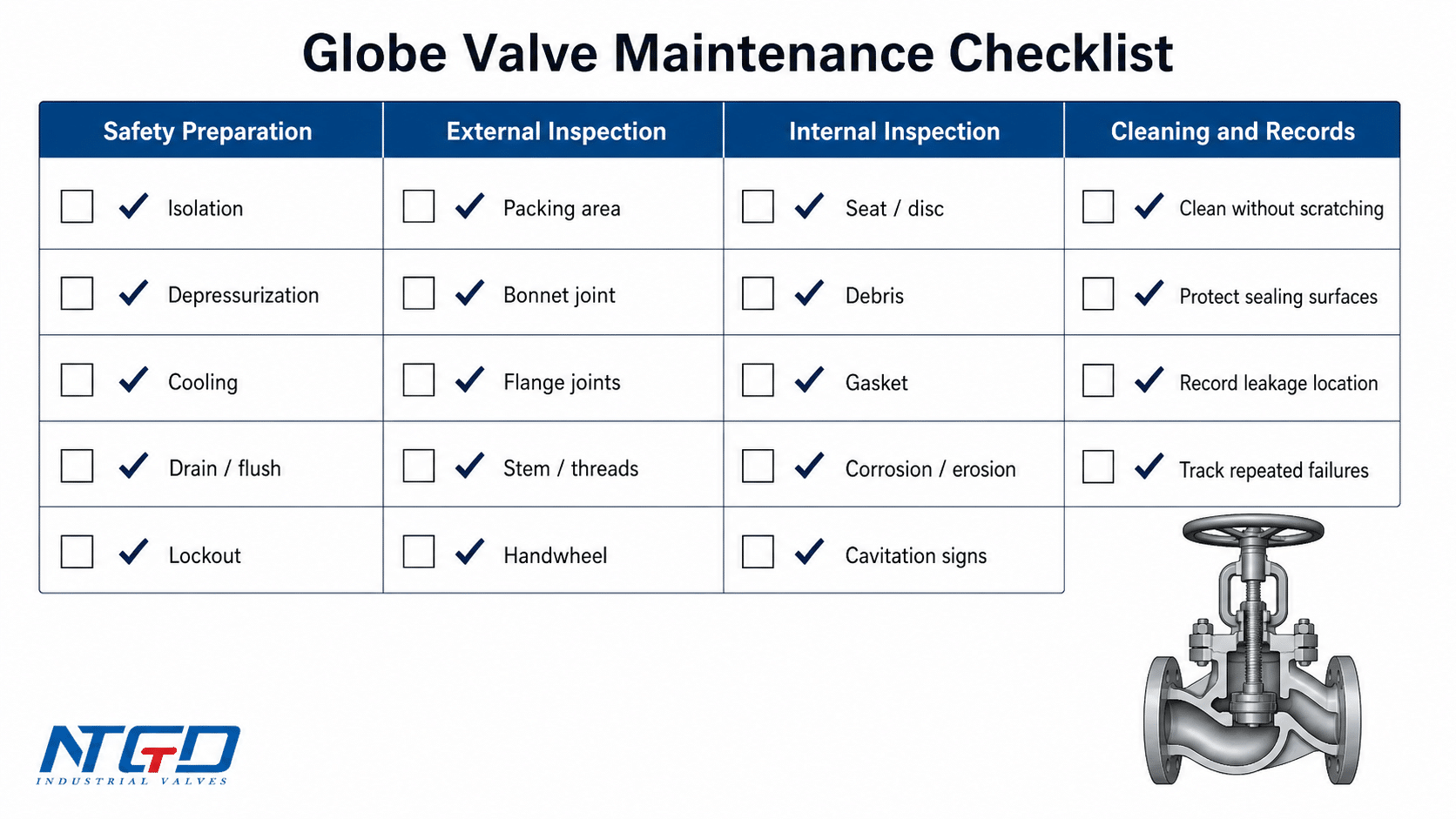
Before opening, adjusting, or disassembling a globe valve, maintenance work must start with hazardous energy control and system safety. Globe valves may retain pressure, hot fluid, cold media, corrosive residue, steam, or trapped fluid in the body cavity and nearby piping. Do not treat valve maintenance as a simple cleaning task.
Safety Before Maintenance
Before inspection or repair, confirm that the valve and pipeline are safe to work on.
| Check Item | What to Confirm | Why It Matters |
|---|---|---|
| System isolation | Upstream and downstream pressure sources are isolated | Prevents unexpected flow or pressure release during inspection |
| Depressurization | Pipeline pressure has been released safely | Reduces risk during packing, bonnet, gasket, or body inspection |
| Cooling time | Valve body and nearby piping are safe to touch or access | Important in steam, thermal oil, high-temperature, cryogenic, or low-temperature service |
| Drainage and flushing | Hazardous, corrosive, or dirty media has been drained or flushed where required | Reduces personnel exposure risk and prevents residue from damaging internal parts |
| Lockout procedure | Site safety procedure has been followed | Prevents accidental operation during maintenance |
| Access clearance | Handwheel, stem, gland, bonnet, and flanges are accessible | Allows proper inspection instead of partial visual checks |
External Inspection Points
External inspection should be performed during routine operation and before any planned shutdown. The goal is to identify visible signs of wear, leakage, corrosion, or abnormal operation before the valve is removed from service.
| Inspection Area | What to Check | Warning Sign | Action |
|---|---|---|---|
| Packing area | Moisture, fluid stains, steam marks, crystallized residue | Stem leakage or packing failure | Adjust gland carefully or plan packing replacement |
| Bonnet joint | Leakage at body-to-bonnet connection | Gasket compression loss or bolting issue | Check bolts and gasket condition during shutdown |
| Flange joints | Leakage, corrosion, bolt loosening | External leakage path | Verify bolt condition and gasket sealing |
| Stem and threads | Rust, scoring, dirt, uneven movement | Stiff operation or stem wear | Clean and lubricate suitable areas |
| Handwheel or actuator interface | Excessive play, difficult turning, loose connection | Mechanical wear or misalignment | Inspect connection and operating mechanism |
| Valve body | Cracks, corrosion, coating failure, deformation | Structural risk | Remove from service if structural damage is suspected |
Internal Inspection Points
Internal inspection normally requires shutdown or valve removal. It should not be performed while the valve is pressurized.
Key internal checks include:
- Seat and disc sealing surfaces, especially where shutoff leakage or throttling wear is suspected
- Dirt, scale, weld slag, or abrasive debris, which may indicate upstream contamination, dirty service, or poor commissioning cleanliness
- Disc condition and movement, including any sign that the disc is not seating evenly
- Body-seat contact area, especially when internal leakage continues after cleaning
- Gasket condition, including compression loss, surface damage, or chemical attack
- Internal corrosion or erosion, particularly in corrosive or high-velocity media
- Signs of cavitation or severe throttling damage, which may indicate that operating conditions are damaging the valve internally
If the valve has been leaking internally, do not assume the packing is the only issue. Poor shutoff is more often related to seat, disc, debris, alignment, or sealing surface condition.
Cleaning and Basic Care Checklist
Cleaning should remove contamination without damaging sealing surfaces. External dirt can hide leakage points. Internal debris can score the seat or disc.
| Maintenance Task | Recommended Practice | Avoid |
|---|---|---|
| External cleaning | Wipe body, bonnet, stem area, and handwheel to expose leaks or corrosion | Do not paint over leakage or corrosion without inspection |
| Stem cleaning | Remove dirt from exposed stem threads before lubrication | Do not force a dry or corroded stem |
| Internal cleaning | Remove scale, deposits, and debris during shutdown inspection | Do not scratch seat or disc surfaces |
| Sealing surface care | Inspect for scoring, erosion, cracks, or embedded particles | Do not grind or lap aggressively without proper repair procedure |
| Record keeping | Note leakage location, parts replaced, torque issues, and repeated failures | Do not treat repeated leakage as a new unrelated problem each time |
Component-Level Globe Valve Maintenance
A strong maintenance plan should not treat the valve as one single object. Globe valve maintenance becomes more effective when each critical component has a defined inspection point and failure boundary.
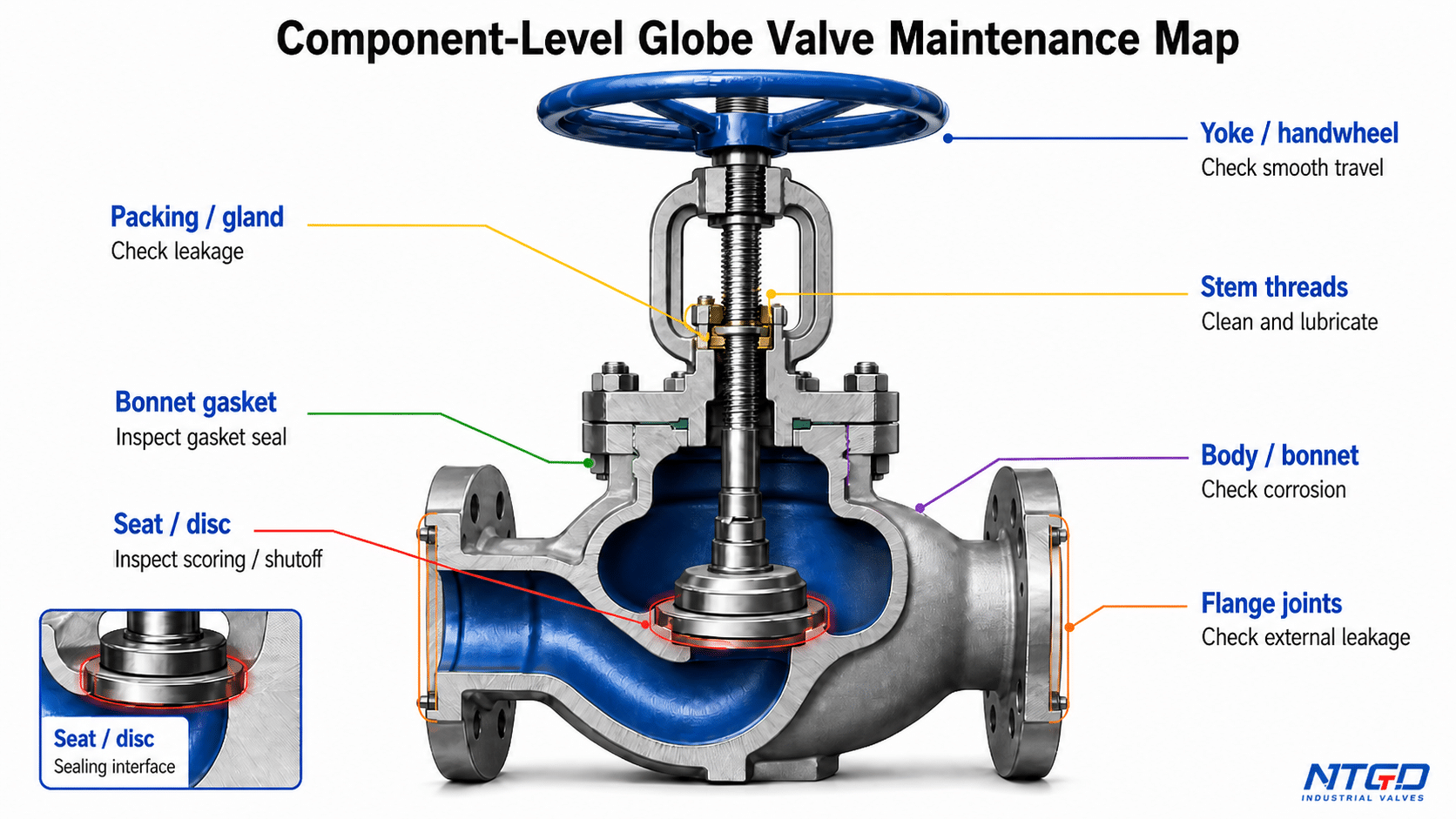
Packing, Gland, and Gasket Maintenance
Packing prevents leakage along the stem. Over time, packing can lose compression, harden, wear, or become damaged by heat, pressure cycling, chemical exposure, or repeated operation.
Check the packing and gland area for:
- Fluid or vapor leakage around the stem
- Uneven gland compression
- Over-tightened gland bolts
- Packing extrusion or hardening
- Corrosion around the gland area
- Repeated leakage after adjustment
A minor packing leak may be corrected by careful gland adjustment if the packing is still serviceable. Adjustment should stop when the gland needs repeated tightening, stem movement becomes noticeably tighter, or leakage returns quickly after operation. At that point, continued compression can create new operating problems; packing replacement and stem surface inspection are usually more reliable.
Bonnet gaskets should be inspected when leakage appears at the body-to-bonnet joint. A bonnet leak is not the same as packing leakage, and tightening bolts without confirming gasket condition may delay the real repair.
Stem, Yoke, and Handwheel Lubrication
Lubrication should target the correct moving parts. In globe valves, the stem threads, yoke sleeve, handwheel mechanism, and exposed operating surfaces are common lubrication points. The lubricant must be suitable for the valve material, operating temperature, media environment, and site maintenance procedure.
Signs that stem and yoke maintenance is needed include:
- Handwheel becomes harder to turn
- Stem movement is uneven
- Valve does not reach expected open or closed position
- Stem threads show corrosion or galling
- Operation torque increases suddenly
- Lubrication does not improve movement
Start with cleaning and suitable lubrication to eliminate basic friction issues. If stiffness remains, stop forcing the valve and inspect the stem, yoke, packing compression, and internal parts. Lubrication alone cannot correct a bent stem, damaged thread, over-compressed packing, misalignment, or seat/disc damage.
Seat, Disc, and Sealing Surface Inspection
The seat and disc determine whether the globe valve can shut off properly. Unlike valves used mainly for on-off isolation, globe valves are commonly exposed to throttling service, where velocity impact, pressure drop, and dirty media can accelerate sealing surface wear.
Inspect the seat and disc for:
- Scratches or scoring
- Erosion from throttling service
- Cracks caused by thermal or pressure stress
- Deposits or embedded particles
- Uneven contact marks
- Disc damage or deformation
- Leakage after closure
Minor surface damage may be corrected through controlled lapping or reseating if the valve design and site procedure allow it. If shutoff leakage repeats after cleaning or repair, or if cracks, deep erosion, or severe scoring are found, the issue should move from routine maintenance into component replacement or valve replacement review.
Body, Bonnet, Bolts, and Alignment Checks
The valve body and bonnet should be checked for leakage, corrosion, bolt looseness, and mechanical stress. Bolts and nuts should not be tightened blindly. If leakage is caused by gasket failure, flange distortion, or body damage, excessive tightening may worsen the problem.
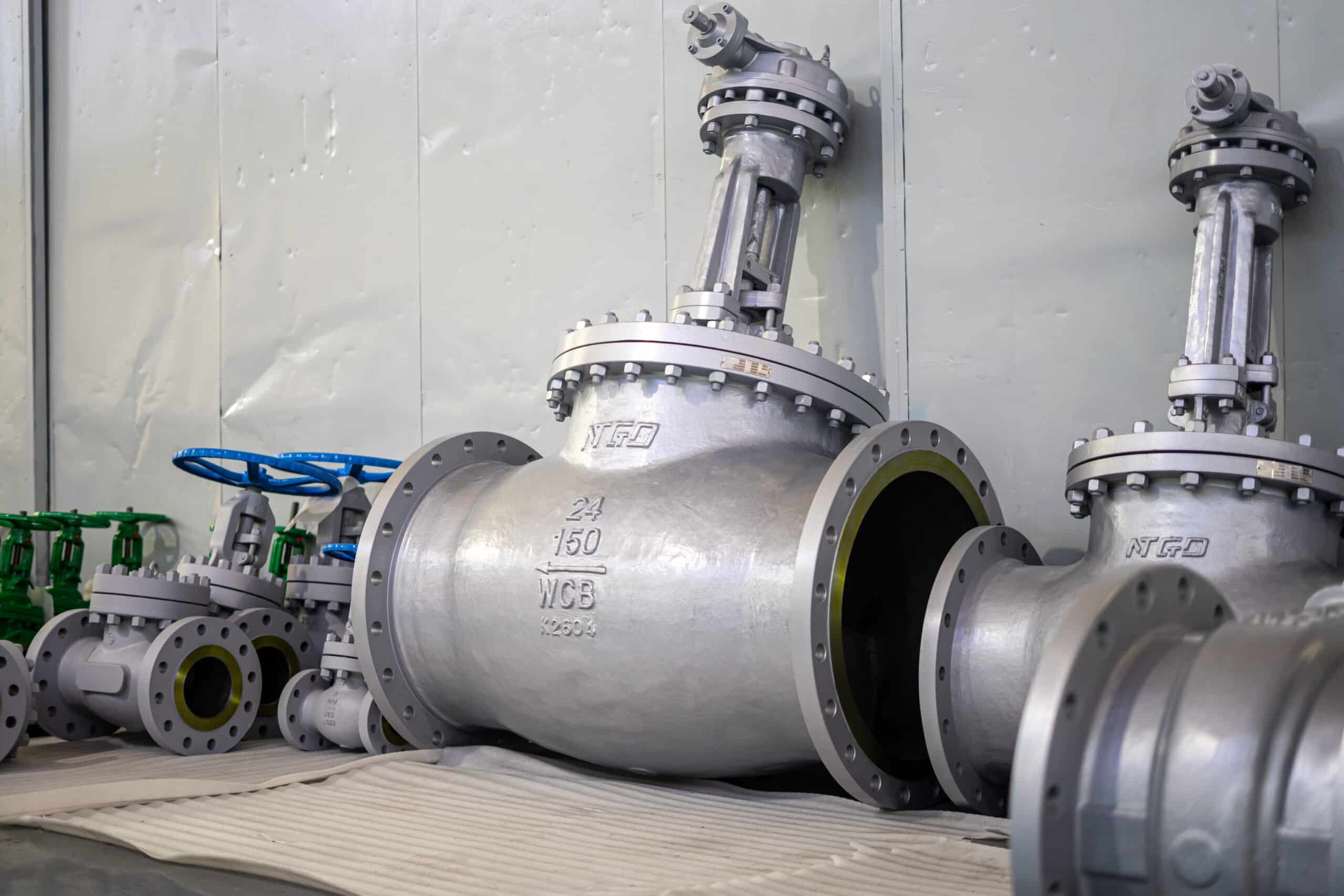
Also check for installation and maintenance access issues that affect maintenance and troubleshooting:
- Incorrect flow direction
- Poor valve orientation for drainage or inspection
- Misalignment with piping
- Stress from unsupported pipe loads
- Disc alignment problems after repair
- Abnormal pressure drop after installation or maintenance
This article does not provide a full globe valve installation procedure. Installation-related checks are included only because poor setup can create repeated maintenance and troubleshooting problems.
Preventive Maintenance Schedule by Service Severity
A globe valve maintenance schedule should reflect service conditions. A valve in clean, low-cycle service does not need the same inspection frequency as a valve in steam, corrosive, dirty, high-temperature, or high-cycle service.
| Service Condition | Inspection Priority | Suggested Maintenance Focus |
|---|---|---|
| Clean liquid, low-cycle service | Medium | External leakage, smooth movement, periodic cleaning, basic lubrication |
| Steam or high-temperature service | High | Packing condition, bonnet gasket, stem lubrication, and thermal cycling signs |
| High-pressure service | High | Body/bonnet joint, closure performance, pressure test results, and seat/disc wear |
| Corrosive media | High | Material attack, packing compatibility, body corrosion, and gasket condition |
| Dirty or particle-laden media | High | Seat/disc scoring, debris buildup, poor shutoff, and internal cleaning |
| High-cycle operation | High | Stem wear, packing compression, handwheel or actuator interface, and repeated leakage |
| Low-temperature service | High | Packing leakage, flange leakage, seat/disc sealing, stem movement, material brittleness, insulation, and condensation risks |
| Valves kept as spares | Medium | Storage condition, corrosion protection, cleanliness, and sealing surface protection |
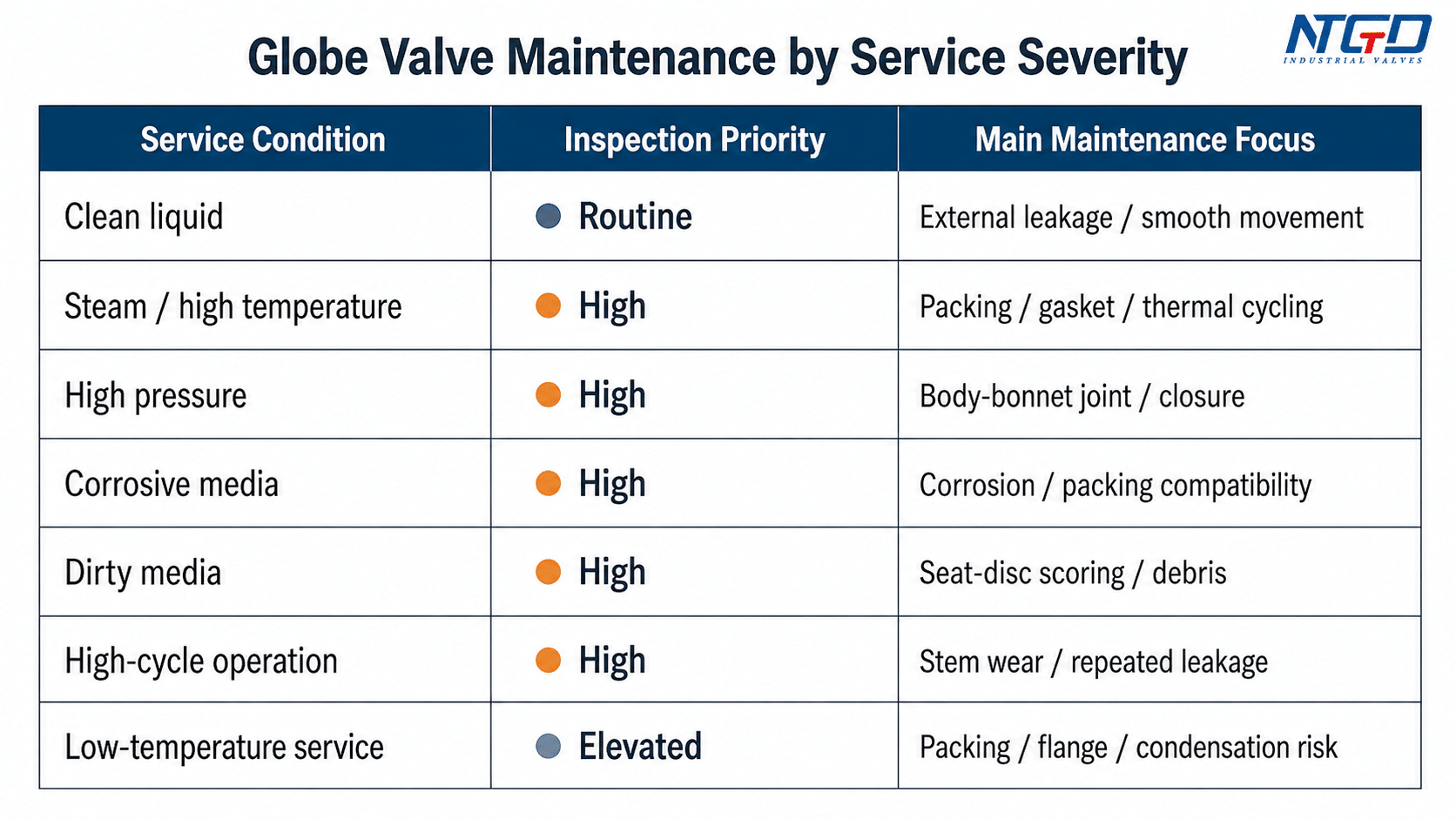
Normal Service vs Severe Service
For normal service, routine external inspection and planned shutdown checks may be enough. Severe service requires a shorter inspection interval and better documentation. If a valve handles steam service, corrosive liquid, abrasive particles, or frequent throttling, inspect packing, seat, disc, and stem condition more often.
Dirty or particle-laden media should push seat/disc scoring and poor shutoff higher in the troubleshooting priority. Steam and high-temperature service should push packing, gasket, and stem lubrication checks higher. High-cycle operation should make stem/yoke wear, packing compression, and repeated leakage part of every maintenance review.
Maintenance Records and Repeated-Failure Tracking
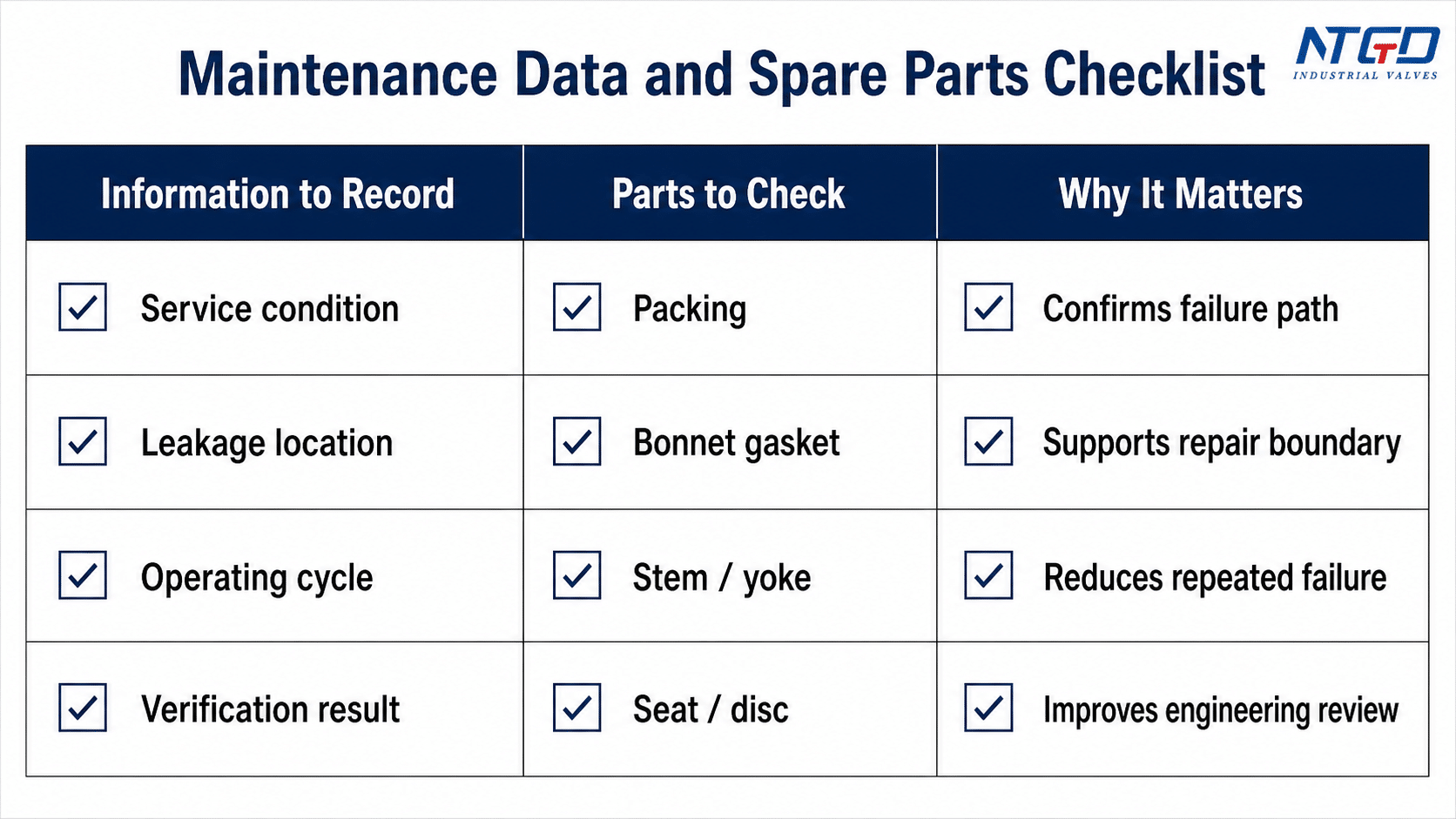
Maintenance records help identify recurring failure patterns.
Track:
- Leakage location
- Packing adjustment frequency
- Parts replaced
- Pressure or leakage test results
- Repeated seat leakage
- Operation torque changes
- Service condition changes
- Shutdown findings
If the same valve repeatedly needs packing replacement, gland adjustment, or seat repair, the issue may not be poor maintenance alone. It may point to service severity, material compatibility, pressure-temperature limits, installation stress, or incorrect valve application.
Globe Valve Troubleshooting Matrix
Troubleshooting should begin with the symptom the operator can observe. A useful globe valve troubleshooting diagnosis does not stop at “the valve leaks” or “the valve is stuck.” It should connect the symptom to the likely cause, the inspection point, the corrective action, and the verification step.
| Symptom | Likely Cause | Inspection Point | Corrective Action | Verification |
|---|---|---|---|---|
| Leakage around stem | Worn packing, uneven gland compression, damaged stem surface | Packing box, gland, stem surface | Adjust gland carefully if packing is serviceable; replace packing if leakage returns or stem movement becomes tight | Confirm no stem leakage after operation under normal service conditions |
| Valve does not shut off fully | Seat/disc wear, debris on sealing surface, disc damage, poor sealing contact | Seat, disc, internal flow path | Clean, inspect, repair sealing surfaces if suitable, or replace damaged parts | Confirm closure performance and check for internal leakage |
| Handwheel is stiff | Dry stem threads, corrosion, over-tightened packing, bent stem | Stem, yoke, gland, handwheel | Clean and lubricate; inspect packing compression and stem alignment before applying more force | Confirm smooth full travel without abnormal torque increase |
| Valve is stuck | Internal debris, severe corrosion, thread damage, seized stem, sticky/scaling/crystallizing media after shutdown | Stem/yoke, internal parts, seat area | Isolate, disassemble if needed, clean or replace affected parts | Confirm full travel after reassembly and check that the cause does not recur |
| External leakage at bonnet | Gasket failure, loose or uneven bolts, bonnet joint damage | Body-to-bonnet joint | Inspect gasket, bolting, and seating surface; replace gasket if required | Confirm no leakage at the bonnet joint under safe pressure conditions |
| Noise or vibration | Cavitation, high pressure drop, unstable flow, worn trim, erosion damage | Operating condition, seat/disc, flow path | Check operating condition, pressure drop, and internal wear; inspect for erosion or cavitation damage | Monitor operation after corrective action and confirm vibration or noise is reduced |
| Repeated packing failure | Over-tightening, stem damage, wrong packing material, severe service | Packing, stem, service temperature/media | Replace packing; check stem surface and service compatibility | Confirm leakage does not return after operation and gland adjustment remains stable |
| Pressure test failure | Body, bonnet, seat, gasket, or packing issue | Leak location during test | Repair or replace affected component after locating the failure path | Repeat verification according to site procedure before returning valve to service |
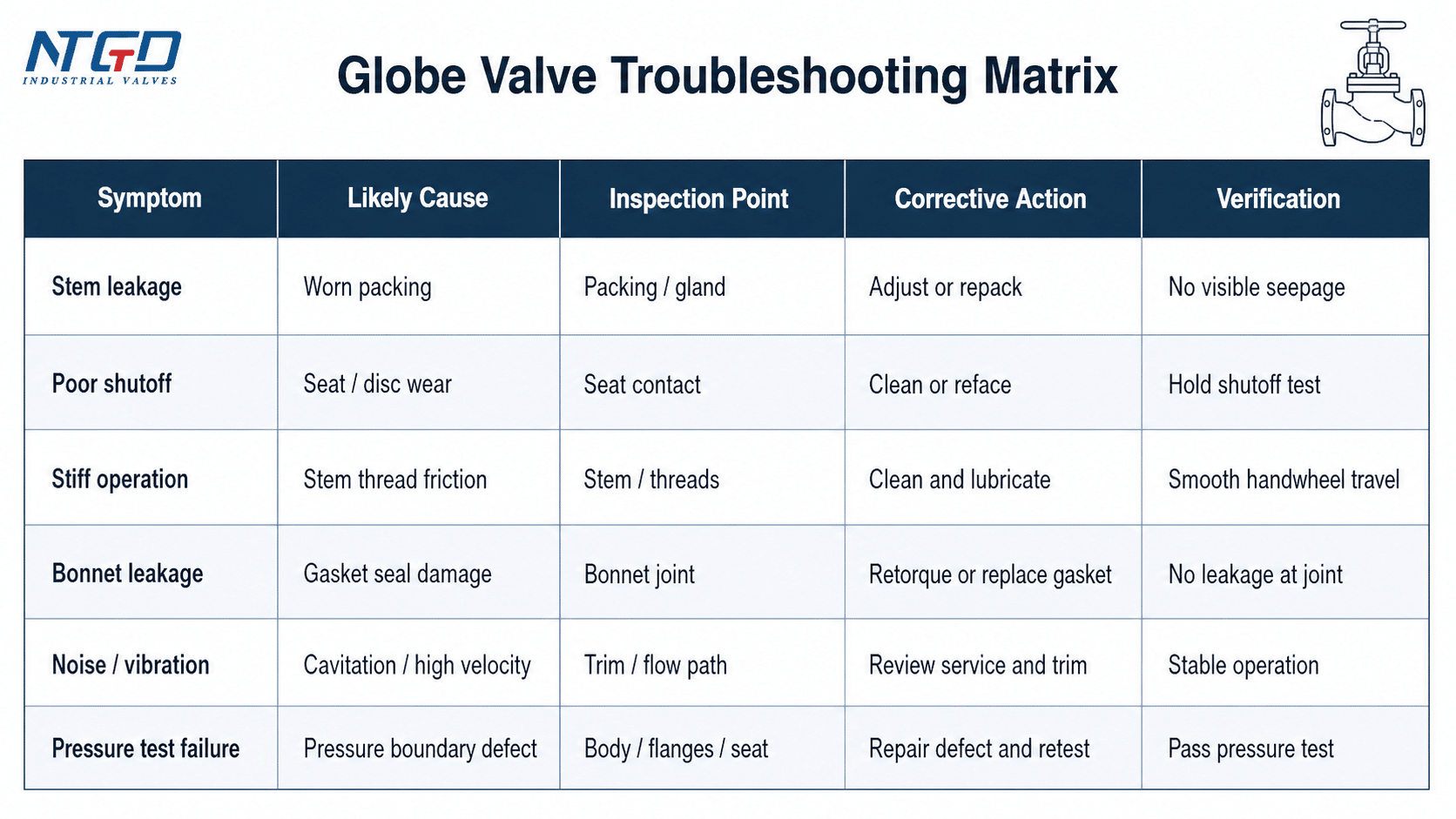
Stiff or Stuck Operation
Stiff operation should not be solved by force. Excessive force can damage the handwheel, stem, yoke, disc connection, or seat. First identify whether the resistance comes from dry stem threads, over-tightened packing, corrosion, internal debris, sticky media, or service conditions that have changed since the last maintenance cycle.
If cleaning and lubrication improve movement, record the condition and monitor the valve. If stiffness remains, inspect the packing, stem alignment, yoke, and internal parts before applying more torque.
Poor Shutoff or Internal Leakage
Poor shutoff often points to the seat and disc area. Common causes include:
- Worn sealing surfaces
- Debris trapped between seat and disc
- Disc damage
- Seat cracks
- Erosion from throttling
- Incorrect closure or alignment
- Internal corrosion
Internal leakage is different from external leakage. The valve may look dry from outside but still fail to isolate flow. In that case, focus on seat, disc, and closure performance.
Noise, Vibration, and Abnormal Pressure Drop
Noise, vibration, or a sudden change in pressure drop may indicate operating conditions that are damaging the valve. Possible causes include cavitation, flashing, excessive velocity, debris, partial blockage, or worn internal sealing surfaces.
If noise or vibration appears together with abnormal pressure drop or unstable throttling behavior, check the seat/disc area and operating condition before treating the issue as only an external lubrication problem. These signs may indicate internal wear or service conditions outside what the valve can handle reliably.
Leakage Source Classification for Globe Valves
Globe valve leakage should be diagnosed by location. Different leak paths point to different causes and require different corrective actions.
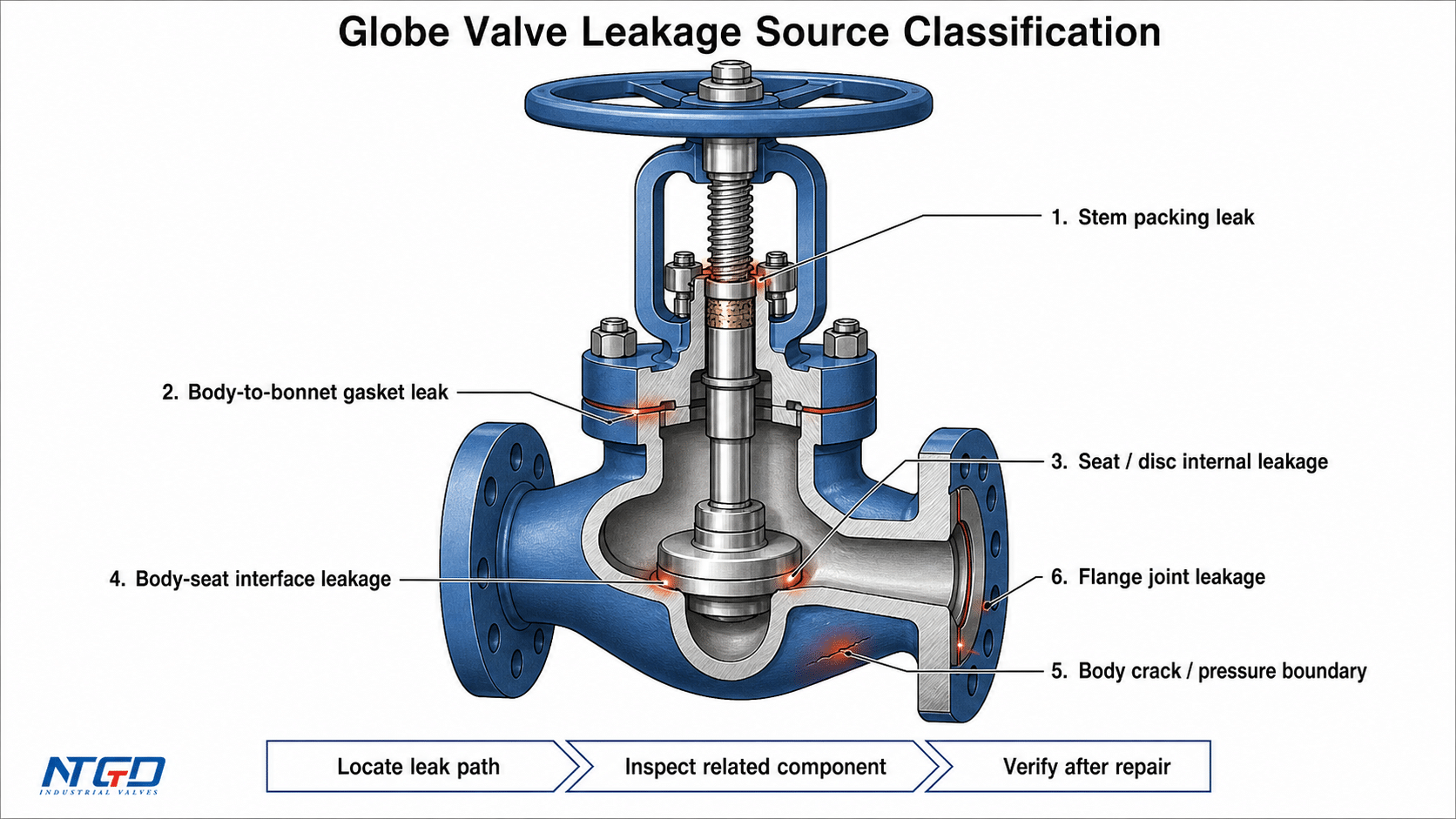
| Leakage Location | What It Usually Indicates | First Inspection Area | Typical Response |
|---|---|---|---|
| Around the stem | Packing wear, gland issue, stem surface damage | Packing box, gland, stem | Adjust gland or replace packing |
| Body-to-bonnet joint | Gasket failure, uneven bolting, bonnet joint damage | Bonnet gasket and bolts | Inspect gasket and reassemble correctly |
| Seat/disc leakage | Worn seat, damaged disc, debris, poor sealing contact | Internal sealing surfaces | Clean, inspect, repair sealing surfaces if suitable, or replace parts |
| Body-seat area | Seat damage, body-seat interface issue, internal wear | Seat area and body interface | Requires shutdown inspection |
| Valve body crack | Severe corrosion, mechanical stress, casting or service damage | Body wall and pressure boundary | Remove from service and evaluate replacement |
| Flange leakage | Gasket, bolting, pipe stress, alignment issue | Flange joint | Inspect gasket, bolts, and pipe alignment |
Packing Leakage
Packing leakage is one of the most common external leakage points. Minor leakage may be corrected through controlled gland adjustment, but over-tightening can make the stem harder to operate and may damage the packing.
If leakage continues after adjustment, replace the packing and inspect the stem surface. Repeated packing leakage may indicate unsuitable packing material, stem damage, thermal cycling, pressure cycling, or severe service.
Bonnet or Gasket Leakage
Leakage at the body-to-bonnet joint should not be confused with stem leakage. If fluid appears around the bonnet joint, inspect the gasket, gasket seating surface, bonnet bolts, and reassembly condition.
If the gasket is damaged, tightening bolts alone usually will not solve the problem. Blind tightening may distort the flange, damage bolts, or further damage the gasket, making the repair less reliable and less safe.
Seat and Disc Leakage
Seat/disc leakage affects shutoff performance. It may show up as flow passing through the valve even when the valve is closed. Unlike packing leakage, internal leakage may be invisible from outside the valve, but it can still compromise isolation reliability.
Inspect the disc, seat, sealing surface contact, and any debris that may prevent proper closure. If the sealing surface is lightly damaged, controlled repair may be possible. If cracks, severe erosion, or repeated leakage appear, replacement is usually safer than repeated temporary repair.
Post-Maintenance Verification and Testing
Maintenance is not complete when the valve is reassembled. The valve must be checked before it is returned to normal service.
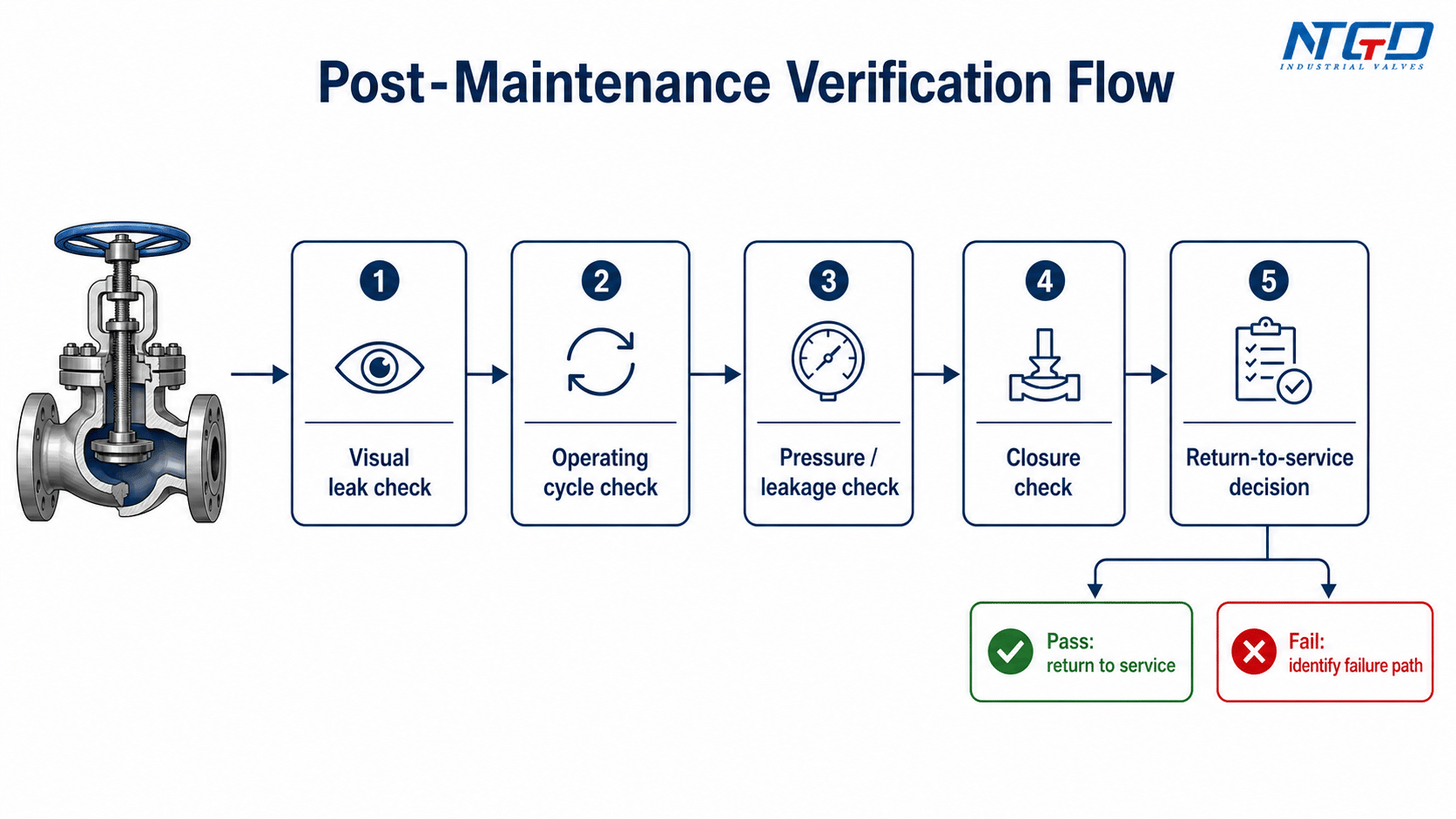
Visual Leak Check
After reassembly, inspect the packing area, bonnet joint, flange joints, body surface, and drain points. Look for moisture, stains, steam traces, pressure marks, or residue that could indicate leakage.
Operating Cycle Check
Open and close the valve through its expected travel range. Confirm:
- Smooth handwheel or actuator movement
- No abnormal stiffness
- No sudden torque increase
- Stem movement matches expected valve position
- No unusual sound during operation
- Valve can reach intended open and closed positions
Pressure, Leakage, and Closure Check
Where site procedure allows, use pressure and closure testing to confirm that the valve can hold pressure and close properly. The aim is to verify that the maintenance work has not left an unresolved sealing, assembly, or pressure-boundary issue.
Check:
- External leakage under pressure
- Packing leakage after operation
- Bonnet or flange leakage
- Shutoff performance
- Seat leakage signs
- Pressure drop or flow abnormality after reinstallation
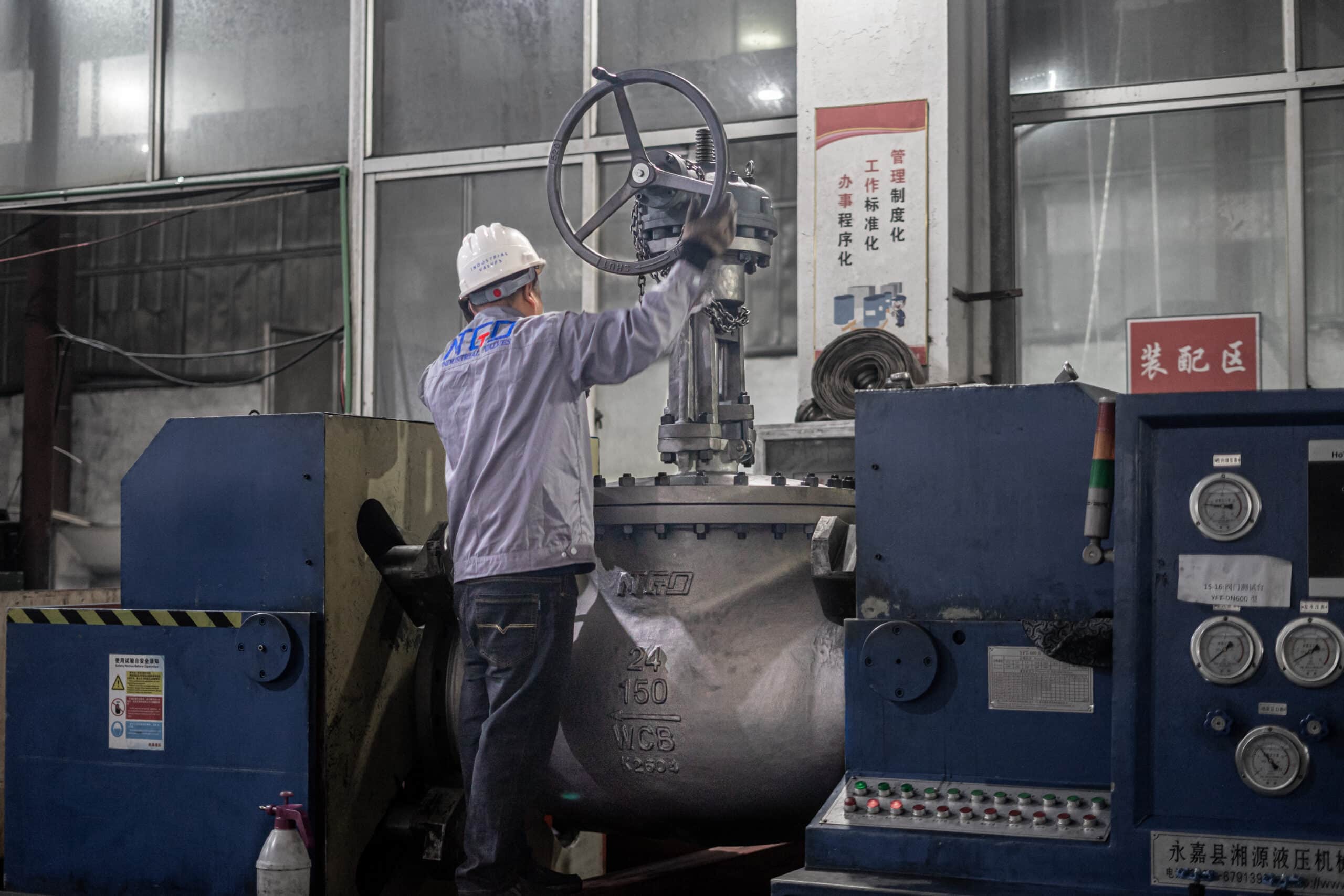
What to Do if Verification Fails
If the valve fails verification, do not return it to service without identifying the failure path. First determine whether the failure is external leakage, internal leakage, abnormal operation, or a pressure-boundary concern.
External leakage should be traced back to the packing, bonnet, flange, gasket, or body area. Internal leakage should return the inspection to the seat, disc, sealing surface, and closure path. Repeating the same adjustment without locating the failed sealing boundary often hides the real problem until the next shutdown. If the failure path cannot be confirmed on site, move the issue into repair-or-replace review.
Repair, Replace, or Ask for Engineering Support?
Not every globe valve problem requires replacement. Not every problem should be handled with a simple adjustment either. The decision depends on the failure location, severity, service condition, and whether the same problem has appeared before.
| Condition | Typical Decision | Reason |
|---|---|---|
| Minor stem dryness or light stiffness | Field maintenance | Cleaning and suitable lubrication may restore normal movement |
| Slight packing seepage | Controlled adjustment | Gland adjustment may work if packing is still serviceable and stem movement remains normal |
| Repeated packing leakage | Replace packing and inspect stem | Repeated leakage suggests packing damage, stem surface wear, or unsuitable packing for the service |
| Persistent seat leakage | Shutdown inspection | Internal sealing surfaces must be checked before the valve can be trusted for closure |
| Scored seat or damaged disc | Repair or replace component | Shutoff reliability depends on sealing surface condition |
| Body crack or severe corrosion | Replace valve or remove from service | Pressure-boundary integrity is at risk |
| Failed pressure or closure verification | Engineering review | The valve should not return to service until the failure path is confirmed |
| Wrong material for service | Replacement or application review | Maintenance cannot change the base material’s resistance to corrosion, temperature, or pressure |
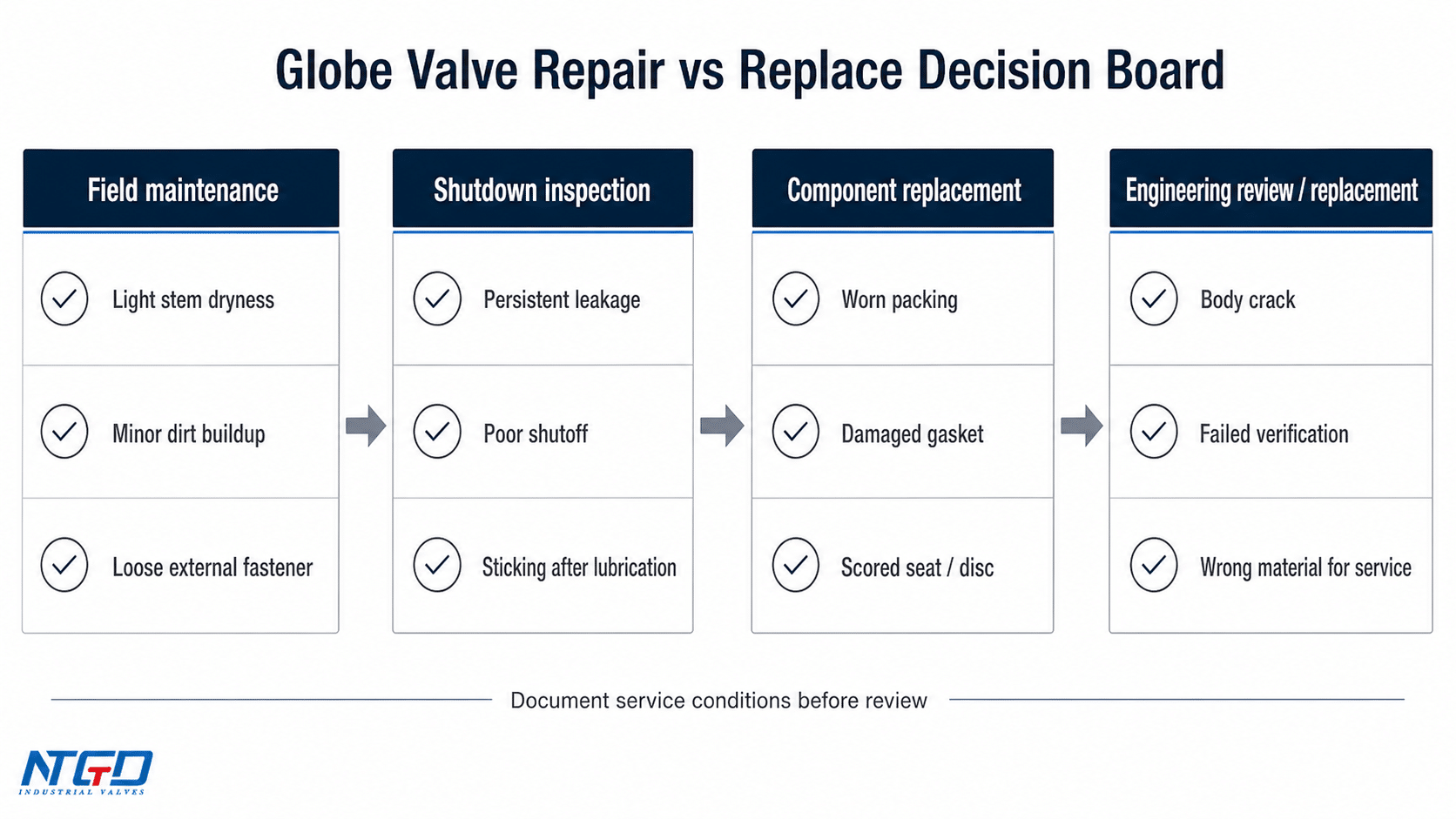
Problems That Can Often Be Handled On Site
Some minor issues may be corrected during routine maintenance:
- Light stem dryness
- Minor external dirt buildup
- Slight gland leakage
- Loose external fasteners
- Early corrosion on exposed non-pressure-bearing surfaces
- Handwheel connection looseness
Even for these cases, record the condition. If the issue repeats, treat it as a failure pattern rather than routine maintenance.
Problems That Require Shutdown Inspection
Shutdown inspection is usually needed when the problem involves the pressure boundary, internal sealing surfaces, or repeated failure.
Examples include:
- Persistent leakage after packing adjustment
- Poor shutoff after cleaning
- Suspected seat or disc damage
- Internal debris affecting closure
- Bonnet gasket leakage
- Valve sticking that does not improve after lubrication
- Abnormal pressure drop, noise, or vibration
When Component Replacement Is Needed
Component replacement may be required when inspection confirms wear or damage that adjustment cannot correct. Common examples include:
- Worn packing
- Damaged bonnet gasket
- Scored seat
- Cracked disc
- Bent stem
- Damaged handwheel or yoke component
- Worn fasteners or bolting components
A repair should always be followed by verification. Replacing parts without confirming operation and sealing performance may leave the valve unreliable.
When Complete Valve Replacement Is Safer
Complete valve replacement should be considered when:
- The valve body is cracked
- Pressure boundary corrosion is severe
- The valve repeatedly fails verification
- The material is unsuitable for the service
- Seat or body damage cannot be repaired reliably
- Repair cost and downtime exceed practical value
- The valve no longer meets plant operating requirements
Before replacing the valve, document the service conditions, pressure, temperature, media, leakage location, operating cycle, inspection findings, and failed components. This information helps engineering teams or suppliers evaluate whether the failure was caused by maintenance condition, service severity, material compatibility, installation stress, or valve selection.
Frequently Asked Questions
How often should an industrial globe valve be maintained?
Maintenance frequency depends on service severity. Clean, low-cycle service may only need routine external inspection and planned shutdown checks. Steam, high-temperature, high-pressure, corrosive, dirty, or high-cycle service should be inspected more closely because packing, stem movement, seat/disc condition, and leakage risk change faster under severe operating conditions.
How do you maintain a globe valve?
Start with safe isolation and depressurization. Inspect the outside for leakage, corrosion, loose bolts, and smooth operation. During shutdown, inspect internal parts such as the seat, disc, gasket, and body cavity. Clean debris, lubricate suitable stem and yoke surfaces, adjust or replace packing when required, and verify operation before returning the valve to service.
How do you clean a globe valve without damaging the sealing surfaces?
Clean external surfaces to expose leakage, corrosion, and damaged areas. For internal cleaning, remove debris, deposits, and buildup during shutdown inspection. Avoid scratching the seat or disc sealing surfaces. If sealing surfaces are damaged, they should be inspected and repaired using the correct procedure rather than cleaned aggressively.
How do you lubricate a globe valve stem?
Clean the exposed stem threads and yoke area before applying a lubricant suitable for the valve material, temperature, and service environment. Lubrication should reduce friction and support smooth travel. If the valve remains stiff after lubrication, inspect the packing, stem alignment, yoke, and internal parts.
How do you know whether a globe valve leak is from packing or the seat?
Start with the leakage location. Leakage around the stem usually points to packing, gland, or stem surface issues. Leakage through the closed valve points toward seat, disc, debris, or internal sealing damage. Bonnet, flange, and body leaks should be treated as separate external leakage paths because they require different inspection and repair actions.
When should globe valve packing be replaced instead of adjusted?
Replace packing when leakage continues after proper gland adjustment, when packing is hardened or damaged, when the stem surface is affected, or when leakage returns quickly after maintenance. If each adjustment makes the valve harder to operate, further tightening can create a new stem or packing problem.
Why does a globe valve become hard to operate?
Common causes include dry stem threads, corrosion, over-tightened packing, damaged stem surfaces, debris inside the valve, seat/disc damage, sticky media, or misalignment. Do not force the handwheel. Inspect the stem, yoke, packing, and internal parts before applying more torque.
What should be checked if a globe valve still leaks after maintenance?
Identify whether the leakage is external or internal. For external leakage, recheck the packing, gland, bonnet gasket, flange joint, or body. For internal leakage, inspect the seat, disc, sealing surface contact, and debris in the flow path. If the valve still fails pressure or closure verification, move the issue into repair-or-replace review.
Conclusion
Globe valve maintenance works best when it is organized around actual failure points: packing, gland, stem, yoke, seat, disc, body, bonnet, and sealing surfaces. Basic cleaning and lubrication are useful, but they are not enough for industrial service. A reliable maintenance program should combine inspection, component-level care, service-severity scheduling, troubleshooting, leakage classification, verification testing, and clear repair-or-replace decisions.
For B2B users, the practical goal is not only to make the valve last longer. It is to reduce unexpected leakage, prevent poor shutoff, avoid repeated maintenance, and keep the valve safe for the service conditions it actually sees.
Engineering Review for Persistent Globe Valve Problems
If a globe valve continues to leak, becomes difficult to operate, or fails verification after maintenance, prepare the service conditions, valve size, pressure class, medium, temperature, leakage location, operating cycle, inspection findings, and repeated failure history for engineering review. A focused maintenance review can help identify whether the issue is packing, seat/disc wear, stem movement, service severity, material compatibility, or valve replacement risk.
