
Author Name: Bruce Zheng
Author Role: Co-Founder and Valve Engineer at NTGD Valve
Author Bio: Bruce Zheng is Co-Founder and Valve Engineer at NTGD Valve, focusing on industrial valve selection, application, and technical content for global B2B buyers.
Last Updated: June 14, 2026
Ball valve pressure drop is the pressure difference that occurs as fluid passes through a ball valve. In many industrial systems, a fully open ball valve can provide a relatively straight flow path and low resistance, especially when the valve is a full-port or full-bore design.
Even a full-port design has measurable flow resistance, and in high-flow, viscous, or pressure-sensitive systems, that resistance can become a selection factor.
The actual pressure loss through a ball valve depends on the valve bore, port design, flow rate, fluid properties, valve position, and manufacturer Cv data. A reduced-port ball valve, a partially open ball valve, a high-velocity line, or a viscous service can create more flow resistance than buyers expect.
This guide explains how ball valve pressure drop, ball valve Cv, flow coefficient, full-port design, reduced-port design, and RFQ data work together during industrial valve selection.
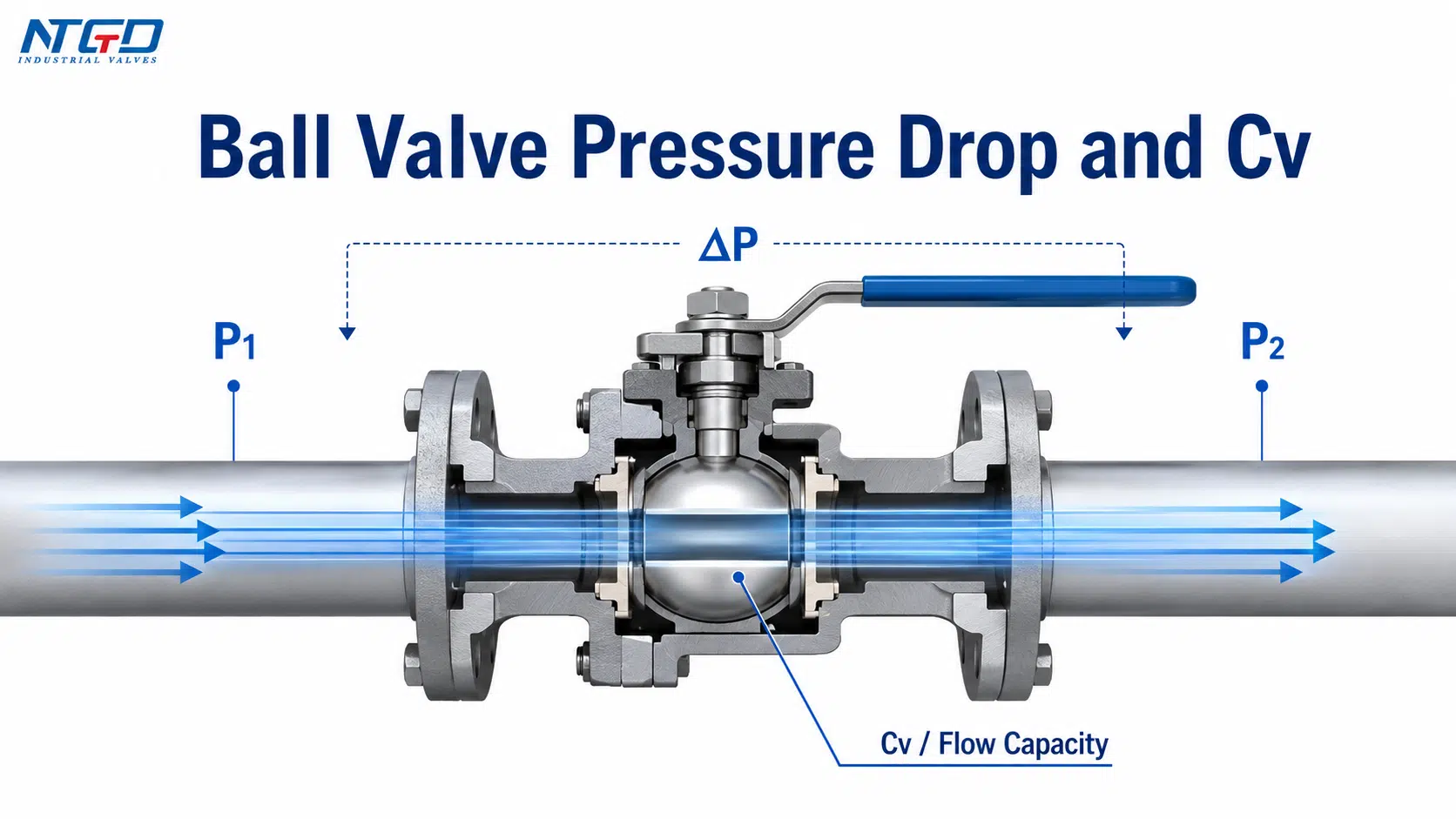
Quick Answer: Ball Valve Pressure Drop and Cv
A ball valve does cause pressure drop, but the pressure drop is usually low when the valve is fully open, full-port, correctly sized, and used with a suitable fluid velocity.
For most industrial on/off services, a fully open full-port ball valve can provide acceptable pressure drop, but the Cv should still be checked against the actual flow rate, fluid properties, and allowable ΔP. In pump-head-sensitive or high-flow systems, even a “low” valve pressure drop can become a selection factor.
The key point is this:
- Pressure drop is the pressure difference across the valve.
- Pressure loss is often used as a practical synonym for that loss of available pressure.
- Cv, or flow coefficient, indicates the flow capacity of the valve under defined conditions.
- A higher Cv generally means lower restriction for the same flow rate and fluid.
- A full-port ball valve usually has lower pressure drop than a reduced-port ball valve of the same nominal size.
- A reduced-port ball valve may still be acceptable when the system can tolerate the added pressure loss.
- A partially open standard ball valve can create higher turbulence and pressure loss and is not normally selected for precise throttling.
Prolonged partial opening can create unstable flow, vibration, seat wear, and poor control accuracy, so throttling service should be reviewed separately instead of assuming a standard on/off ball valve is suitable.
For final selection, valve size alone is not enough. The buyer should check flow rate, fluid properties, allowable pressure drop, port type, and manufacturer Cv data for the selected valve configuration.
What Is Ball Valve Pressure Drop or Pressure Loss?
In industrial valve selection, ball valve pressure drop is a key way to evaluate how much flow resistance the valve adds to the line. It is the difference between the upstream pressure and downstream pressure when fluid flows through the valve.
In simple terms:
ΔP = P1 – P2
Where:
- P1 is the pressure before the valve.
- P2 is the pressure after the valve.
- ΔP is the pressure drop across the ball valve.
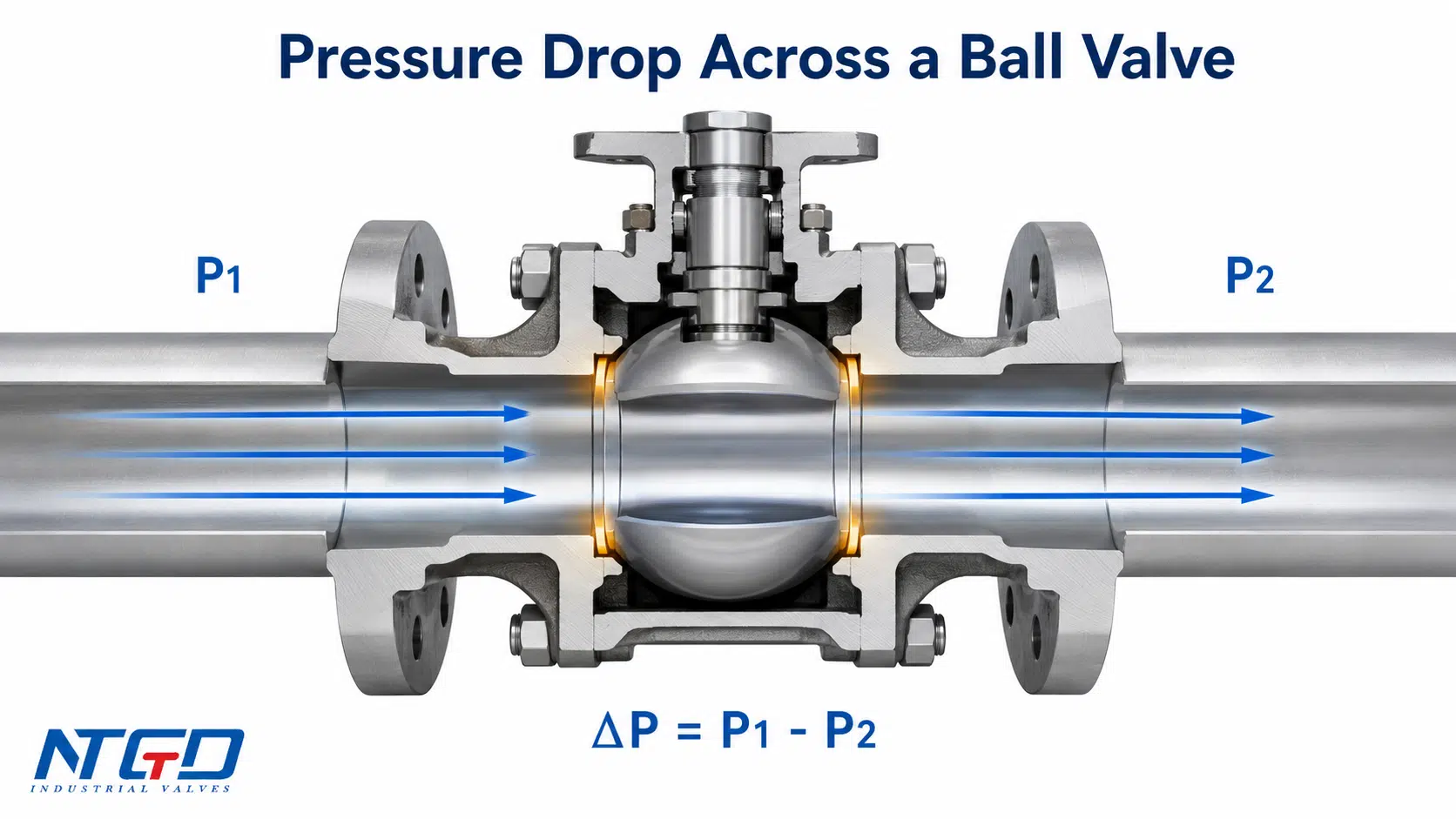
In many industrial discussions, pressure drop and pressure loss are used almost interchangeably. Pressure drop describes the measured pressure difference across the valve. Pressure loss describes the practical result: less available pressure remains downstream after the fluid passes through the restriction.
For a ball valve, this pressure drop is usually created by changes in flow area, internal geometry, velocity, turbulence, and friction. Even when the ball is fully open, the fluid still passes through a real valve body, seats, bore, end connections, and downstream expansion area.
A ball valve should not be evaluated as an isolated pipe opening. The flow path is usually short and efficient, but the actual resistance depends on how closely the valve bore matches the pipe bore and how the selected valve is designed.
Pressure Drop vs Total System Pressure Loss
A valve pressure drop is only one part of total pipeline pressure loss.
Total system pressure loss may include:
- pipe friction;
- elbows and reducers;
- strainers and filters;
- fittings;
- elevation changes;
- pumps or compressors;
- other valves in the line.
This article focuses on pressure drop across a ball valve, not the full pressure loss calculation for the entire piping system. A ball valve is only one component in the pressure path; isolating its contribution helps buyers compare port design and Cv without confusing valve selection with full piping-system engineering.
What Is Ball Valve Cv or Flow Coefficient?
Ball valve Cv is a flow coefficient used to describe the flow capacity of a valve. In common valve sizing practice, Cv expresses how much water flow a valve can pass under a defined pressure drop condition.
For buyers, the practical meaning is more important than the formula definition:
Cv helps compare how restrictive one valve is compared with another valve under similar conditions.
A higher Cv generally means the valve can pass more flow at the same pressure drop. A lower Cv usually means the valve creates more resistance at the same flow rate.
The term ball valve flow coefficient is another way to describe this flow capacity. In many technical documents, Cv and flow coefficient are closely related terms. Cv is commonly used in inch-pound units, while Kv is often used in metric contexts.
For a neutral engineering definition of Cv as a liquid flow coefficient, the EngineeringToolBox flow coefficient reference explains the relationship between water flow capacity and pressure drop.
Cv Is Not the Same as Nominal Size
A 4-inch ball valve does not automatically have the same Cv as every other 4-inch ball valve.
Cv can change with:
- full-port or reduced-port design;
- ball bore diameter;
- body pattern;
- seat design;
- end connection;
- pressure class;
- manufacturer design;
- fully open or partially open position.
This is why a ball valve Cv chart can be useful as a reference, but it should not replace actual manufacturer data for the selected valve.
Fully Open Cv for Ordinary On/Off Ball Valves
For ordinary on/off isolation ball valves, Cv is usually discussed in the fully open position. This is important because a standard ball valve is mainly designed for shutoff and isolation, not accurate flow control.
If the buyer needs modulating control, repeatable flow adjustment, or Cv behavior at different opening angles, the application should be reviewed separately. A V-port ball valve or another control-oriented valve design may be more suitable. Using a standard on/off ball valve as a throttling valve can increase pressure loss, seat wear, vibration, and control instability.
How Cv Relates to Ball Valve Pressure Drop
Cv and pressure drop are directly related in valve sizing logic.
For the same fluid and flow rate, a valve with a higher Cv usually creates a lower pressure drop. A valve with a lower Cv usually creates a higher pressure drop. This is why full-port and reduced-port ball valves can behave differently even if their nominal pipe size is the same.
| Condition | General Effect on Cv | General Effect on Pressure Drop |
|---|---|---|
| Larger internal flow area | Higher Cv | Lower pressure drop |
| Smaller internal flow area | Lower Cv | Higher pressure drop |
| Full-port bore close to pipe ID | Higher flow capacity | Lower flow resistance |
| Reduced-port bore | Lower flow capacity | Higher flow resistance |
| Higher flow rate through same valve | Same valve Cv | Higher pressure drop |
| More viscous or difficult fluid | Cv may need correction or review | Higher practical pressure loss risk |
For viscous or difficult fluids, a clean-water Cv value alone can be misleading because viscosity can change the flow regime and increase actual pressure loss.
Cv does not replace application review. It is a useful engineering parameter, but the pressure drop result still depends on the real operating conditions.
A valve may have an acceptable Cv for clean water service but need additional review for viscous liquids, slurry, gas, steam, flashing, cavitation risk, high velocity, or other special conditions.
Ball Valve Pressure Drop Formula and Required Inputs
For basic liquid service, pressure drop through a valve is commonly estimated using a relationship between flow rate, Cv, specific gravity, and pressure drop.
One common liquid relationship is:
Cv = Q × √(SG / ΔP)
This can also be rearranged as:
ΔP = SG × (Q / Cv)²
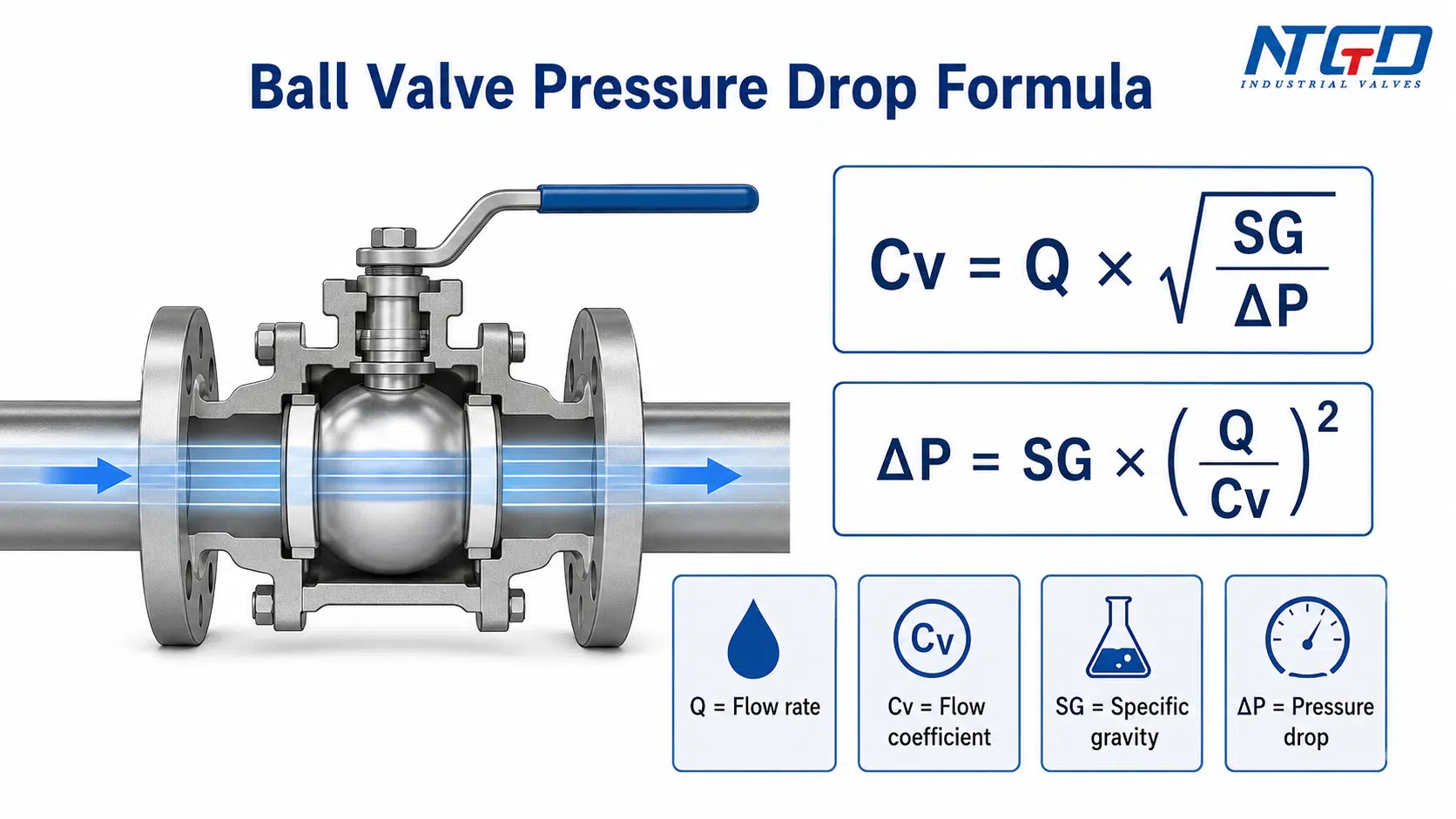
Where:
| Symbol | Meaning | Typical Use |
|---|---|---|
| Q | Flow rate | The required flow through the ball valve |
| Cv | Valve Cv, or flow coefficient | The flow capacity of the selected valve |
| SG | Specific gravity | Fluid density compared with water |
| ΔP | Pressure drop | Pressure difference across the valve |
This formula is useful for understanding the relationship between flow capacity and pressure drop. It is not a complete online calculator for every service condition.
For a broader sizing workflow that includes Cv/Kv, port design, pressure drop, material rating, connection type, and installation checks, see NTGD’s ball valve sizing and installation guide.
Required Inputs for a Pressure Drop Estimate
A pressure drop estimate normally needs:
| Required Input | Why It Matters |
|---|---|
| Flow rate | Pressure drop rises as flow rate increases through the same valve |
| Fluid type | Water, oil, chemical, gas, steam, slurry, or other media behave differently |
| Specific gravity | Heavier fluids affect the pressure drop relationship |
| Viscosity | Viscous fluids may create more resistance than clean water |
| Valve Cv | Must match the selected valve size, port design, and model |
| Allowable ΔP | Determines whether the valve pressure loss is acceptable |
| Operating pressure and temperature | Affect material, seat, service condition, and data verification |
| Valve position | Fully open and partially open conditions are not the same |
| Port type | Full port and reduced port can have different Cv and resistance |
When the Formula Is Only an Estimate
The basic liquid formula is most useful for simple estimation. It becomes less reliable when the service involves gas, steam, two-phase flow, high viscosity, slurry, flashing, cavitation, severe turbulence, or non-standard operating conditions.
For those services, the pressure drop and Cv should be reviewed with manufacturer data and the project specification.
If the service involves any of these conditions, the formula should be used only for preliminary scoping; final selection should rely on manufacturer Cv or pressure drop data and application review.
A ball valve pressure drop calculator can help organize the inputs, but it cannot give an exact result if the Cv value, fluid properties, and real operating conditions are incomplete or incorrect.
Full-Port vs Reduced-Port Ball Valve Pressure Drop
Port design is one of the most important reasons two ball valves of the same nominal size may have different pressure drop.
A full-port ball valve has a bore closer to the pipe inside diameter. A reduced-port ball valve has a smaller bore through the ball. This smaller flow area increases velocity through the valve and can increase pressure loss.
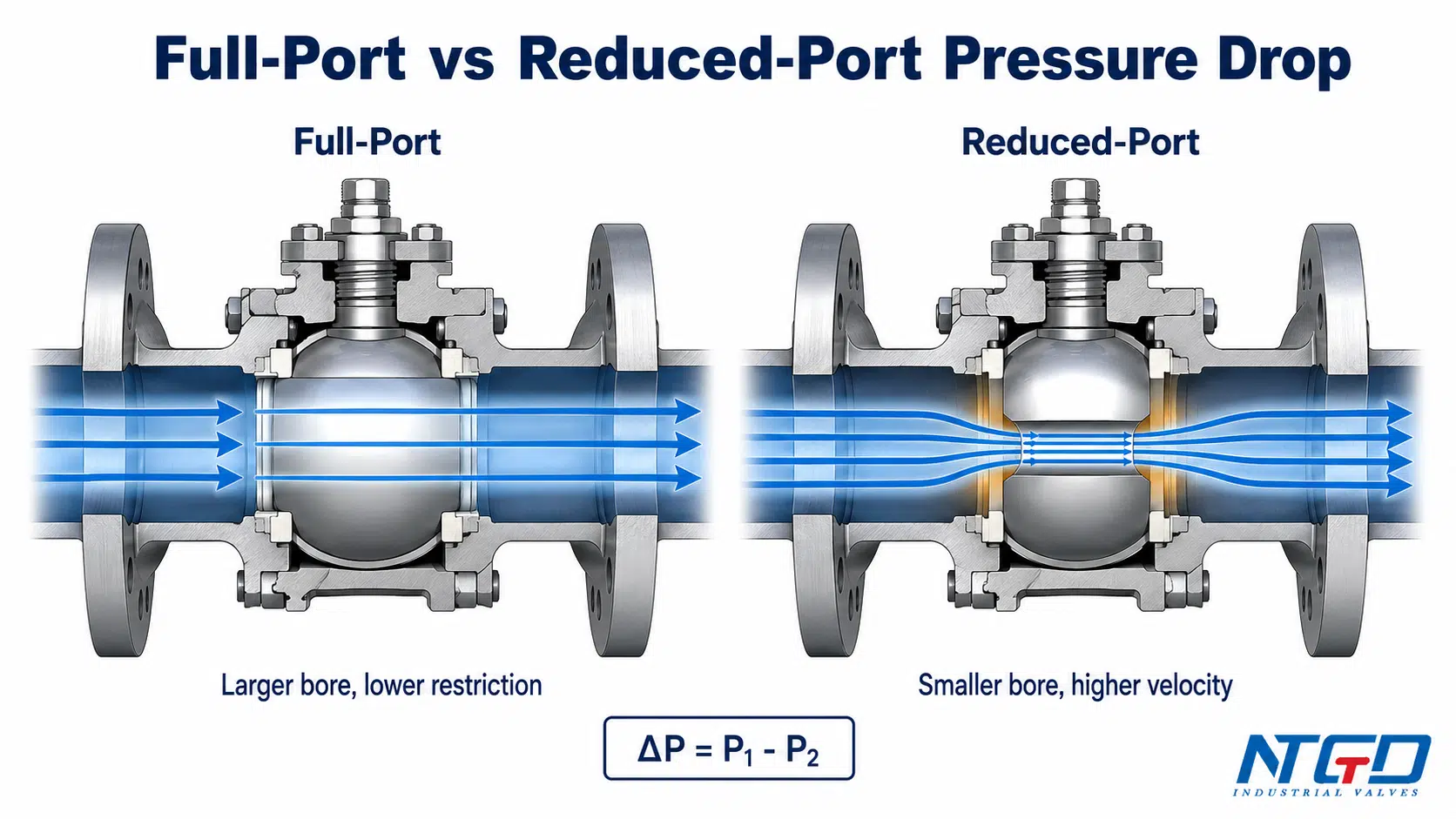
The following comparison shows how bore design affects the flow path, velocity, Cv tendency, and pressure drop tendency.
| Item | Full-Port / Full-Bore Ball Valve | Reduced-Port / Reduced-Bore Ball Valve |
|---|---|---|
| Bore size | Closer to pipe bore | Smaller than pipe bore |
| Flow path | More open and less restrictive | More contracted through the ball |
| Typical Cv tendency | Higher, depending on design | Lower, depending on design |
| Pressure drop tendency | Lower at the same flow condition | Higher at the same flow condition |
| Velocity through port | Lower | Higher |
| Common selection reason | High flow, low pressure drop, pigging or process continuity needs | Compact design, cost-space tradeoff, acceptable ΔP |
| Main selection caution | Still verify actual Cv and pressure class | Do not assume it can handle the same flow with the same pressure loss |
For a broader comparison focused on port design and selection tradeoffs, see NTGD’s guide to full-port and standard-port ball valves.
If low pressure drop is a project requirement, the selected full-port valve should still be checked against its actual Cv, pressure class, end connection, and service condition before final selection.
Full-Port / Full-Bore Ball Valves
A full-port or full-bore ball valve is often selected when the system needs lower pressure drop, higher flow capacity, or a bore closer to the pipe ID.
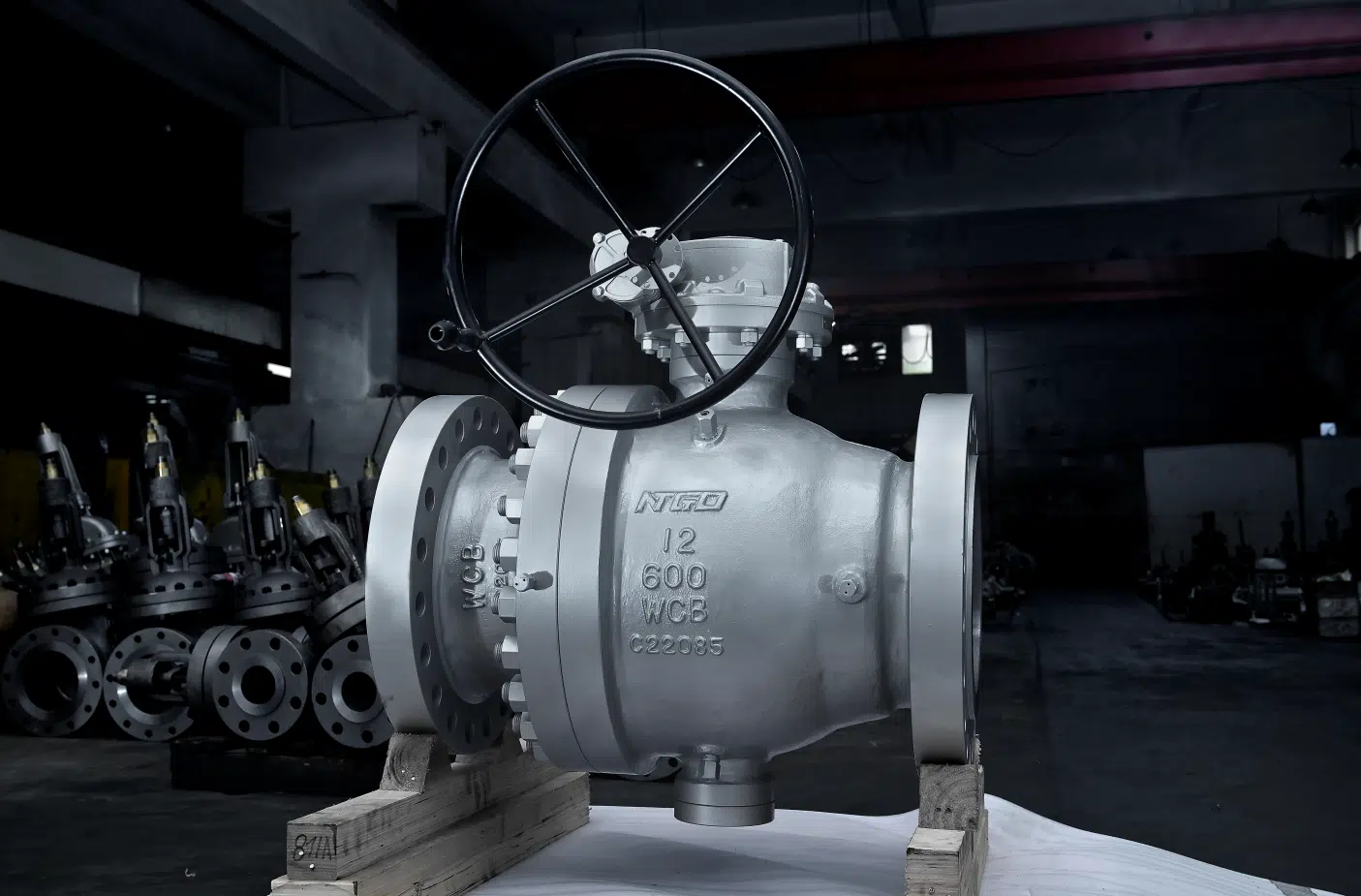
For product-level specifications and configuration review, NTGD’s full port ball valve page can be used as the next reference after the pressure drop and Cv requirements are defined.
This does not mean every full-port valve has zero pressure drop. The valve body, seats, bore surface, end connection, and downstream expansion still influence the flow path. However, compared with a reduced-port valve, a full-port design usually reduces the contraction effect through the ball.
Full-port ball valves are commonly considered when pressure loss is important, when the pipeline has a limited pressure budget, or when the process requires more open flow.
Reduced-Port / Reduced-Bore Ball Valves
A reduced-port ball valve can still be a correct choice when the process does not require the full pipe bore flow capacity.
Reduced-port designs may be used where compact size, weight, cost, or space matters and where the additional pressure loss is acceptable. The key is not to assume that a reduced-port valve has the same Cv as a full-port valve.
For the same flow rate, a smaller bore usually increases velocity through the port. Higher velocity can increase turbulence and pressure drop, especially when the flow rate is high or the fluid is viscous.
Selection Tradeoff: Low Pressure Drop vs Compact Design
The choice between full port and reduced port should be made from the system requirement, not from nominal size alone.
A good selection review should ask:
- Is low pressure drop a project requirement?
- What is the allowable ΔP across the valve?
- Is the line high-flow or pump-head sensitive?
- Is the fluid clean water, oil, chemical, slurry, gas, or steam?
- Is full bore required for process, cleaning, pigging, or maintenance reasons?
- Does the selected manufacturer provide Cv data for both port options?
If the answer shows that pressure loss is critical, full port should be reviewed first. If the system can tolerate additional pressure drop, reduced port may still be suitable.
Full port should usually be reviewed first when the line has high flow demand, limited allowable ΔP, pigging or cleaning needs, or pump-head sensitivity. Reduced port can be considered when the required flow is moderate and manufacturer Cv data confirms that the added pressure loss stays within the system budget.
What Causes Pressure Drop in a Ball Valve?
Ball valve pressure drop is not caused by one factor only. It is the combined result of flow area, velocity, fluid behavior, internal geometry, and valve condition.
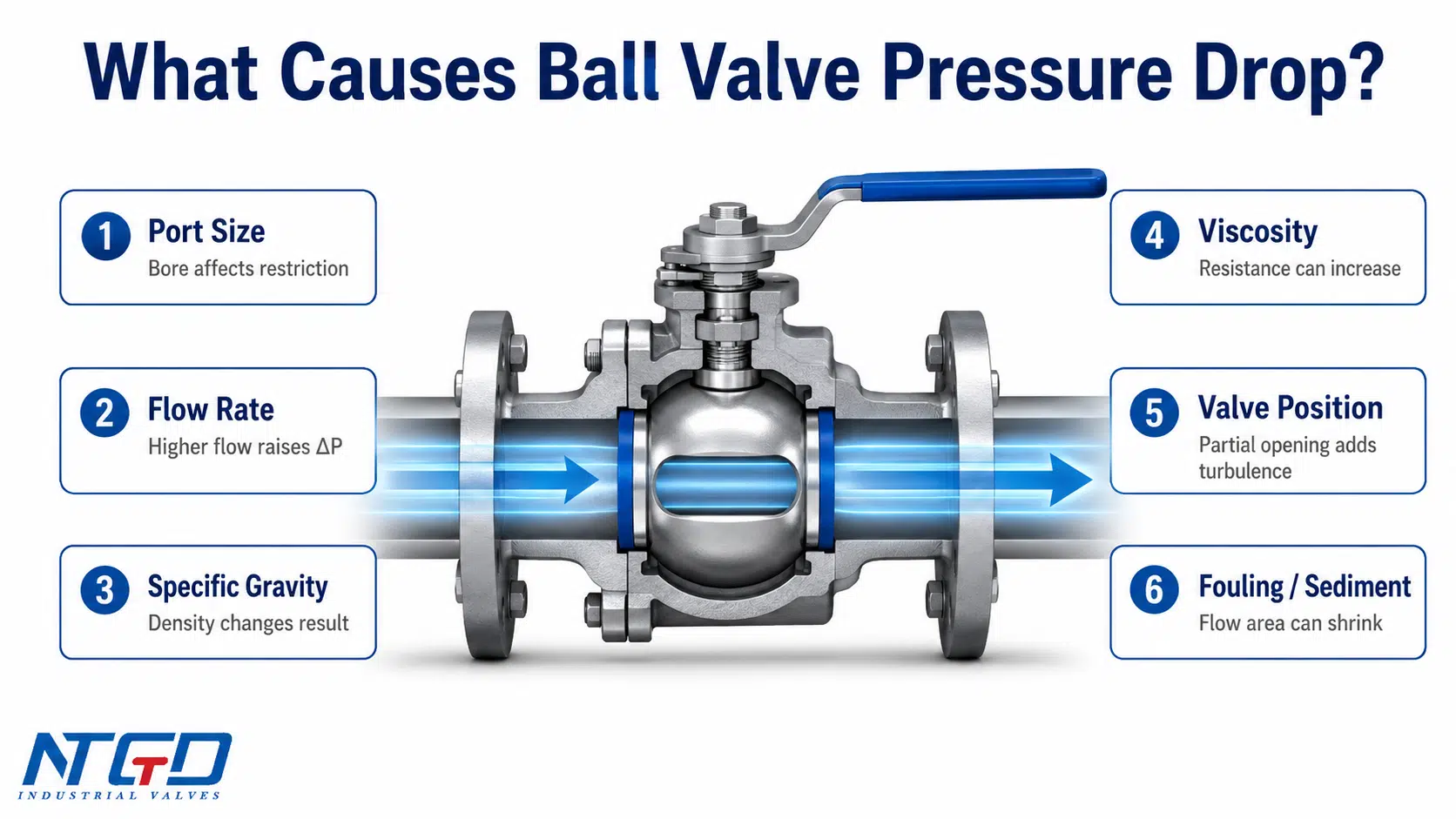
| Factor | How It Affects Pressure Drop | Selection Note |
|---|---|---|
| Port size | Smaller bore increases restriction | Compare full-port and reduced-port options |
| Flow rate | Higher flow through the same valve increases ΔP | Confirm required operating flow, not only pipe size |
| Specific gravity | Heavier fluids affect pressure drop calculation | Provide SG for calculation or RFQ review |
| Viscosity | Viscous fluids create more practical resistance | Do not rely only on clean-water Cv |
| Valve position | Partially open ball valves can create turbulence | Avoid using ordinary ball valves for precise throttling |
| Internal geometry | Contraction, expansion, seats, and body pattern affect flow | Use manufacturer Cv data for selected model |
| Fouling or sediment | Deposits reduce effective flow area | Consider media cleanliness and service condition |
| Adjacent fittings | Reducers, elbows, and short pipe runs may affect local flow | Review piping layout separately if pressure loss is critical |
| Wear or internal damage | Roughness or damaged surfaces can increase resistance | Maintenance condition matters in operating systems |
Port Size and Bore Design
The port is the opening through the ball. If the port is close to the pipe bore, flow contraction is reduced. If the port is smaller, the fluid accelerates through a restricted area and then expands downstream.
This contraction and expansion can increase pressure loss.
Flow Rate, SG and Viscosity
Flow rate has a strong effect on pressure drop. If the same valve must pass more flow, pressure drop usually rises.
Specific gravity affects the liquid pressure drop relationship. Viscosity can make the real pressure loss higher than a simple clean-water estimate. For oils, polymers, slurries, or other difficult fluids, the project should not rely only on a standard Cv table.
If a high-viscosity fluid is calculated using only clean-water Cv data, the estimated pressure drop may be lower than the actual operating pressure loss. This can affect downstream flow, pump head, and the final choice between full-port and reduced-port designs.
Turbulence, Contraction and Partial Opening
When a standard ball valve is fully open, the flow path is relatively clear. When it is partially open, the ball opening creates a more restricted and uneven flow passage. This can create turbulence, noise, vibration, erosion risk, and unstable control.
For precise throttling or repeatable flow control, an ordinary on/off ball valve is usually not the preferred choice. A V-port ball valve or control-oriented valve design should be reviewed separately.
When partial opening is part of the normal operating requirement, a V-port ball valve should be reviewed separately because its characterized opening is designed for more predictable flow control than a standard round-port ball valve.
Fouling, Sediment and Internal Surface Condition
A valve may have acceptable pressure drop when new, but deposits, solids, sediment, scale, or corrosion can reduce the effective flow area over time.
This does not turn the article into a maintenance guide, but it matters for services where the media is not clean. If the fluid contains solids or deposits, the pressure drop review should include media behavior and cleaning expectations.
For fluids containing solids, scale, or residue, the RFQ should state media cleanliness, solids content, and whether pressure drop may change during operation.
When Pressure Drop Matters in Ball Valve Selection
Ball valve pressure drop matters most when the system has limited pressure margin, high flow demand, energy sensitivity, or strict process flow requirements.
| Service Condition | Pressure Drop Importance | Selection Implication |
|---|---|---|
| High-flow liquid line | High | Review full-port design and manufacturer Cv |
| Pump head-sensitive system | High | Added pressure loss may affect downstream flow |
| Long pipeline with many valves | Medium to High | Small losses can accumulate across the system |
| Viscous liquid service | High | Clean-water Cv may not be enough |
| Low-pressure system | High | Even moderate ΔP may be unacceptable |
| Utility water line with generous pressure margin | Medium | Reduced port may be acceptable if flow requirement is met |
| On/off isolation service with low flow demand | Lower | Pressure drop may not drive selection |
| Flow control or throttling service | High but different review | Consider V-port or control-oriented valve design |
| Slurry or dirty service | High | Pressure drop may increase over time as solids accumulate; initial clean-service Cv data may not reflect long-term operation |
| Energy-sensitive operation | Medium to High | Reduced pressure loss may reduce pumping energy over time |
High-Flow or Low Pressure-Drop Systems
In high-flow services, a small restriction can create a large pressure drop. This is where full-port design and accurate Cv data become more important.
A valve selected only by nominal pipe size may still be restrictive if the bore is reduced or the internal geometry is not suitable for the required flow.
These systems usually justify a full-port review and manufacturer Cv verification before the valve size and port design are finalized.
Pump Head and Energy Impact
Pressure drop across a valve consumes part of the available system pressure. In pump systems, this may increase energy demand or reduce available downstream pressure.
If the process depends on maintaining flow rate, pressure drop should be reviewed before finalizing valve size and port design. This is especially important when the line has a limited pump head margin, multiple valves, or a strict downstream pressure requirement.
When Reduced Port May Still Be Acceptable
A reduced-port ball valve is not automatically wrong.
It may be acceptable when:
- the required flow is moderate;
- the pressure drop allowance is sufficient;
- space or weight matters;
- the service is simple on/off isolation;
- manufacturer Cv data confirms the selected valve meets the requirement.
The selection risk appears when a reduced-port valve is used as if it had the same flow capacity as a full-port valve.
If several of these conditions apply and manufacturer Cv data confirms the required flow capacity, reduced port can be a cost-effective choice without compromising system performance.
Why Manufacturer Cv Data Is Needed
A ball valve Cv chart or ball valve Cv table can help buyers understand general flow capacity, but it should not be treated as final selection data for every manufacturer, pressure class, bore design, and service condition.
Manufacturer Cv data is more useful than a generic table because it is tied to the selected valve design, bore, pressure class, opening condition, and test context.
The ISA article on full-bore ball valve capacity also notes that published rated flow capacity can vary depending on how manufacturers determine the value, which is why project selection should use data for the selected valve configuration.
Actual Cv depends on the selected valve design.
| Data Source | How to Use It | Main Limitation |
|---|---|---|
| General online Cv chart | Early reference only | May not match the selected manufacturer or valve design |
| Generic ball valve Cv table | Rough comparison | May ignore pressure class, bore design, seat design, and test condition |
| Manufacturer catalogue data | Better project reference | Must match the exact valve series, size, port type, and configuration |
| Project datasheet | Final specification basis | Must be checked against operating conditions |
| Engineering review | Required for difficult service | Needed for gas, steam, high-viscosity, slurry, severe duty, or tight ΔP limits |
Why Cv Tables Are Only References
A Cv table may list a value for a nominal valve size, but that value may not apply to a different body pattern, ball bore, end connection, pressure class, or manufacturer design.
A full-port ball valve and reduced-port ball valve of the same nominal size may have different Cv values. Two full-port valves from different manufacturers can also differ.
What Changes the Actual Cv Value
Actual Cv can be influenced by:
- valve size;
- full-port or reduced-port design;
- ball bore geometry;
- seat design;
- body pattern;
- end connection;
- pressure class;
- opening condition;
- manufacturer test method;
- fluid type and service condition.
This is why final pressure drop review should use manufacturer Cv or pressure drop data for the selected valve configuration.
What to Request from the Manufacturer
Manufacturer confirmation is especially important for high-flow lines, low-pressure systems, high-viscosity media, pump-head-sensitive systems, tight allowable ΔP, and critical process lines.
For a project RFQ, it is reasonable to ask for:
- Cv or Kv value for the selected valve size and port design;
- pressure drop estimate under the provided flow condition;
- confirmation whether the valve is full port or reduced port;
- any service limitations for fluid type, viscosity, solids, gas, steam, or special media;
- confirmation that the valve configuration matches the project pressure, temperature, and connection requirements.
RFQ Checklist for Ball Valve Pressure Drop Review
A useful RFQ should give enough information for the manufacturer or supplier to review pressure drop, Cv, port type, and application fit.
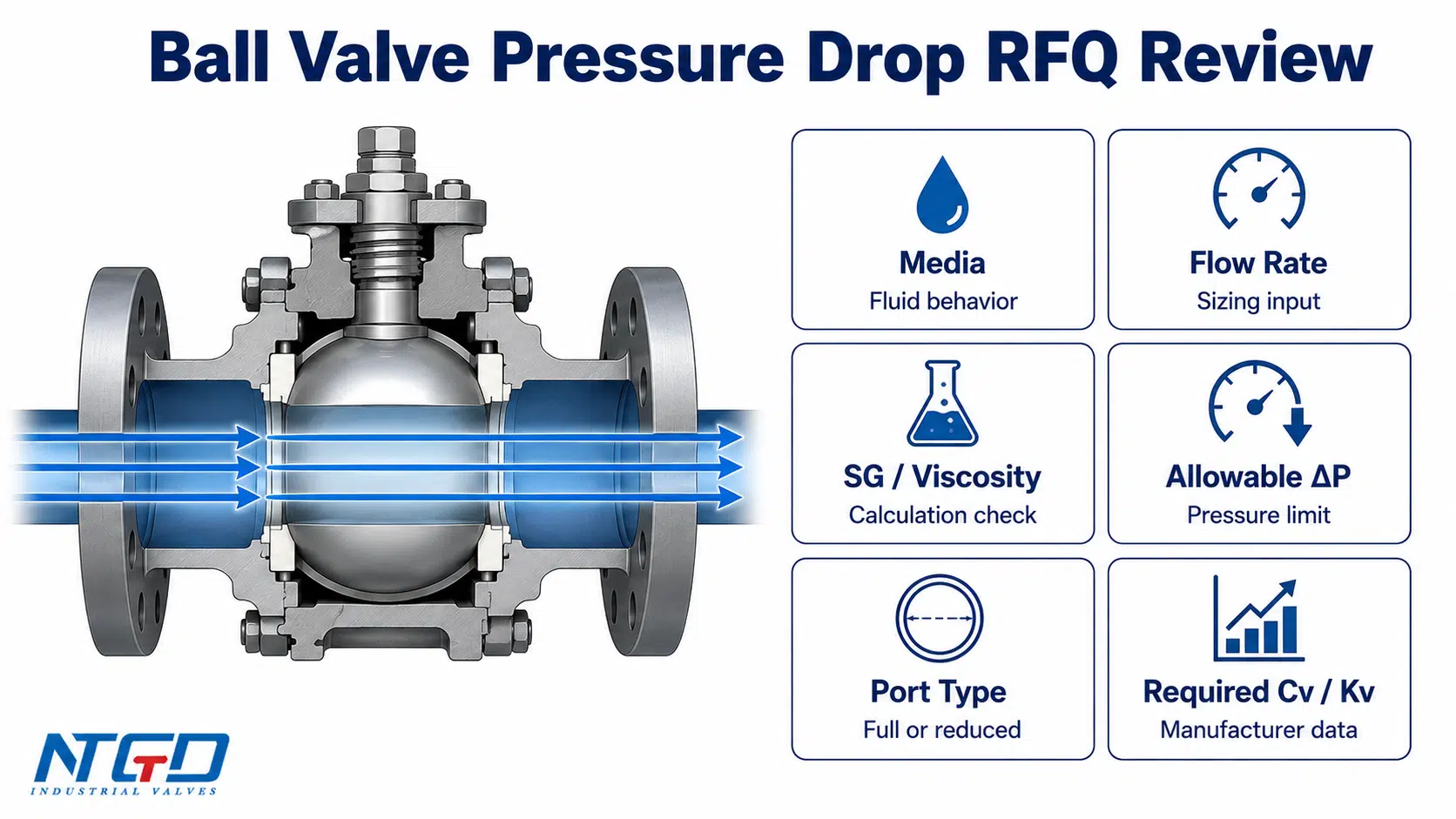
| RFQ Item | Why It Is Needed |
|---|---|
| Media / fluid | Pressure loss depends on fluid behavior |
| Flow rate | Required for Cv and ΔP review |
| Specific gravity | Used in liquid pressure drop relationship |
| Viscosity | Needed for oils, polymers, slurry, or difficult fluids |
| Operating pressure | Confirms pressure class and service condition |
| Inlet / outlet pressure or allowable ΔP | Defines the pressure drop limit |
| Operating temperature | Affects materials, seats, and service suitability |
| Pipe size | Helps compare valve size and bore design |
| Required valve size | Needed for preliminary selection |
| Full port or reduced port preference | Directly affects flow capacity |
| End connection | Flanged, threaded, welded, or other connection may affect configuration |
| Pressure class / rating | Must match project specification |
| On/off or throttling service | Ordinary ball valves and flow control valves are not the same selection |
| Required Cv / Kv data | Allows technical comparison |
| Special media conditions | These conditions can change the effective Cv, increase actual pressure loss, or require special valve configuration; standard clean-liquid assumptions may not apply |
After the pressure drop limit, flow rate, media data, and port preference are defined, buyers can compare suitable ball valve product options without relying only on nominal pipe size.
The purpose of this checklist is not to replace engineering sizing. It helps prevent incomplete RFQs, especially when the buyer asks for a ball valve pressure drop review but does not provide flow rate, fluid data, or allowable ΔP.
With complete operating data, the supplier can review the expected pressure drop, confirm the required Cv or flow coefficient, and recommend whether full-port, reduced-port, or another configuration is more suitable.
FAQ About Ball Valve Pressure Drop and Cv
Is ball valve pressure loss the same as pressure drop?
In many practical valve discussions, pressure loss and pressure drop are used to describe the same decrease in available pressure across the valve. Pressure drop is the measured pressure difference between upstream and downstream pressure. Pressure loss describes the practical effect of that pressure difference.
Does a ball valve cause pressure drop?
Yes. A ball valve causes pressure drop because fluid passes through a real valve body, bore, seat area, and end connection. A fully open full-port ball valve usually has low pressure drop, but the pressure drop is not zero.
How do you calculate pressure drop through a ball valve?
For basic liquid service, pressure drop can be estimated from flow rate, Cv, and specific gravity. A common relationship is ΔP = SG × (Q / Cv)². This estimate requires accurate Cv data for the selected valve. For special media or non-clean-liquid service, the formula should be treated as a preliminary estimate and checked against manufacturer data.
What is Cv in a ball valve?
Cv is the valve flow coefficient. It indicates the flow capacity of the ball valve under defined conditions. A higher Cv generally means the valve creates less restriction for the same flow rate and fluid. The Cv value used for selection should match the actual valve model, size, port type, and opening condition, not only the nominal pipe size.
Does a full port ball valve have less pressure drop?
Usually yes, compared with a reduced-port ball valve of the same nominal size and similar design. A full-port ball valve has a larger bore and a more open flow path. However, the exact pressure drop still depends on manufacturer design, flow rate, fluid properties, and valve configuration.
Does a reduced port ball valve reduce flow?
A reduced-port ball valve has a smaller bore through the ball, so it can reduce flow capacity and increase pressure drop compared with a full-port design. It may still be suitable when the system can tolerate the pressure loss.
Can I use a ball valve Cv chart for final sizing?
A ball valve Cv chart can be used as an early reference, but final sizing should use manufacturer Cv data for the selected valve model, size, port type, pressure class, and configuration. A generic chart may not match the valve being purchased.
Can a ball valve pressure drop calculator give exact results?
A calculator can only be as accurate as the input data. If the Cv value, fluid properties, flow condition, valve position, or service condition is incomplete, the result should be treated as an estimate. Manufacturer review is still needed for final selection.
Why is pressure loss higher when a ball valve is partially open?
Pressure loss increases because the partially open ball creates a narrow, uneven flow path. This can increase turbulence, velocity, noise, vibration, and pressure loss. Ordinary on/off ball valves are not normally selected for precise throttling.
Can a standard ball valve be used for throttling?
A standard ball valve can physically be left partially open, but it is usually not the best choice for precise flow control. Prolonged throttling with a standard ball valve can cause seat erosion, vibration, unstable flow, and poor control accuracy. If throttling, modulating control, or Cv vs opening behavior is important, a V-port ball valve or another control-oriented valve design should be reviewed.
Conclusion
Ball valve pressure drop is not determined by valve size alone. It depends on Cv, flow coefficient, port design, flow rate, fluid properties, valve position, and actual manufacturer data.
A fully open full-port ball valve usually provides lower pressure drop than a reduced-port design, but it still has real flow resistance. A reduced-port ball valve may be acceptable when the system has enough pressure margin, but it should not be assumed to have the same Cv or flow capacity as a full-port valve.
For reliable selection, buyers should avoid relying only on a generic ball valve Cv chart or calculator. The final review should use the required flow rate, fluid data, allowable pressure drop, selected port design, and manufacturer Cv data.
If the required flow rate, fluid data, allowable pressure drop, and port type are prepared, the valve supplier can assist with Cv verification and configuration review.
Application / Specification Support
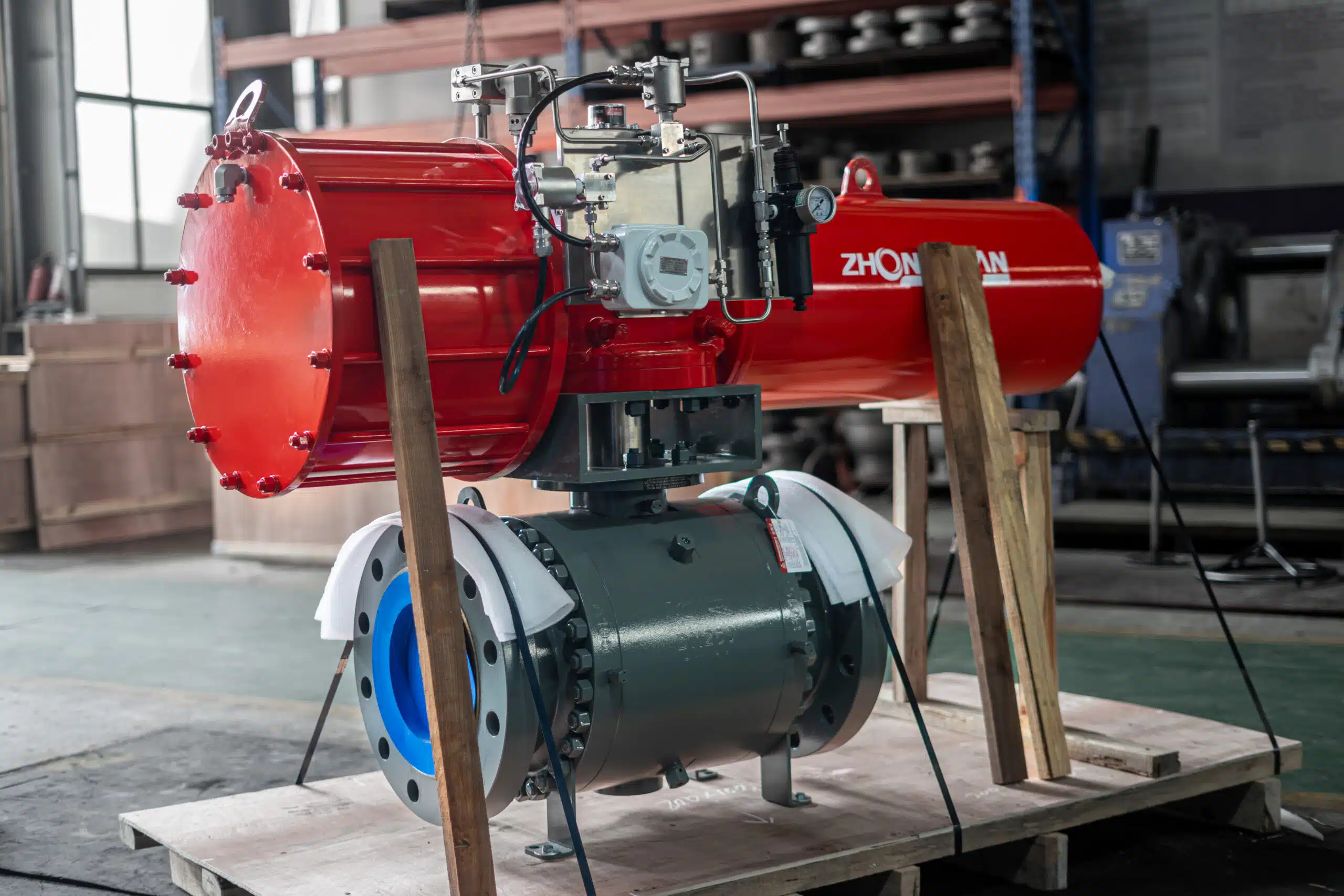
For project review, provide the operating media, flow rate, pressure condition, allowable ΔP, temperature, pipe size, valve size, port type, pressure class, and service purpose. These details allow a more accurate review of pressure drop, Cv, and whether a full-port or reduced-port design is suitable.
To request a pressure drop, Cv, or port-design review for a project RFQ, contact NTGD Valve with the operating media, flow rate, pressure condition, allowable ΔP, temperature, valve size, and required connection type.
