
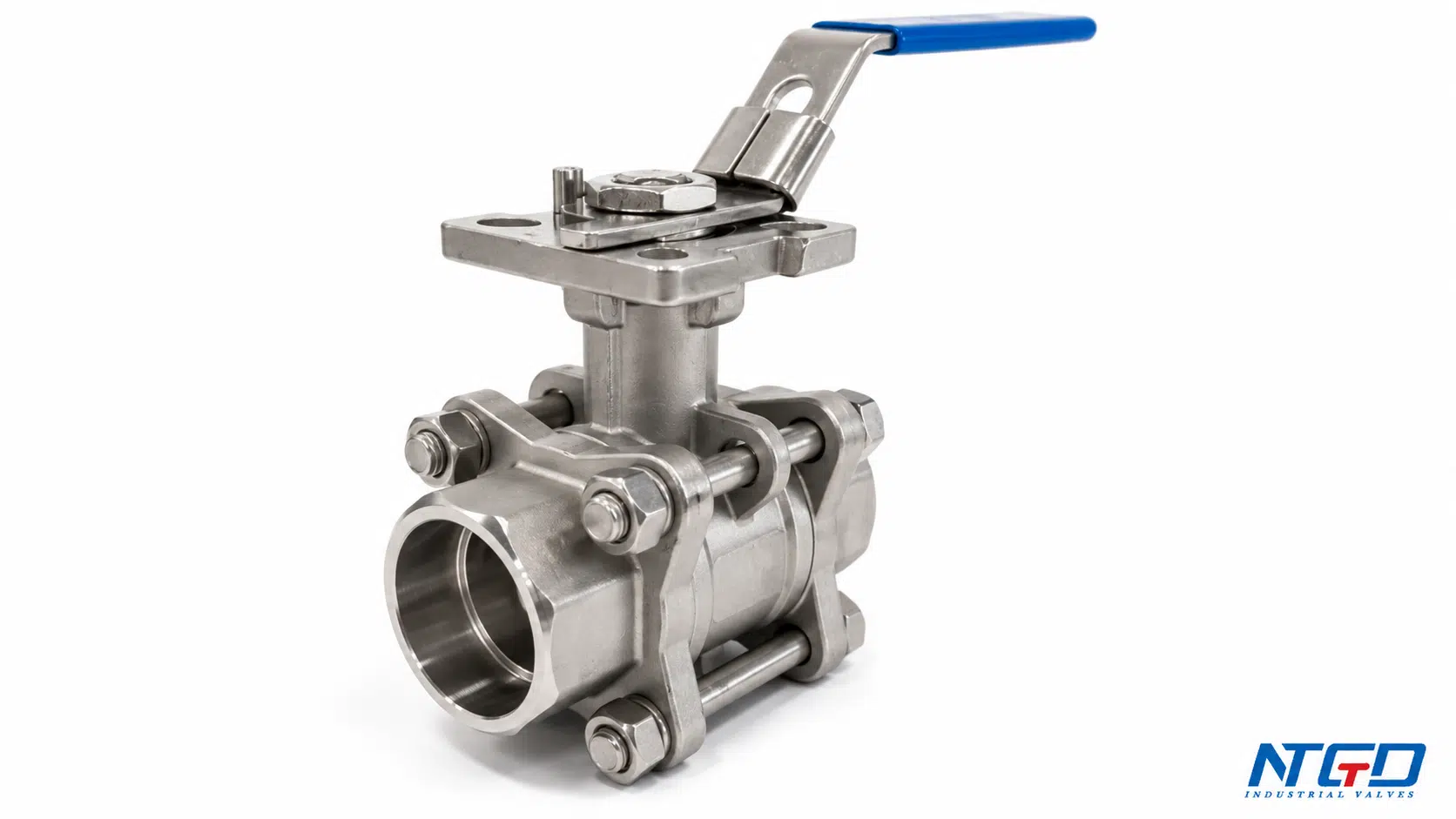
Una válvula de bola con soldadura de encaje es una válvula de bola con extremos para soldadura por encaje. La tubería se inserta en un encaje empotrado en cada extremo de la válvula y luego se suelda alrededor del exterior de la unión. Esto crea una conexión soldada compacta y permanente, mientras que la bola interna sigue funcionando como un elemento de cierre de un cuarto de vuelta.
Las válvulas de bola con conexión por soldadura de manguito suelen considerarse para tuberías industriales de diámetro pequeño, en las que la estanqueidad, la instalación compacta, la presión nominal y la confiabilidad de la conexión soldada son más importantes que la necesidad de desmontar la válvula con frecuencia. Se utilizan con frecuencia en los sectores de petróleo y gas, procesamiento químico, energía, líneas auxiliares de vapor, sistemas hidráulicos y otros servicios industriales en los que las especificaciones de las tuberías requieren extremos con conexión por soldadura de manguito.
Lo importante es que el término “soldadura por encaje” se refiere a la conexión del extremo de la válvula, no al principio de funcionamiento interno. Una válvula de bola con conexión de soldadura de manguito se abre y se cierra girando una bola perforada 90 grados. Antes de especificar la válvula, confirme el tamaño de la tubería, la clase de presión, los requisitos de material y si será necesario realizar mantenimiento en línea después de soldar los extremos.
Si el servicio requiere desmontar la válvula con frecuencia, o si no se confirman las dimensiones de la pieza de repuesto antes de soldar, es posible que una válvula de bola con conexión por encaje no sea la mejor opción inicial, incluso cuando la presión nominal parezca adecuada.
¿Qué es una válvula de bola con conexión por soldadura?
Una válvula de bola con conexión de soldadura por encaje es una válvula de bola industrial diseñada con conexiones finales de soldadura por encaje, en lugar de conexiones roscadas, con bridas o de soldadura a tope. En una conexión de soldadura por encaje, la tubería se encaja en un encaje mecanizado en el cuerpo de la válvula o en el conector final. La unión se completa luego mediante una soldadura en filete alrededor del diámetro exterior de la tubería.
Este tipo de válvula combina dos conceptos diferentes:
| Artículo | Significado | Por qué es importante |
|---|---|---|
| Válvula de bola | Una válvula de cuarto de vuelta que utiliza una bola giratoria con un orificio que la atraviesa | Determina cómo se abre, se cierra y aísla el flujo la válvula |
| Extremo para soldadura por encaje | Una conexión de tubería soldada en la que la tubería se inserta en un manguito empotrado | Determina cómo se conecta la válvula al sistema de tuberías |
| Válvula de bola para soldadura por encastre | Una válvula de bola con extremos para soldadura por encaje | Se utiliza cuando el proyecto requiere tanto una válvula de cierre de cuarto de vuelta como una conexión compacta soldada a la tubería |
Una válvula de bola con conexiones de soldadura por encaje es un tipo de válvula con conexiones de soldadura por encaje, pero no todas las válvulas con conexiones de soldadura por encaje son válvulas de bola. Las conexiones de soldadura por encaje también se pueden utilizar en otros tipos de válvulas, pero este artículo se centra únicamente en las válvulas de bola con conexiones de soldadura por encaje.
Válvula de bola con conexión por soldadura de manguito frente a válvula general con conexión por soldadura de manguito
El término “válvula de soldadura por encaje” es más amplio que “válvula de bola de soldadura por encaje”. Una válvula de soldadura por encaje puede referirse a cualquier válvula con extremos de soldadura por encaje, incluyendo válvulas de compuerta, válvulas de globo, válvulas de retención, válvulas de tapón o válvulas de aguja. Una válvula de bola de soldadura por encaje tiene un significado más específico: se refiere específicamente a un cuerpo de válvula de bola y un mecanismo de cierre de bola combinados con extremos de tubería de soldadura por encaje.
Este criterio es importante para la selección. Si la aplicación requiere un cierre rápido con un cuarto de vuelta, baja resistencia al flujo y un aislamiento compacto, una válvula de bola con conexión por soldadura de manguito podría ser adecuada. Si la aplicación requiere control de estrangulamiento, protección contra reflujo o regulación lineal del flujo, se debe confirmar el tipo de válvula antes de seleccionar la conexión final.
¿Por qué se utilizan extremos de soldadura por encaje en las válvulas de bola?
Los extremos para soldadura por encaje se utilizan en las válvulas de bola cuando el sistema de tuberías requiere una conexión soldada permanente en un espacio reducido. En comparación con los extremos roscados, los extremos para soldadura por encaje reducen el riesgo de fugas y daños en la rosca. En comparación con los extremos con bridas, reducen el espacio y el peso de la conexión. En comparación con los extremos para soldadura a tope, suelen elegirse para tuberías de menor diámetro cuando el diseño de la tubería especifica una unión tipo encaje.
Entre las razones más comunes para elegir válvulas de bola con conexión por soldadura de manguito se incluyen:
| Motivo de la selección | Explicación |
|---|---|
| Instalación compacta | Los extremos para soldadura por encaje evitan el uso de bridas grandes y pernos |
| Servicio de soldadura permanente | La válvula pasa a formar parte del sistema de tuberías soldadas |
| Tuberías de pequeño diámetro | Las conexiones por soldadura de manguito suelen asociarse con tuberías de menor diámetro |
| Idoneidad para servicio a presión | Muchas válvulas de bola forjadas con conexión por soldadura de manguito se utilizan en aplicaciones en las que las especificaciones de las tuberías exigen extremos soldados con resistencia a la presión |
| Integridad frente a fugas | Una unión correctamente diseñada y soldada puede ofrecer una mayor integridad de conexión que muchas uniones roscadas |
La desventaja es la facilidad de desmontaje. Una vez que una válvula de bola con soldadura de encaje se suelda a la tubería, su desmontaje o reemplazo resulta más difícil que en el caso de las válvulas roscadas o con bridas.
¿Qué es una conexión con extremo de soldadura en manguito?
Una conexión de extremo por soldadura en manguito es una conexión de tubería soldada en la que la tubería se inserta en un manguito empotrado en el extremo de la válvula y luego se suelda alrededor del exterior. El manguito permite la alineación y el acoplamiento entre la válvula y la tubería. La soldadura en filete externa asegura la unión.
En el caso de una válvula de bola, la conexión de extremo para soldadura de manguito no modifica el mecanismo interno de la bola. Solo cambia la forma en que la válvula se conecta al sistema de tuberías.
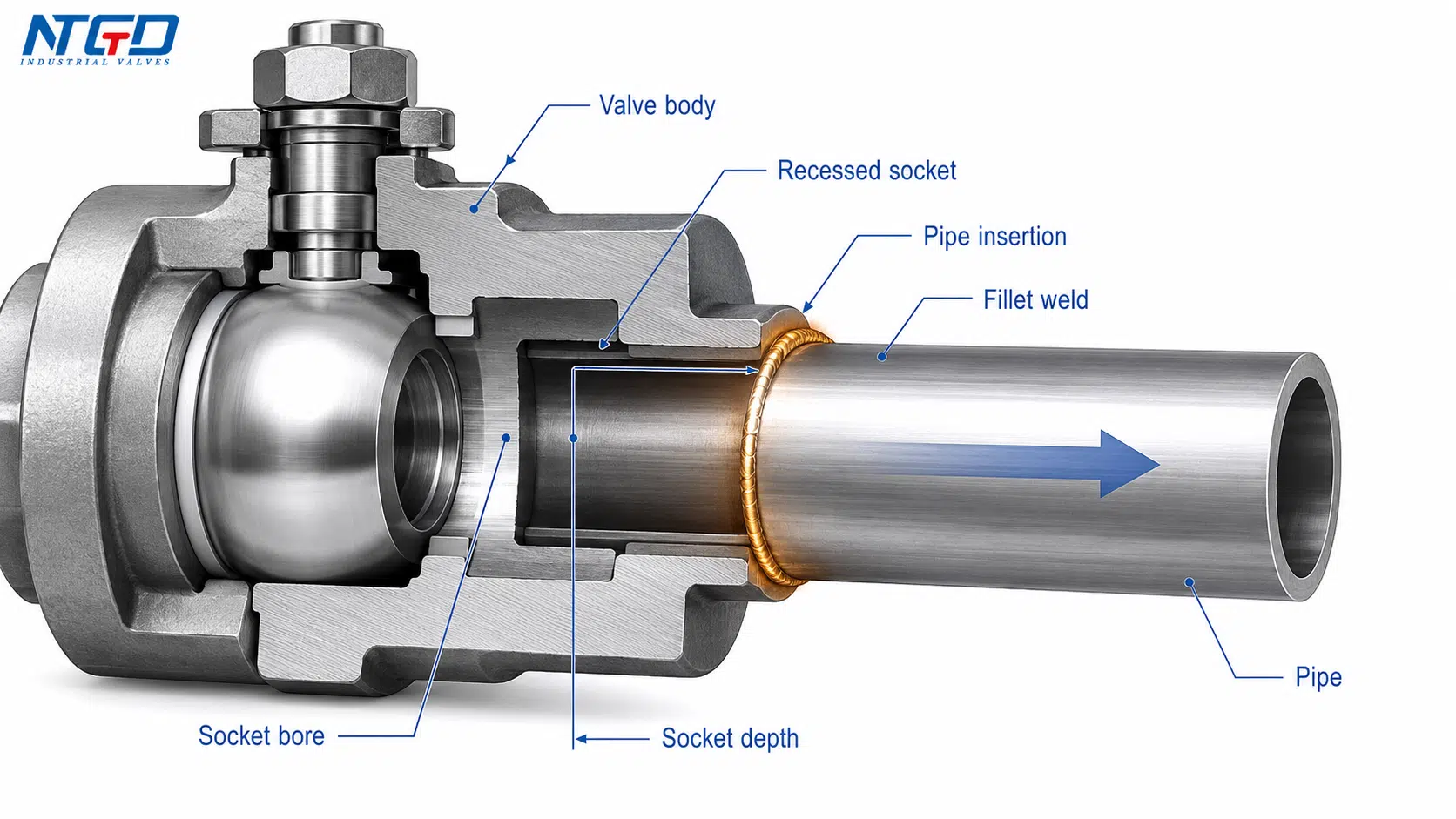
Encaje empotrado, inserción de tubería y soldadura en filete
Una conexión por soldadura de manguito suele incluir tres características clave:
| Característica | Función | Repercusiones de la selección |
|---|---|---|
| Toma empotrada | Se acopla al extremo del tubo | Debe coincidir con el tamaño de la tubería y con las especificaciones de tubería correspondientes |
| Área de inserción de tuberías | Coloca el tubo dentro del extremo de la válvula | Afecta el montaje, la alineación de las uniones, el espacio libre requerido y la verificación dimensional |
| Soldadura en ángulo externa | Fija el tubo al extremo de la válvula | Hace que la unión sea permanente y que se realice de acuerdo con las prácticas de soldadura aprobadas |
A la hora de elegir una válvula, el comprador no debe limitarse a verificar únicamente el tamaño de la misma. También es necesario confirmar el diámetro interior del manguito, la profundidad del manguito, el espesor de la tubería, el patrón del cuerpo de la válvula y el plano requerido. Una válvula descrita como “manguito de soldadura de 1/2 pulgada” o “manguito de soldadura NPS 1” debe confirmarse de todos modos con las especificaciones del proyecto y los datos del fabricante.
Conexión soldada permanente y límite de mantenimiento
Los extremos para soldadura por encaje crean una conexión permanente entre tuberías. Esto resulta útil cuando el sistema requiere una unión soldada compacta, pero también modifica la planificación del mantenimiento. Por lo general, una válvula roscada se puede desmontar con herramientas, y una válvula con bridas se puede desatornillar. Por lo general, una válvula de bola con conexión de soldadura por encaje no se puede desmontar sin realizar trabajos de corte o soldadura, a menos que el diseño de la válvula permita realizar algún tipo de mantenimiento interno mientras las conexiones finales permanecen en la línea.
Por eso, las válvulas de bola de tres piezas con conexión por soldadura de manguito suelen ser una opción a considerar cuando el acceso para el mantenimiento es importante. En algunos diseños de tres piezas, es posible realizar el mantenimiento de la sección central sin necesidad de retirar los conectores de los extremos soldados. Sin embargo, esto depende de la construcción de la válvula, el espacio disponible, el diseño de la junta, el acceso a los pernos y las instrucciones del fabricante.
Por eso es importante evaluar la facilidad de mantenimiento antes de elegir entre diseños de válvulas de bola con soldadura de encaje de una, dos o tres piezas. No se debe elegir una válvula de bola con soldadura de encaje únicamente porque la conexión sea compacta. Antes de la compra, también se deben evaluar el plan de mantenimiento, el plan de reemplazo y la exposición al calor de la soldadura.
¿Cómo funciona una válvula de bola con conexión por soldadura?
La función de cierre de una válvula de bola con conexión por soldadura de manguito proviene de la bola interna, no de los extremos soldados. La válvula contiene una bola con un orificio en el centro. Cuando el orificio está alineado con la tubería, el fluido puede pasar a través de la válvula. Cuando la bola gira 90 grados, la parte sólida de la bola bloquea la vía de flujo.
Los extremos para soldadura por encaje no realizan la acción de cierre. Solo conectan el cuerpo de la válvula a la tubería.
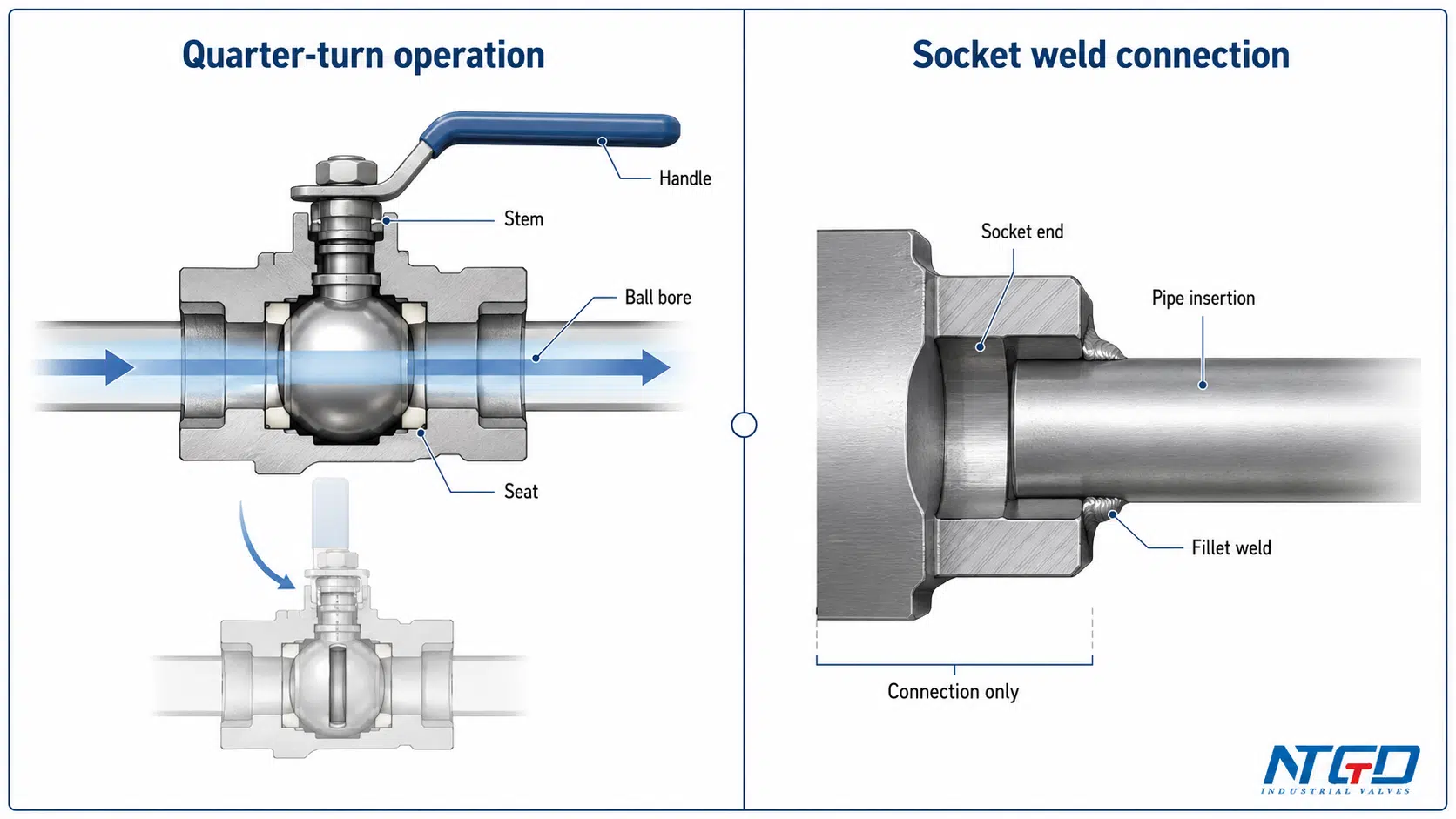
Operación de un cuarto de vuelta
La mayoría de las válvulas de bola con conexión por soldadura de manguito funcionan con un cuarto de vuelta. Una manija, una palanca, un operador de engranaje o un actuador hace girar el vástago. El vástago hace girar la bola dentro del cuerpo de la válvula. Cuando la válvula está completamente abierta, el orificio que atraviesa la bola se alinea con la trayectoria del flujo. Cuando la válvula está completamente cerrada, el orificio queda perpendicular a la trayectoria del flujo, y la bola presiona contra los asientos para aislar el flujo.
| Cargo | Dirección del orificio de la bola | Condiciones de flujo |
|---|---|---|
| Totalmente abierto | Alineado con la tubería | El flujo pasa a través de la válvula |
| Parcialmente abierto | Alineado parcialmente | El flujo está restringido, pero este no suele ser el modo de operación preferido para las válvulas de bola con asiento blando estándar |
| Totalmente cerrado | Perpendicular a la tubería | El flujo se interrumpe por la bola y los asientos |
Las válvulas de bola se eligen principalmente para el aislamiento de tipo “abierto-cerrado”. Las válvulas de bola estándar para soldadura por encaje no deben considerarse válvulas de control, a menos que su diseño esté específicamente pensado para la regulación del caudal, como es el caso de ciertas configuraciones de puerto en V.
El funcionamiento de la válvula es diferente al de la conexión final
El funcionamiento de la válvula y la conexión final deben evaluarse por separado.
La bola, el vástago, los asientos y la manija determinan cómo se abre y se cierra la válvula. Los extremos para soldadura por encaje determinan cómo se instala la válvula en el sistema de tuberías. Esta distinción evita un error común de selección: elegir una válvula basándose únicamente en el tipo de funcionamiento o únicamente en el tipo de conexión.
El comprador debe confirmar lo siguiente:
| Área de selección | Preguntas que hay que hacer |
|---|---|
| Funcionamiento de la válvula | ¿Es adecuada una válvula de cierre de un cuarto de vuelta para esta aplicación? |
| Conexión final | ¿La especificación de las tuberías exige extremos para soldadura por encaje? |
| Mantenimiento | ¿Se puede reparar o reemplazar la válvula después de soldarla? |
| Dimensiones | ¿La longitud total, el diámetro interior del casquillo y el espacio libre del mango se ajustan a la instalación? |
Componentes principales y su impacto en la selección
Los componentes principales de una válvula de bola con soldadura de manguito influyen directamente en el rendimiento y la facilidad de mantenimiento de los sistemas de tuberías con soldaduras permanentes. El cuerpo, los conectores de los extremos, la bola, el vástago, los asientos, los sellos y la empaquetadura deben revisarse en conjunto, en lugar de tratarlos como elementos independientes.
| Componente | Función | Repercusiones de la selección |
|---|---|---|
| Conectores de cuerpo y de extremo | Límite de presión y conexión de tuberías | Debe cumplir con los requisitos de material, clase de presión, soldadura de manguito y diseño del cuerpo |
| Bola | Abre o bloquea el paso del flujo | Influye en el tipo de puerto, la capacidad de flujo, el rendimiento de cierre y el contacto con el medio |
| Vástago | Transfiere el par desde la manija o el actuador a la bola | Influye en el par de funcionamiento, el sellado y la idoneidad para el accionamiento |
| Asientos | Sellado entre la bola y el cuerpo | Debe cumplir con los requisitos de temperatura, presión, medio y tiempo de cierre esperado |
| Sellos y empaque | Controla las fugas externas alrededor de las juntas y el vástago | Importante para la temperatura, la compatibilidad química y la planificación del mantenimiento |
| Manija o actuador | Proporciona la fuerza de accionamiento | Debe ajustarse al espacio libre de instalación y al método de operación requerido |
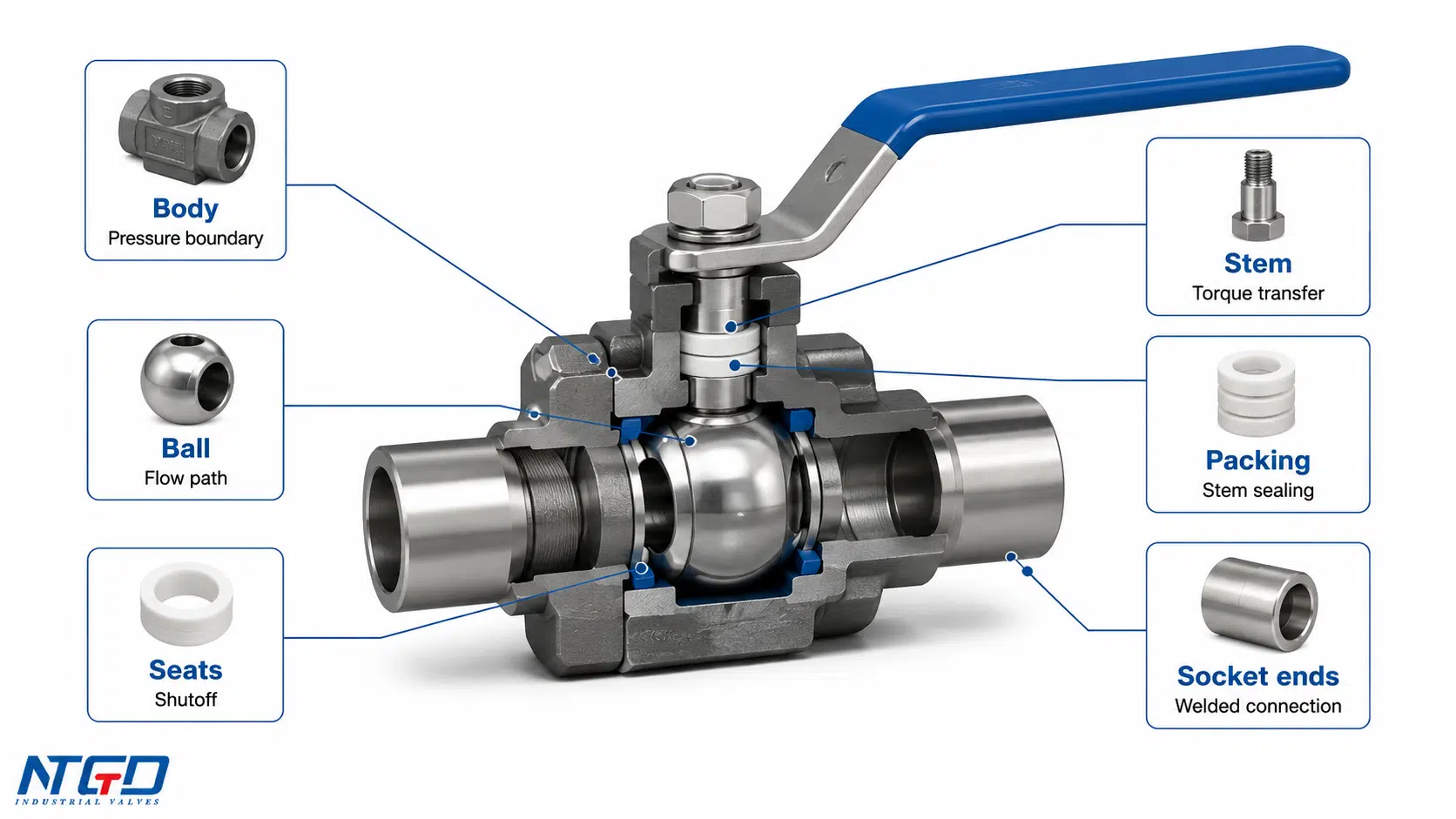
Carcasa y tapas de los extremos
El cuerpo de la válvula constituye la estructura que contiene la presión y las conexiones. En las válvulas de bola con conexión por soldadura de manguito, el cuerpo o los conectores de los extremos cuentan con los extremos para soldadura de manguito. El diseño del cuerpo influye en la capacidad de presión, las dimensiones de extremo a extremo, el acceso para el mantenimiento y el peso.
Entre las consideraciones comunes sobre la construcción de la carrocería se incluyen:
| Carrocería / Elemento de construcción | Pregunta de selección |
|---|---|
| Carrocería de una sola pieza | ¿Es aceptable un diseño compacto y económico? |
| Carrocería de dos piezas | ¿Se requiere un diseño de carrocería dividida para la especificación? |
| Carrocería de tres piezas | ¿Es importante la facilidad de mantenimiento en línea después de la instalación soldada? |
| Carrocería forjada | ¿El servicio requiere una construcción forjada debido a la presión o a las especificaciones del proyecto? |
| Construcción con carrocería soldada | ¿El término se refiere a la estructura del cuerpo, y no al extremo del tubo con soldadura de manguito? |
La construcción exacta debe confirmarse en la hoja de datos o en el plano. La expresión “cuerpo soldado” no debe confundirse con “extremo de soldadura por encaje”. Una válvula puede tener extremos de soldadura por encaje sin por ello ser una válvula de bola con cuerpo totalmente soldado.
Bola, vástago y manija / Accionamiento
La bola controla el recorrido del flujo. El vástago transmite el par desde la manija o el actuador a la bola. La manija o el actuador proporcionan la fuerza de accionamiento. Estas piezas influyen tanto en la facilidad de uso como en la disposición de la instalación.
En el caso de las válvulas manuales, el espacio libre de la manija es importante. Es posible que una válvula de bola con conexión por soldadura de manguito quepa entre las tuberías, pero la manija podría interferir con equipos cercanos, aislamiento, soportes o válvulas adyacentes. Para el servicio automatizado, se deben verificar la interfaz de montaje, el diseño del vástago, los requisitos de par y el espacio de instalación del actuador.
La conexión final no determina si la válvula es manual, neumática, eléctrica o accionada por engranajes. Las válvulas de bola para soldar por encaje pueden suministrarse con diferentes métodos de accionamiento, dependiendo del tamaño, el par de torque, la presión y los requisitos de control del proyecto.
Asientos, sellos y empaque
Los asientos y las juntas son fundamentales, ya que determinan el rendimiento de cierre, la compatibilidad con los fluidos, la capacidad de resistencia a la temperatura y el riesgo de mantenimiento. Los asientos blandos pueden proporcionar un cierre hermético, pero pueden ser sensibles a la temperatura y al calor de la soldadura si la válvula no se diseña o no se maneja correctamente durante la instalación.
Entre las consideraciones comunes sobre los asientos y las juntas se incluyen:
| Artículo | Por qué es importante |
|---|---|
| Material del asiento | Debe cumplir con los requisitos de temperatura, presión, medio y cierre |
| Sellos de cuerpo | Influye en el control y el mantenimiento de las fugas externas |
| Empaquetadura del vástago | Evita las fugas alrededor del vástago |
| Diseño resistente al fuego o a altas temperaturas | Debe verificarse con la hoja de datos y las especificaciones del proyecto |
| Exposición al calor de la soldadura | Si no se controla de acuerdo con el diseño de la válvula y las instrucciones, puede afectar a los asientos blandos, los sellos y las juntas de la carcasa. |
En el caso de las válvulas de bola con conexión por soldadura de manguito, la selección del asiento y la junta debe revisarse junto con el plan de soldadura y mantenimiento. Cuando el diseño de la tubería especifique extremos con conexión por soldadura de manguito y la válvula utilice asientos blandos, se deben revisar el material del asiento, el diseño de los extremos y la disposición de la sección central de fácil mantenimiento antes de planificar la soldadura.
Conexiones de válvulas de bola: soldadura en manguito frente a roscadas, soldadura a tope y con bridas
La conexión por soldadura de encaje es solo uno de los tipos de conexión de las válvulas de bola. Antes de elegirla, se debe comparar con las conexiones roscadas, por soldadura a tope y con bridas. La mejor conexión depende de las especificaciones de la tubería, la clase de presión, el acceso para el mantenimiento, el riesgo de fugas, el espacio de instalación y si se prevé desmontarla en el futuro.
| Tipo de conexión | Uso habitual | Talla estándar | Ventaja principal | Limitación principal | Relevancia de la página actual |
|---|---|---|---|---|---|
| Soldadura por encastre | Tuberías soldadas de diámetro pequeño, para servicio permanente y de tamaño compacto | Se utiliza habitualmente en tuberías de diámetro pequeño; verifique las especificaciones del proyecto | Conexión soldada compacta que ofrece una buena integridad de la unión cuando se especifica y se suelda correctamente | Son más difíciles de desmontar que las válvulas roscadas o con brida | Tema principal |
| Roscado | Tuberías de diámetro pequeño en las que resulta útil que sean fáciles de instalar y desmontar | Se utiliza comúnmente para conexiones desmontables de diámetro pequeño | No requiere soldadura y es más fácil de quitar | Las roscas pueden no ser la opción más adecuada para ciertas vibraciones, fugas o condiciones de servicio extremas | Solo a modo de comparación |
| Soldadura a tope | Tuberías soldadas en las que se requiere la preparación de la soldadura entre la tubería y la válvula | Se revisa con frecuencia cuando se especifica la preparación de los extremos de las tuberías soldadas | Conexión soldada resistente para diseños de tuberías adecuados | Es posible que se requiera una preparación e inspección de las soldaduras más exigentes | Solo a modo de comparación |
| Con bridas | Sistemas que requieren un desmontaje, una inspección o un reemplazo más sencillos | Se utiliza comúnmente en una gama más amplia de tamaños en los que es necesario desmontarlo con pernos | La conexión atornillada facilita el acceso para el mantenimiento | Es más grande, más pesado y requiere juntas y tornillos | Solo a modo de comparación |
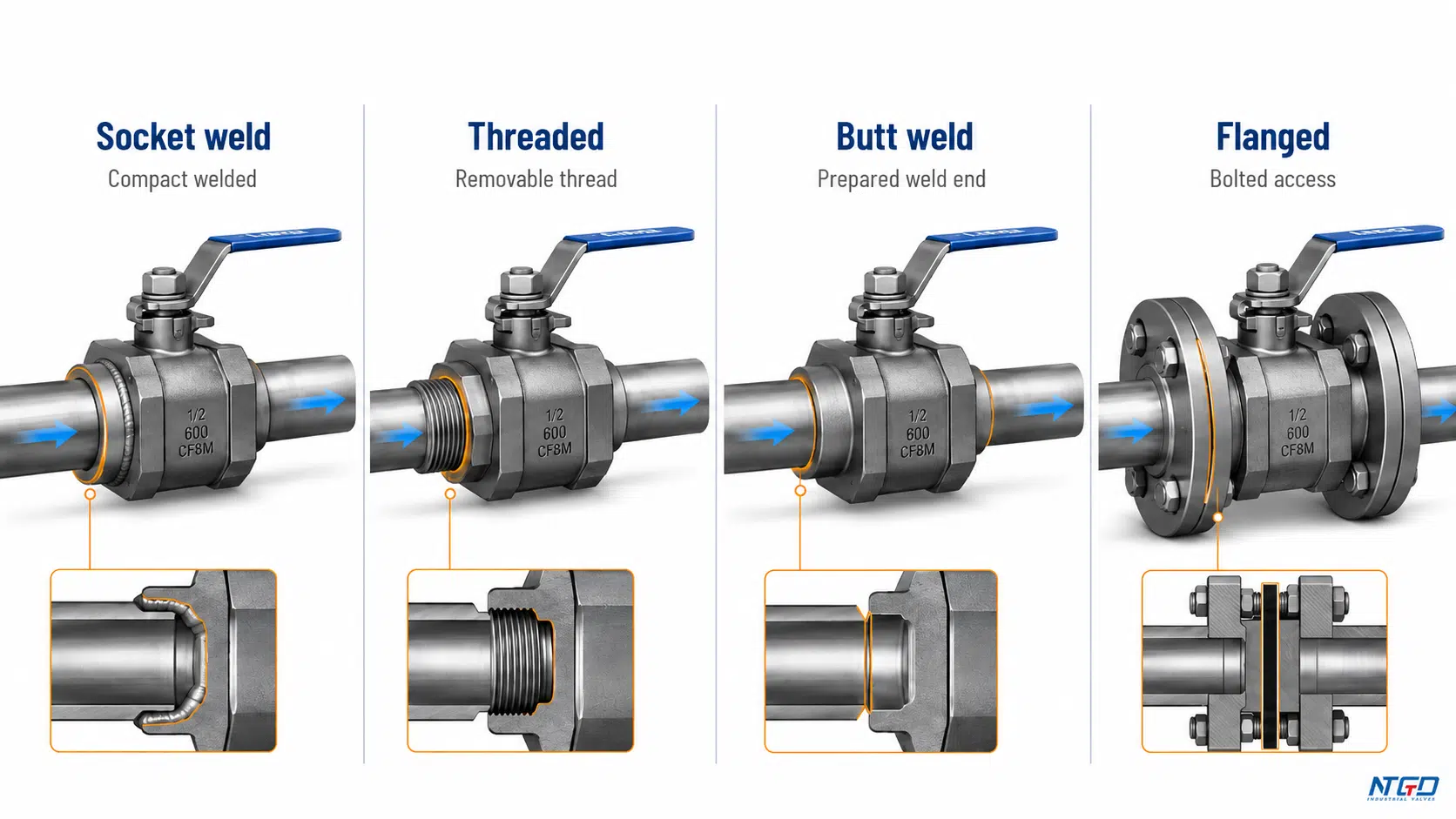
Válvula de bola con conexión por soldadura frente a válvula de bola roscada
Una válvula de bola con conexión por soldadura de manguito utiliza una unión soldada, mientras que una válvula de bola roscada utiliza roscas. Las válvulas roscadas son más fáciles de instalar y desmontar, pero las válvulas con conexión por soldadura de manguito suelen ser la opción preferida cuando el proyecto requiere una unión soldada o cuando existe el riesgo de fugas en las roscas o de que estas se aflojen.
La elección no debe basarse únicamente en el precio o la disponibilidad. Una válvula de bola roscada puede resultar conveniente para el mantenimiento, pero es posible que las especificaciones de la tubería exijan una válvula de bola para soldadura por encastre. La elección correcta depende de la presión, la temperatura, la vibración, el nivel de fugas previsto, el acceso para el mantenimiento y las normas del proyecto.
Válvula de bola con soldadura de encaje frente a soldadura a tope
Tanto la soldadura por manguito como la soldadura a tope son conexiones soldadas, pero no son lo mismo. En una conexión por soldadura por manguito, la tubería se inserta en el manguito de la válvula y se fija con una soldadura en ángulo. En una conexión por soldadura a tope, el extremo de la tubería y el de la válvula se preparan para una unión a tope.
Los extremos para soldadura por encaje suelen utilizarse en tuberías de menor diámetro y en diseños compactos. Los extremos para soldadura a tope pueden especificarse cuando el diseño de la tubería requiera una unión soldada a tope. El comprador debe confirmar la preparación de los extremos, el espesor de la tubería, las especificaciones de soldadura y los requisitos de inspección antes de realizar el pedido.
Válvula de bola con conexión por soldadura frente a válvula de bola con conexión por brida
A válvula de bola con bridas Por lo general, es más fácil de desmontar porque la válvula está atornillada entre las bridas. Una válvula de bola con conexión por soldadura de manguito es más compacta, pero pasa a formar parte del sistema de tubería soldada. Esto hace que sea menos conveniente para su reemplazo.
En los sistemas en los que se prevé un mantenimiento, una limpieza o un reemplazo de válvulas frecuentes, una conexión con bridas puede resultar más fácil de manejar. En el caso de tuberías compactas soldadas de diámetro pequeño, en las que se acepta una instalación permanente, una válvula de bola con conexión por soldadura de manguito puede ser más adecuada.
Configuraciones de válvulas de bola con conexión por soldadura
Las válvulas de bola con soldadura de encaje están disponibles en diferentes configuraciones. Las principales opciones de configuración incluyen la construcción del cuerpo, el tipo de conexión, el material, la presión nominal y si la válvula está diseñada para facilitar el mantenimiento después de la soldadura.
| Configuración | Qué significa | Repercusiones de la selección |
|---|---|---|
| Válvula de bola de una sola pieza para soldadura por encaje | Cuerpo compacto con desmontaje limitado | Adecuado para aislamientos sencillos en los que el acceso para mantenimiento no es tan importante |
| Válvula de bola de dos piezas para soldadura por encaje | Construcción de carrocería dividida | Configuración industrial habitual; depende del diseño del fabricante |
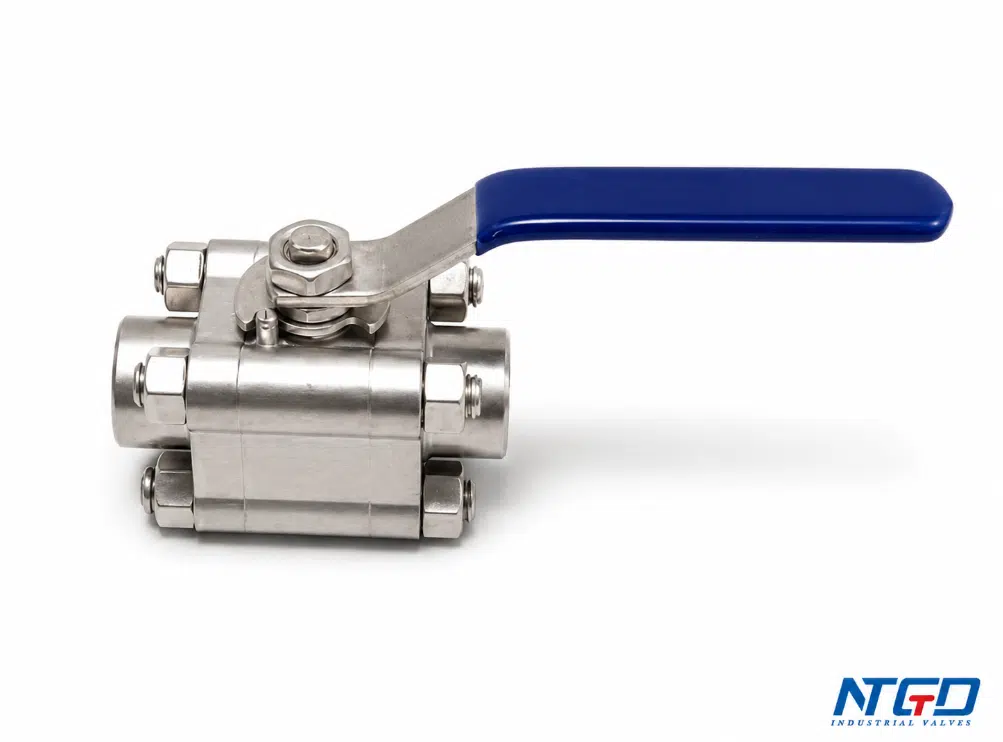
| Válvula de bola de soldadura por encastre de tres piezas | A menudo se puede acceder a la sección central por separado | Útil cuando la facilidad de mantenimiento es importante después de que los extremos se hayan soldado a la línea |
| Puerto completo | El diámetro interior de la bola es similar al del tubo | Es posible que se aplique una restricción de flujo menor, un cuerpo más grande o un costo más elevado |
| Diámetro interior reducido | El diámetro interior de la bola es menor que el del tubo | Es más compacto o económico, pero genera más restricciones |
| Válvula de bola forjada de soldadura por encastre | Carrocería forjada | A menudo se asocia con sistemas de servicio a presión y tuberías industriales de diámetro pequeño |
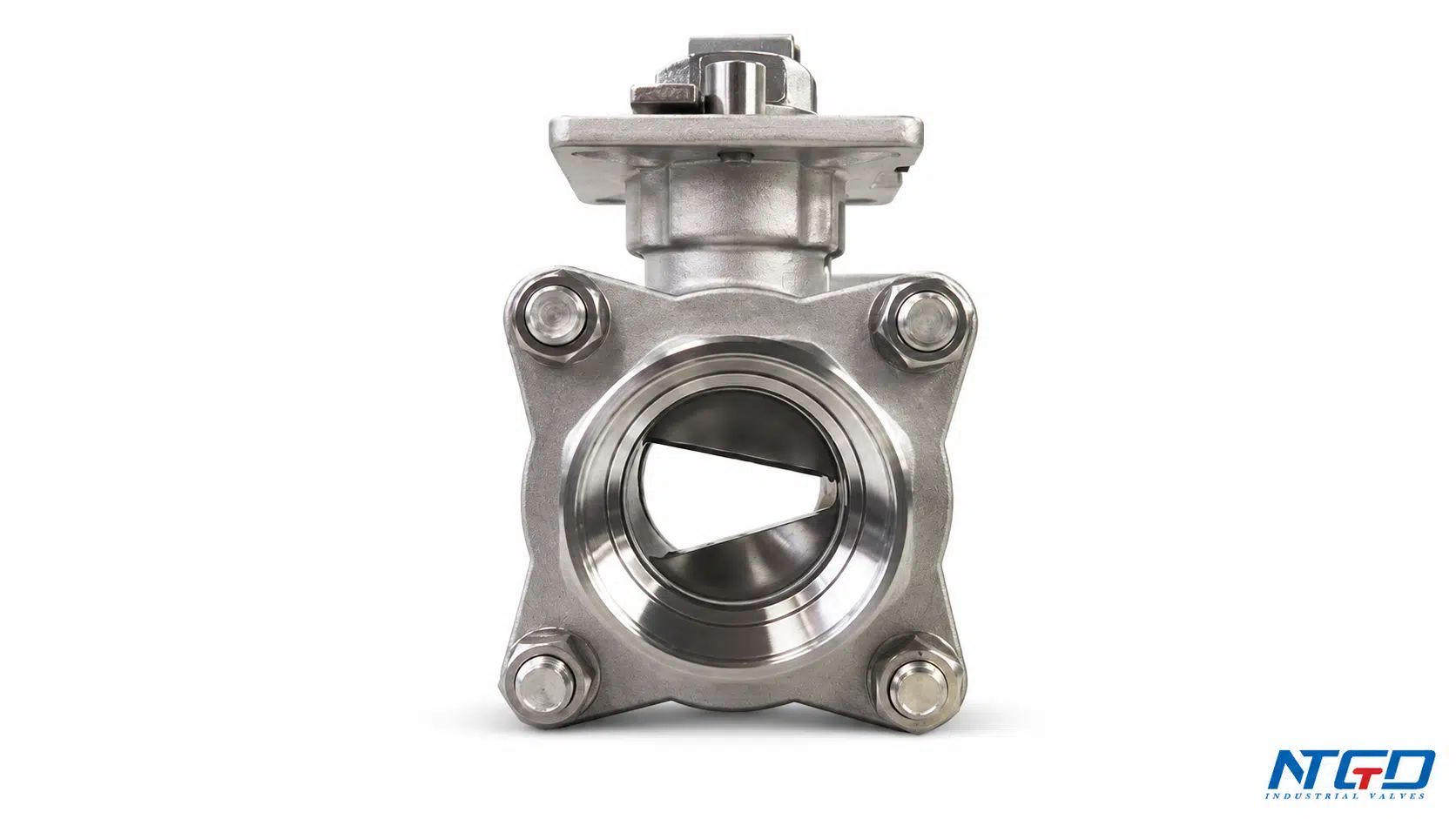
| Variante con puerto en V | El puerto esférico tiene una abertura con forma | Se utiliza únicamente cuando se requiere un diseño específico de control de flujo |
| Versión con carrocería soldada | La estructura de la carrocería es soldada | No debe confundirse con la conexión de extremo con soldadura en manguito |
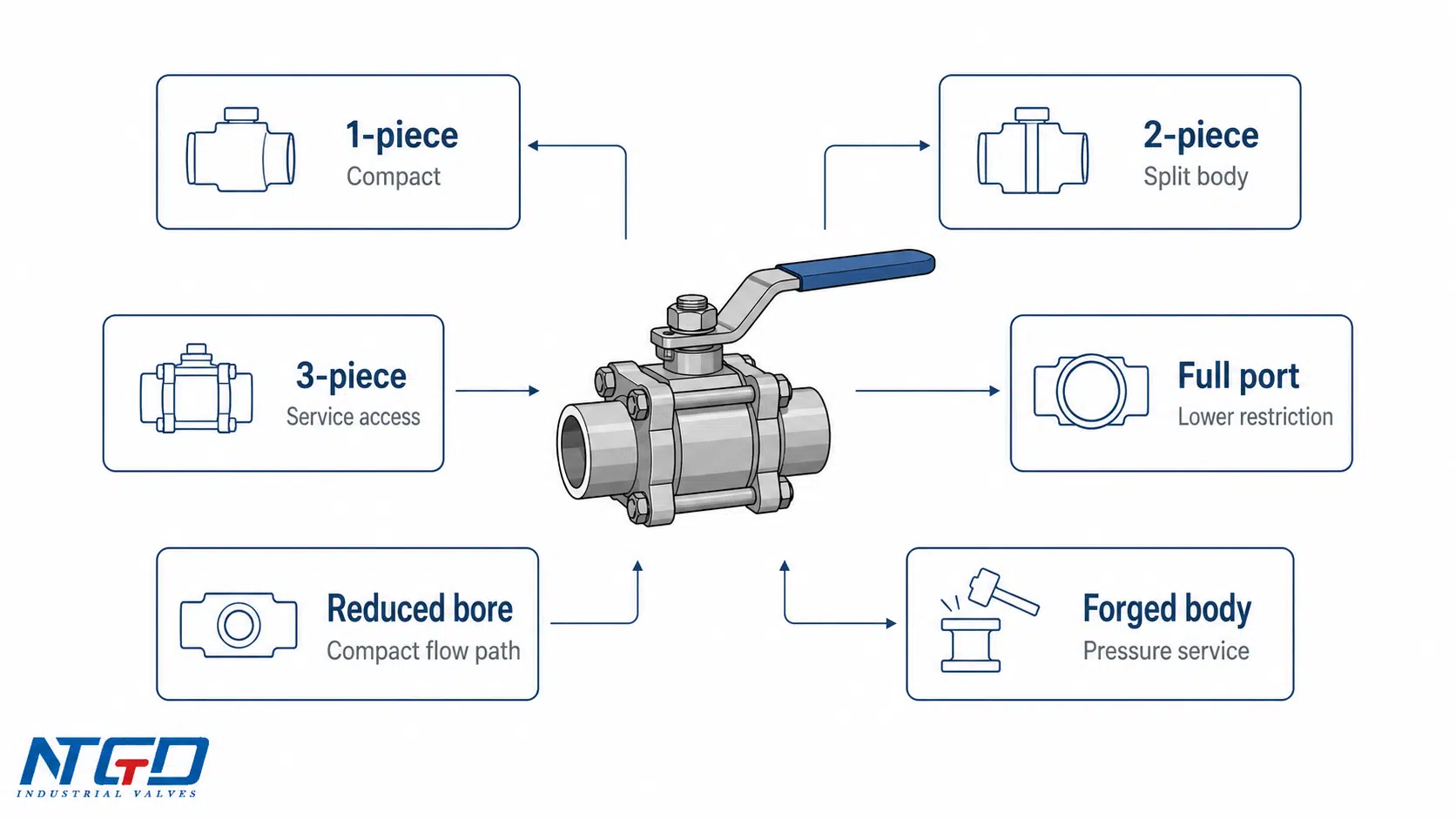
Válvulas de bola para soldadura por encaje de 1, 2 y 3 piezas
El diseño de la carrocería influye en el costo, el mantenimiento, las dimensiones y la facilidad de mantenimiento, por lo que cuanto más amplio sea el Válvulas de bola de 3 piezas frente a las de 2 piezas Se debe revisar esta decisión antes de dar por sentado que un solo estilo de cuerpo es adecuado para todas las instalaciones con extremos soldados.
Una válvula de bola de una sola pieza para soldadura por encaje puede ser compacta y económica, pero por lo general ofrece un acceso interno limitado. Un diseño de dos piezas puede brindar un equilibrio diferente entre el límite de presión, el método de ensamblaje y el mantenimiento. A válvula de bola de tres piezas Las válvulas con extremos de soldadura de manguito suelen considerarse cuando el acceso para el mantenimiento es importante, ya que la sección central puede retirarse o someterse a mantenimiento mientras las conexiones de los extremos soldados permanecen en la tubería, dependiendo del diseño de la válvula.
Para la instalación soldada, el diseño de tres piezas puede resultar útil, pero no debe darse por sentado automáticamente. El comprador debe verificar el acceso a los pernos, el espacio libre en la sección central, el diseño de la junta, el material de los asientos y las instrucciones del fabricante. El servicio en línea sigue requiriendo la despresurización total del sistema, un aislamiento seguro y suficiente espacio libre para retirar los pernos de la sección central, los asientos, los sellos y las juntas.
Puerto completo vs. Diámetro reducido
El tipo de puerto influye en la capacidad de flujo y en la caída de presión.
| Tipo de puerto | Característica principal | Mejor ajuste |
|---|---|---|
| Válvula de bola de soldadura por encastre de paso total | Diámetro interior mayor a través de la bola | Servicios en los que es importante que haya menos restricciones |
| Válvula de bola para soldadura por encastre de paso reducido | Diámetro interior más pequeño a lo largo de la bola | Servicios en los que se puede dar prioridad al tamaño compacto, el costo o el peso |
| Válvula de bola para soldar con orificio en V | Abertura perfilada para un comportamiento del flujo más controlado | Solo para aplicaciones especiales, no para aislamiento general |
No siempre se requiere una válvula de paso completo. Una válvula de paso reducido puede ser adecuada cuando la caída de presión no es crítica. En los proyectos de reemplazo, se debe verificar el diámetro del paso, ya que dos válvulas con el mismo tamaño nominal pueden no tener el mismo paso interno.
Válvulas de bola forjadas para soldadura por encaje
A válvula de bola forjada Se pueden utilizar extremos de soldadura por encaje en aplicaciones industriales en las que la clase de presión, la especificación del material o la norma del proyecto exijan una construcción de cuerpo forjado. La construcción forjada suele asociarse con tuberías de alta presión y diámetro pequeño, pero la capacidad exacta de presión y temperatura debe verificarse consultando la hoja de datos de la válvula.
La expresión “válvula de bola forjada para soldadura por encaje” debe considerarse como un tema relacionado con la configuración y el material o la construcción del cuerpo, y no como la descripción completa de esta página. Una válvula de bola forjada puede utilizar diferentes conexiones en los extremos, y una válvula de bola para soldadura por encaje puede ser forjada o fundida, dependiendo del diseño y las especificaciones.
Variantes con puerto en V y cuerpo soldado
A Válvula de bola con puerto en V Las válvulas con extremos de soldadura por encaje son una configuración más especializada. Pueden utilizarse cuando la abertura de la bola está diseñada para lograr un perfil de flujo más controlado. Sin embargo, las válvulas de bola estándar con extremos de soldadura por encaje suelen seleccionarse para el aislamiento de tipo «abierto-cerrado» más que para la regulación del flujo.
Una válvula de bola con cuerpo soldado también es diferente de una válvula de bola con extremo de soldadura por encaje. “Cuerpo soldado” se refiere a cómo está construido el cuerpo de la válvula. “Extremo de soldadura por encaje” se refiere a cómo se conecta la válvula a la tubería. Estos términos no deben usarse indistintamente.
Materiales, asientos, valores nominales de presión y condiciones de servicio
La selección de una válvula de bola con conexión por soldadura debe basarse en las condiciones de servicio, y no solo en el tamaño nominal y la conexión final. El material del cuerpo, el material del asiento, el material de sellado, la presión nominal, el rango de temperatura y la compatibilidad con los fluidos son factores que influyen en la idoneidad de la válvula.
| Elemento de selección | Qué hay que confirmar | Por qué es importante |
|---|---|---|
| Material de la carrocería | Acero al carbono, acero inoxidable, acero forjado u otro material especificado | Determina los límites de presión, la resistencia a la corrosión y el cumplimiento de los requisitos del proyecto |
| Material del asiento | PTFE, RTFE, grafito, metal u otro material específico del diseño | Influye en el cierre, la temperatura, la compatibilidad química y el par de apriete |
| Sello / material de empaque | Diseño del sello del cuerpo y de la empaquetadura del vástago | Afecta el control y el mantenimiento de las fugas externas |
| Presión nominal | WOG, PSI, Clase o clase de presión del proyecto | Debe cumplir con las condiciones de diseño de las tuberías |
| Temperatura | Temperatura mínima y máxima de funcionamiento | Afecta al material de la carcasa, al material del asiento, al empaque y al par de apriete |
| Medios de comunicación | Líquidos, gases, vapor, aceite, productos químicos, fluidos hidráulicos u otros servicios | Establece los requisitos de corrosión, compatibilidad y limpieza |
Acero al carbono, acero inoxidable y acero forjado
Las válvulas de bola de acero al carbono para soldadura por encaje suelen considerarse para aplicaciones industriales generales y de presión, en las que los requisitos de resistencia a la corrosión son moderados y el material de la tubería es compatible. El acero al carbono suele evaluarse para aplicaciones no corrosivas o ligeramente corrosivas, como agua, aceite, vapor o líneas de servicios públicos en general, siempre que el material de la tubería sea compatible.
Las válvulas de bola de acero inoxidable con conexión por soldadura de manguito suelen elegirse cuando la resistencia a la corrosión, la compatibilidad química o el servicio limpio son factores más importantes. El acero inoxidable se suele considerar para productos químicos corrosivos, exposición al agua de mar, servicio limpio o aplicaciones en las que la resistencia a la corrosión es una prioridad mayor. Las válvulas de bola de acero forjado para soldadura por encaje se asocian comúnmente con tuberías de servicio a presión, especialmente en sistemas industriales de diámetro pequeño.
El material no debe seleccionarse basándose únicamente en una palabra clave o en el nombre de un producto; debe seguir un enfoque más amplio Selección del material para válvulas de bola: acero al carbono vs. acero inoxidable Revisión basada en el fluido, la presión, la temperatura, el material de la tubería, el margen de corrosión y las especificaciones del proyecto.
Material del asiento y de la junta
Los materiales del asiento y de la junta determinan el comportamiento de cierre, los límites de temperatura, el par de apriete y la compatibilidad química. Las válvulas de bola con asiento blando y conexión por soldadura de enchufe pueden ofrecer un cierre hermético, pero es necesario verificar los materiales del asiento y de la junta antes de la soldadura y la puesta en funcionamiento.
Por ejemplo, los asientos a base de PTFE pueden ser adecuados para muchos servicios, pero la elección final depende de la presión, la temperatura, los fluidos y el diseño de la válvula. Los servicios a altas temperaturas o a prueba de fuego pueden requerir diferentes configuraciones de asiento, sello, empaque o junta del cuerpo. Estos requisitos deben verificarse en la hoja de datos del fabricante y en las especificaciones del proyecto.
Clasificación de presión, WOG, PSI y clase
Las especificaciones de las válvulas de bola con conexión por soldadura pueden describirse utilizando diferentes términos, como WOG, PSI o clase de presión. Estos términos no siempre son intercambiables y no deben considerarse como garantías universales de desempeño.
En cuanto a los valores nominales de presión y temperatura de las válvulas y a los requisitos de las válvulas con extremos para soldar, las especificaciones del proyecto pueden hacer referencia a ASME B16.34, pero la clasificación final aún debe confirmarse con base en la ficha técnica y el plano de la válvula seleccionada.
El comprador debe confirmar lo siguiente:
| Elemento de calificación | Qué comprobar |
|---|---|
| Clase de presión o clasificación WOG | Si cumple con la presión de diseño del proyecto |
| Reducción de la capacidad en función de la temperatura | Si la capacidad de presión varía a la temperatura de servicio |
| Material de la carrocería | Si el material cumple con los requisitos de presión y temperatura |
| Material del asiento | Si el asiento es adecuado para la presión, la temperatura y los medios |
| Requisitos de prueba | Si la válvula debe cumplir con requisitos específicos de inspección o prueba |
| Norma aplicable | Si la válvula y la conexión final cumplen con las especificaciones del proyecto |
No se debe dar por sentado que todas las válvulas de bola con soldadura de manguito del mismo tamaño tengan la misma capacidad nominal. La capacidad nominal depende del diseño de la válvula, el material, la construcción del asiento, la norma de fabricación y las condiciones de servicio.
Confirmación de las dimensiones y el plano de la válvula de bola con conexión por soldadura
Las dimensiones de las válvulas de bola con soldadura de encaje deben considerarse como un conjunto dimensional completo, no solo como una longitud de extremo a extremo; un enfoque más amplio Dimensionamiento e instalación de válvulas de bola Antes de tomar la decisión final, también se debe considerar el diseño de la conexión, el tipo de conexión, el espacio de instalación y los límites de presión y temperatura. Esto es especialmente importante en los trabajos de reemplazo, ya que una válvula soldada es más difícil de ajustar después de su instalación.
Las dimensiones exactas dependen del diseño del fabricante, el tamaño de la válvula, la presión nominal, el patrón del cuerpo, el tipo de puerto, la conexión final, el material, la manija o el actuador, y la revisión del plano.
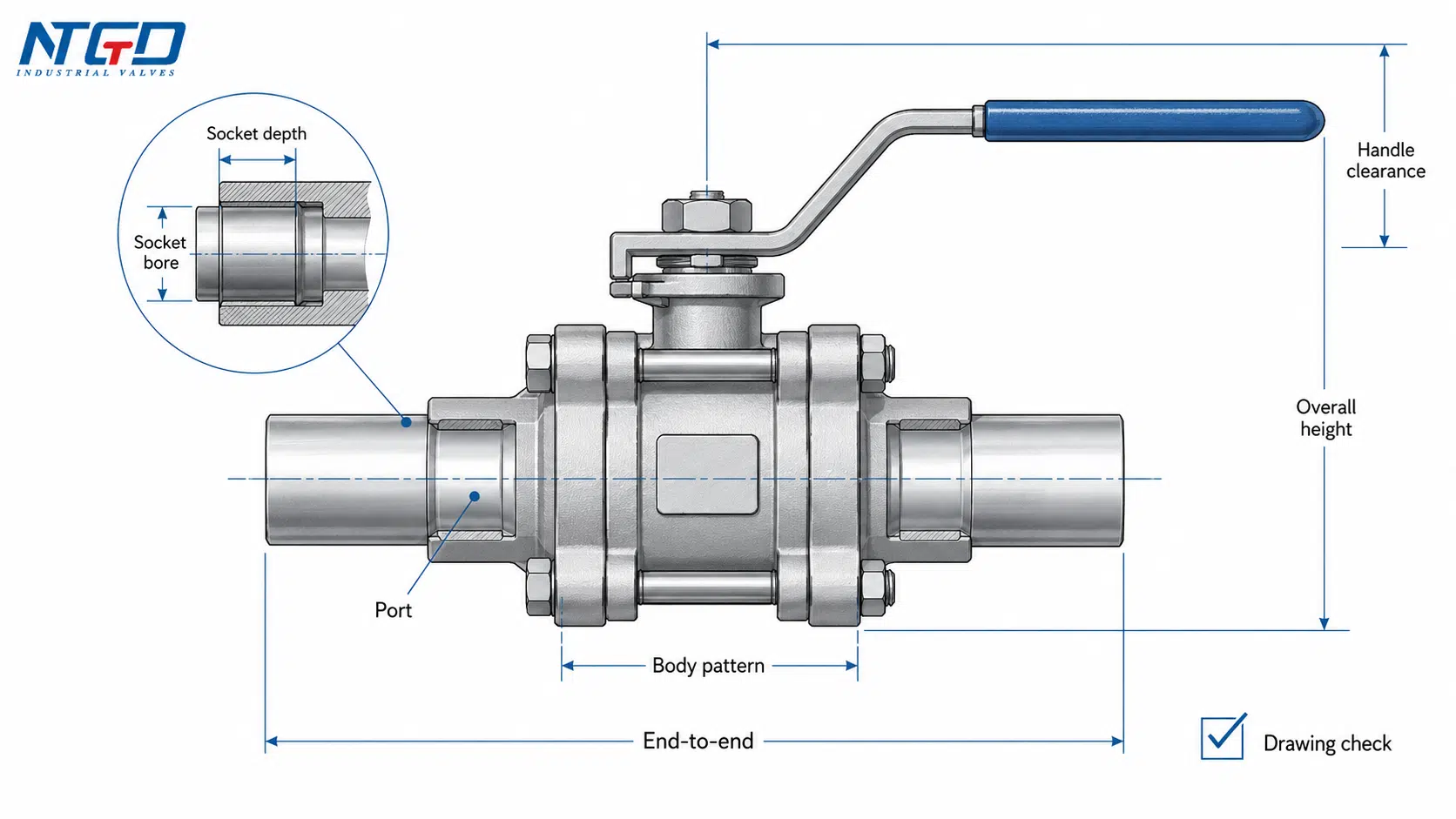
¿Qué dimensiones se deben verificar?
Antes de pedir o reemplazar una válvula de bola con conexión por soldadura, revisa los siguientes campos:
| Dimensión / Campo | Por qué se debe revisar |
|---|---|
| Tamaño de la válvula / NPS / DN | Confirma la compatibilidad con los tamaños básicos de tubería |
| Longitud total o de extremo a extremo | Afecta al espacio entre las tuberías y al ajuste durante el reemplazo |
| Diámetro interior del casquillo | Debe coincidir con el diámetro exterior y las especificaciones de la tubería |
| Profundidad del casquillo | Afecta la inserción y el ajuste de las tuberías |
| Diámetro del puerto | Afecta la capacidad de flujo y la caída de presión |
| Patrón corporal | Afecta el peso, la envolvente y el acceso de mantenimiento |
| Altura total | Afecta al espacio libre de instalación |
| Longitud del mango | Afecta la autorización de operación |
| Envolvente del actuador | Es obligatorio si se utiliza un accionamiento neumático, eléctrico o por engranajes |
| Base de montaje | Necesario para la automatización o la instalación futura de un actuador |
| Peso aproximado | Afecta el soporte y el manejo |
| Revisión del dibujo | Evita el uso de datos obsoletos |
Dado que una válvula de bola con soldadura de manguito es difícil de ajustar después de la soldadura, estas dimensiones deben confirmarse antes de la instalación, en lugar de considerarlas un elemento que se corregirá después de la instalación.
Una tabla de dimensiones de válvulas de bola con soldadura de manguito puede servir como referencia inicial, pero no debe sustituir al plano confirmado para la instalación del proyecto.
Por qué las dimensiones no son universales
Las dimensiones de las válvulas de bola con soldadura de manguito no son uniformes entre los distintos fabricantes ni siquiera dentro de una misma serie de productos. Dos válvulas con el mismo tamaño nominal pueden tener diferentes longitudes de extremo a extremo, profundidades de manguito, espacios libres de la manija, anchos del cuerpo y diámetros de los puertos.
Entre las razones más comunes se encuentran:
- construcción de la carrocería de una, dos o tres piezas;
- diseño de paso completo o de paso reducido;
- construcción del cuerpo forjada o fundida;
- clase de presión y espesor de la pared;
- diseño de la sede y la junta;
- funcionamiento manual, por engranajes, neumático o eléctrico;
- requisitos de dibujo específicos del proyecto o requisitos estándar.
Para el reemplazo, se debe comparar la válvula existente con el plano de la válvula nueva antes de planificar la conexión soldada.
Gráfico del catálogo frente a plano confirmado
Una ilustración del catálogo o un archivo PDF son útiles para una comparación inicial, pero un plano confirmado es más confiable para la selección final. Esto es especialmente cierto cuando la válvula se soldará a una línea existente o cuando el espacio libre para la manija, el perfil del actuador, la profundidad del casquillo o el tamaño del puerto son factores críticos.
Las normas dimensionales aplicables y los catálogos de los fabricantes pueden servir de ayuda para la selección inicial, pero no sustituyen al plano confirmado en lo que respecta a la serie exacta de la válvula, la presión nominal, el diseño de las conexiones, los extremos de acoplamiento y la disposición del actuador.
| Tipo de documento | Mejor uso | Limitación |
|---|---|---|
| Tabla del catálogo | Revisión temprana del tamaño y la configuración | Es posible que no refleje la configuración exacta del proyecto |
| Ficha técnica | Confirmación técnica del material, la clasificación, el asiento y la conexión | Es posible que no se muestren todas las dimensiones de instalación |
| Dibujo de GA | Confirmación de la envolvente de instalación y las dimensiones | Debe coincidir con la configuración de válvula seleccionada |
| Dibujo confirmado | Confirmación del proyecto final | Se debe verificar antes de la adquisición o el reemplazo |
En el caso de las válvulas de bola con soldadura de encaje, se deben confirmar las dimensiones finales antes de soldar, ya que cualquier corrección en el lugar de instalación después de montarlas podría requerir corte, reelaboración o reemplazo.
¿Cuándo se debe usar o evitar una válvula de bola con conexión por soldadura?
Las válvulas de bola con conexión por soldadura son útiles en las aplicaciones adecuadas, pero no son la mejor opción para todos los sistemas de tuberías. La decisión debe basarse en los requisitos de conexión, las expectativas de mantenimiento, las condiciones de presión y temperatura, y en si es aceptable una instalación soldada de forma permanente.
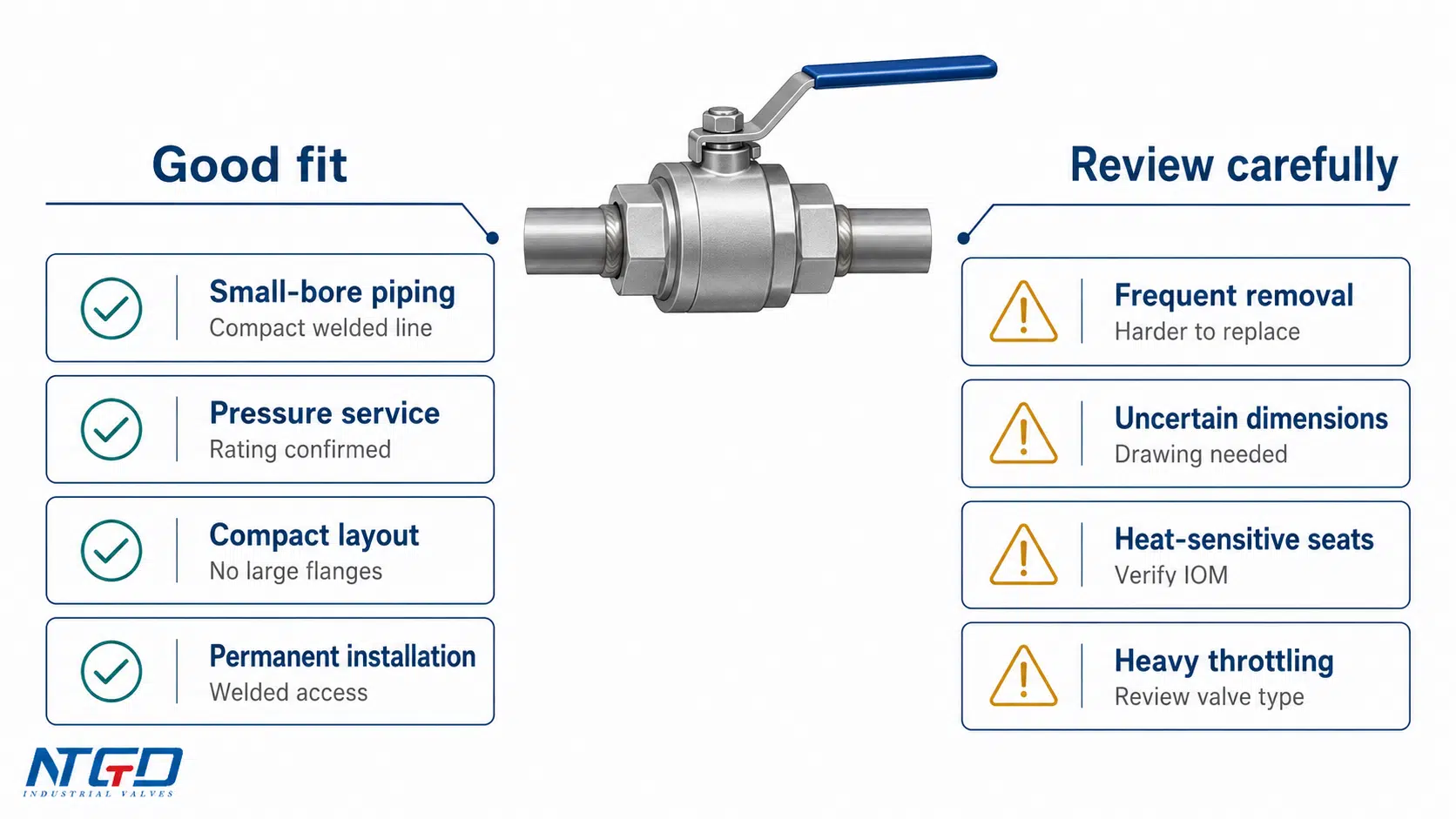
Aplicaciones con buen ajuste
Una válvula de bola con conexión por soldadura suele ser una buena opción cuando se requiere un cierre compacto con extremos de tubería soldados.
| Buen estado, se ajusta bien | Por qué es la opción ideal |
|---|---|
| Tuberías industriales de pequeño diámetro | Los extremos para soldadura por encaje se utilizan con frecuencia en sistemas compactos de diámetro pequeño |
| Tuberías de alta presión o para servicio a presión | Es posible que la especificación de las tuberías exija una conexión de extremo soldada |
| Servicios para el sector del petróleo y el gas | Es posible que se requiera una válvula de cierre compacta soldada en las líneas auxiliares o de proceso |
| Servicio químico | Se puede seleccionar la compatibilidad del material y el asiento para los soportes |
| Líneas auxiliares de energía y vapor | Los extremos soldados pueden ser la opción preferida cuando no se desean uniones roscadas |
| Sistemas hidráulicos o de servicios públicos | El aislamiento compacto puede resultar útil cuando la válvula, el diámetro de la tubería y la presión nominal coinciden |
| Instalación permanente | No se espera que la válvula se desmonte con frecuencia |
Aún así, se debe verificar que el servicio cumpla con los requisitos de material, presión nominal, temperatura, diseño del asiento y las normas aplicables al proyecto.
Cuándo evitarlo o analizarlo con cuidado
Se debe revisar cuidadosamente una válvula de bola con conexión por soldadura de manguito cuando sea necesario desmontar el sistema con frecuencia o cuando no se conozcan con exactitud las dimensiones de la pieza de repuesto.
| Revisa con cuidado cuando | Por qué es importante |
|---|---|
| Se prevé que la válvula se retire con frecuencia | Los extremos soldados dificultan el desmontaje |
| La limpieza o la inspección interna se realizan con frecuencia | Una configuración con bridas o con uniones podría ser más sencilla |
| Las dimensiones de los repuestos son inciertas | La instalación soldada deja poco margen para errores dimensionales |
| Los medios de comunicación son muy corrosivos | Las uniones soldadas por encaje pueden crear zonas de hendiduras en las que la corrosión localizada puede acelerarse en medios agresivos; se debe evaluar conjuntamente la elección del material y el tipo de conexión |
| El servicio implica una fuerte limitación de ancho de banda | Las válvulas de bola estándar se utilizan principalmente para el aislamiento de tipo “abierto-cerrado” |
| La válvula utiliza asientos blandos sensibles al calor | El calor de soldadura y el método de instalación deben controlarse de acuerdo con el diseño de la válvula y las instrucciones del fabricante |
| Se trata de una tubería de gran diámetro o de un actuador pesado | El soporte, el acceso y el mantenimiento cobran mayor importancia |
Una válvula de bola con conexión por soldadura de manguito ofrece integridad en la conexión y un diseño compacto, pero esas ventajas deben sopesarse con la facilidad de mantenimiento, el riesgo de corrosión, la complejidad de su reemplazo y el plan de mantenimiento del proyecto.
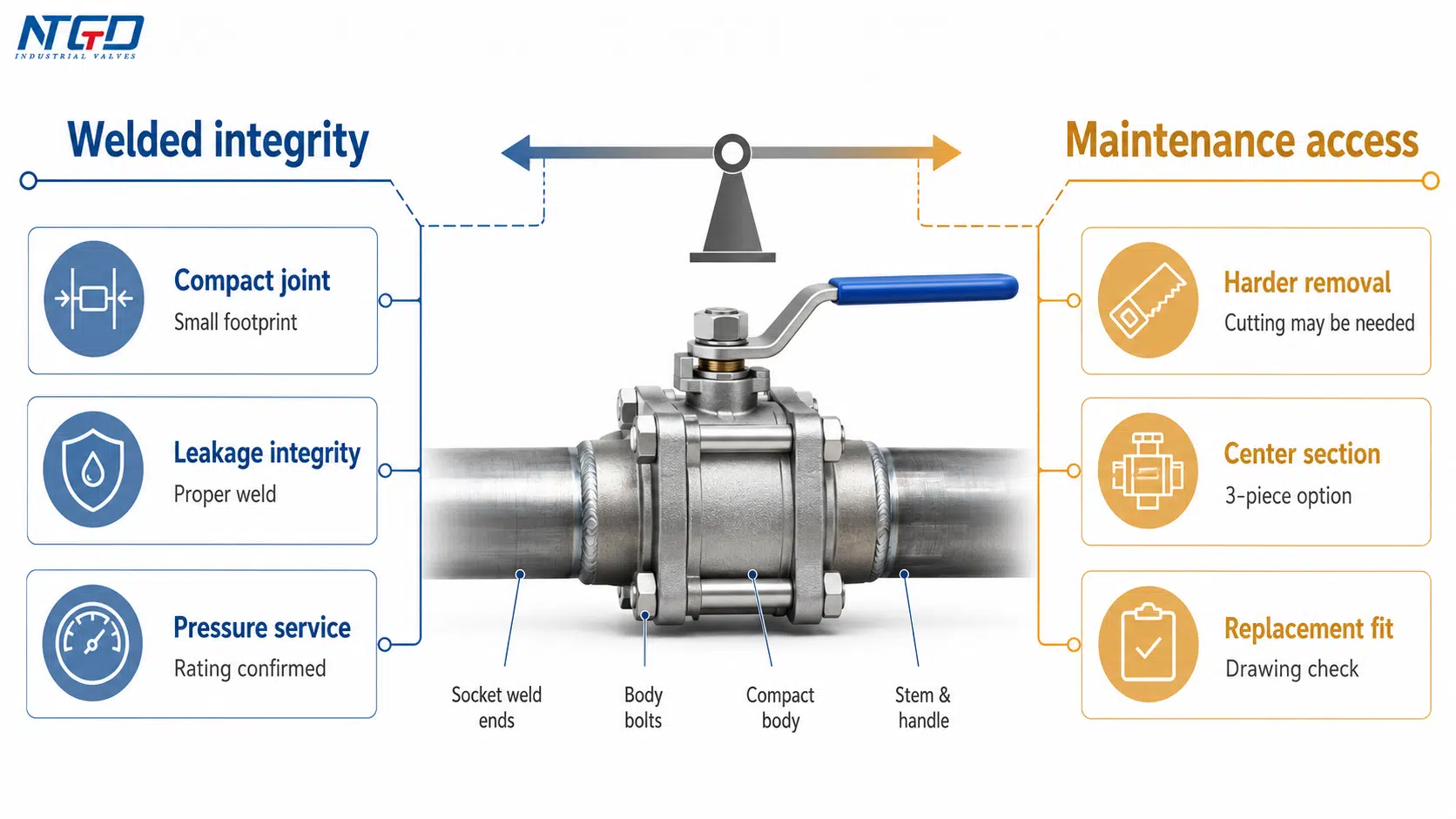
Instalación, mantenimiento y resolución de problemas de Boundary
Las válvulas de bola con conexión por soldadura requieren una planificación cuidadosa de la instalación, ya que la válvula se suelda al sistema de tuberías. Los procedimientos de soldadura deben seguir las especificaciones del proyecto y las instrucciones del fabricante; sin embargo, el ingeniero encargado de la selección también debe confirmar si el diseño de la válvula puede soportar el aporte de calor previsto durante la instalación.
La elección de la válvula es diferente a la redacción de un procedimiento de soldadura. Antes de la compra, confirme si el diseño de la válvula, el material del asiento, el material del sello, la construcción del cuerpo y el plan de mantenimiento son adecuados para la instalación soldada prevista.
Calor de soldadura y riesgo de asentamiento/sellado
El calor de la soldadura puede afectar a las sedes blandas, los sellos del cuerpo o la empaquetadura si no se tienen debidamente en cuenta el diseño de la válvula y el método de instalación. Esta es una de las razones por las que los compradores deben verificar la construcción de la válvula antes de la instalación, especialmente en el caso de las válvulas de bola con sede blanda o de tres piezas para soldadura por encaje.
Un aporte de calor no controlado puede deformar las sedes blandas, dañar los sellos de la cuerpo, aumentar el par de operación o provocar fugas antes de que la válvula entre en servicio normal. En el caso de las válvulas de bola con sede blanda y conexión por soldadura de manguito, revise los extremos de soldadura de manguito extendidos, los diseños de sección central desmontable o las instrucciones de instalación aprobadas por el fabricante antes de soldar.
Entre las preguntas importantes se encuentran:
| Pregunta | Por qué es importante |
|---|---|
| ¿Los asientos son blandos, reforzados, de grafito o de metal? | El material del asiento influye en la sensibilidad al calor y en el comportamiento de cierre |
| ¿La válvula es de una pieza, de dos piezas o de tres piezas? | Las obras afectan el mantenimiento y la posible gestión del calor |
| ¿El fabricante proporciona instrucciones de instalación? | Es posible que la válvula requiera un manejo específico durante la soldadura |
| ¿La válvula viene con extremos de soldadura de manguito extendidos? | Los extremos prolongados pueden ayudar a aislar el calor de la soldadura de las partes blandas internas, dependiendo del diseño |
| ¿Es necesario realizar una inspección después de la soldadura? | Los requisitos del proyecto pueden exigir una inspección o pruebas tras la instalación |
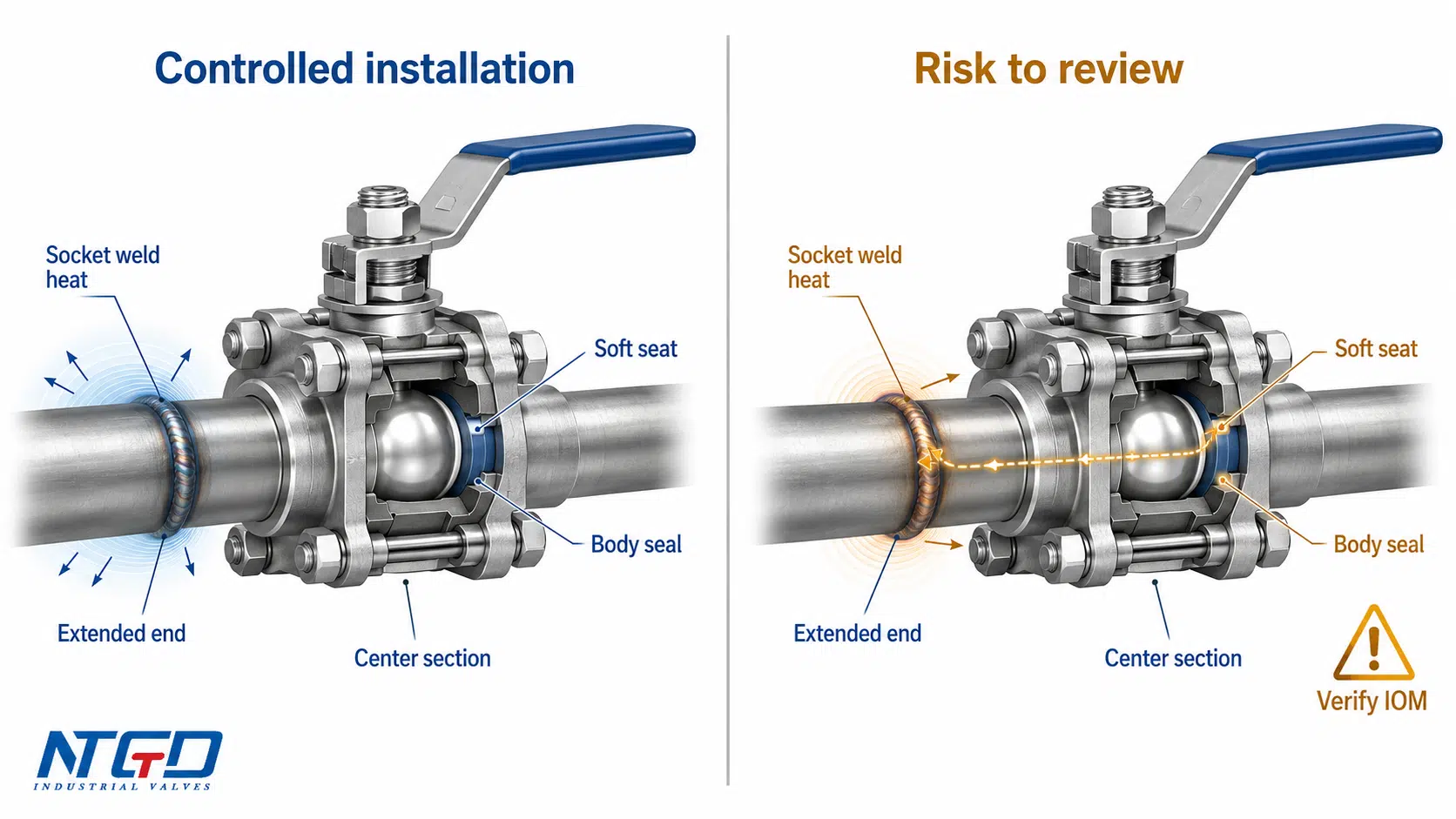
Lo más seguro es revisar las instrucciones del fabricante y los requisitos del proyecto antes de soldar, no después de que la válvula ya se haya instalado.
Límites de mantenimiento y reemplazo
La planificación del mantenimiento es una de las diferencias más importantes entre las válvulas de bola con conexión por soldadura de manguito y las de conexión con brida. Una vez que una válvula con conexión por soldadura de manguito se ha soldado a la tubería, su desmontaje suele requerir trabajos de corte o soldadura. Esto no significa que las válvulas de bola con conexión por soldadura de manguito sean una mala opción. Significa que deben seleccionarse para aplicaciones en las que sea aceptable una instalación permanente.
Una válvula de bola de tres piezas con soldadura de enchufe puede reducir algunas dificultades de mantenimiento, ya que la sección central del cuerpo puede someterse a mantenimiento mientras los extremos permanecen soldados en su lugar. Sin embargo, esto depende del diseño de la válvula, el acceso a los pernos, la disposición de las juntas y el espacio disponible para la instalación.
Antes de elegir una válvula de bola con conexión por soldadura, asegúrese de:
- si la válvula podría necesitar mantenimiento frecuente;
- si se puede acceder a la sección central después de la soldadura;
- si la manija o el actuador se pueden accionar en la posición en que están instalados;
- si se han confirmado las dimensiones de los repuestos;
- si se necesitan repuestos, sellos o empaques.
Síntomas comunes que hay que revisar
Los problemas comunes en las válvulas de bola con soldadura de manguito pueden estar relacionados con el cuerpo de la válvula, los asientos, la empaquetadura del vástago, la superficie de la bola o las condiciones de instalación; para un diagnóstico más amplio de los síntomas, utilice un Guía de mantenimiento y resolución de problemas de válvulas de bola en lugar de convertir esta página de selección de uniones soldadas en un manual de reparación.
| Síntoma | Área que podría revisarse |
|---|---|
| Fuga a través de la válvula cerrada | Daños en el asiento, daños en la superficie de la bola, residuos, desajuste de presión o temperatura |
| Fuga alrededor del vástago | Desgaste de las empaquetaduras, daños en el sello del vástago, funcionamiento incorrecto, condiciones de presión o temperatura |
| Fugas alrededor de las juntas de la carrocería | Sello del cuerpo, junta, carga del perno, ciclos térmicos o diseño de la válvula |
| Dificultad para manejar la manija | Hinchazón del asiento, residuos, corrosión, diferencia de presión, daños en el vástago o en la bola |
| Fuga externa cerca de los extremos soldados | Calidad de la soldadura, alineación de las tuberías, tensión térmica o problema de instalación |
Esta sección está pensada como una guía para la selección y el mantenimiento, no como un manual de reparación.
Lista de verificación para la solicitud de cotización antes de seleccionar una válvula de bola de soldadura en manguito
Antes de solicitar una válvula de bola con soldadura de encaje, prepare la información clave que influye en el diseño de la válvula, el precio, el plazo de entrega y la confirmación de los planos. Una consulta completa ayuda a evitar elegir un material incorrecto para el cuerpo o el asiento, una clasificación de presión inadecuada, una conexión final inadecuada o unas dimensiones incorrectas.
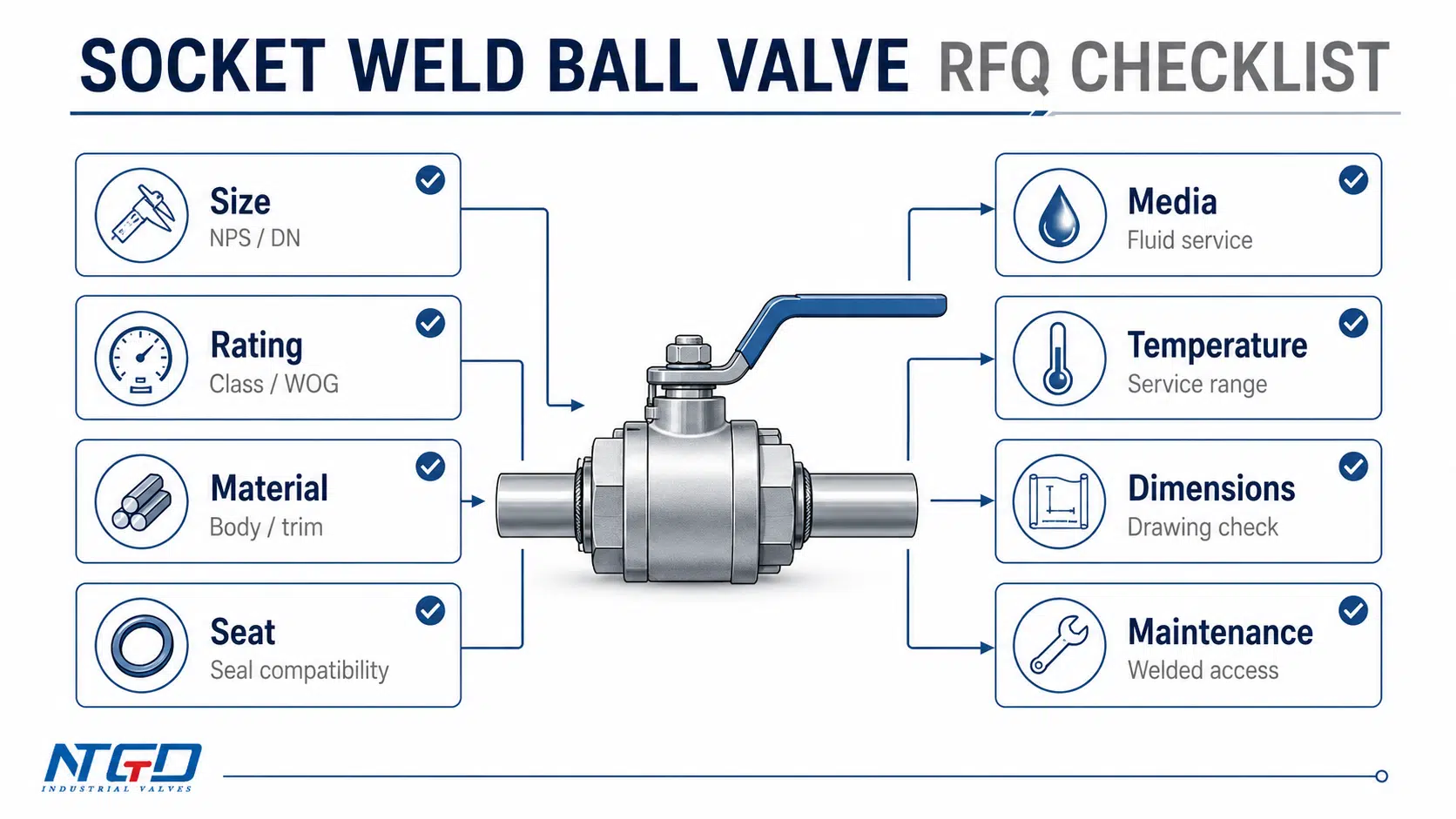
| Artículo de la solicitud de cotización | Información que debe preparar |
|---|---|
| Tamaño de la válvula | NPS / DN y espesor de la tubería |
| Conexión final | Requisitos para los extremos de soldadura por encaje y especificaciones aplicables a las tuberías |
| Presión nominal | WOG, PSI, Clase o presión nominal del proyecto |
| Temperatura | Temperatura mínima y máxima de funcionamiento |
| Medios de comunicación | Tipo de fluido, grado de limpieza, corrosividad y fase |
| Material de la carrocería | Acero al carbono, acero inoxidable, acero forjado o aleación especificada |
| Material de la bola y el vástago | Material de acabado o en contacto con el líquido requerido |
| Material del asiento y de la junta | PTFE, RTFE, grafito, metal o requisitos específicos del proyecto |
| Tipo de puerto | Puerto completo, diámetro reducido o puerto especial |
| Estructura de la carrocería | De una pieza, de dos piezas, de tres piezas, forjado u otro diseño especificado |
| Operación | Palanca, engranaje, actuador neumático, actuador eléctrico o montaje preparado para la automatización |
| Dimensiones | Longitud total, diámetro interior del casquillo, profundidad del casquillo, altura, espacio libre del mango, envolvente del actuador |
| Requisito de dibujo | Hoja de datos, plano GA o plano confirmado |
| Pruebas / inspección | Hidrostático, neumático, de detección de fugas, a prueba de incendios, Normas API para válvulas, o pruebas específicas para cada proyecto, si es necesario |
| Expectativas de mantenimiento | Si se requiere la capacidad de mantenimiento en línea después de la soldadura |
| Plan de mantenimiento de extremos soldados | Si la válvula debe poder repararse una vez que los extremos de la soldadura de manguito permanezcan en la línea |
Para proyectos de instalación o reemplazo mediante soldadura, se debe completar la verificación de los planos y las dimensiones antes de la adquisición.
Preguntas frecuentes sobre las válvulas de bola con conexión por soldadura
¿Qué es una válvula de bola soldable?
Una válvula de bola con extremos para soldadura por encaje es una válvula de bola con extremos diseñados para este tipo de soldadura. La tubería se inserta en un encaje empotrado en cada extremo de la válvula y se suelda alrededor del exterior. La válvula en sí sigue funcionando mediante la rotación de una bola 90 grados para abrir o cerrar el paso del flujo.
¿Cuál es la diferencia entre una válvula de bola con conexión por soldadura de manguito y una válvula con conexión por soldadura de manguito?
El término «válvula de soldadura por encaje» es un término general que se refiere a cualquier válvula con extremos de soldadura por encaje. La válvula de bola de soldadura por encaje es un tipo específico: utiliza un mecanismo de cierre de válvula de bola y conexiones de tubería de soldadura por encaje. Otras válvulas de soldadura por encaje pueden utilizar diseños de válvula de compuerta, de paso, de retención, de tapón o de aguja.
¿Una válvula de bola SW es lo mismo que una válvula de bola de soldadura por encaje?
Sí. En las especificaciones de las válvulas, “SW” suele significar «soldadura por encaje». Una válvula de bola SW generalmente se refiere a una válvula de bola con conexión de soldadura por encaje, pero aún así se debe consultar la hoja de datos para confirmar el tipo de conexión, la presión nominal, el material y las dimensiones.
¿Por qué podría ser más difícil mantener una válvula de bola con soldadura de manguito?
Una válvula de bola con conexión por soldadura es más difícil de mantener, ya que los extremos soldados complican su desmontaje y reemplazo. Las principales preocupaciones son la menor facilidad de desmontaje, los posibles efectos del calor de la soldadura en los asientos o sellos blandos, y la necesidad de verificar las dimensiones antes de la instalación. No es la mejor opción cuando se prevé un desmontaje o una limpieza frecuentes.
¿Cuál es la clasificación de una válvula de bola con soldadura en el manguito?
La clasificación depende del diseño de la válvula, el material, la clase de presión, el material del asiento, la temperatura y la norma aplicable. Algunos productos pueden describirse mediante clasificaciones WOG, PSI o de clase, pero estas deben verificarse con la hoja de datos del fabricante y las especificaciones del proyecto.
¿Para qué tamaños se suelen utilizar las válvulas de bola con soldadura de encaje?
Las válvulas de bola con soldadura de encaje se utilizan comúnmente en tuberías de diámetro pequeño. La gama de tamaños disponibles depende del diseño de la válvula, la clase de presión, la serie del fabricante y las especificaciones del proyecto, por lo que el tamaño seleccionado siempre debe confirmarse en la hoja de datos o en el plano.
¿Las dimensiones de las válvulas de bola con conexión por soldadura son universales?
No. Las dimensiones de las válvulas de bola con conexión por encaje no son universales. La longitud de extremo a extremo, el diámetro interior del encaje, la profundidad del encaje, el diámetro de la conexión, el espacio libre de la manija y el perfil del actuador pueden variar según el fabricante, el modelo del cuerpo, la clasificación de presión, el tipo de conexión y la revisión del plano.
¿Qué norma se aplica a los extremos de las válvulas con soldadura en manguito?
La norma aplicable depende de las especificaciones del proyecto, el código de tuberías, el diseño de la válvula y los requisitos de conexión en los extremos. Para consultar referencias sobre accesorios forjados para soldadura por encaje y roscados, ASME B16.11 puede revisarse, mientras que el requisito final del extremo de la válvula aún debe coincidir con la hoja de datos del fabricante y el plano confirmado.
¿Cuál es la diferencia entre las válvulas de bola con soldadura de encaje y las roscadas?
Una válvula de bola con conexión por soldadura de manguito se suelda a la tubería. Una válvula de bola roscada se conecta mediante roscas. Las conexiones por soldadura de manguito son más permanentes y suelen utilizarse cuando se requieren uniones soldadas. Las conexiones roscadas son más fáciles de desmontar, pero es posible que no sean adecuadas para todos los requisitos de presión, vibración o fugas.
¿La soldadura por encaje es lo mismo que la soldadura a tope?
No. En una conexión por soldadura en manguito, la tubería se inserta en un manguito empotrado y se suelda alrededor del exterior. En una conexión por soldadura a tope, el extremo de la tubería y el de la válvula se preparan para una unión a tope. La elección correcta depende de las especificaciones de la tubería y de los requisitos de instalación.
¿La soldadura por encaje es lo mismo que la soldadura de sellado o la soldadura completa?
No. La soldadura de encaje es un tipo de conexión en el extremo de una tubería. Los términos «soldadura de sellado» y «soldadura completa» suelen referirse al sellado adicional o a la construcción del cuerpo de la válvula. Confundir estos términos puede llevar a pedir un tipo de válvula incorrecto. Estos términos no deben considerarse intercambiables sin consultar la hoja de datos y la construcción de la válvula.
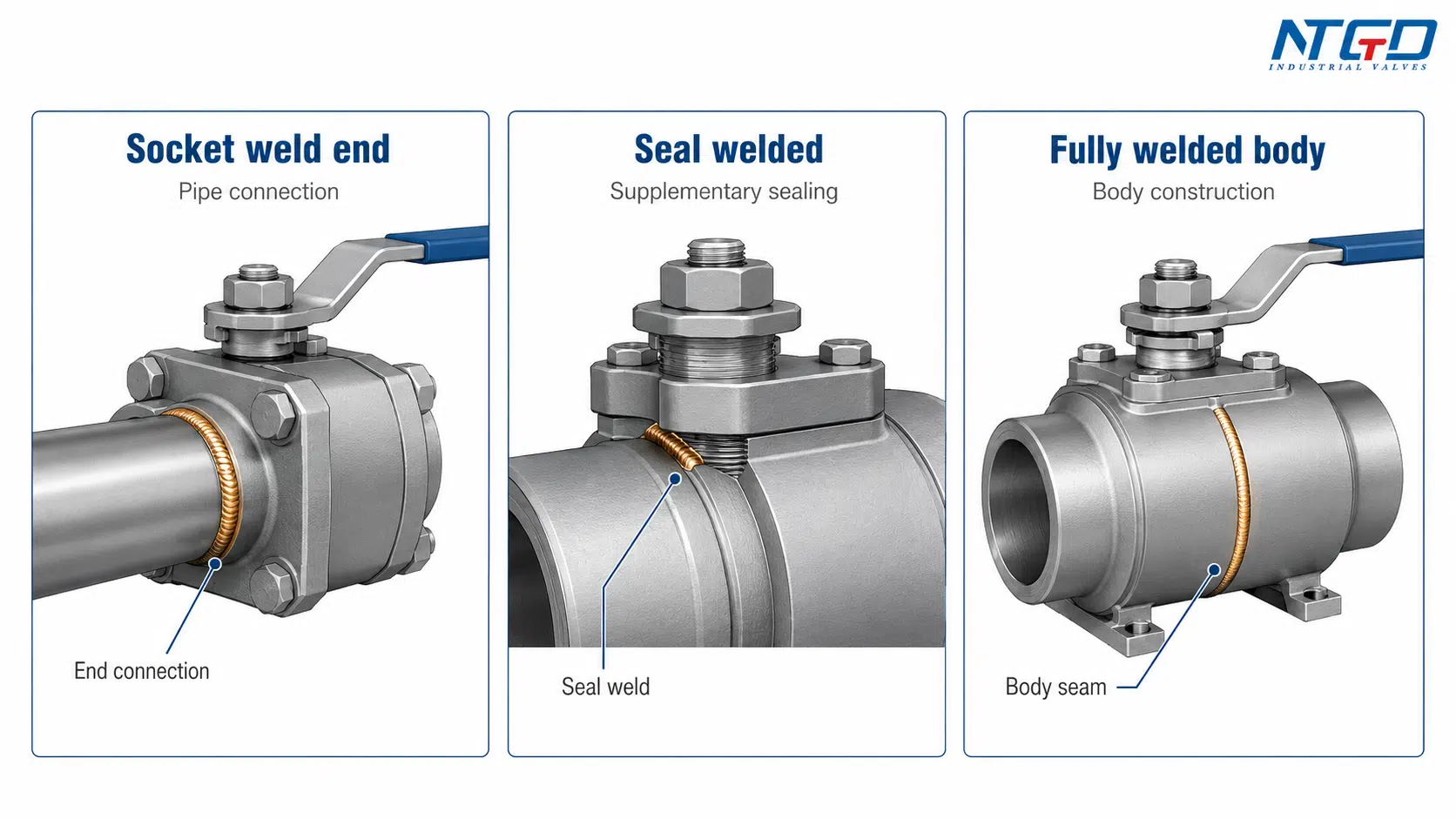
¿Puedo desmontar una válvula de bola con conexión por soldadura de manguito después de que se haya soldado a la tubería?
Una válvula de bola con soldadura de manguito es más difícil de desmontar que las válvulas roscadas o con bridas, ya que está soldada a la tubería. Algunas válvulas de bola de tres piezas con soldadura de manguito pueden permitir el mantenimiento de la sección central mientras los extremos permanecen soldados, pero esto depende del diseño de la válvula, el aislamiento seguro, el acceso a los pernos y el espacio libre para la instalación.
¿El calor de la soldadura puede dañar los asientos o las juntas de las válvulas de bola?
Sí, el calor de la soldadura puede afectar a los asientos blandos, las juntas de la carcasa o las empaquetaduras si no se tienen debidamente en cuenta el diseño de la válvula y el método de instalación. El riesgo depende de la construcción de la válvula, el material del asiento, el diseño de los extremos, el procedimiento de soldadura, el aporte de calor y las instrucciones del fabricante.
¿Qué información debo proporcionar antes de pedir una válvula de bola con soldadura de manguito?
Prepara el tamaño de la válvula, el espesor de la tubería, la presión nominal, el material del cuerpo, el material del asiento y de la junta, el medio, la temperatura, el tipo de conexión, la construcción del cuerpo, el método de operación, los requisitos para los extremos de soldadura por encaje, las dimensiones, los requisitos de planos, los requisitos de pruebas y el plan de mantenimiento de los extremos soldados.
Conclusión
Una válvula de bola con conexión por soldadura de manguito puede definirse como una válvula de bola de cuarto de vuelta con extremos de tubería con conexión permanente por soldadura de manguito. El mecanismo de bola permite el cierre total (abierto/cerrado), mientras que los extremos con conexión por soldadura de manguito determinan cómo se instala la válvula en el sistema de tuberías.
La decisión principal a la hora de elegir no se limita a si la válvula cuenta con extremos de soldadura por encaje. El comprador también debe verificar la construcción del cuerpo, el material, la compatibilidad del asiento y la junta, la presión nominal, el tipo de puerto, las dimensiones del encaje, los requisitos del plano y el acceso para el mantenimiento después de la soldadura. Para tuberías soldadas compactas de diámetro pequeño, una válvula de bola con conexión de soldadura por encaje puede ser una opción práctica. Para sistemas que requieran desmontajes frecuentes, dimensiones de reemplazo inciertas o un amplio acceso para el mantenimiento, se debe revisar el tipo de conexión y el diseño del cuerpo en relación con el plan de soldadura y mantenimiento del proyecto antes de la compra.
Para la selección del proyecto, prepare las condiciones de servicio y los requisitos dimensionales antes de solicitar una válvula. Esto ayuda a confirmar si la válvula de bola con conexión de soldadura por encaje se ajusta a las especificaciones de la tubería, el espacio de instalación, la clase de presión, los requisitos de material, la conexión de extremos soldados y el plan de mantenimiento.
¿Necesitas ayuda para elegir una válvula de bola con conexión por soldadura?
Para seleccionar una válvula de bola con conexión por soldadura de manguito, comparta con NTGD Valve el tamaño de la válvula, la presión nominal, el material del cuerpo, el material del asiento, el fluido, la temperatura, el espesor de la tubería, los requisitos de conexión en los extremos y las necesidades de planos. NTGD Valve puede ayudarle a evaluar la aplicación de su válvula de bola con conexión por soldadura de manguito en función de las condiciones específicas de servicio, los requisitos de los extremos soldados y el paquete de dimensiones que se analizan en esta guía.
