
Nom de l'auteur : Bruce Zheng
Rôle de l'auteur : Cofondateur et ingénieur en vannes chez NTGD Valve
Bio de l'auteur : Bruce Zheng est cofondateur et ingénieur en vannes chez NTGD Valve, qui se concentre sur la sélection des vannes industrielles, les applications et le contenu technique pour les acheteurs B2B mondiaux.
Dernière mise à jour : 22 juin 2026
Un Robinet à boisseau sphérique API 6D Il s'agit d'une vanne à bille destinée aux réseaux de canalisations, conçue, fabriquée, testée et documentée conformément aux exigences de la norme API 6D lorsque le cahier des charges du projet impose cette norme. Elle est couramment utilisée pour l'isolement des conduites dans les secteurs du pétrole, du gaz, de la pétrochimie, du transport, des terminaux et des systèmes de traitement connexes, où la fiabilité de la fermeture, l'intégrité de l'enveloppe sous pression, les rapports d'essais et la traçabilité sont des critères importants avant l'approbation de l'achat.
Contrairement à une vanne à bille industrielle à usage général, une vanne à bille API 6D fait généralement l'objet d'un examen dans le cadre du processus de réception d'un projet. La différence ne réside pas uniquement dans la forme de la vanne. Elle concerne également la vérification de la conception, les essais de pression, la traçabilité des matériaux, le marquage, les procès-verbaux d'inspection et la documentation, qui doivent tous être conformes à l'appel d'offres, à la fiche technique, à la classe de tuyauterie et à la norme du projet.
Pour les acheteurs et les ingénieurs de projet, ce terme ne désigne pas seulement une vanne à bille dotée d'une bille rotative. Il renvoie à un référentiel technique. Avant de commander des vannes à bille conformes à la norme API 6D, il convient de Critères de sélection des vannes à bille—notamment le type de vanne, la conception de l'alésage, la construction du corps, la conception du siège, la classe de pression, le matériau, le mode de fonctionnement, les rapports d'essais et les documents requis—doivent être confirmés avant l'établissement du devis et la production.
Dans le langage courant des appels d'offres, les expressions “ vanne à bille API 6D ” et “ vanne à bille API 6D ” désignent généralement la même catégorie de produits, mais le choix final doit toujours être confirmé par le cahier des charges complet de la vanne, et non par la seule appellation.
Qu'est-ce qu'un robinet à boisseau sphérique API 6D ?
Une vanne à bille API 6D est une vanne d'arrêt à quart de tour utilisée dans les réseaux de canalisations. À l'intérieur de la vanne, une bille percée d'un alésage traversant pivote entre les positions ouverte et fermée. Lorsque l'alésage est aligné avec la canalisation, le fluide peut s'écouler à travers la vanne. Lorsque la bille pivote d'environ 90 degrés, la partie pleine de la bille bloque le passage du fluide.
C'est la mention « API 6D » dans la désignation qui permet de la distinguer d'une vanne à bille à usage général lors d'une procédure d'approvisionnement ou d'une étude technique. Du point de vue de l'acheteur, la mention « API 6D » signifie que la vanne est envisagée pour une utilisation dans des pipelines, où le contrôle de la conception, le contrôle de la fabrication, les essais de pression, la documentation, le marquage et la traçabilité font partie intégrante du processus d'achat et d'inspection.
On envisage généralement l'utilisation d'une vanne à bille API 6D lorsqu'une vanne d'isolement de pipeline doit répondre à la fois aux exigences techniques en matière de service et aux exigences relatives à la documentation du projet. Si un projet impose la norme API 6D mais qu'une vanne à bille à usage général est proposée sans les documents requis, celle-ci peut poser des problèmes d'homologation, d'inspection ou de traçabilité, même si sa fonction de base (ouverture-fermeture) semble similaire.
Une vanne à bille API 6D peut être proposée dans différentes configurations, notamment à bille flottante, à pivot, à entrée latérale, à entrée par le haut, à corps divisé, entièrement soudée, à siège souple ou à siège métallique. Le choix de la version appropriée dépend du diamètre de la conduite, de la classe de pression, du fluide, de la température, de la fréquence de fonctionnement, des exigences en matière de fermeture, de l'accès pour l'inspection et des exigences de la documentation du projet.
Une façon pratique de lire le nom du produit est la suivante :
| Durée | Ce que cela signifie en matière de sélection |
|---|---|
| API 6D | La vanne est définie dans le cadre d'une norme relative aux vannes de pipeline. |
| Vanne à bille | L'élément de fermeture est une bille rotative percée d'un alésage central. |
| Service de pipelines | La vanne est généralement choisie pour assurer l'isolation ou la fermeture des conduites ou des installations. |
| Confirmation de l'appel d'offres | Il reste à confirmer les caractéristiques de la vanne finale : dimensions, classe, alésage, matériau, siège, mode de fonctionnement, essais et documentation. |
Cela signifie qu’il ne faut pas choisir une vanne à bille API 6D uniquement parce que ce mot-clé figure dans le titre d’un catalogue. L’acheteur doit vérifier si la conception de la vanne proposée, l’étendue des essais, les matériaux, la classe de pression, le dossier de documentation et les certificats correspondent aux exigences du projet.
Ce que signifie la norme API 6D pour les vannes à bille
API 6D est associée aux vannes de pipeline. Dans le cas des vannes à bille, elle influe sur la manière dont la vanne est spécifiée, contrôlée, testée, documentée, marquée et réceptionnée avant la livraison. Elle ne transforme pas automatiquement chaque vanne à bille en vanne de pipeline et ne doit pas être considérée comme un simple argument marketing.
La norme API 6D fournit principalement un cadre pour la conception, la fabrication, les essais de pression, la documentation, le marquage et la traçabilité dans le domaine des vannes de pipelines. Les caractéristiques telles que les modèles DBB et DIB, la conception résistante au feu, les garnitures spéciales, l’injection d’étanchéité d’urgence ou les exigences relatives aux matériaux destinés à un service acide doivent être confirmées séparément dans le cahier des charges du projet et l’appel d’offres. Elles ne doivent pas être supposées sur la seule base de la désignation API 6D.
Pour un robinet à boisseau sphérique conforme à la norme API 6D, l'acheteur doit généralement examiner plusieurs aspects :
| Section « Avis » | Que signifie la norme API 6D dans le cadre de l'évaluation par l'acheteur ? |
|---|---|
| Conditions de conception | La conception de la vanne doit permettre de valider la conception des vannes de canalisation, et pas seulement leur utilisation dans le cadre d'une application industrielle générale de fermeture. |
| Classe de pression | La pression nominale doit être conforme à la classe de tuyauterie, au type de raccordement, à la conception de l'enveloppe sous pression et aux documents d'agrément du projet. |
| Conception de l'alésage | Le diamètre intérieur influe sur le tracé du flux, le contrôle par raclage, la perte de charge et la conformité de la vanne aux exigences d'exploitation de la canalisation. |
| Construction du corps | La conception du corps influe sur la disposition des parois sous pression, l'accès aux opérations d'inspection, l'étanchéité des joints du corps, l'accès pour la maintenance et la planification de l'installation. |
| Conception du siège et de l'étanchéité | Le matériau du siège et la conception du joint influent sur le comportement de fermeture, le couple de manœuvre, la résistance à la température, la compatibilité d'utilisation et les attentes en matière d'acceptation. |
| Rapports d'essais | Les rapports relatifs aux essais de la coque/de la carrosserie, du siège et aux essais fonctionnels doivent être fournis dans le dossier de livraison ou d'inspection. |
| Traçabilité des matériaux | Les pièces sous pression et les pièces en contact avec le fluide doivent pouvoir être rattachées à la spécification matérielle requise et au dossier de certification correspondant. |
| Marquage et documentation | La plaque signalétique, l'étiquette, le plan, la fiche technique, le rapport d'essai et les procès-verbaux d'inspection doivent être conformes aux exigences de l'appel d'offres et de la documentation du projet. |
Si les rapports d'essais, les certificats de matériaux, le marquage ou les détails des plans et fiches techniques ne sont pas validés suffisamment tôt, le projet risque de se heurter à un blocage de la documentation, à un retard d'inspection, à des problèmes de réception sur site ou à un réexamen de remplacement une fois que la vanne aura déjà été fabriquée ou expédiée.
Champ d'application de la norme API 6D : vannes à bille, à guillotine, anti-retour et à bouchon
Une source fréquente de confusion réside dans la différence entre Robinet à boisseau sphérique API 6D et Vannes API 6D. La norme API 6D s'applique à plusieurs catégories de vannes de pipeline, et pas uniquement aux vannes à bille.
| Catégorie de vannes API 6D | Traitement de la page actuelle |
|---|---|
| Vannes à bille | Thème principal de cet article. |
| Vannes à guillotine | Il s'agit d'un type de vanne conforme à la norme API 6D, mais ce n'est pas le sujet qui nous intéresse ici. |
| Clapets anti-retour | Il s'agit d'un type de vanne conforme à la norme API 6D, mais ce n'est pas le sujet qui nous intéresse ici. |
| Vannes à bouchon | Il s'agit d'un type de vanne conforme à la norme API 6D, mais ce n'est pas le sujet qui nous intéresse ici. |
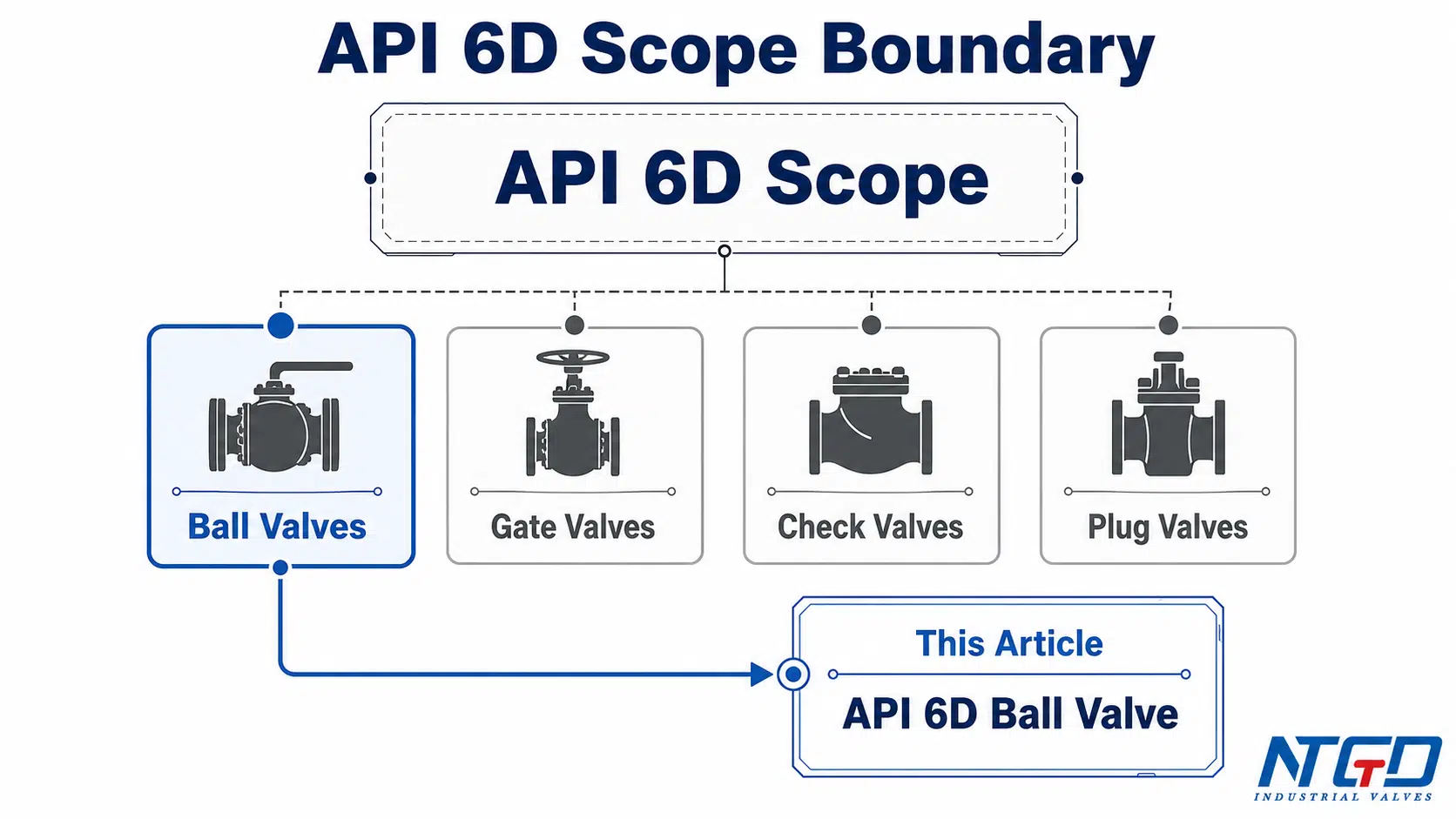
Cette page est exclusivement consacrée aux vannes à bille API 6D. Les sujets plus généraux, tels que les vannes API 6D en tant que catégorie à part entière, les vannes à obturateur API 6D, les vannes à guillotine API 6D ou les clapets anti-retour API 6D, doivent être traités séparément afin d'éviter toute confusion entre les fonctions des vannes et les critères de sélection.
Pourquoi cette page est consacrée aux robinets à bille
Le choix des vannes à bille soulève des questions spécifiques : modèle flottant ou monté sur tourillon, passage intégral ou passage réduit, siège en matériau souple ou en métal, entrée latérale ou entrée par le haut, commande manuelle ou motorisée, et compatibilité de la conception avec les exigences du projet en matière de fermeture et de documentation.
Ces questions diffèrent de la logique de sélection applicable aux vannes à guillotine, aux clapets anti-retour ou aux vannes à boisseau. Le fait que cette page soit consacrée aux vannes à bille permet aux acheteurs de comparer les options de construction adaptées avant d'envoyer un appel d'offres.
Fonctionnement d'une vanne à bille API 6D dans les réseaux de canalisations
Une vanne à bille API 6D fonctionne grâce à la rotation d'une bille percée à l'intérieur du corps de vanne. En position ouverte, l'alésage de la bille est aligné avec l'entrée et la sortie, ce qui permet au fluide de s'écouler à travers la vanne. En position fermée, la bille pivote de manière à ce que son alésage soit perpendiculaire à la canalisation, et la partie pleine de la bille bloque le passage du fluide.
Le couple de manœuvre est transmis depuis le volant, le réducteur, le levier ou l'actionneur à la bille, en passant par la tige. Pour les grandes tailles ou les classes de pression élevées, on privilégie généralement l'utilisation d'un réducteur ou d'un actionneur, car la manœuvre manuelle directe peut nécessiter un couple trop important.
Robinet d'arrêt à un quart de tour et circuit d'écoulement
Le principal avantage fonctionnel d'une vanne à bille réside dans sa fermeture par quart de tour. Une rotation de 90 degrés permet de faire passer la vanne de la position entièrement ouverte à la position entièrement fermée. Cela rend les vannes à bille API 6D particulièrement utiles lorsqu'une isolation rapide est nécessaire, mais cela implique également que la conception du système doit tenir compte des coups de bélier, des procédures d'exploitation, du temps de course de l'actionneur et de la vitesse de fermeture.
Dans les réseaux de canalisations à longue distance ou lors de l'isolation d'une station, une fermeture rapide peut entraîner un risque de coup de bélier ou de surpression. Pour les vannes motorisées, le temps de fermeture, la position de sécurité, le signal de commande et la séquence de fonctionnement doivent être examinés lors de la sélection de la vanne, et non pas uniquement lors de la mise en service.
Dans le domaine des canalisations, le tracé du flux revêt une importance particulière. Le diamètre intérieur de la bille doit correspondre aux exigences du projet. Une vanne qui semble adaptée à première vue peut s'avérer inadaptée si son diamètre intérieur, son siège, son raccord d'extrémité ou sa classe de pression ne correspondent pas aux spécifications de la canalisation.
Alésage plein vs alésage réduit
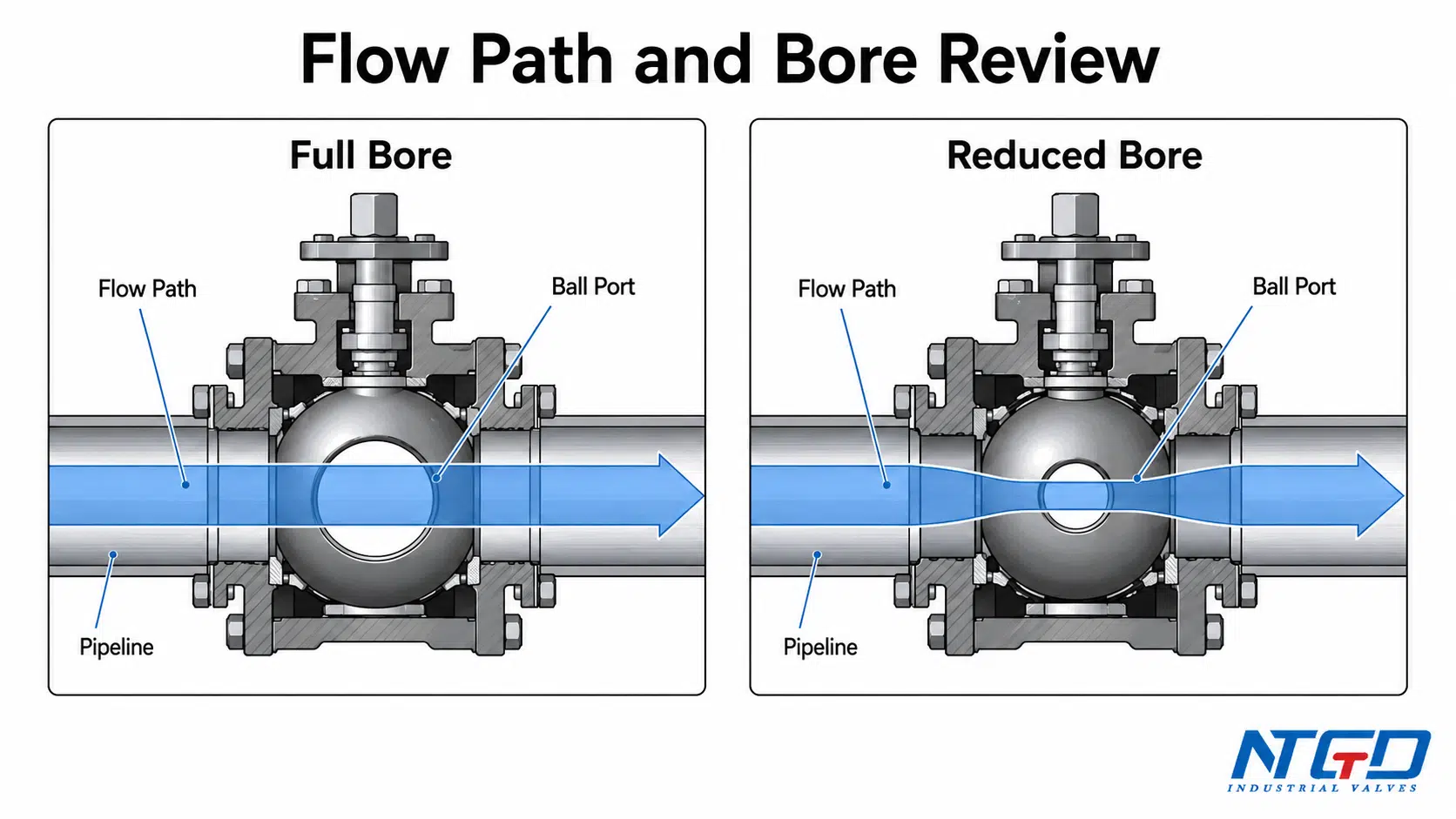
Perçage complet « alésage réduit » est un terme important utilisé dans les appels d'offres pour les vannes à bille conformes à la norme API 6D.
| Type d'alésage | Signification de la sélection | Point de contrôle type |
|---|---|---|
| Perçage complet | Le diamètre intérieur est proche de celui de la canalisation, en fonction de la conception et des spécifications. | Cet aspect est généralement examiné lors d'opérations de raclage, en cas de restriction de débit ou lorsqu'un accès est nécessaire pour le nettoyage de la canalisation. |
| Alésage réduit | Le diamètre intérieur est inférieur au diamètre intérieur de la canalisation. | Cette solution peut être envisagée lorsque l'on peut se contenter d'un coût moindre, d'un poids réduit ou d'une restriction de débit moins importante. |
Le type de passage approprié doit être indiqué dans l'appel d'offres et confirmé dans la fiche technique ou le plan. Il doit être adapté à la classe de tuyauterie, aux exigences du procédé, aux exigences en matière de raclage, à la perte de charge prévue et à l'enveloppe d'installation.
Principaux types de vannes à bille API 6D
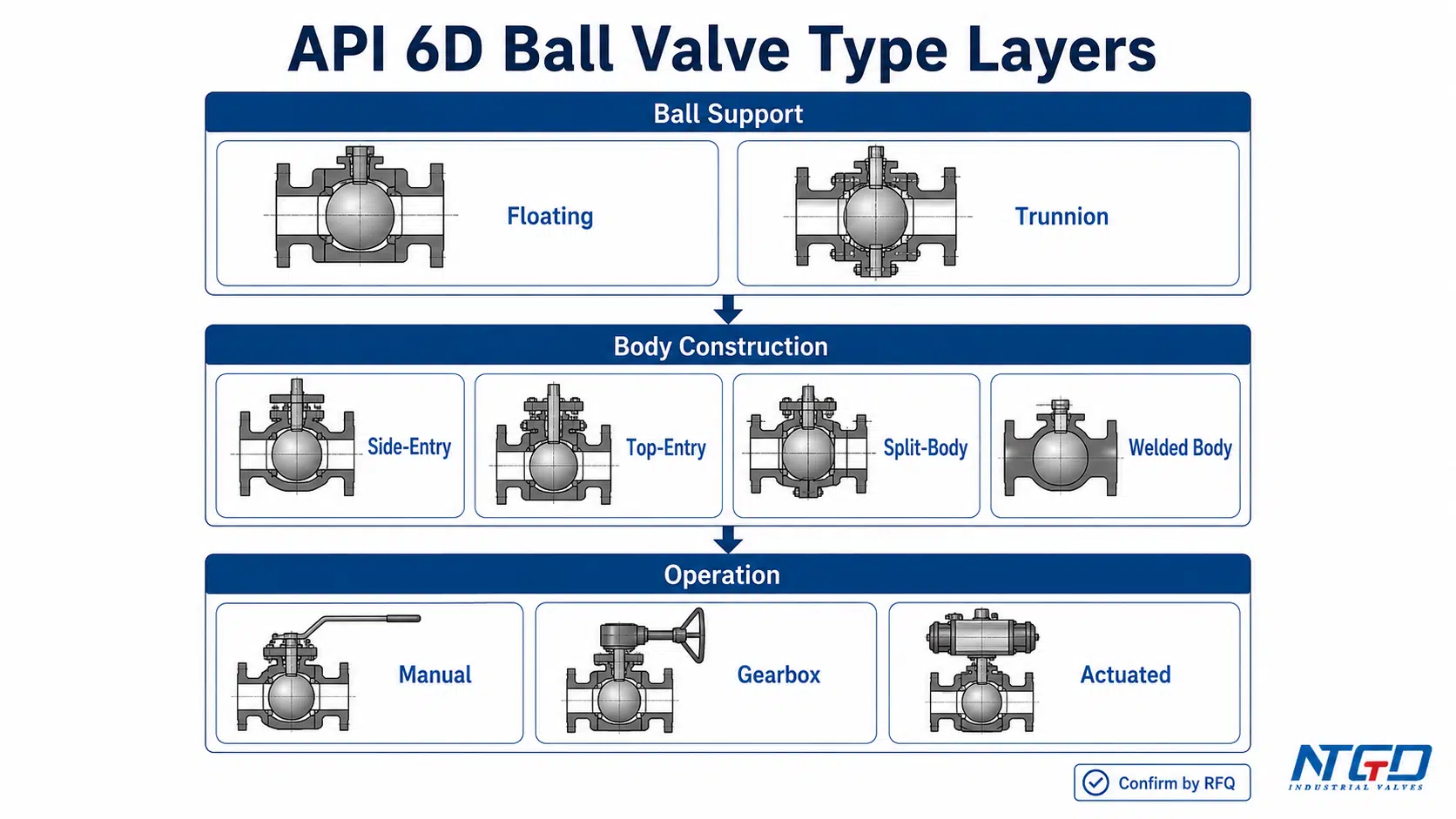
Les vannes à bille API 6D peuvent être classées de plusieurs façons. Une classification claire permet d’éviter un problème courant dans les appels d’offres : confondre la construction du corps, la conception du support de la bille et le mode de fonctionnement, comme s’il s’agissait d’un seul et même critère de sélection.
Lors de la sélection, les vannes à bille API 6D sont généralement évaluées selon trois critères : tout d’abord la conception du support de la bille, puis la structure du corps de vanne, et enfin le mode de fonctionnement. Si ces critères sont confondus, un devis peut correspondre à la désignation visible de la vanne tout en ne répondant pas aux exigences en matière de couple, d’accès pour la maintenance, d’automatisation ou d’inspection.
Montage flottant ou sur tourillon
La première question importante à se poser lors du choix d'une vanne est de savoir si celle-ci utilise une bille flottante ou une bille montée sur tourillon.
| Type | Logique de conception | Contexte de sélection commun | Avertissement concernant les avis |
|---|---|---|---|
| Robinet à bille flottant API 6D | La bille repose principalement sur les sièges et se déplace légèrement sous la pression pour favoriser l'étanchéité. | Petites tailles, plages de pression modérées ou applications pour lesquelles une conception à élément flottant est adaptée à l'usage prévu. | Le couple, la charge sur le siège, la classe de pression, l'alésage et le matériau du siège doivent être vérifiés avant le choix définitif. |
| Vanne à bille API 6D à montage sur tourillon | La bille est soutenue mécaniquement par des tourillons, ce qui réduit la charge exercée sur le siège sous pression. | Grandes tailles, classes de pression élevées, isolation des conduites et applications dans lesquelles le couple de fonctionnement ou la charge sur le siège constituent un enjeu majeur. | Il convient de vérifier la conception du siège, la décompression de la cavité, les exigences DBB/DIB, le dimensionnement de l'actionneur et les données de couple. |
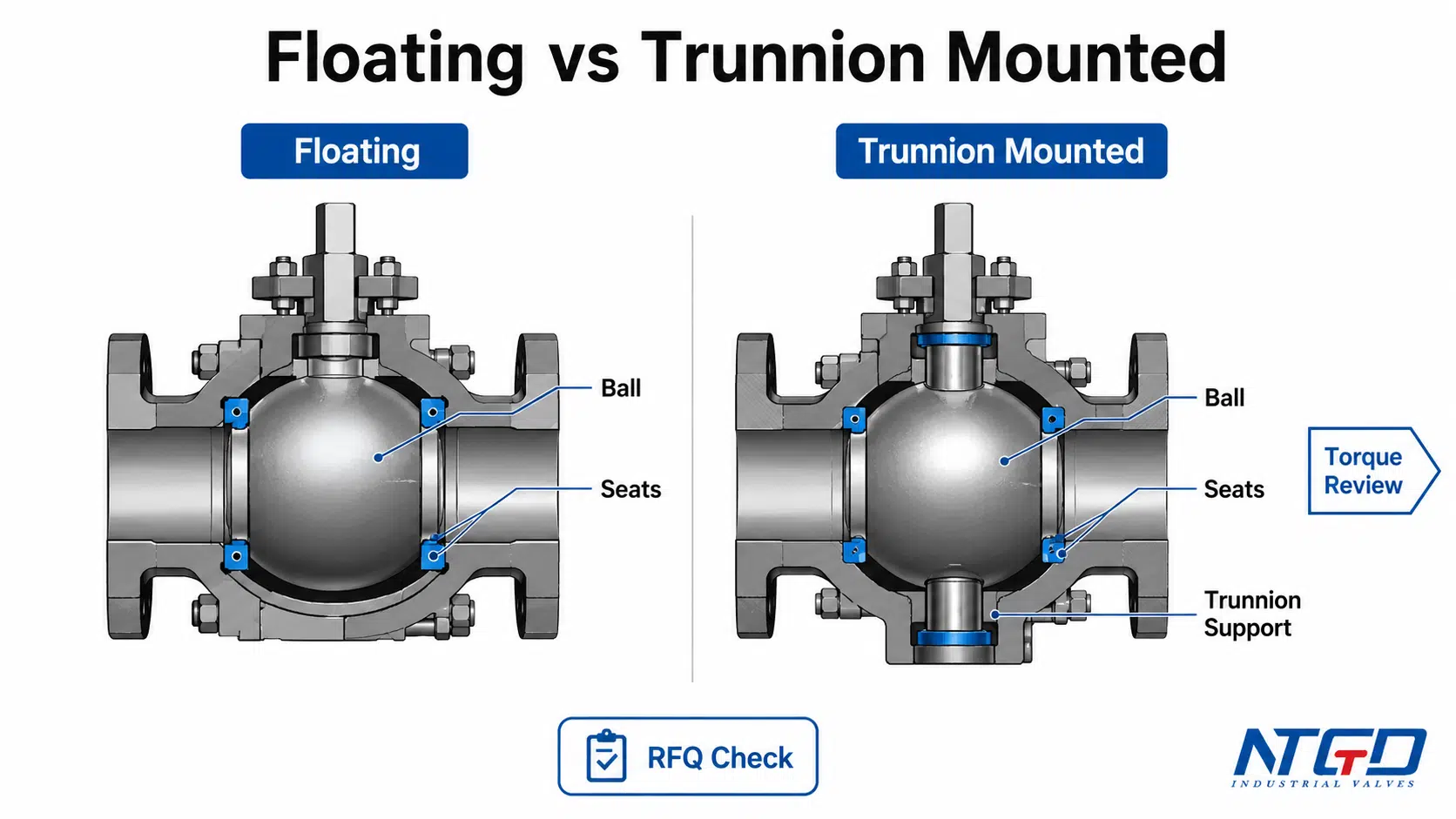
Modèles flottants et montés sur tourillon Le choix ne doit pas se fonder uniquement sur le coût. Pour les grandes tailles, les classes de pression élevées, les pressions différentielles importantes ou les applications où le couple de fonctionnement et la charge sur le siège sont déterminants, on examine généralement la conception à montage sur tourillon avant de valider définitivement l’appel d’offres. La décision finale doit également tenir compte de la conception de la décharge de la cavité, des exigences relatives à l’alésage, du dimensionnement de l’actionneur et de la documentation du projet.
À entrée latérale, à entrée par le haut, à corps divisé et à corps soudé
La deuxième question importante à se poser lors du choix concerne la structure de la carrosserie, en particulier lorsque les acheteurs doivent comparer construction à entrée latérale ou à entrée par le haut avant l'approbation de l'appel d'offres.
| Construction de la carrosserie | Ce que cela signifie | Impact de la sélection |
|---|---|---|
| Entrée latérale | Le corps de vanne est assemblé par le côté ; il est souvent composé de deux ou trois pièces. | C'est un élément courant sur de nombreuses vannes à bille utilisées dans les canalisations ; il permet, selon la conception, l'assemblage en usine et l'accès pour l'entretien. |
| Entrée par le haut | L'accès aux pièces internes se fait par le haut de la vanne. | Utile lorsque l'on envisage un accès pour la maintenance en ligne, mais les dimensions, la conception et les exigences du projet doivent être vérifiées. |
| Corps divisé | La structure est divisée en sections assemblées à l'aide de boulons ou d'autres techniques de construction. | Ce système offre une certaine souplesse de montage, mais il convient de vérifier l'étanchéité des joints de la carrosserie, le serrage des boulons, le matériau des joints d'étanchéité et les rapports d'inspection. |
| Corps soudé / corps entièrement soudé | Les raccords de la carrosserie sont soudés plutôt que boulonnés dans l'enveloppe sous pression principale. | Cette solution est souvent envisagée lorsque le risque de fuite au niveau des joints boulonnés doit être réduit au minimum, mais que l'accès pour les réparations sur site peut être plus limité. |
L'article original classait au même niveau les modèles à entrée latérale, à entrée par le haut, à corps soudé, manuels et à commande motorisée. Pour l'examen des appels d'offres, il est plus clair de distinguer construction de la carrosserie de mode opératoire.
Fonctionnement manuel, par boîte de vitesses et par commande assistée
Le mode de fonctionnement constitue un autre critère de sélection.
| Mode opératoire | Analyse « Best-Fit » | Sélection Attention |
|---|---|---|
| Levier ou volant | Petites vannes ou conditions de couple réduit. | Ne convient pas lorsque le couple est trop élevé ou lorsque le fonctionnement doit se faire à distance. |
| Boîte de vitesses | Vannes manuelles de grande taille pour lesquelles une réduction du couple est nécessaire. | Il convient de vérifier le rapport de réduction, l'orientation du volant, le sens d'ouverture et l'accès au site. |
| Actionneur pneumatique, électrique ou hydraulique | Commande à distance, automatisation, arrêt d'urgence ou intégration des systèmes de commande. | Il convient de vérifier le couple de l'actionneur, la position en cas de défaillance, le signal de commande, la source d'alimentation, le temps de course et la disposition des fins de course. |
Pour vannes à bille motorisées conformes à la norme API 6D, la vanne et l'actionneur doivent être considérés comme un ensemble. Même si le corps de vanne est conforme, un actionneur de capacité insuffisante peut empêcher la vanne de s'ouvrir ou de se fermer de manière fiable dans les conditions réelles d'exploitation.
Éléments clés et caractéristiques de conception à examiner
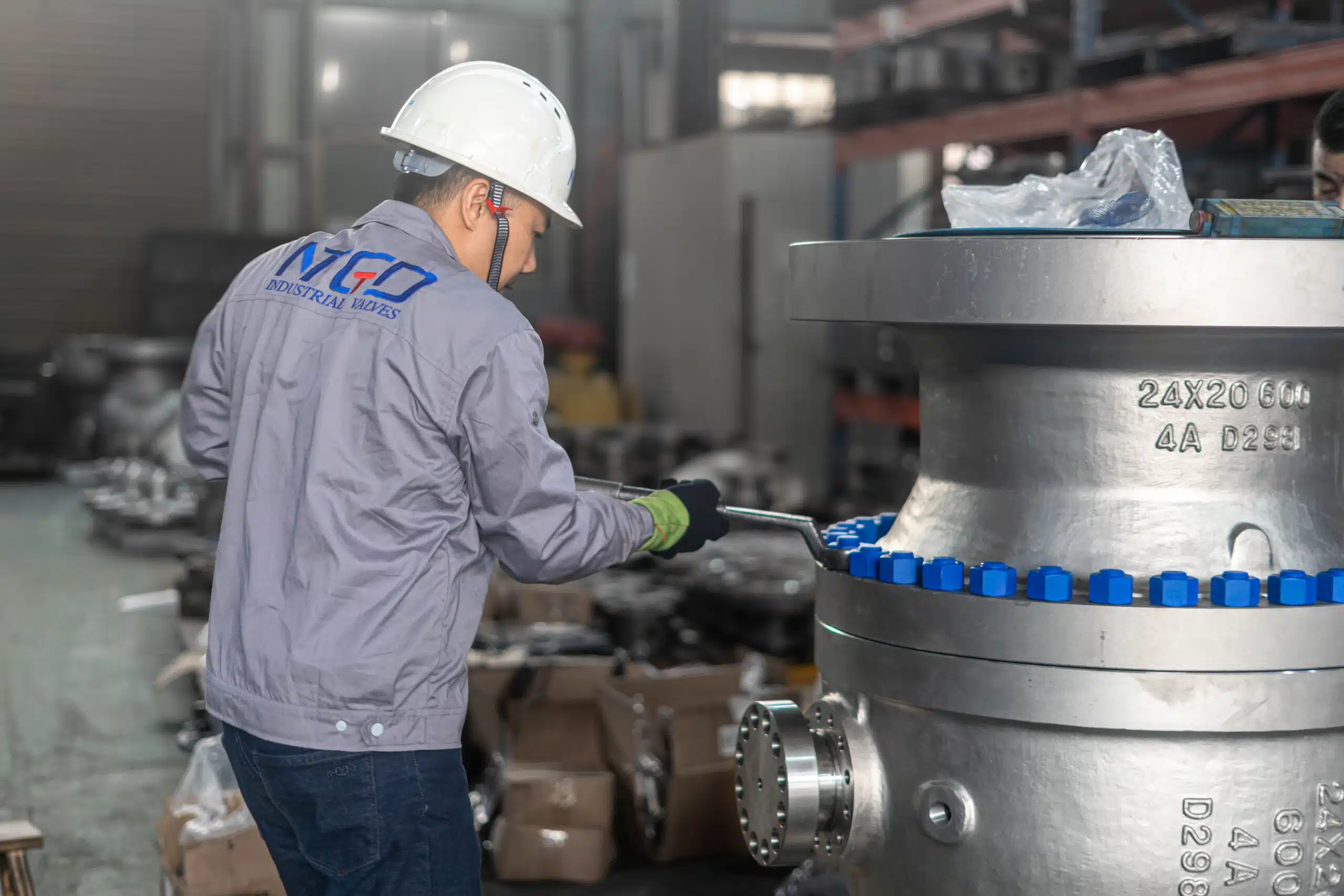
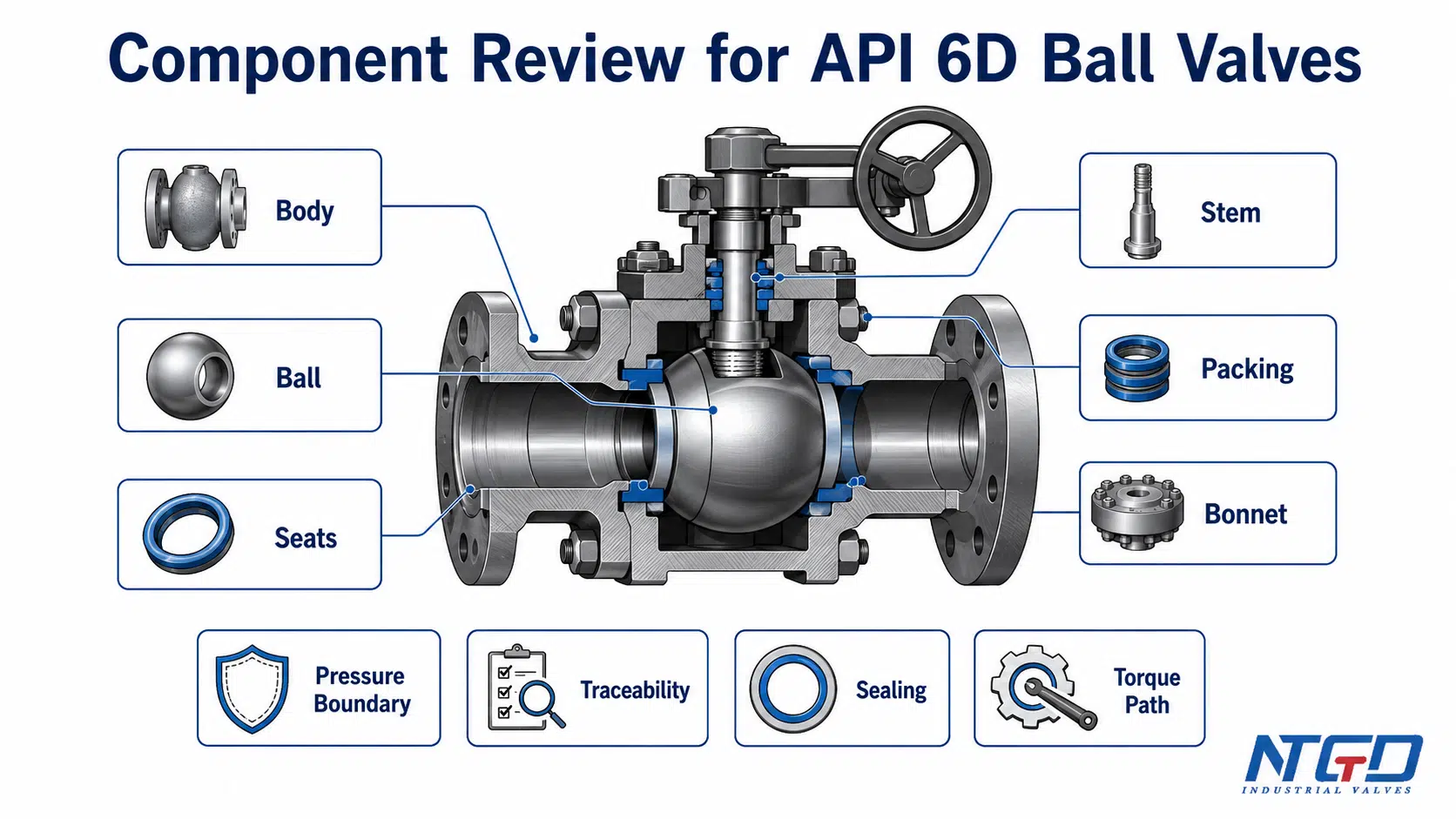
Une vanne à bille API 6D utilise les mêmes familles de composants de base que les autres vannes à bille industrielles, mais le choix des composants revêt une importance accrue dans le cadre d'une utilisation en canalisation. Les composants doivent être examinés dans le cadre de l'enveloppe sous pression, du système d'étanchéité, du chemin de couple, du dossier de traçabilité et de la documentation du projet.
Corps, bille, sièges, tige, garniture et chapeau
| Composant | Fonction | Impact de la sélection |
|---|---|---|
| Corps de vanne | Il maintient l'enveloppe sous pression et soutient les pièces internes. | Le matériau du corps, la conception, l'épaisseur des parois, les raccords d'extrémité et les registres d'inspection ont une incidence sur l'intégrité de l'enveloppe sous pression, la traçabilité des matériaux et la conformité des matériaux utilisés dans le cadre du projet. |
| Boule | Élément de fermeture rotatif muni d'un alésage central. | Le type d'alésage, le revêtement, l'état de finition et l'état de la surface ont une incidence sur les performances d'étanchéité, la vérification du trajet d'écoulement, le couple et la compatibilité avec l'utilisation prévue. |
| Sièges | Assurer l'étanchéité entre la bille et le corps. | Le matériau du siège influe sur les performances de fermeture, la plage de température, le couple de fonctionnement, la compatibilité d'utilisation, ainsi que sur l'adéquation de la conception proposée avec l'appel d'offres. |
| Tige | Transmet le couple de l'opérateur à la bille. | La conception de la tige influe sur la transmission du couple, la liaison avec l'opérateur, l'étanchéité externe et la capacité de la vanne à fonctionner de manière fiable sous la différence de pression requise. |
| Emballage | Joints au niveau de la tige. | Les matériaux d'étanchéité et la conception des presse-étoupe ont une incidence sur le risque de fuite externe, l'acceptation sur site, la fréquence de fonctionnement et la compatibilité avec la température et le fluide. |
| Zone du capot / du presse-étoupe | Assure le bon fonctionnement du dispositif d'étanchéité de la tige et de l'interface utilisateur. | La conception des fixations, des joints d'étanchéité, des accès et de l'assemblage doit être vérifiée pour le dossier de construction et de documentation retenu. |
Le matériau de chaque pièce en contact avec le fluide et sous pression doit être adapté au fluide, à la pression, à la température, au risque de corrosion et aux spécifications du projet en matière de matériaux. Les certificats de conformité des matériaux et leur traçabilité doivent être vérifiés avant la production, le contrôle ou l'expédition.
Conception du siège, DBB / DIB et décompression de la cavité
La conception du siège est l'un des critères les plus importants dans le choix d'une vanne à bille conforme à la norme API 6D. Un siège qui fonctionne bien dans un type d'application donné peut ne pas convenir à une autre application caractérisée par des températures plus élevées, la présence de particules abrasives, des cycles de pression ou des exigences particulières en matière de fermeture.
Les points d'évaluation courants liés aux sièges sont notamment les suivants :
| Fonctionnalité | Pourquoi c'est important |
|---|---|
| Siège souple | Ce produit est couramment évalué pour sa capacité à assurer une fermeture étanche dans des applications d'isolation de conduites d'huile, de gaz ou de service général. La compatibilité thermique et chimique, ainsi que la résistance à l'usure, doivent encore être confirmées. |
| Siège métallique / siège métal contre métal | Peut être envisagé dans des conditions d'utilisation à haute température, abrasives ou difficiles, où les matériaux tendres risquent de se dégrader trop rapidement. |
| Exigences DBB / DIB | Ce point devrait être précisé dans le cahier des charges du projet, car le comportement d'étanchéité et la logique d'isolation des cavités peuvent varier selon la conception. |
| Soulagement de la pression dans la cavité | Il est important de tenir compte du risque de formation d'une pression de confinement dans la cavité corporelle. La méthode exacte dépend de la conception de la valve. |
| Injection d'un produit d'étanchéité en urgence | Cette spécification peut s'appliquer à certaines vannes de pipeline, mais elle ne doit pas être considérée comme acquise à moins d'être mentionnée dans la conception. |
Sièges souples et sièges métalliques sont souvent choisies en fonction des conditions d’utilisation : des sièges souples pour les applications de fermeture dans un milieu propre, et des sièges métalliques lorsque la température, la présence de particules, les cycles de pression ou des conditions d’utilisation difficiles risquent d’endommager les matériaux souples. Une vanne à bille API 6D à siège métallique peut offrir une meilleure durabilité dans certaines applications difficiles, mais cela peut également avoir une incidence sur le couple et les performances de fermeture. Ce point doit être clairement spécifié, testé et documenté.
DBB et DIB, le dégagement de la cavité, la conception résistante au feu et l'injection de mastic d'étanchéité doivent être considérés comme des éléments de spécification propres à chaque projet, et non comme des caractéristiques automatiques de toutes les vannes à bille conformes à la norme API 6D.
Matériau du corps : forgé ou moulé
Le terme Vanne en acier forgé conforme à la norme API 6D peut apparaître dans les résultats de recherche de produits, mais dans le cadre de cette page, il convient de le considérer comme un critère lié aux matériaux et à la fabrication, et non comme une consigne distincte.
| Matériau de la carrosserie / Construction | Signification de la sélection |
|---|---|
| Corps en acier forgé | Souvent envisagées pour les modèles de vannes de canalisation à haute pression, compactes ou spécifiques, lorsque le projet exige une fabrication à partir de matériaux forgés. |
| Corps en acier moulé | Couramment utilisé dans de nombreux modèles de vannes industrielles, en fonction de la taille, de la classe de pression, de la nuance de matériau et de la conception du fabricant. |
| Acier au carbone résistant aux basses températures | Peut faire l'objet d'une évaluation pour une utilisation dans des canalisations à basse température ou pour l'alimentation en gaz. |
| Acier inoxydable ou alliage | À envisager lorsque la résistance à la corrosion ou la compatibilité avec un milieu spécifique est requise. |
Lorsque l'on compare les vannes en acier moulé et forgé, les corps en acier forgé sont souvent envisagés pour les vannes de canalisations compactes ou destinées à des pressions élevées ; toutefois, le choix final du matériau doit respecter le cahier des charges du projet, la classe de pression, la plage de température, les exigences en matière de corrosion et le dossier technique.
Il ne faut pas considérer qu'un corps forgé est systématiquement plus adapté à toutes les applications de vannes à bille conformes à la norme API 6D.
Essais, inspections et documentation visant à confirmer
Les essais et la documentation constituent les principales raisons pour lesquelles les acheteurs recherchent des vannes à bille conformes à la norme API 6D plutôt que des vannes à bille classiques. La décision d'achat ne doit pas se limiter au nom du produit. La vanne proposée doit être accompagnée de rapports d'inspection et de documents répondant aux exigences du projet.
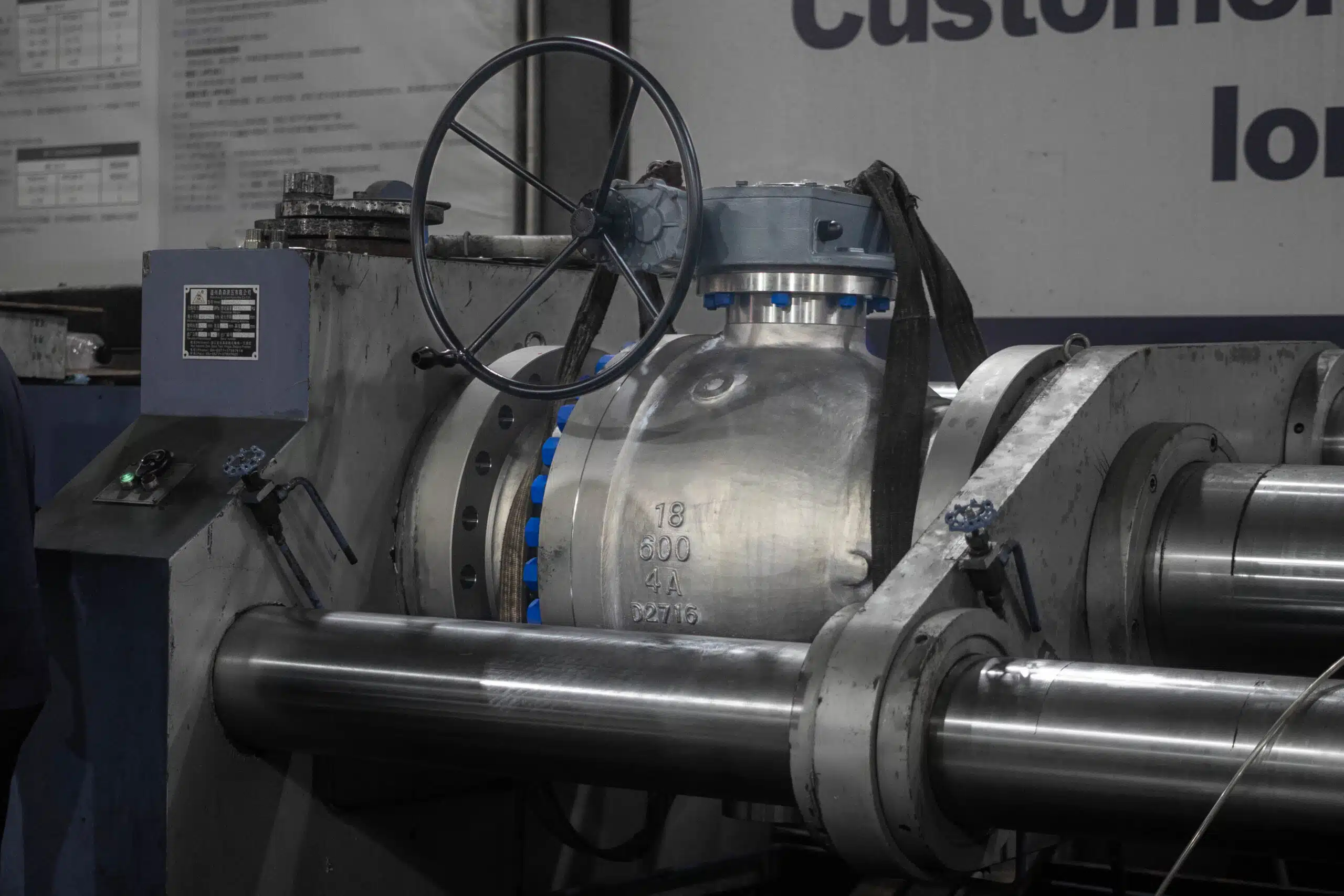
Rapports d'essais de pression, d'étanchéité et de fonctionnement
Dans le cadre des appels d'offres et des contrôles avant expédition, les acheteurs doivent généralement vérifier si le fabricant est en mesure de fournir les documents requis concernant essais de pression et essais fonctionnels.
Le périmètre exact des essais, les critères d'acceptation et les exigences relatives à la présence de témoins lors des contrôles doivent être conformes au cahier des charges du projet, au plan d'inspection et d'essais, ainsi qu'aux normes applicables.
| Élément de confirmation | Question d'un acheteur |
|---|---|
| Procès-verbal d'essai de pression de la coque / de la carrosserie | Le rapport précise-t-il le type de vanne, le fluide d'essai, la pression d'essai, la durée de l'essai, les critères d'acceptation et l'enveloppe sous pression soumise à l'essai ? |
| Rapport d'essai des sièges | Le dossier indique-t-il l'orientation du siège testé, les exigences en matière d'étanchéité, les exigences d'inspection et l'identification de la vanne ? |
| Test de fonctionnement | Le rapport confirme-t-il l'ouverture/la fermeture, l'indication de position, la course ou le déplacement, ainsi que le fonctionnement conformément à la configuration requise ? |
| Données relatives au couple nominal ou au dimensionnement de l'actionneur | Ces données tiennent-elles compte de la différence de pression, de la conception du siège, du mode de fonctionnement et, le cas échéant, de la marge de sécurité de l'actionneur ? |
| Point de contrôle | L'ITP précise-t-il si la présence d'un témoin du client, une inspection par un tiers ou des points de contrôle spécifiques sont requis avant l'expédition ? |
Une procédure d'essai détaillée doit être validée à partir du dossier technique du fabricant (ITP), du cahier des charges du projet, du bon de commande et documents normatifs applicables.
Certificats de matériaux, traçabilité et rapports d'inspection
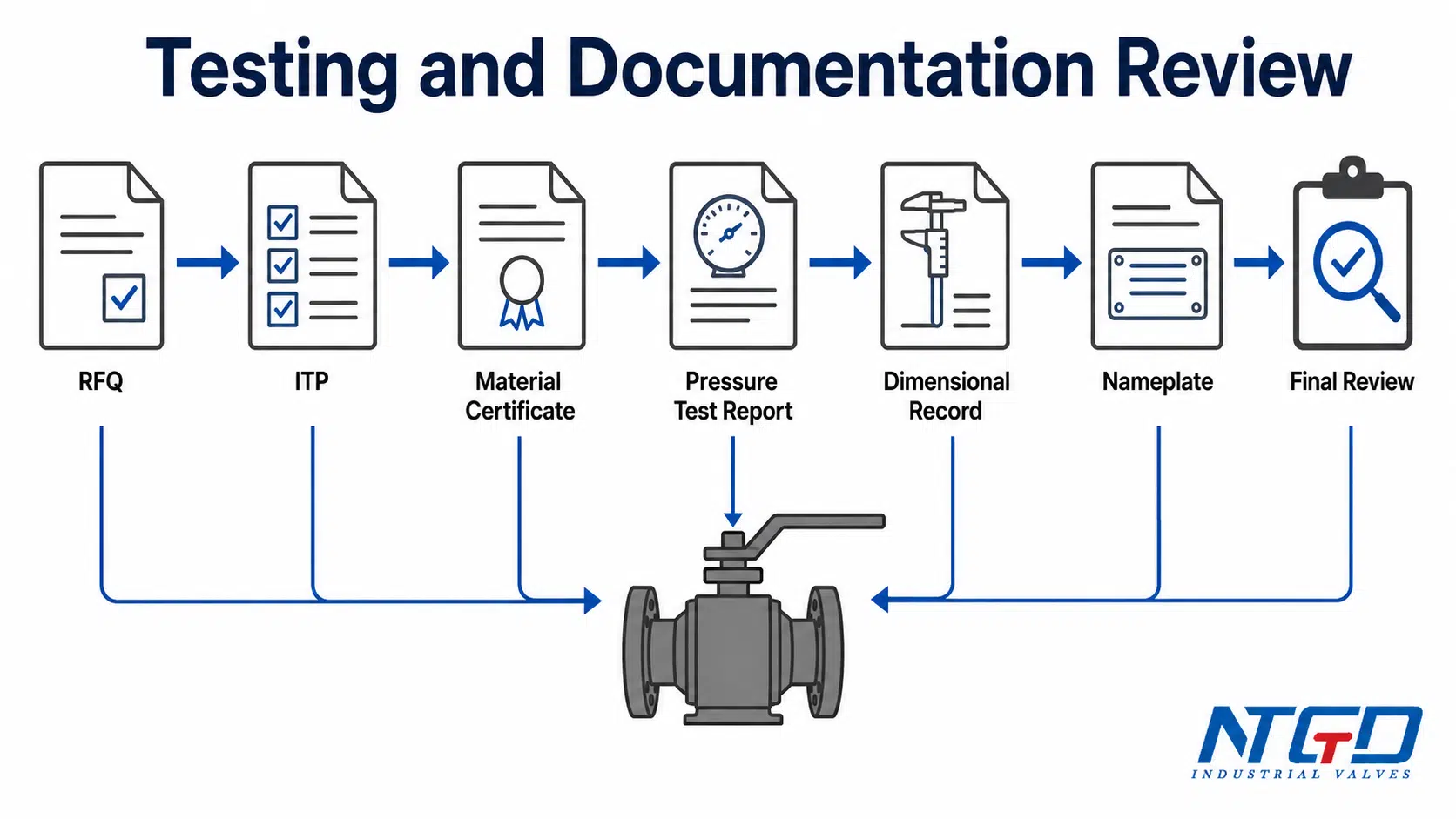
La documentation revêt souvent autant d'importance que le corps de vanne lui-même. Si le projet nécessite des vannes à bille conformes à la norme API 6D, les acheteurs doivent vérifier le dossier technique dès le début du projet, et non une fois la production terminée.
Les vérifications courantes des documents comprennent :
| Document / Dossier | Pourquoi c'est important |
|---|---|
| Certificat de matériau | Vérifie la nuance des matériaux utilisés pour les pièces sous pression et en contact avec le fluide. |
| Plan d'inspection et d'essai | Indique les étapes d'inspection prévues, les points de contrôle et les points d'arrêt. |
| Rapport d'essai de pression | Permet la validation des essais de résistance à la pression et d'étanchéité. |
| Fiche de contrôle dimensionnel | Permet de vérifier les dimensions, les raccords d'extrémité, la distance entre faces, l'alésage et les spécifications du plan. |
| Rapport sur le revêtement / la peinture | Peut être nécessaire dans le cadre d'installations de canalisations, souterraines, en mer ou en extérieur. |
| Marquage et informations figurant sur la plaque signalétique | Permet de faire correspondre l'identification de la vanne avec la fiche technique, le numéro d'étiquette, les dossiers du projet et le contrôle à la réception. |
| Dessin et fiche technique | Confirme la conception, le diamètre intérieur, la classe de pression, le matériau, le siège, le mode de fonctionnement, les accessoires et les dimensions de l'enveloppe. |
| Document de l'OIM | Permet de réaliser des contrôles relatifs à l'installation, au fonctionnement, à la mise en service et à la maintenance. |
Si ces documents ne sont pas validés avant l'expédition, la vanne peut passer le contrôle mécanique mais faire l'objet d'un blocage documentaire, d'un retard dans le contrôle à la réception ou de questions lors de la réception sur site.
Si les documents requis ne sont pas clairement précisés, l'appel d'offres doit les mentionner explicitement. À défaut, le fournisseur risque de fournir une vanne qui, bien que mécaniquement adaptée, ne sera pas complète au regard de la documentation requise pour la validation du projet.
Applications, adaptation et limites de sélection
Les vannes à bille API 6D sont couramment utilisées pour la fermeture et l'isolation dans les systèmes de canalisations. Elles servent généralement à assurer un fonctionnement fiable en position ouverte ou fermée, plutôt qu'à réguler le débit.
Applications des vannes à bille API 6D
Parmi les domaines d'application typiques, on peut citer :
| Domaine d'application | Pourquoi les robinets à boisseau sphérique API 6D font-ils l'objet d'une révision ? |
|---|---|
| Oléoducs et gazoducs | Exigences relatives à l'isolation, à la fermeture par sections et à l'exploitation des canalisations. |
| Transport et distribution de gaz | Fiabilité de la fermeture, classe de pression et contrôle de la documentation. |
| Réseaux de canalisations pétrochimiques | Compatibilité avec la classe de tuyauterie du projet et les documents d'inspection. |
| Stations de pompage et de compression | Isolation autour des équipements, des canalisations de la station et des zones de maintenance. |
| Systèmes de comptage et de raccordement | Traçabilité positive de l'isolement et de la spécification. |
| Systèmes de stockage et de chargement | Opérations de fermeture où la documentation relative aux vannes et la vérification des matériaux revêtent une importance particulière. |
La vanne doit être évaluée en fonction du fluide transporté, de la pression, de la température, de l'orientation de montage, des conditions de fonctionnement, de la fréquence d'utilisation et des exigences en matière d'inspection.
Dans les cas où un examen complémentaire est nécessaire
Une vanne à bille API 6D n’est pas nécessairement le choix le plus approprié pour toutes les conditions d’utilisation difficiles. Une analyse plus approfondie s’impose lorsque l’utilisation implique service avec abrasifs ou boues conditions :
| Condition | Pourquoi une révision supplémentaire est-elle nécessaire ? |
|---|---|
| Particules abrasives ou fluides encrassés | Il convient de vérifier le matériau du siège, le revêtement de la bille et la propreté du fluide afin de réduire le risque de détérioration prématurée du siège ou de fuite. |
| Haute température | Il convient de vérifier la plage de températures de fonctionnement du matériau du siège, du joint d'étanchéité, de la tige et du corps. |
| Gaz acide ou environnement corrosif | Il convient de vérifier la compatibilité des matériaux, la marge de corrosion et les exigences spécifiques au projet en matière de matériaux. |
| Fonctionnement fréquent | Le couple, l'usure des sièges, le dimensionnement des actionneurs et l'accès pour la maintenance prennent une importance accrue. |
| Exigences en matière de sécurité incendie | La conception anti-incendie et la documentation relative aux essais de résistance au feu doivent être confirmées séparément dans le cahier des charges du projet. |
| Exigences en matière de raclage | La conception à passage intégral, le raccord d'extrémité et la géométrie interne doivent être examinés avant validation. |
| Risque de fermeture rapide | Le mode de fonctionnement, la durée de course de l'actionneur et la vitesse de fermeture peuvent avoir une incidence sur le risque de coup de bélier. |
Les vannes à bille API 6D sont principalement choisies pour des applications d'isolement de type « tout ou rien ». Elles ne doivent pas être utilisées comme vannes de régulation continue du débit. Si l'application nécessite une modulation fréquente, un contrôle stable ou une régulation précise du débit, il peut être nécessaire d'envisager un autre type de vanne ou une solution de vanne de régulation.
La règle de sélection principale est simple : la norme API 6D fournit un cadre de spécifications, mais la vanne finale doit tout de même faire l'objet d'une évaluation des conditions d'utilisation propres au projet.
Liste de contrôle pour les demandes de devis concernant les vannes à bille API 6D
Un appel d'offres clair permet d'éviter les propositions de vannes inadaptées. Pour les vannes à bille API 6D, l'acheteur doit fournir suffisamment d'informations pour permettre au fabricant de confirmer la conception de la vanne, les matériaux utilisés, les essais effectués et la documentation correspondante.
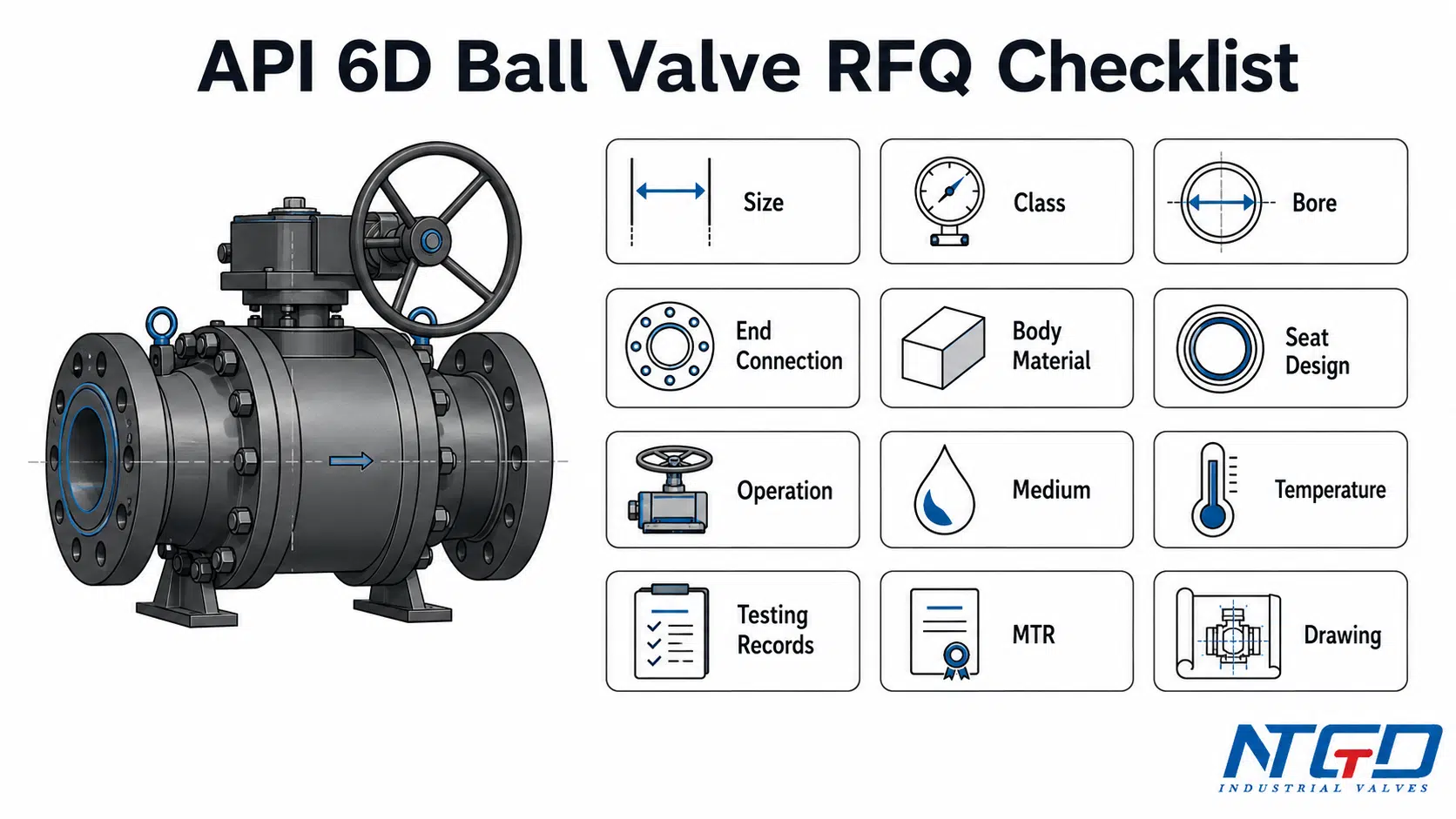
Données techniques à fournir
| Point de l'appel d'offres | Ce qu'il faut spécifier | Pourquoi c'est important |
|---|---|---|
| Type de vanne | Robinet à boisseau sphérique API 6D, à boisseau flottant ou monté sur tourillon, si cette information est disponible | Cela évite de choisir une famille de vannes inadaptée et aide le fournisseur à s'engager dès le départ dans la bonne voie de conception. |
| Taille | NPS / DN | Cela a une incidence sur la conception du corps, l'alésage, la cote entre faces, l'enveloppe de l'actionneur, la validation des plans, le couple et le raccordement d'extrémité. |
| Classe de pression | Classe ASME ou pression nominale du projet | Supervise la conception des enceintes sous pression, la compatibilité des raccords à bride et des raccords d'extrémité, ainsi que l'examen des procès-verbaux d'essais de pression. |
| Alésage | Alésage complet ou réduit | Cela a une incidence sur le raclage, la perte de charge, le tracé du flux et l'accès pour le nettoyage des canalisations. |
| Raccordement final | Bride RF, bride RTJ, soudure bout à bout ou autre extrémité requise | Doit être conforme au raccordement de la canalisation, à la classe de tuyauterie et aux exigences d'installation. |
| Matériau du corps | WCB, A105, LF2, acier inoxydable ou matériau spécifié par le projet | Cela a une incidence sur l'adéquation des enceintes sous pression, la compatibilité des équipements, la vérification des certificats de matériaux et la traçabilité. |
| Matériau de la bille et du siège | Siège souple, siège en métal, revêtement ou matériau spécial | Cela a une incidence sur l'étanchéité, la plage de température, le couple de fonctionnement, les résultats attendus lors des essais et la durée de vie. |
| Mode opératoire | Levier, boîte de vitesses, actionneur pneumatique, électrique ou hydraulique | Cela a une incidence sur le couple, l'automatisation, la position de sécurité, l'interface de commande et l'exploitation du site. |
| Moyen | Pétrole, gaz, eau, produits chimiques, gaz acide ou autres services | Supervise l'évaluation des matériaux, des joints, des garnitures, des revêtements et de la corrosion. |
| Température | Température minimale et maximale de fonctionnement | Cela a une incidence sur le siège, le garnissage, l'étanchéité de la tige, le matériau du corps et le choix de l'actionneur. |
| Exigences relatives aux pipelines | Nettoyage par raclage, DBB / DIB, décompression des cavités, résistance au feu, propriétés antistatiques ou autres exigences | Précise les caractéristiques techniques spécifiques au projet avant l'établissement du devis. |
| Normes et documentation | Exigences de la norme API 6D, rapports d'essais, MTR, ITP, plans, manuel d'utilisation, certificats | Confirme que la vanne proposée et le dossier technique correspondent à la norme API 6D relative aux vannes à bille et au processus d'homologation du projet. |
L'appel d'offres ne doit pas se transformer en catalogue de produits. Il doit fournir suffisamment d'informations sur le projet pour permettre au fabricant de vérifier la configuration correcte de la vanne à bille conforme à la norme API 6D avant l'établissement du devis, la validation des plans, la production, le contrôle et l'expédition.
Documents à demander avant de passer commande
Pour de nombreux acheteurs, le terme de recherche Robinet à boisseau sphérique API 6D - PDF Cela ne signifie pas pour autant qu'ils ont uniquement besoin d'un fichier téléchargeable. Dans la pratique des achats, cela signifie généralement qu'ils ont besoin de documents techniques qu'ils peuvent consulter avant de passer commande.
Parmi les documents habituellement demandés, on trouve notamment :
| Document | Quand en faire la demande |
|---|---|
| Fiche technique | Avant l'homologation technique. |
| Plan d'ensemble | Avant la vérification des cotes et de la tuyauterie. |
| Certificat de matériau | Avant la réception définitive ou le contrôle. |
| Rapport d'essai de pression | Avant l'expédition ou la remise des documents. |
| Plan d'inspection et d'essai | Avant la production ou l'inspection en présence de témoins. |
| Manuel de l'OIM | Vérification préalable à l'installation et à la mise en service. |
| Confirmation de la plaque signalétique / du marquage | Avant la livraison ou le contrôle à la réception. |
Si un projet nécessite des documents spécifiques, la présence d'un témoin lors de l'inspection, une inspection par un tiers ou des essais supplémentaires, ces éléments doivent être précisés dans l'appel d'offres plutôt que d'être supposés a posteriori.
Problèmes courants et remarques relatives à l'inspection
Les problèmes courants de performance sur site des vannes à bille API 6D sont souvent liés à une inadéquation des spécifications, au choix inapproprié des matériaux ou des sièges, au contrôle des débris, au dimensionnement de l'actionneur ou à une inspection incomplète, et non uniquement à l'usure des composants. Cette section doit être utilisée comme aide à la sélection et à la vérification des inspections, et non comme un manuel de réparation.
Fuites, endommagement des sièges et fuites au niveau des garnitures
| Problème | Directives relatives à la sélection et au contrôle qualité |
|---|---|
| Fuite à travers le siège | Vérifiez si le matériau du siège, la propreté du fluide, l'état de la surface de la bille, la plage de pression et de température ou le contrôle des débris étaient adaptés à l'application. |
| Fuite au niveau du joint du bloc-moteur | Vérifier la conception des raccords du corps, le matériau des joints, l'état des fixations, les registres relatifs aux enceintes sous pression, et s'assurer que la conception du corps est conforme aux exigences d'exploitation. |
| Fuite au niveau de la garniture de tige | Vérifier le matériau de garniture, la disposition des presse-étoupe, la surface de la tige, la fréquence de fonctionnement, la plage de température et les critères d'acceptation des fuites externes. |
| Problèmes récurrents d'étanchéité | Vérifier le choix des sièges, le niveau de propreté moyen, les cycles de pression, la plage de température, le réglage des actionneurs et si la conception de la vanne est adaptée aux conditions réelles d'exploitation. |
Pour les services critiques, les décisions en matière de réparation doivent respecter le manuel d'exploitation (IOM) du fabricant et les procédures de sécurité du site. Un réglage sur site ne doit pas servir à masquer un problème lié au choix de la vanne, au dimensionnement de l'actionneur ou à la documentation.
Couple élevé ou impossibilité d'ouvrir/fermer
Un couple élevé ou une impossibilité d'ouvrir/fermer peut avoir plusieurs causes :
| Symptôme | Directives relatives à la sélection et au contrôle qualité |
|---|---|
| Le robinet est difficile à actionner | Vérifiez la différence de pression, la charge sur le siège, le dimensionnement de la boîte de vitesses, l'alignement de la tige, la présence de débris, et si la conception du siège choisie génère un couple plus élevé que prévu. |
| La vanne motorisée ne réagit pas | Vérifier le dimensionnement de l'actionneur, l'alimentation en air ou en énergie, le signal de commande, la position de sécurité, le réglage du couple, la limite de course et l'obstruction de la vanne. |
| La vanne ne se ferme pas complètement | Vérifiez la présence de débris, les dommages au siège, les dommages à la bille, un réglage de fonctionnement incorrect, la limite de course de l'actionneur ou une incompatibilité du matériau du siège pour cette intervention. |
| La vanne ne s'ouvre pas complètement | Vérifiez la butée mécanique, la course de l'actionneur, le raccordement de la tige, la présence d'obstacles internes et si le mode de fonctionnement est adapté aux conditions d'installation. |
La réponse appropriée dépend de la conception de la vanne et des conditions d'exploitation. En cas d'utilisation sur une canalisation, il convient de respecter les procédures d'inspection et d'isolement avant tout démontage ou intervention de maintenance.
Foire aux questions sur les vannes à bille API 6D
La norme API 6D s'applique-t-elle uniquement aux vannes à bille ?
Non. La norme API 6D s'applique à plusieurs catégories de vannes de pipeline, notamment les vannes à bille, les vannes à guillotine, les clapets anti-retour et les vannes à boisseau. Cet article se concentre uniquement sur les vannes à bille conformes à la norme API 6D, car celles-ci obéissent à une logique de sélection qui leur est propre, notamment en ce qui concerne le choix entre un système flottant ou à tourillon, un passage à section pleine ou réduite, la conception du siège, la construction du corps et le mode de fonctionnement.
Quelle est la différence entre les normes API 6D et API 598 ?
La norme API 6D concerne les exigences relatives aux spécifications des vannes de pipeline, tandis que API 598 est généralement associé à l'inspection et aux essais des vannes. Ces deux notions ne doivent pas être considérées comme interchangeables. Les exigences précises doivent être vérifiées dans le cahier des charges du projet, le bon de commande et les documents normatifs applicables.
Quelle est la différence entre les normes API 6D et API 608 ?
La norme API 6D est généralement utilisée pour les vannes de pipelines, tandis que la norme API 608 concerne certaines vannes à bille métalliques destinées à un usage industriel général. Le choix de la norme appropriée dépend du cahier des charges du projet et des conditions d'utilisation. Un acheteur ne doit pas remplacer une norme par une autre sans avoir obtenu la confirmation des services d'ingénierie.
La norme API 6D inclut-elle automatiquement des exigences en matière de sécurité incendie ?
A exigence de sécurité incendie Ce point doit être précisé séparément dans le cahier des charges du projet. Certaines vannes à bille conformes à la norme API 6D peuvent également être fournies avec une conception résistante au feu ou accompagnées d’une documentation relative aux essais de résistance au feu, mais il ne faut pas en déduire automatiquement cette caractéristique sur la seule base de la désignation API 6D.
Une vanne à bille conforme à la norme API 6D intègre-t-elle automatiquement les modèles DBB ou DIB ?
Non. Les fonctions DBB, DIB, de décompression de la cavité et d'injection d'étanchéité d'urgence dépendent de la conception de la vanne et du cahier des charges du projet. Si ces fonctions sont requises, elles doivent être clairement mentionnées dans l'appel d'offres et confirmées dans la fiche technique, le plan et la documentation d'essai.
Quels documents faut-il vérifier avant de commander une vanne à bille conforme à la norme API 6D ?
Les documents courants comprennent la fiche technique, le plan, le certificat de matériau, le rapport d'essai de pression, le plan d'inspection et d'essai, le manuel d'utilisation et la confirmation de la plaque signalétique ou du marquage. Dans le cadre d'un projet, la liste des documents requis doit figurer dans l'appel d'offres.
Les vannes à bille API 6D ont-elles des dimensions standard ?
Les dimensions dépendent de la taille, de la classe de pression, du type de raccordement, du type d'alésage, de la conception du corps et des spécifications du fabricant. Avant de valider la commande, les acheteurs doivent vérifier le plan de la vanne, la cote entre faces, le type de raccordement, l'alésage, l'enveloppe de l'actionneur et l'espace libre nécessaire à l'installation.
Comment choisir entre des vannes à bille API 6D à siège flottant et à pivot ?
La conception à siège flottant peut être envisagée lorsque la taille, la pression, le couple et la sévérité des conditions de service sont modérés et que la conception du siège est adaptée à l'application. La conception à siège monté sur tourillon est généralement envisagée lorsque la taille, la classe de pression, la pression différentielle, le couple de fonctionnement ou la charge sur le siège deviennent critiques. La décision finale doit tenir compte des données de couple, des exigences relatives à l'alésage, de la conception du siège, du dimensionnement de l'actionneur et des spécifications du projet.
Comment choisir un fabricant ou un fournisseur de vannes à bille conformes à la norme API 6D ?
Pour Sélection d'un fournisseur de vannes à bille pour le secteur pétrolier et gazier, un fabricant ou fournisseur de vannes à bille conformes à la norme API 6D doit être évalué en fonction de ses capacités techniques, de la gamme de modèles proposés, de la traçabilité des matériaux, de ses capacités en matière d'essais de pression, de la prise en charge des plans, du contrôle de la documentation, de la coordination des inspections et de la qualité des réponses aux appels d'offres. Le prix ne constitue qu'un élément parmi d'autres dans la prise de décision. Dans le domaine des pipelines, l'exhaustivité de la documentation et la conformité aux spécifications revêtent souvent autant d'importance que la vanne elle-même.
Conclusion
Une vanne à bille conforme à la norme API 6D doit être choisie en tant que vanne d'arrêt destinée à un réseau de canalisations, et non comme une simple vanne à bille générique à laquelle on aurait simplement ajouté une désignation standard. Les principaux points à examiner sont le type de vanne, la conception du passage, la construction du corps, les matériaux, la conception du siège, le mode de fonctionnement, les rapports d'essais, les documents d'inspection et la clarté de l'appel d'offres.
Pour la plupart des acheteurs, une approche technique plus fiable consiste à vérifier d’abord les conditions d’utilisation, puis à examiner les différences entre les conceptions à flotteur et à tourillon, entre passage à section pleine et passage à section réduite, entre les modèles à entrée latérale et à entrée par le haut, le matériau du siège, les exigences relatives à l’actionneur, l’étendue des essais et le dossier de documentation. Les questions plus générales relatives aux vannes API 6D, les comparaisons entre normes et les types de vannes apparentés doivent être traitées séparément afin que la spécification des vannes à bille API 6D reste claire.
Vous avez besoin d'aide pour examiner un appel d'offres concernant une vanne à bille API 6D ?
Les divergences par rapport aux spécifications et les dossiers de documentation incomplets sont des causes fréquentes de retards dans l'homologation des vannes à bille API 6D. Si vous préparez un appel d'offres pour des vannes à bille API 6D, veuillez indiquer la taille de la vanne, la classe de pression, les exigences relatives au passage, le matériau du corps, la conception du siège, le type de raccordement, le mode de commande, le fluide de service, la plage de température ainsi que les documents requis.
NTGD Valve peut vous aider à examiner le cahier des charges avant l'établissement du devis afin que la vanne proposée réponde aux exigences du projet, aux attentes en matière d'essais et au dossier technique.
