
Nom de l'auteur : Bruce Zheng
Rôle de l'auteur : Cofondateur et ingénieur en vannes chez NTGD Valve
Bio de l'auteur : Bruce Zheng est cofondateur et ingénieur en vannes chez NTGD Valve, qui se concentre sur la sélection des vannes industrielles, les applications et le contenu technique pour les acheteurs B2B mondiaux.
Dernière mise à jour : 18 mai 2026
Choisir le bon matériau du robinet à bille Ce n'est pas seulement une question de prix ou d'aspect. Dans le cadre d'une utilisation industrielle, le matériau influe sur la résistance à la corrosion, l'aptitude aux conditions de pression et de température, l'exposition lors de l'entretien, la durée de vie et la fiabilité de la vanne après son installation.
Ce guide compare Robinet à boisseau sphérique en acier au carbone ou en acier inoxydable les matériaux du point de vue de la sélection technique. Il explique dans quels cas un robinet à boisseau sphérique en acier au carbone convient généralement mieux, lorsqu'un vanne à bille en acier inoxydable est la plus adaptée, et quels éléments il convient de vérifier avant la définition définitive du cahier des charges ou l'appel d'offres.
Le but n'est pas d'affirmer qu'un matériau est toujours meilleur qu'un autre. A Robinet à boisseau sphérique en acier au carbone vs robinet à boisseau sphérique en acier inoxydable Le choix doit être fondé sur le fluide concerné, la classe de pression, la température, l'exposition à la corrosion, les matériaux du siège et du joint, ainsi que le coût du cycle de vie. Un mauvais choix de matériau peut accroître le risque de fuite, les arrêts imprévus, la fréquence des interventions de maintenance et le coût total du cycle de vie.
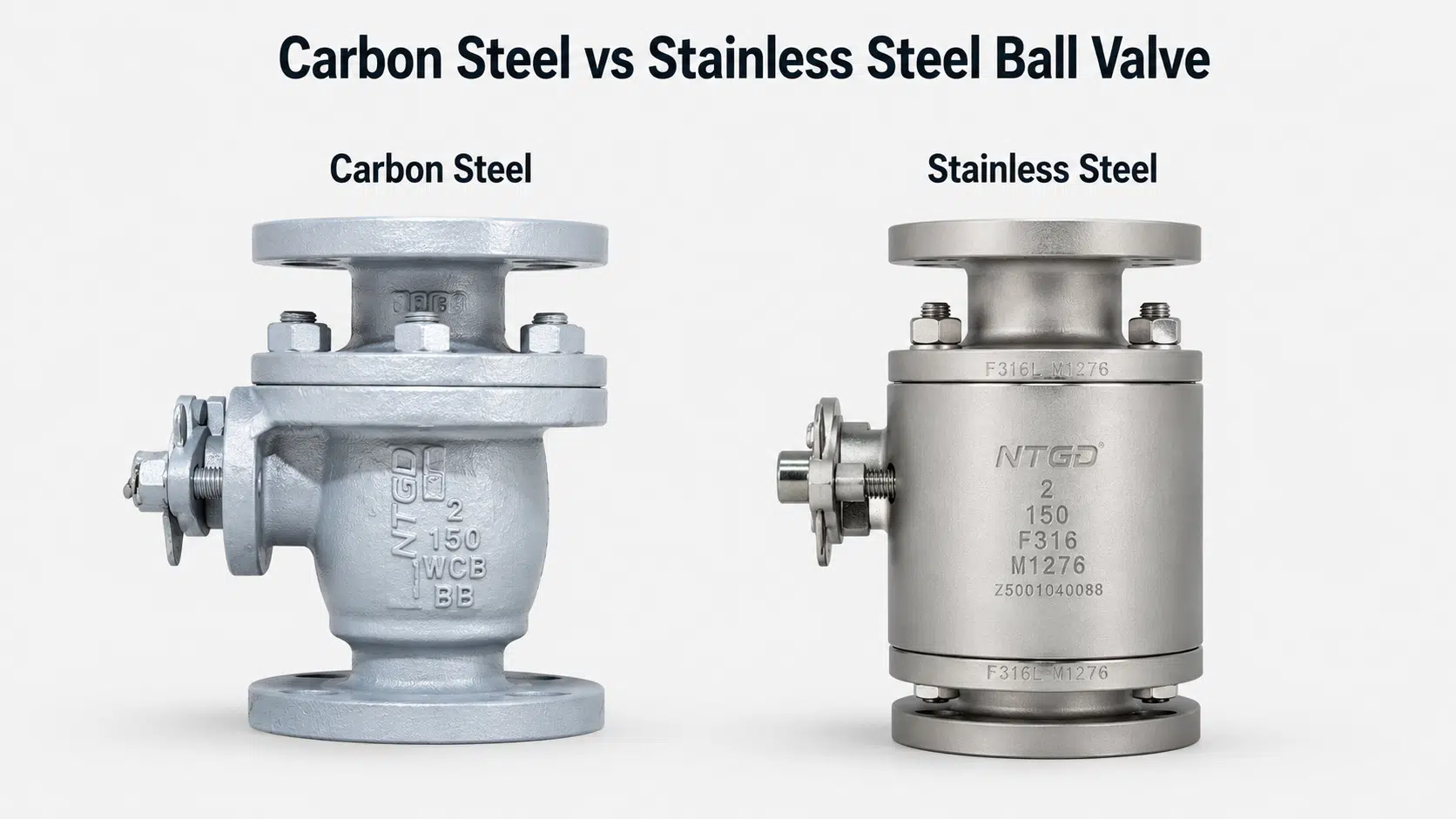
Vanne à bille en acier au carbone ou en acier inoxydable : résumé pour une sélection rapide
Lorsque la priorité est donnée à la résistance mécanique, à la maîtrise des coûts et à une utilisation industrielle sans risque de corrosion, l'acier au carbone constitue souvent le choix de départ. Il est généralement envisagé pour les systèmes liés au pétrole, au gaz, aux carburants, aux services publics et à l'industrie en général, lorsque les fluides et l'environnement ne présentent pas de risque sérieux de corrosion.
Lorsque la priorité est donnée à la résistance à la corrosion, à la propreté d'utilisation, à la réduction des besoins d'entretien ou à la stabilité sur le long terme, l'acier inoxydable constitue souvent le choix de départ. Il est couramment envisagé dans les secteurs maritime, chimique, agroalimentaire, pharmaceutique, du traitement de l'eau et pour les applications en extérieur, où les risques de corrosion ou de contamination doivent être maîtrisés.
Le choix final ne dépend pas uniquement du matériau du corps. Un corps en acier inoxydable associé à un matériau de siège inadapté peut tout de même présenter des défaillances dans des conditions d'utilisation inappropriées. Un corps en acier au carbone doté d'un revêtement adapté peut donner de bons résultats dans des environnements contrôlés, mais il ne doit pas être considéré comme une solution universelle pour les milieux corrosifs.
Optez pour l'acier au carbone lorsque la résistance, le coût et la résistance à la corrosion sont des critères importants
Les vannes à bille en acier au carbone constituent souvent un choix judicieux lorsque les conditions d'utilisation sont exigeantes sur le plan mécanique, mais sans présenter de forte corrosivité. Elles offrent une bonne résistance et un bon rapport coût-efficacité pour de nombreux systèmes industriels, en particulier lorsque le cahier des charges du projet autorise déjà l'utilisation d'acier au carbone.
Les conditions d'ajustement typiques sont les suivantes :
- dans des environnements intérieurs secs ou à climat contrôlé ;
- pétrole, gaz, carburant ou services publics où le risque de corrosion est limité ;
- les applications pour lesquelles le coût initial constitue une contrainte majeure du projet ;
- les systèmes dans lesquels il est possible d'assurer l'entretien des revêtements, des peintures ou de la protection anticorrosion ;
- services pour lesquels la conception de la vanne, la classe de pression, le matériau du siège et la fiche technique sont adaptés aux conditions de pression et de température requises.
Ce choix n'est valable que si le milieu, l'environnement, les conditions de revêtement et les spécifications du fabricant justifient tous l'utilisation de l'acier au carbone. Si l'environnement d'exploitation est humide, riche en chlorures, acide ou mal protégé, l'avantage lié au matériau peut rapidement ne plus jouer en faveur de l'acier au carbone.
Optez pour l'acier inoxydable lorsque la résistance à la corrosion, la facilité d'entretien ou la stabilité tout au long du cycle de vie sont des critères essentiels
Les vannes à bille en acier inoxydable sont généralement privilégiées lorsque la vanne doit résister à la rouille, à la corrosion, à la contamination ou nécessiter un entretien fréquent. Dans des conditions d'utilisation adaptées, l'acier inoxydable permet de réduire les temps d'arrêt liés à la corrosion et de prolonger la durée de vie utile de la vanne.
Les conditions d'ajustement typiques sont les suivantes :
- les environnements humides, en extérieur ou marins ;
- l'eau potable, l'alimentation, les boissons, les produits pharmaceutiques ou les services liés à l'hygiène ;
- des milieux chimiques ou légèrement corrosifs avec lesquels la nuance d'acier inoxydable choisie est compatible ;
- les systèmes dans lesquels les fuites, la contamination ou les interventions de maintenance répétées entraîneraient des coûts élevés ;
- les applications dans lesquelles le coût du cycle de vie prime sur le prix d'achat le plus bas de la vanne.
Ce choix dépend de la sélection de la nuance et de la compatibilité chimique. L'acier inoxydable n'est pas systématiquement adapté à tous les fluides corrosifs ; les chlorures, les acides, l'eau de Javel, la concentration, la température et la présence d'oxygène peuvent tout de même présenter un risque de corrosion.
Le choix final dépend du fluide, de la pression, de la température, du matériau du siège et de la fiche technique
Une solution fiable Choix du matériau des vannes à bille Il convient de vérifier l'état général de l'installation, et pas seulement le matériau du corps de vanne.
Vérifiez au minimum les points suivants :
- les fluides concernés et l'exposition à la corrosion ;
- pression et température de service ;
- le matériau du siège et du joint ;
- classe de pression et conception de la vanne ;
- fiche technique du fabricant ou guide de compatibilité.
Une vérification plus détaillée de l'ajustement figure plus loin dans la liste de contrôle finale des spécifications.
Tableau comparatif entre les vannes à bille en acier au carbone et celles en acier inoxydable
| Facteur de comparaison | Robinet à bille en acier au carbone | Robinet à bille en acier inoxydable | Note de sélection |
|---|---|---|---|
| Rôle principal du matériau | Matériau de fabrication robuste et économique, adapté à de nombreuses applications industrielles | Matériau de corps résistant à la corrosion, destiné à des environnements plus propres ou plus agressifs | Le matériau du corps ne constitue qu'un élément parmi d'autres des caractéristiques techniques complètes de la vanne |
| Résistance à la corrosion | Utilisation limitée sans revêtement ni protection ; sensible en milieu humide, salin, acide ou chimique | Meilleure résistance dans de nombreuses applications corrosives ou humides, selon la nuance | Une mauvaise évaluation de l'exposition à la corrosion peut accélérer la formation de rouille, l'amincissement des parois, le risque de fuite et entraîner un arrêt imprévu de l'installation. |
| Ajustement pression/température | Peut convenir à des applications exigeantes lorsque la conception de la vanne et sa classe de résistance le permettent | Peut également convenir à des utilisations exigeantes lorsque la conception, la qualité, la classe et l'assise le permettent | Ne vous fiez pas uniquement au nom du matériau pour évaluer la pression nominale ; le facteur limitant peut être la classe de la vanne, le raccord d'extrémité, le siège, le joint d'étanchéité ou les caractéristiques de pression et de température indiquées par le fabricant. |
| Résistance mécanique | Souvent choisie pour une utilisation industrielle intensive | Solide et résistant, offrant une meilleure résistance à la corrosion dans les milieux appropriés | L'acier au carbone est souvent un choix judicieux pour les applications lourdes en milieu non corrosif ; l'acier inoxydable s'avère plus intéressant lorsque la corrosion risque de réduire la résistance réelle du matériau au fil du temps. |
| Coût initial | Généralement inférieur | Généralement plus élevé | Le prix initial doit être mis en balance avec les coûts d'entretien, de revêtement, d'inspection et les risques liés au remplacement. |
| Coût du cycle de vie | Peut s'avérer économique dans des conditions d'utilisation non corrosives ; peut s'avérer coûteux en cas de corrosion | Un coût initial plus élevé peut être compensé par des frais d'entretien réduits dans le cadre d'un service adapté. | Un matériau de fabrication peu coûteux peut s'avérer onéreux dans des installations exposées à la corrosion, situées dans des zones isolées ou où tout arrêt de fonctionnement est critique. |
| Exposition liée à la maintenance | Il peut être nécessaire de vérifier l'état du revêtement, la présence de rouille et la protection contre la corrosion. | L'entretien est souvent moins important lorsque la nuance d'acier inoxydable est adaptée au fluide | Les matériaux du siège et du joint doivent encore faire l'objet d'une inspection ; le matériau du corps à lui seul ne suffit pas à supprimer les besoins d'entretien |
| Adaptation aux services courants | Pétrole, gaz, carburants, industrie générale, services publics en intérieur sous contrôle | Secteurs maritime, chimique, de l'eau potable, agroalimentaire, pharmaceutique, des activités de plein air ou en milieu humide | Choisissez le matériau en fonction du support et de l'environnement, et pas uniquement en fonction du nom du secteur d'activité |
| Risque lié à un mauvais choix | Rouille, défaillance du revêtement, perte d'épaisseur, fuite, remplacement prématuré | Corrosion par piqûres, corrosion caverneuse, attaque chimique, coûts superflus ou défaillance des sièges ou des joints | Ces deux matériaux peuvent présenter des défaillances si leur utilisation n'est pas bien comprise ou si les pièces en contact avec le fluide ne sont pas compatibles. |
| Confirmation de l'appel d'offres | Vérifier la classe de résistance, le revêtement, la classe de pression, la finition, le siège, le joint et les exigences d'essai | Vérifier la nuance d'acier inoxydable, les pièces en contact avec le fluide, le siège, le joint et la compatibilité | L'approbation définitive doit intervenir après l'examen du cahier des charges du projet, la vérification de la compatibilité et la consultation de la fiche technique du fabricant. |
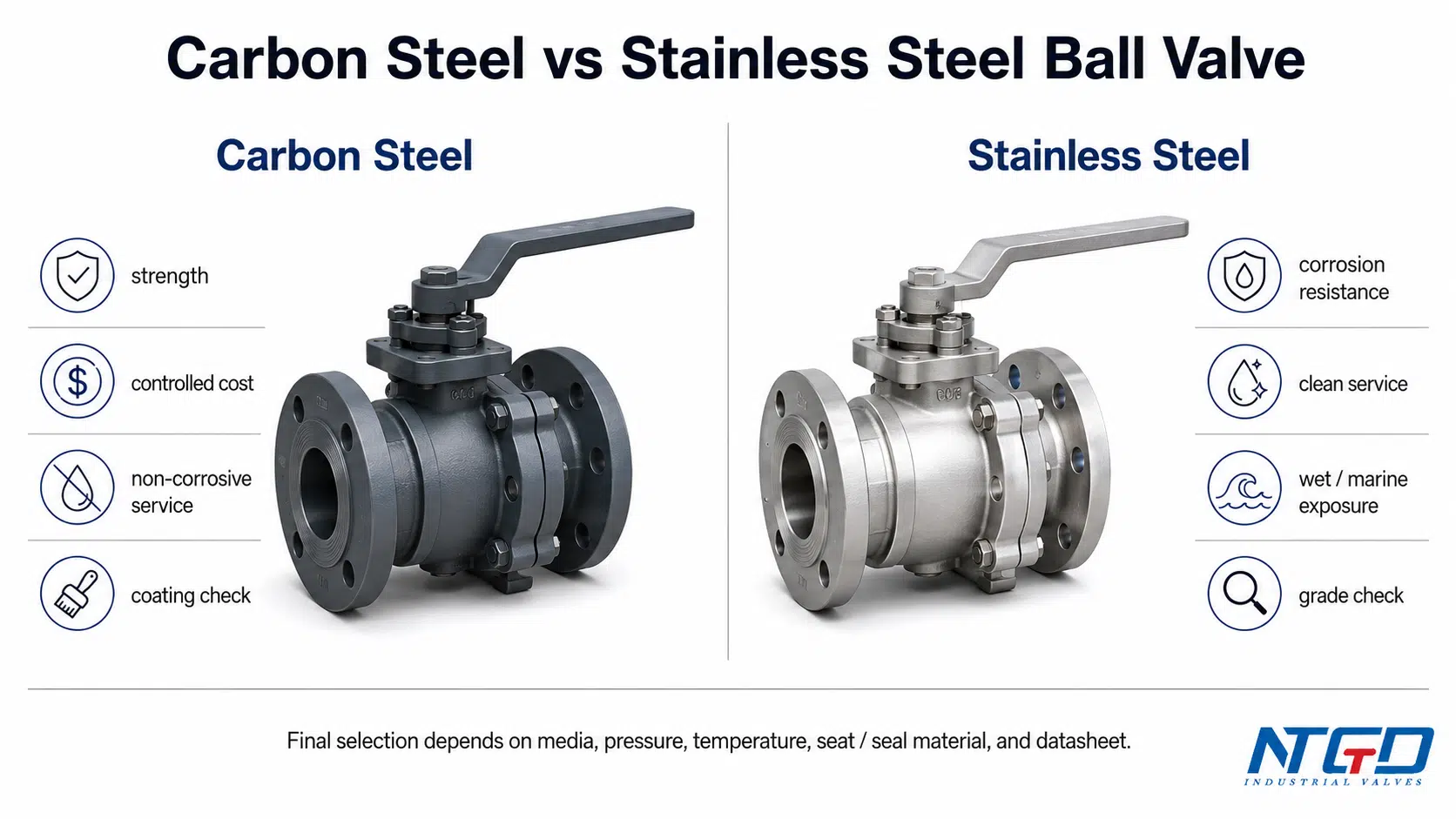
Ce tableau doit être utilisé comme aide à la décision et ne saurait se substituer au cahier des charges d'un projet. Les limites exactes de pression et de température, l'adéquation des matériaux et la durée de vie dépendent de la conception de la vanne, de la classe de pression, de la structure du siège, du matériau d'étanchéité, du fluide transporté et des données fournies par le fabricant.
Robinets à bille en acier au carbone : résistance, coût et limites d'utilisation
A robinet à boisseau sphérique en acier au carbone Il s'agit d'un choix courant lorsqu'un projet nécessite une vanne d'arrêt industrielle robuste à un coût maîtrisé. L'acier au carbone est largement utilisé car il offre une grande robustesse mécanique et est couramment employé dans de nombreux systèmes liés au pétrole, au gaz, à l'eau, aux services publics et à l'industrie en général.
L'avantage principal n'est pas que l'acier au carbone convienne à toutes les applications. L'avantage réside dans le fait que l'acier au carbone peut constituer un choix pratique et économique lorsque les conditions d'utilisation sont bien connues et que le risque de corrosion est maîtrisé.
Les applications pour lesquelles les vannes à bille en acier au carbone sont particulièrement adaptées
Les vannes à bille en acier au carbone sont souvent utilisées dans :
- oléoducs et gazoducs ;
- systèmes de gestion du carburant ;
- eau non corrosive ou réseau de distribution ;
- lignes de processus industrielles générales ;
- installations intérieures contrôlées ;
- certaines applications à haute pression ou à usage intensif pour lesquelles la conception de la vanne et la classe de pression sont adaptées.
Dans ces applications, l'acier au carbone offre un bon compromis entre résistance, disponibilité et coût. Il s'avère particulièrement utile lorsque la corrosion ne constitue pas le principal risque d'exploitation et lorsque le système utilise déjà des tuyauteries en acier au carbone ou des matériaux compatibles.
Termes désignant les aciers au carbone, tels que WCB, A105, ou « CS » peuvent figurer dans les spécifications des vannes. Le WCB est couramment utilisé comme matériau pour les corps de vannes en acier au carbone moulé, tandis que l’A105 figure généralement dans les spécifications relatives à l’acier au carbone forgé pour les corps de vannes ou les composants sous pression. Ces termes doivent toutefois être vérifiés au regard de la norme du projet, des exigences en matière de moulage ou de forgeage, de la classe de pression et de la documentation du fabricant, plutôt que d’être considérés comme des désignations interchangeables.
Avantages en termes de coût et de résistance mécanique
Les principaux avantages des vannes en acier au carbone sont les suivants :
- un coût initial inférieur à celui de nombreux modèles en acier inoxydable ;
- une bonne résistance mécanique pour une utilisation industrielle ;
- une large gamme de configurations de vannes industrielles courantes ;
- convient à de nombreux environnements d'utilisation non corrosifs ou contrôlés.
Pour les projets de grande envergure, la différence de coût peut être considérable. Une vanne à bille en acier au carbone peut constituer un choix judicieux lorsque le fluide n'est pas corrosif, que l'environnement est contrôlé et que les équipes de maintenance sont en mesure de répondre aux exigences en matière de revêtement ou de protection de surface.
Cependant, un faible coût initial ne signifie pas toujours un coût total moindre. Si la vanne est installée dans un environnement humide, salé, acide ou chimiquement agressif, la corrosion peut entraîner des travaux d'entretien, des arrêts de production, des risques de fuite ou un remplacement prématuré. Dans ce cas, le coût d'achat réduit peut être compensé par un coût de cycle de vie plus élevé.
La pression et la température doivent être vérifiées à l'aide des caractéristiques techniques et de la fiche technique de la vanne.
L'acier au carbone est souvent associé à des applications industrielles exigeantes, mais sa résistance à la pression et à la température ne doit jamais être évaluée uniquement en fonction du matériau du corps de la pièce.
L'adéquation d'un robinet à bille en acier au carbone dépend des éléments suivants :
- la conception de la valve ;
- classe de pression ;
- conception du corps et des raccords d'extrémité ;
- matériau de la bille et de la tige ;
- le matériau du siège et du joint ;
- exigences en matière de sécurité incendie ou d'antistaticité, le cas échéant ;
- normes applicables au projet ;
- caractéristiques de pression et de température indiquées par le fabricant.
Un corps de vanne en acier au carbone peut convenir à des conditions d'utilisation exigeantes, mais le pression-température nominale, le matériau du siège, celui du joint d'étanchéité ou le raccord d'extrémité peuvent devenir le facteur limitant. L'utilisation d'une vanne en dehors de ses limites de pression et de température homologuées peut endommager les sièges et les joints d'étanchéité, augmenter le risque de fuite, affaiblir l'enveloppe sous pression et entraîner un arrêt imprévu. Consultez toujours la fiche technique du fabricant avant d’utiliser de l’acier au carbone pour des applications à haute pression, à haute température, soumises à des cycles thermiques ou dans des conditions de service difficiles.
Limites de corrosion et d'entretien des vannes en acier au carbone
La principale limite de l'acier au carbone réside dans sa résistance à la corrosion. L'acier au carbone peut rouiller ou se détériorer lorsqu'il est exposé à l'humidité, à l'eau de mer, aux acides, à des produits chimiques agressifs ou à des conditions extérieures mal maîtrisées.
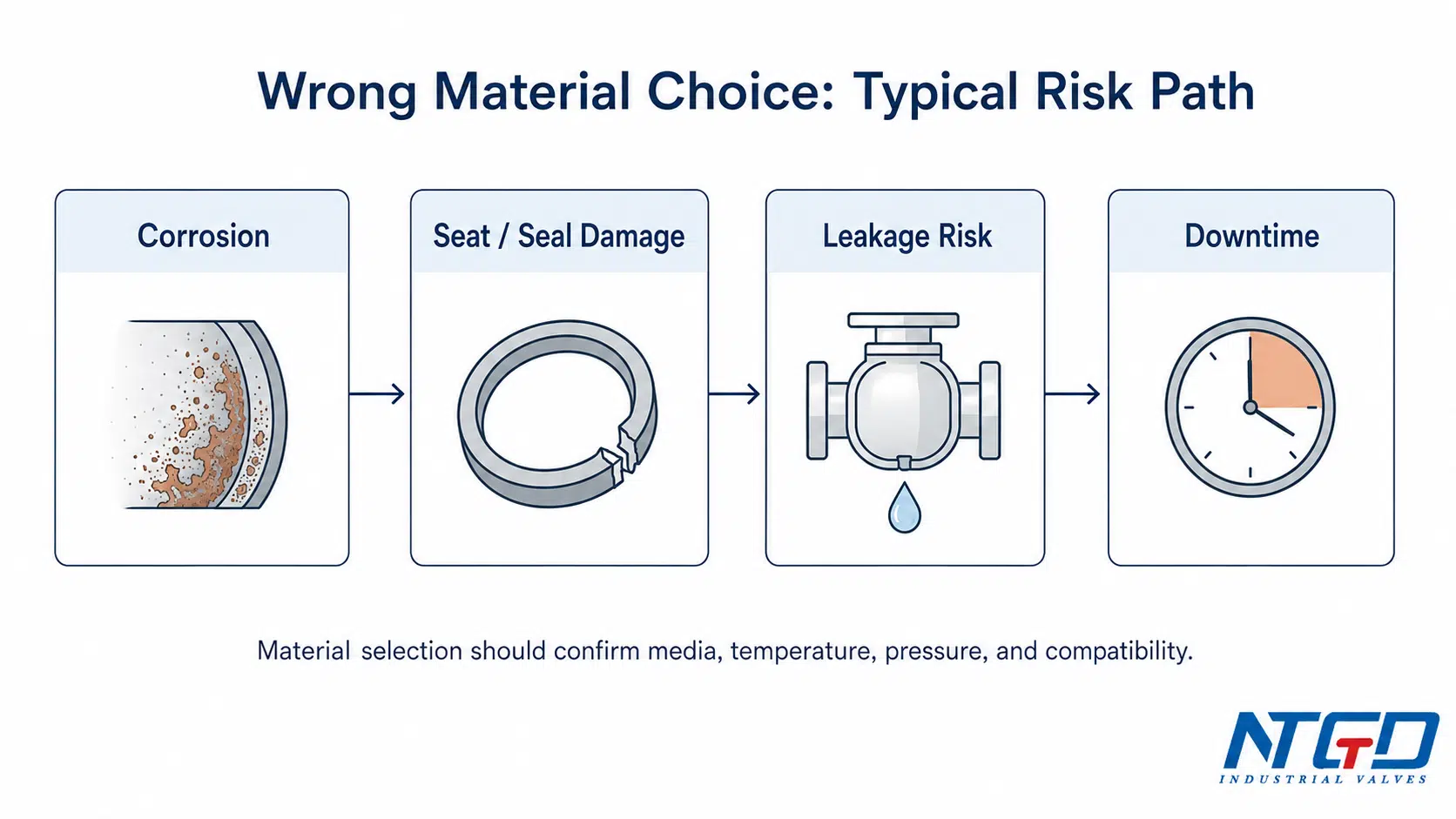
Parmi les situations à risque courantes, on peut citer :
- exposition à l'eau de mer ou au chlorure ;
- milieux acides ou alcalins ;
- installation en extérieur dans un environnement humide ;
- conduites enterrées ou mal ventilées ;
- revêtement ou peinture endommagés ;
- service de traitement chimique sans confirmation de compatibilité.
Les revêtements, la peinture ou les revêtements intérieurs peuvent contribuer à réduire l'exposition à la corrosion, mais ils ne rendent pas pour autant l'acier au carbone automatiquement adapté à toutes les applications corrosives. Les revêtements peuvent s'user, se fissurer ou être endommagés lors de la pose ou de l'exploitation. Dès que le métal de base est exposé, le risque de corrosion augmente.
Si une détérioration du revêtement expose un corps en acier au carbone à un environnement humide ou corrosif, une corrosion localisée peut se développer plus rapidement que prévu. Cela peut conduire à opter pour de l’acier inoxydable ou une autre solution résistante à la corrosion plus tôt que ne le laissait supposer la comparaison initiale des coûts.
Pour les vannes en acier au carbone, planification de la maintenance devrait inclure :
- contrôles de l'état du revêtement ;
- inspection de la corrosion ;
- surveillance de la corrosion externe ;
- la confirmation que le milieu reste conforme aux caractéristiques chimiques attendues ;
- prêter attention à l'usure des sièges et des joints ;
- examen du risque d'arrêt en cas de remplacement nécessaire.
L'acier au carbone est un matériau résistant et économique, mais il offre ses meilleures performances lorsque risque de corrosion est limité ou correctement maîtrisé.
Robinets à bille en acier inoxydable : résistance à la corrosion, nuances et valeur sur le cycle de vie
A vanne à bille en acier inoxydable On opte pour l'acier inoxydable lorsque la résistance à la corrosion, la propreté, la facilité d'entretien ou la fiabilité sur toute la durée de vie priment sur le coût initial le plus bas. L'acier inoxydable ne signifie pas systématiquement “ plus résistant ” ou “ meilleur ” dans tous les cas. Son intérêt dépend de l'environnement d'utilisation et de la nuance d'acier inoxydable choisie.
Les vannes à bille en acier inoxydable sont couramment utilisées dans les applications où la rouille, la contamination ou les agressions chimiques pourraient entraîner des problèmes de fonctionnement. Elles sont souvent privilégiées dans les secteurs de l'agroalimentaire, des boissons, de l'industrie pharmaceutique, de la marine, du traitement de l'eau et de l'industrie chimique, à condition que la nuance d'acier et les pièces en contact avec le fluide soient adaptées.
Les applications idéales des vannes à bille en acier inoxydable
Les vannes à bille en acier inoxydable constituent souvent le meilleur choix pour :
- dans des environnements humides ou à l'extérieur ;
- installations situées en milieu marin ou exposées aux chlorures ;
- transformation des produits alimentaires et des boissons ;
- secteur pharmaceutique ou des services de nettoyage ;
- service chimique pour lequel la nuance choisie est compatible ;
- les systèmes de traitement de l'eau ;
- les installations dans lesquelles les temps d'arrêt liés à la corrosion peuvent coûter plus cher que la vanne elle-même ;
- applications nécessitant une surface plus propre et présentant un risque de rouille moindre.
La raison principale réside dans sa résistance à la corrosion. Dans des milieux adaptés, l'acier inoxydable permet de limiter la rouille, de préserver l'aspect de la vanne, de réduire la fréquence d'entretien et de prolonger sa durée de vie.
Acier inoxydable 304 vs 316 / 316L : choix des vannes à bille
Les vannes à bille en acier inoxydable ne sont pas toutes identiques. Le choix de la nuance est important.
En langage de sélection général :
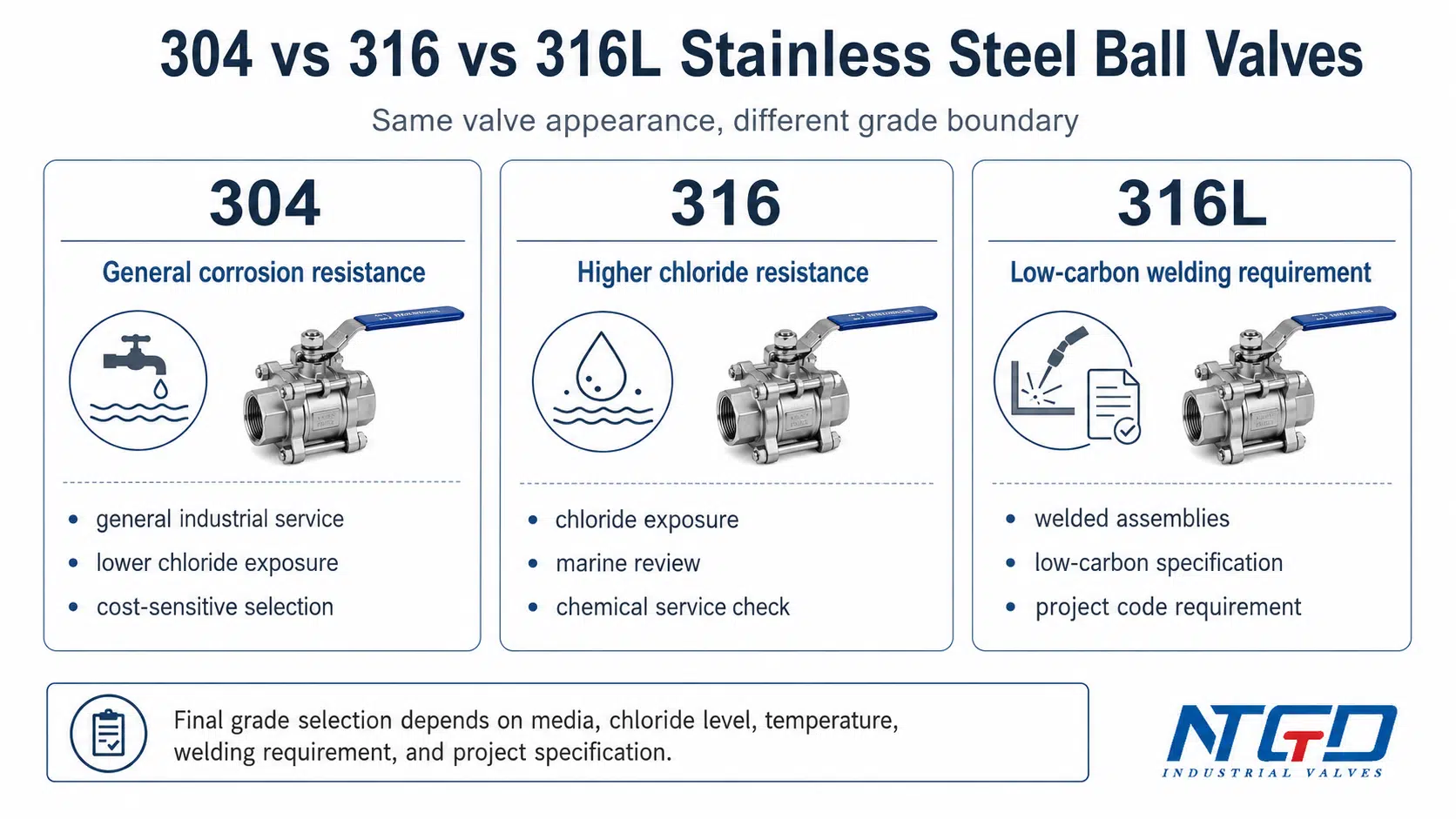
- Acier inoxydable 304 est souvent utilisé pour assurer une résistance à la corrosion générale et dans des applications où l'exposition aux chlorures ou à des produits chimiques agressifs est limitée.
- Acier inoxydable 316 offre une meilleure résistance dans de nombreux environnements chlorés, marins et chimiques grâce à la composition de son alliage.
- Acier inoxydable 316L est souvent envisagé lorsque, selon le cahier des charges, une teneur en carbone plus faible est préférable pour les assemblages soudés ou dans le cas d'exigences liées à la sensibilité à la corrosion.
Pour les corps de vannes moulés, les utilisateurs peuvent également rencontrer des désignations de matériaux telles que CF8 ou CF8M, qui sont généralement associées à des nuances d’acier inoxydable moulé. Il convient de vérifier ces désignations par rapport au cahier des charges du projet et à la documentation du fabricant.
Dans les assemblages soudés ou en cas d'utilisation dans des environnements propices à la corrosion, Acier inoxydable 316L peut être spécifiée afin de réduire le risque de corrosion liée à la sensibilisation ou de corrosion intergranulaire. Le choix définitif de la nuance doit toutefois respecter le cahier des charges du projet et tenir compte des milieux réels, de la concentration, de la température et d'une analyse de compatibilité.
Le choix du niveau doit tenir compte des éléments suivants :
- chimie des milieux ;
- teneur en chlorure ;
- concentration ;
- pH ;
- température de fonctionnement ;
- produits chimiques de nettoyage ;
- environnement externe ;
- exigences en matière de soudage ou de fabrication ;
- normes et documentation applicables.
Le fait que le corps de la vanne soit en acier inoxydable ne garantit pas que l'ensemble de la vanne soit adapté. La bille, la tige, le siège, le joint d'étanchéité, le joint d'étanchéité et tout revêtement ou traitement de surface doivent également être adaptés à l'application.
Durée de vie, entretien et coût initial plus élevé
Les vannes à bille en acier inoxydable sont généralement plus chères que celles en acier au carbone lors de l'achat initial. Ce surcoût peut se justifier si la résistance à la corrosion permet de réduire les coûts d'entretien, les temps d'arrêt, la fréquence de remplacement ou le risque de contamination.
La valeur du cycle de vie de l'acier inoxydable est maximale lorsque :
- le risque de corrosion est bien réel ;
- l'accès pour l'entretien est difficile ;
- les coûts liés à la fermeture sont élevés ;
- la propreté est de mise ;
- l'environnement est humide, marin ou chimiquement agressif ;
- l'aspect à long terme et la stabilité de la surface sont importants.
Cependant, l'acier inoxydable n'est pas forcément le choix le plus économique. Si le système est sec, non corrosif et simple sur le plan mécanique, l'acier au carbone peut offrir un meilleur rapport qualité-prix.
Quand l'acier inoxydable ne suffit pas
L'acier inoxydable ne doit pas être considéré comme une solution universelle contre la corrosion.
Dans certaines applications, l'acier inoxydable peut néanmoins présenter les inconvénients suivants :
- corrosion par piqûres ;
- corrosion interstitielle ;
- attaque liée au chlorure ;
- incompatibilité chimique ;
- risque de corrosion sous contrainte ;
- défaillance du siège ou du joint, même lorsque le corps reste intact.
Acides forts, produits chimiques concentrés, agents oxydants, milieux à forte teneur en chlorure, l'eau de Javel, l'eau de mer ou l'exposition à des produits chimiques à haute température peuvent nécessiter une évaluation supplémentaire des matériaux. Dans ces cas-là, l'acier inoxydable peut tout de même convenir dans une nuance spécifique, ou il peut être nécessaire de le remplacer par une vanne revêtue, un matériau plastique, un alliage spécial ou une autre conception résistante à la corrosion.
Un service plus dynamique dans environnements corrosifs nécessite souvent une analyse de compatibilité spécifique, plutôt qu’un simple choix entre l’acier au carbone et l’acier inoxydable. Cette analyse doit prendre en compte le fluide précis, sa concentration, la température, la pression, les pièces en contact avec le fluide, les matériaux des sièges et des joints, le cahier des charges du projet ainsi que les recommandations du fabricant.
Comment choisir le matériau adapté à votre application pour une vanne à bille
Une solution fiable Choix du matériau des vannes à bille dépend des conditions d'utilisation, et non d'une préférence générale pour l'acier au carbone ou l'acier inoxydable. Le meilleur matériau est celui qui est adapté au fluide, à la pression, à la température, à l'environnement et au plan de maintenance spécifiques.
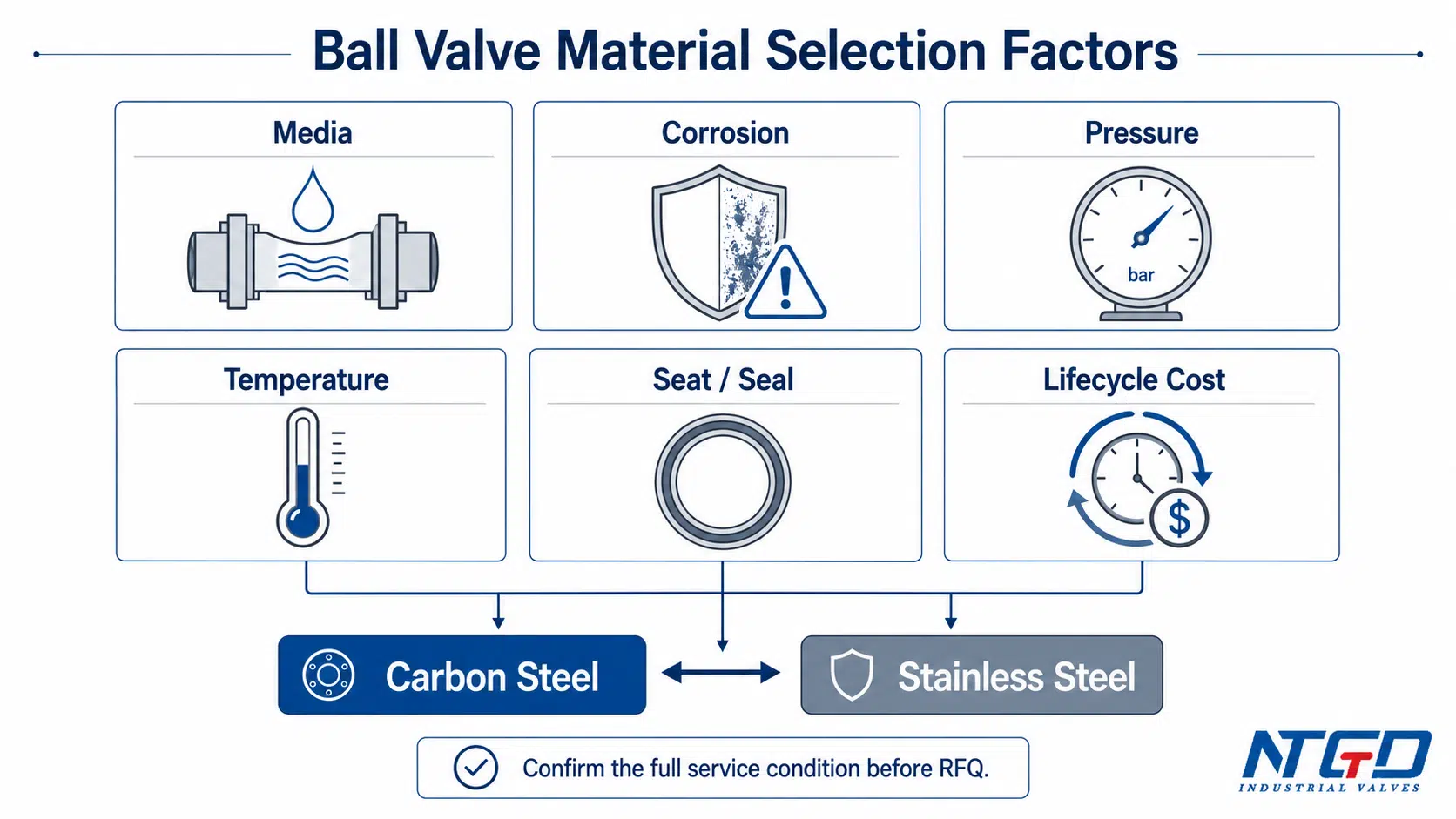
Exposition aux fluides et à la corrosion
Le fluide est le premier critère de sélection. Une vanne destinée à être utilisée avec du gaz sec, de l'huile propre ou un fluide non corrosif ne répond pas aux mêmes exigences en matière de matériaux qu'une vanne destinée à être utilisée avec de l'eau de mer, une solution acide, une solution alcaline, de l'eau riche en chlorure ou des produits chimiques de nettoyage.
Posez-vous les questions suivantes avant de choisir le matériau de la carrosserie :
- De quel support s'agit-il exactement ?
- Le milieu est-il inerte, corrosif, abrasif ou chimiquement actif ?
- Y a-t-il des chlorures, des acides, des alcalis, des solvants ou des agents oxydants ?
- La concentration du média varie-t-elle pendant le fonctionnement ?
- La vanne sera-t-elle exposée à la corrosion externe ?
L'acier au carbone peut convenir lorsque l'exposition à la corrosion est faible. L'acier inoxydable est généralement plus résistant en cas de risque de corrosion, mais la nuance d'acier inoxydable doit tout de même être validée. Dans des milieux incompatibles, l'acier inoxydable peut présenter des piqûres, des fissures ou une corrosion localisée, ce qui peut à terme entraîner des fuites, un risque de contamination ou un remplacement imprévu.
Classe de pression et température de fonctionnement
La pression et la température ont une incidence tant sur les pièces métalliques que sur les pièces souples. Il se peut que le corps de la vanne soit suffisamment résistant, mais que le siège ou le joint constitue en réalité le point faible.
Confirmer :
- classe de pression ;
- températures maximale et minimale de fonctionnement ;
- caractéristiques de pression et de température ;
- le cyclage thermique ;
- connexion finale ;
- le matériau du siège et du joint ;
- norme du projet et exigences en matière de tests.
Évitez de choisir un matériau uniquement parce qu’il est “ résistant ”. Dans le cas des vannes à bille, l’adéquation pression-température est un enjeu de conception à part entière.
Conditions d'écoulement, matières solides et exposition à l'abrasion
Les vannes à bille sont largement utilisées pour la coupure de débit, mais les conditions d'écoulement restent un facteur important. Vitesse élevée, présence de matières en suspension, service de boues, les particules abrasives ou les cycles de fonctionnement fréquents peuvent avoir une incidence sur l'usure du siège et les performances d'étanchéité.
Pour le choix des matériaux, consultez :
- si le milieu est limpide ou contient des particules solides ;
- si la vanne sera principalement utilisée en position ouverte ou fermée, ou si elle sera soumise à des manœuvres fréquentes ;
- si le service présente un risque d'érosion ;
- si la corrosion et l'abrasion se produisent simultanément ;
- si le matériau du siège est compatible à la fois avec les fluides et les conditions d'exploitation.
L'acier au carbone résiste certes bien aux contraintes mécaniques, mais la corrosion associée à l'abrasion peut accélérer sa détérioration. L'acier inoxydable offre certes une meilleure résistance à la corrosion, mais les matériaux des sièges et des joints doivent tout de même faire l'objet d'une évaluation distincte.
Coût du cycle de vie, temps d'arrêt et accès pour la maintenance
Le prix initial d'une vanne ne représente qu'une partie du coût total. Une vanne moins chère peut finir par coûter cher si elle se corrode, présente des fuites ou doit être remplacée fréquemment.
Comparer les facteurs liés au cycle de vie :
| Facteur de sélection | Pourquoi c'est important |
|---|---|
| Coût d'achat initial | L'acier au carbone présente souvent un avantage dans les conditions d'utilisation appropriées |
| Entretien anti-corrosion | L'acier au carbone peut nécessiter une protection supplémentaire dans des environnements humides ou corrosifs |
| Coût des temps d'arrêt | L'acier inoxydable peut réduire le risque d'arrêt dans les systèmes corrosifs ou difficiles d'accès |
| Fréquence de remplacement | Un mauvais choix de matériau peut réduire la durée de vie utile du produit. |
| Accès aux locaux pour inspection | Les vannes difficiles d'accès nécessitent une planification plus rigoureuse de leur cycle de vie |
| Nettoyage / risque de contamination | L'acier inoxydable peut être privilégié pour les applications nécessitant une grande propreté |
| Entretien des revêtements | La protection en acier au carbone doit rester intacte pour conserver son efficacité |
Conseil de sélection : dans les installations exposées à la corrosion, situées dans des endroits isolés, enterrées ou nécessitant un entretien régulier, le coût initial plus élevé de l’acier inoxydable peut se justifier par une réduction des temps d’arrêt et du nombre d’interventions liées à la corrosion. Dans les conduites sèches, facilement accessibles et non exposées à la corrosion, l’acier au carbone peut toutefois offrir un meilleur rapport coût total.
Le meilleur choix n'est pas toujours la vanne la moins chère. C'est celle qui offre une fiabilité acceptable au coût total le plus bas pour l'utilisation prévue.
Exigences en matière de normes, d'essais et de documentation
Certains projets exigent davantage qu'une simple désignation du matériau. Ils peuvent nécessiter des certificats de conformité des matériaux, des essais de résistance à la pression, une conception résistante au feu, une conception antistatique, la maîtrise des émissions fugitives, une expertise conforme aux normes NACE ou la conformité à des normes spécifiques au projet.
Cet article ne remplace pas le cahier des charges du projet. Il met en évidence les éléments à vérifier avant la sélection finale. Lorsque des normes ou des certificats sont exigés, il convient de vérifier leur conformité avec le cahier des charges d'achat et la documentation du fabricant.
Mise en correspondance des applications et des conditions de service
Un même matériau de vanne peut présenter des performances différentes selon les conditions d'utilisation. Utilisez ce tableau comme guide pratique de sélection avant de préparer votre appel d'offres.
| Conditions de service | Meilleur ajustement | Pourquoi | Confirmer avant l'appel d'offres |
|---|---|---|---|
| Utilisation industrielle à sec, sans risque de corrosion | L'acier au carbone convient souvent très bien | Résistant et économique lorsque le risque de corrosion est faible | Composition du fluide, classe de pression, températures de service maximale et minimale, et nécessité ou non d'un revêtement externe |
| Services liés au pétrole, au gaz ou aux carburants | Souvent en acier au carbone, selon les spécifications | Utilisation industrielle courante présentant de bonnes propriétés mécaniques | Type de matériau, classe de pression, exigences en matière de sécurité incendie ou d'antistaticité, matériau du siège et exigences d'essai |
| Réseau d'eau non corrosif | Cela dépend de la composition chimique de l'eau | L'acier au carbone peut convenir dans des conditions contrôlées ; l'acier inoxydable peut réduire le risque de rouille | Teneur en chlorure, oxygène dissous, environnement extérieur, état du revêtement et accès pour l'entretien |
| Eaux usées ou eaux à composition chimique variable | Souvent en acier inoxydable ou dans un autre matériau résistant à la corrosion | La composition chimique peut évoluer et accroître le risque de corrosion | plage de pH, teneur en chlorure, matières en suspension, compatibilité entre le siège et le joint, et produits chimiques de nettoyage |
| Utilisation avec des produits chimiques peu agressifs | Souvent en acier inoxydable, mais cela dépend de la nuance | L'acier inoxydable peut mieux résister à de nombreux fluides corrosifs que l'acier au carbone | Tableau détaillé des produits chimiques, de leur concentration, de la température de fonctionnement, de la pression et de leur compatibilité |
| Exposition à l'eau de mer ou au chlorure | Généralement en acier inoxydable 316 / 316L, ou en matériau spécial | Les chlorures peuvent nuire à l'acier au carbone et à certaines nuances d'acier inoxydable | Teneur en chlorure, température, risque de corrosion interstitielle, exposition externe et nécessité ou non d'une évaluation des matériaux 316 / 316L ou des matériaux spéciaux |
| Services liés à l'alimentation, aux boissons ou à l'industrie pharmaceutique | Acier inoxydable | La facilité de nettoyage et la maîtrise de la contamination sont importantes | Classe, finition de surface, matériau du siège/du joint, exigences en matière d'hygiène et produits de nettoyage |
| Service haute pression | Cela dépend de la conception et de la classe de la vanne | Le matériau à lui seul ne détermine pas la résistance à la pression | Classe de pression, conception du corps, raccord d'extrémité, capacité nominale du siège, caractéristiques pression-température et fiche technique |
| Installation à l'extérieur ou dans un environnement humide | Acier inoxydable ou acier au carbone protégé | Le risque de corrosion externe est plus élevé | Système de revêtement, drainage, humidité, exposition aux chlorures et fréquence d'entretien |
| Installation nécessitant un entretien régulier | Souvent en acier inoxydable, en fonction du fluide | Une réduction de l'entretien lié à la corrosion peut permettre de réduire les temps d'arrêt | Accès, coût de mise hors service, durée de vie prévue, plan d'approvisionnement en pièces de rechange et fréquence des inspections |
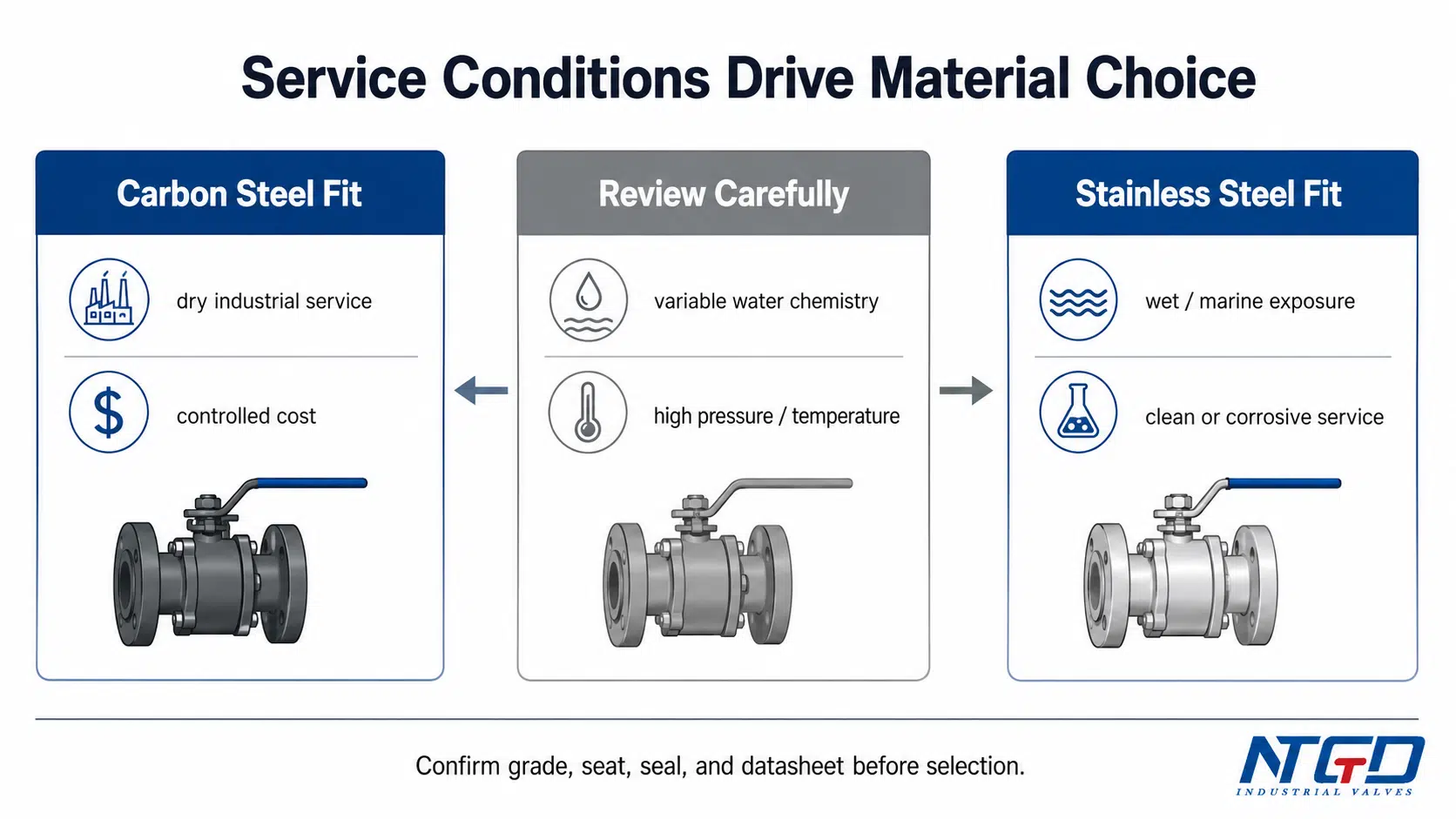
Ce tableau ne doit pas être considéré comme une règle absolue. Il s'agit d'un point de départ permettant d'affiner le choix des matériaux.
Le matériau du corps ne constitue pas à lui seul l'ensemble des spécifications du robinet à boisseau sphérique
Une erreur courante lors du choix d'un robinet à boisseau sphérique consiste à ne tenir compte que du matériau du corps. En conditions réelles d'utilisation, c'est l'ensemble complet du robinet qui importe.
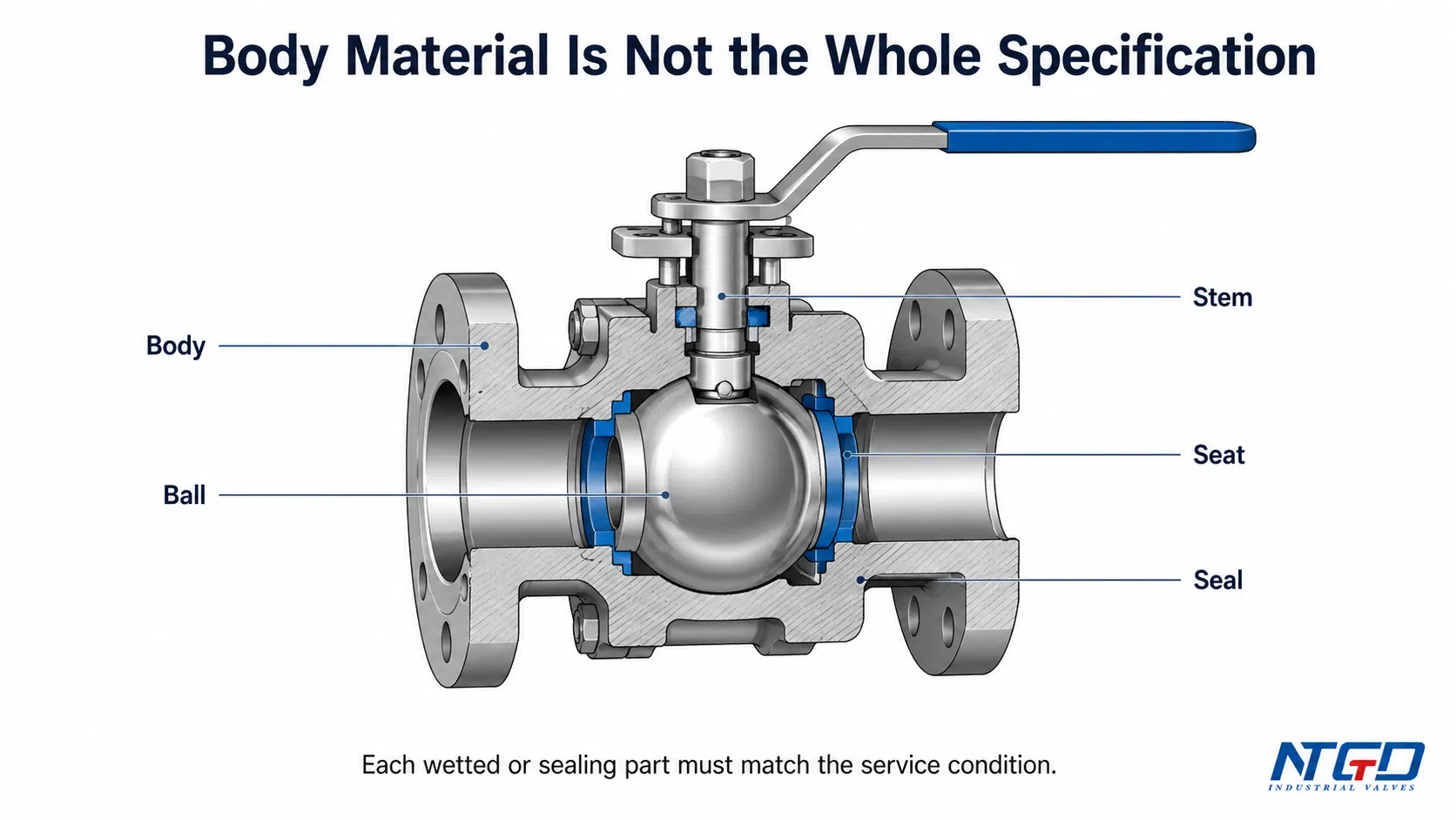
Un robinet à boisseau sphérique peut comporter plusieurs pièces en contact avec le fluide ou essentielles au bon fonctionnement :
| Composant | Pourquoi c'est important dans le choix des matériaux |
|---|---|
| Corps | Élément principal sous pression et point de comparaison des matériaux de base |
| Boule | Entre en contact avec les fluides et affecte la fiabilité des surfaces d'arrêt |
| Tige | Transmet le couple et peut être exposé à des fluides ou à l'environnement |
| Siège | Assure l'étanchéité autour de la bille et est souvent sensible à la température et aux produits chimiques |
| Joint / garniture | Cela a une incidence sur l'étanchéité externe et la compatibilité avec les fluides |
| Revêtement / doublure | Peut protéger le métal de base dans des conditions d'utilisation où la corrosion est un risque |
| Raccordement final | A un impact sur l'installation, l'enveloppe sous pression et les spécifications |
Matériaux du corps, de la bille, de la tige, du siège et du joint
Un corps en acier au carbone peut être associé à des garnitures en acier inoxydable ou à différents matériaux pour les sièges. Un corps en acier inoxydable peut néanmoins nécessiter un matériau spécifique pour le siège, le joint d'étanchéité, la garniture ou la tige, en fonction de l'application.
C’est pourquoi une description du matériau telle que “ vanne à bille en acier au carbone ” ou “ vanne à bille en acier inoxydable ” ne suffit pas toujours pour définir le cahier des charges définitif. L’appel d’offres doit préciser clairement quelles pièces sont en acier au carbone, lesquelles sont en acier inoxydable, et quels matériaux non métalliques sont utilisés pour les sièges et les joints.
Pourquoi la compatibilité entre le siège et le joint est-elle importante ?
Matériaux des sièges et des joints, en particulier Sièges disponibles en PTFE ou en PEEK Dans les modèles courants de vannes à bille, ces éléments constituent souvent la limite pratique de la durée de vie de la vanne. Ils peuvent être affectés par :
- température ;
- exposition à des produits chimiques ;
- pression ;
- la pratique fréquente du vélo ;
- liquide de nettoyage ;
- particules abrasives ;
- gonflement, durcissement ou dégradation.
Un corps en acier inoxydable ne peut pas protéger la vanne si le matériau du siège est attaqué par le fluide. Un corps en acier au carbone peut présenter une bonne résistance mécanique, mais la vanne peut tout de même présenter des fuites si le siège ou le joint n'est pas compatible. Dans certaines applications, matériau du siège ou du joint incompatible peut entraîner des fuites bien avant l'apparition de traces visibles de corrosion sur la carrosserie.
Les revêtements, les garnitures et les alliages spéciaux constituent des cas de sélection distincts
Certains services sont trop corrosifs ou trop spécifiques pour se limiter à un simple choix entre l'acier au carbone et l'acier inoxydable. Dans ces cas-là, on peut envisager des vannes revêtues, chemisées, en plastique ou en alliage spécial.
Il s'agit là de cas distincts de choix de matériaux, et non de simples substituts. Les options telles que les revêtements en PTFE, en PFA, en PVDF, en PP, en céramique, ainsi que l'Hastelloy, le titane ou d'autres matériaux spéciaux, doivent faire l'objet d'une évaluation spécifique portant sur la corrosion ou la compatibilité chimique.
Dans cet article, l'accent est mis sur le choix du matériau du corps des vannes à bille en acier au carbone et en acier inoxydable. Pour les applications plus agressives, il convient de vérifier la compatibilité à l'aide d'un tableau de compatibilité, du cahier des charges du projet et de la fiche technique du fabricant.
Liste de contrôle finale des matériaux des vannes à bille avant l'appel d'offres
Avant d'envoyer un appel d'offres ou de finaliser le cahier des charges, veuillez vérifier les points suivants : Données relatives au dimensionnement et à l'installation des vannes à bille.
| Point à confirmer | Pourquoi c'est important |
|---|---|
| Nom du média | Évalue les risques fondamentaux liés à la corrosion et à la compatibilité |
| Concentration chimique, le cas échéant | Le comportement d'un matériau peut varier en fonction de sa concentration |
| Température de fonctionnement | A un impact sur les pièces métalliques, les sièges, les joints et les caractéristiques de pression et de température |
| Classe de pression | Doit être conforme à la pression du système et aux exigences du code de conception |
| Diamètre du tuyau | Cela a une incidence sur la taille de la vanne, son couple, son poids et son installation |
| Raccordement final | Les extrémités à bride, filetées, soudées ou autres ont une incidence sur l'enveloppe sous pression et l'installation |
| Port complet ou port réduit | Cela influe sur la capacité de débit et les prévisions de perte de charge |
| Matériau du corps | Principaux critères de choix entre l'acier au carbone et l'acier inoxydable |
| Matériau de la bille et de la tige | Élément important pour la compatibilité des pièces en contact avec le fluide et le bon fonctionnement |
| Matériau du siège et du joint | C'est souvent le facteur limitant pour les applications impliquant des produits chimiques et des températures élevées |
| Exigences en matière de revêtement ou de doublure | À prendre en compte lorsque l'acier au carbone est exposé à un risque de corrosion |
| Nuance d'acier inoxydable | Les nuances 304, 316, 316L, CF8, CF8M ou autres doivent être adaptées à l'utilisation prévue |
| Exigences relatives aux normes et aux essais | Peut avoir une incidence sur les certificats de matériaux, les contrôles et la réception |
| Exigences en matière de sécurité incendie ou d'antistaticité | Convient à certaines applications liées au pétrole, au gaz, aux carburants ou aux substances dangereuses |
| Accès pour l'entretien | A une incidence sur le coût du cycle de vie et la planification du remplacement |
| Fiche technique du fabricant | Confirme les caractéristiques de pression et de température ainsi que les limites de conception |
| Tableau de compatibilité | Convient aux applications chimiques, marines ou en milieu corrosif |
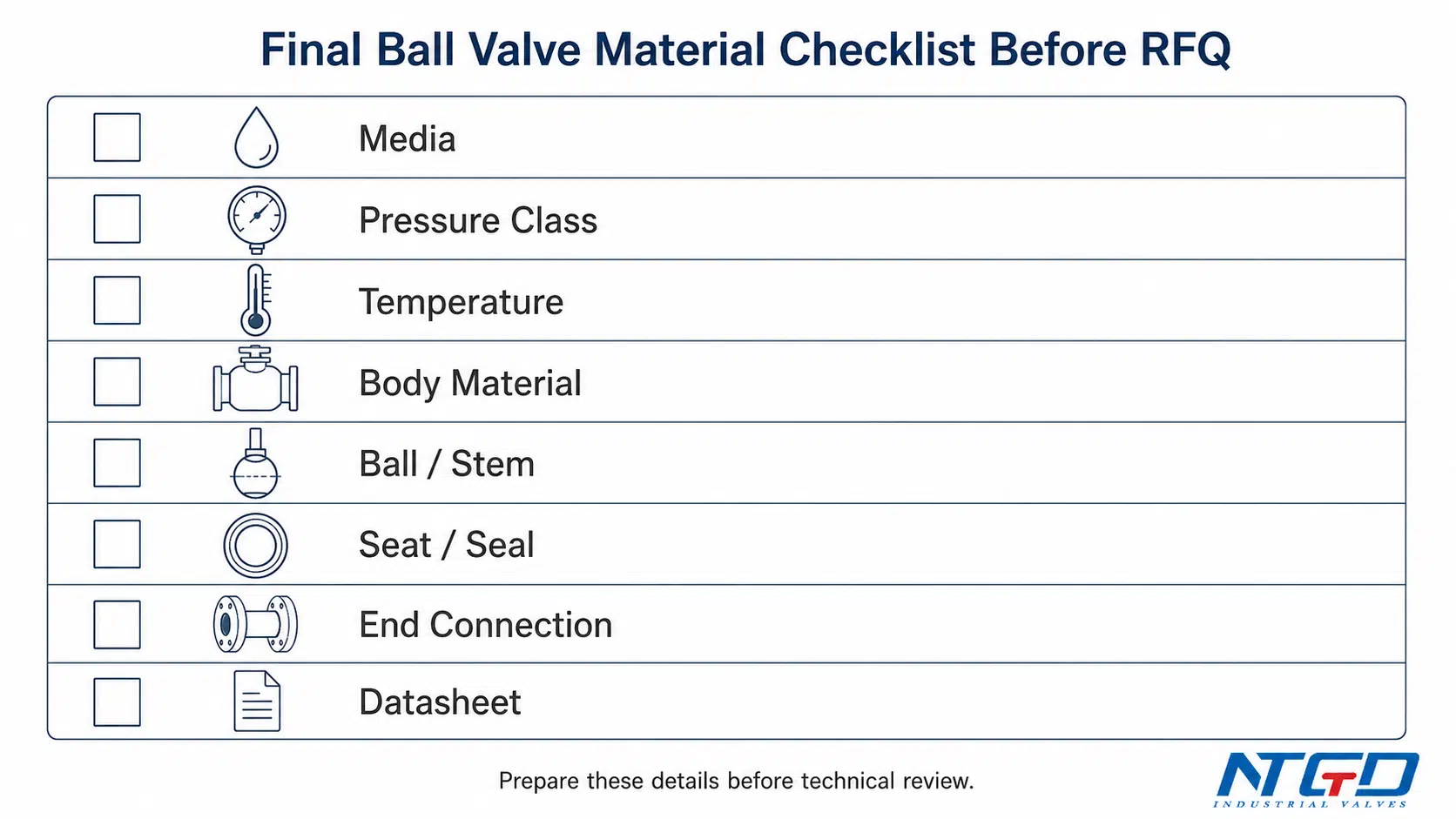
Cette liste de contrôle n'est pas un formulaire de devis. Il s'agit d'un filtre technique visant à réduire les risques d'inadéquation des matériaux avant l'approvisionnement. Si l'application se situe entre les options « acier au carbone » et « acier inoxydable », le fait de préparer ces informations à l'avance permet un examen technique plus rapide et plus précis.
FAQ sur les matériaux utilisés pour les vannes à bille en acier au carbone et en acier inoxydable
Quel est le meilleur matériau pour les robinets à boisseau sphérique : l'acier au carbone ou l'acier inoxydable ?
Le choix le plus judicieux dépend du risque de défaillance et de l'exposition aux coûts dans les conditions réelles d'utilisation. L'acier au carbone est souvent préférable lorsque l'environnement d'utilisation est sec, non corrosif, soumis à des contraintes mécaniques importantes et que le coût est un facteur déterminant. L'acier inoxydable est souvent préférable lorsque les risques liés à la corrosion, à la contamination, à l'accès pour la maintenance ou aux temps d'arrêt priment sur le prix d'achat initial le plus bas.
Dans quels cas dois-je opter pour un robinet à boisseau sphérique en acier au carbone ?
Optez pour une vanne à bille en acier au carbone lorsque l'environnement d'utilisation n'est pas fortement corrosif, que le système nécessite un corps de vanne industriel robuste et que le projet bénéficie d'un coût initial réduit. Elle est couramment utilisée dans les secteurs du pétrole, du gaz, des carburants, des services publics et de l'industrie en général. Vérifiez toujours le revêtement, la classe de pression, le matériau du siège et les limites indiquées dans la fiche technique.
Dans quels cas dois-je opter pour un robinet à boisseau sphérique en acier inoxydable ?
Optez pour un robinet à boisseau sphérique en acier inoxydable lorsque la résistance à la corrosion, la propreté, la facilité d'entretien ou la stabilité à long terme priment sur le coût initial le plus bas. L'acier inoxydable est généralement privilégié dans les secteurs maritime, agroalimentaire, pharmaceutique, du traitement de l'eau, des applications en extérieur et de l'industrie chimique. La nuance d'acier inoxydable doit toutefois être adaptée au fluide concerné.
Quelle est la différence entre les vannes à bille en acier inoxydable 304 et 316 ?
Les vannes à bille en acier inoxydable 304 sont couramment utilisées pour leur résistance générale à la corrosion et dans des applications propres où l'exposition aux chlorures ou aux produits chimiques agressifs est limitée. Les vannes à bille en acier inoxydable 316 sont souvent choisies pour les applications marines, en milieu chloré ou impliquant des produits chimiques, car elles offrent généralement une meilleure résistance à la corrosion dans ces environnements. L'acier 316L peut être spécifié lorsqu'une teneur en carbone plus faible est requise pour des applications soudées ou sensibles à la corrosion. Le choix final doit néanmoins tenir compte du fluide, de sa concentration, de la température, du matériau du siège et des données fournies par le fabricant.
L'acier inoxydable est-il toujours meilleur que l'acier au carbone ?
Non. L'acier inoxydable est plus adapté à de nombreuses applications corrosives, humides ou nécessitant une grande propreté, mais il n'est pas systématiquement le meilleur matériau pour tous les systèmes. Dans les applications industrielles sèches, non corrosives et où le coût est un facteur déterminant, l'acier au carbone peut s'avérer plus pratique. L'acier inoxydable peut également subir de la corrosion si une nuance inadaptée est utilisée dans des applications impliquant des chlorures, des acides, de l'eau de Javel ou des produits chimiques à haute température.
Quelle est la durée de vie des vannes à bille en acier inoxydable ?
La durée de vie des vannes à bille en acier inoxydable dépend de l'exposition à la corrosion, de la fréquence des cycles, de l'état des sièges et des joints, de la température de fonctionnement, de la pression, de la composition chimique du fluide et de l'accessibilité pour la maintenance. L'acier inoxydable peut offrir une excellente rentabilité sur l'ensemble du cycle de vie dans des conditions d'utilisation adaptées, mais sa durée de vie effective reste toutefois limitée par l'ensemble complet de la vanne, et non uniquement par le matériau du corps.
Quels sont les travaux d'entretien nécessaires pour les vannes en acier au carbone ?
Les vannes en acier au carbone peuvent nécessiter une inspection visant à détecter la présence de rouille, d'endommagements du revêtement, de corrosion externe, de fuites et d'usure des sièges. En cas d'utilisation en milieu humide ou à l'extérieur, l'état du revêtement revêt une importance particulière. En cas de changement du fluide ou de l'environnement, il convient de réexaminer l'adéquation du matériau.
Quels autres éléments faut-il vérifier, outre le matériau de la carrosserie ?
Vérifiez la bille, la tige, le siège, le joint d'étanchéité, le joint d'étanchéité, le raccord d'extrémité, la classe de pression, la plage de température, les fluides de service, le risque de corrosion, les exigences en matière de revêtement ou de garnissage, ainsi que la fiche technique du fabricant. Le matériau du corps est important, mais il ne détermine pas à lui seul l'adéquation de la vanne.
Les vannes à bille résistantes aux produits chimiques sont-elles identiques aux vannes à bille en acier inoxydable ?
Non. Une vanne à bille résistante aux produits chimiques peut être fabriquée en acier inoxydable, mais elle peut également nécessiter l'utilisation de matériaux revêtus, de plastique, d'alliages spéciaux ou d'autres matériaux résistants à la corrosion. L'acier inoxydable est une solution possible, mais il ne constitue pas la définition exhaustive de la résistance aux produits chimiques. La compatibilité avec les produits chimiques doit être vérifiée en fonction des données précises relatives au milieu, à la concentration, à la température et à la compatibilité.
Conclusion
Le choix entre les vannes à bille en acier au carbone et celles en acier inoxydable dépend des conditions d'utilisation, et non d'une préférence générale pour l'un ou l'autre matériau. Les vannes à bille en acier au carbone sont robustes et économiques pour de nombreux systèmes industriels non corrosifs. Les vannes à bille en acier inoxydable offrent une meilleure résistance à la corrosion et une plus grande stabilité tout au long de leur cycle de vie dans des environnements humides, propres, marins, chimiques ou nécessitant un entretien régulier.
Pour faire un choix fiable, comparez le coût initial, l'exposition à la corrosion, les exigences en matière de pression et de température, la nuance, la compatibilité des sièges et des joints, l'accès pour la maintenance et les exigences en matière de documentation. Le choix de matériau le plus sûr est celui qui correspond à l'ensemble des spécifications de la vanne et à l'environnement d'exploitation réel.
La préparation des paramètres clés figurant dans la liste de contrôle ci-dessus permet aux équipes d'ingénierie d'évaluer plus rapidement l'adéquation des matériaux et réduit le risque de choisir une vanne qui tombera en panne plus tôt que prévu.
Vous avez besoin d'aide pour vérifier la compatibilité des matériaux d'un robinet à boisseau sphérique ?
Si vous ne savez pas si l'acier au carbone ou l'acier inoxydable convient à l'application de votre vanne à bille, les ingénieurs spécialisés de NTGD Valve peuvent vous aider à évaluer la compatibilité des matériaux et les limites techniques. Une brève analyse technique permet de réduire les risques de fuite, d'arrêt imprévu, de contamination du fluide ou de remplacement prématuré dus à une incompatibilité des matériaux.
Pour une évaluation plus précise, veuillez indiquer le fluide, la concentration (le cas échéant), la classe de pression, la température de service, le diamètre de la conduite, le type de raccordement, le matériau souhaité pour le corps de la vanne, ainsi que les exigences relatives au siège et au joint.
