
Author Name: Bruce Zheng
Author Role: Co-Founder and Valve Engineer at NTGD Valve
Author Bio: Bruce Zheng is Co-Founder and Valve Engineer at NTGD Valve, focusing on industrial valve selection, application, and technical content for global B2B buyers.
Last Updated: June 25, 2026
A gas plug valve is a quarter-turn isolation valve used to open or close the flow of gaseous media in a pipeline. It uses a cylindrical, conical, or tapered plug with a port through the plug body. When the plug port aligns with the pipeline, gas can pass through the valve. When the plug rotates about 90 degrees, the solid part of the plug blocks the flow path.
For industrial gas service, a gas plug valve should not be selected by valve name alone. The medium, pressure class, temperature, body material, sealant or seat compatibility, end connection, operation method, leakage expectation, and project specification must all match the actual service conditions.
This article focuses on industrial gas service plug valve selection for natural gas, LP gas, propane gas, fuel gas, utility gas, and other specified gas services. It is not a household gas line repair guide, appliance gas cock guide, or product catalog page.
What Is a Gas Plug Valve?
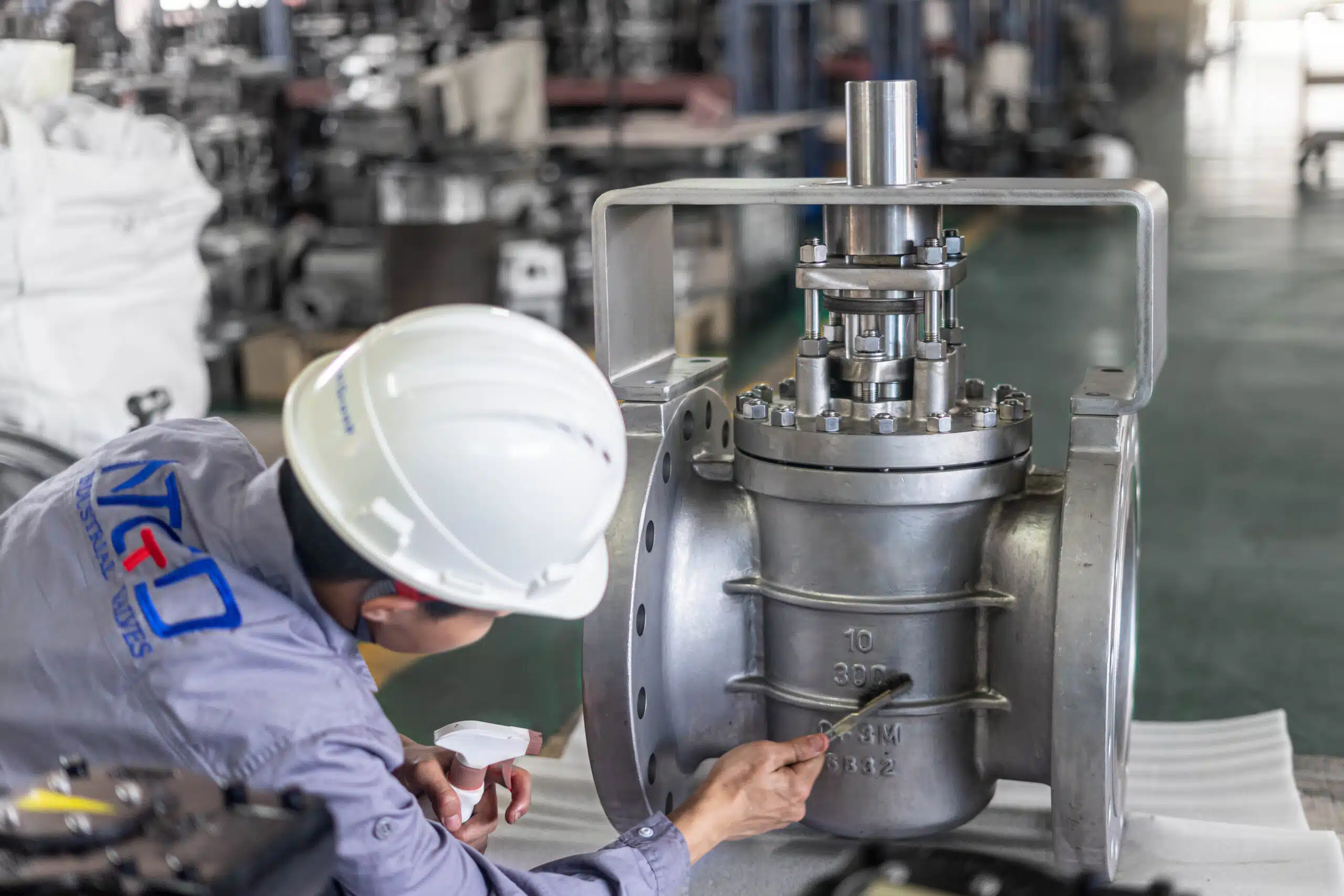
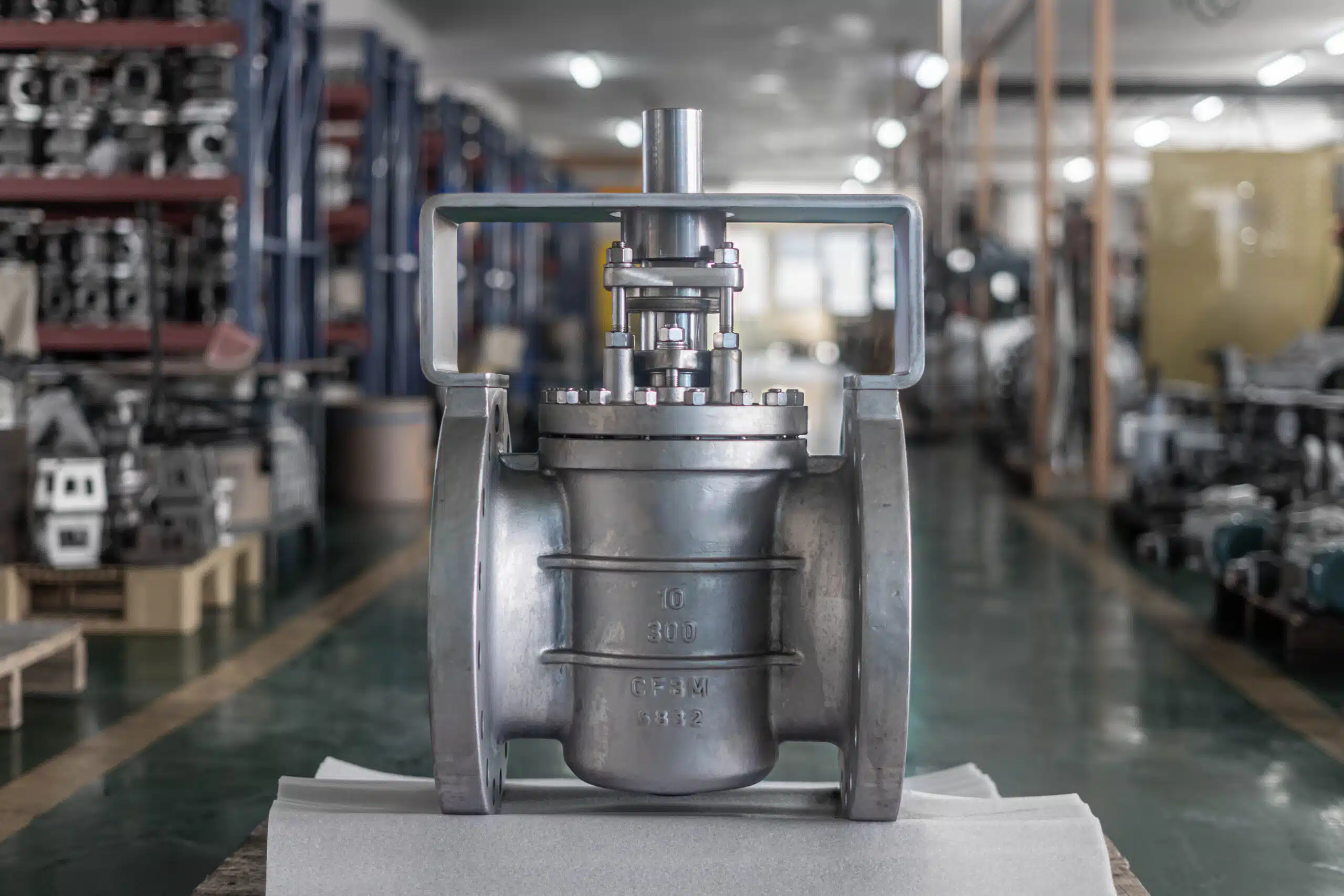
A gas plug valve is a plug valve selected for gaseous service where on-off isolation is required. The closing member is a plug inside the valve body. The plug contains one or more openings, also called ports, that allow flow when aligned with the pipeline.
For most gas service applications, the valve is used mainly for shutoff and isolation, not precision throttling. The quarter-turn motion allows fast opening and closing, while the plug, seat, sleeve, sealing surface, or sealant system determines how the valve controls shutoff behavior.
A typical gas plug valve may include:
| Main part | Basic function |
|---|---|
| Valve body | Contains the pressure boundary and end connections |
| Plug | Rotates to open or close the flow path |
| Seat, sleeve, or sealing surface | Controls shutoff behavior and leakage expectation |
| Stem | Transfers torque from the operator to the plug |
| Packing | Helps control external leakage around the stem |
| Handwheel, gear, lever, or actuator | Provides manual or automated operation |
| Sealant system, if lubricated | Supports sealing, torque control, and plug-body interface performance |
The term gas plug valve can cover several construction styles. Some are lubricated plug valves, some use liners or sleeves, and some are designed for specific pressure classes, end connections, or operation methods. For industrial buyers, the key question is not only “what is the valve called?” but also “is this design suitable for the actual gas service?”
How Does a Gas Plug Valve Work?
A gas plug valve works by rotating the plug inside the valve body. The plug has a bore or port through it. The position of this port controls whether the valve is open or closed.
When the port in the plug is aligned with the inlet and outlet ports of the valve body, the flow path is open. Gas can pass through the valve. When the plug turns about a quarter turn, the port becomes perpendicular to the pipeline. The solid section of the plug blocks the flow path, and the valve is closed.
| Valve position | Plug position | Flow condition |
|---|---|---|
| Fully open | Plug port aligned with pipeline | Gas flows through the valve |
| Fully closed | Plug port turned across the pipeline | Flow is blocked |
| Partly open | Plug between open and closed position | Not normally used for precision control |
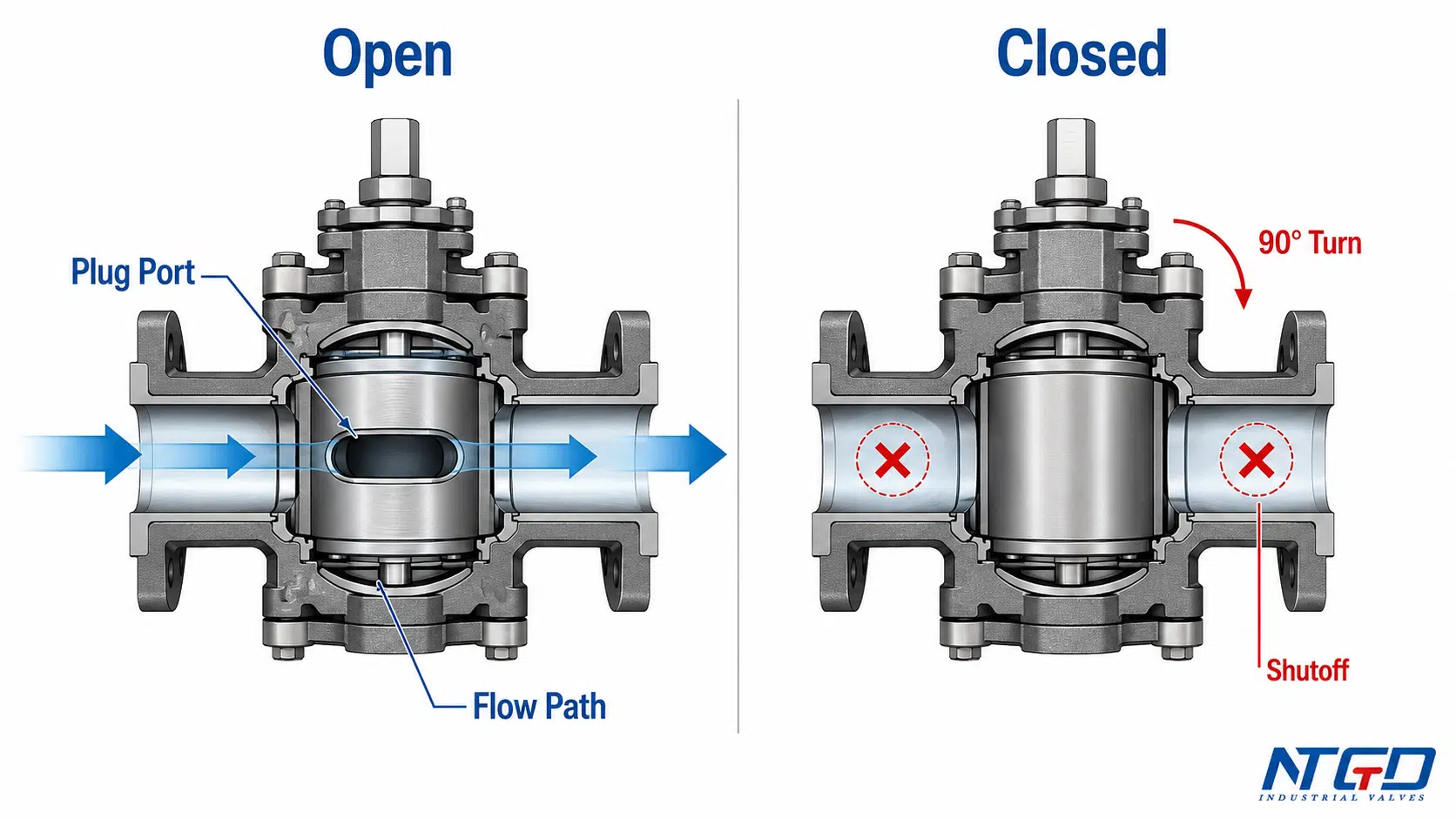
The plug may be cylindrical, conical, or tapered depending on the valve design. In many industrial designs, a tapered plug helps create sealing contact between the plug and the body, sleeve, or seat area. In lubricated plug valves, sealant between the plug and body can help improve sealing behavior and reduce operating friction.
Gas plug valves should normally be reviewed as on-off isolation valves. If the service requires accurate flow control, stable throttling, or continuous modulation, a control valve or another valve type may need to be reviewed instead.
Can Gas Plug Valves Be Used for Natural Gas and LP Gas Service?
Yes, gas plug valves can be used for natural gas and LP gas service when the valve design, materials, pressure rating, sealant or seat system, and applicable project requirements are suitable for the service. The phrase natural gas plug valve usually refers to a plug valve selected or rated for natural gas service, not a completely separate valve family.
For industrial projects, a plug valve for natural gas should be reviewed against the actual working conditions. Natural gas, LP gas, propane, fuel gas, and other gas services may require different material, sealing, pressure, temperature, testing, and safety considerations.
| Service | Can a gas plug valve be considered? | Key checks before selection |
|---|---|---|
| Natural gas | Yes, if designed and rated for the service | Gas composition, condensate risk, pressure class, temperature, body material, sealant or seat compatibility, leakage expectation, project standard |
| LP gas / propane gas | Yes, if specified for LP gas service | Medium compatibility, elastomer or sealant compatibility, shutoff requirement, connection type, operation method |
| Industrial fuel gas | Yes, project-dependent | Pressure, temperature, fire-safe or project requirements if specified |
| Utility gas in plants | Often possible | Operating frequency, accessibility, torque, maintenance plan |
| Household gas line | Outside the scope of this article | Follow local code and qualified service requirements |
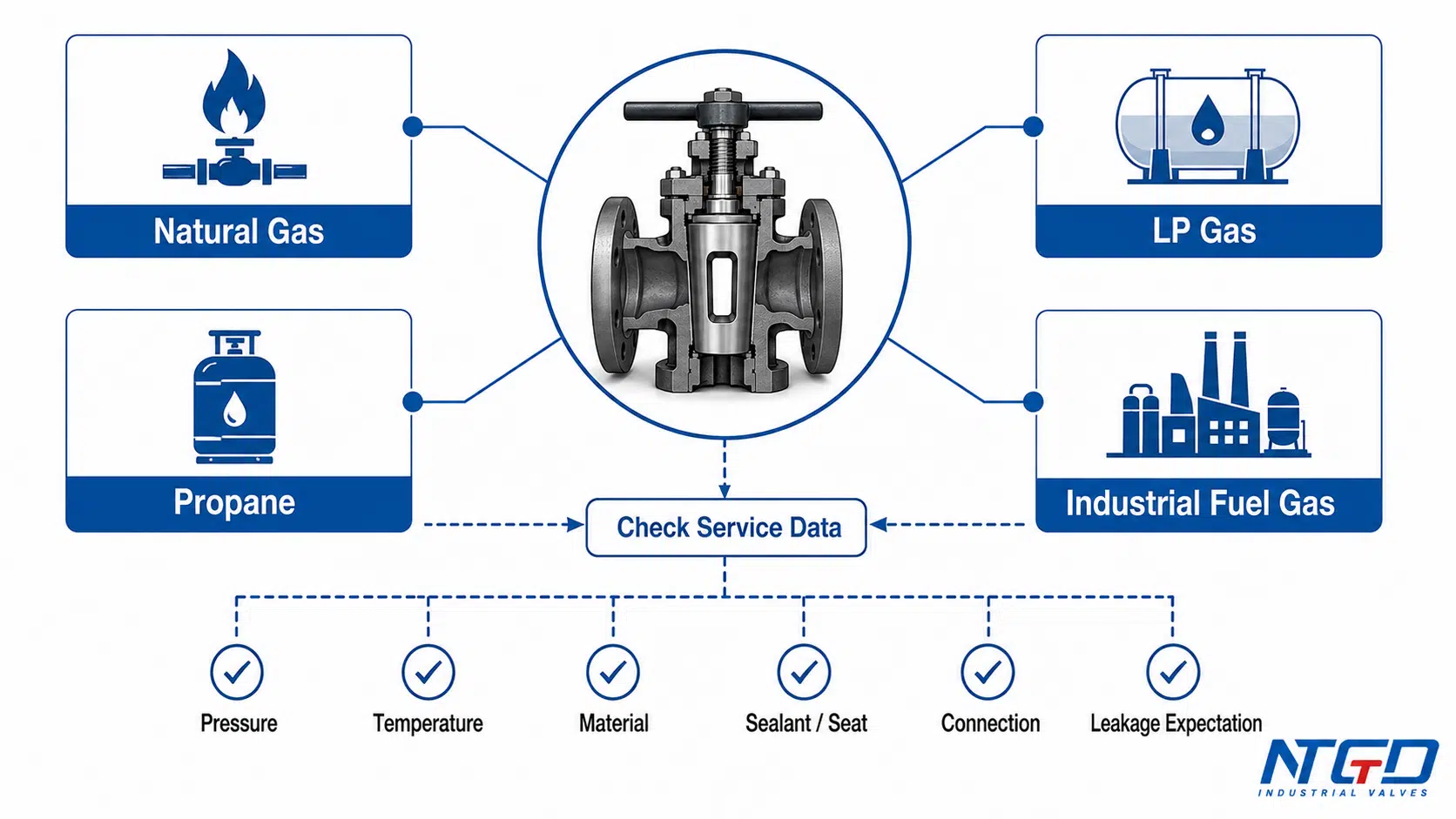
The main selection risk is assuming that any plug valve can be used in any gas service. Pressure class mismatch, incompatible sealant or seat materials, unsuitable body material, or the wrong end connection can lead to leakage risk, high operating torque, premature wear, or an unsafe service mismatch. For this reason, natural gas and LP gas plug valve selection should always be tied to RFQ data and project specifications, not only to the valve name.
Before selecting a gas plug valve for natural gas or LP gas service, confirm at least the following:
- Gas composition and operating condition.
- Design pressure and operating pressure.
- Operating and design temperature.
- Required body, plug, seat, sleeve, or trim material.
- Whether a lubricated design is required.
- Whether the sealant, sleeve, seat, or grease is compatible with the gas and temperature.
- End connection, such as threaded, flanged, RF, RTJ, NPT, or BW.
- Manual, gear, or actuator operation.
- Required inspection and pressure test, or project specification.
Industrial Gas Plug Valves vs Plumbing Gas Cocks
Search results for gas plug valves often include plumbing products, low-pressure gas cocks, appliance valves, distributor category pages, and small threaded valves. These results are useful for some buyers, but they do not fully represent industrial gas plug valve selection.
An industrial gas plug valve is usually reviewed as part of a piping specification. The valve may need to match pressure class, material, end connection, operating method, leakage expectation, and project testing requirements. A plumbing gas cock or appliance shutoff valve is usually selected under a different code environment and application context.
| Item | Industrial gas plug valve | Plumbing gas cock / appliance gas valve |
|---|---|---|
| Typical use | Plant gas line, fuel gas, process gas, pipeline, gas gathering, utility gas | Household or light commercial gas shutoff |
| Selection basis | Pressure class, material, connection, sealing design, operation, project specification | Local code, appliance requirement, small pipe size, local installation practice |
| Common connection | Flanged, threaded, welded, RF, BW, NPT depending on project | Usually small threaded connection |
| Operation | Handwheel, gear, lever, pneumatic or electric actuator | Manual shutoff |
| Article focus | Yes | No |
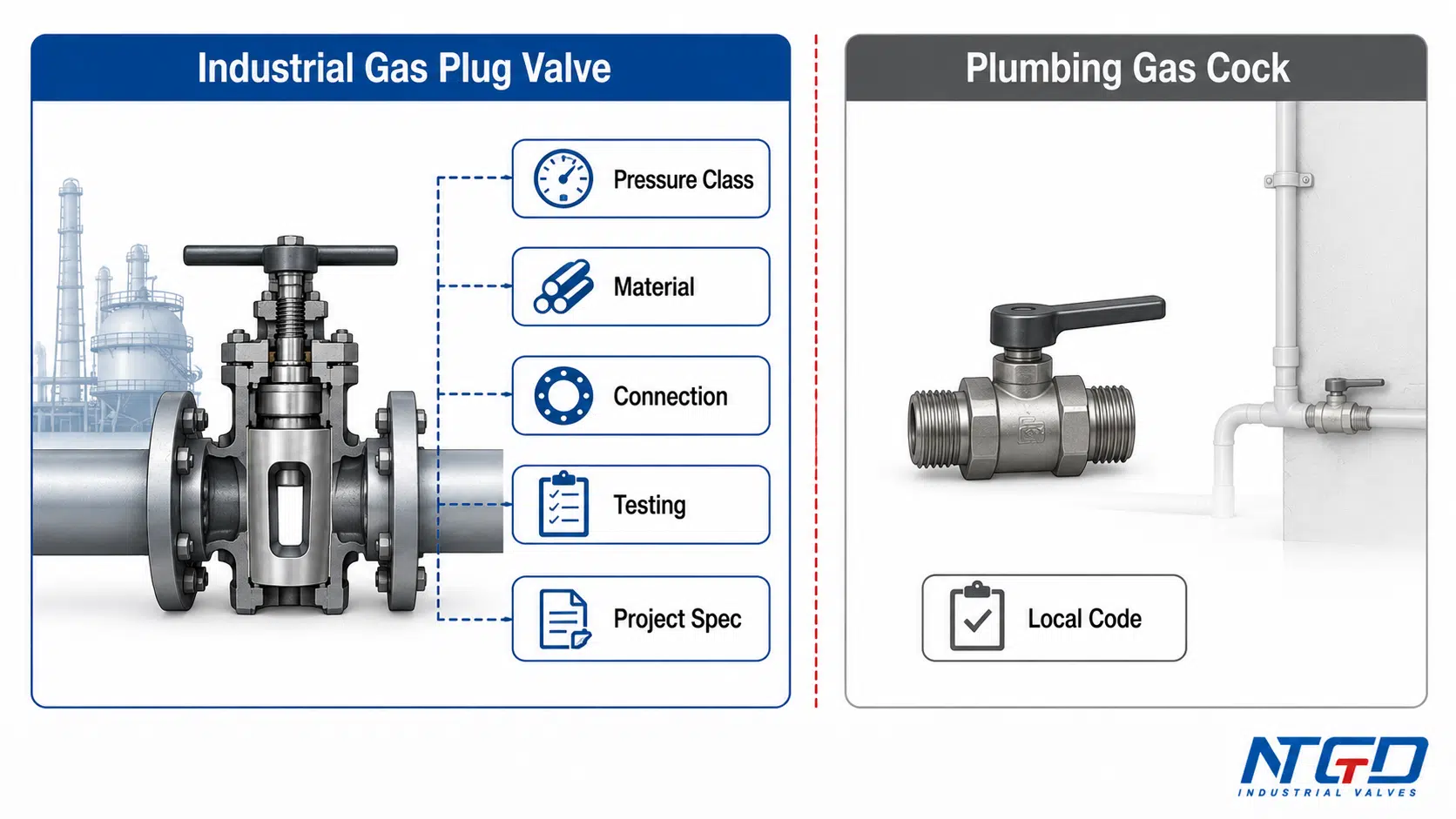
Confusing a plumbing gas cock with an industrial gas plug valve can underspecify the pressure boundary, material compatibility, connection rating, external leakage control, and maintenance access. For industrial service, the valve should be checked against the project specification and datasheet rather than selected from a low-pressure product category result.
For NTGD-style industrial valve selection, the correct question is not “can this valve be used for gas?” in a general sense. The better question is:
Is this gas plug valve designed, rated, tested, and specified for the actual industrial gas service?
That distinction helps prevent a low-pressure product-category result from being confused with an industrial gas service valve.
Lubricated Plug Valve Design in Gas Service
A lubricated plug valve uses sealant or grease between the plug and valve body. This sealant helps reduce friction, supports sealing between metal surfaces, and can help the valve operate with more controlled torque.
In gas service, lubricated plug valves are often considered when tight shutoff, simple quarter-turn operation, and reliable isolation are important. The sealant system is part of the valve’s sealing behavior, so it should be treated as a selection item, not just a maintenance detail.
What is a lubricated plug valve?
A lubricated plug valve is a plug valve that uses an injected or retained sealant between the plug and the valve body. The sealant forms a film in the plug-body interface. This film can help reduce metal-to-metal friction and support sealing performance.
The design is especially relevant when the valve must handle gas isolation under project-specific pressure and temperature conditions. However, the valve’s suitability still depends on its actual construction, material, pressure class, sealant compatibility, and testing requirements.
How sealant or grease affects sealing and torque
Sealant or grease can influence three important areas:
| Area | Why it matters |
|---|---|
| Shutoff behavior | Sealant helps fill small clearances between plug and body surfaces |
| Operating torque | Lubrication can reduce friction during opening and closing |
| Maintenance planning | Sealant condition may affect long-term operation, leakage risk, and service interval |
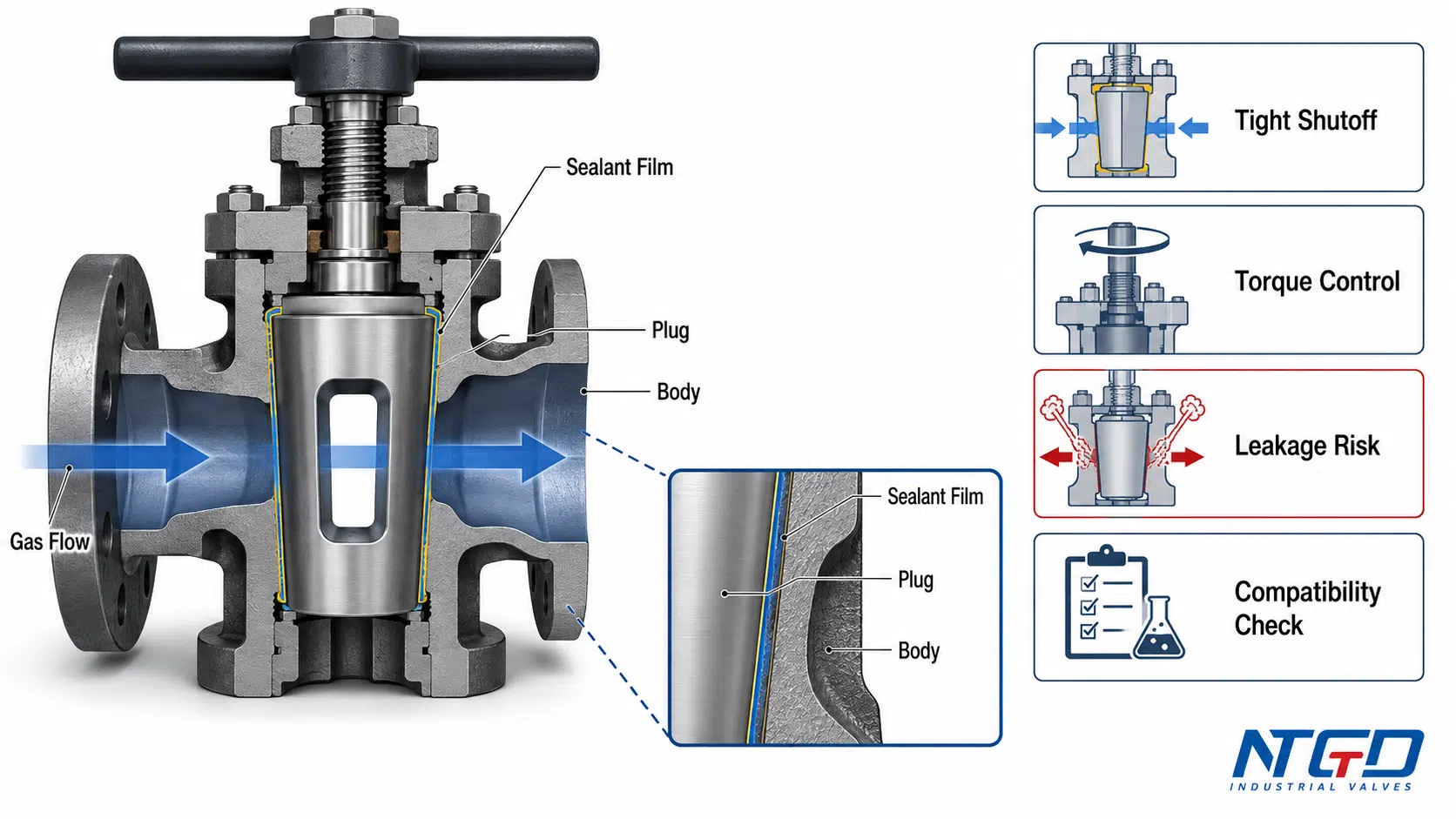
If the sealant or grease is not compatible with the gas composition, temperature, or contaminants in the service, the valve may develop higher torque, lose sealing film performance, create internal leakage paths, or require a shorter maintenance interval.
In gas service, the value of a lubricated design depends on tight shutoff, torque control, and plug-body interface protection, but those benefits depend on selecting the correct sealant for the actual medium and temperature.
Lubricated vs non-lubricated plug valves for gas service
| Design | Gas service relevance | Selection note |
|---|---|---|
| Lubricated plug valve | Often used where shutoff and torque control are important | Confirm sealant compatibility, pressure class, temperature range, and maintenance expectations |
| Non-lubricated plug valve | May use a sleeve, liner, or seat design instead of sealant film | Confirm sleeve or seat material, pressure, temperature, and leakage expectation |
| Eccentric plug valve | More often used where specific seating action or industrial service conditions are required | Check whether the seating action and materials fit the gas service instead of treating it as the default gas valve design |
| Multi-port plug valve | Used when flow diversion or routing is required | Confirm port arrangement, shutoff requirement, and whether each flow path matches the service condition |
A lubricated plug valve should not be selected only because the word “lubricated” appears in the description. For gas service, the sealant, body material, plug design, end connection, operation method, and test requirements must all match the project.
Main Components and Their Selection Impact
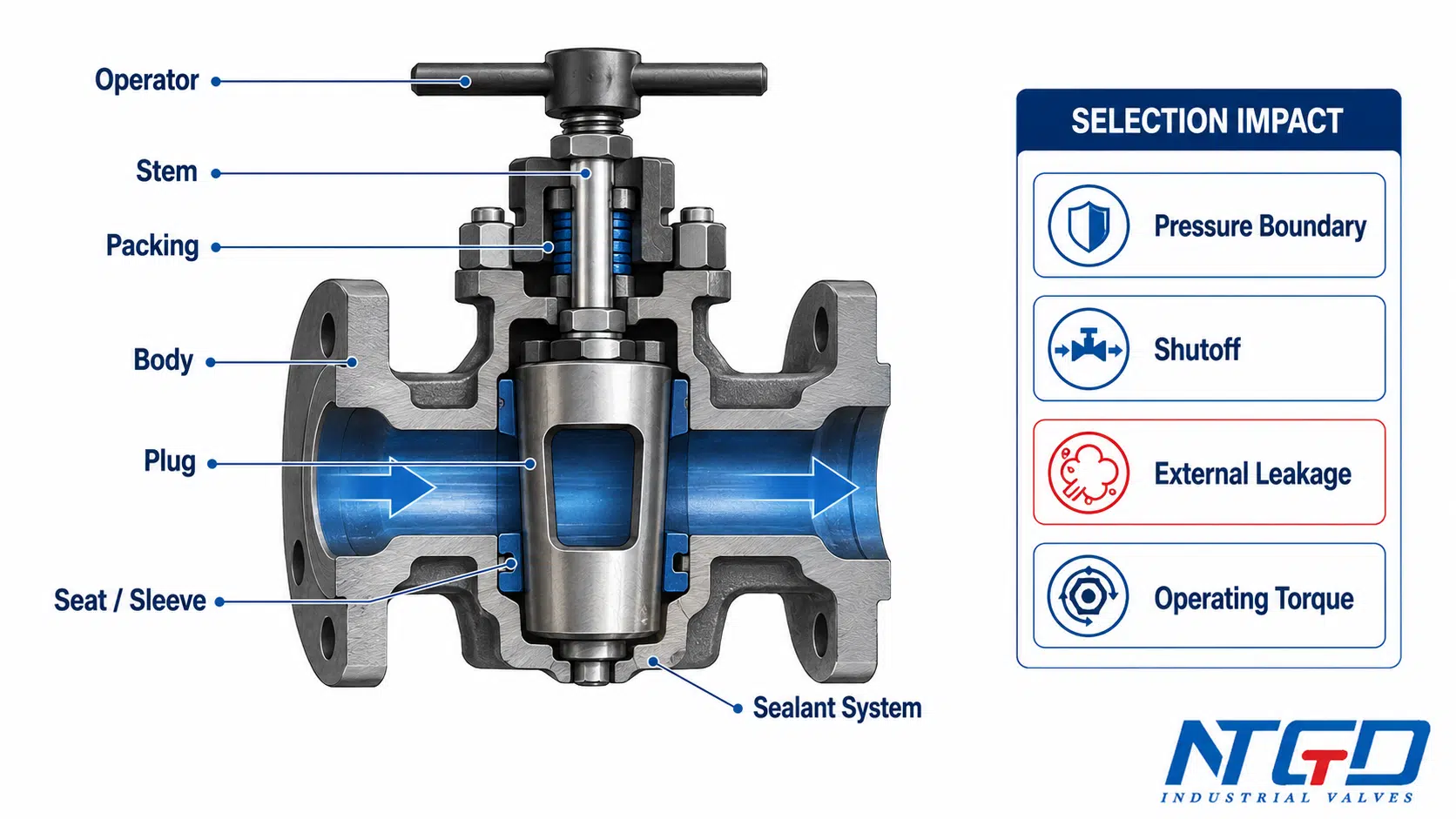
The components of a gas plug valve should not be reviewed only as a parts list. Each component affects the pressure boundary, sealing behavior, operating torque, leakage risk, and maintenance expectations.
| Component | What to check | Why it matters in gas service |
|---|---|---|
| Valve body | Material, pressure class, casting or forging, end connection | Wrong body material or rating can create a pressure-boundary or corrosion-resistance mismatch |
| Plug | Cylindrical, conical, or tapered design; port type | Controls the open and closed flow path and affects shutoff behavior |
| Seat, sleeve, or sealing surface | Material, liner, sleeve, or metal seating design | A poor match can increase internal leakage risk or shorten service life |
| Stem | Strength, stem connection, torque transfer | Incorrect sizing or damage can affect torque transmission and operation reliability |
| Packing | Packing material and arrangement | Directly affects external gas leakage control around the stem |
| Sealant system | Sealant type and compatibility | Drives torque, leakage expectation, and maintenance interval; incompatibility can cause high torque or sealing loss |
| Operator | Handwheel, gear, lever, pneumatic or electric actuator | Must match valve size, torque demand, site access, and automation requirement |
Body and pressure boundary
The valve body contains the internal parts and connects to the pipeline. In industrial gas service, body material should be selected based on pressure, temperature, corrosion risk, project specification, and compatibility with the gas medium.
Common industrial valve materials may include carbon steel, stainless steel, ductile iron, cast iron, or alloy materials depending on the valve design and service. The key selection point is not simply material name; it is whether the body material and pressure rating match the gas composition, design pressure, design temperature, and piping class.
Plug, port and sealing surface
The plug is the rotating element that opens or closes the flow path. The plug may be cylindrical, conical, or tapered. Its port arrangement determines how gas flows through the valve when open and how the valve blocks the flow when closed.
For gas service, the plug and sealing surface influence shutoff performance, operating torque, and wear behavior. If the service contains contaminants, condensate, or temperature variation, the plug-body interface, seat, sleeve, or sealant system should be reviewed as part of the selection decision.
Stem, packing and external leakage control
The stem connects the operator to the plug. Packing around the stem helps control external leakage. In gas service, external leakage control is important because gas escaping around the stem or packing area can create safety, environmental, and maintenance concerns.
Packing design, stem condition, operating torque, and actuator alignment should be reviewed together. A valve that is correctly rated for pressure can still create operating problems if the packing, stem, or operator is not suited to the actual torque and site-access conditions.
Gas Plug Valve Types, Connections and Operation Methods
Older gas plug valve articles often mix design types, end connection types, and operation methods under one “types” section. For industrial selection, it is better to separate these categories.
Design types
| Design type | Selection role |
|---|---|
| Lubricated gas plug valve | Uses sealant or grease between plug and body; often reviewed for gas isolation service |
| Non-lubricated gas plug valve | Uses sleeve, liner, or seating design instead of a lubricating film |
| Eccentric plug valve | Uses an offset plug motion and may be suitable for specific industrial services |
| Multi-port plug valve | Routes or diverts flow through more than two ports |
Lubricated and non-lubricated designs should not be selected only by preference. The correct design depends on medium, pressure, temperature, leakage expectation, operating torque, maintenance access, and project specification.
End connections
| End connection | Typical selection note |
|---|---|
| Threaded / NPT | Often used in smaller sizes or lower-pressure piping, depending on specification |
| Flanged / RF | Common where bolted installation, maintenance access, and piping class require flange connection |
| Welded / BW | Considered where welded pipeline integrity is required and frequent removal is not expected |
| RTJ or other flange facing | Used only when required by pressure class and piping specification |
A threaded end gas plug valve, flanged end gas plug valve, and welded end gas plug valve may all serve gas applications, but their installation, maintenance access, and pressure-boundary considerations are different.
Operation methods
| Operation method | Selection note |
|---|---|
| Handwheel or lever operation | Suitable where manual torque is acceptable and access is available |
| Gear operation | Often considered for larger sizes or higher torque requirements |
| Pneumatic actuator | Used where remote or automated operation is required |
| Electric actuator | Used where electric automation and control integration are needed |
| Hydraulic actuator | Used in selected services requiring hydraulic power or high actuation force |
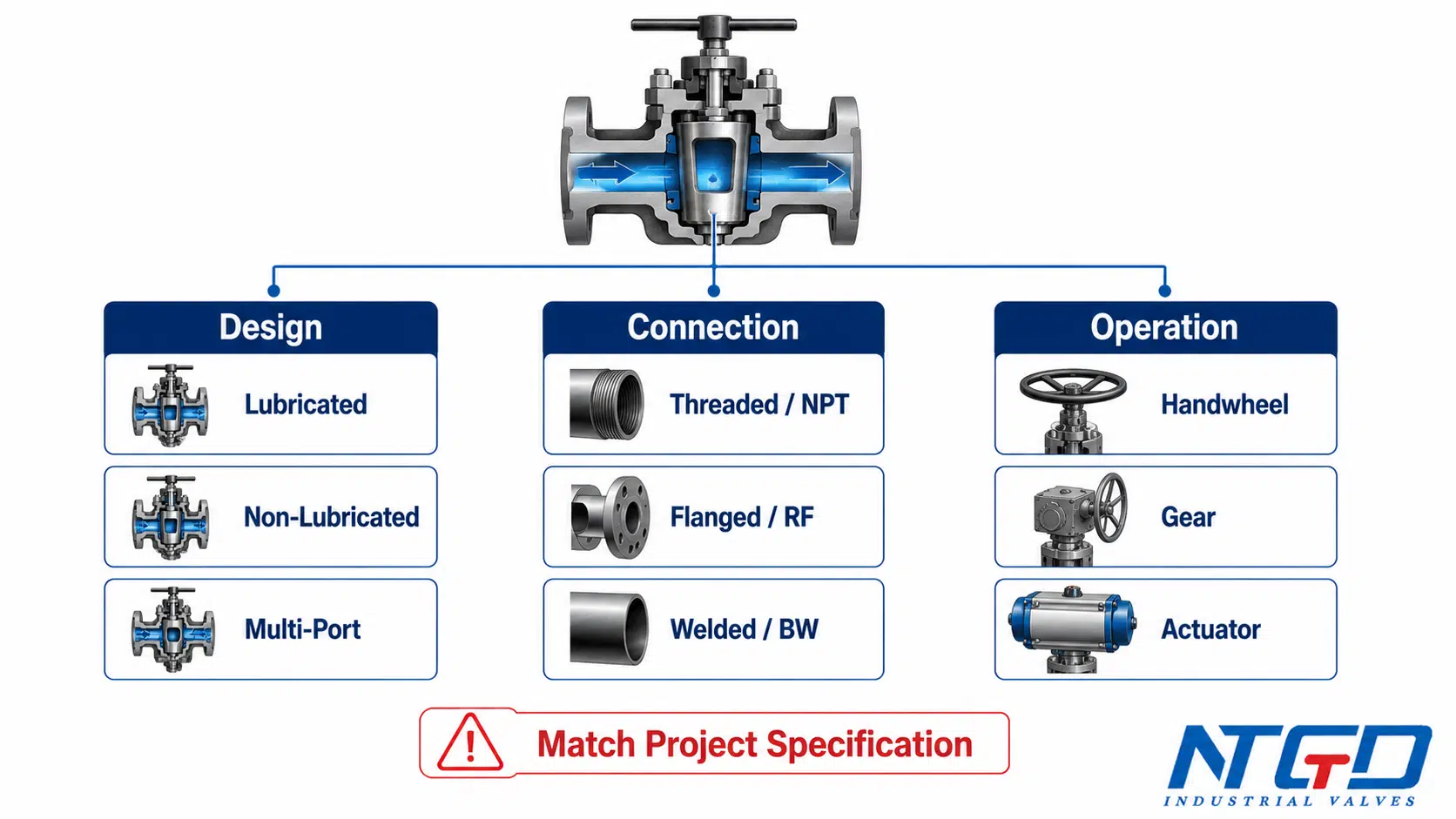
A handwheel operated plug valve may be suitable for small or moderate torque applications. A gear operated plug valve may be required when valve size, pressure, sealing load, or site operation requirements make direct manual operation difficult.
Pressure class and standard notes
Pressure class and material requirements, fire-safe requirements, NACE requirements, emissions requirements, and test standards should not be assumed from the valve name. They should be confirmed using the project specification, datasheet, and manufacturer documentation.
For example, a project may require Class 600, Class 1500, or Class 2500 plug valves, or may require RF, BW, NPT, or other connections. These terms are useful in RFQ preparation, but they should not be treated as universal requirements for every gas plug valve.
Gas Service Selection Factors and Application Fit
In broader industrial valve selection, a gas plug valve is usually selected for isolation service where quick quarter-turn operation, compact construction, and shutoff performance are useful. However, suitability depends on the complete service condition.
Key selection factors before choosing a gas plug valve
| Factor | Why it matters |
|---|---|
| Medium | Determines material, sealant, sleeve, seat, packing, and corrosion-resistance requirements |
| Pressure and temperature | Define pressure class, body material, sealant limits, packing selection, and operating torque |
| Body and trim material | Affects pressure boundary, corrosion resistance, and compatibility with the gas service |
| Sealant, sleeve, or seat design | Controls leakage expectation, torque behavior, and maintenance interval |
| End connection | Must match piping class, installation method, and maintenance access |
| Operation method | Must match valve size, torque, automation requirement, and site access |
| Leakage expectation | Should be defined by project requirement, not marketing wording |
| Maintenance access | Important for lubricated designs, packing inspection, and long-term operation |
| Applicable standard | Must be checked against the project specification and manufacturer data |
These factors are not just information fields. They define the boundary for valve design, sealant or seat selection, material selection, end connection, operator choice, and test requirement. If one factor is mismatched, the valve may still fit the pipe mechanically but fail the actual gas service requirement.
Application fit matrix
| Application | Fit level | Selection note |
|---|---|---|
| Natural gas pipeline or plant utility gas | Good when specified correctly | Confirm pressure, sealant or seat system, body material, connection, and testing |
| LP gas / propane service | Possible with correct design | Confirm medium compatibility, elastomer or sealant compatibility, and shutoff expectation |
| Industrial fuel gas isolation | Good for on-off service | Confirm operator, pressure class, leakage expectation, and project standard |
| Gas gathering or midstream service | Project-dependent | Confirm pressure, material, connection, inspection requirement, and operating frequency |
| Chemical vapor or process gas | Project-dependent | Confirm corrosion resistance, sealant compatibility, and temperature limits |
| Precise throttling or continuous modulation | Usually not the first choice | Review control valve or another valve type |
| Household gas line or appliance gas shutoff | Outside this article scope | Follow local codes and qualified service requirements |
Industrial gas service should be judged by project conditions, not by a generic product-category result. A valve that appears under “LP and natural gas plug valves” in a plumbing or distributor context may not meet the pressure, material, connection, operation, or inspection requirements of a plant or pipeline system.
Where gas plug valves may not be the best choice
A gas plug valve may not be the best choice when the system requires fine flow control, frequent modulation, very low operating torque without maintenance access, or a design where sealant, sleeve, or seat compatibility cannot be confirmed.
It may also need further review when the gas contains contaminants, condensate, corrosive service conditions, high temperature, high pressure, or strict leakage requirements. In these cases, the buyer should confirm the design with project specifications and the valve manufacturer’s datasheet.
RFQ Checklist for Gas Plug Valve Selection
Because gas plug valve selection depends on service conditions, the RFQ should contain more than the valve name. Incomplete service data is one of the most common causes of selection mismatch in gas plug valve RFQs. A clear RFQ helps avoid wrong pressure class, wrong sealant, wrong connection, wrong operator, or unsuitable material.
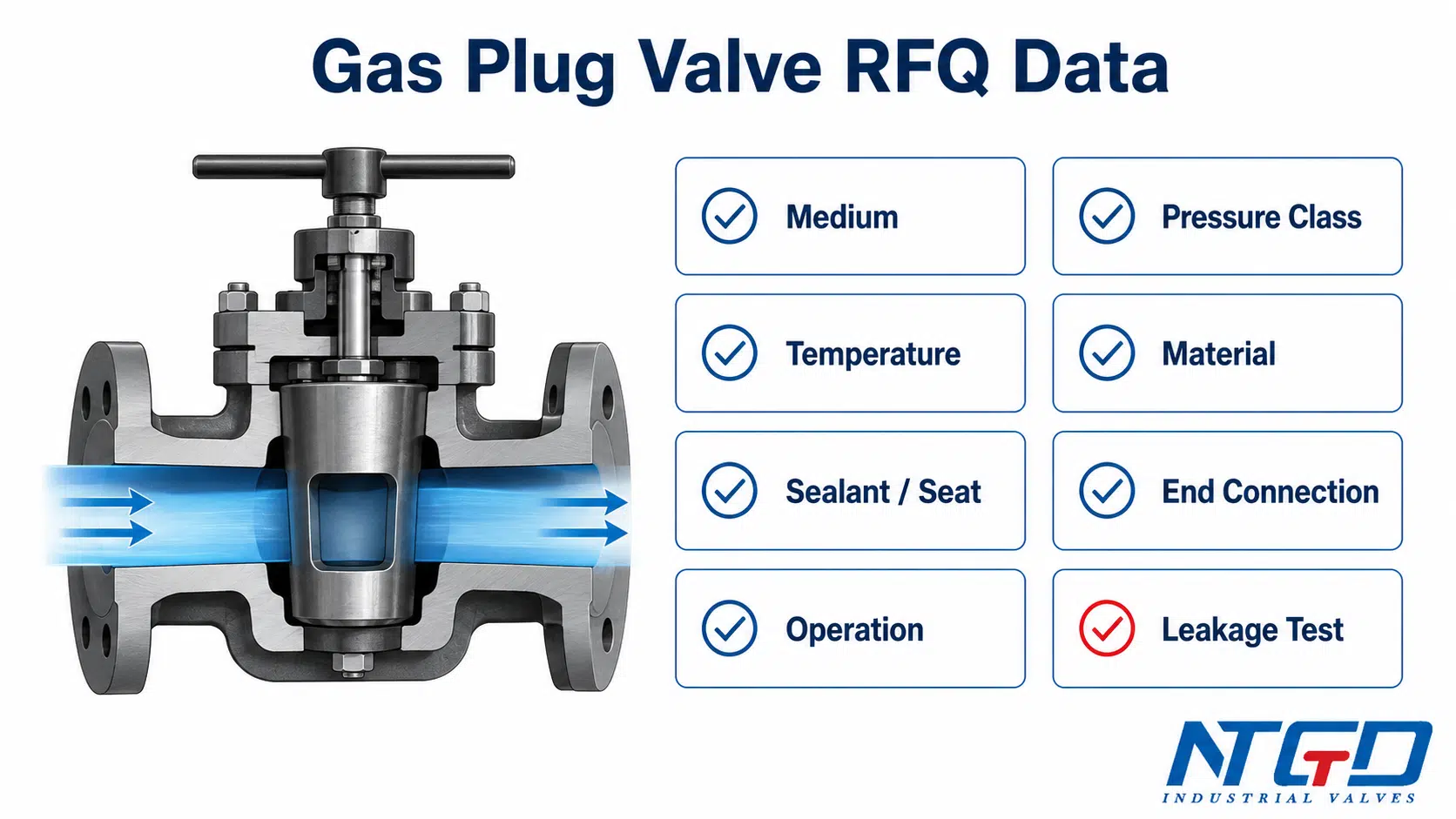
| RFQ data group | RFQ item | Example data to prepare |
|---|---|---|
| Process data | Medium | Natural gas, LP gas, propane, fuel gas, industrial gas, process gas |
| Process data | Gas composition | Clean gas, wet gas, corrosive component, condensate risk, special service note |
| Process data | Operating pressure | Normal and maximum operating pressure |
| Process data | Temperature | Operating and design temperature |
| Valve construction data | Valve size | NPS or DN |
| Valve construction data | Pressure class | Class 150, 300, 600, 900, 1500, 2500, or project-specified rating |
| Valve construction data | Body material | Carbon steel, stainless steel, ductile iron, alloy, or project-specified material |
| Valve construction data | Plug / trim material | Material required for sealing and corrosion resistance |
| Valve construction data | Seat / sleeve / liner | Material and design if applicable |
| Valve construction data | Sealant / grease requirement | Compatibility with gas medium and temperature |
| Connection / operation data | End connection | NPT, threaded, RF flange, RTJ, BW, welded, or project-specific |
| Connection / operation data | Operation method | Handwheel, gear, lever, pneumatic actuator, electric actuator, hydraulic actuator |
| Testing / documentation data | Leakage expectation | Specified closure test, allowable leakage criterion, or project shutoff requirement |
| Testing / documentation data | Standard / inspection | API, fire-safe, NACE, emission, or project standard if specified |
| Project data | Quantity and tag data | Valve tags, line number, service description, drawing reference |
A request that says only “gas plug valve” may not be enough for correct selection. A better RFQ includes medium, pressure, temperature, material, sealant or seat requirement, connection, operation method, leakage expectation, and applicable standards. With complete RFQ data, an engineering team can check service compatibility and recommend a valve configuration before quotation.
Operation and Maintenance Cautions
Gas plug valves should be operated and maintained according to the manufacturer’s instructions and the project maintenance procedure. This article does not provide field repair instructions, live-line adjustment guidance, or household gas line service guidance.
Leakage signs and service review
Internal leakage may occur if the sealing surface, sleeve, seat, plug, or sealant system is damaged, worn, contaminated, or incompatible with the service. External leakage may occur around packing, gaskets, threaded connections, or flange joints.
In gas service, external leakage should trigger isolation and qualified review according to the plant procedure, not casual adjustment. The cause should be identified before assuming that the valve itself is the only problem.
Hard operation and high torque
A gas plug valve may become hard to operate because of sealant breakdown, high differential pressure, pressure locking, contamination, corrosion, packing friction, stem damage, actuator misalignment, or normal torque increase over time.
For lubricated plug valves, sealant condition can affect operating torque. However, hard operation should not be treated automatically as a lubrication problem. The service condition, pressure differential, valve position, sealant compatibility, packing condition, and operator sizing should be checked together.
Sealant and lubrication caution
Plug valve lubricant, plug valve grease, or natural gas valve grease should not be selected casually. The correct sealant depends on gas composition, pressure, temperature, valve design, and manufacturer guidance.
Do not use this article as a field relubrication procedure. For industrial gas service, maintenance work should follow the valve manual, plant safety procedure, and applicable project requirements.
FAQ About Gas Plug Valves
Can a standard plug valve be used for natural gas service?
A standard plug valve should not be assumed suitable for natural gas service unless its design, pressure rating, materials, sealant or seat system, end connection, operation method, and test requirements match the project. A plug valve for natural gas service is feasible when the valve is specified for the actual gas composition, pressure, temperature, and leakage expectation.
Are gas plug valves suitable for LP gas or propane service?
Gas plug valves may be suitable for LP gas or propane gas service when the valve materials, sealant, seat system, pressure rating, temperature range, and leakage expectation match the service. LP gas and propane service should be confirmed against the project specification and valve manufacturer’s data.
What is the difference between a gas plug valve and a natural gas plug valve?
A gas plug valve is a broader term for a plug valve used in gas service. A natural gas plug valve is usually a service-specific selection expression for a gas plug valve selected or rated for natural gas. The construction may vary depending on pressure class, material, sealant, connection, and operation method.
Does a gas plug valve need lubrication?
Some gas plug valves are lubricated plug valves and use sealant or grease between the plug and valve body. Others are non-lubricated designs, such as a sleeve plug valve, that use a sleeve, liner, or seating system. Whether lubrication is required depends on the valve design and service conditions.
Why does a gas plug valve become hard to operate?
A gas plug valve may become hard to operate because of sealant condition, high differential pressure, pressure locking, packing friction, contamination, corrosion, stem damage, or actuator alignment issues. A practical review usually starts with the service condition and sealant history, then checks pressure differential, packing condition, and operator sizing.
Is a plug valve better than a ball valve for natural gas?
A plug valve can be suitable for natural gas isolation, especially when the design is specified correctly. A ball valve may also be suitable in many gas systems. The better choice depends on pressure, temperature, leakage expectation, operation frequency, maintenance access, end connection, and project standard. This topic should be reviewed as a plug valve vs ball valve selection comparison, not decided by valve name alone.
What information should I send before asking for a gas plug valve quotation?
Before asking for a gas plug valve quotation, send the medium, gas composition, valve size, pressure class, operating pressure, temperature, body and trim material, sealant or seat requirement, end connection, operation method, leakage expectation, project standard, and tag data. These details help the engineering team check service compatibility before quotation.
Conclusion
A gas plug valve is a good fit when the service requires quarter-turn on-off isolation for industrial gas, natural gas, LP gas, propane gas, fuel gas, or other specified gas media, and when the valve design matches the actual operating conditions.
Before final selection, use three checks:
- Medium compatibility
Confirm that the body material, plug, seat, sleeve, packing, sealant, or grease are compatible with the gas composition, temperature, and contaminants. - Pressure and temperature rating
Confirm that the pressure class, body design, end connection, and test requirements match the piping specification and operating conditions. - Sealing and operation design
Confirm whether the service needs a lubricated plug valve, non-lubricated design, specific leakage expectation, gear operation, actuator operation, or special maintenance access.
Further engineering review is recommended when sealant compatibility is uncertain, operating torque is high, leakage expectation is strict, automation is required, or the project specifies special standards, materials, or inspections.
The safest selection approach is to treat the gas plug valve as a complete engineered component, not as a generic gas valve, plumbing gas cock, or product category item.
Gas plug valve selection support
If you are preparing an RFQ for an industrial gas plug valve, share the medium, gas composition, pressure class, temperature, material requirement, sealant or seat requirement, end connection, operation method, leakage expectation, and applicable project standard with the NTGD Valve engineering team.
NTGD Valve can review the service conditions, check specification gaps, and help clarify a suitable gas plug valve configuration before quotation. This review helps reduce the risk of selecting the wrong pressure class, sealing design, connection type, or operation method for the actual gas service.
