
Author Name: Bruce Zheng
Author Role: Co-Founder and Valve Engineer at NTGD Valve
Author Bio: Bruce Zheng is Co-Founder and Valve Engineer at NTGD Valve, focusing on industrial valve selection, application, and technical content for global B2B buyers.
Last Updated: June 3, 2026
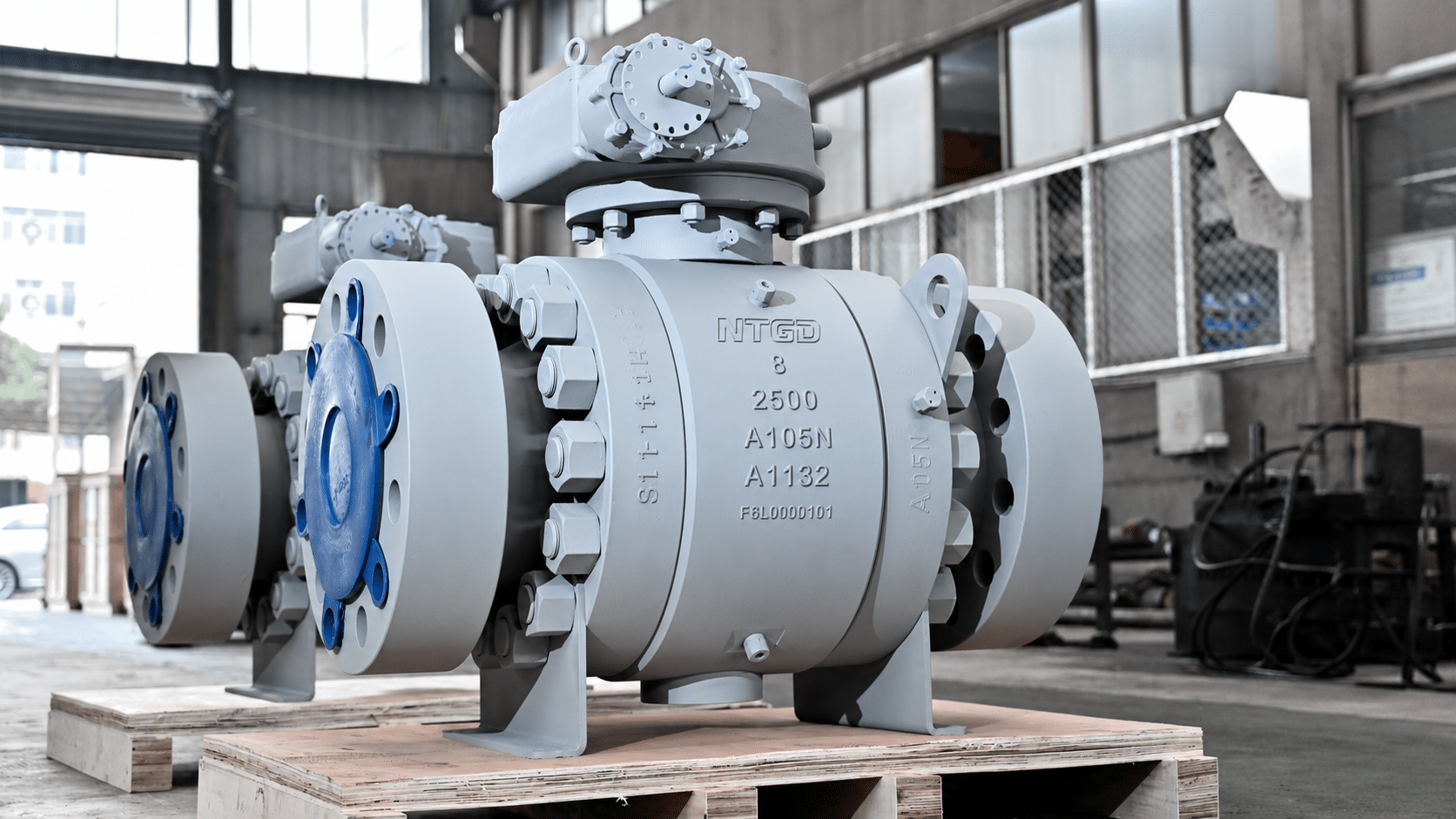
A 3 piece ball valve is a quarter-turn shutoff valve built with one center body and two end caps or pipe-connection ends. This three-piece body structure is the reason the valve is commonly selected for industrial lines where cleaning, inspection, seat replacement, seal replacement, or maintenance access matters.
The key value of a three-piece ball valve is not simply that the body has three sections. The value is that the center body can often be accessed more easily, while the pipe ends may remain connected in many installations. This can reduce pipe disturbance and help maintenance teams inspect or service internal parts such as the ball, seats, stem seals, body seals, and O-rings.
For industrial buyers, the practical question is:
Does the three-piece body design reduce maintenance difficulty, shutdown time, and service risk for this application?
This guide explains the body construction, major parts, working principle, serviceability logic, specification points, application fit, and the quick boundary between 2 piece and 3 piece ball valves.
What Is a 3 Piece Ball Valve?
Quick answer
A 3 piece ball valve is a ball valve with three major pressure-containing body sections: one center body and two end caps or pipe-connection ends. The ball, seats, stem interface, body seals, and related internal components are usually located around the center body area. The valve opens and closes by rotating the ball 90 degrees.
When the hole through the ball is aligned with the pipeline, flow passes through the valve. When the ball is rotated a quarter turn, the solid side of the ball blocks the flow path.
The three-piece construction matters because it can improve access to internal components. In suitable designs, the center body can be removed, opened, or swung out for cleaning, inspection, or seat and seal replacement with less disturbance to the pipe ends.
Why it is called a three-piece design
The name does not mean the valve has only three parts. A three-piece ball valve contains many components, including the ball, stem, seats, body seals, O-rings, packing, bolts, handle, or actuator interface.
The term “three-piece” refers mainly to the body construction:
| Body section | Basic role |
|---|---|
| Center body / main body | Houses the ball, seats, stem interface, body seals, and service-access area |
| End cap / pipe connection end | Connects one side of the valve to the pipeline |
| End cap / pipe connection end | Connects the other side of the valve to the pipeline |
These body sections are usually clamped together by body bolts or studs. The exact design depends on valve size, pressure class, body material, end connection, seat design, and manufacturer construction.
The main value: service access, not just “three parts”
A three-piece design should be understood as a serviceable body design. It is often selected when internal access has practical value.
In many industrial systems, the expensive part of valve maintenance is not only the valve itself. It is the shutdown time, labor, pipe disturbance, cleaning difficulty, and risk of reinstalling or realigning the valve. A three-piece body design can reduce these problems when the application requires repeated inspection, cleaning, or replacement of wear parts.
A 3 piece ball valve is often considered when:
- internal parts may need inspection;
- seats or seals may wear over time;
- cleaning access is required;
- shutdown time is costly;
- pipe connections should not be repeatedly disturbed;
- the valve is installed in a process line where serviceability affects long-term reliability.
Three-Piece Ball Valve Body Design: Center Body, End Caps and Bolts
Center body / main body
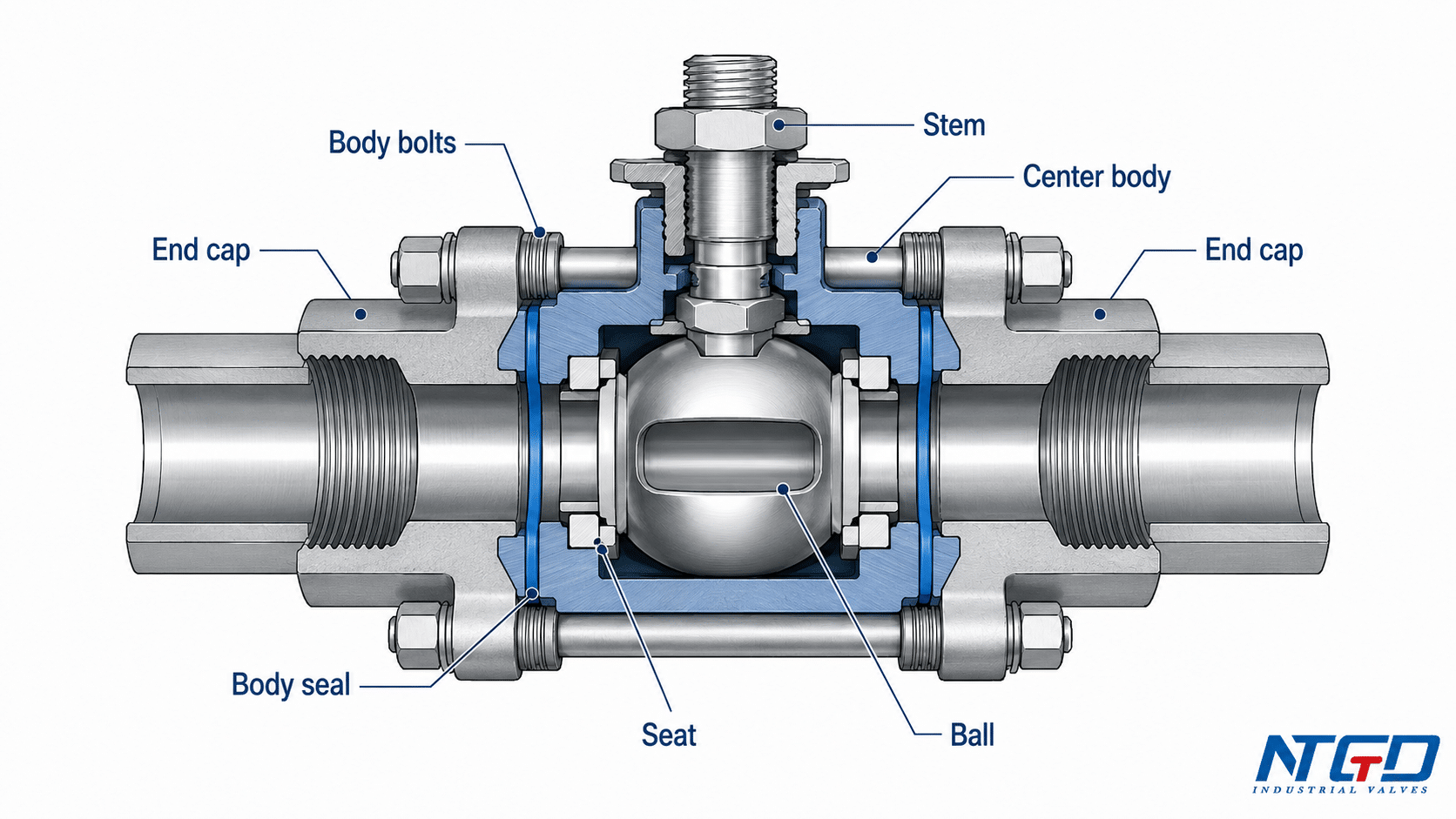
The center body is the main service zone of a three-piece ball valve. It usually houses the ball, seats, stem interface, body seals, and sealing area around the ball cavity.
The center body must do more than contain pressure. It must keep the ball and seats aligned, support the stem interface, and maintain a stable sealing environment. If the center body is misaligned, damaged, or incorrectly assembled, the valve may develop leakage, higher torque, uneven seat wear, or unreliable shutoff.
This is why the center body is the core of a ball valve 3 piece body design. It is where pressure containment, shutoff performance, and maintenance access meet.
Two end caps / pipe connections
The two end caps form the pipeline connection points. Depending on the valve design, they may be threaded, socket weld, butt weld, flanged, or another connection style suitable for the project.
The end caps perform three main functions:
- They connect the valve to the pipeline.
- They help compress and seal the body assembly.
- They allow the center body to be accessed more easily in many three-piece designs.
In many installations, the pipe connection ends can remain in the piping while the center body is accessed. This is one reason a three-piece body ball valve is preferred in maintenance-sensitive service.
This should still be verified against the actual valve design. Pipe layout, clearance, end connection, bolt arrangement, and manufacturer instructions all affect whether the center section can be removed or swung out safely.
Body bolts, body seals and O-rings
Body bolts or studs hold the center body and end caps together. They control the compression of the body assembly. Uneven bolt loading, loose fasteners, damaged threads, or incorrect assembly can reduce seal compression and create leakage at the body joint.
Body seals, gaskets, or O-rings seal the joint between the center body and the end caps. These are static sealing points, but they still matter because a three-piece valve has more body joint areas than a one-piece valve.
A reliable three-piece body design must control:
- body joint sealing;
- compression of body seals;
- alignment between body sections;
- seat compression;
- vibration or thermal cycling effects;
- correct bolt tightening during assembly.
The accessible bolt-and-seal arrangement is part of the maintenance value. It allows qualified maintenance personnel to inspect body-joint sealing areas more directly than in less serviceable body constructions, provided the valve design and plant procedure allow it.
How the body design supports inline service
The body design supports serviceability because the center body is separated from the pipe connection ends. During planned maintenance, the valve can often be opened or accessed for inspection, cleaning, seat replacement, or seal replacement with less pipe disturbance than simpler body styles.
This service logic is the real reason behind the three-piece body design. The valve is not only divided into three sections for manufacturing convenience. It is built to make internal access more practical when service conditions justify that added complexity.
3 Piece Ball Valve Parts and Components
A three-piece ball valve contains both common ball valve parts and three-piece-specific service parts. These parts should not be treated only as a spare parts list. Each component affects pressure containment, shutoff, torque, sealing, maintenance access, or service reliability.
Pressure-containing parts
Pressure-containing parts form the valve boundary and support the internal assembly.
These include:
- center body;
- end caps or end connections;
- body bolts or studs;
- nuts and washers;
- body seals, O-rings, or body gaskets.
The center body and end caps are usually made from metallic materials selected for pressure, temperature, corrosion resistance, and mechanical strength. The final material must match the media and project specification.
Flow-control and operating parts
Flow-control and operating parts control the open and closed position of the valve.
These include:
- ball;
- stem or shaft;
- handle, gear operator, or actuator interface;
- locking device if provided;
- mounting pad or actuator bracket if required.
The ball has a bore through it. When the bore aligns with the pipeline, the valve is open. When the ball turns 90 degrees, the valve is closed. The stem transfers torque from the handle or actuator to the ball.
Sealing and service parts
Sealing parts control leakage through the valve and around the stem or body joints.
These include:
- seats;
- body seals or O-rings;
- stem packing;
- stem seal;
- thrust washer or bushing, if used;
- seal rings or related trim parts.
Seats determine shutoff performance. Stem packing or stem seals help prevent external leakage around the stem. Body seals help prevent leakage between the center body and end caps.
Parts table: function and service relevance
| Part / component | Location | Function | Why it matters in a 3-piece design | Service note |
|---|---|---|---|---|
| Center body / main body | Middle valve body section | Houses the ball, seats, stem interface, and sealing area | It is the main service-access zone, not only a pressure shell | Inspect for alignment, corrosion, deposits, internal wear, and body-joint condition |
| End caps / pipe connections | Both sides of the center body | Connect the valve to the pipeline | In many designs, the pipe ends can remain installed while the center body is accessed | Confirm connection type, pipe clearance, and disassembly procedure before maintenance |
| Body bolts / studs | Around body joints | Clamp the center body and end caps together | Bolt loading affects compression of body seals and body-joint integrity | Uneven tightening or damaged fasteners can create external leakage paths |
| Body seals / O-rings | Between body sections | Seal the joints between center body and end caps | These static seals are key service parts in a three-piece construction | Check seal aging, chemical compatibility, deformation, and groove cleanliness |
| Ball | Inside the center body | Opens or blocks flow | The ball is accessible through the center body area in many serviceable designs | Inspect for scratches, coating damage, corrosion, or deposits that may affect shutoff |
| Stem / shaft | Between operator and ball | Transfers torque to the ball | Stem alignment affects torque, sealing, and reliable open-close operation | Check stem wear, bending, packing contact area, and actuator alignment |
| Seats | Around the ball | Seal between the ball and body | Seat access is one of the main reasons buyers choose a three-piece design | Seat wear, swelling, or chemical attack can cause internal leakage or high torque |
| Stem packing / stem seal | Around the stem | Prevents external leakage around the stem | Repeated operation and media compatibility affect stem sealing life | Inspect if stem leakage, torque increase, or packing compression loss appears |
| Thrust washer / bushing | Around the stem area, if used | Supports stem movement and reduces friction | Helps stabilize operating torque where the design uses this part | Not all three-piece ball valves use the same stem support arrangement |
| Handle / actuator interface | Outside valve body | Provides manual or automated operation | Operator choice affects torque, access, automation, and safety margin | Confirm torque, cycle frequency, environment, and fail position when automated |
| Trim parts | Internal sealing and operating parts | Support shutoff and operation | The exact trim definition varies by manufacturer and valve series | Do not assume trim or repair parts are interchangeable across designs |
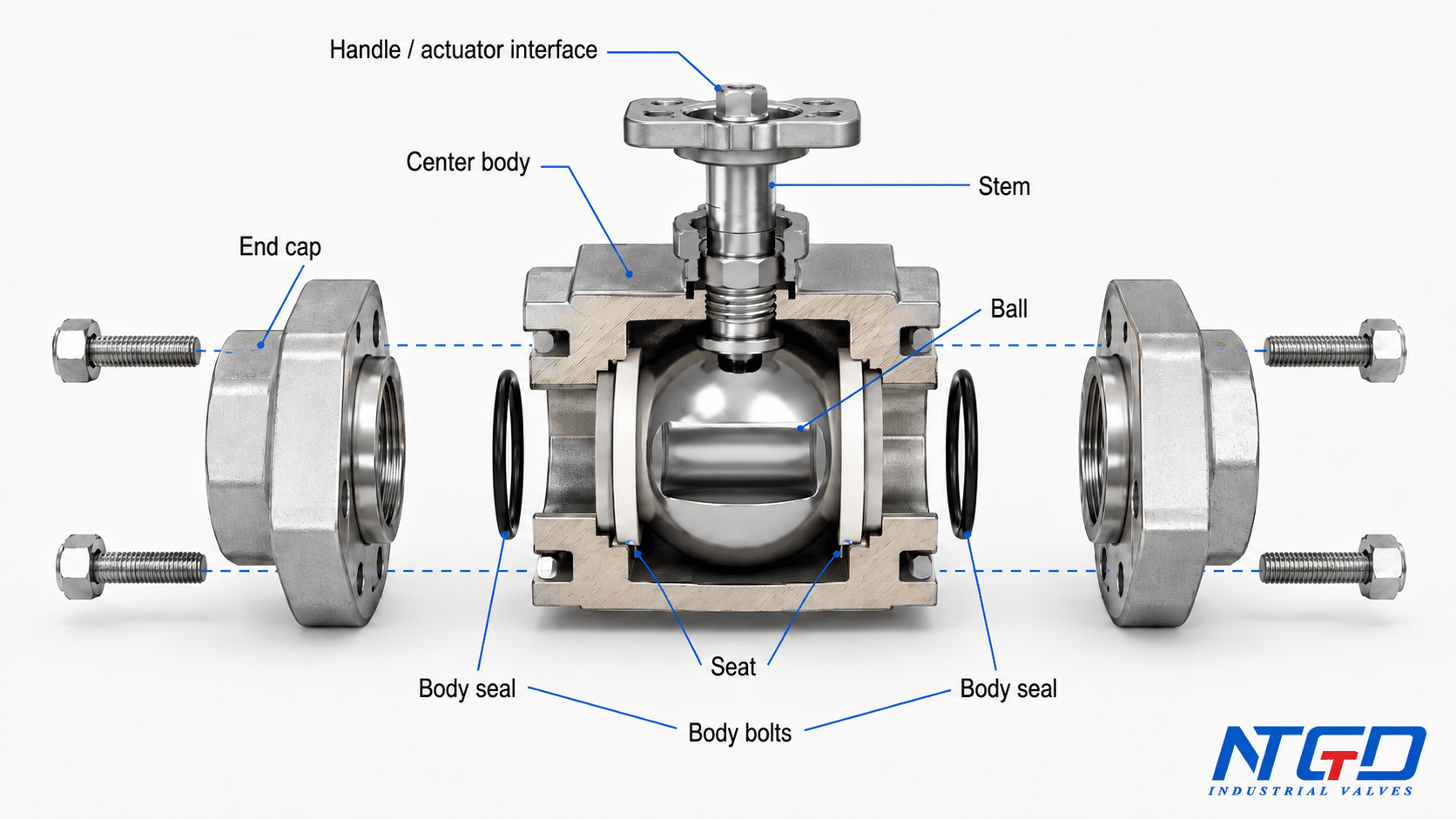
This table explains the parts of a 3 piece ball valve as functional components. It is not a universal replacement parts catalog. Seats, O-rings, body seals, stems, balls, and center sections must match the valve design, size, pressure class, material, seat construction, and manufacturer dimensions.
How Does a Three-Piece Ball Valve Work?
Quarter-turn open and close operation
A three-piece ball valve works as a quarter-turn valve. The handle or actuator rotates the stem by 90 degrees, and the stem rotates the ball.
When the ball bore is parallel to the pipeline, flow passes through the valve. When the ball bore is perpendicular to the pipeline, the solid side of the ball blocks the flow path.
This makes the valve fast to operate compared with multi-turn valves. It also makes the open and closed position easy to identify when a manual handle is used.
Ball bore alignment and shutoff
The ball has a bore through its center. In the open position, this bore forms the flow passage. In the closed position, the bore is turned away from the flow path.
For reliable shutoff, the ball surface must seal against the seats. If the ball is scratched, the seats are worn, or debris is trapped around the sealing area, leakage through the closed valve may occur.
The bore type also matters:
| Bore type | Flow effect | Typical selection logic |
|---|---|---|
| Full port / full bore | Bore size is close to the pipe bore | Used when lower pressure drop or easier cleaning access is important |
| Reduced bore | Bore is smaller than the pipe bore | Used where some pressure drop is acceptable and compactness or cost must be controlled |
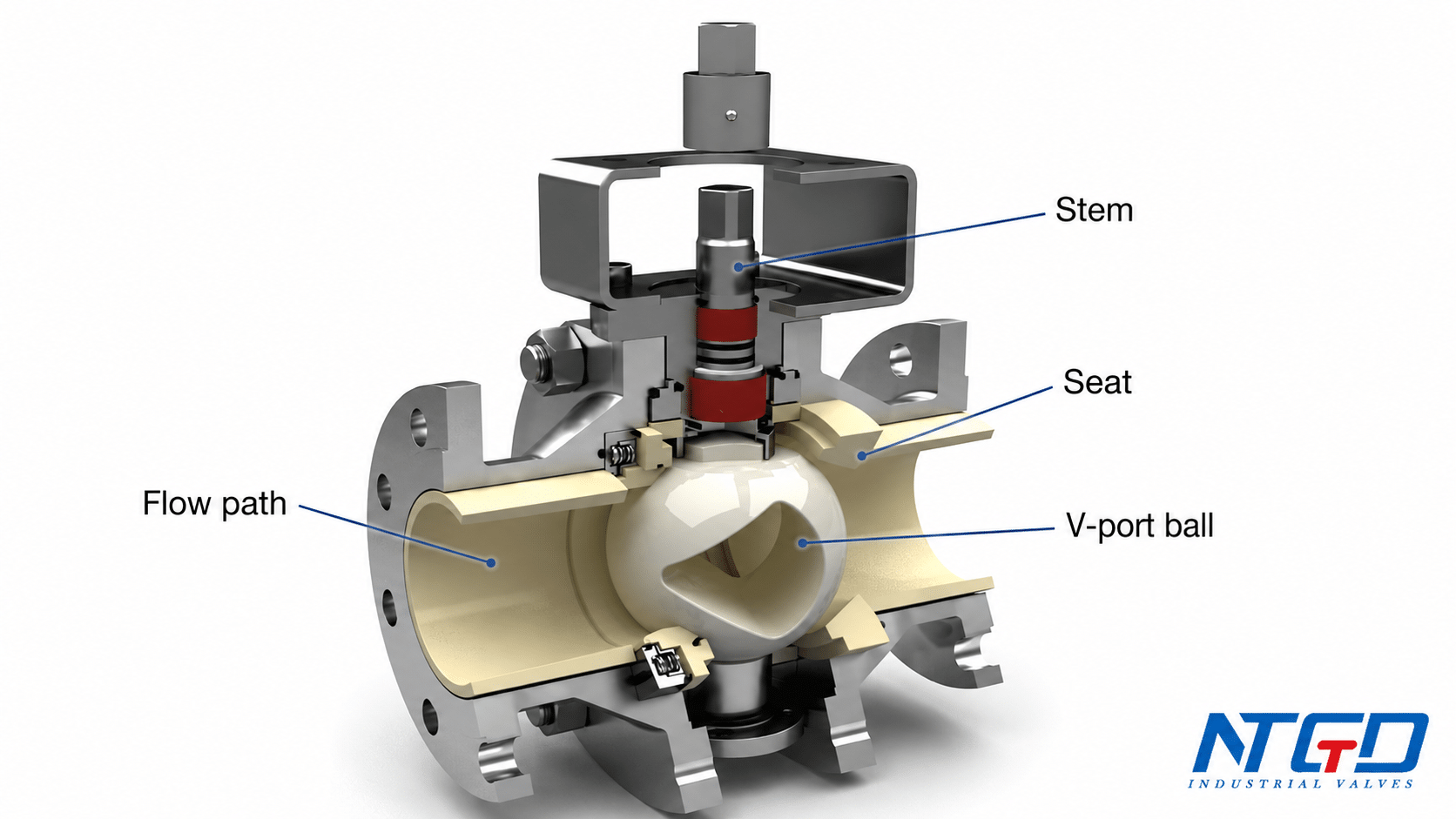
| V-port | Ball or seat has a V-shaped opening | Used when more controlled flow regulation is required, not just simple shutoff |
The exact bore design should match flow requirement, pressure drop tolerance, media condition, and control expectation.
Seat sealing and stem torque transfer
The stem transfers torque from the operator to the ball. The seats support and seal against the ball. The packing or stem seal prevents leakage around the stem.
In a floating ball design, line pressure can push the ball toward the downstream seat. In a trunnion-supported design, the ball is mechanically supported, and the seat loading logic depends on the design. Both can appear in ball valve applications, but they should not be treated as the same selection.
Why the working principle is separate from the body service design
The open-close principle of a three-piece ball valve is similar to other ball valves. The difference is the body construction and service access.
The working principle explains how the valve opens and closes. The three-piece body design explains how internal parts can be reached for cleaning, inspection, or replacement. The long-term reliability of the ball, seats, stem, and seals depends not only on the quarter-turn principle, but also on whether those parts can be maintained when service conditions require it.
Why Three-Piece Design Improves Cleaning, Inspection and Maintenance
Removable or accessible center section
The service advantage of a three-piece ball valve comes from the separation between the center body and the pipe connection ends. In many designs, the center section can be removed, opened, or accessed without fully removing the pipe ends.
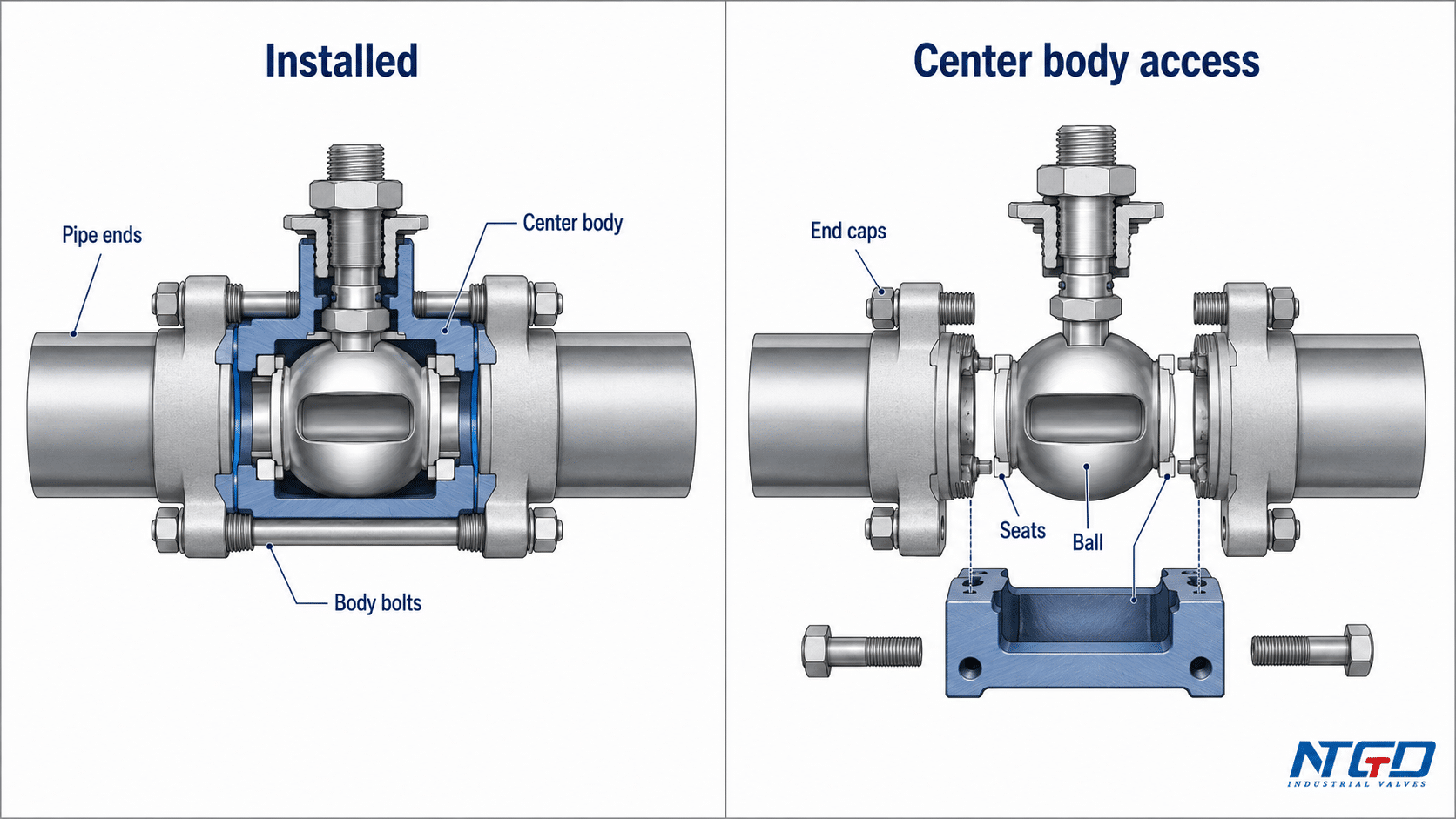
This can help when the valve is installed in a line that requires:
- regular cleaning;
- internal inspection;
- seat replacement;
- seal replacement;
- removal of deposits;
- faster maintenance turnaround.
In cleaning-sensitive or high-cycle service, easier access to the center body can reduce pipe disturbance and shorten planned shutdown work, provided the valve design and piping layout allow center-body access.
Seat, seal, ball and stem access
Three-piece construction is useful because the parts most likely to wear are usually located around the center body area.
These include:
- seats;
- ball;
- stem sealing area;
- body seals;
- O-rings;
- packing;
- thrust washer or bushing, if used.
When these parts can be inspected or replaced without replacing the entire valve, maintenance planning becomes more practical. This is especially relevant where seat damage, seal aging, media deposits, or repeated cycling can affect shutoff performance.
Downtime and labor impact
The purchase price of a three-piece ball valve is often higher than simpler body styles. Buyers still choose it when lifecycle value is more important than the lowest initial purchase cost.
The cost comparison should include:
| Cost factor | Why it matters |
|---|---|
| Initial valve cost | Three-piece construction is usually more complex |
| Maintenance labor | Better access may reduce labor time during planned service |
| Shutdown cost | Faster access may shorten planned maintenance windows |
| Cleaning requirement | Frequent cleaning can justify a serviceable body design |
| Seat and seal replacement | Replaceable wear parts may reduce the need for full valve replacement |
| Reinstallation risk | Less pipe disturbance may reduce alignment and leakage risk |
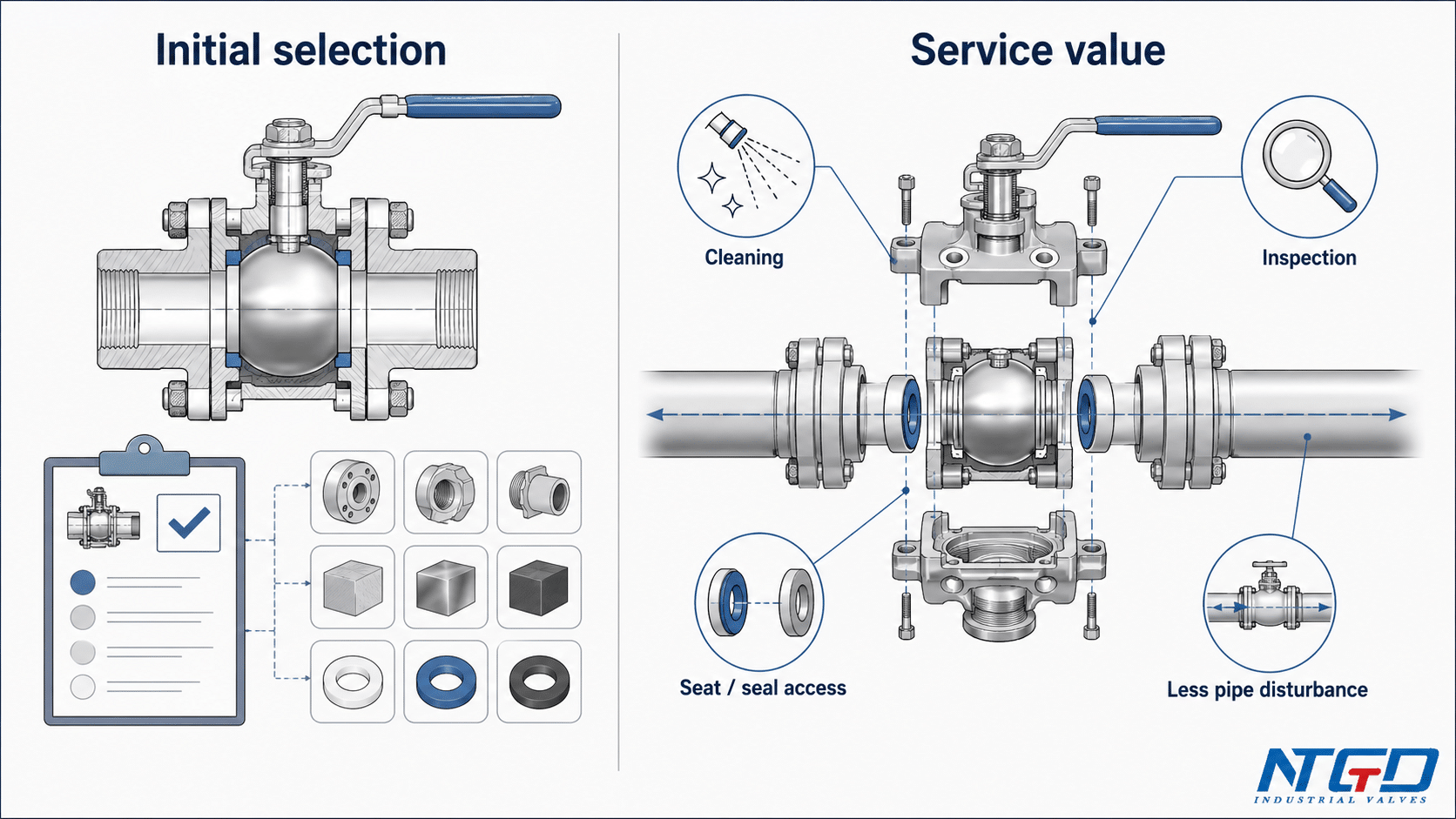
A three-piece valve is not always the lowest-cost option at purchase. It becomes more attractive when cleaning access, seat and seal replacement, or downtime reduction has real operational value.
Compatibility caution for replacement parts
A three-piece body does not mean all parts are interchangeable between manufacturers or models. Seats, O-rings, stem seals, body gaskets, bolts, and center sections must match the valve design.
Replacement compatibility should be checked against:
- valve size;
- pressure class;
- body material;
- seat and seal material;
- face-to-face dimensions;
- bolt pattern;
- stem design;
- manufacturer’s parts list;
- service media and temperature.
Different manufacturers, and even different series from the same manufacturer, may use different seat geometry, stem sealing layouts, body gasket profiles, and center-body dimensions. Unverified replacement can lead to leakage, abnormal torque, poor shutoff, or unsafe service.
Design Options and Specifications to Check Before RFQ
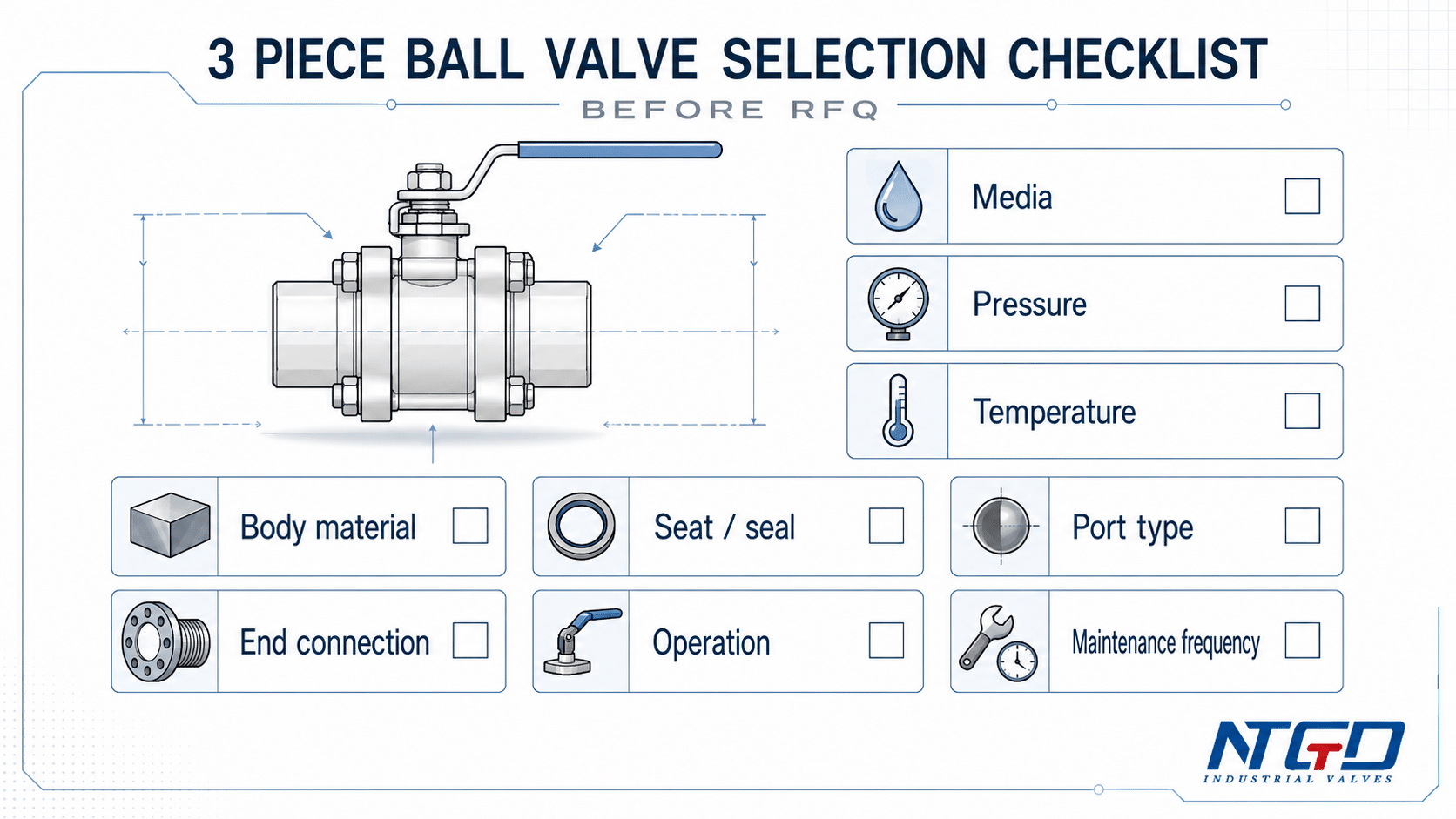
A 3 piece ball valve can be configured in different ways. These options should be checked before requesting a recommendation.
Body material
Common body material directions include carbon steel, stainless steel, and other project-specific alloys. The final material depends on media corrosion, pressure, temperature, external environment, and project specification.
A 3 piece stainless steel ball valve may be suitable where corrosion resistance or cleanliness is important. A carbon steel body may be used in other industrial services where the media and environment allow it. Material should be verified against the actual media, operating temperature, and project standard.
Port type
Port type affects pressure drop, cleaning, and flow capacity.
| Port type | Main feature | Selection note |
|---|---|---|
| Full port / full bore | Larger flow passage | Useful when lower pressure drop or easier cleaning access is important |
| Reduced bore | Smaller flow passage | May reduce size and cost, but process flow and pressure loss must be acceptable |
| V-port | Shaped opening for flow control | Used when throttling or control behavior is required |
A full port ball valve in a three-piece body is often considered where lower resistance matters. A reduced bore design may be acceptable where the process can tolerate additional pressure drop. A V-port ball valve should be treated as a control-oriented option, not as a standard shutoff configuration.
End connection
End connection determines how the valve connects to the pipeline and how service access is handled.
| End connection | Typical consideration |
|---|---|
| Threaded | Compact and common for smaller sizes |
| Socket weld | Used where welded pipe integrity is required |
| Butt weld | Used for welded piping systems and more permanent installation |
| Flanged | Allows bolted pipe connection and may simplify removal depending on layout |
A 3 piece threaded ball valve, 3 piece socket weld ball valve, and 3 piece flanged ball valve may all serve different piping requirements. The connection should match the piping standard, pressure class, maintenance plan, and installation space.
Seat and seal material
Seat and seal material affects shutoff performance, chemical compatibility, operating torque, and service life. Wrong seat or seal selection can lead to swelling, chemical attack, internal leakage, high torque, or premature failure.
Key checks include:
- media compatibility;
- operating temperature;
- required shutoff performance;
- cleaning method;
- abrasive or sticky media risk;
- frequency of cycling;
- compatibility with body and ball material.
The seat material should not be selected only by a standard product option. It should be matched to the actual service condition.
Pressure, temperature and media
Pressure and temperature should never be assumed from a general article. They must be verified against the actual valve design, pressure-temperature ratings, body material, seat material, seal material, and project specification.
The media also changes the selection. Clean water, oil, gas, chemical fluids, viscous media, and particle-bearing fluids may require different body materials, seats, seals, and operation methods.
Manual, pneumatic or electric operation
A three-piece ball valve may be manually operated or configured as an actuated ball valve.
| Operation type | Best-fit situation | What to check |
|---|---|---|
| Manual handle | Smaller sizes or occasional operation | Accessibility and operating torque |
| Gear operator | Larger size or higher torque | Space, torque, and operation speed |
| Pneumatic actuator | Frequent or remote operation | Air supply, fail position, torque margin |
| Electric actuator | Electrical control or slower automation | Power supply, duty cycle, torque, environment |
Actuation should not be selected only by valve size. It should be based on torque, cycle frequency, fail-safe requirement, control signal, environment, and maintenance access.
RFQ checklist table
| RFQ item | Why it matters | Examples / options to confirm | Notes for technical review |
|---|---|---|---|
| Media | Determines body, ball, seat, and seal compatibility | Water, oil, gas, chemical fluid, viscous media | Include concentration, solids, and cleaning method if relevant |
| Pressure | Affects body rating and seat load | Working pressure, design pressure | Verify against valve class and datasheet |
| Temperature | Affects seat, seal, packing, and body material | Normal and maximum temperature | Check both media and ambient conditions |
| Body material | Controls strength and corrosion resistance | Carbon steel, stainless steel, alloy options | Match corrosion risk and project specification |
| Seat / seal material | Controls shutoff, torque, and chemical resistance | PTFE, reinforced materials, elastomers | Wrong selection may cause leakage, swelling, or high torque |
| Port type | Affects pressure drop and cleaning access | Full port, reduced bore, V-port | Confirm flow requirement and pressure loss tolerance |
| End connection | Affects installation and maintenance access | Threaded, socket weld, butt weld, flanged | Match piping design and service plan |
| Operation method | Affects torque and control | Manual, gear, pneumatic, electric | Confirm cycle frequency, torque margin, and fail position |
| Maintenance frequency | Determines whether serviceable body design is justified | Frequent cleaning, inspection, seat replacement | High maintenance demand can justify three-piece construction |
| Project condition | Affects configuration and production planning | Quantity, line size, standards, environment | Confirm before final technical recommendation |
Where 3 Piece Ball Valves Fit Best
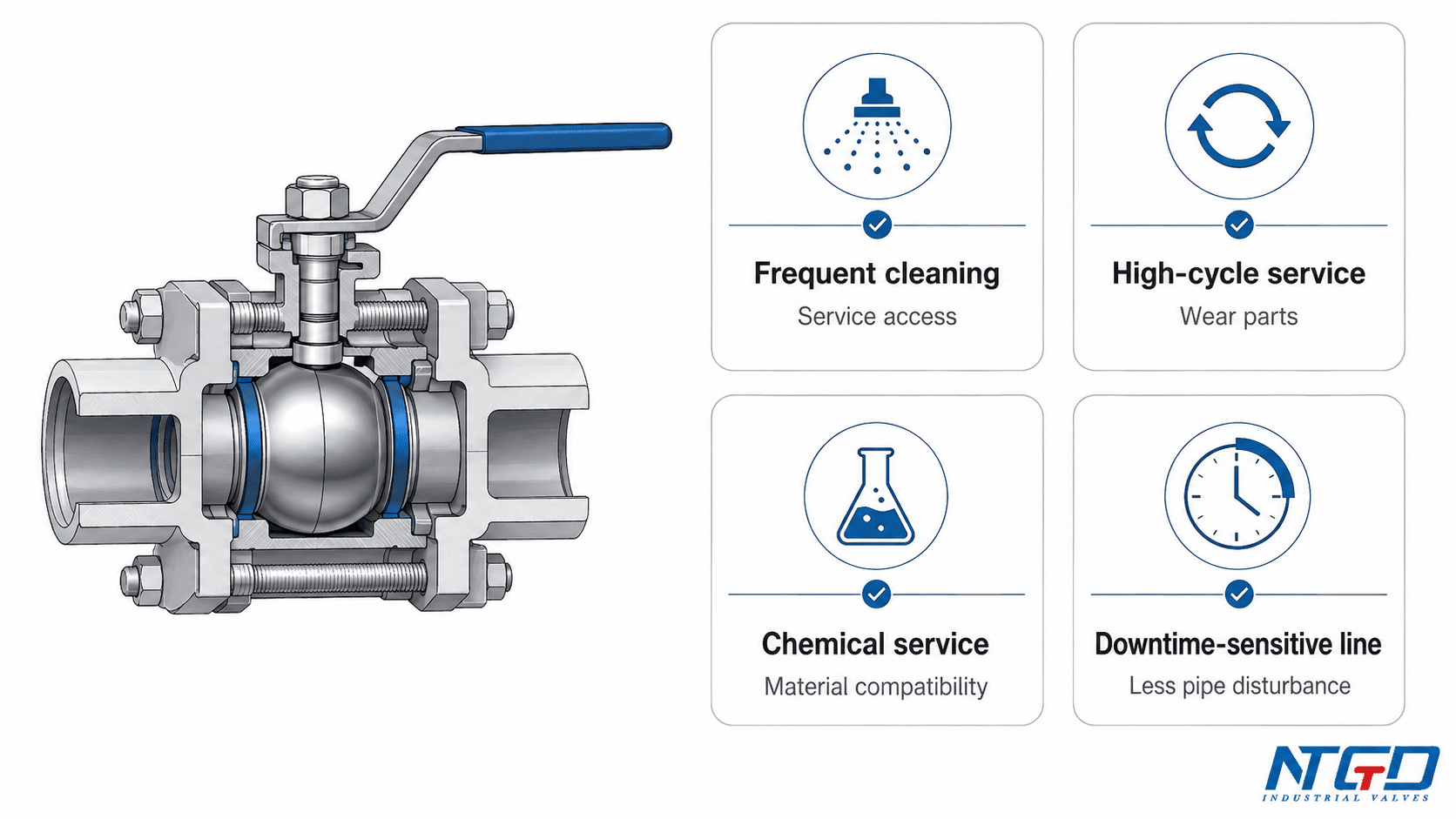
A three-piece ball valve is most useful when its serviceable body design provides real value. It should not be recommended only because it sounds more advanced.
Services that require frequent cleaning or inspection
Three-piece ball valves are often suitable where the valve may need to be cleaned or inspected regularly. The body construction can make internal access easier than less serviceable designs.
This is useful in process lines where deposits, residue, or contamination risk must be controlled.
High-cycle or downtime-sensitive process lines
In high-cycle service, seats, seals, stem packing, and other wear parts may need more attention over time. A three-piece body design can make maintenance planning easier.
In downtime-sensitive service, the ability to service the valve with less pipe disturbance can be a major advantage.
Chemical, water, oil, gas and process piping examples
A three-piece ball valve may be considered in:
- chemical process piping;
- water treatment systems;
- oil and gas auxiliary lines;
- general industrial process lines;
- power plant auxiliary systems;
- cleaning-sensitive fluid handling systems;
- food or beverage-related industrial systems where suitable materials and cleaning design are verified.
The industry name alone is not enough. The actual media, pressure, temperature, cleaning requirement, and maintenance frequency determine whether the valve is suitable.
When a 3-piece valve may not be necessary
A three-piece design is not always required. Simpler one-piece or two-piece designs may be enough when the service is clean, maintenance frequency is low, shutdown cost is minor, and full valve replacement is easier than internal servicing.
A three-piece valve may be unnecessary when:
- the media is clean and non-aggressive;
- the valve is rarely operated;
- the valve is small and inexpensive to replace;
- pipe disturbance during replacement is acceptable;
- online cleaning or internal inspection is not required;
- the project is highly cost-sensitive.
In those conditions, the extra body joints, bolts, and sealing points of a three-piece construction may not provide enough lifecycle value to justify the added complexity.
Application fit matrix
| Service condition | Why a 3-piece ball valve may fit | What to check | When another design may be enough |
|---|---|---|---|
| Frequent cleaning | Center body access may simplify cleaning | Body access method, clearance, seal material | Cleaning is rare or valve replacement is easy |
| High-cycle operation | Wear parts may need inspection or replacement | Seat material, stem seal, torque, actuation | Low-cycle service with low downtime cost |
| Chemical service | Material and seal selection can be specified | Corrosion, concentration, temperature | Media is mild and simple valve design is sufficient |
| Process piping | Inline serviceability can reduce maintenance burden | End connection, pressure, media, access space | Valve is rarely serviced |
| Downtime-sensitive line | Reduced pipe disturbance may save maintenance time | Maintenance procedure and spare parts plan | Shutdown cost is not significant |
| Lower pressure drop requirement | Full port options may reduce flow resistance | Port type and flow requirement | Reduced bore is acceptable |
3 Piece vs 2 Piece Ball Valve: Quick Boundary
This page is mainly about the 3 piece ball valve. The comparison with a 2 piece ball valve is useful, but the full selection comparison belongs to a dedicated comparison guide.
Key difference in body construction
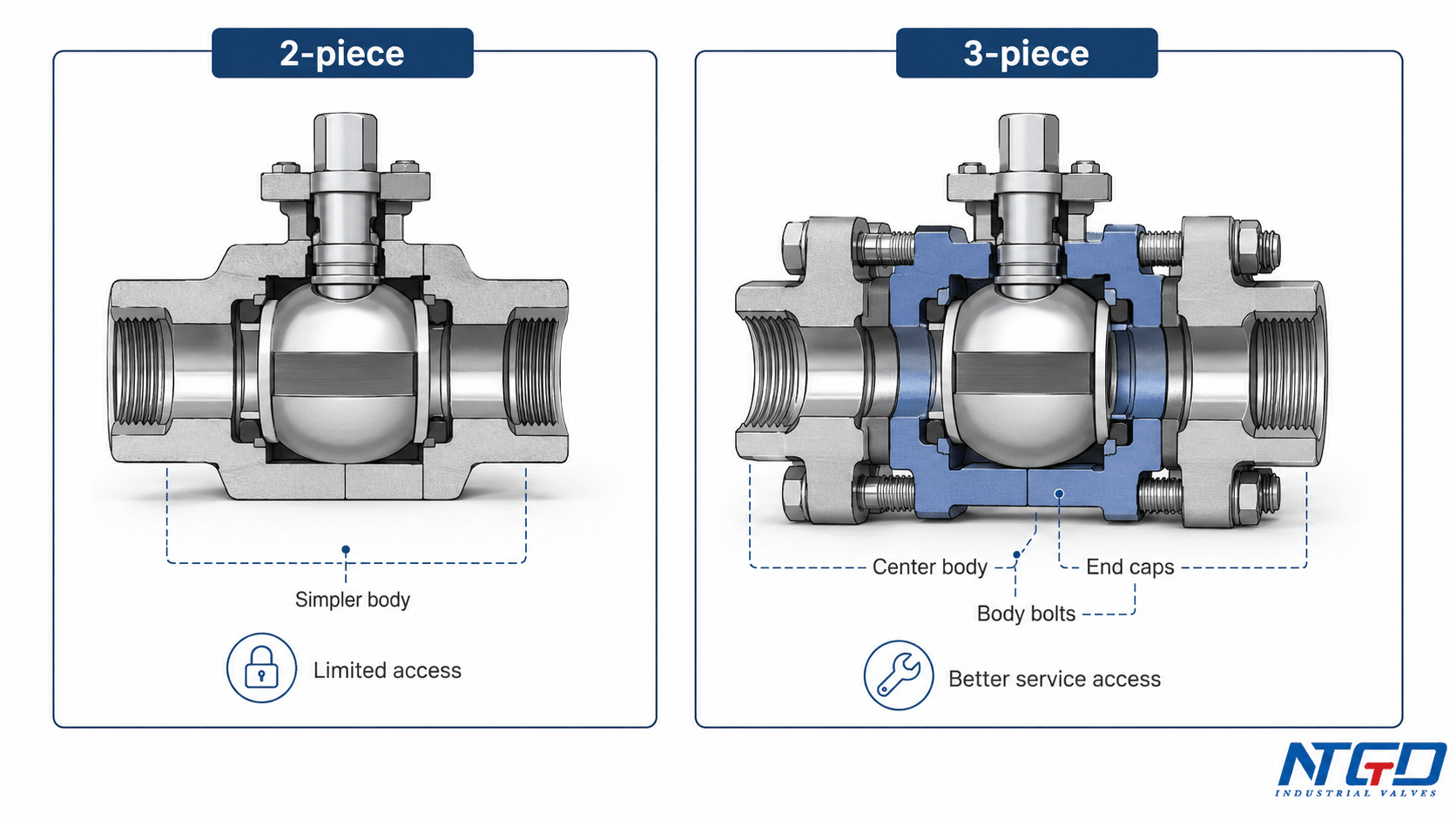
A 2 piece ball valve usually has a simpler body construction with two main body sections. A 3 piece ball valve uses a center body and two end caps or pipe-connection ends.
The three-piece construction normally gives better access to the internal parts located around the center body.
Key difference in maintenance access
A 2 piece valve may be suitable for clean service, compact piping, and lower-cost applications. A 3 piece valve is usually preferred where inspection, cleaning, seat replacement, or seal replacement is expected.
| Selection point | 2 piece ball valve | 3 piece ball valve |
|---|---|---|
| Body construction | Simpler body structure | Center body plus two end caps |
| Initial cost | Usually lower | Usually higher |
| Maintenance access | More limited in many designs | Better internal access in many designs |
| Cleaning suitability | Acceptable for many clean services | Better for frequent cleaning |
| Best-fit use | Clean, lower-maintenance service | Serviceable, downtime-sensitive, cleaning-sensitive lines |
When to use a separate comparison
If the main decision is whether to choose 2 piece or 3 piece construction, use a dedicated 2 piece vs 3 piece ball valve comparison rather than treating this article as a full comparison guide. This current page only defines the boundary and explains why the three-piece body design matters.
Common Service Notes for Three-Piece Ball Valves
This section preserves useful troubleshooting context from the old article, but it is not a maintenance manual. Actual inspection, disassembly, pressure testing, and repair should follow manufacturer instructions and plant safety procedures.
Connection leakage and body seal checks
Leakage around the body joints or end connections may be related to:
- misaligned end connections;
- damaged body seals or O-rings;
- loose or uneven body bolts;
- particles in the seal groove;
- incompatible seal material;
- pipe stress acting on the valve body.
The first task is to identify whether leakage comes from the pipe connection, the body joint, the stem area, or the downstream shutoff path. Replacing parts without locating the leakage path may not solve the problem.
Stem leakage and packing checks
Stem leakage may occur when stem packing, stem seals, or O-rings are worn, damaged, or chemically incompatible with the media. Excessive operating torque may also affect the stem sealing area.
For selection and maintenance planning, stem leakage is a signal to check packing condition, stem surface condition, operating torque, and seal compatibility rather than assuming the valve body itself has failed.
Seat or ball leakage
Leakage through a closed valve may be caused by:
- damaged seats;
- debris on the seat surface;
- scratches on the ball;
- incomplete closing;
- incorrect actuator travel;
- media particles trapped in the sealing area.
A three-piece design can make inspection easier, but the root cause still needs to be identified. Seat replacement will not solve leakage if the ball is damaged or the actuator does not fully close the valve.
Hard-to-operate handle or actuator torque
A handle that is difficult to operate may be caused by debris, seat swelling, high pressure differential, stem friction, actuator sizing issues, or internal damage.
For actuated valves, actuator torque must be checked against valve torque under actual service conditions. A valve that operates easily in the workshop may require more torque under pressure, temperature, or media load.
What should remain a maintenance manual issue
This article explains selection and serviceability logic. It does not replace a maintenance manual. Bolt torque, seal replacement sequence, pressure testing method, cleaning procedure, and safety steps must be confirmed from manufacturer documentation and project requirements.
Final Fit-Check Before Selecting a 3 Piece Ball Valve
Before selecting a three-piece ball valve, confirm whether the application truly benefits from serviceable body construction.
Information to prepare before inquiry
Prepare the following information before asking for a technical recommendation:
| Information | Why it matters |
|---|---|
| Media | Determines body, ball, seat, and seal compatibility |
| Working pressure | Controls pressure rating and body design |
| Temperature | Affects seat, seal, packing, and material selection |
| Line size | Determines valve size and torque |
| End connection | Must match piping design and maintenance plan |
| Body material | Must match corrosion and strength requirements |
| Seat / seal material | Controls shutoff and chemical compatibility |
| Port type | Affects pressure drop and flow capacity |
| Operation method | Manual, gear, pneumatic, or electric |
| Maintenance frequency | Determines whether a 3-piece design is justified |
| Cleaning requirement | Supports removable center body selection |
| Quantity and project condition | Helps confirm production and delivery planning |
What NTGD should confirm before recommending a valve
For an industrial three-piece ball valve recommendation, NTGD should confirm:
- whether the valve is for shutoff or control;
- whether full port, reduced bore, or V-port is required;
- whether floating or trunnion support is suitable;
- whether the media is clean, corrosive, viscous, or particle-bearing;
- whether the line requires frequent cleaning;
- whether the body material and seat material match the service;
- whether manual or actuated operation is needed;
- whether the end connection supports the maintenance plan.
A good valve selection is not only a product match. It is a match between body design, internal parts, service condition, and maintenance expectations.
FAQs About 3 Piece Ball Valves
What is a 3 piece ball valve?
A 3 piece ball valve is a quarter-turn shutoff valve built with a center body and two end caps or pipe-connection ends. The three-piece body design makes the internal parts easier to access in many maintenance-sensitive applications.
What are the parts of a 3 piece ball valve?
The main parts include the center body, end caps, body bolts, ball, stem, seats, body seals, O-rings, stem packing, handle or actuator interface, and other trim parts. These parts should be understood by function: some contain pressure, some control flow, and some provide sealing or service access.
What is a 3-piece ball valve body?
A 3-piece ball valve body is a body construction made of a center body and two end sections. The center body usually houses the ball, seats, stem interface, and sealing parts, while the end sections connect the valve to the pipeline.
Is a 3 piece ball valve easier to repair?
In many designs, yes. A three-piece body can allow better access to seats, seals, ball, and stem-related parts. This can make cleaning, inspection, and replacement easier than in less serviceable body designs. The actual maintenance method still depends on valve construction, installation space, and manufacturer instructions.
Are 3 piece ball valve parts interchangeable?
Not universally. Different manufacturers, and even different series from the same manufacturer, may use different center-body dimensions, seat profiles, stem designs, seal grooves, O-ring sizes, and material grades. Unverified interchange can cause leakage, abnormal torque, poor shutoff, or unsafe service. Replacement parts should be matched to the original valve specification or confirmed by the valve manufacturer.
How is a 3 piece ball valve different from a 2 piece ball valve?
A 2 piece ball valve usually has a simpler body construction and lower initial cost. A 3 piece ball valve has a center body and two end caps, which usually provides better internal access for cleaning, inspection, and seat or seal replacement. A full 2-piece versus 3-piece selection should compare cost, maintenance frequency, downtime, and application risk.
Is a 3 piece ball valve the same as a 3-way ball valve?
No. A 3 piece ball valve describes the body construction. A 3-way ball valve describes the flow path arrangement. A valve can be three-piece without being three-way, and a three-way valve is a different flow-control concept.
When should I choose a 3 piece ball valve?
Choose a three-piece ball valve when the application benefits from easier maintenance access, frequent cleaning, seat or seal replacement, high-cycle operation, or reduced pipe disturbance during service. For simple clean service with low maintenance demand, a simpler valve design may be enough.
Conclusion
A 3 piece ball valve should be understood as a serviceable body design, not just a ball valve with three visible sections. Its center body, two end caps, body bolts, seats, seals, ball, and stem work together to provide quarter-turn shutoff and easier access to internal parts.
The best use cases are applications where cleaning, inspection, maintenance, or downtime reduction matters. The main trade-off is that a three-piece design is usually more complex and may cost more at purchase than simpler body styles. Selection should therefore be based on media, pressure, temperature, end connection, seat and seal material, maintenance frequency, and lifecycle value.
For a 3 piece ball valve technical review, prepare the media, pressure, temperature, connection type, body material, seat and seal requirements, port type, operation method, and expected maintenance frequency. NTGD can review these conditions and help confirm whether a three-piece body design, internal parts configuration, and end connection style match the actual service requirement.
