
An OS&Y is in the open position if?
An OS&Y valve is in the open position if the stem is raised and visibly protrudes above the handwheel or yoke.
An outside screw and yoke valve is in the open position if the rising stem is fully lifted and clearly visible.
Stem up = OS&Y / OSY valve open. Stem down = OS&Y / OSY valve closed.
This is the fastest field rule for visual identification. It is also the reason OS&Y valves are widely used in systems where operators, inspectors, and maintenance teams must confirm valve status quickly.
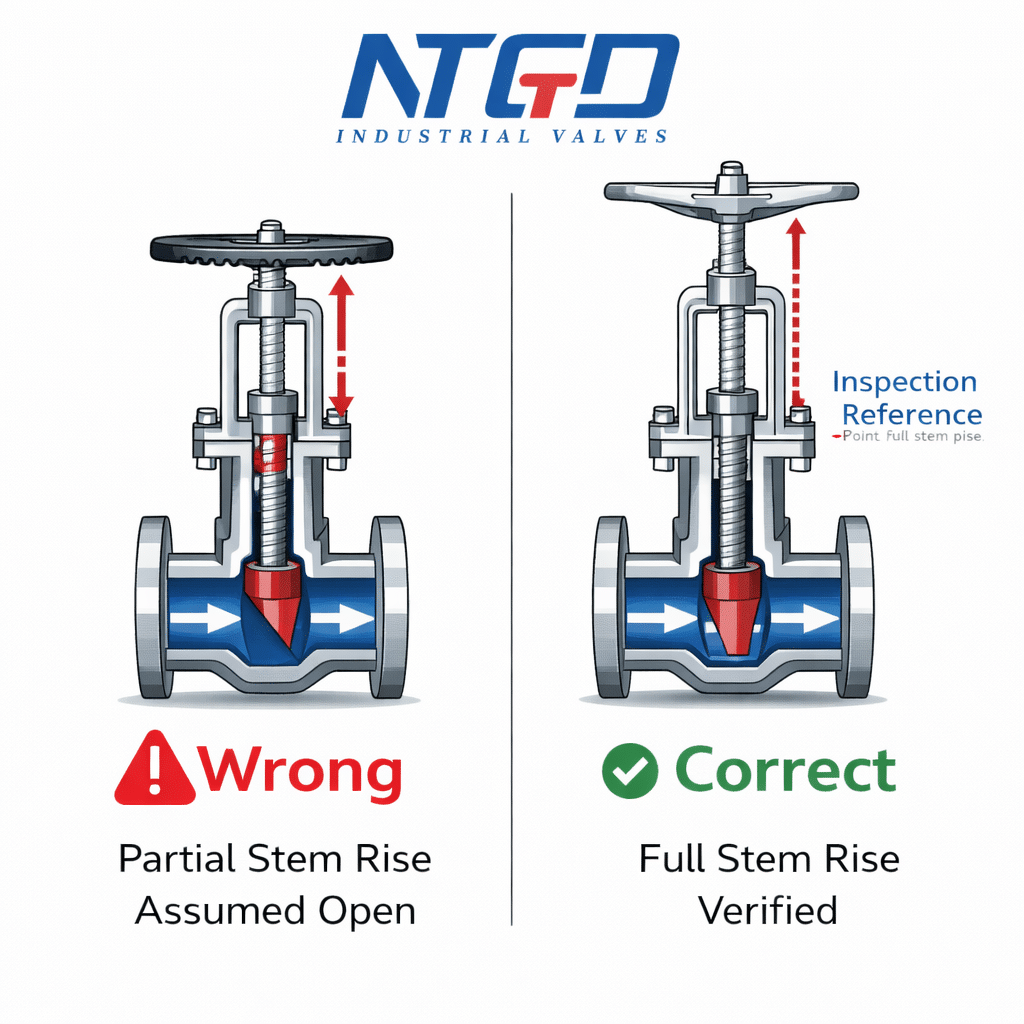
Quick answer for inspection: partial stem rise should not be assumed to mean fully open. Full-travel confirmation is recommended during commissioning, inspection, and maintenance.
An OS&Y valve is a rising stem gate valve in which the threaded stem is located outside the valve body. OS&Y stands for Outside Screw and Yoke. In many projects, it is also described as an outside stem and yoke valve.
The visible stem movement is the defining feature of this design. When the valve opens, the stem rises. When the valve closes, the stem lowers. That external movement makes valve status easier to verify than on designs where the stem travel is not visible.
This matters in fire protection, water distribution, pump room layouts, and industrial shut-off service, where a fast and unambiguous visual check can reduce inspection error and support safer operation.
This guide explains:
- how to tell if an OS&Y valve is open or closed
- what OS&Y / OSY means
- how the valve works
- how it compares with a non-rising stem valve
- what engineers should check during selection and inspection
- how to move from identification to specification and procurement
How to Tell if an OS&Y Valve Is Open or Closed
Quick Answer
An OS&Y valve is in the open position if the stem is raised and visibly protruding above the handwheel.
If the stem is lowered, the valve is closed.
This is the most direct answer to the common search query: “an os&y is in the open position if”.
Quick Identification Table
| Condition | Visual Sign | Valve Status |
|---|---|---|
| Stem raised and clearly visible above the yoke or handwheel | Gate lifted away from the seats | Open |
| Stem lowered with little or no visible upward projection | Gate seated in shut-off position | Closed |
A correct field judgment should be based on visible stem position plus full-travel confirmation, not on guesswork. In real systems, a partially raised stem can be mistaken for a fully open valve if installers or inspectors do not verify the actual travel.

Why the Visible Stem Matters
A visible rising stem is not just a mechanical detail. It is an inspection advantage. In systems where valve status must be verified quickly, a visible stem reduces ambiguity and helps operators confirm whether the shut-off path is open or closed without relying only on handle position.
What Does OS&Y (OSY) Mean in Valves?
OS&Y meaning in valves = outside screw and yoke, a rising-stem configuration with visible stem travel.
- Outside Screw means the threaded part of the stem is outside the pressure boundary of the valve.
- Yoke is the external frame that supports and guides the operating assembly.
Because the stem thread is external, the stem rises when the valve opens and lowers when the valve closes. This is why OS&Y valves are commonly grouped under rising stem gate valves.
What Is a Valve Yoke?
A valve yoke is the external support structure that holds and guides the stem assembly. In simple terms, it is the frame that helps keep the operating mechanism aligned while the stem travels up and down.
OS&Y vs Outside Stem and Yoke
In practice, the terms outside screw and yoke and outside stem and yoke are often used interchangeably. Both refer to a valve whose stem movement is externally visible.
Why the Term Matters in Procurement
For engineers and buyers, the term OS&Y does not just describe a nameplate feature. It signals a valve design with:
- visible position indication
- rising stem travel
- different space requirements from non-rising stem valves
- inspection advantages in the right applications
How an OS&Y Valve Works
An OS&Y valve is designed for full shut-off duty, not throttling. The valve opens and closes by moving a gate vertically inside the body.

Opening
When the handwheel or actuator drives the valve in the opening direction, the stem rotates and travels upward through the external thread arrangement. As the stem rises, it lifts the gate away from the seats and clears the flow path.
Closing
When the valve is operated in the closing direction, the stem rotates and travels downward. This pushes the gate back into the shut-off position and blocks the flow path.
Core Operating Principle
The critical point is not only that the gate moves, but that the stem position changes visibly outside the valve. That visible motion is what makes OS&Y valves easier to verify in service.
Practical Engineering Value
This visible stem movement is not just a mechanical feature; it is also a practical inspection benefit in systems where valve status must be confirmed quickly.
In NTGD inspection practice, stem travel visibility should be checked together with full shut-off verification before shipment, installation handover, or major maintenance return-to-service.
Main Components of an OS&Y Valve
An OS&Y gate valve typically includes the following main components:
Valve Body
The body is the main pressure-retaining part of the valve. It contains the flow passage and connects to the piping system through flanged, threaded, grooved, or welded ends depending on the design.
Bonnet
The bonnet encloses the upper internal section of the valve and forms part of the pressure boundary together with the body.
Gate
The gate is the internal closure element. It moves upward to open the valve and downward to shut off the flow.
Stem
The stem transmits motion from the handwheel or actuator to the gate. In an OS&Y valve, the stem movement is externally visible, which makes visual position confirmation possible.
Yoke
The yoke supports the upper operating assembly and helps guide stem motion.
Seats
The seats form the sealing interface with the gate. Seat design and material selection directly affect shut-off performance, wear life, and service suitability.
Packing and Gland
Packing seals around the stem as it passes through the bonnet area. Packing adjustment is important: too tight increases operating torque, while too loose may allow leakage.
Operator or Actuator
OS&Y valves may be operated by:
- handwheel
- gear operator
- electric actuator
- pneumatic actuator
- hydraulic actuator
For selection and maintenance, the most critical components are usually the stem, packing, seats, and operator assembly, because these directly affect visibility, shut-off reliability, and operating torque.

OS&Y Valve vs Non-Rising Stem Valve
One of the most important comparison questions in selection is the difference between an OS&Y valve and a non-rising stem (NRS) valve.
Comparison Table
| Feature | OS&Y Valve | Non-Rising Stem Valve |
|---|---|---|
| Stem movement visible | Yes | No |
| Easy visual position check | Excellent | Limited |
| Installation height required | Higher | Lower |
| External thread exposure | Yes | No |
| Inspection convenience | Better for quick visual checks | Lower visual clarity |
| Common in visibility-critical applications | Very common | Depends on design and project requirement |
NTGD Engineering Data
In NTGD OS&Y projects, full-open confirmation should be based on verified stem travel, not on visual assumption alone. For larger sizes, the visible stem rise is typically substantial enough to support fast field identification, but dimensional confirmation should always follow the approved drawing, valve design, and project requirement.
For retrofit layouts or pump room applications, installation clearance above the valve must be checked early, because rising stem travel directly affects available space.
When to Choose OS&Y
OS&Y valves are typically preferred when:
- visible open/closed confirmation is important
- inspection speed matters
- maintenance teams need clear visual status
- installation height is available
- shut-off service is more important than compact space savings
See NTGD OS&Y dimensional drawings and datasheets for full travel and installation clearance details.
When a Non-Rising Stem Valve May Be Chosen
Non-rising stem valves may be more suitable when:
- installation height is limited
- the valve is placed in tighter spaces
- external stem travel is not practical
- the project does not require visible stem movement
For a full engineering breakdown, read our complete guide to Rising Stem vs Non-Rising Stem Gate Valves.
OS&Y Valve Technical Specifications and Selection Criteria
For engineers, contractors, and procurement teams, identifying valve position is only the first step. The next step is confirming whether the valve matches the pressure class, medium, standards, installation conditions, and project documentation.
Typical Selection Criteria
| Item | Common Options | Typical Note / Standard |
|---|---|---|
| Valve Type | OS&Y gate valve | Rising stem shut-off design |
| Size Range | 1/2″ – 48″ | Standard and custom sizes available |
| Pressure Class | Class 150 / 300 / 600 / 900 / 1500 / 2500 | Depends on design code and service condition |
| Body Materials | Ductile iron / WCB / stainless steel / alloy materials | Material depends on medium, temperature, and corrosion requirement |
| End Connection | Flanged / grooved / threaded / butt-weld | Connection standard must match project piping specification |
| Operation | Handwheel / gear / electric / pneumatic / hydraulic | Selected based on torque, control method, and access condition |
| Service | Fire protection / water service / industrial shut-off | OS&Y is primarily for isolation duty |
| Compliance Standards | API 600 /ASME B16.34 /project-specific AWWA / FM / UL / NFPA requirements | Standards must match application and certification scope |
NTGD OS&Y valves can be specified to align with API 600, ASME B16.34, and project-driven fire protection or industrial shut-off requirements, subject to the exact valve design and certification scope.
Key Questions Before Selection
Before selecting an OS&Y valve, engineers should confirm:
- What is the required valve size?
- What is the design pressure and pressure class?
- What medium will the valve handle?
- Is the valve being used for shut-off only, or is throttling mistakenly being considered?
- What body and trim materials are required?
- What connection standard must be matched?
- Is visible valve position required during inspection?
- Is there enough vertical clearance for stem travel?
→ Check NTGD OS&Y dimensional drawing library - Does the project require FM/UL, NFPA, API, ASME, or other compliance documentation?
- Is manual or actuated operation required?
Practical Selection Rule
Choose an OS&Y valve when visible position indication, shut-off reliability, and inspection clarity are more important than minimizing vertical installation space.
Ready to spec? Jump to the NTGD OS&Y product catalog, dimensional drawing library, and technical datasheets for size range, stem travel, pressure rating, and project compliance details.
Typical Applications of OS&Y Gate Valves
OS&Y gate valves are commonly used where clear open/closed identification and reliable shut-off are more important than compact height.
Common Applications
- fire protection systems
- sprinkler control lines
- water distribution systems
- pump room valve layouts
- industrial utility shut-off lines
- oil and gas auxiliary shut-off service
- general process isolation duty
Fire Protection Use
OS&Y valves are widely used in fire protection-related systems because a visible rising stem makes valve status easier to verify during inspection and routine checks aligned with
NFPA standards.
For projects requiring visible shut-off status in fire protection systems, view NTGD’s full range of OS&Y fire protection gate valves and project support resources.
Industrial Use
In industrial systems, OS&Y valves are commonly selected for shut-off service where a simple visual indication of stem travel adds value to inspection and operation.
Application Boundary
OS&Y valves are primarily isolation valves. They should not be positioned as throttling valves. If regulated flow control is required, another valve type is usually more suitable.
NTGD Engineering Insight: Common OS&Y Issues in Real Projects
This section is intended to go beyond textbook explanation. In real projects, OS&Y valve problems are usually caused by incorrect installation assumptions, incomplete travel verification, poor maintenance practice, wrong application matching, or overlooked space constraints.
1. Misreading Valve Condition
A raised stem is useful, but operators can still misjudge a valve if they assume any visible rise means fully open.
NTGD Field Note: In visibility-critical systems, the most common inspection mistake is assuming partial stem rise equals full-open position. This usually happens after commissioning or maintenance when the valve has not been checked against actual full-travel condition.
NTGD Recommendation: During handover and routine inspection, confirm full-open position against the approved travel condition, not just by a quick visual guess. Where practical, mark or record the verified full-open position for field reference.
2. Excessive Packing Compression
Packing that is tightened too aggressively may reduce leakage temporarily, but it often increases operating torque and accelerates stem wear.
NTGD Field Note: Over-tightened packing is one of the most common causes of “hard to operate” complaints on otherwise serviceable valves. The issue is often created in the field, not in the factory.
NTGD Recommendation: Tighten packing only enough to maintain sealing. If operating torque rises sharply after adjustment, stop and recheck gland compression instead of forcing operation.
3. Lack of Full-Stroke Exercise
Valves that stay in one position for long periods can become harder to operate if they are never exercised under controlled maintenance procedures.
NTGD Field Note: In pump rooms and industrial utility lines, long static periods increase the chance that a valve will be difficult to move when urgently needed.
NTGD Recommendation: Include periodic functional checks and controlled full-stroke operation where permitted by maintenance procedure and system condition.
4. Wrong Valve Choice for the Service
Some buyers search for “OS&Y valve” and assume it is automatically suitable for any gate-valve-like application. That is not the right selection logic.
NTGD Field Note: OS&Y is a structural configuration, not a universal service answer. The right choice still depends on medium, pressure class, required standards, installation space, and whether shut-off duty is the real requirement.
NTGD Recommendation: Verify medium, pressure, temperature, shut-off duty, compliance requirement, and operating method before final model selection.
5. Installation Clearance Overlooked
Because the stem rises during operation, OS&Y valves need overhead space. This becomes a common issue in retrofit pump rooms, compact mechanical areas, and congested piping layouts.
NTGD Field Note: Clearance problems are often discovered too late, after installation space has already been fixed by the surrounding layout.
NTGD Recommendation: Review maximum stem rise and dimensional drawing before order approval, especially for retrofits or tight equipment rooms.
6. Fire Protection System Freeze or Low-Temperature Risk
In cold environments, valves in fire protection-related service may face additional maintenance risk if local freeze protection and operating conditions are not considered.
NTGD Field Note: Low-temperature exposure changes how operators should think about inspection frequency, drainage condition, and surrounding system protection.
NTGD Recommendation: For cold-region projects, confirm valve material suitability, insulation or enclosure requirement, and maintenance procedure as part of project engineering review.

Advantages and Limitations of OS&Y Valves
Advantages
OS&Y valves provide several practical benefits:
- clear visual indication of valve status
- reliable shut-off service when correctly selected
- useful for inspection-based systems
- compatible with manual or automated operation
- well suited to applications where visible position feedback matters
Limitations
They also have practical limitations:
- require more vertical installation space
- not suitable for throttling duty
- external stem area and packing require maintenance attention
- wrong packing adjustment can increase operating torque
- application suitability still depends on pressure, medium, and standards
Practical Takeaway
The real value of an OS&Y valve is not just that it opens and closes, but that it combines shut-off duty with visible position feedback for inspection-critical systems.
OS&Y Valve Inspection and Troubleshooting
A useful troubleshooting section should connect the symptom to the likely cause and the next corrective action.
Valve Is Hard to Operate
Possible causes:
- packing gland too tight
- lack of periodic exercise
- internal obstruction or wear
- stem condition or lubrication issue
Recommended action:
- inspect packing adjustment
- review exercise history
- inspect for mechanical obstruction
- confirm the valve is being used in the correct service
Leakage Around the Stem Area
Possible causes:
- worn packing
- incorrect packing compression
- stem surface wear
- poor maintenance condition
Recommended action:
- inspect and replace packing as required
- adjust gland compression correctly
- inspect stem condition before return to service
Valve Position Is Unclear
Possible causes:
- incomplete travel
- operator assumption without verification
- actuator setup not aligned to actual full travel
Recommended action:
- verify full stem travel
- inspect opening and closing stop settings
- compare field position against approved drawing or maintenance record
Internal Shut-Off Is Unsatisfactory
Possible causes:
- seat or gate wear
- debris at the sealing surfaces
- wrong specification for the service
- damage caused by improper operation
Recommended action:
- inspect sealing surfaces
- confirm service compatibility
- verify whether the valve has been used for shut-off duty only
Download the NTGD OS&Y valve maintenance and troubleshooting manual for a step-by-step inspection checklist, common field issues, and engineering support guidance.

Frequently Asked Questions (OS&Y Valve Open Position & More)
An OS&Y valve is in the open position if?
An OS&Y valve is in the open position if the stem is raised and visibly protrudes above the handwheel or yoke. Stem up indicates the gate has been lifted into the open position.
How do you tell if an OS&Y valve is open or closed?
The fastest field check is the stem position. If the rising stem is up and clearly visible, the valve is open. If the stem is lowered, the valve is closed. Partial stem rise should not be assumed to mean fully open.
What is the difference between OS&Y and non-rising stem valves?
The main difference is visible stem travel. OS&Y valves have an externally visible rising stem, while non-rising stem valves do not.
→ See detailed comparison: [Rising Stem vs Non-Rising Stem Gate Valve]
What does OS&Y mean on a valve?
OS&Y means Outside Screw and Yoke. It refers to a valve design in which the stem thread is outside the valve body and stem travel is externally visible.
What is a valve yoke?
A valve yoke is the external support frame that guides and supports the stem assembly and operating mechanism.
Is an outside screw and yoke valve in the open position if the stem is raised?
Yes. An outside screw and yoke valve is generally considered open when the rising stem is raised and visibly above the handwheel or yoke area. Full-travel verification is still recommended.
What does “an OS&Y valve is in the open position if” mean in practice?
It means the stem must be fully raised and visibly above the yoke or handwheel area. Partial stem rise should not be assumed to mean fully open.
What is the difference between OS&Y valve open vs closed?
The difference is the visible stem position. In the open position, the stem is raised. In the closed position, the stem is lowered. This visual movement is the main operating indicator.
What should be checked during OS&Y valve inspection?
Inspectors should check:
- stem position
- full-travel condition
- stem area leakage
- packing condition
- ease of operation
- general condition of the external operating assembly
→ For maintenance support, contact NTGD engineering.
Are OS&Y valves required for fire protection systems?
That depends on the project code, specification, and approval requirement. In many fire protection-related applications, visible valve position is a major advantage, which is one reason OS&Y designs are widely used.
Can OS&Y valves be installed horizontally?
That depends on the valve design, installation requirement, and project specification. Horizontal installation should always be checked against the approved drawing, service condition, and manufacturer guidance.
How often should OS&Y valves be exercised?
Exercise frequency depends on the system, maintenance procedure, and project requirement. In critical service, regular inspection and controlled functional checks are important to reduce the risk of seizure or misjudged position.
OS&Y Valve Engineering Support & Resources
NTGD Certifications / Trust Signals
Depending on the exact project, valve design, and certification scope, NTGD can support customers with documentation and product configurations aligned to requirements such as:
- UL Listed
- FM Approved
- AWWA compliant design basis
- ISO 9001 quality management
- Material traceability available
- technical datasheets and drawing support
Free Download: OS&Y Valve Quick Reference Guide
Get a quick-reference resource covering:
- OS&Y valve open vs closed identification
- basic inspection checkpoints
- selection reminders
- installation clearance considerations
Fill in your name and email to get the guide instantly.
Free Engineering Selection Support
For fire protection, water system, or industrial shut-off projects, submit your parameters to receive a tailored engineering recommendation.
Suggested form fields:
- Size
- Pressure Class
- Medium
- Project Type: Fire Protection / Industrial
- Connection Type
- Quantity
- Country
Fill out this 30-second form to receive a personalized OS&Y valve spec sheet and engineering recommendation.
Request a Custom Quote for OS&Y Gate Valves
When your project is ready for pricing or model confirmation, request:
- commercial quotation
- technical datasheet
- CAD drawing
- 3D model
- dimensional drawing confirmation
Recommended image here
Image: NTGD original factory, inspection, or OS&Y project photo
Insert after: the NTGD Certifications / Trust Signals block or before Related Internal Resources
Filename: ntgd-osy-valve-factory-inspection-photo.png
Alt text: NTGD OS&Y valve factory inspection or project support photo
Caption: Figure 4: NTGD OS&Y valve engineering support, inspection, and project documentation capabilities.
Summary
An OS&Y valve is a rising stem gate valve with externally visible stem travel. The most important field rule is simple:
- Stem up = OS&Y valve open
- Stem down = OS&Y valve closed
That visible stem movement is what makes OS&Y valves especially useful in systems where inspection clarity matters. But identification is only the first step. Good selection also depends on:
- pressure class
- material
- end connection
- installation clearance
- service condition
- compliance requirement
- documentation support
For engineers, contractors, and buyers, the real value of this page is not only understanding what OS&Y means, but using that understanding to make a better specification decision.
For project support, NTGD can assist with:
- technical datasheets
- dimensional drawings
- selection support
- quotation response
- engineering clarification for fire protection and industrial shut-off applications
