
Author Name: Bruce Zheng
Author Role: Co-Founder and Valve Engineer at NTGD Valve
Author Bio: Bruce Zheng is Co-Founder and Valve Engineer at NTGD Valve, focusing on industrial valve selection, application, and technical content for global B2B buyers.
Last Updated: April 30, 2026
Double Block and Bleed Valves in Oil and Gas: Technical Guide and Selection
A double block and bleed valve is a valve or valve assembly designed to provide two isolation barriers with an intermediate bleed or vent point between them. In oil and gas service, its value is not only shutoff. The bleed point allows trapped pressure to be released, drained, vented, or monitored before a line, instrument, or equipment section is opened for maintenance.
That verification step is the reason DBB valves are widely used in pipeline isolation, midstream facilities, offshore systems, refineries, sampling points, and chemical injection lines. A single shutoff valve may stop normal flow, but it does not provide the same confirmation that pressure between two isolation barriers has been relieved.
For engineering buyers, the main risk is terminology. A DBB valve, a DBB system, a DIB requirement, and an OSHA-related double block and bleed isolation method are not always the same thing. A reliable specification must separate valve design, system isolation, site procedure, service conditions, and testing requirements before the valve is selected.
What Is a Double Block and Bleed Valve?
A double block and bleed valve, often shortened to DBB valve, provides two blocking barriers and a bleed or vent connection between them. The two blocking barriers isolate the flow path. The bleed connection releases or verifies pressure trapped between the barriers.
In simple terms:
- Double block means there are two shutoff barriers.
- Bleed means there is a drain or vent point between the barriers.
- DBB means the operator can isolate a section and check whether pressure remains between the isolation points.
In oil and gas systems, this design is used where simple shutoff is not enough. Maintenance teams may need to isolate a pipeline section, confirm pressure relief, protect workers during line opening, or prevent process media from entering an instrument, sampling point, or downstream system.
DBB Valve, DBB System, and DBB Safety Practice
The term double block and bleed is used in more than one context. In procurement, it may refer to a compact valve assembly. In plant maintenance, it may describe a field-built isolation arrangement. In safety procedures, it may refer to an energy isolation practice.
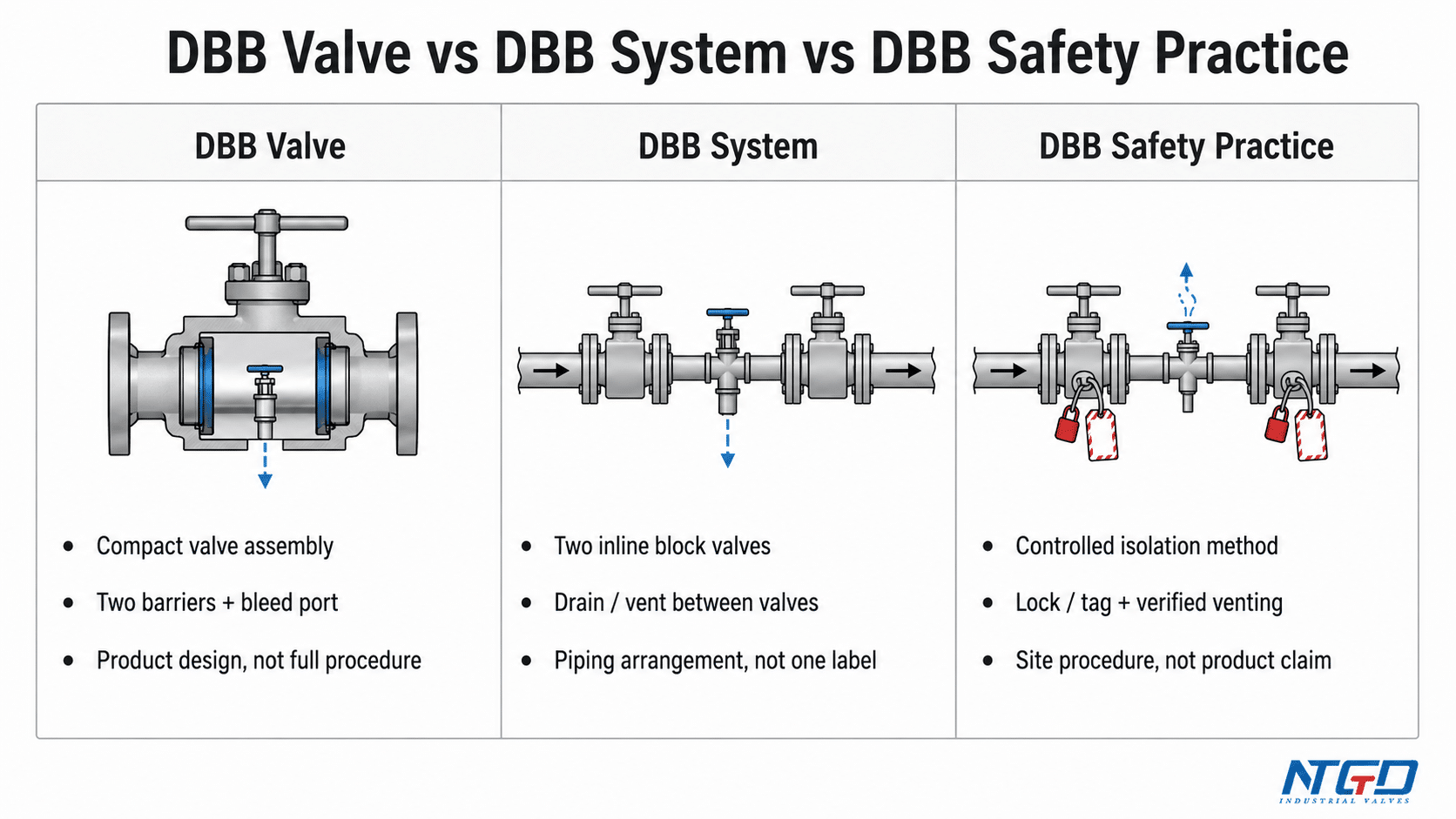
| Term | What It Usually Means | Why the Distinction Matters |
|---|---|---|
| DBB valve | A compact valve or valve assembly with two sealing barriers and an intermediate bleed / vent connection | Common in valve procurement, instrumentation, and compact pipeline isolation; it should not automatically be treated as a complete site safety isolation practice |
| DBB system | Two block valves installed in series with a bleed or drain valve between them | Common in field isolation practices; replacing a required two-valve system with one compact valve may not match the site procedure |
| DBB safety practice | A method of isolating energy or process media before work begins | Governed by the actual work procedure, lockout / tagout method, vent condition, and hazard assessment, not by the valve label alone |
A compact DBB valve may be the right engineering choice in many services, but the supply scope must match the isolation requirement. If a project asks for a DBB safety arrangement but the RFQ only specifies a “DBB valve,” the supplier may quote a valve that performs correctly as a product while still leaving the site procedure, verification method, or lockout requirement unresolved.
The Role of the Bleed or Vent Valve
The bleed valve is not just an accessory. It is the diagnostic point in the DBB arrangement. It can be used to:
- release trapped pressure between the two isolation barriers;
- drain liquid from the cavity or spool section;
- vent gas to a safe location;
- help verify whether one of the isolation barriers is leaking;
- support maintenance, inspection, sampling, or instrument isolation.
In field language, this component may be called a bleed valve, vent valve, drain valve, or sometimes a bleeder valve. In this article, the important point is its function inside the double block and bleed arrangement, not a separate bleeder valve product category.
DBB, DIB, SBB, API 6D, and OSHA: Key Definition Boundaries
DBB terminology is often misunderstood because the same words appear in valve standards, safety procedures, plant practices, and procurement documents. A strong specification should clarify which DBB or DIB meaning applies before the valve is selected.
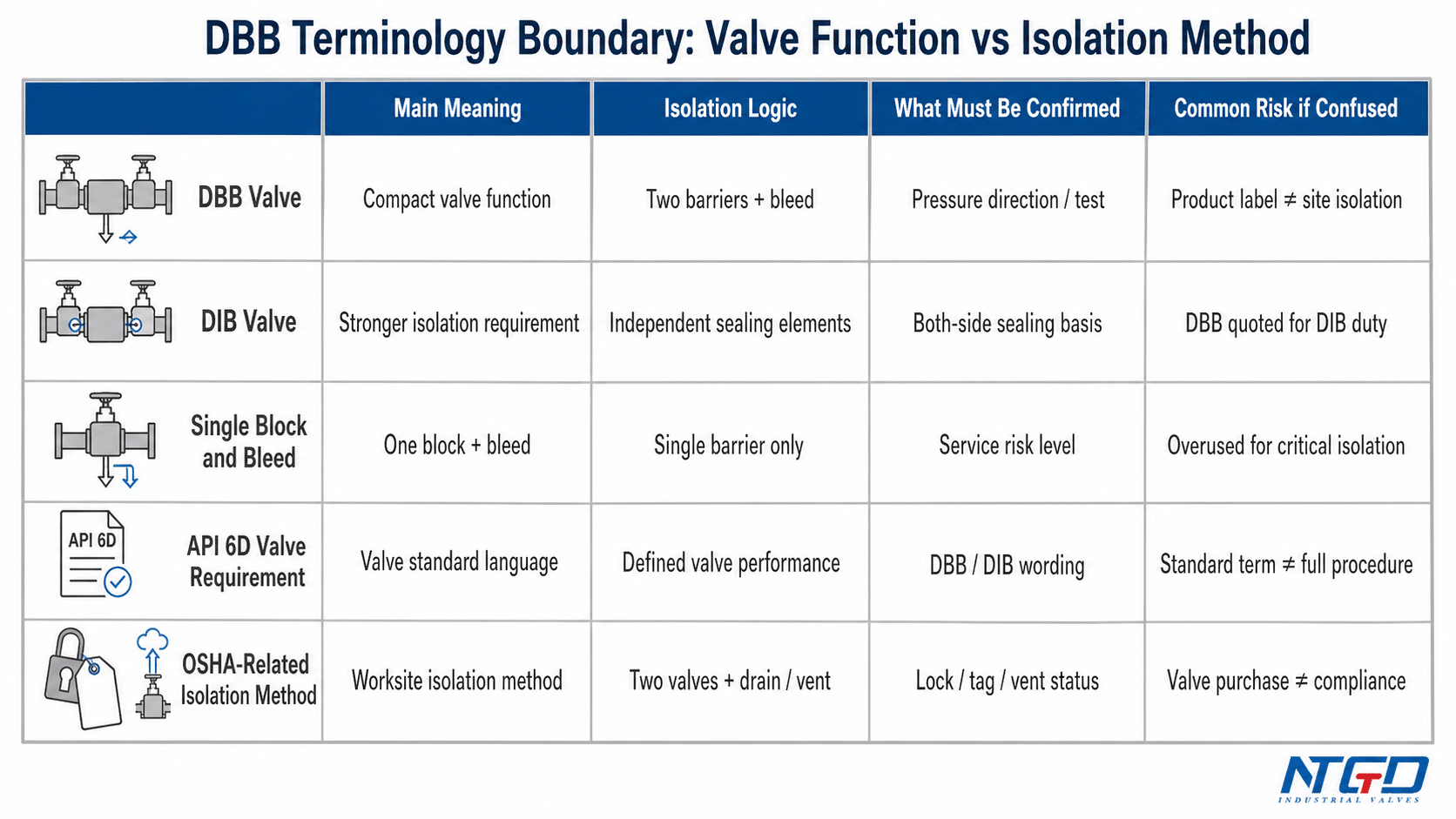
DBB vs DIB
DBB and DIB valves should not be treated as the same term.
A DBB arrangement provides two isolation barriers with a bleed point between them. In many valve discussions, the focus is on blocking pressure and bleeding the cavity between sealing surfaces.
DIB, or double isolation and bleed, is typically used when each sealing element is expected to provide isolation under defined pressure conditions. DIB language can be more demanding because it may require stronger sealing performance from both barriers, depending on valve design, pressure direction, project specification, and the standard version being applied.
For buyers, the practical checklist is:
- Pressure direction: Must the seat seal against upstream pressure, downstream pressure, or pressure from both directions?
- Seat independence: Does each seat need to provide independent isolation, or is the project only requiring DBB functionality?
- Terminology in the RFQ: Does the project specification ask for DBB, DIB, or a site-defined isolation arrangement?
- Testing documentation: Will the supplier provide test records that match the required DBB or DIB wording?
- Service purpose: Is the valve being selected for process isolation, maintenance safety, custody transfer, instrumentation, or emergency isolation support?
A vague specification can create a costly mismatch: one supplier may quote a DBB valve, while the project inspector expects DIB performance or a system-level isolation method. The earlier this distinction is clarified, the lower the risk of late-stage specification changes.
DBB vs Single Block and Bleed
A single block and bleed arrangement provides one shutoff barrier and one bleed or vent connection. It may be enough for low-risk instrument isolation or non-critical services, but it does not provide the same isolation logic as a double block and bleed arrangement.
| Arrangement | Isolation Barriers | Bleed / Vent Point | Typical Use |
|---|---|---|---|
| Single block and bleed | One | One | Basic isolation, instrument isolation, lower-risk services |
| Double block and bleed | Two | One between the barriers | Higher-confidence isolation, pipeline maintenance, hazardous or pressurized service |
| Double isolation and bleed | Two independent isolation barriers, depending on standard and design | One between the barriers | More demanding isolation requirements where independent sealing performance is required |
API 6D DBB Valve vs OSHA Double Block and Bleed Isolation
In valve procurement, API 6D terminology is often used to describe pipeline valves and DBB / DIB performance requirements. In workplace safety language, OSHA-related double block and bleed discussion is usually tied to isolation methods, lockout / tagout, confined space entry, or hazardous energy control.
These two uses are connected, but they are not identical.
A DBB valve may help form part of an isolation strategy. However, OSHA-related double block and bleed language may refer to a system arrangement involving two inline valves and a drain or vent valve between them, with appropriate locking or tagging depending on the task and standard. That is different from simply buying a compact valve marketed as a DBB valve.
A project specification should separate three questions:
- Valve design question: What DBB or DIB function must the valve provide?
- System isolation question: How will the piping system be isolated before work?
- Safety procedure question: What lockout, venting, draining, testing, and hazard controls are required on site?
This separation protects both buyer and supplier. A valve may meet the requested valve function, yet the field installation may still require additional isolation, vent routing, lockout control, or procedure verification before maintenance work can begin.
How Double Block and Bleed Valves Work
A DBB valve works by closing two isolation barriers and using the bleed point between them to release or verify trapped pressure. Valve construction may vary, but the isolation logic remains the same: two barriers create the isolated space, and the bleed point proves whether that space is still under pressure.

The Double Block Mechanism
The two block barriers are the primary isolation points. In a DBB ball valve, especially a trunnion ball valve used in high-pressure service, the sealing elements may be arranged so that the valve can block flow and isolate pressure from the process line. In a DBB valve assembly, the barriers may be two separate block valves built into one compact configuration.
The purpose of the double block arrangement is to reduce reliance on a single sealing point. If one barrier leaks, the intermediate bleed point may reveal leakage before pressure reaches the downstream side or the maintenance area.
DBB valves are commonly selected for oil and gas services involving:
- high-pressure pipeline isolation;
- hydrocarbon process lines;
- gas service where leakage risk is critical;
- instrument or sampling systems connected to live process media;
- offshore platforms where space, weight, and safety access matter.
The Bleed / Vent Valve Function
The bleed or vent valve sits between the two isolation barriers. When opened under the correct procedure, it can release trapped gas or liquid from the cavity or spool section between the two barriers.
This middle point performs three functions:
- Pressure relief: It removes trapped pressure from the isolated section.
- Drain or vent function: It allows liquid or gas to be routed away from the cavity.
- Verification: It helps show whether upstream or downstream isolation is holding.
If pressure continues to build at the bleed point after the barriers are closed, at least one isolation barrier may not be holding as intended. In that condition, the bleed point has done its job: it has revealed that maintenance should not proceed until the isolation is re-evaluated.
Basic Operating Sequence
A simplified DBB operation before maintenance may follow this logic:
| Step | Action | Purpose |
|---|---|---|
| 1 | Close the first block barrier | Stop flow from one side of the system |
| 2 | Close the second block barrier | Create a second isolation point |
| 3 | Open the bleed or vent valve under controlled conditions | Release trapped pressure between the barriers |
| 4 | Monitor or test the bleed point | Confirm whether pressure remains or rebuilds; pressure rebuild means the isolation must be rechecked |
| 5 | Proceed with maintenance only after site procedure is satisfied | Protect workers and equipment before the system is opened |
This sequence is simplified. Actual operation depends on the medium, pressure, temperature, system layout, vent destination, and site safety rules. For flammable, toxic, sour, or high-pressure media, the bleed path must be routed and controlled so that venting does not create a new hazard.
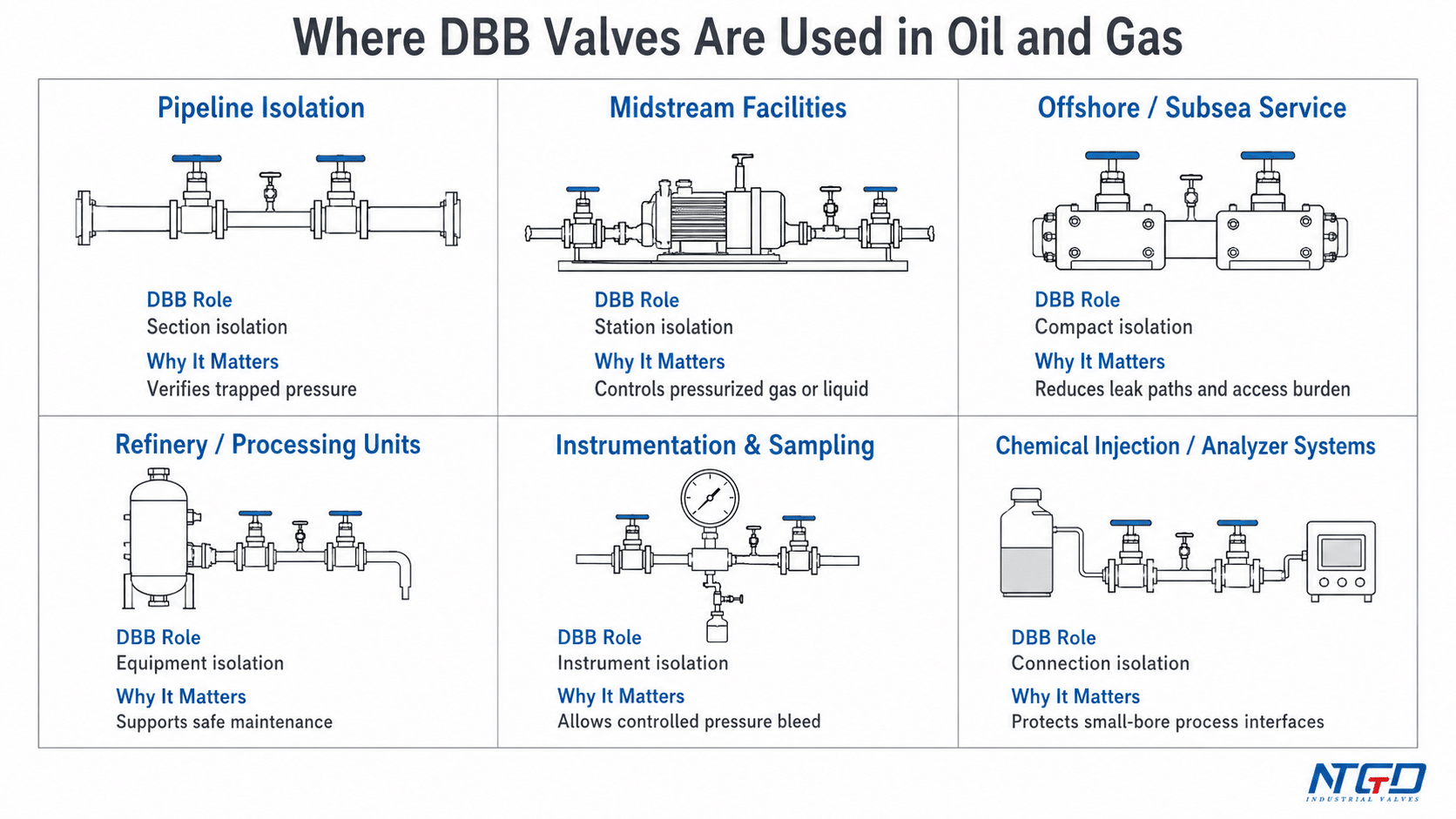
Where Double Block and Bleed Valves Are Used in Oil and Gas
DBB valves are used in oil and gas when isolation quality, maintenance access, pressure verification, or leakage control is more important than basic shutoff. The application spans upstream, midstream, downstream, offshore, and instrumentation systems.
| Oil and Gas Area | Typical DBB Use | Why DBB Is Selected |
|---|---|---|
| Pipeline isolation | Isolating pipeline sections for inspection, repair, pressure testing, or maintenance | Long pressurized sections make single-point isolation uncertain; DBB allows pressure between barriers to be verified before line opening |
| Midstream facilities | Compressor stations, metering stations, terminals, and pipeline manifolds | Pressurized gas or hydrocarbon liquid isolation needs a controlled bleed point to confirm depressurization before intervention |
| Offshore and subsea service | Platform isolation, compact valve assemblies, subsea production systems | Space, weight, and access limitations favor compact isolation with fewer leak paths and clearer maintenance boundaries |
| Refinery and processing units | Unit isolation, process equipment maintenance, hydrocarbon service | Hazardous process media must be isolated and depressurized before equipment is opened or removed |
| Instrumentation and sampling | Gauge isolation, sampling panels, chemical injection, analyzer systems | Instruments can be removed or serviced only after trapped process pressure is safely relieved |
| Emergency isolation support | Additional isolation layer around hazardous sections | Supports safer isolation planning, but should not be confused with an emergency shutdown system market topic |
Pipeline Isolation and Midstream Maintenance
Pipeline systems often contain long sections of pressurized fluid or gas. During maintenance, a single isolation point can leave too much uncertainty, especially when the line contains flammable gas, hydrocarbon liquid, or hazardous process media.
A DBB arrangement allows the operator to isolate a section and use the bleed point to confirm whether pressure remains between the two block barriers. This is especially valuable before line opening, equipment replacement, hydrotesting preparation, or maintenance around valves, meters, or manifolds.
Offshore, Subsea, and Upstream Production Service
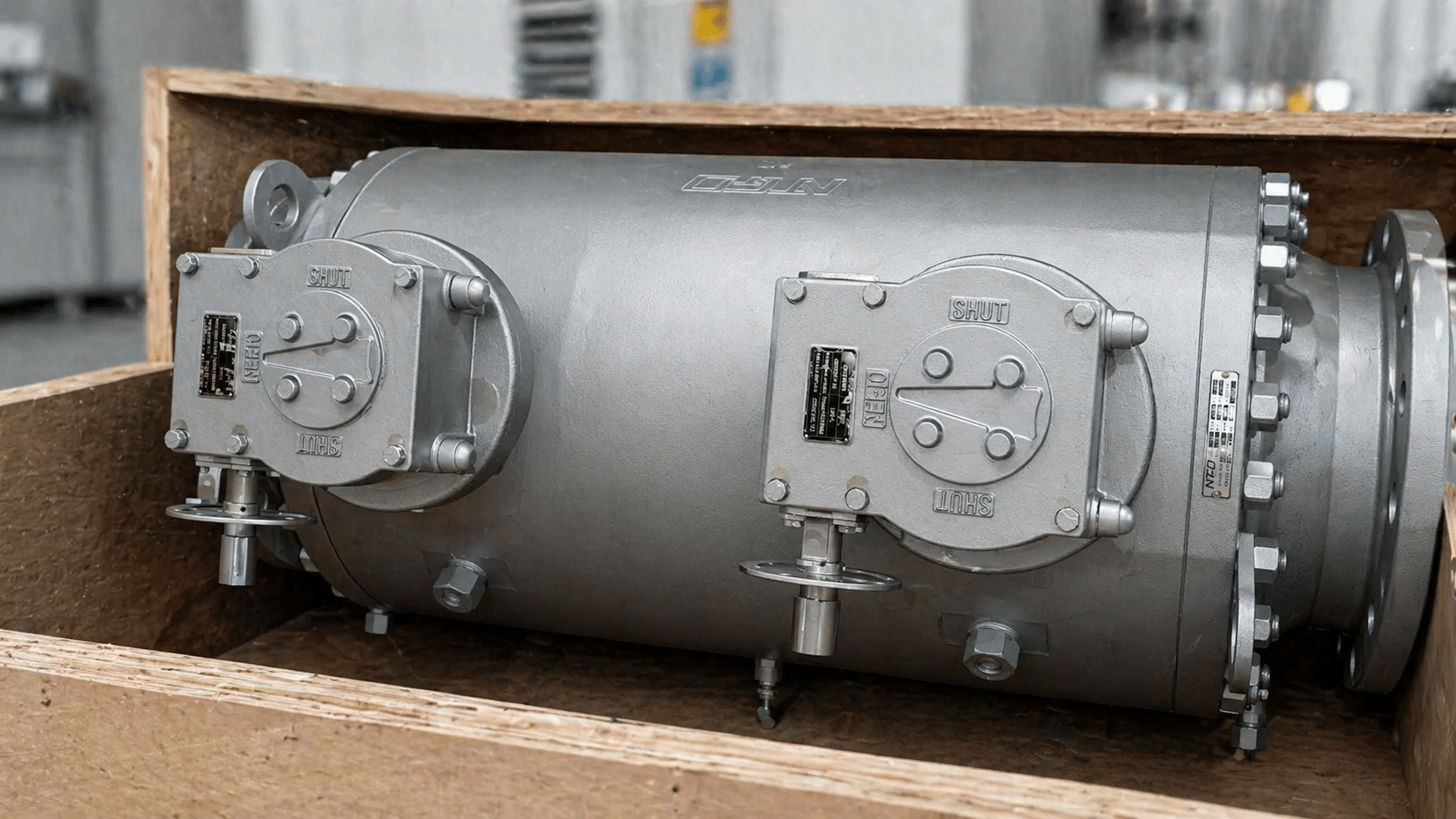
Offshore platforms and subsea systems place high value on compact, reliable isolation. Space and weight are limited, access is difficult, and maintenance windows are expensive. A compact DBB valve assembly can reduce the number of separate components and potential leak points compared with a field-built arrangement, provided the valve design matches the isolation requirement.
For upstream production, DBB valves may be used around wellhead equipment, production manifolds, separation systems, and chemical injection points. The main concern is not just shutoff; it is whether the operator can verify that the isolated section is depressurized before work begins.
Refinery and Processing Unit Isolation
Refineries and processing plants handle fluids that may be hot, toxic, flammable, corrosive, or under high pressure. DBB valves are used where equipment must be isolated before maintenance or where process contamination must be prevented.
Common locations include:
- equipment isolation before maintenance;
- process unit tie-ins;
- sampling systems;
- analyzer connections;
- chemical injection lines;
- isolation around meters or control systems.
In these services, the DBB valve must be selected based on the actual medium, not only line size and pressure class. A valve that is suitable for clean hydrocarbon service may not be suitable for hot, corrosive, sour, or solids-bearing media.
Instrumentation, Sampling, and Chemical Injection
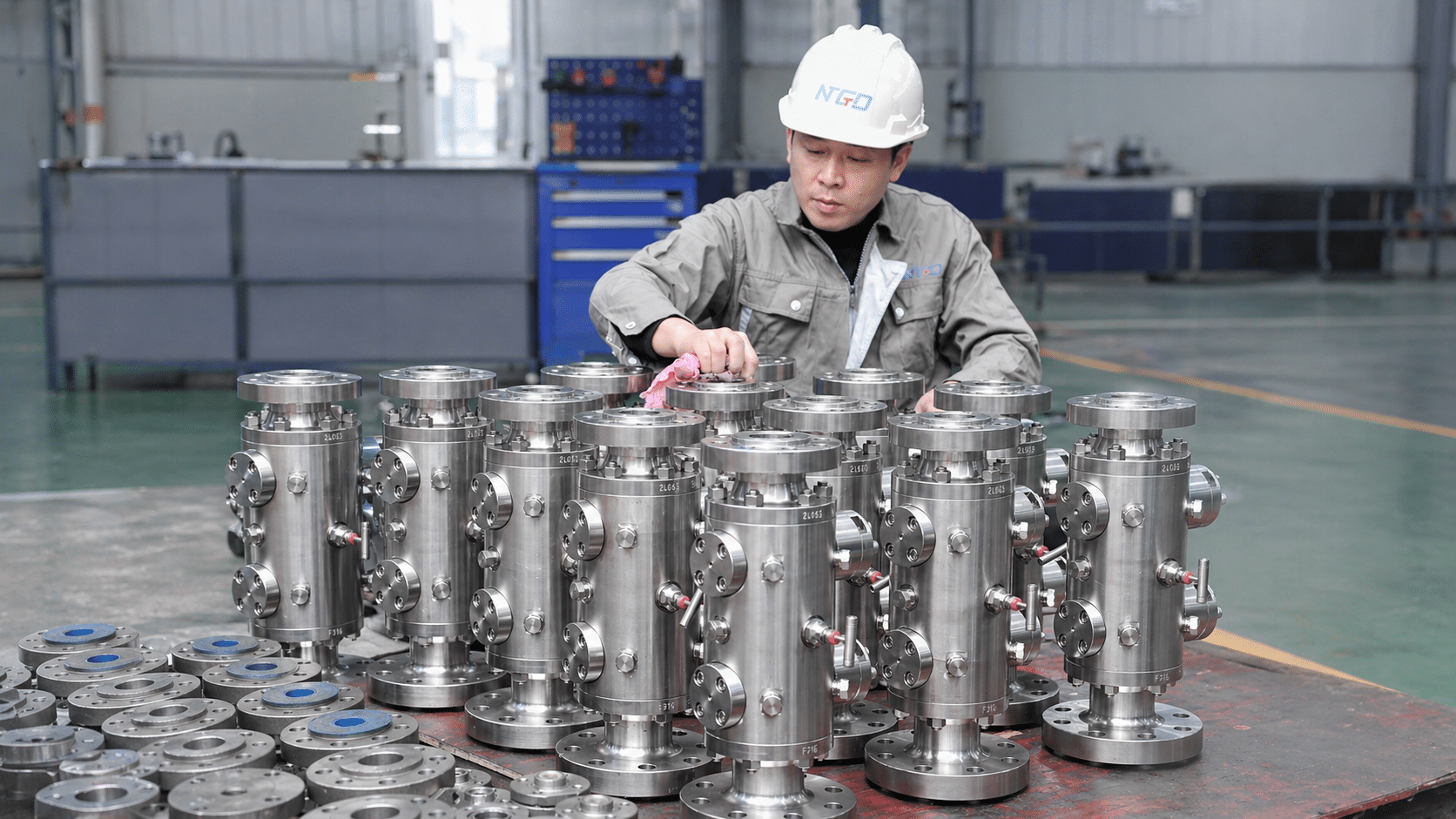
Instrumentation DBB valves are often smaller than pipeline DBB valves, but their function is still critical. They isolate instruments, gauges, transmitters, sampling points, and chemical injection connections from the process line.
Before an instrument is removed, the operator must know whether process pressure remains in the connection. A DBB valve allows the pressure to be bled down and verified, reducing the chance of process media being released during maintenance. The material, packing, seat, vent routing, and end connection must match the process fluid and maintenance procedure.
Safe Bleed, Vent, and Isolation Practices
The bleed function is one of the most important parts of a DBB arrangement. A DBB valve that blocks pressure but does not allow safe draining, venting, or verification does not fully support the purpose of double block and bleed isolation.
Why the Bleed Point Matters
Before anyone breaks containment, removes an instrument, or opens a pressurized section, the bleed point answers the critical field question: is there still trapped energy between the isolation barriers?
Without a bleed or vent point, the operator may know that two valves are closed, but cannot easily confirm whether pressure remains between them. With a bleed point, trapped pressure can be released and monitored.
This matters most when:
- the medium is flammable, toxic, sour, or hot;
- the system will be opened for maintenance;
- an instrument will be removed;
- pressure could rebuild due to leakage past one barrier;
- the isolated section must be verified before work.
Safe Vent or Drain Destination
Bleeding pressure is only safe if the released media has a safe vent or drain destination. Venting hydrocarbon gas, sour gas, or toxic vapor to an unsafe area can turn a depressurization step into a new site hazard, even when the valve itself is functioning correctly.
Before using the bleed valve, the project or site procedure should confirm:
| Checkpoint | Why It Matters |
|---|---|
| Fluid phase | Gas, liquid, condensate, or mixed-phase flow changes the venting and draining method |
| Fluid hazard | Toxic, flammable, sour, corrosive, or hot media require controlled handling before release |
| Vent or drain destination | Released media must be routed to a safe location rather than discharged into the work area |
| Valve position control | Block and bleed valves may need lockout, tagging, or procedural control |
| Pressure rebuild monitoring | Rebuilding pressure can indicate leakage past an isolation barrier |
| Toxic or sour gas release control | Sour or toxic gas service requires additional attention to vent routing, personnel exposure, and site procedure |
When DBB Isolation May Be Required or Preferred
Double block and bleed may be required by project specifications, site procedures, safety rules, or regulatory interpretation. It may also be preferred even when not explicitly required, especially when the consequence of leakage is high.
DBB isolation is commonly considered when:
- maintenance requires opening a pressurized process system;
- hazardous media may enter the work area;
- a single block valve does not provide enough confidence;
- pressure must be verified before work;
- instrument removal could expose personnel to toxic vapor, hot fluid, chemical contact, or flammable media;
- the system handles flammable, toxic, sour, or high-pressure service.
For OSHA-related questions, the wording must remain precise. OSHA-related double block and bleed discussion may refer to a specific isolation method, not simply a product label. A compact DBB valve can support isolation, but whether it satisfies a safety requirement depends on the system arrangement and the site procedure.
Severe Service Selection Factors for Oil and Gas DBB Valves
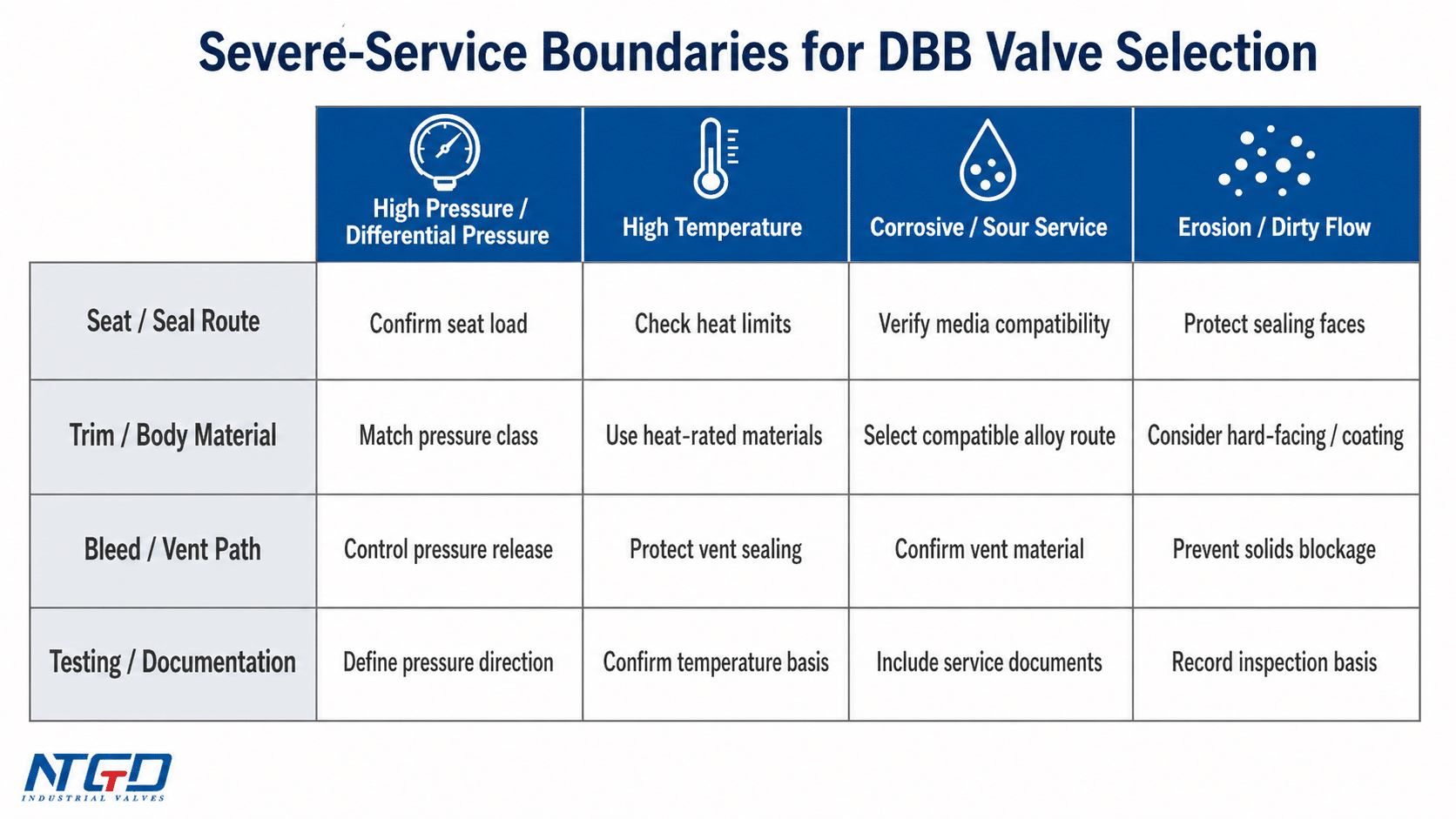
A DBB valve for oil and gas service should not be selected only by nominal size, pressure class, and end connection. The service conditions determine whether the valve will maintain sealing performance, vent safely, resist corrosion, and remain maintainable over time.
Pressure and Temperature Boundary
Pressure class must match the pipeline design, but the isolation function also depends on differential pressure across the sealing elements. High differential pressure can affect seat loading, operating torque, venting behavior, and actuation requirements.
Temperature affects the seat and seal route. Soft seats may provide tight shutoff in clean service, but their temperature and chemical limits must be confirmed. Metal-seated ball valve designs or specially coated designs may be required for higher temperature, abrasive, or severe services.
Corrosive, Toxic, Flammable, or Sour Service
Oil and gas systems may contain sour gas, produced water, hydrocarbons, chemicals, or corrosive process fluids. In these cases, body material, trim material, seat material, sealing components, bolting, and vent connections must be compatible with the medium.
A DBB valve that seals well in clean hydrocarbon service may not be suitable for corrosive or sour service unless the material route is confirmed. The bleed path also needs attention because it may expose small components, fittings, or tubing to the same hazardous medium.
Erosion and Abrasive Flow
Some oil and gas applications involve sand, scale, catalyst fines, or dirty fluid. Abrasive particles can damage sealing surfaces and reduce isolation performance over time.
The core risk with erosion in DBB service is not only seat wear. Damaged sealing surfaces may allow leakage past an isolation barrier and compromise the verification function at the bleed point.
For abrasive or dirty service, selection should consider:
- flow path geometry;
- seat exposure;
- coating or hard-facing;
- cavity areas where solids can accumulate;
- maintenance access;
- flushing or draining requirements.
The more severe the medium, the more important it becomes to specify the DBB valve as a service-matched isolation device rather than a generic shutoff valve.
Seat, Seal, Trim, and Body Material Route
| Service Factor | Selection Impact |
|---|---|
| Clean hydrocarbon service | Soft seats may be acceptable if temperature, chemical compatibility, and leakage requirement are suitable |
| High-temperature service | Seat material, packing, and stem sealing limits must be checked; metal seat or graphite-based sealing routes may be required by the project |
| Sour or corrosive service | Body, trim, bolting, and sealing material must match the corrosion and sour service requirements, including the bleed / vent path |
| Abrasive or dirty service | Hard-facing, coatings, or metal-seated designs may be needed to protect sealing surfaces and preserve isolation verification |
| Frequent operation | Torque, actuator sizing, stem sealing, and packing wear become more important over repeated cycles |
| Critical isolation | DBB vs DIB requirement, pressure direction, test basis, and documentation must be clarified before purchase |
The final material boundary should be based on the actual medium, pressure, temperature, operating frequency, project standard, and verified material compatibility. Severe service selection should not rely on material name alone.
RFQ-Ready DBB Valve Selection Checklist
A strong DBB valve RFQ should go beyond basic industrial valve selection by size and pressure class. It should define the service, isolation requirement, material route, testing expectation, and documentation needed for the project.
Use the following checklist before sending a DBB valve inquiry.
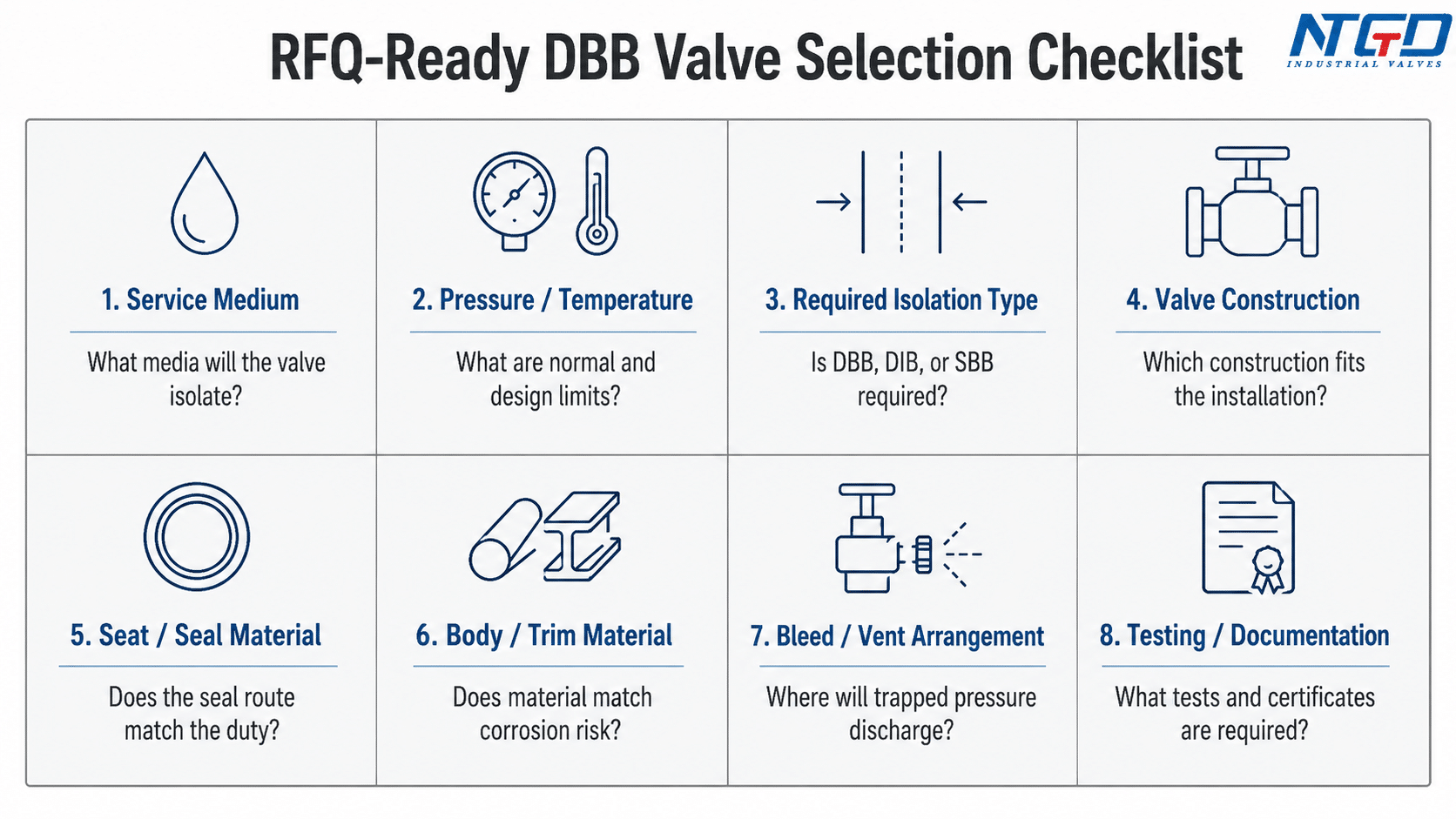
| RFQ Item | What to Confirm | Why It Matters |
|---|---|---|
| Service medium | Hydrocarbon liquid, gas, sour gas, chemical, produced water, mixed phase | Determines material, seat, seal, and venting risk |
| Operating pressure and temperature | Normal, maximum, design, and differential pressure | Affects pressure class, seat load, torque, and sealing route |
| Required isolation type | DBB, DIB, single block and bleed, or project-specific isolation method | Prevents terminology mismatch between valve function and site isolation requirement |
| Applicable standard and isolation terminology | Project-required DBB / DIB definition, API-style valve requirement, site isolation procedure boundary, and inspection expectation | Aligns valve supply scope, testing basis, and field acceptance criteria before procurement |
| Valve construction | Single-body DBB valve, modular assembly, trunnion ball valve, plug valve, instrument DBB | Matches installation space and service duty |
| End connection | Flanged, welded, threaded, hub, compression, or instrument connection | Must match piping and maintenance requirements |
| Seat and seal material | Soft seat, metal seat, elastomer, graphite, PTFE, PEEK, or other route | Controls leakage, temperature, and chemical compatibility |
| Body and trim material | Carbon steel, stainless steel, alloy, CRA, overlay, or coating | Controls corrosion and severe service performance |
| Bleed / vent arrangement | Port size, connection type, routing, drain / vent orientation | Determines safe depressurization and verification |
| Operation / actuation | Manual, gear, pneumatic, hydraulic, electric, or remote operation | Affects safety access, torque, and control system integration |
| Testing and documentation | Pressure test, seat test, leakage requirement, standard reference, certificates | Supports inspection, QA, and project approval |
A DBB valve should be selected as part of the isolation strategy, not as a standalone label. Before final selection, the RFQ should confirm that the terminology, service conditions, bleed / vent arrangement, testing basis, and field isolation method all point to the same requirement.
FAQ
What is the full form of DBB?
DBB stands for double block and bleed.
What is the purpose of a double block and bleed valve?
The purpose is to provide two isolation barriers and a bleed point between them. This allows trapped pressure to be released or verified before maintenance, inspection, instrument removal, or line opening.
How does a double block and bleed valve work?
A DBB valve closes two isolation barriers and uses the bleed or vent connection between them to release and monitor trapped pressure. If pressure rebuilds at the bleed point, the isolation should be checked again before work continues.
Is double block and bleed required by OSHA?
It depends on the task, system arrangement, and applicable site procedure. OSHA-related double block and bleed language may refer to an isolation method involving two inline valves and a drain or vent between them. A DBB valve product should not be assumed to satisfy every OSHA-related isolation requirement without checking the full system and procedure.
What is a double block and bleed test?
A DBB test checks whether the isolation barriers are holding by observing pressure at the bleed point between them. The exact method depends on the valve design, pressure direction, standard requirement, and project procedure.
What is the difference between DBB and DIB?
DBB means double block and bleed. DIB means double isolation and bleed. They are related but not interchangeable. DIB may require independent isolation performance from both sealing elements, depending on valve design and project terminology.
What is the difference between single block and bleed and double block and bleed?
Single block and bleed has one shutoff barrier and one bleed point. Double block and bleed has two shutoff barriers with a bleed point between them. DBB provides a higher level of isolation verification than a single blocking barrier.
Can a DBB valve be used for sour or H2S service?
It may be used only when the body, trim, seat, seal, bolting, and bleed / vent arrangement are suitable for the sour service conditions. The project should confirm material compatibility, vent routing, testing requirements, and site procedure before selecting the valve.
Conclusion
Double block and bleed valves play an important role in oil and gas because they combine isolation, pressure relief, and verification in one arrangement. Their value is strongest when maintenance teams must control hazardous pressure, isolate pipeline or process sections, reduce leak paths, and confirm that trapped pressure has been released before work begins.
The main selection point is alignment. A DBB valve, a DBB system, a DIB requirement, and an OSHA-related isolation method are not always the same thing. A reliable specification should align the isolation function, service conditions, bleed route, seat and seal route, testing basis, and project terminology before the valve is selected.
Final Application Check
For oil and gas projects requiring DBB valve selection, NTGD Valve can help review DBB / DIB terminology, service conditions, pressure class, seat and seal route, body and trim material, bleed / vent arrangement, and RFQ specification requirements before final valve selection.
