
Author Name: Bruce Zheng
Author Role: Co-Founder and Valve Engineer at NTGD Valve
Author Bio: Bruce Zheng is Co-Founder and Valve Engineer at NTGD Valve, focusing on industrial valve selection, application, and technical content for global B2B buyers.
Last Updated: May 5, 2026
API standards for gate valves should not be checked by name alone. The real compliance risk is using the wrong standard route for the service, or receiving a valve whose nameplate, serial number, test report, MTR, and certificate package cannot be matched during inspection.
For gate valves, API compliance often involves several standards working together. API 600 may define the construction route for a steel bolted-bonnet gate valve. API 6D may apply when the valve is specified for pipeline service. API 598 may support inspection and pressure testing evidence. API marking, API Monogram information, valve serial numbers, Material Test Reports, test records, and certificates then help confirm whether the delivered valve matches the stated standard.
Quick summary
- Check API compliance by standard role, not by standard name alone; design, testing, marking, and documentation may be controlled by different requirements.
- Match the valve service to the correct route: API 600, API 602, API 603, API 6D, API 6A, and API 598 do not serve the same function.
- For API 6D valves, the serial number, compliance placard or nameplate, API Monogram information, MTR, test report, and certificate package should tell the same story.
- Confirm the required API standard before RFQ so the supplier quotes the correct construction route, test scope, marking requirement, and document package.
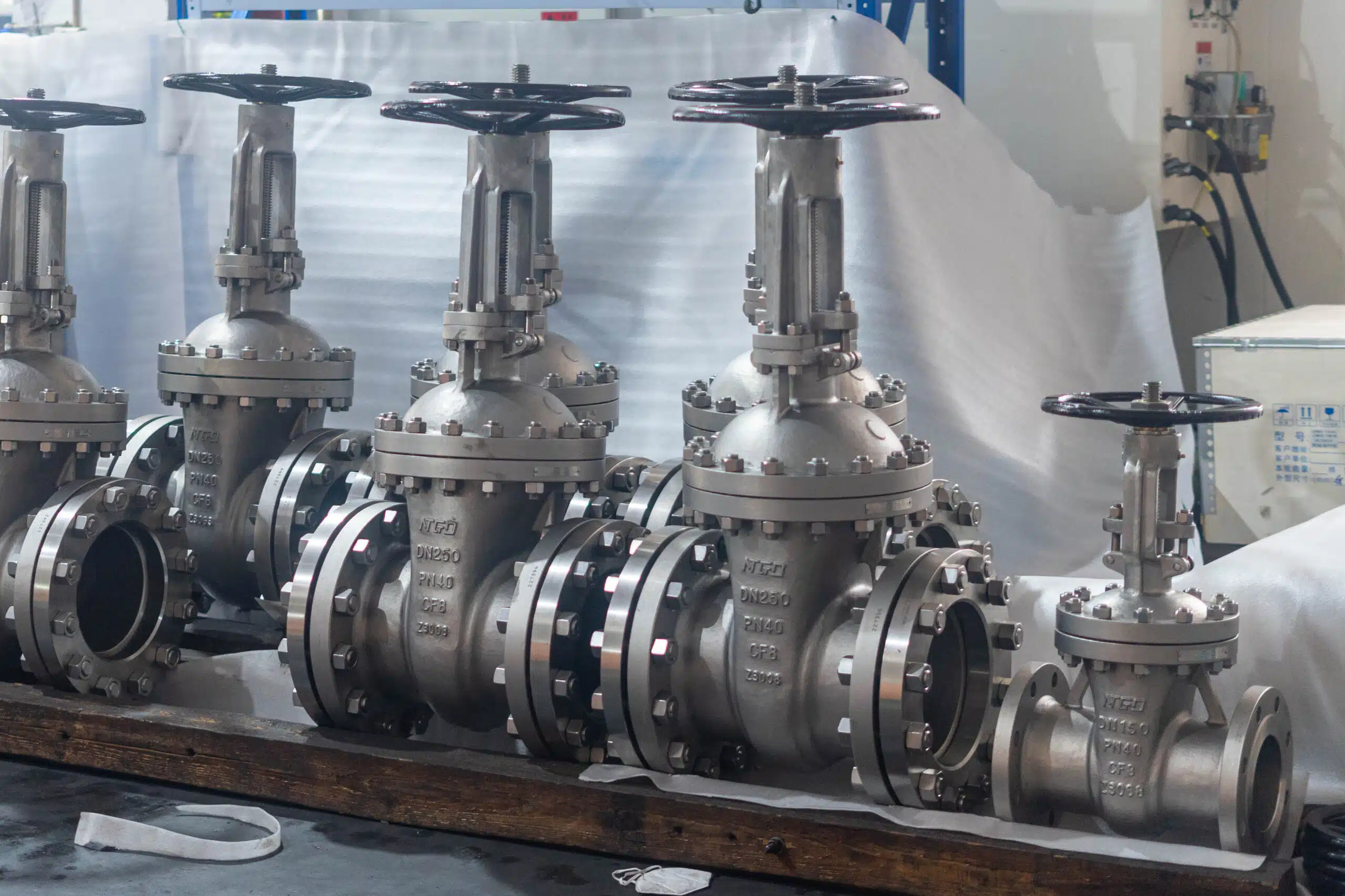
What API Standards Mean for Gate Valve Compliance
API standards are published by the American Petroleum Institute and are widely used in oil, gas, petrochemical, pipeline, and process industries. For gate valves, these standards help define how a valve should be designed, manufactured, inspected, tested, marked, and documented.
In practical terms, API compliance controls several areas:
| Compliance Area | What It Means for Gate Valves |
|---|---|
| Design and construction | Confirms the valve follows the required body, bonnet, end connection, pressure class, and construction route |
| Materials | Supports material selection, heat traceability, and Material Test Report review |
| Pressure testing | Confirms shell, seat, backseat, and closure performance before shipment |
| Marking and identification | Matches the physical valve to its standard, size, pressure class, material, and serial number |
| Documentation | Provides evidence through certificates, test reports, MTRs, and inspection records |
A gate valve may be described as API-compliant, but the claim should still be checked against the valve marking, standard scope, pressure class, material route, test records, and supplier documentation.
If the standard route is mixed up, the problem may not appear until RFQ review, final inspection, or site acceptance. A bolted-bonnet steel gate valve for refinery piping, a pipeline gate valve, a compact forged small-bore valve, and a wellhead gate valve can require different review paths. When those paths are confused, the quotation, nameplate, MTR, pressure test report, and final certificate package may no longer support the same compliance claim.
Key API Standards for Gate Valves: Role Map
The first step is to understand the role of each standard. Some API standards define gate valve construction. Others define testing, pipeline service, wellhead service, fire testing, emissions, or supplier quality systems.
| API Standard | Main Role for Gate Valves | Typical Gate Valve Relevance | How to Use It in Review |
|---|---|---|---|
| API 600 | Steel gate valve design and construction | Heavy-duty bolted-bonnet steel gate valves, commonly used in refinery and process piping | Check the body/bonnet route, pressure class, end connection, material route, and gate valve construction basis. Do not use an API 600 statement as a substitute for API 6D pipeline traceability review when API 6D is specified. |
| API 602 | Compact forged steel valve standard | Small-bore forged gate valves, often used in compact piping systems | Confirm that the valve is a compact forged small-bore design. Do not treat API 602 as interchangeable with a larger cast steel API 600 gate valve route. |
| API 603 | Corrosion-resistant gate valve route | Corrosion-resistant bolted-bonnet gate valves | Review the corrosion-resistant material route together with construction evidence and test documentation, not as a material label alone. |
| API 6D | Pipeline and piping system valve specification | Pipeline gate valves, especially where isolation, traceability, and documentation are critical | Verify pipeline service suitability, nameplate or placard information, serial number traceability, and the supporting document package. |
| API 6A | Wellhead and Christmas tree equipment | Wellhead gate valves and upstream equipment | Use when the valve belongs to wellhead or Christmas tree service, not as the default standard for plant piping gate valves. |
| API 598 | Valve inspection and pressure testing | Shell, backseat, and closure testing for many valve types, including gate valves | Use as inspection and test evidence. It supports compliance review but does not replace the valve design or service standard. |
| API 6FA | Fire test support standard | Fire-safe performance requirements when specified | Apply only when the project or specification requires fire testing evidence. |
| API 624 | Fugitive emission type testing support | Emissions-related requirements for applicable rising stem valve designs | Apply only when fugitive emission control is part of the project requirement. |
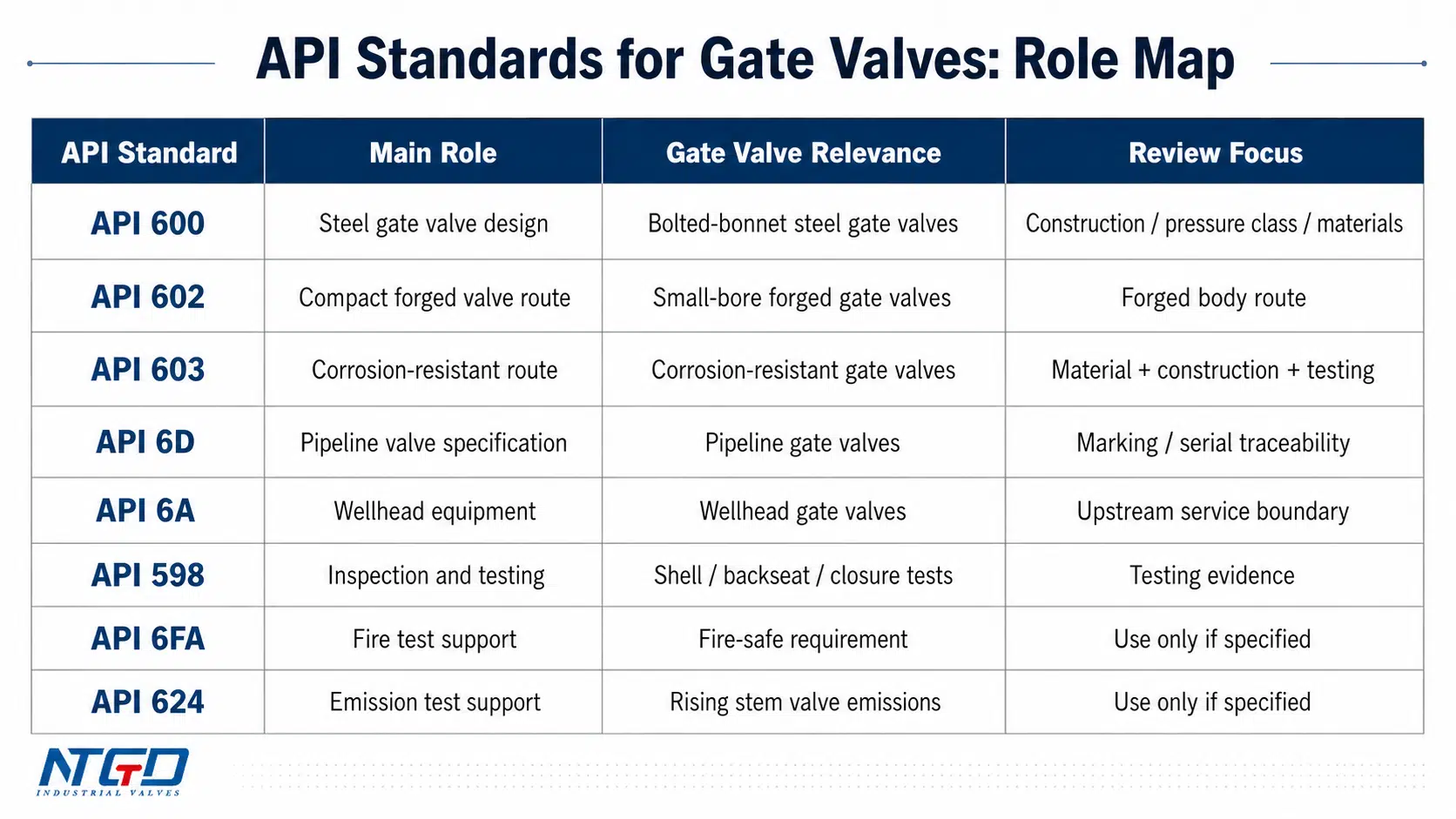
A strong gate valve specification usually does not rely on one standard in isolation. A steel gate valve may be designed to API 600 and pressure-tested according to API 598. A pipeline gate valve may be specified under API 6D and also require stronger marking, serial number, and documentation control.
The role map should be used before choosing a supplier or reviewing a quotation. If the standard role is wrong, even a well-built valve can be mismatched to the application.
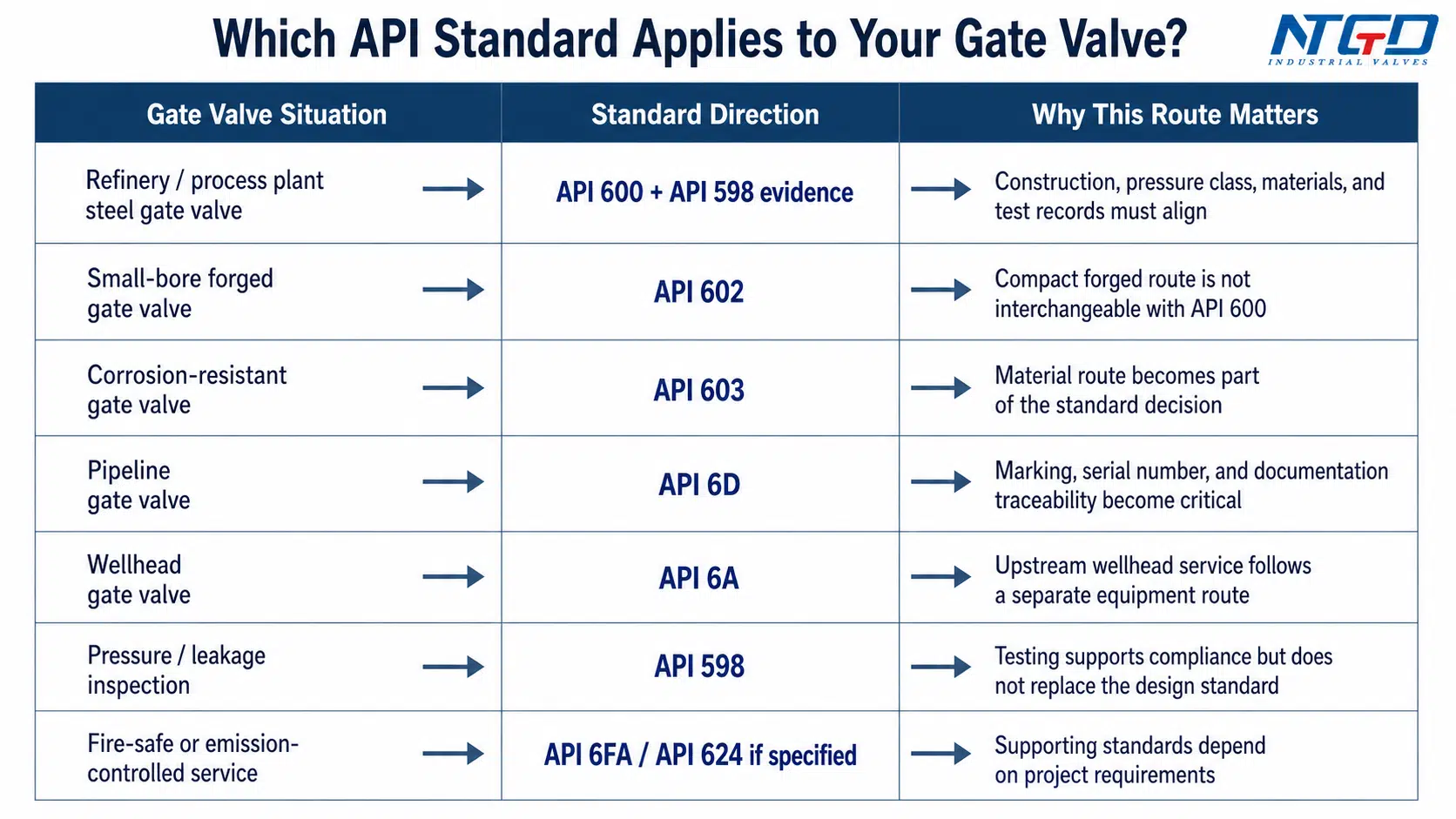
Which API Standard Applies to Your Gate Valve?
The most common mistake is asking whether a gate valve is “API approved” without first asking which API standard applies. A supplier may provide a valve that carries an API-related claim, but the claim may still fail project review if the standard scope, service route, marking, or document package does not match the order.
The required standard depends on where the valve is used, how it is constructed, what evidence the project requires, and the broader gate valve selection context.
| Gate Valve Situation | Standard Direction | Engineering Logic |
|---|---|---|
| Refinery or process plant steel gate valve | API 600, with testing evidence such as API 598 | The review must confirm a heavy-duty steel gate valve construction route, then match pressure class, material documents, and test records to that route. |
| Small-bore forged gate valve | API 602 | Compact forged construction has a different review path from larger cast steel gate valves; quoting the wrong route can create construction and documentation mismatch. |
| Corrosion-resistant gate valve route | API 603 | Material route and corrosion-resistant construction become part of the standard decision, not only a material description. |
| Pipeline gate valve | API 6D | Pipeline service requires stronger attention to marking, serial number traceability, documentation, and service-specific acceptance evidence. |
| Wellhead or Christmas tree gate valve | API 6A | Upstream wellhead service has its own equipment requirements and should not be reviewed as ordinary plant piping. |
| Pressure and leakage inspection | API 598 | Testing evidence supports compliance, but it does not replace the design or service standard. |
| Fire-safe or emission-controlled service | API 6FA or API 624 if specified | These are supporting requirements added by project conditions, not general gate valve design standards. |
Upstream Wellhead Gate Valves
API 6A is relevant when the gate valve is part of wellhead or Christmas tree equipment. It should not be treated as the default standard for ordinary plant piping or pipeline gate valves.
In a gate valve standards review, API 6A should remain a boundary reference. It tells the buyer when upstream service changes the standard path, but it should not dominate a general gate valve API compliance page.
Pipeline Gate Valves
API 6D applies to valves used in pipeline and piping system service. It covers more than gate valves, but when a gate valve is specified for pipeline isolation, API 6D becomes an important route.
For pipeline gate valves, the physical marking, serial number, API Monogram information, documentation package, and test records become part of the acceptance path. The buyer should be able to trace the delivered valve back to manufacturing and inspection records.
Refinery and Process Plant Gate Valves
API 600 is commonly associated with heavy-duty bolted-bonnet steel gate valves used in refinery, petrochemical, power, and process plant piping. In this route, the key questions are not only “Is it API 600?” but also:
- Is the valve construction within the standard’s scope?
- Are the pressure class and end connections correct?
- Do the material documents match the valve body, bonnet, trim, and pressure rating?
- Are the required pressure tests documented?
A credible API 600 standard claim depends on these items working together. The standard name, construction route, pressure class, material records, and test evidence must support the same valve.
Small-Bore and Corrosion-Resistant Gate Valves
API 602 becomes relevant when the valve is a compact forged small-bore design. API 603 becomes relevant when corrosion-resistant construction is the route being specified.
These standards should not be merged into a generic “steel gate valve” statement. Their scope and construction logic are different from API 600 and API 6D.
Testing and Documentation Requirements
API 598 belongs in the testing and inspection evidence layer. It helps verify that the valve has passed required pressure and leakage checks, but it does not replace the design or construction standard.
A practical review combines:
- the design or service standard, such as API 600 or API 6D;
- the test standard or test requirements, such as API 598;
- the marking and documentation package;
- the buyer’s project specification.
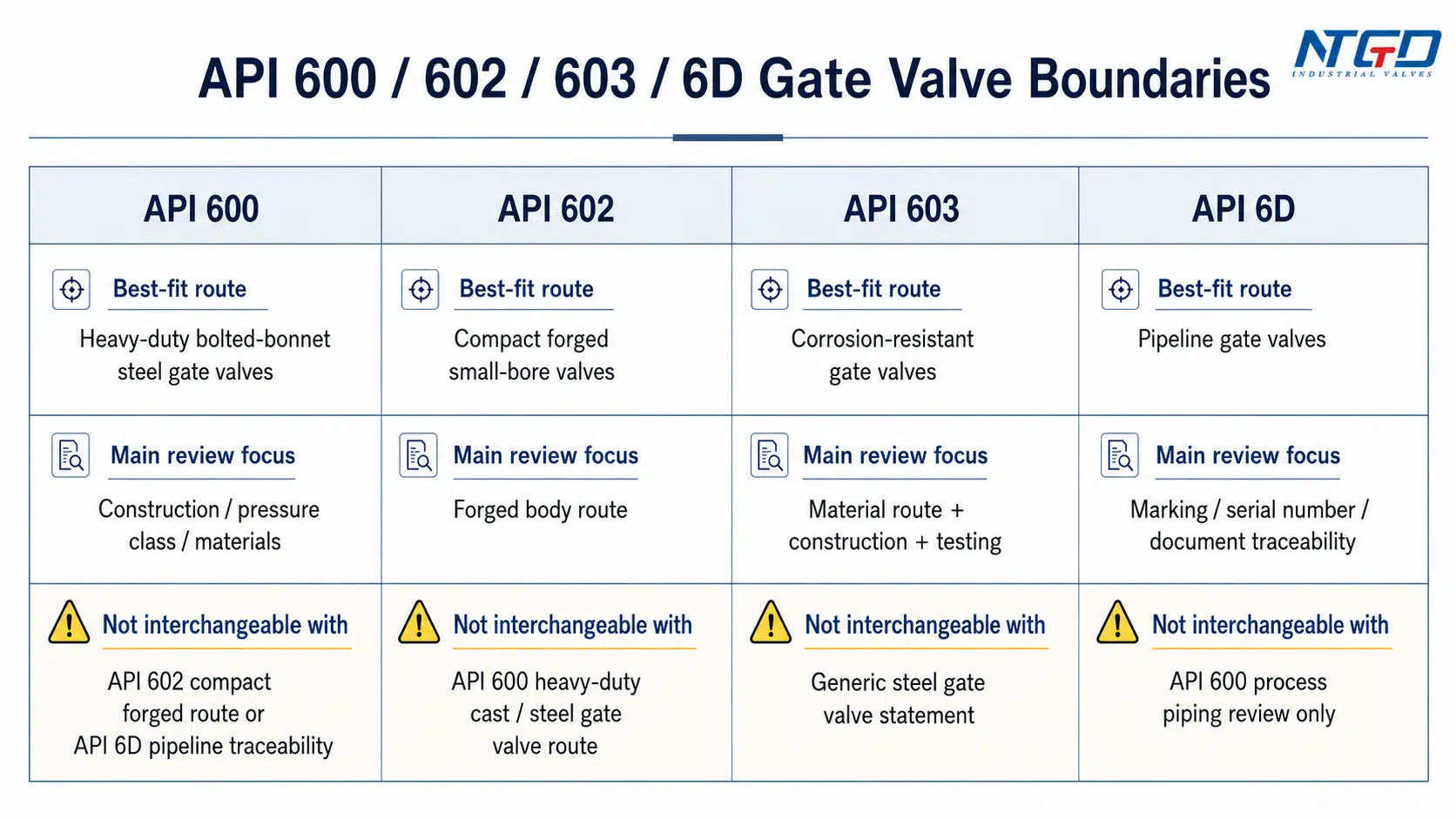
API 600, API 602, API 603, and API 6D: Gate Valve Standard Boundaries
Several API standards can appear in a gate valve specification, but they are not interchangeable. The clearest way to prevent misapplication is to define each standard by its gate valve route.
| Standard | Best-Fit Gate Valve Route | Main Boundary |
|---|---|---|
| API 600 | Heavy-duty bolted-bonnet steel gate valves | Fits steel gate valves commonly used in refinery and process plant piping; it does not replace API 6D review when pipeline service, marking, documentation, and traceability are specified. |
| API 602 | Compact forged small-bore valves | Fits compact forged small-bore valves; it should not be used as a substitute for the larger cast or heavy-duty steel gate valve route normally reviewed under API 600. |
| API 603 | Corrosion-resistant gate valves | Fits corrosion-resistant gate valve construction where material route is a defining requirement; material, construction, and testing evidence must be checked together. |
| API 6D | Pipeline valves, including pipeline gate valves | Fits pipeline service where isolation duty, marking, documentation, and serial traceability are part of the acceptance path. |
API 600: Heavy-Duty Bolted-Bonnet Steel Gate Valves
API 600 is one of the most important standards for industrial steel gate valves. It is commonly associated with bolted-bonnet steel gate valves with flanged or butt-welding ends.
For buyers, API 600 is relevant when the valve is intended for refinery, petrochemical, power, or process plant piping where a heavy-duty gate valve construction is required.
The review should focus on:
- valve type and construction route;
- pressure class;
- end connection;
- body and bonnet material;
- trim or internal material route;
- test and inspection documentation.
For detailed API 600 gate valve design parameters, dimensions, material requirements, and inspection rules, the project specification or dedicated technical documentation should be reviewed separately.
In this article, API 600 is treated as a key standard route inside the broader gate valve compliance system.
API 602: Compact Forged Small-Bore Valves
API 602 is relevant when the valve follows a compact forged steel gate valve route in small-bore service.
It is not simply a smaller version of API 600. The construction route, body design, and typical application range are different.
During RFQ review, a vague request for an “API steel gate valve” can create ambiguity. The supplier may need to confirm whether the valve should follow an API 600 heavy-duty steel gate valve route or an API 602 compact forged route.
API 603: Corrosion-Resistant Gate Valve Route
API 603 should be considered when corrosion-resistant construction is required. This can apply when the service conditions make material route a central part of the specification.
For gate valves in corrosive service, the standard discussion should not stop at pressure class. The material route, body/bonnet construction, trim compatibility, and test evidence should all be checked together.
API 6D: Pipeline Gate Valve Boundary
API 6D is used for valves in pipeline and piping systems. It can apply to several valve types, including pipeline slab gate valves, but that does not turn this page into a general API 6D valve guide.
For this article, API 6D should be understood through the gate valve lens:
- pipeline isolation service;
- pipeline gate valve traceability;
- nameplate and marking review;
- serial number verification;
- test and documentation records;
- API Monogram and certification evidence.
When a Gate Valve May Need More Than One Standard Reference
A gate valve specification may include more than one standard reference. For example:
- API 600 may define a steel gate valve construction route;
- API 598 may define pressure testing and inspection evidence;
- API 6FA may be added when fire testing is specified;
- API 624 may be added when fugitive emission performance is required;
- project specifications may add material, NDE, coating, or inspection requirements.
The correct approach is not to add as many standards as possible. The correct approach is to match each standard to a specific function in the valve specification.
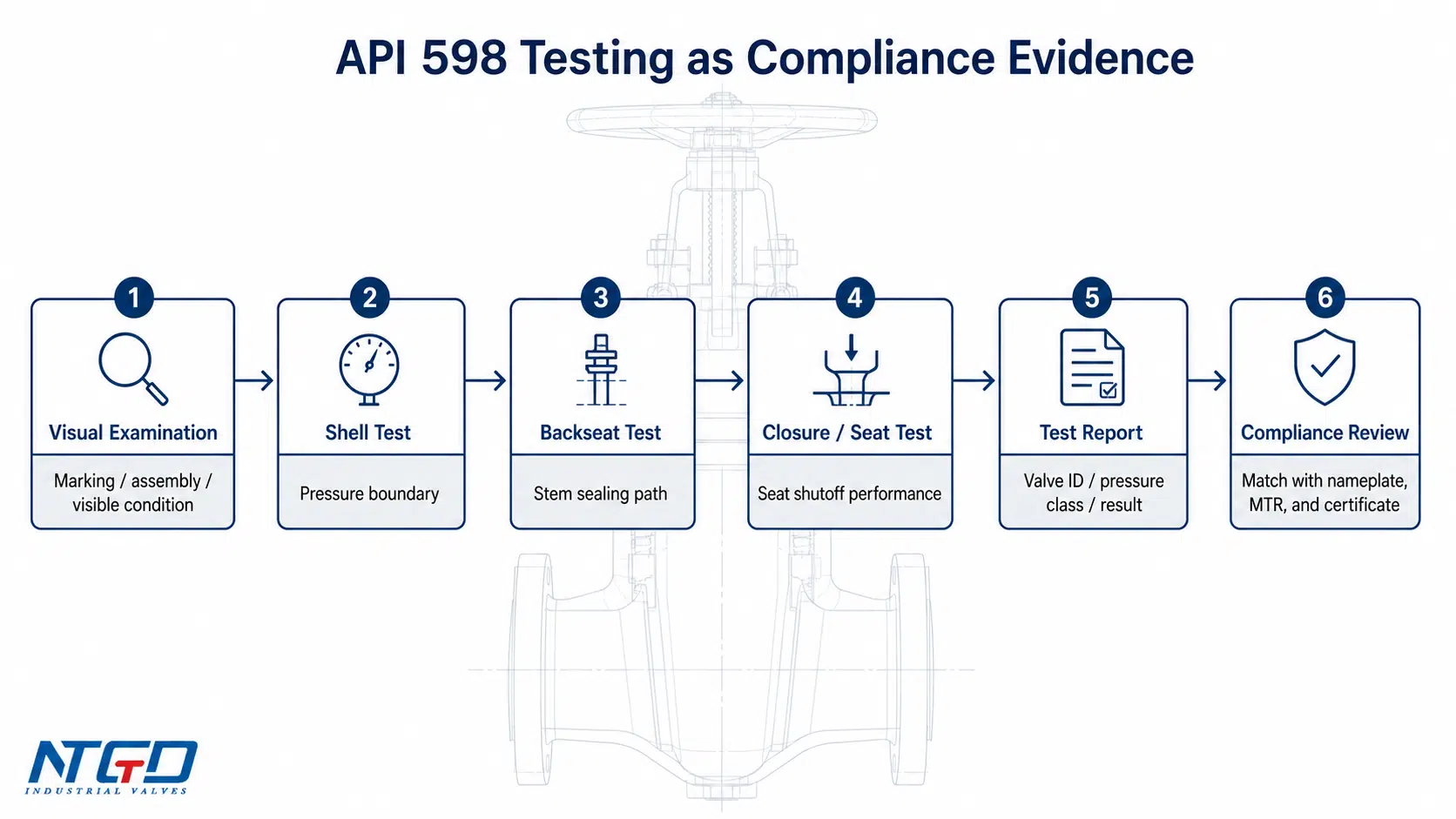
API 598 Testing and Inspection as Compliance Evidence
Testing is where a gate valve compliance claim becomes measurable. API 598 provides a structured basis for valve inspection and pressure testing, but it belongs in the evidence layer, not the design-standard layer.
A gate valve can follow the correct design route and still fail compliance review if the test records are missing, incomplete, or inconsistent with the valve nameplate.
Visual, Shell, Backseat, and Closure Tests
API 598 testing commonly includes several inspection and pressure test categories. The exact requirement depends on valve type, pressure class, and specification, but the review logic is consistent.
| Test / Inspection Type | What It Checks | Why It Matters for Gate Valves |
|---|---|---|
| Visual examination | Visible condition, assembly, markings, and basic conformity | Confirms that obvious marking, assembly, or identification issues are addressed before pressure testing is accepted as evidence. |
| Shell test | Pressure boundary strength of body and bonnet | Provides core evidence that the pressure-containing parts were tested for the stated valve rating and identification. |
| Backseat test | Stem/backseat sealing area where applicable | Supports verification of the backseat sealing path on applicable gate valve designs. |
| Closure / seat test | Shutoff performance across the seat | Confirms that the gate and seat sealing path was tested against the required acceptance basis for the valve specification. |
These tests become compliance evidence only when the report can be tied to the valve being delivered. A test record without valve identification, pressure class, applicable standard, or serial reference may confirm that a test was performed, but it may not prove that the delivered valve package is complete.
Hydrostatic and Low-Pressure Test Records
Hydrostatic testing is commonly used to verify the shell and pressure boundary. Low-pressure air or gas tests may also be used for certain sealing checks when specified.
For compliance review, the test method alone is not enough. The buyer should ask whether the test report clearly shows:
- valve identification or serial number;
- pressure class and size;
- test type;
- test pressure or test condition as applicable;
- test duration when required;
- result or acceptance statement;
- inspector or quality control sign-off.
A test report that cannot be matched to the delivered valve is weak evidence, even if the valve physically looks correct.
How API 598 Supports API 600 and API 6D Compliance
API 598 often works beside other standards. It can support inspection and testing evidence for gate valves specified under API 600 or other applicable standards. API 6D also has its own requirements for pipeline valves, including documentation and testing expectations.
The role separation should be clear:
- API 600 or API 6D may define the valve route;
- API 598 may support inspection and pressure testing evidence;
- the project specification may add extra inspection, NDE, fire test, or emission requirements.
When these roles are mixed together, the specification becomes unclear. A buyer may receive a valve with test results but still lack design, material, marking, or traceability evidence.
What Test Reports Should Confirm
A useful gate valve test report should not only state “passed.” It should help confirm that the tested valve is the same valve being delivered.
At minimum, the report should be checked against:
- valve size;
- pressure class;
- valve type;
- material specification or material route;
- serial number or traceable identification;
- applicable API standard;
- test categories performed;
- acceptance statement.
If the test report, nameplate, and MTR do not match, the valve package should not be treated as complete compliance evidence until the mismatch is clarified. This is especially important when several similar valves are supplied in one batch.
API 6D Nameplate, Serial Number, and Compliance Placard Verification
For API 6D gate valves, compliance verification should not stop at the words “API 6D” on a quotation. The physical marking and documentation must support the same claim.
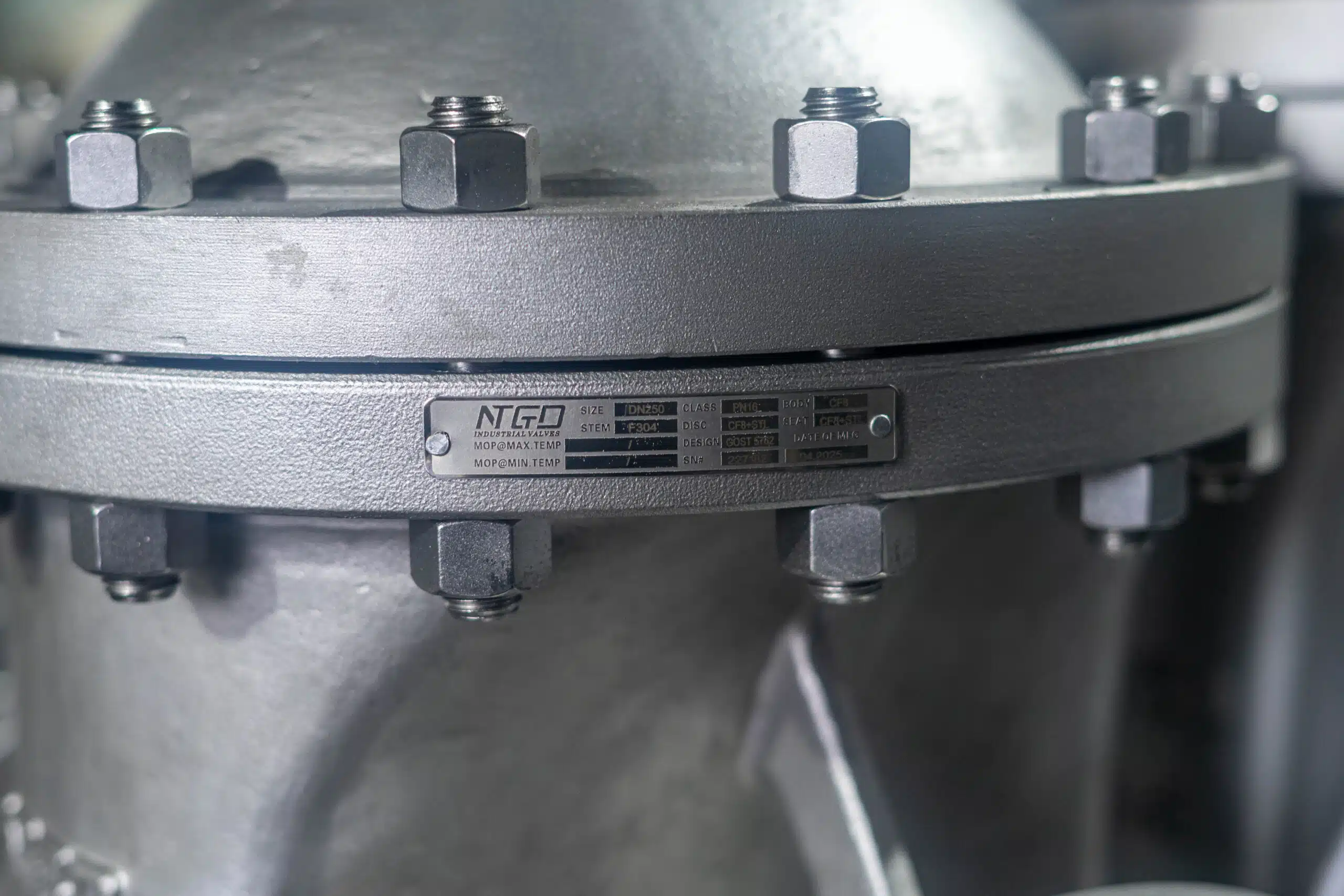
The API 6D valve serial number and compliance placard or nameplate are the entry points for traceability. They connect the physical valve to the API 6D claim, API Monogram information, manufacturing record, Material Test Report, pressure test report, and certificate package.
What to Check on an API 6D Valve Nameplate
An API 6D valve nameplate or compliance placard should be reviewed as a traceability tool. Depending on the valve and specification, the buyer or inspector may need to check fields such as:
| Nameplate / Marking Item | Why It Matters |
|---|---|
| Manufacturer identification | Confirms who produced the valve and provides the starting point for supplier and certification review. |
| API standard reference | Shows which API standard is being claimed and must match the standard referenced in the certificate and test report. |
| API Monogram or certification mark, when applicable | Supports licensed manufacturing and certification review, but it does not replace valve-level MTR, test report, or certificate checks. |
| Valve size | Must match the purchase order, inspection records, and test report. |
| Pressure class or rating | Must match the system design, purchase order, and pressure test documentation. |
| Body material | Must match the MTR and the service requirement. |
| Trim or internal material identification, when listed | Helps confirm the seat, gate, stem, or trim material route against the order and material documents. |
| Serial number or unique identification | Must connect the nameplate, MTR, pressure test report, certificate, and inspection record. |
| Date or production reference, when provided | Supports batch traceability and document control. |
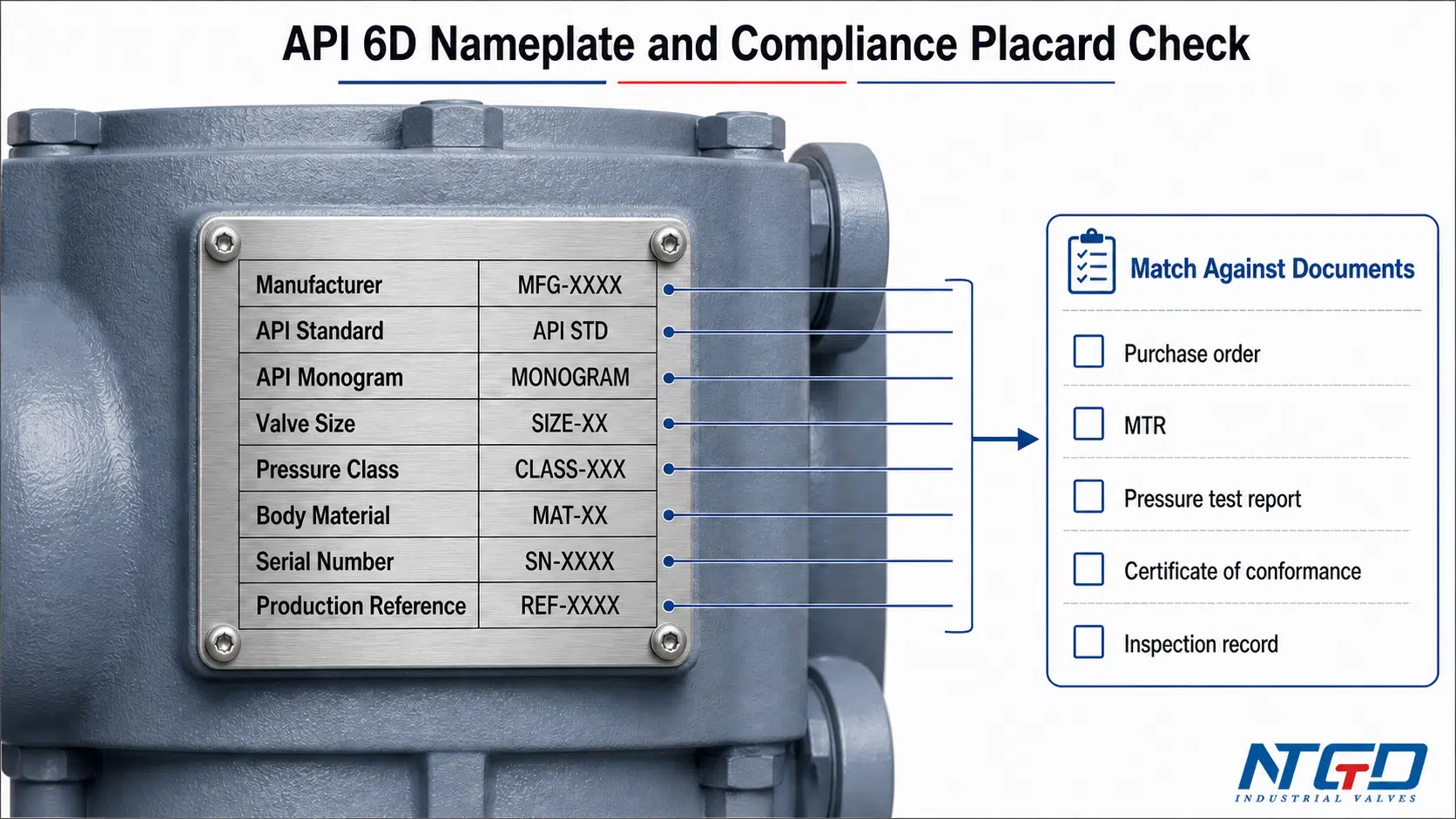
The most important rule is consistency. The nameplate, body marking, MTR, test report, and certificate should not tell different stories.
Valve Serial Number vs API License Number vs Certificate Number
These identifiers are often confused, but they are not the same.
| Identifier | What It Identifies | How It Should Be Used |
|---|---|---|
| Valve serial number | The individual valve or valve batch, depending on manufacturer system | Used to trace the delivered valve to MTRs, test reports, inspection records, and certificates |
| API license number | The manufacturer’s licensed API program or facility scope | Used to verify whether the manufacturer is authorized under the relevant API program |
| Certificate number | A document or compliance certificate reference | Used to match the document package to the supplied valve or order |
| API Monogram | A mark applied under API licensing rules when applicable | Used as one part of verification, not as the only proof of compliance |
A serial number stamped or marked on the valve is useful only if the supplier can provide documents that refer to the same number. If the documents use one number and the valve nameplate shows another, the package needs clarification before acceptance.
Serial Number Traceability: From Valve Body to MTR and Test Report
A strong traceability chain should look like this:
| Traceability Step | What Should Match |
|---|---|
| Valve body / nameplate | Confirm that the serial number, size, pressure class, and material route are clear and match the order. |
| Purchase order / RFQ | Verify that the valve type, standard, pressure class, end connection, and material route match the supplier’s documentation. |
| MTR | Cross-check the material specification, heat number, and listed body/bonnet/trim material where applicable. |
| Pressure test report | Match the valve identification, test type, result, and pressure class to the physical valve. |
| Certificate of conformance | Confirm that the standard claim, order reference, and valve identification are consistent. |
| Supplier / manufacturer record | Verify consistent identification across production, inspection, and shipment documents. |
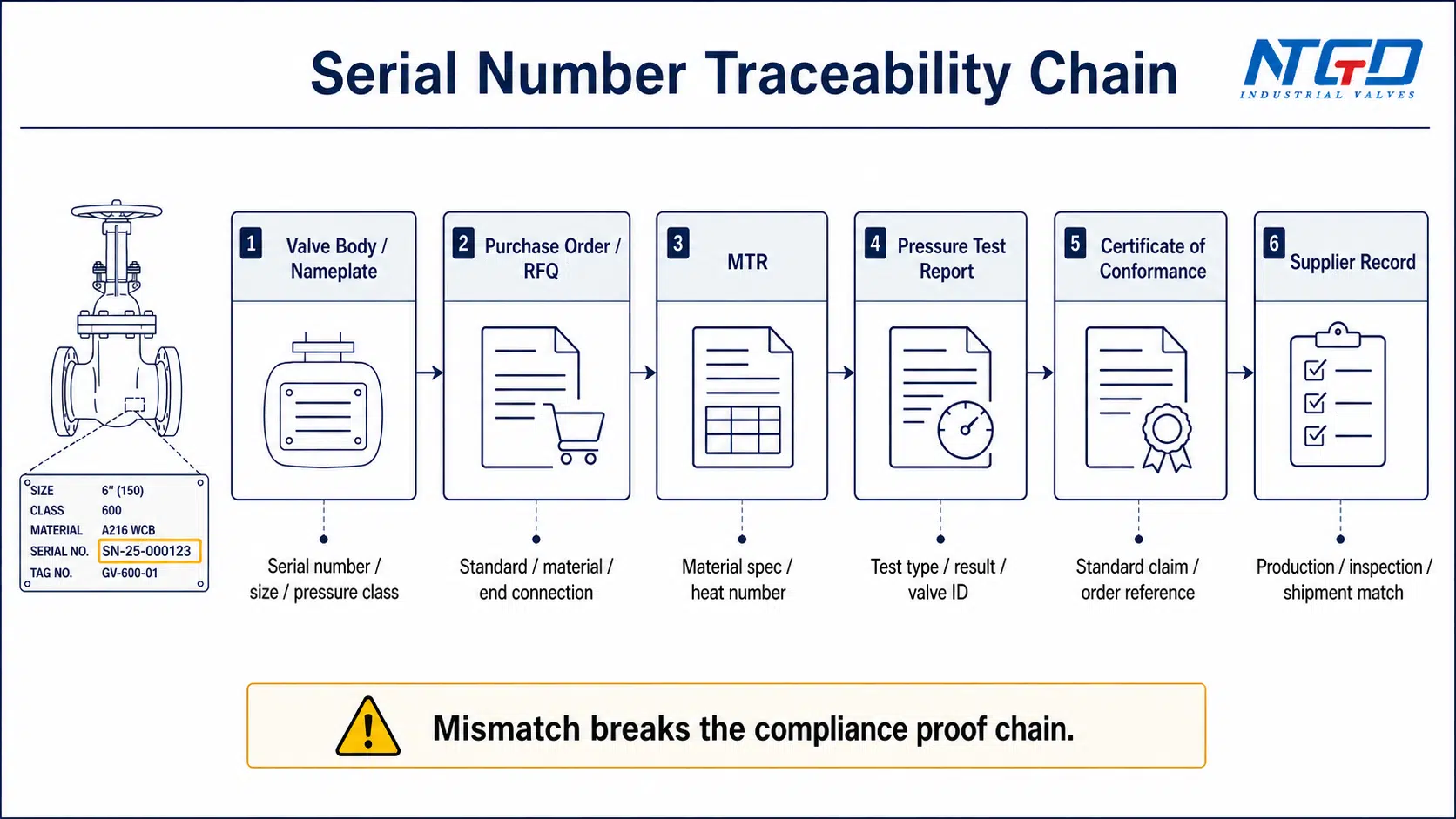
This is the difference between a marked valve and a verifiable valve. A mark shows a claim. Traceability proves whether the claim connects to the delivered product.
Red Flags in Marking, Documents, and Supplier Claims
Several issues should trigger additional review:
- The valve has no serial number or the serial number is unreadable.
- The nameplate states one pressure class while the test report shows another.
- The MTR does not match the material stated on the valve or order.
- The certificate does not identify the valve, order, or standard clearly.
- The supplier claims API 6D compliance but cannot provide supporting records.
- The API Monogram is shown, but license or certification details are unclear.
- The document package uses generic certificates with no traceable valve identification.
These issues do not automatically mean the valve is unusable, but they break the proof chain. Until the mismatch is clarified, the package should not be accepted as complete compliance evidence.
Compliance Documents to Request Before Purchase or Inspection
A gate valve compliance review should be prepared before the valve arrives on site. The RFQ or purchase order should state which standard applies, what documents are required, and whether third-party inspection is needed.
API Monogram and API Composite List Check
When an API Monogram or API certification claim is involved, the buyer should verify that the manufacturer’s certification scope matches the valve and standard being supplied.
The API Composite List or equivalent certification database is used to confirm whether the manufacturer or facility is listed for the relevant scope. This check should be treated as a supplier qualification step, not as a replacement for valve-level inspection.
A listed manufacturer can still ship the wrong material, incomplete documents, or mismatched test records if the order is not reviewed carefully.
Material Test Reports and Heat Number Traceability
The Material Test Report is one of the most important documents for gate valve verification. It helps confirm that the body, bonnet, trim, and other pressure-containing or critical components follow the specified material route.
A useful MTR review should check:
- material specification;
- heat number;
- chemical and mechanical properties where required;
- component connection to the valve or batch;
- consistency with the valve marking and order requirements.
The MTR should not be reviewed as a loose shipment document. It should be matched against the valve marking, order requirement, heat number, and material route.
Pressure Test Reports and Certificates of Conformance
A certificate of conformance states that the supplied valve meets the specified requirements. A pressure test report provides measurable evidence of testing.
Both documents should be checked together. A certificate without a matching test report may be too weak for critical service. A test report without a clear standard reference or serial number may also be difficult to accept.
The document package should confirm:
- applicable API standard;
- valve type and size;
- pressure class;
- test categories;
- test results;
- serial number or order reference;
- responsible quality control approval.
Third-Party Inspection and Witness Records
For critical projects, independent inspection or third-party witnessing may be required. This is not a substitute for the manufacturer’s quality system, but it gives the buyer additional confidence that inspection, material review, and pressure testing were performed as specified.
Third-party records are especially useful when:
- the valve is used in high-pressure or critical isolation service;
- the project requires witnessed hydrostatic testing;
- materials must be verified before shipment;
- the buyer needs independent confirmation of marking and documents;
- multiple valves are supplied in a large project batch.
RFQ-Ready Gate Valve Compliance Checklist
Before requesting a quotation or approving a valve for inspection, prepare the following information:
| RFQ / Inspection Field | What to Provide or Request | Why It Matters |
|---|---|---|
| Valve type | Gate valve design route | Prevents a general “API valve” request from being quoted under the wrong valve type or construction route. |
| Applicable API standard | API 600, API 602, API 603, API 6D, API 6A, API 598 as applicable | Defines the acceptance basis for design, testing, marking, and documentation review. |
| Size and pressure class | Nominal size and rating/class | Must match the system requirement, nameplate, quotation, and test documents. |
| End connection | Flanged, butt-welding, threaded, socket weld, or project-specific | Affects standard fit, piping compatibility, and documentation review. |
| Material route | Body, bonnet, trim, stem, seat material | Controls MTR review, heat traceability, and service compatibility. |
| Service condition | Medium, temperature, pressure, corrosion, sour service if applicable | Determines whether supporting standards, special materials, or additional inspection requirements are needed. |
| Required tests | Shell, seat, backseat, closure, special tests if required | Defines what the test reports must show before final acceptance. |
| Marking requirement | Nameplate, serial number, API Monogram if applicable | Creates the traceability entry point between the physical valve and the document package. |
| Documentation package | MTR, test report, CoC, inspection records | Provides the evidence needed to verify the valve beyond the supplier’s compliance statement. |
| Inspection level | Manufacturer QC, third-party witness, final inspection | Determines whether witness testing, independent review, or additional hold points are required before shipment. |
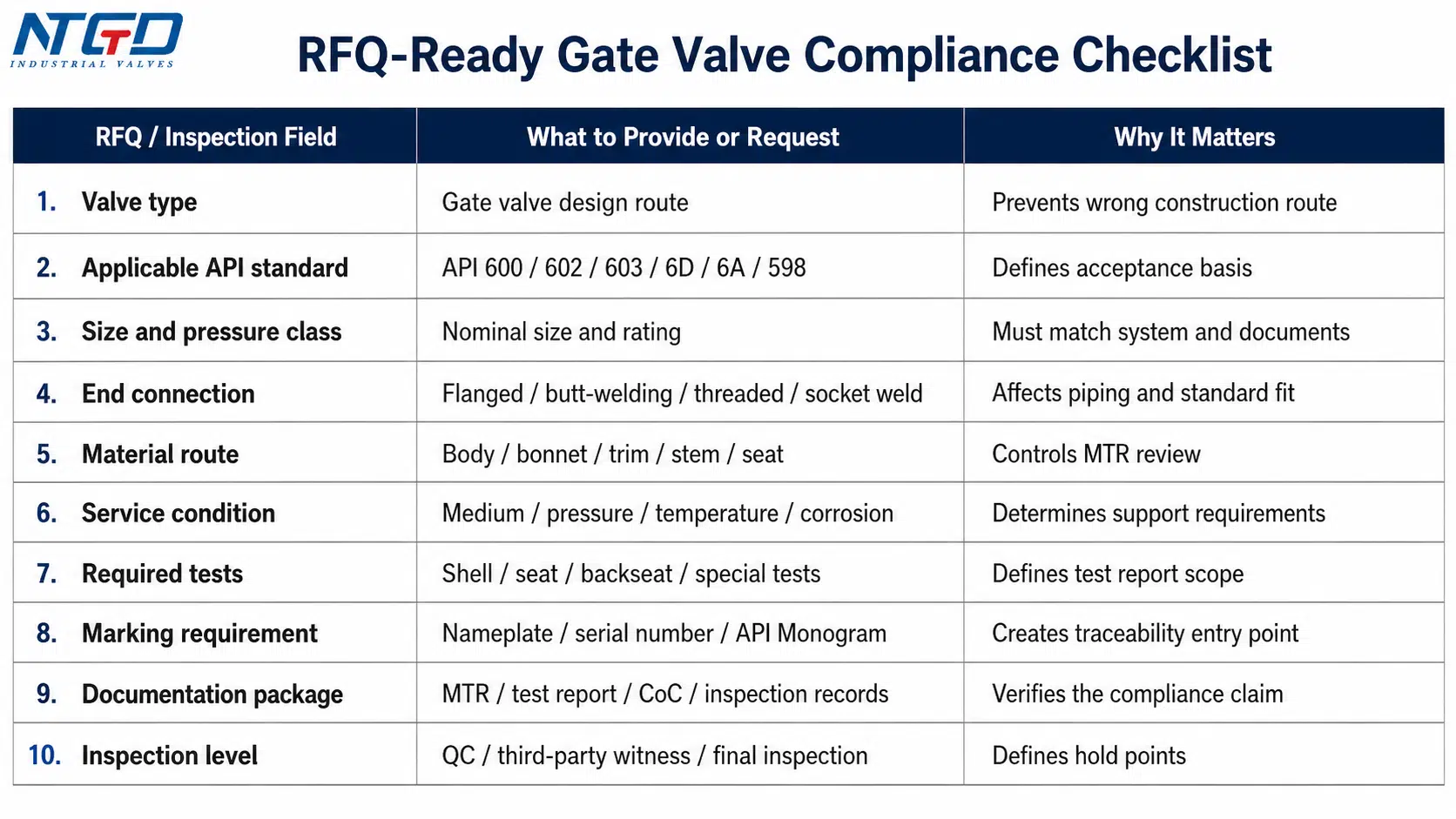
This checklist keeps the conversation technical. It also prevents the RFQ from becoming a vague request for an “API valve,” which can lead to mismatched standards or incomplete documentation.
FAQ: API Standards and Gate Valve Compliance
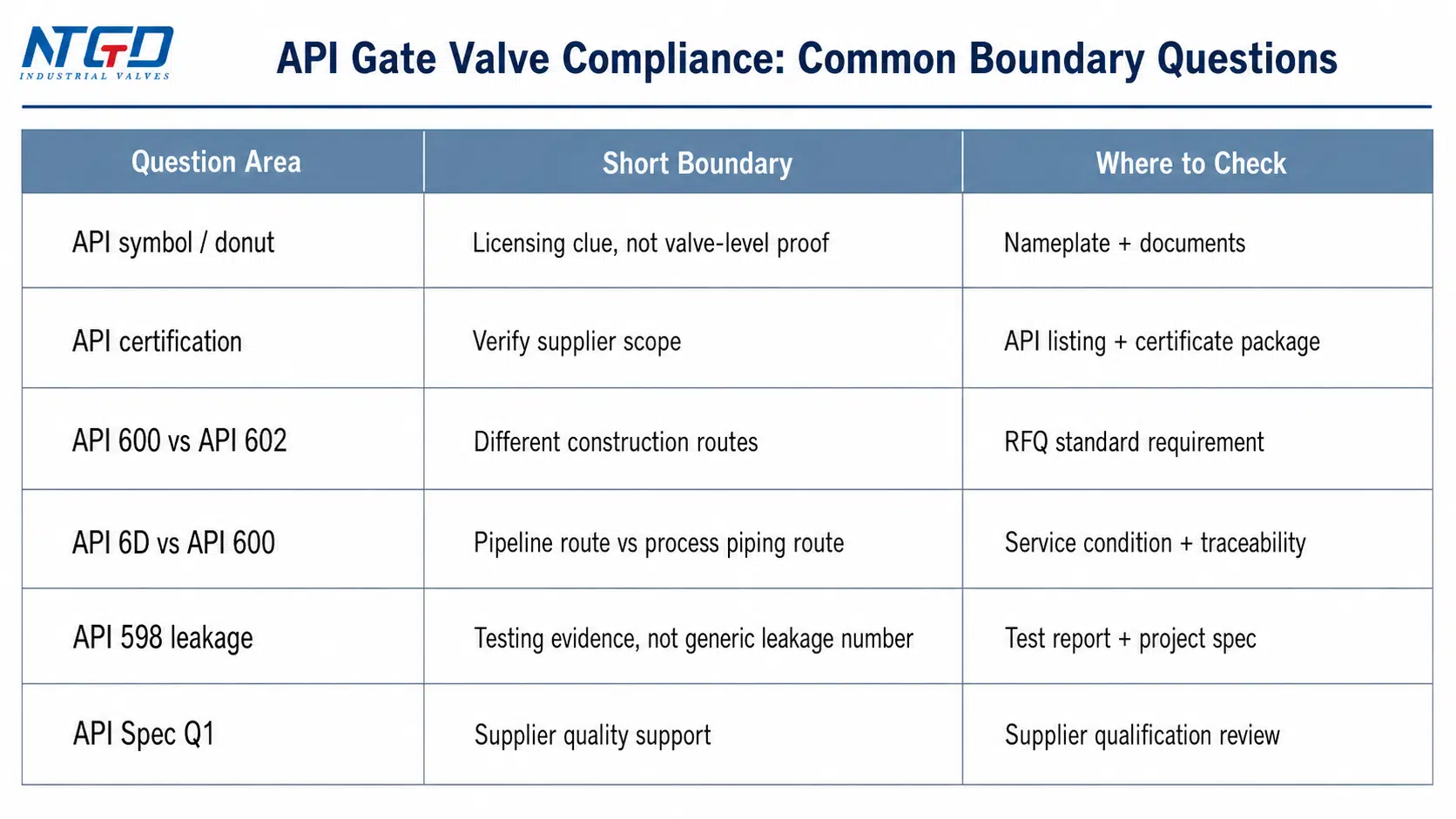
What information does the API symbol or donut provide?
The API symbol or API Monogram indicates that the manufacturer is licensed under the applicable API program for the relevant product scope. It is a certification and licensing clue, not valve-level acceptance proof by itself. The nameplate, serial number, MTRs, test reports, and certificates still need to match the delivered valve.
How do I verify API certification for a gate valve?
Start with the supplier’s certification claim, then check the manufacturer’s API listing, the valve nameplate, serial number, applicable standard, test reports, and certificate of conformance. The documents should match the delivered valve and purchase order.
What is the difference between API 600 and API 602 for gate valves?
API 600 is associated with heavy-duty bolted-bonnet steel gate valves, while API 602 applies to compact forged small-bore valves. The construction route is different, so the two standards should not be swapped in an RFQ just because both may involve gate valves.
Is API 6D the same as API 600?
No. API 6D applies to pipeline and piping system valves, including pipeline gate valves. API 600 is associated with steel gate valves commonly used in refinery and process piping. When a project requires API 6D, the review should include pipeline service, marking, documentation, and serial traceability—not only steel gate valve construction.
Does API 598 define acceptable valve leakage?
API 598 supports valve inspection and pressure testing, including closure or seat testing. Leakage acceptance must be reviewed according to the applicable valve type, seat design, pressure class, test medium, project specification, and main design or service standard. It should not be reduced to a generic leakage number without context.
What is API Spec Q1, and does it apply to valve suppliers?
API Spec Q1 relates to quality management requirements for manufacturing organizations in the petroleum and natural gas industry. For valve buyers, it may support supplier qualification, but it does not replace valve-level verification under API 600, API 6D, API 598, or the project specification.
What documents should come with an API-compliant gate valve?
The core package should include a certificate of conformance, Material Test Reports, and pressure test reports that match the valve serial number or order reference. Supporting records may include inspection reports, witness records, API license or certification information where applicable, and any project-specific NDE, fire test, or emission documents.
Conclusion
API standards for gate valves should be reviewed as a working compliance system, not as isolated labels. The reliable path is to identify the correct standard role first, then verify that the physical valve and document package support the same claim.
For buyers and engineers, this means checking the valve service, construction route, API standard, nameplate, serial number, API Monogram information, MTRs, pressure test reports, certificates, and inspection records together. A gate valve is easier to accept when the valve body, compliance placard, test evidence, and certificate package all point to the same technical record.
Before RFQ: Check the Compliance Package
If your project requires API-compliant gate valves, prepare the service condition, target API standard, pressure class, material route, end connection, and required document package before RFQ. NTGD Valve can support gate valve standard route review, serial number / MTR / test report consistency checks, and RFQ-ready specification preparation.
