
Nombre del autor: Bruce Zheng
Función del autor: Cofundador e ingeniero de válvulas en NTGD Valve
Biografía del autor: Bruce Zheng es cofundador e ingeniero de válvulas en NTGD Valve, donde se dedica a la selección y aplicación de válvulas industriales, así como a la elaboración de contenido técnico para compradores B2B de todo el mundo.
Última actualización: 16 de junio de 2026
Una válvula de bola de cerámica es una válvula de bola industrial que utiliza materiales cerámicos en las piezas internas clave que entran en contacto con el fluido, tales como la bola, los asientos, el revestimiento o los componentes internos. Se recomienda su uso cuando las partículas abrasivas, los medios corrosivos, las suspensiones, los polvos o los fluidos químicamente agresivos pueden causar desgaste prematuro, daños en los asientos, un par elevado o riesgo de fugas en válvulas metálicas comunes o de asiento blando.
En la mayoría de los diseños industriales, el cuerpo externo de la válvula sigue fabricándose con un material metálico, como el acero al carbono o el acero inoxidable. El cuerpo metálico proporciona resistencia mecánica y contención de la presión, mientras que las piezas internas de cerámica ayudan a proteger el conducto de flujo contra el desgaste y la corrosión.
No se debe elegir una válvula de bola de cerámica únicamente porque la cerámica sea “dura” o “resistente a la corrosión”. La elección correcta depende del fluido, el contenido de sólidos, la presión, la temperatura, la frecuencia de ciclo, la velocidad de flujo, los requisitos de cierre, el método de accionamiento y el material cerámico y el diseño del revestimiento confirmados por el fabricante. Si se selecciona incorrectamente el grado de la cerámica, la cobertura del revestimiento, el diseño del asiento o el par del actuador, la válvula aún puede sufrir desgaste prematuro, erosión de los puertos, cierre deficiente o dificultad de operación.
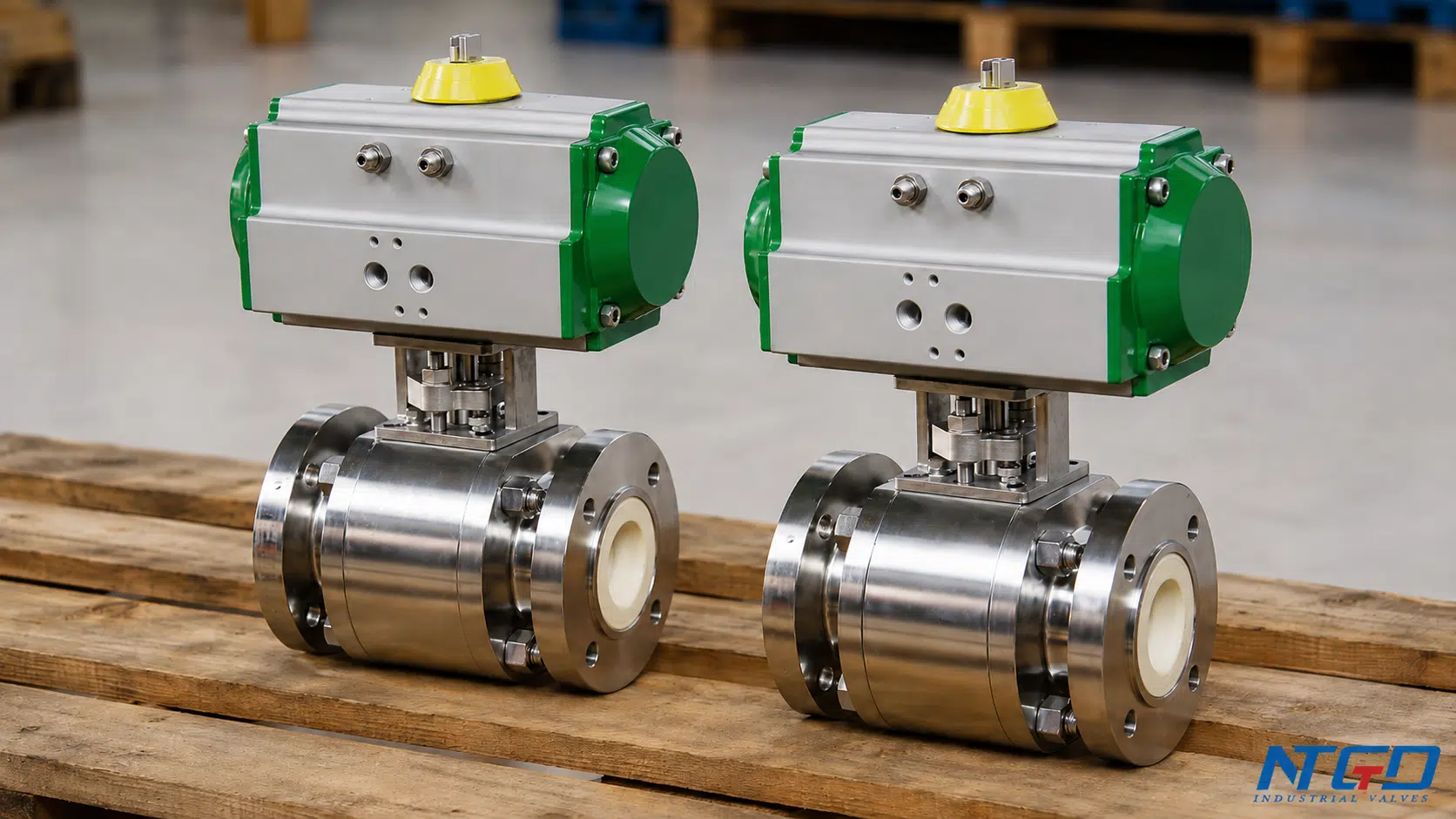
¿Qué es una válvula de bola de cerámica?
Una cerámica válvula de bola es una válvula de cierre de cuarto de vuelta que utiliza una bola giratoria con un orificio en el centro para abrir o cerrar el paso del flujo. Cuando el orificio está alineado con la tubería, el fluido puede pasar a través de la válvula. Cuando la bola gira 90 grados, el orificio queda perpendicular a la tubería y bloquea el flujo.
La diferencia entre una válvula de bola estándar y una válvula de bola de cerámica radica principalmente en la estructura interna en contacto con el fluido. Una válvula de bola de cerámica puede utilizar una bola de cerámica, asientos de cerámica, revestimiento de cerámica, accesorios de cerámica o una combinación de estas piezas. Estas superficies de cerámica se utilizan cuando la trayectoria del flujo requiere una mayor resistencia a la abrasión, la corrosión o la erosión por partículas de la que puede ofrecer un diseño convencional metálico o con asiento blando.
Las válvulas de bola de cerámica forman parte de la familia más amplia de válvulas cerámicas industriales, pero este artículo se centra únicamente en las válvulas de bola de cerámica. No aborda las válvulas de disco de cerámica, los cartuchos de grifos, las válvulas de grifos domésticos ni las válvulas cerámicas de uso médico.
Definición de válvula de bola de cerámica
En términos prácticos para el comprador, una válvula de bola de cerámica se puede definir como:
Una válvula de bola industrial con piezas en contacto con el fluido de cerámica, diseñada para controlar el flujo de tipo “on/off” en medios abrasivos, corrosivos o de servicio extremo.
La construcción exacta varía según el fabricante. Algunos diseños utilizan una bola de cerámica y asientos de cerámica dentro de un cuerpo metálico. Otros emplean un revestimiento cerámico en la vía de flujo para proteger el paso de la válvula y la cavidad del cuerpo del contacto directo con el fluido. Para aplicaciones corrosivas y abrasivas, al seleccionar la válvula se debe verificar qué partes son realmente de cerámica y cuáles siguen siendo metálicas, elastoméricas o a base de polímeros.
En los casos en que normalmente se consideran las válvulas de bola de cerámica
Elija o revise una válvula de bola de cerámica cuando los medios puedan dañar los componentes internos de una válvula estándar debido a la abrasión, el ataque químico, la acumulación de sólidos o una combinación de corrosión y desgaste. Las condiciones típicas de servicio incluyen lodos abrasivos, medios químicos ácidos o alcalinos, polvos, cenizas volantes, lodos de cal, lodos de yeso, medios de proceso de fertilizantes y otros fluidos que contienen sólidos.
Las válvulas de bola de cerámica también pueden considerarse para sistemas de petróleo, ingeniería química, manufactura, pulpa y papel, fertilizantes y tratamiento ambiental. Sin embargo, el nombre de la industria por sí solo no es suficiente. La selección final debe basarse en los medios reales y las condiciones de operación.
Válvula de bola cerámica vs. válvula cerámica industrial
“Válvula cerámica” es un término más amplio. Puede referirse a válvulas de bola cerámicas, válvulas con revestimiento cerámico, válvulas de control cerámicas, válvulas de compuerta cerámicas, válvulas de retención cerámicas o incluso a piezas de plomería no industriales, dependiendo del contexto de la búsqueda.
A la hora de elegir tuberías industriales, la pregunta más precisa no es simplemente “¿Necesito una válvula de cerámica?”, sino:
- ¿Necesito una válvula de bola de cerámica para el cierre de cuarto de vuelta?
- ¿Necesito piezas en contacto con el fluido de cerámica porque el medio es abrasivo o corrosivo?
- ¿Necesito una válvula de bola de cerámica estándar de tipo «on/off», o una válvula de bola de cerámica con puerto en V para un flujo controlado?
- ¿Qué piezas cerámicas y superficies de revestimiento están realmente expuestas al medio?
Piezas internas de cerámica y construcción revestida
La parte más importante de una válvula de bola de cerámica no es solo el cuerpo externo de la válvula. El valor de ingeniería suele residir en la forma en que la bola de cerámica, el asiento de cerámica, el revestimiento de cerámica y los componentes internos de cerámica protegen la vía de flujo.
Una válvula de bola con revestimiento cerámico bien seleccionada puede reducir el contacto directo entre los medios agresivos y las superficies vulnerables de la válvula. Esto es especialmente importante cuando la corrosión y la abrasión ocurren al mismo tiempo, ya que el ataque químico puede debilitar las superficies, mientras que las partículas duras aceleran el desgaste.
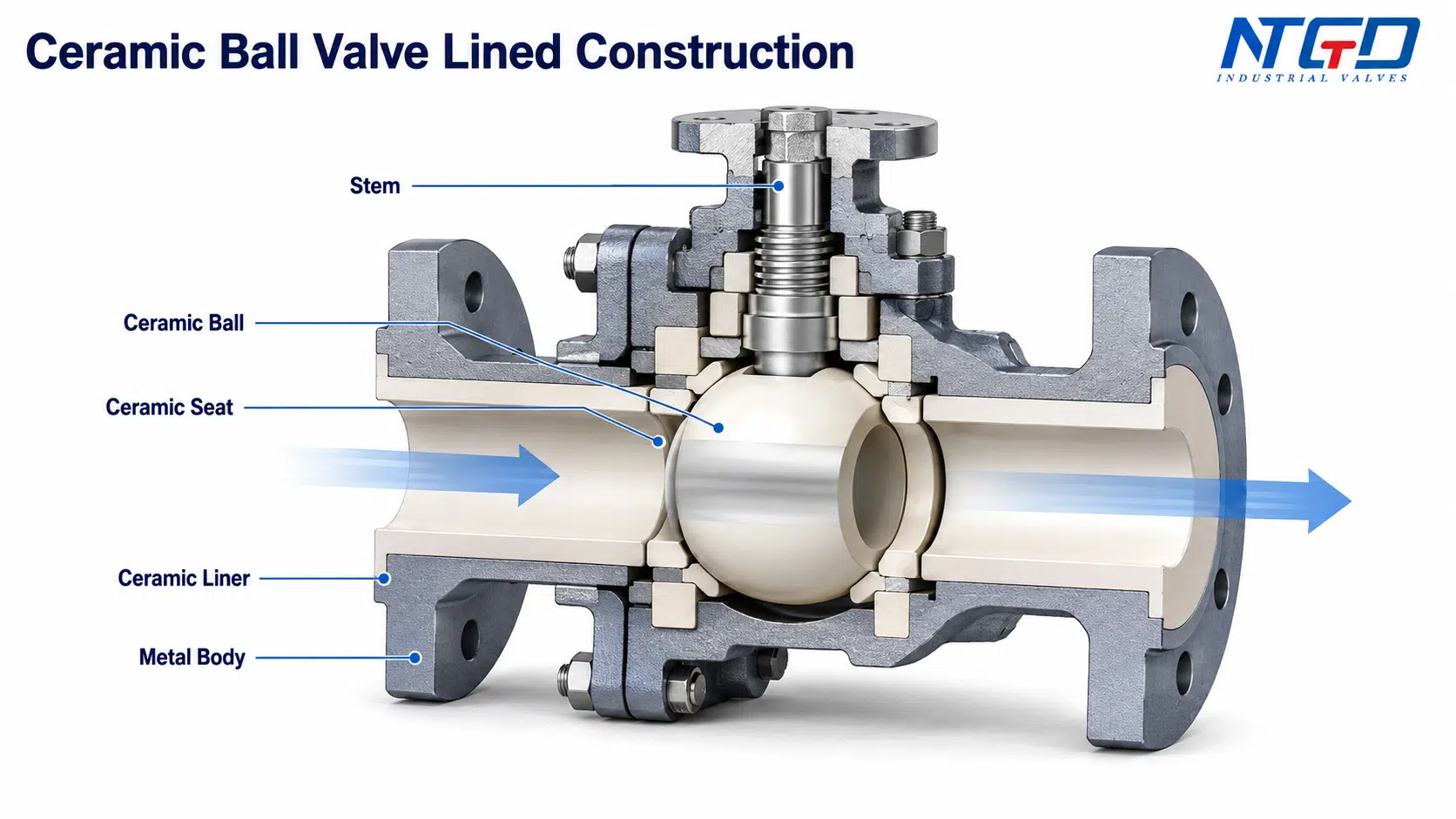
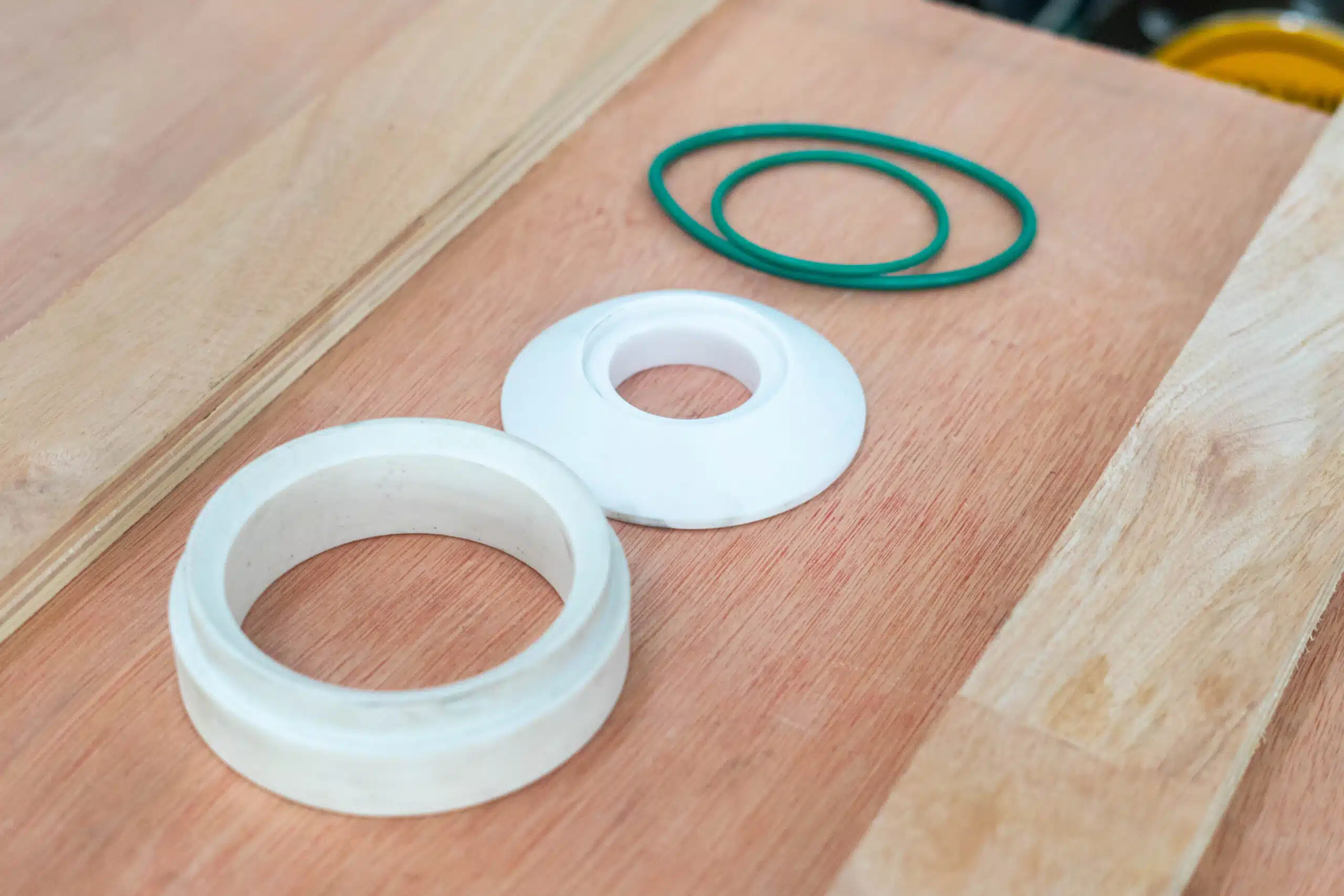
Bola, asiento, revestimiento y embellecedor de cerámica
La bola de cerámica abre y cierra el conducto de flujo. Los asientos de cerámica sostienen la bola y ayudan a formar la interfaz de sellado. El revestimiento de cerámica protege el conducto de flujo interno, según el diseño. El término «conjunto de cierre» suele referirse a las piezas internas que entran en contacto con el fluido o que afectan directamente al cierre, al par de apriete y al desgaste.
| Pieza interna de cerámica | Función principal | Repercusiones de la selección |
|---|---|---|
| Bola de cerámica | Se gira para abrir o cerrar el orificio | Influye en el cierre, la resistencia al desgaste y la durabilidad de la vía de flujo |
| Asiento de cerámica | Sujeta y sella contra la bola | Influye en el control de fugas, el par y el comportamiento cíclico |
| Revestimiento cerámico | Protege el recorrido del flujo en contacto con el líquido | Influye en la resistencia a la corrosión y a la abrasión en esa zona del cuerpo |
| Molduras de cerámica | Partes generales de contacto con los medios de comunicación | Afecta la compatibilidad con sólidos, sustancias químicas y la temperatura |
| Interfaz del vástago | Transmite el par a la bola | Afecta el funcionamiento, la tensión de empaque y la confiabilidad de la activación |
| Empaque de la válvula / Sello del vástago | Juntas en la zona del vástago | Influye en el riesgo de fugas externas y en los requisitos de mantenimiento |
La interfaz entre la bola y el asiento no es solo un detalle de las piezas. Afecta directamente a la estanqueidad de cierre, al par de operación y a la forma en que la válvula responde cuando las partículas llegan al área de contacto de sellado. El revestimiento o la cobertura del revestimiento también es un factor a considerar, ya que determina si la cavidad del cuerpo y la trayectoria del flujo en contacto con el fluido están protegidas, no solo la bola y el asiento.
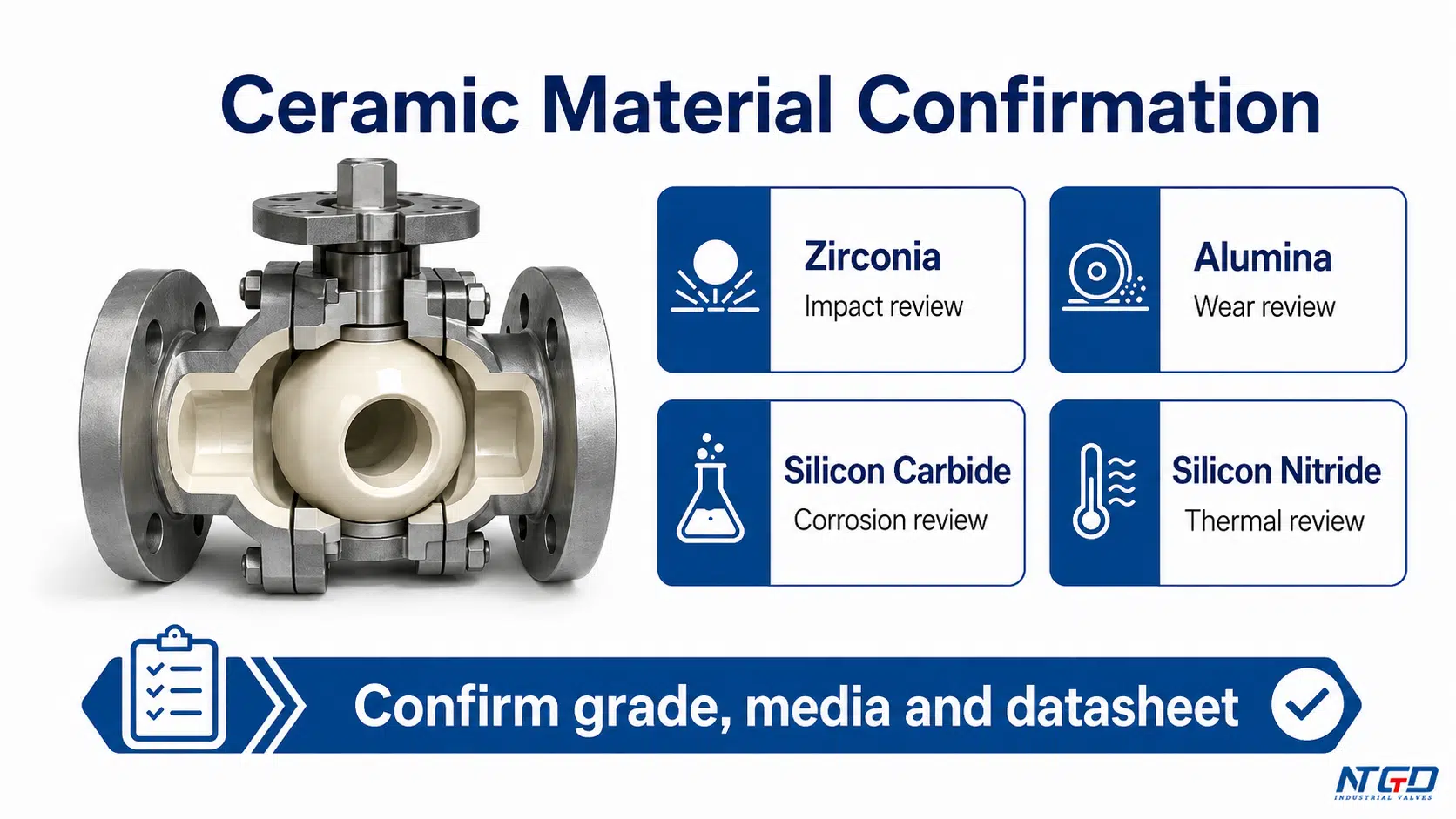
Se debe verificar el material cerámico exacto consultando la hoja de datos. Materiales como la circonia, la alúmina, el carburo de silicio o el nitruro de silicio pueden aparecer en diferentes diseños de válvulas cerámicas, pero no deben considerarse intercambiables. El grado de la cerámica debe coincidir con la composición química del fluido, el comportamiento de los sólidos, la temperatura, el riesgo de impacto y las condiciones de ciclos térmicos.
Válvula de bola de cerámica vs. válvula de bola con revestimiento de cerámica
«Válvula de bola de cerámica» es el término general que designa este producto. El término «válvula de bola con revestimiento cerámico» suele hacer hincapié en que, además de las piezas de sellado de cerámica, el recorrido interno del flujo o la cavidad del cuerpo están protegidos por un revestimiento cerámico.
En la comunicación con el comprador, ambos términos pueden solaparse. Sin embargo, no deben considerarse idénticos hasta que se confirme la construcción.
| Término | Significado práctico | Qué hay que confirmar |
|---|---|---|
| Válvula de bola cerámica | Válvula de bola con piezas internas de cerámica, tales como la bola, el asiento, el revestimiento o los componentes internos | ¿Cuáles son las partes en contacto con el líquido que son de cerámica? |
| Válvula de bola con revestimiento cerámico | Válvula de bola con revestimiento cerámico que protege el conducto de flujo o la cavidad del cuerpo | Ya sea que el revestimiento sea completo, parcial o solo en ciertas áreas |
| Válvula de bola compuesta con revestimiento cerámico | Una variante de construcción o de producto más estrecha que puede utilizar conceptos de carrocería o revestimiento compuestos | No des por sentado este diseño a menos que la hoja de datos lo confirme |
| Válvula de bola metálica estándar | Válvula de bola con componentes internos de asiento metálico o blando | Si puede resistir la abrasión, la corrosión o los sólidos |
Esta distinción es importante en las solicitudes de cotización. Un comprador puede solicitar una válvula de bola con revestimiento cerámico porque el medio de proceso corroe la cavidad interna del cuerpo, no solo la superficie de sellado. Si solo la bola es de cerámica, pero la vía de flujo no está protegida, es posible que la válvula no cumpla con las expectativas de servicio.
Si los medios de transporte pueden afectar la cavidad del cuerpo, la superficie interior del paso de flujo o la trayectoria del flujo en contacto con el fluido, la solicitud de cotización (RFQ) debe especificar la cobertura del revestimiento cerámico, en lugar de limitarse a preguntar si la bola y los asientos son de cerámica. En el caso de una válvula de bola compuesta con revestimiento cerámico, se deben confirmar la construcción del cuerpo, el diseño del revestimiento, la lista de materiales y el plano antes de considerarla adecuada para el proyecto.
Construcción con forro completo, con forro parcial y compuesta
El revestimiento cerámico no siempre es el mismo en todos los productos. Algunas válvulas pueden tener un revestimiento completo para proteger una mayor parte de la trayectoria del flujo en contacto con el fluido. Otras pueden utilizar un revestimiento parcial o un conjunto cerámico solo en las áreas de contacto más críticas.
| Tipo de construcción | Finalidad habitual | Límite de selección |
|---|---|---|
| Válvula de bola cerámica con revestimiento completo | Protege un área mayor del recorrido del flujo en contacto con el líquido | Útil cuando la exposición de las cavidades corporales representa un riesgo importante |
| Válvula de bola cerámica con revestimiento parcial | Protege las zonas seleccionadas contra el desgaste o la corrosión | Requiere una revisión minuciosa de las superficies que están en contacto directo con el medio |
| Válvula de bola con obturador cerámico | Se enfoca en las superficies de la bola, el asiento y el sellado | Es posible que no proteja todas las partes del cuerpo contra la lechada corrosiva |
| Válvula de bola compuesta con revestimiento cerámico | Concepto de producto más específico que puede aparecer en diseños de fabricantes concretos | Debe confirmarse mediante la hoja de datos, el plano y los requisitos del proyecto |
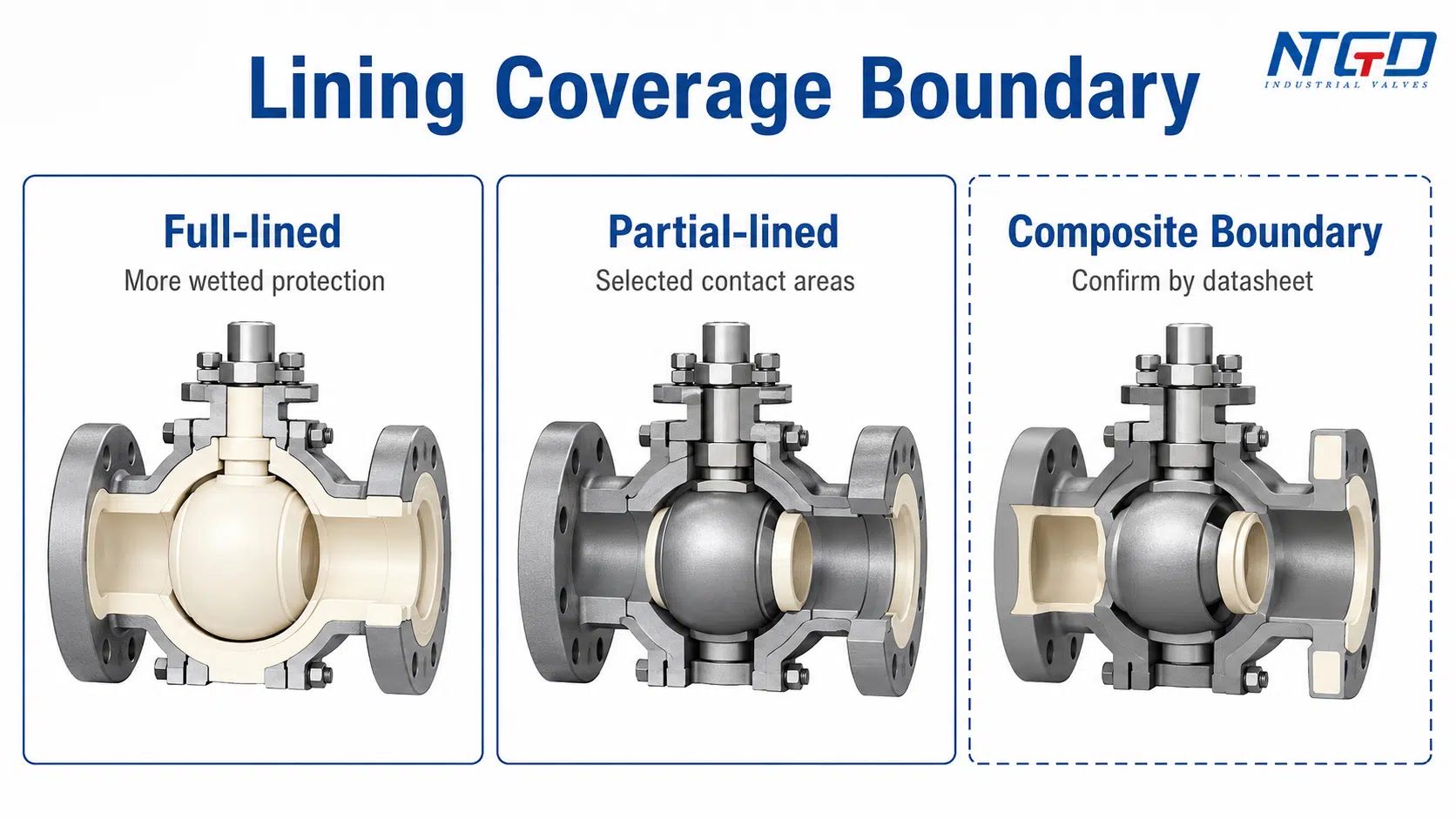
En la comunicación de proyectos B2B al estilo NTGD, el enfoque más seguro consiste en describir primero las condiciones reales del servicio y, luego, confirmar el diseño. La solicitud de cotización no debe basarse únicamente en una frase breve como “válvula de bola compuesta con revestimiento cerámico”, sin definir el medio, la presión, la temperatura, los sólidos y la cobertura de revestimiento requerida.
Confirmación del material cerámico
Material cerámico La selección debe partir de las condiciones de servicio, no del nombre del material. En lugar de preguntar únicamente si la válvula utiliza circonio, alúmina, carburo de silicio o nitruro de silicio, el comprador debe confirmar qué grado de cerámica se utiliza, en qué parte está expuesta al medio y por qué es adecuada para la carga química, abrasiva, térmica y mecánica del servicio.
Un material que ofrece un buen desempeño en una suspensión abrasiva puede no ser la opción adecuada para otro proceso en el que se produzcan choques térmicos, ataques químicos o cargas de impacto. Se deben verificar el tipo de cerámica, el diseño del asiento, el método de fijación del revestimiento, la clase de presión y el límite de temperatura consultando la hoja de datos del fabricante.
Componentes de las válvulas de bola de cerámica y su impacto en la selección
Los componentes originales de una válvula de bola de cerámica incluyen la manija o el actuador, el cuerpo de la válvula, el vástago, la bola, los asientos, el conjunto interno y la empaquetadura del prensaestopas. En una válvula para servicio severo, estas piezas no deben describirse únicamente como una lista de piezas. Cada componente influye en la confiabilidad del cierre, el par de apriete, la compatibilidad con los fluidos y el riesgo de mantenimiento.
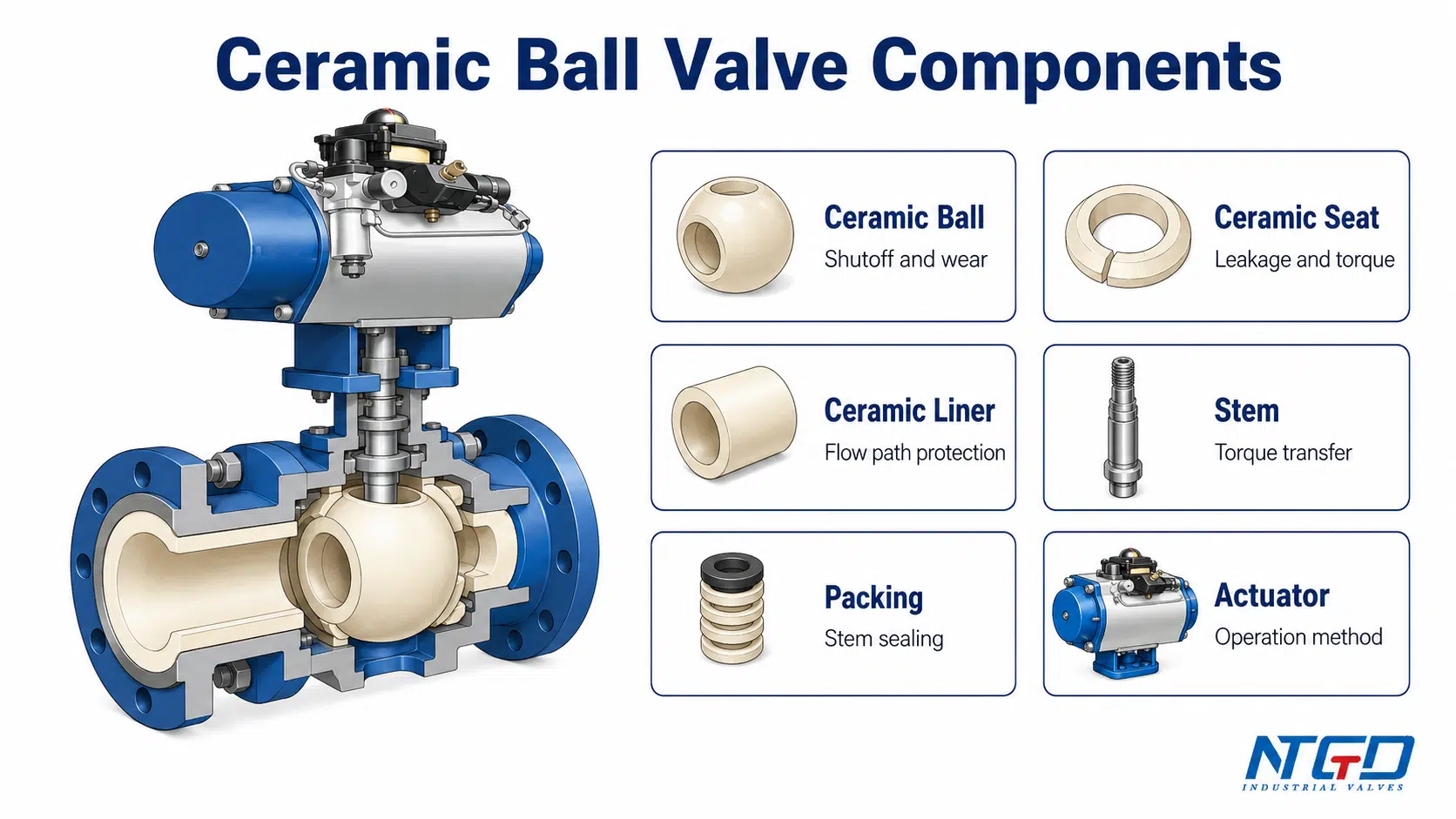
| Componente | Función de la válvula | Repercusiones de la selección |
|---|---|---|
| Manija / actuador | Proporciona el par necesario para girar el vástago y la bola | Debe ajustarse al par de apriete de la válvula, la frecuencia de ciclo, las necesidades de automatización y los requisitos de control del sitio |
| Cuerpo de la válvula | Alberga las partes internas y contiene presión | El material del cuerpo debe ser adecuado para la presión, la temperatura, la corrosión externa y la carga mecánica |
| Vástago | Transfiere el par desde la manija o el actuador a la bola | Afecta el funcionamiento, la tensión de empaque, la alineación y la transmisión del par |
| Bola de cerámica | Abre y cierra el conducto de flujo | Debe resistir la abrasión, la corrosión y los daños superficiales causados por los medios |
| Asientos de cerámica | Sostén la bola y forma la interfaz de sellado | Influyen en el rendimiento de la desconexión, el par y el comportamiento frente al desgaste |
| Revestimiento cerámico | Protege el recorrido interno del flujo en contacto con el líquido | Importante en caso de que el cuerpo entre en contacto con medios corrosivos o abrasivos |
| Recorte | Piezas internas de contacto con el medio | Debe ser compatible con las condiciones químicas, de temperatura y de presencia de sólidos |
| Empaquetadura | Juntas alrededor del vástago | Influye en el riesgo de fugas en el tallo y en los requisitos de mantenimiento |
| Conexión final | Conecta la válvula a la tubería | Debe cumplir con las normas de tuberías, el diseño de instalación y el acceso para mantenimiento |
| Accesorios para actuadores | Proporcionar automatización, retroalimentación o control | Requerido para el funcionamiento neumático, eléctrico, hidráulico o a distancia |
¿Qué piezas influyen en las fugas, el par y la vida útil?
El control de las fugas depende del contacto entre la bola y el asiento, el estado del asiento, la superficie de la bola, el sellado del vástago, el diferencial de presión, la temperatura, los sólidos presentes en el fluido y el diseño probado por el fabricante. Una válvula de bola de cerámica no debe describirse como “sin fugas” automáticamente, a menos que el requisito específico de fugas y base de prueba se han confirmado.
El par de operación se ve afectado por la carga sobre el asiento, la acumulación de sólidos, la presión, la temperatura, los depósitos del fluido, el estado de la superficie de la bola y el tamaño del actuador. Una válvula que funciona sin problemas con un fluido limpio puede requerir un margen de par diferente cuando se utiliza con lodos o polvos.
La vida útil puede prolongarse cuando se selecciona correctamente una válvula de bola de cerámica para aplicaciones abrasivas o corrosivas, pero el resultado depende del medio y de las condiciones de instalación. No se debe prometer que su vida útil sea un múltiplo universal de la de otras válvulas sin evidencia específica del proyecto.
¿Cómo funciona una válvula de bola de cerámica?
Una válvula de bola de cerámica funciona girando una bola con un orificio 90 grados entre las posiciones de abierta y cerrada. La válvula está abierta cuando el orificio de la bola se alinea con la tubería. La válvula está cerrada cuando el orificio queda perpendicular a la tubería y la parte maciza de la bola bloquea la vía de flujo.
Este movimiento de un cuarto de vuelta hace que las válvulas de bola de cerámica sean adecuadas para aplicaciones de apertura y cierre en las que se requiere un funcionamiento rápido y un cierre compacto. En aplicaciones con medios abrasivos o corrosivos, las superficies de cerámica ayudan a proteger el conducto de flujo durante las repetidas operaciones de apertura y cierre.
Posiciones abiertas y cerradas
En la posición abierta, el orificio que atraviesa la bola crea un conducto de flujo. En la posición cerrada, la bola gira de tal manera que el orificio ya no queda alineado con la tubería. Los asientos presionan contra la bola para formar la interfaz de sellado.
El resultado del sellado depende de la superficie de la bola, el material del asiento, la carga sobre el asiento, la dirección de la presión y el estado de desgaste. Si quedan partículas atrapadas entre la bola y el asiento, pueden producirse fugas o un par de giro elevado.
Funcionamiento manual, neumático, eléctrico e hidráulico
Una válvula de bola de cerámica manual utiliza una manija o una caja de engranajes para que el operador pueda girar el vástago. Una válvula de bola de cerámica accionada utiliza un actuador neumático, eléctrico o hidráulico para proporcionar el par necesario.
| Tipo de operación | Uso habitual | Nota de selección |
|---|---|---|
| Válvula de bola de cerámica accionada por palanca | Válvulas manuales más pequeñas o para servicio de bajo ciclo | Verificar el par de operación y el acceso del operador |
| Válvula de bola cerámica accionada por engranajes | Tamaños más grandes o servicio con mayor par de giro | Útil cuando es necesario reducir la fuerza manual |
| Válvula de bola cerámicas neumática | Sistemas de automatización rápida y de aire comprimido para plantas | Confirmar el margen de torque, la posición de fallo y los accesorios de control |
| Válvula de bola eléctrica de cerámica | Funcionamiento remoto cuando se prefiere el control eléctrico | Confirme la frecuencia de ciclo, la fuente de alimentación y los requisitos de la carcasa |
| Válvula de bola cerámica hidráulica | Servicio de automatización de alto par o especial | Verificar la potencia hidráulica, la lógica de seguridad y el acceso para el mantenimiento |
Control de encendido/apagado frente a control modulado
Las válvulas de bola de cerámica estándar se utilizan principalmente para operaciones de apertura y cierre. Si se requiere controlar el flujo, se debe revisar cuidadosamente el diseño de la válvula.
Una válvula de bola cerámica con puerto en V es una configuración especial diseñada con un puerto en forma de V o una abertura de flujo con muesca en V. Puede proporcionar un flujo más controlado que una válvula de bola estándar con puerto redondo, pero también requiere un dimensionamiento adecuado del actuador, una revisión de las características de flujo, una revisión de la velocidad y una evaluación del riesgo de erosión.
No se debe dar por sentado que una válvula de bola de cerámica estándar sea adecuada para la regulación del flujo solo porque se pueda abrir parcialmente.
Tipos y configuraciones de válvulas de bola cerámicas
Las válvulas de bola de cerámica pueden clasificarse según la construcción del cuerpo, la trayectoria del flujo, el diseño de las conexiones, el soporte de la bola, la cobertura del revestimiento, la conexión final y el método de accionamiento. La configuración correcta debe seleccionarse en función de las condiciones de servicio y no solo por el nombre del producto.
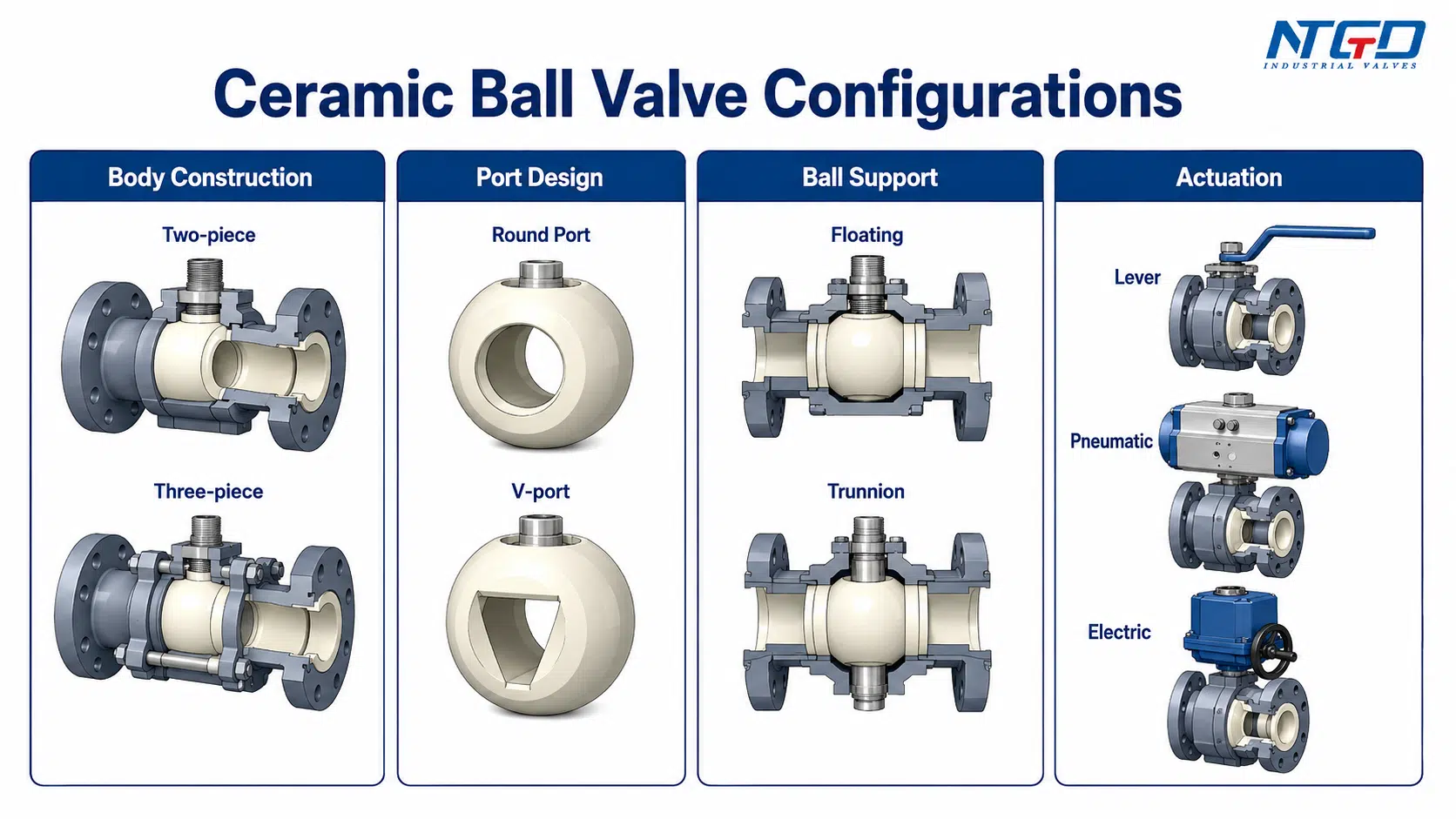
Válvulas de bola cerámicas de dos y tres piezas
Una válvula de bola de cerámica de dos piezas está compuesta por dos cuerpos principales ensamblados entre sí. Es un diseño común en las válvulas de bola industriales y, dependiendo del diseño, puede permitir la inspección o el mantenimiento una vez retirada de la tubería.
A válvula de bola de tres piezas cuenta con dos secciones extremas y una sección central, unidas mediante pernos. Esta disposición puede facilitar el acceso interno en algunas configuraciones de tuberías, especialmente cuando es posible realizar el mantenimiento de la sección central sin necesidad de retirar toda la válvula de la tubería. En el caso de fluidos de servicio severo, esto puede facilitar la inspección, la limpieza o el reemplazo de los asientos y las empaquetaduras, pero el procedimiento de mantenimiento real depende del diseño del fabricante.
Las válvulas de bola de cerámica de tres piezas pueden ofrecer un mejor acceso interno para la inspección o el reemplazo del asiento en algunas aplicaciones de servicio extremo; sin embargo, antes de seleccionarlas es necesario evaluar el costo, el espacio de instalación y los procedimientos de mantenimiento aprobados.
| Tipo | Ventaja principal | Advertencia sobre la selección |
|---|---|---|
| Válvula de bola cerámica de dos piezas | Comunes, compactos y, a menudo, económicos | Es posible que sea necesario retirar la tubería para realizar un servicio interno |
| Válvula de bola cerámica de tres piezas | Mejor acceso a la sección central en algunos diseños | Por lo general, su costo es mayor y hay que verificar que haya espacio suficiente para su instalación |
Válvulas de bola cerámicas de tres vías
A válvula de bola de tres vías Cuenta con tres puertos y se utiliza para desviar o mezclar el flujo. La bola interna puede tener una geometría de puerto en L o en T, según los requisitos de flujo.
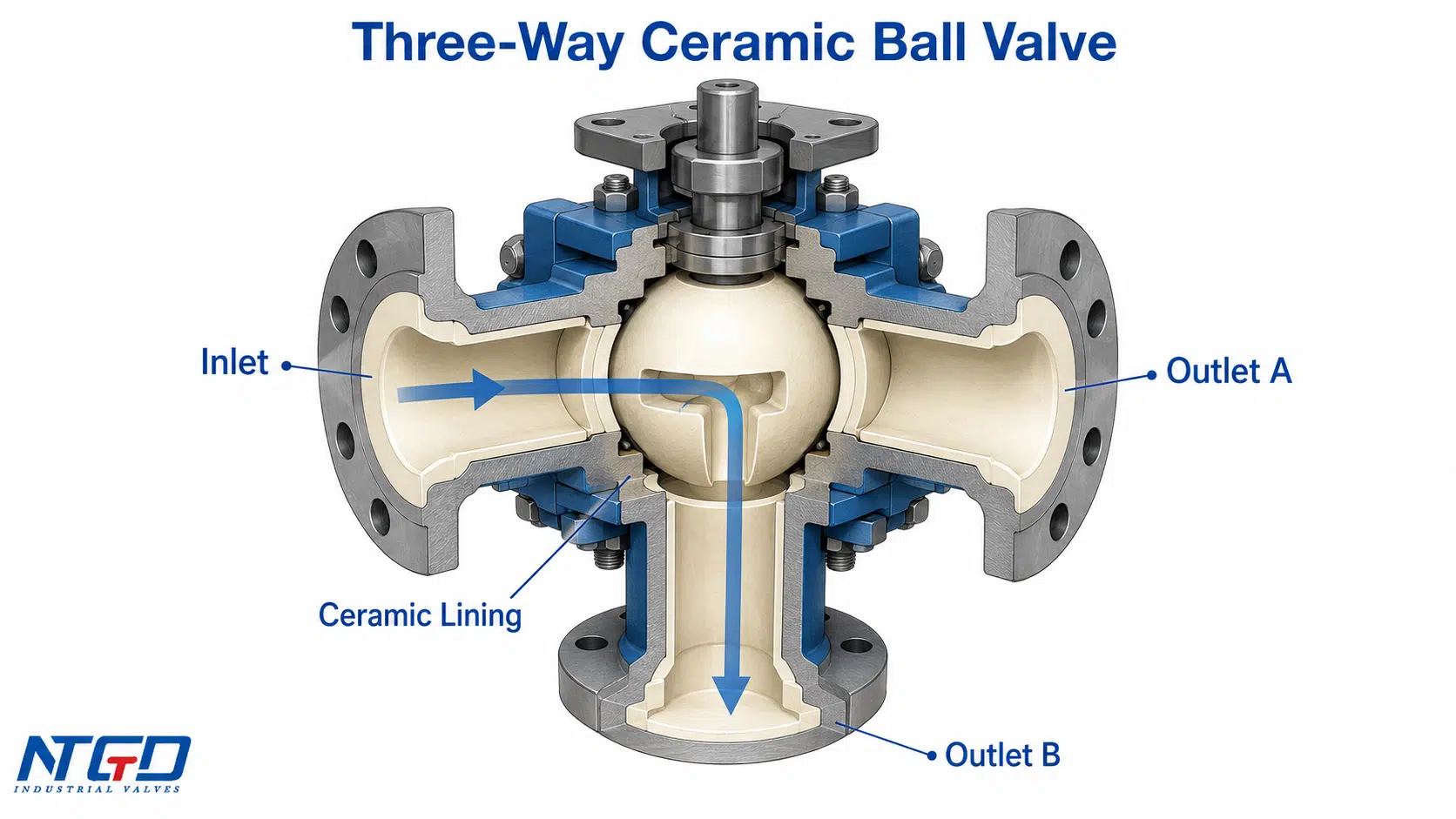
El diseño de puerto en L se utiliza comúnmente para desviar el flujo de una línea a otra. El diseño de puerto en T puede utilizarse para mezclar o desviar, dependiendo de la posición del puerto y la lógica de funcionamiento. En aplicaciones corrosivas o abrasivas, se deben revisar cuidadosamente el revestimiento cerámico y la geometría del puerto, ya que los cambios en la dirección del flujo pueden aumentar el desgaste local.
Válvulas de bola cerámicas de tipo flotante y de muñón
Los diseños flotantes y con muñón describen cómo se sostiene la bola.
Una válvula de bola flotante de cerámica utiliza la presión de la línea para ayudar a presionar la bola contra el asiento aguas abajo. Se utiliza con frecuencia en aplicaciones de válvulas de bola de servicio ligero o moderado, dependiendo de la presión y el tamaño.
Una válvula de bola de cerámica montada sobre muñón cuenta con un soporte mecánico adicional para la bola, lo cual puede considerarse en casos de tamaños más grandes, presiones más altas o condiciones de mayor par de torsión. Antes de la selección, se debe verificar con el fabricante la construcción de cerámica, el diseño del soporte y la carga del asiento.
Válvulas de bola de cerámica de paso redondo / paso en O frente a válvulas de bola de cerámica de paso en V
La forma del puerto influye en el comportamiento de la válvula.
| Diseño de puertos | Función típica | Nota de selección |
|---|---|---|
| Válvula de bola cerámica de puerto redondo / O-port | Principalmente, encendido/apagado | Es más adecuado cuando la válvula está completamente abierta o completamente cerrada |
| Válvula de bola cerámica con puerto en V | Flujo controlado o modulado en aplicaciones específicas | Requiere una revisión de Cv, el actuador, la velocidad, la erosión y los requisitos de control |
| Válvula de bola cerámica de diámetro interior reducido | Trayectoria de flujo compacta o económica | Verifica la caída de presión y el riesgo de paso de sólidos |
| Válvula de bola cerámica de paso total | Trayectoria de flujo más abierta | Verifica el tamaño, el peso, el precio y la disponibilidad |
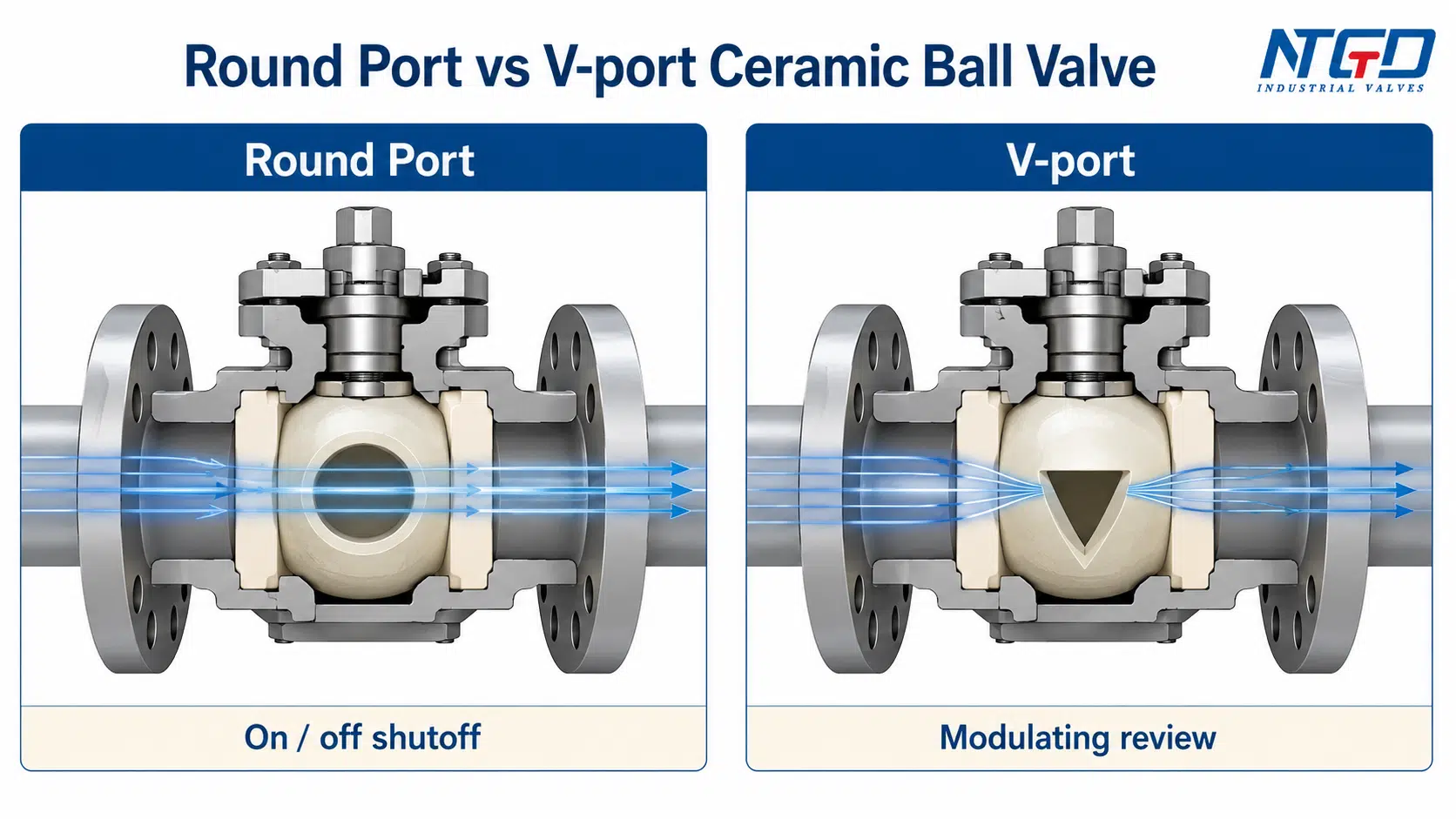
A Válvula de bola cerámica con puerto en V puede resultar útil cuando los medios abrasivos o corrosivos también requieren un ajuste del flujo. Sin embargo, no debe utilizarse como una solución rápida para todas las aplicaciones de estrangulamiento. Es necesario evaluar las condiciones de flujo, el rango de control esperado y la erosión en el borde del puerto.
En lodos abrasivos o de alta velocidad, el borde del puerto en V puede convertirse en un punto de erosión local si no se analizan la velocidad, el tamaño de las partículas, la caída de presión y la frecuencia de los ciclos. El actuador también debe dimensionarse de acuerdo con el perfil de torque del puerto en V y el rango de control requerido, y no solo para el movimiento básico de apertura y cierre.
Diámetro nominal completo, diámetro nominal reducido, conexión final y accionamiento
Se deben confirmar los detalles de la configuración antes de la compra o de solicitar una cotización.
| Elemento de configuración | Opciones para confirmar | Por qué es importante |
|---|---|---|
| Diseño del orificio | Diámetro total, diámetro reducido, puerto en V | Afecta la capacidad de flujo, la caída de presión y el paso de sólidos |
| Estructura de la carrocería | De dos piezas, de tres piezas, de cuerpo dividido, de cuerpo forrado | Afecta el mantenimiento y la cobertura del revestimiento |
| Soporte de bola | Flotante o con muñón | Influye en el par, el rango de presión y la idoneidad del tamaño |
| Cobertura del revestimiento | Con forro completo, con forro parcial, solo ribete | Afecta la protección de la superficie en contacto con el líquido |
| Conexión final | Con brida, roscadas, soldadas o específicas para cada proyecto | Debe ajustarse al diseño de la tubería |
| Accionamiento | De palanca, de engranajes, neumático, eléctrico, hidráulico | Debe cumplir con los requisitos de par y control |
| Documentación | Ficha técnica, plano, manual de operación, requisitos de prueba | Requisitos para la aprobación técnica |
Aplicaciones según las condiciones de servicio
La mejor manera de evaluar las aplicaciones de las válvulas de bola de cerámica es según las condiciones de servicio, no solo según el nombre de la industria. Muchas industrias presentan tanto condiciones de servicio moderadas como severas. Una válvula de cerámica puede ser innecesaria en una línea y esencial en otra dentro de la misma planta.
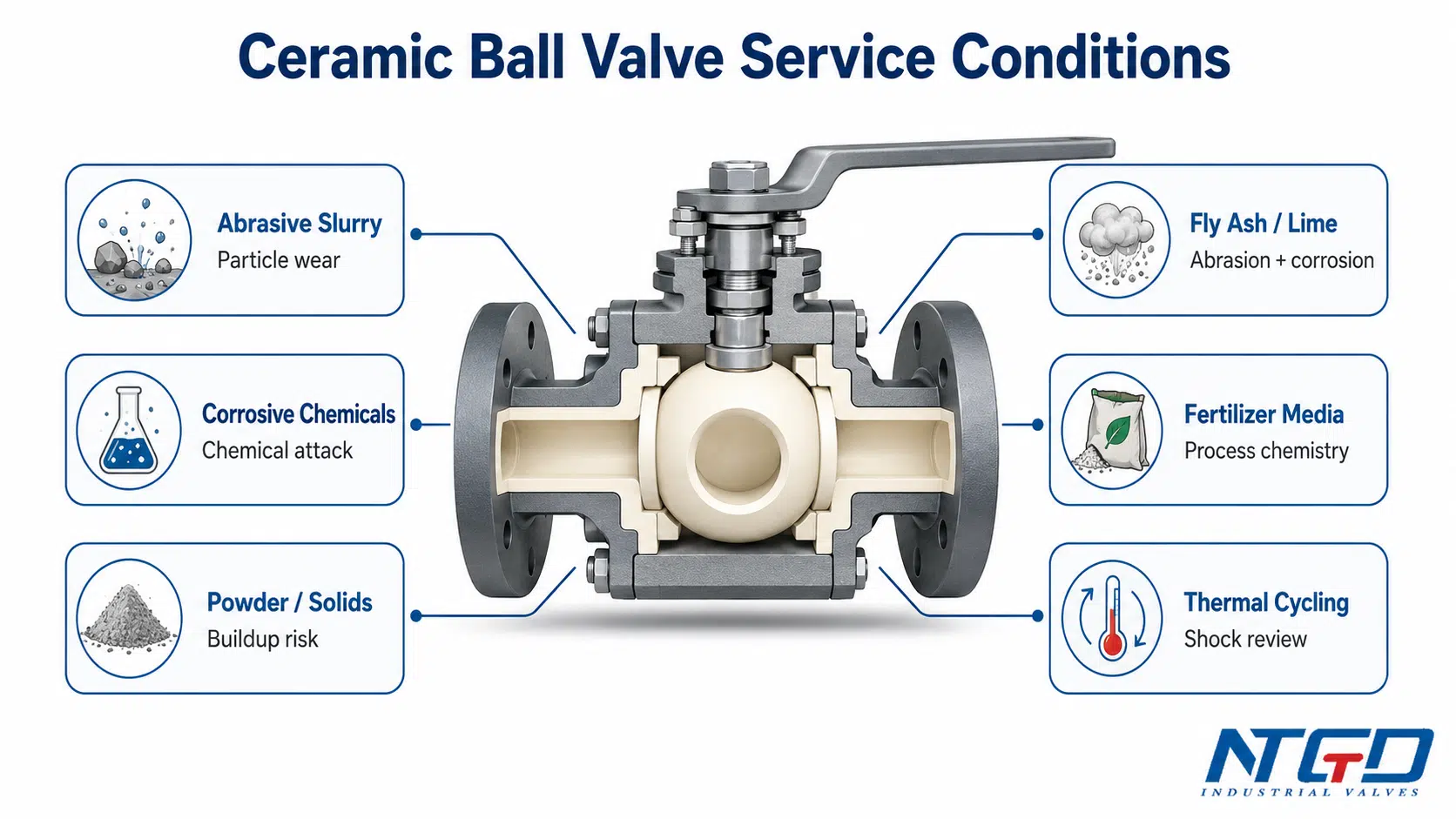
| Condiciones del servicio | Por qué se podría considerar la cerámica | Advertencia sobre la selección |
|---|---|---|
| Suspensión abrasiva | Las partículas duras pueden desgastar las superficies de sellado metálicas o blandas | Confirmar el tamaño de las partículas, la concentración, la velocidad y el riesgo de sedimentación de los sólidos |
| Aplicaciones con productos químicos corrosivos | Los productos químicos pueden dañar las superficies metálicas en contacto con el líquido | Verifique la compatibilidad química, la concentración, la temperatura y la cobertura del revestimiento |
| Polvo o sólidos secos | Los sólidos pueden acumularse o desgastar el conducto de flujo | Confirmar el diseño del sellado y el acceso para la limpieza |
| Servicio de cenizas volantes, cal, yeso o FGD | La abrasión y la corrosión pueden ocurrir al mismo tiempo | Confirmar el material cerámico, el diseño del asiento y el ciclo de funcionamiento |
| Medios de proceso para fertilizantes | Pueden estar presentes líquidos ácidos o abrasivos | Verifica la composición y la temperatura del medio |
| Servicio químico para la industria de la pulpa y el papel | Las sustancias químicas y los sólidos en suspensión pueden dañar los componentes internos comunes | Confirmar el medio real y los requisitos de cierre |
| Líneas de producción de petróleo o de procesos manufactureros | En algunas líneas de proceso pueden aparecer medios agresivos | No elijas solo por el nombre del sector |
| Servicio de agua o desagüe con sólidos | Los sólidos pueden provocar desgaste o riesgo de obstrucción | Confirmar si la construcción en cerámica está justificada |
Suspensiones abrasivas y medios que contienen sólidos
Para servicio de lodos, las válvulas de bola de cerámica suelen ser la opción preferida cuando el fluido contiene partículas duras, cristales, cenizas, cal, yeso, partículas de catalizador u otros sólidos abrasivos. En estas aplicaciones, las superficies de la bola, el asiento y el revestimiento pueden sufrir un desgaste continuo durante la apertura, el cierre o el flujo parcial.
Las preguntas clave para la selección son:
- ¿Cuál es la concentración de sólidos?
- ¿Cuál es el tamaño de las partículas y su dureza?
- ¿Los medios de comunicación se están estabilizando o creciendo?
- ¿La válvula suele estar completamente abierta, completamente cerrada o parcialmente abierta?
- ¿Es necesario andar en bicicleta con frecuencia?
Una válvula de bola de cerámica puede ser útil en medios abrasivos, pero un dimensionamiento incorrecto, una velocidad elevada o la acumulación de sólidos pueden seguir causando daños. En el caso de lodos a alta velocidad con partículas grandes o afiladas, las superficies de cerámica pueden sufrir erosión en los bordes de los orificios o daños en los asientos si no se verifican el dimensionamiento, la velocidad de flujo y el modo de operación.
Aplicaciones con productos químicos corrosivos
Los materiales cerámicos suelen elegirse por su estabilidad química en aplicaciones corrosivas. Las válvulas de bola de cerámica pueden considerarse para ácidos, álcalis, productos químicos para fertilizantes, agentes blanqueadores y otros corrosivos o servicio químico fluidos.
Sin embargo, resistencia a la corrosión Se debe verificar la concentración química exacta y la temperatura. El cuerpo, el revestimiento, la bola, el asiento, el empaque, las juntas y los accesorios del actuador pueden tener distintos límites de compatibilidad.
Servicio de polvo, cenizas volantes, cal, yeso y FGD
Los servicios que involucran polvos y lodos pueden presentar una combinación de retos relacionados con la abrasión, la deposición y el sellado. Las cenizas volantes, los lodos de cal, los lodos de yeso y los medios relacionados con la desulfuración de gases de combustión (FGD) pueden requerir un análisis minucioso del revestimiento cerámico, el comportamiento de limpieza de los asientos, el diámetro interior y la frecuencia de operación.
Para estos servicios, es especialmente importante no basar la selección únicamente en el tamaño de la válvula y la clase de presión. El comportamiento del fluido dentro de la cavidad de la válvula suele ser más importante que el tamaño de la tubería por sí solo.
Análisis de altas temperaturas, choques térmicos e impactos
Los materiales cerámicos pueden ser duros y resistentes al desgaste, pero pueden ser sensibles a los impactos mecánicos, a los cambios bruscos de temperatura o a las cargas desiguales, dependiendo del material y del diseño. El cuerpo metálico puede ayudar a proteger el acabado cerámico de las cargas mecánicas externas, pero no elimina todo el riesgo.
Para altas temperaturas o choque térmico Antes de poner en servicio la válvula, confirme con el fabricante el tipo de material, el diseño del asiento, el método de fijación del revestimiento, el comportamiento ante la expansión y el procedimiento de operación. No dé por sentado que todas las válvulas de bola de cerámica son adecuadas para cambios rápidos de temperatura, impactos mecánicos o cargas desiguales; estas condiciones deben motivar una revisión del tipo de material, la fijación del revestimiento, el diseño del asiento y el procedimiento de puesta en marcha.
Ventajas, limitaciones y criterios de selección
Las válvulas de bola de cerámica son muy útiles cuando se eligen para la aplicación adecuada. No son sustitutos universales de todas las válvulas de bola de acero, válvulas revestidas, válvulas de control o válvulas para lodos.
Ventajas cuando se elige correctamente
Cada ventaja depende de que el servicio se adapte correctamente. La resistencia a la abrasión debe evaluarse en función del tamaño y la velocidad de las partículas. La resistencia a la corrosión debe evaluarse en función de la concentración y la temperatura. Ninguna ventaja se aplica de manera universal a todas las líneas de proceso.
| Ventaja | Por qué es importante | Se requiere confirmación |
|---|---|---|
| Resistencia a la abrasión | Ayuda a proteger contra el desgaste causado por partículas duras y lodos | Confirme el tamaño de las partículas, la velocidad, el contenido de sólidos y el tipo de cerámica |
| Resistencia a la corrosión | Ayuda a proteger las piezas en contacto con el líquido frente a sustancias químicas agresivas | Verifica la concentración química, la temperatura y la compatibilidad |
| Superficies de sellado duras | Puede mejorar la durabilidad en determinadas condiciones de uso extremas | Confirmar el diseño del asiento y los requisitos de estanqueidad |
| Superficie cerámica lisa | Puede ayudar a reducir la fricción y el par en un servicio limpio y compatible | Verifica el par de apriete bajo condiciones reales de presión y con el medio correspondiente |
| Resistencia de la estructura metálica | Proporciona contención de presión y soporte mecánico | Confirme el material del cuerpo, la clase de presión y el entorno externo |
| Posibilidades de reparación y mantenimiento | Algunos diseños permiten la inspección o el reemplazo de piezas | Confirmar el procedimiento de construcción y mantenimiento de la carrocería |
Limitaciones y riesgos de uso indebido
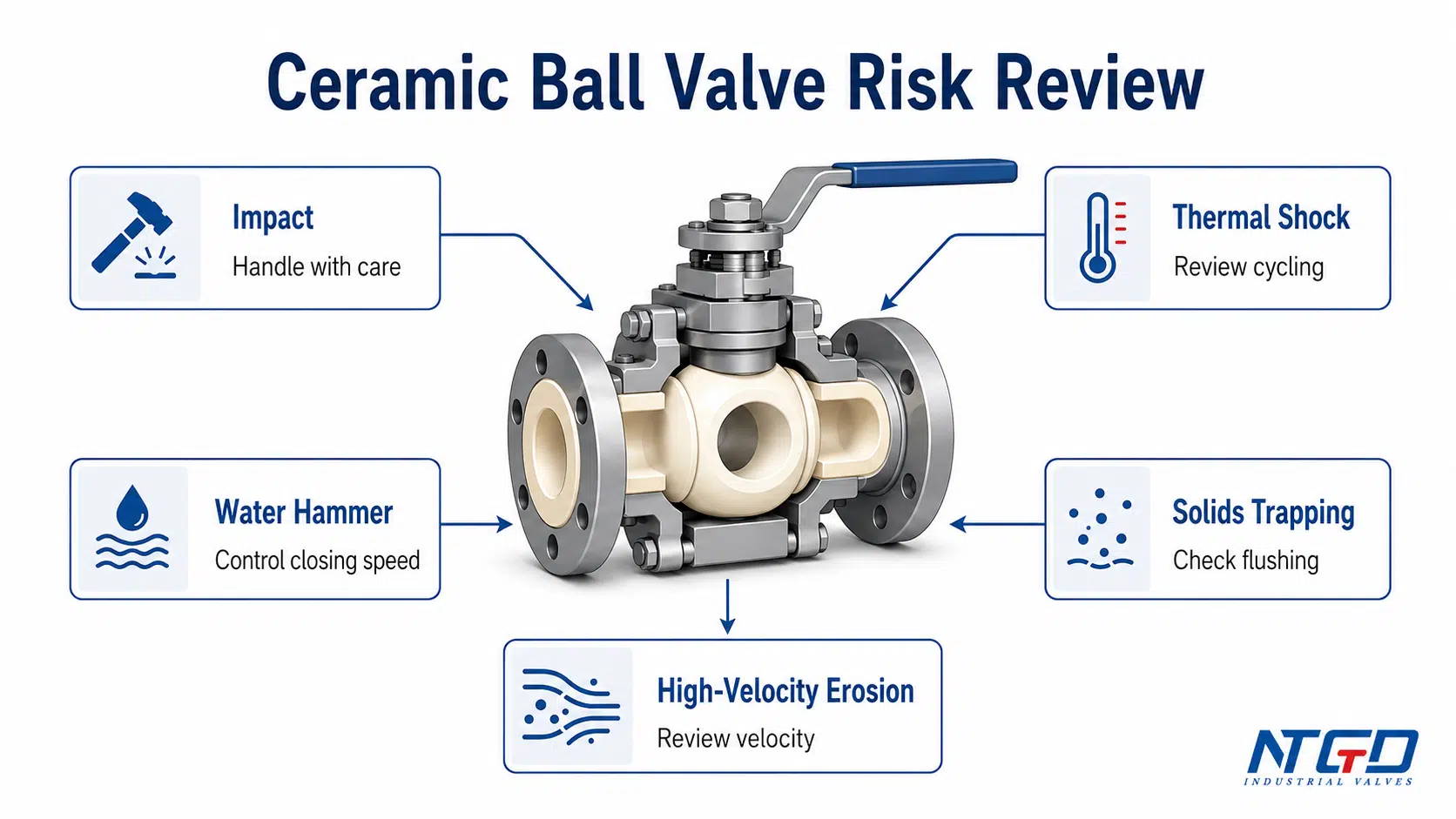
| Limitación / riesgo | Por qué es importante | Respuesta a la convocatoria de licitación y a las especificaciones |
|---|---|---|
| Fragilidad de la cerámica | Las piezas de cerámica pueden dañarse por un impacto o por un montaje incorrecto | Confirme los requisitos de manejo, el procedimiento de ensamblaje y si se prevén cargas de impacto |
| Choque térmico | Los cambios bruscos de temperatura pueden causar tensión en las piezas de cerámica | Confirme el tipo de cerámica, el método de fijación del revestimiento, el diseño del asiento y el procedimiento de encendido y apagado |
| Golpe de ariete | Un cierre rápido puede provocar un pico de presión | Revisa la velocidad de cierre, la configuración del actuador y el control de oscilaciones en la tubería |
| Retención de sólidos | Las partículas que se encuentran entre la bola y el asiento pueden aumentar el par o provocar fugas | Revisar el comportamiento de los medios, el lavado, la orientación de las válvulas y el acceso para el mantenimiento |
| Erosión de alta velocidad | La velocidad local puede dañar los bordes o los asientos de los orificios | Revisa la caída de presión, la velocidad local, la geometría del puerto y si el puerto en V es adecuado |
| Limitación de velocidad no compatible | Las válvulas de bola estándar pueden sufrir daños si se utilizan parcialmente abiertas | No utilice un diseño estándar de puerto redondo como válvula de control a menos que el fabricante confirme que es apto para ese servicio |
| Afirmaciones exageradas sobre fugas | El cierre depende del diseño y de las condiciones de prueba | Confirme la clase de fuga o los requisitos de cierre del proyecto antes de la selección final |
Válvula de bola cerámica estándar frente al diseño de control con puerto en V
El artículo original señaló correctamente que las válvulas de bola cerámicas con puerto en V pueden controlar el flujo mejor que las válvulas de bola comunes. La corrección importante es que esto no significa que todas las válvulas de bola cerámicas sean adecuadas para la regulación del flujo.
Por lo general, una válvula de bola de cerámica con paso redondo estándar debe considerarse una válvula de tipo “abierto/cerrado”, a menos que el fabricante indique lo contrario. Una válvula de bola de cerámica con paso en V puede utilizarse para servicio de modulación cuando el diseño se selecciona en función de la característica de flujo requerida, el rendimiento del actuador y la resistencia a la erosión.
Una válvula de bola de cerámica con paso en V debe considerarse como una configuración orientada al control, y no como una válvula de cierre estándar que se deja medio abierta. Antes de utilizarla en aplicaciones de control con medios abrasivos o corrosivos, se deben verificar el coeficiente Cv, el rango de control, el dimensionamiento del actuador, la caída de presión, la velocidad y el comportamiento de las partículas.
Cómo seleccionar y especificar una válvula de bola de cerámica para una solicitud de cotización
Una solicitud de cotización para una válvula de bola de cerámica debe describir claramente las condiciones de servicio porque selección de válvulas Depende de más factores que el tamaño de la válvula y la clase de presión. Las consultas breves, como “necesito el precio de una válvula de bola de cerámica” o “cotización de una válvula de bola de cerámica”, a menudo no incluyen los detalles necesarios para una selección segura.
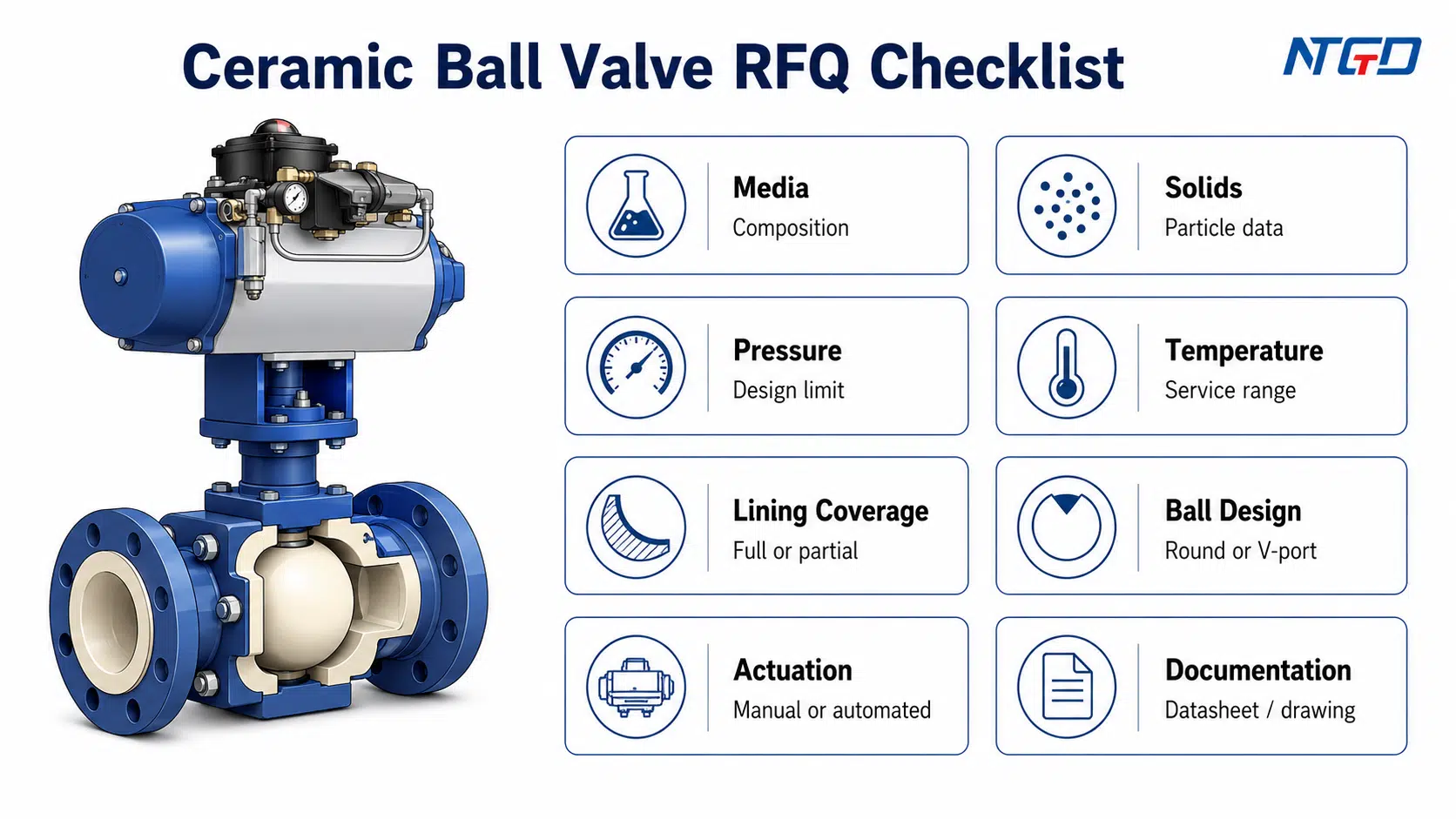
Una lista de verificación completa para solicitudes de cotización ayuda a evitar una fijación de precios demasiado simplificada y reduce el riesgo de elegir un material cerámico incorrecto, una cobertura de revestimiento inadecuada, un actuador de tamaño insuficiente o una selección inadecuada de puertos en V.
Datos del servicio que se deben confirmar antes de la selección
| Campo de datos de la solicitud de cotización | Por qué es importante |
|---|---|
| Nombre y composición del medio | Determina la compatibilidad frente a la corrosión |
| Contenido de sólidos y tamaño de las partículas | Determina el riesgo de abrasión, obstrucción y daños en los asientos |
| Presión y temperatura | Establece los límites del cuerpo, el asiento, el revestimiento y el relleno |
| Caudal y velocidad | Influye en la erosión, la caída de presión y el desgaste de los bordes de los puertos |
| Modo de funcionamiento | Separa los estados de servicio y fuera de servicio, los ciclos frecuentes, el apagado de emergencia y el servicio de control |
| Orientación de la instalación | Puede afectar la sedimentación de los sólidos y el funcionamiento |
| Rendimiento de cierre requerido | Establece los requisitos de diseño y prueba de los asientos |
| Método de limpieza o enjuague | Importante para el servicio con lodos y polvos |
Datos de construcción y configuración
| Partida de obra | Qué hay que especificar |
|---|---|
| Tamaño de la válvula y clase de presión | Ajustar el ribete a las especificaciones del proyecto |
| Material de la carrocería | Acero al carbono, acero inoxidable o el material que requiera el proyecto |
| Piezas de cerámica en contacto con el líquido | Bola, asiento, revestimiento, recubrimiento o trayectoria de flujo completa |
| Cobertura del revestimiento | Con forro completo, con forro parcial o con énfasis en los detalles |
| Diseño de la bola | Puerto redondo, paso completo, paso reducido o puerto en V |
| Estructura de la carrocería | De dos piezas, de tres piezas, con cuerpo dividido u otro diseño |
| Accionamiento | De palanca, de engranaje, neumático, eléctrico o hidráulico |
| Conexión final | Conexión con brida, roscada, soldada o específica para el proyecto |
Revisión de la documentación y las hojas de datos
Antes de la selección final, el comprador debe revisar la hoja de datos, el plano de disposición general, la lista de materiales, el par de operación, los datos del actuador, los límites de presión y temperatura, y los requisitos de prueba aplicables. En caso de condiciones de servicio extremas, también es útil verificar la experiencia del fabricante con medios similares.
Así es como se debe abordar la información relacionada con fabricantes, proveedores y cotizaciones en una página técnica: aclarando los datos de aplicación y especificaciones, y no convirtiendo el artículo en una lista de proveedores o una página de precios.
Solución de problemas en válvulas de bola de cerámica
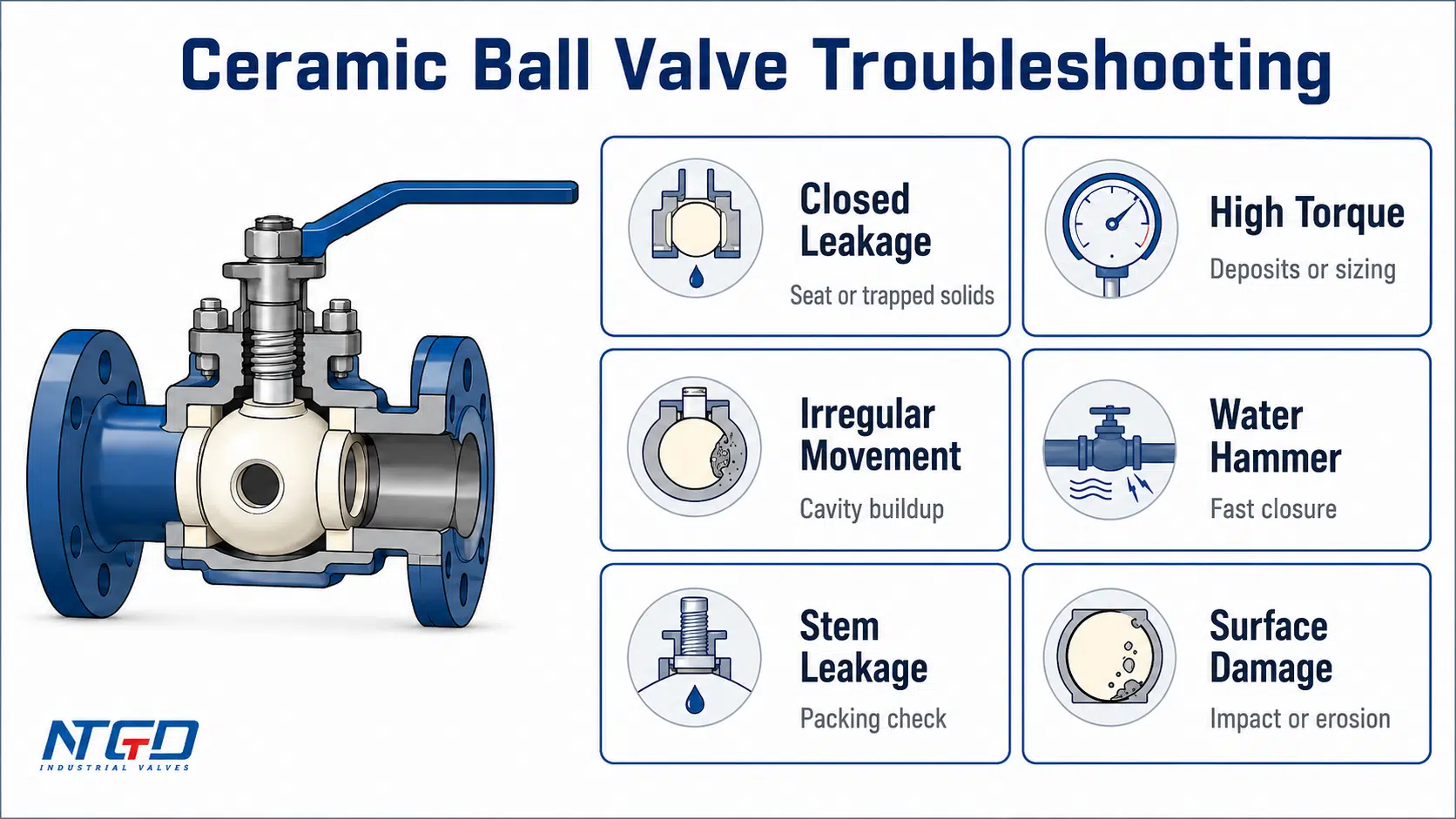
Solución de problemas en válvulas de bola Se debe comenzar por el síntoma y luego verificar las causas más probables. La tabla a continuación es solo para un diagnóstico preliminar. Una válvula de bola de cerámica no debe repararse, desarmarse ni volver a ponerse en servicio sin seguir el manual de operación y mantenimiento (IOM) del fabricante y los procedimientos de seguridad del sitio.
| Síntoma | Posible causa | Verificación / acción |
|---|---|---|
| Fuga cuando está cerrado | Superficie de la bola dañada, asiento dañado, residuos sólidos atascados, bola no completamente cerrada | Verifique la posición de apertura y cierre; inspeccione la bola y el asiento en busca de erosión, incrustaciones de partículas, grietas o daños a lo largo de la línea de contacto de sellado; luego, limpie o reemplace las piezas según sea necesario |
| Movimiento irregular del balón | Sedimentos entre la bola y el asiento, acumulación de sólidos en la cavidad, desalineación del vástago | Limpia las superficies internas, revisa si hay depósitos e inspecciona los asientos y la conexión del vástago |
| Par muy alto | Presencia de material extraño dentro de la válvula, asientos dañados, presión o temperatura fuera del rango de diseño | Elimine los depósitos, verifique el estado de funcionamiento, revise el tamaño del actuador y el estado del asiento |
| Ruido o golpe de ariete | Velocidad excesiva, cierre rápido, tamaño incorrecto, el actuador se cierra demasiado rápido | Revisa el caudal, el tamaño de la válvula, la velocidad de cierre y el control de las oscilaciones en la tubería |
| Fugas en el tallo | Zona de la glándula floja, empaque dañado, sello del vástago desgastado | Apriete el prensaestopas siguiendo el procedimiento, revise la empaque y reemplace el sello del vástago si es necesario |
| Acumulación de sólidos | Sedimentación de lodos, compactación de polvo, enjuague insuficiente | Revisar el comportamiento de los medios, el plan de limpieza, la orientación de las válvulas y el acceso para el mantenimiento |
| Daños en la superficie cerámica | Impactos mecánicos, choques térmicos, erosión por alta velocidad, manejo inadecuado | Inspeccione las piezas de cerámica, verifique los límites de servicio y reemplace los componentes de cerámica que presenten grietas o astillas graves, en lugar de intentar repararlos en el lugar. |
Es preferible sustituir el término antiguo “fuga de vapor” por “fuga del vástago” cuando la fuga se produce alrededor del vástago y la zona de la empaquetadura.
Preguntas frecuentes sobre las válvulas de bola de cerámica
¿Cuándo necesito una válvula de bola con revestimiento cerámico en lugar de una válvula de bola de cerámica estándar?
Se debe considerar el uso de una válvula de bola con revestimiento cerámico cuando el fluido pueda atacar la trayectoria interna del flujo o la cavidad del cuerpo, y no solo la superficie de sellado entre la bola y el asiento. Si los fluidos abrasivos o corrosivos pueden entrar en contacto con áreas desprotegidas del cuerpo, el comprador debe confirmar, antes de la selección, si la válvula cuenta con revestimiento completo, parcial o si el revestimiento se concentra en los componentes internos.
¿Cuál es la diferencia entre una válvula de bola de cerámica y una válvula de bola con revestimiento de cerámica?
Una válvula de bola de cerámica es el término más amplio para referirse a una válvula de bola con piezas internas de cerámica. Una válvula de bola con revestimiento de cerámica hace hincapié específicamente en el revestimiento de cerámica o en la protección de la vía de flujo. En muchos proyectos, los términos se superponen, pero la solicitud de cotización debe confirmar qué piezas son de cerámica y qué superficies están en contacto con el medio.
¿Son adecuadas las válvulas de bola de cerámica para lodos?
Las válvulas de bola de cerámica pueden ser adecuadas para lodos cuando el material cerámico, el diseño del revestimiento, el diseño del asiento, el diámetro interior y el sistema de accionamiento se seleccionan de acuerdo con las condiciones reales del lodo. Aunque suelen evaluarse para partículas duras y lodos corrosivos, una velocidad muy alta, partículas grandes y afiladas, una sedimentación severa o un funcionamiento frecuente con apertura parcial aún pueden causar problemas de erosión o de par de torsión. El comprador debe confirmar el tamaño de las partículas, el contenido de sólidos, la velocidad, el comportamiento de sedimentación y los requisitos de cierre antes de realizar la selección.
¿Se puede usar una válvula de bola de cerámica para regular el flujo?
Por lo general, una válvula de bola de cerámica estándar debe considerarse como una válvula de apertura/cierre. Para aplicaciones de regulación o modulación, puede ser necesario utilizar una válvula de bola de cerámica con puerto en V u otro diseño orientado al control. La elección final debe tener en cuenta la característica de flujo, el coeficiente Cv, el control del actuador, la velocidad, la caída de presión y el riesgo de erosión.
¿Qué es una válvula de bola cerámica de paso en V?
Una válvula de bola cerámica con paso en V utiliza un paso en forma de V o una abertura con muesca en V para proporcionar un flujo más controlado que una válvula de bola estándar con paso redondo. Se puede utilizar cuando los fluidos abrasivos o corrosivos también requieren un ajuste del flujo, pero debe seleccionarse como una válvula de control y no como una válvula de cierre estándar.
¿Qué información se necesita para solicitar una cotización de una válvula de bola de cerámica?
La información útil para la solicitud de cotización incluye la composición del medio, el contenido de sólidos, el tamaño de las partículas, la presión, la temperatura, el caudal, el tamaño de la válvula, la clase de presión, la conexión final, los requisitos de revestimiento cerámico, el método de accionamiento, los requisitos de cierre y cualquier hoja de datos o plano del proyecto.
¿Las válvulas de bola de cerámica no tienen fugas?
Una válvula de bola de cerámica puede ofrecer un alto rendimiento de cierre cuando la bola, el asiento y el diseño de sellado se seleccionan y prueban correctamente. Sin embargo, el rendimiento en cuanto a fugas depende del diseño, los requisitos de prueba, la presión, la temperatura, los sólidos presentes en el fluido y el estado del asiento. No se debe dar por sentado sin un requisito de fugas confirmado.
¿En qué casos un comprador debería evitar comprar una válvula de bola de cerámica?
El comprador debe evitar el uso de una válvula de bola de cerámica cuando la aplicación implique impactos mecánicos severos, choques térmicos incontrolados, estrangulamiento sin soporte, erosión por alta velocidad que supere el límite de diseño, o condiciones de los fluidos que no se hayan verificado en relación con el material cerámico y el diseño del revestimiento.
Lista de verificación para la selección final
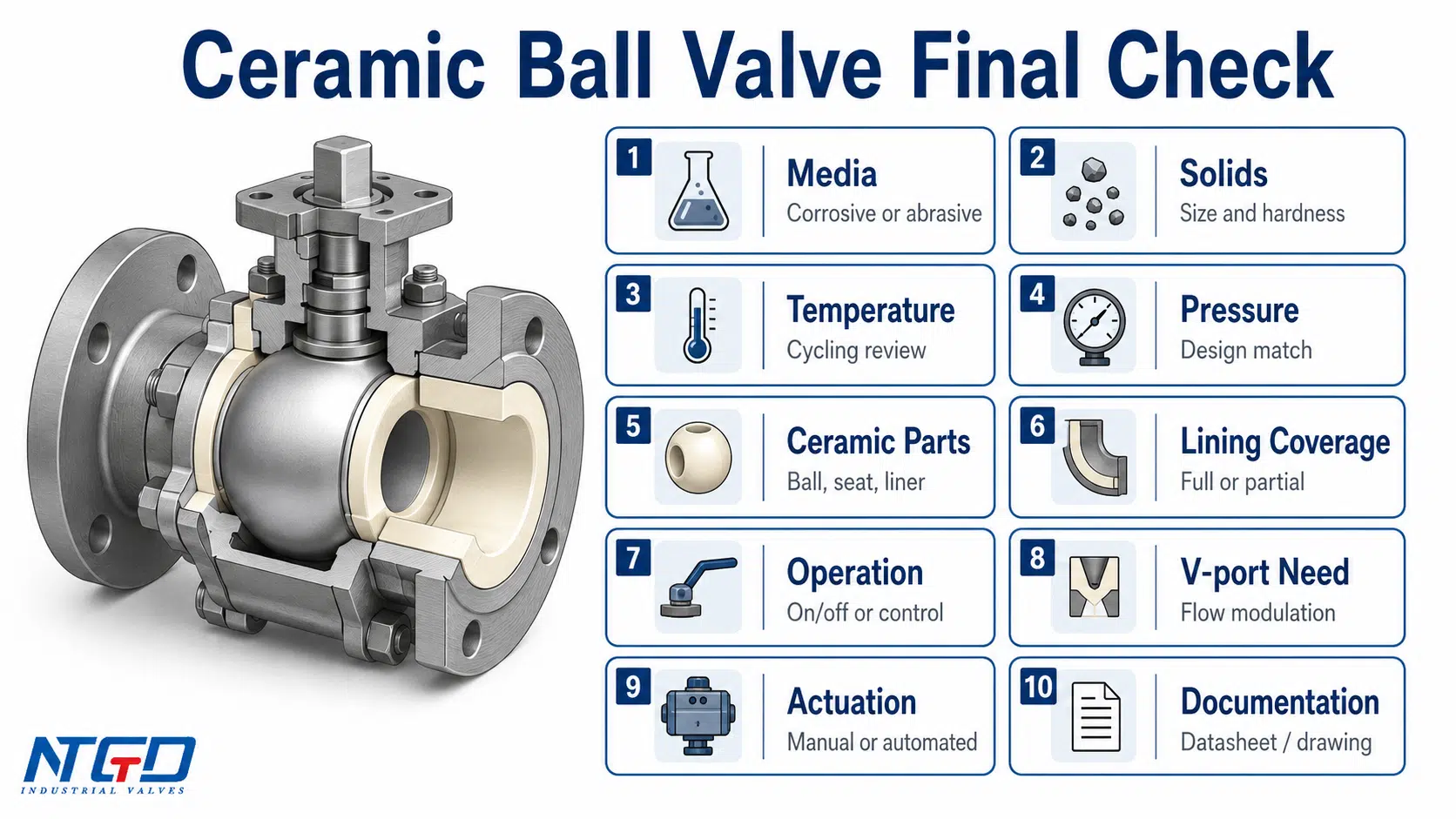
Antes de elegir una válvula de bola de cerámica, verifica estos puntos. Si no se conoce alguno de estos datos, no se debe elegir la válvula basándose únicamente en el tamaño y la clase de presión.
| Verificar elemento | Pregunta del comprador |
|---|---|
| Medios de comunicación | ¿El fluido es corrosivo, abrasivo, está en forma de lodo, polvo o contiene sólidos? |
| Sólidos | ¿Cuáles son el tamaño de las partículas, la dureza y la concentración? |
| Temperatura | ¿Hay altas temperaturas, ciclos térmicos o cambios rápidos de temperatura? |
| Presión | ¿El diseño del cuerpo y el asiento de la válvula se adapta a la presión del proyecto? |
| Piezas de cerámica | ¿La bola, el asiento, el revestimiento o el acabado son de cerámica? |
| Cobertura del revestimiento | ¿La válvula tiene revestimiento completo, revestimiento parcial o está enfocada en el conjunto de control? |
| Operación | ¿La válvula es para servicio de encendido/apagado, ciclos frecuentes, cierre de emergencia o flujo controlado? |
| Necesidad de un puerto en V | ¿Es necesario un control de modulación? ¿Se ha revisado el diseño del puerto en V en cuanto a la velocidad y la erosión? |
| Accionamiento | ¿Manual, de engranajes, neumático, eléctrico o hidráulico? |
| Documentación | ¿Se cuenta con la hoja de datos, el plano, la lista de materiales, el par de operación y los requisitos de prueba? |
Conclusión
Una válvula de bola de cerámica puede definirse como una válvula de bola para servicio extremo con piezas en contacto con el fluido fabricadas en cerámica, seleccionadas para medios abrasivos, corrosivos o que contienen sólidos. Su principal ventaja radica en que la bola, el asiento, el revestimiento y los componentes internos de cerámica funcionan en conjunto con un cuerpo metálico de gran resistencia mecánica.
En la mayoría de los proyectos, la selección debe centrarse menos en el nombre de la válvula y más en las condiciones de servicio. La composición del fluido, los sólidos, la presión, la temperatura, la velocidad del flujo, los requisitos de cierre, la cobertura del revestimiento y el método de accionamiento son factores que influyen en si una válvula de bola de cerámica es la opción adecuada.
Las válvulas de bola de cerámica estándar se utilizan principalmente para operaciones de apertura y cierre. Si se requiere control de flujo, se debe considerar una válvula de bola de cerámica con puerto en V u otro diseño orientado al control, con el valor Cv, el actuador, la caída de presión y las condiciones de erosión adecuados.
Para la selección de válvulas de bola de cerámica, prepare los datos del fluido, la información sobre sólidos, la presión, la temperatura, el tamaño de la válvula, los requisitos de revestimiento, los requisitos de cierre y la preferencia de accionamiento antes de enviar una solicitud de cotización. Una vez que tenga listos los datos de servicio, NTGD Valve puede realizar una revisión de ingeniería específica para su aplicación y ayudarle a confirmar si una válvula de bola de cerámica, una válvula de bola con revestimiento de cerámica o una válvula de bola de cerámica con puerto en V es la configuración técnicamente adecuada para el proyecto.
