
Nombre del autor: Bruce Zheng
Función del autor: Cofundador e ingeniero de válvulas en NTGD Valve
Biografía del autor: Bruce Zheng es cofundador e ingeniero de válvulas en NTGD Valve, donde se dedica a la selección y aplicación de válvulas industriales, así como a la elaboración de contenido técnico para compradores B2B de todo el mundo.
Última actualización: 12 de junio de 2026
Una válvula de mariposa de acero inoxidable es una válvula de cuarto de vuelta cuyo cuerpo, disco, vástago y otras piezas metálicas clave están fabricados en acero inoxidable. Se suele elegir para sistemas de tuberías industriales en los que se requiere resistencia a la corrosión, resistencia mecánica, resistencia al lavado a presión o superficies metálicas más limpias.
En el lenguaje de los compradores, una válvula de mariposa de acero inoxidable también puede denominarse «válvula de mariposa inoxidable» o «válvula de mariposa SS». Estos términos suelen referirse a la misma categoría general de válvulas, pero aún así es necesario verificar la configuración exacta. Una válvula con cuerpo de acero inoxidable puede tener un asiento de EPDM, PTFE, RTFE, NBR, Viton/FKM o metal, y el material del asiento puede ser tan importante como el del cuerpo.
Esta guía tiene como objetivo ayudar a los compradores e ingenieros a revisar los principales aspectos de las especificaciones antes de la selección final: tipo de acero inoxidable, piezas en contacto con el fluido, material del asiento, tipo de conexión, fluido, temperatura, clase de presión, método de operación y requisitos de documentación.
El criterio principal de selección es sencillo: el acero inoxidable mejora la resistencia a la corrosión y la durabilidad, pero eso no significa automáticamente que la válvula sea adecuada para cualquier fluido, temperatura, clase de presión o condición de limpieza. Si una solicitud de cotización solo indica “válvula de mariposa de acero inoxidable” sin confirmar la compatibilidad del asiento, las condiciones del fluido, la temperatura y el tipo de conexión, es posible que la válvula tenga el material de cuerpo adecuado, pero aún así presente fugas, requiera un par de apriete excesivo o tenga una vida útil más corta.
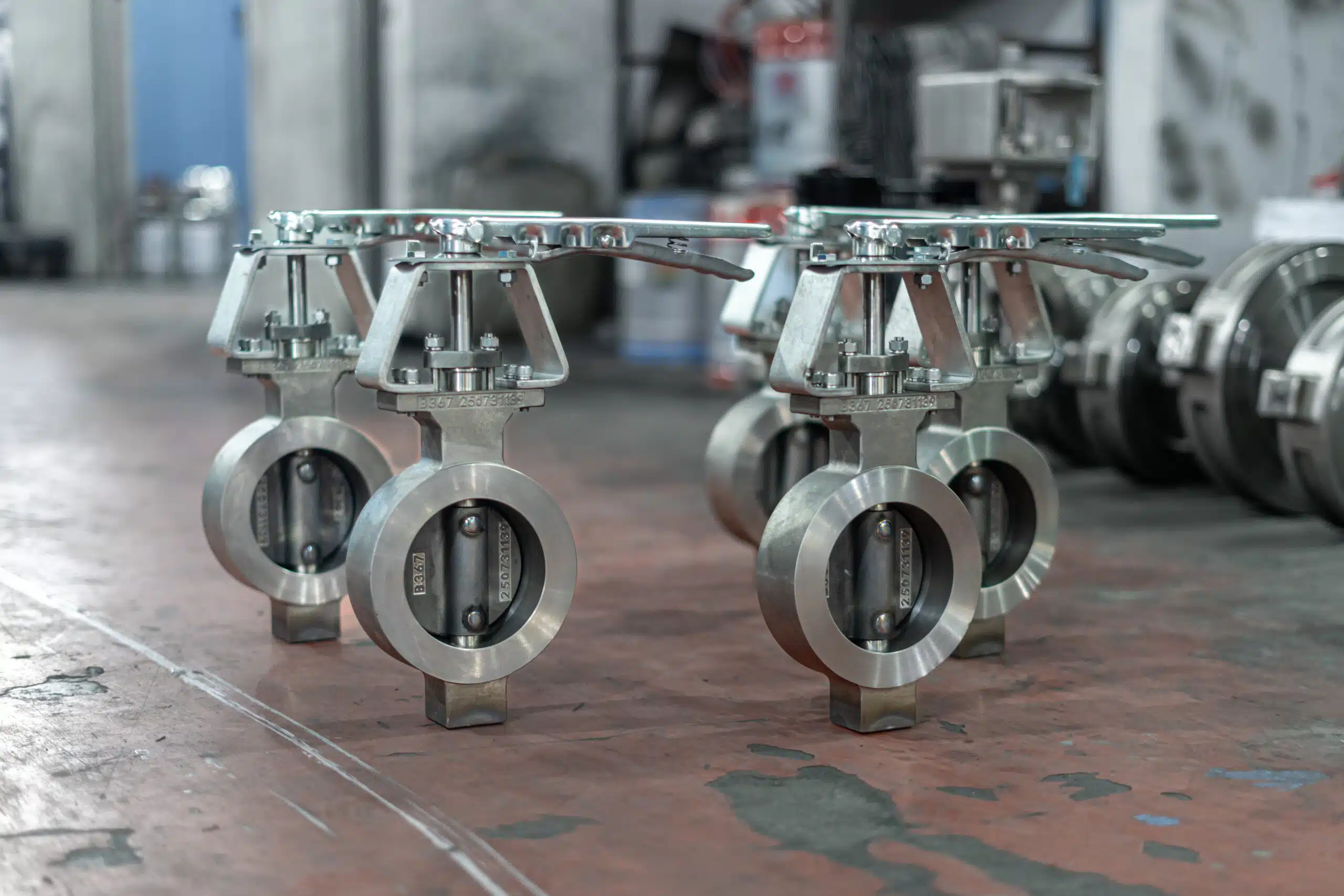
¿Qué es una válvula de mariposa de acero inoxidable?
Una válvula de mariposa de acero inoxidable es una válvula de mariposa fabricada con acero inoxidable como material metálico principal para el cuerpo, el disco, el vástago o una combinación de estas piezas. Al igual que otras válvulas de mariposa, controla el flujo mediante un disco giratorio instalado en la trayectoria del flujo. Al girar la manija, el operador de engranajes o el actuador, el disco gira un cuarto de vuelta para abrir, regular o cerrar la tubería.
El término “acero inoxidable” en el nombre de la válvula no siempre significa que todas las piezas de la válvula sean de acero inoxidable. El cuerpo y el disco pueden ser de acero inoxidable, mientras que el asiento, los anillos de O, la empaquetadura, el revestimiento y las juntas pueden estar hechos de hule, PTFE, PTFE reforzado, grafito u otros materiales de sellado. Estas piezas no metálicas determinan muchos de los límites reales de servicio de la válvula.
| Término | Significado | Uso en este artículo |
|---|---|---|
| Válvula de mariposa de acero inoxidable | Nombre técnico completo del producto | Término principal para la categoría de válvulas |
| Válvula de mariposa de acero inoxidable | Expresión abreviada del comprador | Variante con la misma intención utilizada de manera natural |
| Válvula de mariposa SS | Expresión abreviada para válvula de mariposa de acero inoxidable | Término de uso común entre compradores, no es un tipo de válvula distinto |
| Válvulas de mariposa de acero inoxidable | Expresión de familia de productos en plural | Se utiliza al hablar de configuraciones, aplicaciones y requisitos de solicitudes de cotización |
Válvula de mariposa de acero inoxidable y terminología relacionada con las válvulas de mariposa de acero inoxidable
En muchas solicitudes de cotización y búsquedas, los compradores abrevian “válvula de mariposa de acero inoxidable” como “válvula de mariposa inoxidable” o “válvula de mariposa SS”. Esto es aceptable como forma abreviada, pero no debe sustituir a una especificación técnica completa.
Por ejemplo, una solicitud de cotización (RFQ) que solo diga “válvula de mariposa de acero inoxidable” está incompleta. El proveedor aún necesita saber si el material requerido es 304, 316, CF8, CF8M u otro grado de acero inoxidable. El proveedor también necesita confirmar si el asiento es de EPDM, PTFE, RTFE, NBR, Viton/FKM o un sello metálico.
Una solicitud de cotización más clara separaría las piezas principales, como el cuerpo de acero inoxidable, el disco de acero inoxidable, el vástago de acero inoxidable y un material específico para el asiento. Esto evita el malentendido común de que “SS” se refiere automáticamente a todos los componentes en contacto con el fluido y de sellado.
Cuando el acero inoxidable es un factor importante en la selección de válvulas de mariposa
El acero inoxidable es fundamental cuando el cuerpo de la válvula, el disco o el vástago deben resistir la corrosión, los productos químicos de limpieza, las condiciones de lavado a presión, la exposición marina, los ácidos débiles o los medios industriales en general mejor que el hierro fundido común, el hierro dúctil o el acero al carbono.
Sin embargo, el acero inoxidable por sí solo no determina el rendimiento total de la válvula. Un cuerpo de acero inoxidable con un material de asiento inadecuado puede presentar fugas, hincharse, desgastarse rápidamente, volverse difícil de operar o fallar ante condiciones de temperatura o exposición a sustancias químicas. Por eso, la selección de una válvula de mariposa de acero inoxidable siempre debe combinar la elección del grado del metal con la verificación del asiento, las conexiones, el mecanismo de operación y la aplicación.
Factores clave para la selección de válvulas de mariposa de acero inoxidable
La válvula de mariposa de acero inoxidable adecuada no se elige solo por el nombre del material. Para una especificación confiable, el comprador debe seguir una guía práctica proceso de selección de válvulas y revisa la válvula como un conjunto completo: cuerpo, disco, vástago, asiento, revestimiento, empaque, junta, conexión, clase de presión y método de operación.
| Factor de selección | Por qué es importante | Qué hay que confirmar |
|---|---|---|
| Grado de acero inoxidable | Influye en la resistencia a la corrosión, la resistencia mecánica y el costo | 304, 316, CF8, CF8M o el material especificado en el proyecto |
| Partes metálicas en contacto con el líquido | Determina qué piezas metálicas entran en contacto con los medios de proceso | Cuerpo, disco, vástago, eje, pasadores y herrajes a la vista |
| Material del asiento / revestimiento | Controla el apagado, la compatibilidad con los soportes, el rango de temperatura y el torque | EPDM, PTFE, RTFE, NBR, Viton / FKM o asiento metálico |
| Tipo de conexión | Influye en el método de instalación, el acceso para el mantenimiento y el soporte de las tuberías | De tipo wafer, con orejetas, con brida, soldado o con abrazadera sanitaria |
| Método de funcionamiento | Afecta al par, la automatización, la posición de seguridad y la señal de control | Palanca, accionador de engranajes, actuador neumático o actuador eléctrico |
| Medios y temperatura | Determina si tanto las piezas metálicas como las de material blando son adecuadas | Tipo de fluido, concentración, sólidos, método de limpieza y temperatura |
| Tamaño y clase de presión | Garantiza que la válvula se ajuste a la tubería y al diseño del proyecto | Tamaño en DN/pulgadas, clasificación en PN/Clase y norma de bridas |
| Requisito de cierre | Determina si se requiere un asiento blando, un diseño de alto rendimiento o un sello metálico | Aislamiento, limitación, expectativa de fugas y criticidad del servicio |
| Documentación | Brinda apoyo en la aprobación de proyectos y la revisión de instalaciones | Ficha técnica, plano, confirmación de materiales, requisitos de ensayo y normas aplicables |
Un error común a la hora de elegir una válvula es centrarse únicamente en el cuerpo de acero inoxidable y pasar por alto el asiento. En muchas válvulas de mariposa, el asiento es la pieza que sella alrededor del disco. Si el asiento no es compatible con el fluido o la temperatura, el cuerpo de acero inoxidable no podrá evitar fugas ni problemas de funcionamiento.
Una secuencia de selección práctica suele ser la siguiente: primero, el fluido y la temperatura; luego, el material del asiento o del revestimiento; después, el grado de acero inoxidable y las piezas en contacto con el fluido; a continuación, el tipo de conexión; y, por último, el método de operación o el dimensionamiento del actuador. Este orden es importante porque el asiento seleccionado puede afectar el comportamiento de cierre y el par de operación, mientras que el tipo de conexión influye en la instalación y el acceso para el mantenimiento. En el caso de las válvulas de mariposa de acero inoxidable con actuador, este debe evaluarse después de comprender el par de la válvula y el comportamiento del asiento, y no solo en función del tamaño nominal de la válvula.
Grados de acero inoxidable y piezas en contacto con el fluido
Las válvulas de mariposa de acero inoxidable pueden fabricarse con diferentes grados de acero inoxidable, dependiendo del diseño de la válvula, el método de fundición, los requisitos de resistencia a la corrosión y las especificaciones del proyecto. Las decisiones más comunes se refieren a la elección entre el acero inoxidable 304 y el 316, y entre el acero inoxidable fundido CF8 y el CF8M.
Estos nombres deben manejarse con cuidado. Un grado de acero inoxidable forjado o laminado y un grado de acero inoxidable fundido no siguen el mismo sistema de nomenclatura. En el caso de los cuerpos y discos de las válvulas, muchas válvulas de mariposa industriales utilizan materiales de acero inoxidable fundido, mientras que los componentes fabricados o mecanizados pueden utilizar diferentes grados de acero inoxidable. El material definitivo siempre debe verificarse de acuerdo con las especificaciones del proyecto y la hoja de datos del fabricante.
| Material / grado | Función típica | Nota de selección |
|---|---|---|
| Acero inoxidable 304 | Opción general de acero inoxidable para la carrocería, el disco o los componentes | Se suele considerar para aplicaciones relacionadas con el agua, servicios públicos, lavado a presión y uso industrial general en las que el riesgo de corrosión no es muy elevado |
| Acero inoxidable 316 | Opción con mayor resistencia a la corrosión en comparación con el 304 en muchas aplicaciones | Se revisa con frecuencia cuando existe exposición al cloruro, ambiente marino, contacto con sustancias químicas o un mayor riesgo de corrosión |
| CF8 | La dirección del material del acero inoxidable fundido suele asociarse con la fundición de acero inoxidable tipo 304 | Es común en los cuerpos de válvulas o discos fundidos, según el diseño |
| CF8M | La dirección del material del acero inoxidable fundido suele asociarse con la fundición de acero inoxidable tipo 316 | Se utiliza habitualmente cuando se requiere una mayor resistencia a la corrosión en componentes fundidos |
| Disco de acero inoxidable | Componente giratorio principal en contacto con el líquido | Debe ajustarse al medio, al material del asiento y a los requisitos de cierre |
| Vástago de acero inoxidable | Componente de transmisión de par | Se debe verificar si hay signos de corrosión, la resistencia y la carga del actuador |
| Cuerpo de acero inoxidable | Componente de conexión y contención de presión | Debe coincidir con la clase de presión, el tipo de conexión y el entorno de servicio |
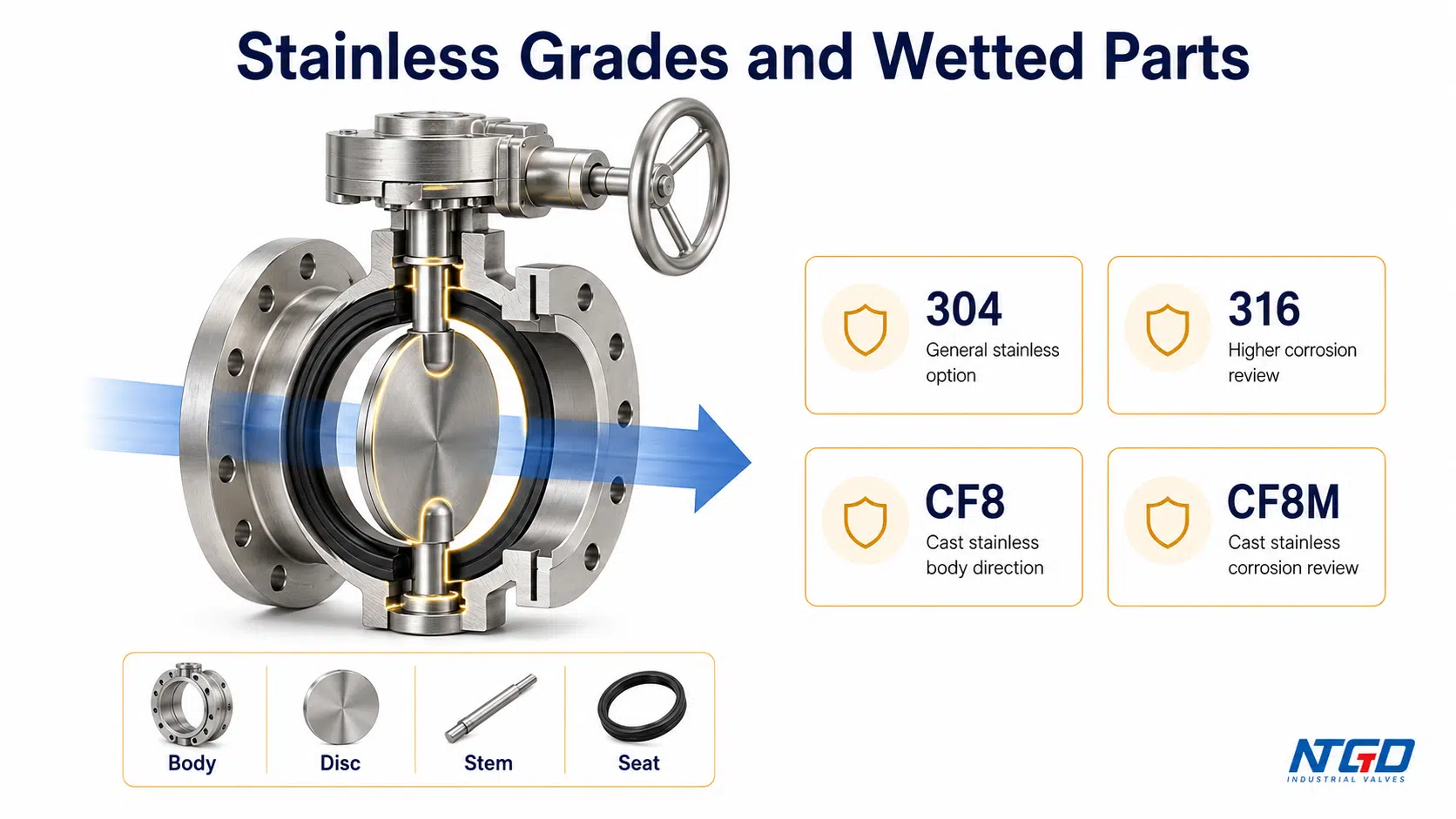
Acero inoxidable 304 vs 316
El acero inoxidable 304 se utiliza con frecuencia para ofrecer resistencia general a la corrosión en aplicaciones menos agresivas. Puede ser adecuado para numerosas aplicaciones relacionadas con el agua, los servicios públicos, el aire, el lavado a presión y la industria en general, dependiendo de la temperatura, las propiedades químicas del medio y el material del asiento.
No se debe considerar que el 304 sea la opción predeterminada para todas las válvulas de mariposa de acero inoxidable. Si el servicio implica un mayor riesgo de corrosión, exposición a cloruros, productos químicos de limpieza o concentraciones químicas desconocidas, se debe analizar el material con mayor detenimiento antes de seleccionarlo.
El acero inoxidable 316 suele elegirse cuando el entorno de corrosión es más exigente. Se suele considerar para aplicaciones químicas, exposición marina, entornos de lavado y medios en los que se requiere una mayor resistencia a la corrosión.
Sin embargo, el 316 no debe considerarse una solución universal. Su idoneidad exacta sigue dependiendo de la concentración, la temperatura, los cloruros, el método de limpieza, el material del asiento y el diseño del fabricante. En aplicaciones corrosivas, se deben evaluar conjuntamente el grado de acero inoxidable y el material del asiento, ya que cualquiera de los dos puede convertirse en el factor limitante.
CF8 vs CF8M de acero inoxidable fundido
Los códigos CF8 y CF8M suelen mencionarse cuando el cuerpo o el disco de la válvula están fabricados con acero inoxidable fundido. El código CF8 se asocia generalmente con un tipo de acero inoxidable fundido similar al acero inoxidable tipo 304, mientras que el código CF8M se asocia generalmente con un tipo de acero inoxidable fundido similar al acero inoxidable tipo 316.
Estos pertenecen a un piezas fundidas de acero austenítico contexto y no deben considerarse sustitutos directos y equivalentes al acero forjado 304 o 316 en todas las especificaciones. El comprador debe confirmar si el cuerpo, el disco y el vástago son todos de acero inoxidable, y si el grado indicado se aplica a la pieza fundida, al disco, al vástago o solo a uno de los componentes.
En las solicitudes de cotización se deben evitar descripciones vagas como “todo de acero inoxidable”, a menos que se definan claramente las partes en contacto con el fluido. El material definitivo debe confirmarse comparando la hoja de datos de la válvula, las especificaciones del proyecto y la oferta de materiales del fabricante.
Partes en contacto con el líquido frente a partes que no están en contacto con el líquido
Las partes en contacto con el fluido son los componentes que entran en contacto con el medio de proceso. En una válvula de mariposa, estas suelen incluir el interior del cuerpo o el área del revestimiento, el disco, el vástago o el eje, el asiento y, en ocasiones, los elementos de sujeción o pasadores, dependiendo del diseño.
Las piezas que no están en contacto con el fluido pueden incluir el mango, la caja de engranajes, la carcasa del actuador, el soporte de montaje o los pernos externos. Estas piezas siguen siendo importantes para la instalación y el entorno, pero no siempre requieren el mismo material que las piezas que están en contacto con el fluido.
Esta distinción es importante porque una válvula puede describirse como una válvula de mariposa de acero inoxidable, aunque solo algunas de sus piezas sean de este material. Para aplicaciones corrosivas, de lavado a presión o de carácter sanitario, la solicitud de cotización debe indicar claramente qué piezas deben ser de acero inoxidable y qué materiales de sellado son aceptables.
Componentes principales y su impacto en la selección
Los componentes básicos de una válvula de mariposa de acero inoxidable son similares a los de otras válvulas de mariposa, pero la elección del material y de los sistemas de sellado tiene un impacto directo en la vida útil, el riesgo de fugas, el par de operación y la compatibilidad con los fluidos.
En aplicaciones corrosivas, de lavado o de proceso limpio, las piezas metálicas del núcleo que están en contacto con el fluido constituyen el primer punto de control de los materiales. El cuerpo, el disco, el vástago, el asiento, la empaquetadura y la junta deben evaluarse como un sistema en su conjunto, en lugar de como piezas aisladas.
| Componente | Función | Repercusiones de la selección |
|---|---|---|
| Cuerpo | Sujeta el conjunto de la válvula y permite la conexión a la tubería | Influye en la clase de presión, el tipo de conexión, la compatibilidad de materiales y la resistencia de la instalación |
| Disco | Gira dentro del conducto de flujo para abrir, regular o cerrar la válvula | Influye en la exposición a la corrosión, la resistencia al flujo, el contacto de cierre y la compatibilidad con los medios |
| Vástago / eje | Transfiere el par desde la manija, el engranaje o el actuador al disco | Influye en la resistencia, la exposición a la corrosión, la transmisión del par y el dimensionamiento de los actuadores |
| Asiento / forro | Proporciona la superficie de sellado alrededor del disco | Afecta el cierre, la compatibilidad con los medios, el rango de temperatura, el par de apriete y el mantenimiento |
| Embalaje | Ayuda a prevenir las fugas en la zona del vástago | Influye en el riesgo de fugas externas y en los requisitos de mantenimiento |
| Junta | Sella la unión entre la válvula y la brida de la tubería | Influye en las fugas de las válvulas de las tuberías y en la confiabilidad de la instalación |
| Palanca, accionador de engranaje o actuador | Abre y cierra la válvula | Influye en el esfuerzo manual, la automatización, la posición de fallo y el método de control |
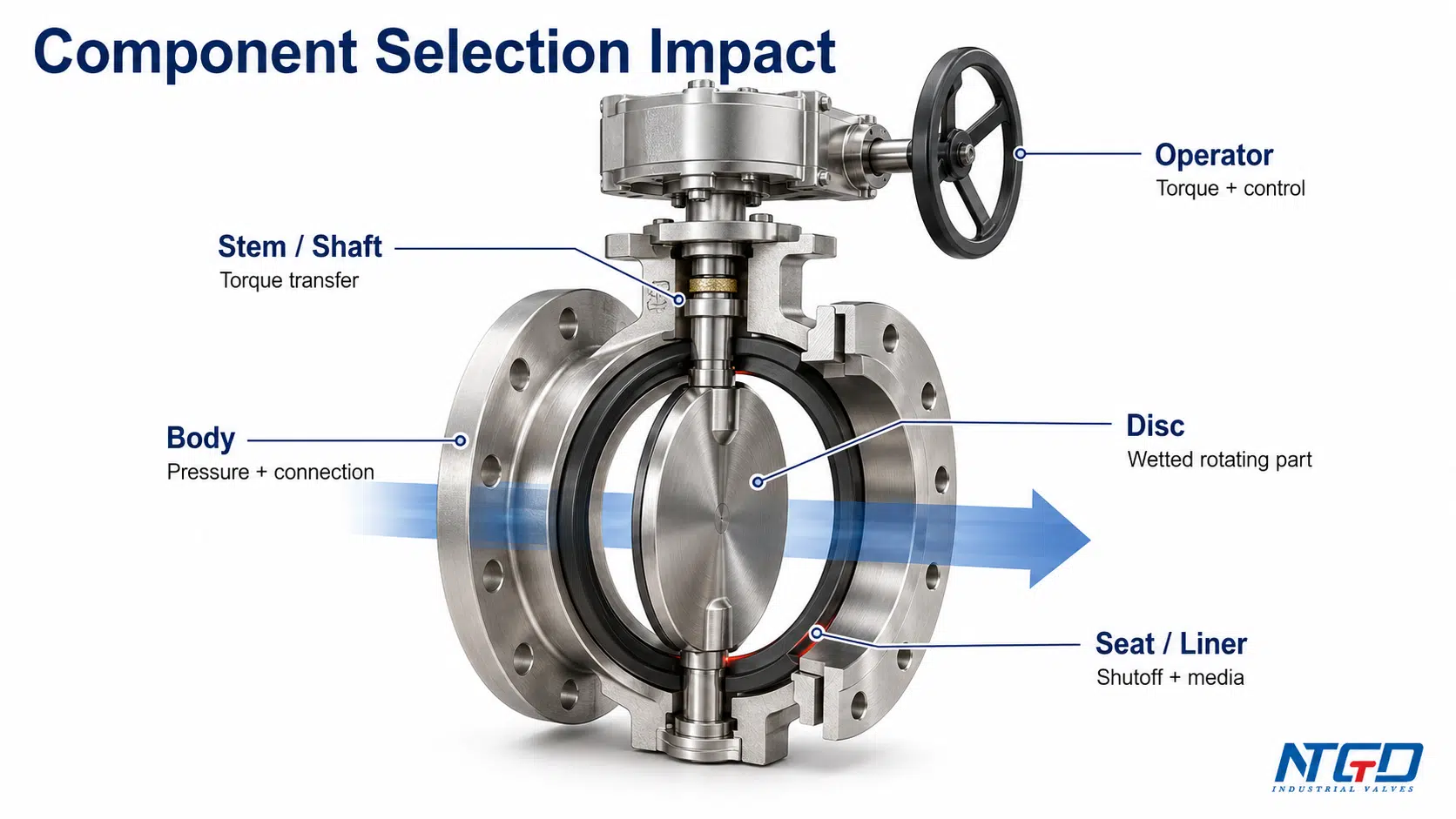
Cuerpo
El cuerpo es la parte de la válvula que contiene la presión y proporciona la interfaz de conexión con la tubería. En una válvula de mariposa de acero inoxidable, el cuerpo puede estar fabricado con fundición de acero inoxidable u otra estructura de acero inoxidable, según el diseño.
El material del cuerpo es importante, pero no debe ser el único aspecto que se verifique. El comprador también debe confirmar la clase de presión, la dimensión de cara a cara, la norma de bridas, el patrón de pernos y si el estilo del cuerpo es tipo wafer, con orejetas, con bridas, soldado o sanitario.
Una válvula instalada en entornos marinos, al aire libre, en zonas de lavado o en plantas químicas podría requerir una revisión tanto en lo que respecta al contacto interno con los medios como al contacto externo exposición a la corrosión.
Disco
El disco es una de las piezas en contacto con el fluido más importantes. Gira dentro del recorrido del flujo y entra en contacto con el asiento durante el cierre. Dado que el disco está expuesto directamente a los medios del proceso, el material del que está hecho es fundamental para garantizar la resistencia a la corrosión y la confiabilidad del sellado a largo plazo.
El disco de una válvula de mariposa de acero inoxidable puede ser de acero 304, 316, CF8, CF8M u otro material, dependiendo del diseño de la válvula y los requisitos del proyecto. Si el fluido es corrosivo, abrasivo, viscoso o tiende a formar residuos, se debe verificar la compatibilidad entre el material del disco y el del asiento.
El disco también forma parte de la interfaz de cierre. Incluso cuando el material del cuerpo es el adecuado, una compatibilidad deficiente entre la superficie del disco, el material del asiento y los medios de proceso puede afectar el rendimiento en cuanto a fugas y el par de operación.
Vástago / eje
El vástago o eje transmite el par desde la manija, la caja de cambios o el actuador al disco. En algunos diseños, el vástago puede quedar expuesto al medio de proceso. En otros diseños, la exposición puede verse limitada por la disposición del asiento o del revestimiento.
Para el funcionamiento manual, el vástago debe soportar movimientos repetidos de un cuarto de vuelta. Para el funcionamiento automatizado, también debe cumplir con los requisitos de par del actuador. Si la válvula se vuelve difícil de operar, es posible que la causa no sea solo el vástago. El material del asiento, la acumulación de residuos, la corrosión y el tamaño del actuador pueden ser factores que contribuyan a ello.
El vástago debe considerarse tanto como una pieza de transferencia de torque como un posible punto de riesgo de corrosión o de sellado dinámico. En caso de medios corrosivos o ciclos frecuentes, se debe verificar el material del vástago y su sellado junto con el diseño del asiento y la empaquetadura.
Asiento / forro
El asiento o revestimiento es el principal elemento de sellado. Cuando el disco gira hasta la posición cerrada, se sella contra el asiento. Por eso, la elección del asiento suele ser más importante de lo que los compradores esperan.
Aunque el cuerpo de acero inoxidable sea resistente a la corrosión, un asiento inadecuado puede provocar fugas, hinchamiento, ataque químico, un par de apriete elevado o una vida útil reducida. El material del asiento siempre debe seleccionarse de acuerdo con el fluido, la temperatura, las condiciones de presión, los requisitos de cierre, el método de limpieza y la frecuencia de ciclo.
El asiento no debe seleccionarse simplemente copiando un material estándar de otro proyecto. Una válvula utilizada en aplicaciones de agua limpia, productos químicos corrosivos, medios relacionados con el petróleo, lavado a presión o automatización de alto ciclo puede requerir consideraciones diferentes en cuanto al asiento, incluso cuando el material del cuerpo sea el mismo.
Empaque y junta
El empaque ayuda a controlar las fugas en la zona del vástago. Las juntas ayudan a sellar la conexión entre la tubería y la válvula. Se trata de componentes pequeños, pero pueden convertirse en puntos de fuga si el material no es compatible con el fluido o la temperatura.
En la antigua perspectiva de resolución de problemas, las fugas solían considerarse un problema de mantenimiento. En un artículo de apoyo a las especificaciones, es mejor abordar el riesgo de fugas desde el principio: hay que confirmar que el asiento, la empaquetadura, la junta, la norma de bridas, la disposición de los pernos y las condiciones de instalación sean correctos antes de suministrar la válvula.
Se debe revisar la selección de las empaques y juntas cuando sean importantes factores como la temperatura, los productos químicos de limpieza, los ciclos de presión o el riesgo de fugas externas. Un cuerpo de válvula de acero inoxidable no evita las fugas si estas piezas de sellado no están bien adaptadas al servicio.
Palanca, accionador de engranaje o actuador
Una válvula de mariposa de acero inoxidable puede accionarse mediante una palanca, un volante con caja de engranajes, un actuador neumático o un actuador eléctrico. El método de accionamiento debe seleccionarse de acuerdo con el tamaño de la válvula, el par de operación, las necesidades de automatización, la posición de fallo, la señal de control y el acceso al sitio.
Las válvulas pequeñas pueden utilizar una palanca. Las válvulas más grandes o los asientos que requieren un par de apriete mayor suelen necesitar un accionamiento por engranajes. Las líneas automatizadas pueden requerir un accionamiento neumático o eléctrico. El actuador no debe seleccionarse por separado de la válvula; el par de apriete de la válvula, el material del asiento, las condiciones de presión y los medios de servicio deben analizarse en conjunto.
Configuraciones comunes y opciones de conexión
Las válvulas de mariposa de acero inoxidable están disponibles en varias configuraciones. El tipo de conexión influye en la instalación, el mantenimiento, el costo, el espacio, el soporte de la tubería y la posibilidad de utilizar la válvula en determinadas condiciones de aislamiento.
Esta sección no es una versión completa Tipos de válvulas de mariposa centro. Se enfoca únicamente en las opciones de conexión y configuración que influyen en la selección de válvulas de mariposa de acero inoxidable.
| Configuración | La mejor opción | Advertencia sobre la selección |
|---|---|---|
| Válvula de mariposa wafer de acero inoxidable | Instalación compacta entre dos bridas de tubería | Por lo general, no se elige para el aislamiento independiente al final de la línea, a menos que el diseño lo permita específicamente |
| Válvula de mariposa con orejetas de acero inoxidable | Instalación atornillada en la que podría ser necesario acceder a un lado de la tubería para realizar tareas de mantenimiento | El uso al final de la línea depende del diseño, la capacidad nominal y los límites establecidos por el fabricante |
| Válvula de mariposa con bridas de acero inoxidable | Conexión de tuberías más rígida, a menudo utilizada en instalaciones más grandes o pesadas | Es más pesado, ocupa más espacio y debe verificarse que cumpla con la norma de bridas |
| Configuración de soldadura a tope | Requisitos especiales para tuberías soldadas | Más difícil de desmontar para repararla; no es lo mismo que una válvula de soldadura a tope genérica |
| Configuración de la abrazadera sanitaria | Servicio higiénico o de proceso limpio | No basta con que el material sea de acero inoxidable; también hay que verificar el acabado de la superficie y el diseño higiénico |
| Diseño concéntrico | Estructura común de una válvula de mariposa con asiento blando | Por lo general, se diferencian de los diseños de alto rendimiento o de desplazamiento |
| Diseño de alto rendimiento / diseño descentrado | Presión o temperatura más altas, o condiciones de servicio extremo | No debe considerarse lo mismo que una válvula de mariposa concéntrica estándar de acero inoxidable |
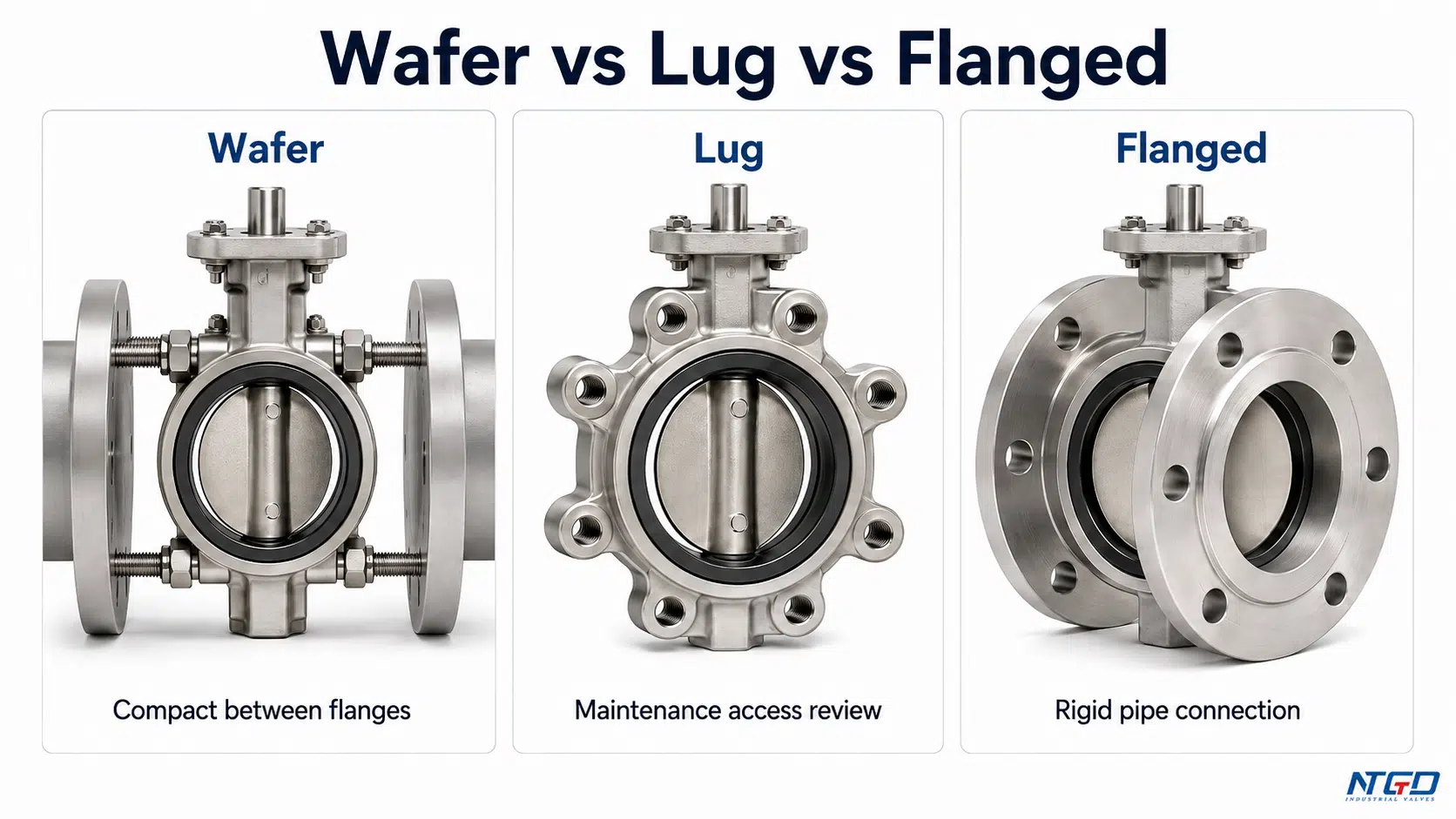
Válvula de mariposa wafer de acero inoxidable
De acero inoxidable válvula de mariposa wafer Se instala entre dos bridas de tubería. Unos pernos largos atraviesan las bridas y mantienen la válvula en su lugar. Este diseño es compacto y económico en comparación con muchos diseños con orejetas o con bridas.
La principal precaución se refiere a la instalación y el mantenimiento. Una válvula de disco normalmente se apoya entre dos bridas, y es posible que no sea adecuada para ciertas condiciones de aislamiento en el extremo de la línea, a menos que el diseño y las especificaciones del fabricante lo permitan. Si el sistema requiere que se retire un lado de la tubería mientras la válvula permanece instalada, el comprador debe verificar si es más adecuado un diseño con orejetas o con bridas.
Si se utiliza un diseño de oblea en el que se requiere la eliminación de la tubería por un solo lado o el aislamiento independiente del extremo de la línea, pero la válvula no está diseñada para esa condición, el resultado puede ser el cierre total de la línea, la falla de la junta, el movimiento de la válvula o el riesgo de fugas durante el mantenimiento.
Válvula de mariposa con orejetas de acero inoxidable
De acero inoxidable válvula de mariposa de orejetas cuenta con puntos de montaje tipo oreja alrededor del cuerpo. Se instala entre bridas mediante pernos desde cada lado. Dependiendo del diseño y la capacidad nominal, una válvula de mariposa tipo oreja puede permitir un mantenimiento más flexible que una válvula tipo wafer.
Un punto importante a tener en cuenta es que el “tipo de oreja” no implica automáticamente que todas las condiciones de extremo de línea sean aceptables. El comprador debe confirmar la presión nominal, los requisitos de dirección del flujo (si los hubiera), la disposición de los pernos, las condiciones de instalación y los límites establecidos por el fabricante.
Para el servicio en callejones sin salida o en extremos de línea, se debe verificar el diseño y la capacidad de los terminales antes de su uso. Si no se verifica esto, la válvula podría utilizarse en una condición de aislamiento que exceda los límites de instalación previstos.
Válvula de mariposa con bridas de acero inoxidable
De acero inoxidable válvula de mariposa con bridas cuenta con extremos con bridas integradas que se conectan directamente a bridas de tubería compatibles. Esta estructura permite una conexión de tubería más rígida y suele elegirse para tamaños más grandes, tuberías más pesadas o aplicaciones en las que se requiere una interfaz de conexión más robusta.
La contrapartida es el peso, el espacio y el costo. Las válvulas de mariposa con bridas suelen requerir más espacio de instalación y una alineación cuidadosa con el estándar de bridas adecuado. Para los proyectos que ya se centran en la selección de conexiones con bridas, el tema específico de las válvulas de mariposa con bridas debería mantenerse separado de esta descripción general sobre el acero inoxidable.
Al elegir una válvula con bridas, también se debe tomar en cuenta la carga de la tubería, la alineación de las bridas, la disposición de los pernos, la elección de la junta y el espacio disponible para la instalación. Una válvula de mariposa de acero inoxidable con bridas puede ser la mejor opción para algunas conexiones rígidas de tuberías, pero no debe seleccionarse únicamente porque parezca más resistente.
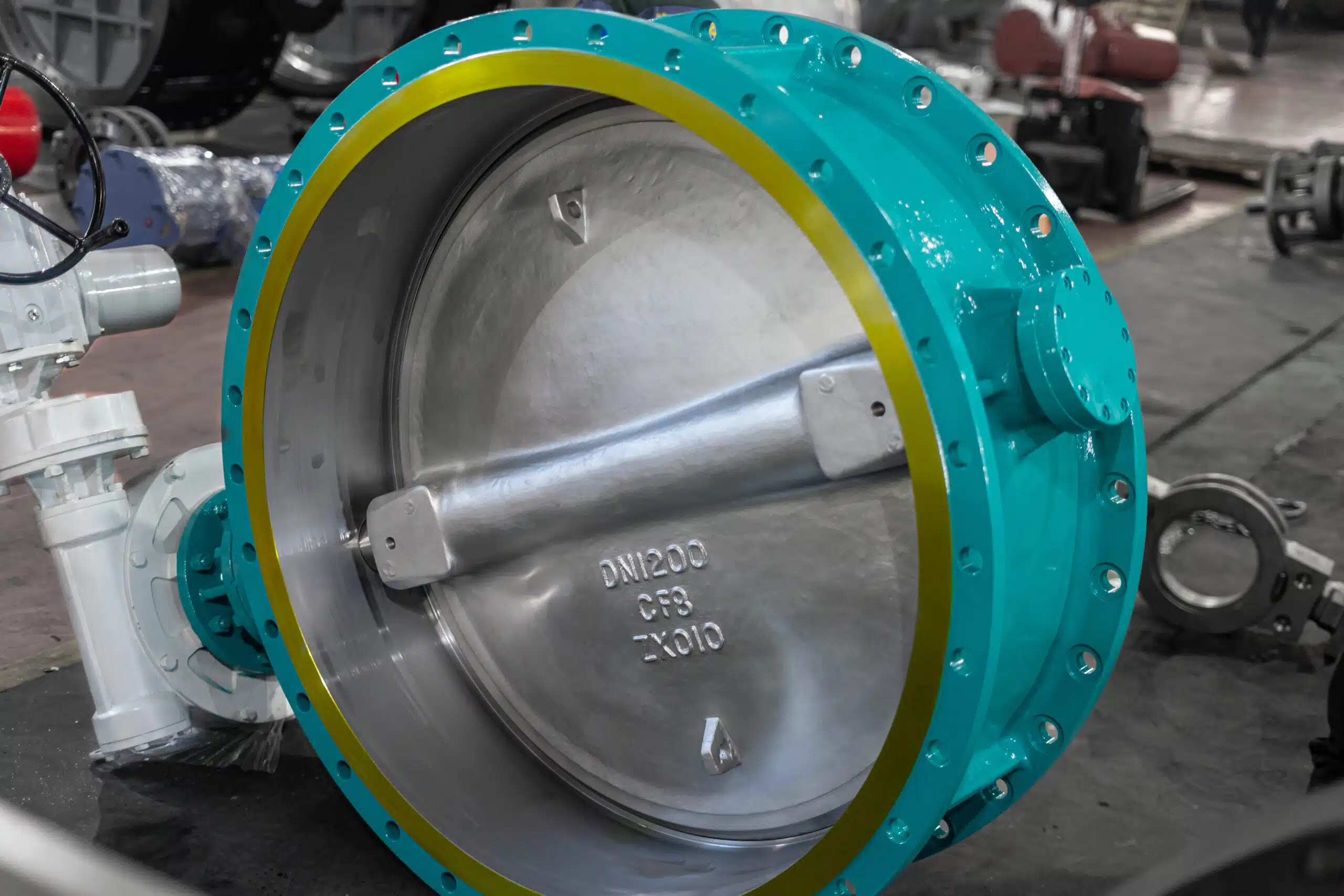
Límite entre la unión a tope y la abrazadera sanitaria
Una válvula de mariposa de acero inoxidable con soldadura a tope se utiliza cuando la válvula se suelda directamente a la tubería. Esto puede reducir los puntos de fuga en las bridas, pero también dificulta su desmontaje, reparación y reemplazo. Solo debe seleccionarse cuando el diseño de la tubería y la filosofía de mantenimiento permitan la instalación soldada.
Las válvulas de mariposa con abrazadera sanitaria son comunes en aplicaciones de alimentos, bebidas, productos lácteos, productos farmacéuticos y procesos de limpieza. Sin embargo, el hecho de que la válvula esté fabricada en acero inoxidable no la convierte por sí solo en una válvula sanitaria. El servicio sanitario puede requerir una geometría específica del cuerpo, un acabado superficial adecuado, una conexión con abrazadera, facilidad de limpieza, selección de elastómeros, documentación y requisitos de aprobación del proyecto.
La selección más detallada de conexiones individuales —como las de solo oblea, solo terminal, solo brida, abrazadera sanitaria o válvulas de mariposa de alto rendimiento— debe tratarse como un tema aparte, para que esta página se centre en las especificaciones de las válvulas de mariposa de acero inoxidable en su conjunto.
Límite concéntrico frente a límite de alto rendimiento
Una válvula de mariposa concéntrica de acero inoxidable tiene el vástago alineado con el eje central del disco y, por lo general, cuenta con un asiento blando o un revestimiento. Es común en muchos servicios públicos e industriales.
Válvulas de mariposa de alto rendimiento, las válvulas de mariposa de doble desplazamiento, las de triple desplazamiento y los diseños con asiento metálico pertenecen a una categoría destinada a condiciones de servicio más severas. Pueden seleccionarse para presiones más altas, temperaturas más elevadas o condiciones de cierre más exigentes, pero no deben incluirse en la categoría de válvulas de mariposa estándar de acero inoxidable sin antes verificar su diseño.
Compatibilidad entre el asiento y el forro
La selección del asiento y el revestimiento es uno de los aspectos más importantes en las especificaciones de una válvula de mariposa de acero inoxidable. El cuerpo de acero inoxidable ofrece ventajas mecánicas y de resistencia a la corrosión, pero el asiento es la pieza que garantiza el cierre hermético alrededor del disco.
En muchas válvulas de mariposa de acero inoxidable, el asiento o revestimiento puede convertirse en el factor limitante en cuanto a la compatibilidad con los fluidos, la confiabilidad del cierre, la idoneidad para la temperatura y el par de operación. Si el material del asiento no es el adecuado, la válvula puede presentar fugas, hincharse, agrietarse, desgastarse o requerir un par excesivo. Esto puede ocurrir incluso cuando el cuerpo y el disco están fabricados en acero inoxidable.
| Material del asiento / revestimiento | Puesto típico de selección | Precaución |
|---|---|---|
| EPDM | Directrices generales para los servicios de agua, servicios públicos y algunos servicios de limpieza | No es apto para aceites, hidrocarburos ni todos los medios químicos |
| NBR | A menudo se toma en cuenta para determinar la compatibilidad con el petróleo | Se deben verificar la temperatura, el medio y el riesgo de hinchazón |
| PTFE | Pautas generales sobre la resistencia química | Se deben verificar el par, el comportamiento de sellado y los límites de diseño |
| RTFE | Opción de PTFE reforzado para ciertos diseños | Los límites de aplicación dependen del diseño de la válvula |
| Viton / FKM | Mayor resistencia a la temperatura o a los productos químicos en algunos servicios | Se deben verificar cuidadosamente el costo y la compatibilidad |
| Sello metálico / duro | Aplicaciones de servicio extremo o altas temperaturas | A menudo forma parte de diseños de válvulas de alto rendimiento o de compensación |
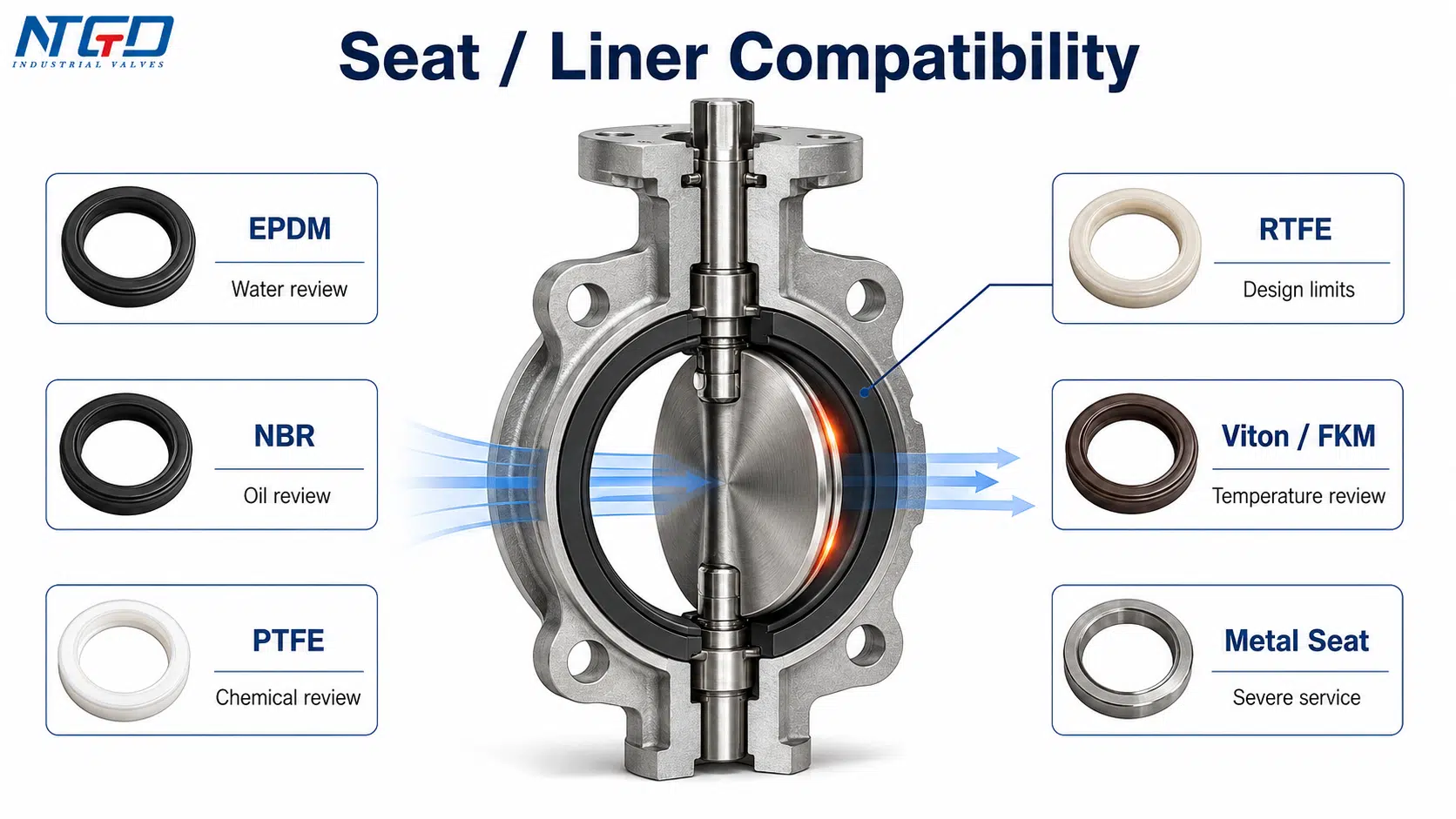
EPDM y NBR
El EPDM se utiliza con frecuencia en aplicaciones de agua, servicios públicos y ciertos servicios de fluidos limpios. No es un material universal para asientos, especialmente cuando hay presencia de aceite, hidrocarburos o sustancias químicas incompatibles. Los compradores deben verificar la compatibilidad con los fluidos en lugar de dar por sentado que el EPDM es adecuado solo porque el cuerpo es de acero inoxidable.
Un cuerpo de acero inoxidable con un asiento de EPDM puede ser una opción práctica para muchos servicios de agua o de servicios públicos, pero esa misma combinación podría no ser adecuada para otros fluidos. La decisión final debe basarse en el fluido específico, la temperatura, el método de limpieza y los requisitos de cierre.
El NBR suele considerarse cuando se requiere compatibilidad con el aceite, pero su idoneidad específica para el servicio depende del medio, la concentración, la temperatura y el diseño de la sede del fabricante. También se debe verificar si el NBR presenta riesgo de hinchamiento o envejecimiento en el fluido real.
PTFE y RTFE
El PTFE suele elegirse cuando la resistencia química es un factor clave. En las válvulas de mariposa de acero inoxidable, los diseños de PTFE o revestidos de PTFE pueden resultar útiles en aplicaciones químicas, corrosivas o de procesos limpios, dependiendo de la estructura completa de la válvula.
Sin embargo, elegir el PTFE por su resistencia química no elimina la necesidad de verificar el par de apriete, el comportamiento de sellado, los límites de presión y temperatura, y el diseño de la válvula. Una válvula de mariposa de acero inoxidable con asiento de PTFE puede comportarse de manera diferente a una válvula con asiento de elastómero tanto en funcionamiento como en cierre.
El RTFE, o PTFE reforzado, puede utilizarse cuando el diseño requiera un comportamiento mecánico mejorado en comparación con el PTFE puro. El comprador debe verificar la construcción exacta del asiento, los límites de presión y temperatura, el efecto del par de apriete y los requisitos de cierre consultando la hoja de datos de la válvula.
Viton / FKM
El Viton / FKM suele considerarse cuando se requiere una mayor resistencia a las altas temperaturas o a los productos químicos. No es automáticamente adecuado para todas las condiciones químicas o térmicas. Antes de seleccionarlo, se deben verificar el costo, la compatibilidad y los límites de servicio.
El uso correcto del Viton / FKM depende del medio concreto, la temperatura, la frecuencia de los ciclos y los requisitos de sellado. Debe evaluarse como parte del ensamblaje completo de la válvula, no como una mejora independiente.
Límite de sellado metálico o rígido
Los asientos metálicos o las juntas rígidas suelen asociarse con condiciones de servicio más severas, temperaturas más altas o diseños de válvulas de mariposa de alto rendimiento. Es posible que no ofrezcan el mismo comportamiento de cierre que los asientos elásticos y, a menudo, requieren una revisión más minuciosa del diseño.
En esta página, el tema de los asientos metálicos debe tratarse de manera secundaria. Si el proyecto requiere asientos metálicos, altas temperaturas, medios abrasivos o un cierre crítico, el comprador debe verificar si es más adecuada una válvula de mariposa de alto rendimiento o una válvula de mariposa con desplazamiento.
La selección de asientos debe verificarse con respecto a compatibilidad química, concentración del medio, temperatura, requisito de cierre, frecuencia de ciclo, método de limpieza y par del actuador.
Cómo funciona una válvula de mariposa de acero inoxidable
Una válvula de mariposa de acero inoxidable funciona mediante la rotación de un disco dentro de la tubería. El disco está conectado a la manija, al operador de engranajes o al actuador a través del vástago. Cuando el operador gira la válvula, el par de torque se transmite a través del vástago y hace girar el disco.
En la posición abierta, el disco suele estar alineado con la trayectoria del flujo, lo que permite que el fluido pase a través de la válvula. En la posición cerrada, el disco gira transversalmente a la trayectoria del flujo y entra en contacto con el asiento para detener el flujo. Para la regulación del caudal, el disco puede colocarse parcialmente abierto; sin embargo, la idoneidad de este uso depende de la aplicación, la caída de presión, la estabilidad del flujo, el diseño del asiento y las especificaciones de la válvula.
Movimiento del disco de un cuarto de vuelta
Normalmente, la válvula pasa de la posición abierta a la cerrada mediante un movimiento de cuarto de vuelta de 90 grados. Esto hace que las válvulas de mariposa sean más rápidas de operar que muchos tipos de válvulas multivuelta. El accionamiento manual mediante palanca es común en los tamaños más pequeños, mientras que el accionamiento por engranajes se utiliza con frecuencia cuando el par es mayor.
Para la selección, se debe evaluar el movimiento de cuarto de vuelta junto con la fricción del asiento, el riesgo de acumulación de medios y el par del actuador. Un funcionamiento rápido es útil, pero no resuelve los problemas de compatibilidad del asiento ni una actuación insuficiente.
Cómo el contacto con el asiento provoca el cierre
El cierre depende del contacto entre el disco y el asiento. Si el asiento está desgastado, ha sufrido un ataque químico, está dañado por partículas sólidas o no es compatible con el fluido, la válvula puede presentar fugas incluso si el cuerpo de acero inoxidable se mantiene en buenas condiciones.
Por eso, el principio de funcionamiento no debe entenderse únicamente como “el disco se abre y se cierra”. A la hora de elegir, lo importante es cómo el disco, el asiento, el par del vástago, las condiciones de presión y el fluido afectan la confiabilidad del cierre.
Dado que el cierre depende del contacto entre el disco y el asiento, al evaluar el riesgo de fugas, el material del asiento y la revisión del par de apriete pueden ser más importantes que el cuerpo de acero inoxidable por sí solo.
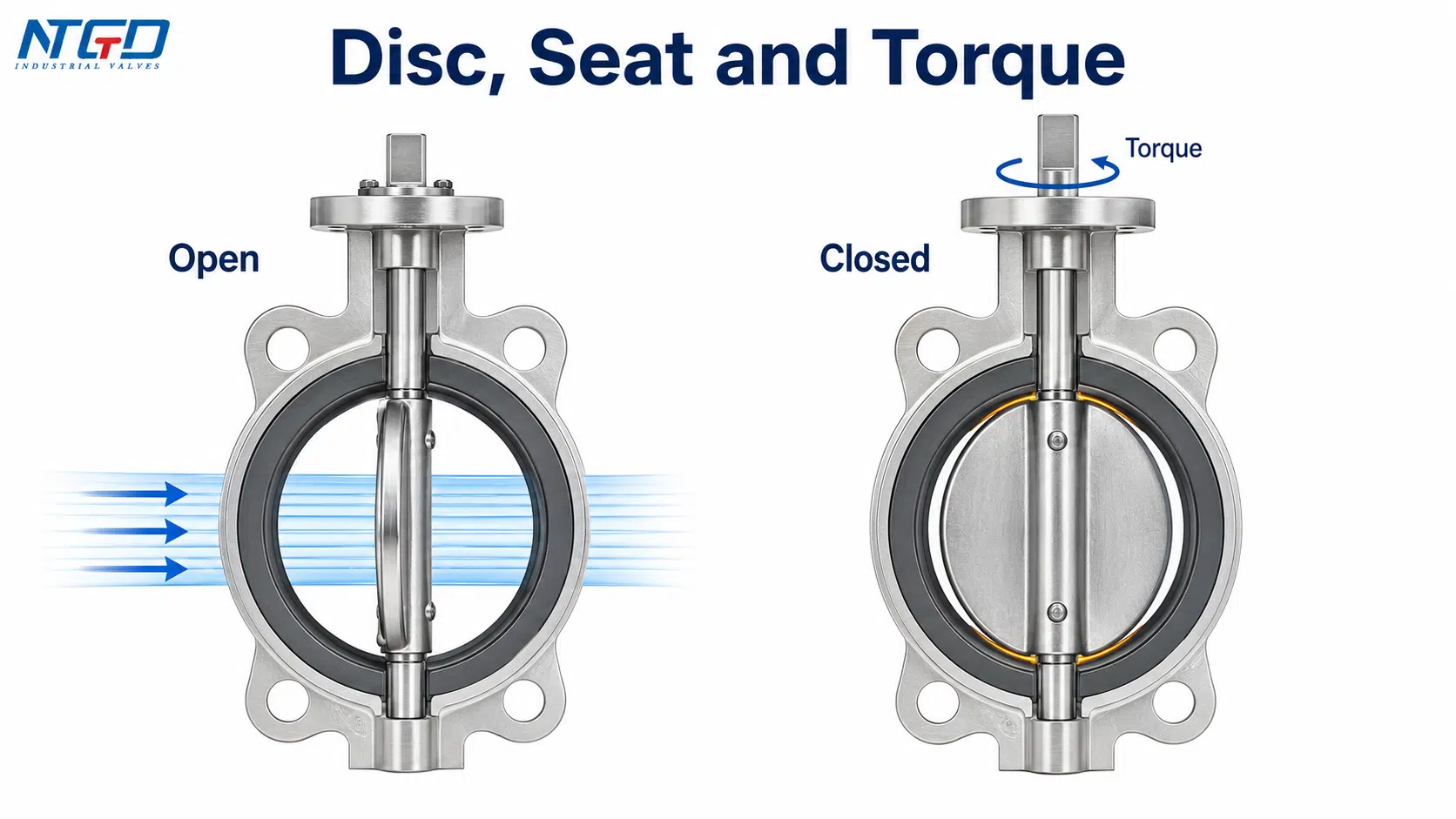
Por qué es importante el dimensionamiento de los asientos, el par y los actuadores
El material del asiento influye en el par de operación. Una válvula con asiento de PTFE, elastómero o metal puede requerir una fuerza de operación diferente según el tamaño, las condiciones de presión y los medios de servicio. Cuando se acciona una válvula, el actuador debe dimensionarse en función del requisito real de par de la válvula, y no solo del tamaño nominal.
Si el actuador es de tamaño insuficiente, es posible que la válvula no se abra o se cierre por completo. Si el asiento o el fluido provocan una fricción excesiva, el accionamiento manual puede resultar difícil. Estos problemas suelen detectarse más adelante como dificultades de resolución de fallas, pero muchos de ellos pueden reducirse mediante una selección adecuada durante la etapa de solicitud de cotización.
Adecuación de la aplicación y límites de diseño
Las válvulas de mariposa de acero inoxidable se utilizan en numerosas aplicaciones industriales y de proceso, ya que combinan una estructura compacta, un funcionamiento rápido, resistencia a la corrosión y múltiples opciones de conexión. Sin embargo, la aplicación más adecuada depende tanto de los materiales metálicos como de las piezas de sellado blandas.
| Condiciones del servicio | Apto para válvulas de mariposa de acero inoxidable | Qué hay que confirmar |
|---|---|---|
| Agua / servicios públicos | A menudo adecuado para el aislamiento o el control de flujo | Material del asiento, clase de presión, norma de bridas |
| Aguas residuales | Es posible, dependiendo de los sólidos y las condiciones de limpieza | Abrasión, obstrucción, desgaste de los asientos y acceso para la limpieza |
| Medios químicos | El cuerpo y el disco de acero inoxidable podrían ser de ayuda | Grado, concentración, temperatura y compatibilidad con el asiento |
| Petróleo, gas y servicios industriales | Posible en determinadas aplicaciones | Presión, temperatura, requisitos de seguridad y material de los asientos |
| Servicio marítimo | Los materiales inoxidables pueden ser útiles | Exposición al cloruro, selección de la calidad y entorno externo |
| Alimentación y bebidas | El acero inoxidable es un material común, pero por sí solo no garantiza que la válvula sea higiénica | Diseño higiénico del cuerpo, acabado de la superficie, conexión con abrazadera, facilidad de limpieza, documentación del asiento y aprobación del proyecto |
| Temperatura y presión extremas | Puede requerir un diseño de alto rendimiento | Diseño de desplazamiento, asiento metálico, clasificación y límites de la hoja de datos |
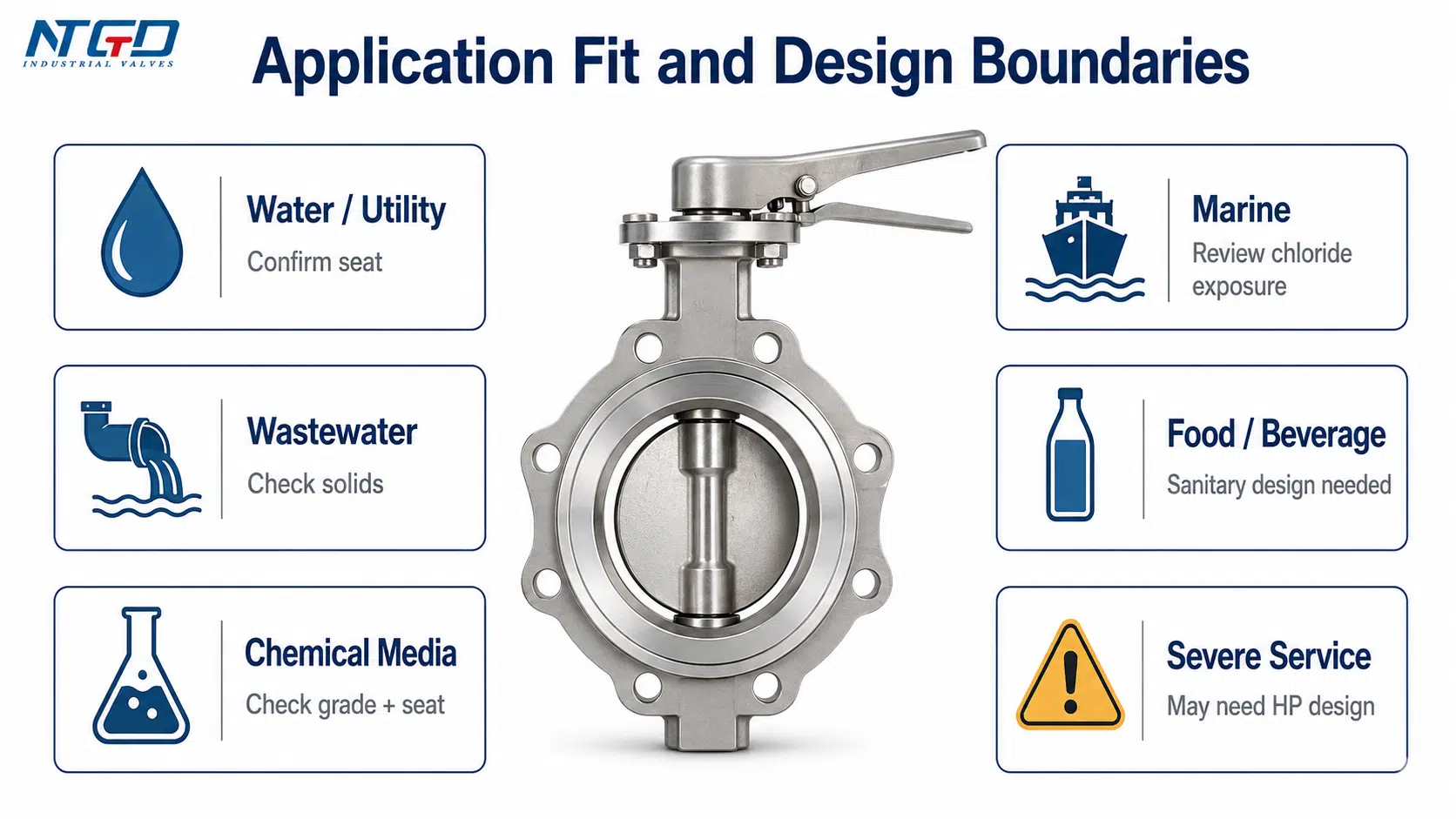
Agua, aguas residuales y servicios públicos
En los sistemas de agua y servicios públicos, se pueden elegir válvulas de mariposa de acero inoxidable cuando se requiere resistencia a la corrosión o superficies de material más higiénicas. No obstante, el comprador debe confirmar el material del asiento, la clase de presión, la norma de bridas y si la válvula se utilizará para aislamiento, regulación o control general del flujo.
El servicio de aguas residuales requiere especial cuidado. Los sólidos, la arena, los residuos y las condiciones de limpieza pueden afectar al disco, al asiento y al par de operación. El acero inoxidable puede ayudar a prevenir la corrosión, pero no elimina la necesidad de revisar la abrasión, las acumulaciones y el acceso para el mantenimiento.
Sustancias químicas y corrosivas
El servicio químico es una de las razones más comunes por las que los compradores optan por válvulas de mariposa de acero inoxidable. Un cuerpo o disco de acero inoxidable puede mejorar la resistencia a la corrosión en comparación con otros materiales, pero el grado exacto debe ser adecuado para el medio.
En el caso de medios corrosivos, el comprador debe confirmar el nombre del fluido, su concentración, la temperatura, la posible presencia de sólidos, los productos químicos de limpieza y si el asiento es compatible. En muchos casos, la selección del asiento es el factor limitante, no el cuerpo de acero inoxidable.
Un marco básico para la selección consiste en comenzar por el fluido y la temperatura reales, luego analizar el tipo de acero inoxidable, después evaluar el material del asiento y del revestimiento, y finalmente confirmar el diseño de la válvula. Sin seguir esta secuencia, una válvula podría parecer adecuada por el material del cuerpo, pero fallar a nivel del asiento, la junta, la empaquetadura o el actuador.
Área de alimentos, bebidas e higiene
El acero inoxidable se utiliza ampliamente en entornos de alimentos, bebidas y procesos limpios; sin embargo, una válvula de mariposa de acero inoxidable no es automáticamente una válvula sanitaria. Una válvula sanitaria puede requerir una geometría higiénica del cuerpo, conexiones con abrazaderas, superficies pulidas, facilidad de limpieza, documentación sobre los elastómeros y requisitos de aprobación específicos para cada proyecto.
Si el proyecto es verdaderamente higiénico, la solicitud de cotización no solo debe indicar “válvula de mariposa de acero inoxidable”. Debe especificar el tipo de conexión, los requisitos de acabado superficial, el método de limpieza, el material del asiento, los requisitos de documentación y si el diseño de la válvula está destinado a un uso higiénico.
No se debe dar por sentado que una válvula de mariposa industrial estándar de acero inoxidable es apta para uso sanitario solo porque el cuerpo o el disco sean de acero inoxidable.
Servicios para los sectores petrolero, gasífero, marítimo e industrial
Las válvulas de mariposa de acero inoxidable pueden utilizarse en aplicaciones de petróleo, gas, marítimas, petroquímicas, de refinería, de energía y de la industria en general, dependiendo de la clase de presión, los fluidos, la temperatura y los requisitos de cierre. En estos servicios, las especificaciones deben confirmar si basta con una válvula concéntrica estándar o si se requiere una válvula de mariposa de alto rendimiento.
El uso en el sector marítimo requiere una atención especial a la exposición al cloruro y a la corrosión externa. El uso en el sector del petróleo y el gas puede requerir normas adicionales para el proyecto, pruebas, consideraciones de seguridad contra incendios o documentación sobre los materiales. Estos aspectos deben verificarse según las especificaciones del proyecto, en lugar de darse por sentados a partir de la denominación del acero inoxidable.
Cuando el acero inoxidable puede no ser suficiente
Es posible que el acero inoxidable no sea suficiente cuando el fluido sea altamente corrosivo para el grado seleccionado, cuando el asiento sea incompatible, cuando la temperatura supere el límite del asiento, cuando los sólidos provoquen una abrasión severa o cuando la presión y los requisitos de cierre excedan el diseño estándar de la válvula.
En estos casos, la solución podría ser un grado diferente de acero inoxidable, un asiento diferente, una válvula revestida, una válvula de mariposa de alto rendimiento, un diseño con asiento metálico u otro tipo de válvula. La decisión correcta depende de las condiciones completas de servicio.
Si la compatibilidad de los asientos, el riesgo de corrosión, los sólidos, los parámetros de presión y temperatura, el par del actuador o los requisitos de cierre exceden el diseño estándar de la válvula, se debe revisar el proyecto comparando la hoja de datos del fabricante con las condiciones de aplicación antes de realizar la selección definitiva.
Lista de verificación de especificaciones antes de la solicitud de cotización
Una solicitud de cotización clara ayuda a evitar una selección incorrecta de la válvula. En lugar de solicitar únicamente una “válvula de mariposa de acero inoxidable”, el comprador debe proporcionar información suficiente para que el fabricante pueda verificar el material, el asiento, la conexión, la presión, el funcionamiento y la aplicación.
| Partida de la solicitud de cotización | Por qué es importante |
|---|---|
| Talla | Evita que no coincidan el diámetro interior de la tubería y el espacio de instalación |
| Clase de presión | Confirma la resistencia del cuerpo, la compatibilidad de las bridas y la clasificación del proyecto |
| Tipo de conexión | Determina si el ajuste es tipo wafer, con orejetas, con reborde, soldado o con abrazadera sanitaria |
| Norma de bridas | Evita que no coincidan el patrón de pernos, la junta y la instalación |
| Material de la carrocería | Confirma que el material está a presión |
| Material del disco | Confirma el material principal en contacto con el líquido en las partes giratorias |
| Material del vástago | Confirma la transmisión del par y la exposición a la corrosión |
| Material del asiento / revestimiento | Confirma la estanqueidad, la compatibilidad con los medios y la idoneidad en cuanto a la temperatura |
| Medios de comunicación y concentración | El punto de partida para la selección tanto del metal como del material del asiento; la información incompleta sobre los medios de comunicación es uno de los mayores riesgos de una solicitud de cotización |
| Temperatura | Influye en la selección del asiento, la junta, el empaque y el actuador |
| Método de funcionamiento | Determina si se trata de una palanca, un engranaje, un actuador neumático o un actuador eléctrico |
| Requisitos del actuador | Define la posición de fallo, la señal de control, el voltaje, el suministro de aire y la retroalimentación |
| Dibujo / hoja de datos | Facilita la revisión de proyectos y la verificación de dimensiones |
| Pruebas / documentación | Cumple con los requisitos de inspección, aprobación y calidad |
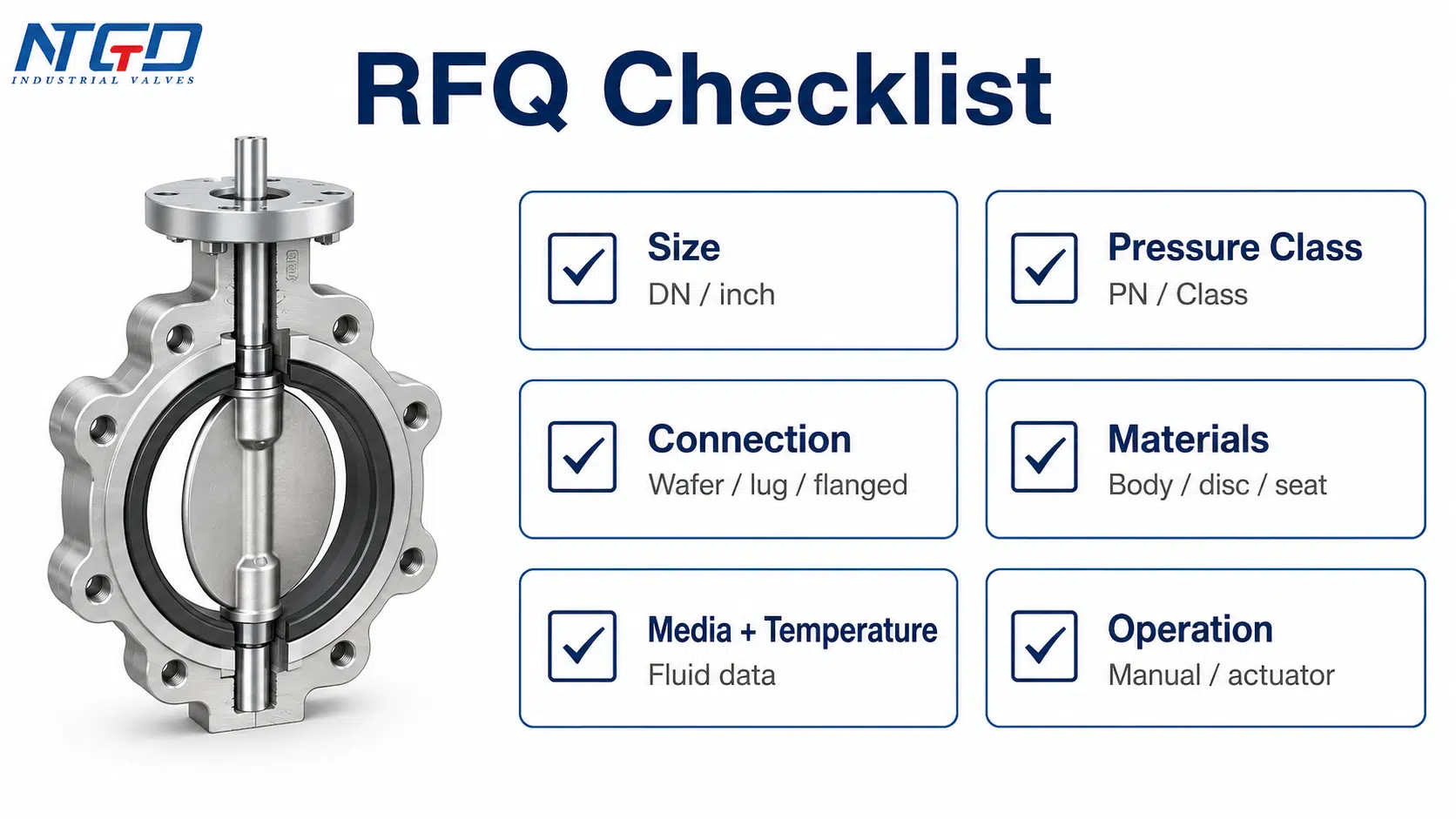
Tamaño, clase de presión y norma de bridas
El tamaño debe indicarse en DN o pulgadas. Por ejemplo, un comprador puede solicitar una válvula de mariposa de acero inoxidable de 2 pulgadas, pero el tamaño por sí solo no es suficiente. La solicitud de cotización también debe incluir la clase de presión, norma de bridas, el tipo de conexión y el requisito de unión cara a cara si el proyecto tiene límites dimensionales.
La clase de presión debe verificarse en función del diseño del cuerpo de la válvula, la interfaz de la brida, el asiento y la temperatura. No se debe dar por sentado que todas las válvulas de mariposa de acero inoxidable del mismo tamaño tengan la misma capacidad de presión.
Material del cuerpo, el disco, el vástago y el asiento
La solicitud de cotización debe especificar por separado el material del cuerpo, el disco, el vástago y el asiento. Un requisito claro podría indicar: cuerpo de acero inoxidable, disco de acero inoxidable, vástago de acero inoxidable y un material específico para el asiento. Si el medio de proceso entra en contacto con varias piezas, se deben enumerar claramente las piezas en contacto con el medio.
Esto es especialmente importante cuando el comprador necesita opciones de 304, 316, CF8, CF8M, PTFE, RTFE, EPDM, NBR, Viton / FKM o con asiento metálico. Las expresiones imprecisas como “todo de acero inoxidable” pueden dar lugar a malentendidos.
Requisitos relativos al medio, la temperatura y el cierre
La información sobre el fluido debe incluir el nombre del fluido, su concentración, el contenido de sólidos, la viscosidad, el método de limpieza y la temperatura. Si la válvula se utiliza para cierre, regulación o funcionamiento frecuente, también se debe indicar.
Es posible que una válvula utilizada para el aislamiento ocasional en agua limpia no requiera el mismo diseño que una válvula utilizada para sustancias químicas corrosivas, lodos, medios que forman residuos o ciclos automatizados. Las condiciones de servicio deben determinar la selección final del material y del asiento.
El medio y la temperatura deben considerarse como el punto de partida de la solicitud de cotización, no como información adicional opcional. Si estos datos están incompletos, es posible que el fabricante no pueda confirmar si el grado de acero inoxidable, el asiento, la junta, el empaque y el actuador son adecuados.
Accionamiento manual, por engranajes, neumático o eléctrico
Operación manual de la válvula de mariposa Es sencillo y compacto, pero es posible que no sea adecuado para válvulas más grandes o en condiciones de mayor par. El funcionamiento por engranajes reduce el esfuerzo manual. Los actuadores neumáticos y eléctricos facilitan la automatización, pero requieren información sobre el par y su control.
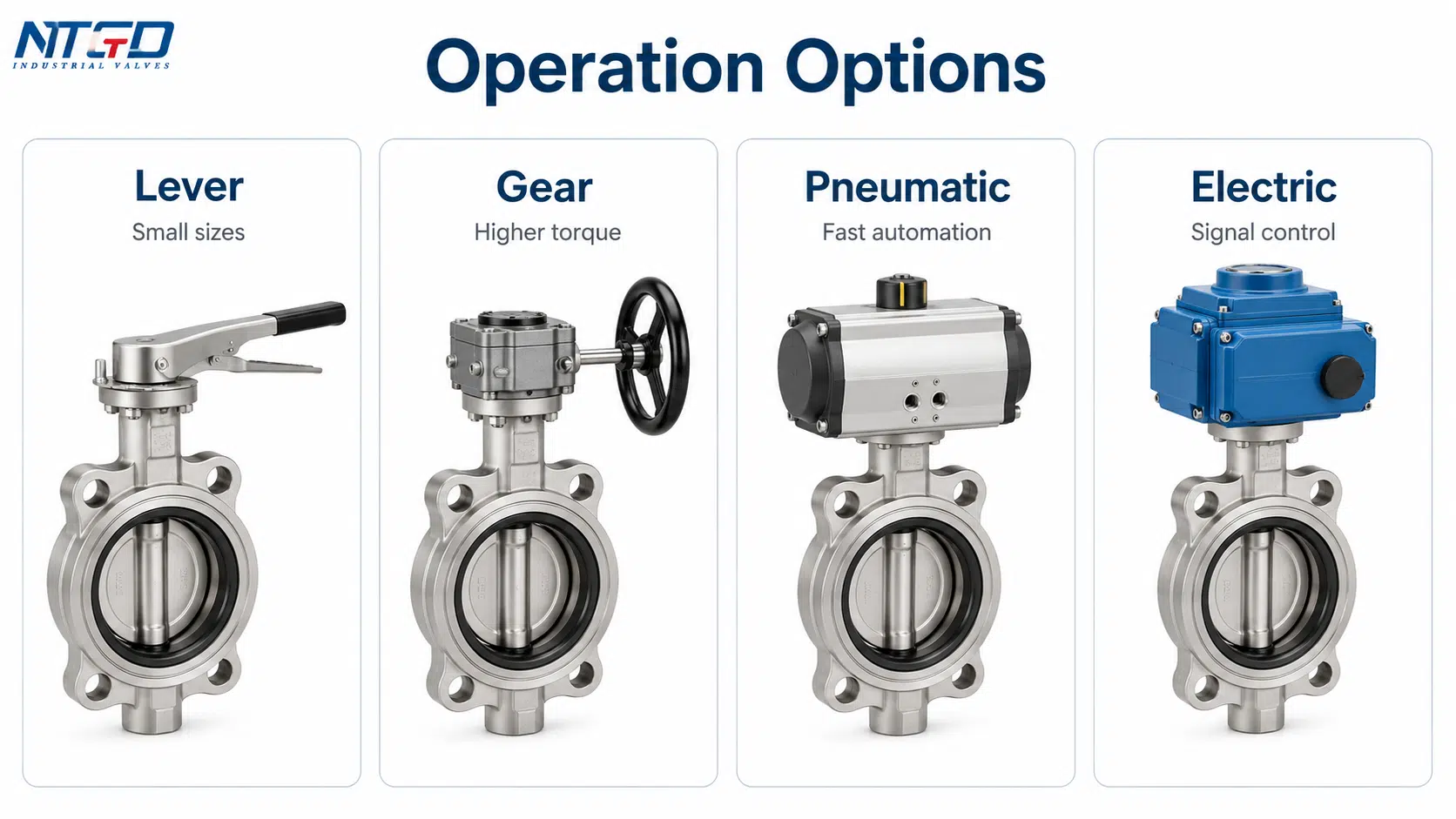
En el caso de las válvulas de mariposa accionadas de acero inoxidable, la solicitud de cotización debe indicar la posición de fallo requerida, el suministro de aire o el voltaje, la señal de control, Fijación del actuador de medio giro interfaz, interruptor de límite, válvula solenoide, posicionador, control manual y entorno del sitio, si corresponde.
Requisitos relativos a los planos, las pruebas y las normas
Los equipos de proyecto suelen necesitar planos, confirmación de materiales, pruebas de presión, datos dimensionales o documentos de inspección antes de dar su aprobación. Estos requisitos deben especificarse desde el principio para que el proveedor pueda adaptar el diseño de la válvula a las necesidades de la documentación del proyecto.
Si el proyecto cuenta con normas o requisitos de prueba específicos, estos deben verificarse comparando la hoja de datos del fabricante y las especificaciones del proyecto. No te bases únicamente en el nombre general del producto.
Verificaciones prácticas previas a la selección
Algunos problemas que surgen posteriormente como dificultades de resolución a menudo pueden minimizarse mediante una especificación más clara. Esta sección no es una guía de resolución de problemas de mantenimiento. Se trata de una verificación de idoneidad en la etapa de selección, destinada a ayudar a los compradores a identificar riesgos comunes antes de realizar el pedido de la válvula.
Muchos de los problemas posteriores, como fugas, funcionamiento difícil, vida útil corta de la sede o problemas de cierre del actuador, pueden reducirse al verificar que el material, la sede, la conexión, el par de apriete y los datos del medio sean los correctos durante la etapa de solicitud de cotización.
| Riesgo de problemas | Verificación de selección |
|---|---|
| Fuga en posición cerrada | Verifique el material del asiento, el estado del disco, los requisitos de cierre y las condiciones de presión |
| Fuga en la conexión de una tubería | Confirma el estándar de la brida, el material de la junta, la disposición de los pernos y la alineación de la instalación |
| Operación difícil | Verificar el par de apriete, el material de la sede, el riesgo de acumulación de residuos y el dimensionamiento del operador y del actuador |
| Fugas externas | Verificar el empaque, la junta, el sellado del vástago y la compatibilidad con la temperatura |
| Configuración de instalación incorrecta | Confirme si se requiere un diseño tipo wafer, con orejetas, con brida, soldado o con abrazadera sanitaria |
| Vida útil corta del asiento | Confirme el medio, la temperatura, los sólidos, los productos químicos de limpieza y la frecuencia de los ciclos |
| Falla del actuador al cerrar | Verifica el par de apriete de la válvula, el factor de seguridad del actuador, el suministro de aire o el voltaje, y la posición de seguridad |
PREGUNTAS FRECUENTES
¿Qué es una válvula de mariposa de acero inoxidable?
Una válvula de mariposa de acero inoxidable es una válvula de cuarto de vuelta cuyo cuerpo, disco, vástago y otras piezas metálicas clave están fabricados en acero inoxidable. Se abre y se cierra girando un disco dentro del conducto de flujo. Se utiliza comúnmente en aplicaciones donde se requiere resistencia a la corrosión, una instalación compacta y un funcionamiento rápido.
¿Una válvula de mariposa de acero inoxidable es lo mismo que una válvula de mariposa de acero inoxidable?
En la mayoría de las conversaciones con los compradores, “válvula de mariposa de acero inoxidable” es una forma abreviada de decir “válvula de mariposa de acero inoxidable”. No obstante, es importante aclararlo en los documentos técnicos, ya que el grado de acero inoxidable, el material del asiento, el tipo de conexión y el método de operación pueden variar.
¿Qué significa «válvula de mariposa SS»?
El término “válvula de mariposa de acero inoxidable” (SS) suele referirse a una válvula de mariposa fabricada en acero inoxidable. Se trata de una expresión abreviada, no de un diseño de válvula específico. En una solicitud de cotización (RFQ), la expresión «válvula de mariposa de acero inoxidable» debe ir seguida de una especificación más clara, como el material requerido para el cuerpo, el disco, el vástago y el asiento, así como el tamaño, la clase de presión, el tipo de conexión y el método de operación.
¿Qué grado de acero inoxidable se utiliza para las válvulas de mariposa?
Entre los materiales de acero inoxidable más comunes se encuentran el 304, el 316, el CF8 y el CF8M, dependiendo de si el componente se fabrica, se mecaniza o se moldea. El grado adecuado depende del medio, la temperatura, el riesgo de corrosión, la clase de presión y las especificaciones del proyecto.
¿Cuál es mejor, el 304 o el 316, para una válvula de mariposa de acero inoxidable?
El 316 suele elegirse cuando se necesita una mayor resistencia a la corrosión, pero no es necesariamente la mejor opción para todas las aplicaciones. El 304 puede ser adecuado para muchos usos generales, mientras que el 316 puede ser preferible para entornos más corrosivos o exigentes. La elección final debe evaluarse teniendo en cuenta el medio, la concentración, la temperatura, el material del asiento y los requisitos del proyecto.
¿Cuál es la diferencia entre CF8 y CF8M?
CF8 y CF8M son designaciones de materiales de acero inoxidable fundido que se utilizan comúnmente para las piezas fundidas de válvulas. CF8 se asocia generalmente con un tipo de acero inoxidable fundido 304, mientras que CF8M se asocia generalmente con un tipo de acero inoxidable fundido 316. Los requisitos exactos del material deben confirmarse mediante la hoja de datos de la válvula y las especificaciones del proyecto.
¿Cuál es la diferencia entre las válvulas de mariposa de acero inoxidable de tipo wafer, lug y con brida?
El criterio de selección más rápido es la instalación y el mantenimiento. Una válvula de mariposa de acero inoxidable tipo wafer es compacta y económica para su instalación entre bridas. Una válvula de mariposa de acero inoxidable tipo lug puede ser más adecuada cuando se necesita acceso para el mantenimiento en un lado de la tubería, dependiendo del diseño y las especificaciones. A menudo se elige una válvula de mariposa de acero inoxidable con bridas cuando se requiere una conexión de tubería más rígida, pero esta requiere más espacio y una alineación cuidadosa de las bridas.
¿De qué material están hechas las válvulas de mariposa de acero inoxidable?
Las opciones comunes de asiento o revestimiento incluyen EPDM, NBR, PTFE, RTFE, Viton/FKM y diseños de sellado metálico o duro. El material adecuado para el asiento depende del fluido, la temperatura, las condiciones de presión, los requisitos de cierre y el diseño de la válvula. El hecho de que el cuerpo sea de acero inoxidable no significa automáticamente que todos los materiales de asiento sean adecuados, por lo que la respuesta práctica es: primero confirme el fluido y la temperatura, y luego confirme el asiento.
¿Se pueden usar válvulas de mariposa de acero inoxidable para medios corrosivos?
Se pueden utilizar en algunos medios corrosivos, pero su idoneidad depende del tipo de acero inoxidable, la concentración del medio, la temperatura, el material del asiento, la junta, el empaque y el diseño de la válvula. Aunque un cuerpo de acero inoxidable puede ayudar a resistir la corrosión, un asiento o una junta incompatibles pueden seguir fallando. Para aplicaciones corrosivas, se deben evaluar conjuntamente tanto las partes metálicas en contacto con el fluido como los materiales de sellado blandos.
¿Las válvulas de mariposa de acero inoxidable son válvulas sanitarias?
No siempre. El acero inoxidable es común en aplicaciones sanitarias y de contacto con alimentos, pero una válvula sanitaria también requiere una geometría adecuada del cuerpo, un acabado superficial adecuado, un tipo de conexión adecuado, un material adecuado para el asiento, facilidad de limpieza y la documentación correspondiente. No se debe dar por sentado que una válvula de mariposa industrial estándar de acero inoxidable sea sanitaria, a menos que su diseño lo confirme.
¿Por qué me cuesta tanto accionar mi válvula de mariposa de acero inoxidable?
Una válvula de mariposa de acero inoxidable puede ser difícil de operar debido al hinchamiento del asiento, la acumulación de medios, la presencia de sólidos atrapados alrededor del disco o del asiento, la corrosión, un tiempo prolongado de inactividad o un operador de engranajes o un actuador de tamaño insuficiente. Antes de reemplazar la válvula, revisa los medios, la temperatura, el material del asiento, el par de apriete requerido y el tamaño del actuador.
¿Qué información se necesita antes de solicitar una cotización para una válvula de mariposa de acero inoxidable?
Una solicitud de cotización útil debe incluir el tamaño, la clase de presión, el tipo de conexión, la norma de bridas, el material del cuerpo, el material del disco, el material del vástago, el material del asiento, el fluido, la temperatura, el método de operación, los requisitos del actuador (si los hay), las necesidades de planos y los requisitos de pruebas o documentación.
Conclusión
Una válvula de mariposa de acero inoxidable resulta útil cuando un sistema de tuberías requiere un accionamiento compacto de un cuarto de vuelta, piezas metálicas resistentes a la corrosión y múltiples opciones de configuración. Sin embargo, la válvula no debe seleccionarse basándose únicamente en el nombre «acero inoxidable». El grado del material, las piezas en contacto con el fluido, la compatibilidad entre el asiento y el revestimiento, el tipo de conexión, el medio, la temperatura, la clase de presión y el método de operación son factores que influyen en el correcto funcionamiento de la válvula.
Para aplicaciones industriales, el enfoque más seguro consiste en considerar las válvulas de mariposa de acero inoxidable como conjuntos completos, en lugar de simples cuerpos de acero inoxidable. Un proceso de selección práctico es el siguiente: primero, confirmar el medio de servicio y la temperatura; luego, elegir el grado de acero inoxidable y el material del asiento o del revestimiento; y, por último, confirmar el tipo de conexión, el método de operación, los requisitos de los planos y los requisitos de pruebas o documentación.
Los datos de servicio incompletos pueden provocar una combinación incorrecta de materiales, incompatibilidad de los asientos, una selección errónea de las conexiones, un funcionamiento difícil o riesgo de fugas. Para recibir apoyo en la selección del proyecto, envíe a NTGD el medio, la temperatura, la clase de presión, el tipo de conexión, los requisitos de material, la preferencia de asiento, el método de operación y los requisitos de planos o pruebas, a fin de que se realice una revisión de ingeniería antes de finalizar las especificaciones de la válvula de mariposa de acero inoxidable.
