
Author Name: Bruce Zheng
Author Role: Co-Founder and Valve Engineer at NTGD Valve
Author Bio: Bruce Zheng is Co-Founder and Valve Engineer at NTGD Valve, focusing on industrial valve selection, application, and technical content for global B2B buyers.
Last Updated: May 27, 2026
Globe valve pressure drop is one of the most important selection factors when a valve is used for throttling, flow regulation, or any service where system pressure loss matters. A globe valve does not provide a straight-through flow path like many gate or full-bore ball valves. Its internal body geometry, disc-seat restriction, and flow direction changes create resistance, and that resistance appears in the piping system as pressure drop or pressure loss.
Cv, or flow coefficient, is closely connected to this topic. In simple terms, Cv describes how much flow a valve can pass under a defined pressure drop condition. A higher Cv generally means the valve can pass more flow under comparable conditions, while a lower Cv usually indicates greater restriction. For globe valves, Cv is especially important because the same nominal valve size can have different flow capacity depending on body pattern, trim design, port opening, seat geometry, and manufacturer design.
For early selection, formulas and Cv tables can help engineers understand the relationship between flow rate, pressure drop, and fluid properties. But they should not replace manufacturer-confirmed datasheet values. In real projects, globe valve pressure drop should be reviewed together with flow rate, fluid properties, inlet and outlet pressure, allowable pressure loss, body pattern, trim design, and required shutoff performance. If pressure drop and Cv are not matched to the actual service, the result may be insufficient pump head, unstable throttling control, unexpected downstream flow loss, or an RFQ that cannot be checked accurately.
What Is Globe Valve Pressure Drop?
Globe valve pressure drop is the difference between the pressure before the valve and the pressure after the valve when fluid flows through it. It is commonly expressed as ΔP.
In practical valve selection, the terms pressure drop, pressure loss, and head loss are often closely related. Pressure drop usually refers to the measured difference between upstream and downstream pressure. Pressure loss describes the energy lost as the fluid passes through the valve. Head loss is often used in hydraulic calculations to express that loss in terms of fluid head.
For a globe valve, pressure drop is not only a theoretical calculation. It affects whether the system can maintain required downstream pressure, whether the pump has enough head, whether the valve can control flow smoothly, and whether excessive velocity, noise, erosion, or cavitation risk may appear.
Pressure Drop, Pressure Loss and Head Loss
When fluid enters a valve, it may accelerate, change direction, pass through a reduced opening, and then expand again. Each of these actions consumes energy. The result is a lower pressure at the outlet side of the valve compared with the inlet side.
In a globe valve, this effect is usually stronger than in straight-through valve designs because the fluid path is more directional and restricted. This is why globe valves are commonly selected for throttling and control duties, but they are not usually the first choice when minimum pressure loss is the main requirement.
Why a Valve Creates Pressure Drop in a Piping System
A valve creates pressure drop because it introduces a local resistance into the piping system. Even when a valve is fully open, the internal geometry of the body, seat, disc, plug, or trim can disturb the flow.
In a globe valve, pressure drop can be affected by body pattern, disc-seat restriction, opening position, flow rate, fluid properties, and manufacturer design. These factors should be reviewed together instead of being judged only by nominal valve size.
Why Globe Valves Usually Create Higher Flow Resistance
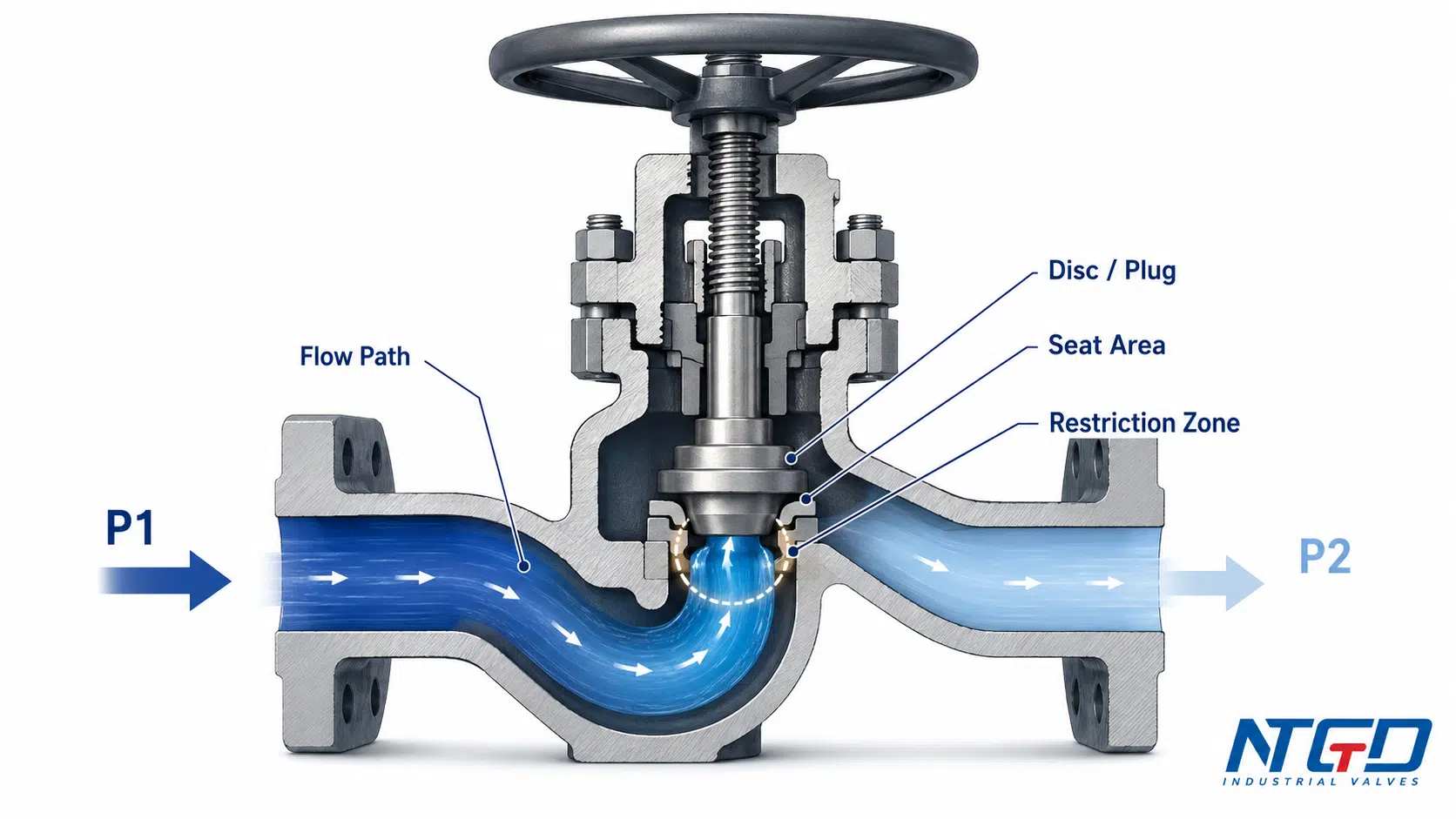
Globe valves usually create higher flow resistance because the fluid does not travel through a simple straight bore. The flow must pass through the valve body, turn around the seat area, move through the disc-seat opening, and then leave the valve through another shaped passage.
This geometry is useful when the valve is intended to regulate flow, but it also creates more resistance than a straight-through flow path. This higher resistance is one reason globe valves are useful for throttling, but it also means they are usually not the first choice when the system requires the lowest possible pressure loss.
Direction Changes Inside the Globe Valve Body
In many T-pattern or Z-pattern globe valves, the fluid changes direction inside the valve body. Instead of moving in a straight line, it follows a more tortuous path through the body and seat area.
These direction changes create turbulence and energy loss. As a result, the valve may have a higher pressure drop than a gate valve or full-port ball valve of similar nominal size. When allowable pressure drop is tight, body pattern should be reviewed early, not after the valve size has already been fixed.
This does not mean a globe valve is a poor choice. It means its function is different. A globe valve is often selected when throttling, shutoff control, or regulation is more important than minimum flow resistance.
For a deeper comparison of why globe valves are used for throttling while gate valves are usually selected for low-loss isolation, see NTGD’s guide to gate valve vs globe valve selection.
Disc, Plug and Seat Restriction
The disc, plug, and seat area are central to globe valve pressure drop. The fluid must pass through the opening between the disc and seat. When the valve is partially open, that opening becomes smaller, increasing velocity and resistance.
This is why a globe valve can restrict flow. In throttling service, that restriction is the working principle that allows the valve to regulate flow. But if the valve is undersized, poorly matched to the required flow rate, or used in a system with limited available pressure, the resulting pressure drop may become a problem.
If a globe valve is undersized for throttling service, small changes in opening can cause large pressure changes and reduce control stability. This is one reason the disc-seat area, trim design, and expected operating range should be reviewed before final selection.
Readers who need the operating sequence before reviewing pressure drop can also refer to NTGD’s guide on how a globe valve works.
Body Pattern and Opening Position Matter
Not all globe valves have the same pressure drop behavior. A T-pattern or Z-pattern globe valve usually creates more resistance than a Y-pattern or angle-pattern design, depending on the specific construction. A Y-pattern body often provides a smoother flow path, while an angle globe valve may reduce direction changes in certain piping layouts.
Opening position also matters. A fully open globe valve has one flow capacity. A partially open globe valve has a different effective opening and a different pressure drop behavior. This is why full-open Cv should not automatically be used as the operating Cv for throttling conditions.
Where pressure drop allowance is very limited, a T/Z-pattern globe valve may not be the best starting point. Y-pattern or angle designs should be evaluated before final specification when the application requires throttling but cannot tolerate high pressure loss.
For a dedicated body-pattern comparison, NTGD’s Tee Pattern vs Y Pattern Globe Valve guide explains when lower pressure loss justifies a Y-pattern route.
What Is Cv in a Globe Valve?
Cv, or flow coefficient, is a standard way to describe the flow capacity of a valve. In valve selection, it helps engineers understand how much flow can pass through a valve for a given pressure drop.
For a globe valve, Cv is important because globe valves often have lower flow capacity than straight-through valves of the same nominal size. This is mainly due to the internal flow path and seat restriction.
Cv / Flow Coefficient Definition
Cv is commonly defined as the number of U.S. gallons per minute of water at a standard temperature that will flow through a valve with a pressure drop of 1 psi.
In many datasheets, the published Cv refers to the rated full-open flow coefficient. The effective Cv at a throttling position can be lower and should be checked separately when control performance matters.
In practical terms:
- Higher Cv means the valve can pass more flow under comparable conditions.
- Lower Cv means the valve creates more restriction under comparable conditions.
- Cv is not the same as valve size.
- Cv is not fixed for all globe valves of the same nominal diameter.
A 2-inch globe valve from one manufacturer may not have the same Cv as another 2-inch globe valve if the body pattern, trim, seat design, or internal port geometry is different.
For a neutral engineering reference on Cv, Kv and the pressure-loss relationship, see Pipe Flow’s guide to Cv and Kv flow coefficients.
Basic Cv Formula and Variables
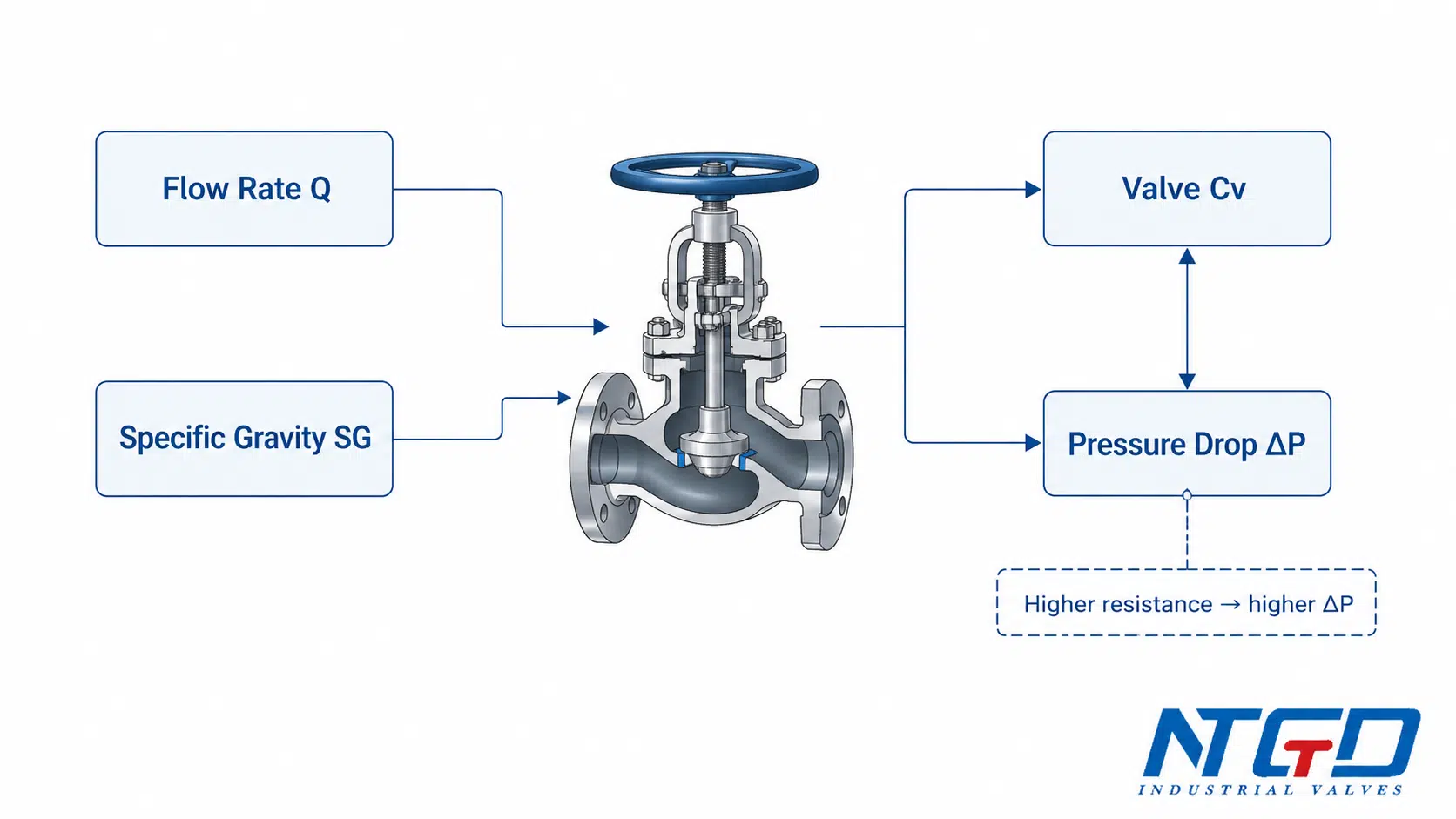
For liquid service, a common simplified relationship is:
Cv = Q × √(SG / ΔP)
Where:
- Cv = valve flow coefficient;
- Q = flow rate;
- SG = specific gravity of the fluid;
- ΔP = pressure drop across the valve.
This formula helps explain the relationship between flow rate, pressure drop, and fluid properties. However, it should be used carefully. It is not a replacement for manufacturer sizing data, especially for gas, steam, viscous media, flashing, cavitation risk, or severe service conditions.
Cv vs Kv for International Valve Selection
Cv is commonly used in U.S. customary units, while Kv is commonly used in metric-based valve sizing. Both describe valve flow capacity, but they use different unit systems.
For international B2B valve projects, buyers may see either Cv or Kv in datasheets. The important point is not only the unit, but whether the value is confirmed for the actual valve design, size, trim, opening condition, and service condition.
If a datasheet gives Kv while the project uses Cv-based calculations, confirm the conversion basis with the manufacturer or project engineer instead of assuming that the number alone confirms valve suitability.
How Cv, Pressure Drop and Flow Resistance Work Together
Pressure drop, Cv, and flow resistance are related but not identical. Understanding the difference helps avoid common sizing mistakes.
A globe valve may have a lower Cv because its internal flow path creates more restriction. That restriction causes energy loss. In the piping system, the energy loss appears as pressure drop.
Lower Cv Usually Means More Restriction Under Comparable Conditions
Under comparable fluid and flow conditions, a valve with a lower Cv usually creates more resistance. If the required flow rate stays the same and the Cv is lower, the valve may need a higher pressure drop to pass that flow.
This is why globe valve Cv matters in selection. If the Cv is too low, the valve may cause excessive pressure drop and reduce downstream flow. If the Cv is too high for a throttling application, the valve may operate too close to the closed position, making control less stable.
Cv Is the Capacity View; K Is the Resistance View
Cv and K coefficient are both related to flow behavior, but they are used differently.
| Concept | What It Describes | Practical Meaning | Common Use | Boundary |
|---|---|---|---|---|
| Pressure drop / ΔP | Pressure difference across the valve | How much pressure is lost through the valve | System pressure review | Do not judge every operating position from one rated pressure drop value. |
| Cv / flow coefficient | Valve flow capacity | How much flow the valve can pass for a defined pressure drop | Valve sizing and datasheet comparison | Do not replace manufacturer-confirmed valve data with a generic Cv table. |
| Flow resistance | Opposition to fluid movement through the valve | Higher resistance usually means higher pressure loss | Selection and troubleshooting | Do not assume all globe valves of the same nominal size have the same resistance. |
| K / ζ resistance coefficient | Hydraulic resistance or head-loss view | Useful in piping loss calculations | Engineering calculation | Do not use K as a substitute for Cv when communicating valve sizing requirements. |
For most buyers and project engineers, Cv is easier to use for valve sizing communication. K coefficient is more useful when the valve is one element in a broader hydraulic system calculation.
Full-Open Cv Is Not Always Operating Cv
A datasheet may show a rated Cv for a fully open valve. But in throttling service, a globe valve may operate at a partial opening. The effective flow capacity at that position can be different from the full-open Cv.
This matters when the valve is used for flow regulation. A globe valve selected only by full-open Cv may not perform well at the actual operating position. In throttling service, selecting only by full-open Cv can place the valve in an unstable operating range, where small opening changes create large flow or pressure changes.
For critical services, the manufacturer’s Cv curve, trim data, or application review should be checked.
Factors Affecting Globe Valve Pressure Drop and Cv
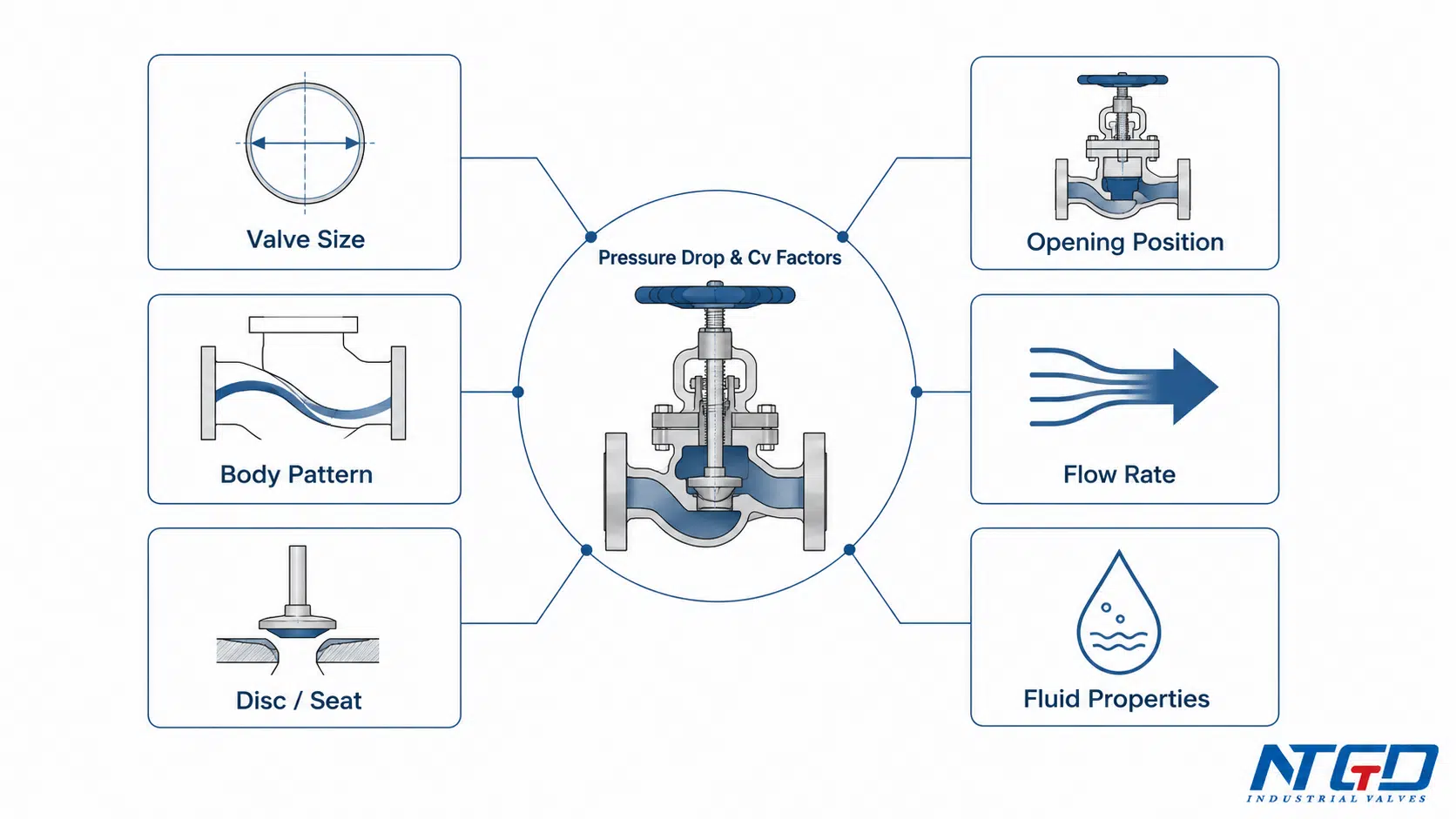
Globe valve pressure drop and Cv are affected by design, operating conditions, and fluid properties. A good selection should review these factors together instead of relying on valve size alone.
The table below should be read as a selection review checklist. It links each factor to its effect on pressure drop or Cv, the data that should be confirmed, and the consequence if the factor is overlooked.
| Factor | Effect on Pressure Drop / Cv | What to Confirm | Risk if Ignored |
|---|---|---|---|
| Valve size | Larger size usually offers more flow area, but size alone does not define Cv | Nominal size and datasheet Cv | Oversizing may reduce throttling control range; undersizing may create excessive pressure drop and downstream flow starvation. |
| Body pattern | T/Z, Y-pattern and angle patterns create different flow paths | Body pattern and flow direction | Pump head may be insufficient or downstream equipment may not receive stable pressure. |
| Disc / plug / seat design | Controls the restriction area | Disc, seat and trim details | Poor throttling behavior, unstable control or excessive system loss |
| Trim / port design | Changes effective opening and flow capacity | Port size and trim type | Incorrect Cv assumption and poor match to required flow range |
| Opening position | Partial opening changes effective Cv and resistance | Full-open vs operating position | Full-open Cv may not represent throttling performance. |
| Flow rate | Higher flow usually increases pressure drop sensitivity | Normal, minimum and maximum flow | Higher-than-expected flow can push pressure drop beyond allowable limits. |
| Fluid properties | SG, density, viscosity and temperature affect calculation | Medium data and operating temperature | Wrong sizing for viscous, high-temperature or non-water-like services |
| Manufacturer design | Internal geometry differs by manufacturer | Certified datasheet / tested Cv | Generic table values may lead to incorrect sizing. |
Valve Size and Nominal Pipe Size
Nominal pipe size is only a starting point. A globe valve may match the pipe size but still create too much pressure drop if its Cv is too low for the required flow rate.
For example, a buyer may specify only “DN100 globe valve” or “4 inch globe valve,” but that does not fully define the valve’s flow capacity. The manufacturer still needs flow rate, pressure conditions, fluid properties, and valve design details to review pressure drop.
Body Pattern: T/Z, Y-Pattern and Angle Globe Valves
Body pattern is one of the most important design factors. A T-pattern or Z-pattern globe valve usually has a more tortuous flow path. A Y-pattern globe valve may reduce resistance by creating a smoother path. An angle globe valve may be useful where the pipeline already changes direction.
The article should not become a full body pattern comparison, but buyers should understand that body pattern can change pressure drop and Cv.
For broader type selection across Z-pattern, Y-pattern, angle-pattern and special-service designs, use NTGD’s globe valve types and selection guide.
Tameson’s globe valve guide also describes Y-pattern globe valves as using a more direct flow path that can reduce pressure loss compared with traditional T- or Z-shaped globe valve bodies, which supports treating body pattern as a selection variable rather than a naming detail: globe valve body patterns and pressure loss.
Disc, Seat, Trim and Port Design
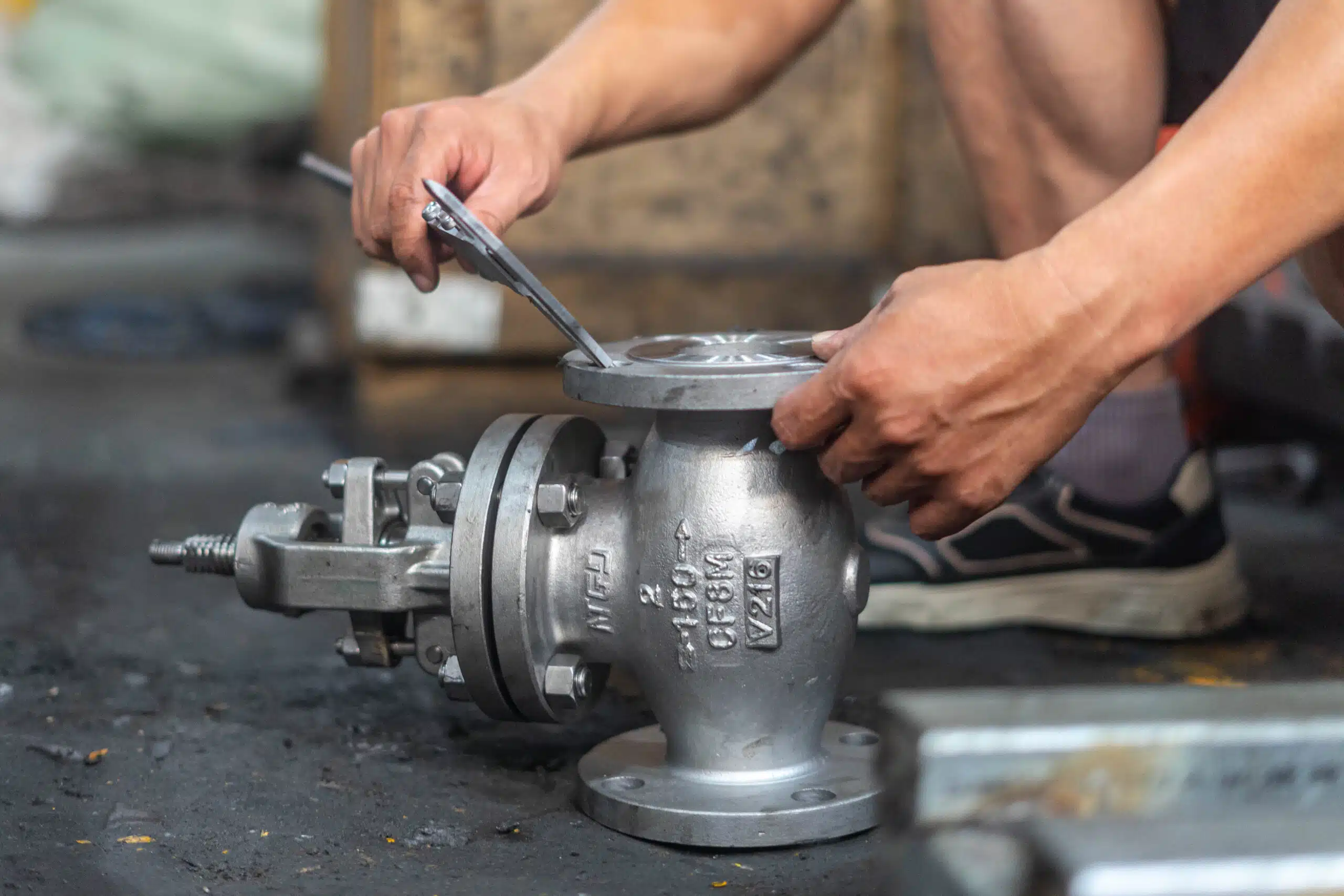
The disc, seat, trim and port determine the effective flow area. A small seat opening or restrictive trim can reduce Cv and increase pressure drop. A different trim design may improve throttling control but also change flow capacity.
This is one reason generic Cv tables are limited. A Cv value should be tied to a real valve design, not only to the nominal size.
Flow Rate and Fluid Properties
Flow rate is central to pressure drop. Higher flow through the same valve usually increases pressure loss. Fluid properties also matter. Water-like liquids, viscous fluids, gases, steam and high-temperature services do not behave the same way.
For basic liquid service, the simplified Cv formula may help with early understanding. For gas, steam, compressible flow, viscous fluids or severe service, additional sizing review is needed.
Manufacturer Design and Datasheet Data
Two globe valves with the same nominal size and pressure class can still have different Cv values. Manufacturer design, casting geometry, seat diameter, trim construction, port area and pressure class design may all affect the actual flow capacity.
For this reason, final selection should be based on manufacturer-confirmed datasheet values or application-specific sizing review, not only on a generic chart found online. When pressure drop matters, the RFQ should ask for manufacturer-confirmed Cv data or enough project information for the manufacturer to review the valve against the actual service.
Can You Calculate Globe Valve Pressure Drop from Cv?
Cv can be used to estimate the relationship between flow rate and pressure drop, especially for preliminary liquid service review. However, the result depends on whether the selected Cv value is accurate for the valve and whether the service conditions fit the formula assumptions.
What the Cv Relationship Can Tell You
From the Cv relationship, engineers can see three practical points: higher flow requires either higher Cv or higher pressure drop; higher specific gravity changes the pressure drop behavior; and a Cv that is too low for the required flow will force a higher ΔP.
These relationships are useful for early feasibility checks, especially when comparing valve sizes or reviewing whether a selected globe valve is likely to create excessive system loss. They do not confirm final valve suitability by themselves.
Where Formula-Based Calculation Becomes Limited
Formula-based calculation becomes limited when the service moves beyond simple liquid flow and stable operating conditions.
The simplified liquid relationship should not be used as the final sizing basis for gas, steam, viscous liquids, two-phase flow, flashing, cavitation risk, severe throttling, or high-ΔP service. In these cases, pressure drop and Cv should be reviewed with manufacturer data and complete process conditions.
High differential pressure is especially important. If the valve creates too much pressure drop across the seat area, the result may be noise, vibration, flashing, cavitation, erosion or premature trim damage. These conditions require engineering review rather than a simple formula-only estimate.
Why This Article Does Not Replace a Pressure Drop Calculator
A pressure drop calculator is a separate tool. It requires reliable input data, including confirmed Cv, flow rate, fluid properties, inlet pressure, outlet pressure and sometimes additional service factors.
This article explains how the concepts work and what data should be checked. It does not replace a certified sizing calculation, manufacturer software, or engineering review.
Swagelok’s Cv calculator also shows why fluid type, inlet pressure, outlet pressure and temperature must be supplied before a flow-capacity calculation can be meaningful.
Can You Use a Globe Valve Cv Table for Selection?
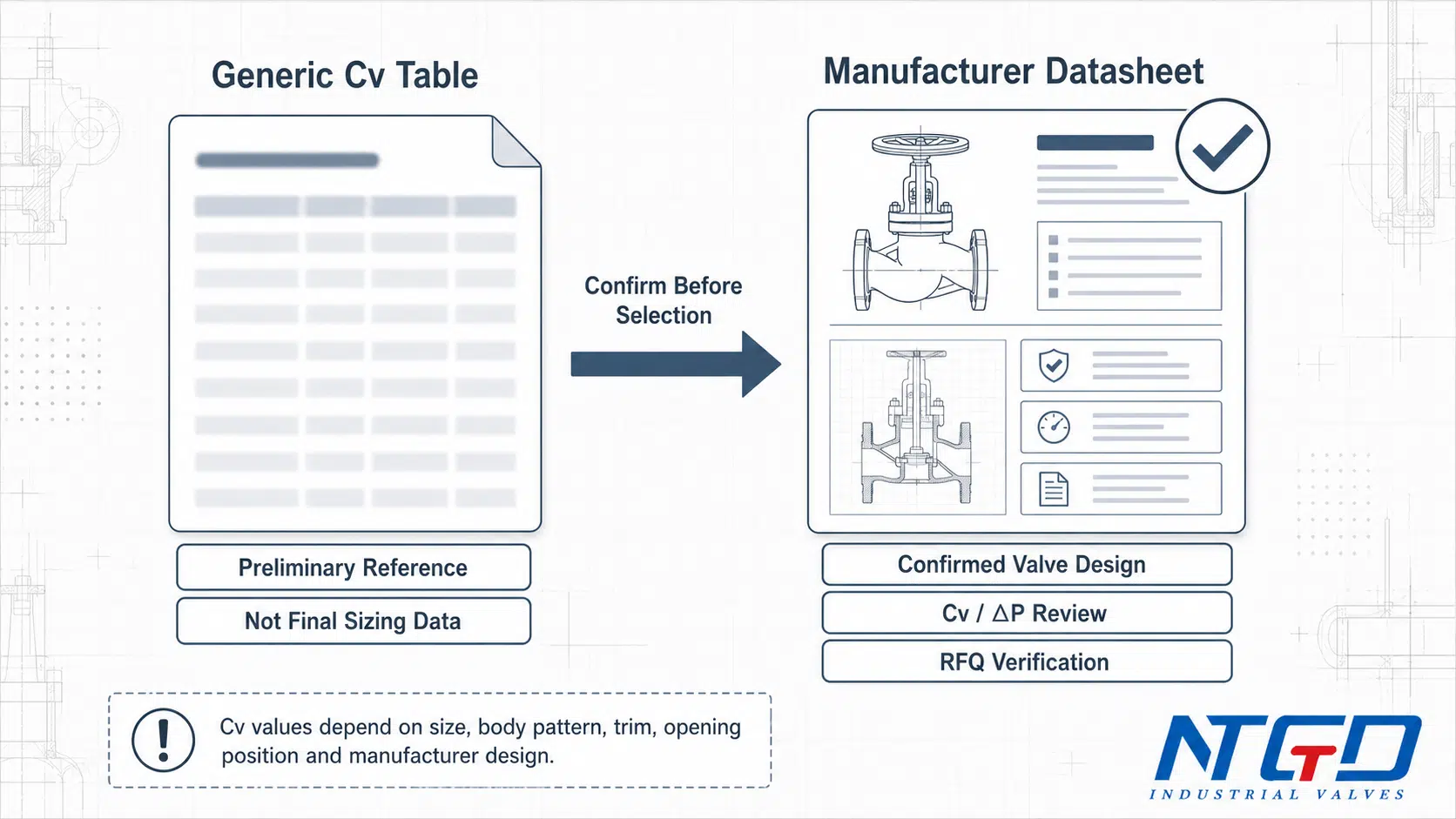
A globe valve Cv table can help with preliminary comparison, but it should not be the only basis for final selection.
Cv tables are useful because they show how flow capacity may change by valve size, valve type, or sometimes body pattern. They can help a buyer understand whether a proposed valve size is generally in the right range. However, they cannot confirm the actual performance of every globe valve design.
What a Cv Table Can Help You Check
A Cv table can help answer early questions such as:
- Is this valve size likely to pass the required flow?
- Does the selected globe valve appear more restrictive than another valve type?
- Does a Y-pattern or angle design need to be considered?
- Is the expected pressure drop likely to be acceptable?
- Should the RFQ ask for confirmed Cv data?
For early project discussion, this can be helpful. But a table should not be treated as final sizing proof.
Why Generic Cv Tables Are Not Enough
Generic Cv tables may not reflect the exact valve being purchased. Cv can vary by:
- manufacturer;
- valve size;
- pressure class;
- T/Z, Y-pattern or angle body design;
- seat diameter;
- trim and port design;
- disc or plug shape;
- full-open or partial-opening condition;
- special construction or severe-service trim.
A generic Cv table is not a substitute for a manufacturer-confirmed datasheet. Using a generic Cv table as final sizing data can lead to an oversized valve with poor throttling control, an undersized valve with excessive pressure drop, or an RFQ that cannot be technically verified.
When to Ask for Manufacturer-Confirmed Cv Data
Manufacturer-confirmed Cv data should be requested when:
- the system has limited pump head;
- downstream pressure is critical;
- the valve is used for throttling service;
- the flow rate is high;
- the pressure drop is high;
- the medium is viscous, gas, steam or severe service;
- noise, vibration, erosion or cavitation risk matters;
- the project requires technical documentation before approval.
For these cases, the RFQ should include enough process data for pressure drop and Cv review.
When Pressure Drop Matters in Globe Valve Selection
Globe valve pressure drop matters most when it affects system performance, energy use, control stability or equipment life.
| Service Condition | Why Pressure Drop Matters | Selection Direction | Data Needed |
|---|---|---|---|
| Pump head is limited | Excessive ΔP may reduce downstream flow | Confirm allowable pressure drop before selection | Flow rate, P1, P2, pump margin |
| Throttling service | Globe valve may be suitable, but Cv must match control range | Confirm that the required Cv range matches the valve’s effective control range; do not select by full-open Cv only. | Normal / min / max flow |
| High flow rate | Pressure drop can rise quickly | Check size, body pattern and Cv before finalizing the valve | Maximum flow and allowable ΔP |
| Low-pressure system | Small losses may be critical | Consider a lower-resistance pattern or another valve type if pressure loss is not acceptable | Inlet pressure and required outlet pressure |
| Viscous fluid | Pressure loss may be higher than expected | Review viscosity and temperature with the manufacturer | Viscosity, density, temperature |
| Noise / cavitation risk | High ΔP and velocity can damage valve internals | Review service limits, trim design and allowable ΔP | ΔP, vapor pressure, medium data |
| Retrofit / replacement | New valve may not match old flow capacity | Compare Cv and actual construction, not only size and pressure class | Existing valve data and system conditions |
Pump Head, Energy Loss and System Efficiency
If the globe valve pressure drop is too high, the pump may need to work harder or may fail to deliver the required downstream flow. In energy-sensitive systems, excessive pressure loss can reduce efficiency.
This is especially important in long pipelines, low-pressure systems, and systems where downstream equipment requires a stable pressure range. Compared with straight-through valves such as gate valves, globe valves usually create higher pressure drop, but they also offer better throttling capability. If the system is highly sensitive to pressure loss, the valve type and body pattern should be reviewed before specification.
Throttling Service and Control Stability
A higher pressure drop is not always bad. In throttling service, a globe valve is often selected because it can create a controlled restriction. The problem is not that the valve has resistance. The problem is whether the resistance matches the system requirement.
If Cv is too high, the valve may need to operate close to the closed position. If Cv is too low, the valve may create excessive pressure drop. Either case can reduce stable control.
In both oversized and undersized cases, the valve may appear to work at start-up but still create long-term control instability, process variation, or premature trim wear.
Noise, Erosion and Cavitation Risk
High pressure drop can increase velocity through the seat area. In some services, this may lead to noise, vibration, erosion, flashing or cavitation risk.
This does not mean every globe valve with high pressure drop is unsafe.
For steam and other high-ΔP services, Spirax Sarco notes that excessive pressure drop across a valve can contribute to noise and erosion effects, which is why severe globe valve applications should be reviewed rather than treated as simple sizing cases: valve pressure drop, noise and erosion in steam service.
It means the service condition must be reviewed carefully, especially when pressure drop, temperature, flow rate or medium characteristics are severe.
Low-Pressure, High-Flow and Viscous Services
In low-pressure systems, even a moderate pressure drop can become significant. In high-flow systems, the same valve may create a larger pressure drop than expected. In viscous services, flow behavior may differ from simple water-based assumptions.
These cases require more careful Cv and pressure drop review before final valve selection.
In retrofit or replacement projects, the new globe valve should not be checked only by size and pressure class. If the replacement valve has a very different Cv from the existing valve, the system pressure distribution and flow behavior may change.
RFQ Checklist for Globe Valve Pressure Drop and Cv Review
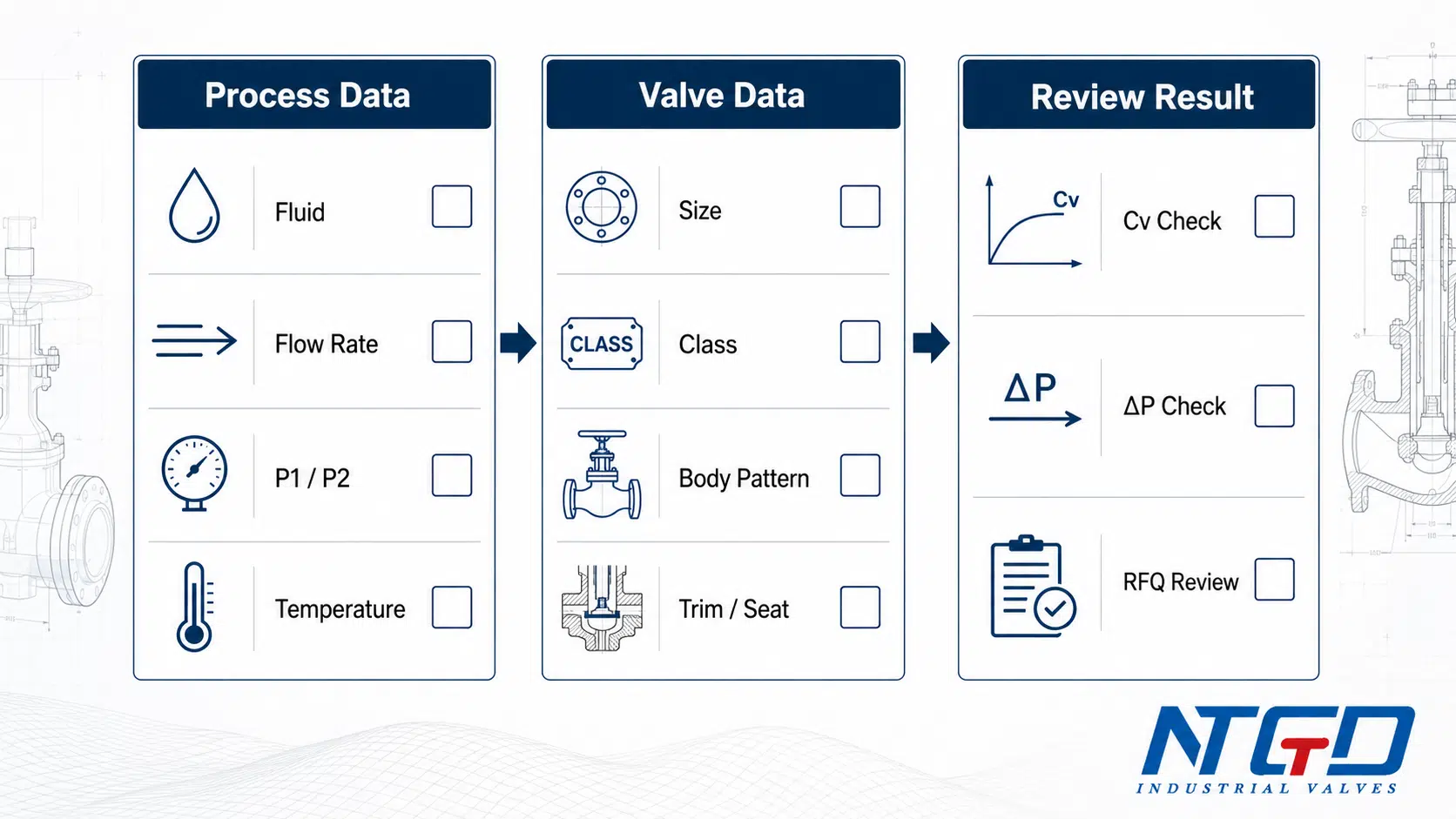
A good RFQ should give the valve manufacturer enough information to review pressure drop and Cv properly. If the RFQ only states size and pressure class, the manufacturer may not be able to confirm whether the globe valve is suitable for the actual service.
| RFQ Data | Why It Matters | Usually Provided By | Notes |
|---|---|---|---|
| Fluid / medium | Determines density, viscosity and compatibility | Buyer / process engineer | Include concentration if relevant |
| Flow rate | Required for Cv and pressure drop review | Buyer / process engineer | Provide normal, minimum and maximum flow if available |
| Specific gravity / density | Affects pressure drop calculation | Process engineer | Needed for liquid sizing |
| Viscosity | Important for non-water-like fluids | Process engineer | Especially important for thick or low-temperature fluids |
| Temperature | Affects fluid properties and material selection | Buyer / process engineer | Include operating and design temperature |
| Inlet pressure | Defines upstream condition | Process engineer | Needed for ΔP review |
| Outlet pressure | Defines downstream condition | Process engineer | Helps confirm allowable loss |
| Allowable pressure drop | Sets selection limit | Process engineer | Important for pump head and downstream performance |
| Valve size | Basic mechanical requirement | Buyer / engineer | Should be checked against Cv |
| Pressure class | Defines pressure rating | Buyer / engineer | Does not define Cv by itself |
| Body pattern | Affects flow resistance | Buyer / manufacturer | T/Z, Y-pattern or angle |
| Trim / seat / disc design | Affects Cv and throttling behavior | Manufacturer / engineer | Important for control and shutoff |
| Opening condition | Full-open or throttling | Process engineer | Full-open Cv may not equal operating Cv |
| Required shutoff | Affects seat and leakage requirements | Buyer / engineer | Do not ignore leakage class |
| Datasheet / Cv requirement | Confirms actual manufacturer data | Buyer / manufacturer | Request when pressure drop matters |
Process Data to Prepare
Before asking for a globe valve pressure drop review, prepare the fluid, flow rate, inlet pressure, outlet pressure, temperature, specific gravity or density, viscosity, and allowable pressure drop.
If the process has minimum, normal and maximum flow conditions, all three should be provided. This helps the manufacturer review whether the selected globe valve can handle the full operating range.
Valve Data to Confirm
The RFQ should also confirm valve size, pressure class, body pattern, trim, seat design, disc or plug type, required shutoff class and whether the valve is normally fully open or used for throttling.
For critical applications, ask for the manufacturer’s Cv data or datasheet confirmation.
Application Support Note
A globe valve that creates unexpected pressure drop can affect pump performance, control stability and long-term reliability. Before finalizing a specification, it is useful to review the flow conditions and valve selection against the actual service requirements.
If the flow rate, medium, pressure range and allowable pressure drop are known—even if some details are still being finalized—NTGD can help review whether the selected globe valve type and size are likely to work within the system limits.
This review is not only about selecting a valve size. It is about matching the valve’s flow resistance and flow capacity to the actual piping system.
If the next step is to confirm construction, pressure class, end connection and project documents, review NTGD’s industrial globe valves product page before sending the RFQ.
Frequently Asked Questions About Globe Valve Pressure Drop and Cv
What is globe valve pressure drop?
Globe valve pressure drop is the pressure difference between the inlet and outlet of the valve when fluid flows through it. It represents the pressure loss caused by the valve’s internal flow path, seat restriction and operating condition.
What is Cv in a globe valve?
Cv is the valve flow coefficient. It describes the flow capacity of the valve under a defined pressure drop condition. For a globe valve, Cv helps engineers estimate whether the valve can pass the required flow without excessive pressure loss. Published Cv is often a full-open rated value, so throttling applications may require additional review.
How is Cv related to pressure drop?
Cv, flow rate and pressure drop are connected. Under comparable conditions, a lower Cv usually means the valve needs a higher pressure drop to pass the same flow. A higher Cv usually means more flow capacity at the same pressure drop.
Why do globe valves have higher pressure drop?
Globe valves usually have higher pressure drop because the fluid path is not straight. The flow changes direction and passes through the disc-seat opening. This creates turbulence, restriction and energy loss.
Does a globe valve reduce flow?
Yes, a globe valve restricts flow by design, especially when partially open. Whether that restriction is a problem depends on the system’s allowable pressure drop and whether the selected Cv matches the required flow range.
Is pressure loss the same as pressure drop?
In valve selection, pressure loss and pressure drop are often used closely. Pressure drop usually refers to the measurable pressure difference across the valve, while pressure loss describes the energy lost as fluid passes through the valve.
Can I select a globe valve only from a Cv table?
A Cv table can support preliminary screening, but it should not be the final sizing basis. Confirm the actual valve design, trim, opening condition, pressure class, and manufacturer datasheet before final selection.
How do you calculate pressure drop across a globe valve?
For simple liquid service, the Cv relationship can be rearranged to estimate pressure drop as ΔP = SG × (Q / Cv)². This is only a preliminary estimate and assumes the Cv is correct for the actual valve and operating condition. For gas, steam, viscous fluids, partial-opening throttling, or high-ΔP service, request manufacturer sizing support.
Do I need to know the K coefficient for globe valve selection?
For most valve selection discussions, Cv is the more common sizing communication value. K is useful for system-level hydraulic loss calculations. If system head loss must be calculated, ask the manufacturer or project engineer whether K data is required.
Conclusion
Globe valve pressure drop should not be treated as a minor detail after valve size and pressure class are selected. It is directly connected to flow resistance, Cv, body pattern, trim design, opening position and fluid properties.
A globe valve is often a good choice for throttling and flow regulation because its internal geometry creates a controlled restriction. But that same restriction can also create excessive pressure loss if the valve is not matched to the system.
For early selection, formulas and Cv tables can help engineers understand the relationship between flow rate, Cv and pressure drop. For final selection, the RFQ should include process data and request manufacturer-confirmed Cv or datasheet information when pressure drop matters.
When pressure drop is underestimated or Cv is misapplied, the result can be higher energy consumption, unstable control, downstream flow shortage, or valve damage risk. For that reason, generic formulas and Cv tables should remain preliminary tools; final selection should be based on actual service conditions and manufacturer-confirmed valve data.
