
Author Name: Bruce Zheng
Author Role: Co-Founder and Valve Engineer at NTGD Valve
Author Bio: Bruce Zheng is Co-Founder and Valve Engineer at NTGD Valve, focusing on industrial valve selection, application, and technical content for global B2B buyers.
Last Updated: April 20, 2026
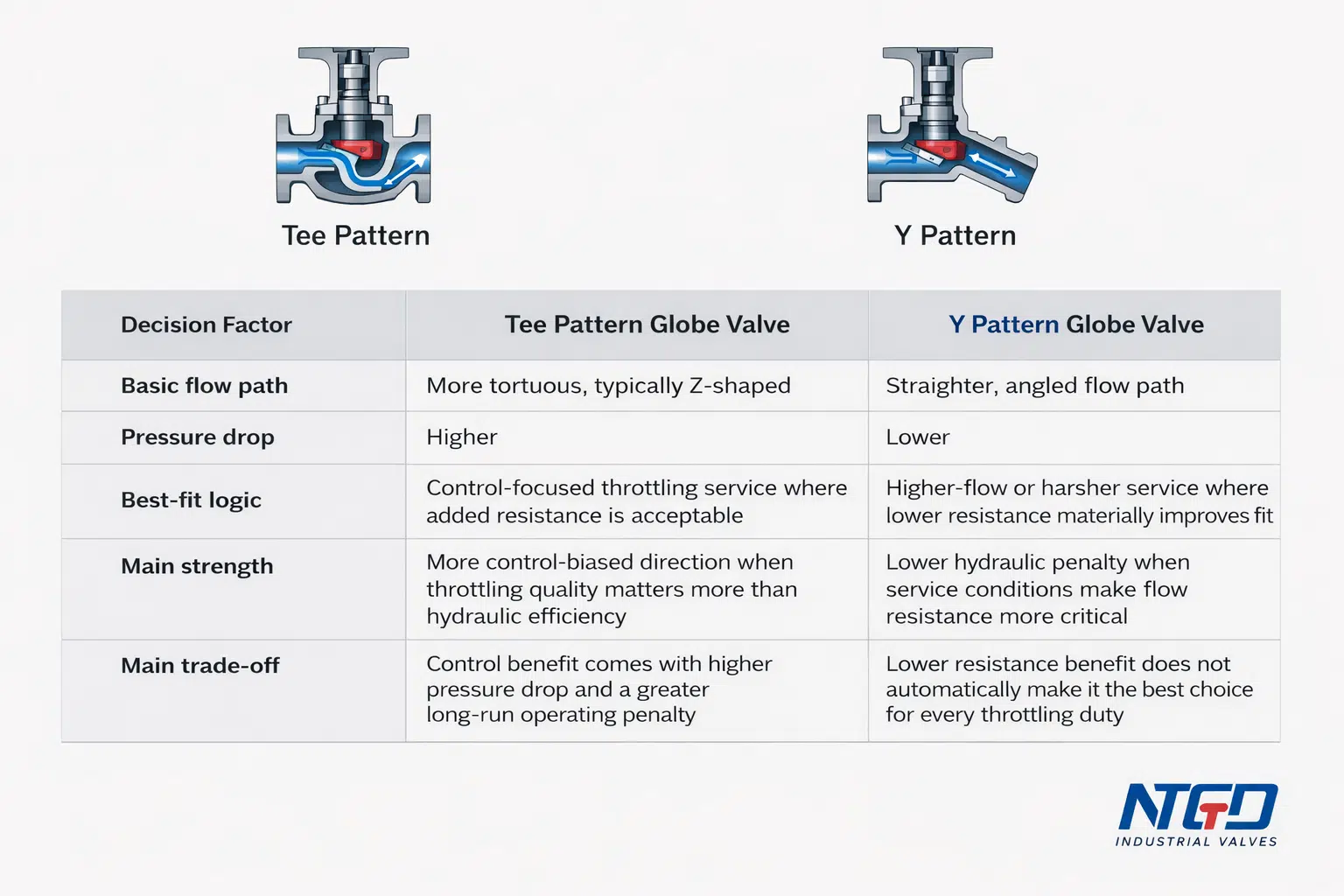
A tee pattern globe valve vs y pattern globe valve comparison is really a service-fit decision. The core question is not which pattern is newer or more advanced. It is whether your duty justifies accepting a higher pressure-drop penalty for stronger control bias, or whether the service should prioritize lower flow resistance, better hydraulic efficiency, and a cleaner fit for harsher operating conditions.
| Decision Factor | Tee Pattern Globe Valve | Y Pattern Globe Valve |
|---|---|---|
| Basic flow path | More tortuous, typically Z-shaped | Straighter, angled flow path |
| Pressure drop | Higher | Lower |
| Best-fit logic | Control-focused throttling service where added resistance is acceptable | Higher-flow or harsher service where lower resistance materially improves fit |
| Main strength | More control-biased direction when throttling quality matters more than hydraulic efficiency | Lower hydraulic penalty when service conditions make flow resistance more critical |
| Main trade-off | Control benefit comes with higher pressure drop and a greater long-run operating penalty | Lower resistance benefit does not automatically make it the best choice for every throttling duty |
Terminology and Pattern Context for This Comparison
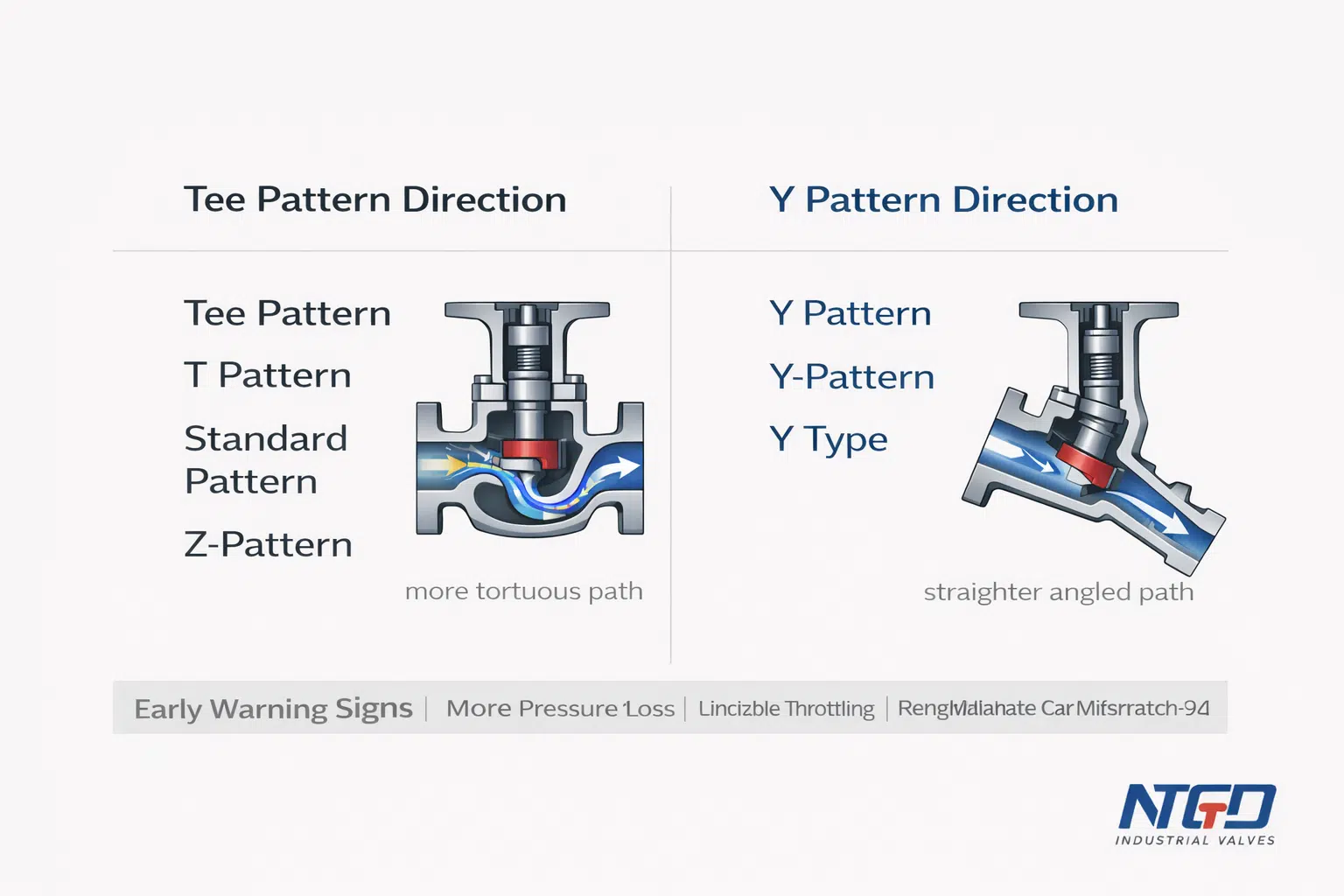
In this comparison, tee pattern globe valve and t pattern globe valve refer to the same basic body-pattern direction. In many specification and buyer-side discussions, that same direction is also associated with standard pattern or Z-pattern terminology because the medium changes direction more sharply through the body. The important point is practical, not semantic: the label may change from source to source, but the hydraulic implication does not.
A y pattern globe valve is treated as a separate selection direction because the seat and stem arrangement shift the flow path closer to a straighter line. In industry usage, y pattern globe valve, y-pattern globe valve, and y type globe valve are commonly used to describe that same basic design direction.
This page is intentionally narrow. It does not try to explain every globe valve pattern or act as a general globe valve definition page. Its purpose is to compare tee pattern and y pattern body choices for shutoff and throttling service where flow path and service duty directly affect selection.
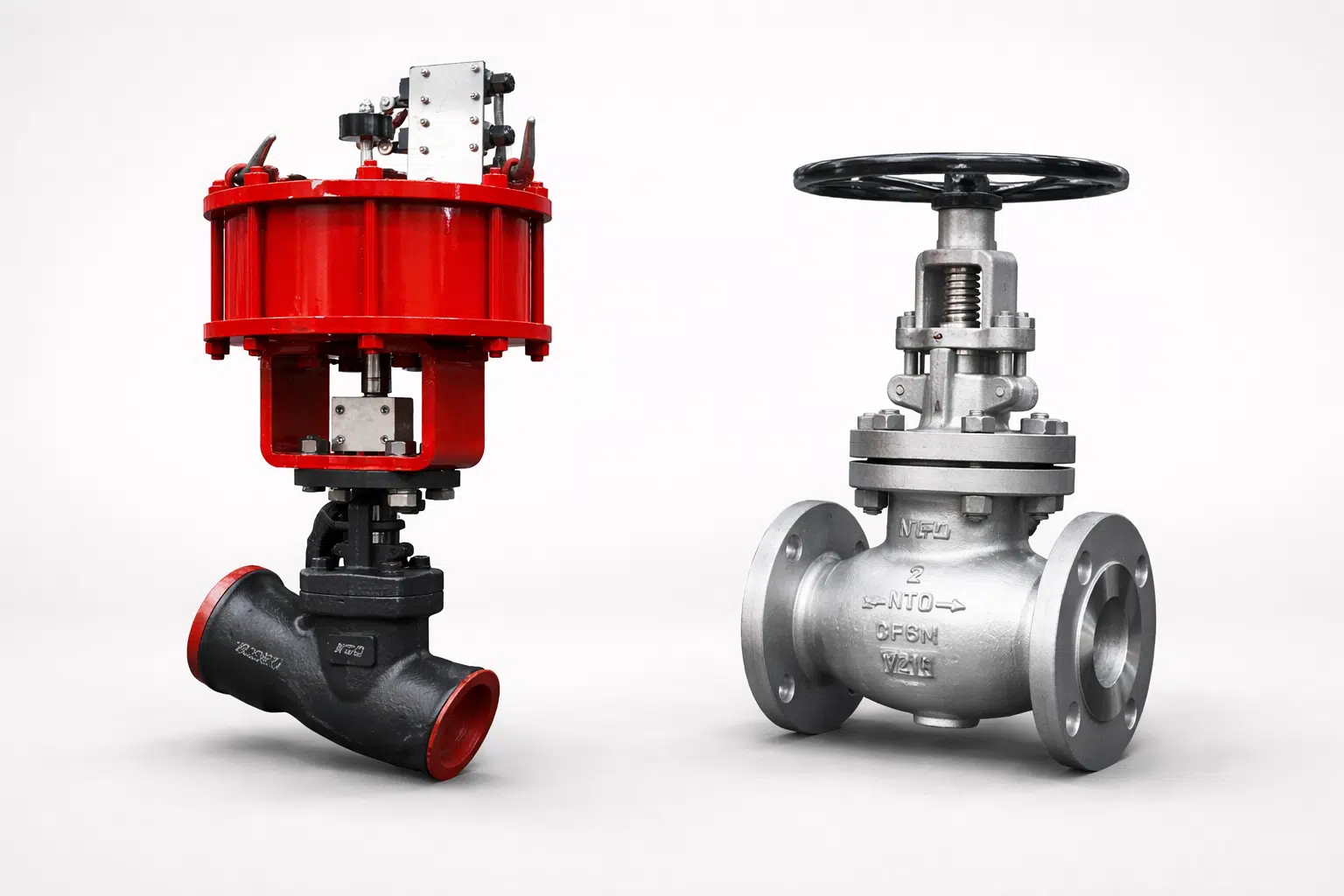
How Body Pattern Changes Flow Path and Pressure Drop
Why Tee Pattern Creates Higher Resistance
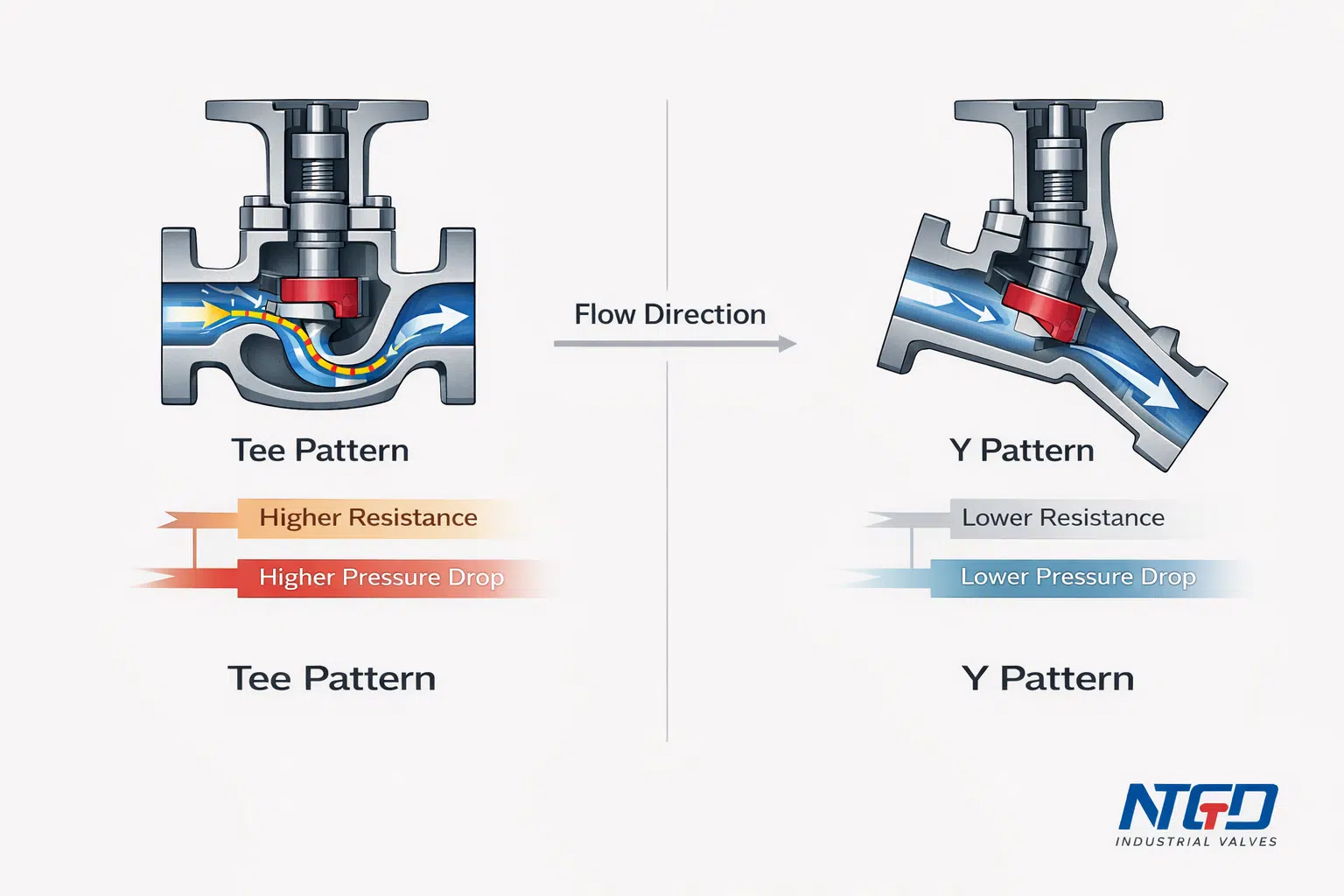
A tee pattern globe valve forces the medium through a more abrupt directional change. The flow does not pass through the body in a near-straight line; it turns, moves through a tighter control zone, and exits through a more resistive route. That geometry increases flow resistance and makes the pressure-drop penalty more important whenever system efficiency, pump load, or differential-pressure exposure matter to the service.
That does not make the tee pattern wrong. It means the tee pattern earns its place when the service values control behavior enough to justify the added hydraulic penalty.
Why Y Pattern Reduces Flow Deviation and Pressure Loss
A y pattern globe valve changes the body arrangement so the medium sees a less severe directional shift. The seat and disc still control the flow, but the route is less tortuous than in a tee pattern body. In hydraulic terms, that usually means lower resistance through the valve, lower pressure loss across it, and less system penalty from forcing flow through an unnecessarily restrictive path.
That is why a y pattern globe valve becomes more attractive when the service is sensitive to pressure drop, must handle higher flow, or operates under conditions where excess resistance becomes harder to tolerate.
When Pressure Drop Becomes a Real Selection Issue
Tee pattern globe valve pressure drop and y pattern globe valve pressure drop are not just comparison-table differences. They become real selection drivers when they affect line balance, valve sizing margin, throttling stability under higher differential pressure, pumping energy consumption over the operating life of the service, or avoidable cavitation and wear exposure in demanding duty.
If the system can absorb that added resistance and the control duty benefits from the tee pattern layout, the pressure-drop penalty may be acceptable. If that penalty starts to affect operating cost, stability, or service severity, the y pattern direction becomes much more compelling.
The Real Trade-Off Between Tee Pattern and Y Pattern
The decision is not “tee for older systems, y for newer systems.” The real decision is whether the service is better served by control bias or flow-efficiency bias.
Where Tee Pattern Still Wins
A tee pattern globe valve remains a valid choice when the service needs a more control-focused valve direction and the system can accept higher resistance. In those cases, the penalty is known, visible, and justified by the duty.
A tee pattern direction is often more attractive when:
- precise throttling matters more than minimum hydraulic loss
- the system can absorb the added pressure drop without creating an operating burden
- the valve is being chosen for controlled regulation duty rather than for the least restrictive flow path
- body simplicity and a familiar control-side geometry support the application
Where Y Pattern Becomes the Better Direction
A y pattern globe valve becomes the better direction when the process cannot afford unnecessary resistance or when harsher operating conditions push hydraulic efficiency higher in the decision.
A y pattern direction is often stronger when:
- lower pressure drop is operationally important
- the service runs at higher flow rates
- higher-pressure or higher-temperature service makes excess resistance more expensive to carry
- the valve must retain globe-valve control capability while reducing avoidable hydraulic loss
Why Lower Pressure Drop Does Not Automatically Mean Better Fit
A y pattern globe valve is not automatically the right answer simply because it offers lower resistance. If the real operating priority is controlled throttling in a service where the pressure-drop penalty is acceptable, a tee pattern globe valve may still be the more appropriate choice.
| Trade-Off Area | Tee Pattern Direction | Y Pattern Direction |
|---|---|---|
| Hydraulic efficiency | Lower, with the trade-off of a more control-biased path | Higher, with the advantage of less hydraulic penalty |
| Pressure-drop tolerance needed | Service must be able to carry a higher resistance burden | Better fit when the service should not carry that burden |
| Control-focused duty | Often the stronger first direction when throttling behavior leads the decision | Can still work, but not always the first direction when control priority dominates |
| Higher-flow service | Less favorable when resistance becomes a persistent operating cost | More favorable when lower resistance materially improves service fit |
| Harsh-service bias | Can be limited when added resistance amplifies the burden of the duty | Usually stronger when service severity and efficiency matter at the same time |
Mapping Service Conditions to Tee or Y Direction
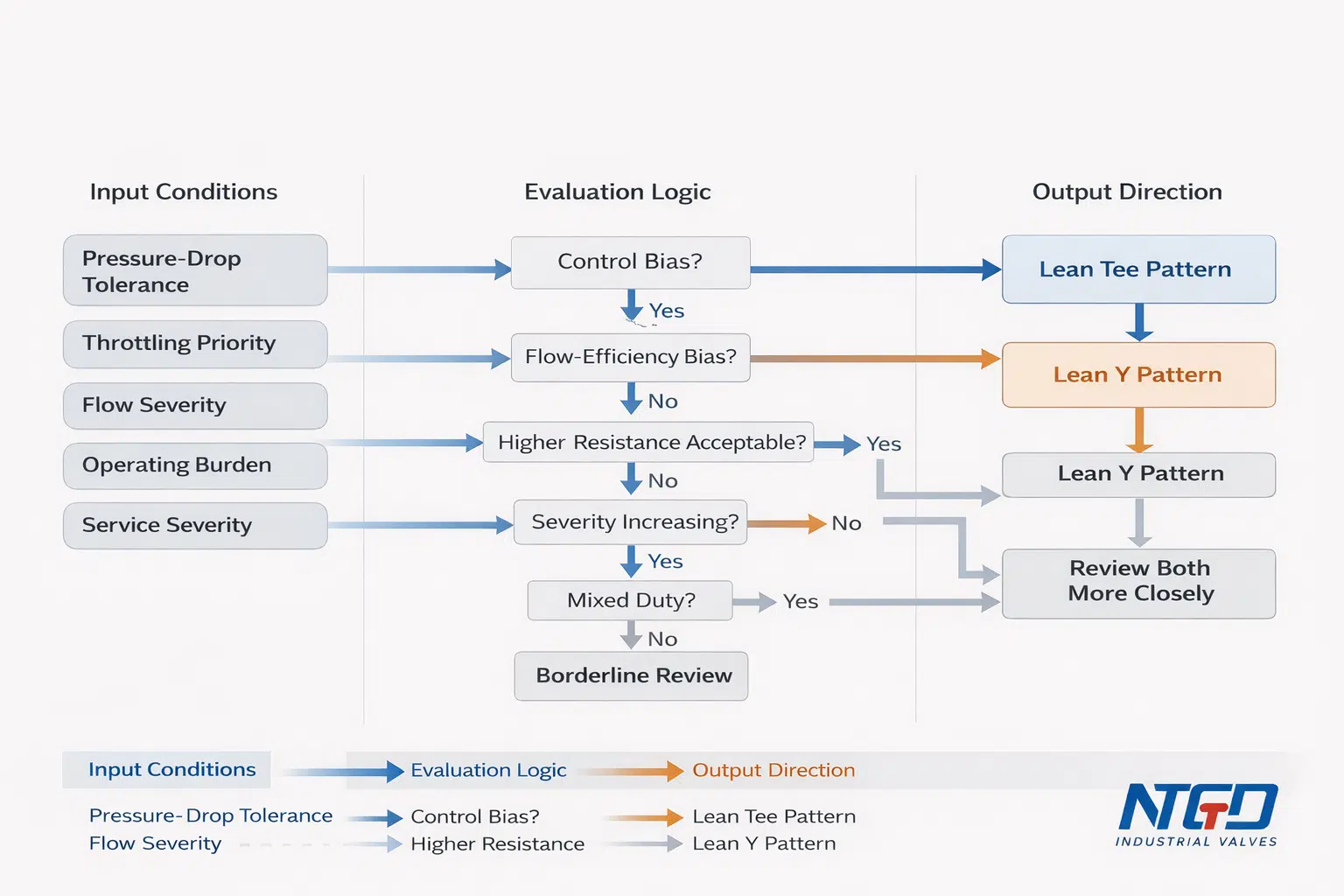
The best way to choose is to map actual service conditions to a valve direction instead of starting from a generic preference.
When Tee Pattern Is the Better Direction
Lean toward a tee pattern globe valve when most of the following are true:
- the service is throttling-heavy
- the system can tolerate higher pressure drop
- tight control behavior matters more than minimizing resistance
- the flow rate is not so high that the added resistance becomes a persistent operating penalty
- the process is being judged more by control quality than by hydraulic efficiency
Typical logic: when to use tee pattern globe valve is usually answered by one boundary condition—throttling quality matters enough that the resistance penalty is acceptable.
When Y Pattern Is the Better Direction
Lean toward a y pattern globe valve when most of the following are true:
- lower pressure loss matters to the system
- the service runs at higher flow or under more severe operating conditions
- higher pressure or higher temperature makes excess resistance more expensive to carry
- the application needs better flow efficiency without giving up shutoff or throttling capability
- long-run operating penalty matters more than body simplicity
Typical logic: when to use y pattern globe valve is usually answered by a different boundary condition—the service should not be forced to carry avoidable resistance when efficiency or severity already drives the specification.
Borderline Cases That Need Closer Review
Some services do not point cleanly to one side. Those cases usually need closer engineering review, especially when the valve must do more than one job at once.
Borderline cases include:
- intermittent throttling with occasional severe load changes
- services where both control stability and lower pressure loss matter
- applications with uncertain differential-pressure exposure during upset conditions
- installations where maintenance access, lifecycle cost, and energy penalty all matter at the same time
In those cases, choosing only from body shape is the wrong shortcut. The next step is to review the actual duty pattern, differential-pressure exposure, and service severity together before finalizing the direction.
What Happens If the Wrong Pattern Is Selected
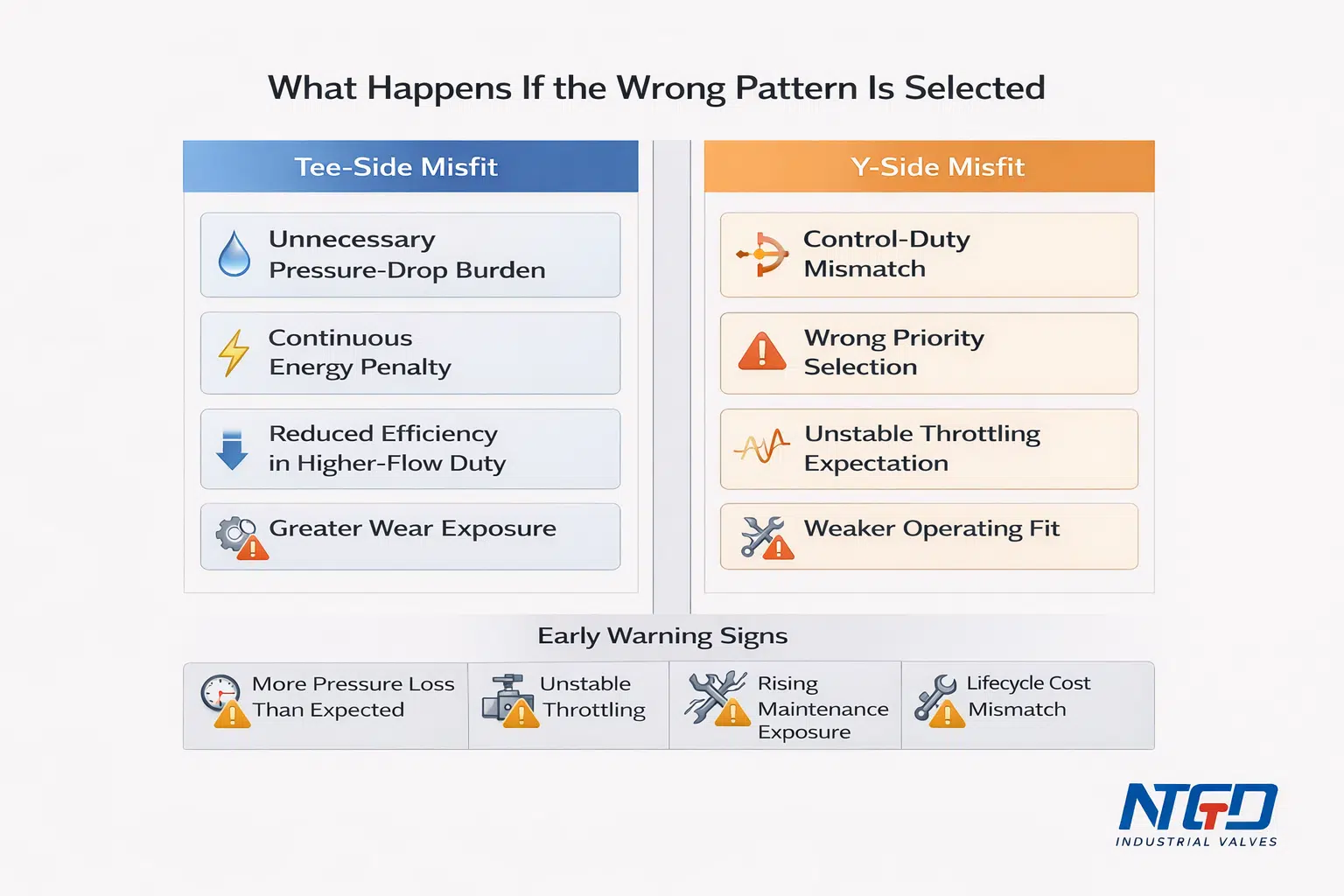
Wrong pattern selection usually does not fail as a naming mistake. It fails as a performance mismatch.
Typical Tee-Side Misfit Risks
Selecting a tee pattern globe valve where lower resistance should have been the priority usually leads to avoidable operating penalties:
- unnecessary pressure-drop burden across the valve
- continuous pumping energy penalty over the service life
- reduced efficiency in higher-flow duty
- greater cavitation-related wear exposure when service severity is already high
- a valve that may control acceptably but costs more to operate than it should
The system may still run, but it runs with a penalty that the specification should have screened out.
Typical Y-Side Misfit Risks
Selecting a y pattern globe valve where the real service priority was control bias creates a different kind of mismatch:
- control expectations may not match the actual operating duty
- the valve may be chosen mainly for lower resistance when the service really needed a more control-driven decision
- buyers may overvalue “lower pressure drop” and undercheck how the valve will actually be throttled
- throttling expectations may become unstable because the selection logic was built around the wrong priority
In other words, wrong y-side selection is often a priority mismatch, not just a geometry mismatch.
Warning Signs Before Performance Problems Escalate
The early warning signs usually appear as operating consequences, not as abstract design concerns:
- the system carries more pressure loss than expected
- throttling performance is less stable than the process requires
- maintenance exposure rises faster than planned
- lifecycle cost no longer matches the original selection logic
- the valve works, but the service fit remains weak
| Wrong Choice | Likely Consequence |
|---|---|
| Tee chosen when lower resistance was critical | Continuous energy penalty, unnecessary pressure drop, and weaker long-run system efficiency |
| Tee chosen for service that is too flow-demanding | Resistance becomes a persistent operating burden rather than a justified control trade-off |
| Y chosen mainly for “better flow” without checking control duty | Control-duty mismatch and a weaker fit for the way the valve is actually operated |
| Either pattern chosen without checking service severity | Maintenance exposure and lifecycle predictability both become less reliable |
Application Fit and Lifecycle Considerations
Once service conditions have already pointed you toward tee or y, the next question is whether that direction still makes sense in the real operating context. This is where application fit stops being a pure mapping exercise and becomes a buyer-side check on operating burden, maintenance exposure, and long-run efficiency.
Application Patterns That Commonly Favor Tee
Tee pattern globe valve applications are more likely to make sense when the application context reinforces a control-biased decision rather than reversing it. That usually means the valve is being used in a duty where regulated flow behavior is still the main value driver and the surrounding system already accepts the added resistance.
Common tee-favoring application contexts include:
- defined regulation or bypass-style duty where control predictability matters more than line efficiency
- services where pressure-drop tolerance is already built into the operating design
- shutoff-and-regulation applications where hydraulic loss is acceptable relative to control needs
- operating contexts where the valve is judged first by regulation performance and only second by resistance penalty
Application Patterns That Commonly Favor Y
Y pattern globe valve applications are more likely to make sense when the operating context reinforces the need to avoid unnecessary hydraulic penalty over time. Here the question is not just which direction the service points to in theory, but whether the actual application will keep paying for extra resistance if the wrong pattern is selected.
Common y-favoring application contexts include:
- continuous-service lines where unnecessary resistance compounds the operating burden
- higher-flow applications where pressure loss carries a visible system cost
- harsher operating contexts where lower hydraulic penalty improves the overall fit
- services where long-run efficiency matters enough to influence the body-pattern decision
Maintenance, Access, and Long-Run Efficiency Considerations
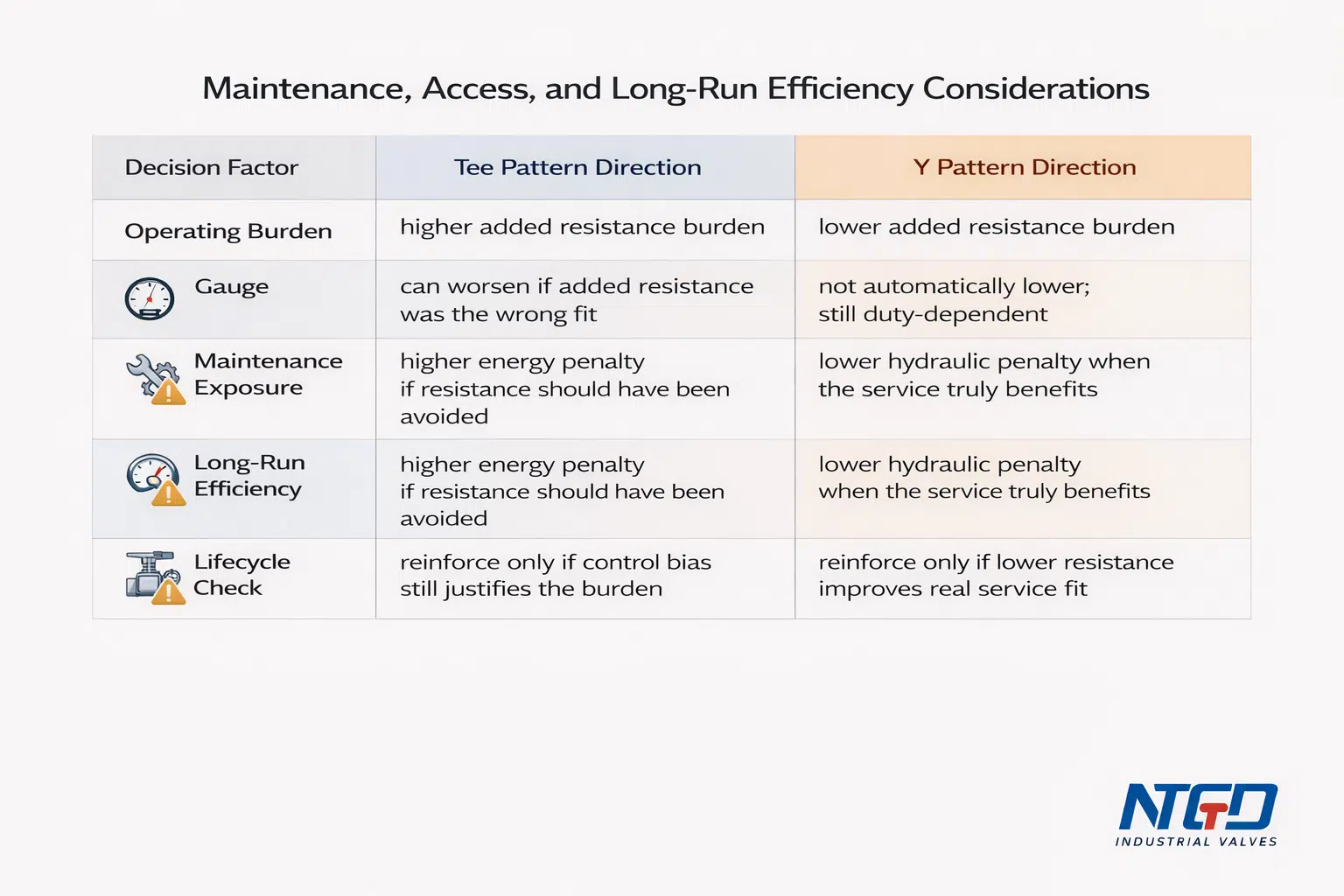
Lifecycle logic should not be reduced to “this one is easier to maintain” or “that one lasts longer.” Those claims depend on service conditions, trim and seat design, operating pattern, and actual maintenance practice.
What this comparison can say with confidence is more specific:
- a tee pattern selection can create a higher long-run operating burden if the added resistance should have been avoided for that duty
- a y pattern selection can reduce that hydraulic burden, but only if the service truly benefits from that direction
- maintenance exposure should be judged in relation to duty severity and operating pattern, not as a blanket valve feature
- lifecycle considerations should refine the choice after service fit is clear, not replace service fit
Final Fit-Check Before You Specify a Tee or Y Pattern Globe Valve
Before final specification, reduce the decision to the factors that actually separate these two directions, then check them against the applicable pressure-temperature rating framework.
A Short Final Review Checklist
Use this short fit-check:
| Final Check Item | If the Answer Trends This Way | Direction to Review First |
|---|---|---|
| Can the system tolerate the continuous pressure-drop penalty of a tee pattern direction? | Yes | Tee pattern |
| Is lower flow resistance a major operating priority? | Yes | Y pattern |
| Is the duty strongly throttling-focused? | Yes | Tee pattern |
| Is the service higher-flow or more severe in operation? | Yes | Y pattern |
| Will added resistance create a meaningful lifecycle energy burden? | Yes | Y pattern |
| Is the service borderline, mixed-duty, or still uncertain? | Yes | Review both more closely |
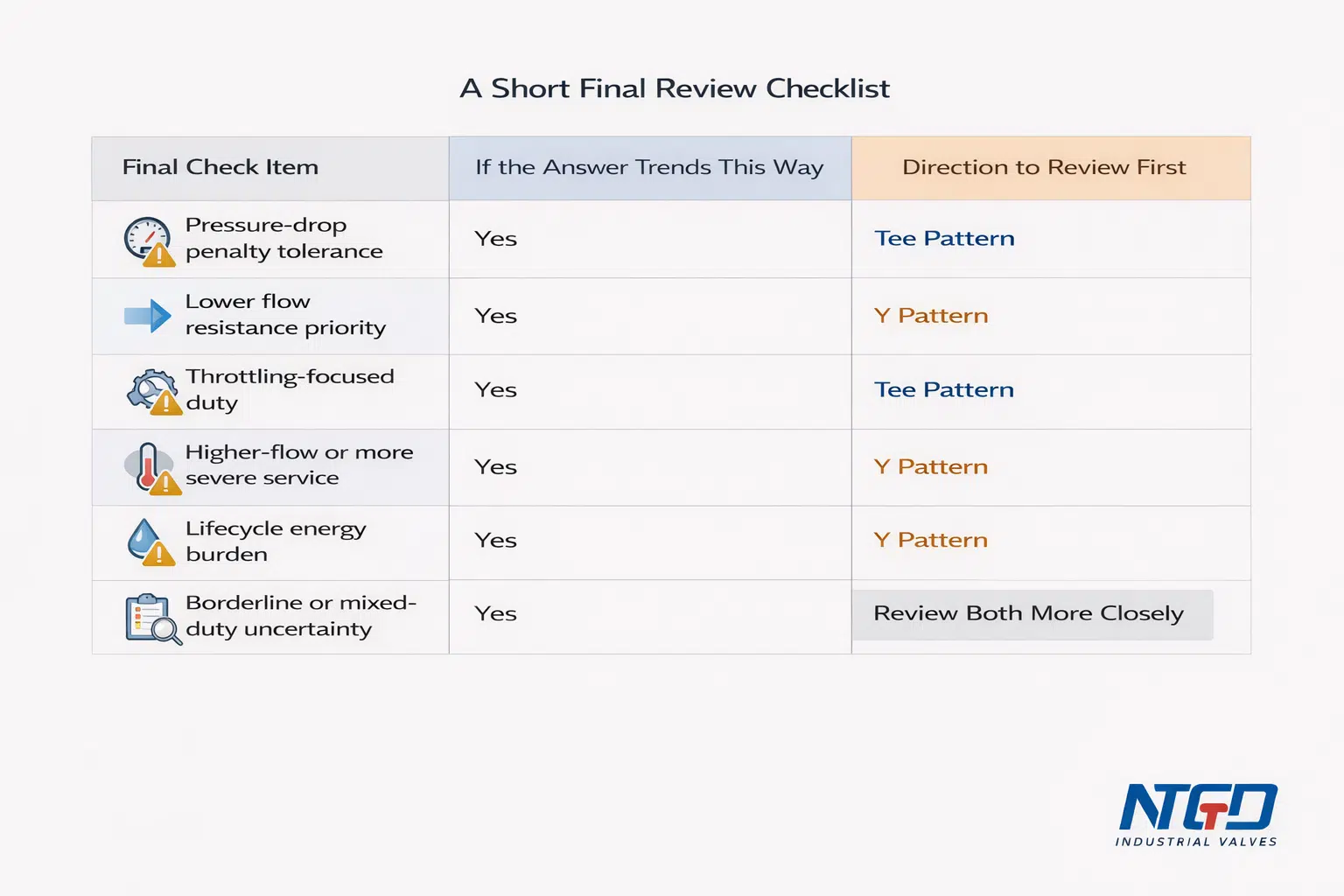
If the checklist points to “review both more closely,” the next step is usually to verify three things: actual differential-pressure tolerance, real operating pattern, and service severity under normal and upset conditions.
When an Engineering Review Is Worth Doing
An engineering review becomes worthwhile when:
- the service sits near the boundary between control priority and efficiency priority
- pressure-drop tolerance is not clear
- upset conditions may change the real duty
- the valve must perform across both regulation and severe operating exposure
- the cost of wrong selection is higher than the cost of one more specification review
FAQ
Is a t pattern globe valve the same as a tee pattern globe valve?
In most selection discussions, yes. T pattern globe valve and tee pattern globe valve usually refer to the same basic body-pattern direction. Depending on the source, you may also see related terms such as standard pattern or Z-pattern.
When should I choose a tee pattern globe valve over a y pattern design?
Choose a tee pattern globe valve over a y pattern design when the service is clearly control-focused, throttling duty matters more than minimum resistance, and the system can carry the added pressure-drop penalty without turning it into an operating burden.
When does a y pattern globe valve become the better choice than a tee pattern globe valve?
A y pattern globe valve becomes the better choice when lower resistance, higher flow efficiency, or harsher operating conditions move to the front of the decision. In that case, the reduced hydraulic penalty matters more than the control-side advantages that often keep tee pattern relevant.
Why does a y-pattern globe valve usually have lower pressure drop than a tee pattern design?
A y-pattern globe valve usually has lower pressure drop because its body pattern creates a less tortuous flow path. The medium changes direction less severely, so the valve imposes less hydraulic resistance than a tee pattern body.
Is a y pattern globe valve always better for high-pressure service?
Not automatically. A y pattern globe valve often becomes more attractive in higher-pressure or harsher service because lower resistance matters more there, but the final choice still depends on actual duty, differential-pressure exposure, and control requirements.
Can a tee pattern globe valve still make sense if throttling is not severe?
Yes. Some tee pattern globe valve applications still make sense even when throttling is not constant or extreme, especially if the service continues to value predictable control behavior and the system can comfortably absorb the added resistance. The real question is whether that control bias still adds enough value to justify the pressure-drop penalty.
Do y type globe valve applications only make sense in very high-flow service?
No. Y type globe valve applications often align with higher flow, but they can also make sense in services that are not extreme in flow rate if pressure-drop sensitivity, operating cost, or service severity still make unnecessary resistance a poor fit.
What is the biggest mistake in tee vs y pattern selection?
The biggest mistake is treating the decision as a simple “better design” question. The real issue is whether the service needs a control-biased direction or a lower-resistance direction, and whether that choice still holds under actual operating conditions.
Conclusion
The right tee pattern globe valve vs y pattern globe valve decision comes down to service fit, not body shape alone. A tee pattern direction remains valid when throttling duty justifies the higher pressure-drop penalty. A y pattern direction becomes stronger when lower resistance, higher flow efficiency, or harsher service conditions move to the front of the specification logic. If the service sits near that boundary, the safest path is to verify differential-pressure exposure, operating pattern, and lifecycle consequences before finalizing the valve direction.
Final Application Check
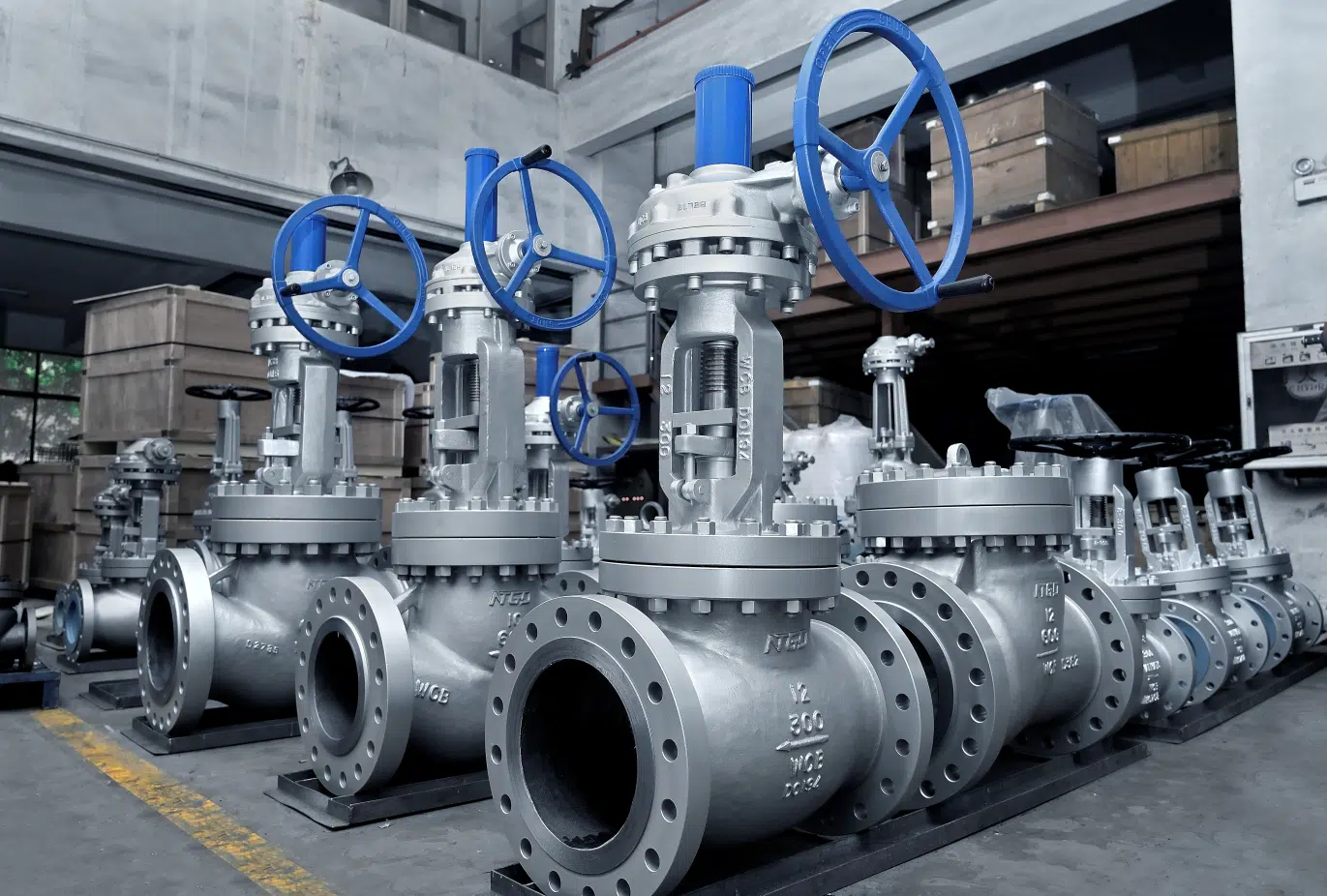
If your service sits near the boundary between control priority and lower-resistance priority, or if pressure-drop tolerance is not yet clear, a focused engineering review can narrow the choice faster than a generic feature comparison. Share the service duty, pressure-drop sensitivity, and operating pattern, and NTGD can help review whether a tee pattern globe valve or y pattern globe valve is the cleaner fit for the application.
