
Author Name: Bruce Zheng
Author Role: Co-Founder and Valve Engineer at NTGD Valve
Author Bio: Bruce Zheng is Co-Founder and Valve Engineer at NTGD Valve, focusing on industrial valve selection, application, and technical content for global B2B buyers.
Last Updated: June 1, 2026
A high pressure ball valve is an industrial quarter-turn shutoff valve used in pipeline systems where pressure, temperature, media, end connection load, sealing stress, and operating torque must be reviewed more carefully than in standard low-pressure utility service.
There is no single universal pressure number that makes every valve “high pressure.” In real projects, the meaning depends on valve size, pressure class or rated pressure, operating temperature, media, body construction, end connection, seat material, seal material, actuator requirement, and applicable project specification.
A small threaded valve, a flanged trunnion-mounted ball valve, and an ultra high pressure instrument valve may all be described as high pressure, but they are not selected in the same way. If pressure is reviewed without temperature, media, construction, and sealing materials, the result can be a specification mismatch, excessive operating torque, seat damage, stem packing leakage, or incomplete shutoff.
For buyers and engineers, the key question is not only “What is a high pressure ball valve?” The more important question is:
Can this ball valve body, seat, stem, seal, end connection, actuator, and test requirement safely match the real pressure, temperature, media, and operating cycle of the system?
This guide explains how high pressure ball valves work, which ball valve parts matter most under pressure, how floating and trunnion designs differ, when actuation should be considered, and what information should be prepared before sending an RFQ.
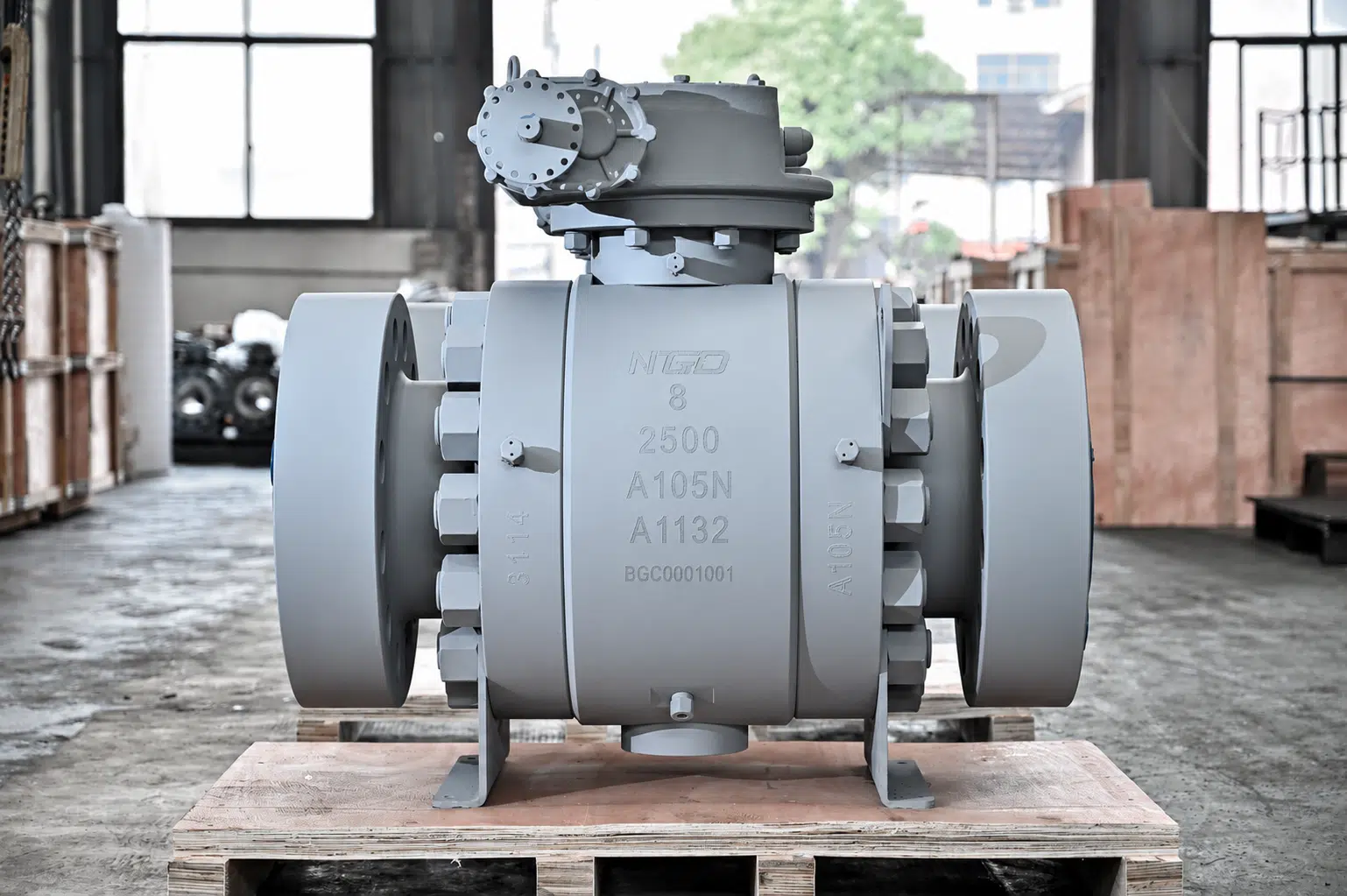
What Is a High Pressure Ball Valve?
A high pressure ball valve is a ball valve used in service conditions where the valve must resist elevated internal pressure while maintaining shutoff, body integrity, stem sealing, and reliable operation. It uses a rotating ball with a bore through the center. When the bore aligns with the pipeline, flow passes through the valve. When the ball rotates 90 degrees, the solid side of the ball blocks the flow path.
In ordinary descriptions, high pressure is sometimes simplified into a fixed PSI value. That is not enough for industrial selection. A valve that is acceptable at one pressure and temperature may not be suitable when temperature rises, when the medium is corrosive, when the connection changes, or when frequent cycling increases seat and stem wear.
A better way to define a high-pressure ball valve is by reviewing the complete pressure boundary and sealing system.
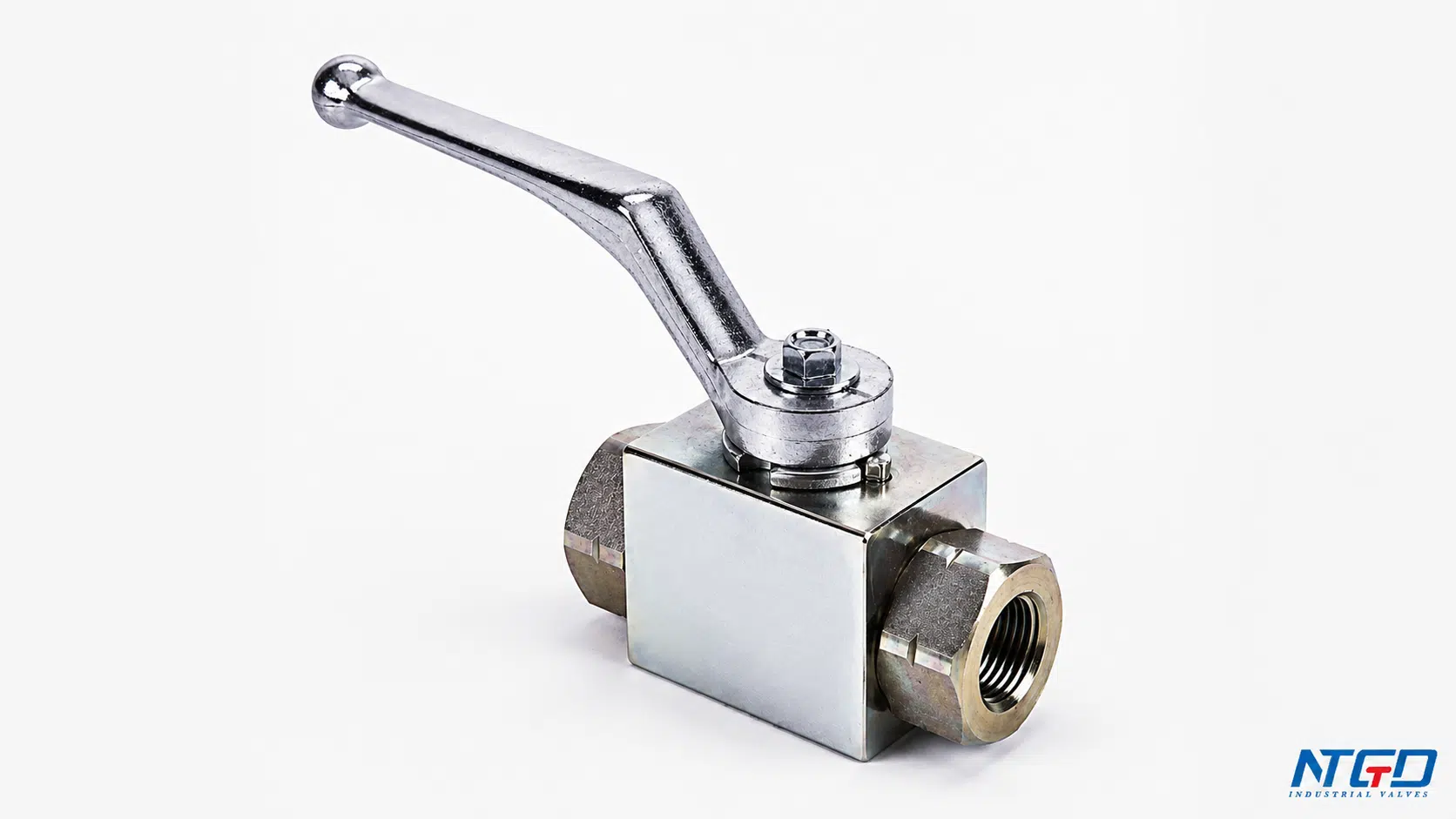
What Makes a Ball Valve Suitable for High-Pressure Service?
A ball valve becomes suitable for high-pressure service only when several design factors work together:
| Selection Area | Why It Matters in High Pressure Service |
|---|---|
| Body pressure rating | The body must contain internal pressure without deformation, cracking, or leakage. |
| End connection | Flanged, threaded, welded, or other ends must match pipe pressure, connection rating, and installation load. |
| Ball support | Floating and trunnion designs behave differently as pressure, size, and operating torque increase. |
| Seat design | Seats must maintain shutoff while resisting pressure load, temperature, media, wear, and cycle frequency. |
| Stem and packing | The stem transfers torque while packing controls external leakage through the stem area. |
| Seals and gaskets | Sealing materials must match media, temperature, pressure cycling, and body joint design. |
| Operation method | Manual, pneumatic, or electric operation must provide enough torque and safe control. |
| Testing and documentation | Pressure testing, inspection, and project documents confirm whether the valve matches the intended service. |
A high-pressure valve is therefore not just a thicker version of a standard valve. It is a pressure-containing assembly where the body, ball, seats, stem, seals, fasteners, connection, and actuator must all be selected as one system.
High Pressure vs Low Pressure Ball Valve: What Actually Changes?
A low pressure ball valve may be selected mainly by size, connection, body material, and basic media compatibility. A ball valve for high pressure service needs additional review.
| Item | Low Pressure Service | High Pressure Service |
|---|---|---|
| Main concern | Basic shutoff and flow control | Pressure boundary, sealing load, torque, and safety |
| Body design | Often lighter construction | Stronger body, suitable pressure class, and verified wall strength |
| Seat load | Lower seat stress | Higher seat load and higher torque risk |
| Stem area | Basic stem sealing may be enough | Blowout protection, packing, gland control, and leakage risk matter more |
| End connection | Common threaded or simple flanged ends | Connection rating and installation stress must be checked |
| Actuation | Manual handle often enough | Actuator torque, fail position, feedback, and mounting may be required |
| Documentation | Basic product information | Datasheet, test report, pressure rating, material, and project requirements |
Using a low-pressure valve in a high-pressure line can create more than poor shutoff. It can lead to seat extrusion, stem packing leakage, body or end-connection leakage, excessive operating torque, or unsafe operation when the valve is required to isolate the line.
The higher the pressure, the less safe it is to select the valve only by nominal size or generic product name.
How Does a High Pressure Ball Valve Work Under Pressure?
A high pressure ball valve works by rotating a bored ball inside the valve body. The basic quarter-turn principle is simple, but the engineering details become more demanding when pressure increases.
Quarter-Turn Flow Control
When the handle or actuator is turned 90 degrees:
- Open position: the bore through the ball aligns with the pipeline, allowing flow.
- Closed position: the bore turns perpendicular to the pipeline, and the solid surface of the ball blocks flow.
- Partly open position: the bore is only partially aligned, but standard ball valves are generally not preferred for throttling unless designed for that purpose.
This quarter-turn motion gives ball valves fast operation and low resistance when fully open, especially in full-port designs. In high pressure service, however, fast operation must be balanced against torque, seat load, pressure shock, and system safety.
For readers who need the basic mechanism before reviewing high-pressure details, NTGD’s ball valve working principle guide explains how the stem, ball, bore, seats, and actuator work together in a standard quarter-turn valve.
Ball, Seat and Stem Load Under Pressure
In a high-pressure ball valve, internal pressure affects more than the valve body. It also affects how the ball presses against the seats and how much torque is needed to rotate the ball.
Key pressure-related effects include:
| Area | What Happens Under Higher Pressure | Why It Matters |
|---|---|---|
| Ball and seat contact | Pressure can increase contact force between ball and seat | Higher shutoff load may improve sealing but also increase torque, seat stress, and wear |
| Stem torque | More torque may be required to rotate the ball | Manual operation may become difficult; actuator sizing becomes important |
| Packing and gland area | Stem sealing must resist external leakage | Gland packing, gland nut, and stem design become more critical |
| End connection | Pressure load transfers into the pipe connection | Flanges, weld ends, or threaded ends must match service conditions |
| Closure performance | The seat and ball must maintain tight shutoff | Incorrect seat selection can lead to leakage or early failure |
This is why a high pressure ball valve working principle should not be explained only as “turn the ball 90 degrees.” In high pressure service, closure performance depends on the combined behavior of the ball, seats, stem, packing, body, and end connection.
A broader industry explanation of ball valve design also treats ball valves as quarter-turn valves and identifies body, ball, seats, and stem as major components, which supports reviewing the valve as a complete assembly rather than only as a rotating ball mechanism (Valve Magazine).
Pressure differential can increase seat load and operating torque. If the required torque is underestimated, a manual valve may become difficult to operate, while an actuator may fail to complete its stroke or fail to reach the required shutoff position.
Floating and trunnion-mounted designs also respond differently to pressure load. In many floating ball designs, line pressure pushes the ball toward the downstream seat, while a trunnion-mounted design mechanically supports the ball and can reduce pressure-related seat load and torque sensitivity. The detailed selection logic belongs in the configuration section, but this difference explains why support method matters in high pressure service.
Why Torque and Sealing Become More Critical at Higher Pressure
As pressure increases, the valve may require more torque to open or close. If the operating torque is underestimated, several problems can occur:
- the handle becomes difficult to turn;
- the actuator may fail to complete the stroke;
- the valve may stop between open and closed positions;
- the seat may wear faster;
- the stem packing may become a leakage point;
- emergency shutoff may become unreliable.
For this reason, high pressure ball valves are often reviewed together with torque data, actuator sizing, seat material, pressure differential, and pressure-temperature conditions.
Key Components of High Pressure Ball Valves
The phrase ball valve parts can refer to many items, including handles, repair kits, replacement accessories, seats, stems, O-rings, fasteners, and body components. For this page, the focus is narrower: the parts that directly affect pressure containment, shutoff, sealing, and operation in high-pressure industrial service.
High-Pressure-Relevant Components
| Component / Ball Valve Parts Name | Main Function | High-Pressure Concern | What to Specify or Check |
|---|---|---|---|
| Body | Contains pressure and supports internal parts | Body strength, pressure rating at operating temperature, body material, wall thickness, and connection load must work together | Body material, pressure rating, temperature condition, size, construction type, inspection requirement |
| Ball | Opens or blocks the flow path | Bore type, support method, surface condition, and seat contact affect shutoff reliability and torque | Full port or reduced port, floating or trunnion support, surface condition, coating if required |
| Seats | Seal against the ball for shutoff | Seat load, deformation, temperature limit, media compatibility, cycle frequency, and leakage expectation must be matched | Soft seat or metal seat, material, leakage expectation, service temperature, cycle condition |
| Stem | Transfers torque from handle or actuator to ball | Stem strength, blowout protection, torque transmission, packing stress, and external leakage risk matter under pressure | Blowout-proof design, stem material, torque, packing arrangement, inspection access |
| Gland / gland nut | Compresses packing around the stem | Packing compression must balance leakage control and operating torque; poor adjustment can cause leakage or hard operation | Gland structure, packing condition, compression method, inspection access |
| Packing | Prevents leakage around the stem | Pressure and temperature cycling can reduce sealing stability around the stem | Packing material, temperature resistance, chemical compatibility, maintenance access |
| Gaskets / seals | Seal body joints and internal interfaces | Material failure or compression loss can cause pressure-boundary leakage | Gasket material, body joint design, compatibility with media and temperature |
| Fasteners / bolting | Hold pressure-retaining joints together | Bolting supports the pressure boundary; uneven load can affect body joint sealing | Bolt material, tightening method, pressure class, inspection requirement |
| End connection | Connects valve to pipeline | Connection rating and pipeline load must match pressure, temperature, and installation conditions | Flanged, threaded, welded, hub, or project-specific connection |
| Handle / actuator interface | Provides operating force | Insufficient torque or poor mounting can prevent full opening or closure | Manual handle, gearbox, pneumatic actuator, electric actuator, mounting interface |
These parts should be reviewed together because a high-rated body cannot compensate for the wrong seat, packing, stem, gasket, fasteners, or end connection.
This component-level view helps protect the useful meaning behind ball valve parts without turning this article into a replacement parts or repair kit page.
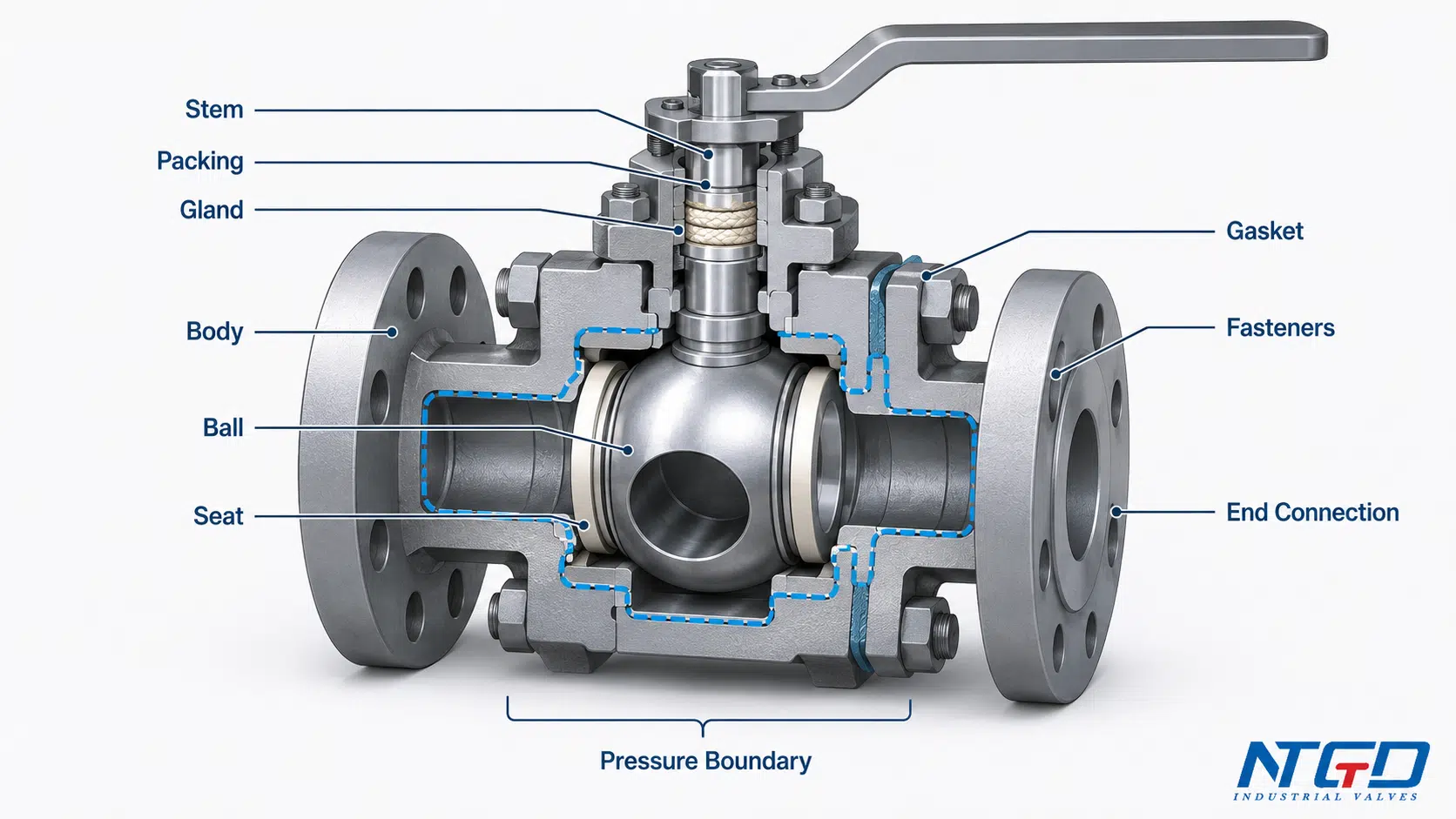
Body and Pressure Boundary
The high pressure ball valve body forms the main pressure boundary. It must resist internal pressure, pipe load, and installation stress. Body material selection depends on media, pressure, temperature, corrosion risk, and project specifications.
Common body material directions include carbon steel, stainless steel, alloy steel, or other project-specific materials. The correct option must be confirmed by the actual service data, not by valve name alone.
Ball and Bore
The ball determines whether the valve provides full bore or reduced bore flow. A full-port high pressure ball valve can reduce pressure loss when the bore is close to the pipe internal diameter. A reduced-port design may be more compact or economical but creates more flow restriction.
The ball surface must remain suitable for repeated contact with the seat. In severe service, the ball surface, coating, and seat combination may need additional review.
Stem, Gland and Packing
The stem is a small part with a large responsibility. It transmits torque, connects the operator to the ball, and passes through the pressure boundary.
In high pressure service, the stem area deserves special attention because external leakage often appears around the packing or gland area. The gland nut or gland follower must compress packing correctly. Too little compression can leak; too much compression can increase torque and make the valve harder to operate.
Seats, Seals and Closure
The seat provides the shutoff interface between the ball and valve body. The high pressure ball valve closure depends on the ball surface, seat material, seat support, and pressure load.
Soft seats can provide tight shutoff in many services, but they have temperature and chemical compatibility limits. Metal seats may be required in some high-temperature, erosive, or severe-service conditions, but they involve different leakage expectations and should not be assumed without project review.
End Connections and Fasteners
High pressure does not stop at the valve bore. It also loads the end connections and pressure-retaining joints. Flanged, threaded, welded, and other end connections must match pipeline pressure and installation conditions.
Fasteners and bolting are also part of the pressure boundary. They may not be the first parts buyers notice, but they influence body joint sealing and long-term reliability.
Pressure Rating, Temperature, Materials, Seats and Seals
Selecting a high pressure ball valve requires more than choosing a pressure number. Pressure, temperature, media, material, seat, seal, and end connection must be checked together.
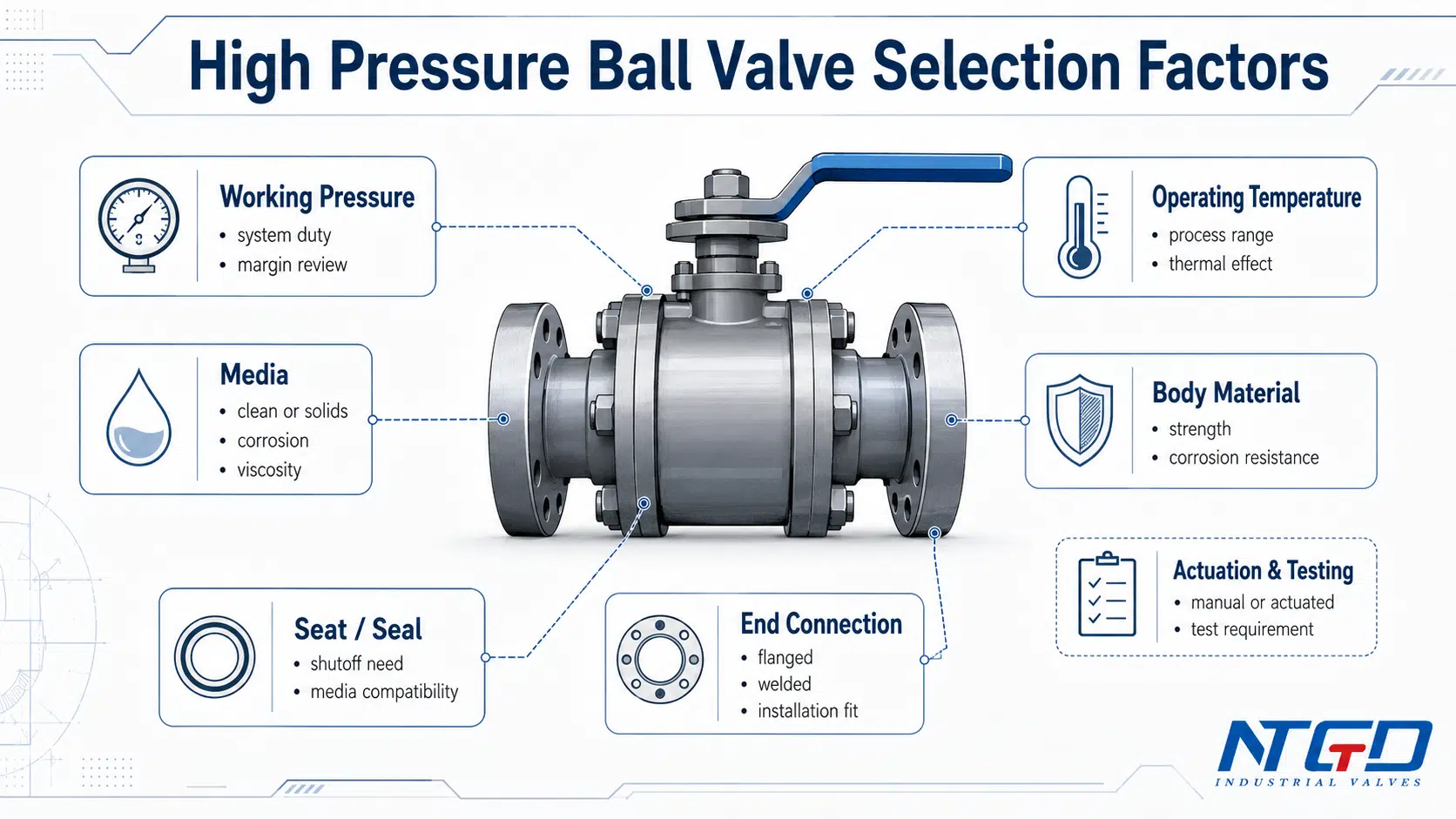
Pressure Rating Is Not the Only Selection Factor
A pressure rating describes what the valve is designed to handle under specified conditions. But the valve’s real suitability depends on the complete operating environment.
| Selection Factor | Why It Matters | What to Confirm |
|---|---|---|
| Working pressure | Main operating load on the body, seats, stem, and connection | Normal pressure, maximum pressure, pressure spikes, and differential pressure |
| Operating temperature | Affects seat, seal, packing, and pressure rating | Minimum, normal, maximum temperature, and thermal cycling |
| Media | Determines corrosion, erosion, and seal compatibility | Fluid type, solids, viscosity, corrosiveness, cleanliness |
| Valve size | Influences torque, body load, flow capacity, and actuator sizing | Nominal size, bore requirement, pipe schedule |
| End connection | Must match pipe rating and installation method | Flanged, threaded, welded, or project-specific connection |
| Seat / seal material | Controls shutoff, temperature range, and chemical compatibility | Soft seat, metal seat, packing, gasket material |
| Operation method | Affects torque, safety, and automation | Manual, gearbox, pneumatic, electric, hydraulic if required |
| Testing requirement | Confirms pressure boundary and shutoff performance | Shell test, seat test, documentation, project inspection |
A valve may be high pressure in name, but if the seat material, connection, or actuator does not match the actual service, the assembly may still fail in operation.
Operating Temperature and Pressure-Temperature Rating
Pressure rating should be reviewed together with temperature. A valve that is acceptable at ambient temperature may have a different allowable pressure at elevated temperature, depending on body material, seat material, packing, gasket material, and applicable design data.
This is especially important for high pressure high temperature ball valves. When pressure and temperature are both demanding, selection may require verified pressure-temperature data, special seat materials, graphite-based packing, metal seats, extension brackets for actuators, or other severe-service design features. Those requirements should be confirmed from the manufacturer’s datasheet and project specification.
For industrial valve specifications, ASME B16.34 is a relevant reference point because it covers pressure-temperature ratings, materials, testing, marking, and flanged, threaded, and welding-end valve construction; the final requirement still needs to match the project specification and valve datasheet.
Body Material Selection
Body material should be selected according to media, pressure, temperature, corrosion risk, and project standards.
| Material Direction | Typical Selection Logic | Caution |
|---|---|---|
| Carbon steel | Often used for industrial pressure service where corrosion is controlled | Not suitable for all corrosive media |
| Stainless steel | Common where corrosion resistance or cleaner service is required | Grade selection must match media and temperature |
| Alloy steel / special alloy | Used when temperature, pressure, corrosion, or project specification requires it | Do not assume availability without project confirmation |
| Forged or cast construction | May depend on size, pressure, design, and manufacturing method | Must be matched to actual pressure class and standard |
A high pressure stainless steel ball valve is often considered where corrosion resistance is important, but stainless steel alone does not guarantee suitability. Seat, seal, temperature, pressure class, and end connection still need review.
Soft Seats vs Metal Seats
Seat selection is one of the most important decisions in high pressure ball valve selection.
| Seat Type | Typical Strength | Key Limitation | When to Review Carefully |
|---|---|---|---|
| Soft seat | Tight shutoff, lower torque in many clean services | Temperature, chemical attack, deformation, wear | High temperature, abrasive media, frequent cycling, pressure spikes |
| Metal seat | Better tolerance for heat, erosion, or severe service in some designs | Higher torque, leakage class differences, cost, surface finishing requirements | HPHT, steam, abrasive media, severe-service shutoff |
| Special seat material | Project-specific balance of sealing and temperature resistance | Must be verified by datasheet | Chemical service, thermal oil, special gas, high-cycle service |
For a more detailed seat-direction comparison, see NTGD’s metal-seated vs soft-seated ball valves guide, which separates shutoff duty, media cleanliness, temperature, pressure, torque, and lifecycle burden before choosing a seat route.
The best seat is not always the hardest seat. It is the seat that matches the operating pressure, temperature, media, shutoff expectation, cycle frequency, and maintenance plan.
If a service involves elevated temperature, abrasive media, thermal cycling, or strict shutoff requirements, the seat decision should be made from verified valve data rather than generic material assumptions. A soft seat may provide excellent shutoff in one service, while another service may require a metal seat, special packing, or different body construction.
Seal and Packing Materials
Seals, gaskets, and packing are often smaller than the body and ball, but they strongly affect leakage control. Under high pressure, a wrong seal or packing material may fail even if the body pressure rating looks acceptable.
Important checks include:
- media compatibility;
- operating temperature;
- pressure cycling;
- external leakage requirement;
- stem packing arrangement;
- gasket compatibility;
- maintenance access.
When High Temperature or Severe Service Requires Extra Review
High pressure high temperature ball valves are not just standard high pressure ball valves with a higher temperature label. High temperature can change seat behavior, packing performance, actuator mounting requirements, and leakage expectations.
If the service involves steam, thermal oil, high-temperature chemical media, abrasive particles, corrosive fluid, or frequent thermal cycling, the valve should be reviewed as a severe-service application. It may require metal seats, special packing, body material review, torque review, and project-specific testing.
High Pressure Ball Valve Configurations and Design Options
The old “types of high-pressure ball valves” approach often mixes different classification dimensions. A clearer method is to separate support method, port configuration, bore type, body construction, and end connection.
Floating vs Trunnion High Pressure Ball Valves
Floating and trunnion designs are two important support methods.
| Design | How It Works | High-Pressure Selection Logic |
|---|---|---|
| Floating ball valve | The ball is supported mainly by the seats and can move slightly under pressure | May be suitable when size, pressure differential, torque, and cycle frequency remain within the valve design limits |
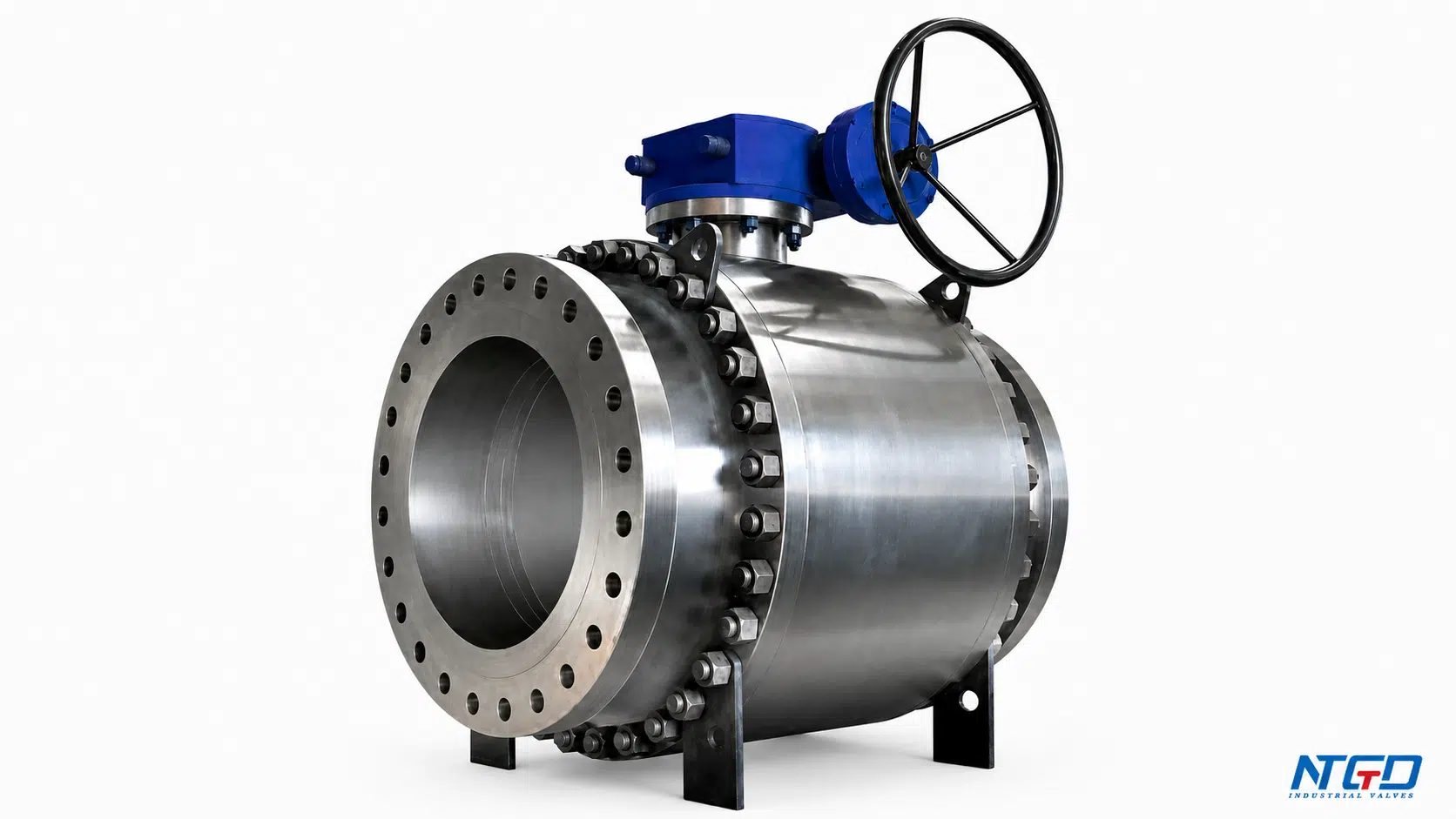
| Trunnion ball valve | The ball is mechanically supported by trunnions, reducing seat load from pressure | Often reviewed when larger size, higher differential pressure, automation, or more predictable torque control is required |
| High pressure trunnion ball valve | A trunnion-supported design selected for demanding pressure and torque control | Useful when pressure load, valve size, or actuator sizing makes floating design less suitable |
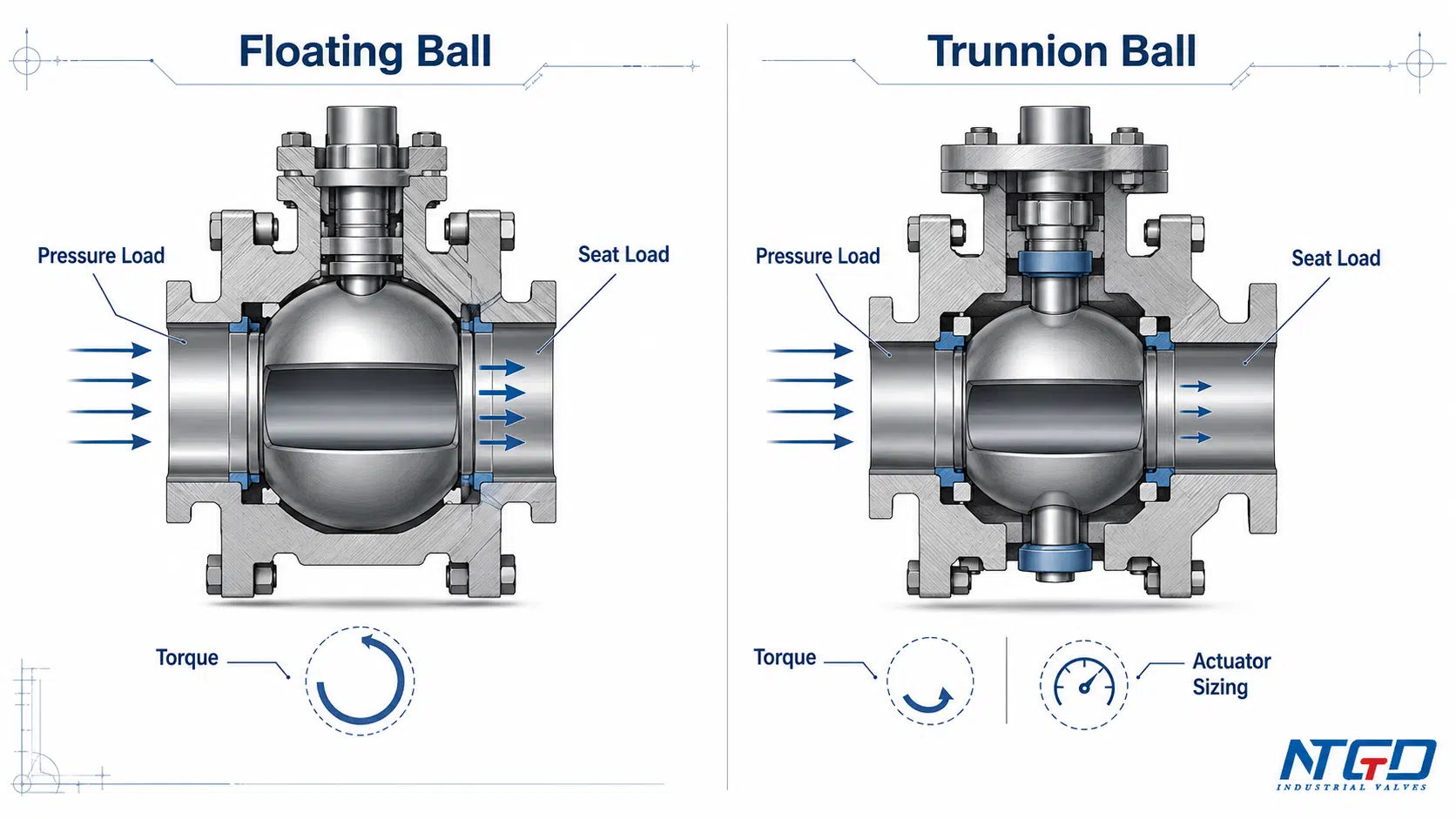
A trunnion ball valve is not automatically required for every high-pressure service, but it becomes more important as size, pressure differential, operating torque, or automation requirements increase. Final selection should be confirmed by the valve datasheet, torque data, seat design, and project specification.
For a deeper engineering comparison, NTGD’s trunnion ball valve vs floating ball valve guide explains how ball support, sealing load path, pressure, size, operating torque, and actuator sizing change the selection direction.
Two-Way vs Three-Way Flow Configuration
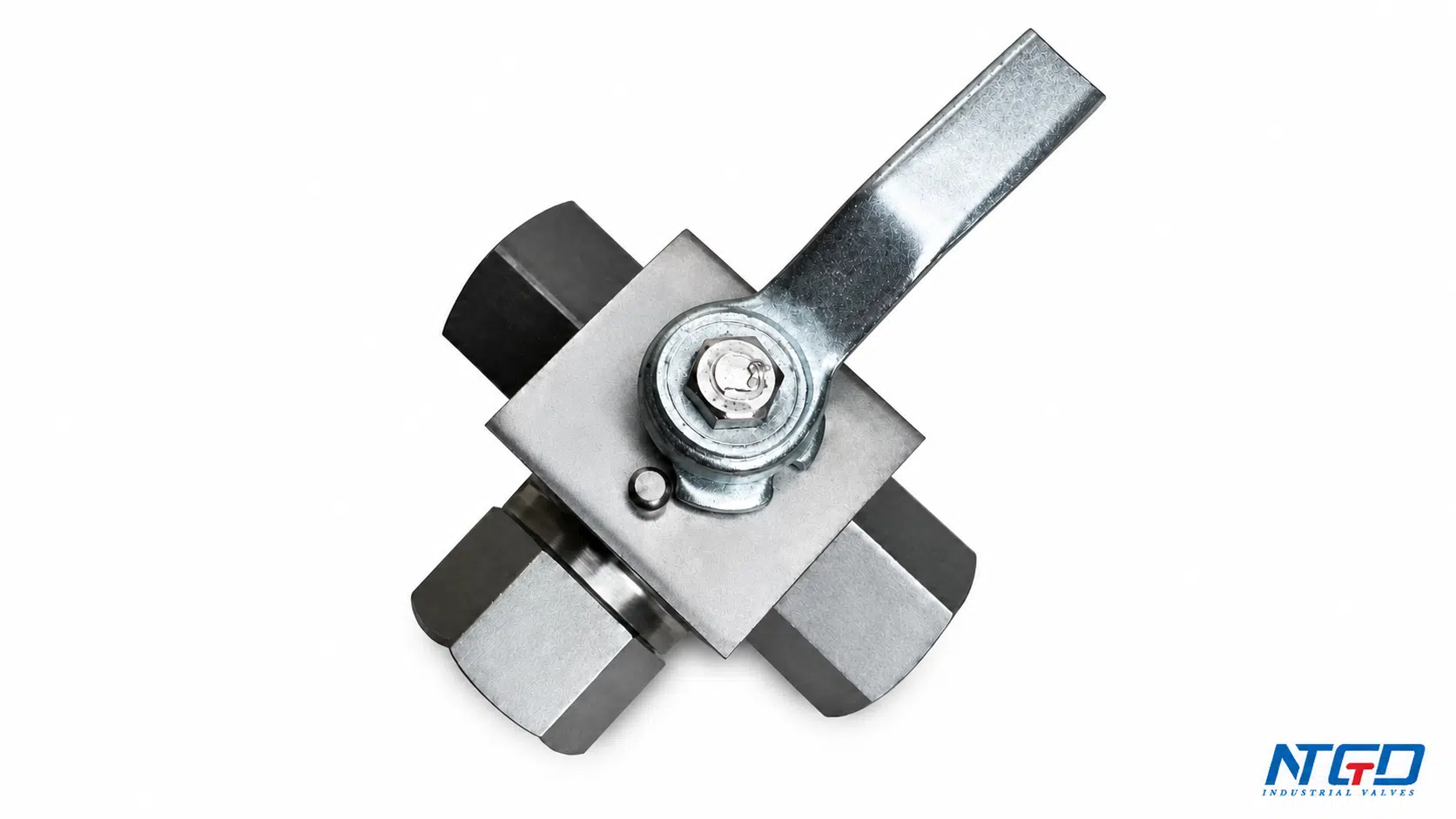
A two-way high pressure ball valve is used for simple on-off flow control in one pipeline. A high pressure 3 way ball valve can divert or combine flow depending on the port design, but it requires careful review of flow path, pressure balance, sealing arrangement, and actuator requirements.
For most high-pressure shutoff applications, two-way valves are more common. Three-way designs should not be selected only because they seem more flexible.
Full Port vs Reduced Port
| Bore Type | Advantage | Selection Caution |
|---|---|---|
| Full port | Lower pressure drop and better pigging or cleaning path in some systems | Larger body and higher cost may apply |
| Reduced port | More compact and sometimes more economical | Higher flow restriction and pressure drop |
| Standard port | Balanced option depending on manufacturer design | Must be checked against required flow capacity |
If bore size, Cv/Kv, flow capacity, or allowable pressure drop is part of the selection, NTGD’s ball valve sizing and installation guide can support the review before finalizing full-port or reduced-port construction.
If the pipeline requires low pressure drop, flow capacity, or pigging, bore type should be confirmed before RFQ.
Top Entry, Side Entry and Body Construction
Top entry and side entry describe body construction and maintenance access, not the same category as two-way / three-way or flanged / threaded connection.
- Top entry ball valve: may allow internal access from the top without removing the valve from the pipeline, depending on design.
- Side entry ball valve: common in many industrial ball valve constructions, with body parts assembled from the side.
- Two-piece or three-piece construction: may affect maintenance, sealing joints, and manufacturing approach.
- Welded body: may reduce external joint leakage points but changes maintenance and inspection considerations.
These choices should be evaluated according to pipeline layout, maintenance strategy, pressure class, and service conditions.
Flanged, Threaded, Welded and Other End Connections
High pressure flanged ball valves are often used where bolted pipeline connections are required. Threaded valves may be used in smaller sizes or specific systems. Welded ends may be selected where leak paths and connection integrity are critical.
| End Connection | Typical Use | High-Pressure Concern |
|---|---|---|
| Flanged | Industrial piping, easier removal and inspection | Flange class, gasket, bolting, alignment |
| Threaded | Smaller lines, compact systems | Thread engagement, sealing method, vibration, maintenance |
| Welded | Permanent installation, reduced joint leakage | Welding procedure, inspection, maintenance access |
| Special connection | Instrumentation, high-pressure tubing, project-specific systems | Must match system standard and manufacturer design |
Connection selection should not be treated as an accessory decision. In high-pressure systems, the end connection is part of the pressure boundary.
Manual vs Actuated High Pressure Ball Valves
A high pressure ball valve with actuator is not a different working principle. The internal ball still rotates 90 degrees. The actuator only changes how the torque is applied and controlled.
Actuation becomes important when the valve is large, difficult to access, operated frequently, used in remote systems, or required to move to a defined fail position.
Operation Options
| Operation Type | Best Use | Key Selection Checks | Risk if Ignored |
|---|---|---|---|
| Manual handle | Smaller valves, accessible locations, low cycle frequency | Operating torque, handle clearance, pressure differential, operator safety | Valve may be hard to operate or unsafe under pressure |
| Gear operator | Larger manual valves or higher torque applications | Gear ratio, valve torque, mounting, maintenance access, handwheel clearance | Slow, incomplete, or inconsistent operation |
| Pneumatic actuator | Fast remote operation where compressed air is available | Air supply, torque output, double acting or spring return, fail-open / fail-close requirement | Actuator may not complete stroke or may fail in the wrong position |
| Electric actuator | Remote or automated operation where power control is preferred | Voltage, control signal, cycle time, torque, manual override, limit switch or feedback | Slow movement, wrong torque, no position confirmation, or incomplete closure |
| Hydraulic actuator | Special high-torque or project-specific control | Hydraulic power unit, control logic, torque demand, environment, fail-safe requirement | Over-complexity or unsafe operation if not required |
When the actuation route is still open, compare the service conditions with NTGD’s pneumatic ball valve and electric ball valve pages, then confirm torque, fail position, control signal, and position feedback against the actual high-pressure valve data.
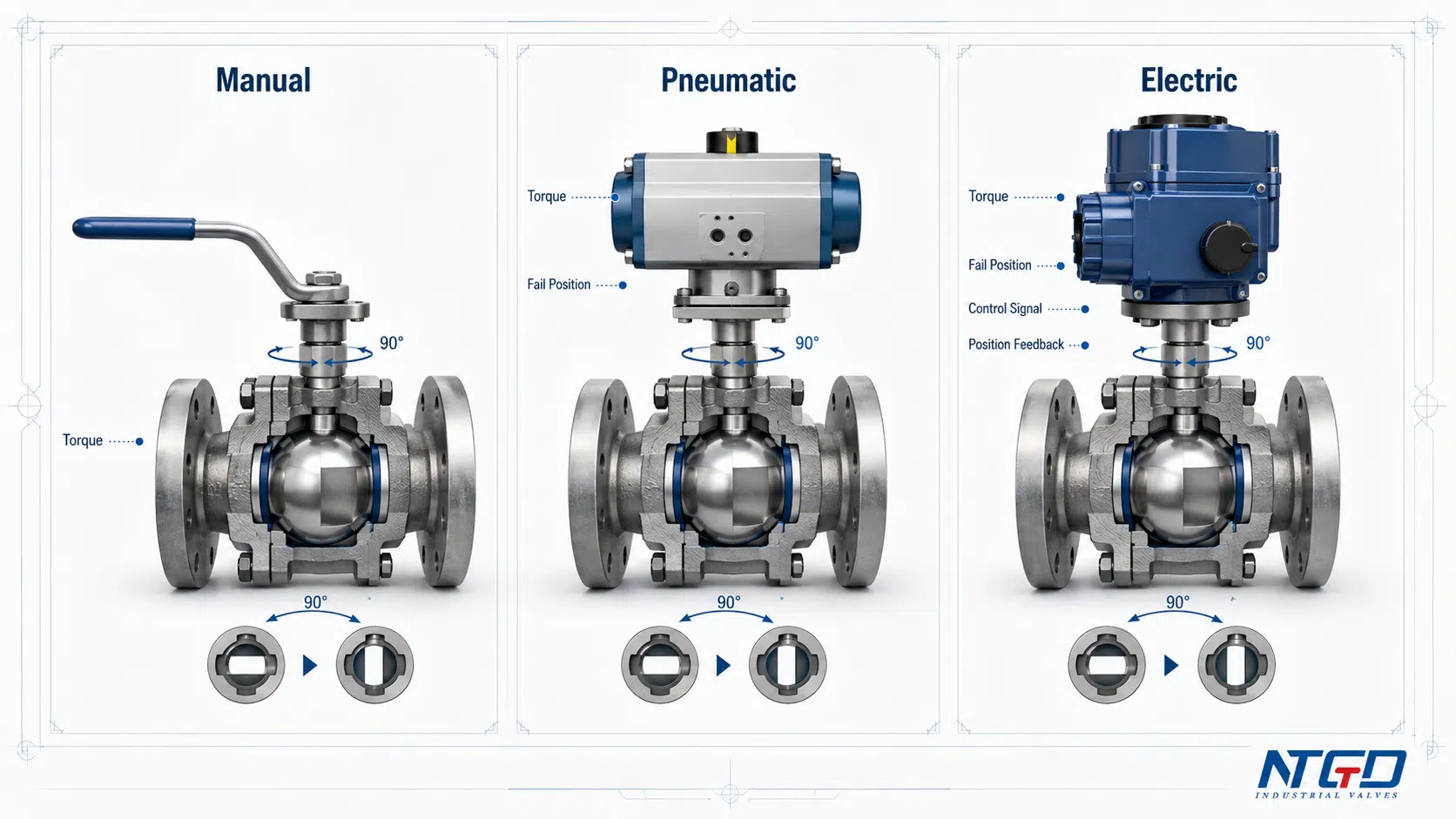
Actuator sizing is a valve-and-service decision, not only an actuator model choice. The valve torque, pressure differential, seat material, cycle frequency, media condition, fail position, and control requirement all need to be reviewed together.
Pneumatic Actuation
A pneumatic actuator uses compressed air to rotate the valve. In high pressure service, the important selection points include actuator torque, air supply pressure, double acting or spring return operation, and fail-open or fail-close requirement.
- Double acting: air is used to open and close the valve.
- Spring return: spring force returns the valve to a defined fail position when air is lost.
- Fail-close / fail-open: selected according to process safety logic.
The fail position should not be guessed. It must be decided according to the process risk.
Electric Actuation
An electric actuator uses a motor to rotate the valve. It may be selected when compressed air is unavailable or when integration into an electrical control system is preferred.
Important checks include:
- torque requirement;
- voltage and power supply;
- control signal;
- cycle time;
- position feedback;
- limit switches;
- manual override;
- environmental protection;
- heat isolation if the service temperature is high.
For high temperature service, actuator mounting may require extension brackets or thermal isolation so heat is not transferred directly into the actuator.
Torque, Mounting and Position Feedback
Actuator sizing must consider more than valve size. It should reflect pressure differential, seat material, stem torque, cycle frequency, media condition, and safety factor.
Mounting also matters. Poor alignment or side-loading can increase wear or prevent smooth operation. For automated high pressure ball valves, position feedback may be required so the control system can confirm whether the valve is fully open or fully closed.
Where a part-turn actuator is specified, the actuator-to-valve interface should be checked against the applicable mounting standard and supplier torque data; ISO 5211 identifies requirements for attaching part-turn actuators, with or without gearboxes, to industrial valves.
Industrial Applications of High Pressure Ball Valves
High pressure ball valves are used where fast shutoff, compact quarter-turn operation, and reliable pressure containment are required. The application should be described by process conditions, not just industry name.
| Application Area | Why a High Pressure Ball Valve May Be Used | Main Specification Concern |
|---|---|---|
| Oil and gas pipelines | Shutoff in pressure lines, injection systems, utility systems, and process units | Pressure class, fire-safe requirement if applicable, seat / seal compatibility |
| Petrochemical and chemical plants | Isolation of process media under pressure | Corrosion resistance, chemical compatibility, leakage control |
| Hydraulic and high-pressure utility systems | Compact shutoff for pressurized fluid systems | Pressure spikes, end connection, torque, seal material |
| Water injection or testing lines | Isolation during pressure testing, injection, or industrial process control | Working pressure, test pressure, connection and documentation |
| Gas service | Shutoff in compressed gas or process gas systems | Seat leakage, body material, external leakage, safety requirement |
| Steam, thermal oil or high-temperature service | Possible use in special designs | HPHT review, seat / packing material, metal seat boundary |
| Remote or hazardous locations | Actuated shutoff where manual operation is difficult | Actuator type, fail position, position feedback |
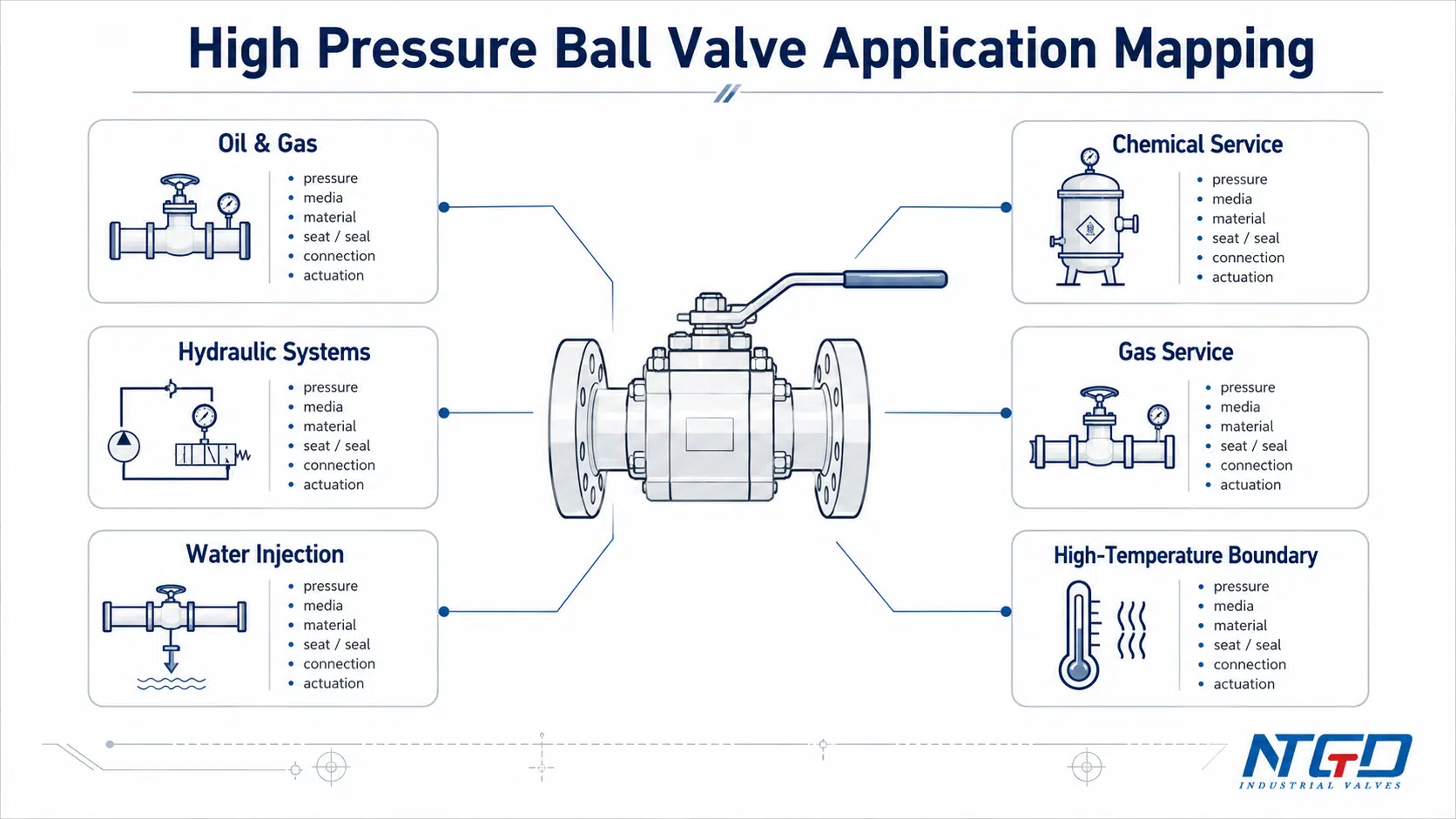
Application name alone is not enough for selection. The same “chemical,” “oil and gas,” or “hydraulic” application can require different body material, seat material, end connection, actuation, and test documentation depending on pressure, temperature, media, and shutoff requirement.
For corrosive or chemical media, NTGD’s ball valves for chemical applications guide gives a more focused route for matching material, seat, pressure, temperature, and valve type to real process conditions.
A high pressure hydraulic ball valve may be a valid product direction in certain hydraulic systems, but a complete hydraulic ball valve guide should be treated as a separate topic. This article only touches hydraulic service as one application case.
How to Select a High Pressure Ball Valve
The most practical selection process is to start from real operating conditions and then match the valve design.
This follows the same logic as a broader industrial valve selection guide: start with service function, medium, pressure, temperature, material, sealing route, connection, actuation, and documentation before confirming the final valve specification.
Selection Framework
| Selection Factor | Why It Matters | What to Confirm Before RFQ |
|---|---|---|
| Working pressure | Determines body, seat, stem, connection load, and torque; pressure spikes and differential pressure can increase seat stress | Normal pressure, maximum pressure, pressure spikes, differential pressure |
| Operating temperature | Changes material behavior, seat performance, packing stability, and pressure-temperature rating | Minimum / maximum temperature, thermal cycling, seat and packing limits |
| Media | Controls corrosion, erosion, solids buildup, seal compatibility, and ball surface wear | Fluid type, solids, viscosity, corrosiveness, cleanliness |
| Valve size | Affects flow capacity, body load, torque, and actuator sizing | Nominal size, pipe schedule, required bore |
| Flow requirement | Determines full port vs reduced port direction and pressure drop tolerance | Flow rate, allowable pressure drop, pigging or cleaning needs |
| Body material | Must match pressure, media, temperature, corrosion risk, and project requirements | Carbon steel, stainless steel, alloy, or project-specific material |
| Seat and seal | Determines shutoff, leakage control, temperature range, and service life | Soft seat, metal seat, packing, gasket, leakage expectation |
| Ball support | Affects torque and pressure-load behavior | Floating or trunnion, based on size, pressure differential, and torque |
| End connection | Part of the pressure boundary | Flanged, threaded, welded, or project-specific connection |
| Operation method | Determines manual or automated control and safe operation | Handle, gearbox, pneumatic, electric, hydraulic if required; fail position and feedback |
| Testing and documents | Confirms project acceptance and pressure boundary verification | Pressure test, seat test, material certificate, inspection report, project documentation |
Step 1: Confirm Pressure and Temperature
Start with working pressure, maximum pressure, pressure spikes, differential pressure, and operating temperature. Pressure and temperature should be reviewed together because material and seat performance can change with temperature.
Step 2: Confirm Media Compatibility
The medium determines whether the body, ball, seat, seal, and packing materials are suitable. Clean water, hydraulic oil, gas, corrosive chemical media, steam, and slurry-like fluids create different selection risks.
Step 3: Choose Body Material and Seat / Seal Type
Body material handles pressure and corrosion. Seat and seal material determine shutoff and leakage control. A mismatch can cause leakage even if the body is strong enough.
Step 4: Choose Floating or Trunnion Design
For smaller or less demanding applications, a floating ball design may be acceptable. For larger size, higher pressure, higher differential pressure, repeated operation, or automated service, trunnion support often deserves stronger consideration.
Step 5: Check Port, Bore and End Connection
Confirm whether the application needs full port, reduced port, two-way, three-way, flanged, threaded, welded, or another connection type. Do not treat these details as interchangeable.
Step 6: Decide Manual or Actuated Operation
If manual operation is difficult, unsafe, frequent, remote, or part of an automated process, an actuator may be required. Actuator selection must include torque, mounting, air supply or voltage, fail position, cycle frequency, and position feedback.
Step 7: Confirm Testing and Documentation
For industrial projects, the buyer may need pressure test reports, material certificates, inspection records, or compliance with project-specific requirements. These should be clarified before order confirmation.
Common Problems and Troubleshooting Notes
Troubleshooting high pressure ball valves should focus on inspection logic rather than generic repair kits. In many cases, the correct action depends on valve design, pressure, media, and manufacturer instructions.
| Symptom | Likely Cause | What to Inspect | When to Consult Manufacturer |
|---|---|---|---|
| Seat leakage | Seat wear, damaged ball surface, wrong seat material, debris | Confirm seat material, ball surface condition, media cleanliness, pressure differential, and closure position | Repeated leakage, severe media, high pressure shutoff failure, or uncertain seat compatibility |
| Stem or gland packing leakage | Packing wear, gland under-compression, thermal cycling, stem damage | Gland nut, packing condition, stem surface, temperature cycling, pressure cycling, operating torque | External leakage under pressure or repeated adjustment required |
| Body or end connection leakage | Gasket failure, bolting issue, flange misalignment, body joint problem | Gasket, fasteners, flange alignment, body joint, end connection rating | Any pressure boundary leakage should be reviewed by the manufacturer or qualified engineer |
| High operating torque | Seat load, media deposits, actuator undersizing, packing too tight | Seat area, stem packing compression, torque data, pressure differential, actuator sizing | Valve cannot fully open or close, or torque changes after adjustment |
| Actuator no response | Air supply loss, power issue, control signal problem, torque overload | Air pressure, voltage, signal, limit switch, actuator output, valve torque demand | Automated valve fails to reach the required safe position |
| Incomplete closure | Debris, seat damage, wrong actuator stroke, ball obstruction | Ball position, seat condition, actuator travel, closure feedback, pipeline cleanliness | Valve cannot isolate a high pressure line or closure position is uncertain |
If the issue is no longer a selection question but a failure or maintenance question, NTGD’s ball valve failure and troubleshooting guide can provide additional context on actuator incompatibility, material mismatch, leakage, pressure-temperature limits, and stem wear.
Do not select replacement handles, repair kits, or seals only by appearance. For high-pressure service, parts should match the exact valve design, material, pressure rating, and manufacturer specification.
Final Specification Checklist Before RFQ
Before selecting or requesting a quotation for high pressure ball valves, prepare the following information.
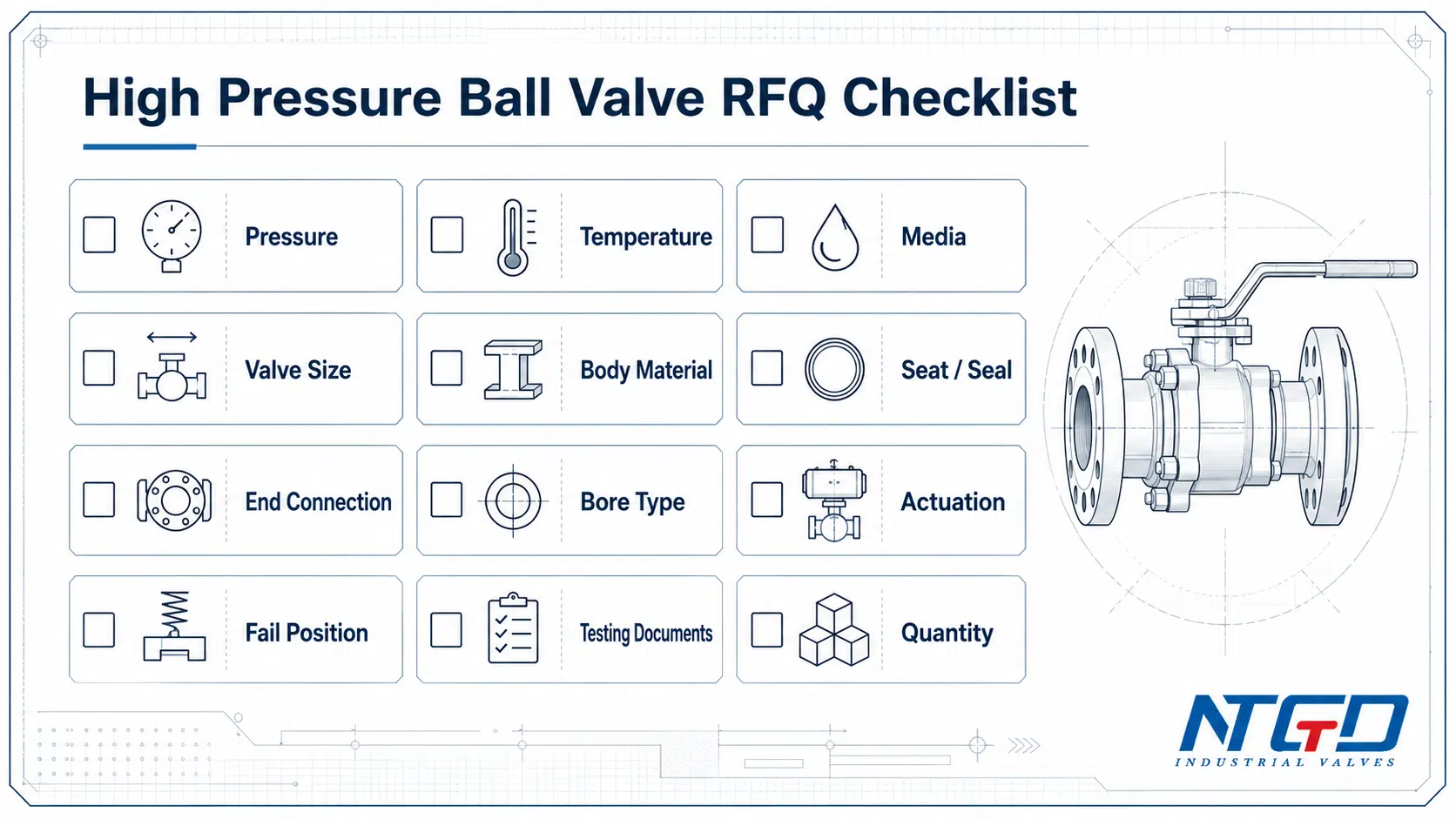
| RFQ Item | Information to Provide |
|---|---|
| Valve size | NPS / DN size and pipeline details |
| Working pressure | Normal pressure, maximum pressure, pressure spikes, differential pressure |
| Operating temperature | Minimum, normal, and maximum temperature |
| Media | Fluid type, corrosiveness, solids, viscosity, cleanliness |
| Valve function | On-off shutoff, isolation, emergency shutoff, remote operation |
| Bore requirement | Full port, reduced port, or flow capacity requirement |
| Body material | Carbon steel, stainless steel, alloy, or project-specified material |
| Seat / seal / packing | Soft seat, metal seat, special seal, packing material if known |
| Ball support | Floating or trunnion preference, if already specified |
| End connection | Flanged, threaded, welded, hub, or other connection |
| Operation method | Manual handle, gearbox, pneumatic actuator, electric actuator, hydraulic actuator if required |
| Pneumatic actuator data | Air supply, double acting or spring return, fail-open or fail-close requirement |
| Electric actuator data | Voltage, control signal, cycle time, manual override if required |
| Position feedback | Limit switch, position feedback, open / close confirmation requirement |
| Testing requirement | Shell test, seat test, inspection, material certificate, documentation |
| Quantity and project environment | Quantity, installation area, service criticality, delivery requirement |
If the project data is ready, send the pressure, temperature, media, valve size, end connection, seat / seal preference, operation method, actuator requirement, and documentation needs through the NTGD contact form for application-specific review.
A complete RFQ reduces the risk of selecting a valve that matches the size but fails to match the service.
FAQ
What is the difference between a high pressure and low pressure ball valve?
A high pressure ball valve is selected with closer attention to body pressure rating, seat load, stem sealing, end connection, torque, temperature, media, and testing requirements. A low pressure ball valve may be acceptable for simpler utility service, but high pressure service requires a more complete review of the pressure boundary and sealing system.
Can a ball valve be used in high-pressure service?
Yes, a ball valve can be used in high-pressure service if its body, ball support, seats, seals, stem, end connection, pressure rating, temperature range, and testing requirements match the actual application. The valve should not be selected by valve type alone.
Which ball valve parts most affect pressure containment and shutoff?
The most important high-pressure-related parts include the body, ball, seats, stem, packing, gland, gaskets, fasteners, end connections, and actuator interface. These parts affect pressure containment, shutoff, torque, leakage control, and long-term reliability. A strong body cannot compensate for the wrong seat, packing, gasket, or connection.
How does a high pressure ball valve work?
It works by rotating a bored ball 90 degrees inside the valve body. When the bore aligns with the pipeline, flow passes through. When the ball turns perpendicular to the pipeline, the valve closes. In high pressure service, seat load, stem torque, packing, and pressure boundary design become especially important.
Can high pressure ball valves be actuated?
Yes. High pressure ball valves can use manual operation, gear operators, pneumatic actuators, electric actuators, or other project-specific actuation methods. The actuator must be sized according to valve torque, pressure differential, seat material, cycle frequency, mounting interface, and required fail position.
When does high pressure service also require high-temperature or metal-seat review?
High-temperature or metal-seat review is needed when operating temperature, steam or thermal oil service, abrasive media, corrosive media, thermal cycling, or leakage requirements exceed what a standard soft-seat design can safely handle. In those cases, the seat, packing, gasket, body material, torque, and actuator mounting should be checked against the valve datasheet and project specification.
What is an ultra high pressure ball valve?
An ultra high pressure ball valve generally refers to a valve designed for pressure levels beyond standard industrial pressure service. The exact definition depends on industry, size, connection type, and manufacturer design. It should be selected using a verified datasheet, not a generic pressure label.
When is a trunnion ball valve more suitable for high pressure service?
A trunnion ball valve is often more suitable when valve size, differential pressure, operating torque, automation, or cycle frequency makes floating ball operation less predictable. It is not automatically required for every high-pressure service, so the decision should be based on torque data, pressure conditions, seat design, and project specification.
What information should be provided before selecting a high pressure ball valve?
Provide valve size, working pressure, maximum pressure, pressure spikes, operating temperature, media, body material, seat / seal requirement, end connection, bore type, operation method, actuator requirements, testing requirements, quantity, and project environment. This allows the supplier or engineer to review the valve as a complete pressure-containing assembly.
Conclusion
A high pressure ball valve should be selected as an engineered assembly, not as a generic shutoff valve. The body, ball, seats, stem, packing, gland nut, fasteners, connection, actuator, and test requirements all influence whether the valve can safely handle the actual pressure, temperature, media, and operating cycles.
The most reliable selection process starts with service conditions, then confirms pressure-temperature rating, material compatibility, seat and seal design, floating or trunnion support, connection type, operation method, and documentation needs.
Before procurement or engineering confirmation, check pressure, temperature, media, seat / seal, end connection, torque, actuation, and documentation together. A wrong choice may cause leakage, high torque, incomplete shutoff, external leakage, or specification mismatch.
For a project-specific review, prepare the RFQ checklist above before selecting the valve.
Need Help Selecting a High Pressure Ball Valve?
If you are preparing a high pressure ball valve inquiry, share the working pressure, operating temperature, media, valve size, end connection, seat / seal preference, manual or actuated operation requirement, fail position if applicable, and test documentation needs. NTGD can review the application conditions and help match the valve design to the required service.
