
Author Name: Bruce Zheng
Author Role: Co-Founder and Valve Engineer at NTGD Valve
Author Bio: Bruce Zheng is Co-Founder and Valve Engineer at NTGD Valve, focusing on industrial valve selection, application, and technical content for global B2B buyers.
Last Updated: June 9, 2026
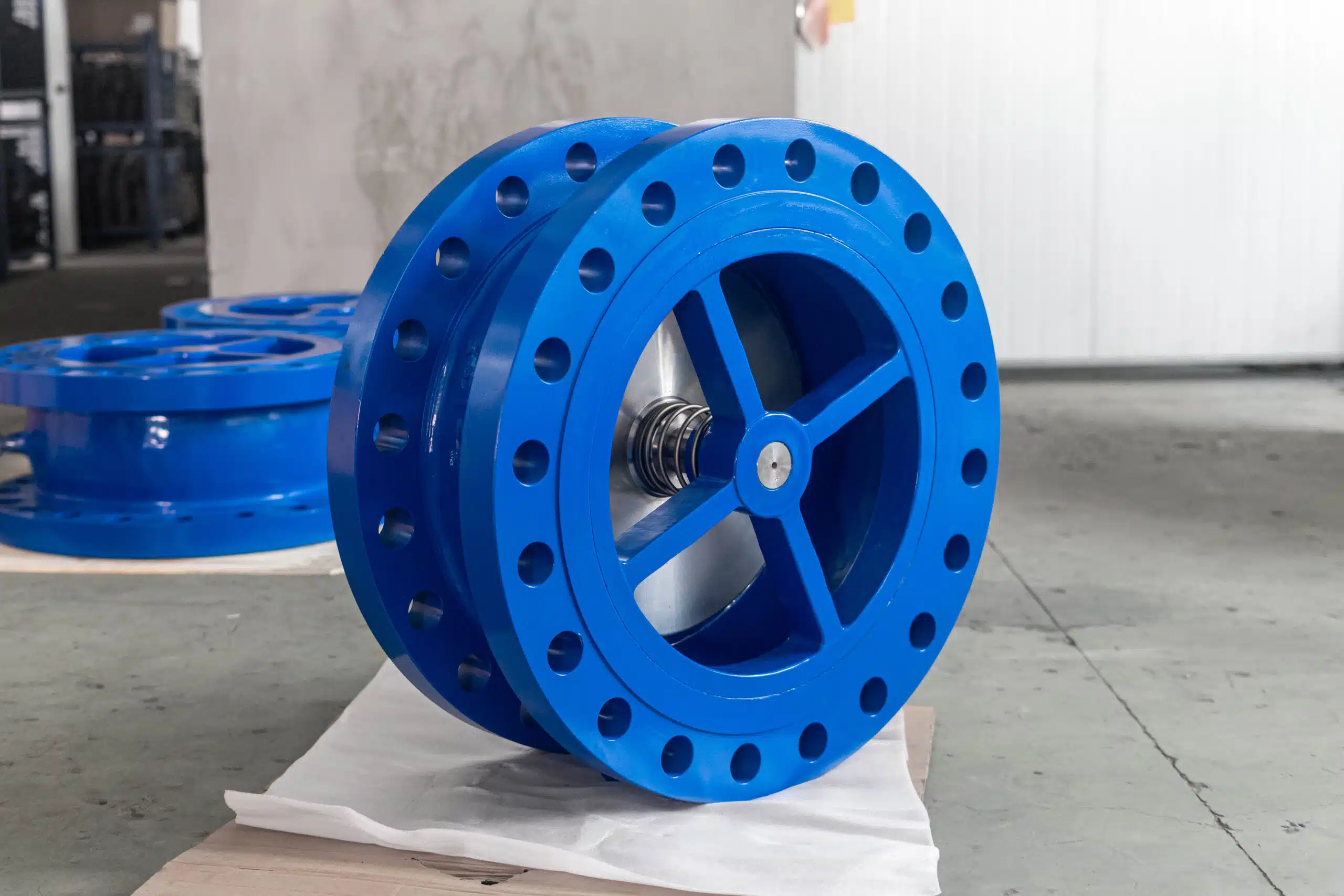
A nozzle check valve is a spring-assisted, axial-flow check valve used to prevent reverse flow in pipelines and process systems. It is commonly selected where fast closure, water hammer reduction, pressure-loss control, and pump or compressor protection are important.
Unlike a conventional swing check valve, a nozzle check valve uses a guided disc and spring-assisted short stroke. When forward flow is strong enough, the disc opens. When flow begins to slow, the spring helps move the disc back toward the seat before severe reverse flow develops. This is why nozzle check valves are often associated with non-slam check valve performance.
In pump discharge, compressor discharge, or fast flow deceleration service, slow or unstable check valve closure can allow reverse flow to build before the valve closes. The result may be slam, pressure surge, water hammer, or insufficient protection for rotating equipment and piping.
This article discusses industrial nozzle check valves used in pipeline, pump discharge, compressor discharge, water, power, oil and gas, and chemical service. It does not cover spray nozzle body check valves, garden sprayer accessories, carburetor parts, agricultural nozzle components, or small replacement nozzle accessories.
What Is a Nozzle Check Valve?
Engineering Definition
A nozzle check valve is an industrial non-return valve that allows flow in one direction and stops reverse flow automatically. It does not use a handwheel or actuator for normal operation. Instead, the flowing medium, internal spring, guided disc, and seat work together to open and close the valve.
The engineering value of a nozzle check valve is not only backflow prevention. Its axial-flow body, center-guided disc, and spring-assisted closure help the valve respond earlier when flow decelerates. In suitable service, this can reduce valve slam, pressure surge, water hammer, chatter, and unstable disc movement.
A typical nozzle check valve may be used for liquids, gases, steam, or selected process media. The final valve design depends on the body material, seat design, spring configuration, pressure class, temperature rating, installation orientation, and project specification.
Nozzle Check Valve, Axial Check Valve and Non-Slam Check Valve: Term Boundary
Several terms are used around this valve type. They are related, but they should not be treated as identical in every project.
| Term | Practical Meaning |
|---|---|
| Nozzle check valve | The main valve type discussed in this article. It uses a nozzle-shaped or streamlined flow path with an internally guided closure element. |
| Nozzle type check valve | A descriptive term for the same general valve family. It helps distinguish this design from other check valve types, including swing, lift, piston, ball, or dual plate check valves. |
| Axial nozzle check valve | A nozzle check valve where the flow path and disc movement are mainly axial. This term emphasizes inline flow and center-guided closure. |
| Axial flow check valve | A broader related term. Some axial flow check valves are nozzle-style designs, but naming and design details vary by manufacturer and project. |
| Non-slam check valve | A functional description. A nozzle check valve often achieves non-slam behavior through spring-assisted short stroke and a guided axial disc, but non-slam check valves may include other designs. |
| Silent check valve | A related category often associated with quick closure and reduced slam. It overlaps with nozzle / non-slam terminology in some projects, but the name alone does not confirm the exact design. |
For procurement or specification review, use the datasheet, drawing, IOM, valve standard, or manufacturer documentation as the naming authority. Different projects may use axial nozzle check valve, non-slam check valve, or silent check valve for related but not always identical designs.
Nozzle Check Valve Design and Key Components
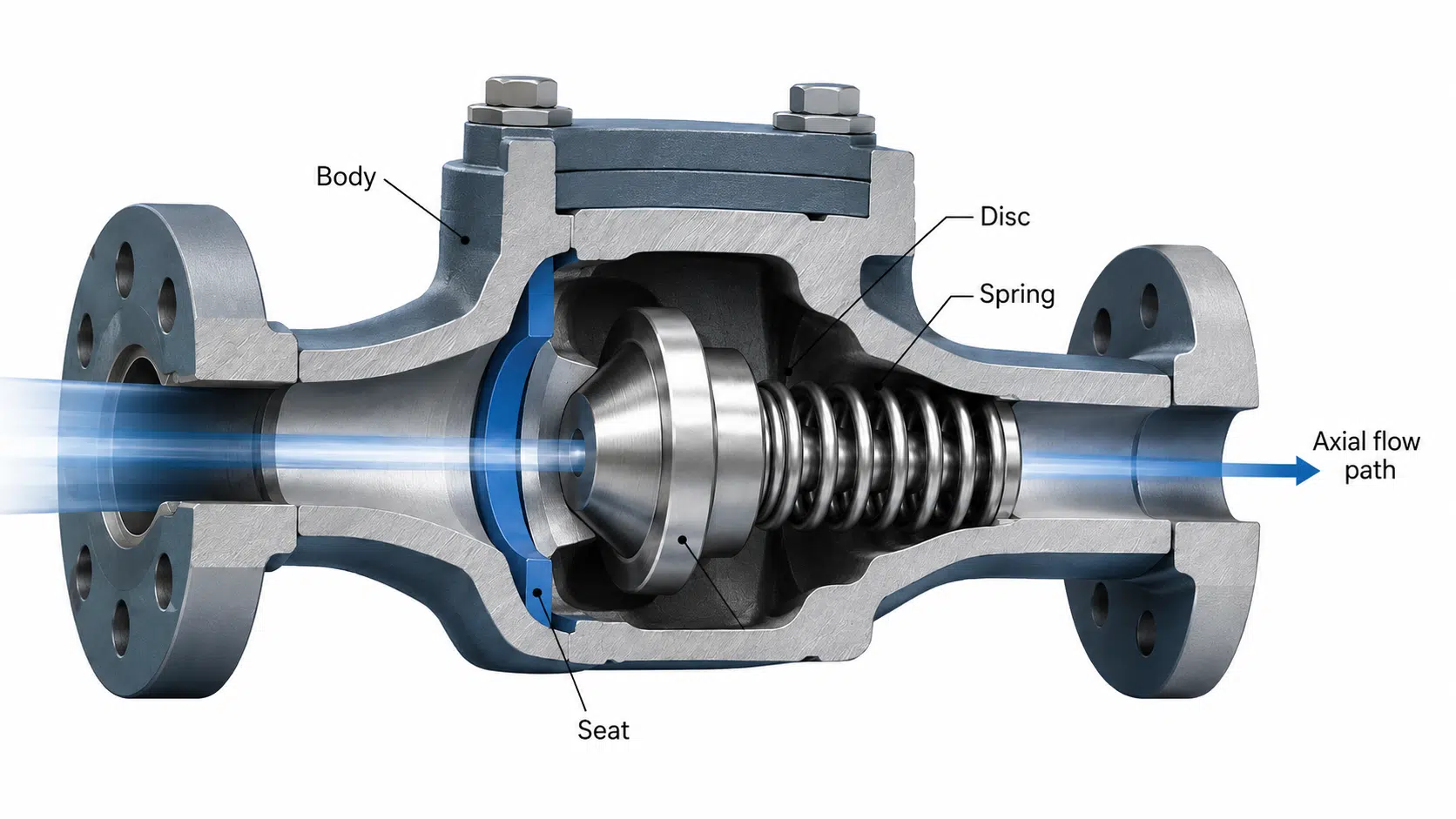
A nozzle check valve works as a dynamic system. The body, flow path, disc, spring, seat, gasket, and end connection all affect how the valve opens, closes, seals, and responds to changing flow.
Nozzle-Shaped / Axial Flow Body
The body of a nozzle check valve guides the medium through a streamlined internal path. In many designs, the flow moves through the valve in an axial direction rather than forcing a disc to swing away from a hinge.
This axial or nozzle-shaped flow path can support smoother flow, controlled disc movement, and more stable closure behavior. It may also reduce turbulence and pressure loss compared with some less streamlined designs, but actual pressure drop depends on valve size, internal geometry, flow rate, medium, and manufacturer data.
The axial-flow body also affects selection. Flow velocity distribution, disc stability, pressure drop, and flow deceleration response all depend on the internal geometry. Selection should not be based only on nominal pipe size; manufacturer pressure-drop data and actual service conditions must also be checked.
Body material must match the service conditions. Carbon steel, stainless steel, alloy steel, ductile iron, cast iron, and other materials may be used depending on pressure, temperature, corrosion, erosion, and project requirements.
Disc, Spring and Seat
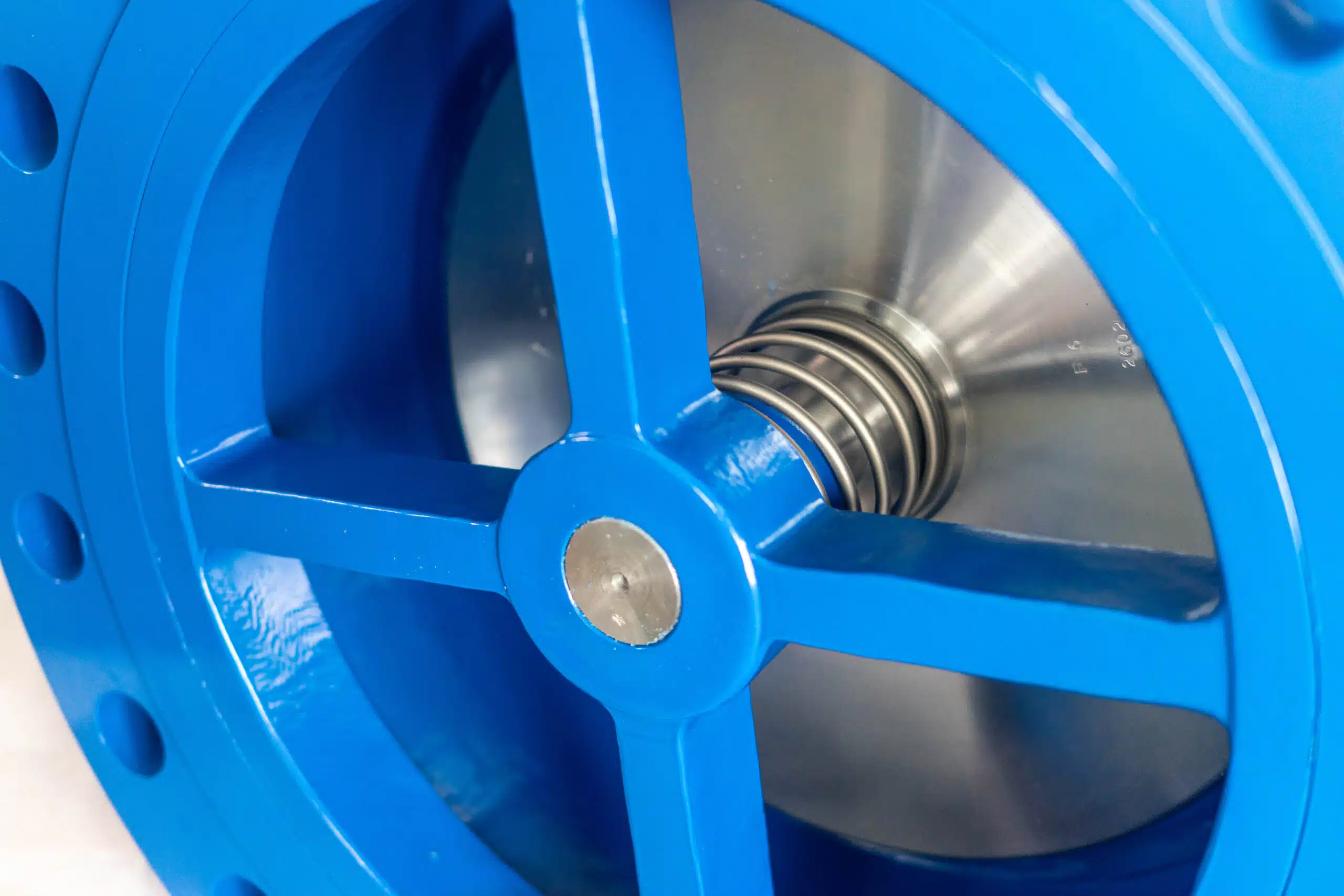
The disc opens and closes the flow path. In a nozzle check valve, the disc is usually guided along the valve axis. This controlled travel helps the closure element move in a stable path instead of swinging through a long arc.
The spring returns the disc toward the seat as forward flow slows, and this spring-assisted closure is central to non-slam nozzle check valve behavior. If the spring response does not match the service condition, the valve may chatter, close too slowly, remain unstable at low flow, or create unnecessary pressure loss.
The seat provides the sealing interface between the disc and valve body. Seat material must be selected based on media, temperature, pressure, shutoff expectation, and testing requirement. A soft seat may support tighter shutoff in suitable service, while a metal seat may be preferred in higher temperature or more severe applications. The correct choice must be verified against the valve design and project specification.
Gasket, Body Connection and Installation Interface
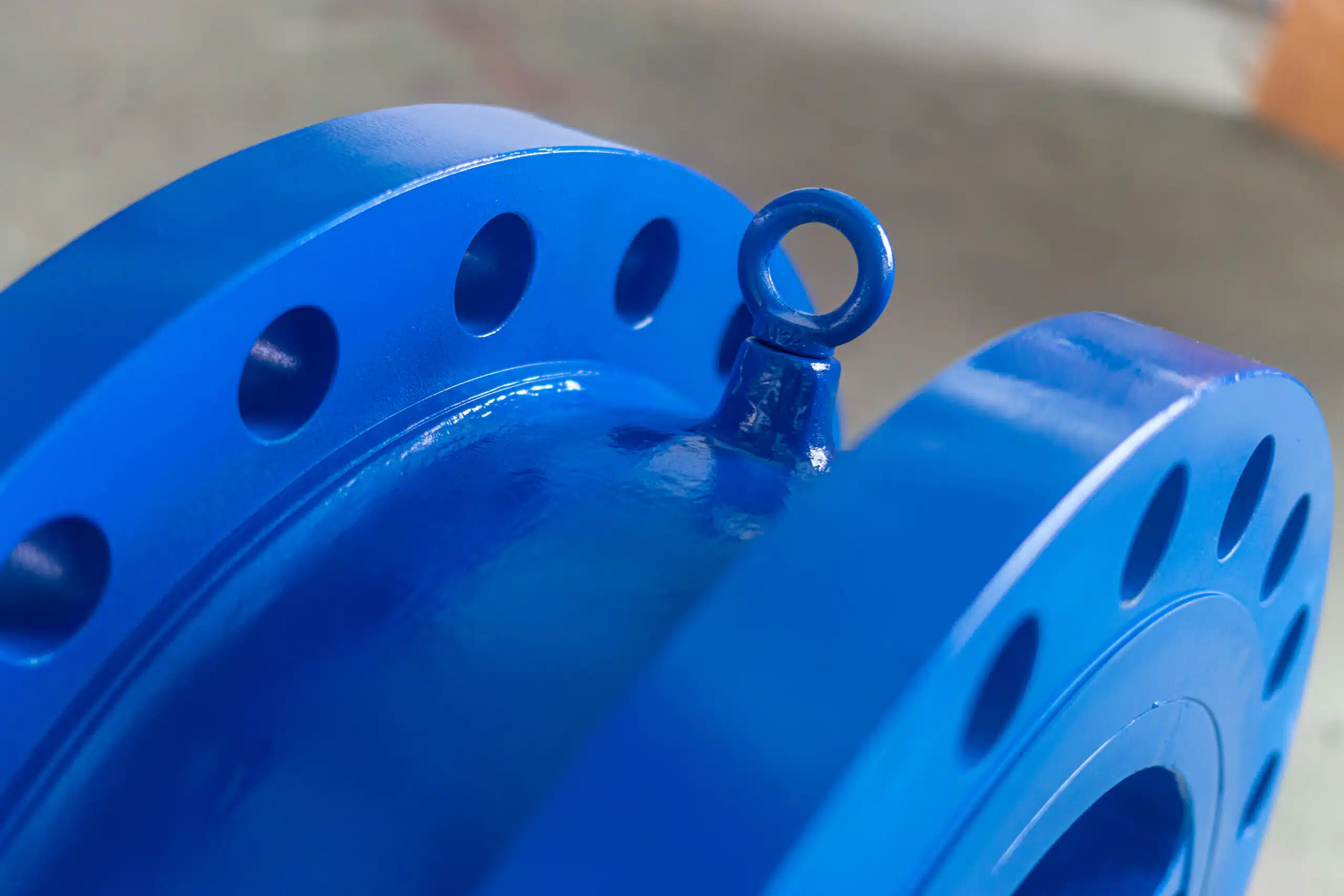
The gasket helps seal the valve-pipe connection. For flanged valves, gasket selection, flange alignment, bolt load, and installation procedure all affect external leakage risk. For welded or threaded connections, installation method and maintenance access must also be considered.
Gasket and connection details belong mainly to the installation interface, external sealing, and maintenance planning layer. They affect leakage risk and installation integrity, but the dynamic closure performance of a nozzle check valve is still mainly controlled by the flow path, disc, spring, seat, sizing, and service condition.
| Component | Main Function | Selection Impact |
|---|---|---|
| Body / flow path | Guides the medium through the valve | Affects pressure drop, velocity profile, material compatibility, and service range |
| Disc | Opens under forward flow and closes against reverse flow | Affects response speed, stability, and shutoff behavior |
| Spring | Assists disc closure when flow slows | Affects non-slam response, cracking behavior, minimum flow behavior, and chatter risk |
| Seat | Provides the sealing surface | Affects leakage performance, temperature limit, media compatibility, and maintenance need |
| Gasket / connection | Seals the valve-pipe interface | Affects external leakage risk, installation fit, inspection access, and replacement planning |
How Does a Nozzle Check Valve Work?
A nozzle check valve opens and closes automatically according to flow condition. The important point is timing: the valve should begin closing as forward flow decelerates, not only after strong reverse flow has already developed.
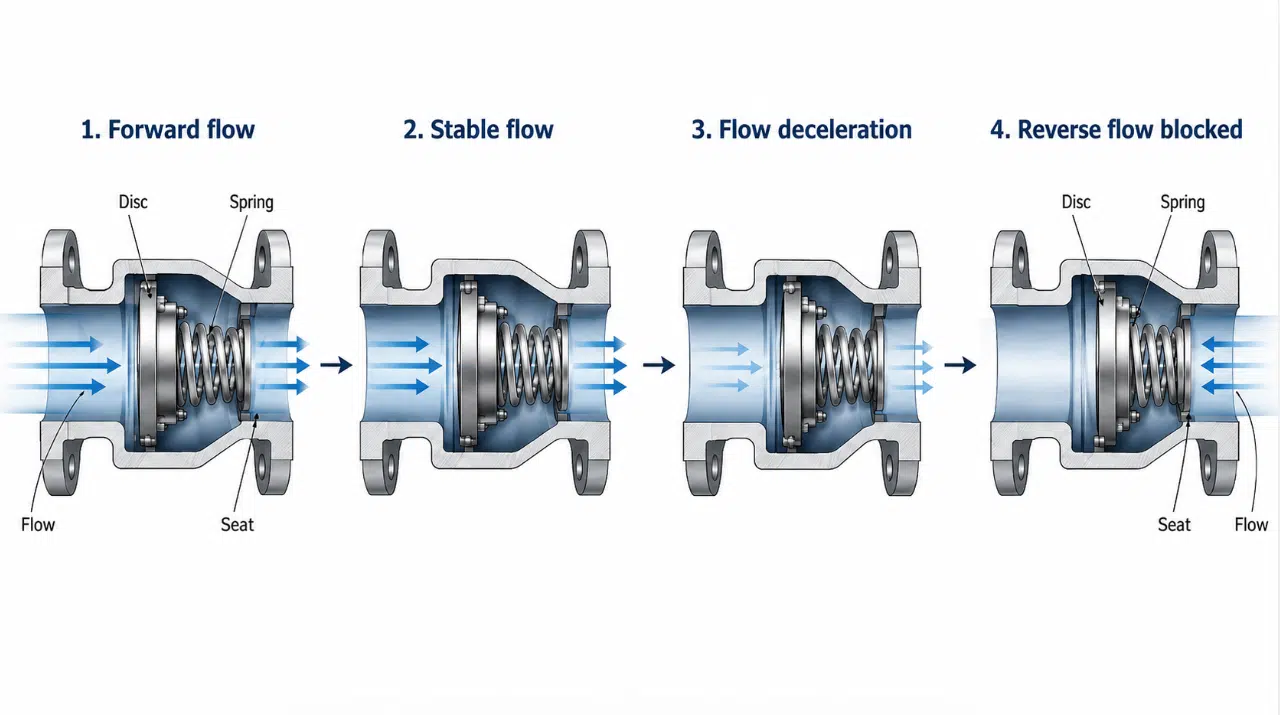
Forward Flow Opens the Disc
When forward flow enters the valve, the pressure and velocity of the medium act on the disc. If the forward force is high enough to overcome spring force and cracking requirement, the disc moves away from the seat and opens the flow path.
As the disc opens, the spring compresses. In a properly selected valve, the open position should support the required flow rate while keeping pressure loss within the project’s acceptable range.
Flow Deceleration Starts Spring-Assisted Closure
When a pump slows, a compressor condition changes, or system flow decelerates, the force holding the disc open decreases. The spring then begins to return the disc toward the seat.
This short-stroke spring-assisted closure is the main reason nozzle check valves are selected for fast-response service. The disc does not need to swing through a long travel distance. It moves along a guided path and can respond quickly to flow reduction.
Reverse Flow Is Blocked Before Slam Becomes Severe
If reverse flow begins to build, the disc should already be moving toward the seat. When the disc reaches the seat, it blocks reverse flow and helps protect upstream equipment and piping.
This action is intended to reduce the impact associated with valve slam and water hammer. It should not be treated as a universal guarantee. Actual performance depends on valve sizing, spring design, flow deceleration rate, pipeline layout, pump or compressor behavior, installation orientation, and system surge conditions.
| Stage | What Happens | Why It Matters |
|---|---|---|
| Forward flow | Flow pushes the disc open and compresses the spring | Allows normal flow through the pipeline |
| Stable flow | The disc remains open while forward flow is sufficient | Maintains the required flow path |
| Flow deceleration | Spring force begins returning the disc toward the seat | Improves response before strong reverse flow develops |
| Flow stop or reversal | Disc closes against the seat | Helps reduce reverse flow, slam, and water hammer risk |
The buyer-side question is not only whether the valve can close. The real selection question is whether it can close early and stably enough under the project’s flow deceleration rate to reduce reverse-flow impact.
Why Non-Slam Performance Matters in Nozzle Check Valves
Nozzle check valves are often selected for non-slam service. This does not simply mean the valve “closes quietly.” It means the design controls closure timing so reverse flow does not create severe impact, pressure surge, or repeated disc movement.
Water Hammer and Pressure Surge
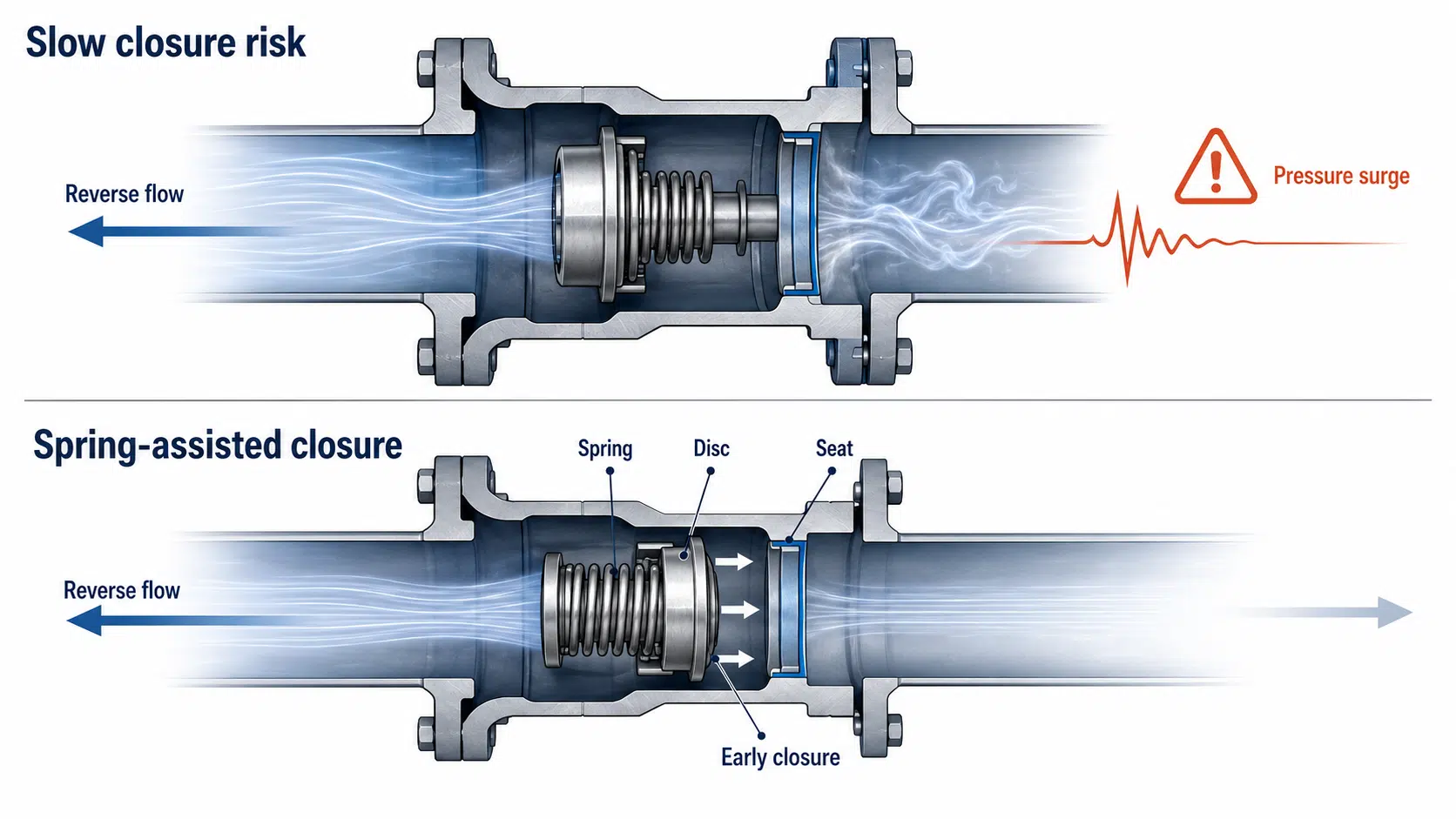
Water hammer can occur when moving fluid changes velocity suddenly. In check valve service, a slow-closing or unstable valve can allow reverse flow to build before the disc closes. When the valve finally closes, the sudden stop may create a pressure surge.
A nozzle check valve helps reduce this risk by using a spring-assisted, short-stroke closure. The goal is to close the disc earlier in the flow reversal process and reduce the severity of impact.
For critical systems, valve selection should be reviewed together with pump behavior, pipeline length, flow velocity, elevation change, valve operation, and system surge analysis. The valve alone cannot correct every water hammer problem caused by the overall system design.
If water hammer mainly comes from pipeline layout, rapid valve operation, pump control, long risers, high elevation differences, or extreme flow changes, a nozzle check valve may not be sufficient by itself. The project may require system-level surge review or additional water hammer control measures.
Chatter, Vibration and Unstable Flow
Chatter occurs when the disc repeatedly moves or vibrates because flow is not stable enough to hold the valve in a steady position. This can happen when a valve is oversized, flow is too low, velocity is unstable, or spring response does not match the service condition.
Chatter can increase wear on the disc, spring, guide, and seat. It may also create noise and vibration in the pipeline. When chatter appears in a nozzle check valve, the system should not be judged only by valve type name. Flow rate, pressure conditions, sizing, minimum flow, installation orientation, and spring design should be reviewed.
Pressure Drop, Head Loss and Cracking Pressure
Pressure drop is a major selection factor for nozzle check valves. A streamlined axial path may reduce flow disturbance in suitable designs, but pressure drop must be checked against manufacturer pressure-drop curves, Cv / Kv data, or flow coefficient data. The result should then be compared with the project’s allowable head loss.
A nozzle check valve is not automatically the lowest pressure drop option in every pipeline. A full-bore swing check valve may have lower head loss in some steady-flow, low-surge systems. However, in water hammer-sensitive systems, higher initial cost or local pressure drop may be offset by faster closure response and stronger equipment protection value. In stable, low-risk systems, the decision should be made by comparing data rather than valve names.
Spring stiffness and cracking pressure also affect low-flow opening, pressure drop, disc stability, and closure speed. If the opening requirement is too low or too high for the actual service condition, the valve may become unstable, lose efficiency, or respond too late. Minimum flow, normal flow, and flow deceleration conditions should be checked together.
| Performance Point | Engineering Effect | Selection Note |
|---|---|---|
| Spring-assisted closure | Helps the disc close as flow decelerates | Check flow deceleration, spring response, and minimum flow |
| Short disc stroke | Reduces closure travel distance | Useful in fast-reversing systems |
| Axial / streamlined flow path | Can reduce turbulence in suitable designs | Confirm pressure-drop curve, Cv / Kv, or flow coefficient data |
| Controlled disc movement | Helps reduce chatter and unstable motion | Check sizing, orientation, and stable flow range |
| Seat contact | Stops reverse flow at the sealing interface | Confirm seat material, shutoff expectation, and testing requirement |
Types and Configurations of Nozzle Check Valves
Nozzle check valves can be configured in different ways. These differences are usually more important than a simple “type” label. Connection, seat design, body material, spring behavior, and installation requirements all affect whether the valve fits a specific service.
Nozzle Type Check Valve by Design
A nozzle type check valve generally refers to a check valve with a guided closure element and a nozzle-shaped or streamlined internal profile. In many industrial applications, this design is selected for quick closure, low reverse-flow impact, and controlled pressure drop.
Some projects may use terms such as axial nozzle check valve, axial-flow check valve, silent check valve, or non-slam check valve. These terms should be verified against actual construction. The key questions are whether the disc is guided, how the spring closes the disc, how the flow path is shaped, and what performance data the manufacturer provides.
Connection Configurations
Connection configuration affects installation, pressure boundary integrity, maintenance access, inspection, and replacement fit. It should not be treated as only a piping detail.
| Configuration | When It Matters | Selection Note |
|---|---|---|
| Flanged end | Industrial pipeline installation and maintenance access | Confirm pressure class, flange standard, gasket standard, face-to-face length, and maintenance clearance |
| Welded end | High-integrity piping or services where joint integrity is critical | Review pressure boundary integrity, weld procedure, inspection plan, and future maintenance access |
| Threaded end | Smaller-size or lower-duty service | Confirm pressure / temperature limits and avoid assuming it fits heavy industrial duty |
| Compact / wafer-style | Space-limited installation or replacement projects | Check face-to-face length, bolting arrangement, pressure class, and replacement fit |
Seat, Disc and Spring Configurations
Seat, disc, and spring configuration should match the medium, pressure, temperature, shutoff expectation, and flow behavior. A metal seat may be preferred in higher temperature or more severe service. A soft seat may support tighter sealing in suitable media and temperature conditions.
The spring must be suitable for the flow profile. A spring that closes too slowly may not reduce reverse-flow impact. A spring that is too strong for the available forward flow may increase pressure loss or cause unstable opening. The correct selection depends on service data, not only valve size.
How to Select a Nozzle Check Valve
Nozzle check valve selection should start with the system condition, not only the valve size. Flow rate, flow deceleration, pressure drop allowance, seat requirement, spring response, and installation orientation all affect performance.
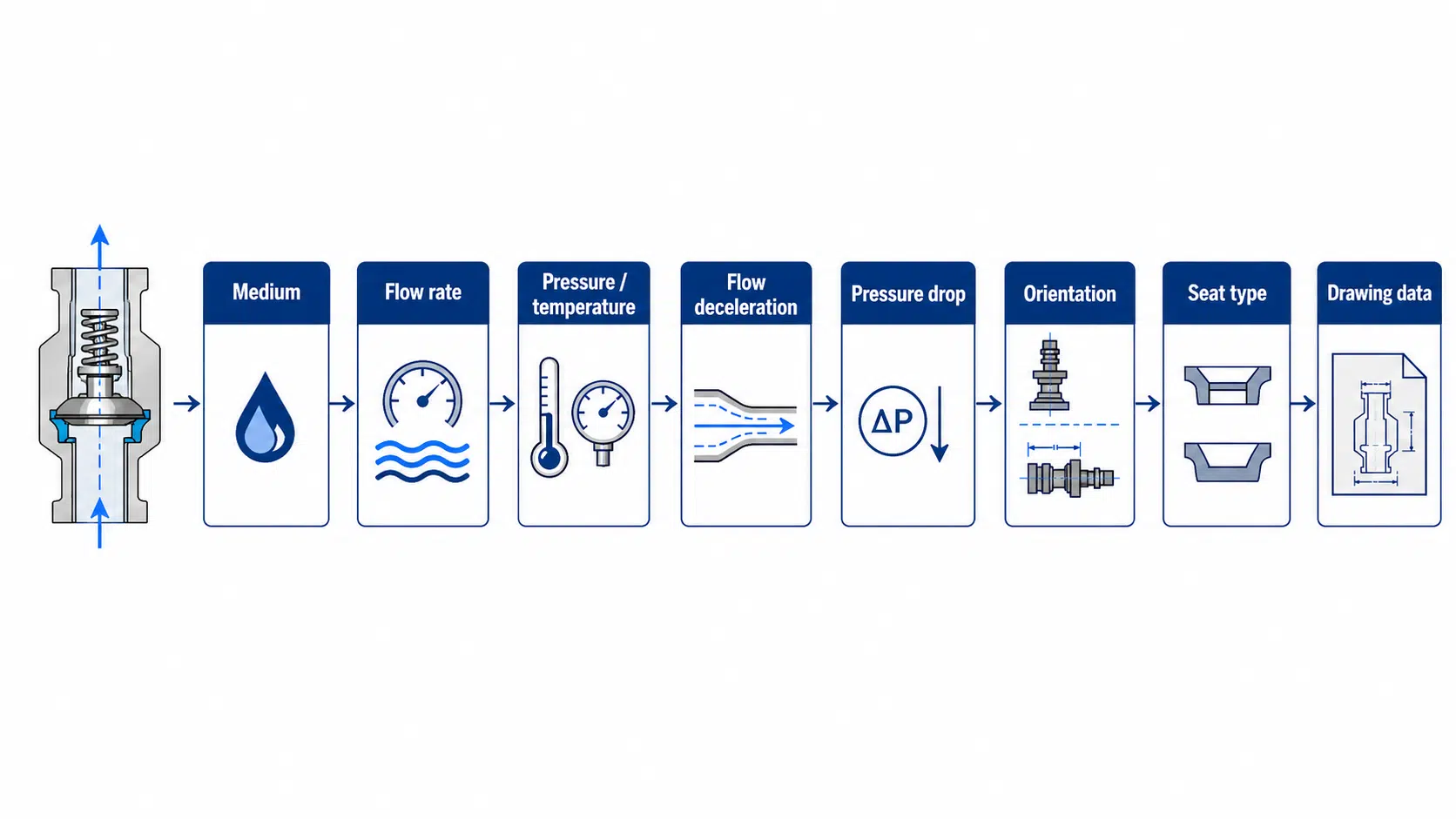
If flow rate, flow deceleration, pressure drop, seat requirement, or installation orientation data are missing, the result may be spring response mismatch, chatter, excessive pressure loss, water hammer risk, premature wear, or inadequate pump / compressor protection.
Media, Pressure and Temperature
The medium determines material compatibility, corrosion risk, erosion risk, seat selection, and cleaning requirements. Liquids, gases, steam, seawater, hydrocarbons, chemical media, and dirty service may require different body, trim, seat, and spring materials.
Pressure and temperature define pressure-temperature ratings, seat suitability, gasket selection, spring material, and testing requirement. Do not assume a nozzle check valve fits all services because it has a fast-closing design. The exact limit depends on material, pressure class, seat design, and manufacturer documentation.
Flow Deceleration, Cracking Pressure and Dynamic Response
Dynamic response is the core selection issue. A nozzle check valve is often selected where reverse flow develops quickly, such as pump shutdown, compressor discharge, or fast-changing process flow.
The spring and cracking pressure must be compatible with minimum flow, normal flow, and shutdown behavior. If the valve is oversized, the disc may not stay stable. If the spring response is not suitable, the valve may chatter, open inefficiently, or close too late.
Pressure Drop, Orientation and Connection
Pressure drop should be verified using manufacturer pressure-drop data, Cv / Kv data, or flow coefficient data. The selected valve must meet the project’s allowable head loss while still providing the required closure response.
Installation orientation also matters. Horizontal, vertical upward, vertical downward, or inclined installation can change the relationship between gravity, spring force, and fluid force. The allowed orientation should be confirmed against the datasheet, drawing, IOM, or manufacturer documentation.
Connection type must match the piping specification, installation space, pressure class, gasket requirement, inspection plan, and replacement constraints.
RFQ / Specification Checklist
| Data to Confirm | Why It Matters |
|---|---|
| Medium | Determines body, trim, seat, spring, and gasket compatibility |
| Flow rate | Affects sizing, pressure drop, disc stability, and minimum flow behavior |
| Pressure / temperature | Defines pressure boundary, material suitability, seat design, and test requirement |
| Flow deceleration | Determines whether spring response can reduce reverse-flow impact |
| Cracking pressure / opening behavior | Affects low-flow opening, pressure loss, and dynamic stability |
| Installation orientation | Influences closure behavior, sealing, and stable disc movement |
| End connection | Controls installation fit, inspection access, maintenance, and replacement planning |
| Seat type | Affects shutoff expectation, temperature range, and media compatibility |
| Applicable standard / testing | Supports procurement, QA, documentation, and acceptance criteria |
| Drawing / face-to-face length | Prevents installation mismatch during new projects or replacement work |
Where Are Nozzle Check Valves Used?
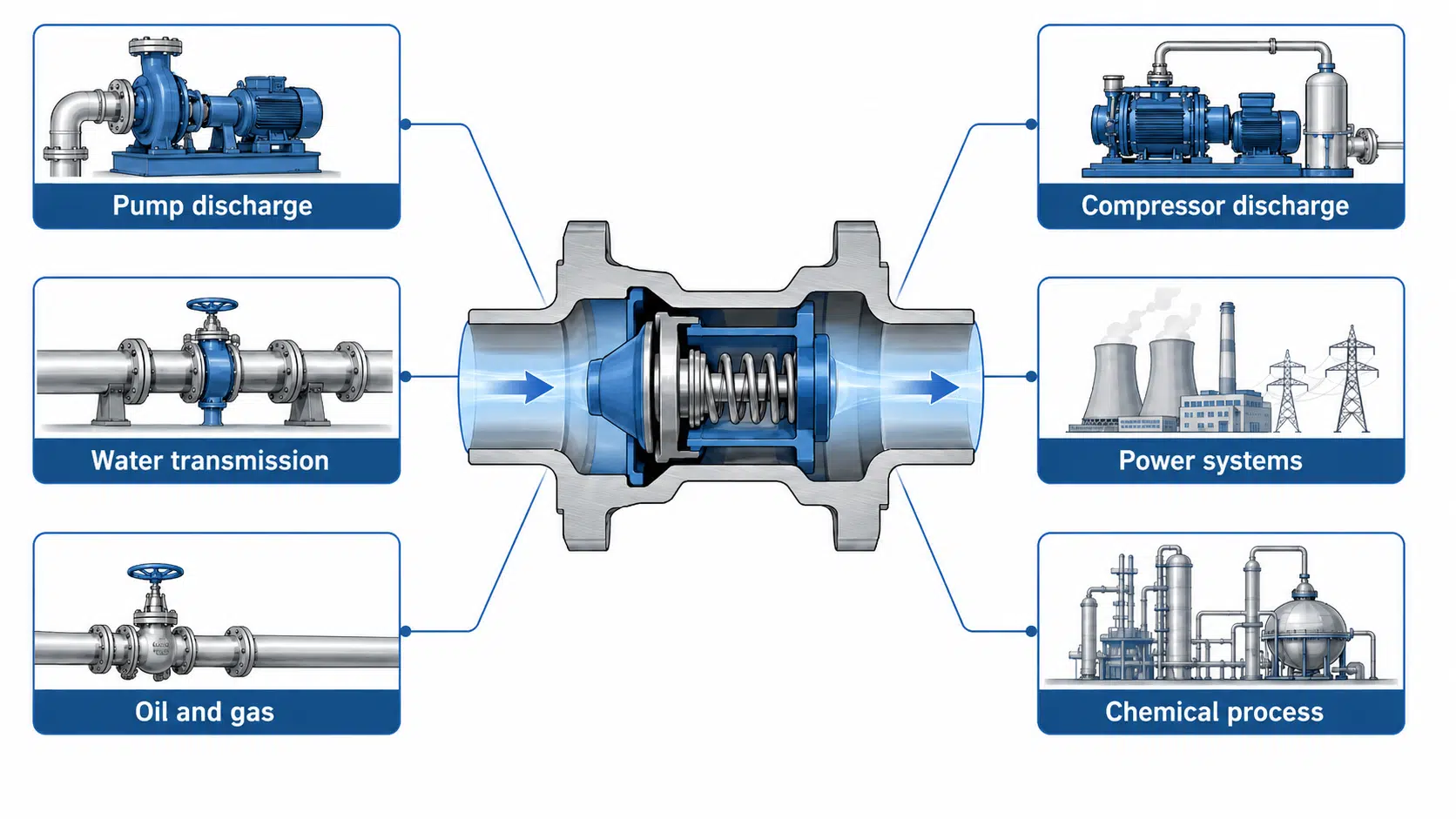
Nozzle check valves are used where reverse flow control, fast closure, and dynamic response matter. They should be selected by service condition, not only by industry name.
Pump Discharge Service
Pump discharge is one of the most common applications for nozzle check valves. When a pump stops or slows, reverse flow can develop. A spring-assisted nozzle check valve can help close before reverse flow becomes severe.
This is useful in water transmission, wastewater treatment, desalination, cooling water, boiler feed, and other pump-based systems where water hammer or pressure surge can damage equipment and piping.
Compressor Discharge and Fast-Reversing Systems
Compressor discharge and fast-reversing gas systems can create rapid changes in flow direction. In these systems, a slow or unstable check valve may chatter, slam, or allow reverse flow toward rotating equipment.
A nozzle check valve may be selected when fast closure, stable disc movement, and equipment protection are more important than lowest initial cost.
Industrial Process Applications
Nozzle check valves can be used in oil and gas, petrochemical, chemical, power, water, and other process industries. The final design depends on the medium, pressure, temperature, material compatibility, shutoff expectation, and project specification.
| Application | Why a Nozzle Check Valve May Fit |
|---|---|
| Pump discharge | Helps control reverse flow when a pump stops or slows |
| Compressor discharge | Supports fast response in flow reversal conditions |
| Water transmission | Helps reduce water hammer risk in suitable systems |
| Power plant systems | Supports equipment protection and dynamic response |
| Oil and gas service | Used where backflow prevention and pressure boundary integrity matter |
| Chemical process lines | Requires material, spring, and seat compatibility review |
| Desalination / seawater service | Requires corrosion-resistant materials and documentation checks |
Nozzle check valves are not the first choice for every service. Heavy solids, abrasive slurry, dirty media that may restrict guide or spring movement, or high-risk services requiring verified zero-leakage isolation should receive project-specific review. The valve type name alone is not enough for selection.
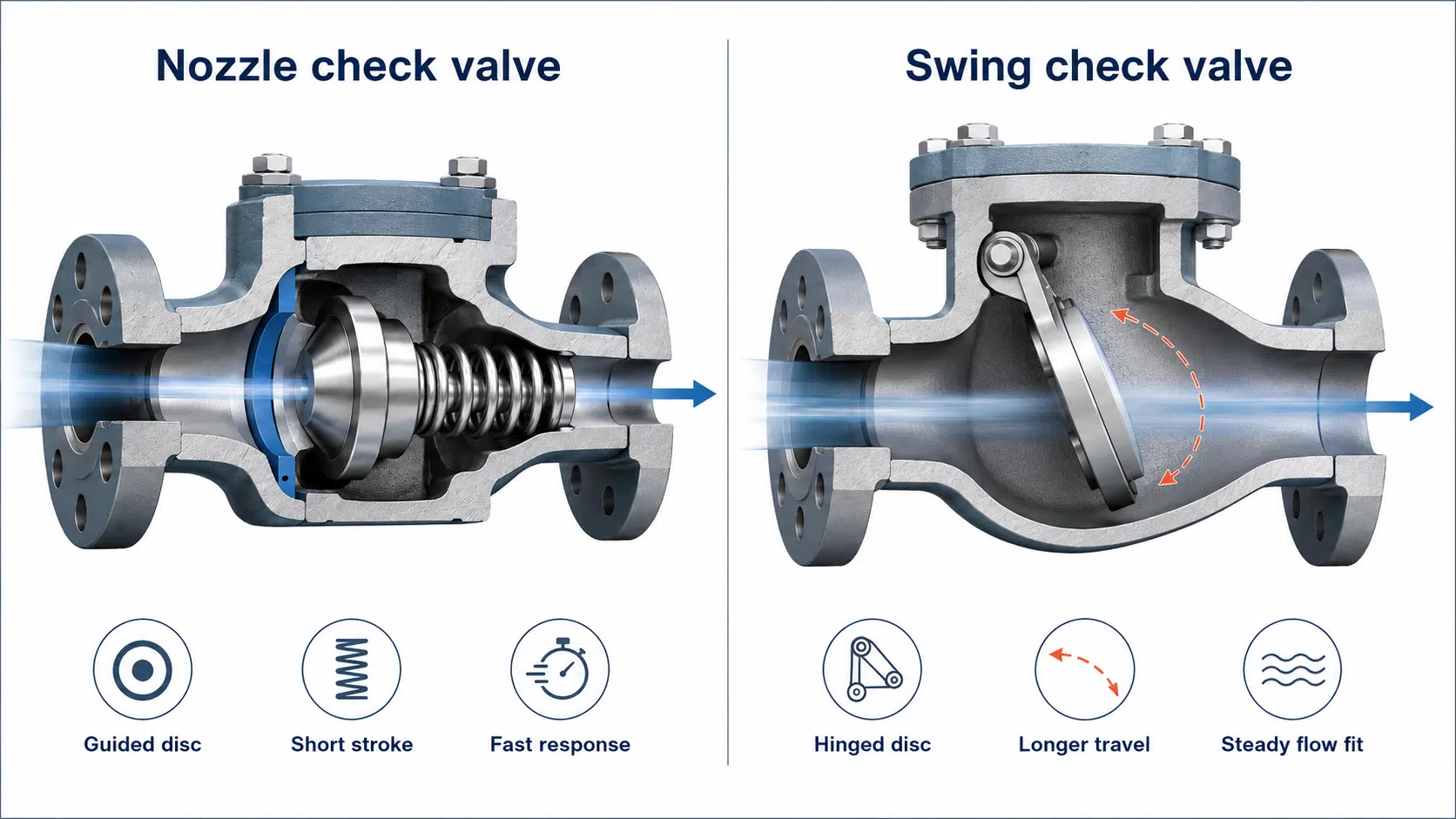
Nozzle Check Valve vs Swing Check Valve: Key Differences
A nozzle check valve is not always “better” than a swing check valve. The better choice depends on flow behavior, pressure drop limits, water hammer risk, maintenance expectations, installation space, and budget.
| Factor | Nozzle Check Valve | Swing Check Valve |
|---|---|---|
| Closure mechanism | Spring-assisted axial or center-guided disc | Hinged disc swings open and closed |
| Response speed | Usually faster because of short disc travel | Usually slower because the disc travels through a longer arc |
| Water hammer risk | Selected to reduce slam in suitable fast-response service | Can have higher slam risk in fast-reversing systems |
| Pressure drop | Depends on internal design, sizing, and manufacturer flow data | May be lower in full-bore, steady-flow, low-surge systems; must still be checked by curve / data |
| Initial cost | Usually higher | Usually lower |
| Maintenance focus | Spring, guide, disc, and seat condition | Hinge, pin, disc, and seat wear |
| Best-fit service | Pump discharge, compressor discharge, water hammer-sensitive systems | Lower-risk, cost-sensitive, steady-flow systems |
When a Nozzle Check Valve Is Preferred
A nozzle check valve is often preferred when the system has fast flow deceleration, pump stop events, compressor discharge conditions, water hammer risk, or a need for quick non-slam closure.
It may also be preferred when a compact, guided, spring-assisted design is needed and the project can justify the higher initial cost through better dynamic response or lower operating risk.
When a Swing Check Valve May Still Be Acceptable
A swing check valve may still be acceptable in lower-risk systems with steady flow, moderate pressure surge risk, and cost-sensitive requirements. It can also be suitable where full-bore flow and simple construction are more important than fast closure.
Selection should not be based on valve type name alone. It should be based on flow dynamics, pressure drop allowance, reverse-flow consequence, installation orientation, and maintenance strategy.
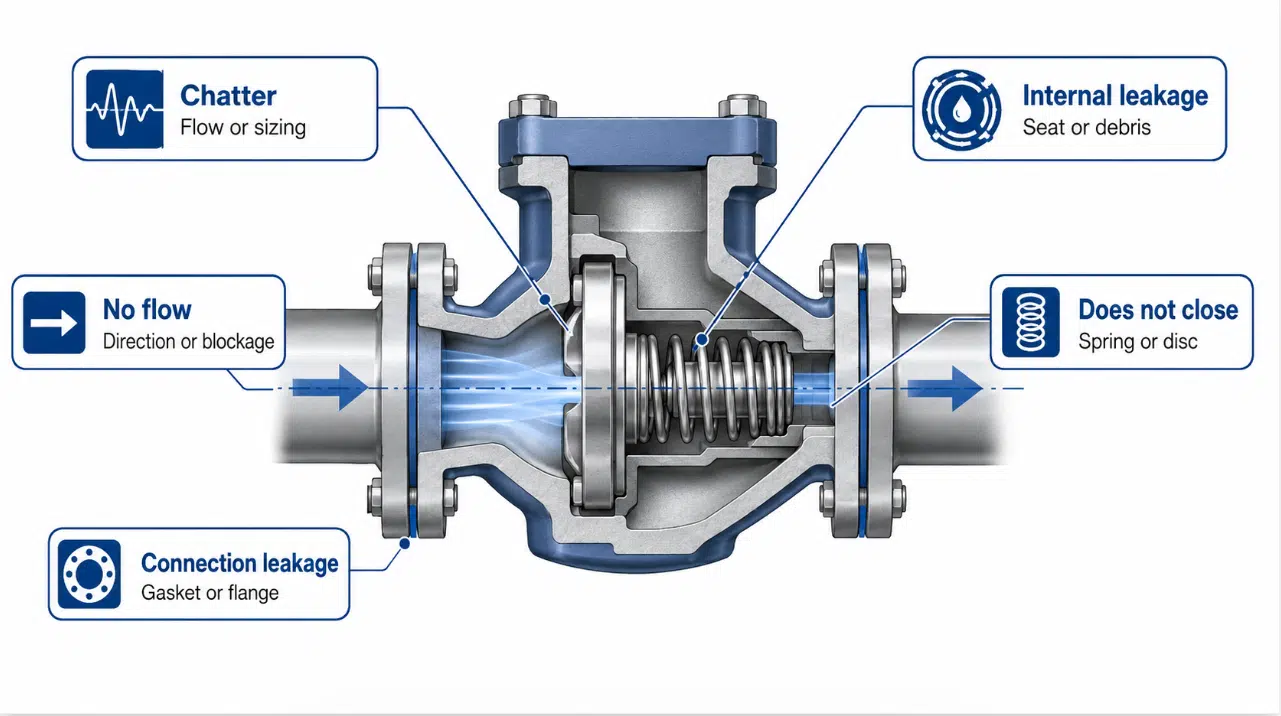
Troubleshooting Nozzle Check Valves
Troubleshooting should start with the service condition. Many nozzle check valve problems are related to sizing, flow instability, debris, seat wear, installation direction, or spring response.
Persistent chatter, leakage, water hammer, or no-flow condition can accelerate wear on the seat, disc, spring, guide, and gasket area. In severe cases, it may create unplanned downtime or equipment risk.
| Problem | Possible Cause | What to Check |
|---|---|---|
| Chatter or vibration | Valve oversized, unstable flow, low flow velocity, unsuitable spring response | Flow rate, sizing, minimum flow, spring behavior, piping layout |
| Internal leakage | Seat wear, disc damage, debris, wrong seat material | Seat surface, disc contact, media cleanliness, shutoff requirement |
| No flow through the valve | Wrong installation direction, blocked pipe, stuck disc, insufficient forward pressure | Flow arrow, pipeline obstruction, disc movement, upstream pressure |
| Valve does not close | Spring damage, debris, stuck disc, reverse pressure condition | Spring condition, guide clearance, disc travel, debris inside valve |
| Leakage at valve-pipe connection | Gasket damage, flange misalignment, loose bolts, poor installation | Gasket, flange face, bolt tightening, alignment, connection type |
For serious service issues, do not treat troubleshooting as only a repair task. If the same problem repeats, review sizing, minimum flow, spring response, installation orientation, and system flow behavior.
Final Fit-Check Before Ordering
Before selecting or requesting a nozzle check valve, confirm the application data and project constraints. This is especially important for replacement projects, pump discharge systems, compressor discharge systems, and water hammer-sensitive pipelines.
| Fit-Check Item | Confirm Before Procurement |
|---|---|
| Valve type | Nozzle / axial / non-slam terminology matches datasheet and drawing |
| Size and pressure class | Matches pipeline, pressure rating, and project specification |
| Medium | Compatible with body, trim, seat, spring, and gasket materials |
| Flow condition | Normal flow, minimum flow, maximum flow, and flow deceleration are understood |
| Pressure drop | Manufacturer data fits allowable head loss |
| Spring response | Suitable for opening, stability, and closure timing |
| Installation orientation | Horizontal / vertical / inclined installation is permitted by documentation |
| End connection | Matches flange, weld, thread, wafer, or compact installation requirement |
| Seat requirement | Shutoff expectation and test requirement are clear |
| Drawing data | Face-to-face length, connection dimensions, and installation space are verified |
Insufficient fit-check may lead to chatter, excessive pressure loss, slow closure, water hammer risk, premature wear, or inadequate pump / compressor protection.
FAQ
What is a nozzle check valve?
A nozzle check valve is an industrial check valve that allows forward flow and prevents reverse flow. It usually uses a streamlined axial flow path, guided disc, spring-assisted closure, and seat sealing interface.
How does a nozzle check valve work?
Forward flow pushes the disc open and compresses the spring. When flow slows, the spring returns the disc toward the seat. This short-stroke closure helps block reverse flow before severe slam develops.
What does a nozzle check valve do?
It prevents reverse flow in pipelines and helps protect pumps, compressors, piping, and process equipment from reverse-flow impact, water hammer, pressure surge, and unstable check valve movement in suitable applications.
Is a nozzle check valve non-slam?
A nozzle check valve is often selected for non-slam service, but non-slam performance is a design intent, not a universal guarantee. Actual performance depends on valve sizing, spring design, flow condition, installation orientation, and system surge behavior.
How does a nozzle check valve reduce water hammer?
It helps reduce water hammer by starting closure during flow deceleration, before strong reverse flow develops. This can reduce reverse-flow impact, but severe surge conditions still require system-level review.
What is the difference between a nozzle check valve and a swing check valve?
A nozzle check valve uses a spring-assisted guided disc that moves mainly along the flow axis. A swing check valve uses a hinged disc that swings open and closed. Nozzle check valves are often preferred for fast-response and water hammer-sensitive systems, while swing check valves may still fit lower-risk steady-flow systems.
When should you choose a nozzle check valve?
Choose a nozzle check valve when fast closure, reverse-flow control, pump or compressor protection, water hammer reduction, compact installation, or stable guided disc movement is important. It should be reviewed carefully when flow is very low, unstable, dirty, abrasive, or outside the manufacturer’s recommended service range.
Is a nozzle check valve the same as an axial flow check valve?
Not always. A nozzle check valve is commonly an axial-flow, center-guided design, so the terms may overlap in some projects. However, axial flow check valve is broader. Use the datasheet, drawing, and manufacturer documentation to confirm the exact design.
What information is needed before selecting a nozzle check valve?
Confirm the medium, flow rate, pressure, temperature, flow deceleration, cracking pressure or opening behavior, pressure drop allowance, installation orientation, end connection, seat requirement, testing requirement, and drawing dimensions. Missing data may cause spring mismatch, chatter, excessive pressure loss, water hammer risk, or premature wear.
Conclusion
A nozzle check valve is best understood as a fast-response industrial check valve for reverse-flow control and non-slam closure. Its engineering value comes from the relationship between the axial flow path, guided disc, spring-assisted short stroke, seat design, and system flow behavior.
For stable, low-risk systems, a simpler check valve may be enough. For pump discharge, compressor discharge, and water hammer-sensitive service, a properly selected nozzle check valve can provide stronger protection against reverse flow, slam, chatter, and pressure surge.
Final selection should not be based only on valve type name. Confirm closing response, pressure-drop data, seat and spring configuration, installation orientation, and the consequence of reverse flow before procurement.
Application / Specification Support
For nozzle check valve selection, prepare the medium, pressure, temperature, flow rate, flow deceleration condition, installation orientation, end connection, seat requirement, and drawing data before technical review.
NTGD Valve can support application review and specification discussion for industrial nozzle check valve projects where buyers need to verify spring response, water hammer risk, pressure drop, installation fit, or reverse-flow protection.
