
Author Name: Bruce Zheng
Author Role: Co-Founder and Valve Engineer at NTGD Valve
Author Bio: Bruce Zheng is Co-Founder and Valve Engineer at NTGD Valve, focusing on industrial valve selection, application, and technical content for global B2B buyers.
Last Updated: May 21, 2026
Check valves are one-way valves, also called non-return valves, that allow fluid to flow in one direction and help prevent reverse flow in a piping system. They are commonly used to protect pumps, compressors, pipelines, process equipment, and water systems from backflow-related damage.
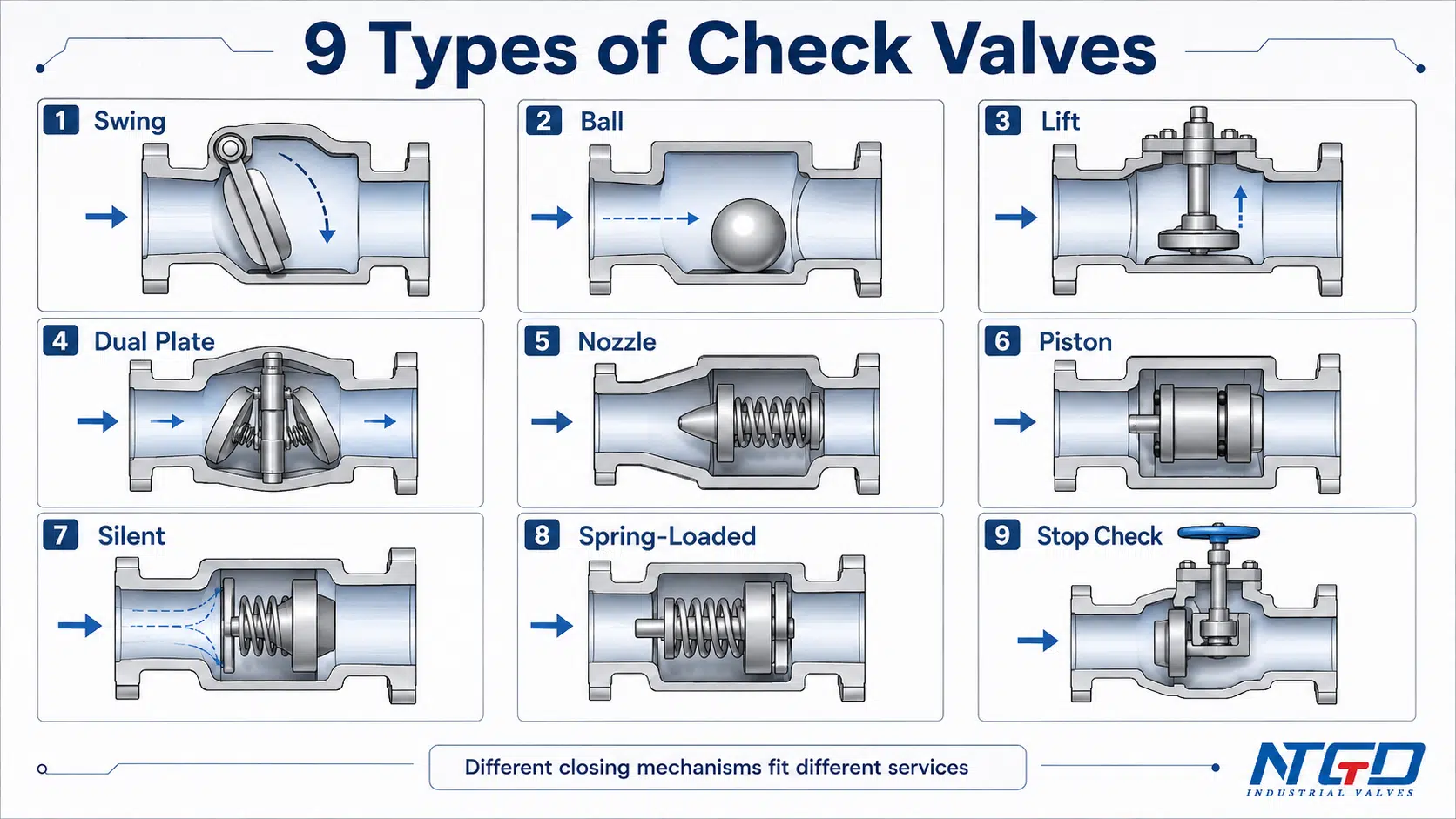
The main check valve types include swing check valves, ball check valves, lift check valves, dual plate check valves, nozzle check valves, piston check valves, silent check valves, spring-loaded check valves, and stop check valves.
These different types of check valves are not interchangeable in industrial service. Each type has different closure behavior, flow resistance, media tolerance, and failure risk. A valve that works well in clean water service may perform poorly in wastewater, slurry, steam, pump discharge, or surge-prone piping.
This guide focuses on check valve types, their key features, common industrial applications, and basic selection considerations. It is not a full sizing calculation, installation guide, or material design standard.
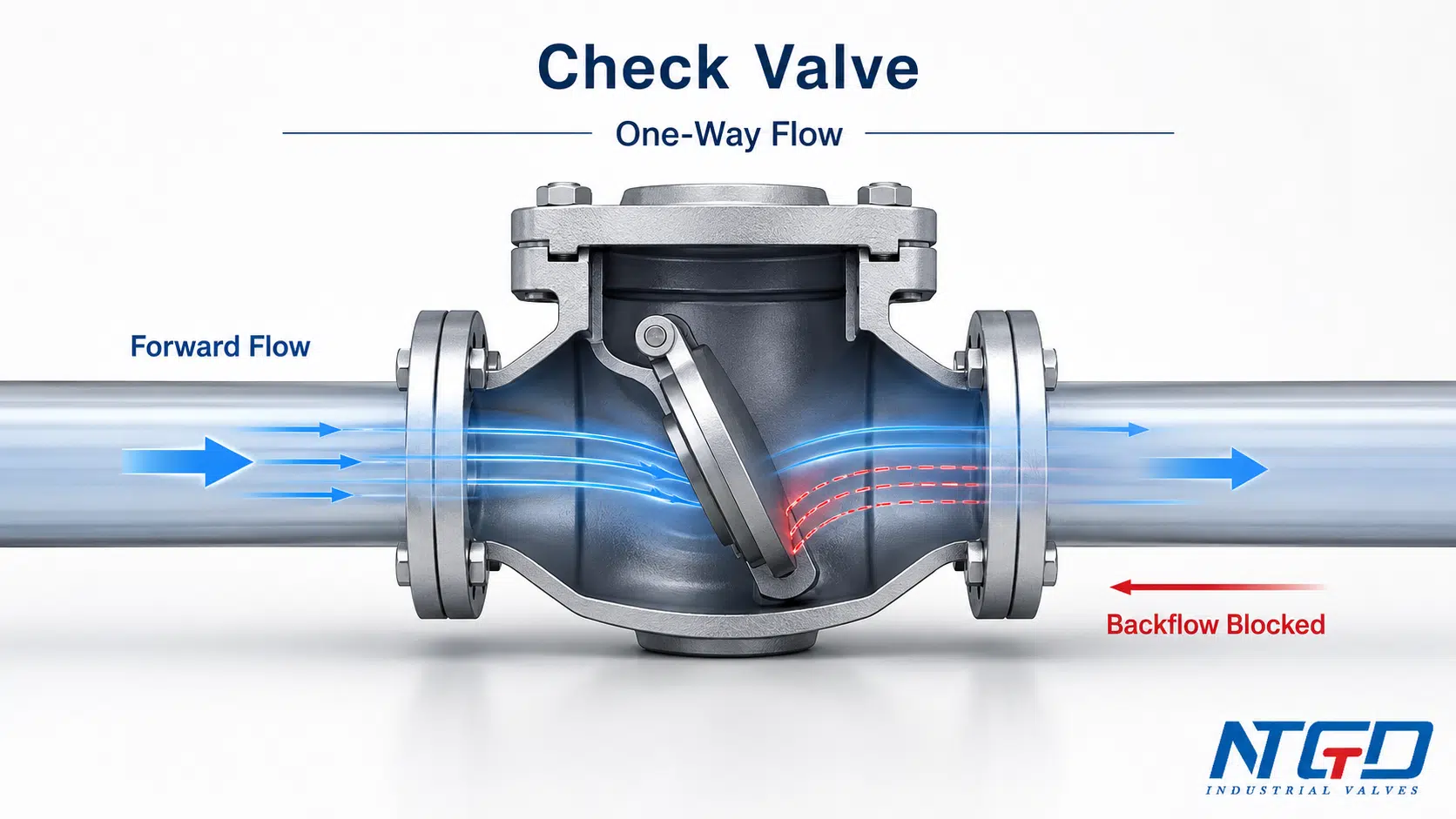
Quick Answer: What Are the Main Types of Check Valves?
The most common types of check valves are:
- Swing check valves for low pressure drop and general pipeline service.
- Ball check valves for wastewater, slurry, and viscous media.
- Lift check valves for clean, higher-pressure service.
- Dual plate check valves for compact piping layouts and larger pipelines.
- Nozzle check valves for pump discharge and non-slam applications.
- Piston check valves for clean, high-pressure, guided-disc service.
- Silent check valves for reducing slam and water hammer risk.
- Spring-loaded check valves for quick closure and flexible installation conditions.
- Stop check valves for systems that need both check function and manual shutoff.
For industrial buyers, the type matters because the closing mechanism directly affects system reliability, pressure drop, maintenance frequency, and the risk of water hammer, chatter, leakage, or premature wear. The application mapping section below shows how service conditions such as clean water, wastewater, slurry, steam, chemical media, pump discharge, and surge risk can change the best-fit check valve type.
A check valve should not be selected by name alone. The same pipeline size can require different check valve types depending on flow rate, media condition, pipe orientation, pressure drop sensitivity, water hammer risk, maintenance access, and the required closing behavior.
Check Valve Types Overview Table
Use this table as an initial engineering comparison, not as a replacement for manufacturer datasheets or service-specific review. The same check valve type can behave differently depending on valve size, internal design, material, pressure class, flow rate, and media condition.
| Check Valve Type | Closure / Movement | Best-Fit Applications | Use Caution When | Main Limitation |
|---|---|---|---|---|
| Swing Check Valve | Hinged disc swings open with forward flow and closes against reverse flow | Water distribution, wastewater, oil and gas pipelines, low pressure drop service | Flow reverses quickly, pump cycling is frequent, or surge risk is high | Disc travel can cause slam in some systems |
| Ball Check Valve | Ball lifts or moves away from the seat during forward flow | Wastewater, slurry, sump service, viscous media, solids-bearing flow | Tight flow control, low pressure drop, or compact installation is required | Ball movement and seat design may add resistance |
| Lift Check Valve | Disc or plug lifts vertically from the seat | Clean fluid, steam, high-pressure process lines | Media contains debris or the system is pressure-drop sensitive | Flow path can create higher pressure drop |
| Dual Plate Check Valve | Two spring-assisted plates open and close around a central hinge | Large pipelines, HVAC, water systems, compact wafer installations | Media contains heavy solids, or spring and plate materials are not verified | Springs and plates must match the service condition |
| Nozzle Check Valve | Axial spring-assisted disc moves in line with flow | Pump discharge, surge-sensitive lines, high-flow systems | Actual flow rate, pressure loss, and sizing are not verified | Usually requires careful sizing and specification |
| Piston Check Valve | Guided piston or disc moves within the valve body | Clean high-pressure service, process lines, steam-related service | Dirty media may cause sticking or wear | Not ideal for solids-heavy flow |
| Silent Check Valve | Spring-assisted closure reduces reverse-flow impact | Clean water systems, pump discharge, water hammer-sensitive service | Slurry, viscous, or dirty media is present | Not every silent design fits dirty or abrasive service |
| Spring-Loaded Check Valve | Spring helps close the disc, poppet, or ball quickly | Vertical or horizontal lines, compact systems, quick-closing service | Cracking pressure or spring material is not verified | Spring selection affects opening and closing behavior |
| Stop Check Valve | Check valve function combined with manual shutoff | Boiler, steam, power, high-pressure isolation service | A simple automatic check valve is enough | More complex than standard check valves |
For example, a swing check valve may be suitable in stable, low pressure drop service, but fast reverse flow or frequent pump shutdowns may require a faster-closing or non-slam design. The table should be used to narrow the options before checking service conditions in more detail.
How Check Valve Types Are Classified
Check valve types can be classified in several ways. Understanding the classification helps prevent a common mistake: choosing a valve only by pipe size or product name.
By Closure Element
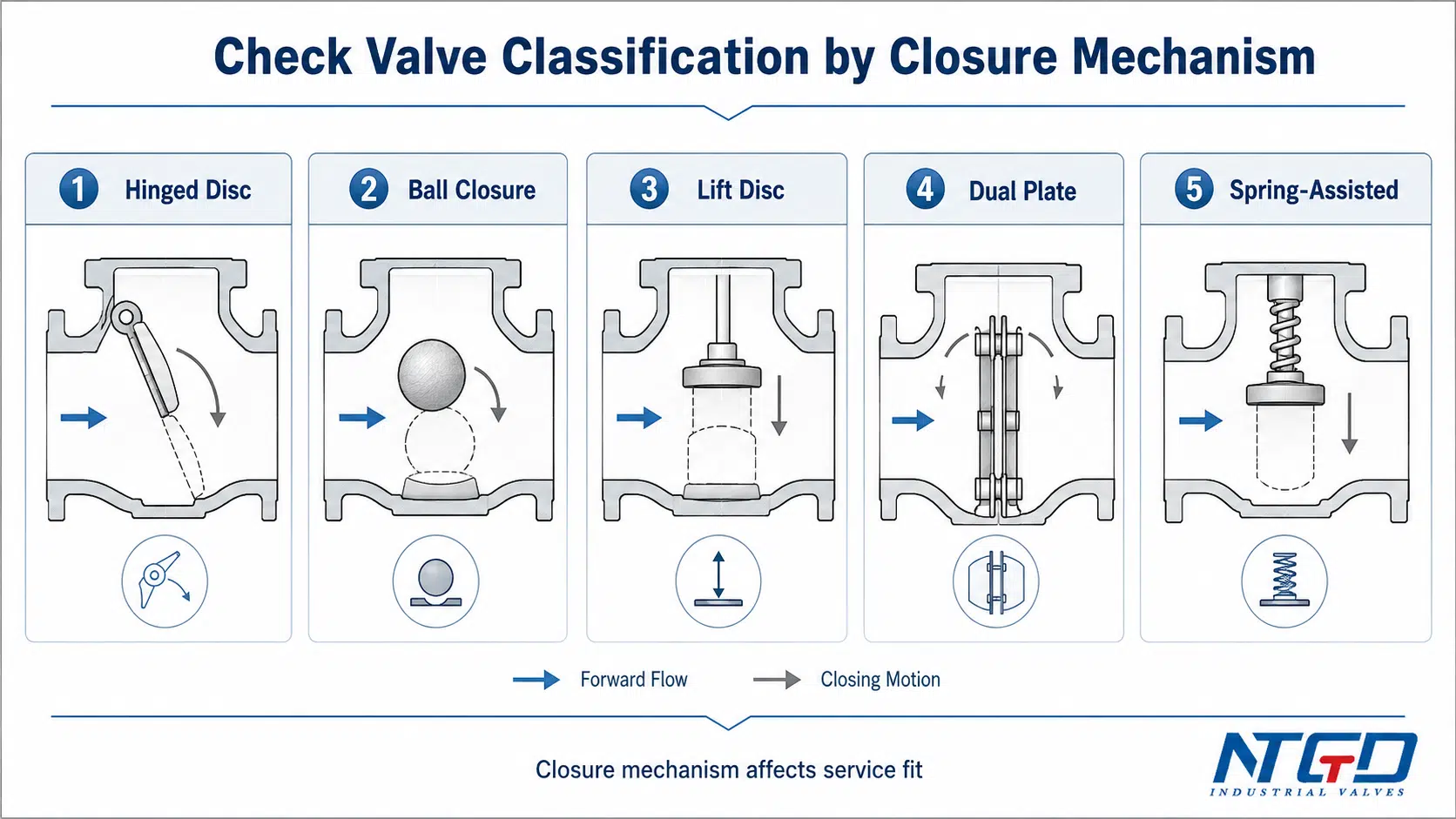
Some check valves close with a hinged disc, while others use a ball, piston, plug, dual plates, or spring-assisted disc. The closure element affects how quickly the valve responds, how much flow resistance it may create, and how sensitive it is to debris.
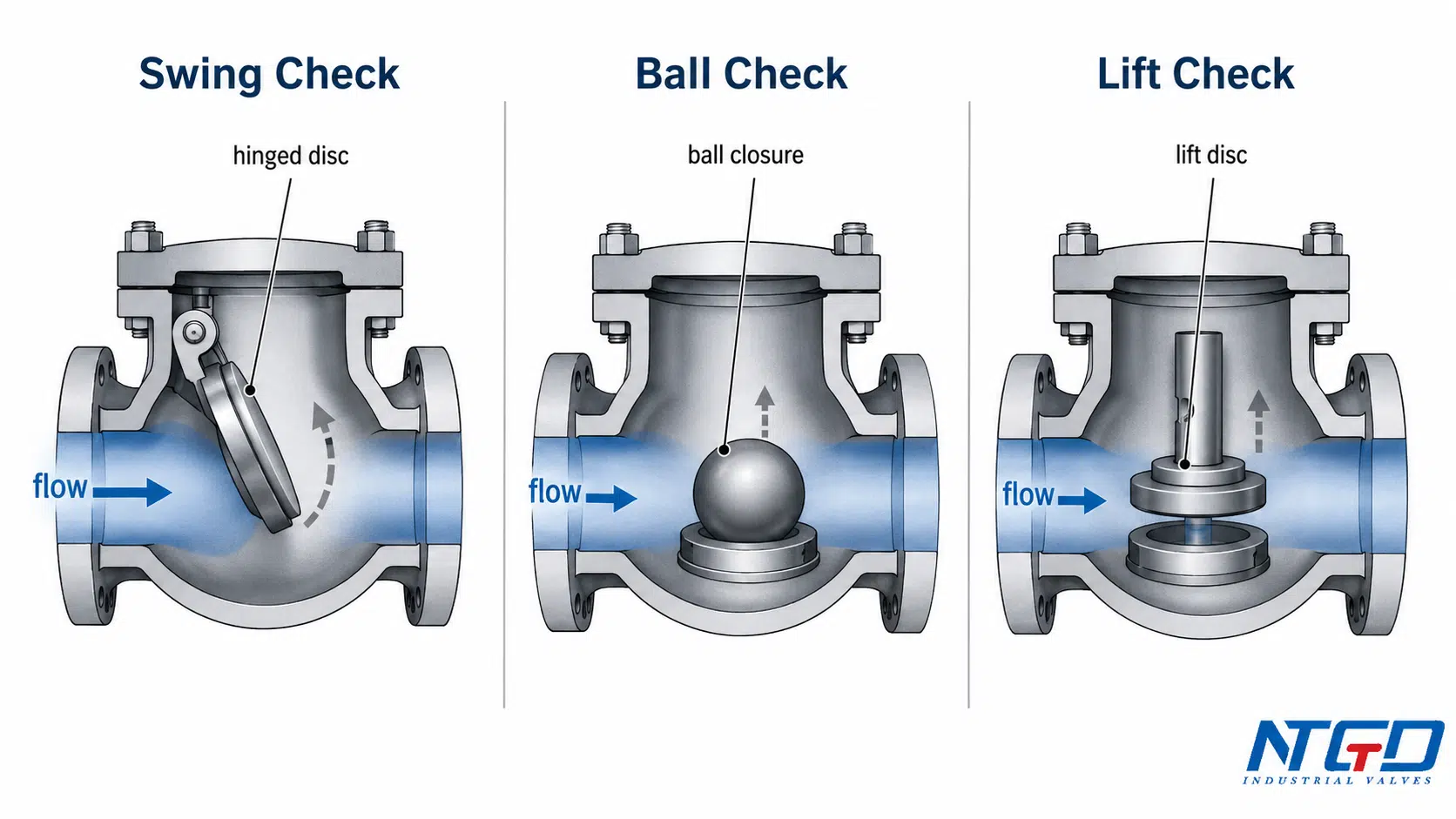
The choice of closure element directly affects the valve’s tolerance to debris, pressure drop, closing speed, and maintenance requirements. For example, a swing check valve uses a hinged disc, while a ball check valve uses a moving ball. Both prevent reverse flow, but they behave differently in wastewater, slurry, pump discharge, and clean process lines.
By Gravity or Spring-Assisted Closing
Some designs rely mainly on gravity and reverse flow to close. Others use a spring to close faster before significant reverse flow develops.
Spring-assisted designs are often considered where valve slam or water hammer is a concern. However, the spring also affects cracking pressure and must be compatible with the fluid, temperature, and service conditions.
By Body Pattern or Flow Path
Check valves may use straight-through, wafer, axial, globe-style, Y-pattern, or compact body designs. Body pattern affects face-to-face length, pressure drop, installation space, and maintenance access.
A compact wafer dual plate check valve may fit where a traditional swing check valve is too long, while a stop check valve uses a more complex body and operating arrangement for combined isolation and check function.
By Application Fit
The most practical classification is application fit. A check valve used in clean water service may not be suitable for slurry. A valve used in a boiler or steam system may require a different design from a valve used in wastewater or HVAC.
The right type of check valve should match the media, flow behavior, pressure conditions, and failure risk of the system.
9 Types of Check Valves and Their Key Features
1. Swing Check Valve
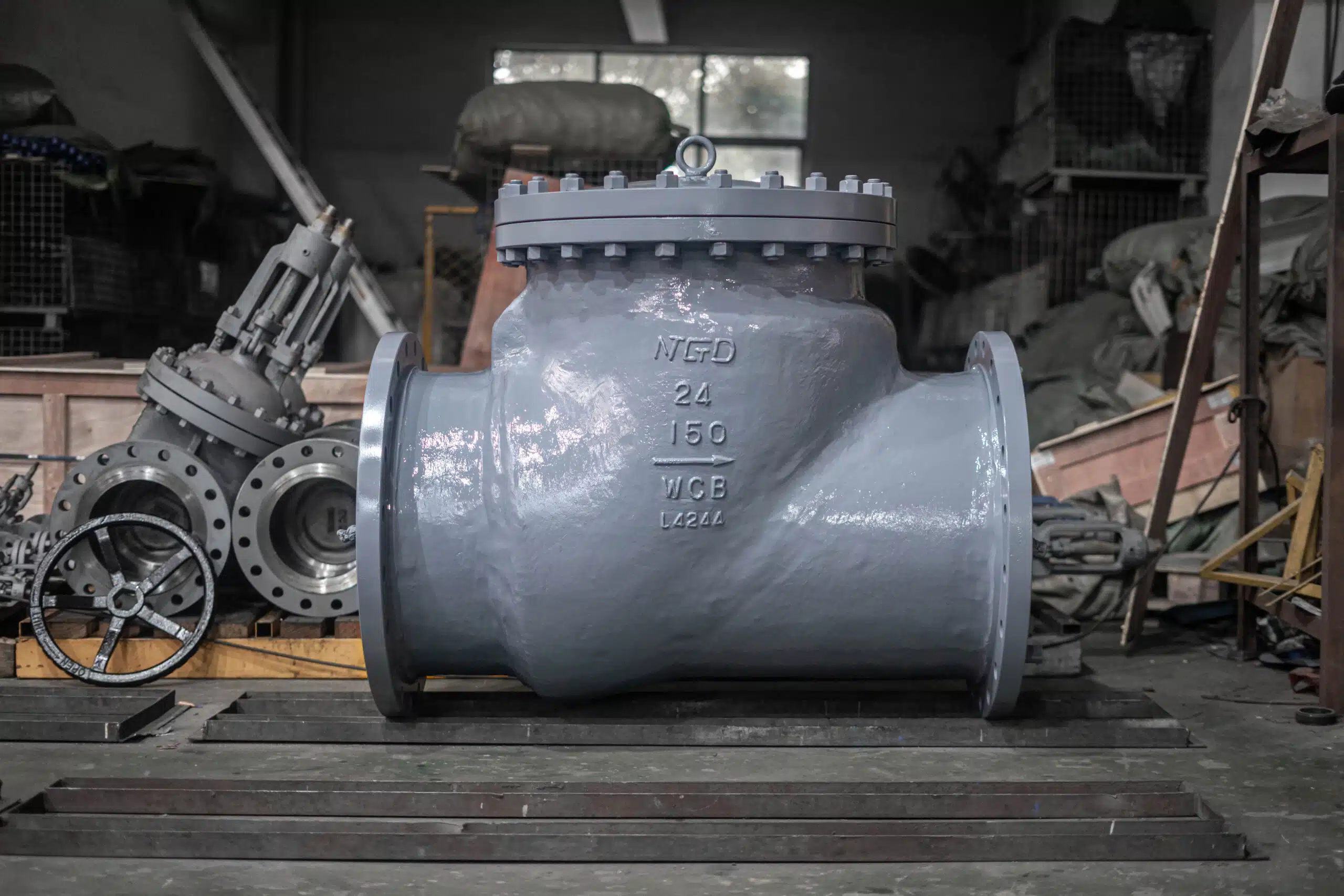
A swing check valve uses a hinged disc that swings open when fluid flows forward. When flow stops or reverses, the disc moves back toward the seat to help prevent backflow.
Swing check valves are among the most common check valve types because they offer a simple structure and relatively low flow resistance. They are often used in water distribution, wastewater systems, oil and gas pipelines, HVAC systems, and general industrial piping.
The full or near-full flow opening can reduce pressure drop compared with more restrictive designs. This makes swing check valves suitable for stable forward flow, larger pipelines, and systems where low resistance is important.
However, the disc must travel back to the seat. In systems with rapid flow reversal, frequent pump cycling, or unstable flow, this closing movement may lead to valve slam, noise, vibration, or accelerated seat and hinge wear. In those cases, a dual plate, nozzle, silent, or other faster-closing design may be more suitable.
Best fit: large pipelines, low pressure drop service, water and wastewater lines, general process piping.
Use caution: fast-closing systems, pulsating flow, vertical downward flow, or severe water hammer conditions.
2. Ball Check Valve
A ball check valve uses a ball as the closing element. Forward flow moves the ball away from the seat, allowing fluid to pass. When flow stops or reverses, the ball returns to the seat and helps block reverse flow.
Ball check valves are often used in wastewater, slurry, sump, and viscous media applications because the ball movement can be more tolerant of suspended solids than some narrow-guided designs. In suitable designs, the valve can provide a relatively simple and self-cleaning closing action.
This type can be useful where debris, sludge, or viscous media could interfere with a thin disc or tightly guided mechanism. It is also common in pump discharge and drainage-related services.
The trade-off is flow resistance and application range. Depending on the body design, the ball path may create more pressure drop than a full-opening swing design, and the valve may not be ideal for high-precision sealing or tight installation spaces. For solids-bearing service, the ball material, seat geometry, and internal clearance should be checked carefully.
Best fit: wastewater, slurry, viscous media, sump service, dirty water lines.
Use caution: high-precision control, severe pressure drop limits, tight installation spaces, or services requiring very specific sealing performance.
3. Lift Check Valve
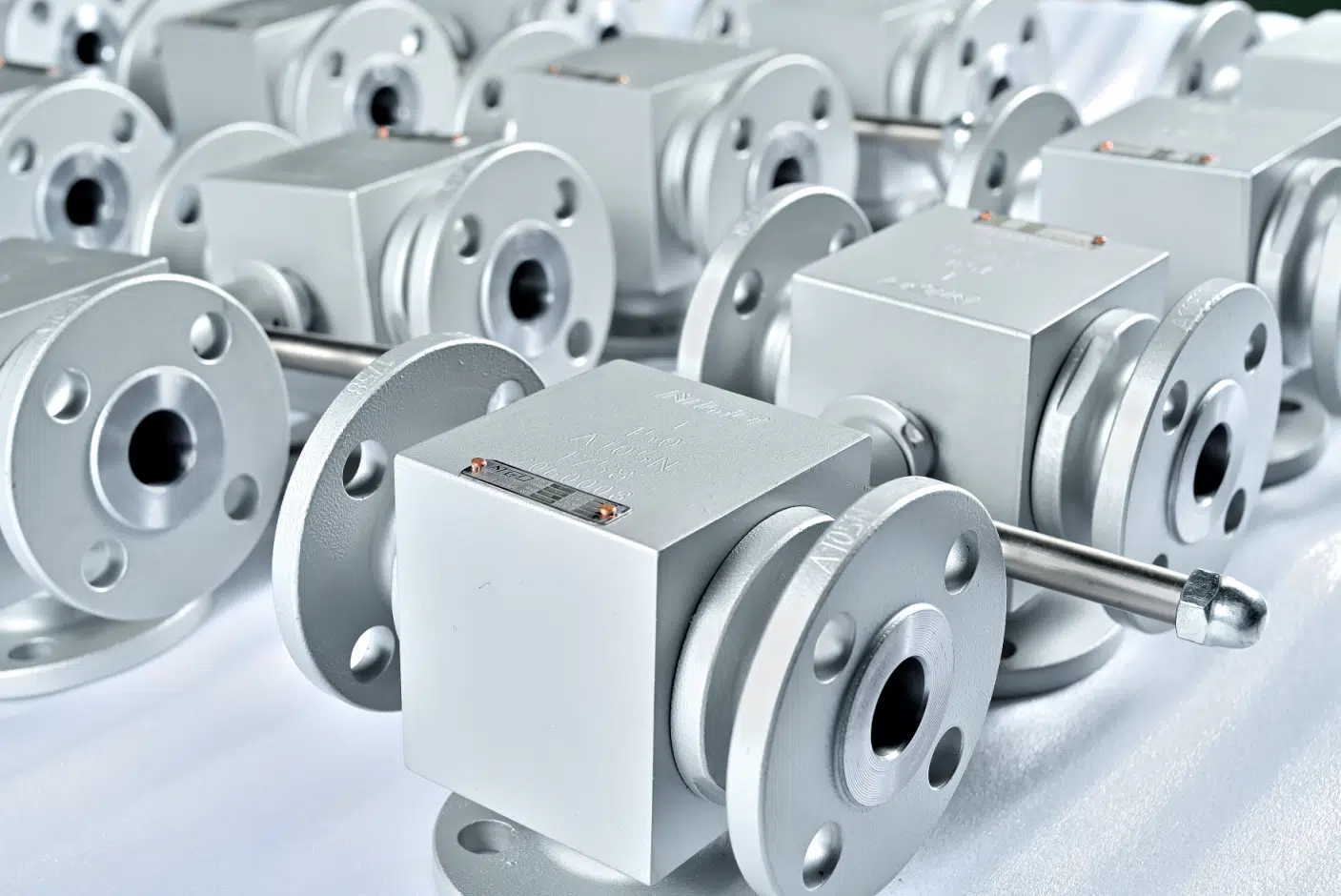
A lift check valve uses a disc or plug that lifts from the seat when forward flow creates enough pressure. When flow decreases or reverses, the disc returns to the seat to prevent backflow.
Lift check valves are commonly used in clean fluid service, steam-related applications, and higher-pressure process lines. Because the disc is guided, the valve can provide more controlled movement than a freely swinging disc.
This guided movement makes lift check valves useful where a compact, direct seating action is preferred. In suitable clean services, they can provide reliable reverse-flow prevention.
The trade-off is pressure drop and media sensitivity. A lift check valve typically has a more restrictive flow path than a swing check valve. It may also be more sensitive to debris, solids, or sticky media because the disc or piston must move freely in the guide. Compared with piston check valves, lift check valves are often used as a broader clean-service option, while piston designs are usually selected where more guided movement is required.
Best fit: clean liquids, steam service, high-pressure process lines, applications needing guided closure.
Use caution: dirty media, slurry, solids-bearing flow, or systems where pressure drop must be minimized.
4. Dual Plate Check Valve
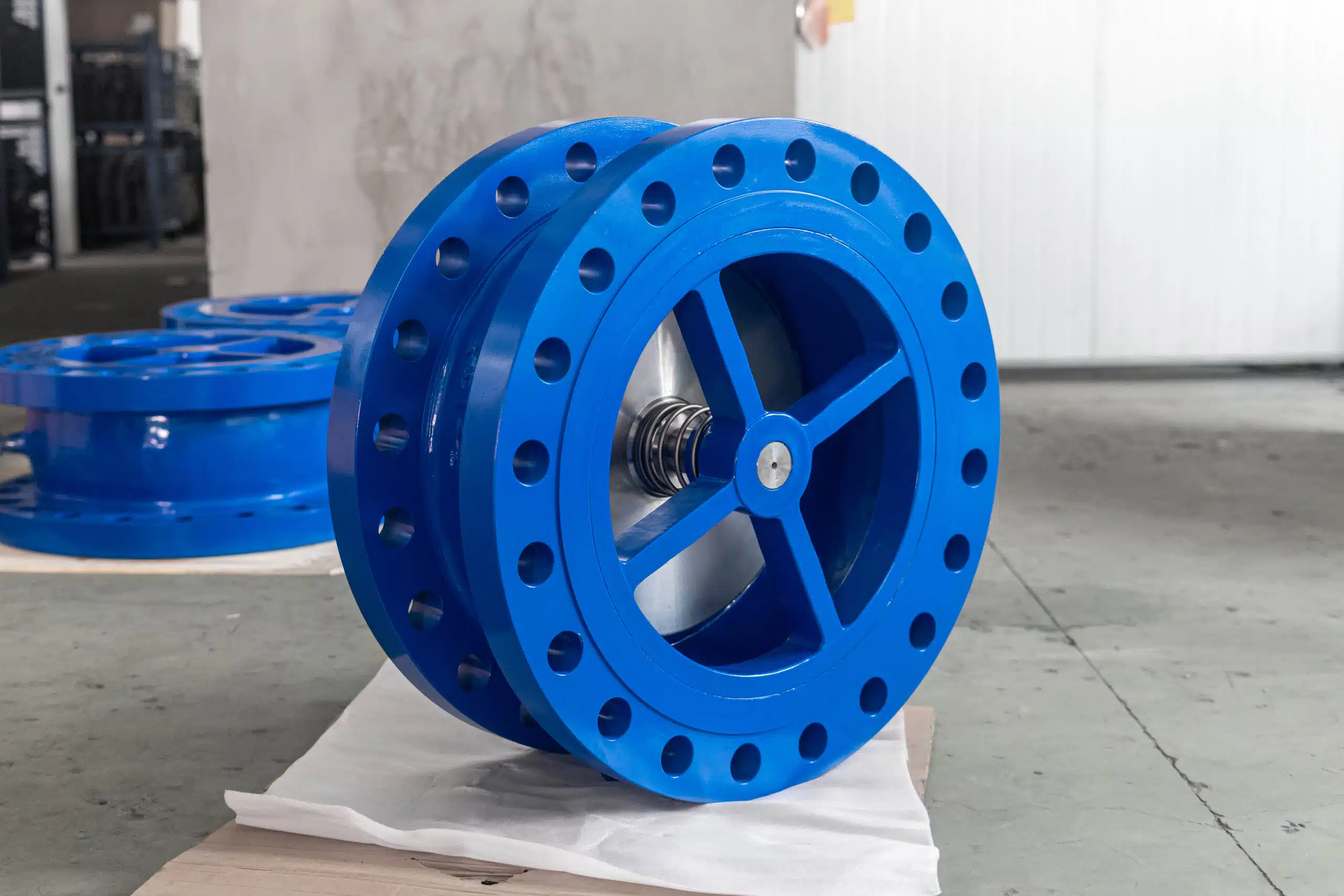
A dual plate check valve uses two spring-assisted plates that open with forward flow and close when flow reduces or reverses. Many dual plate designs are compact and installed between flanges, which makes them useful where space is limited.
Dual plate check valves are often used in large pipelines, HVAC systems, water systems, process lines, and pump discharge service. Compared with many traditional swing designs, the shorter closing travel can help reduce reverse-flow impact when correctly selected.
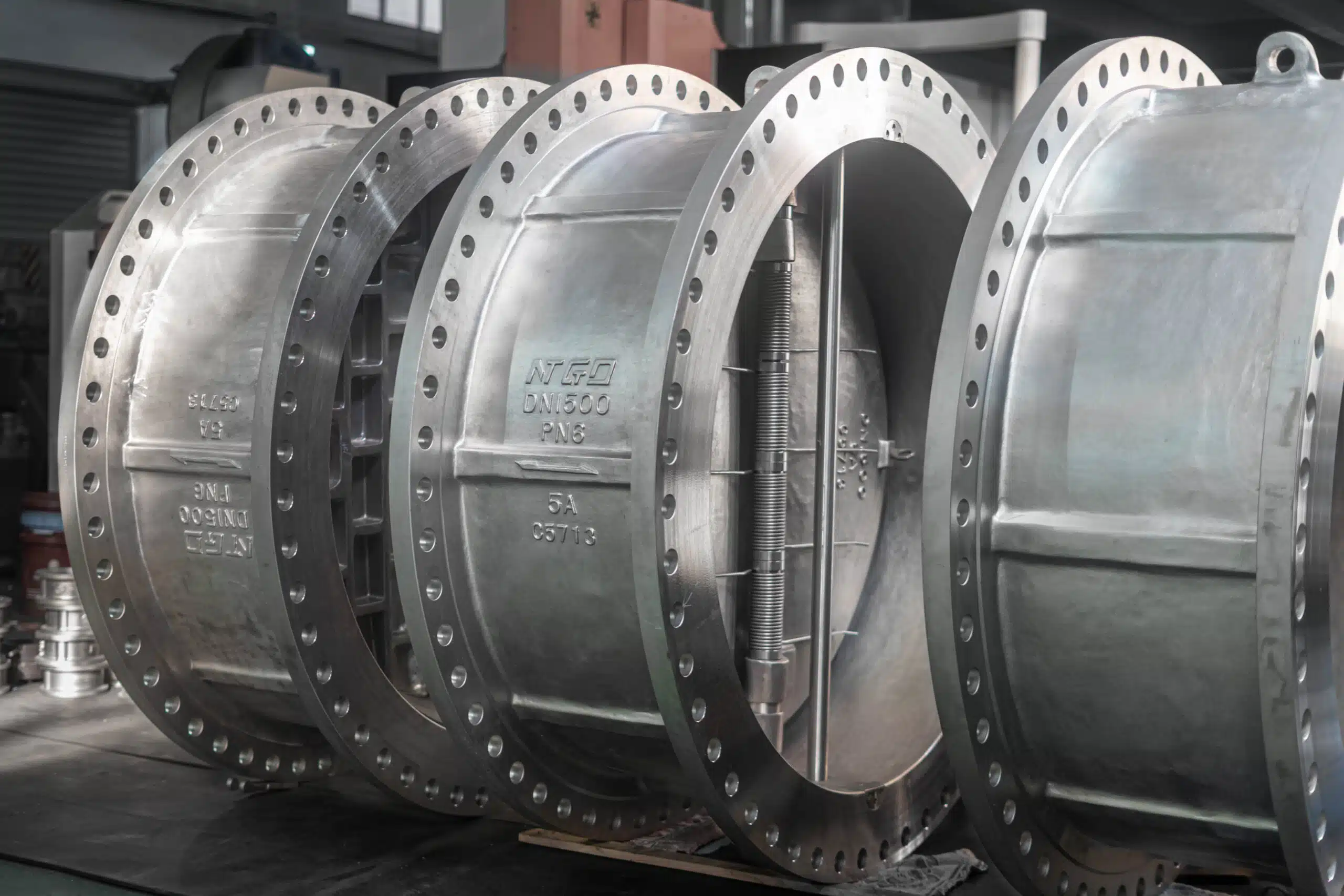
The compact wafer-style body is one of the major advantages. It can reduce installation length and weight, especially in larger pipe sizes. This makes dual plate check valves attractive for systems where space, weight, or piping layout are important.
However, the spring and plate design must match the service. Heavy solids, sticky media, or abrasive particles can interfere with the plates or springs. If the valve is not sized correctly, plate movement may become unstable, causing chatter, wear, or incomplete closing. Dual plate valves are often preferred over traditional swing check valves where space is limited or a shorter closing travel is needed, but they should not be treated as a universal replacement.
Best fit: compact piping layouts, large pipelines, HVAC, clean water, pump discharge, general process service.
Use caution: solids-heavy wastewater, slurry, abrasive media, or poorly controlled flow conditions.
Factory Example: Large Dual Plate Check Valve Manufacturing Scale
This factory video shows the manufacturing scale of a large dual plate check valve. Final valve type selection should still be based on service conditions, flow behavior, pressure, temperature, material compatibility, and manufacturer datasheet.
5. Nozzle Check Valve
A nozzle check valve is an axial-flow, spring-assisted check valve. The disc moves along the flow axis and closes quickly when forward flow decreases. This design is often selected to reduce slam and help control surge in pump discharge systems.
Nozzle check valves are used in high-flow systems, pump stations, water transmission, oil and gas pipelines, power systems, and other services where reverse flow must be limited quickly. Their short stroke and axial flow path can provide stable closing behavior when properly selected.
The main engineering value is controlled non-slam behavior. Because the disc is spring-assisted and travels a shorter distance, the valve can close before significant reverse flow develops. This can help reduce water hammer risk in suitable systems.
The limitation is that nozzle check valves normally require careful specification. They should be selected based on actual flow conditions, not only pipe size. Cost, pressure loss, clean-service suitability, and sizing should be reviewed before selection. Compared with a silent check valve, a nozzle check valve is usually a more specific axial-flow solution for pump discharge or surge-sensitive systems.
Best fit: pump discharge, surge-sensitive systems, high-flow clean service, water transmission, oil and gas pipelines.
Use caution: dirty or sticky media, very low flow conditions, or projects where pressure loss and sizing are not verified.
6. Piston Check Valve
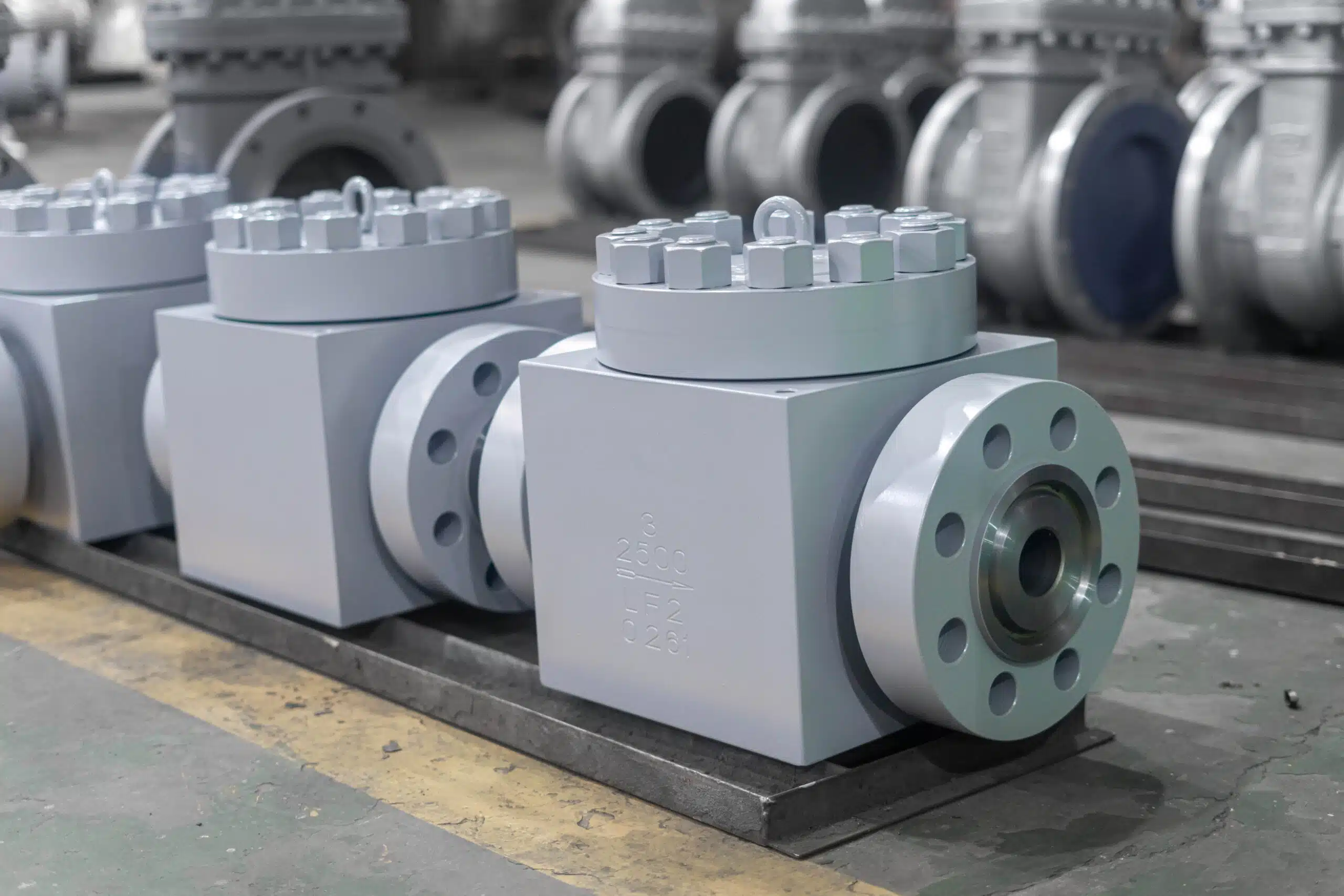
A piston check valve uses a guided piston or disc that lifts from the seat during forward flow and returns to the seat when flow stops or reverses.
It is closely related to the lift check valve family but uses a piston-style guided closing element.
Piston check valves are often used in clean, high-pressure applications where stable seating and guided movement are required. They may be found in steam, process, power, and high-pressure liquid systems depending on the design.
The guided piston can provide a controlled closing movement and good alignment with the seat. This makes the valve useful where reverse flow must be controlled in clean service.
However, piston check valves are not ideal for every media condition. Dirty fluid, scale, debris, or sticky media can affect piston movement. If the piston cannot move freely, the valve may stick, leak, or respond slowly. This is why piston check valves should be treated as clean-service, guided-closure designs rather than general dirty-service valves.
Best fit: clean high-pressure service, steam-related process lines, power systems, controlled reverse-flow prevention.
Use caution: slurry, wastewater, abrasive media, or services with debris that may affect the guided piston.
7. Silent Check Valve
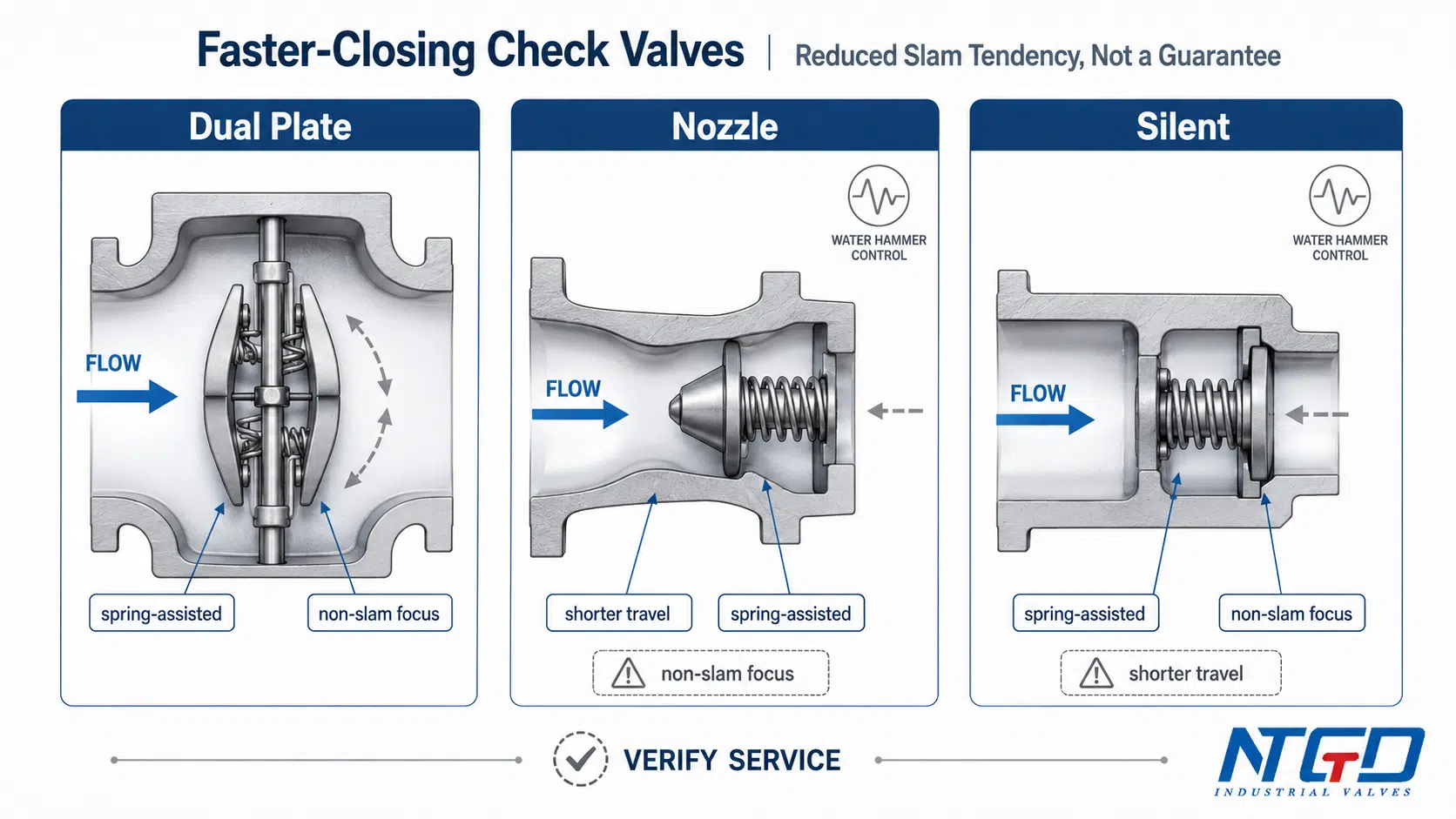
A silent check valve is designed to close before strong reverse flow develops. It usually uses a spring-assisted disc, poppet, or similar closing element to reduce valve slam and noise.
Silent check valves are commonly used in pump discharge lines, clean water systems, HVAC, water treatment, and other services where water hammer or noise is a concern. In suitable conditions, they can provide faster, smoother closure than a traditional swing check valve.
The key feature is controlled closing behavior. Instead of allowing the disc to travel a long distance and then slam shut, the silent check valve closes more quickly as flow decreases. This can help protect pumps, piping, and downstream equipment.
Silent check valve is also a functional classification: it describes the closing behavior, not only one fixed body shape. Some silent check valves overlap with spring-loaded or nozzle-style designs, but non-slam performance should still be evaluated according to actual flow, media cleanliness, and pressure loss requirements.
Best fit: clean water, pump discharge, HVAC, water hammer-sensitive systems, noise-sensitive piping.
Use caution: solids-heavy media, sticky fluids, abrasive service, or applications where spring compatibility is not confirmed.
8. Spring-Loaded Check Valve
A spring-loaded check valve uses a spring to help close the valve when forward flow decreases. The closure element may be a disc, poppet, or ball depending on the design.
Spring-loaded check valves are used in many systems because they can close faster than gravity-dependent designs and may be suitable for different installation orientations. They are common in compact piping systems, pump discharge lines, hydraulic circuits, and general industrial service.
The spring changes the valve’s opening and closing behavior. This is useful when quick closure is needed, but it also means that cracking pressure and spring material must be verified. A spring that is too strong, too weak, or incompatible with the media can cause poor opening, unstable closing, corrosion, or premature spring failure.
Spring-loaded designs should not be selected only because they are compact. The spring, seat, body material, and flow path should match the actual service conditions.
Best fit: compact systems, quick-closing service, vertical or horizontal installations where design permits, clean industrial fluids.
Use caution: very low-pressure systems, dirty media, corrosive service, or cases where cracking pressure is critical.
9. Stop Check Valve
A stop check valve combines automatic check valve function with manual shutoff capability. It can help prevent reverse flow while also allowing an operator to close the valve manually when required.
Stop check valves are commonly used in boiler, steam, power, and high-pressure process systems. They are not simply another general-purpose check valve. Their value comes from the combination of directional flow protection and manual isolation.
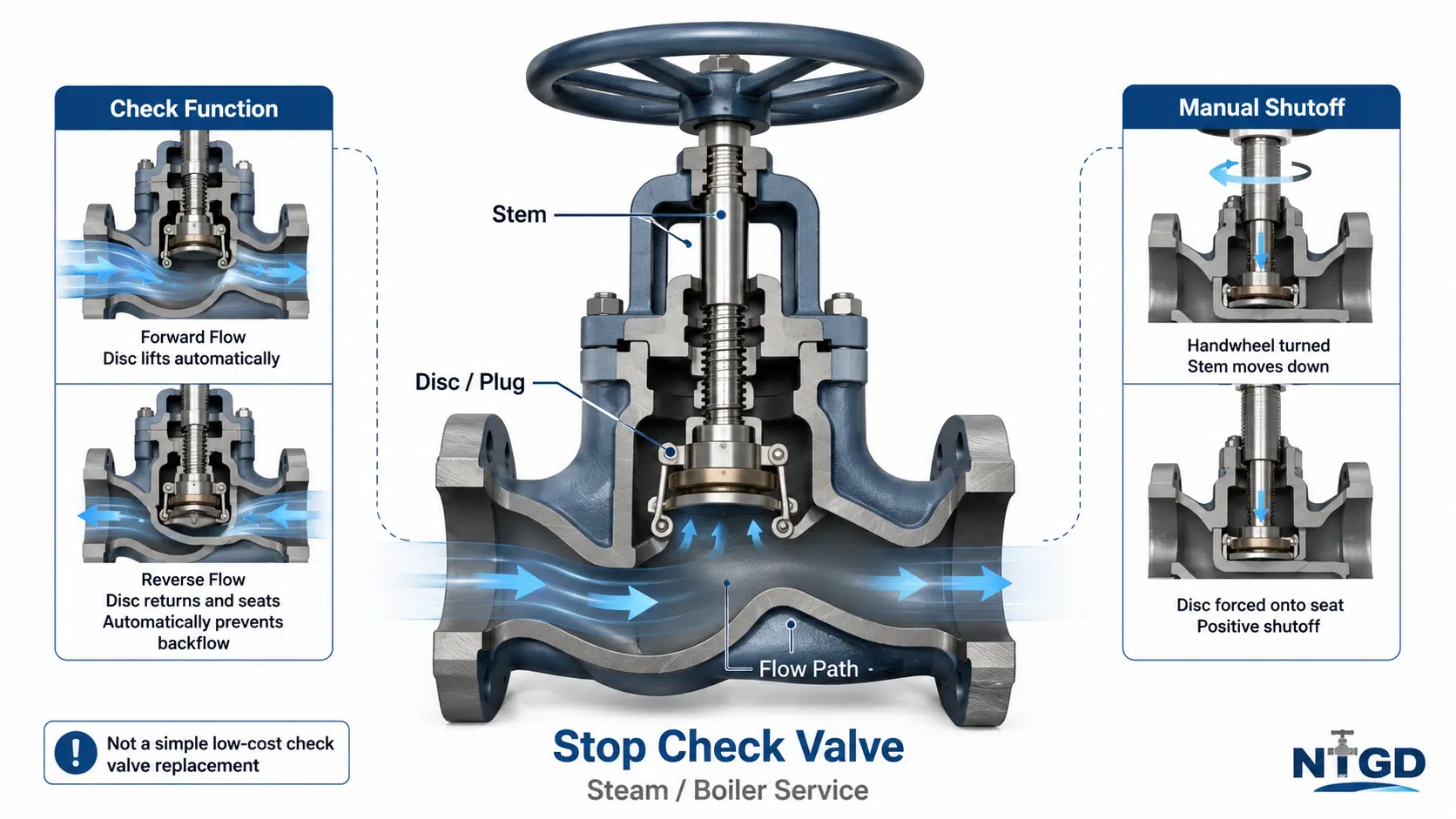
Many stop check valves use a globe-style body or similar construction. This makes them suitable for applications where operators need more control than a standard check valve provides.
The limitation is complexity. A stop check valve is usually larger, more complex, and more application-specific than a standard swing or lift check valve. It is suitable where a system needs both automatic check action and manual shutoff, especially in steam, boiler, or power service. It should not be selected as a low-cost replacement for a simple check valve.
Best fit: steam, boiler, power generation, high-pressure isolation, process systems requiring manual override.
Use caution: simple low-cost backflow prevention, compact piping, or applications where manual shutoff is not needed.
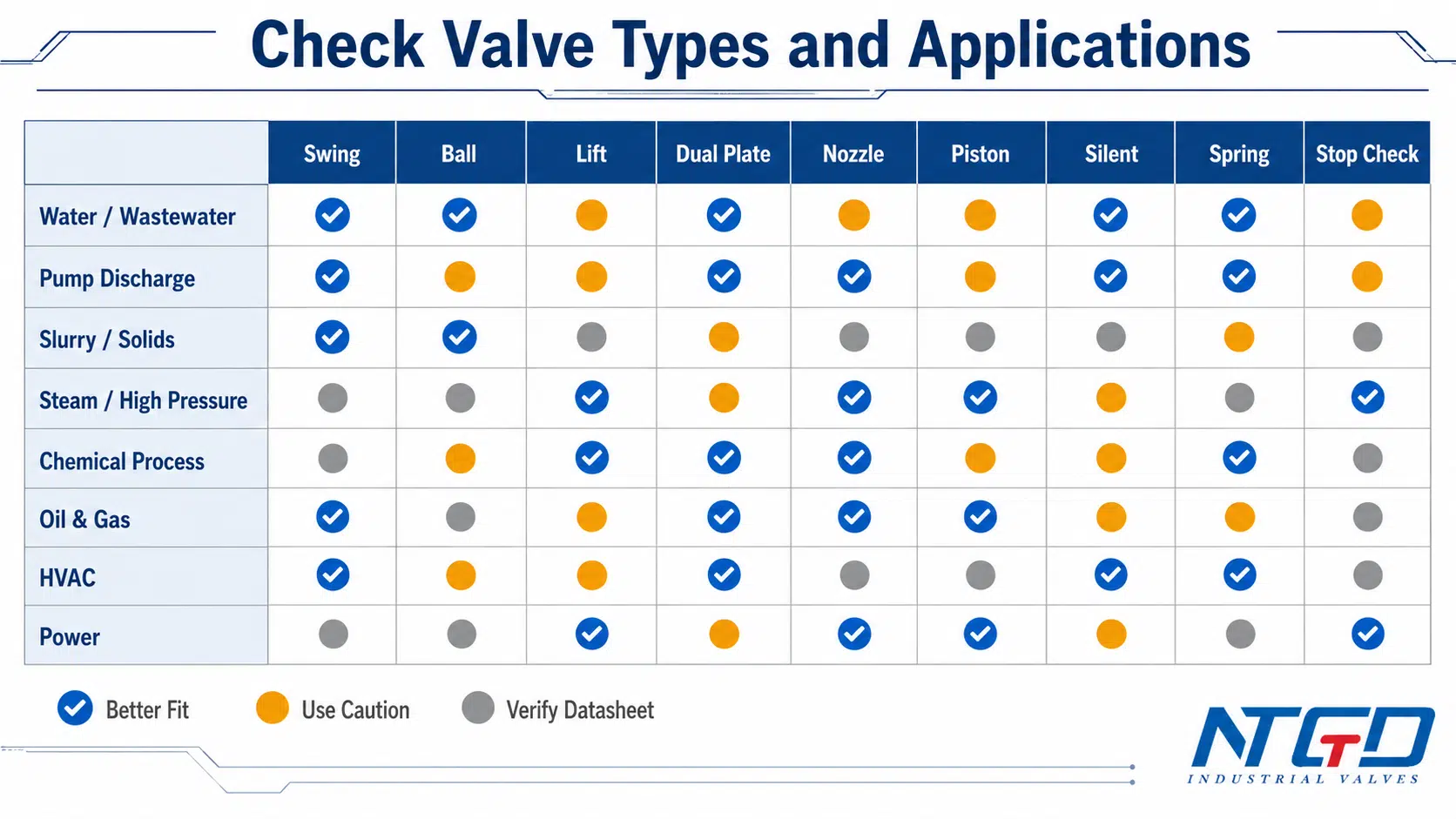
Check Valve Types and Applications
Different check valve types are used in different applications because the operating conditions are not the same. A wastewater line, clean water pump discharge, steam system, slurry pipeline, and chemical process line may all need backflow prevention, but they do not need the same valve design.
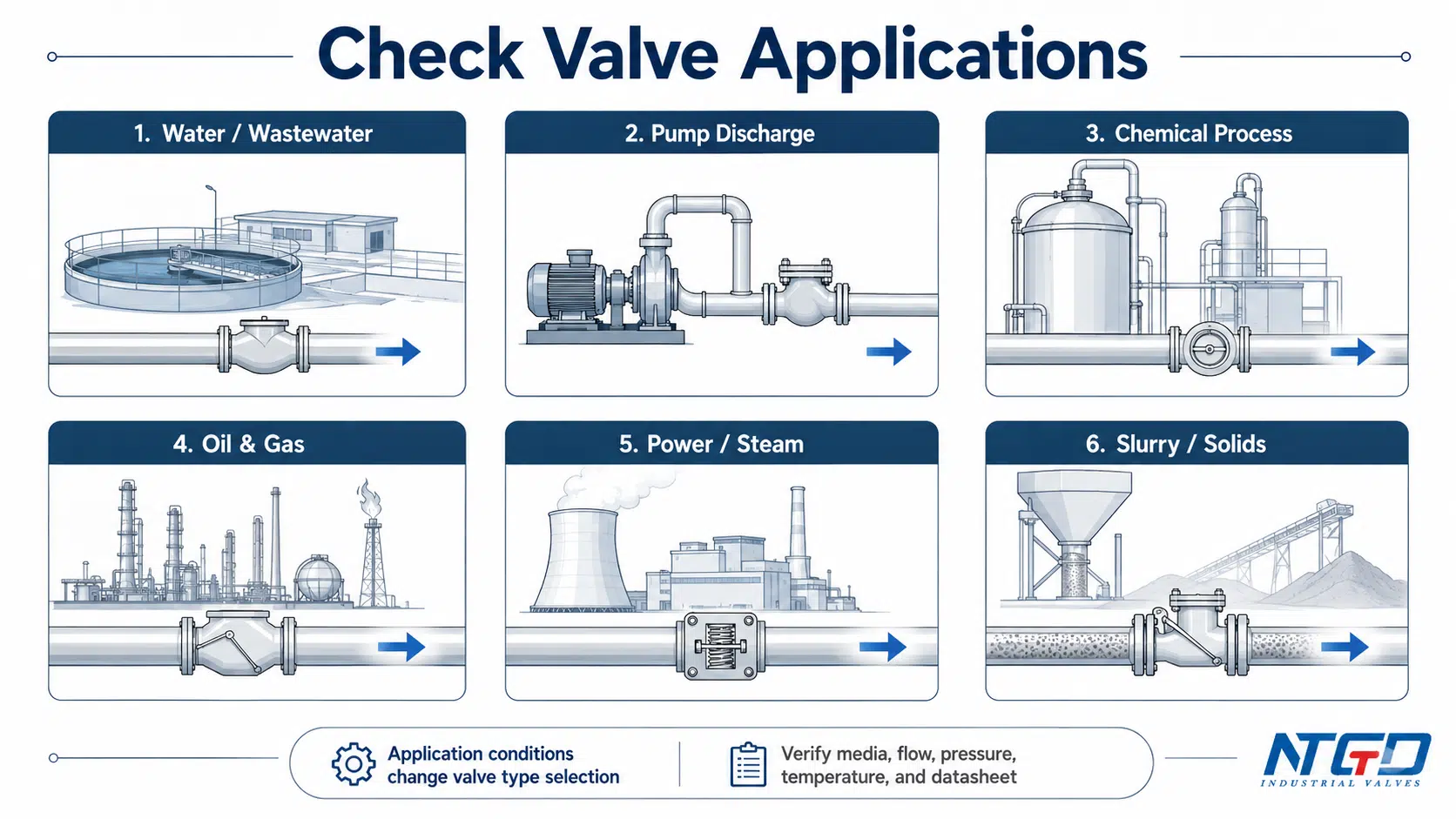
| Application | Better-Fit Check Valve Types | Use Caution | Why It Matters |
|---|---|---|---|
| Water / wastewater service | Swing, ball, dual plate, silent, nozzle, foot valve depending on service | Do not choose only by pipe size; check clean water vs wastewater, solids, pump cycling, and surge risk | Flow velocity, solids, pump cycling, and water hammer risk can change the best choice |
| Pump discharge | Silent, nozzle, spring-loaded, dual plate, swing in stable flow | Oversized valves may chatter or close poorly | Pump systems often experience flow reversal and surge |
| Slurry / solids / dirty media | Ball, suitable swing, selected full-flow designs | Narrow guides, small clearances, or springs may clog | Solids can prevent proper closure or cause wear |
| Steam / high-pressure service | Lift, piston, stop check, selected swing designs | Confirm pressure, temperature, and material limits | Steam and high-pressure service require suitable body, trim, and seating design |
| Chemical / process systems | Lift, piston, spring-loaded, lined or compatible-material designs | Do not assume material compatibility | Corrosive media can attack body, seat, spring, or sealing surfaces |
| Oil and gas pipelines | Swing, nozzle, dual plate, piston depending on flow and pressure | Confirm pressure class and surge behavior | Reverse flow can affect pumps, compressors, and pipeline equipment |
| HVAC and building service | Dual plate, spring-loaded, silent, swing | Avoid bulky valves where space is limited | Installation space and quiet operation may matter |
| Power generation | Stop check, piston, lift, nozzle | Avoid simple low-pressure designs in demanding service | High-pressure and steam-related systems need controlled operation |
| Sanitary / food / pharmaceutical service | Sanitary check valve designs, diaphragm-type or compatible designs where applicable | Do not use standard industrial cast designs without verification | Cleanability, material compatibility, and hygienic requirements may apply |
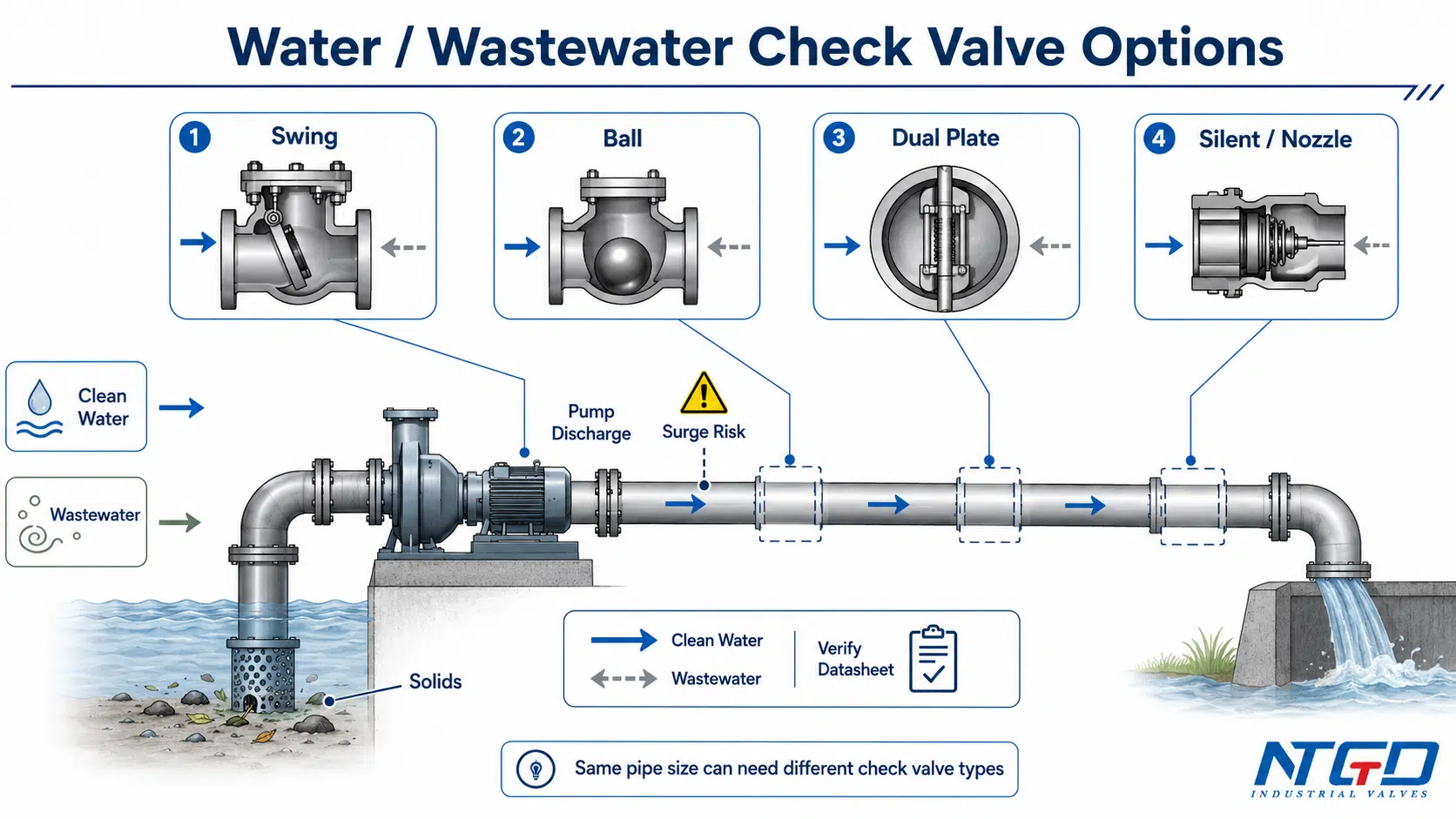
Water and wastewater service is only one application category. It should not define the entire check valve selection. A clean water line, wastewater line with solids, pump discharge line, and surge-prone water transmission line may use the same nominal pipe size but require different check valve types.
Slurry and solids-bearing service may require ball, suitable swing, or selected full-flow designs.
This is why application-to-type mapping must consider media cleanliness, flow stability, solids content, head loss, water hammer risk, and maintenance access. The goal is not to find the most common check valve, but to find the type whose closing behavior matches the actual service.
How to Choose Between Check Valve Types
Choosing between check valve types requires more than matching the valve to the nominal pipe size. A valve that is too large, too slow to close, too restrictive, or unsuitable for the media can create operational problems.
Start with Flow Rate and Normal Operating Conditions
The valve should operate under the system’s normal flow conditions, not only its maximum design condition. If the valve does not open fully during normal operation, the closure element may flutter, chatter, or wear prematurely.
This is especially important in pump discharge systems, low-flow systems, and pipelines with variable flow. Normal operating flow can change the preferred valve type because some designs need enough forward flow to hold the disc, plate, ball, or piston in a stable open position.
Check Media, Solids, and Cleanliness
Clean water, steam, oil, slurry, wastewater, and chemical media behave differently. A guided piston or spring-loaded design may work well in clean service but may not tolerate debris or sticky media.
For wastewater or solids-bearing flow, the internal flow path and closure design should reduce clogging risk. For corrosive media, body, seat, disc, and spring materials must be checked against the fluid.
Match Valve Type to Pipe Orientation and Available Space
Some check valves work best in horizontal pipelines. Some designs may also operate in vertical upward flow if the manufacturer’s design allows it. Others are more sensitive to orientation.
Available space also matters. A dual plate wafer check valve may fit into a compact layout where a traditional swing check valve is too long. A stop check valve may require more space and access because of its manual operating function.
Consider Head Loss and Pressure Drop
A low pressure drop can be important in large pipelines, pump systems, and energy-sensitive service. Swing check valves may offer relatively low resistance in stable flow, while lift, piston, or some spring-assisted designs may create more resistance depending on the body pattern.
Pressure drop can change the selection decision because a valve with a suitable closing action may still be unsuitable if it adds too much flow resistance for the pump or process. This should be checked again in the final fit-check against the valve datasheet and normal operating flow.
Consider Non-Slam or Water Hammer Requirements
Water hammer can occur when flow reverses quickly and the valve closes too late or too aggressively. Nozzle, silent, dual plate, and selected spring-assisted check valves may help reduce slam risk in suitable systems.
However, no check valve type automatically eliminates water hammer in every service. Piping layout, pump behavior, flow velocity, valve sizing, and closure characteristics all affect the result. If surge or pump shutdown behavior is a known concern, non-slam performance should be treated as a selection requirement, not as a marketing label.
Confirm Pressure, Temperature, Material, and Datasheet
Before final selection, confirm:
- pressure class;
- temperature range;
- body and trim material;
- seat material;
- spring material if applicable;
- connection type;
- flow direction;
- installation orientation;
- service media;
- inspection and maintenance requirements.
The exact limits depend on valve design, material, pressure class, seat construction, and application conditions. If any of these items are uncertain, the valve type should remain a preliminary choice until the datasheet and service conditions are reviewed.
Common Risks When the Wrong Check Valve Type Is Used
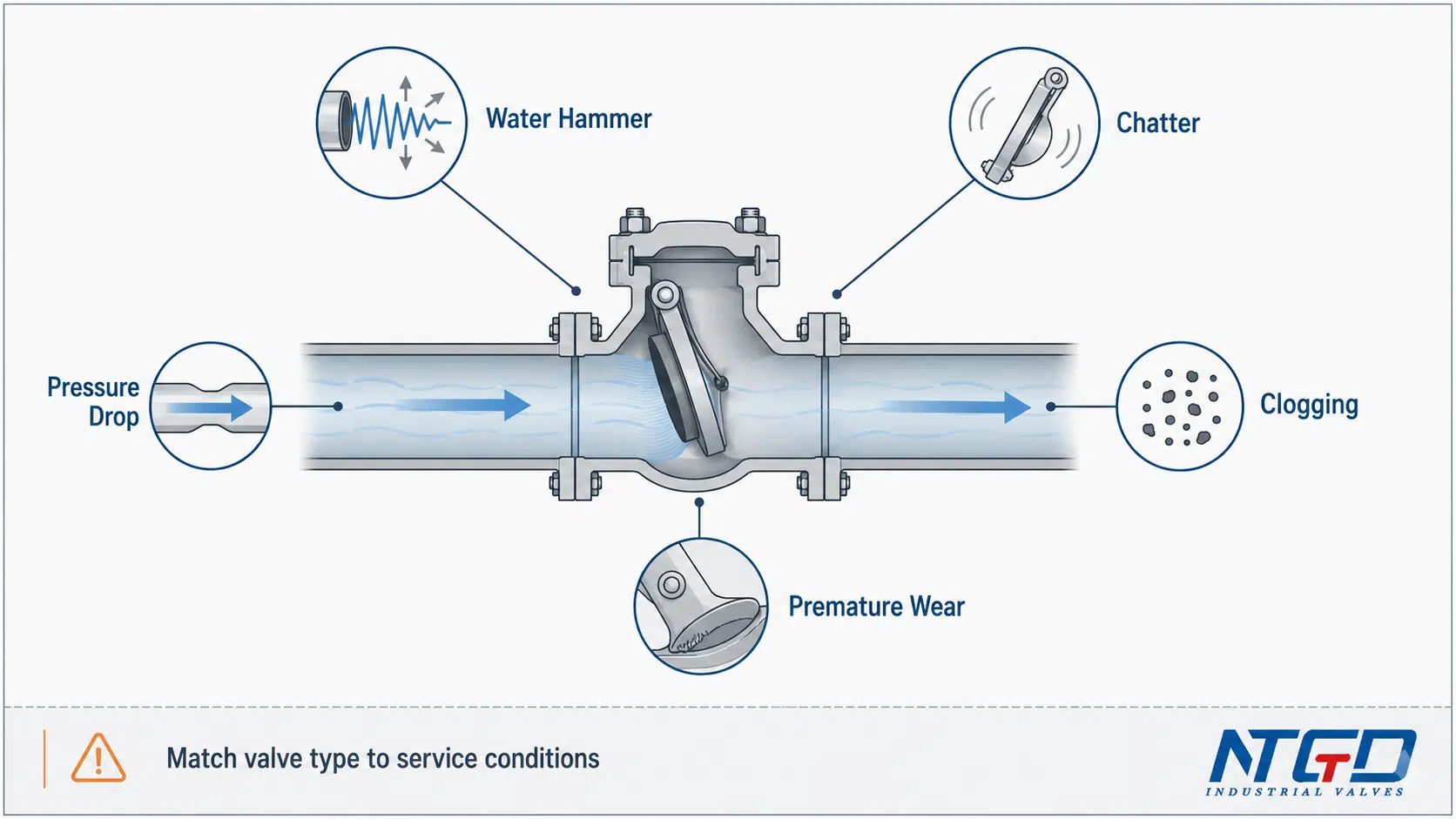
A check valve may look simple, but the wrong type can create problems in service. The risk is not only reverse flow. Poor selection can also affect pump operation, system stability, energy use, and maintenance frequency.
| Wrong Choice Risk | Typical Cause | Possible Consequence | How to Reduce the Risk |
|---|---|---|---|
| Water hammer or valve slam | Valve closes after reverse flow develops, or closes too aggressively for the system | Noise, vibration, piping stress, pump damage risk | Review pump shutdown behavior, reverse-flow tendency, valve closing speed, and non-slam options |
| Disc flutter or chattering | Valve is oversized, flow is too low, or the closure element is not stable at normal flow | Wear, noise, unstable sealing, hinge or spring fatigue | Size and select the valve based on normal operating flow, not pipe size or maximum flow alone |
| Excessive pressure drop | Restrictive body, unsuitable flow path, or wrong valve type | Higher energy cost, reduced system efficiency, pump performance issues | Compare valve type, flow path, and datasheet pressure loss before final selection |
| Debris clogging or sticking | Dirty media enters a narrow guide, spring area, piston clearance, or seating zone | Valve may fail to open or close properly | Match internal clearance and closure mechanism to solids content and media cleanliness |
| Leakage or reverse flow | Seat wear, poor selection, debris on seat, or unsuitable sealing design | Backflow, contamination, equipment damage risk | Confirm media, seating design, reverse-flow requirement, and maintenance access |
| Premature wear | Wrong orientation, high velocity, unstable flow, poor sizing, or unsuitable material | Shorter service life and more downtime | Confirm orientation, flow range, material compatibility, and application conditions |
A good check valve selection reduces risk by matching the valve’s closing behavior to the system’s actual operating conditions. Final confirmation should always be based on the specific valve design, service media, operating range, and manufacturer datasheet.
Final Fit-Check Before RFQ or Specification
Before confirming a check valve type for a project, review the following fit-check items:
| Fit-Check Item | Why It Matters |
|---|---|
| Normal flow rate | Determines whether the valve opens fully and operates stably |
| Pipe size vs actual flow | Pipe size alone does not confirm correct valve sizing |
| Media type | Clean water, wastewater, slurry, steam, oil, and chemicals require different designs |
| Solids or debris | Affects clogging, sticking, and seat wear risk |
| Pressure and temperature | Must match valve body, trim, seat, and spring design |
| Installation orientation | Some check valves are orientation-sensitive |
| Head loss sensitivity | Affects pump performance and energy cost |
| Water hammer risk | May require silent, nozzle, dual plate, or spring-assisted designs |
| Material compatibility | Body, seat, disc, spring, and seals must match the media |
| Maintenance access | Some designs are easier to inspect or service than others |
| Manufacturer datasheet | Final limits must be verified against the actual valve design and specification data |
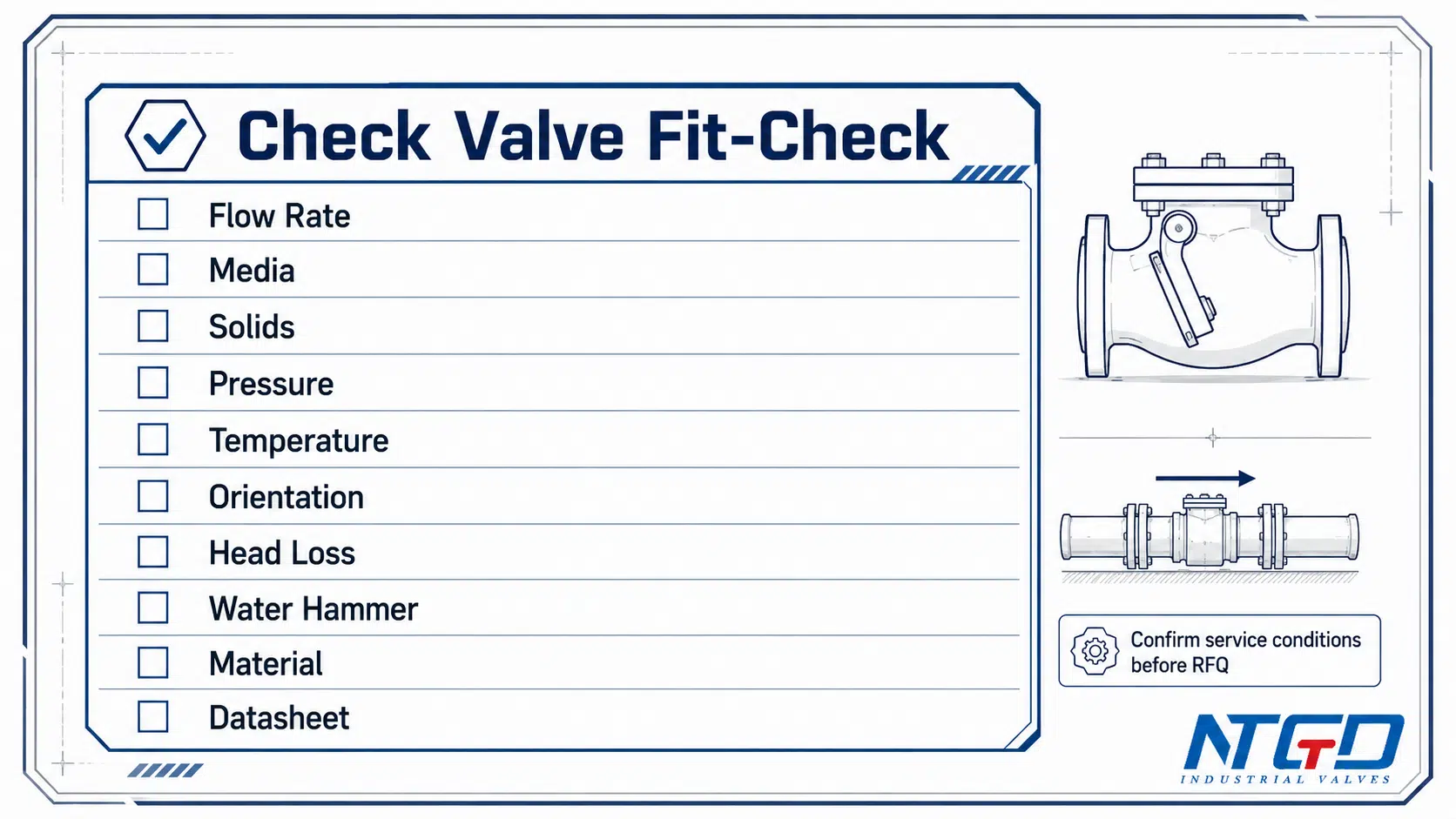
This final check helps avoid treating all check valve types as interchangeable. The correct valve type should match both the service conditions and the failure risk of the system.
For industrial projects, the fit-check is also the bridge between article-level understanding and technical review. If the wrong type could cause water hammer, clogging, leakage, excessive pressure drop, or unstable operation, the application should be reviewed before RFQ or specification.
FAQ About Check Valve Types
What are the different types of check valves?
Different check valve types use different closing mechanisms, such as a hinged disc, ball, lift disc, dual plates, piston, spring-assisted disc, or manual stop-check arrangement. Common industrial types include swing, ball, lift, dual plate, nozzle, piston, silent, spring-loaded, and stop check valves. The best type depends on the application, media, flow behavior, and closing-speed requirement.
What are the three basic types of check valves?
A simplified grouping is swing-type check valves, lift-type check valves, and spring-assisted check valves. This grouping is useful for basic understanding, but industrial systems may also use ball, dual plate, nozzle, piston, silent, and stop check valve designs for more specific service conditions.
Name the two basic types of check valves.
The two basic categories are often gravity-operated check valves and spring-assisted check valves. Gravity-operated designs rely mainly on flow reversal and closure element weight, while spring-assisted designs use a spring to help the valve close more quickly.
What are the five most common types of check valves?
Five common check valve types used in many industrial systems are swing check valves, ball check valves, lift check valves, dual plate check valves, and spring-loaded check valves. Other types, such as nozzle, piston, silent, and stop check valves, are often selected for more specific operating conditions such as non-slam service, high-pressure clean service, or steam and boiler applications.
What type of valve is a check valve?
A check valve is an automatic one-way valve. It allows flow in one direction and helps prevent reverse flow when the fluid stops or reverses. It normally operates without a handwheel or actuator.
What does a check valve do?
A check valve helps prevent backflow. It protects pumps, pipelines, compressors, tanks, and process equipment by closing when reverse flow begins or when forward flow is no longer sufficient to keep the valve open.
What is the purpose of a check valve?
The purpose of a check valve is to maintain one-way flow and reduce the risk of reverse-flow damage, contamination, pump reversal, or process disruption. The exact performance depends on the valve design and service conditions.
Which check valve types are commonly used for water applications?
Common check valve types for water and wastewater applications include swing check valves, ball check valves, dual plate or wafer check valves, silent check valves, nozzle check valves, spring-loaded check valves, and foot valves. Clean water, wastewater with solids, pump discharge, irrigation, and surge-prone pipelines may require different designs, so the final choice should consider flow rate, solids content, head loss, water hammer risk, orientation, and datasheet limits.
Is a swing or spring check valve better?
Neither is always better. A swing check valve may be suitable for stable flow and low pressure drop service. A spring check valve may be better where faster closure, vertical installation, or reduced slam risk is required. The decision should be based on flow conditions, media, orientation, cracking pressure, and datasheet limits.
What is the difference between a check valve and a backflow preventer?
A check valve is a one-way valve used to help prevent reverse flow. A backflow preventer is usually a more specialized assembly used in systems where contamination control or regulatory protection is required. They are related but not always interchangeable.
Conclusion
Check valves are selected to prevent reverse flow, but different check valve types behave very differently in service. A swing check valve, ball check valve, lift check valve, dual plate check valve, nozzle check valve, piston check valve, silent check valve, spring-loaded check valve, and stop check valve each has its own operating logic, application range, and limitation.
For an industrial piping system, the best choice is not simply the most common type. It should match the flow rate, media, pipe orientation, pressure drop requirement, water hammer risk, maintenance access, and manufacturer datasheet.
A strong check valve selection starts with understanding the valve type, then confirming whether that type fits the actual application.
If you are unsure about water hammer risk, media compatibility, or which check valve type best matches your system’s flow and pressure conditions, NTGD’s valve engineers can review your service requirements and provide a technical recommendation before RFQ or specification.
