“`html
Author Name: Bruce Zheng
Author Role: Co-Founder and Valve Engineer at NTGD Valve
Author Bio: Bruce Zheng is Co-Founder and Valve Engineer at NTGD Valve, focusing on industrial valve selection, application, and technical content for global B2B buyers.
Last Updated: April 24, 2026
Finding ball valve suppliers in Mexico is easy. Shortlisting the right supplier for an industrial project is harder.
Search results for Mexico ball valve manufacturers often mix local manufacturers, distributors, stockists, exporters, brand offices, and general industrial valve suppliers. A company that can quickly supply a standard stainless steel ball valve may not be the right source for a trunnion-mounted ball valve, a high-pressure project, or a chemical service that requires material traceability and test documentation.
Quick Procurement Summary
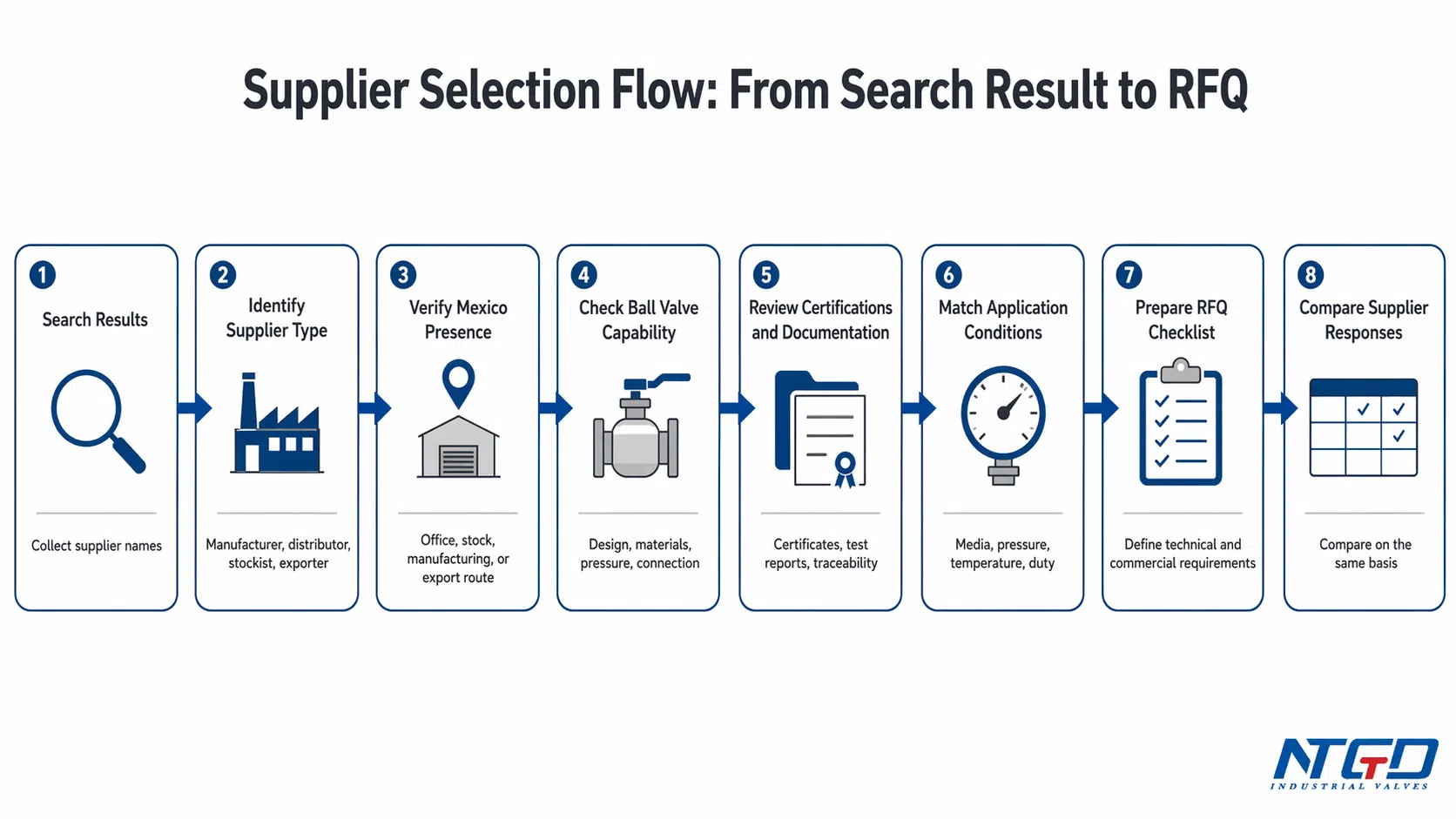
- A “supplier in Mexico” is not always a manufacturer in Mexico. First confirm whether the company is a manufacturer, distributor, stockist, exporter, or local representative.
- A shortlist is only the starting point. Before choosing a supplier, verify Mexico presence, ball valve construction, material options, pressure class, seat/seal design, and documentation support.
- For industrial projects, request certificates, test reports, material traceability, lead time, and delivery route before treating any supplier as qualified.
How to Evaluate Ball Valve Suppliers in Mexico Before Shortlisting
A supplier list is useful only when the buyer knows how to read it. The same company name may appear under “manufacturer,” “supplier,” “stockist,” or “distributor,” but those terms do not carry the same meaning in industrial valve purchasing.
For ball valve projects, the first question is not “Who is the best supplier?” The better first question is:
What kind of supplier do I need for this service condition and project risk?
A maintenance buyer replacing standard valves may need local stock and fast delivery. A project engineer specifying valves for oil and gas, chemical processing, or high-pressure service may need a manufacturer or authorized channel that can provide test records, material certificates, and engineering support. Many real projects sit between these two cases: an EPC may need a specified brand replacement, an MRO team may work under a framework agreement, or a shutdown order may require both fast delivery and complete documentation.
Manufacturer, Supplier, Distributor, Stockist, or Exporter: Why the Difference Matters
| Supplier Type | What It Usually Means | Buyer Advantage | Buyer Risk to Check |
|---|---|---|---|
| Manufacturer | Produces valves or controls manufacturing directly | Better technical support, customization, documentation control | Confirm actual product range, factory location, standards, and test capability |
| Distributor | Sells products from one or more manufacturers | Local access, brand availability, project support | Confirm authorization, stock, and technical competence |
| Stockist | Holds inventory for faster delivery | Shorter lead time for standard products | Limited customization or documentation depth |
| Exporter | Supplies to Mexico from another country | Broad product range, possible cost advantage | Confirm logistics, warranty handling, and after-sales support |
| Local office / representative | Supports sales, service, or distribution in Mexico | Easier communication and local coordination | Confirm whether they stock valves or only coordinate orders |
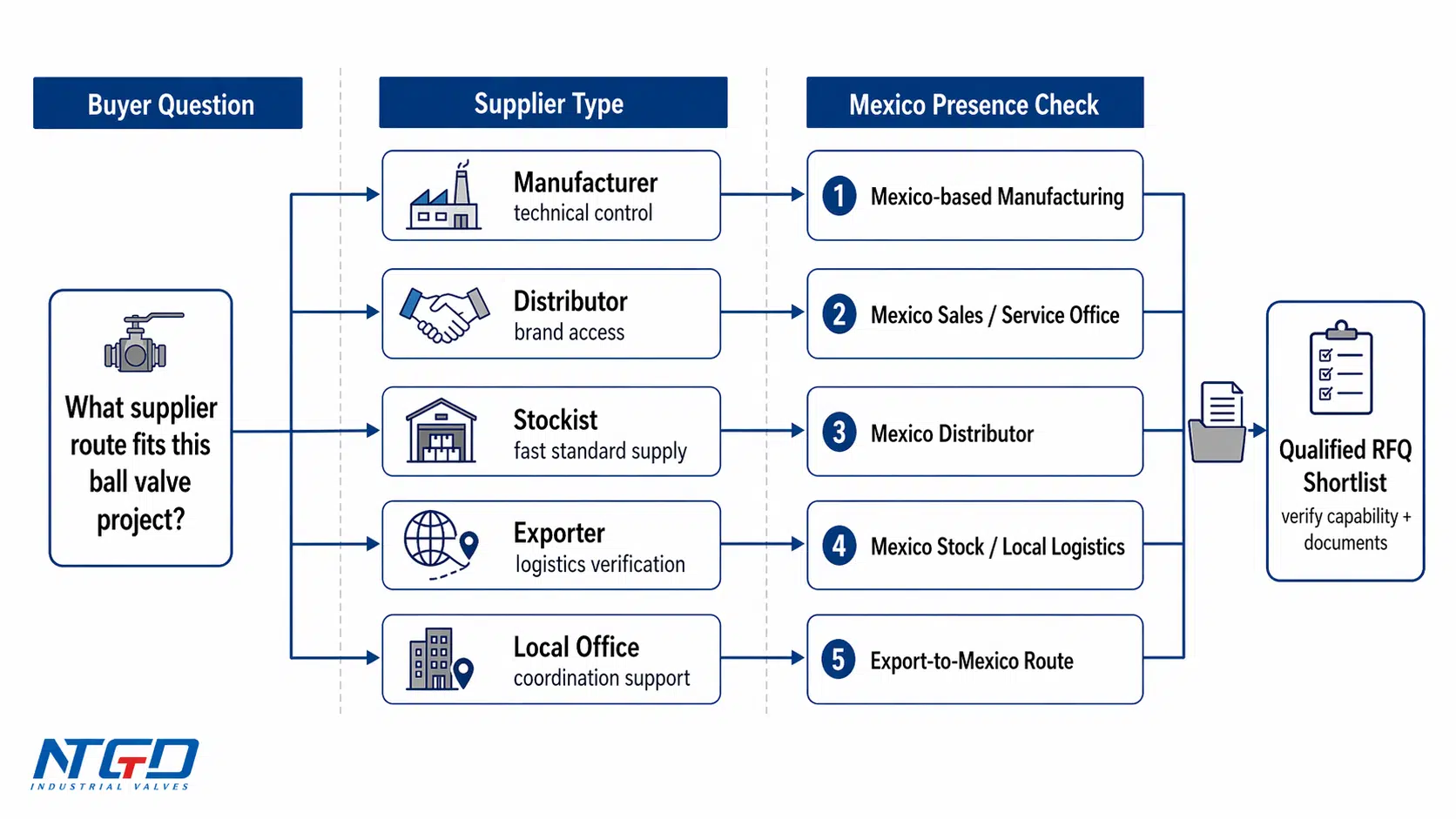
For many buyers, the right answer is not one supplier type for every project. A local stockist may be enough for standard water or utility lines. A manufacturer or authorized technical distributor may be safer for trunnion ball valves, fire-safe requirements, corrosive media, or high-pressure systems.
Mexico Presence: Local Manufacturer, Local Office, Local Stock, or Export-to-Mexico
“Supplier in Mexico” can mean several things. A local presence is valuable when the project needs field coordination, faster communication, urgent replacement, or local logistics support. An export-to-Mexico supplier can still be suitable for standard or planned orders, but the buyer carries more responsibility for checking shipment terms, documentation, warranty route, and after-sales response.
| Mexico Presence Type | What to Verify | Why It Matters |
|---|---|---|
| Mexico-based manufacturer | Manufacturing site, product range, certifications, test capability | Stronger local identity and possible technical control |
| Mexico sales or service office | Contact team, service area, supported product lines | Easier communication and project coordination |
| Mexico distributor | Authorized brands, inventory, technical support | Useful for standard procurement and replacement needs |
| Mexico stock / local logistics | Available inventory, lead time, certificate availability | Important for urgent shutdown or maintenance work |
| Export-to-Mexico supplier | Shipping terms, documentation, warranty route, local support | Suitable only if logistics and documentation are clear |
This distinction matters because a supplier that appears in Mexico-related search results may not manufacture in Mexico. That does not automatically make the supplier unsuitable, but it changes how the buyer should verify delivery, warranty, and documentation.
Top Ball Valve Suppliers and Manufacturers in Mexico
The following supplier shortlist should be used as a starting point for screening. Each company should be checked against the actual project requirements, especially if the valve will be used in chemical service, oil and gas, water treatment, high-pressure systems, or corrosive media.
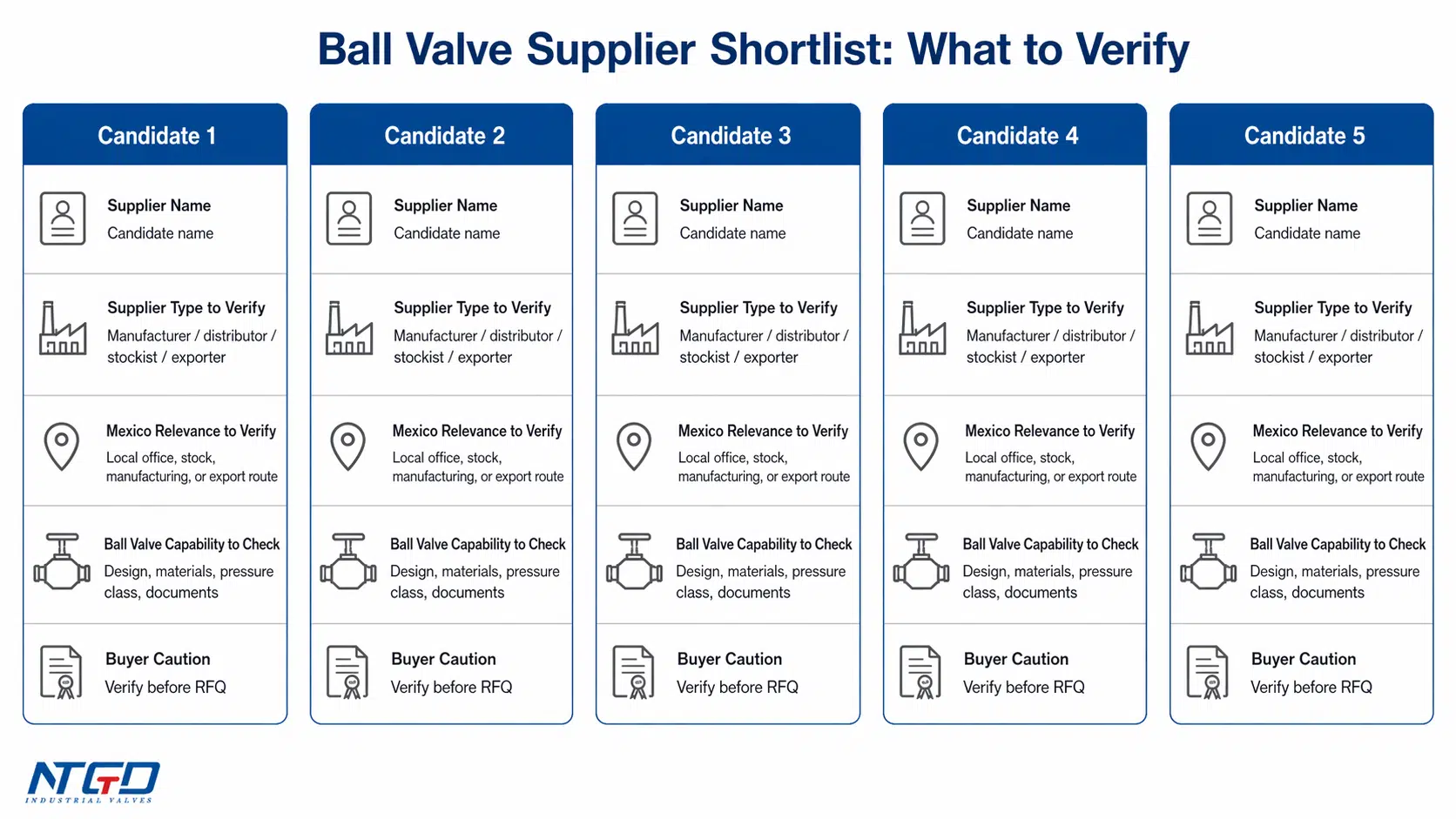
1. Xanik
Xanik is a Mexico-based industrial valve manufacturer known for specialty valve applications and severe-service positioning. For buyers searching for xanik supplier or xanik mexico, the value is not simply the company name. The value is whether the supplier’s current product range and engineering support match the service condition.
Xanik is more accurately treated as a specialty industrial valve manufacturer than as a generic ball-valve-only supplier. It is more likely to deserve early technical discussion when the project involves severe-service specifications, non-standard materials, special testing, or a documentation package that must be reviewed before procurement. Buyers should still confirm whether the required ball valve type, material, pressure class, seat/seal design, and documentation package are available for the project.
Best-fit screening angle:
High-spec industrial valve projects where engineering support, specialty service knowledge, and documentation discipline matter.
Buyer verification notes:
- Confirm whether the specific ball valve type required is within the supported product range.
- Check available materials for corrosive, high-temperature, or severe-service applications.
- Ask for project-specific certifications, inspection records, and test documentation.
- Do not assume every specialty valve manufacturer is automatically the best source for standard ball valves.
2. OyM Valve
OyM Valve is a relevant Mexico-based valve manufacturer candidate for buyers looking for local ball valve manufacturing identity. For procurement teams, the key question is whether the company’s current product range, certifications, distribution route, and documentation support match the required ball valve service.
A local manufacturer can be valuable when buyers need direct technical communication, domestic support, or project coordination in Mexico. Before treating OyM as a qualified Mexico ball valve manufacturer for a specific order, confirm its current ball valve range, material options, pressure class coverage, available test reports, applicable certificates, distributor route, lead time, and after-sales support.
Best-fit screening angle:
Projects where Mexico-based valve manufacturing identity and local supplier verification are important.
Buyer verification notes:
- Confirm current ball valve product range and manufacturing scope.
- Request applicable certificates, test reports, and inspection records.
- Check whether the supplier supports both standard and project-specific valve requirements.
- Clarify distributor network, lead time, warranty route, and after-sales support.
3. D Chel Valves
D Chel Valves is positioned for Mexico-related ball valve procurement as a manufacturer, supplier, stockist, or exporter candidate. In the original supplier list, it was associated with stainless steel ball valves, trunnion mounted ball valves, and industrial applications such as oil and gas, petrochemicals, and water treatment.
For a buyer, the key screening point is not only whether D Chel can quote a ball valve. The buyer should verify the supply path, available ball valve constructions, material range, pressure class coverage, inspection documents, and delivery terms for Mexico. If the supply route is export-oriented rather than local, confirm logistics, delivery location, documentation package, and warranty support before comparing price.
Best-fit screening angle:
Buyers looking for broad ball valve options, including stainless steel, trunnion, and industrial-service configurations.
Buyer verification notes:
- Confirm whether the supplier is acting as manufacturer, stockist, exporter, or local distributor.
- Check available ball valve types such as floating, trunnion, two-piece, three-piece, top-entry, or fully welded designs.
- Ask for material certificates, pressure test reports, and applicable standards.
- Verify delivery terms, lead time, and after-sales support for Mexico.
4. MVS Valves
MVS Valves is relevant for buyers comparing industrial valve suppliers in Mexico because it positions around a wider industrial valve portfolio, including ball valves and other valve types used in process industries.
For this article, MVS should not be treated as a pure ball valve specialist unless the required ball valve capability is verified. Its value is broader industrial valve coverage, which may help projects that need ball valves together with gate, globe, check, plug, butterfly, or lined valves from a coordinated supply route.
Best-fit screening angle:
Industrial projects requiring ball valves together with other valve categories.
Buyer verification notes:
- Confirm the available ball valve constructions, materials, end connections, and pressure classes.
- Check whether the Mexico-related supply route is local, export-based, or distributor-supported.
- Ask whether documentation is available for industrial project procurement.
- Do not let broad industrial valve coverage replace ball-valve-specific verification.
5. Bray Mexico
Bray Mexico is a relevant industrial valve and automation presence for buyers who need local access, brand support, or project coordination in Mexico. For ball valve procurement, buyers should confirm the supported product range, inventory position, and whether the local operation can provide the specific ball valve configuration required.
Bray may be especially relevant where the project needs both valve supply and control or automation support. However, local brand presence does not automatically mean local inventory, project documentation, or direct support for every ball valve configuration.
Best-fit screening angle:
Industrial buyers who need local Mexico coordination, valve supply support, and possible automation or control package alignment.
Buyer verification notes:
- Confirm ball valve product availability through the Mexico operation.
- Ask whether the required valve is stocked locally or supplied through order placement.
- Check actuator, automation, or control support if the project requires operated ball valves.
- Verify certificates, test records, and lead times before final supplier selection.
Supplier Type and Mexico Presence Comparison
The following comparison should be used before treating any company as a qualified Mexico ball valve supplier.
| Supplier | Likely Screening Category | Mexico Relevance to Verify | Ball Valve Relevance to Verify | Main Buyer Caution |
|---|---|---|---|---|
| Xanik | Specialty industrial valve manufacturer | Mexico-based presence and current support scope | Confirm exact ball valve product availability | Do not treat as ball-valve-only without product verification |
| OyM Valve | Mexico valve manufacturer candidate | Local manufacturing identity, distribution support | Confirm current ball valve range and documents | Verify current certifications and supply capability |
| D Chel Valves | Manufacturer / supplier / stockist / exporter candidate | Confirm local vs export-to-Mexico supply route | Broad ball valve range should be checked by type and material | Do not assume local production or local stock |
| MVS Valves | Industrial valve manufacturer / exporter candidate | Confirm Mexico supply route and local support | Confirm ball valve construction and project documentation | Broad valve range may dilute ball-valve-specific fit |
| Bray Mexico | Local brand / industrial valve support presence | Confirm office, support, stock, and delivery route | Confirm supported ball valve products and accessories | Local presence does not automatically mean local inventory |
Supplier type tells you what role the company may play in the order. Mexico presence tells you how much local support, inventory, communication, logistics, or field coordination that role can provide. Both dimensions should be checked before sending a formal RFQ.
This table should not replace direct supplier qualification. It helps buyers decide what questions to ask before requesting a quotation.
Ball Valve Capability Matrix for Supplier Screening
A strong ball valve supplier should not only say that it offers “high-quality ball valves.” The buyer needs to understand whether the supplier can support the required construction route, material, service condition, and documentation package.
| Capability Area | What to Check | Why It Changes Supplier Selection |
|---|---|---|
| Floating vs trunnion design | Confirm whether the supplier supports floating ball valves, trunnion mounted ball valves, or both | Trunnion capability matters when the project involves higher load, larger size, higher-pressure service, or stricter documentation expectations |
| Two-piece / three-piece construction | Ask which body construction is available | Three-piece designs may support easier maintenance; two-piece designs are common in standard service |
| Top-entry or fully welded design | Confirm availability for project-specific requirements | These routes may matter for pipeline, buried service, or maintenance access requirements |
| Materials | Check stainless steel, carbon steel, duplex, special alloy, and seat/seal material options | Media compatibility and corrosion resistance depend on actual material selection, not the supplier’s general valve category |
| Pressure class and size range | Confirm pressure class, bore size, and operating conditions | A supplier with only standard utility sizes may be filtered out early when the project requires a higher pressure class, larger bore, or project-specified rating |
| End connection | Verify flanged, threaded, socket weld, butt weld, or other connection types | Connection mismatch can delay installation, force adapter use, or create avoidable rework |
| Seat and seal options | Ask about soft seat, metal seat, fire-safe design, and seal compatibility | Seat and seal selection affects leakage, temperature limit, media compatibility, operating torque, and lifecycle |
| Documentation | Request material certificates, test reports, and inspection records | A capability claim has limited value if it cannot be supported by order-level documents |
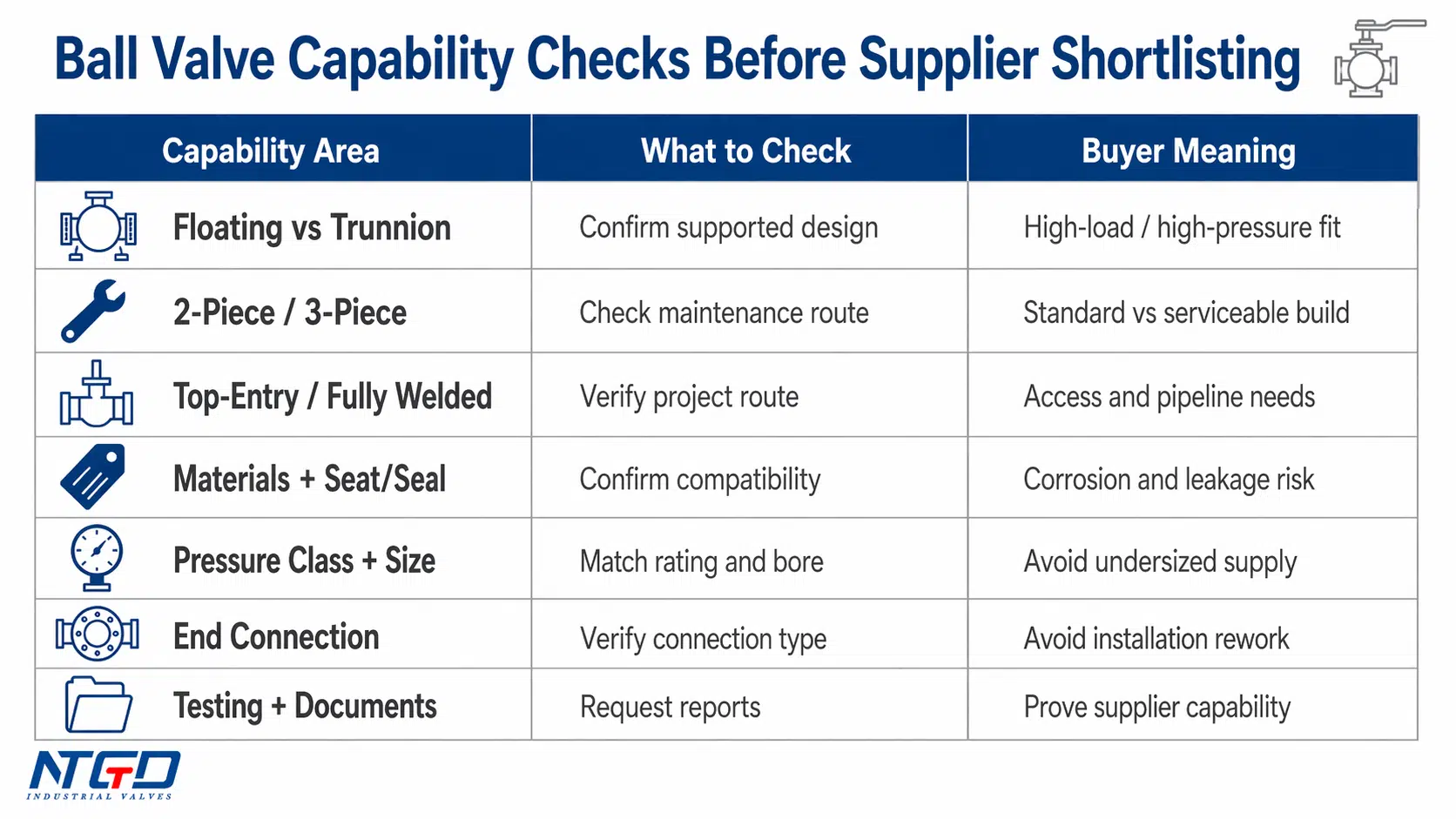
For standard utility service, not every item needs the same depth of review. For chemical, oil and gas, high-pressure, or critical isolation service, the documentation and engineering checks become more important than a simple price comparison.
Certification, QC, and Documentation Checks
A supplier may display quality certificates or mention standards on its website, but the buyer still needs to confirm whether those documents apply to the specific ball valve being quoted, whether they are current, and whether they can be included with the order.
Before selecting a ball valve supplier in Mexico, ask which documents can be provided for the exact valve configuration, material, pressure class, and delivery route. Company-level claims are useful only when they connect to the product and project file.
| Verification Item | What to Request | Buyer Purpose |
|---|---|---|
| Quality system certificate | Applicable quality management certificates, if available | Confirms whether the supplier has a documented quality management process that can support industrial project review |
| Product standard reference | Applicable valve design, testing, or dimensional standards | Helps match the valve to project specifications and receiving inspection requirements |
| Material certificate | Body, trim, ball, stem, seat, and seal material records where required | Supports material compatibility, traceability, and corrosion-service verification |
| Pressure / hydrostatic test report | Valve test records for the ordered item or batch | Confirms pressure-retaining and shutoff testing before the valve enters service |
| Fire-safe documentation | Fire-safe test evidence where required by service | Important when the valve is used in oil, gas, petrochemical, or hazardous service where fire-test documentation may be required |
| Inspection report | Dimensional, visual, or third-party inspection records when required | Reduces risk during project acceptance, warehouse receiving, or site installation |
| Traceability | Heat number, serial number, or batch tracking where required | Useful for audits, maintenance records, warranty control, and replacement tracking |
| Packing and delivery records | Export packing, delivery terms, and project labeling | Reduces logistics errors, receiving confusion, and documentation gaps |
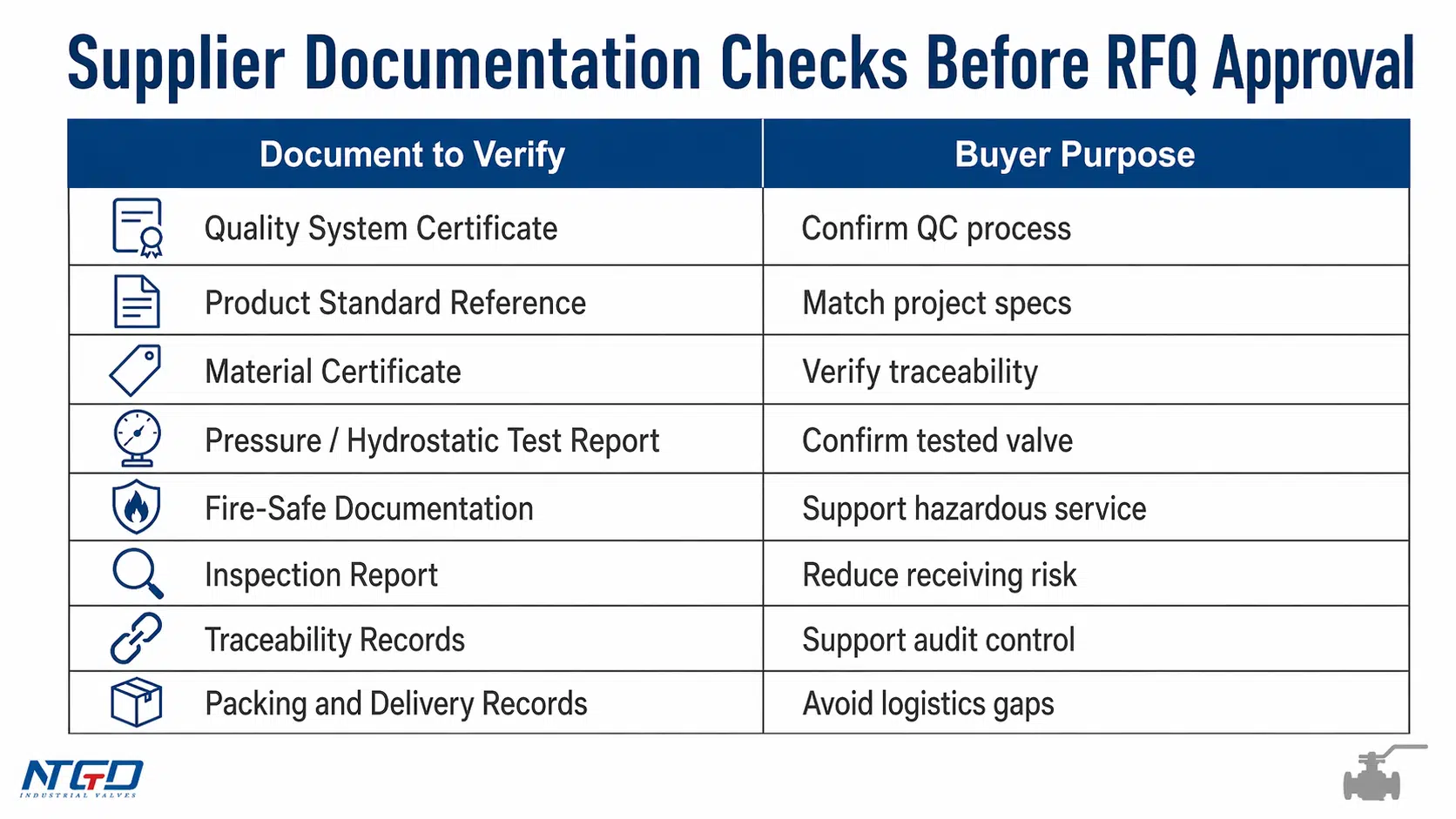
A certified industrial valve supplier should be able to explain which certificates apply to the product and which documents are available for the order. If a supplier cannot confirm documentation until after payment, clarify that risk before purchase.
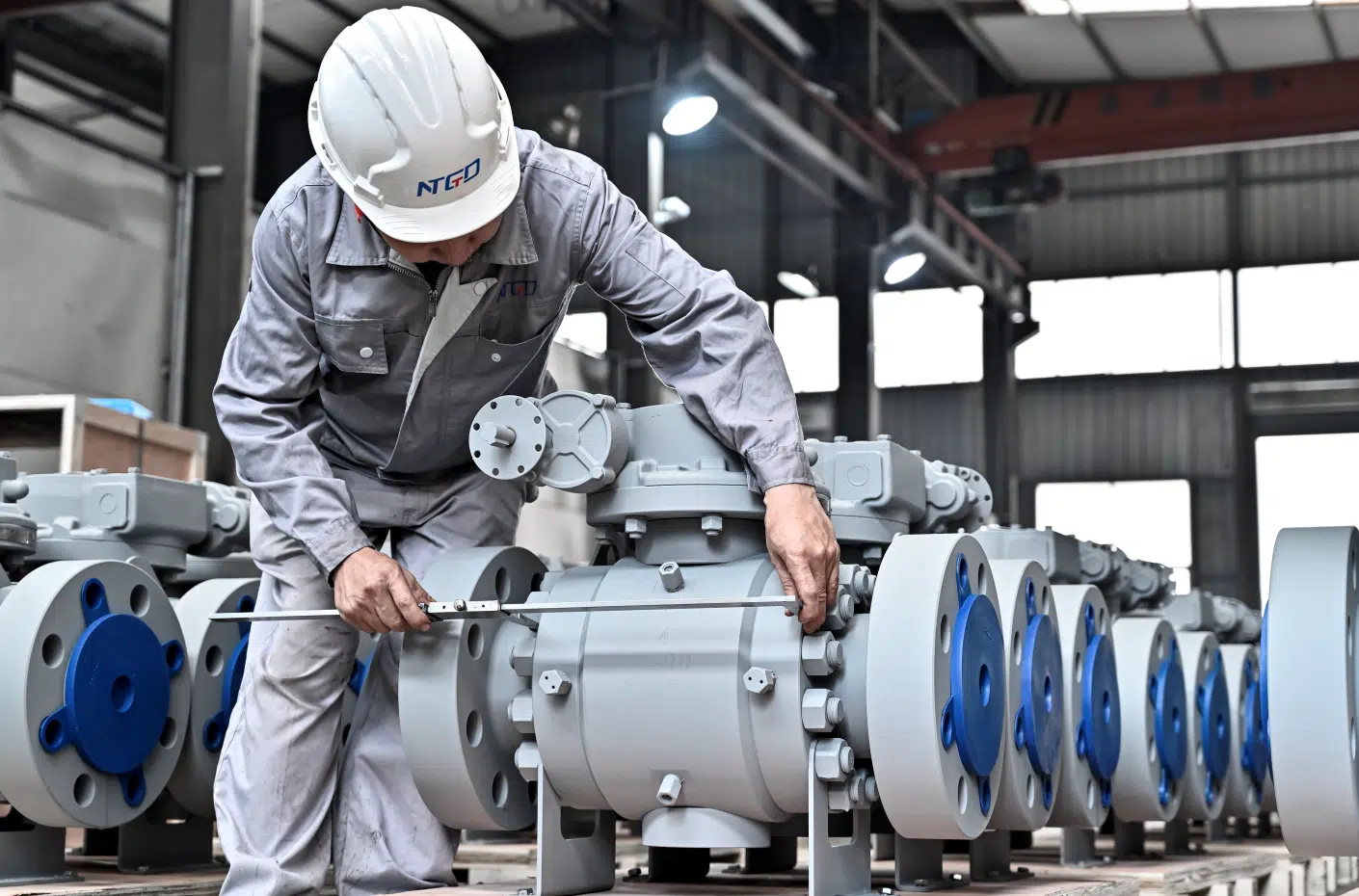
Application Fit: Matching Supplier Capability to Service Conditions
Different industries do not need the same ball valve supplier. The right supplier depends on service severity, documentation requirements, delivery expectations, and whether the valve is a standard replacement or part of a project package.
| Application Area | What the Buyer Should Prioritize | Supplier Capability to Check |
|---|---|---|
| Oil and gas | Pressure class, fire-safe requirements, documentation, operated valves | Trunnion capability, fire-safe documentation, material traceability, actuator support, and a clear project documentation route |
| Chemical / petrochemical | Corrosion resistance, seal compatibility, leakage control | Stainless steel, alloy, lined or compatible seat/seal options, material certificates, and confirmation of media compatibility |
| Water treatment | Standardization, delivery, corrosion resistance, maintenance access | Local stock, stainless or coated options, standard end connections, and reliable replacement support |
| HVAC / building systems | Availability, cost control, standard connection types | Distributor or stockist support, common sizes, predictable lead time, and clear warranty route |
| General industrial service | Balance of quality, lead time, documentation, and price | Broad product range, technical support, basic test records, and responsive commercial communication |
| High-pressure service | Structural load, seat design, pressure class, testing | Trunnion design, forged body options where required, pressure testing, documented ratings, and project-specific review |
| Corrosive service | Material compatibility and lifecycle risk | Stainless steel, duplex, special alloy, or compatible trim/seat selections supported by material documentation |
A supplier that works well for standard water service may not be the safest option for corrosive chemical media. A supplier strong in severe-service valves may not be the fastest source for standard replacement inventory. Supplier fit should therefore be mapped to the service condition before price comparison.
Final Supplier Comparison Matrix
The following matrix summarizes the shortlist from a buyer’s perspective. It is designed for early screening, not final vendor approval.
| Supplier | Supplier Type to Verify | Mexico Presence to Verify | Ball Valve Capability to Check | Best-Fit Buyer Scenario | Key Verification Step |
|---|---|---|---|---|---|
| Xanik | Specialty industrial valve manufacturer | Mexico-based support and current service scope | Confirm actual ball valve range, materials, pressure class, and documentation support | High-spec projects where specialty service knowledge and technical review matter | Verify whether the required ball valve is within its current supported product line |
| OyM Valve | Mexico valve manufacturer candidate | Local manufacturing identity, distributor route, and support scope | Confirm current ball valve range, materials, pressure class, and test records | Buyers seeking a Mexico-based manufacturing candidate | Request current product details, certificates, test reports, and lead time confirmation |
| D Chel Valves | Manufacturer / supplier / stockist / exporter candidate | Local vs export-to-Mexico supply route | Floating, trunnion, stainless steel, high-pressure, and industrial-service options | Buyers comparing broad ball valve availability for industrial service | Confirm supply path, delivery terms, documentation package, and warranty support |
| MVS Valves | Industrial valve manufacturer / exporter candidate | Mexico supply route and service support | Ball valve constructions within a broader industrial valve range | Projects needing ball valves together with other industrial valve categories | Confirm ball-valve-specific capability before relying on broad valve coverage |
| Bray Mexico | Local brand / industrial valve support presence | Local office, technical support, stock, or distribution route | Supported ball valve products, operated valves, and automation options | Buyers needing local coordination or operated valve support | Verify inventory, product range, certificate availability, and lead time |
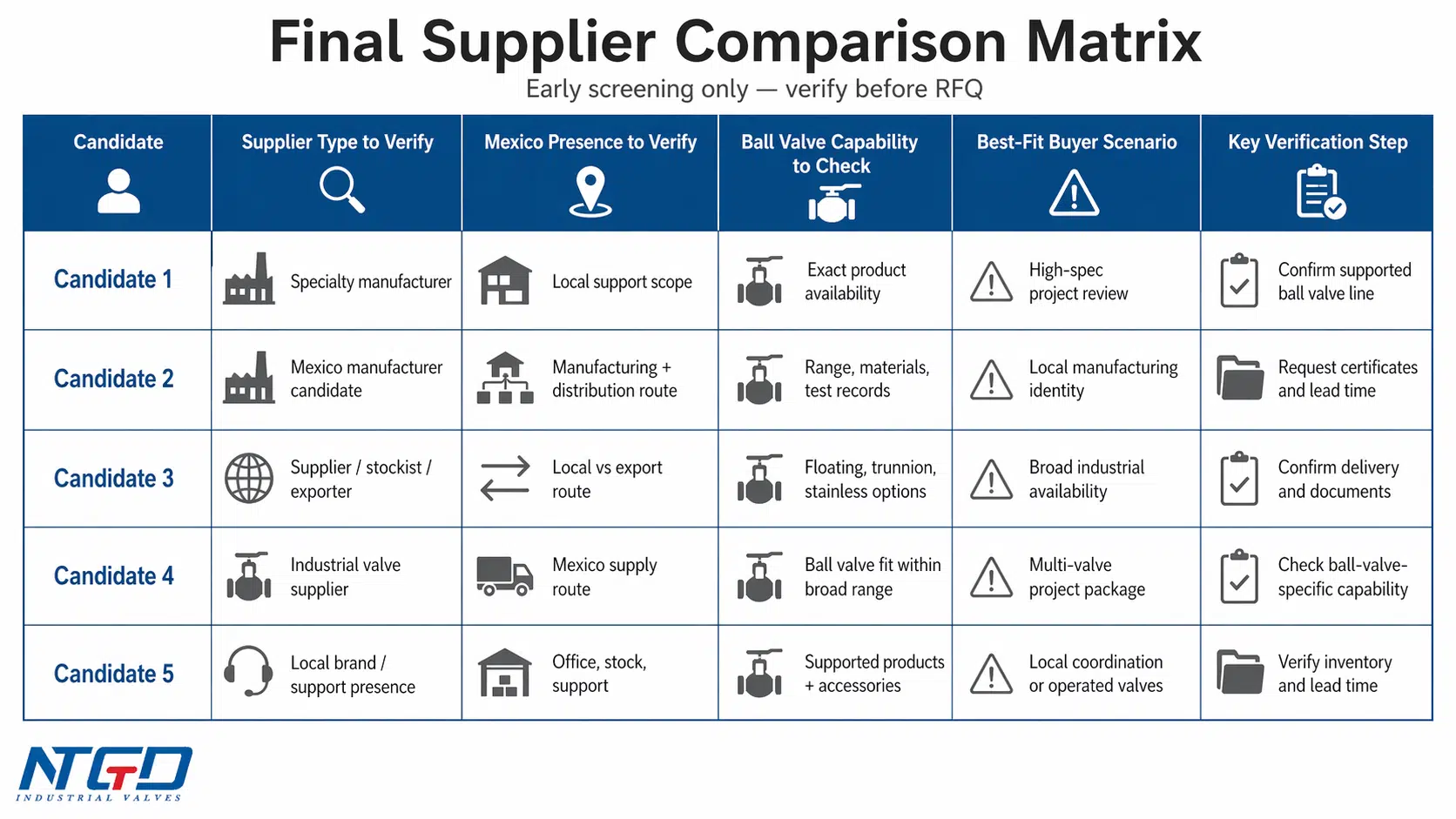
For industrial procurement, this type of comparison is more useful than a simple “best supplier” label. A supplier is only “best” when its capability matches the valve specification, service condition, documentation requirement, and delivery schedule.
RFQ-Ready Checklist Before Contacting a Ball Valve Supplier
Before contacting a supplier, prepare enough technical information for an accurate quotation. If the RFQ only says “ball valve,” the supplier may quote a product that does not match the service; basic ball valve sizing and installation requirements should be clarified before comparison.
| RFQ Item | Information to Prepare |
|---|---|
| Valve type | Floating ball valve, trunnion ball valve, three-piece, top-entry, fully welded, or other required design |
| Size and pressure class | Nominal size, pressure class, and any project standard |
| Body material | Carbon steel, stainless steel, duplex, alloy, or other specified material |
| Seat and seal material | PTFE, reinforced PTFE, metal seat, or other seat/seal requirement |
| Service media | Water, gas, steam, oil, chemical, slurry, or corrosive fluid |
| Operating conditions | Working pressure, temperature, shutoff differential pressure, and cycling frequency |
| End connection | Flanged, threaded, socket weld, butt weld, or special connection |
| Operation method | Lever, gear operator, pneumatic actuator, electric actuator, or bare stem |
| Documentation | Material certificate, pressure test report, fire-safe document, inspection report, traceability record |
| Quantity and delivery | Required quantity, delivery location, stock requirement, and target delivery date |
| Compliance requirement | Applicable project, industry, or customer standard |
| After-sales support | Spare parts, warranty route, replacement support, and technical communication |
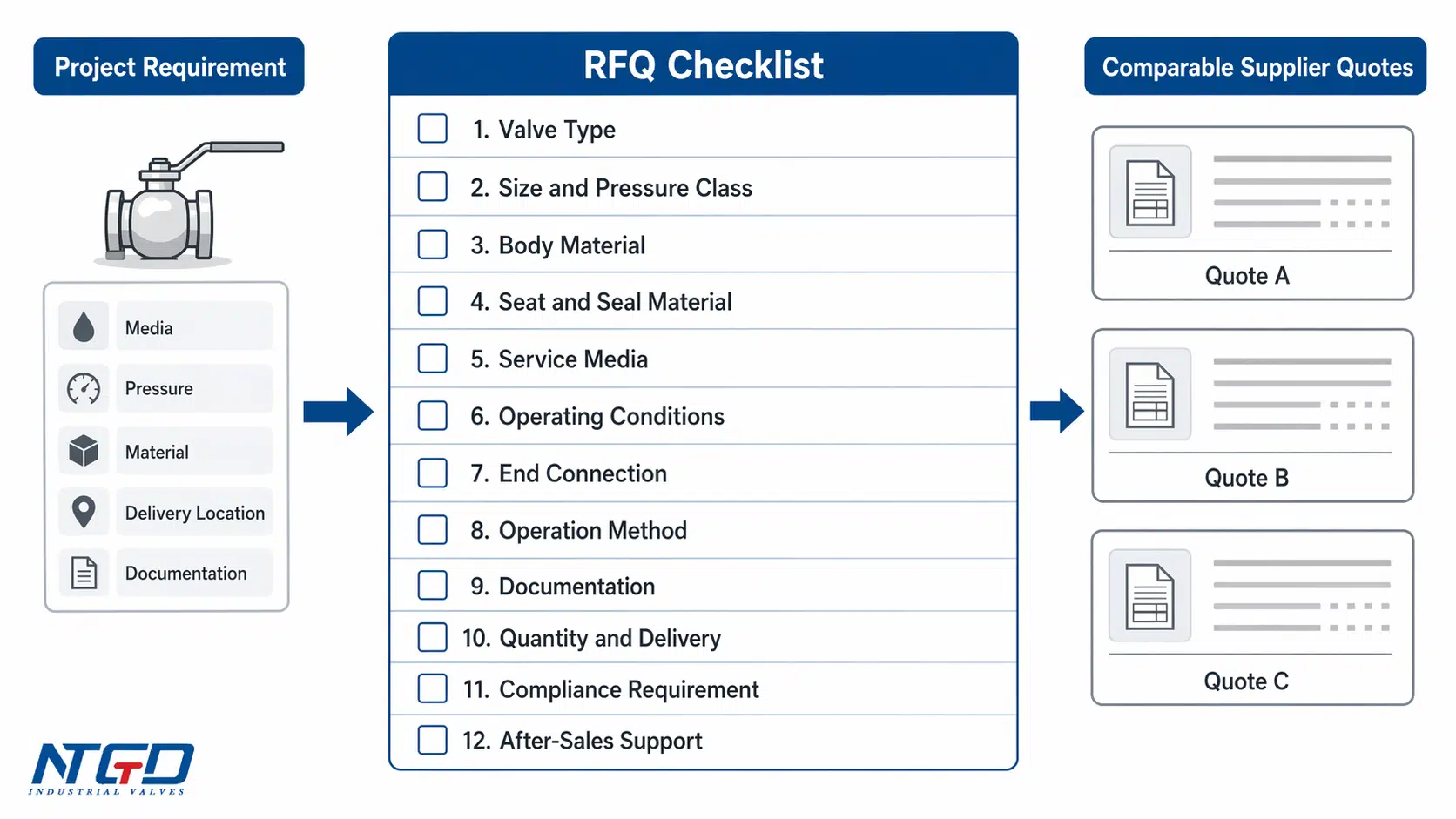
A complete RFQ reduces wrong quotations, mismatched valve selections, missing documentation, and avoidable delivery delays. It also makes supplier comparison more accurate because each company is responding to the same technical basis.
FAQ
How can I tell whether a ball valve supplier in Mexico is worth shortlisting?
Start by checking four points: supplier type, Mexico presence, ball valve capability, and documentation support. A supplier that appears in search results may still need verification before it fits an industrial RFQ.
When is a distributor or stockist enough, and when should I look for a manufacturer?
For standard replacement valves, a distributor or stockist may be enough if the size, material, and delivery are clear. For critical service, corrosive media, high-pressure duty, or project documentation requirements, confirm the manufacturer source, test route, and certificate package before accepting the supplier.
How can I verify whether a valve supplier is certified?
Ask for documents tied to the actual valve being quoted. Useful documents may include quality system certificates, product test reports, material certificates, inspection records, traceability documents, and project-required standard references.
Do I need a local Mexico supplier or an exporter to Mexico?
A local supplier may be better when you need fast communication, local stock, site support, or urgent replacement. An exporter can work for planned orders if logistics, warranty handling, documents, and lead time are clear before purchase.
Which supplier is best for trunnion ball valves or high-pressure projects?
The best supplier is the one that can support the required trunnion design, pressure class, materials, testing records, and project documents. Seeing “trunnion ball valve” in a catalog is not enough; confirm whether the supplier can support the needed size range, material combination, seat/seal route, and inspection package.
What information is most often missing from a ball valve RFQ?
The most common missing details are seat/seal material, service media, operating temperature, pressure class, end connection, documentation requirement, and delivery location. Missing these details can make two supplier quotations impossible to compare fairly.
Is price the most important factor when choosing a ball valve supplier?
Price matters, but it should not be evaluated alone. A low price can become expensive if the valve material is wrong, the documentation is incomplete, the delivery route is unclear, or the supplier cannot support the service condition.
Conclusion
Choosing among ball valve suppliers in Mexico requires more than collecting company names. The useful shortlist is the one that connects supplier identity, Mexico presence, ball valve capability, documentation discipline, and RFQ readiness.
For standard applications, local stock and delivery may carry more weight. For high-pressure, corrosive, chemical, oil and gas, or project-based service, certification, testing, material traceability, and engineering support become more important. The final supplier decision should be based on what the supplier can prove for the actual valve order, not only on how the company describes itself.
Final Supplier Check Before RFQ
Before sending a ball valve RFQ to multiple suppliers in Mexico, it is worth checking whether the valve specification, service conditions, documentation requirements, and supplier qualification questions are complete. NTGD Valve can support an application and RFQ review by checking valve type, material, pressure class, seat/seal selection, documentation needs, and service conditions before supplier comparison.
“`
