
Author Name: Bruce Zheng
Author Role: Co-Founder and Valve Engineer at NTGD Valve
Author Bio: Bruce Zheng is Co-Founder and Valve Engineer at NTGD Valve, focusing on industrial valve selection, application, and technical content for global B2B buyers.
Last Updated: May 11, 2026
Wafer Check Valve vs Swing Check Valve: Quick Answer
The core trade-off in a wafer check valve vs swing check valve selection is not small size versus heavy-duty construction. It is compact installation versus fuller flow path, closure behavior, service access, and lifecycle maintenance exposure.
A wafer check valve is usually the stronger direction when face-to-face space, valve weight, and compact piping layout are the dominant constraints. A swing check valve is usually the stronger direction when the line needs more disc travel, a fuller opening path, and easier access for inspection or repair.
A practical wafer vs swing check valve rule is:
- Choose a wafer check valve when space, weight, and compact installation control the decision — otherwise a full-body valve may create installation or clearance conflict.
- Choose a swing check valve when fuller flow behavior and service access matter more — otherwise a compact body may limit flow opening or make inspection harder.
- Verify the design carefully when flow reversal, pulsation, dirty media, or orientation sensitivity is involved — otherwise chatter, seat wear, poor closure, or water hammer risk may increase.
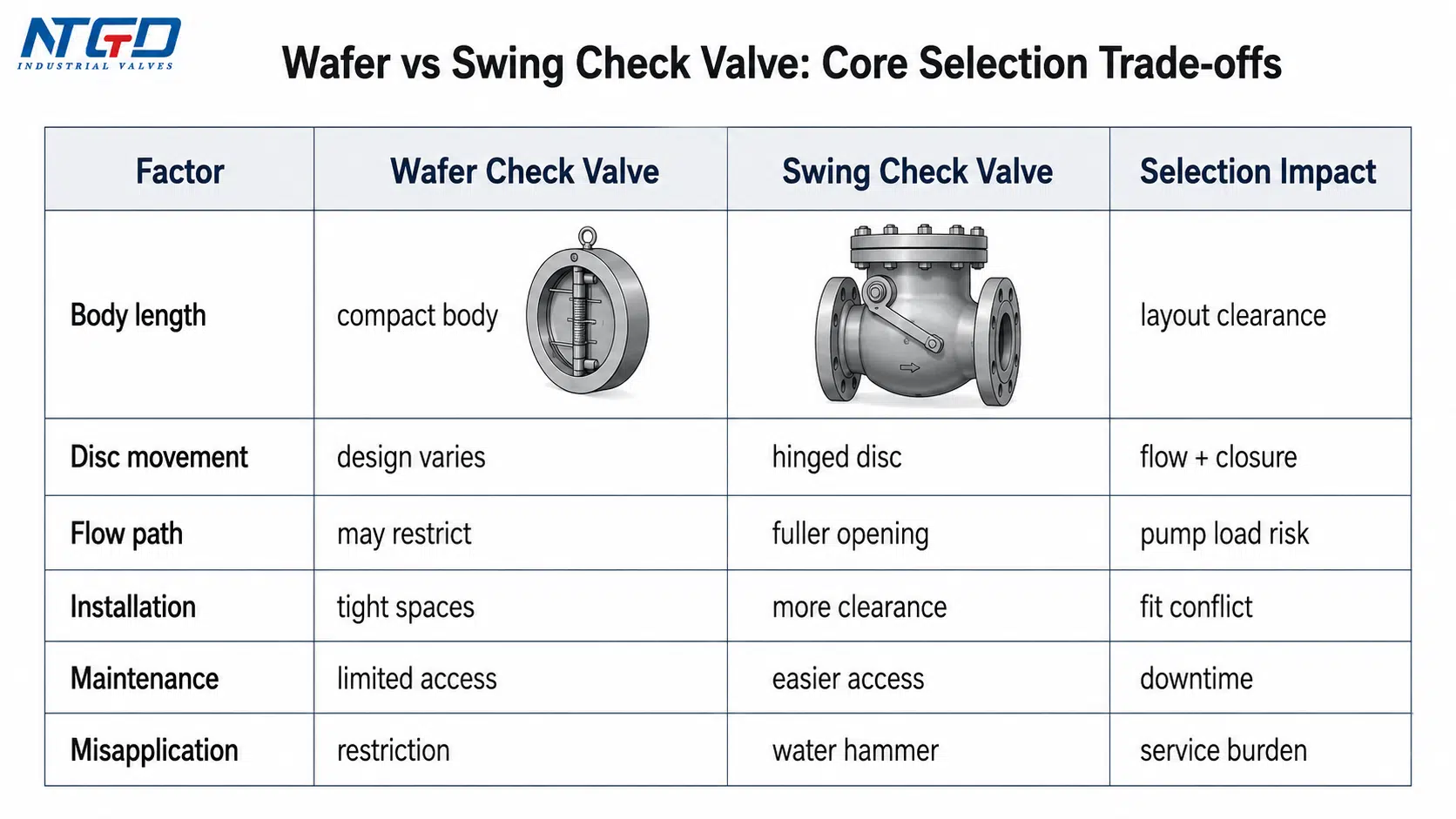
The same logic applies when the comparison is searched as swing check valve vs wafer check valve: match the valve design to the system’s dominant constraint, not only to the valve name.
What Are Wafer Check Valves and Swing Check Valves?
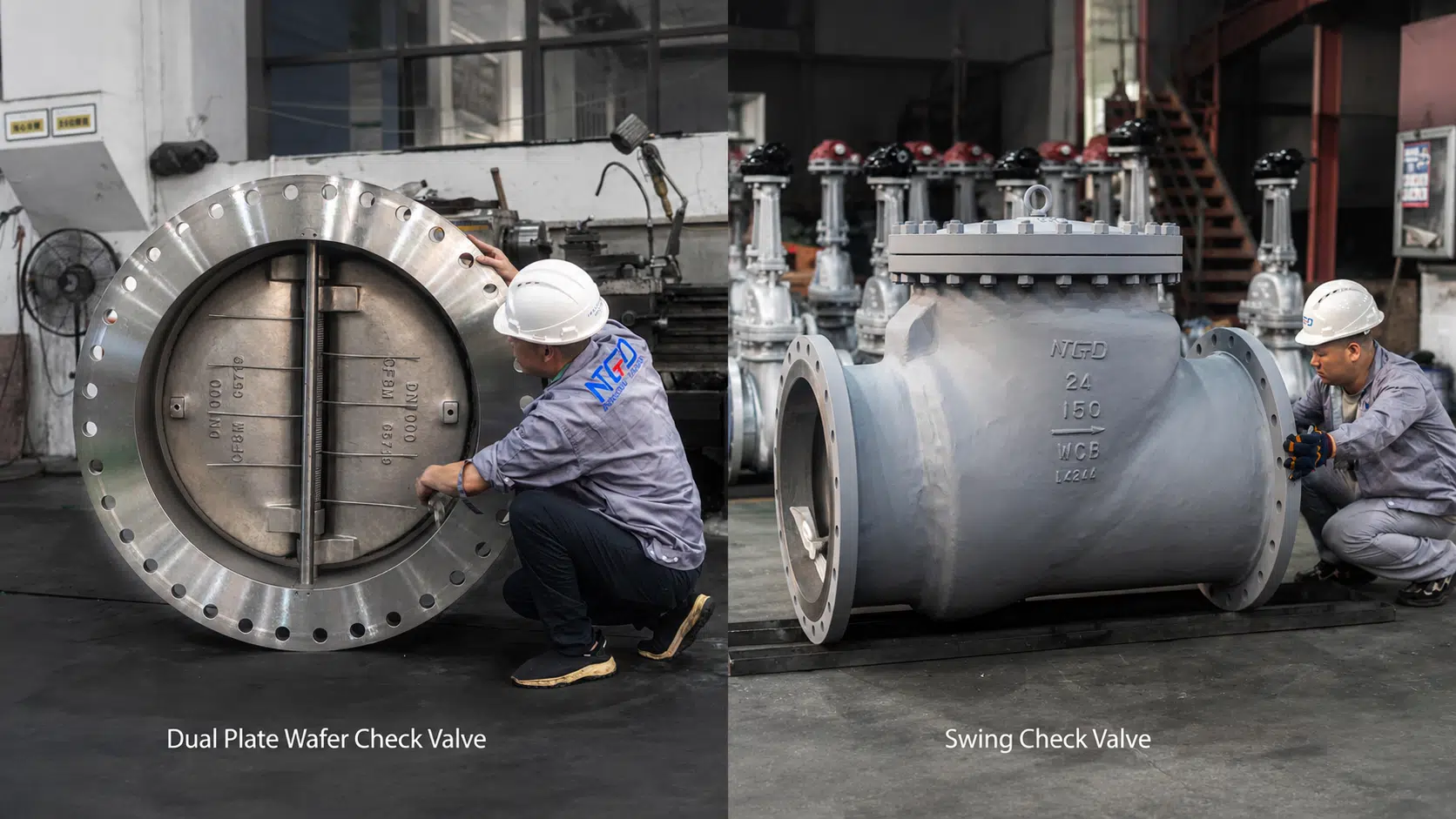
A wafer check valve is mainly defined by its compact body style. It is installed between pipe flanges and uses a short face-to-face design to reduce installation length and weight. Its internal closure mechanism can vary: some designs use spring-assisted discs, dual plates, single discs, or other compact arrangements. For that reason, “wafer” should not be treated as one fixed internal mechanism.
A swing check valve is mainly defined by its disc movement. A hinged, pivoting, or flapper-style disc opens with forward flow and returns toward the seat when reverse flow occurs. Conventional full-body swing check valves usually provide more internal space for disc travel than compact wafer designs, but they also require more installation and service clearance.
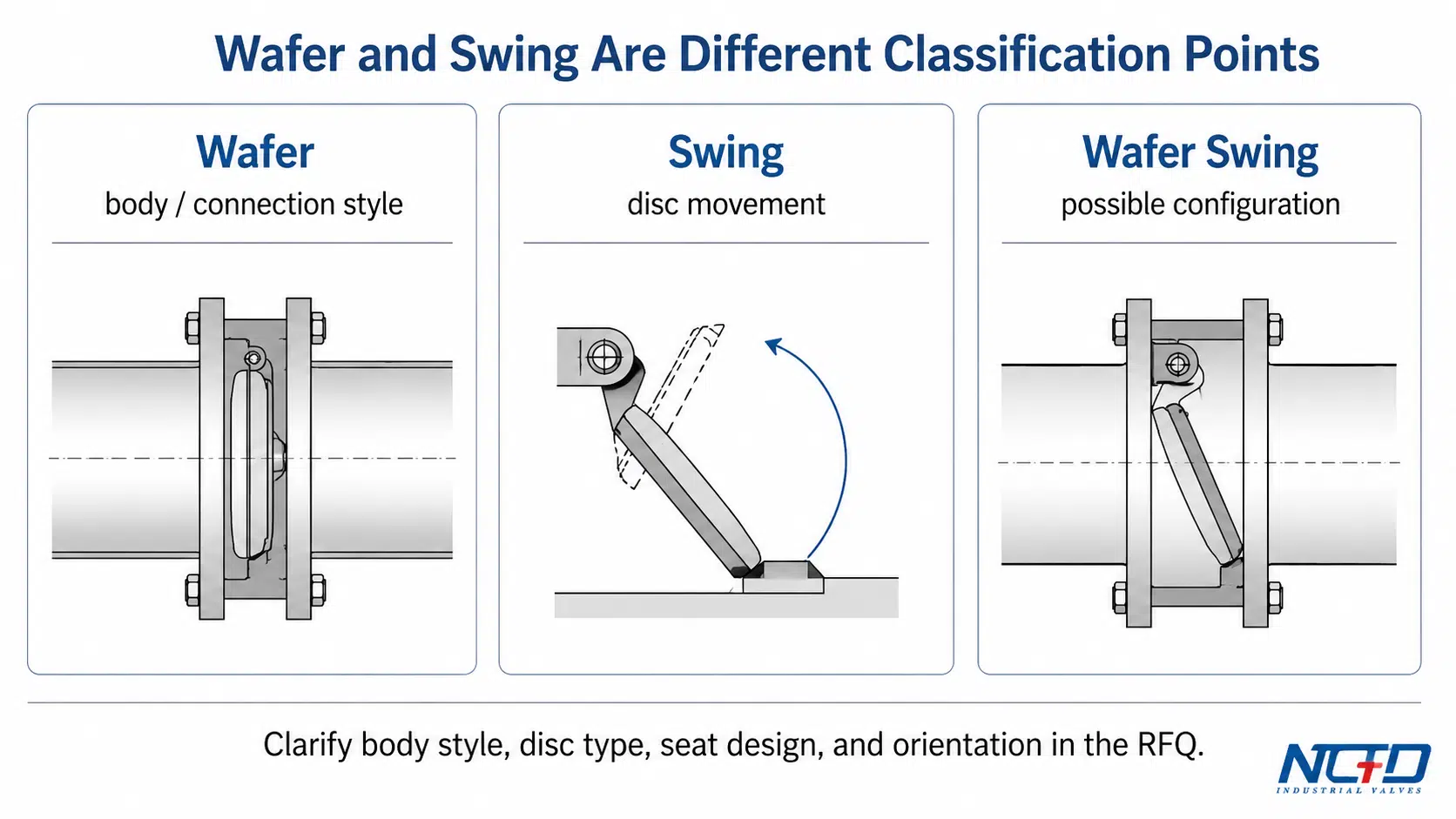
This terminology matters for procurement. Wafer describes the body or connection style; swing describes the disc movement. They are not always opposite categories. A valve may be described as a wafer swing check valve, but that term needs specification clarification. This article compares the common engineering selection differences between wafer check valves and conventional swing check valves; it is not a wafer swing check valve catalog page.
In broader piping terminology, these automatic backflow-prevention valves are often grouped as non-return valves.
How Body Design and Disc Movement Affect Flow, Closure, and Access
The main engineering difference begins with body geometry.
A wafer check valve has a short face-to-face body. This helps when the piping layout has limited space or when valve weight must be controlled. The trade-off is that the compact body leaves less room for internal closure components and may make inspection or servicing more dependent on line access, removal procedure, or the specific valve design.
A swing check valve has a larger body cavity for the disc to move through its opening path. This added internal space can allow the disc to move farther away from the flow path in many conventional full-body designs. That can support fuller-flow behavior and easier access to internal parts, but it also means the valve body needs more installation clearance and service space.
This difference in body geometry directly affects how far the disc can travel away from the flow path. Disc travel then affects flow opening, restriction tendency, closure timing, and access to internal parts.
Closure behavior is another major difference. A spring-assisted wafer design may close faster in some services, while a swing check valve relies on disc movement, gravity, reverse flow, and system conditions. If the flow is unstable or pulsating, the disc may not close smoothly. That may lead to chatter, seat wear, system vibration, slam, water hammer, or higher maintenance exposure.
External check-valve guidance also notes that closing action can depend on gravity, spring force, external weights, downstream pressure, or combinations of these factors.
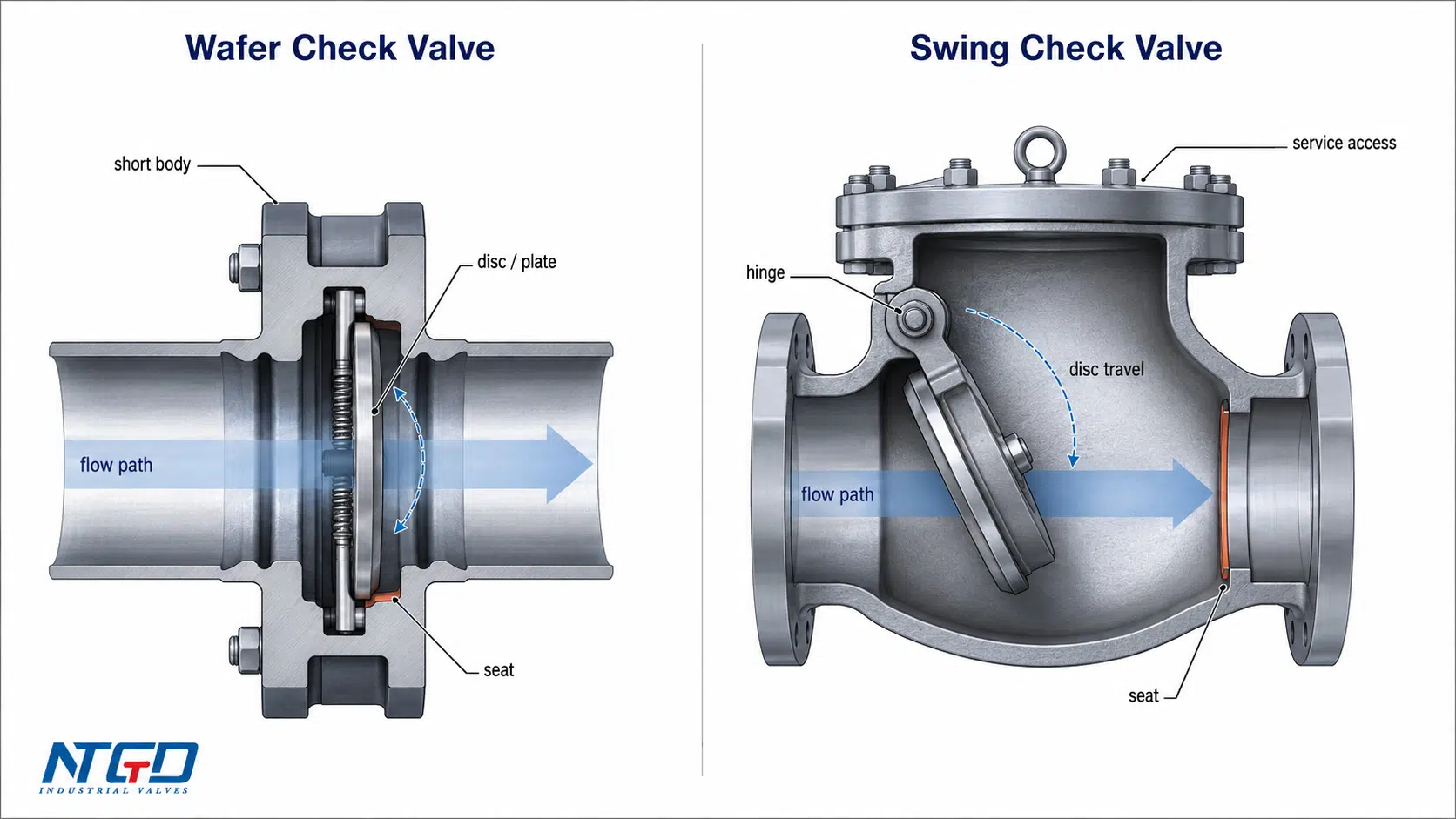
Effective selection therefore follows the full chain of design consequences:
Body geometry affects disc travel. Disc travel affects flow opening and closure behavior. Closure behavior affects reliability, vibration, wear, and maintenance access.
Wafer Check Valve vs Swing Check Valve: Key Differences
| Comparison Factor | Wafer Check Valve | Swing Check Valve | Selection Impact |
|---|---|---|---|
| Body / face-to-face design | Compact wafer-style body installed between flanges | Larger full-body design with more internal space | Wafer reduces layout length; swing needs planned installation and service clearance |
| Disc movement | Depends on design; may use spring-assisted, dual-plate, or single-disc closure | Hinged or pivoting disc swings open with forward flow | Disc movement affects flow path, closure speed, seat contact, and wear pattern |
| Flow opening / restriction tendency | Compact body may create more restriction depending on internal design | Conventional swing designs may allow a fuller opening path | In high-flow service, restriction may increase pump load or reduce system throughput |
| Installation space | Better for tight pipe layouts, compact skids, and limited face-to-face space | Requires more body length and maintenance clearance | Wafer is stronger when space is the dominant constraint; swing must be planned into the layout early |
| Orientation sensitivity | Depends on valve design and manufacturer instructions | Often more sensitive to gravity, disc travel, and installation direction | Orientation should be confirmed before installation because wrong positioning may affect closure reliability |
| Closure behavior | Some designs may close quickly, but response depends on disc and spring arrangement | Closure depends on disc travel, reverse flow, and system stability | Unstable flow can increase chatter, slam, seat wear, or water hammer risk |
| Maintenance access | Compact body can make internal access more difficult | Typically provides easier internal access in many full-body designs | Poor access can extend downtime; easier access matters when inspection is frequent |
| Cost logic | Often lower in material weight and installation space | Often higher upfront due to larger body | Upfront savings may be offset by maintenance access, downtime, or pipe disturbance |
| Typical fit | Tight spaces, compact systems, weight-sensitive layouts | Larger pipelines, fuller-flow requirements, access-priority systems | Selection should follow the system’s dominant constraint, not only valve price |
| Risk if misapplied | May restrict flow in full-flow service and complicate inline inspection | May not fit tight envelopes; delayed closure may increase water hammer risk | Misapplication may lead to pipe modification, downtime, poor closure, or higher maintenance burden |
The table should be read as a constraint-matching tool. If layout space is the controlling issue, wafer check valves usually have the advantage. If flow opening, internal access, and serviceability dominate the decision, swing check valves may be more suitable. If closure behavior is the main risk, the valve name alone is not enough; the disc design and service conditions must be reviewed together.
When to Use Wafer Check Valves or Swing Check Valves
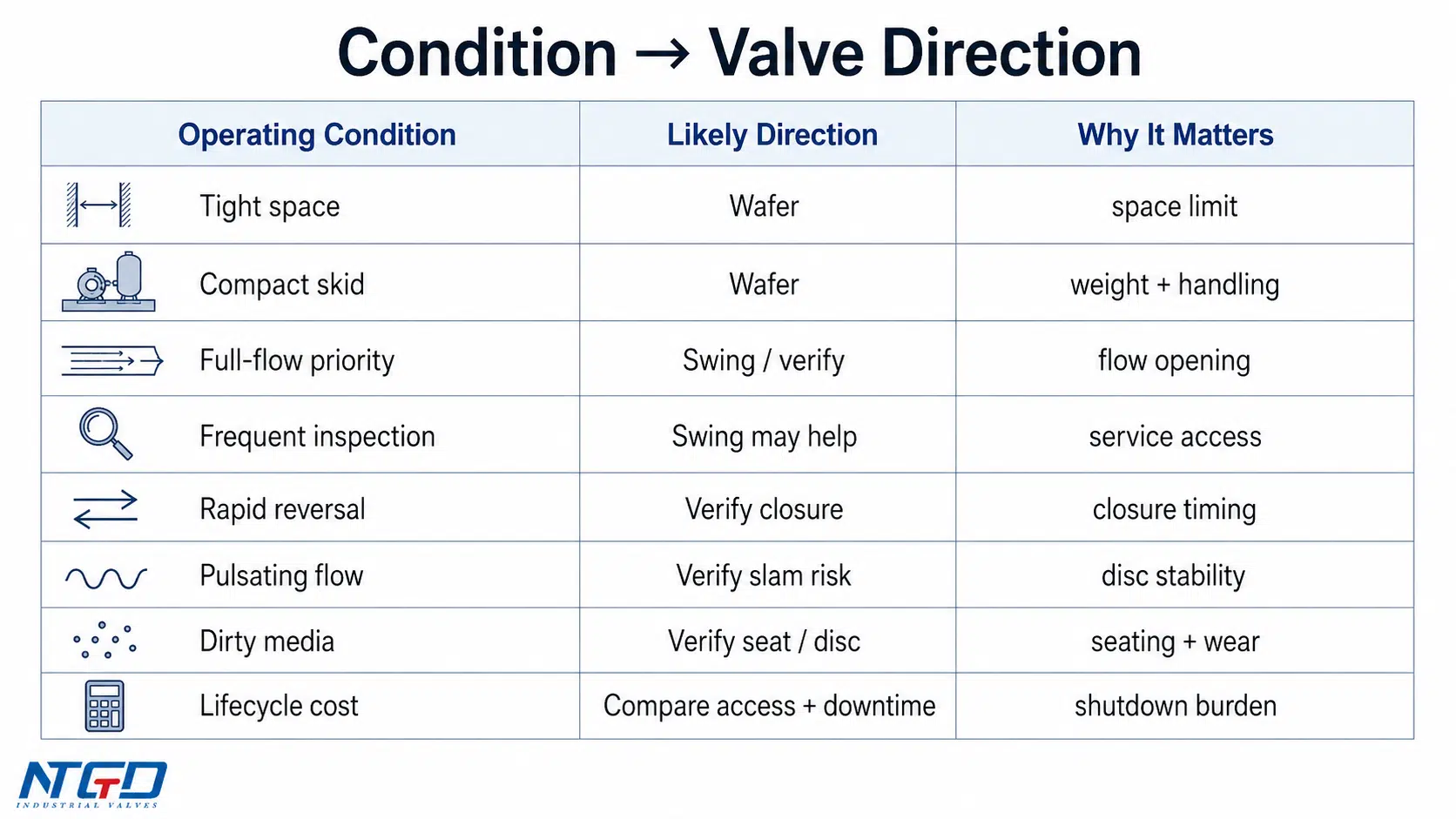
A useful way to compare wafer vs swing check valve selection is to start from the service conditions rather than the valve name.
| Operating Condition | More Likely Direction | Why It Matters |
|---|---|---|
| Tight face-to-face space | Wafer check valve | The compact body helps fit between flanges where pipe space is limited |
| Compact skid or limited pipe envelope | Wafer check valve | Lower weight and shorter body length can simplify layout and handling |
| Full-flow or lower restriction priority | Swing check valve or verify design | More disc travel may support a fuller opening path, but actual flow behavior depends on the design |
| Frequent inspection or seat access | Swing check valve may be easier | Larger body designs often provide better internal access and may reduce service downtime |
| Rapid flow reversal | Verify closure design | Closure timing and reverse-flow control become more important than body style alone |
| Pulsating or unstable flow | Verify closure and slam risk | Disc instability may cause chatter, slam, vibration, or accelerated seat wear |
| Dirty or debris-laden media | Verify seat and disc design | Debris may prevent proper seating, interfere with closure, or accelerate wear |
| Cost-sensitive but maintenance-sensitive service | Compare lifecycle cost | Lower upfront cost may be offset by difficult access, longer shutdowns, or repeated service work |
Choose wafer check valves when space, weight, or short lay length matters
Wafer check valves are strongest where the piping layout cannot easily accept a longer full-body valve. Their main advantage is compact installation. The trade-off is access: a compact body can make internal inspection, disc access, or seat service more dependent on the specific construction and removal procedure.
For that reason, wafer selection should not stop at face-to-face length. The internal closure design, flow opening, media condition, and installation orientation still determine whether the valve will perform reliably in service.
Choose swing check valves when full-flow behavior and internal access matter
Swing check valves are strongest where the system benefits from a larger body cavity, wider disc travel, and easier internal access. This can be useful in larger pipelines, access-priority service, or lines where inspection and cleaning are expected during the valve’s service life.
The trade-off is space. A swing check valve may solve flow and maintenance access problems but create layout problems if the pipe run, valve pit, skid frame, or maintenance envelope does not allow enough clearance.
Verify design carefully in unstable, pulsating, or dirty service
In unstable flow, pulsating flow, rapid reversal, or dirty media, the valve name is not enough to decide suitability. Closure stability, minimum flow conditions, disc travel, seat design, and orientation can change the answer.
A swing check valve may create slam or water hammer risk if the disc closes too late under reverse-flow conditions. A wafer design may also create problems if the compact internal arrangement does not match the required flow opening, media condition, or installation direction.
What Can Go Wrong If the Wrong Check Valve Is Selected?
The cost of a mismatched check valve is rarely paid only at purchase. It often appears later as flow inefficiency, unplanned maintenance, water hammer, shutdown time, or RFQ clarification delay.
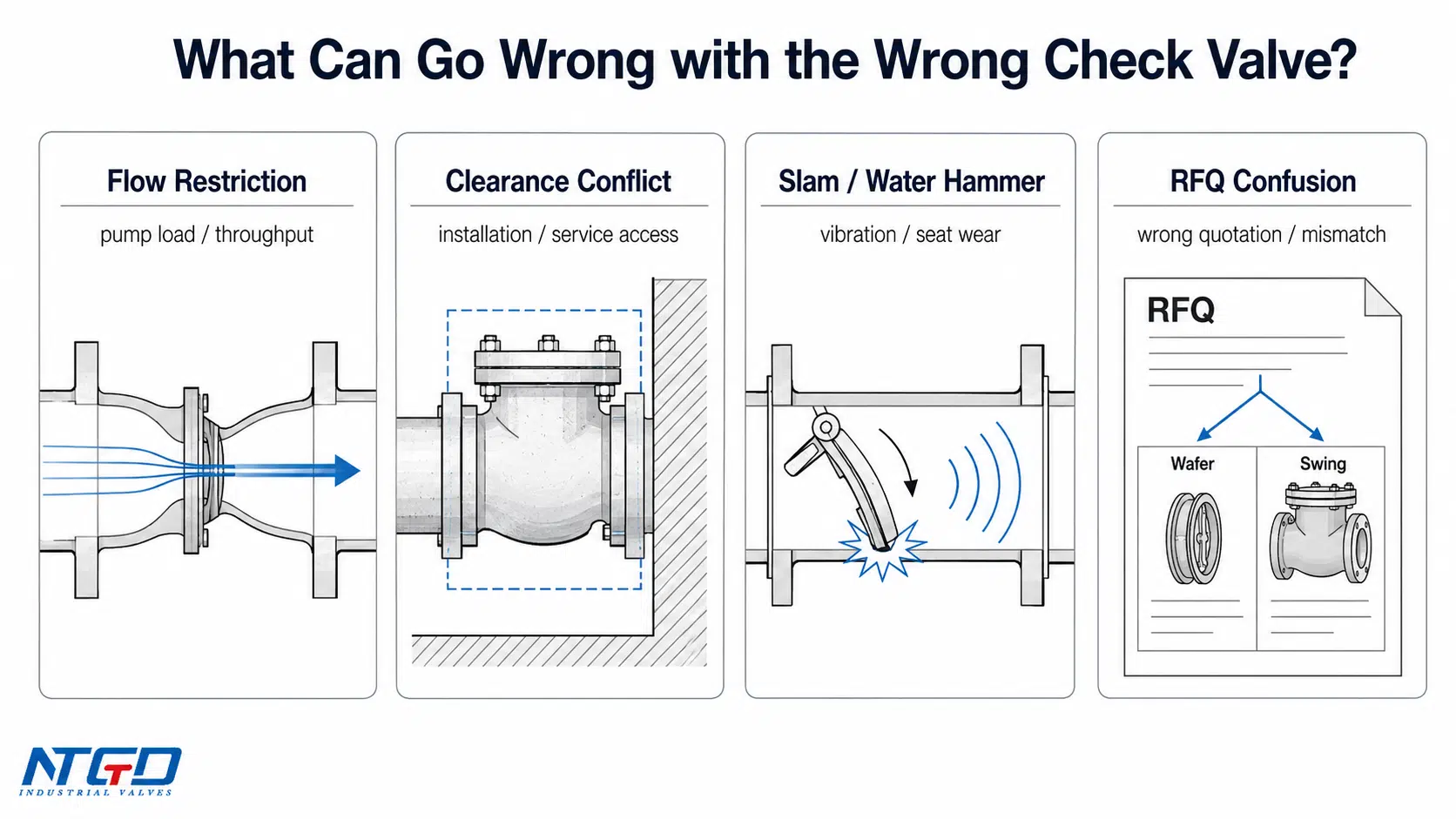
Flow restriction and efficiency loss
If a compact wafer valve is used where the system requires a very open flow path, the internal design may create unwanted restriction. This does not mean wafer check valves always have high restriction. It means the actual flow opening and disc arrangement must match the system requirement.
In high-flow or low-resistance service, excessive restriction may increase pump load, reduce system throughput, or create an operating burden over the valve’s lifecycle. The flow path, opening area, and pressure loss behavior should be reviewed against project data or manufacturer documentation.
Installation interference and poor maintenance clearance
A swing check valve may be the wrong choice if the pipeline does not have enough space for the larger body. The issue is not only face-to-face length. Maintenance clearance also matters.
If the valve cannot be accessed after installation, inspection and repair may become slow, costly, or dependent on a full shutdown. In some cases, insufficient clearance may require pipe modification or make future service access impractical.
A wafer check valve can solve many space problems, but its compact design may also limit internal access. The stronger selection is the one that matches both installation space and future service access.
Chatter, slam, and water hammer risk
Closure behavior is critical in check valve selection. If the disc does not close at the right time, the valve may chatter, slam, or allow reverse flow before seating. This can increase noise, vibration, seat wear, and water hammer risk.
Swing check valves can be sensitive to flow stability because disc movement depends on flow direction, disc travel, gravity, and system dynamics. Wafer designs may close faster in some configurations, but the actual response still depends on the specific closure mechanism.
Severe chatter or water hammer may stress seats, flanges, pipe supports, and nearby equipment. In systems where surge risk is high, closure behavior should be treated as a primary selection factor, not a secondary detail.
RFQ wording mistakes caused by wafer / swing terminology confusion
A common procurement mistake is assuming that “wafer” and “swing” are always opposite categories. They are not.
- Wafer describes body style or connection style.
- Swing describes disc movement.
- A wafer swing check valve can exist as a specific product configuration.
If an RFQ simply says “wafer swing check valve,” different suppliers may interpret the wording differently. One may quote a wafer-body single-disc design, another may treat it as a compact swing-type configuration, and another may ask for a conventional full-body swing check valve clarification. That can lead to mismatched quotations, technical clarification delays, or a product that does not match the intended installation.
For RFQs, clarify the body style, disc type, spring assistance if any, installation orientation, seat material, flange standard, and service conditions.
Lifecycle Cost, Maintenance Access, and Final Fit-Check
For wafer vs swing check valve selection, cost is usually a trade-off between the material and space savings of a compact body and the serviceability value of a larger body. A wafer check valve may reduce installation weight and layout burden. A swing check valve may cost more upfront but provide easier inspection or servicing in some systems.
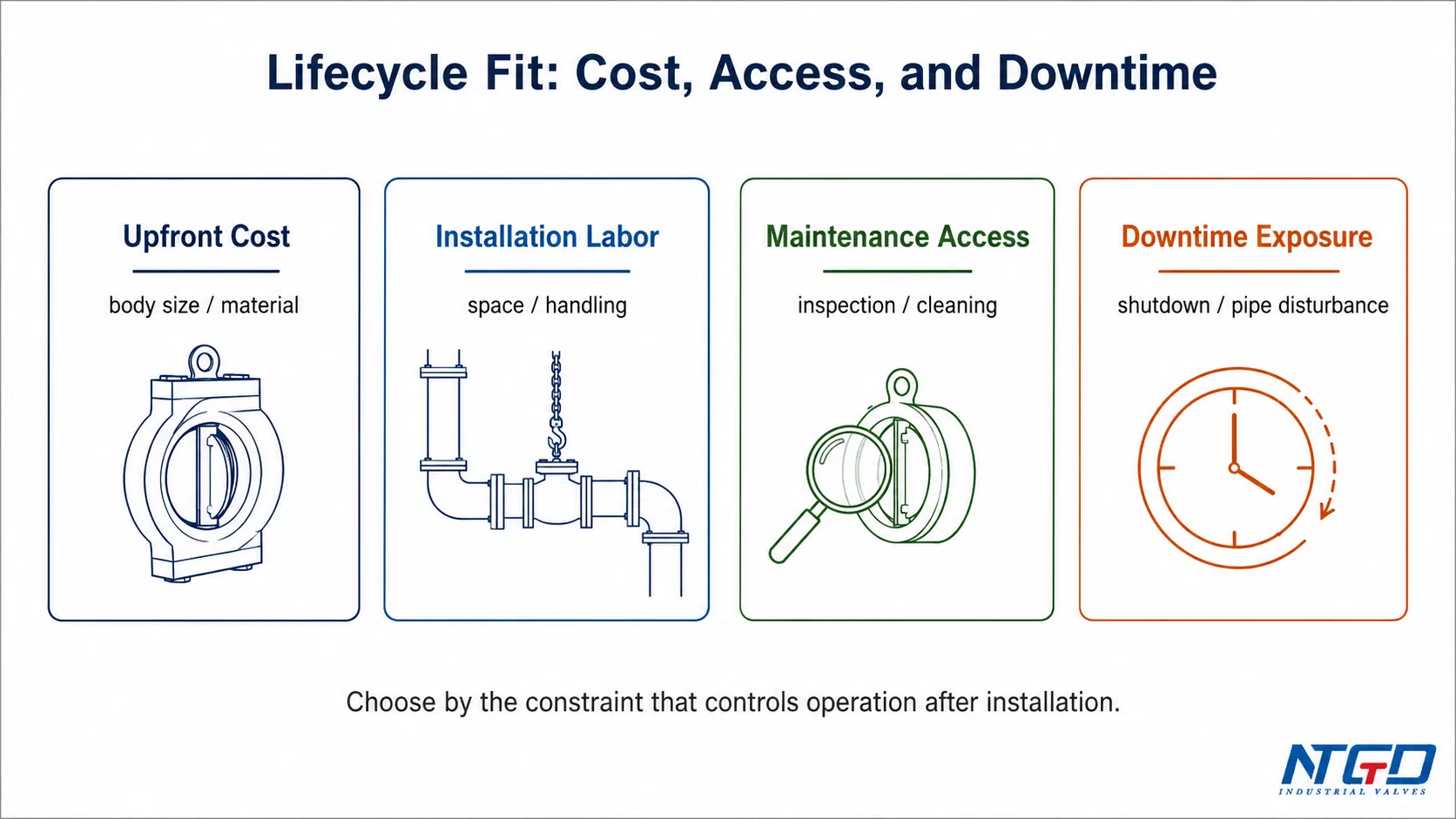
A better comparison is lifecycle fit:
| Cost / Maintenance Factor | What to Check |
|---|---|
| Upfront valve cost | Compare body size, material, and construction, but avoid selecting only by purchase price |
| Installation labor | Check available space, flange alignment, handling weight, and pipe layout |
| Maintenance access | Confirm whether the valve can be inspected, cleaned, or serviced after installation |
| Pipe disturbance | Consider whether servicing requires pipe removal or significant disassembly |
| Downtime exposure | Review how much shutdown the line can tolerate during inspection or replacement |
| Media condition | Check whether solids, corrosion, scaling, or debris may affect seat and disc movement |
| Closure behavior | Confirm reverse-flow risk, minimum flow, and potential chatter or slam |
| Orientation | Follow manufacturer installation instructions rather than assuming universal installation |
When upfront cost, service access, and downtime risk point in different directions, prioritize the constraint that will control operation after installation.
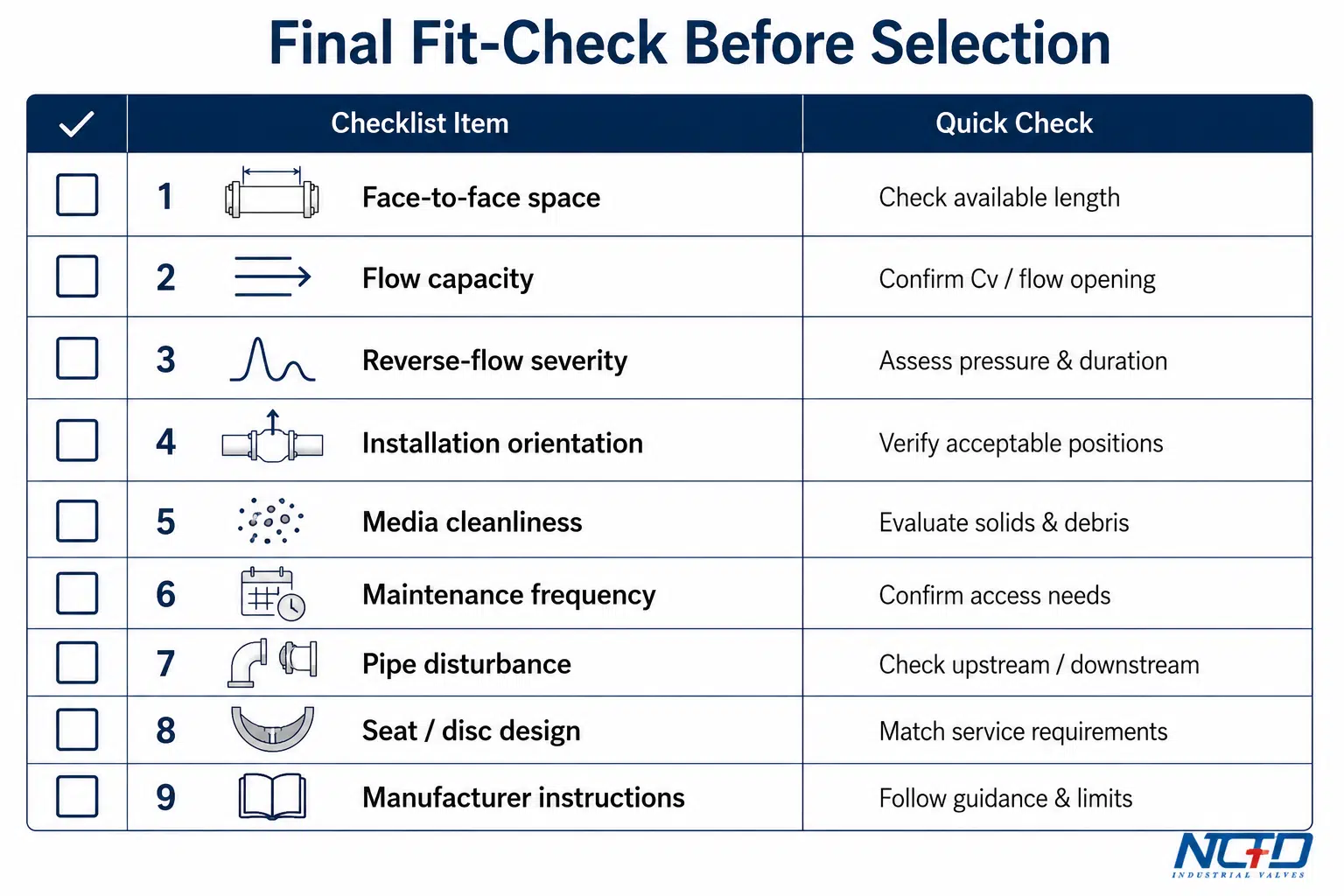
Before final selection, the buyer or engineer should confirm:
- available face-to-face space;
- required flow capacity and acceptable pressure loss;
- expected reverse-flow frequency and severity;
- installation orientation;
- media cleanliness, corrosion potential, and solids content;
- required inspection and maintenance frequency;
- pipe disturbance required for servicing;
- seat and disc design suitability for the service;
- manufacturer installation instructions and project specification requirements.
This fit-check is especially important when the project has limited space, unstable flow, frequent shutdowns, dirty media, or strict maintenance access requirements.
FAQ About Wafer vs Swing Check Valves
What is the main difference between a wafer check valve and a swing check valve?
For engineers and procurement teams, the practical difference is that wafer check valves prioritize compact installation and low weight, while swing check valves often prioritize fuller disc travel and easier internal access. That difference affects installation space, flow opening, closure behavior, and maintenance planning.
Can a check valve be both wafer type and swing type?
Yes. “Wafer” and “swing” describe different classification points. Wafer refers to body or connection style, while swing refers to disc movement. A valve can be both wafer-style and swing-type, but that description alone is not enough for specification. The buyer still needs to confirm the body design, disc arrangement, seat design, and installation orientation.
What does wafer swing check valve mean?
A wafer swing check valve usually means a check valve with a wafer-style body and a swing or single-disc closure mechanism. In an RFQ, terms such as wafer swing check valve, swing check valve wafer type, wafer style swing check valve, or swing wafer check valve should be clarified carefully. Confirm disc type, spring assistance if any, orientation limits, seat material, flange compatibility, and service conditions before quotation alignment.
Is a flapper check valve the same as a swing check valve?
In practice, the terms are often used closely. A flapper check valve usually refers to a hinged disc or flap that opens with forward flow and closes against reverse flow, which is similar to swing check valve behavior. The important distinction is the body and installation design: a full-body swing check valve and a compact wafer-style flapper design can have very different flow, clearance, and service access requirements.
Which valve is better for tight installation space?
A wafer check valve is usually the better direction when tight face-to-face space or limited pipe envelope is the main constraint. Its compact body is designed to fit between flanges. However, orientation limits, bolt clearance, and the internal closure design still need to match the actual installation.
Which valve is better for full-flow or lower restriction service?
A conventional swing check valve may be more suitable when fuller flow path and lower restriction are important, because the larger body can allow more disc travel. This is not automatic. Actual flow behavior depends on valve size, body geometry, disc position, and service conditions, so manufacturer data should be reviewed before specification.
How should I compare wafer vs swing check valve cost?
Compare lifecycle cost, not only purchase price. In stable, space-limited service with limited maintenance demand, a wafer check valve may reduce installation burden. In service where inspection, dirty media, or repeated maintenance is expected, a swing check valve may reduce labor and downtime exposure. The better cost choice depends on access, service frequency, media condition, and shutdown tolerance.
What should be checked before installing a wafer check valve?
Before installing a wafer check valve, check flow direction, flange compatibility, installation orientation, available pipe space, bolt clearance, media condition, and manufacturer instructions. Do not assume every wafer check valve can be installed in any orientation, because acceptable orientation depends on the valve design and closure mechanism.
Conclusion
Choosing between wafer check valves and swing check valves is an engineering trade-off. Wafer check valves are often a strong fit for compact piping layouts, short face-to-face space, and weight-sensitive installations. Swing check valves are often better suited where fuller flow behavior, larger internal clearance, and easier service access are important.
The best selection process is to compare body design, disc movement, flow behavior, closure response, installation envelope, maintenance access, and lifecycle cost together. If the service includes unstable flow, rapid reversal, dirty media, or limited maintenance space, the check valve design should be reviewed against the project specification before final selection.
Final Application Check
For project-specific selection, NTGD Valve’s application engineers can review the key variables with your team: flow capacity, installation envelope, orientation, closure behavior, media condition, maintenance access, and RFQ wording. This helps align the wafer or swing check valve specification with the actual service conditions before procurement.
