
Author Name: Bruce Zheng
Author Role: Co-Founder and Valve Engineer at NTGD Valve
Author Bio: Bruce Zheng is Co-Founder and Valve Engineer at NTGD Valve, focusing on industrial valve selection, application, and technical content for global B2B buyers.
Last Updated: May 7, 2026
The core difference between a 3-piece ball valve and a 2-piece ball valve is not only the number of body sections. It is how the valve body construction controls in-line service access, pipeline disturbance, and lifecycle downtime exposure.
A 2-piece ball valve has a simpler body structure and is usually selected for compact, lower-maintenance systems. A 3-piece ball valve has a removable center body between two end connections, giving maintenance teams easier access to the ball, seats, seals, stem, and other internal parts.
For industrial buyers, the 3 piece ball valve vs 2 piece decision should be made around one main trade-off: lower upfront cost versus easier internal maintenance and lower downtime exposure. If the valve will rarely be opened after installation, a 2-piece design may be the practical choice. If the valve must be cleaned, inspected, or serviced regularly, a 3-piece design can provide stronger lifecycle value.
| Selection Factor | 2-Piece Ball Valve | 3-Piece Ball Valve |
|---|---|---|
| Body construction | Two main body sections | Center body with two end connections |
| Maintenance access | Internal service usually requires more valve removal or body disassembly | Center body can be removed or swung out for internal access |
| Pipeline disturbance | Higher in fixed or tight piping layouts, especially when full valve removal is needed | Lower in many fixed piping systems because end connections can remain in place |
| Seat / seal access | More limited; access depends heavily on design and installation | Easier access to seats, seals, ball, stem, and body seals |
| Initial cost | Lower | Higher |
| Lifecycle cost | Efficient when maintenance is infrequent; repeated service can erase initial savings | Stronger when cleaning, inspection, or repair is frequent |
| Space and weight | More compact and lighter | Larger and heavier |
| Best-fit service | Clean media, utility lines, compact piping, low-intervention service | Process lines, frequent cleaning, maintenance-critical service |
| Selection risk | Can create unplanned downtime or higher maintenance cost if frequent service is required | Can add unnecessary upfront cost for simple, low-intervention systems |
A 2-piece ball valve is usually the practical option when the system is clean, compact, cost-sensitive, and not expected to require frequent internal maintenance. A 3-piece ball valve is usually justified when maintenance access, cleaning frequency, or shutdown cost matters more than the initial valve price.
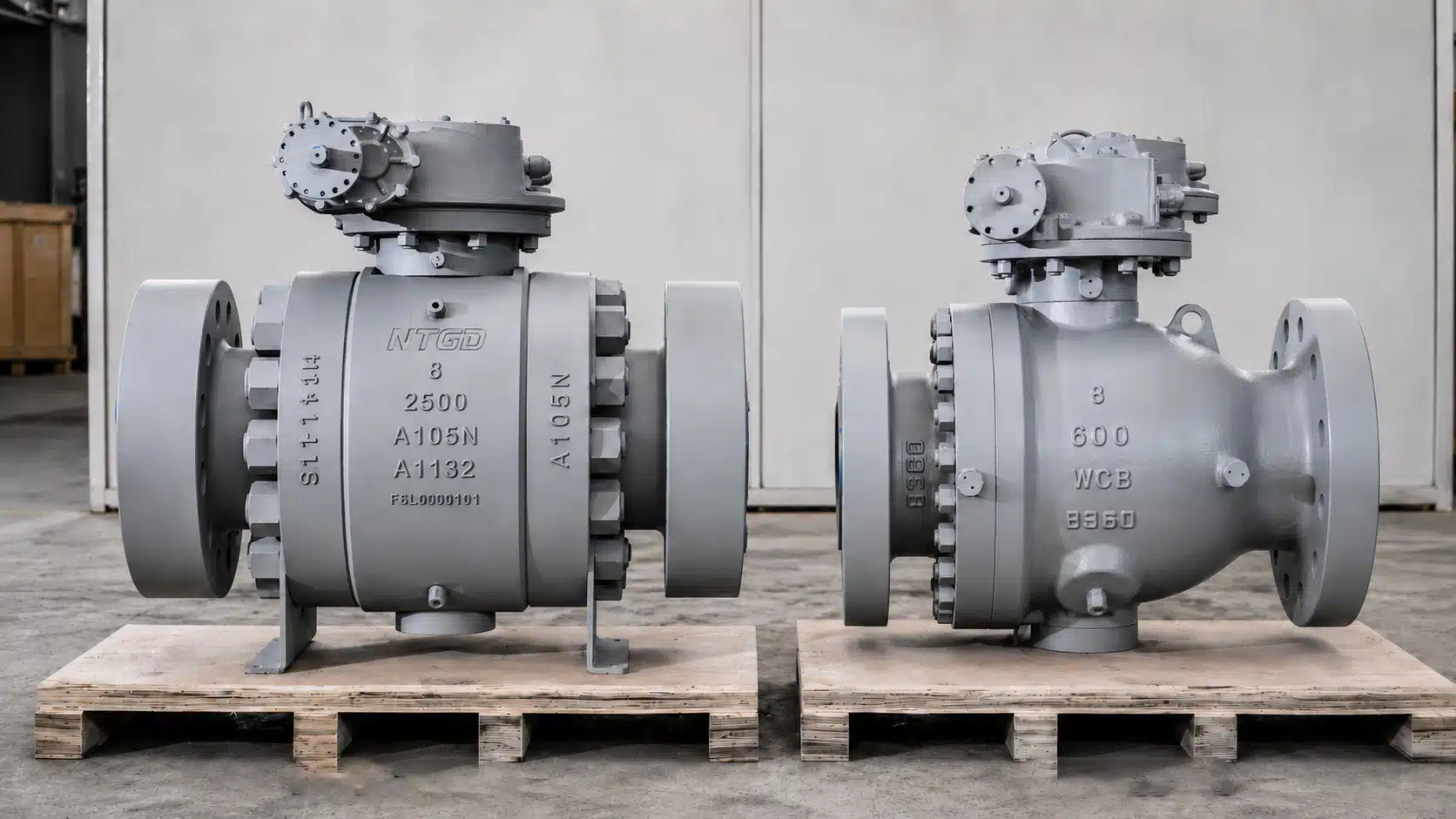
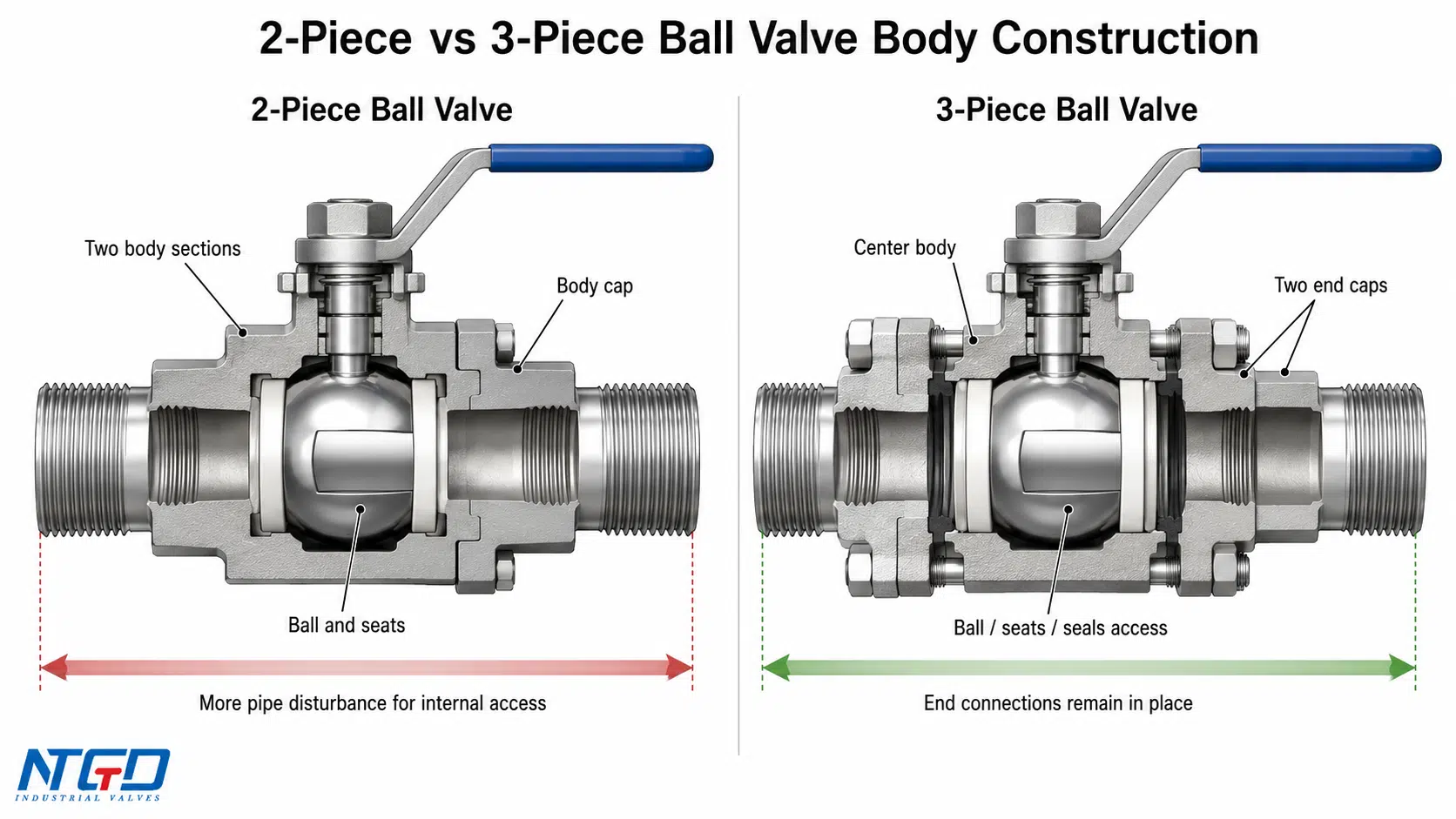
How 2-Piece and 3-Piece Ball Valve Construction Differs
The difference between 2-piece and 3-piece ball valves starts with the pressure boundary and body assembly. Both are quarter-turn ball valves, but the way the valve body is built affects how the valve is installed, opened for service, and returned to operation.
2-Piece Ball Valve Body Design
A 2-piece ball valve is built from two main body sections. One section usually contains the main valve body, while the second section closes the body and supports the end connection. This design is simpler than a 3-piece construction, so it is often more compact, lighter, and less expensive to manufacture.
This structure works well when the valve will remain in service for long periods without frequent disassembly. It is commonly selected for clean media, utility lines, compact piping layouts, and systems where valve removal or replacement does not create major production loss.
The maintenance boundary is the key limitation. This body design means that full internal service typically requires removing the valve from the pipeline or disturbing at least one pipe connection. The exact serviceability depends on the valve design, end connection, installation space, and how much clearance is available around the valve.
3-Piece Ball Valve Center Body and End Caps
A 3-piece ball valve has three main body sections: two end caps and a center body. The end caps connect to the pipeline, while the center body contains the ball, seats, seals, stem, and related internal parts.
The key advantage is that the center body can be removed or swung out while the end connections remain in place. This gives the maintenance team a direct path to the internal components without fully disturbing the piping connection.
This construction is especially useful in systems where the valve must be opened regularly for cleaning or maintenance. It is also valuable when shutdown time is expensive, access is limited, or the valve is welded or fixed into a process line.
Why Body Construction Affects Maintenance Access
Body construction determines where the valve is opened and whether internal access requires disturbing the pipe connection. That is the core factor in a 3 piece ball valve vs 2 piece selection, especially when maintenance access is part of the operating plan.
The number of body sections does not automatically determine pressure rating, sealing quality, or service life. Those depend on the valve design, body material, seat material, seal material, pressure-temperature rating, end connection, and manufacturing quality.
However, body construction strongly affects service access. A 3-piece design gives maintenance teams a more direct path to internal parts. A 2-piece design may still be serviceable, but the work usually involves more removal effort, more connection disturbance, or full valve replacement when internal wear becomes significant.
The real selection question is not simply “two pieces or three pieces.” It is how often the installed valve will need internal access, and how much time and cost are required to obtain that access.
Maintenance Access, Repairability, and Line Shutdown
Maintenance is the strongest practical difference between a 2-piece ball valve and a 3-piece ball valve. A 2-piece valve is usually acceptable when the valve is expected to operate for long periods with minimal internal service. A 3-piece valve becomes more valuable when the system requires regular inspection, cleaning, or internal part replacement.
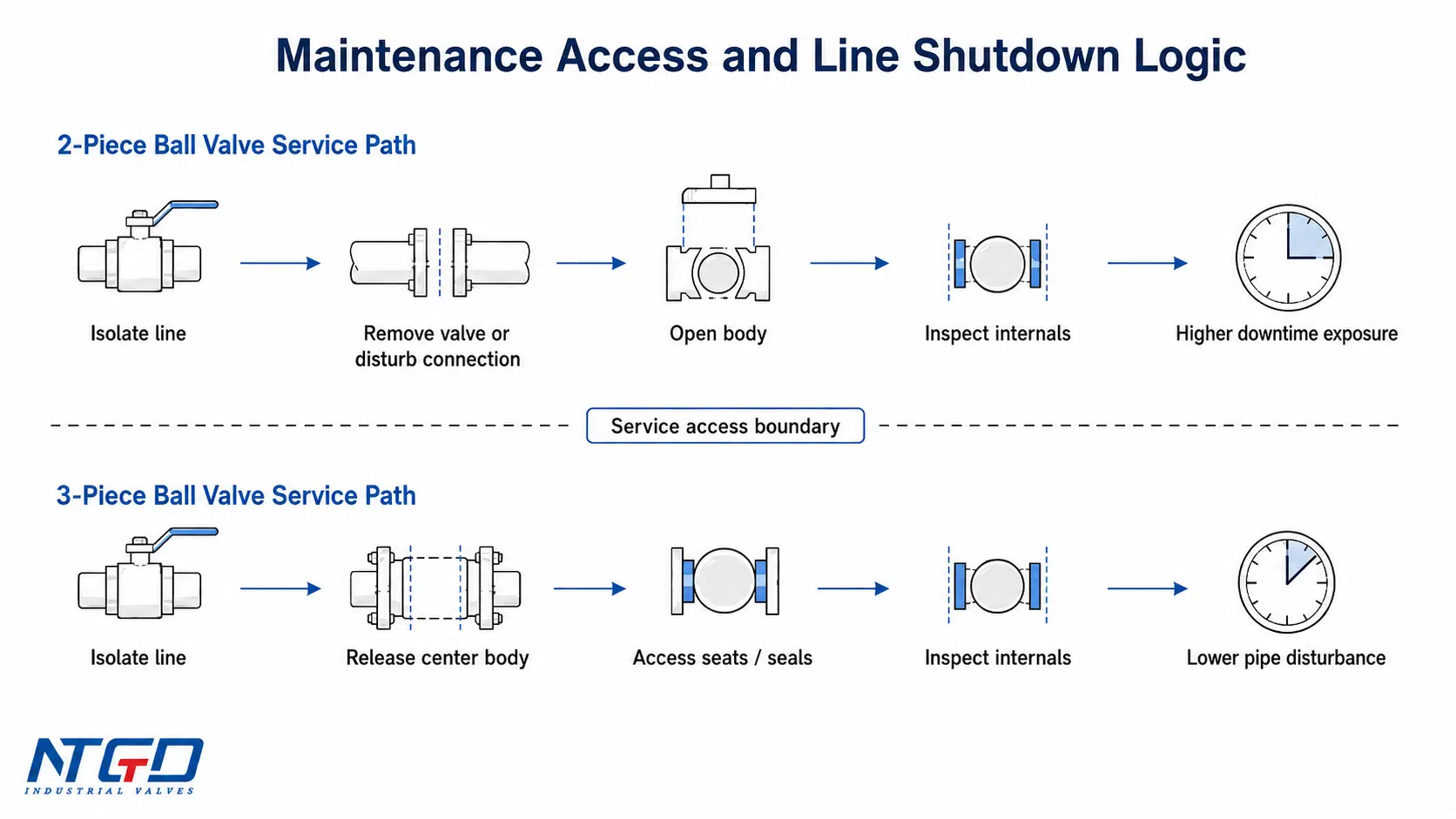
Why 3-Piece Ball Valves Are Easier to Service
In a 3-piece ball valve, the center body can be accessed without removing the end connections from the pipe. This allows the maintenance team to reach the internal components more directly.
The internal parts that typically decide maintenance effort include:
- Ball — rotating shutoff element exposed to media contact
- Seats — primary shutoff wear points
- Stem — torque transmission and sealing path
- Stem seal — external leakage control point
- Body seals or gaskets — body joint leakage path
- Packing or elastomeric sealing parts — service-dependent sealing components
This is why 3-piece ball valve maintenance becomes more valuable in process systems where media may crystallize, contaminate, polymerize, corrode, leave deposits, or require periodic cleaning. When these parts need inspection or replacement, a 3-piece design can reduce line removal work, shorten access time compared with full valve removal, and lower labor exposure during repeated maintenance.
A 3-piece valve is not automatically maintenance-free. It still requires correct assembly, compatible sealing materials, proper body bolt tightening, and testing after reassembly. If the center body, body seals, gasket seating, or body bolts are not handled correctly, body joint leakage can occur. Its advantage is controlled service access, not immunity from wear or assembly risk.
What Limits 2-Piece Ball Valve Repairability
A 2-piece ball valve should not be described as impossible to repair in every case. Some designs can be opened and serviced. The practical limitation is that access is usually less convenient than with a 3-piece design.
Repairability depends on several conditions:
| Factor | Why It Matters |
|---|---|
| End connection | Threaded, welded, and flanged connections change how much work is needed to remove the valve; fixed or welded piping increases the value of 3-piece center-body access |
| Installation space | Tight piping layouts can turn simple removal into a labor-intensive job with alignment and clearance problems |
| Valve size and weight | Larger valves increase handling, lifting, support, and reinstallation effort |
| Internal damage | Severe seat, seal, ball, or body damage may make replacement more practical than repairing a compact 2-piece valve |
| Maintenance frequency | Repeated cleaning or inspection favors a design that allows internal access with less pipe disturbance |
If the system rarely needs disassembly, a 2-piece ball valve may remain the better economic choice. If the valve must be opened frequently, the cost of repeated removal, labor, shutdown, and retesting can exceed the initial savings.
Seat, Seal, Ball, and Stem Access
For many industrial applications, the real maintenance question is not simply whether the valve opens and closes. It is whether the internal sealing parts can be inspected and replaced without turning each maintenance event into a piping job.
Seat and seal selection is affected by cycle frequency, media cleanliness, temperature, pressure differential, chemical compatibility, abrasive particles, sticky deposits, and cleaning requirements. When these factors increase inspection or replacement frequency, the 3-piece design provides a practical advantage because the maintenance team can reach the internal parts with less line disturbance.
A 3-piece ball valve is suitable for systems where leakage control, cleaning access, and repair speed matter. A 2-piece ball valve is more suitable when the media is clean, the operating cycle is moderate, and maintenance intervention is expected to be rare.
Cost Comparison: Upfront Price vs Lifecycle Downtime
A 2-piece ball valve usually has a lower initial purchase cost. A 3-piece ball valve usually costs more because it has more body sections, more sealing interfaces, more assembly work, and a more serviceable structure.
That does not mean one is always cheaper than the other. The real cost comparison must include purchase price, service labor, shutdown exposure, replacement parts, pipe disturbance, and retesting after maintenance.
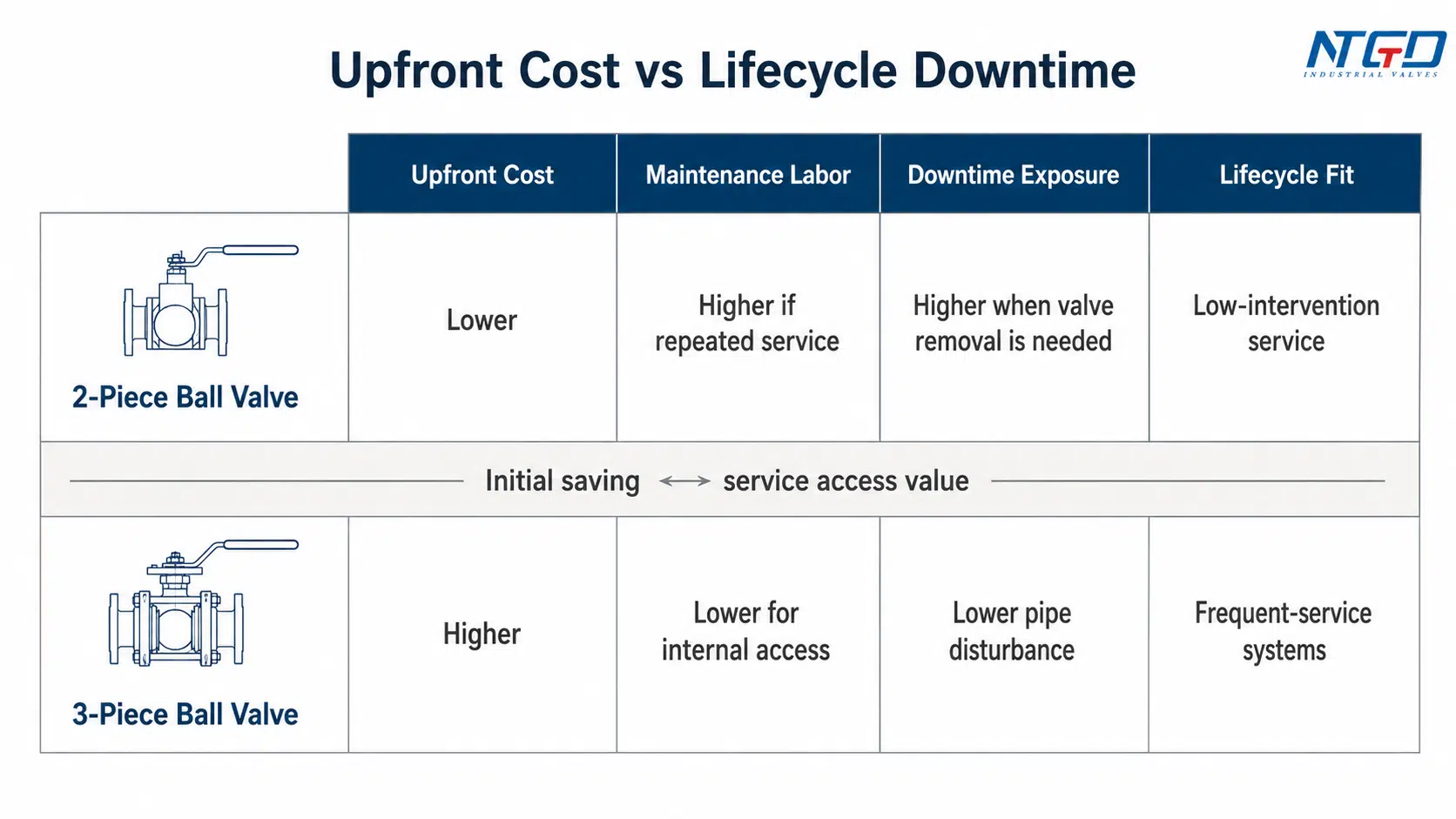
Initial Cost Difference
For a simple system, the lower upfront cost of a 2-piece ball valve can be the better decision. If the valve is installed in a clean utility line and is not expected to be opened for internal service, paying more for a 3-piece construction may not create enough value.
A 2-piece valve is often selected when:
- Budget is limited
- Space is tight
- The system is low-maintenance
- The valve is small enough to remove or replace easily
- The media does not require frequent cleaning
- Production downtime is not a major cost driver
The risk appears when a low-cost 2-piece valve is placed in a service that later requires repeated internal access. In that case, the initial purchase saving can be offset by labor, shutdown time, pipe disturbance, and post-maintenance testing.
A 3-piece valve is often selected when the cost of downtime or maintenance access is more important than the initial purchase price.
Maintenance Labor and Downtime Cost
The lifecycle cost of a ball valve increases when maintenance requires line removal, extended shutdown, replacement labor, connection rework, or repeated leak testing after reinstallation.
A 3-piece valve can reduce these costs when the system needs regular internal access. The value comes from:
- Faster access to seats and seals, reducing maintenance labor exposure
- Less disturbance to pipe connections during repeated service
- Easier cleaning and inspection of the internal valve cavity
- Lower risk of turning routine inspection into full valve removal
- Reduced production interruption in maintenance-critical lines
A 2-piece valve can become expensive if it is installed in a service where internal cleaning or part replacement is frequent. The lower purchase price may be reasonable for low-intervention systems, but it becomes less attractive when repeated service events require shutdown, removal, and reinstallation.
When the Higher Cost of a 3-Piece Ball Valve Is Justified
The higher cost of a 3-piece ball valve is easier to justify when at least one of the following conditions applies:
| Condition | Why It Favors a 3-Piece Ball Valve |
|---|---|
| Frequent cleaning | Repeated internal access is easier when the center body can be opened without full valve removal |
| High cycle operation | Seats and seals may require more planned inspection, making service access more valuable |
| Expensive shutdown | Faster access can reduce downtime exposure, system draining time, and rework during maintenance |
| Fixed piping | End connections can often remain in place while the center body is accessed |
| Critical leakage control | Planned seat and seal inspection supports leakage control before failure becomes disruptive |
| Harsh media | Inspection and cleaning may be required more often when media causes deposits, corrosion, or wear |
If these conditions do not apply, a 2-piece ball valve may remain the simpler and more economical choice.
Operating Conditions That Change the Choice
A 2-piece vs 3-piece ball valve comparison should not be reduced to “simple vs advanced.” Operating conditions decide whether the added serviceability of a 3-piece design is necessary.
Pressure and Temperature Rating Boundaries
Pressure and temperature should be checked against the manufacturer’s datasheet and, where applicable, the pressure-temperature rating framework of ASME B16.34. A valve’s rating depends on the body material, seat material, seal material, end connection, size, design standard, and manufacturing quality.
It is not accurate to assume that every 3-piece ball valve automatically has a higher pressure rating than every 2-piece ball valve. Piece count does not decide pressure rating by itself. Some 2-piece valves are designed for demanding pressure classes, while some 3-piece valves may be limited by seat material, seal material, body bolt design, or gasket performance.
Use pressure and temperature as selection boundaries:
- For moderate pressure and stable temperature, either design may be suitable.
- For higher pressure, higher temperature, or frequent cycling, check the full pressure-temperature rating, seat material, seal material, and end connection design.
- For services where internal parts are likely to wear, the 3-piece construction may provide better maintenance access even if both designs meet the pressure rating.
Media, Cleaning Frequency, and Inspection Needs
Media condition strongly affects the choice.
A 2-piece ball valve is usually suitable for clean, stable media where the valve does not need frequent cleaning. Examples include clean water, utility gas, compatible oils, and auxiliary process lines, provided the selected valve material and seat are compatible with the media.
A 3-piece ball valve becomes more useful when the media increases the need for inspection or cleaning. This can include:
- Sticky or viscous media
- Media that may leave deposits
- Ball valves for chemical applications that require periodic inspection
- Systems that need clean-in-place or frequent sanitation checks
- Services where seat or seal replacement must be planned
In services with deposits, frequent cleaning, corrosive exposure, or strict inspection requirements, the access advantage of a 3-piece design can outweigh the initial cost difference. Media, temperature, and pressure should also be evaluated together. The same fluid may become more aggressive, more likely to form deposits, or more damaging to sealing parts under different temperature and pressure conditions.
Body construction does not replace chemical compatibility review. For corrosive, abrasive, high-temperature, or chemically active media, the body material, seat material, seal material, and pressure-temperature rating must still be verified.
End Connection, Installation Space, and Weight
End connection can change the maintenance decision, especially when ball valve sizing and installation must also account for service access.
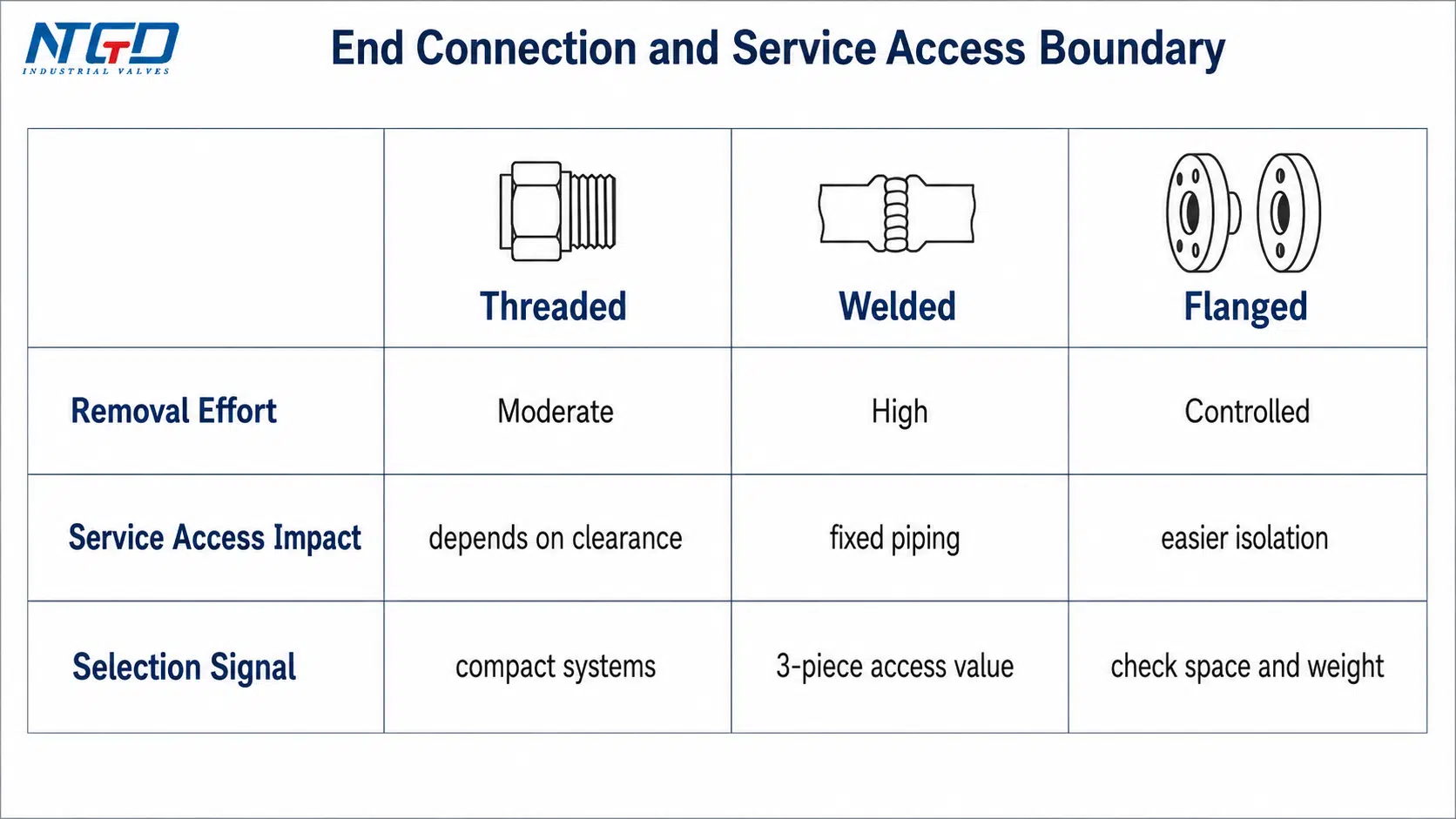
A threaded 2-piece ball valve may be easier to remove in a small system than a welded valve in a fixed process line. A flanged valve may be easier to isolate and remove than a compact threaded valve installed in a tight location. A welded or fixed piping installation can make a 3-piece design more attractive because the center body can be accessed while the end connections remain in place.
Installation space also matters. A 3-piece ball valve is usually larger and heavier than a 2-piece valve. If the piping layout is compact and maintenance access is not critical, a 2-piece valve may be the better fit.
When to Choose a 2-Piece or 3-Piece Ball Valve
The best selection is not based on which valve is “better” in general. It is based on service condition, maintenance strategy, downtime tolerance, and installation reality.
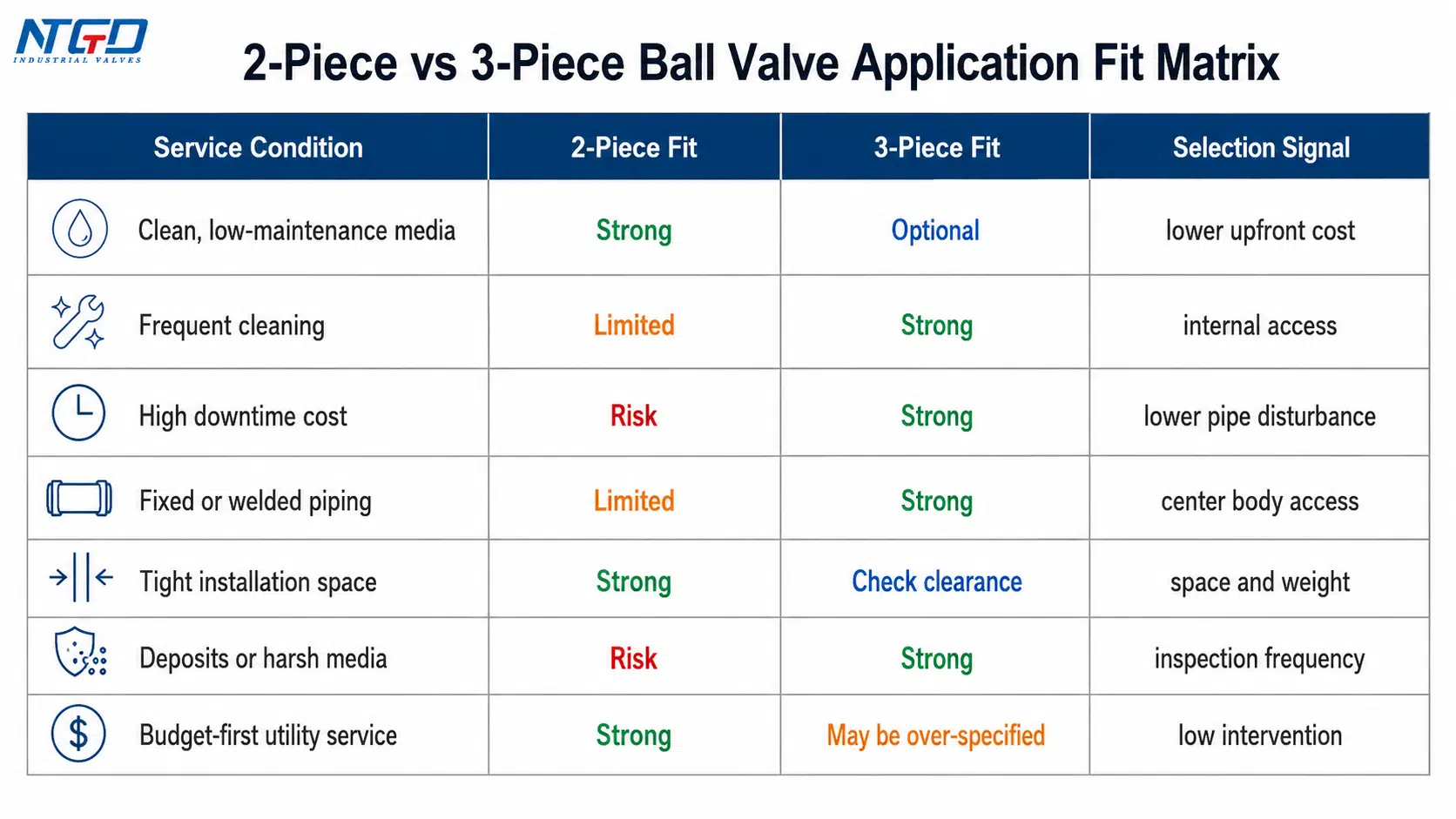
Choose a 2-Piece Ball Valve When…
A 2-piece ball valve is usually a strong option when the system values simplicity, compact size, and lower upfront cost.
Choose a 2-piece ball valve when:
- The media is clean, stable, and compatible with the selected materials.
- The system is low-intervention and does not require frequent internal cleaning.
- Maintenance access is not a major operational concern.
- Space and weight are limited.
- The valve can be removed or replaced without major production loss.
- The pressure-temperature rating is suitable for the actual service.
- Budget control is more important than repeated internal service access.
Typical industrial use cases include clean utility lines, auxiliary systems, compact piping layouts, and low-intervention service where a simple shutoff valve is sufficient. In these services, a 2-piece valve is often the correct economic choice, not a compromise.
Choose a 3-Piece Ball Valve When…
A 3-piece ball valve is usually the better choice when maintenance access and downtime control are part of the operating strategy.
Choose a 3-piece ball valve when:
- The valve must be cleaned or inspected regularly.
- Seat, seal, ball, or stem access is important to the maintenance plan.
- Shutdown windows are short and full valve removal would be disruptive.
- The valve is installed in fixed piping or difficult-to-remove sections.
- The media increases the risk of deposits, leakage, corrosion, or internal wear.
- The system has high cycle frequency or maintenance-critical duty.
- Lifecycle cost matters more than initial purchase price.
Typical industrial use cases include process lines, chemical service, maintenance-sensitive systems, and applications where planned internal inspection is part of the operating routine.
Final Fit-Check Before Selection
Before choosing between a 2-piece and 3-piece ball valve, confirm the following data:
| Selection Check | Why It Matters |
|---|---|
| Media composition | Confirms material compatibility and whether cleaning or inspection will be frequent |
| Pressure and temperature | Confirms the rating boundary before body style is treated as the deciding factor |
| Maintenance frequency | Repeated service increases the value of 3-piece internal access |
| Downtime tolerance | Low shutdown tolerance strengthens the case for a serviceable 3-piece design |
| End connection | Fixed, welded, or difficult-to-remove piping increases the value of center-body access |
| Installation space | Confirms whether a larger 3-piece body can be installed and serviced safely |
| Cleaning requirement | Frequent cleaning can make service access more important than initial cost |
| Spare part strategy | Determines whether replacing seats, seals, and internals is part of the maintenance plan |
| Budget priority | Separates low upfront cost from lifecycle cost and downtime exposure |
If the system is simple, clean, compact, and low-maintenance, a 2-piece valve is often the practical choice. If the system is maintenance-critical, frequently cleaned, or costly to shut down, a 3-piece valve usually provides stronger long-term value.
FAQs
What is the difference between 2-piece and 3-piece ball valves?
A 2-piece ball valve has two main body sections and is usually more compact and lower in initial cost. A 3-piece ball valve has a removable center body between two end connections, so it provides easier access to internal parts during maintenance. The practical difference is service access, not only body count.
Is a 3-piece ball valve always better than a 2-piece ball valve?
No. For clean, low-intervention utility lines, a 2-piece valve can be the better economic choice. For process lines that require cleaning, inspection, or reduced downtime during maintenance, a 3-piece valve is usually the stronger lifecycle choice.
Can a 2-piece ball valve be repaired?
Sometimes. Repairability depends on the valve design, end connection, installation space, valve size, and damage level. In many industrial systems, a 2-piece valve requires more removal or pipe disturbance than a 3-piece valve when internal service is needed.
When should I use a 3-piece ball valve?
Use a 3-piece ball valve when the valve must be cleaned, inspected, or serviced without major pipeline disturbance. It is especially useful when seat or seal replacement is expected, shutdown windows are limited, or the valve is installed in fixed piping.
Does a 3-piece ball valve have a higher pressure rating than a 2-piece ball valve?
Not automatically. Pressure rating depends on the valve design, material, seat, seal, end connection, size, and manufacturer rating. A 3-piece design improves service access, but the pressure-temperature rating still has to be checked against the datasheet.
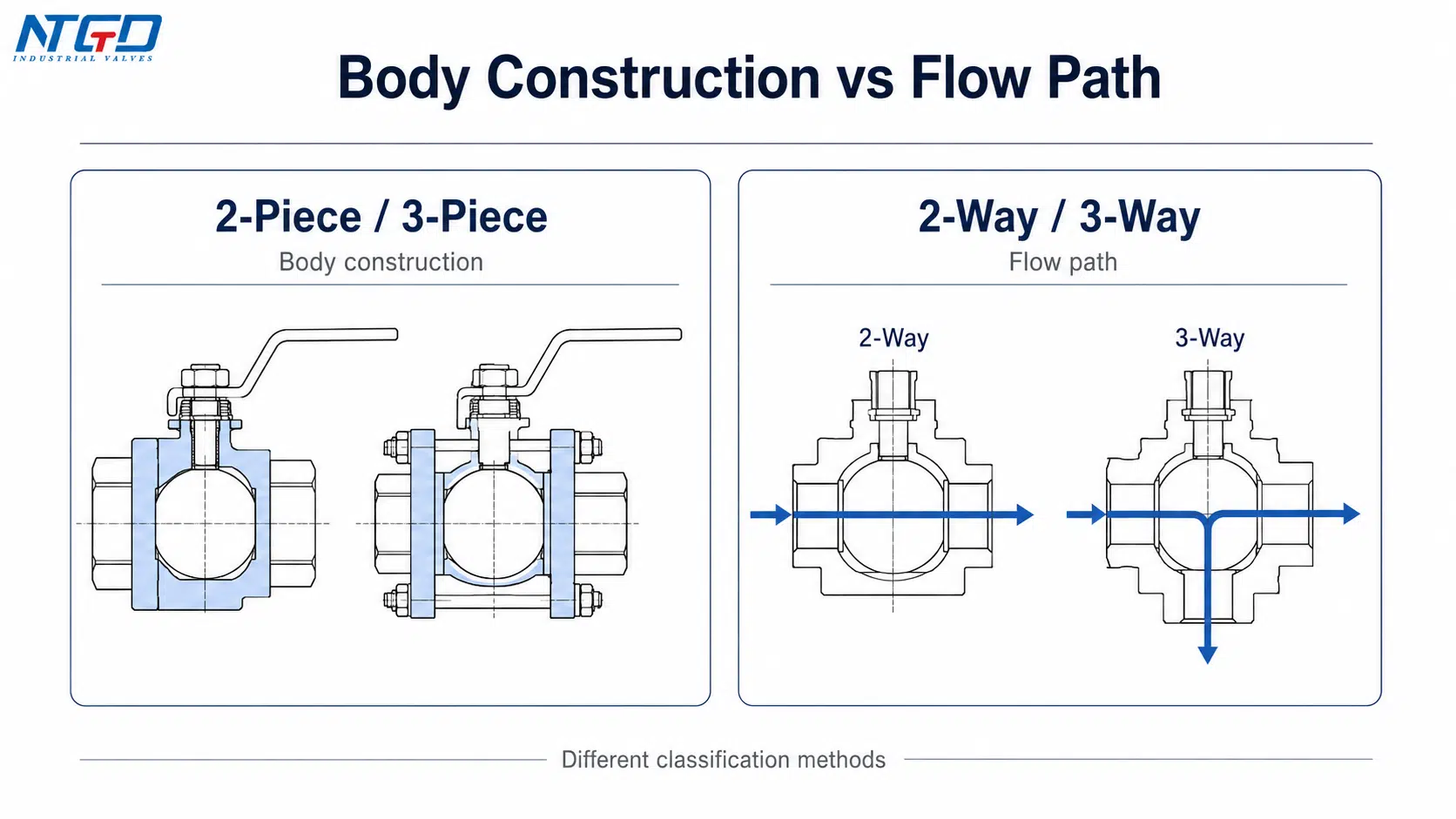
Are 2-piece and 3-piece ball valves the same as 2-way and 3-way ball valves?
No. 2-piece and 3-piece describe the valve body construction. 2-way and 3-way ball valves describe the flow path or port arrangement. These are different classification methods.
How does a 1-piece ball valve relate to 2-piece and 3-piece designs?
A 1-piece ball valve usually has the simplest body construction and is often less serviceable. A 2-piece valve offers more serviceability than many 1-piece designs, while a 3-piece valve provides the easiest internal access among these body styles. This article focuses on 2-piece vs 3-piece selection.
Can I use a 3-piece ball valve in a compact piping system?
Yes, but only if there is enough space for the larger body and for safe access to the center section. In a compact line with little maintenance need, a 2-piece valve may be more practical. In a compact but maintenance-critical line, the space trade-off may still be justified.
Conclusion
The choice between a 2-piece and 3-piece ball valve should be based on service conditions, not only on purchase price. A 2-piece ball valve is usually the practical choice for clean, compact, low-maintenance systems where lower upfront cost matters. A 3-piece ball valve is usually better for frequent cleaning, planned inspection, seat and seal replacement, and systems where downtime is costly.
The wrong choice can turn an initial cost saving into repeated labor, shutdown, and maintenance cost. The strongest decision path is to compare construction, maintenance access, lifecycle cost, pressure-temperature rating, media condition, end connection, and available installation space before selecting the right ball valve.
Final Application Check
If you are selecting between 2-piece and 3-piece ball valves for an industrial application, NTGD Valve can support an application-specific fit-check covering media compatibility, pressure-temperature rating, end connection, maintenance frequency, installation space, and lifecycle cost review before final valve construction is confirmed.
