
Author Name: Bruce Zheng
Author Role: Co-Founder and Valve Engineer at NTGD Valve
Author Bio: Bruce Zheng is Co-Founder and Valve Engineer at NTGD Valve, focusing on industrial valve selection, application, and technical content for global B2B buyers.
Last Updated: May 7, 2026
A wafer type vs flanged butterfly valve comparison is not only about whether the valve body has flanges. It is a connection-structure decision that affects installation accuracy, seal compression, maintenance disturbance tolerance, pressure suitability, and lifecycle cost.
The short answer is this: a wafer butterfly valve is clamped between two pipe flanges, while a flanged butterfly valve has integral flanges on the valve body and bolts directly to the pipe flanges. In practical terms, the wafer connection vs flange connection difference determines how the valve is supported, how evenly the sealing area is compressed, and how safely the line can be maintained later.
Wafer valves are compact and cost-effective for many clean, lower-demand lines when flange alignment is controlled. Flanged butterfly valves provide stronger mechanical support and are usually the safer direction for higher pressure, larger diameter, vibration, maintenance disturbance, or critical isolation service.
This comparison focuses on engineering selection, not only price or appearance.
Wafer vs Flanged Butterfly Valve: Quick Comparison and Selection Summary
Quick answer: what is the main difference?
The main difference is the connection route.
A wafer-type butterfly valve has a compact body that is installed between two pipe flanges. The pipe flanges and through-bolts clamp the valve in position. The valve body normally does not have full integral end flanges.
A flanged butterfly valve has flanges cast, fabricated, or integrated into both ends of the valve body. Each side of the valve bolts directly to the matching pipe flange. This gives the valve a more independent and mechanically stable connection to the pipeline.
For a buyer or engineer, the wafer vs flange question should be framed this way: can the pipeline maintain alignment, compression, support, and safe maintenance access under the actual service conditions?
Engineering comparison table
| Decision Factor | Wafer-Type Butterfly Valve | Flanged Butterfly Valve |
|---|---|---|
| Connection route | Clamped between two pipe flanges; the pipe flange assembly provides the main support and compression path | Integral valve flanges bolted directly to pipe flanges; the valve body has its own flange support |
| Body style | Compact body without full end flanges | Heavier body with flanges on both ends |
| Installation sensitivity | More sensitive to flange alignment, bolt preload, and even tightening | Easier to center and support during installation |
| Space requirement | Lower face-to-face space and lighter weight | Requires more installation space and handling allowance |
| Initial cost | Usually lower due to simpler body construction | Higher due to integral flanges and heavier construction |
| Pressure suitability | Common in low to medium pressure service when design, rating, and installation conditions match | Better direction for higher pressure, larger size, or critical service |
| Sealing stability | Requires uniform flange clamping to maintain predictable seat or gasket compression | Provides a more predictable compression environment under higher pressure, larger size, vibration, or maintenance disturbance |
| Maintenance boundary | Downstream disturbance tolerance is limited unless the maintenance plan and end-of-line requirement are verified | More stable where line disturbance, repeated maintenance, or independent pipe-end support is expected |
| Best fit | Compact clean utility lines, HVAC, water service, space-limited systems, budget-sensitive non-critical lines | High-pressure lines, large diameters, vibration, critical isolation, heavy-duty service |
| Avoid when | One-side pipe removal, unverified end-of-line service, severe vibration, high-pressure duty, or frequent downstream flange removal is expected | Budget, weight, and installation space are strict limits and the service is not critical |
Choose wafer when / choose flanged when
Choose a wafer-type butterfly valve when the line is compact, clean, lower to medium pressure, flange alignment is controllable, and downstream pipe disturbance is not expected.
Choose a flanged butterfly valve when the system involves higher pressure, larger diameter, vibration, maintenance disturbance, or critical isolation where stronger body support and more predictable alignment matter.
What Wafer-Type and Flanged Butterfly Valves Mean in Pipeline Connections
What is a wafer-type butterfly valve?
A wafer-type butterfly valve is a butterfly valve designed to sit between two pipe flanges.
Its body is normally compact and does not include full integral end flanges. The pipeline flanges, gaskets, and bolts create the clamping force that holds the valve in position.
The phrase butterfly valve without flange describes only the valve body, not the installation method. A wafer valve still requires pipe flanges, bolts, correct alignment, and proper clamping. Without the surrounding pipe flange assembly, the term can be misleading.
Wafer-type butterfly valves are commonly reviewed for:
- clean water, HVAC, and general utility lines;
- compact piping where face-to-face space is limited;
- low to medium pressure duty, depending on design and rating;
- budget-sensitive, non-critical systems where maintenance disturbance is limited.
The main advantage is compactness. The main limitation is that the support and sealing environment depend heavily on correctly aligned pipe flanges and uniform clamping force.
What is a flanged butterfly valve?
A flanged butterfly valve has flanges on both ends of the valve body.
These valve flanges are bolted directly to the pipe flanges, creating a more independent and mechanically supported connection.
This construction makes flanged butterfly valves suitable for systems where connection rigidity matters. They are commonly reviewed for:
- larger pipe diameters;
- higher pressure service;
- systems with vibration or water hammer risk;
- more critical isolation duties;
- pipelines where maintenance access and connection stability are important.
A flanged butterfly valve is not automatically the best option in every line. It is heavier, takes more space, and has a higher initial cost. Its value appears when the pipeline needs stronger support or when the cost of leakage, misalignment, or maintenance disturbance is higher than the initial price difference.
Why this page is not a general butterfly valve types guide
Broader butterfly valve types can also be classified by disc offset, sealing material, working pressure, temperature range, and actuation method.
Those categories matter, but they are not the main subject here.
This article focuses on connection type: wafer vs flanged butterfly valve. Lug-style, grooved, welded, threaded, and other valve end connections may appear in related discussions, but they should not replace the main comparison between wafer-type and flanged butterfly valves.
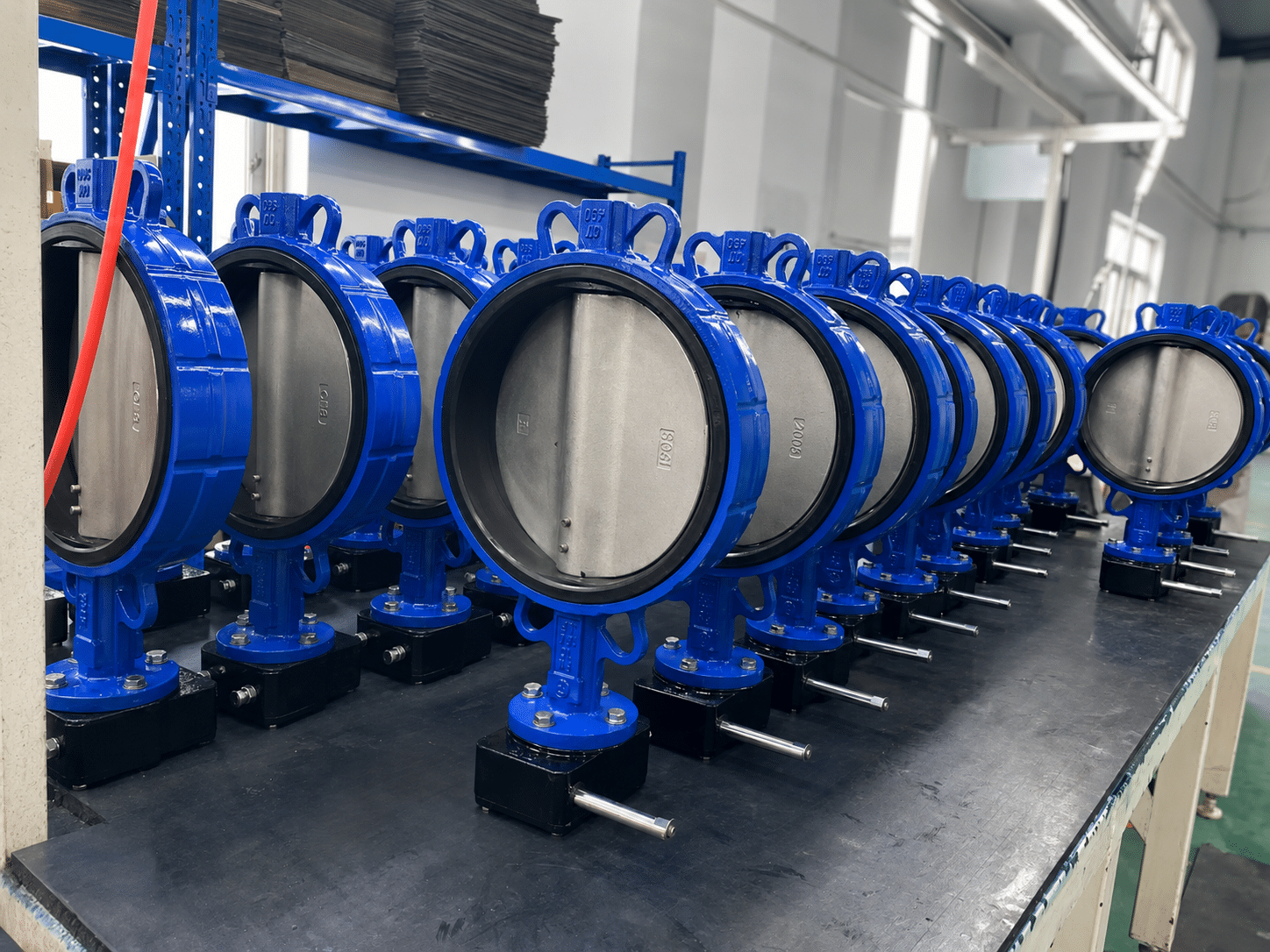
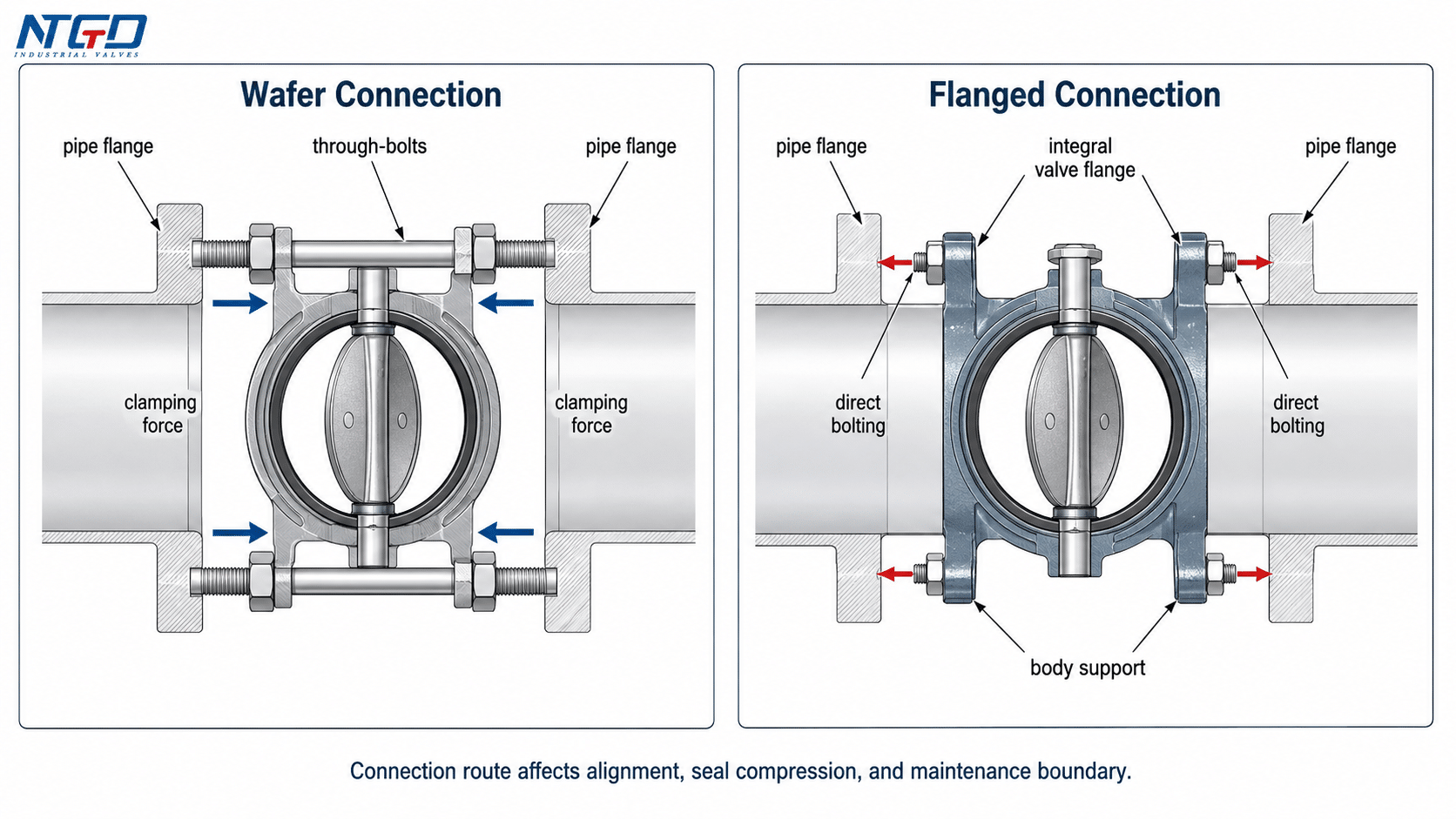
Connection Structure: Clamped Between Flanges vs Integral Flanges
Wafer connection load path
In a wafer connection, the pipe flanges do much of the mechanical work. The valve body is positioned between the flanges, and the bolt set clamps the assembly together. The valve body, gaskets, pipe flanges, and bolts must work as one assembly.
That means the wafer connection depends on:
- flange parallelism;
- correct valve centering;
- uniform bolt tightening;
- compatible gasket or seat compression;
- correct flange drilling and bolt pattern;
- enough support from the pipe flanges during operation and maintenance.
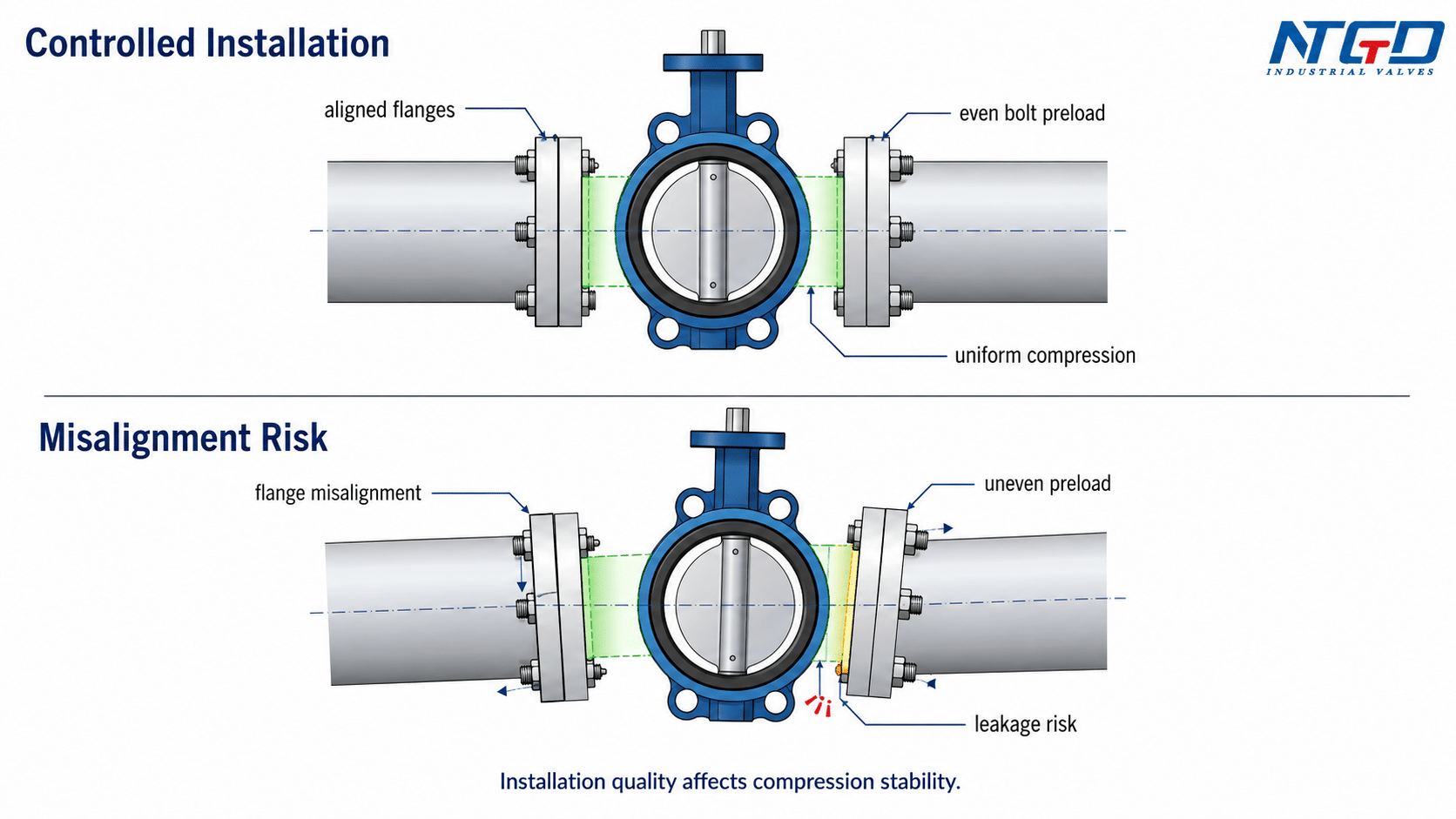
If the flanges are not aligned, the valve can be pulled unevenly. If bolt preload is inconsistent, the sealing area may not be compressed evenly. The result may be local leakage, disc interference, uneven seat stress, or difficulty operating the valve.
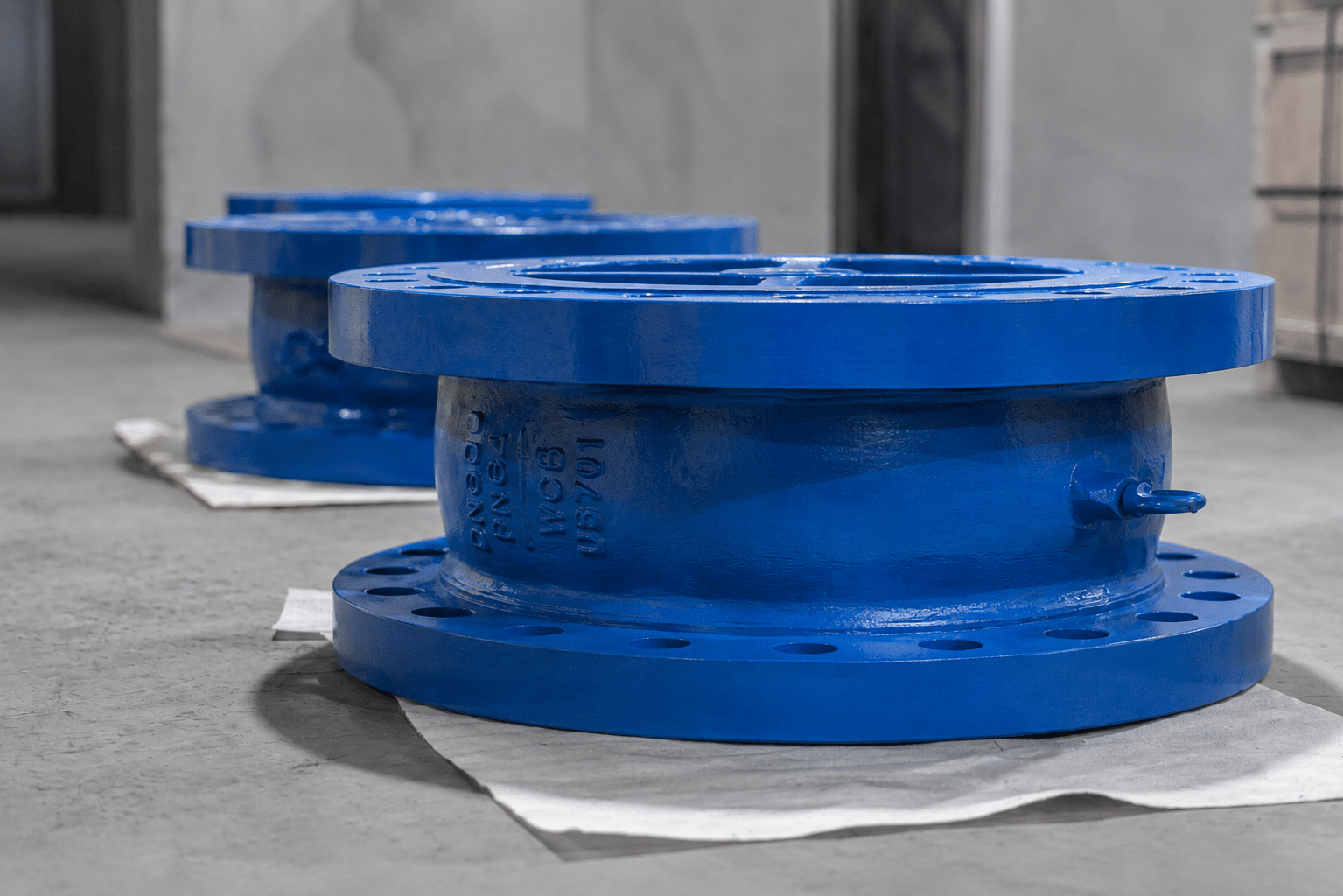
This is the engineering reason the keyword wafer connection vs flange matters. The difference is not only visual. It changes how the load is transferred from the pipe flanges into the valve body and sealing area.
Flanged connection load path
In a flanged butterfly valve, the valve body has integral flanges. Each side of the valve bolts directly to the matching pipe flange. This creates a more defined connection path and improves mechanical support around the valve body.
Compared with a wafer body, the flanged body provides:
- more stable centering during installation;
- stronger pipe-to-valve connection support;
- better resistance to movement in large or heavy lines;
- less dependence on a single through-bolt clamping assembly;
- a clearer boundary when one side of the pipeline is disturbed.
This does not mean the flanged butterfly valve seals by connection structure alone. The seat design, gasket condition, flange face, bolt torque, material compatibility, and service conditions still decide final sealing performance. The flanged connection mainly improves the mechanical environment in which the seal must work.
Why connection structure affects sealing and maintenance
A butterfly valve seal depends on controlled contact between the disc, seat, body, and mating pipeline components. Connection structure influences that contact by controlling alignment and compression.
For wafer valves, the sealing environment is only as stable as the flange alignment and clamping uniformity around the valve body. Uneven flange force can shift the body, distort compression, or create local seat stress.
For flanged valves, the integrated body flanges provide a more independent support envelope. Installation disturbance is less likely to shift the valve body or change the compression path in the same way.
This is why installation accuracy and maintenance disturbance must be reviewed together. A valve that seals correctly at first installation can still become a risk if one side of the line is opened, the flange load changes, or the pipe support is not stable.
Installation Accuracy and Sealing Reliability
Flange alignment and bolt preload
Wafer-type butterfly valves are sensitive to installation quality. The valve should be centered between the pipe flanges, the disc should have clearance to open and close, and bolts should be tightened evenly in a cross-pattern sequence suitable for the flange assembly.
For a pressure-boundary bolted flange joint assembly, the actual number of bolts depends on valve size, flange standard, and drilling pattern.
It should not be generalized. What matters is that the tightening force is distributed evenly enough to avoid distortion, uneven compression, or disc-seat interference.
Flanged butterfly valves are easier to position because the valve body has its own flanged ends. The installer still needs correct gasket placement, bolt torque, and flange compatibility, but the body is less dependent on being held only by the clamping action of two external pipe flanges.
Seal compression and leakage risk
It is too simple to say “flanged valves always seal better.” The stronger engineering point is this:
A stable mechanical connection helps maintain seat or gasket compression under higher pressure, larger diameter, vibration, thermal cycling, or repeated maintenance disturbance.
That is where flanged butterfly valves often have an advantage. Their integral flanges give the valve body a more stable support condition, so the compression path is less dependent on a through-bolt clamping assembly.
A wafer valve can still seal reliably in a properly designed, correctly installed clean service line. The key condition is that flange alignment, bolt preload, gasket or seat compression, and pipe support must remain stable during operation.
In a gasketed bolted flange connection, leakage risk depends on several factors:
- seat type and seat material;
- gasket type and condition;
- flange face finish;
- bolt torque and tightening sequence;
- flange alignment;
- media characteristics;
- pressure and temperature cycling;
- disc and seat wear after operation.
Initial sealing is not enough. The assembly must also maintain compression after thermal cycling, vibration, pressure changes, and disc or seat wear accumulate over time.
Installation implications for larger or critical systems
The larger the valve size, the more important support and alignment become. Larger valves have heavier bodies, larger discs, and greater sensitivity to installation distortion. High pressure, vibration, and water hammer can also expose weak installation practices.
For these conditions, a flanged butterfly valve is often the safer selection direction because the body is mechanically supported by its own flanges. For compact lower-pressure systems where alignment can be controlled and maintenance conditions are simple, a wafer-type butterfly valve can be a practical and economical choice.
Pressure, Temperature, Vibration, and Size Boundaries
Pressure rating and differential pressure
When comparing wafer vs flanged butterfly valve pressure rating, the connection style is only one part of the rating decision. The actual pressure suitability depends on the full valve assembly and service conditions.
Key factors include:
- valve design;
- body, disc, and shaft material;
- seat or liner construction;
- flange standard;
- operating temperature;
- manufacturer pressure rating;
- installation quality and pipe support.
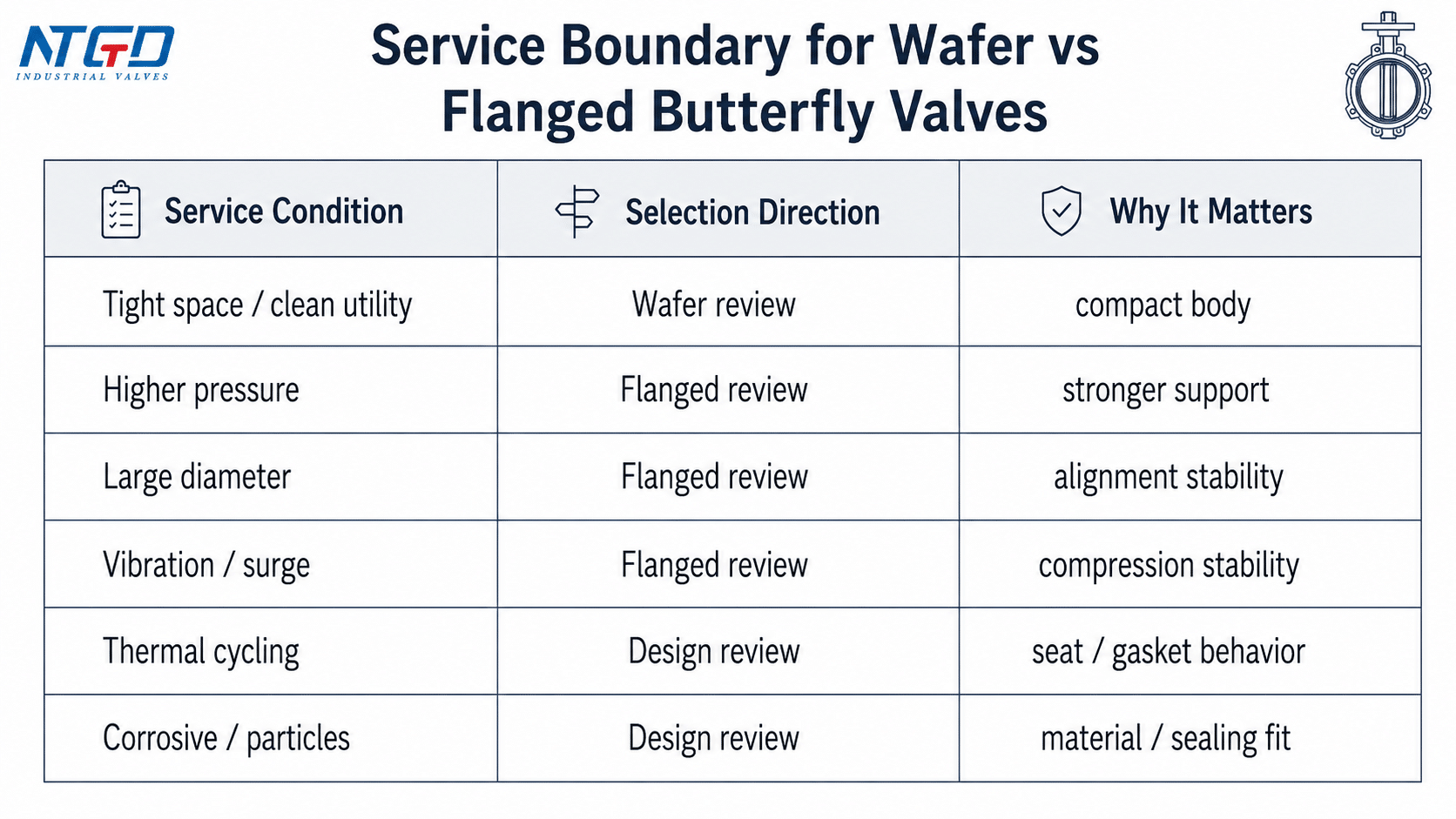
Wafer butterfly valves are frequently used in low and medium pressure lines, but the correct rating depends on the actual valve design, seat construction, material, pressure class, flange standard, and manufacturer rating.
Flanged butterfly valves are usually reviewed first when the system involves:
- higher pressure;
- larger diameter piping;
- critical isolation;
- stronger pipe loads;
- more demanding pressure cycling;
- stricter maintenance access requirements.
Do not select by PN or class label alone; flange compatibility should also be checked against pressure-temperature ratings, materials, dimensions, and tolerances before final selection.
Temperature and thermal cycling
Temperature affects more than body material. It can change seat behavior, gasket compression, bolt preload, and the expansion relationship between valve body, bolts, and pipe flanges.
For wafer valves, temperature cycling deserves attention because the valve relies on the clamping relationship between the two pipe flanges. If thermal expansion changes the bolt load or gasket compression, sealing stability may be affected.
For flanged butterfly valves, the integral flanges give better mechanical support, but temperature still affects seat material, gasket selection, and torque retention. High-temperature or thermal cycling service should be reviewed as a full valve assembly, not only as a body connection choice.
Vibration, water hammer, and large diameter lines
Vibration and hydraulic shock can expose connection weakness. In systems with pump starts, quick valve operation, unstable flow, or water hammer risk, the valve connection must resist movement and maintain sealing compression.
A flanged butterfly valve is generally the better direction when:
- the pipe size is large;
- the valve is heavy;
- vibration is present;
- the pipeline is critical;
- the system has pressure surges;
- pipe movement or support limitations exist.
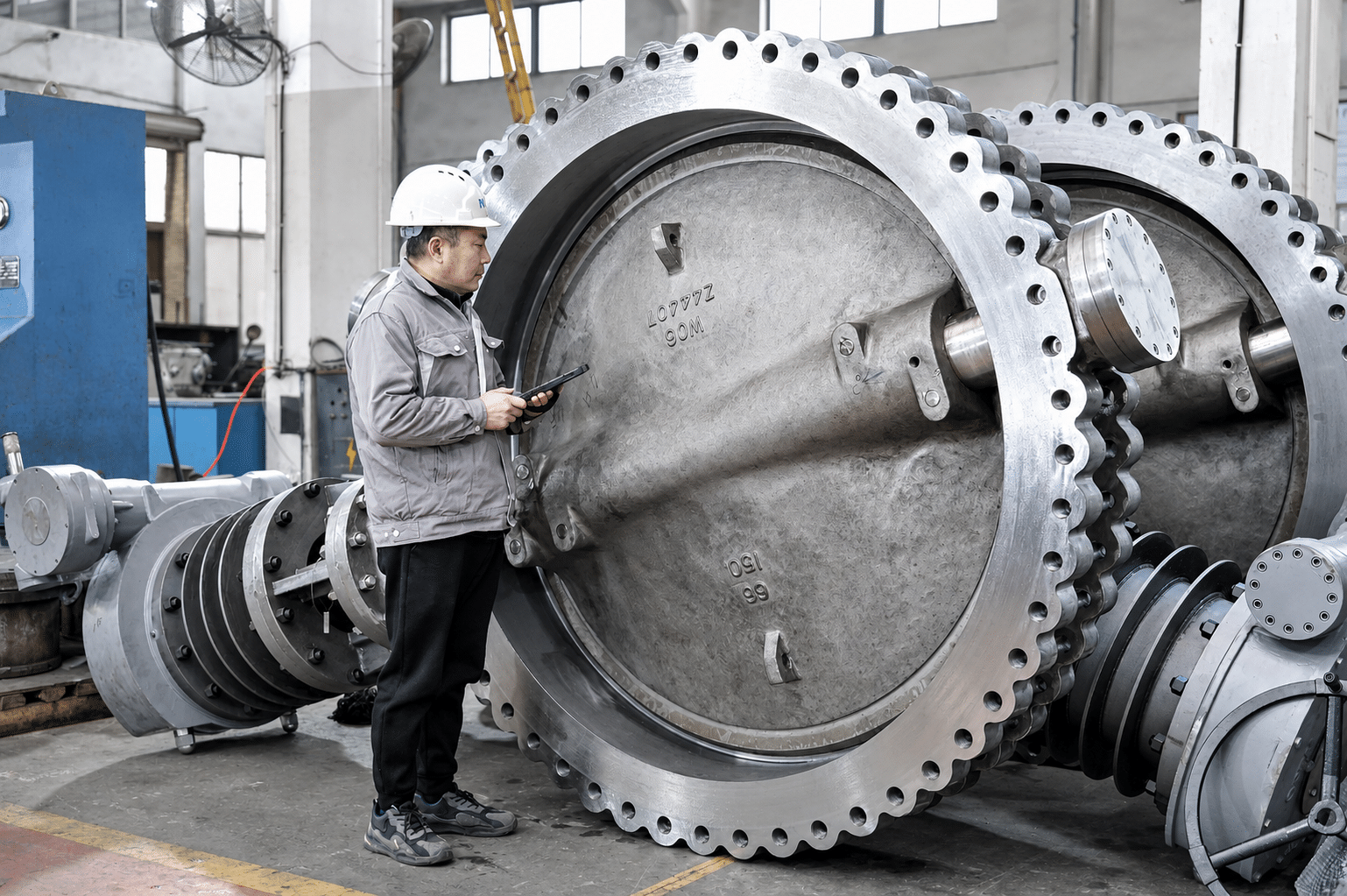
A wafer-type butterfly valve may still be reviewed for compact systems, but only where pipe support, flange alignment, and bolt preload can remain stable under the expected vibration or surge condition.
Media condition and seat / gasket compatibility
The connection type does not decide media compatibility by itself. A wafer valve and a flanged valve can both be built with different body materials, discs, seats, liners, and gaskets.
For clean water, HVAC, and general utility lines, wafer valves are often attractive because they are compact and cost-effective. For chemical service, corrosive fluids, particulate media, or higher temperature service, the seat, liner, gasket, disc, and body material must be checked together with the connection type.
In corrosive or particulate service, do not choose wafer or flanged construction based only on price. Confirm whether the seal path, gasket area, disc edge, and body material can tolerate the actual media.
Maintenance, Downstream Flange Removal, and End-of-Line Limits
Why wafer valves are not always easier to maintain
Wafer valves are light and compact, so they may look easier to handle. That does not mean they are always easier to maintain in the pipeline.
The maintenance difference in wafer connection vs flange connection comes from support logic. A wafer butterfly valve depends on the two pipe flanges for clamping support. If one side of the pipe may be removed during maintenance, that support condition changes.
For maintenance planning, the key check is whether the valve remains supported, aligned, and compressed when one pipe side is opened.
Downstream flange removal risk
If the downstream flange is removed, a wafer valve may lose part of the support and compression condition that keeps it stable. This can affect alignment, sealing, or safe handling during maintenance.
The practical consequences can include:
- loss of valve centering;
- loss of gasket or seat compression;
- difficulty controlling the valve body during line opening;
- leakage during maintenance;
- uncontrolled media release if the line is not properly isolated and drained.
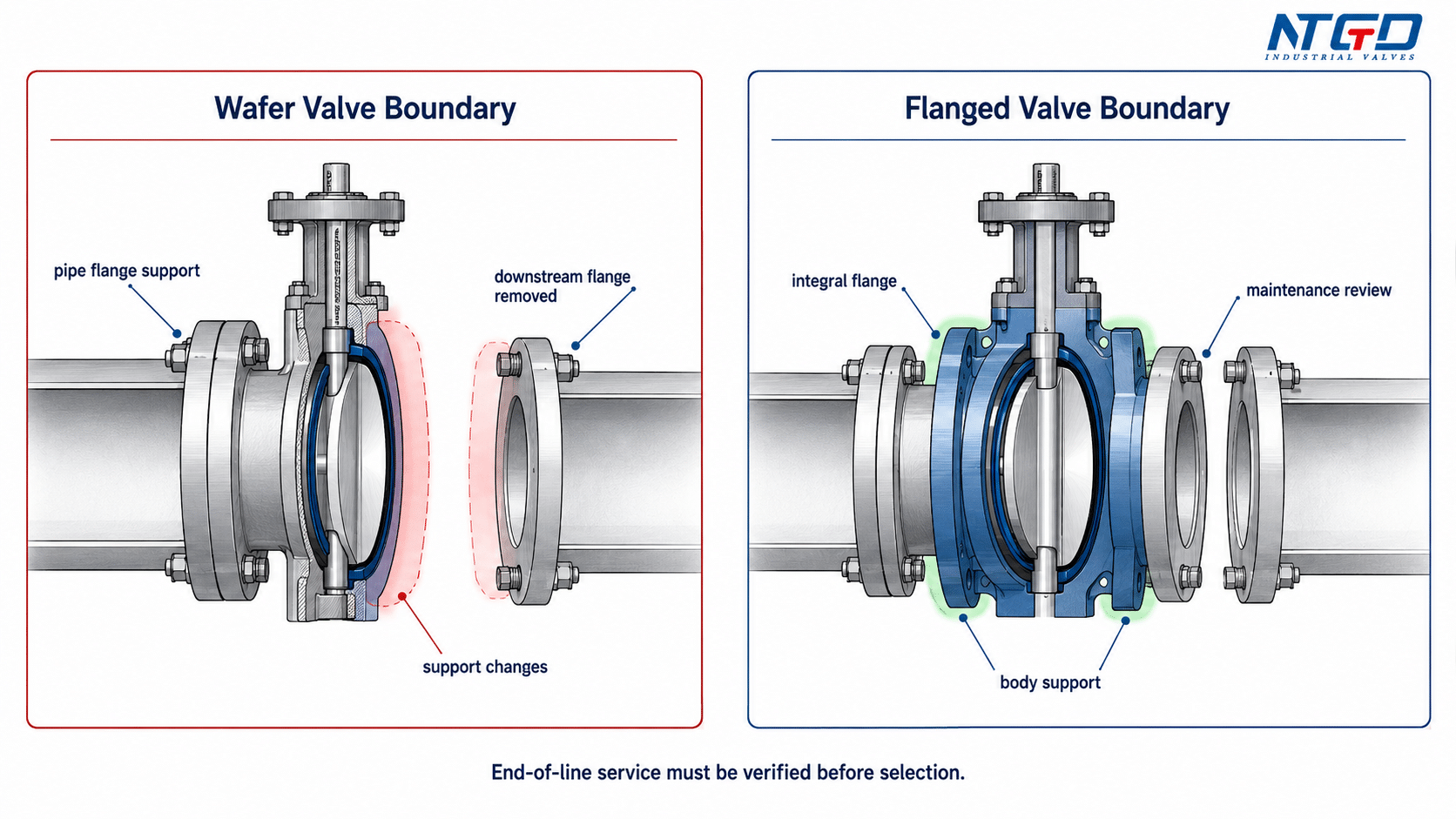
For this reason, wafer butterfly valves should not be assumed suitable for end-of-line service or one-side pipe removal. If a pipeline section needs to be opened while the valve remains installed, the valve connection type must be checked before selection.
Flanged butterfly valves provide a more stable body-to-pipe connection because the valve has its own flanges. This can make them a better direction for maintenance-sensitive lines where pipe disturbance is expected.
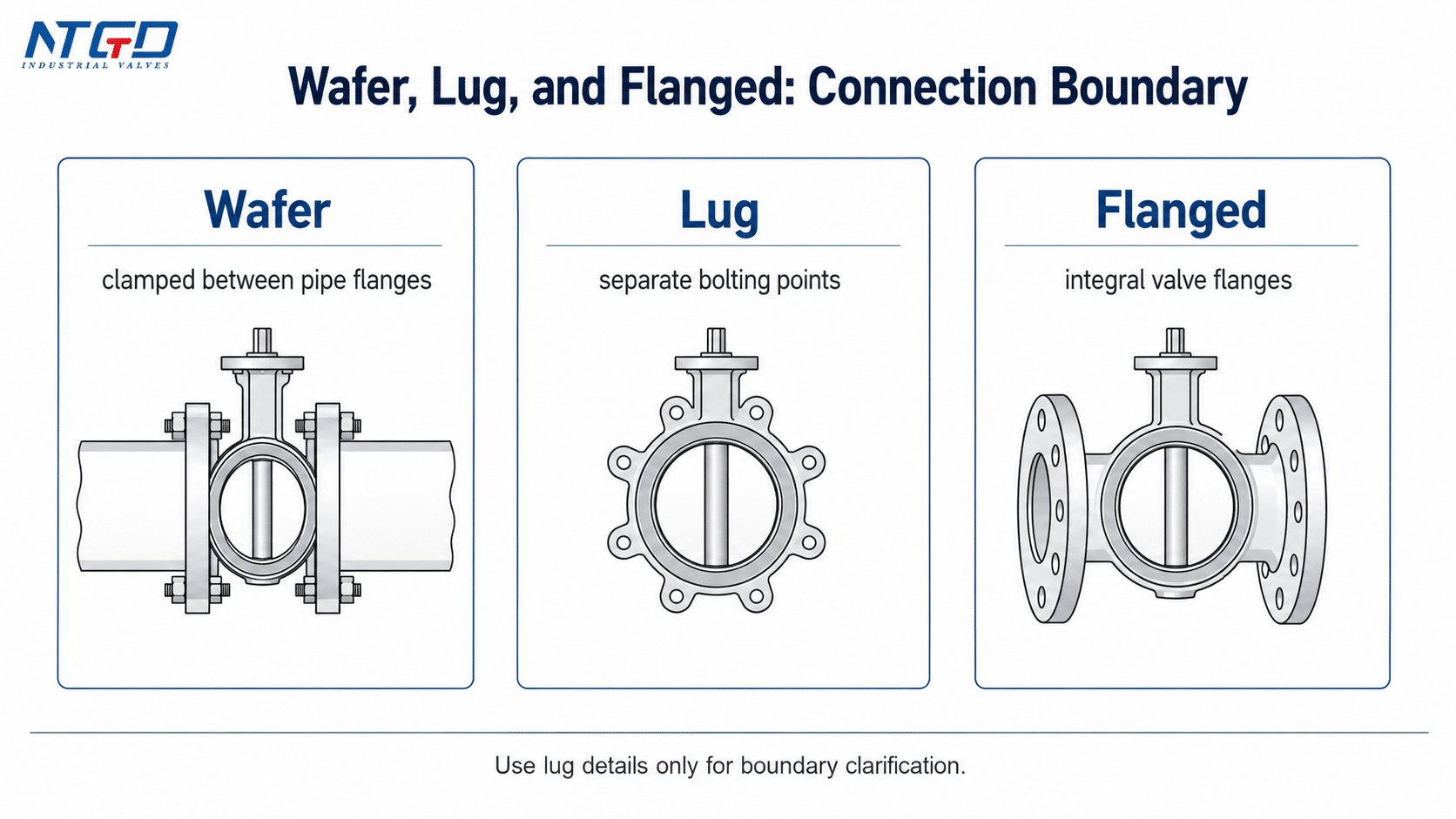
End-of-line service and wafer vs lug vs flanged boundary
A lug-style butterfly valve is different from a wafer butterfly valve. Lug valves may allow bolting from each side and are often discussed when one side of the pipeline may be removed. That is a separate comparison and should not be confused with wafer vs flanged butterfly valve selection.
For this page, the key boundary is simple:
- Wafer butterfly valve: compact and clamped between pipe flanges; end-of-line suitability must be verified.
- Flanged butterfly valve: integral flanges provide more independent pipe connection support.
- Lug butterfly valve: a separate connection style that may be relevant when one-side disassembly is required.
If end-of-line service is a real requirement, do not assume a wafer valve can replace a flanged or lug-style valve without engineering review.
How to Choose: Application Fit, Lifecycle Cost, and RFQ Checklist
Application fit matrix
| Service Condition | Better Selection Direction | Why It Matters |
|---|---|---|
| Tight installation space | Wafer-type butterfly valve | Compact body and shorter face-to-face arrangement reduce space demand |
| Budget-sensitive clean water line | Wafer-type butterfly valve | Lower initial cost can be justified when pressure, maintenance disturbance, and leakage consequence are modest |
| HVAC or general utility service | Wafer-type butterfly valve | Compact design and controlled service conditions often make wafer construction practical |
| Higher pressure line | Flanged butterfly valve | Stronger mechanical support helps maintain alignment and compression under higher load |
| Large diameter pipeline | Flanged butterfly valve | Valve weight, disc size, pipe loads, and installation alignment become more important |
| Vibration or water hammer risk | Flanged butterfly valve review | Connection rigidity directly affects sealing compression stability over time |
| Frequent maintenance or pipe removal | Flanged butterfly valve review | Downstream disturbance tolerance and independent body support become decisive |
| Corrosive or particulate media | Design review required | Seat, gasket, liner, disc, body material, and connection type must be checked together |
| Critical isolation duty | Flanged butterfly valve review | Leakage or maintenance disturbance carries higher operational consequence |
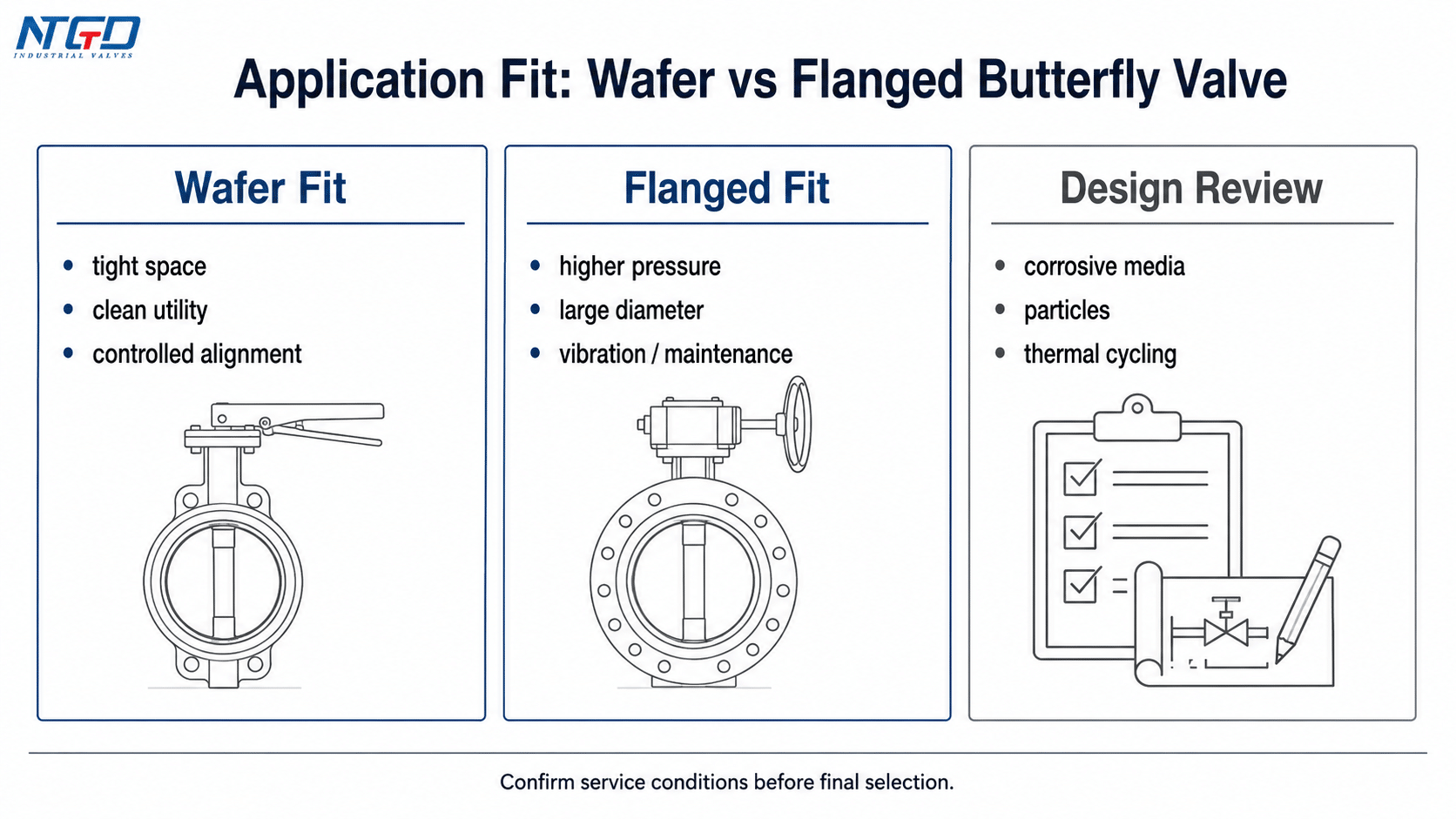
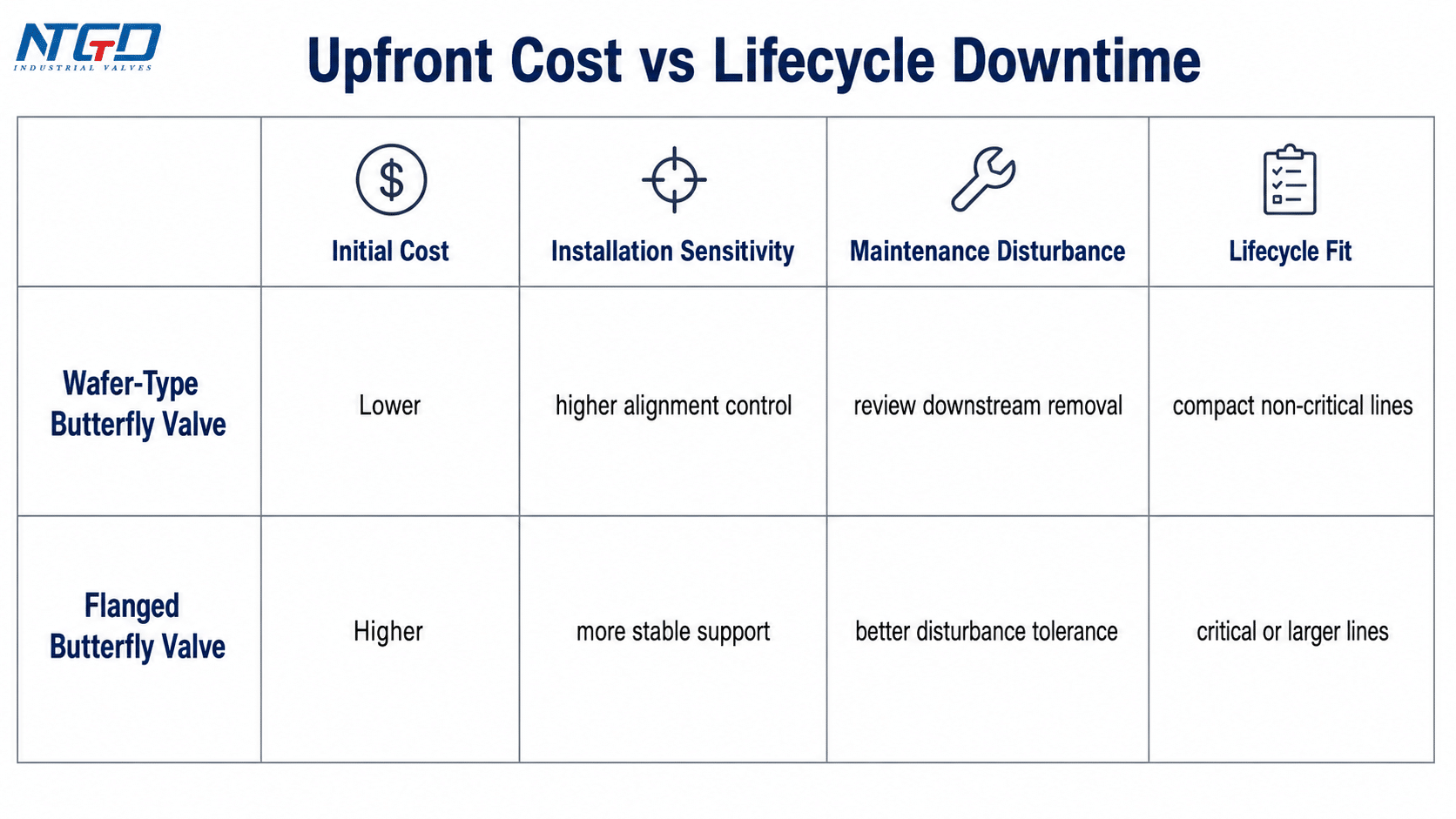
Upfront cost vs lifecycle downtime
Wafer butterfly valves usually have a lower initial cost because the body is simpler and lighter. That cost advantage matters in non-critical lines, compact systems, and projects with many valves.
Flanged butterfly valves cost more at purchase because the body includes integral flanges and more material. The higher initial cost can be justified when the line requires stronger support, easier alignment, safer maintenance planning, or lower downtime exposure.
A low purchase price is not always the lowest project cost. If the valve must be removed frequently, if the line is critical, or if leakage would create shutdown costs, the lifecycle cost may favor the flanged design.
RFQ-ready checklist
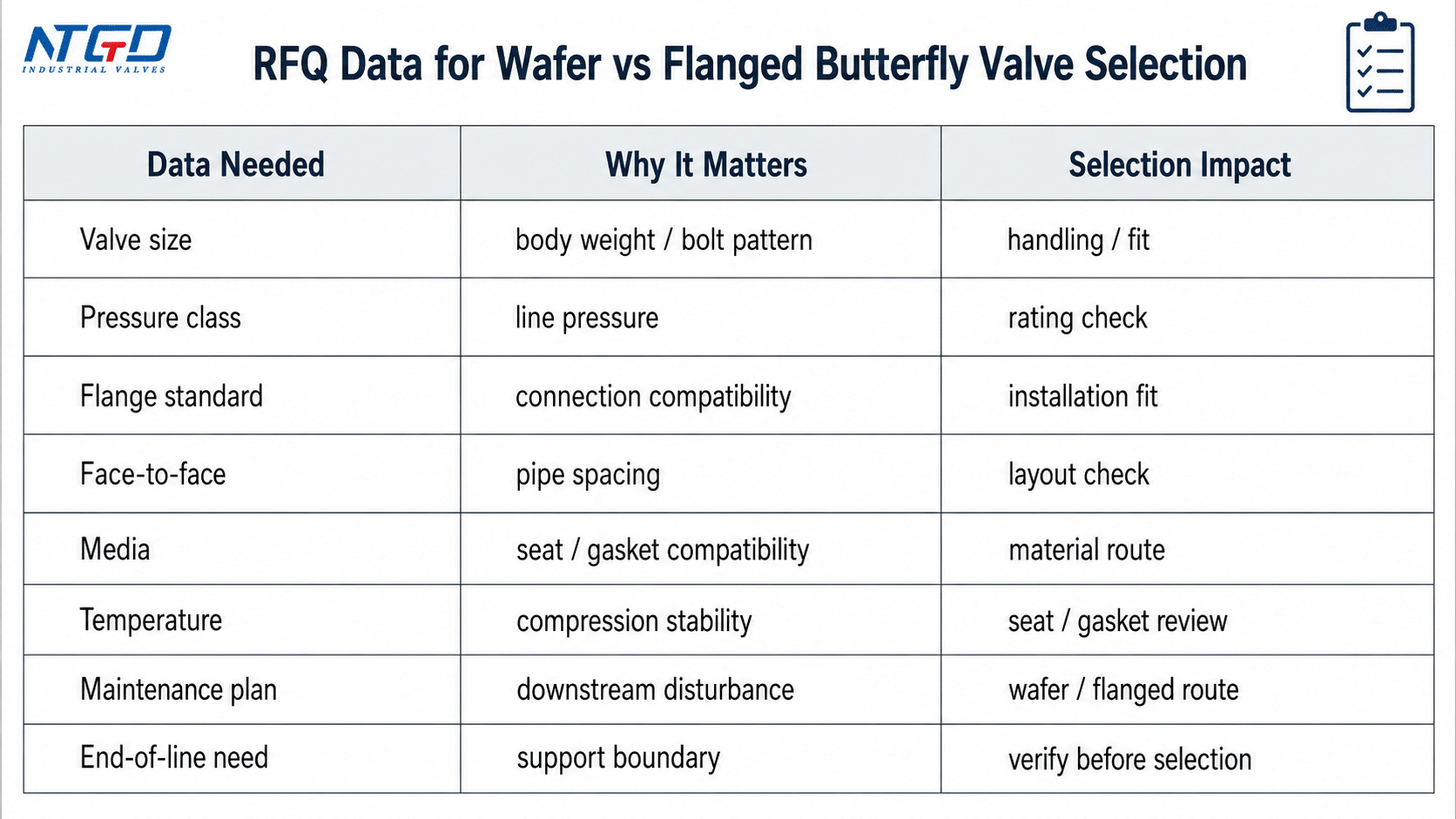
Before ordering a wafer or flanged butterfly valve, confirm these items:
| RFQ Item | Why It Matters |
|---|---|
| Valve size | Affects body weight, bolt pattern, installation clearance, and handling |
| Pressure class / PN rating | Must match line pressure and service condition; do not select by nominal class alone |
| Flange standard | Pipe flange and valve connection must be compatible, or installation may require rework |
| Face-to-face dimension | Prevents installation mismatch and pipe modification |
| Bolt pattern and drilling | Critical for wafer centering, flanged connection fit, and correct compression |
| Media | Determines body, disc, seat, liner, and gasket compatibility |
| Operating temperature | Affects seat material, gasket compression, and bolt preload stability |
| Solids or particles | Can affect seat wear and sealing reliability |
| Corrosion risk | Requires material and lining review |
| Actuation space | Manual gear, pneumatic, or electric actuation may need clearance |
| Maintenance requirement | Wrong assumptions can lead to valve removal issues or unplanned line disturbance |
| End-of-line service | Wafer construction must not be assumed suitable without verification |
Final recommendation
Use a wafer-type butterfly valve when compact size, controlled flange alignment, moderate service demand, and lower initial cost are the main priorities. Use a flanged butterfly valve when pressure, diameter, vibration, maintenance disturbance, critical isolation, or independent body support carries more weight.
For borderline cases, confirm the risk factors before comparing price: pressure, temperature, media, flange compatibility, bolt pattern, maintenance plan, and end-of-line requirement. Reliable industrial valve selection starts with the actual pipeline service conditions, not the connection style name alone.
FAQ: Wafer vs Flange Butterfly Valve Questions
1. What is a wafer-type butterfly valve?
A wafer-type butterfly valve is a compact butterfly valve installed between two pipe flanges. It is held in place by the clamping force of the pipe flange assembly rather than by full integral flanges on the valve body.
2. Is a wafer butterfly valve a butterfly valve without flange?
Only in the sense that the valve body normally does not have full integral end flanges. It still requires pipe flanges, bolts, correct alignment, and proper clamping for installation. Calling it a butterfly valve without flange can be misleading if the pipe flange requirement is not clear.
3. What is the difference between wafer connection and flange connection?
A wafer connection places the valve between two pipe flanges and depends on the flange assembly for clamping. A flange connection uses valve body flanges bolted directly to pipe flanges. The flanged connection gives stronger body support and more stable alignment.
4. Is a wafer valve the same as a butterfly valve?
No. “Wafer” describes the connection style. “Butterfly valve” describes the valve type. A wafer valve in this context means a wafer-type butterfly valve, but not every butterfly valve is wafer type.
5. Can a wafer butterfly valve replace a flanged butterfly valve?
Only when the service conditions allow it. A wafer valve may be suitable for compact, lower-pressure, clean service lines where flange alignment and maintenance disturbance are controlled. Do not decide from dimensional compatibility alone; confirm pressure, temperature, vibration, maintenance, and end-of-line requirements before replacing a flanged valve with a wafer valve.
6. Which is cheaper, wafer or flanged butterfly valve?
A wafer butterfly valve usually has a lower initial cost because the body is lighter and simpler. A flanged butterfly valve has a higher initial cost, but it may reduce lifecycle risk in critical systems where maintenance downtime, leakage, or connection stability matters.
7. Which is better for high pressure, wafer or flanged butterfly valve?
A flanged butterfly valve is usually the better direction for higher pressure service because its integral flanges provide stronger resistance to body movement, alignment shift, and compression instability. The final pressure rating still depends on valve design, material, seat construction, flange standard, temperature, and manufacturer rating.
8. What is the difference between wafer, lug, and flanged butterfly valves?
A wafer valve is clamped between two pipe flanges. A lug valve has lugs around the body and may support different bolting arrangements. A flanged butterfly valve has full flanges on both body ends. Lug-style selection is a separate topic and should not be confused with wafer vs flanged comparison.
9. When should I avoid using a wafer butterfly valve?
Avoid or carefully review wafer butterfly valves when the system has high pressure, large diameter, strong vibration, frequent downstream flange removal, unverified end-of-line service, severe thermal cycling, or critical isolation requirements.
10. What should be confirmed before ordering a wafer or flanged butterfly valve?
Confirm the connection-critical items first: valve size, pressure class, flange standard, face-to-face dimension, bolt pattern, media, operating temperature, seat and gasket material, maintenance plan, and whether end-of-line service is required.
Conclusion
The difference between a wafer-type butterfly valve and a flanged butterfly valve is not only the presence or absence of valve body flanges. It is a difference in how the valve is supported, aligned, sealed, installed, and maintained in the pipeline.
A wafer butterfly valve is best when compact size, controlled installation, lower initial cost, and moderate service conditions are the main priorities. A flanged butterfly valve is the safer direction when the system needs higher pressure capability, stronger support, larger diameter stability, vibration resistance, or more predictable maintenance access.
Make the connection type decision first, then lock in pressure, temperature, media, flange compatibility, maintenance disturbance, and end-of-line needs. A reliable selection does not start from price; it starts from a full review of these operating conditions.
Final Application Check
If your project is comparing wafer type vs flanged butterfly valve options, prepare the key service conditions: pressure, temperature, media, flange standard, and maintenance or end-of-line requirement. NTGD Valve can support an application-specific engineering review and connection-type fit-check against your actual pipeline service conditions, rather than a generic catalog recommendation.
