
Author Name: Bruce Zheng
Author Role: Co-Founder and Valve Engineer at NTGD Valve
Author Bio: Bruce Zheng is Co-Founder and Valve Engineer at NTGD Valve, focusing on industrial valve selection, application, and technical content for global B2B buyers.
Last Updated: May 19, 2026
Choosing between a PTFE valve seat and a PEEK valve seat is not just a generic material comparison. This article focuses on how to choose between PTFE and PEEK for ball valve seats and seal material selection based on real operating conditions.
In a ball valve, the seat must seal against a rotating ball, resist the process media, support pressure load, control operating torque, and stay stable over repeated cycles. That is why a simple “PTFE vs PEEK” comparison is not enough for industrial valve selection.
For most ball valve applications, PTFE is preferred when chemical compatibility, low friction, smooth operation, and cost control are the main priorities. PEEK is preferred when the valve seat must handle higher mechanical load, higher temperature exposure, abrasion, creep resistance, or dimensional stability under more demanding service conditions.
There is no universal best seat material. The better choice depends on the media, temperature, pressure, valve design, operating frequency, particles in the fluid, required torque, seat support, and the manufacturer’s pressure-temperature rating.
Quick Answer: PTFE vs PEEK for Ball Valve Seats
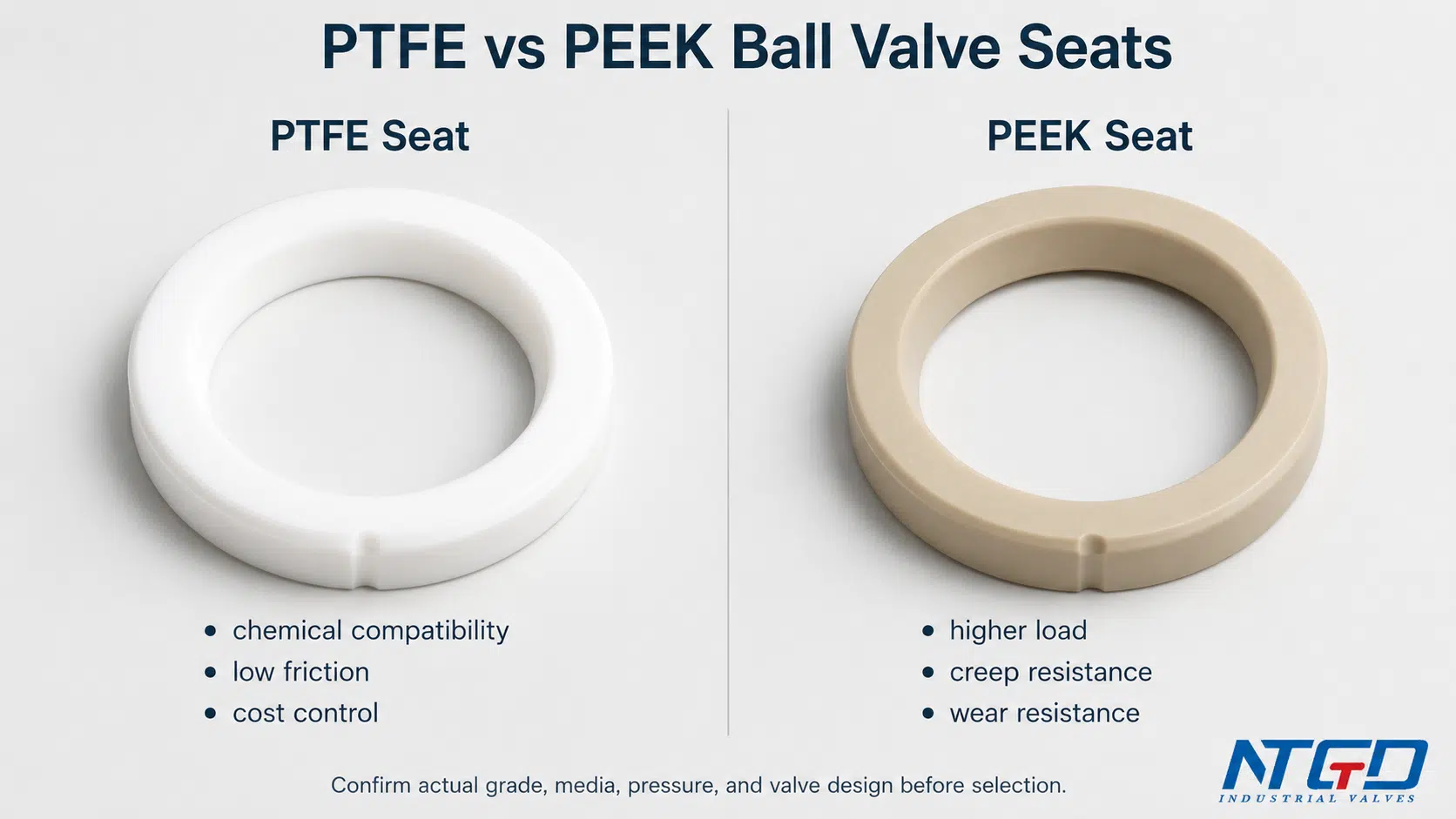
For a quick selection, use the following logic:
| Service condition | Usually better fit | Why it matters |
|---|---|---|
| Chemically aggressive but moderate-load service | PTFE seat | PTFE often provides broader chemical compatibility and low friction in many valve applications. |
| Low operating torque is important | PTFE seat | PTFE’s low-friction behavior can help the ball rotate smoothly and may reduce actuator load. |
| General clean liquid or gas service | PTFE seat | It is widely used, cost-effective, and suitable for many standard ball valve seats. |
| Higher pressure or heavier seat load | PEEK seat | PTFE may creep or deform under sustained high seating stress; PEEK’s creep resistance helps maintain seat shape and sealing force. |
| Higher temperature with mechanical stress | PEEK seat | PEEK can retain strength and dimensional stability better than standard PTFE grades in demanding conditions. |
| Abrasive or particle-laden service | PEEK seat, depending on design | PEEK generally offers better wear resistance, but particle load, cycle frequency, and seat design still need verification. |
| Lowest upfront cost | PTFE seat | PTFE is usually more economical than PEEK. |
| Long lifecycle under severe service | PEEK seat | Higher initial cost may be justified when seat deformation, extrusion, or wear would create maintenance risk. |
In short: choose PTFE when chemical resistance, low friction, and cost are the priority. Choose PEEK when strength, wear resistance, creep resistance, and dimensional stability are more important.
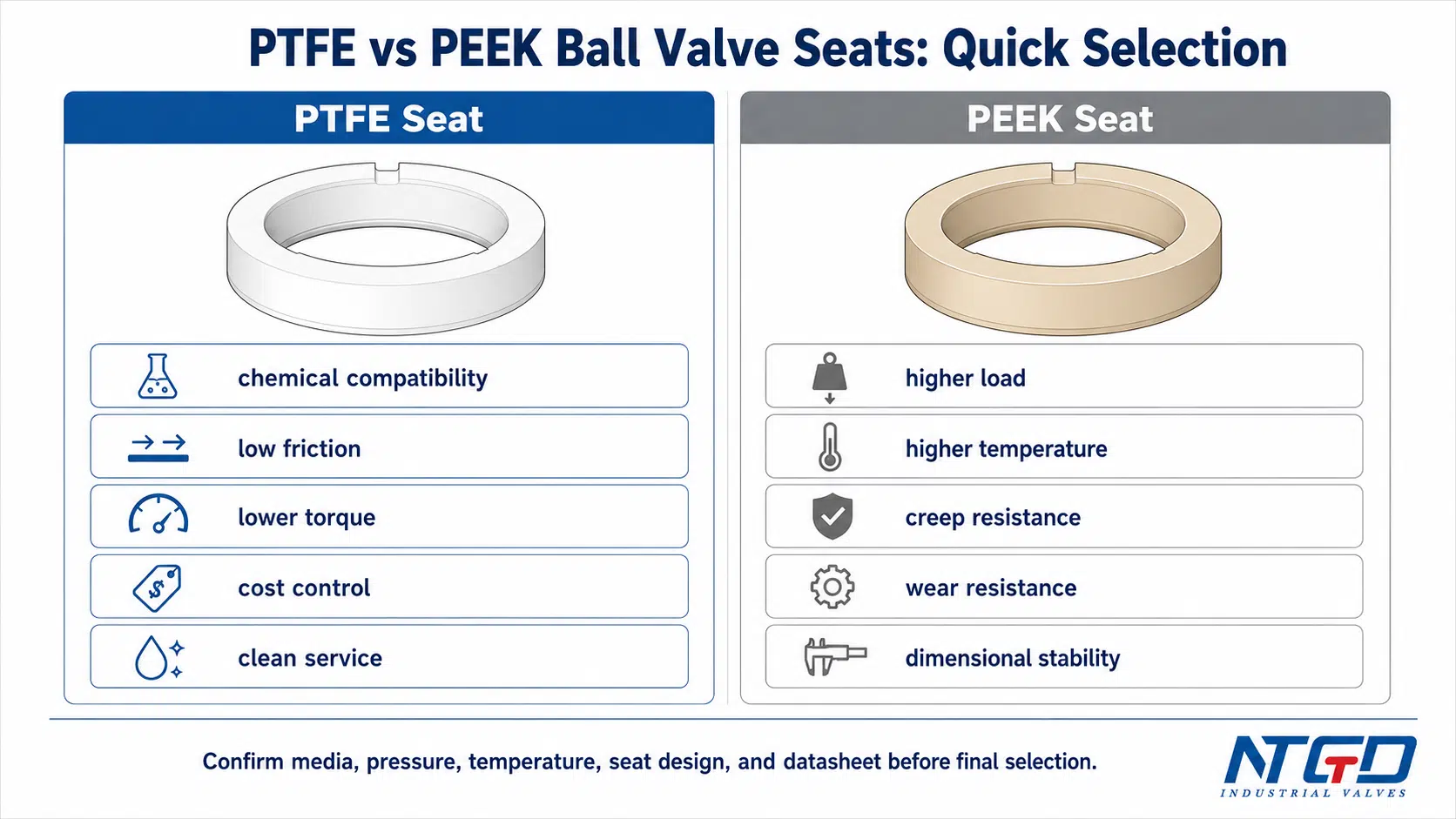
Do not select by material name alone. The final choice should consider the combined effect of media, pressure, temperature, differential pressure, cycle duty, seat support, and valve design.
What a Ball Valve Seat Must Do
A ball valve seat is the sealing contact surface between the valve body and the rotating ball. When the valve is closed, the ball presses against the seat to block flow. When the valve operates, the seat must allow rotation without excessive torque, damage, or loss of sealing performance.
The seat material affects several practical performance factors:
| Seat function | Why it matters in valve selection |
|---|---|
| Sealing against the ball | Poor material selection can create leakage paths across the seat or unstable shut-off during pressure and temperature changes. |
| Supporting pressure load | The seat must resist compression, extrusion, deformation, and loss of sealing force. |
| Allowing smooth rotation | Friction affects operating torque, actuator sizing, and long-term operation. |
| Resisting media attack | Chemical incompatibility can weaken the seat or change its sealing behavior. |
| Handling temperature changes | Heat can change stiffness, creep behavior, and sealing force. |
| Resisting wear | Abrasive particles or frequent cycling can shorten seat life and reduce shut-off reliability. |
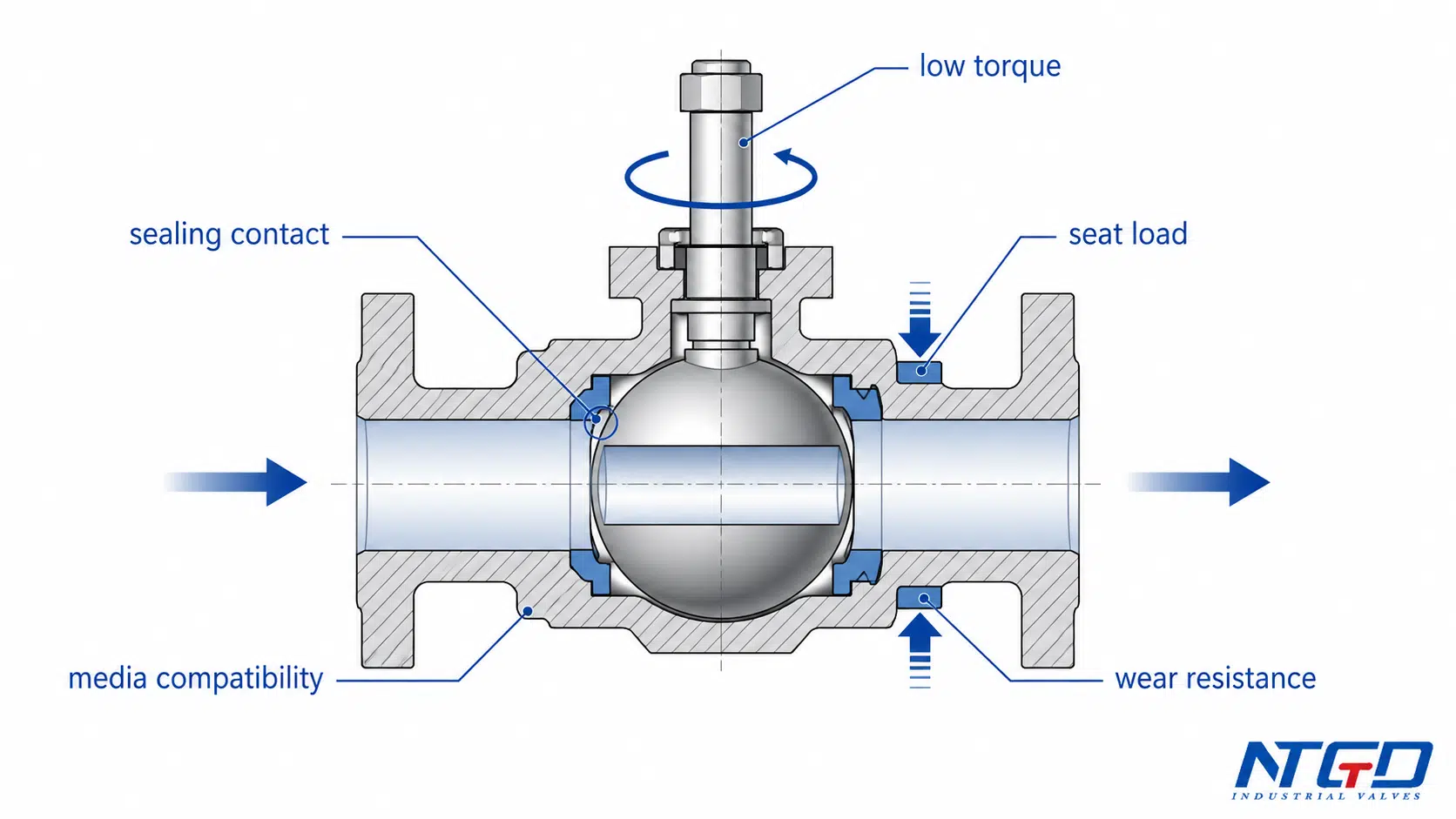
This is why ball valve seal material should be selected as part of the whole valve design, not only by comparing material names.
Seat, Seal, Gasket, and O-Ring: Scope Clarification
In valve discussions, “seat,” “seal,” “gasket,” and “O-ring” are sometimes used together, but they are not always the same component.
For this article:
- Ball valve seat means the sealing surface that contacts the ball.
- Seal material refers broadly to materials used to prevent leakage in valve components.
- Gaskets and O-rings may seal other joints or parts of the valve, but they are not the main focus here.
The focus here is PTFE vs PEEK for ball valve seats and seal material selection, not a complete guide to every valve gasket, stem seal, or elastomer.
Where PTFE and PEEK Fit Among Ball Valve Seat Materials
PTFE and PEEK are both polymer seat materials used in ball valves, but they sit in a wider family of seat and seal materials.
Common ball valve seat or seal material categories may include:
| Material family | Typical role in valve selection | Current article treatment |
|---|---|---|
| PTFE | Low friction, broad chemical compatibility, standard soft seat applications | Main focus |
| PEEK | Higher strength, wear resistance, dimensional stability, severe-service polymer seat applications | Main focus |
| RPTFE / filled PTFE / TFM | Modified PTFE-family options for improved mechanical behavior or specific service needs | Light boundary note only |
| NBR / EPDM / FKM / Viton-type elastomers | Often used in seals or elastomeric components depending on media and temperature | Not the main topic |
| Metal seats | Used for high temperature, abrasive, or severe shut-off applications where soft seats may not be suitable | Boundary topic only |
This article compares PTFE and PEEK because they are both common choices when engineers are evaluating polymer seats for ball valves. Other materials may be better for other services, but they should be handled in a broader ball valve seat material selection guide.
Modified PTFE options such as RPTFE, filled PTFE, or TFM can sometimes act as intermediate choices when standard PTFE needs better mechanical behavior. They are related to PTFE, but they are not identical, and their compatibility and pressure-temperature behavior still need confirmation.
PTFE Valve Seats: Strengths, Limits, and Best-Fit Service
PTFE material is one of the most widely used soft seat materials for ball valves. It is often selected because it provides a strong combination of chemical compatibility, low friction, and cost-effectiveness.
A PTFE valve seat is commonly used when the service requires smooth valve operation and reliable sealing in clean or chemically demanding media, but does not impose extreme mechanical load on the seat.
Why PTFE Is Commonly Used in Ball Valve Seats
PTFE has several practical advantages in ball valve seat service.
| PTFE seat advantage | Engineering impact |
|---|---|
| Broad chemical resistance | Suitable for many chemical services, subject to actual media compatibility checks. |
| Low friction | Helps reduce operating torque and supports smoother ball rotation. |
| Non-stick behavior | Can help reduce sticking or buildup in some clean services. |
| Cost-effective selection | Often more economical than high-performance engineering polymers. |
| Good general sealing behavior | Commonly used in many standard soft-seated ball valves. |
For many industrial applications, PTFE provides a practical balance of performance and cost. It is often a good fit for clean liquids, chemical service, water treatment, food and beverage systems, and general process lines where the pressure, temperature, and mechanical load remain within the valve manufacturer’s seat design limits.
PTFE Seat Limitations: Creep, Cold Flow, and Load Sensitivity
PTFE is not always the best choice. Its main limitation is mechanical stability under higher load or more severe conditions.
Under pressure, temperature, or repeated seating stress, PTFE may be more vulnerable to:
- creep or cold flow;
- seat deformation;
- extrusion risk in some designs;
- reduced sealing stability under higher load;
- faster wear in abrasive or high-cycle service.
In a ball valve seat, this matters because creep or cold flow can reduce sealing force over time. Under higher seating stress, high differential pressure, or elevated temperature exposure, the seat may lose shape, create a leakage path, or become more vulnerable to extrusion.
This does not mean PTFE is unreliable in every application. A well-supported PTFE seat in a properly rated valve can provide reliable service. The actual risk depends on seat geometry, seat backing, pressure-temperature rating, media, and the manufacturer’s valve design.
In some services, modified PTFE materials such as RPTFE, filled PTFE, or TFM may be considered. However, these are not the same as standard PTFE, and they should not be treated as automatic replacements without reviewing compatibility and seat design.
PEEK Valve Seats: Strengths, Limits, and Best-Fit Service
PEEK material is a high-performance engineering polymer used when a ball valve seat needs stronger mechanical performance than standard PTFE can provide. A PEEK valve seat is commonly considered for higher temperature, higher pressure, abrasive, or high-load applications where dimensional stability and wear resistance are important.
PEEK is not selected simply because it is “better.” It is selected when the service conditions justify its higher cost and when its chemical compatibility is suitable for the media.
Why PEEK Is Used for High-Load or High-Temperature Seats
PEEK offers several advantages in demanding ball valve applications.
| PEEK seat advantage | Engineering impact |
|---|---|
| Higher mechanical strength | Helps the seat resist deformation under higher load. |
| Better creep resistance | Supports dimensional stability under pressure and temperature. |
| Wear and abrasion resistance | Useful where particles, frequent cycling, or mechanical stress increase seat wear. |
| Dimensional stability | Helps maintain seat shape and sealing contact. |
| High-temperature service potential | Often considered where standard PTFE may lose mechanical stability. |
A PEEK seat may be considered for oil and gas service, power applications, high-pressure process lines, chemical processing with compatible media, or other severe-service ball valves. It is especially relevant when the seat must resist compression, extrusion, or wear while maintaining a stable sealing interface.
PEEK Seat Limitations: Cost and Chemical Compatibility Boundaries
PEEK also has limitations.
The most obvious limitation is cost. PEEK is usually more expensive than PTFE, so it should not be selected only because it sounds more advanced. It should be selected when the service requires its mechanical performance.
PEEK also does not automatically have broader chemical compatibility than PTFE. In many chemically aggressive services, PTFE may still be the safer or more suitable choice. PEEK compatibility depends on the specific media, concentration, temperature, and operating conditions. Some strong oxidizing media or certain solvent environments may require special verification before PEEK is selected.
PEEK may also create different torque behavior compared with PTFE because it is not simply a low-friction substitute. The actual operating torque depends on the seat design, surface finish, pressure load, and valve construction. In some applications, a PEEK seat may require a different actuator margin or a different seat design to achieve the required operating performance.
PEEK should therefore be treated as a different engineering solution, not as an automatic upgrade over PTFE.
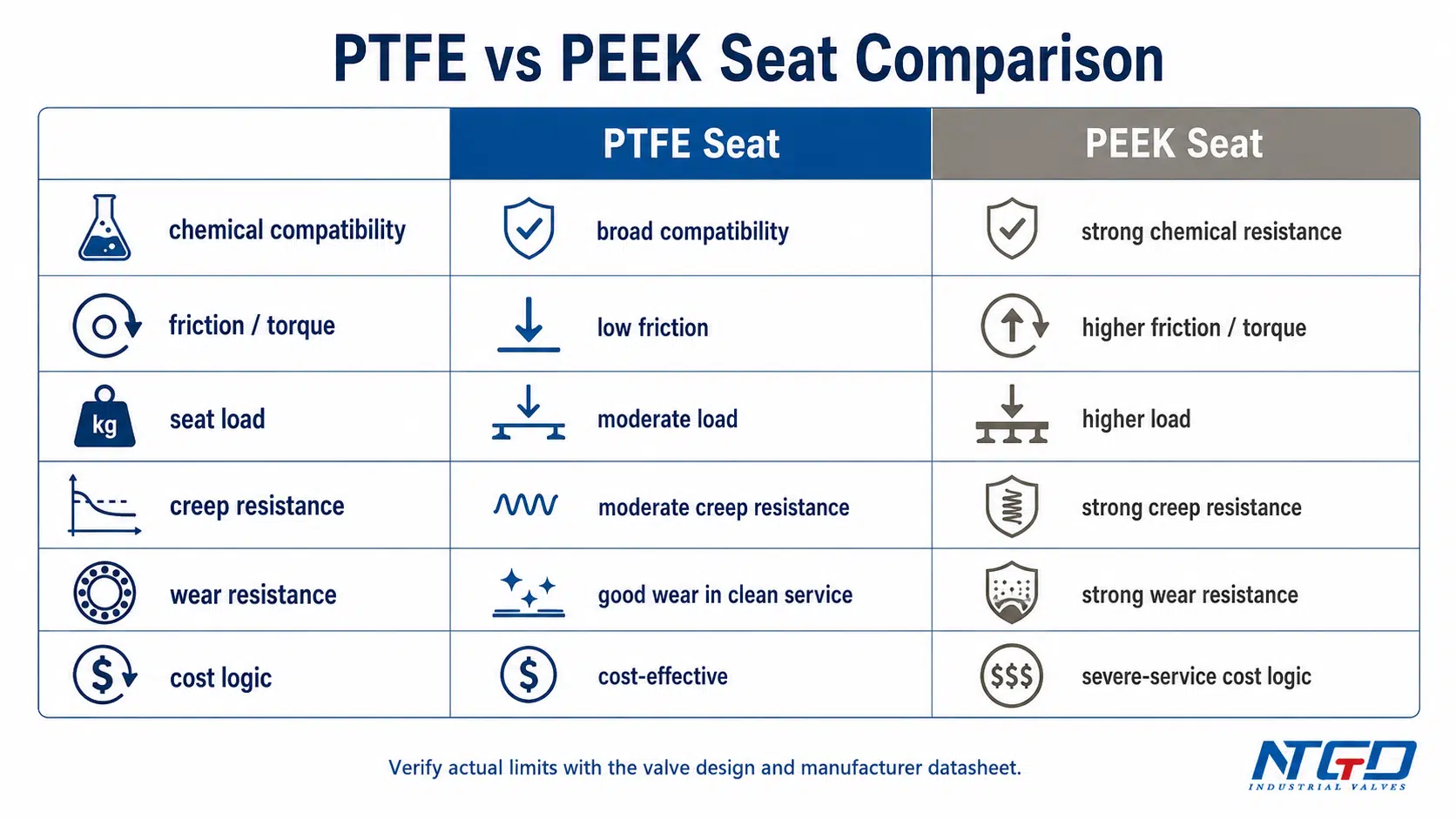
PTFE vs PEEK Seat Comparison Table
The table below summarizes the selection implications of PTFE vs PEEK seats for ball valves. Exact performance limits must always be verified against the valve manufacturer’s datasheet, material grade, pressure-temperature rating, and service conditions.
| Selection factor | PTFE valve seat | PEEK valve seat | Selection implication |
|---|---|---|---|
| Chemical compatibility | Broad chemical resistance in many services | Good chemical resistance, but more media-dependent than PTFE in some aggressive services | PTFE often provides a wider chemical compatibility margin, but the actual fluid, concentration, and temperature still need verification. |
| Temperature behavior | Suitable for many standard services, but mechanical stability may reduce under higher load and heat | Often selected for higher temperature where mechanical strength must be retained | Do not select by material temperature data alone; pressure, seat load, and media can reduce the usable valve seat rating. |
| Pressure / seat load | Good for many standard soft-seated ball valves | Stronger resistance to load, compression, and deformation | PEEK is often better for high-load service where PTFE creep or extrusion could reduce sealing force. |
| Creep / cold flow | More sensitive to creep or cold flow under load | Better creep resistance and dimensional stability | PEEK may be preferred where seat deformation would create leakage or repeated maintenance risk. |
| Wear / abrasion | Good in clean or low-stress service | Better wear resistance in demanding service | PEEK may be better where particles or frequent cycling are present, but seat design and cycle duty still matter. |
| Friction / operating torque | Low friction; often supports smooth operation | Stronger, but not always as low-friction as PTFE | PTFE may be better when low torque is critical; torque can also affect actuator sizing and operating margin. |
| Cost | Lower material cost | Higher material cost | PTFE is often more economical; PEEK may be justified when severe service would otherwise increase maintenance or downtime risk. |
| Best-fit service | Clean, chemically demanding, moderate-load service | High-load, higher-temperature, abrasive, or severe-service applications | Choose by operating conditions, not by material reputation. |
| Selection caution | Watch creep, cold flow, and deformation | Watch chemical compatibility, torque behavior, and cost | Generic material data cannot replace the actual valve datasheet and seat design review. |
How to Choose Between PTFE and PEEK for Ball Valve Seats
As with broader ball valve selection, the best way to choose between PTFE and PEEK is to start from the service conditions, not from the material name.
Choose by Media and Chemical Compatibility
Media compatibility should be checked first. A seat material that looks strong mechanically may still fail if the fluid attacks the polymer, causes swelling, reduces strength, or changes sealing behavior.
Use PTFE when:
- broad chemical compatibility is the main requirement;
- the media is clean or does not impose heavy abrasion;
- low friction and smooth operation are important;
- the valve service is within the PTFE seat design limits.
Use PEEK when:
- the media is compatible with PEEK;
- the service requires higher mechanical strength;
- the seat must resist deformation under pressure or heat;
- the system has higher wear or load demands.
Even when a material appears compatible at room temperature, the long-term sealing behavior can change when media concentration, operating temperature, pressure exposure, and cycling are combined. For ball valves in chemical applications, do not select PTFE or PEEK by material name alone.
Choose by Temperature, Pressure, and Seat Load
Temperature should never be checked alone. A seat material may tolerate a certain temperature in general material data but behave differently inside a pressurized valve seat.
When evaluating the PEEK seat temperature range or PTFE service range, remember that generic material temperature data may be higher than the usable rating inside a pressurized valve seat. Pressure, differential pressure, seat load, media, seat support, and valve construction can all reduce the practical operating window.
Confirm:
- the seat material grade;
- fillers or reinforcements;
- valve pressure class;
- differential pressure;
- seat design;
- media compatibility;
- actual operating and upset conditions.
PEEK is often considered where a seat must keep its shape under higher temperature and pressure. PTFE may still work well in many standard services, especially where chemical compatibility and low friction are more important than high mechanical load.
Choose by Abrasion, Cycling, Torque, and Lifecycle Cost
Wear and operating frequency also affect the decision.
PEEK may be a better option when the valve faces:
- frequent cycling;
- abrasive particles;
- higher seating stress;
- risk of seat extrusion;
- need for dimensional stability over time.
PTFE may be a better option when the valve needs:
- lower torque;
- smooth operation;
- good sealing in clean media;
- chemical resistance at a lower material cost.
Seat material can also influence actuator sizing and maintenance planning. If the seat material increases operating torque or changes seating behavior under pressure, the actuator margin may need to be reviewed.
Cost should be evaluated as lifecycle cost, not only purchase cost. PTFE may reduce upfront cost. PEEK may reduce replacement risk in severe service. The right choice depends on whether the service is standard, moderate, or severe.
What Can Go Wrong with the Wrong Seat Material?
Using the wrong seat material may not cause immediate ball valve failure, but it can create operating problems over time.
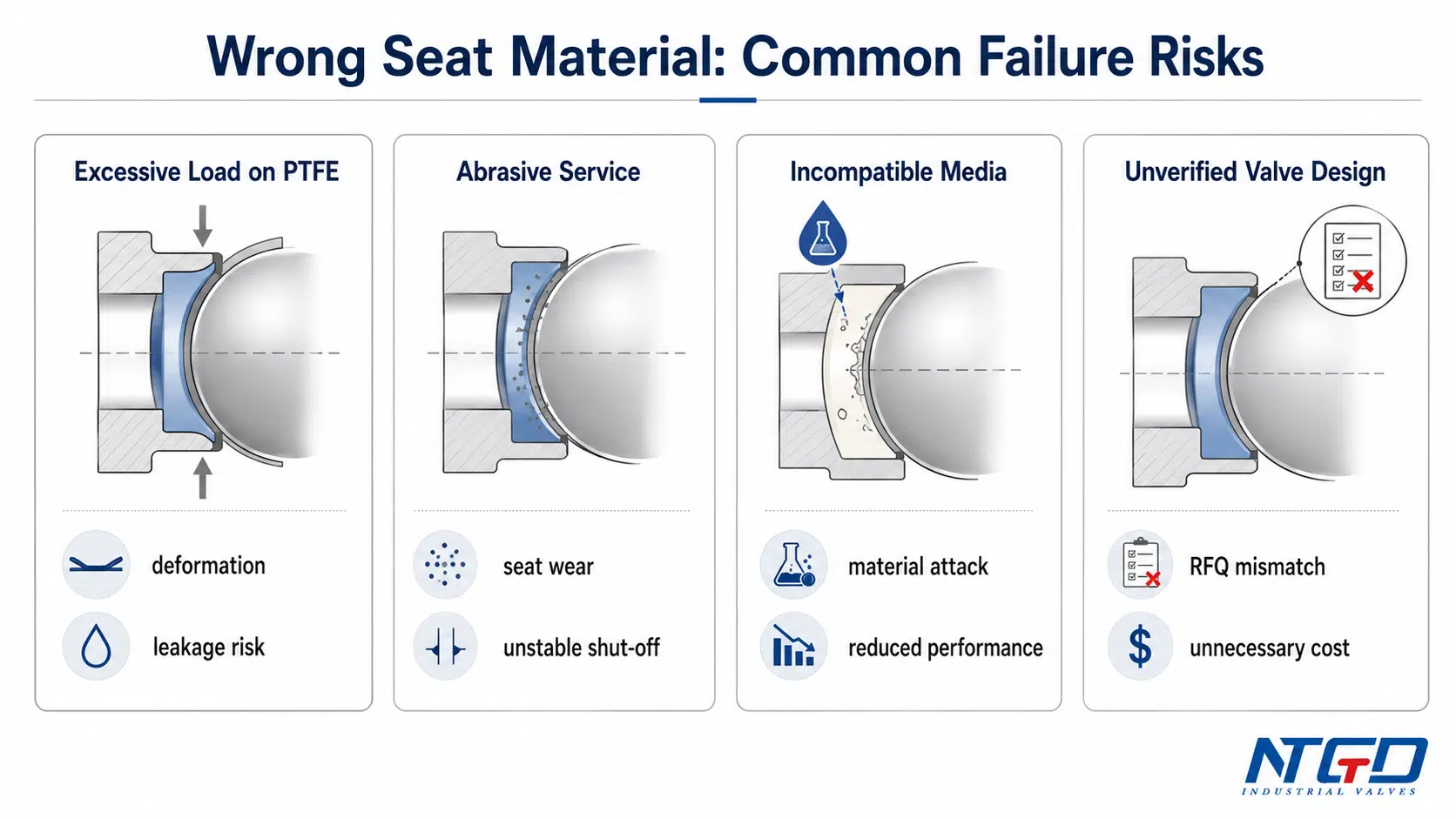
Possible consequences include:
| Wrong selection issue | Possible result |
|---|---|
| PTFE used under excessive load or heat | Seat deformation, cold flow, extrusion, or leakage risk |
| PTFE used in abrasive or high-cycle service | Accelerated wear or loss of sealing stability |
| PEEK used in incompatible chemical media | Material degradation or reduced seat performance |
| PEEK selected when low torque is the main priority | Higher operating torque than expected, depending on design |
| Seat material chosen without checking pressure-temperature limits | Unexpected leakage or shortened service life |
| Material selected without confirming valve design | RFQ mismatch, wrong seat option, or unnecessary cost |
Beyond the valve itself, a seat material mismatch can increase maintenance frequency, create unplanned downtime risk, or introduce contamination concerns in sensitive processes. The seat material decision is therefore both an engineering decision and an operational reliability decision.
A good seat material decision should reduce leakage risk, maintain stable torque, protect sealing surfaces, and avoid unnecessary maintenance. It should also match the valve manufacturer’s actual design, not only generic material data.
Final Fit-Check Before Selecting PTFE or PEEK
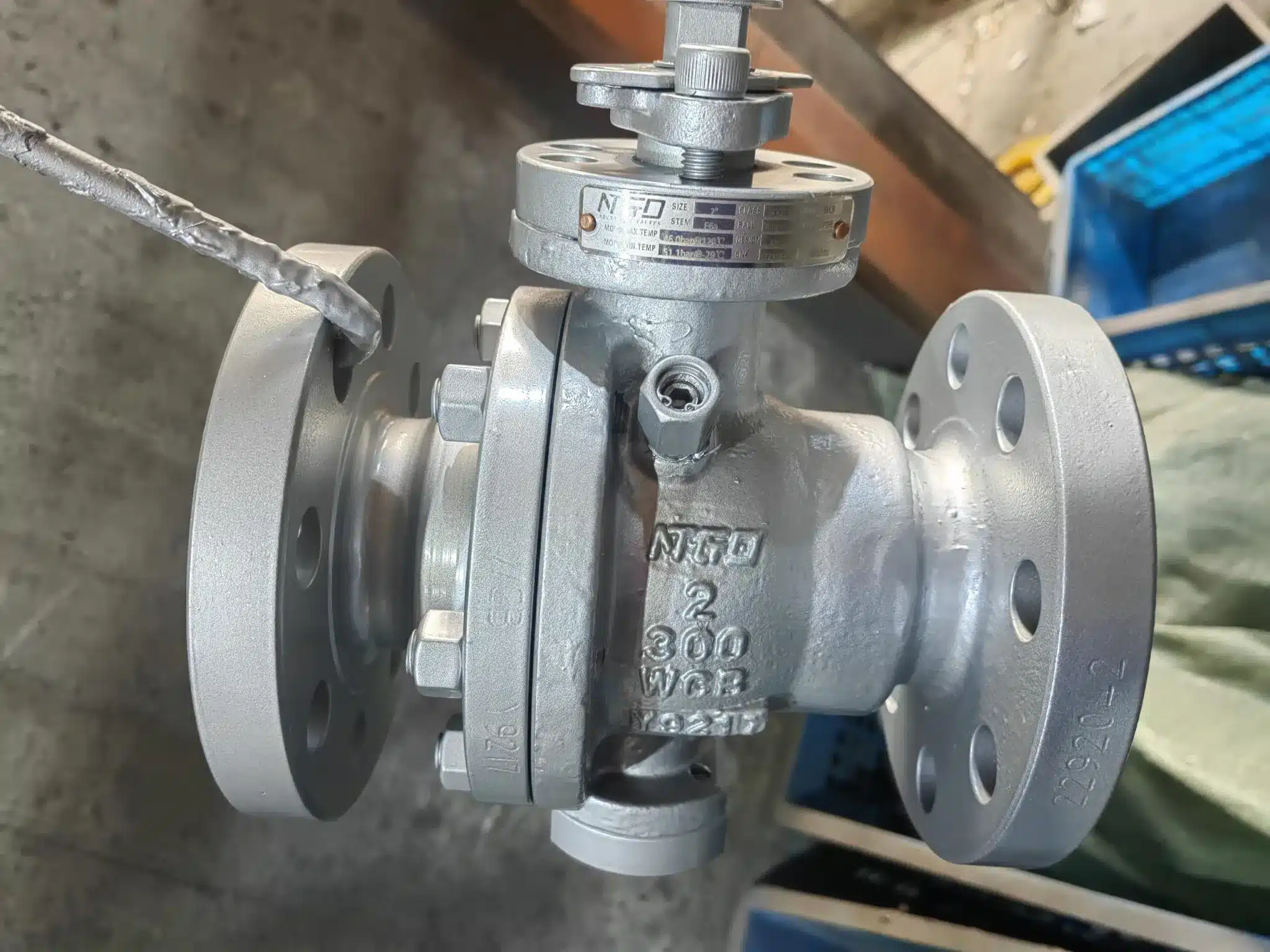
Before selecting PTFE or PEEK for a ball valve seat, confirm the following information:
| Fit-check item | Why it matters |
|---|---|
| Media | Determines chemical compatibility and material safety. |
| Operating temperature | Affects material stability and sealing behavior. |
| Pressure and differential pressure | Determines seat load and extrusion risk. |
| Valve size and pressure class | Influences seat design and required strength. |
| Cycle frequency | Affects wear and long-term seat performance. |
| Abrasive particles or solids | May push selection toward more wear-resistant materials. |
| Required operating torque | Helps evaluate PTFE’s low-friction advantage or actuator needs. |
| Cleanliness or contamination concerns | Affects whether seat wear, shedding, or media reaction creates downstream risk. |
| Required shut-off performance | Determines how conservative the seat selection should be. |
| Manufacturer datasheet | Confirms the real seat material limit for the actual valve design. |
Once the initial material direction is clear, the final step is to confirm the exact valve model, seat design, pressure-temperature rating, and material grade with the manufacturer’s datasheet.
The following pressure test video does not compare PTFE and PEEK directly, but it supports the final verification step: seat material selection should be confirmed together with the actual valve design, pressure class, sealing performance, and manufacturer testing process.
Engineering review is especially important when the service includes mixed media, upset conditions, high differential pressure, abrasive particles, critical shut-off requirements, or uncertain chemical compatibility.
If the application is standard, clean, chemically demanding, and cost-sensitive, PTFE may be the practical choice. If the service is hotter, higher-pressure, abrasive, or mechanically demanding, PEEK may be worth evaluating.
FAQ: PTFE vs PEEK Ball Valve Seat Selection
Is PEEK better than PTFE for ball valve seats?
Not automatically. PEEK is a different solution for a different set of problems. It is usually stronger and more dimensionally stable under higher load, temperature, and wear. PTFE is often the better-engineered choice when broad chemical compatibility, low friction, lower torque, and cost control are more important.
Is Teflon the same as PTFE?
Teflon is a commonly known trade name associated with PTFE. In valve seat discussions, “Teflon vs PEEK” often refers to PTFE vs PEEK. For engineering selection, confirm the actual material grade rather than relying only on the trade name.
What is the difference between PTFE and PEEK seats?
A PTFE seat is usually selected for chemical compatibility, low friction, and smooth ball rotation. A PEEK seat is usually selected when the seat must resist higher seating stress, creep, abrasion, deformation, or dimensional change. The practical difference is not only material strength; it is how the seat maintains sealing force, torque behavior, and shut-off reliability inside the valve.
What is the best material for ball valve seats?
There is no single best material for all ball valve seats. PTFE, PEEK, RPTFE, TFM, elastomers, and metal seats can all be suitable in different services. The best material depends on media, temperature, pressure, cycling, torque, shut-off requirement, and valve design.
What is the PEEK seat temperature range?
There is no safe universal temperature range that applies to every PEEK valve seat. The usable range depends on the PEEK grade, fillers, pressure, media, seat design, and the valve manufacturer’s pressure-temperature rating. The actual valve seat rating may be lower than generic material data, especially when pressure, media, and differential pressure are involved.
When should PTFE be used instead of PEEK?
PTFE should be chosen when its combination of broad chemical resistance, low friction, smooth operation, and cost-effectiveness aligns with the service. This is common in clean process lines, chemical service, water treatment, and utility applications where extreme mechanical load, abrasion, or high differential pressure is not the main concern.
Is RPTFE the same as PTFE?
No. RPTFE usually refers to reinforced PTFE, which includes fillers to improve certain mechanical properties. It is related to PTFE but should not be treated as identical. Compatibility, pressure-temperature behavior, and valve design still need to be confirmed.
Are metal seats part of the same selection?
Metal seats are part of the broader ball valve seat material family, but they serve a different selection logic. They may be used for very high temperature, abrasive, or severe shut-off services where soft polymer seats are not suitable. This article focuses on PTFE vs PEEK polymer seats.
Does ball valve seal material affect torque or leakage?
Yes. Seat material can affect friction, sealing force, deformation, wear, and long-term leakage risk. PTFE may help reduce torque because of its low-friction behavior. PEEK may provide better stability under higher load, but final torque and leakage performance depend on the complete valve design.
Can I replace a PTFE seat with a PEEK seat in an existing ball valve?
Not automatically. A PEEK seat may require a different seat pocket, different support, different torque allowance, or different actuator margin. Before replacing PTFE with PEEK, confirm the valve model, seat design, pressure-temperature rating, chemical compatibility, and manufacturer support for that seat option.
Conclusion
PTFE and PEEK can both be effective ball valve seat materials, but they solve different problems. PTFE is usually the practical choice for chemical compatibility, low friction, smooth operation, and cost control. PEEK is usually the stronger choice for higher load, higher temperature, abrasion, creep resistance, and dimensional stability.
The safest selection is not based on material reputation or a single property. It should be based on the actual media, temperature, pressure, differential pressure, valve size, cycling frequency, torque requirement, seat design, and manufacturer datasheet.
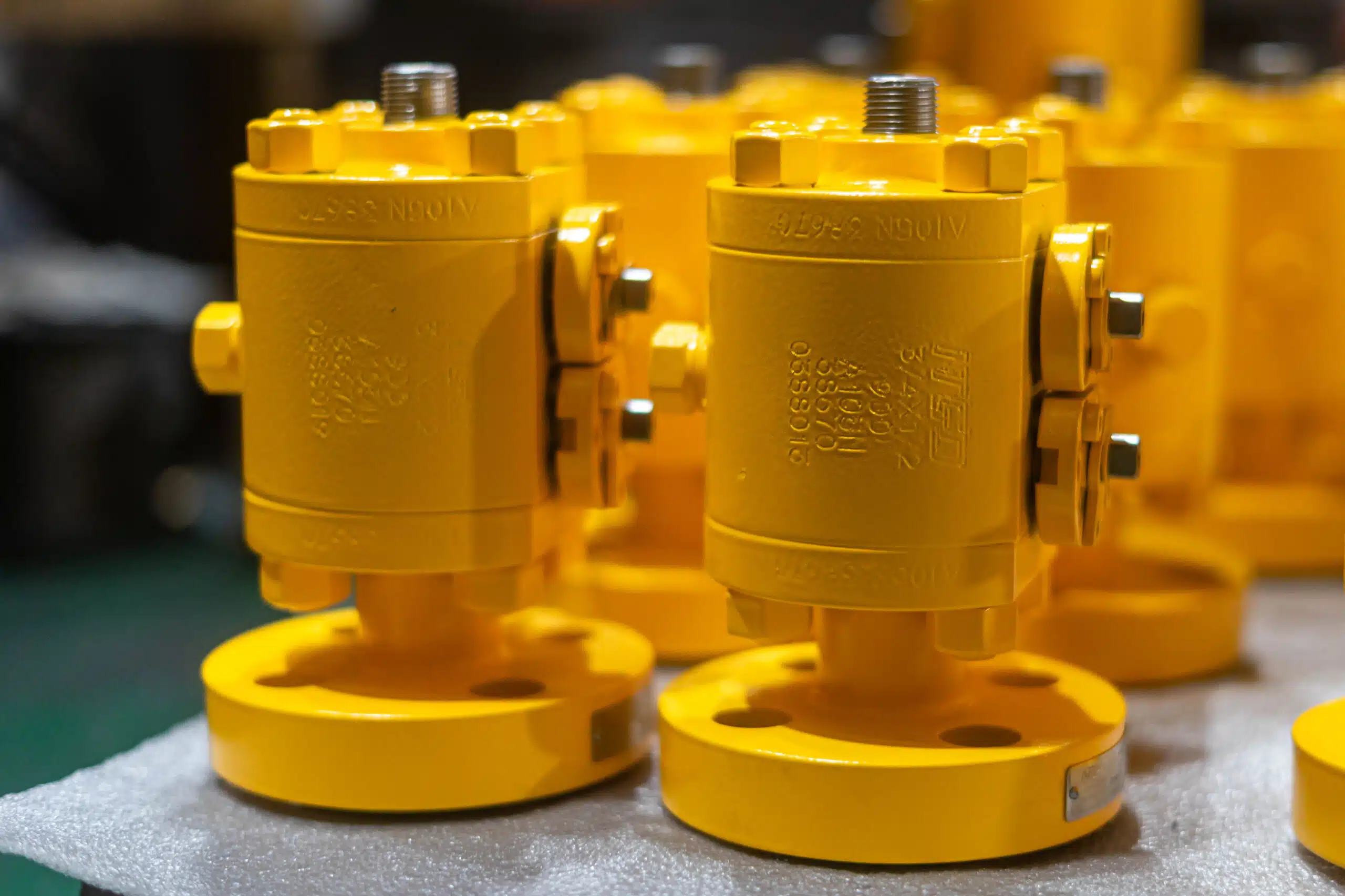
Need Help Choosing PTFE or PEEK Seats?
For ball valve projects where the media, pressure, temperature, differential pressure, or cycling conditions are difficult to judge, share your service conditions with the NTGD Valve team. We can help review chemical compatibility, combined pressure-temperature effects, and seat design factors to reduce selection risk before final valve specification.
