
Author Name: Bruce Zheng
Author Role: Co-Founder and Valve Engineer at NTGD Valve
Author Bio: Bruce Zheng is Co-Founder and Valve Engineer at NTGD Valve, focusing on industrial valve selection, application, and technical content for global B2B buyers.
Last Updated: May 31, 2026
Quick Answer: Knife Gate Valve vs Gate Valve / Wedge Gate Valve
A knife gate valve is a specialized gate-type isolation valve designed mainly for slurry, pulp, wastewater, sludge, and media containing suspended solids or fibers. A standard gate valve, in this comparison, usually means a conventional wedge-style gate valve used for clean-fluid isolation, pressure-rated pipelines, and applications where a stronger pressure boundary and more predictable shutoff are required.
The main difference between a knife gate valve and a gate valve is not only the gate shape. It is the service condition each valve is designed to tolerate.
| Selection Question | Better Fit | Why |
|---|---|---|
| Does the media contain slurry, sludge, pulp, fibers, or solids? | Knife gate valve | The thin blade gate and open flow path help handle difficult media better than a conventional wedge gate design. |
| Is the media clean water, steam, oil, gas, or clean process fluid? | Wedge-style gate valve | The wedge gate and pressure-rated body are more suitable for clean-fluid isolation. |
| Is high-pressure clean service the main concern? | Wedge-style gate valve | The pressure class, body design, seat contact, and applicable standard usually matter more than solids-handling ability. |
| Is compact face-to-face length important? | Knife gate valve | Many knife gate valves are more compact than conventional wedge gate valves. |
| Is tight shutoff required in clean service? | Wedge-style gate valve | A wedge gate valve is usually the safer starting point, but the final choice must still be checked against the project specification. |
In short, choose a knife gate valve when the media is difficult. Choose a wedge-style gate valve when the pipeline service is cleaner and pressure sealing is the stronger priority.
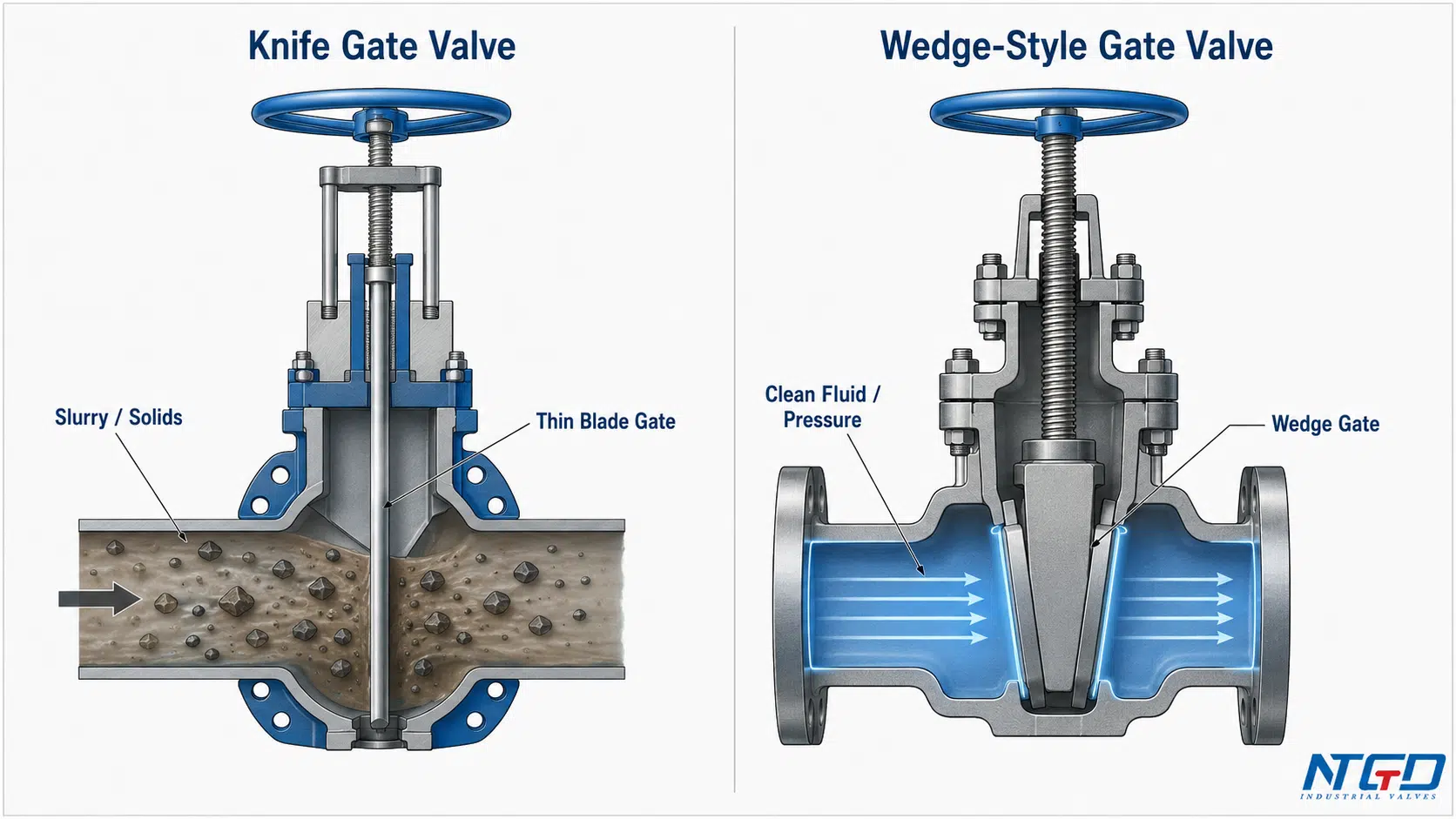
What “gate valve” means in this comparison
In this article, “gate valve” mainly refers to a standard or conventional wedge-style gate valve. This is important because a knife gate valve is also part of the wider gate valve family, but it is not selected the same way as a conventional wedge gate valve.
A wedge gate valve uses a wedge-shaped closure member that moves up and down between two seats. It is commonly used for on/off isolation in water, steam, oil, gas, and general clean-fluid pipelines. A knife gate valve uses a thinner blade-like gate. It is built for services where solids, fibers, or slurry may interfere with a conventional wedge and seat arrangement.
So when users search for knife gate valve vs gate valve or gate valve vs knife gate valve, the real question is usually:
Selection question: Should the pipeline use a slurry-capable knife gate valve, or a conventional wedge-style gate valve for clean-fluid isolation?
Is a knife valve the same as a knife gate valve?
In many search results and buyer conversations, “knife valve” is used as a shortened term for knife gate valve. The two expressions often refer to the same general valve category.
However, in engineering selection, the full term “knife gate valve” is more precise. It makes clear that the valve uses a gate-type closure design and is mainly intended for isolation service, not for throttling or continuous flow control.
Are Knife Gate Valves and Wedge Gate Valves the Same?
Knife gate valves and wedge gate valves are related, but they are not the same.
Both valves use a gate that moves perpendicular to the flow path. Both are normally used as on/off isolation valves. Both should generally be operated fully open or fully closed, rather than used as control valves for throttling.
The difference is in the gate geometry, body design, sealing logic, and service environment.
A knife gate valve uses a thin blade gate. This blade can pass through some thick or fibrous media and close in services where solids may be present. This makes knife gate valves common in pulp and paper, wastewater treatment, mining slurry, sludge handling, cement, and other abrasive or solids-laden applications.
A wedge gate valve uses a wedge-shaped gate that seats against two sealing surfaces. This design is better suited for clean-fluid isolation, especially where pressure rating, temperature, body strength, and shutoff reliability are more important than cutting through solids.
For the complete stem-travel and wedge-seating sequence used by the conventional design, see NTGD’s guide to the conventional wedge gate valve working principle.
The practical selection rule is simple:
Selection rule: A knife gate valve is selected because the media is difficult. A wedge gate valve is selected because the pressure boundary and clean-fluid shutoff are the priority.
This does not mean one valve is universally better. It means each valve solves a different engineering problem.
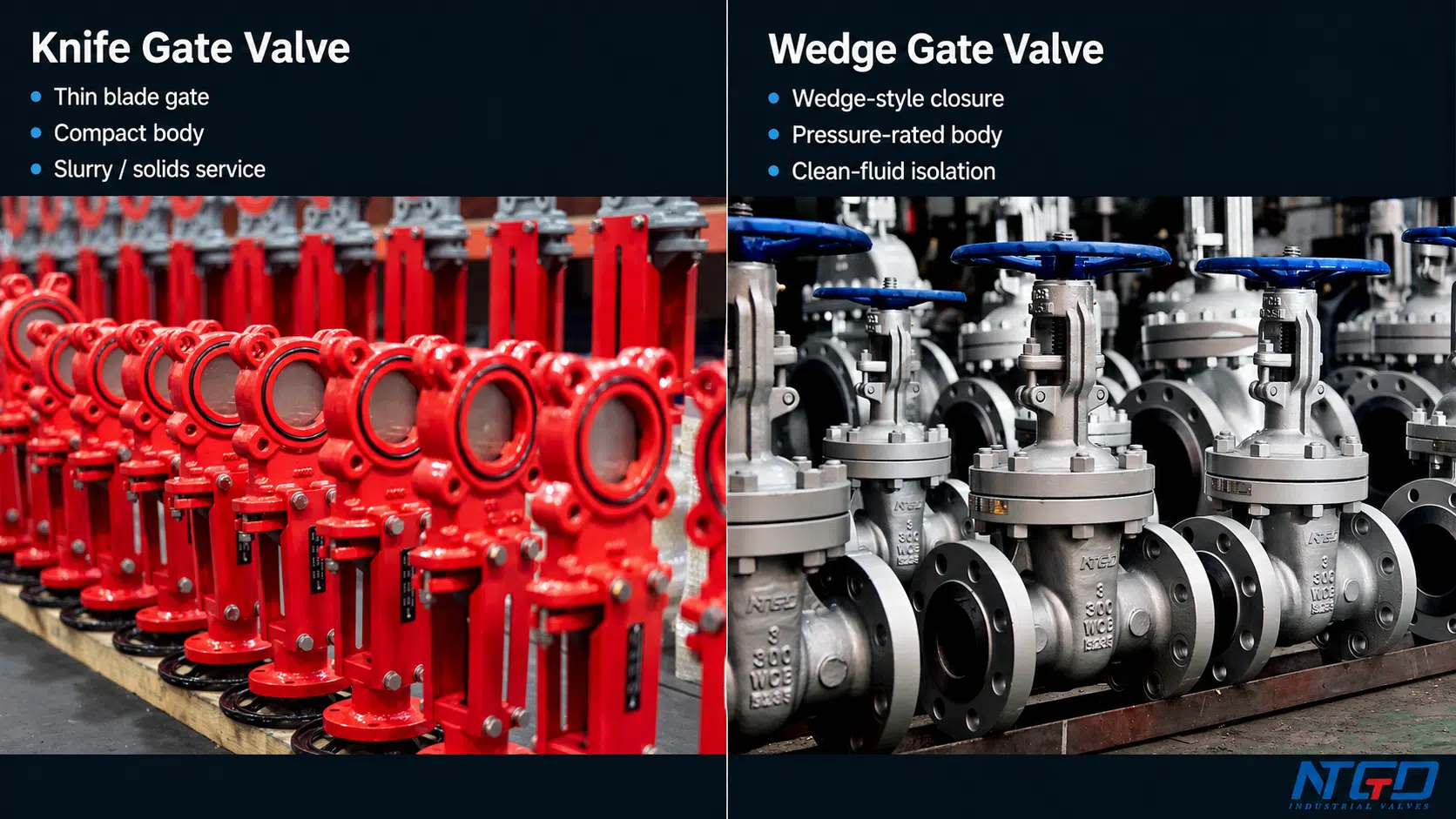
Knife Gate Valve vs Wedge Gate Valve: Key Differences Table
The table below consolidates the most important differences between a knife gate valve and a wedge-style gate valve.
| Difference Point | Knife Gate Valve | Wedge / Conventional Gate Valve | Selection Meaning |
|---|---|---|---|
| Main selection purpose | Isolation of slurry, sludge, pulp, wastewater, fibers, and solids-laden media | Isolation of clean water, steam, oil, gas, and clean process fluids | Start with the media condition before comparing price or size. |
| Gate shape | Thin blade-shaped gate | Wedge-shaped gate | The knife gate is built to pass through difficult media; the wedge gate is built for seat compression and pressure sealing. |
| Body profile | Often compact, with short face-to-face dimensions | Usually heavier and longer, depending on pressure class and standard | Knife gate valves can help where installation space is limited. |
| Flow path | Often more open for difficult media | Full-bore or near full-bore in open position, but with wedge and seat geometry | Both can offer low resistance when fully open, but the internal geometry handles solids differently. |
| Media suitability | Slurry, pulp, sludge, wastewater, tailings, fibrous media | Clean water, steam, oil, gas, chemical lines with compatible clean media | Dirty or fibrous service usually favors knife gate valves. |
| Sealing logic | Depends heavily on seat design, packing, gate condition, and media | Wedge-to-seat contact provides sealing in clean service | Do not assume equal leakage performance across valve types. |
| Pressure suitability | Often used in lower-to-medium pressure difficult media, depending on design | Commonly used in pressure-class clean-fluid pipelines | Always verify pressure class, material, seat design, and standard. |
| Solids handling | Better suited for media with suspended solids | Poorer fit for slurry or fibrous media | Solids can interfere with wedge seating and closure. |
| Actuation force | Often lower in suitable service, but can increase with solids buildup or seat friction | Can require higher torque, especially in larger sizes or higher pressure classes | Actuator sizing must be checked for the actual service. |
| Maintenance focus | Seat wear, packing, gate wear, buildup around gate area | Stem, wedge, seat surfaces, corrosion, body-bonnet sealing | Maintenance priorities differ because the failure mechanisms differ. |
| Cost logic | Can cost more when special materials, seats, coatings, or actuators are required | Often cost-effective for standard clean-fluid isolation | Compare lifecycle cost, not only purchase price. |
The table should not be read as a universal ranking. It is a selection map. A knife gate valve is not “better” than a wedge gate valve in every system. It is better when the service condition matches its design purpose.
Design, Sealing, Pressure and Standards Differences
Gate shape and body profile
The gate shape is the most visible difference.
A knife gate valve uses a thin blade gate. The blade moves down through the flow path and is designed to close in media that may contain pulp, fibers, sludge, slurry, or soft solids. The body is often thinner than a conventional wedge gate valve body, and many designs have a shorter face-to-face length.
A wedge gate valve uses a thicker wedge-shaped gate. The wedge moves into the seat area and creates sealing contact through the wedge geometry. This design is better suited for clean media, where solids are not expected to collect around the seating surfaces.
The body profile also affects installation. Knife gate valves are often selected where space and weight matter, especially in large slurry or wastewater lines. Wedge gate valves are usually selected where pressure class, body strength, end connection, and conventional pipeline standards dominate the specification.
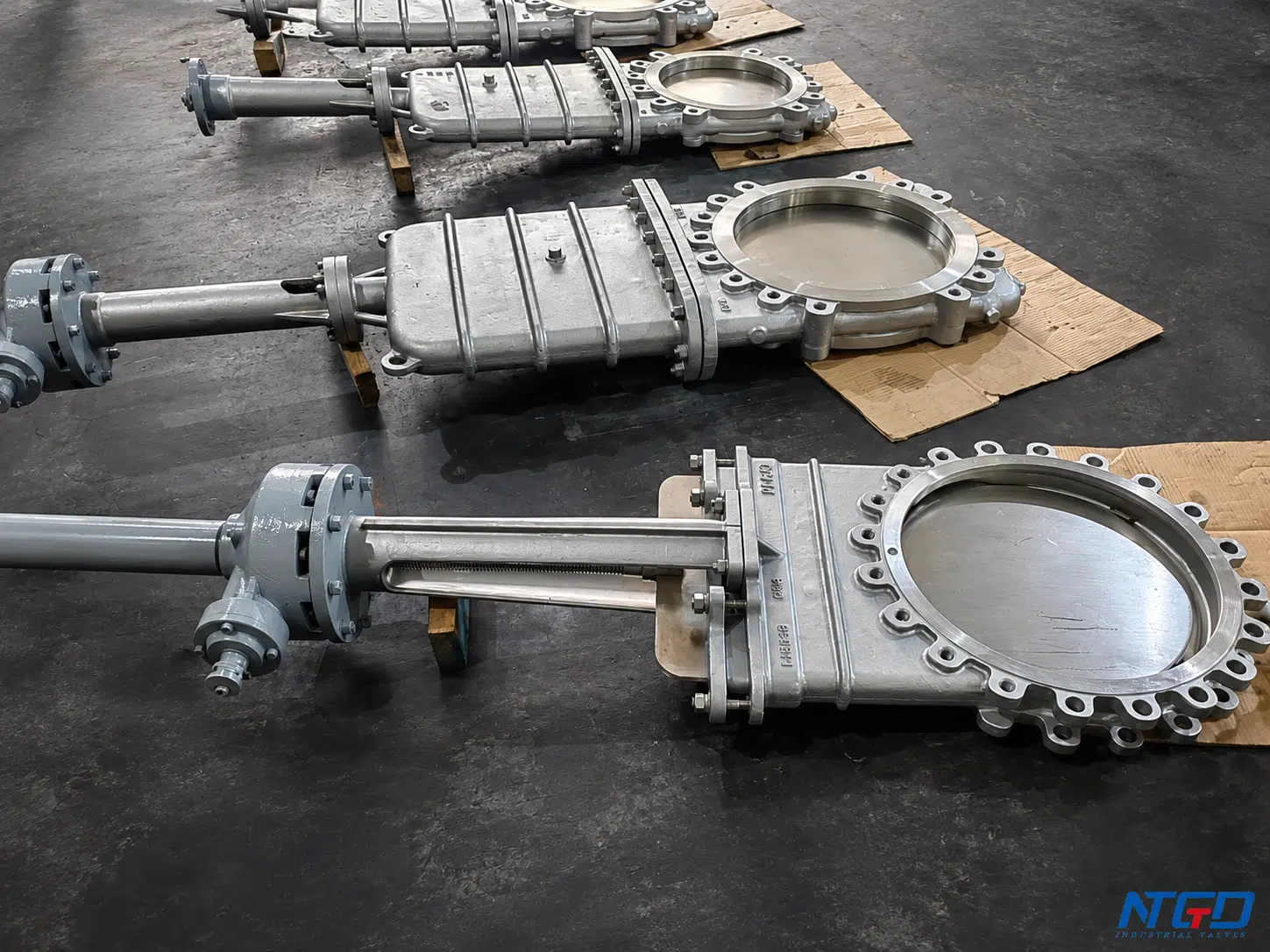
Packing, seat design and leakage boundary
Sealing performance depends on the specific valve design. It should not be described as simply “knife gate valves leak” or “wedge gate valves never leak.”
A knife gate valve may use resilient seats, metal seats, elastomer seals, packing glands, or other sealing arrangements depending on the manufacturer and service. Its leakage performance depends on the seat material, gate surface, packing condition, pressure direction, solids content, and wear.
In abrasive slurry service, the gate and seat area can wear over time. In fibrous media, buildup can also affect closure. This is why knife gate valves should be selected with the media condition clearly defined.
A wedge gate valve relies on the wedge and seat surfaces to achieve isolation. In clean service, this can provide reliable shutoff. But if solids, scale, fibers, or slurry collect around the seat, the wedge may not close properly. This can cause leakage, higher operating torque, or seat damage.
Seat design is critical because elastomer, metal, and special seats behave differently under solids, abrasion, temperature, pressure, and chemical exposure.
Leakage expectation should be verified against the seat design, pressure rating, API Std 598 or the applicable test requirement, and the project specification.
Pressure rating, face-to-face and standards note
Pressure and standard requirements are another major difference between knife gate valves and wedge gate valves.
Wedge gate valves are commonly specified by pressure class, body material, end connection, testing requirement, and applicable industrial valve standards. They are widely used in pipelines where clean-fluid pressure containment is the dominant concern.
For wedge-style steel gate valves, API Standard 600 may define the pressure class, seating route, bonnet construction, end connection, and testing scope when it applies to the project.
Knife gate valves may follow different industrial, application-specific, or project-specific requirements depending on the service. A knife gate valve for wastewater sludge is not specified the same way as a wedge gate valve for steam or oil service.
For knife gate valves, do not assume the same standard route used for conventional wedge gate valves; MSS SP-81 is one standard route to check when it matches the knife gate valve construction.
The key point is that standards should not be copied from one valve type to another without verification. Applicable standards such as ASME B16.34 may affect pressure-temperature rating, materials, end connection, test requirement, and marking. The buyer should check:
| Specification Item | Why It Matters |
|---|---|
| Pressure class or pressure rating | Confirms whether the valve can handle the working pressure and test pressure. |
| Body material | Must match corrosion, abrasion, temperature, and pressure requirements. |
| Seat material | Affects leakage, wear resistance, media compatibility, and temperature boundary. |
| Face-to-face dimension | Determines whether the valve fits the existing pipeline layout. |
| End connection | Must match flange, wafer, lug, butt-weld, or other piping requirements. |
| Test requirement | Confirms how pressure and leakage performance will be verified. |
| Actuation method | Manual, pneumatic, electric, hydraulic, or gear operation affects torque and control. |
For this reason, a knife gate valve vs wedge gate valve comparison should not stop at appearance. It must include pressure rating, seat material, leakage expectation, and project standard.
Media and Application Fit: Slurry Service vs Clean-Fluid Isolation
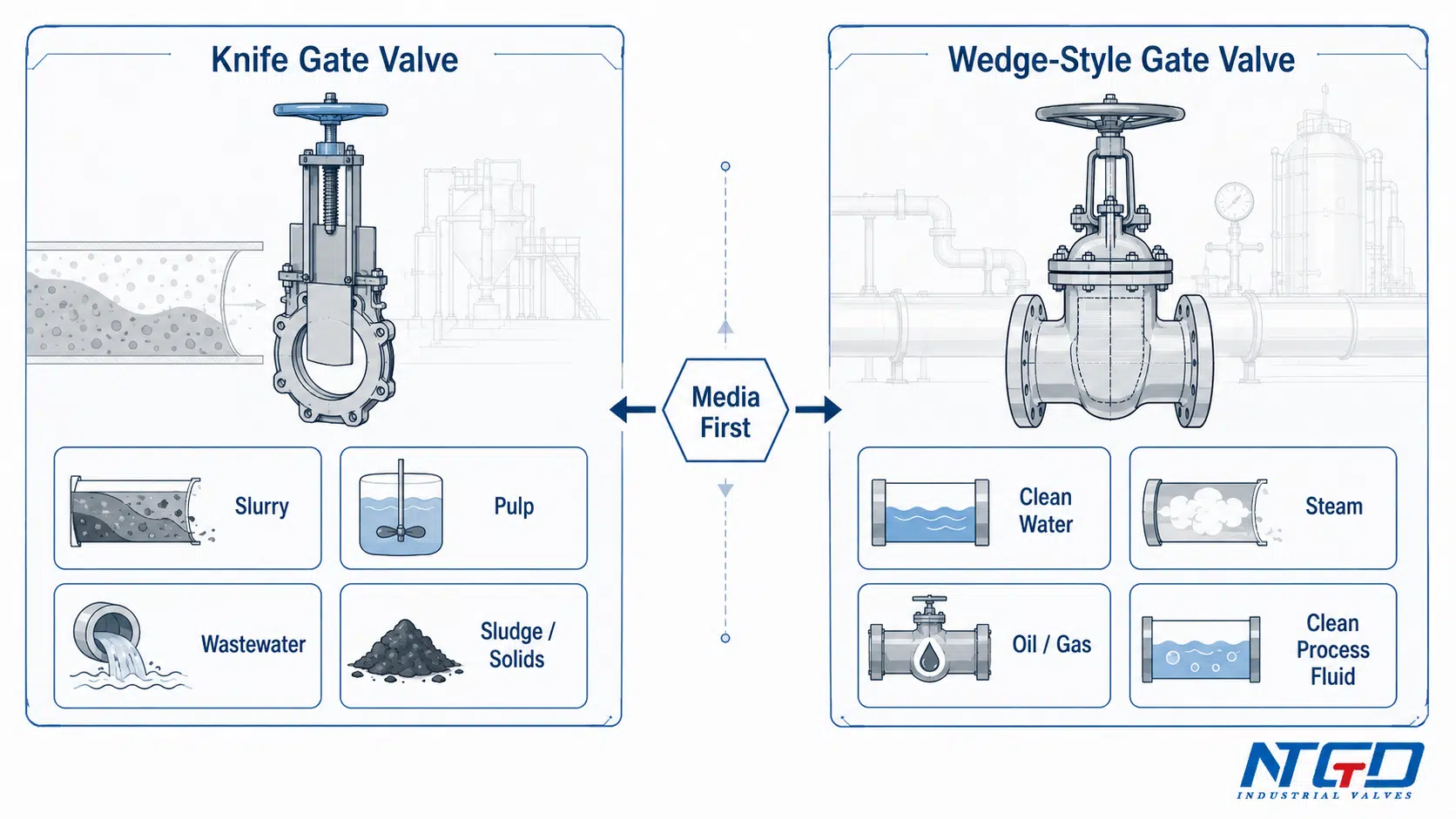
When knife gate valves fit better
A knife gate valve fits better when the main challenge is the media.
For high-solids slurry isolation, knife gate valves are often one of the first valve routes to review.
Typical services include:
- slurry with suspended solids;
- pulp and paper stock;
- wastewater sludge;
- mining tailings;
- cement slurry;
- ash handling;
- abrasive or fibrous media;
- thick or dirty process fluid where conventional seating may clog.
The thin gate helps close through media that would be difficult for a conventional wedge gate valve. The body design can also reduce areas where solids accumulate, depending on the valve construction.
However, a knife gate valve is not automatically suitable for every severe service. The final selection must still check pressure, temperature, solids concentration, abrasion, corrosion, seat material, packing design, actuator torque, and installation direction.
When wedge-style gate valves fit better
A wedge-style gate valve fits better when the pipeline service is cleaner and the main requirement is reliable isolation under pressure.
Typical services include:
- clean water pipelines;
- steam lines within the valve’s rating;
- oil and gas service with compatible media;
- clean process fluid isolation;
- utility systems;
- pressure-class industrial pipelines.
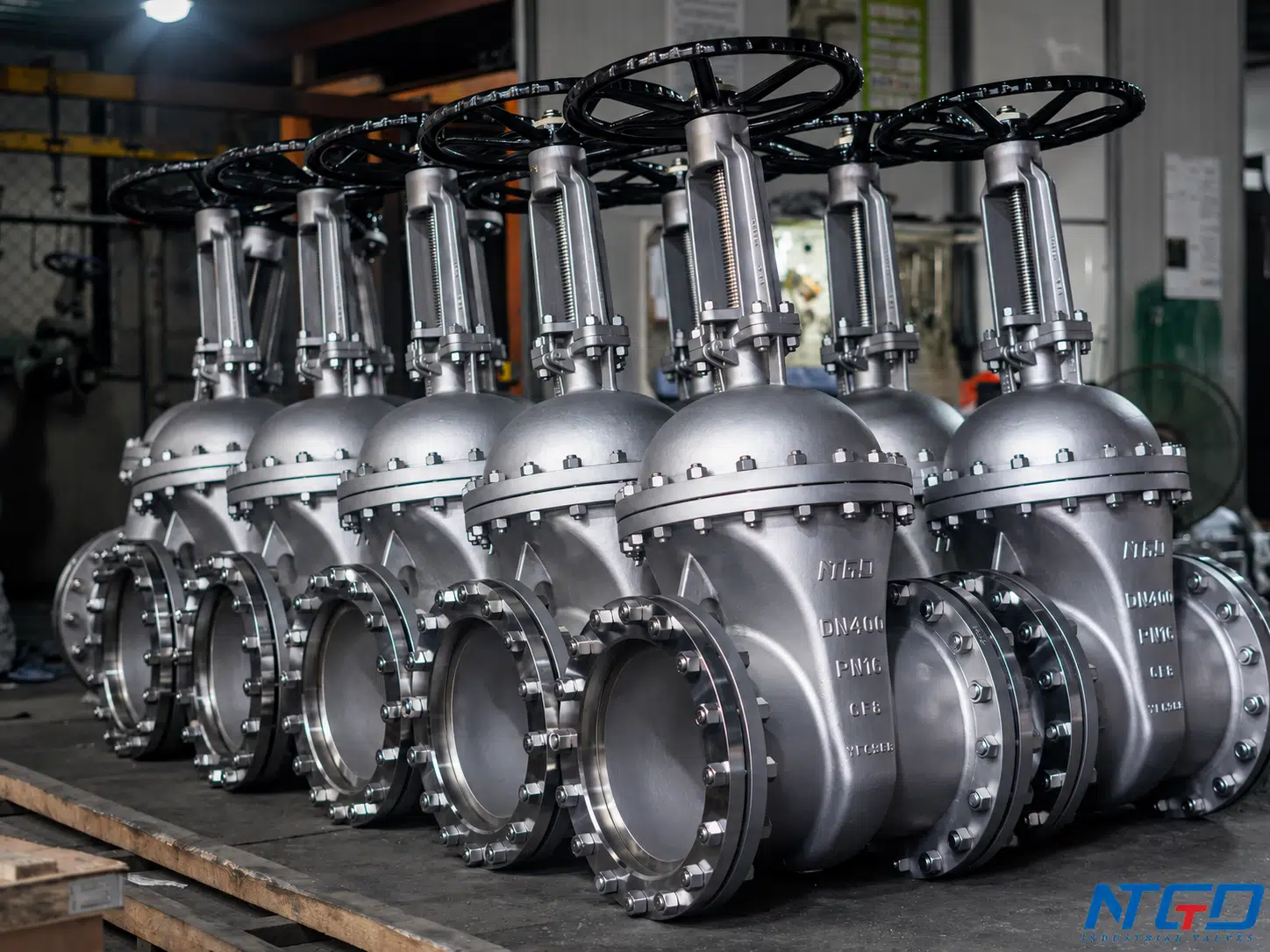
A wedge gate valve is usually the stronger starting point when the buyer needs a conventional pressure-retaining valve for clean-fluid isolation. It can provide a robust pressure boundary and reliable shutoff when the media does not contain solids that damage or block the seating area.
The main limitation is dirty service. If slurry, pulp, sludge, or fibers are present, a wedge gate valve can become harder to operate and less reliable because solids may interfere with the wedge and seat contact.
| Service Condition | Better Starting Point | Selection Reason |
|---|---|---|
| Slurry with suspended solids | Knife gate valve | Better solids-handling logic. |
| Pulp and paper stock | Knife gate valve | Fibers are less suitable for wedge seating. |
| Wastewater sludge | Knife gate valve | Sludge can interfere with conventional gate seating. |
| Mining tailings | Knife gate valve | Abrasion and solids handling dominate. |
| Clean water isolation | Wedge gate valve | Clean-fluid shutoff and pressure rating dominate. |
| Steam service | Wedge gate valve | Pressure and temperature specification must be verified. |
| Oil or gas clean service | Wedge gate valve | Conventional pressure-class isolation is usually required. |
| Limited installation space | Often knife gate valve | Compact body profile may help. |
| High-pressure clean service | Often wedge gate valve | Pressure class and body design usually dominate. |
Wrong Valve Selection Risks
Wrong valve selection can create leakage, operating difficulty, premature seat wear, excessive torque, maintenance shutdowns, or unsafe operation.
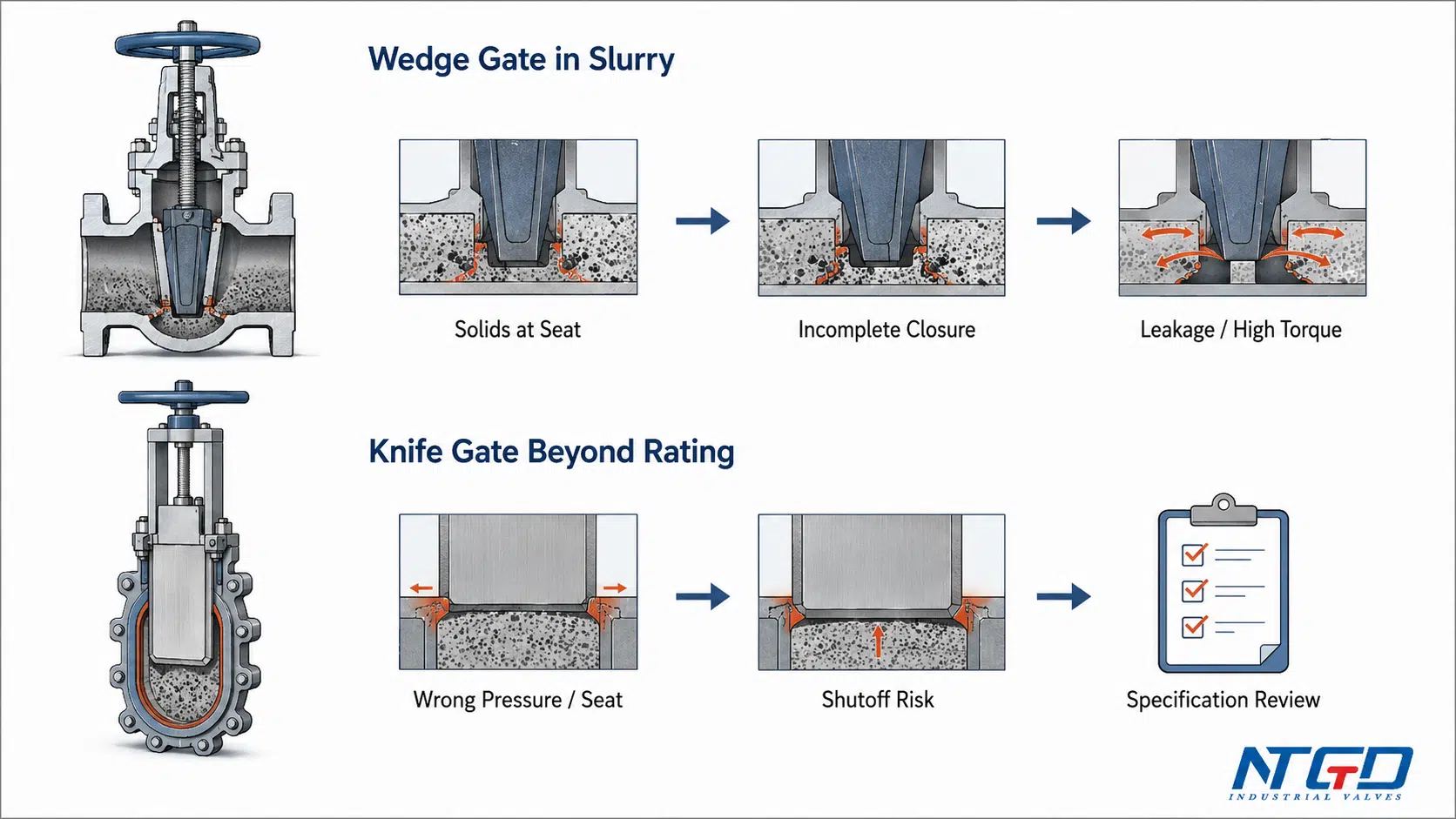
What happens when a wedge gate valve is used in slurry service
Using a wedge gate valve in slurry or fibrous service can create several problems.
The most common risk is incomplete closure. Solids may collect near the seating area and prevent the wedge from fully seating. This can create leakage even if the valve body and pressure class are technically strong enough for the system.
The second risk is seat damage. Abrasive solids can wear the seating surfaces. Once the seat is damaged, the valve may require higher torque to operate and may no longer seal as expected.
The third risk is jamming. If fibers, sludge, or scale accumulate around the wedge and guides, the valve may become difficult to operate. In severe cases, the stem, wedge, or actuator can be overloaded.
This is why wedge gate valves are normally not the first choice for slurry, pulp, sludge, or solids-heavy service.
What happens when a knife gate valve is used beyond its pressure or sealing range
The opposite mistake is also common. A knife gate valve should not be selected only because it is compact or because it appears easier to operate.
If the service is high-pressure clean fluid with strict leakage requirements, the seat and pressure boundary of the knife gate valve must be checked carefully. Some knife gate valve designs are excellent for difficult media but may not be the best choice for high-pressure clean-fluid isolation.
Possible problems include:
| Wrong Selection | Possible Result | Engineering Reason |
|---|---|---|
| Knife gate valve used where a pressure-class wedge gate valve is required | Reduced confidence in pressure isolation | Body design, seat design, and applicable standard may not match the service. |
| Knife gate valve used for strict clean-fluid shutoff without checking leakage requirement | Leakage concern | Seat type and test requirement may not meet the project need. |
| Knife gate valve used for throttling | Gate and seat wear | Both knife gate and wedge gate valves are primarily isolation valves. |
| Knife gate valve used in severe abrasion without suitable material | Shorter service life | Gate, seat, and body surfaces may wear quickly. |
| Knife gate valve selected without actuator torque review | Operation difficulty | Solids buildup, pressure direction, and seat friction can change operating force. |
The safe approach is to define the service first, then select the valve type.
Pros and Cons of Knife Gate and Wedge-Style Gate Valves
Knife gate valves and wedge-style gate valves both have clear advantages, but only when they are applied in the correct service.
| Valve Type | Main Advantages | Main Limitations |
|---|---|---|
| Knife gate valve | Better for slurry, sludge, pulp, wastewater, fibrous media, and many solids-laden services. Often compact and suitable for difficult media isolation. | Not always suitable for high-pressure clean service, strict leakage requirements, or throttling. Seat and packing wear must be monitored in abrasive service. |
| Wedge-style gate valve | Better for clean-fluid isolation, pressure-class pipelines, and services where conventional pressure boundary and shutoff are required. | Poorer fit for slurry, fibrous media, sludge, or dirty service where solids can affect seating. Usually larger and may require higher operating torque. |
Knife gate valve pros
A knife gate valve is useful when solids handling is more important than conventional clean-fluid pressure sealing. Its blade-like gate can cut through or pass through some difficult media, depending on the design. This makes it suitable for slurry, pulp, sludge, wastewater, and other applications where a wedge gate valve may clog or fail to seat properly.
Knife gate valves are also often more compact. This helps in large-diameter slurry pipelines or retrofit applications where installation space is limited.
Knife gate valve cons
A knife gate valve is not a universal replacement for a wedge gate valve. It may not be the best option for high-pressure clean service, steam service, or applications with very strict leakage requirements unless the design is specifically rated and tested for that duty.
In abrasive media, the gate and seat can wear. In sticky media, buildup can affect movement and sealing. Regular inspection of the seat, packing, and gate surface is important.
Wedge-style gate valve pros
A wedge-style gate valve is a strong choice for clean-fluid isolation. Its body, wedge, seats, bonnet, stem, and end connections are commonly specified for pressure-class pipeline service. When the media is clean and compatible, it can provide reliable isolation with low pressure drop in the fully open position.
Wedge gate valves are also familiar to engineers, contractors, and maintenance teams. This makes specification, installation, and replacement more straightforward in many water, oil, gas, steam, and utility systems.
Wedge-style gate valve cons
A wedge-style gate valve is not ideal for slurry or fibrous media. Solids can collect near the seats and prevent full closure. Abrasive particles can damage sealing surfaces. In larger sizes or higher pressure classes, the required operating torque can also increase.
A wedge gate valve should also not be used as a throttling valve. Partially open operation can damage the wedge and seats over time.
Cost, Maintenance and Final Selection Checklist
Cost and maintenance factors
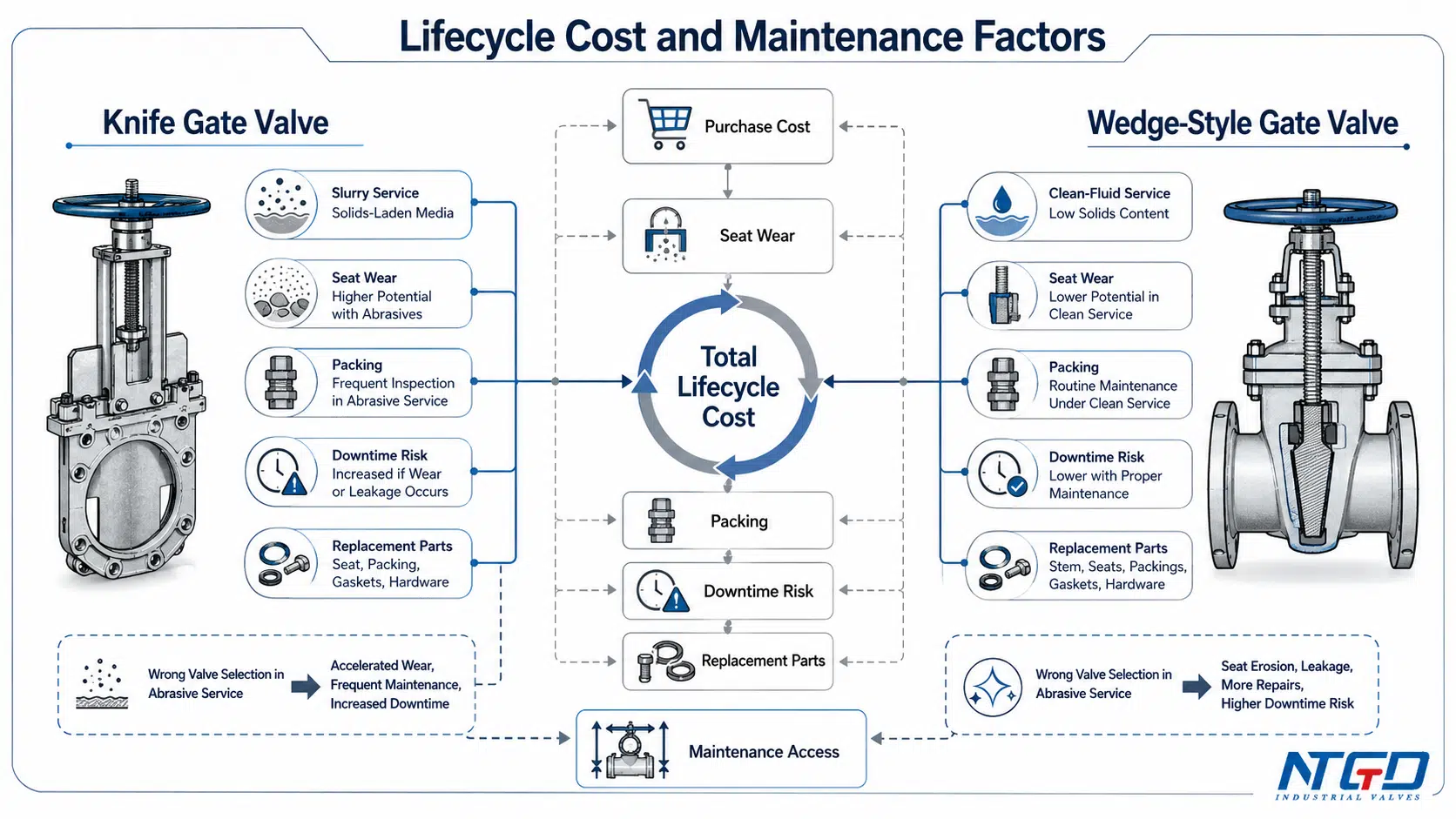
The cost difference between a knife gate valve and a wedge gate valve should be evaluated as lifecycle cost, not only purchase cost.
A knife gate valve may have a higher cost when the project requires stainless steel, corrosion-resistant materials, abrasion-resistant seats, special coatings, pneumatic or hydraulic actuation, or severe-service design. But in slurry or wastewater service, choosing the correct knife gate valve can reduce problems caused by clogging, jamming, and frequent seat damage.
A wedge gate valve may be more economical for standard clean-fluid isolation. But if it is used in dirty or abrasive media, the lower initial cost can be offset by maintenance, leakage, or operational failure.
| Cost / Maintenance Factor | Knife Gate Valve | Wedge-Style Gate Valve |
|---|---|---|
| Purchase cost | Can increase with special materials, seats, coatings, or actuation | Often economical for standard clean-fluid service |
| Main maintenance focus | Gate wear, seat wear, packing, solids buildup | Stem, wedge, seats, body-bonnet joint, corrosion |
| Lifecycle risk | Severe abrasion or wrong seat selection can shorten life | Dirty media can cause seat damage or incomplete closure |
| Installation concern | Face-to-face length, orientation, actuator space | Pressure class, end connection, body weight, actuator torque |
| Specification focus | Media, solids content, abrasion, seat material, packing, actuator | Pressure class, material, end connection, standard, leakage requirement |
Final fit-check before specification or RFQ
Leakage expectation and gate valve sealing test requirements should be confirmed before final specification.
Before selecting between a knife gate valve and a wedge-style gate valve, check these items.
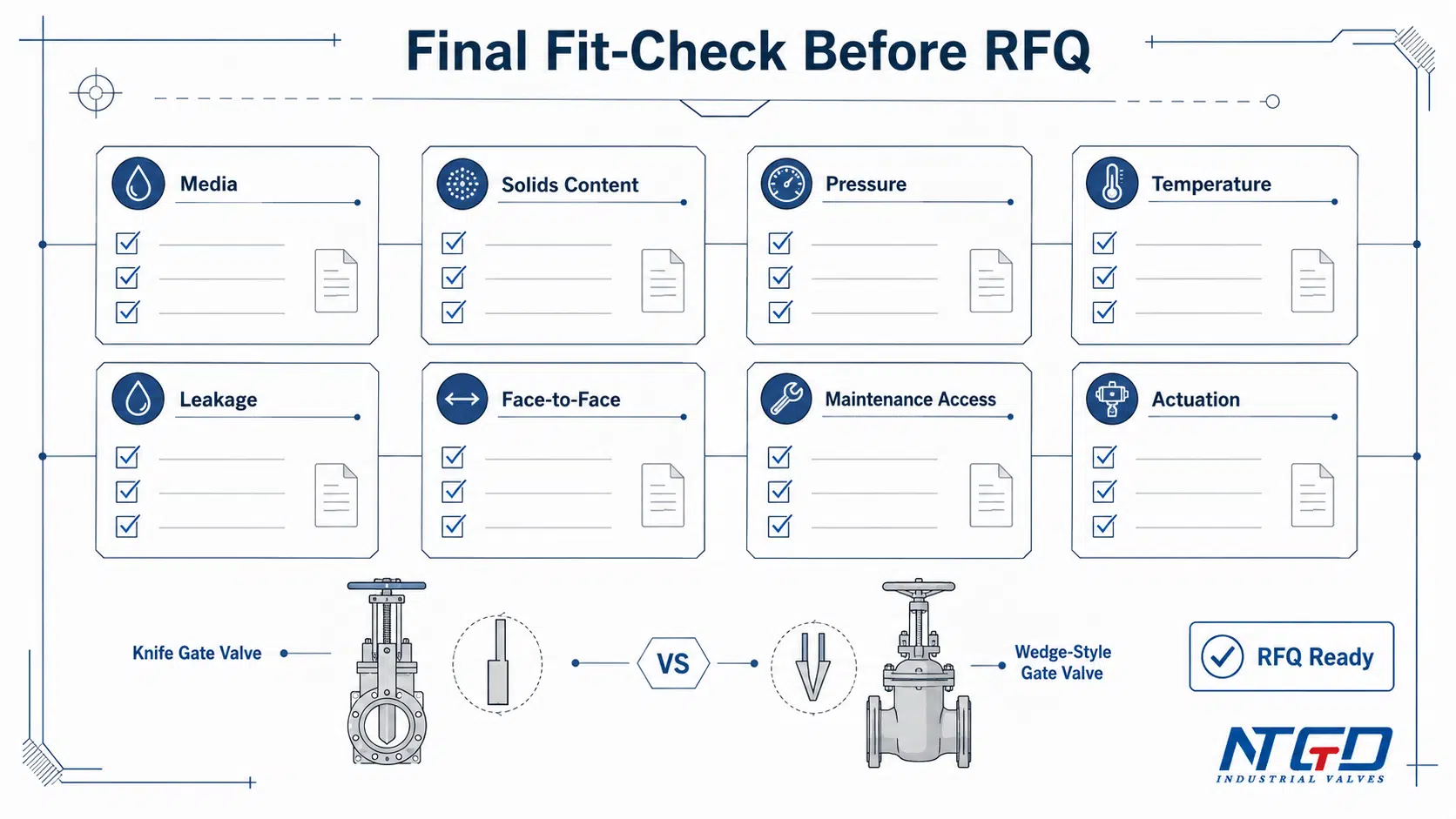
| Check Item | Choose Knife Gate Valve When… | Choose Wedge / Conventional Gate Valve When… |
|---|---|---|
| Media | The media contains slurry, pulp, sludge, wastewater, fibers, or suspended solids. | The media is clean water, steam, oil, gas, or compatible clean process fluid. |
| Solids content | Solids or fibers may interfere with conventional gate seating. | Solids are low or absent. |
| Pressure | The service pressure is within the selected knife gate valve design range. | Pressure class and clean-fluid shutoff are major requirements. |
| Temperature | Seat and packing materials can handle the service temperature. | Body, trim, gasket, and packing are specified for the temperature. |
| Leakage requirement | The acceptable leakage level matches the seat design and test requirement. | Tight clean-fluid isolation is required and verified by specification. |
| Installation space | A compact face-to-face valve helps the layout. | Space, body weight, and actuator torque are acceptable. |
| Operation | On/off isolation is required. | On/off isolation is required. |
| Maintenance access | Seat, packing, and gate inspection are practical. | Stem, wedge, seat, and bonnet maintenance are practical. |
| Standards / specification | Application-specific knife gate valve requirements are acceptable. | Conventional gate valve standards and pressure-class requirements dominate. |
| Final selection data | Media, solids content, pressure, temperature, seat material, actuator, and leakage expectation are known. | Pressure class, material, end connection, test requirement, and clean-fluid service condition are known. |
A simple rule can guide the first decision:
Rule of thumb: If solids and slurry dominate the problem, start with a knife gate valve. If clean-fluid pressure isolation dominates the problem, start with a wedge-style gate valve.
The final selection should still be checked against the datasheet, project specification, material compatibility, and operating conditions.
FAQ: Knife Gate Valve vs Gate Valve
1. Is a knife gate valve the same as a gate valve?
A knife gate valve belongs to the wider gate valve family, but it is not the same as a conventional wedge-style gate valve. A knife gate valve uses a thin blade gate for slurry, pulp, wastewater, sludge, and solids-laden service. A wedge gate valve uses a wedge-shaped gate for clean-fluid isolation and pressure-rated pipeline service.
2. What is the difference between a gate valve and a knife valve?
In many searches, “knife valve” means “knife gate valve.” The main difference is that a knife valve is designed for difficult media such as slurry and fibers, while a conventional gate valve is usually designed for clean-fluid isolation. The knife gate focuses on solids handling; the wedge gate focuses on pressure sealing in clean service.
3. What is the difference between a knife gate valve and a wedge gate valve?
A knife gate valve has a thin blade gate and is normally used for slurry, pulp, sludge, and wastewater. A wedge gate valve has a wedge-shaped gate and is normally used for clean water, steam, oil, gas, and pressure-class isolation. The difference affects sealing, pressure suitability, maintenance, installation space, and application.
4. When should you use a knife gate valve instead of a gate valve?
Use a knife gate valve when the media contains slurry, suspended solids, pulp, sludge, wastewater, fibers, or abrasive particles. These media can interfere with the seating area of a conventional wedge gate valve.
5. When should you use a wedge gate valve instead of a knife gate valve?
Use a wedge gate valve when the media is clean and the main requirement is pressure-rated isolation, tight shutoff, standard pipeline specification, or higher pressure service. The final selection still depends on material, pressure class, seat design, end connection, and test requirement.
6. What are the disadvantages of knife gate valves?
Knife gate valves may have limitations in high-pressure clean-fluid service, strict leakage applications, high-temperature service, and throttling use. They can also experience gate, seat, and packing wear in abrasive slurry service. The exact limitation depends on valve design and service conditions.
7. Do knife gate valves leak?
A knife gate valve can leak if the seat is worn, the packing is damaged, solids interfere with closure, or the selected design does not match the leakage requirement. Some knife gate valves can provide good shutoff in the correct service, but leakage performance must be verified by seat design, test requirement, and manufacturer data.
8. Can a knife gate valve replace a wedge gate valve?
A knife gate valve can replace a wedge gate valve only when the service conditions match the knife gate valve design. It may be a better replacement in slurry or wastewater service. It is not automatically suitable for high-pressure clean-fluid pipelines where a conventional wedge gate valve is required.
9. Are knife gate valves suitable for high pressure?
Some knife gate valves can be designed for higher pressure than basic slurry service, but they should not be assumed suitable without checking pressure rating, body design, seat material, end connection, actuator, and applicable specification. For clean high-pressure service, a wedge-style gate valve is often the safer starting point.
10. Is a knife gate valve more expensive than a gate valve?
It depends on size, material, seat design, pressure rating, actuator, and service severity. A knife gate valve may cost more when it needs special materials, abrasion-resistant seats, or pneumatic / hydraulic actuation. A wedge gate valve may be more economical for standard clean-fluid isolation. Lifecycle cost is more important than purchase cost alone.
Conclusion
Knife gate valves and wedge-style gate valves are both isolation valves, but they solve different pipeline problems. A knife gate valve is usually selected for slurry, pulp, wastewater, sludge, fibers, and solids-laden media. A wedge gate valve is usually selected for clean-fluid isolation, pressure-class pipelines, and services where a conventional pressure boundary and shutoff are more important.
The correct selection depends on media, solids content, pressure, temperature, leakage requirement, material compatibility, face-to-face dimension, end connection, and maintenance access. Do not choose only by valve name, cost, or size. Choose by service condition.
Application Check: For an application check, prepare the media type, solids content, pressure, temperature, pipeline size, end connection, leakage expectation, and actuation requirement. These details make it easier to confirm whether a knife gate valve or wedge-style gate valve is the better fit before final specification.
