
Nombre del autor: Bruce Zheng
Función del autor: Cofundador e ingeniero de válvulas en NTGD Valve
Biografía del autor: Bruce Zheng es cofundador e ingeniero de válvulas en NTGD Valve, donde se dedica a la selección y aplicación de válvulas industriales, así como a la elaboración de contenido técnico para compradores B2B de todo el mundo.
Última actualización: 31 de mayo de 2026
Respuesta rápida: Válvula de compuerta de cuchilla vs. válvula de compuerta / válvula de compuerta de cuña
Una válvula de compuerta de cuchilla es una válvula de aislamiento especializada de tipo compuerta, diseñada principalmente para lodos, pulpa, aguas residuales, lodos de depuración y fluidos que contienen sólidos en suspensión o fibras. En esta comparación, una válvula de compuerta estándar suele referirse a una válvula de compuerta convencional de tipo cuña, utilizada para el aislamiento de fluidos limpios, tuberías sometidas a presión y aplicaciones en las que se requiere un límite de presión más resistente y un cierre más predecible.
La principal diferencia entre una válvula de compuerta de cuchilla y una válvula de compuerta no radica únicamente en la forma de la compuerta, sino en las condiciones de servicio para las que está diseñada cada válvula.
| Pregunta de selección | Mejor ajuste | ¿Por qué? |
|---|---|---|
| ¿El medio contiene lodo, lodos, pulpa, fibras o sólidos? | Válvula de guillotina | La compuerta de hoja delgada y el paso de flujo abierto permiten manejar medios difíciles mejor que un diseño convencional de compuerta de cuña. |
| ¿El medio es agua limpia, vapor, petróleo, gas o un fluido de proceso limpio? | Válvula de compuerta tipo cuña | La válvula de cuña y el cuerpo resistente a la presión son más adecuados para el aislamiento de fluidos limpios. |
| ¿Es el servicio de limpieza a alta presión lo que más le preocupa? | Válvula de compuerta tipo cuña | La clase de presión, el diseño del cuerpo, el contacto del asiento y la norma aplicable suelen ser más importantes que la capacidad para manejar sólidos. |
| ¿Es importante la duración de las sesiones presenciales compactas? | Válvula de guillotina | Muchas válvulas de compuerta de cuchilla son más compactas que las válvulas de compuerta de cuña convencionales. |
| ¿Es necesario un cierre hermético en aplicaciones de servicio limpio? | Válvula de compuerta tipo cuña | Una válvula de compuerta de cuña suele ser la opción inicial más segura, pero la elección final debe contrastarse con las especificaciones del proyecto. |
En resumen, elige una válvula de compuerta de cuchilla cuando el fluido sea agresivo. Elige una válvula de compuerta tipo cuña cuando el fluido que circula por la tubería sea más limpio y la estanqueidad a presión sea la prioridad principal.
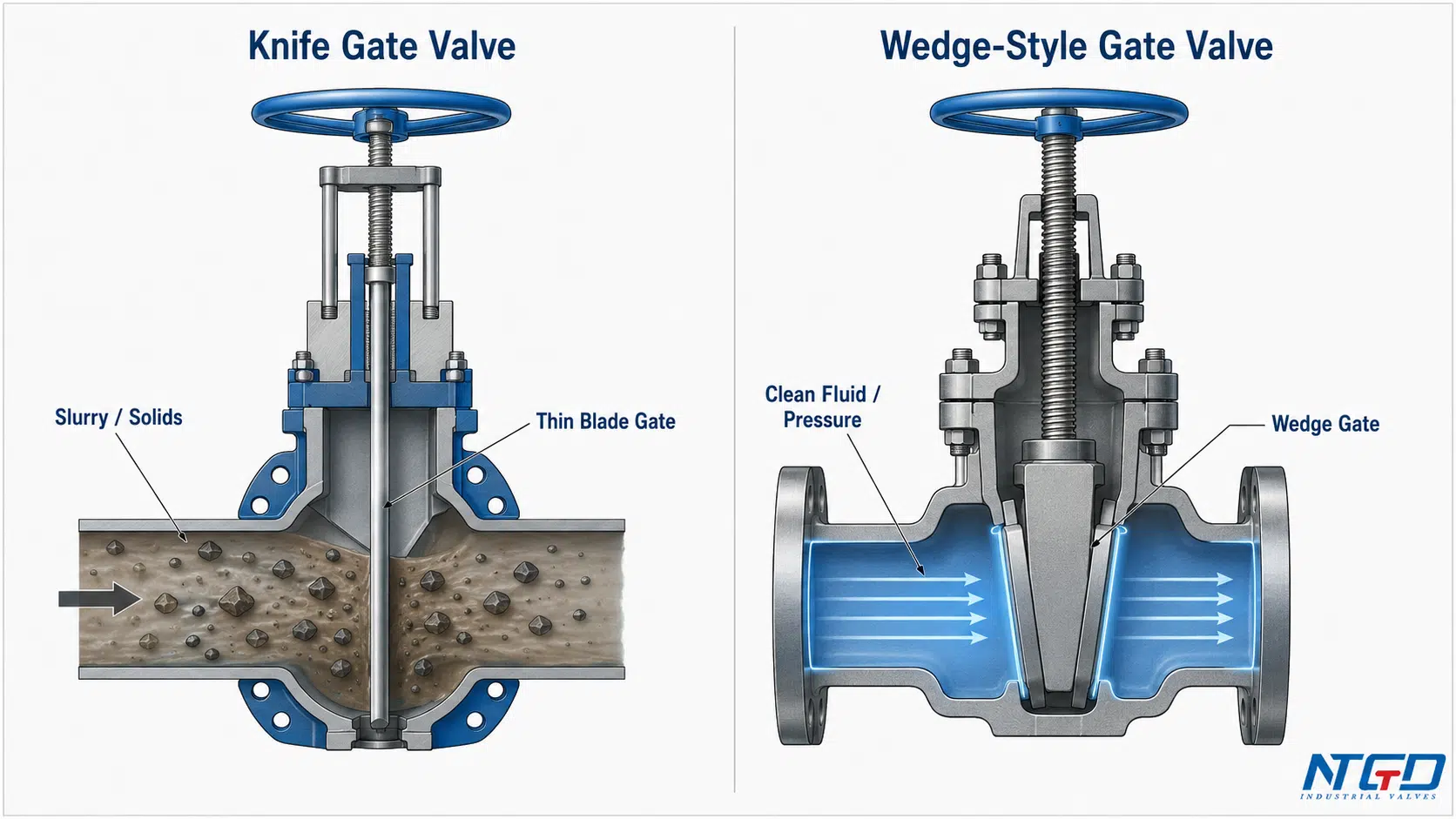
Qué significa “válvula de compuerta” en esta comparación
En este artículo, el término “válvula de compuerta” se refiere principalmente a una válvula de compuerta estándar o convencional de tipo cuña. Esto es importante porque la válvula de compuerta de cuchilla también forma parte de la familia más amplia de válvulas de compuerta, pero no se selecciona de la misma manera que una válvula de compuerta convencional de tipo cuña.
A válvula de compuerta de cuña utiliza un elemento de cierre en forma de cuña que se mueve hacia arriba y hacia abajo entre dos asientos. Se utiliza comúnmente para el aislamiento de tipo “abierto/cerrado” en tuberías de agua, vapor, aceite, gas y fluidos limpios en general. Una válvula de compuerta de cuchilla utiliza una compuerta más delgada con forma de cuchilla. Está diseñada para aplicaciones en las que los sólidos, las fibras o los lodos puedan interferir con la disposición convencional de cuña y asiento.
So when users search for knife gate valve vs gate valve or gate valve vs knife gate valve, the real question is usually:
Selection question: Should the pipeline use a slurry-capable knife gate valve, or a conventional wedge-style gate valve for clean-fluid isolation?
¿Una válvula de cuchilla es lo mismo que una válvula de compuerta de cuchilla?
In many search results and buyer conversations, “knife valve” is used as a shortened term for válvula de guillotina. The two expressions often refer to the same general valve category.
However, in engineering selection, the full term “knife gate valve” is more precise. It makes clear that the valve uses a gate-type closure design and is mainly intended for isolation service, not for throttling or continuous flow control.
¿Son lo mismo las válvulas de compuerta de cuchilla y las válvulas de compuerta de cuña?
Knife gate valves and wedge gate valves are related, but they are not the same.
Both valves use a gate that moves perpendicular to the flow path. Both are normally used as on/off isolation valves. Both should generally be operated fully open or fully closed, rather than used as control valves for throttling.
The difference is in the gate geometry, body design, sealing logic, and service environment.
A knife gate valve uses a thin blade gate. This blade can pass through some thick or fibrous media and close in services where solids may be present. This makes knife gate valves common in pulp and paper, wastewater treatment, mining slurry, sludge handling, cement, and other abrasive or solids-laden applications.
A wedge gate valve uses a wedge-shaped gate that seats against two sealing surfaces. This design is better suited for clean-fluid isolation, especially where pressure rating, temperature, body strength, and shutoff reliability are more important than cutting through solids.
For the complete stem-travel and wedge-seating sequence used by the conventional design, see NTGD’s guide to the conventional wedge gate valve working principle.
The practical selection rule is simple:
Selection rule: A knife gate valve is selected because the media is difficult. A wedge gate valve is selected because the pressure boundary and clean-fluid shutoff are the priority.
This does not mean one valve is universally better. It means each valve solves a different engineering problem.
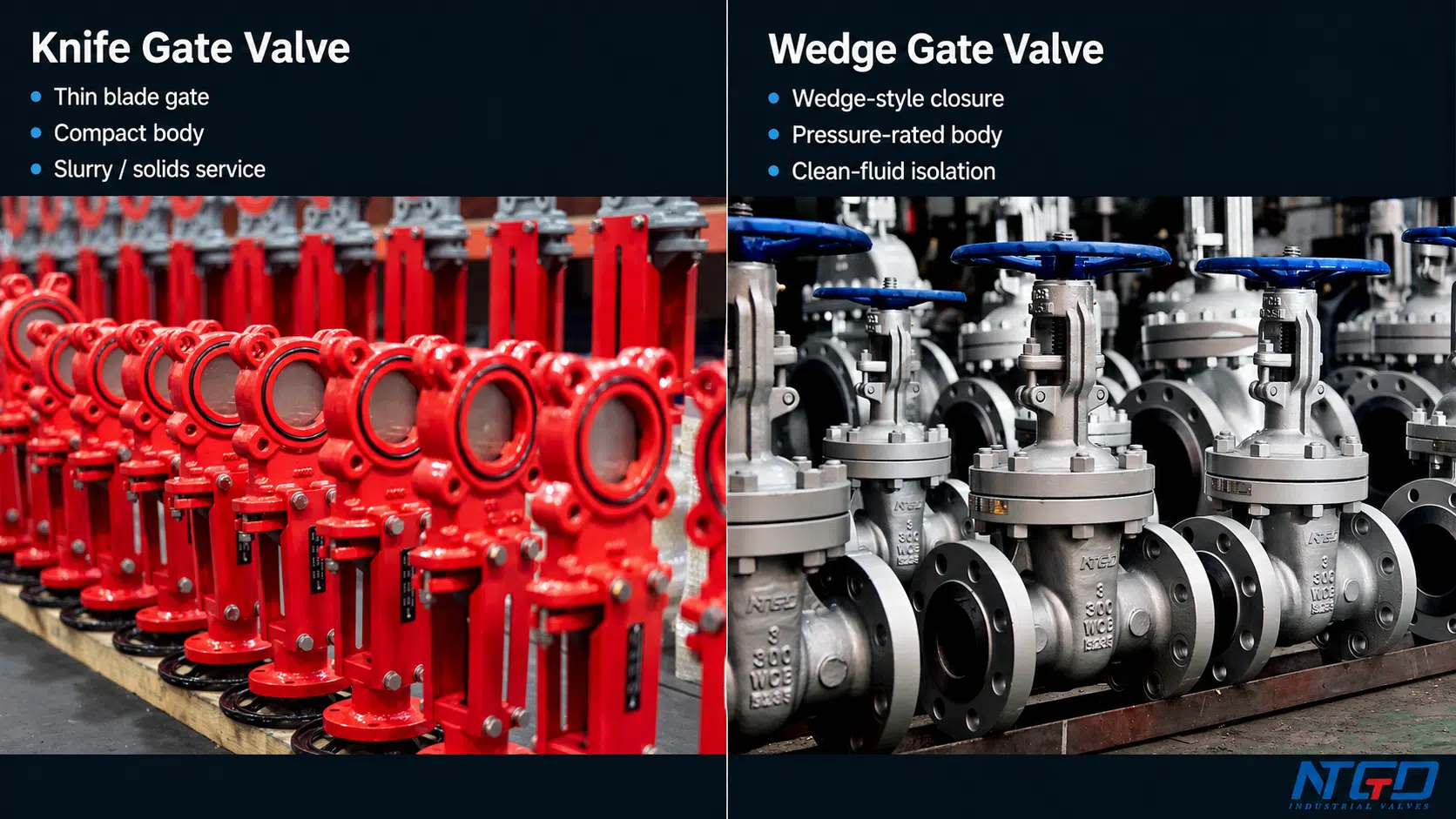
Válvula de compuerta de cuchilla vs. válvula de compuerta de cuña: Tabla de diferencias clave
The table below consolidates the most important differences between a knife gate valve and a wedge-style gate valve.
| Difference Point | Válvula de guillotina | Wedge / Conventional Gate Valve | Significado de la selección |
|---|---|---|---|
| Main selection purpose | Isolation of slurry, sludge, pulp, wastewater, fibers, and solids-laden media | Isolation of clean water, steam, oil, gas, and clean process fluids | Start with the media condition before comparing price or size. |
| Gate shape | Thin blade-shaped gate | Wedge-shaped gate | The knife gate is built to pass through difficult media; the wedge gate is built for seat compression and pressure sealing. |
| Body profile | Often compact, with short face-to-face dimensions | Usually heavier and longer, depending on pressure class and standard | Knife gate valves can help where installation space is limited. |
| Recorrido del flujo | Often more open for difficult media | Full-bore or near full-bore in open position, but with wedge and seat geometry | Both can offer low resistance when fully open, but the internal geometry handles solids differently. |
| Media suitability | Slurry, pulp, sludge, wastewater, tailings, fibrous media | Clean water, steam, oil, gas, chemical lines with compatible clean media | Dirty or fibrous service usually favors knife gate valves. |
| Sealing logic | Depends heavily on seat design, packing, gate condition, and media | Wedge-to-seat contact provides sealing in clean service | Do not assume equal leakage performance across valve types. |
| Idoneidad para la presión | Often used in lower-to-medium pressure difficult media, depending on design | Commonly used in pressure-class clean-fluid pipelines | Always verify pressure class, material, seat design, and standard. |
| Solids handling | Better suited for media with suspended solids | Poorer fit for slurry or fibrous media | Solids can interfere with wedge seating and closure. |
| Actuation force | Often lower in suitable service, but can increase with solids buildup or seat friction | Can require higher torque, especially in larger sizes or higher pressure classes | Actuator sizing must be checked for the actual service. |
| Enfoque de mantenimiento | Seat wear, packing, gate wear, buildup around gate area | Stem, wedge, seat surfaces, corrosion, body-bonnet sealing | Maintenance priorities differ because the failure mechanisms differ. |
| Lógica de costos | Can cost more when special materials, seats, coatings, or actuators are required | Often cost-effective for standard clean-fluid isolation | Compare lifecycle cost, not only purchase price. |
The table should not be read as a universal ranking. It is a selection map. A knife gate valve is not “better” than a wedge gate valve in every system. It is better when the service condition matches its design purpose.
Diferencias en el diseño, el sellado, la presión y las normas
Forma de la compuerta y perfil del cuerpo
The gate shape is the most visible difference.
A knife gate valve uses a thin blade gate. The blade moves down through the flow path and is designed to close in media that may contain pulp, fibers, sludge, slurry, or soft solids. The body is often thinner than a conventional wedge gate valve body, and many designs have a shorter face-to-face length.
A wedge gate valve uses a thicker wedge-shaped gate. The wedge moves into the seat area and creates sealing contact through the wedge geometry. This design is better suited for clean media, where solids are not expected to collect around the seating surfaces.
The body profile also affects installation. Knife gate valves are often selected where space and weight matter, especially in large slurry or wastewater lines. Wedge gate valves are usually selected where pressure class, body strength, end connection, and conventional pipeline standards dominate the specification.
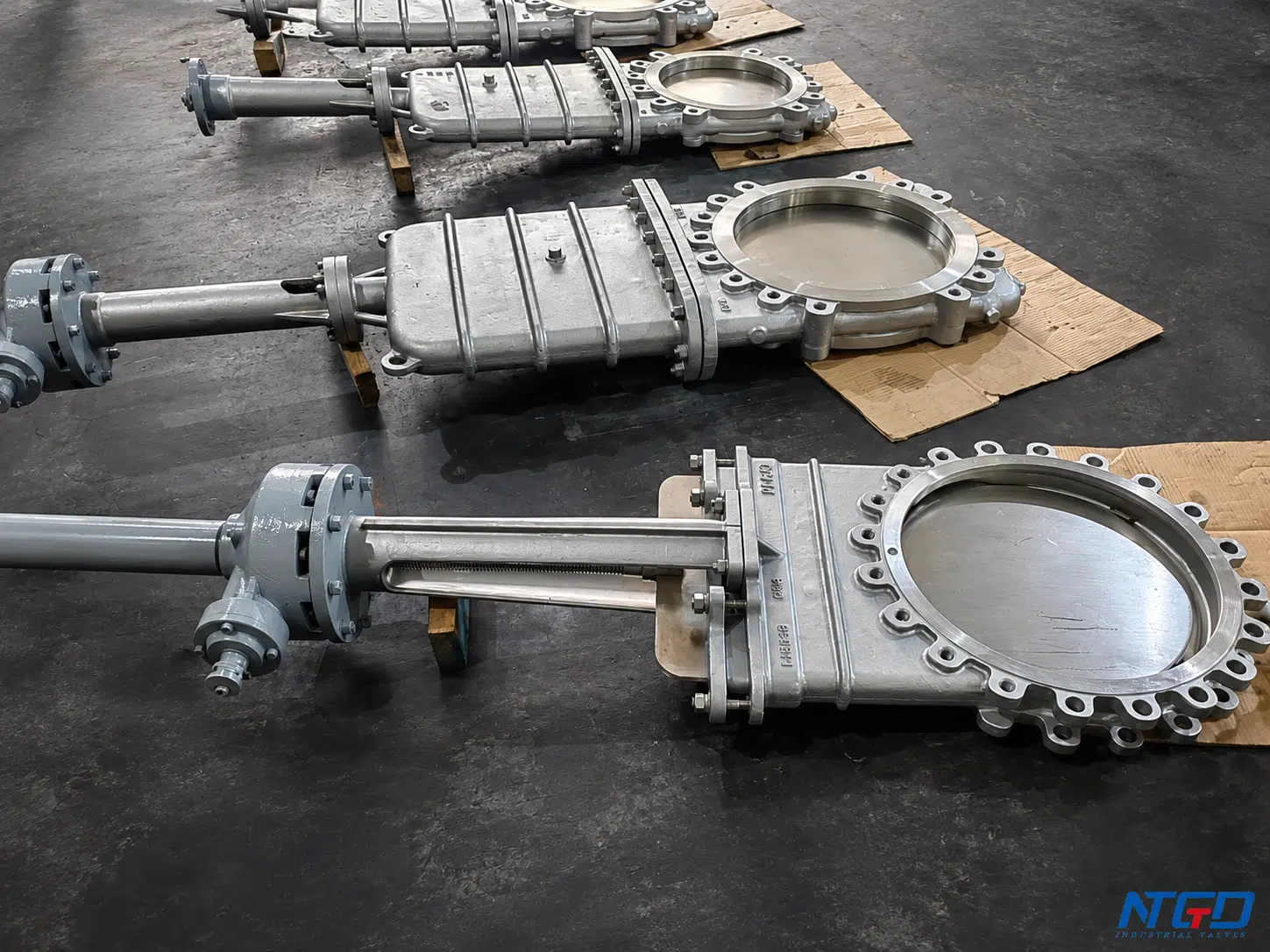
Empaque, diseño del asiento y límite de fugas
Sealing performance depends on the specific valve design. It should not be described as simply “knife gate valves leak” or “wedge gate valves never leak.”
A knife gate valve may use resilient seats, metal seats, elastomer seals, packing glands, or other sealing arrangements depending on the manufacturer and service. Its leakage performance depends on the seat material, gate surface, packing condition, pressure direction, solids content, and wear.
In abrasive slurry service, the gate and seat area can wear over time. In fibrous media, buildup can also affect closure. This is why knife gate valves should be selected with the media condition clearly defined.
A wedge gate valve relies on the wedge and seat surfaces to achieve isolation. In clean service, this can provide reliable shutoff. But if solids, scale, fibers, or slurry collect around the seat, the wedge may not close properly. This can cause leakage, higher operating torque, or seat damage.
Diseño de los asientos is critical because elastomer, metal, and special seats behave differently under solids, abrasion, temperature, pressure, and chemical exposure.
Leakage expectation should be verified against the seat design, pressure rating, API Std 598 or the applicable test requirement, and the project specification.
Nota sobre la presión nominal, la distancia entre caras y las normas
Pressure and standard requirements are another major difference between knife gate valves and wedge gate valves.
Wedge gate valves are commonly specified by pressure class, body material, end connection, testing requirement, and applicable industrial valve standards. They are widely used in pipelines where clean-fluid pressure containment is the dominant concern.
For wedge-style steel gate valves, Norma API 600 may define the pressure class, seating route, bonnet construction, end connection, and testing scope when it applies to the project.
Knife gate valves may follow different industrial, application-specific, or project-specific requirements depending on the service. A knife gate valve for wastewater sludge is not specified the same way as a wedge gate valve for steam or oil service.
For knife gate valves, do not assume the same standard route used for conventional wedge gate valves; MSS SP-81 is one standard route to check when it matches the knife gate valve construction.
The key point is that standards should not be copied from one valve type to another without verification. Applicable standards such as ASME B16.34 may affect pressure-temperature rating, materials, end connection, test requirement, and marking. The buyer should check:
| Elemento de las especificaciones | Por qué es importante |
|---|---|
| Pressure class or pressure rating | Confirms whether the valve can handle the working pressure and test pressure. |
| Material de la carrocería | Must match corrosion, abrasion, temperature, and pressure requirements. |
| Material del asiento | Affects leakage, wear resistance, media compatibility, and temperature boundary. |
| Dimensión presencial | Determines whether the valve fits the existing pipeline layout. |
| Conexión final | Must match flange, wafer, lug, butt-weld, or other piping requirements. |
| Test requirement | Confirms how pressure and leakage performance will be verified. |
| Método de accionamiento | Manual, pneumatic, electric, hydraulic, or gear operation affects torque and control. |
For this reason, a knife gate valve vs wedge gate valve comparison should not stop at appearance. It must include pressure rating, seat material, leakage expectation, and project standard.
Compatibilidad con medios y aplicaciones: servicio con lodos frente a aislamiento con fluidos limpios
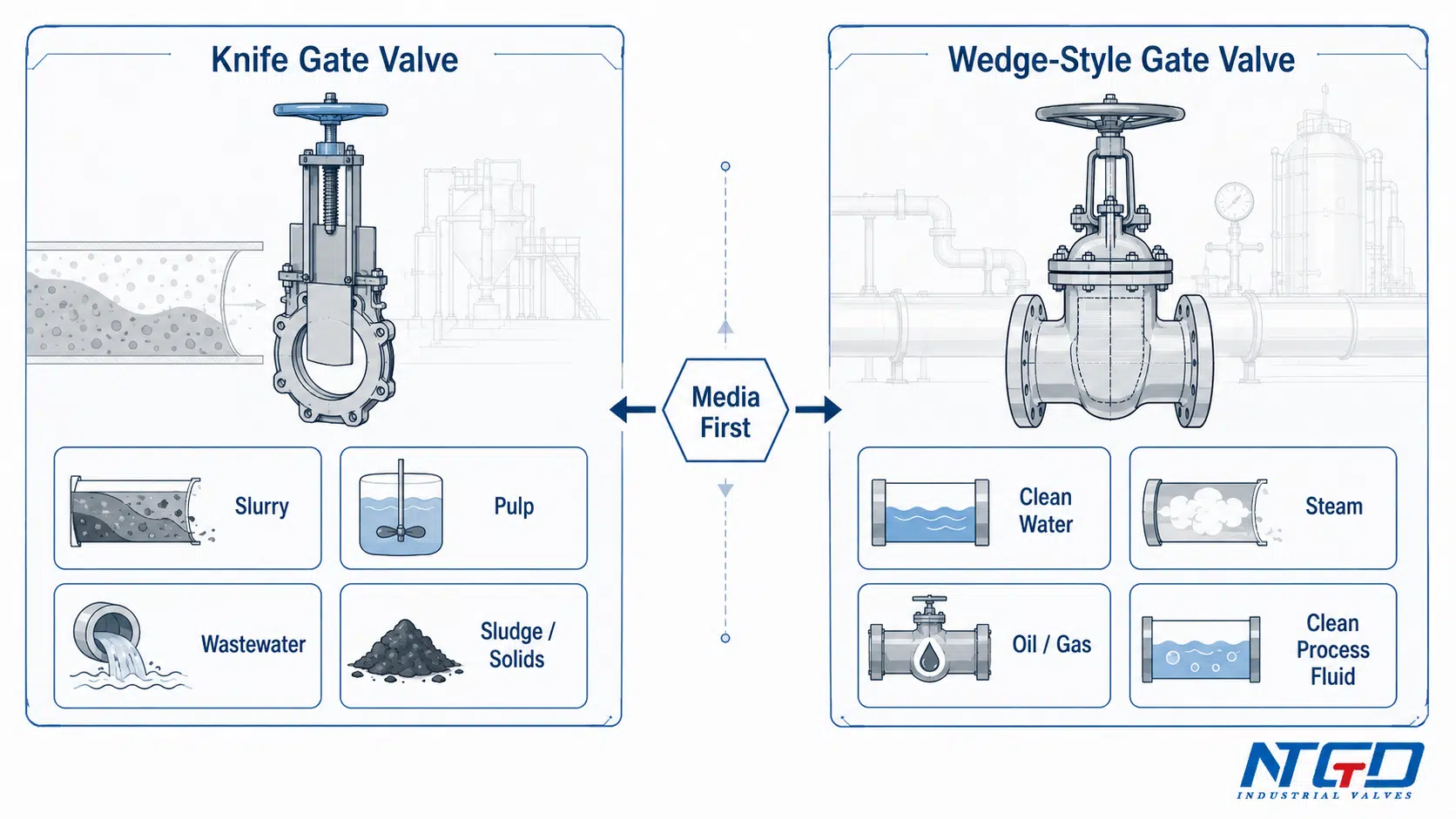
Cuándo las válvulas de compuerta de cuchilla se ajustan mejor
A knife gate valve fits better when the main challenge is the media.
Para high-solids slurry isolation, knife gate valves are often one of the first valve routes to review.
Typical services include:
- slurry with suspended solids;
- pulp and paper stock;
- wastewater sludge;
- mining tailings;
- cement slurry;
- ash handling;
- abrasive or fibrous media;
- thick or dirty process fluid where conventional seating may clog.
The thin gate helps close through media that would be difficult for a conventional wedge gate valve. The body design can also reduce areas where solids accumulate, depending on the valve construction.
However, a knife gate valve is not automatically suitable for every severe service. The final selection must still check pressure, temperature, solids concentration, abrasion, corrosion, seat material, packing design, actuator torque, and installation direction.
Cuándo las válvulas de compuerta tipo cuña se adaptan mejor
A wedge-style gate valve fits better when the pipeline service is cleaner and the main requirement is reliable isolation under pressure.
Typical services include:
- clean water pipelines;
- steam lines within the valve’s rating;
- oil and gas service with compatible media;
- clean process fluid isolation;
- utility systems;
- pressure-class industrial pipelines.
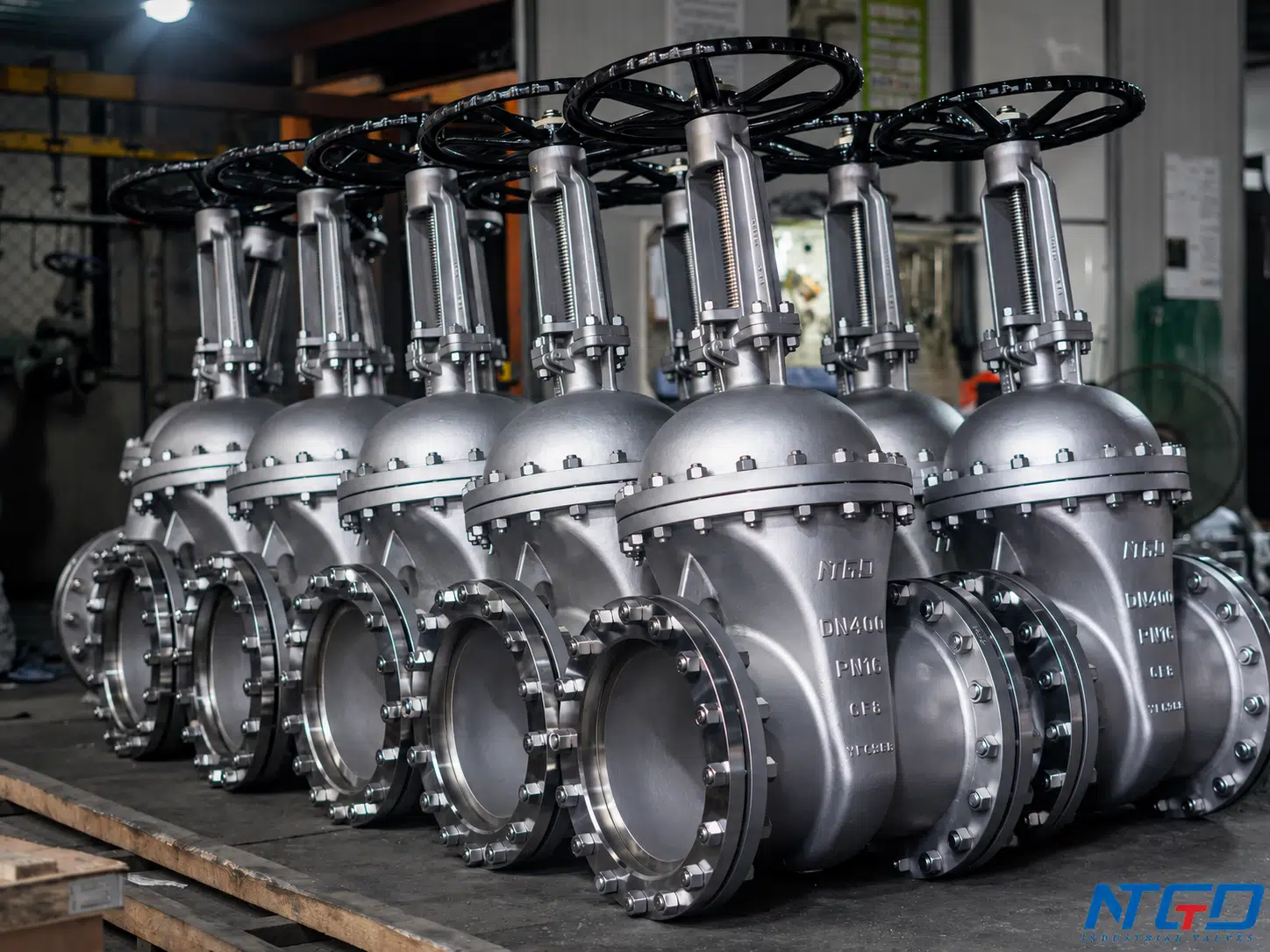
A wedge gate valve is usually the stronger starting point when the buyer needs a conventional pressure-retaining valve for clean-fluid isolation. It can provide a robust pressure boundary and reliable shutoff when the media does not contain solids that damage or block the seating area.
The main limitation is dirty service. If slurry, pulp, sludge, or fibers are present, a wedge gate valve can become harder to operate and less reliable because solids may interfere with the wedge and seat contact.
| Condiciones del servicio | Un mejor punto de partida | Motivo de la selección |
|---|---|---|
| Slurry with suspended solids | Válvula de guillotina | Better solids-handling logic. |
| Pulp and paper stock | Válvula de guillotina | Fibers are less suitable for wedge seating. |
| Wastewater sludge | Válvula de guillotina | Sludge can interfere with conventional gate seating. |
| Mining tailings | Válvula de guillotina | Abrasion and solids handling dominate. |
| Clean water isolation | Válvula de compuerta de cuña | Clean-fluid shutoff and pressure rating dominate. |
| Servicio de vapor | Válvula de compuerta de cuña | Pressure and temperature specification must be verified. |
| Oil or gas clean service | Válvula de compuerta de cuña | Conventional pressure-class isolation is usually required. |
| Espacio de instalación limitado | Often knife gate valve | Compact body profile may help. |
| Servicio de limpieza a alta presión | Often wedge gate valve | Pressure class and body design usually dominate. |
Riesgos derivados de una selección incorrecta de válvulas
Wrong valve selection can create leakage, operating difficulty, premature seat wear, excessive torque, maintenance shutdowns, or unsafe operation.
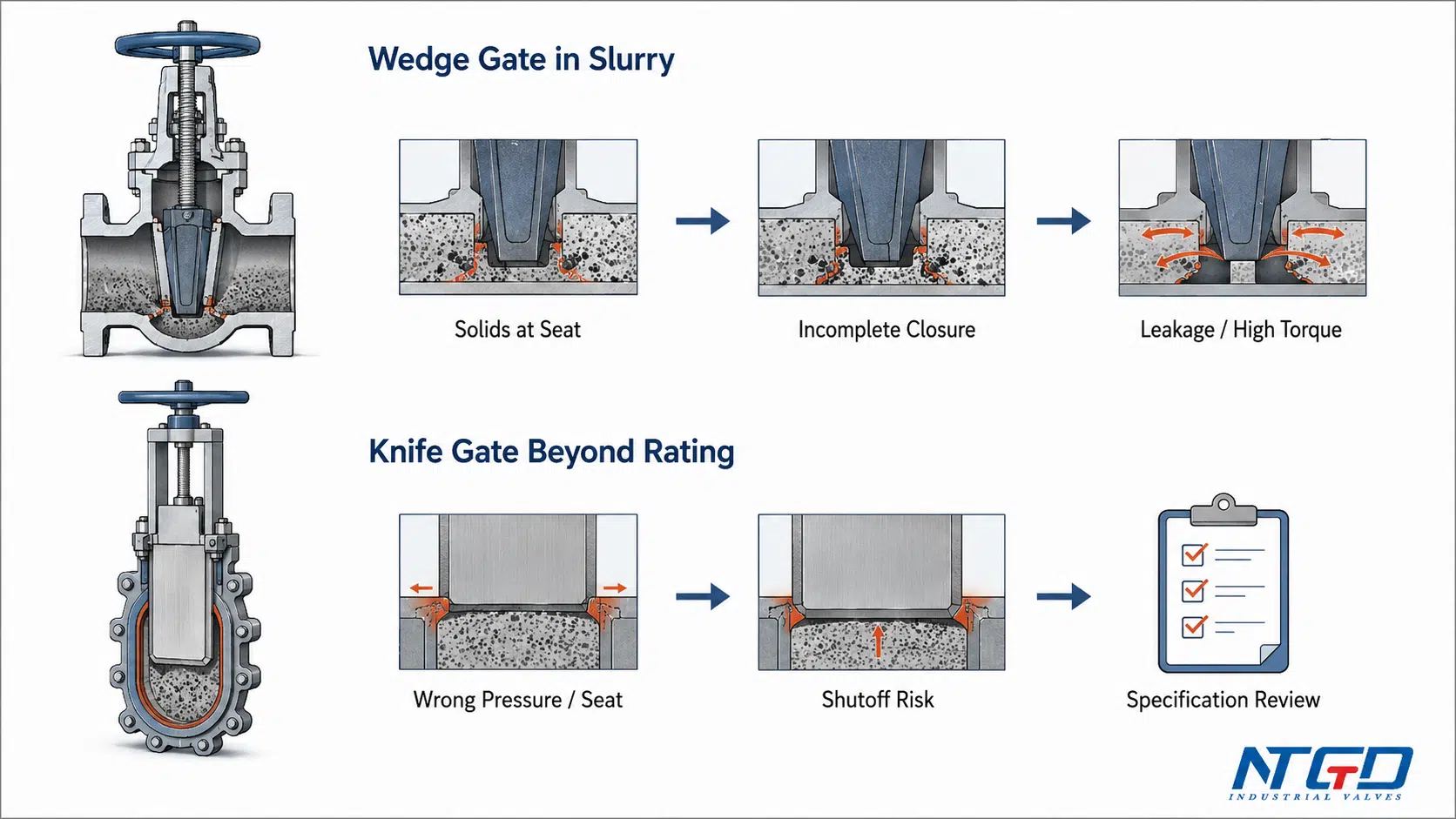
¿Qué sucede cuando se utiliza una válvula de compuerta de cuña en aplicaciones con lodos?
Using a wedge gate valve in slurry or fibrous service can create several problems.
The most common risk is incomplete closure. Solids may collect near the seating area and prevent the wedge from fully seating. This can create leakage even if the valve body and pressure class are technically strong enough for the system.
The second risk is seat damage. Abrasive solids can wear the seating surfaces. Once the seat is damaged, the valve may require higher torque to operate and may no longer seal as expected.
The third risk is jamming. If fibers, sludge, or scale accumulate around the wedge and guides, the valve may become difficult to operate. In severe cases, the stem, wedge, or actuator can be overloaded.
This is why wedge gate valves are normally not the first choice for slurry, pulp, sludge, or solids-heavy service.
¿Qué sucede cuando se utiliza una válvula de compuerta de cuchilla más allá de su rango de presión o de sellado?
The opposite mistake is also common. A knife gate valve should not be selected only because it is compact or because it appears easier to operate.
If the service is high-pressure clean fluid with strict leakage requirements, the seat and pressure boundary of the knife gate valve must be checked carefully. Some knife gate valve designs are excellent for difficult media but may not be the best choice for high-pressure clean-fluid isolation.
Possible problems include:
| Selección incorrecta | Resultado posible | Razonamiento ingenieril |
|---|---|---|
| Knife gate valve used where a pressure-class wedge gate valve is required | Reduced confidence in pressure isolation | Body design, seat design, and applicable standard may not match the service. |
| Knife gate valve used for strict clean-fluid shutoff without checking leakage requirement | Leakage concern | Seat type and test requirement may not meet the project need. |
| Knife gate valve used for throttling | Gate and seat wear | Both knife gate and wedge gate valves are primarily isolation valves. |
| Knife gate valve used in severe abrasion without suitable material | Vida útil más corta | Gate, seat, and body surfaces may wear quickly. |
| Knife gate valve selected without actuator torque review | Operation difficulty | Solids buildup, pressure direction, and seat friction can change operating force. |
The safe approach is to define the service first, then select the valve type.
Ventajas y desventajas de las válvulas de compuerta de cuchilla y de cuña
Knife gate valves and wedge-style gate valves both have clear advantages, but only when they are applied in the correct service.
| Tipo de válvula | Main Advantages | Main Limitations |
|---|---|---|
| Válvula de guillotina | Better for slurry, sludge, pulp, wastewater, fibrous media, and many solids-laden services. Often compact and suitable for difficult media isolation. | Not always suitable for high-pressure clean service, strict leakage requirements, or throttling. Seat and packing wear must be monitored in abrasive service. |
| Válvula de compuerta tipo cuña | Better for clean-fluid isolation, pressure-class pipelines, and services where conventional pressure boundary and shutoff are required. | Poorer fit for slurry, fibrous media, sludge, or dirty service where solids can affect seating. Usually larger and may require higher operating torque. |
Ventajas de la válvula de compuerta de cuchilla
A knife gate valve is useful when solids handling is more important than conventional clean-fluid pressure sealing. Its blade-like gate can cut through or pass through some difficult media, depending on the design. This makes it suitable for slurry, pulp, sludge, wastewater, and other applications where a wedge gate valve may clog or fail to seat properly.
Knife gate valves are also often more compact. This helps in large-diameter slurry pipelines or retrofit applications where installation space is limited.
Desventajas de la válvula de compuerta de cuchilla
A knife gate valve is not a universal replacement for a wedge gate valve. It may not be the best option for high-pressure clean service, steam service, or applications with very strict leakage requirements unless the design is specifically rated and tested for that duty.
In abrasive media, the gate and seat can wear. In sticky media, buildup can affect movement and sealing. Regular inspection of the seat, packing, and gate surface is important.
Ventajas de las válvulas de compuerta tipo cuña
A wedge-style gate valve is a strong choice for clean-fluid isolation. Its body, wedge, seats, bonnet, stem, and end connections are commonly specified for pressure-class pipeline service. When the media is clean and compatible, it can provide reliable isolation with low pressure drop in the fully open position.
Wedge gate valves are also familiar to engineers, contractors, and maintenance teams. This makes specification, installation, and replacement more straightforward in many water, oil, gas, steam, and utility systems.
Desventajas de la válvula de compuerta tipo cuña
A wedge-style gate valve is not ideal for slurry or fibrous media. Solids can collect near the seats and prevent full closure. Abrasive particles can damage sealing surfaces. In larger sizes or higher pressure classes, the required operating torque can also increase.
A wedge gate valve should also not be used as a throttling valve. Partially open operation can damage the wedge and seats over time.
Lista de verificación de costos, mantenimiento y selección final
Factores relacionados con el costo y el mantenimiento
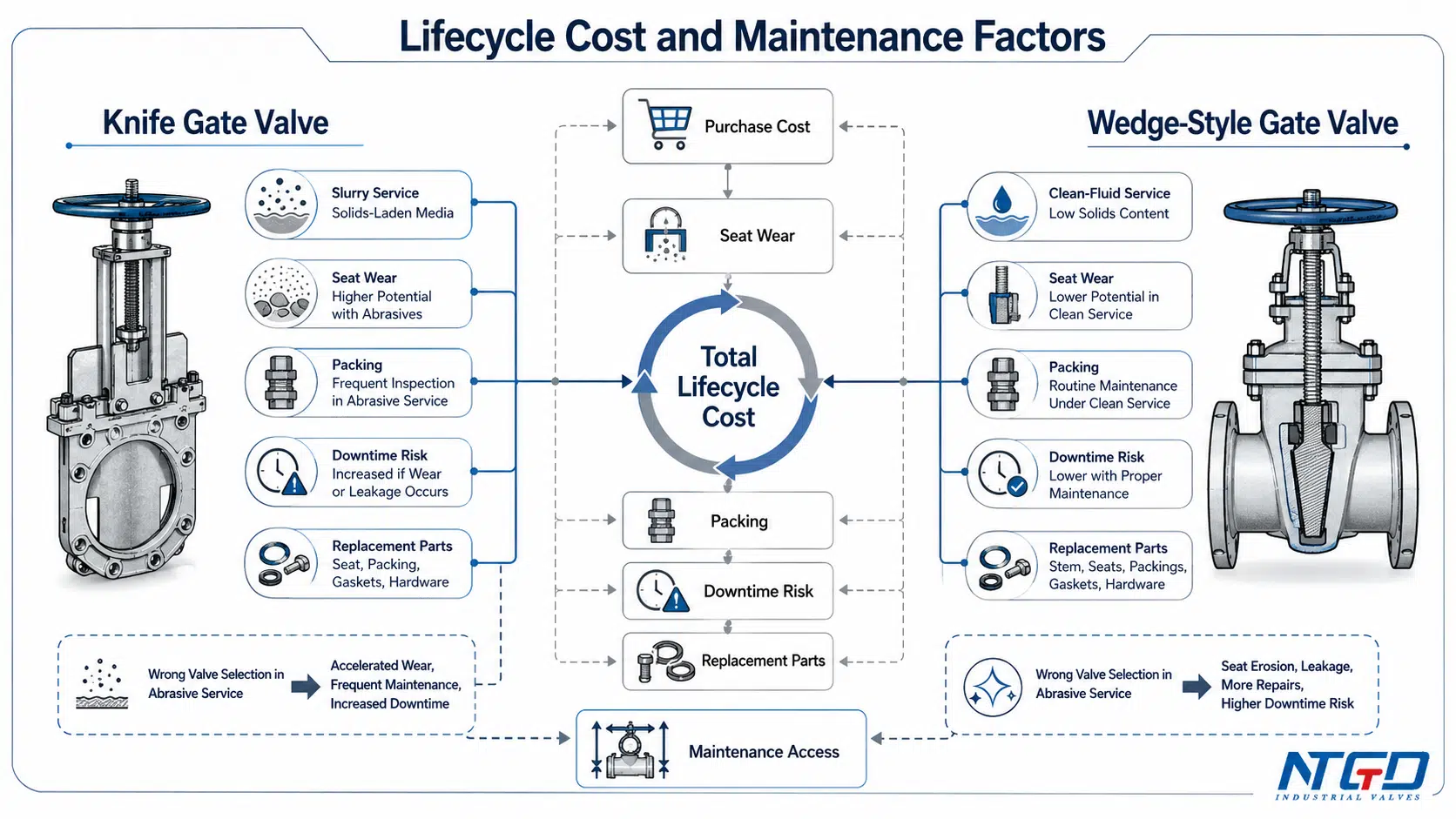
The cost difference between a knife gate valve and a wedge gate valve should be evaluated as lifecycle cost, not only purchase cost.
A knife gate valve may have a higher cost when the project requires stainless steel, corrosion-resistant materials, abrasion-resistant seats, special coatings, pneumatic or hydraulic actuation, or severe-service design. But in slurry or wastewater service, choosing the correct knife gate valve can reduce problems caused by clogging, jamming, and frequent seat damage.
A wedge gate valve may be more economical for standard clean-fluid isolation. But if it is used in dirty or abrasive media, the lower initial cost can be offset by maintenance, leakage, or operational failure.
| Coste / Factor de mantenimiento | Válvula de guillotina | Wedge-Style Gate Valve |
|---|---|---|
| Purchase cost | Can increase with special materials, seats, coatings, or actuation | Often economical for standard clean-fluid service |
| Main maintenance focus | Gate wear, seat wear, packing, solids buildup | Stem, wedge, seats, body-bonnet joint, corrosion |
| Lifecycle risk | Severe abrasion or wrong seat selection can shorten life | Dirty media can cause seat damage or incomplete closure |
| Installation concern | Face-to-face length, orientation, actuator space | Pressure class, end connection, body weight, actuator torque |
| Enfoque en las especificaciones | Media, solids content, abrasion, seat material, packing, actuator | Pressure class, material, end connection, standard, leakage requirement |
Revisión final de adecuación antes de la especificación o la solicitud de cotización
Leakage expectation and gate valve sealing test requirements should be confirmed before final specification.
Before selecting between a knife gate valve and a wedge-style gate valve, check these items.
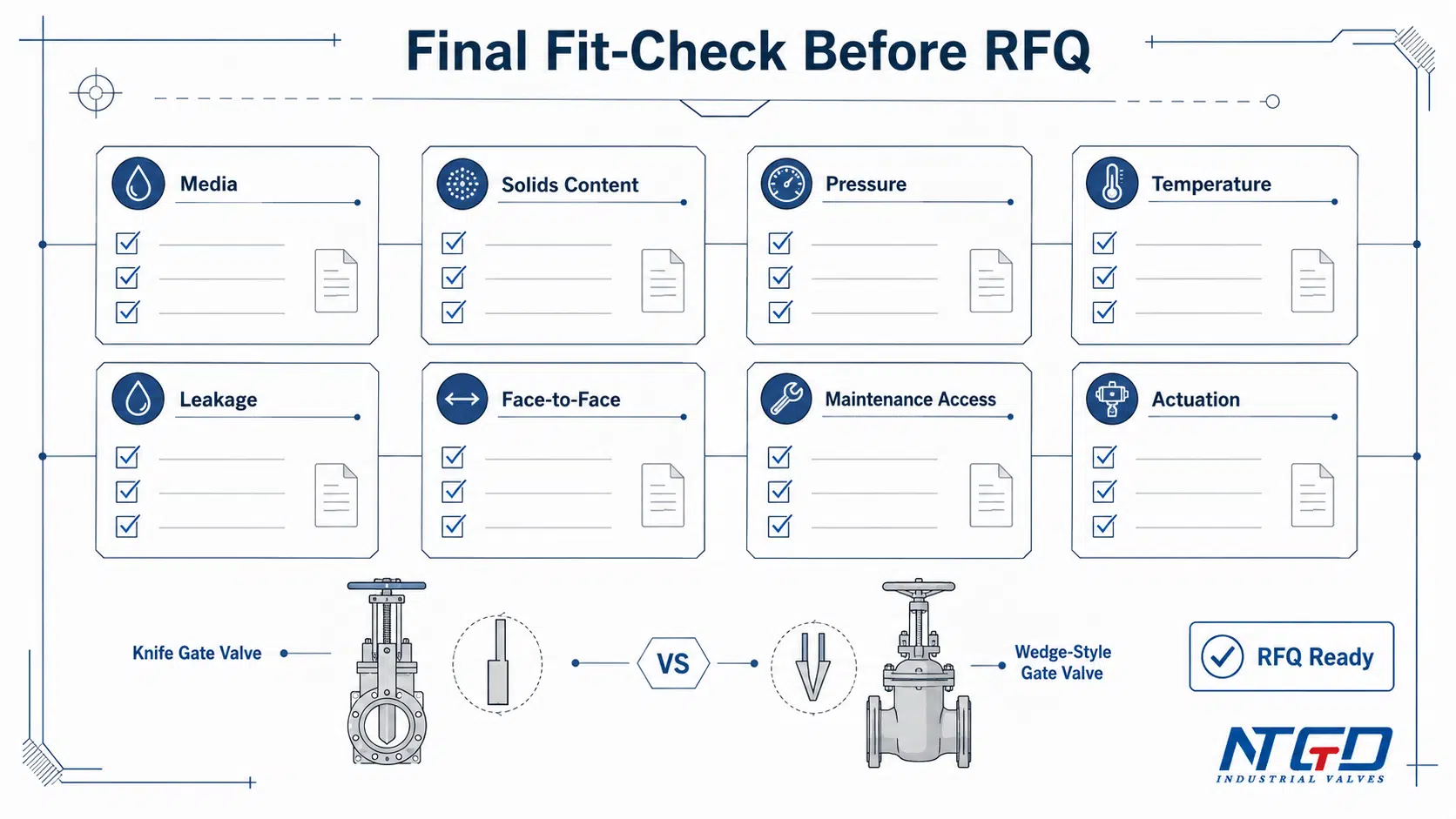
| Marcar elemento | Choose Knife Gate Valve When… | Choose Wedge / Conventional Gate Valve When… |
|---|---|---|
| Medios de comunicación | The media contains slurry, pulp, sludge, wastewater, fibers, or suspended solids. | The media is clean water, steam, oil, gas, or compatible clean process fluid. |
| Contenido de sólidos | Solids or fibers may interfere with conventional gate seating. | Solids are low or absent. |
| Presión | The service pressure is within the selected knife gate valve design range. | Pressure class and clean-fluid shutoff are major requirements. |
| Temperatura | Seat and packing materials can handle the service temperature. | Body, trim, gasket, and packing are specified for the temperature. |
| Requisito de fugas | The acceptable leakage level matches the seat design and test requirement. | Tight clean-fluid isolation is required and verified by specification. |
| Espacio de instalación | A compact face-to-face valve helps the layout. | Space, body weight, and actuator torque are acceptable. |
| Operación | On/off isolation is required. | On/off isolation is required. |
| Acceso para mantenimiento | Seat, packing, and gate inspection are practical. | Stem, wedge, seat, and bonnet maintenance are practical. |
| Standards / specification | Application-specific knife gate valve requirements are acceptable. | Conventional gate valve standards and pressure-class requirements dominate. |
| Final selection data | Media, solids content, pressure, temperature, seat material, actuator, and leakage expectation are known. | Pressure class, material, end connection, test requirement, and clean-fluid service condition are known. |
A simple rule can guide the first decision:
Rule of thumb: If solids and slurry dominate the problem, start with a knife gate valve. If clean-fluid pressure isolation dominates the problem, start with a wedge-style gate valve.
The final selection should still be checked against the datasheet, project specification, material compatibility, and operating conditions.
Preguntas frecuentes: Válvula de compuerta de cuchilla vs. válvula de compuerta
1. ¿Una válvula de compuerta de cuchilla es lo mismo que una válvula de compuerta?
Una válvula de compuerta tipo cuchilla pertenece a la familia más amplia de las válvulas de compuerta, pero no es lo mismo que una válvula de compuerta convencional tipo cuña. Una válvula de compuerta tipo cuchilla utiliza una compuerta en forma de cuchilla delgada para aplicaciones con lodos, pulpa, aguas residuales, lodos y fluidos cargados de sólidos. Una válvula de compuerta tipo cuña utiliza una compuerta en forma de cuña para el aislamiento de fluidos limpios y para su uso en tuberías sometidas a presión.
2. ¿Cuál es la diferencia entre una válvula de compuerta y una válvula de cuchilla?
En muchas búsquedas, “válvula de cuchilla” se refiere a “válvula de compuerta de cuchilla”. La principal diferencia es que una válvula de cuchilla está diseñada para medios difíciles, como lodos y fibras, mientras que una válvula de compuerta convencional suele estar diseñada para el aislamiento de fluidos limpios. La válvula de compuerta de cuchilla se enfoca en el manejo de sólidos; la válvula de compuerta de cuña se enfoca en el sellado a presión en servicios con fluidos limpios.
3. ¿Cuál es la diferencia entre una válvula de compuerta de cuchilla y una válvula de compuerta de cuña?
Una válvula de compuerta de cuchilla cuenta con una compuerta delgada y se utiliza normalmente para lodos, pulpa, sedimentos y aguas residuales. Una válvula de compuerta de cuña cuenta con una compuerta en forma de cuña y se utiliza normalmente para agua limpia, vapor, aceite, gas y aislamiento en clases de presión. La diferencia afecta el sellado, la idoneidad para la presión, el mantenimiento, el espacio de instalación y la aplicación.
4. ¿Cuándo se debe usar una válvula de compuerta de cuchilla en lugar de una válvula de compuerta?
Utilice una válvula de compuerta de cuchilla cuando el fluido contenga lodos, sólidos en suspensión, pulpa, lodos de depuración, aguas residuales, fibras o partículas abrasivas. Estos fluidos pueden interferir con la zona de asiento de una válvula de compuerta de cuña convencional.
5. ¿Cuándo se debe usar una válvula de compuerta de cuña en lugar de una válvula de compuerta de cuchilla?
Utilice una válvula de compuerta tipo cuña cuando el fluido sea limpio y el requisito principal sea el aislamiento a presión nominal, un cierre hermético, el cumplimiento de las especificaciones estándar de las tuberías o un servicio a alta presión. La selección final depende, no obstante, del material, la clase de presión, el diseño del asiento, la conexión en los extremos y los requisitos de prueba.
6. ¿Cuáles son las desventajas de las válvulas de compuerta de cuchilla?
Las válvulas de compuerta de cuchilla pueden presentar limitaciones en aplicaciones con fluidos limpios a alta presión, en aplicaciones con requisitos estrictos de fugas, en servicio a altas temperaturas y en aplicaciones de estrangulamiento. También pueden sufrir desgaste en la compuerta, el asiento y la empaquetadura cuando se utilizan con lodos abrasivos. La limitación exacta depende del diseño de la válvula y de las condiciones de servicio.
7. ¿Las válvulas de compuerta tienen fugas?
Una válvula de compuerta de cuchilla puede presentar fugas si el asiento está desgastado, la empaquetadura está dañada, hay sólidos que interfieren con el cierre o el diseño seleccionado no cumple con los requisitos de fugas. Algunas válvulas de compuerta de cuchilla pueden ofrecer un buen cierre en las condiciones de servicio adecuadas, pero el desempeño en cuanto a fugas debe verificarse según el diseño del asiento, los requisitos de prueba y los datos del fabricante.
8. ¿Puede una válvula de compuerta de cuchilla sustituir a una válvula de compuerta de cuña?
Una válvula de compuerta de cuchilla puede sustituir a una válvula de compuerta de cuña únicamente cuando las condiciones de servicio se ajustan al diseño de la válvula de compuerta de cuchilla. Puede ser una mejor opción de reemplazo en aplicaciones con lodos o aguas residuales. No es automáticamente adecuada para tuberías de alta presión con fluidos limpios, en las que se requiere una válvula de compuerta de cuña convencional.
9. ¿Son adecuadas las válvulas de compuerta de cuchilla para alta presión?
Algunas válvulas de compuerta de cuchilla pueden estar diseñadas para presiones más altas que las del servicio básico con lodos, pero no se debe dar por sentado que son adecuadas sin verificar la presión nominal, el diseño del cuerpo, el material del asiento, la conexión final, el actuador y las especificaciones aplicables. Para el servicio limpio a alta presión, una válvula de compuerta tipo cuña suele ser la opción inicial más segura.
10. ¿Es una válvula de compuerta de cuchilla más cara que una válvula de compuerta?
Depende del tamaño, el material, el diseño del asiento, la presión nominal, el actuador y la severidad de servicio. Una válvula de compuerta de cuchilla puede ser más costosa cuando requiere materiales especiales, asientos resistentes a la abrasión o accionamiento neumático o hidráulico. Una válvula de compuerta de cuña puede ser más económica para el aislamiento estándar de fluidos limpios. El costo del ciclo de vida es más importante que el costo de compra por sí solo.
Conclusión
Knife gate valves and wedge-style gate valves are both isolation valves, but they solve different pipeline problems. A knife gate valve is usually selected for slurry, pulp, wastewater, sludge, fibers, and solids-laden media. A wedge gate valve is usually selected for clean-fluid isolation, pressure-class pipelines, and services where a conventional pressure boundary and shutoff are more important.
The correct selection depends on media, solids content, pressure, temperature, leakage requirement, material compatibility, face-to-face dimension, end connection, and maintenance access. Do not choose only by valve name, cost, or size. Choose by service condition.
Application Check: For an application check, prepare the media type, solids content, pressure, temperature, pipeline size, end connection, leakage expectation, and actuation requirement. These details make it easier to confirm whether a knife gate valve or wedge-style gate valve is the better fit before final specification.
