
Author Name: Bruce Zheng
Author Role: Co-Founder and Valve Engineer at NTGD Valve
Author Bio: Bruce Zheng is Co-Founder and Valve Engineer at NTGD Valve, focusing on industrial valve selection, application, and technical content for global B2B buyers.
Last Updated: April 28, 2026
Resilient Seated Gate Valve vs Metal Seated Gate Valve
In a direct comparison of a resilient seated gate valve vs metal seated gate valve, the main difference is not only the seat material. It is the sealing route, and that route affects leakage expectation, temperature resistance, abrasion risk, operating torque, maintenance method, and failure mode in real service.
A resilient seated gate valve, also called a soft seal gate valve, uses an elastomer-covered wedge to achieve tight shutoff in clean water and moderate service conditions. A metal seated gate valve, also called a hard seal gate valve, uses metal-to-metal contact or hard-faced sealing surfaces for higher temperature, abrasive, corrosive, or severe industrial service.
The correct choice is not based on which valve is “better” in general. It is based on the medium, temperature, pressure differential, solids content, leakage requirement, maintenance access, and lifecycle risk. A valve selected only by initial price, nominal pressure class, or a simple “soft vs hard” label can create predictable problems later: damaged seats, rising torque, unexpected leakage, or difficult repair.
Resilient Seated Gate Valve vs Metal Seated Gate Valve: Quick Comparison
The fastest way to compare resilient seated and metal seated gate valves is to look at the trade-off between tight shutoff in clean service and durability in harsher service.
| Selection Factor | Resilient Seated Gate Valve / Soft Seal Gate Valve | Metal Seated Gate Valve / Hard Seal Gate Valve |
|---|---|---|
| Sealing principle | Rubber or elastomer-coated wedge compresses against the seat area | Metal gate or wedge seals against metal seat surfaces |
| Typical sealing behavior | Very tight shutoff when the medium is clean and the elastomer is compatible | Service-dependent isolation; leakage expectation must match the design, seat condition, and applicable specification |
| Common seat / wedge route | EPDM, NBR, or another specified elastomer encapsulation | Metal-to-metal contact, sometimes with hard-facing or wear-resistant trim |
| Best service fit | Clean water, treated water, irrigation, fire protection, and selected wastewater service | High temperature, abrasive fluids, slurry, steam, chemical service, mining, power, oil and gas |
| Temperature suitability | Limited by elastomer material, medium compatibility, and project specification | Better suited to elevated temperature when body, trim, seat, and standard route are selected correctly |
| Abrasion resistance | Limited where sharp solids, grit, or slurry can cut or erode the soft seat | Stronger for abrasive service when seat surfaces and trim are properly selected |
| Operating torque | Lower in many clean-water applications | Often higher, especially under high differential pressure, large size, deposits, or seat wear |
| Maintenance pattern | Wedge or soft sealing component replacement may be simpler, depending on design | Seat surface repair, lapping, machining, or trim replacement may be more complex |
| Cost tendency | Often lower initial cost in waterworks projects | Higher initial cost, but may reduce failure risk in severe service |
| Main selection risk | Elastomer damage from heat, incompatible chemicals, sharp solids, or abrasion | Higher torque, service-dependent leakage, more complex repair route, or seat surface damage |
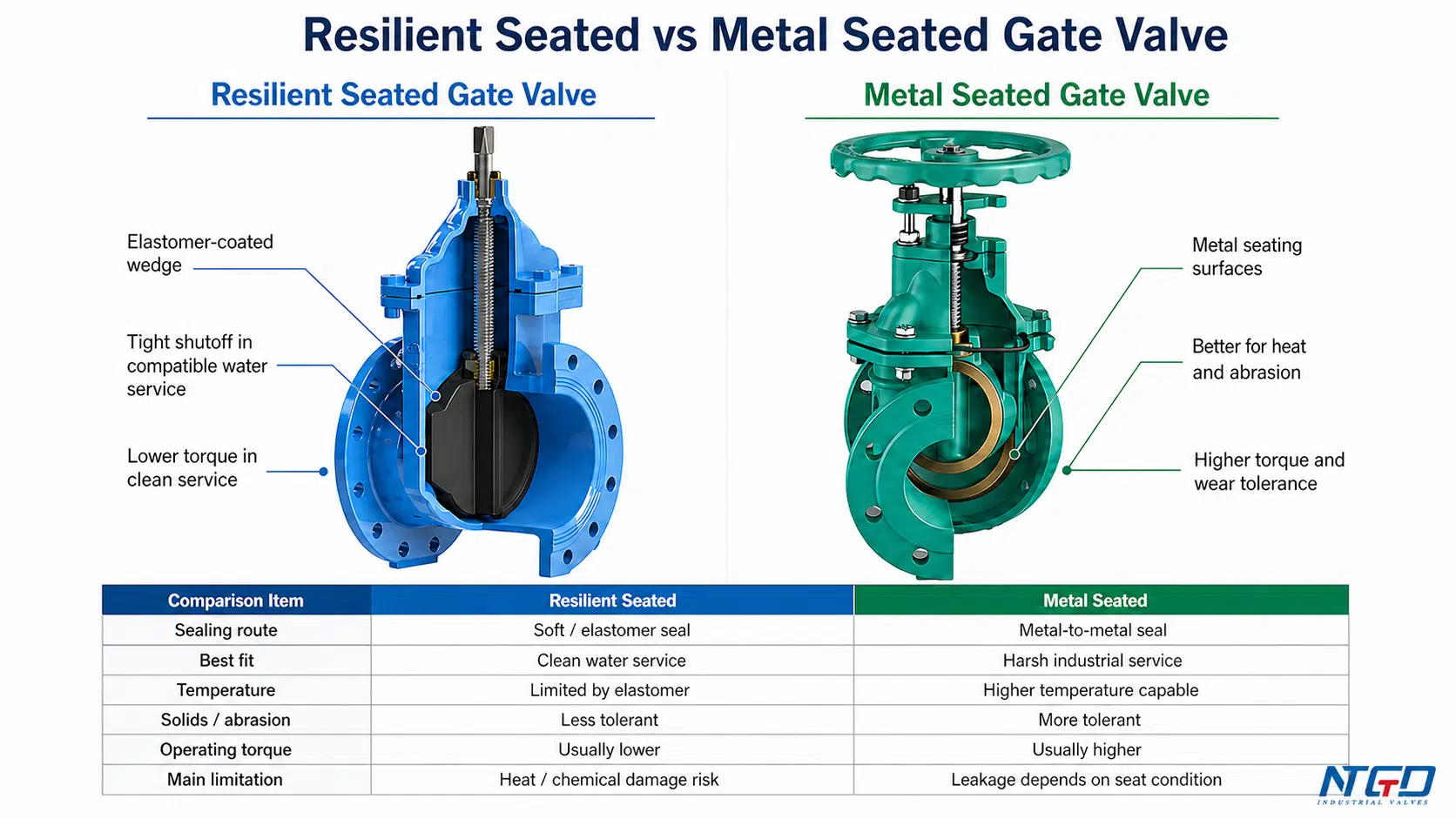
A resilient seated gate valve is usually selected when the priority is tight shutoff, low operating torque, and practical maintenance in compatible water service. A metal seated gate valve is usually selected when the priority is thermal resistance, wear resistance, corrosion resistance, and service reliability under harsher media conditions.
Terminology and Scope: Soft Seal, Hard Seal, Resilient Seated, and Metal Seated
The terminology can be confusing because different manufacturers and markets use different names for the same basic sealing concept.
Resilient Seated Gate Valve and Soft Seal Gate Valve
A resilient seated gate valve is commonly referred to as a soft seal gate valve. The word “resilient” describes the elastomeric sealing material on the wedge or sealing surface. In many waterworks designs, the wedge is encapsulated with rubber such as EPDM or NBR.
When the valve closes, the elastomer compresses against the seat area. This controlled deformation helps compensate for minor surface irregularities, which is why soft seal gate valves can achieve tight shutoff at relatively low seating load in clean water service.
This design is effective where the medium is compatible with the elastomer, where the temperature remains within the seat material limit, and where the service does not contain sharp abrasive particles that can cut the rubber surface.
Metal Seated Gate Valve and Hard Seal Gate Valve
A metal seated gate valve is commonly referred to as a hard seal gate valve. Instead of relying on elastomer deformation, the valve seals through contact between metal seating surfaces. Depending on the valve design and service conditions, these surfaces may be stainless steel, bronze, alloy steel, hard-faced material, or another trim route.
This design is used when elastomeric seating materials may be damaged by high temperature, abrasive solids, corrosive media, or severe operating conditions. Its selection value is not simply that metal is “harder.” The value is that the sealing route can survive service conditions that would quickly damage a soft seat.
Why This Comparison Applies Specifically to Gate Valves
This article focuses on gate valve seat design. It should not be treated as a general comparison of soft and metal seats across all valve types.
For gate valves, the important details are vertical gate or wedge travel, seat contact route, body bottom geometry, debris accumulation risk, and isolation performance. Ball valves, butterfly valves, and knife gate valves use different closure geometry and seat loading behavior, so their soft-seat and metal-seat logic should not be transferred directly into this gate valve comparison.
For the common opening-and-closing sequence behind both seat routes, see NTGD’s explanation of how the gate contacts the seats to stop flow.
What Is a Resilient Seated Gate Valve and What Is a Metal Seated Gate Valve?
Both valve types are isolation valves. Both are intended to be fully open or fully closed, not used as throttling valves. The difference lies in how the gate seals against the seat and how that sealing route responds to water, solids, pressure, temperature, corrosion, and maintenance conditions.
What Is a Resilient Seated Gate Valve?
A resilient seated gate valve uses a gate or wedge covered with an elastomeric material. In many waterworks valves, the valve body is ductile iron or cast iron, while the wedge is encapsulated in EPDM, NBR, or another rubber compound. The stem may be stainless steel, bronze, or another corrosion-resistant material depending on the specification.
The resilient seat helps the valve achieve tight shutoff at relatively low torque. It is especially useful where the medium is clean water or treated water and where leakage control is more important than high-temperature or abrasive resistance.
| Component | Common Material Route | Selection Meaning |
|---|---|---|
| Body | Ductile iron, cast iron, or coated iron | Common for waterworks and buried service when coating and corrosion protection match the project |
| Wedge / gate | Rubber-coated or elastomer-encapsulated wedge | Supports tight shutoff and lower closing torque in compatible service |
| Seat area | Elastomer-to-body contact or resilient sealing route | Helps compensate for minor surface irregularities in clean service |
| Stem | Stainless steel, bronze, or corrosion-resistant alloy | Supports corrosion resistance and operating reliability |
| Elastomer | EPDM, NBR, or another specified rubber compound | Must match water quality, temperature, chemical exposure, and service conditions |
A resilient gate valve is not automatically suitable for every service. The elastomer must be compatible with the medium and temperature. Incorrect elastomer selection can lead to swelling, hardening, cutting, cracking, or loss of sealing force. Sharp solids, abrasive particles, high heat, or incompatible chemicals can turn a tight soft seal into a premature failure point.
What Is a Metal Seated Gate Valve?
A metal seated gate valve uses metal sealing surfaces between the gate or wedge and the valve seat. The valve body material may be cast steel, stainless steel, forged steel, or another material selected for pressure, temperature, and corrosion requirements. The seat or wedge contact area may use stainless steel, bronze, hard-facing alloy, or another wear-resistant material.
The purpose of a metal seated design is not simply to make the valve stronger. It is to maintain a usable sealing route when soft seats would be damaged by heat, abrasive particles, corrosive service, or severe industrial conditions.
| Component / Feature | Common Material Route | Selection Meaning |
|---|---|---|
| Body | Cast steel, stainless steel, forged steel, alloy steel | Selected for pressure, temperature, corrosion, and standard requirements |
| Gate / wedge | Metal wedge, parallel gate, or hard-faced sealing surface | Supports elevated temperature and wear resistance when matched to service |
| Seat surface | Metal-to-metal contact, sometimes hard-faced | Better for severe service but depends heavily on seat condition and maintenance |
| Trim / facing | Stainless steel, Stellite, hard alloy, tungsten carbide, or similar materials | Used where abrasion, erosion, or temperature makes soft seating unsuitable |
| Operation | Manual gearbox, actuator, or higher-torque arrangement may be needed | Torque should be checked under actual differential pressure and service conditions |
A metal seated gate valve should not be described as automatically “zero leakage.” Sealing performance depends on design, seat condition, pressure, applicable standard, test method, and maintenance history. Hard-facing only adds value when it matches the actual abrasion, temperature, corrosion, and repair route of the service.
How Seat and Seal Design Affects Leakage, Temperature, Pressure, and Wear
The seat design affects more than leakage. It changes how the valve behaves under temperature, differential pressure, debris, cycling, wear, corrosion, and maintenance.
Elastomer Deformation vs Metal-to-Metal Contact
A resilient seated valve seals by allowing the elastomer to compress against the seat area. This controlled deformation is the reason soft seal gate valves can achieve tight shutoff in clean water service. The elastic material can compensate for minor surface irregularities that would otherwise become leakage paths.
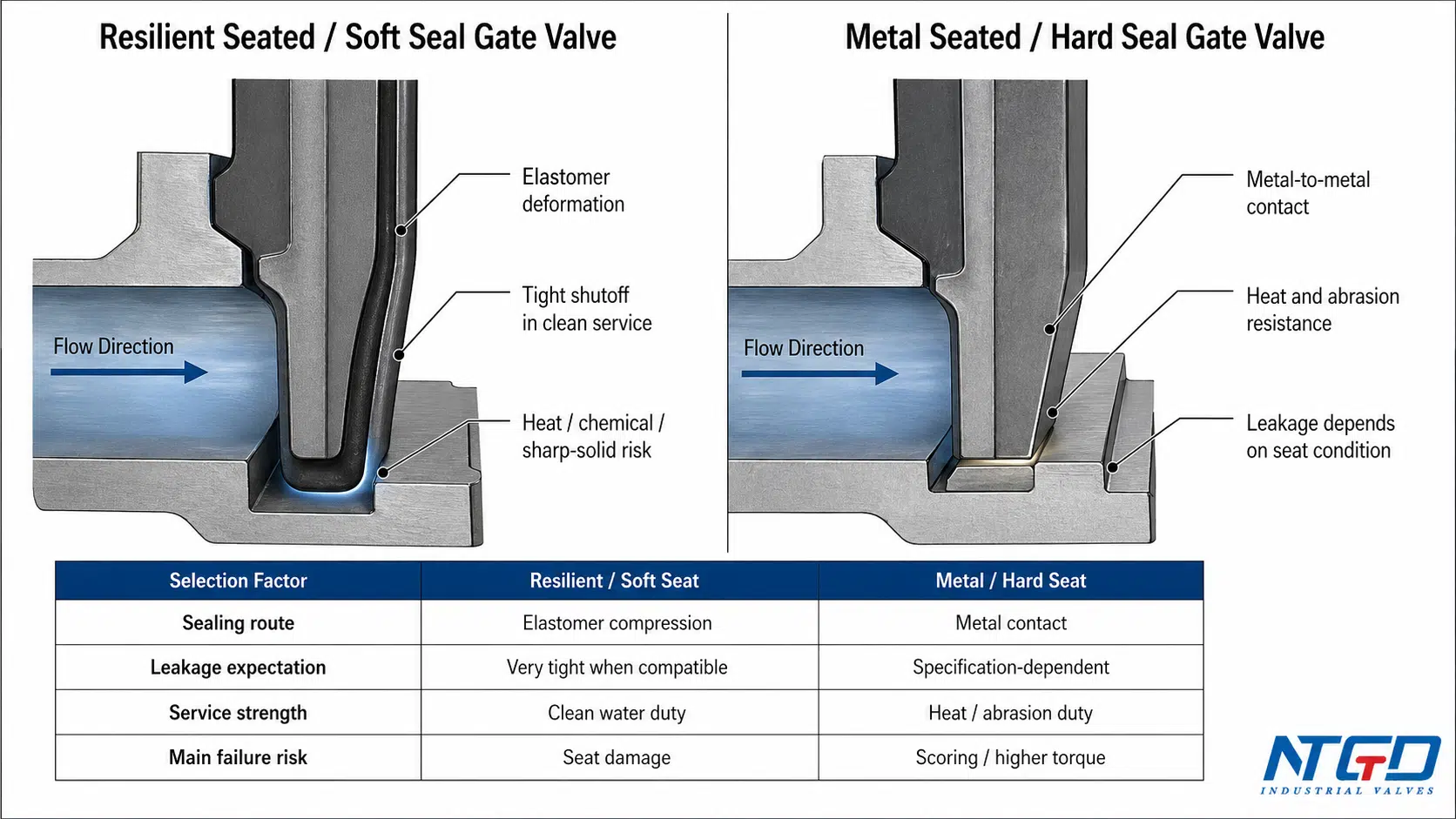
That same property becomes a limitation when the service changes. Sharp abrasive particles can cut or erode the rubber. Incompatible chemicals can swell or degrade the elastomer. Elevated temperature can harden, soften, crack, or permanently deform the seat material. Once the elastomer loses its physical sealing behavior, the valve may no longer maintain tight shutoff.
A metal seated valve relies on direct contact between machined or hard-faced metal surfaces. This design does not depend on rubber elasticity. It is more tolerant of heat and abrasion, but the sealing surfaces must remain serviceable. Scratches, scoring, galling, corrosion, or embedded particles can increase leakage and operating torque.
Tight Shutoff, Bubble-Tight Expectations, and Allowable Leakage
For clean water systems, resilient seated gate valves are often selected because tight shutoff is a key requirement. In this context, the elastomer-coated wedge can provide very low leakage when the valve is new, the seat is clean, and the elastomer is compatible with the service.
That does not mean “soft seal” should be treated as a universal zero-leakage promise. Tight shutoff claims should be understood in relation to specified test conditions, clean seating surfaces, valve design, pressure, and the applicable project requirement. Service leakage can change after exposure to debris, seat wear, temperature, cycling, or poor maintenance.
Metal seated gate valves are selected for a different reason. In harsh service, perfect soft-seat shutoff may be unrealistic because the elastomer could be damaged quickly. A metal seated valve may tolerate the service better, even if the allowable leakage expectation is different. The correct leakage requirement should be confirmed against the applicable valve inspection and testing standard, project specification, and actual seat condition.
The practical question is not only “which valve seals tighter when new?” It is also “which valve maintains acceptable isolation after real exposure to temperature, solids, corrosion, and operating cycles?”
Temperature, Pressure, Abrasion, and Corrosion Boundaries
Temperature is one of the strongest boundaries between the two designs. Elastomer seats are limited by rubber compound properties. EPDM, NBR, PTFE, and other seat materials have different temperature and chemical compatibility limits. Continuous operating temperature, short-term temperature exposure, and cleaning or upset conditions should be checked separately when the project is sensitive.
Pressure also matters, but pressure alone does not decide the valve type. Differential pressure affects seat loading, wedge force, and operating torque. A resilient seated valve may work well in a rated water system but still be unsuitable if sharp solids or incompatible chemicals attack the elastomer. A metal seated valve may handle severe pressure and temperature better, but it may require more torque and more precise maintenance.
Abrasion and corrosion must be judged separately. Abrasion cuts or wears the sealing surfaces. Corrosion attacks body, trim, seat, stem, and coating materials. A service with clean hot water is different from a service with cold abrasive slurry. A mildly corrosive water line is different from a line containing strong acid, alkali, or chemical contamination.
Common Failure Modes of Soft and Metal Seats
| Failure Area | Resilient Seated / Soft Seal Risk | Metal Seated / Hard Seal Risk |
|---|---|---|
| High temperature | Elastomer hardening, softening, deformation, cracking, or loss of sealing force | Usually more tolerant, but trim material and body rating still control suitability |
| Abrasive particles | Cutting, tearing, or erosion of rubber coating | Scoring, galling, or erosion of metal sealing surface |
| Chemical exposure | Swelling, cracking, softening, or degradation of elastomer | Corrosion or pitting if trim material is not compatible |
| Debris at closure | Small particles may be tolerated, but sharp solids can damage the seat | Particles may scratch metal seats or prevent full closure |
| Maintenance | Wedge or soft sealing component replacement may be easier, depending on design | Repair may require lapping, machining, seat replacement, or specialized work |
| Leakage behavior | Tight when seat is clean and compatible with service | May allow minor leakage depending on design, standard, and seat condition |
| Operating consequence | Seat damage can cause unexpected leakage or earlier wedge replacement | Seat damage can cause leakage trend, higher torque, and a longer repair route |
This is the core engineering trade-off. A soft seat is not weak by default. A metal seat is not leak-free by default. Each design fails in a different way when it is placed in the wrong service.
Gate-Valve-Specific Structure: Flat Bottom, Groove, and Debris Risk
A gate valve does not only differ by seat material. The body bottom and flow path can also influence shutoff performance, especially in water, wastewater, raw water, and sediment-containing service.
Flat-Bottom or Groove-Free Body in Resilient Seated Designs
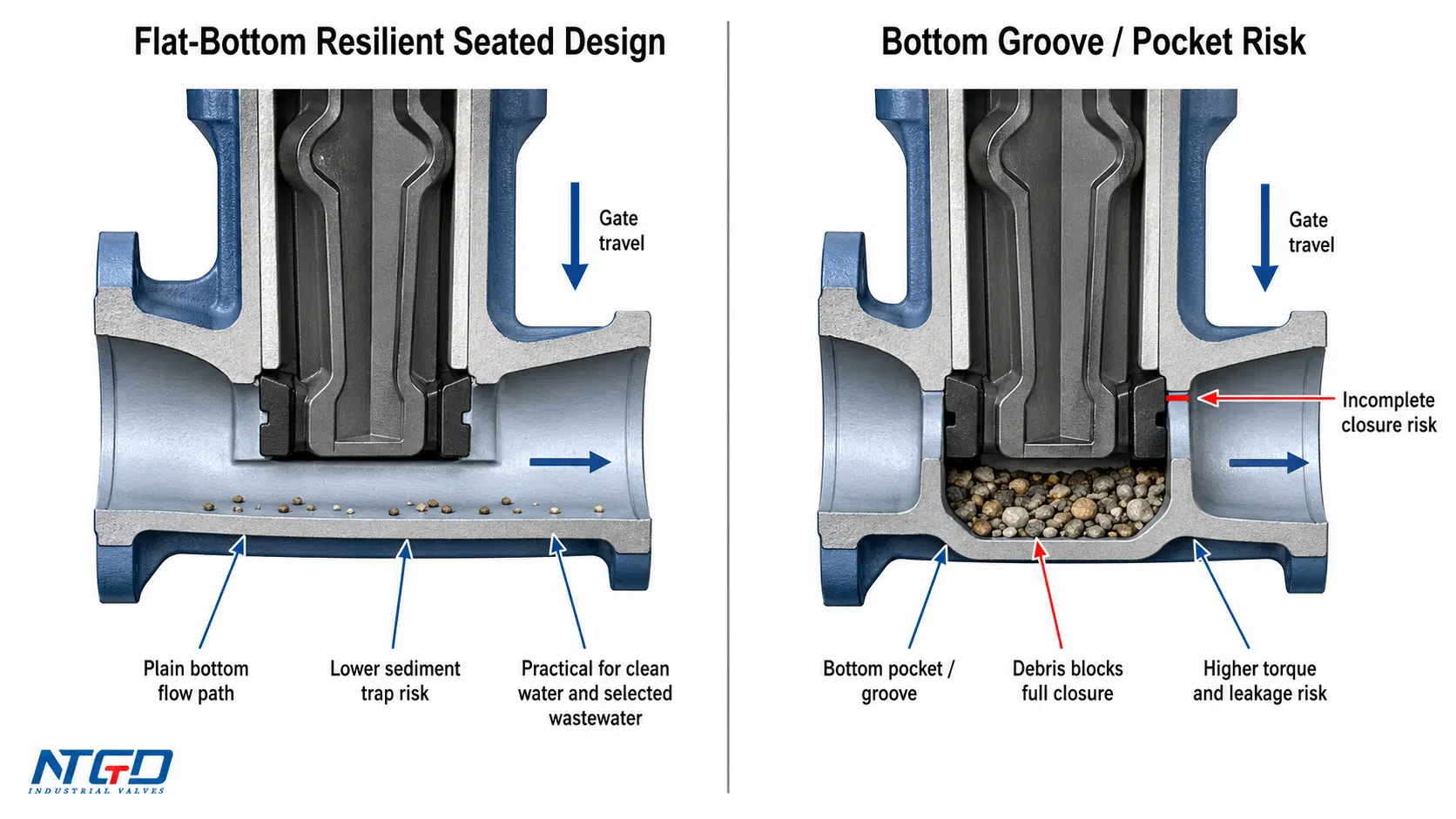
Many resilient seated gate valves use a plain or flat-bottom body design. This reduces the space where sand, small stones, rust, sludge, or other particles can collect. When the valve closes, the rubber-coated wedge can move into position without forcing large amounts of debris into a deep seating groove.
This design is one reason resilient seated gate valves are widely used in municipal water and wastewater systems. The benefit is not only rubber sealing. It is also that the flow path and body bottom can be less prone to sediment accumulation, depending on the exact construction.
Bottom Groove / Pocket Risk in Some Metal Seated Designs
Some traditional metal seated gate valve designs may have a bottom groove or pocket associated with the seating area. In clean service, this may not create an immediate problem. In raw water, sediment, wastewater, or dirty service, solids can settle in the bottom area and prevent full closure.
When debris prevents full gate travel, the operator may experience higher torque, incomplete shutoff, or seat damage. Repeated forcing of the valve can damage the seating surfaces and create a leakage path that did not exist when the valve was new.
Sediment, Sand, Sludge, and Incomplete Closure
Debris risk should be considered separately from pressure rating. A valve can have the correct pressure class but still perform poorly if solids accumulate in the body and interfere with closure.
For water distribution and treated water, a resilient seated design often provides a practical balance of tight shutoff and clean flow passage. For abrasive slurry, high-temperature solids, or corrosive industrial fluids, a metal seated route may still be preferred, but the body design, flushing access, trim material, and maintenance plan become more important.
Body bottom design should be checked from the drawing, datasheet, or valve construction details. It should not be assumed only from the label “resilient seated” or “metal seated.”
Why This Matters in Raw Water, Wastewater, and Sediment Service
Raw water and wastewater services are not always clean water services. They can include sand, silt, biological solids, rust, or debris from aging pipelines. In these systems, the choice between resilient and metal seated gate valves should consider both sealing material and body geometry.
A soft-seated, flat-bottom design may be effective where solids are fine, non-sharp, and compatible with the elastomer. A metal seated design may be needed when the service is abrasive, hot, chemically aggressive, or mechanically severe. The correct answer depends on the type of solids, their hardness, the operating temperature, and how the particles affect the sealing surfaces.
Application Fit Matrix: When to Choose Resilient Seated or Metal Seated Gate Valves
Applications should not be judged by industry name alone. The same water system may be clean, treated, raw, sediment-heavy, or chemically treated. The same industrial system may be mild or severe. The better question is: what will the valve actually see in service?
| Service Condition | More Likely Selection | Why |
|---|---|---|
| Clean potable water | Resilient seated gate valve | Tight shutoff, low torque, and practical maintenance are usually priorities |
| Treated water distribution | Resilient seated gate valve | The medium is usually compatible with elastomer seats when specified correctly |
| Fire protection water lines | Resilient seated gate valve | Low-torque shutoff and reliable operation are important in long-standby water systems |
| Irrigation systems | Resilient seated gate valve | Cost-effective isolation for moderate water service when solids are not severe |
| Wastewater with limited fine solids | Often resilient seated, with material and solids review | Flat-bottom design can help, but grit load, chemical exposure, and particle hardness must be checked |
| Raw water with sand or sediment | Case-by-case | Fine sediment may be manageable; sharp or abrasive particles may require stronger trim or a different design |
| Steam or high-temperature service | Metal seated gate valve | Elastomer seats are limited by material temperature and thermal stability |
| Slurry or abrasive media | Metal seated gate valve | Abrasion can cut, erode, or tear soft seats |
| Corrosive chemical service | Metal seated or special material route | Body, trim, coating, and seat materials must match chemical exposure |
| Mining service | Metal seated gate valve | Abrasion, solids, and severe duty often exceed soft-seat limits |
| Power plant service | Metal seated gate valve | Temperature, pressure, and isolation reliability often require metal seating |
| Oil and gas service | Metal seated or project-specific route | Pressure, temperature, media, leakage requirement, and applicable standards determine final selection |
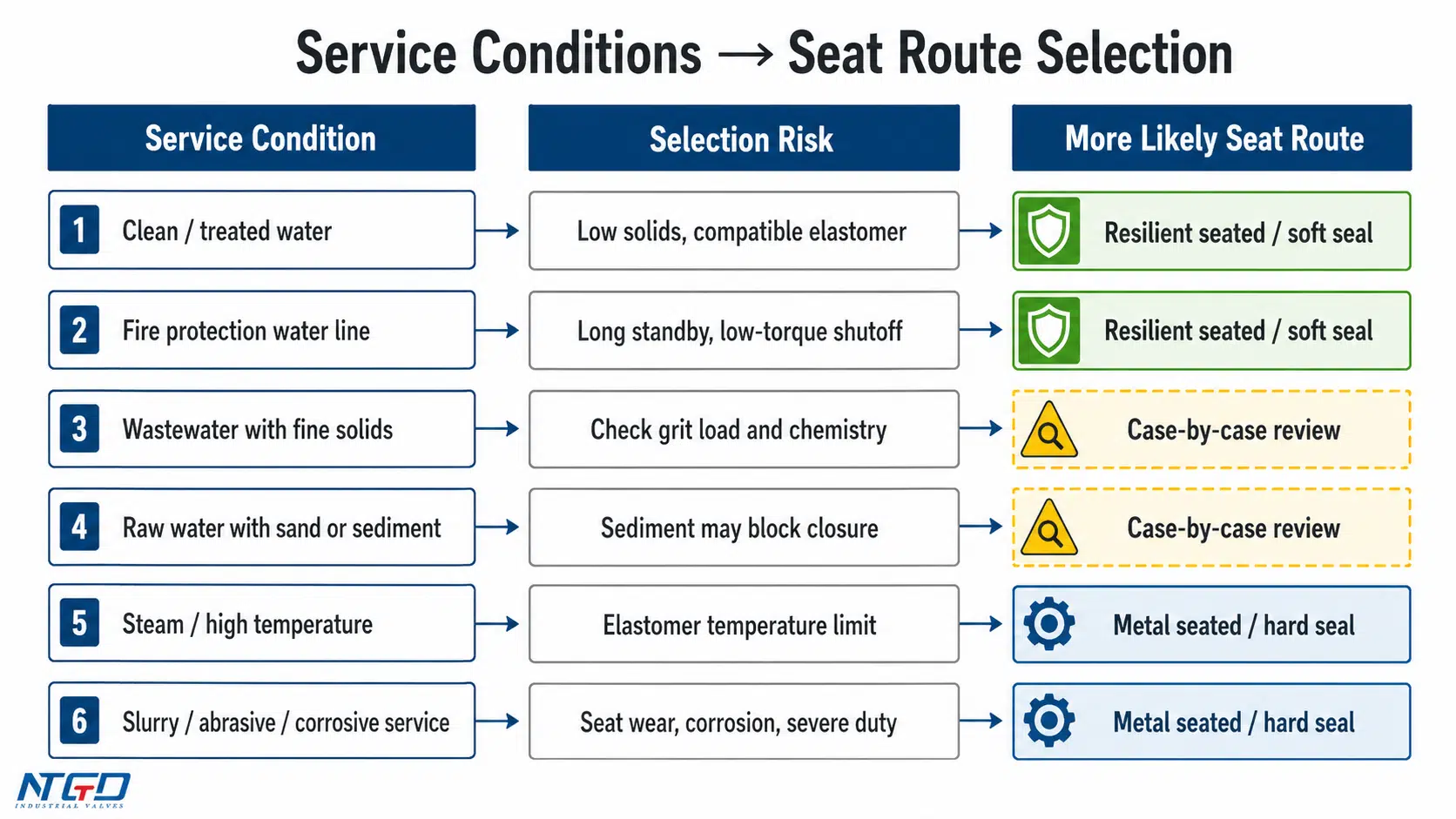
Clean Water, Treated Water, and Fire Protection
A resilient seated gate valve is commonly selected for clean water, treated water, and fire protection systems because the service conditions match the strengths of the design. The rubber-coated wedge supports tight shutoff, the operating torque is relatively low, and maintenance is often simpler than with a metal seated design.
For drinking water or municipal systems, the final specification should also confirm coating, elastomer approval, stem material, end connection, pressure class, and applicable waterworks standards.
Wastewater, Raw Water, and Sediment-Containing Service
Wastewater and raw water require more careful judgment. Fine particles and sludge do not automatically require a metal seated valve, especially if the temperature is moderate and the valve has a suitable body bottom design. However, sharp grit, heavy sediment, or abrasive particles can damage resilient seats.
In these services, the valve should be selected by checking solids type, particle hardness, operating frequency, cleaning access, chemical exposure, and expected shutoff performance. The term “wastewater” or “raw water” is not enough to select the seat route by itself.
Steam, High Temperature, and High Pressure Service
High temperature is one of the clearest reasons to avoid a standard resilient seat. Elastomer materials have defined temperature limits, and exceeding those limits can cause deformation, hardening, cracking, or loss of sealing force.
For steam, thermal oil, high-temperature water, or similar service, a metal seated gate valve is usually the better direction. The body material, trim material, pressure class, bonnet design, and operating method must still match the actual design conditions.
Slurry, Mining, Chemical, Power, and Oil & Gas
Metal seated gate valves are commonly selected for severe industrial services because they can use harder sealing surfaces and stronger body / trim materials. Mining slurry, corrosive chemical fluids, high-temperature power plant systems, and some oil and gas services may damage soft seats quickly.
This does not mean every industrial application requires a metal seated gate valve. The selection should be based on the medium, solids, temperature, pressure, corrosion, operating frequency, required leakage behavior, and maintenance route.
Borderline Cases That Need Engineering Review
Some services are not obvious. The service name alone does not decide the seat route. The real decision depends on fluid data, temperature profile, particle hardness, chemical compatibility, required leakage, operating frequency, and maintenance access.
Borderline cases include:
- treated water with chemical dosing
- wastewater with variable grit load
- raw water with seasonal sediment
- low-temperature slurry
- mildly corrosive water with occasional solids
- high-pressure water isolation
- infrequently operated emergency isolation valves
For these cases, the seat route should be confirmed before the valve is specified. A small amount of missing service data can lead to the wrong seat material, wrong torque expectation, or wrong maintenance plan.
Lifecycle, Maintenance, Torque, and Cost Trade-Offs
Initial price is only one part of valve selection. The lower-cost valve is not always the lower-cost solution if it fails early, leaks, requires emergency repair, or causes shutdown.
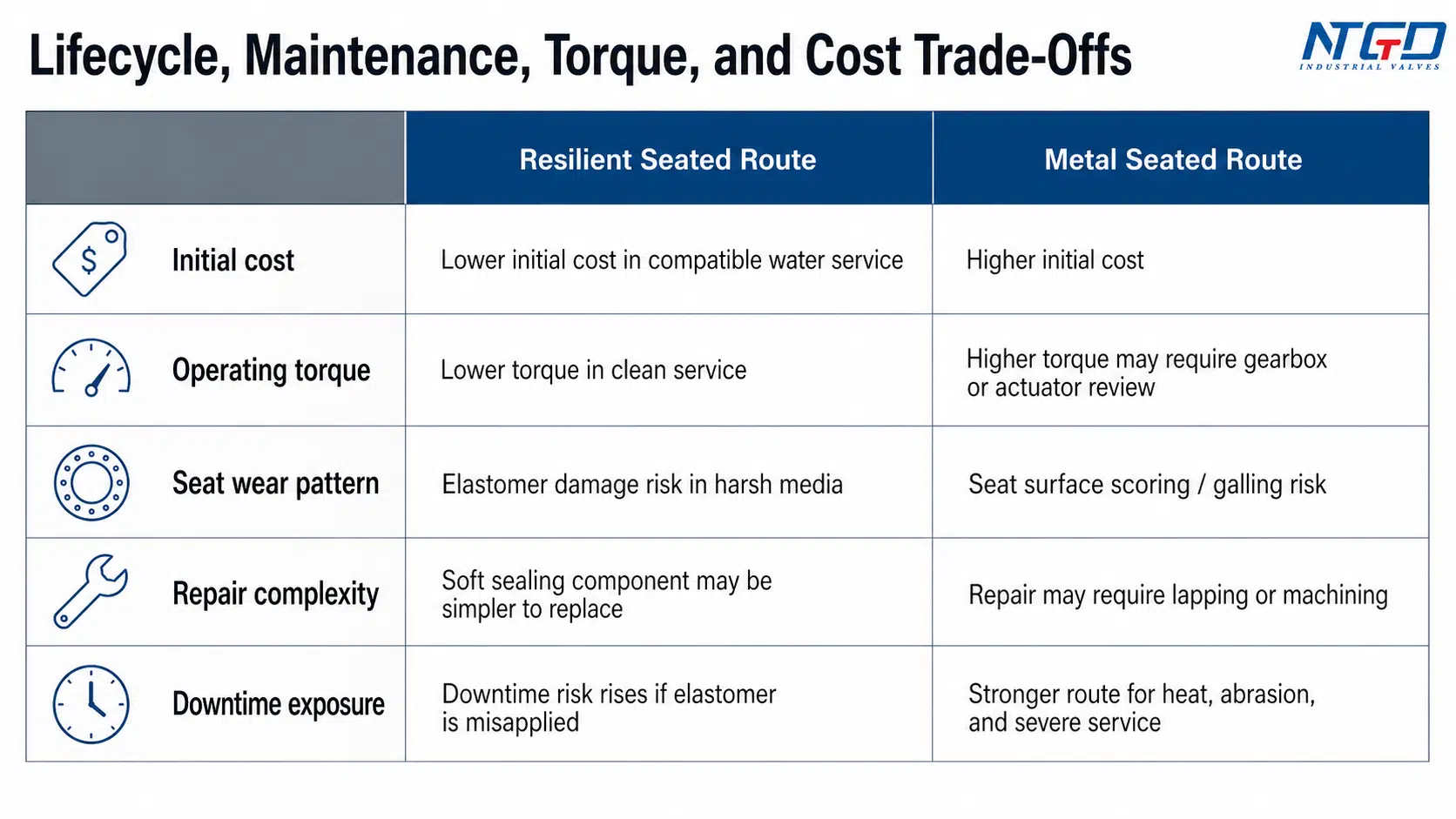
Initial Cost vs Lifecycle Cost
Resilient seated gate valves often have a lower initial cost in waterworks projects. Ductile iron construction, elastomer seating, and simpler maintenance make them economical for large water distribution systems.
Metal seated gate valves usually cost more because of stronger body materials, metal trim, hard-facing, machining, and more demanding service requirements. In severe service, that higher upfront cost may be justified if it reduces seat damage, unplanned shutdowns, or premature replacement.
A soft seat used in abrasive, high-temperature, or chemically incompatible service may fail early and require unplanned replacement. A metal seated valve used where clean-water tight shutoff and low torque are the real priorities may create unnecessary cost, higher operating effort, and more complex repair. The correct comparison is not purchase price alone; it is the cost of the valve route across the full service life.
The cost review should include:
- purchase price
- installation conditions
- operating frequency
- expected seat wear
- maintenance labor
- downtime risk
- replacement difficulty
- consequences of leakage or failure
Seat / Gate Replacement and Metal Seat Repair
A resilient seated valve may allow simpler repair when the wedge or soft sealing surface is worn, depending on the valve design and installation access. This can reduce downtime in compatible waterworks systems.
A metal seated valve may require more specialized maintenance. If the sealing surfaces are scratched, worn, or corroded, repair may involve inspection, lapping, machining, seat replacement, or trim replacement. This is acceptable in severe service, but it should be planned rather than discovered after failure.
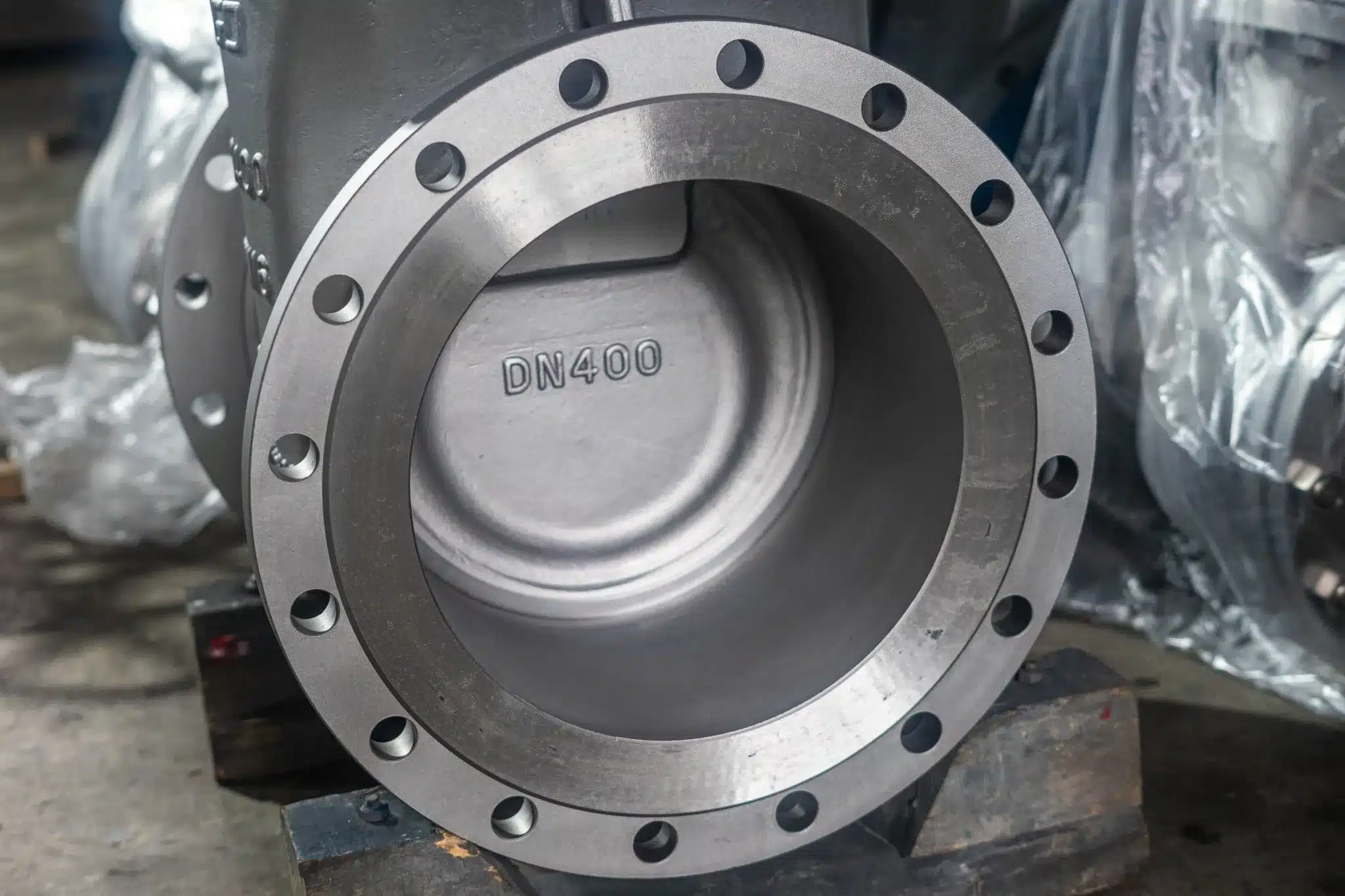
Operating Torque, Gearbox, and Actuator Considerations
Resilient seated gate valves typically operate with lower torque in clean service because the elastomer sealing route is more forgiving. Metal seated gate valves can require higher torque, especially under high differential pressure, large valve size, debris interference, or seat wear.
For larger valves or severe service, the operating method should be reviewed early. A gearbox, electric actuator, pneumatic actuator, or hydraulic actuator may be required. Torque margin should not be based only on new-valve conditions; it should consider aging, deposits, pressure differential, cycling frequency, and maintenance intervals.
Downtime and Inspection Risk
Downtime changes the economics of valve selection. A resilient seated gate valve may be the economical option in water distribution, but it may become expensive if the elastomer is attacked by chemicals or cut by abrasive solids. A metal seated gate valve may be more expensive at purchase, but it can reduce risk in high-temperature or abrasive service.
Gate valve maintenance frequency should match the service. Clean water valves may require relatively simple periodic checks. Severe service metal seated valves need more attention to seat condition, torque change, leakage trend, and operating reliability.
Final Selection Checklist and FAQs
Final Fit-Check Before Specifying the Valve
Before choosing between a resilient seated gate valve and a metal seated gate valve, confirm the following. For reliable gate valve selection, size and pressure class alone are not enough to determine the correct seat route.
| Selection Question | Why It Matters |
|---|---|
| What is the medium? | Clean water, wastewater, slurry, steam, and chemicals create different seat risks |
| What is the operating temperature? | Elastomer seats have material-specific temperature limits |
| What is the pressure class and differential pressure? | Pressure affects seat loading, torque, and leakage behavior |
| Are solids present? | Sand, grit, sludge, or abrasive particles can damage seats or prevent closure |
| Is tight shutoff required? | Resilient seated valves often suit tight water shutoff; metal seats may have different leakage expectations |
| Is the medium corrosive? | Body, trim, stem, coating, and seat materials must match chemical exposure |
| How often will the valve operate? | Frequent operation changes wear and maintenance planning |
| Is maintenance access easy? | Repair route affects lifecycle cost and downtime exposure |
| Is actuation required? | Metal seated and large-size valves may need gearbox or actuator review |
| Which standard or test requirement applies? | Leakage, pressure, coating, and material requirements must match the project specification |
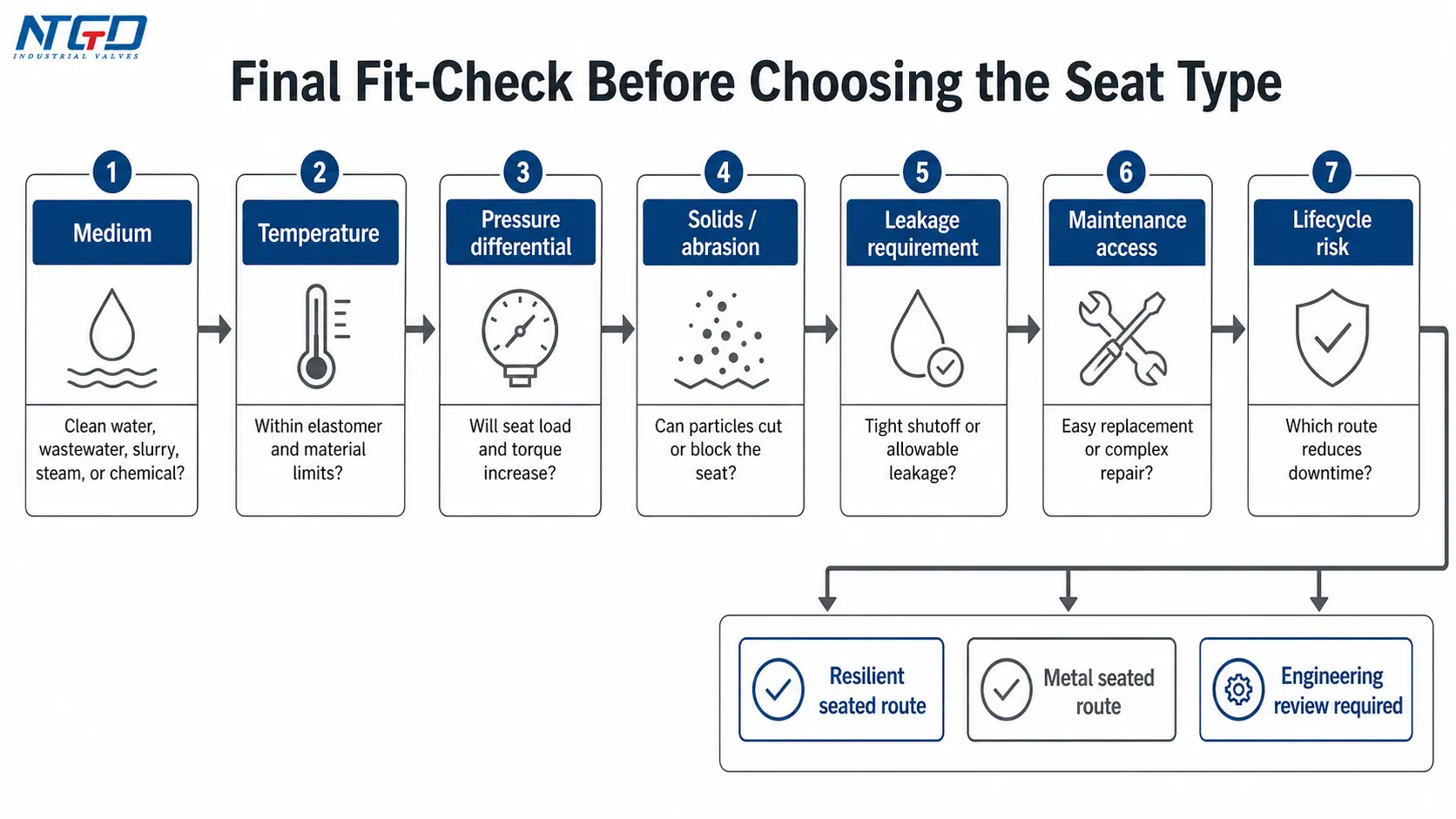
RFQ-Ready Information to Confirm
For a reliable valve recommendation, prepare the following information before requesting a quotation or technical review:
- valve size and pressure class
- body and trim material requirement
- medium and solids content
- operating temperature
- operating pressure and differential pressure
- shutoff / leakage requirement
- end connection
- operation method: handwheel, gearbox, electric actuator, pneumatic actuator, or hydraulic actuator
- applicable standard or project specification
- installation position and maintenance access
- expected operating frequency
Without medium data, solids information, temperature, leakage requirement, operating frequency, and maintenance access, a supplier or engineering team cannot reliably confirm whether a resilient seated or metal seated gate valve is the better match.
FAQs About Resilient and Metal Seated Gate Valves
What is the difference between resilient seated and metal seated gate valves?
A resilient seated gate valve uses an elastomer-covered wedge or soft sealing route to achieve tight shutoff, especially in compatible water service. A metal seated gate valve uses metal-to-metal contact or hard-faced sealing surfaces for higher temperature, abrasive, corrosive, or severe service.
Is a resilient seated gate valve the same as a soft seal gate valve?
In most gate valve selection contexts, yes. “Resilient seated” and “soft seal” both refer to a sealing design that uses rubber or another elastomeric material to create the seat seal. The exact material should still be confirmed, such as EPDM, NBR, or another specified compound.
Is a metal seated gate valve the same as a hard seal gate valve?
In common industrial valve terminology, yes. A metal seated gate valve is often called a hard seal gate valve because the sealing surfaces are metal rather than elastomeric. The specific trim material, hard-facing route, and leakage requirement depend on the design and service.
When is a resilient seated gate valve better for water service?
A resilient seated gate valve is usually the better fit for clean water, treated water, fire protection water lines, and many municipal water systems because it provides tight shutoff, lower operating torque, and practical maintenance. The final selection should still check pressure class, coating, elastomer compatibility, and project standards.
When should I choose metal seated instead of resilient seated?
Choose a metal seated gate valve when the service includes high temperature, sharp abrasive solids, slurry, steam, corrosive media, or severe industrial conditions that may damage elastomer seats. The final decision should confirm trim material, body material, leakage expectation, and maintenance route.
Does soft seal always mean zero leakage?
No. A soft seal can provide very tight shutoff when the seat material is compatible with the medium and the sealing surfaces are clean and undamaged. Leakage performance still depends on valve design, seat condition, test standard, pressure, temperature, and service history.
Can a metal seated gate valve be used in water systems?
Yes, but it is not always the most practical choice. A metal seated gate valve may be used where water service includes high temperature, high pressure, sediment, or special project requirements. For clean water systems where tight shutoff and low torque matter most, a resilient seated gate valve is often the more practical option.
When should I avoid resilient valve inserts in harsh fluid environments?
Avoid relying on resilient inserts when the fluid contains sharp abrasive particles, high temperature, incompatible chemicals, or solids that can cut, swell, harden, or erode the elastomer. In those services, a metal seated or specially engineered trim route should be reviewed before the valve is specified.
Conclusion
A resilient seated gate valve is usually the practical choice for clean water, treated water, irrigation, fire protection, and many moderate waterworks applications where tight shutoff, low torque, and simple maintenance are priorities. A metal seated gate valve is usually the stronger choice for high temperature, high pressure, abrasive, corrosive, or severe industrial service where elastomer seats may not survive.
The best selection comes from matching the seat design to the real operating conditions. Do not choose only by initial cost, general pressure class, or a simple “soft seal vs hard seal” label. Check the medium, temperature, pressure differential, leakage requirement, solids content, corrosion risk, maintenance access, and lifecycle impact before finalizing the valve specification.
For borderline services where the seat route is not obvious, NTGD can support an application check based on your medium, temperature, pressure class, solids content, leakage requirement, operating method, and project specification. This helps confirm whether a resilient seated or metal seated gate valve is the safer match before the valve is finalized.
