
Nombre del autor: Bruce Zheng
Función del autor: Cofundador e ingeniero de válvulas en NTGD Valve
Biografía del autor: Bruce Zheng es cofundador e ingeniero de válvulas en NTGD Valve, donde se dedica a la selección y aplicación de válvulas industriales, así como a la elaboración de contenido técnico para compradores B2B de todo el mundo.
Última actualización: 7 de julio de 2026
Choosing butterfly valve manufacturers is not only about finding a familiar brand name. For industrial projects, the stronger question is whether the butterfly valve manufacturer can support the required valve design, factory testing, documentation, material selection, actuator configuration, and delivery control for your actual service conditions.
This guide reviews 10 butterfly valve manufacturers that buyers often consider in global sourcing research. It also explains how to evaluate a butterfly valve factory, how to separate a manufacturer from a supplier or distributor, and what data should be prepared before RFQ.
This article is not a product catalog, price list, local supplier directory, or universal ranking. It is designed to help B2B buyers build a shortlist and verify whether each manufacturer’s capability matches the project. If a buyer only needs a broad selection-style comparison, that intent should be handled separately; this page focuses on factory capability, documentation readiness, and practical sourcing verification.
Quick Answer: What Makes a Butterfly Valve Manufacturer Trusted?
A trusted butterfly valve manufacturer should be evaluated by more than company size or brand recognition. The most reliable shortlist usually comes from checking five areas: valve design coverage, factory capability, testing control, documentation readiness, and application fit.
For butterfly valves, this matters because different services may require very different valve constructions. A resilient seated wafer butterfly valve for water service is not the same selection problem as a high-performance double offset or triple offset butterfly valve for higher temperature, pressure, or stricter shutoff requirements. If the manufacturer’s product route and factory capability are not verified early, the project may face approval delays, installation mismatch, seat leakage, abnormal torque, or incomplete delivery documentation later.
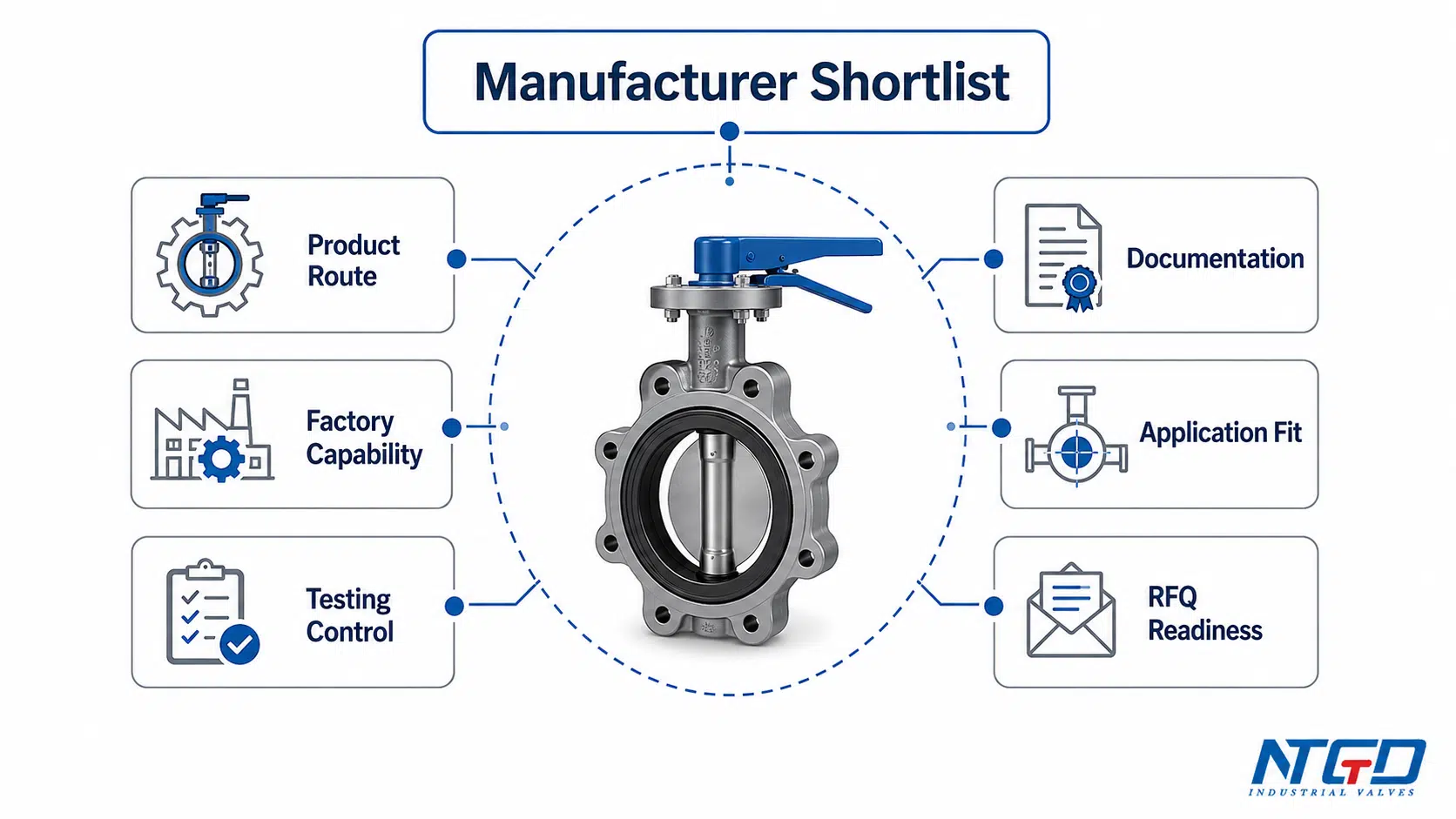
A trusted manufacturer is not only a brand name
A well-known butterfly valve company may have strong global recognition, but buyers still need to verify whether the selected product line fits the actual medium, temperature, pressure class, flange connection, actuator type, and inspection requirement.
A smaller or regional manufacturer may also be suitable if it has the right factory capability, product range, testing process, material traceability, and engineering response. The practical question is not “Which name is famous?” but “Which manufacturer can prove that this valve design, material, test package, and documentation set fit this project?”
What this list is designed to help buyers check
This guide helps buyers compare manufacturers of butterfly valves based on practical sourcing questions:
- Does the manufacturer cover the required valve route, such as wafer, lug, flanged, resilient seated, high-performance, double offset, or triple offset?
- Can the butterfly valve factory provide inspection and testing records?
- Are standards, certificates, drawings, and datasheets clear enough for project approval?
- Is the company acting as a manufacturer, factory, supplier, distributor, or a mix of these roles?
- Can the manufacturer support RFQ review instead of only providing a basic product name?
When you need a manufacturer, factory, supplier, or distributor
For custom specifications, large projects, severe service, or documentation-heavy procurement, a direct manufacturer or verified factory capability may be more important. For standard replacement valves, stock availability, or local delivery, a supplier or distributor may be enough.
The key is not to use the same sourcing method for every butterfly valve project. A standard utility valve and a documented project valve may look similar in a short quotation, but they can require very different levels of factory control, testing evidence, and engineering review.
How We Evaluate Butterfly Valve Manufacturers
This list is based on buyer-side evaluation logic rather than a single “best” claim. A butterfly valve manufacturer should be reviewed through technical, manufacturing, and documentation factors. In this article, factory capability is treated as a core weighting factor because it helps separate a verified manufacturer or controlled production source from a company that only provides sales communication.
| Evaluation Factor | Lo que los compradores deben verificar | Por qué es importante |
|---|---|---|
| Product route | Wafer, lug, flanged, resilient seated, high-performance, double offset, triple offset | Confirms whether the manufacturer can support the required valve design |
| Factory capability | Machining, assembly, inspection, pressure testing, actuator fitting | Helps verify manufacturing control, inspection responsibility, and risk beyond the quotation stage |
| Standards and documentation | Applicable standards, datasheets, test reports, certificates, drawings | Supports project approval and reduces procurement risk |
| Application fit | Water, wastewater, chemical, oil and gas, HVAC, power, marine, mining | Prevents choosing a valve design that does not match service conditions |
| Supplier support | RFQ response, lead time, export support, after-sales communication | Affects project execution after technical selection |
Product route and valve design coverage
A manufacturer with broad butterfly valve capability should not only offer one body style. Buyers should confirm whether the company can supply the body type, seat material, disc material, stem arrangement, actuation method, and pressure class required by the project.
The common mistake is to ask only for “butterfly valve” without defining the route. A manufacturer that mainly supplies resilient seated butterfly valves may be strong for water, HVAC, and utility service, but it may not be the best fit for every high-temperature, high-pressure, or severe-service application.
Factory capability, testing, and inspection control
The phrase “butterfly valve factory” should mean more than a sales claim. Buyers should check whether the company can describe its production process, inspection steps, pressure testing method, packing inspection, and traceability control.
Factory capability is especially important when the order involves project documentation, non-standard materials, actuator mounting, third-party inspection, or export packing requirements. If these items are not clarified before RFQ approval, the buyer may receive a technically acceptable-looking quotation that still fails during document review, factory inspection, or site acceptance.
Standards, certificates, and documentation readiness
Standards such as API, ISO, ASME, AWWA, NSF, ANSI, DIN, or other project specifications should not be treated as decoration. Buyers should verify whether the standard applies to the exact valve type, size, pressure class, material, and service.
A certificate is useful only when its scope matches the product being purchased. Company-level quality management certification, brand reputation, or a general catalog statement should not replace product-specific datasheets, test requirements, material certificates, and inspection records.
Application fit and engineering support
Industrial butterfly valves are used in many systems, but the same valve design does not fit every medium. Water, wastewater, chemical, oil and gas, power, HVAC, marine, and mining applications may require different body materials, seat designs, corrosion resistance, actuator choices, and testing expectations.
A trusted manufacturer should be able to help buyers connect service data to practical Selección de válvulas de mariposa. If the manufacturer cannot explain why a seat, body material, offset design, or actuator package fits the service, the shortlist should remain conditional.
Supplier support, lead time, and RFQ response
Good communication does not replace engineering capability, but weak RFQ support can still delay a project. Buyers should check whether the manufacturer or supplier can respond with a datasheet, drawing, material confirmation, test requirement, packing details, and lead time.
For project supply, the strongest RFQ response is not the fastest price. It is the response that clarifies technical assumptions, lists missing service data, and shows what documents can be provided with the shipment.
Butterfly Valve Manufacturers Comparison Table
The table below is a buyer-oriented comparison. It should be used as a shortlist starting point, not as a final approval document. Start with the product route and application fit, then cross-check the factory / testing signal against the documentation signal. A manufacturer should not move into final approval until the quoted valve series, factory control, and document package match the project specification.
Product scope, standards, certifications, and factory capability should always be verified against current manufacturer documentation and project specifications.
| Fabricante | Region / Base | Principales rutas de las válvulas de mariposa | Aplicaciones típicas | Factory / Testing Signal | Standards / Documentation Signal | Supplier Support Note |
|---|---|---|---|---|---|---|
| Emerson | Global industrial automation and valve group | Industrial butterfly valves through recognized valve brands | Oil and gas, chemical, water, process control | Strong brand and global product systems; buyers should verify product-line-specific testing and series-level records | Standards and certifications should be checked by product series | Suitable when global engineering support and automation integration matter |
| Flowserve | Global flow control company | Industrial butterfly valve product lines for process industries | Oil and gas, power, water, chemical service | Broad flow control manufacturing background; factory scope should be verified by valve line and project requirement | API / ISO / project documentation should be confirmed per product | Suitable for projects requiring process-industry support |
| Bray Internacional | Global valve and actuator manufacturer | Resilient seated, high-performance, triple offset, manual and automated options | Water, wastewater, chemical, HVAC, food, power, marine | Strong valve and actuator integration signal; torque and actuator package should be reviewed by service | Buyers should verify standards, materials, and actuator documentation | Suitable when valve-actuator package support is important |
| KSB | Established pump and valve group | Wafer, lug, flanged, large-size and industrial butterfly valve routes | Water, building services, chemical, energy, mining | Broad engineered product background; large-size and series-specific capability should be verified | Documentation and project compliance should be confirmed by series | Suitable for water, infrastructure, and industrial systems |
| Dombor | Fabricante de válvulas industriales | Metal seated, cryogenic, high-pressure, wear-resistant and process valve routes | Oil, gas, chemical, power, severe service | Existing inspection and testing descriptions are useful starting points for factory verification | Standards such as ANSI, API, BS, DIN, JIS, and GB should be verified by scope | Suitable when factory inspection and custom technical review are important |
| DeZURIK | Valve manufacturer with strong water and industrial focus | Butterfly valves for water, wastewater, industrial and severe applications | Municipal water, wastewater, power, chemical systems | Testing and application-specific manufacturing capability should be verified, especially for water-sector projects | AWWA / NSF-related documentation may be relevant for water projects | Suitable when water-sector documentation is important |
| Válvulas Apollo | U.S.-based valve manufacturer | Butterfly valves for building, industrial, fire protection and utility systems | HVAC, fire protection, plumbing, industrial plants | Product-line testing and approval scope should be checked before project use | ASME / API / CE-related claims should be verified per model | Suitable for standard industrial and building-service applications |
| Válvula Neway | China-based industrial valve manufacturer | High-performance butterfly valves and industrial valve routes | Power, chemical, oil and gas, water systems | Production scale and factory capability should be verified by project, inspection requirement, and records | Standards, material certificates, and test records should be requested | Suitable when broad industrial valve manufacturing support is needed |
| NTVAL | Industrial valve supplier / manufacturer brand | Wafer, lug, double offset, triple offset and actuation options | Oil and gas, chemical, water, power systems | Buyers should verify manufacturing source, inspection control, and responsibility for test documentation | ISO / API-related documentation should be confirmed by project | Suitable when global sourcing support and project communication are needed |
| Válvula Jiangnan | China-based industrial valve company | Wafer, lug, double offset, triple offset and industrial butterfly valves | Power, chemical, water, steam and oil systems | Factory capability and quality control should be verified directly, especially for project supply | Certificate scope and product-specific standards should be checked | Suitable for buyers comparing China-based industrial valve manufacturers |
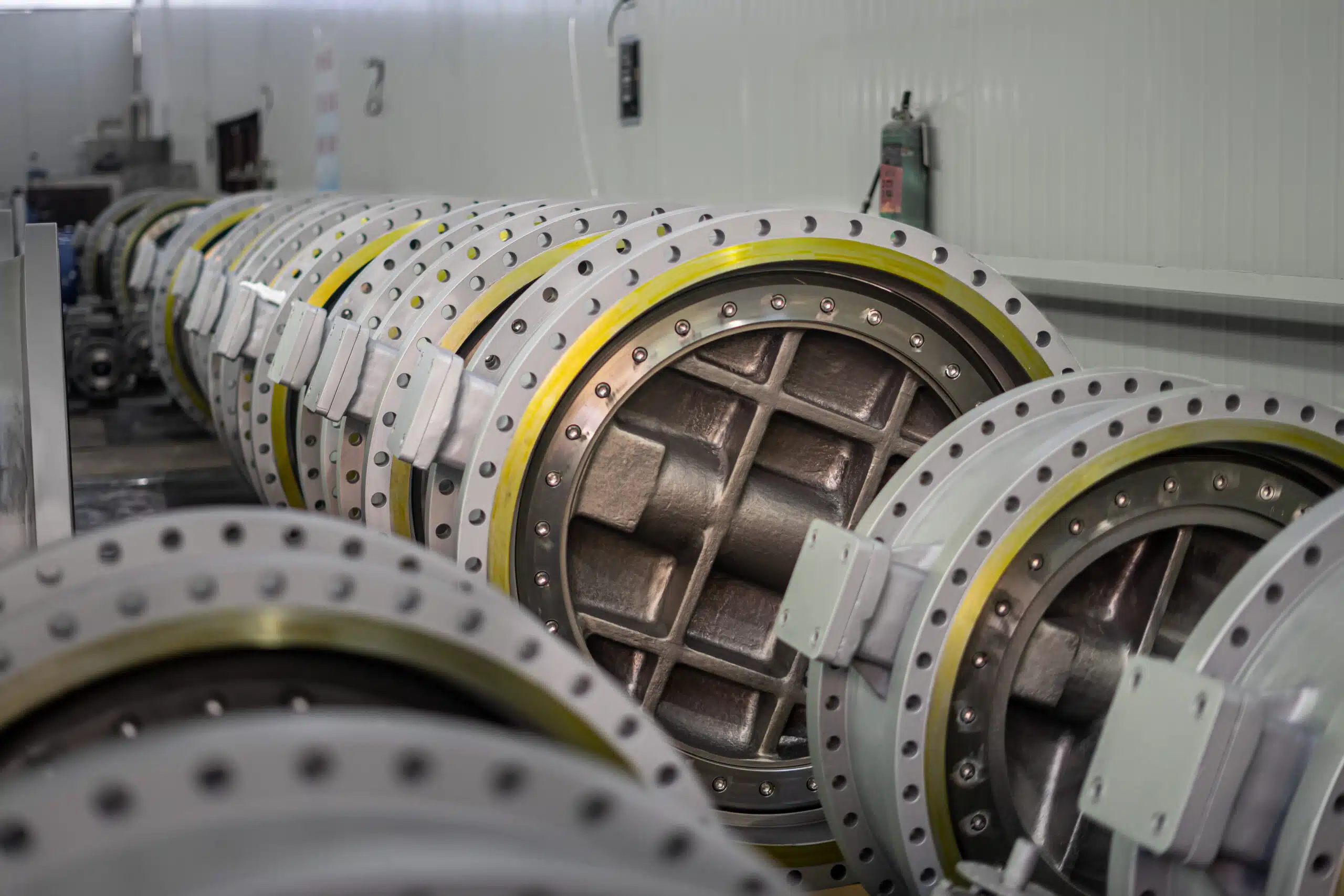
10 Trusted Butterfly Valve Manufacturers to Review
The following manufacturer profiles reuse the original shortlist while restructuring each company around buyer-relevant criteria. The goal is not to repeat marketing claims, but to identify what buyers should verify before shortlisting.
1. Emerson
Emerson is widely recognized in industrial automation, fluid control, and valve technology. For buyers reviewing butterfly valve manufacturers, Emerson is often considered when the project requires global brand support, automation integration, or process control experience.
Its butterfly valve portfolio is commonly associated with established valve brands and industrial product lines. Buyers may see Emerson considered for oil and gas, water treatment, chemical processing, and other process-industry systems.
For RFQ review, the important point is not only the brand name. Buyers should confirm the exact butterfly valve series, body style, pressure class, seat material, disc material, actuation option, and applicable test documentation.
Buyer fit note: Emerson may be suitable when global engineering support, instrumentation compatibility, and process automation integration are important.
What to verify before RFQ: product-line scope, certificate applicability, material compatibility, actuator package, series-level testing records, and project-specific documentation.
2. Flowserve
Flowserve is known as a global flow control company with a long industrial background. Its valve products are often considered in oil and gas, power, water, chemical, and other process systems.
For butterfly valve selection, Flowserve may be relevant when the buyer needs industrial valve support under demanding process conditions. However, buyers should avoid assuming that every product line fits every butterfly valve application.
The project team should verify the exact valve series, available materials, pressure class, flange standard, seat construction, and testing requirements. If the project involves corrosive media, high temperature, or automation, the RFQ should include enough service data for technical review.
Buyer fit note: Flowserve may be a strong candidate for process-industry projects requiring broader flow control expertise.
What to verify before RFQ: valve series, temperature and corrosion limits, documentation package, actuator support, and applicable standards.
3. Bray Internacional
Bray International is a well-known valve and actuator manufacturer. It is often reviewed by buyers who need butterfly valves with manual, pneumatic, or electric actuation support.
Bray’s product direction is commonly associated with resilient seated butterfly valves, high-performance butterfly valves, and triple offset designs. This makes it relevant for buyers comparing manufacturers by product route rather than only by company name.
The original article highlighted Bray’s use across industries such as chemical, oil and gas, HVAC, water and wastewater, marine, mining, food and beverage, and power. In the revised structure, these industries should be treated as application-fit signals, not as a guarantee that one product line fits all conditions.
Buyer fit note: Bray may be useful when valve-actuator integration, sealing performance, and broad application coverage are important.
What to verify before RFQ: seat material, actuation package, torque data, service limits, fire-safe or special design requirements, and certificate scope.
4. KSB
KSB is an established pump and valve group with a long engineering history. Buyers may consider KSB when the butterfly valve requirement is linked to water systems, building services, chemical plants, energy production, mining, or general industrial service.
The original article included several KSB butterfly valve models and detailed size and pressure information. In a buyer-side evaluation page, those details should be treated as product route examples rather than copied as a product catalog.
KSB’s relevance comes from its broader engineered product background and its presence in infrastructure and industrial systems. Buyers should still verify the exact model, body type, seat configuration, pressure class, and actuator options for the project.
Buyer fit note: KSB may be suitable for infrastructure, water, building service, and industrial projects where engineered product support is required.
What to verify before RFQ: model availability, large-size capability, seat and lining material, pressure class, actuator arrangement, and test documentation.
5. Dombor
Dombor is included because the original article provided useful factory and inspection-related information. This makes the profile relevant to buyers searching for a butterfly valve factory rather than only a brand list.
The original content described product routes such as metal hard seal butterfly valves, cryogenic valves, high-pressure wear-resistant control valves, and compliance with standards such as ANSI, API, BS, DIN, JIS, and GB. These claims should be verified by product series and project scope before purchase.
Dombor’s inspection-related content can be upgraded into a buyer checklist: dimensional inspection, surface inspection, assembly inspection, sealing test, functional test, paint inspection, packaging inspection, and third-party testing when required. Its value in this guide is not only product variety, but the fact that inspection and testing signals can be converted into a practical factory capability review.
Buyer fit note: Dombor may be relevant when buyers want to review factory capability, inspection steps, and severe-service valve options.
What to verify before RFQ: inspection records, pressure test reports, material certificates, third-party inspection availability, and whether the stated standards apply to the selected butterfly valve.
6. DeZURIK
DeZURIK is often associated with water, wastewater, industrial, and power applications. For buyers reviewing butterfly valve manufacturers, DeZURIK can be relevant when water-sector standards and project documentation are important.
The original article mentioned certifications and standards such as NSF/ANSI-61, NSF/ANSI-372, AWWA C504, and AWWA C516. These references should be checked carefully by product line, valve type, material, size, and intended service.
A water or wastewater project may need more than a general “certified” statement. Buyers should confirm whether the certificate applies to the valve being quoted and whether the project specification requires additional documentation. For potable water service, the certificate scope should be checked against the exact valve series, wetted materials, coating, and size.
Buyer fit note: DeZURIK may be suitable for municipal water, wastewater, and industrial projects where documentation and application-specific valve design matter.
What to verify before RFQ: AWWA / NSF applicability, pressure test records, seat material, coating requirements, actuator configuration, and project specification compliance.
7. Válvulas Apollo
Apollo Valves is a recognized name in valves for building services, industrial systems, fire protection, plumbing, HVAC, and utility applications. It may be considered by buyers who need standard industrial or building-service butterfly valve solutions.
The original article included product-size and standard-related information. In the revised article, those details are better used as a reminder to verify standards and product scope rather than as a complete specification.
For industrial buyers, Apollo’s suitability depends on whether the selected butterfly valve meets the project’s pressure class, end connection, seat material, media compatibility, and approval requirements.
Buyer fit note: Apollo may be suitable for standard industrial, HVAC, fire protection, and utility systems.
What to verify before RFQ: applicable product series, ASME / API / CE scope where relevant, pressure class, fire-safe requirements if applicable, and documentation package.
8. Válvula Neway
Neway Valve is a China-based industrial valve manufacturer often considered in global sourcing discussions. The original article highlighted high-performance butterfly valves, a broad industrial product range, and large production capability. Such claims should be verified directly against current manufacturer documentation and project needs.
For buyers comparing butterfly valve manufacturers, Neway may be relevant when the project needs industrial valve manufacturing support, high-performance butterfly valve options, and material variety such as carbon steel, stainless steel, alloy steel, or duplex materials.
Because production scale statements can change over time, buyers should not rely only on general capacity claims. RFQ review should focus on whether the factory can produce the selected design, provide required testing, and support project documentation. High-performance butterfly valve capability should be checked through datasheets, material certificates, pressure test records, and actuator or torque review where automation is involved.
Buyer fit note: Neway may be suitable for industrial projects requiring broad valve manufacturing capability and high-performance butterfly valve options.
What to verify before RFQ: factory capability, product-line availability, size and pressure limits, material certificates, test standards, lead time, and inspection requirements.
9. NTVAL
NTVAL is included in the original article as a global valve supplier / manufacturer brand serving industries such as oil and gas, chemical processing, water treatment, and power generation. Buyers should review NTVAL based on product route, documentation support, and project communication rather than name recognition alone.
The original article mentioned wafer butterfly valves, lug butterfly valves, double offset valves, triple offset valves, and manual, electric, or pneumatic actuation. These product routes are useful for evaluating whether the supplier can respond to different industrial service conditions.
Buyers should clarify the relationship between brand, manufacturing control, inspection process, and documentation support before final approval. In sourcing practice, this means confirming who is responsible for production, testing, inspection records, and after-order technical communication.
Buyer fit note: NTVAL may be relevant when buyers need global sourcing communication and a range of butterfly valve routes.
What to verify before RFQ: manufacturing source, inspection responsibility, valve design route, actuator support, applicable standards, and project documentation.
10. Válvula Jiangnan
Jiangnan Valve is a China-based industrial valve company included in the original shortlist. The original article described product routes such as wafer, lug, double offset, and triple offset butterfly valves, as well as applications in power, chemical, water, steam, oil, and gas systems.
For buyers, the practical value is not in ranking the company as “best,” but in checking whether its product route, factory capability, quality control, and certificates match the project.
If Jiangnan is considered for industrial butterfly valves, the buyer should request product-specific documentation and confirm whether the offered valve design fits the intended medium, pressure, temperature, and operation method. For project supply, the key check is whether the factory and documentation package can support approval, inspection, and export requirements.
Buyer fit note: Jiangnan may be relevant for buyers comparing China-based industrial butterfly valve manufacturers.
What to verify before RFQ: product range, certificate scope, testing process, material compatibility, actuator options, and export documentation.
Factory Capability to Verify Before Choosing a Butterfly Valve Factory
A butterfly valve factory should be evaluated through production and inspection capability, not only through a company profile. This is especially important when the buyer needs customized materials, project documentation, third-party inspection, actuator mounting, or export packing.
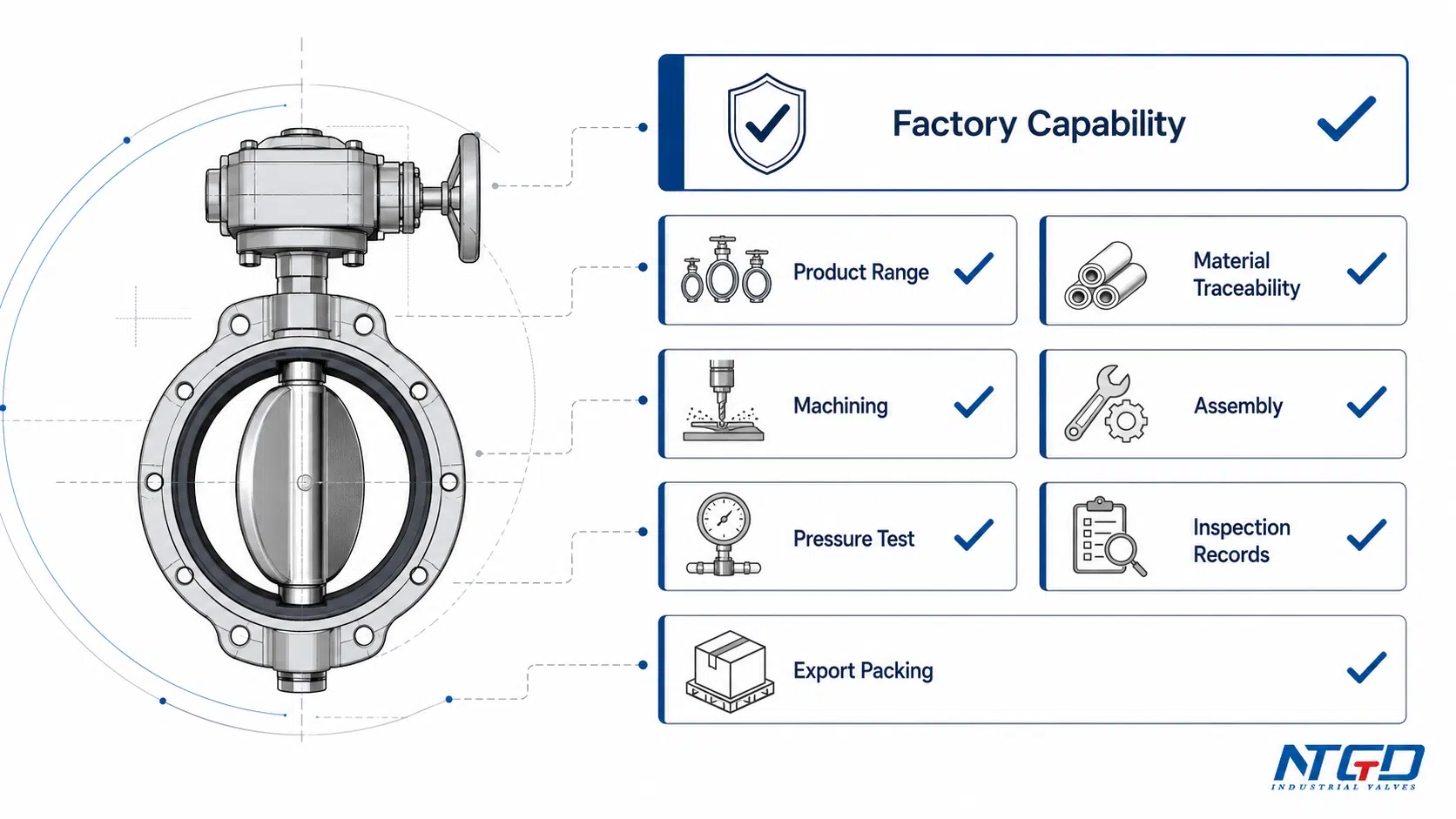
| Factory Capability Item | What Buyers Should Verify | Por qué es importante |
|---|---|---|
| Product range | Whether the factory can produce the required body style, design route, size, pressure class, and operation method | Prevents shortlisting a factory that cannot actually support the required valve |
| Material control | Body, disc, stem, seat, liner, and coating material traceability | Reduces risk of corrosion, abrasion, or specification mismatch |
| Machining and dimensional control | Critical dimensions, flange drilling, face-to-face dimension, stem fit, seat fit | Helps ensure installation compatibility and sealing performance |
| Assembly control | Disc alignment, seat compression, stem sealing, actuator mounting | Affects torque, leakage, and operation reliability |
| Shell and seat testing | Test procedure, test pressure, test medium, acceptance result | Confirma el rendimiento de la pared de contención de presión y del cierre |
| Prueba funcional | Manual, gearbox, pneumatic, or electric operation check | Helps identify torque or actuator problems before shipment |
| Paint and coating inspection | Coating type, thickness, surface preparation, visual defects | Important for corrosion protection and project acceptance |
| Packing and export preparation | End protection, moisture control, labeling, wooden case or project packing | Reduces transport damage and site identification problems |
| Third-party inspection | Availability and scope when required by project | Supports high-value or documentation-heavy procurement |
| Traceability records | Heat number, material certificate, test report, inspection record | Helps buyers connect delivered valves to approved documents |
Manufacturing capability and product range
A factory may claim to manufacture butterfly valves, but buyers should ask which product routes it actually controls. A factory strong in resilient seated wafer valves may not have the same capability for triple offset metal seated valves.
Incoming material and machining control
Material verification is critical when the service involves corrosive media, abrasive slurry, seawater, chemical fluids, or high temperature. Buyers should request material certificates and confirm whether the material grade matches the project specification.
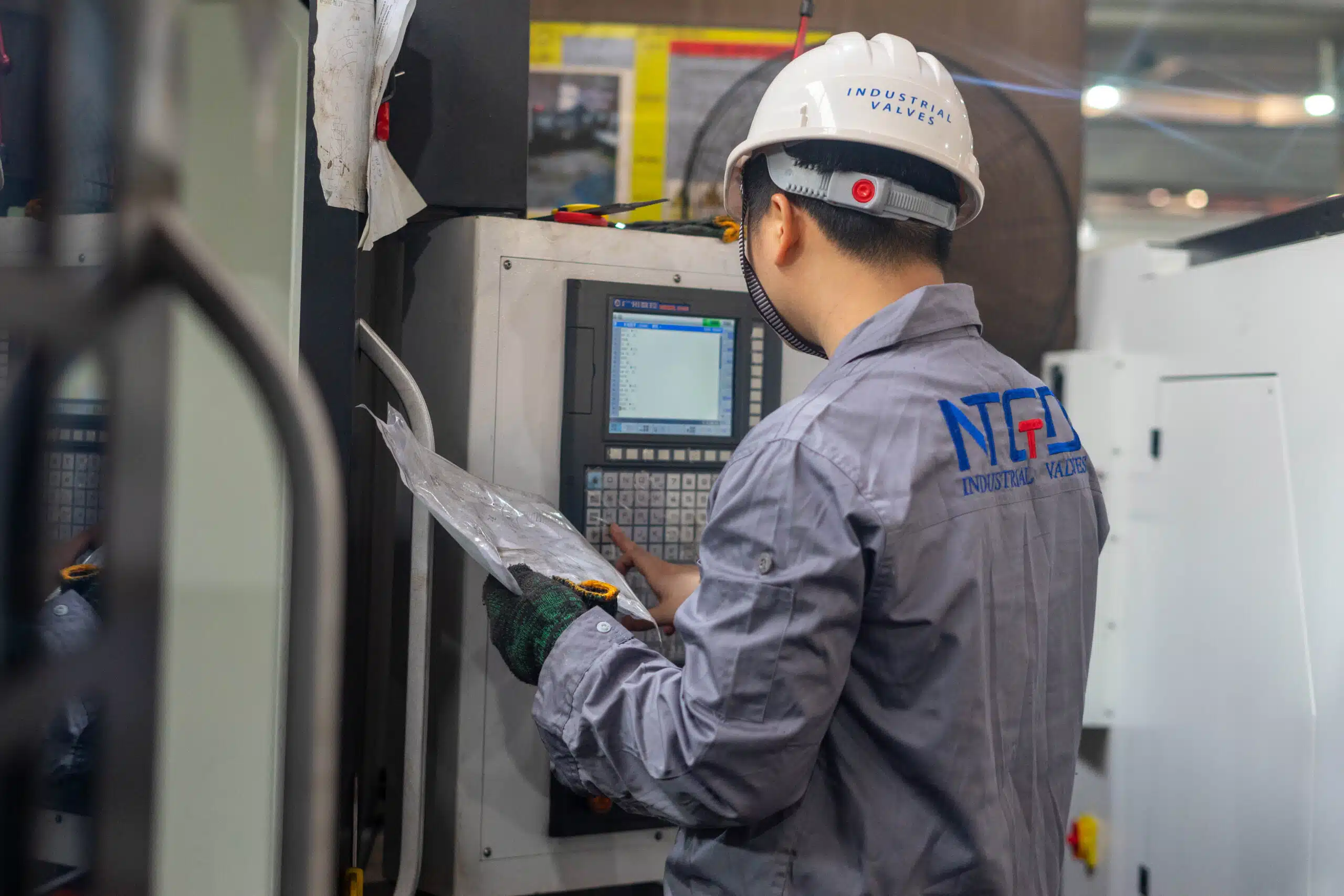
Assembly, seat fitting, and actuation check
Butterfly valve performance depends heavily on disc alignment, seat condition, stem sealing, and actuator fit. Incorrect assembly can lead to high torque, leakage, incomplete opening, or premature wear.
Shell test, seat test, and functional test
Pruebas de presión should be confirmed by standard, procedure, and record. The buyer should not only ask whether the valve is tested; they should ask what test was performed, what result was recorded, and whether the test matches the project requirement.
Inspection records, certificates, and traceability
A reliable butterfly valve factory should be able to provide documentation that connects the valve, material, test, and inspection process. This is especially important for EPC projects, municipal systems, oil and gas projects, chemical plants, and export orders.
Missing traceability can make it difficult to connect delivered valves with approved documents. Unverified face-to-face dimensions, flange drilling, or actuator mounting can cause installation problems at site. Incomplete shell or seat test records may also create approval risk when the project requires documented pressure or leakage verification.
Butterfly Valve Product Routes a Manufacturer Should Cover
A strong butterfly valve manufacturer does not need to make every possible valve, but its product route should match the buyer’s service. Product route is one of the clearest ways to separate a suitable manufacturer from a general supplier.
| Product Route | Where It Is Commonly Used | Manufacturer Capability Signal | Do Not Assume Without Verification |
|---|---|---|---|
| Válvula de mariposa wafer | Water, HVAC, general utility service | Standard compact installation capability | Flange compatibility, seat material, pressure limit |
| Válvula de mariposa | Systems needing easier maintenance or end-of-line considerations | Body design and drilling capability | Whether end-of-line service is allowed by design |
| Válvula de mariposa con bridas | Larger pipelines, water, power, industrial service | Stronger body and installation support | Face-to-face dimension, flange standard, weight |
| Resilient seated butterfly valve | Water, wastewater, HVAC, low to moderate severity service | Rubber seat and general isolation capability | Medium compatibility and temperature limit |
| Válvula de mariposa de alto rendimiento | Higher pressure, higher temperature, stricter shutoff, process service | Offset design, seat technology, material control | Exact pressure / temperature / seat limits |
| Válvula de mariposa de doble desplazamiento | Industrial service requiring lower friction and improved sealing | Offset disc and seat design capability | Whether design fits shutoff and operating conditions |
| Válvula de mariposa de triple offset | Severe service, high temperature, fire-safe or metal seated applications | Advanced sealing geometry and machining control | Standard scope, seat leakage requirement, torque |
| Metal seated butterfly valve | High temperature, abrasive or severe service | Metal seat machining and sealing control | Leakage expectation, material compatibility, test method |
| Rubber lined butterfly valve | Corrosive or utility service depending on liner material | Liner bonding and material selection capability | Chemical compatibility and temperature range |
| Válvula de mariposa de acero inoxidable | Corrosive or hygienic-related industrial conditions | Material procurement and machining control | Exact stainless grade and wetted-parts material |
| Válvula de mariposa neumática | Automated process or utility control | Actuator sizing and mounting support | Suministro de aire, posición de seguridad, margen de par |
| Válvula de mariposa motorizada | Remote operation or control system integration | Electric actuator selection and wiring support | Voltage, control signal, enclosure rating, torque |
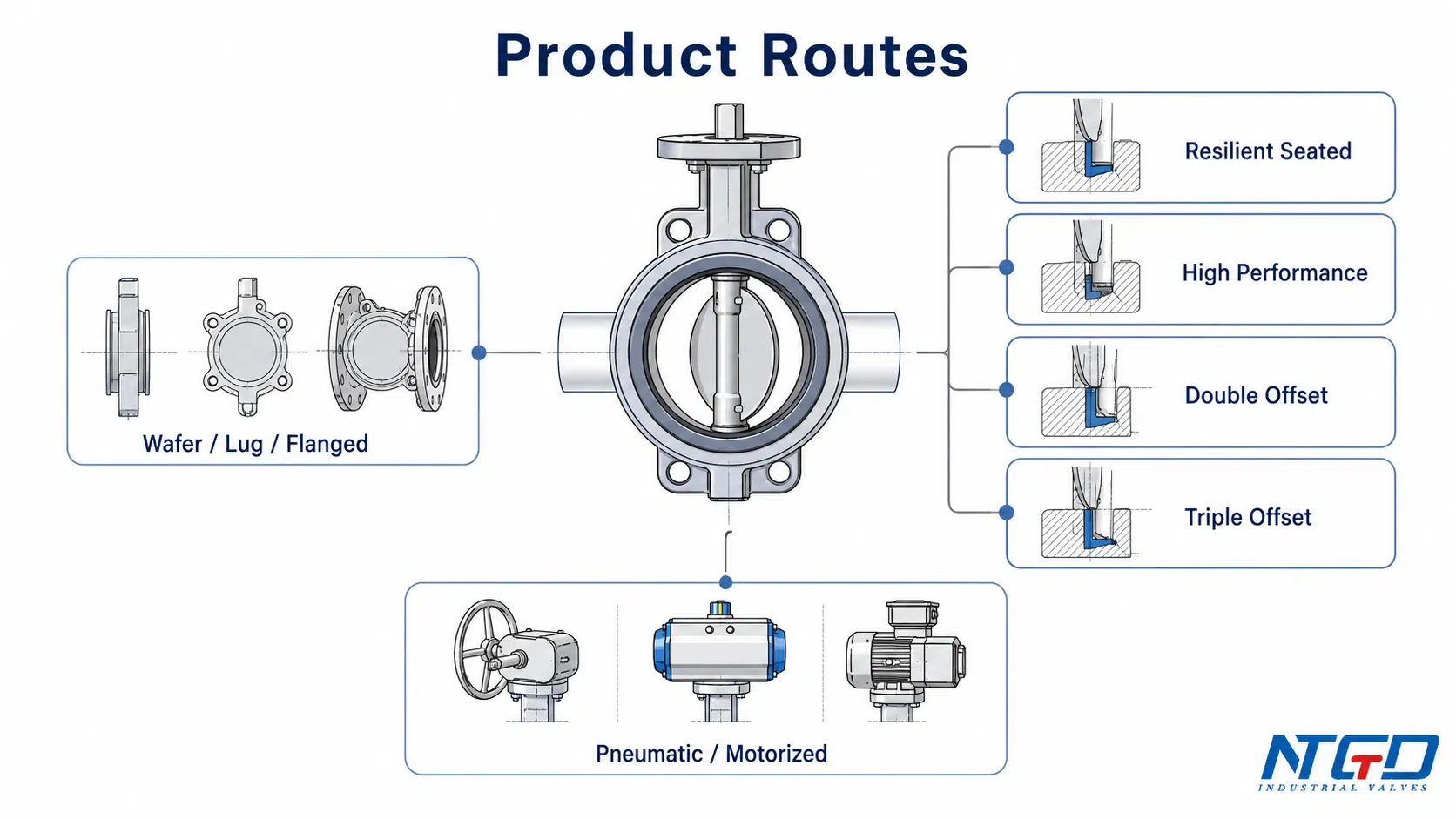
Wafer, lug, and flanged butterfly valves
A Comparación entre válvulas de mariposa de tipo wafer y de tipo brida helps explain how body style affects installation method, maintenance access, pipeline support, and flange compatibility. Buyers should not choose body style by habit. The installation layout and maintenance requirement should be confirmed first.
Resilient seated vs high-performance butterfly valves
Resilient seated butterfly valves are commonly used in water, HVAC, and utility service. Válvulas de mariposa de alto rendimiento are selected when the service requires stronger sealing, higher pressure or temperature capability, or improved durability. The exact limit depends on manufacturer design, material, pressure class, and service conditions.
If the service condition is close to the boundary of standard resilient seated designs, the manufacturer should explain the seat design, material limits, shutoff expectation, and test basis before the valve is shortlisted.
Double offset and triple offset butterfly valves
Offset design can reduce seat friction and improve sealing performance in more demanding service. However, double offset and triple offset butterfly valves should not be selected only because they sound more advanced. The project must confirm medium, temperature, pressure, leakage expectation, and operation method.
A manufacturer that cannot explain seat geometry, torque behavior, material compatibility, and testing expectations for offset butterfly valves should be reviewed carefully before entering the final shortlist.
Metal seated, rubber lined, and stainless steel options
Seat, liner, and material selection should follow the medium. Chemical compatibility, corrosion resistance, abrasion resistance, and temperature limit are often more important than general product category.
For stainless steel or rubber lined butterfly valves, buyers should confirm wetted parts, liner material, seat material, and the actual material certificate or datasheet instead of relying on a general material label.
Manual, gearbox, pneumatic, and motorized actuation
Actuation support is an important manufacturer capability signal. For pneumatic or motorized butterfly valves, buyers should confirm torque data, actuator sizing, fail position, power or air supply, control signal, and manual override requirements.
Automated valve packages should be reviewed as valve-actuator assemblies. A suitable actuator brand does not solve a wrong torque assumption, and a strong valve body does not compensate for an undersized actuator.
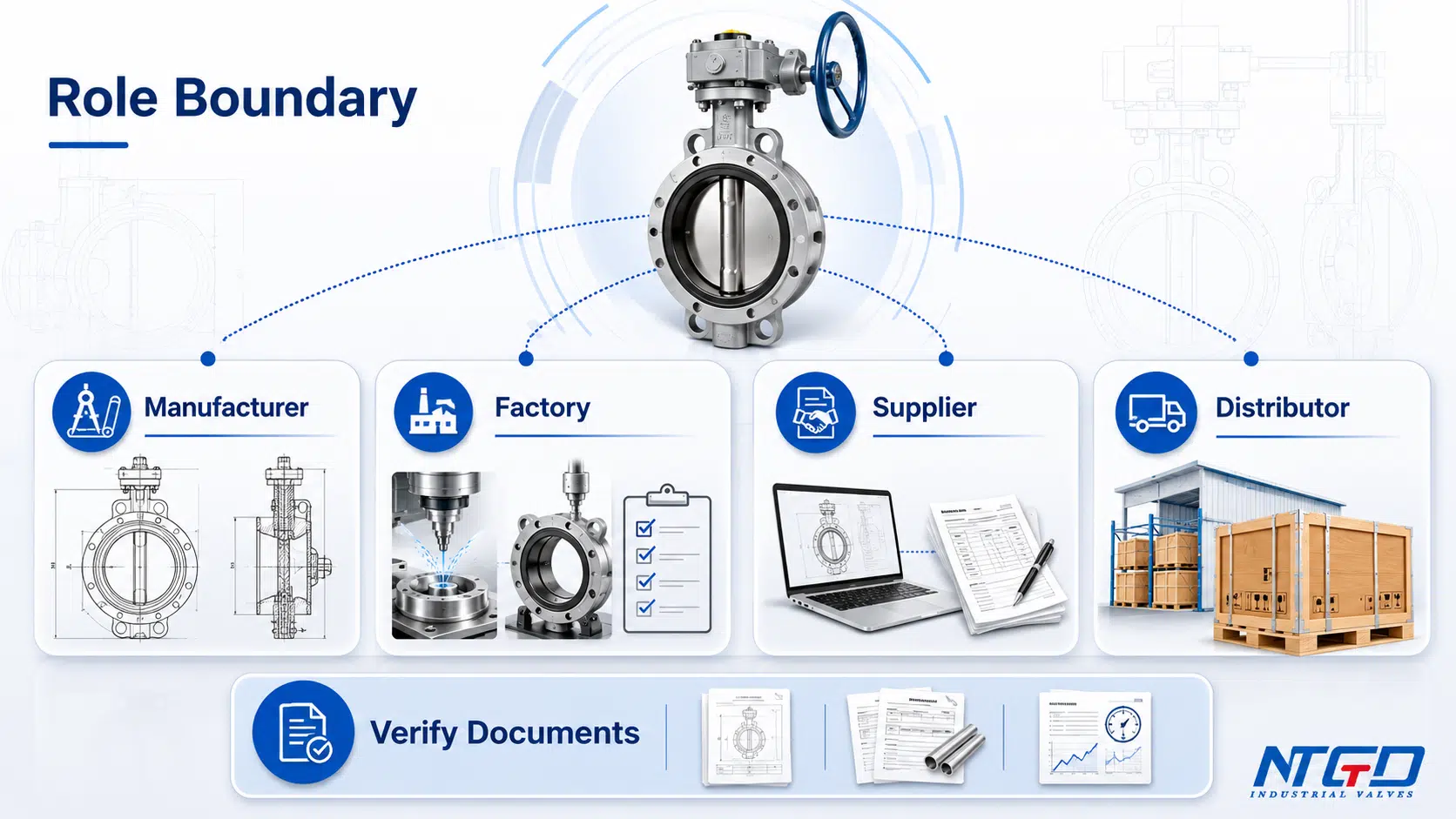
Manufacturer vs Factory vs Supplier vs Distributor
The terms manufacturer, factory, supplier, and distributor are often used loosely in valve sourcing. They are related, but they are not the same.
| Término | Función típica | Lo mejor para | Main Risk |
|---|---|---|---|
| Fabricante | Designs, produces, or controls the valve product route | Engineering selection, project supply, technical review | Product capability still needs verification |
| Fábrica | Handles production, assembly, testing, and inspection | Custom orders, project documentation, factory inspection | A factory claim may be shallow without records |
| Proveedor | Sources, quotes, coordinates, or sells valves | Procurement support, export communication, mixed product sourcing | May not control manufacturing quality |
| Distribuidor | Resells stock or brand products in a market | Fast replacement, local availability, standard products | Limited customization and documentation support |
When a manufacturer is the better choice
A manufacturer is usually preferred when the project has strict technical requirements, special materials, non-standard design conditions, actuator integration, or documentation requirements.
When a factory capability check is more important
Factory capability becomes more important when the buyer needs inspection records, third-party inspection, material traceability, pressure test reports, or customized production.
When a supplier or distributor may be enough
A supplier or distributor may be enough for standard replacement valves, local stock, or routine utility service. In this case, the buyer should still confirm brand, model, material, and documentation requirements.
What buyers should not confuse before RFQ
Do not treat a supplier listing as proof of factory capability. Do not treat a factory claim as proof of engineering support. Do not treat a brand name as proof that the offered valve fits the service.
In real procurement, these roles may overlap. A company may sell as a supplier, source from a factory, and provide manufacturer-branded documents. Buyers can reduce confusion by checking datasheets, material certificates, test reports, nameplate information, packing lists, and inspection reports to identify who is responsible for manufacturing, testing, and documentation.
For severe service, custom materials, third-party inspection, or documentation-heavy projects, factory capability should be checked directly. For standard replacement valves, a qualified supplier or distributor may be acceptable if product identity, documentation, and delivery responsibility are clear.
Emparejar fabricantes de válvulas de mariposa con aplicaciones industriales
Butterfly valve manufacturers should be matched to applications by service conditions, not only by industry name. A water project may prioritize coating, seat material, large-size capability, and water-sector documentation. Chemical service may prioritize corrosion compatibility, liner material, and high-performance design. Oil, gas, and power projects may require stronger review of pressure, temperature, offset design, actuator sizing, testing, and documentation.
| Aplicación | Common Buyer Concern | Capacidad del fabricante para verificar |
|---|---|---|
| Agua y aguas residuales | Corrosion, seat life, coating, large sizes, AWWA / NSF requirements where applicable | Body style, coating system, rubber seat material, water-sector documentation |
| Chemical and petrochemical | Corrosion, temperature, leakage, safety, material compatibility | Body / disc / seat material, high-performance design, test records |
| Petróleo y gas | Pressure, temperature, fire-safe requirements, actuator reliability | Offset design, metal seat option, actuator sizing, project documentation |
| Centrales eléctricas | Temperature, cycling, large pipelines, critical isolation | Material selection, pressure class, testing, actuator support |
| Servicios de climatización y mantenimiento de edificios | Compact installation, cost control, actuator integration | Wafer / lug valves, resilient seat, motorized actuator support |
| Protección contra incendios | Approval scope, reliability, documentation | Applicable product approvals and project-specific compliance |
| Marine and shipbuilding | Corrosion, compact layout, vibration, documentation | Material choice, coating, flange standard, inspection records |
| Mining and slurry-related service | Abrasion, solids, seat damage, torque increase | Wear-resistant design, seat / liner material, severe-service capability |
| Pasta y papel | Chemical exposure, fiber content, process temperature | Material compatibility, seat design, cleaning and maintenance access |
| General industry | Flexible use, replacement, lead time | Product range, supplier support, documentation readiness |
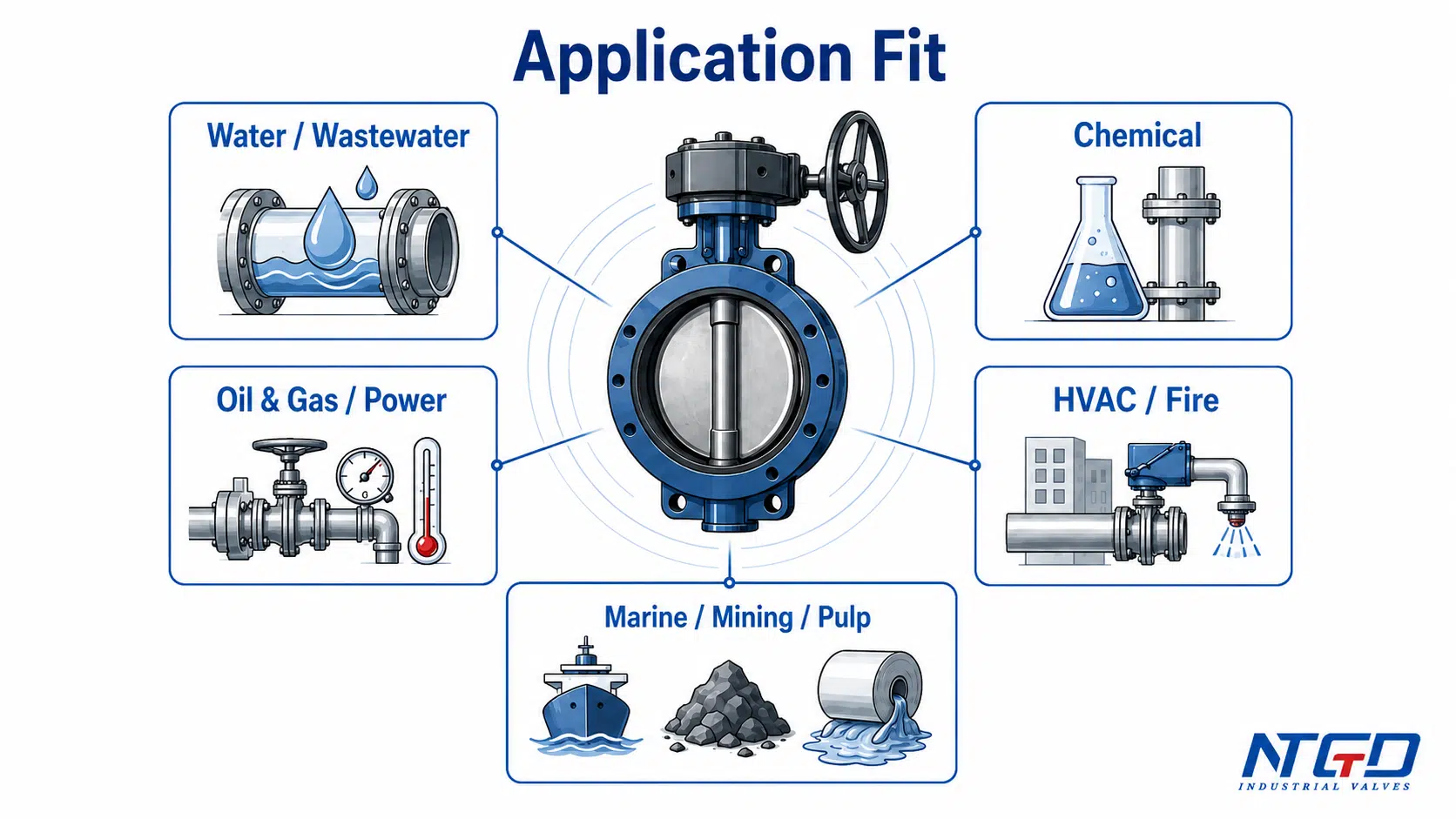
Water and wastewater projects
Projects using butterfly valves in water treatment often focus on corrosion protection, large-size availability, coating, rubber seat selection, and documentation. Buyers should verify whether the manufacturer’s product line is suitable for potable water, municipal systems, or wastewater service as required.
Potable water and non-potable water service should not be treated as the same documentation problem. A valve described as suitable for water service still needs NSF/ANSI 61 documentation and certificate-scope review for the exact valve series, size, material, coating, and wetted parts when drinking-water approval is required.
Chemical and petrochemical service
Chemical service requires careful review of body material, disc material, seat material, stem material, liner compatibility, and temperature limit. A general butterfly valve may not be suitable without chemical compatibility review.
For chemical and petrochemical projects, the buyer should ask the manufacturer to connect selección de materiales to the medium instead of only listing available materials. The risk is not only corrosion; swelling, hardening, liner damage, and seat leakage may also become concerns depending on the fluid.
Oil, gas, power, and high-temperature systems
For higher pressure, higher temperature, or severe service, buyers may need high-performance, double offset, or triple offset butterfly valves. The manufacturer should provide clear datasheets and test documentation before approval.
Actuator sizing and torque review are also important in these applications. A valve selected only by size and pressure class may still be unsuitable if torque, cycling condition, shutoff expectation, or automation requirements are not reviewed.
HVAC, building services, and fire protection
HVAC and building-service butterfly valves often require compact installation, actuator compatibility, and reliable shutoff. Fire protection applications may require specific approvals or documentation that must be verified by product line.
For these projects, the main risk is often assuming that a standard butterfly valve is interchangeable across all building systems. Buyers should confirm connection type, seat material, actuator control, approval scope, and maintenance access.
Marine, mining, pulp and paper, and general industry
These applications often require additional attention to corrosion, abrasion, vibration, solids, chemicals, or maintenance access. Buyers should not assume a standard resilient seated valve fits all industrial applications.
A manufacturer may be suitable for one industrial segment but weak in another. The shortlist should follow the actual medium, solids content, temperature, pressure, operation frequency, and documentation requirement.
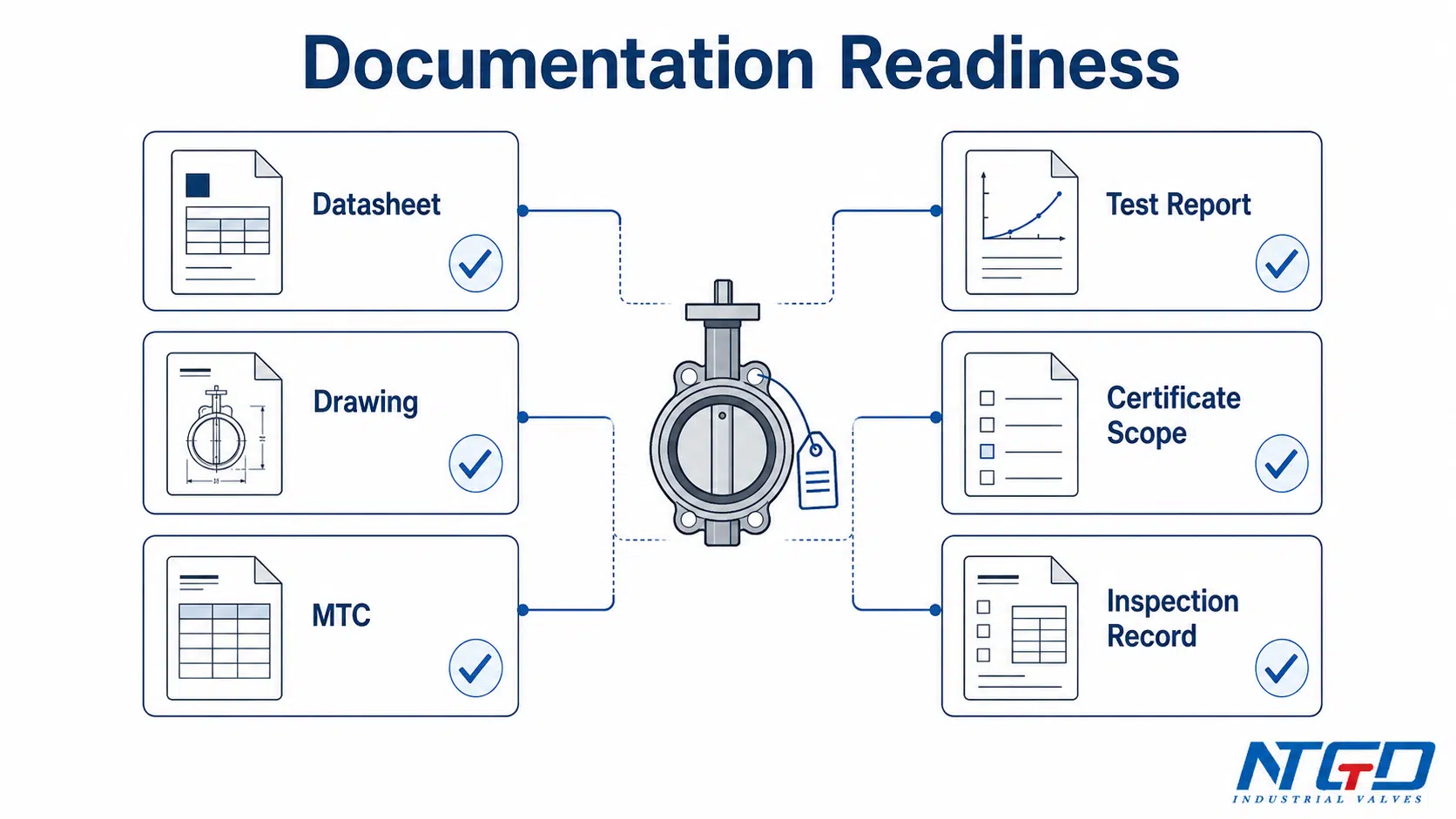
Standards, Testing, and Documentation Readiness
Standards and certificates are useful only when they apply to the selected valve. A manufacturer may mention many standards, but the buyer should verify the scope, validity, and relevance.
| Document / Standard Type | What It Can Support | What Buyers Should Verify |
|---|---|---|
| ISO quality system | Quality management and process control | Scope, validity, and whether it covers the production site |
| API / ASME / ANSI references | Design, testing, dimensions, pressure class, or industrial compliance | Whether the reference applies to the exact butterfly valve being quoted |
| AWWA references | Water-sector butterfly valve requirements | Product line, size range, coating, test requirement, project scope |
| NSF / potable water documentation | Drinking water suitability where required | Certificate scope, material, size, and valve series |
| Certificado de materiales | Trazabilidad de los materiales | Heat number, material grade, wetted parts, and certificate match |
| Informe de la prueba de presión | Shell and seat test confirmation | Test standard, test pressure, result, and valve identification |
| Informe de inspección | Dimensional, visual, coating, assembly, or functional checks | Inspection items, acceptance criteria, and traceability |
| Ficha técnica | Technical confirmation | Size, class, material, seat, disc, stem, operation, end connection |
| Dibujo | Installation and approval support | Face-to-face dimension, flange standard, actuator dimensions, weight |
| Packing list and marking | Delivery and site identification | Tag number, quantity, end protection, packing method |
Standards should be checked by scope, not only by name
A standard name on a website, including a valve standard such as ASME B16.34, does not automatically mean the selected valve meets that standard. Buyers should request product-specific confirmation.
Common documents to request before shortlisting
Before shortlisting a butterfly valve manufacturer, buyers should request a datasheet, drawing, material certificate, pressure test requirement, applicable certificate, and inspection plan when needed.
Testing records and inspection reports
Testing records are most useful when they identify the valve, test method, result, and acceptance basis. A generic statement such as “tested before delivery” is not enough for documentation-heavy projects.
Certificate mismatch risks
Certificate mismatch can delay approval, shipment, or site acceptance. The most common risk is assuming that a company-level certificate applies to every valve series, size, material, or service condition.
RFQ Checklist Before Contacting a Butterfly Valve Manufacturer or Supplier
A clear RFQ helps the manufacturer or supplier confirm whether the product route, factory capability, and documentation package match the project.
| Datos de la solicitud de cotización | Por qué es importante |
|---|---|
| Valve type / design route | Confirms whether wafer, lug, flanged, resilient seated, high-performance, double offset, or triple offset is required |
| Tamaño y clase de presión | Confirms manufacturing range and pressure boundary |
| Medio | Determines material, seat, liner, and corrosion compatibility |
| Temperatura | Affects seat material, seal design, body material, and actuator selection |
| Operating pressure and differential pressure | Affects valve body rating, shutoff, torque, and actuator sizing |
| Conexión final | Confirms wafer, lug, flanged, RF, BW, or project-specific connection |
| Material de la carrocería | Supports corrosion resistance and pressure class requirements |
| Disc and stem material | Affects wetted-parts compatibility and mechanical strength |
| Material del asiento / revestimiento | Affects sealing, chemical compatibility, and temperature limits |
| Método de funcionamiento | Manual, gear, pneumatic, electric, hydraulic, or automated package |
| Actuator requirement | Confirms torque, fail position, control signal, air supply, or voltage |
| Norma aplicable | Helps confirm project compliance and testing basis |
| Requisitos de inspección | Confirms factory inspection, third-party inspection, or witness test needs |
| Paquete de documentación | Confirms datasheet, drawing, MTC, test report, certificate, and packing list |
| Quantity and lead time | Helps evaluate production planning and supplier support |
| Tag data / project reference | Supports traceability, marking, and project document control |
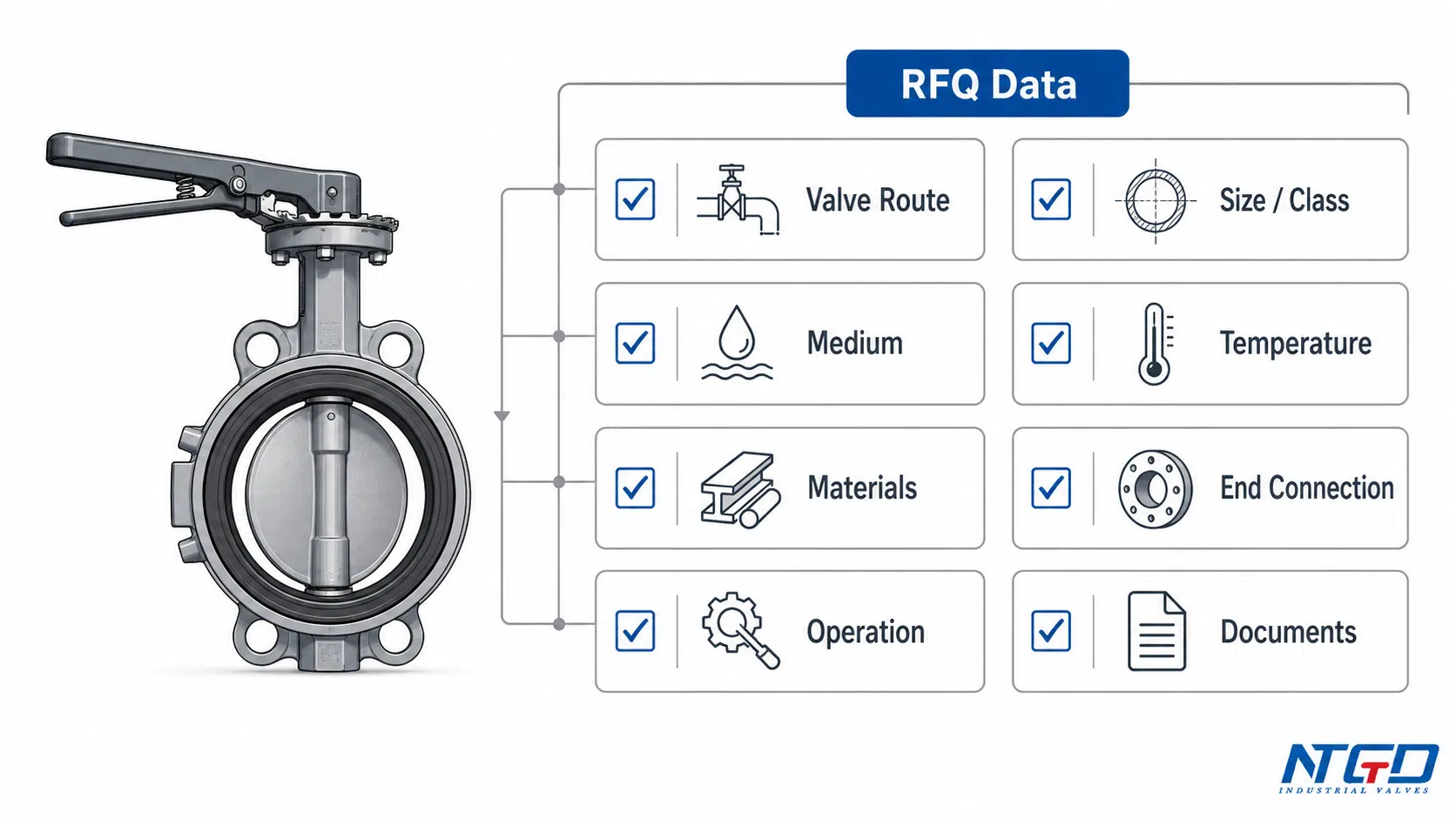
Basic valve data
Start with valve type, size, pressure class, end connection, and operation method. Without these items, a manufacturer cannot reliably confirm product fit.
Service condition data
Medium, temperature, pressure, presión diferencial, and flow condition should be provided early. These data affect seat selection, material compatibility, torque, and actuator sizing.
Material, seat, and sealing data
For corrosive, abrasive, high-temperature, or strict shutoff applications, buyers should confirm body, disc, stem, seat, liner, and seal material before comparing manufacturers.
Operation and actuator data
Manual valves and automated valves require different checks. For pneumatic or motorized butterfly valves, actuator sizing and fail position should be reviewed with the valve torque requirement.
Documentation and inspection data
If the project needs certificates, drawings, MTCs, test reports, or third-party inspection, this should be included in the RFQ. Otherwise, the quote may not include the required documentation.
Commercial and delivery notes
Lead time, packing method, shipping condition, and tag requirements should be confirmed after the technical fit is clear. Price should not be compared before the valve specification is stable.
FAQ About Butterfly Valve Manufacturers, Factories, and Suppliers
¿Cuáles son los mejores fabricantes de válvulas de mariposa a los que hay que considerar?
Esta guía presenta a 10 fabricantes de válvulas de mariposa que los compradores pueden utilizar como punto de partida para su lista de candidatos, con una tabla comparativa que ayuda a filtrar la ruta del producto, la idoneidad para la aplicación, la señal de fábrica y la disponibilidad de la documentación. El mejor fabricante para un proyecto no siempre es el más famoso. Los compradores deben reducir la lista según las condiciones de servicio, la ruta del producto, la capacidad de la fábrica, las normas, las necesidades de inspección y la calidad de la respuesta a las solicitudes de cotización.
¿Cuál es la diferencia entre un fabricante y un proveedor de válvulas de mariposa?
Un fabricante de válvulas de mariposa suele encargarse del diseño del producto, la producción o el proceso técnico del producto. Un proveedor puede ocuparse del abastecimiento, la cotización, la entrega y la comunicación con el cliente, pero es posible que no controle directamente la fabricación. Algunas empresas desempeñan ambas funciones, por lo que los compradores deben verificar quién tiene el control de la fabricación, quién es responsable de la inspección y quién se encarga de la documentación de respaldo.
¿Cómo puedo verificar una fábrica de válvulas de mariposa antes de hacer un pedido?
Verifica una fábrica de válvulas de mariposa en tres pasos. Primero, revisa si su documentación es coherente, incluyendo hojas de datos, planos, certificados de materiales y formatos de informes de pruebas. Segundo, confirma si puede realizar inspecciones en fábrica, inspecciones de terceros o pruebas en presencia de testigos cuando sea necesario. En tercer lugar, revisa si su experiencia en proyectos anteriores, los registros de trazabilidad y la documentación de entrega coinciden con el tipo de válvula que se está cotizando.
¿Debería elegir un fabricante de válvulas de mariposa de alto rendimiento para condiciones de servicio extremas?
Un fabricante de válvulas de mariposa de alto rendimiento puede ser más adecuado cuando el servicio implica presiones más altas, temperaturas más elevadas, un cierre más hermético, un funcionamiento frecuente o condiciones de proceso más exigentes. Sin embargo, no se debe optar automáticamente por un diseño de alto rendimiento. Los compradores deben confirmar primero el medio, la temperatura, la presión, el diseño del asiento, la compatibilidad de los materiales, las expectativas de fugas, los requisitos de par de apriete y las normas aplicables.
¿Las válvulas de mariposa neumáticas o motorizadas requieren una revisión del fabricante diferente?
Yes. Automated butterfly valves require actuator sizing, torque review, mounting compatibility, fail position, control signal, voltage or air supply, enclosure suitability, and manual override checks. A trusted motorized butterfly valve or pneumatic butterfly valve package should be reviewed as a valve-actuator assembly, not as two unrelated products.
¿Qué documentos debo solicitarle a un fabricante de válvulas de mariposa?
Entre los documentos comunes se incluyen la hoja de datos, el plano de disposición general, el certificado de materiales, el informe de prueba de presión, el informe de inspección, el certificado correspondiente, la hoja de datos del actuador, la lista de empaque y la información de las etiquetas del proyecto. Los documentos requeridos dependen de las especificaciones del proyecto.
¿Son mejores los fabricantes de válvulas de mariposa de EE. UU., China o los regionales para cada proyecto?
No hay ninguna región que sea automáticamente la mejor para todos los proyectos. La disponibilidad regional puede afectar el tiempo de entrega, la comunicación, el servicio, la certificación y el costo. Para proyectos que requieran servicio local o un reemplazo rápido, el soporte regional puede ser más importante. Para el suministro a granel estándar o proyectos industriales de uso extremo, los compradores deben priorizar la capacidad del producto, la calificación de la fábrica, la evidencia de pruebas y la disponibilidad de la documentación por encima de la ubicación del país únicamente.
¿Puede un solo fabricante de válvulas de mariposa ofrecer válvulas de tipo wafer, lug, de doble desplazamiento y de triple desplazamiento?
Algunos fabricantes ofrecen una amplia gama de productos, mientras que otros se especializan en líneas de productos más específicas. Los compradores no deben dar por sentada una cobertura completa. La solicitud de cotización debe indicar claramente el estilo de cuerpo requerido, el diseño de desplazamiento, la clase de presión, el material de los asientos, el método de operación y la norma aplicable.
Final Fit Check Before Shortlisting a Manufacturer
Before shortlisting a butterfly valve manufacturer, confirm the service data first. A manufacturer cannot be evaluated properly if the buyer has not defined medium, temperature, pressure, size, end connection, material, seat design, operation method, and documentation requirements.
Do not choose by brand name alone
Brand recognition can be useful, but it does not replace product-specific verification. A trusted manufacturer should still provide clear datasheets, drawings, test records, certificates, and material confirmation.
Confirm service data before comparing suppliers
Comparing suppliers before stabilizing the specification often leads to misleading price comparisons. Two quotes may appear similar while using different seat materials, body materials, test standards, actuator sizes, or documentation packages.
Use factory capability and documentation to reduce sourcing risk
For industrial projects, the safest shortlist is built from verified product route, factory capability, testing process, material traceability, and documentation readiness. This is the practical difference between a basic supplier search and an engineering-based manufacturer selection.
A wrong shortlist is often not caused by choosing an unknown brand. It is more often caused by approving a manufacturer before service data, factory capability, testing requirements, and documentation package have been aligned.
Conclusión
A reliable butterfly valve manufacturer should be selected by fit, not by name alone. The strongest shortlist combines manufacturer reputation with factory capability, product route, standards, inspection control, documentation readiness, and RFQ response quality. For buyers comparing butterfly valve manufacturers, the goal is not to find the longest brand list, but to identify which manufacturer can support the exact service conditions and project approval requirements.
Need help preparing a butterfly valve RFQ?
If you are preparing a butterfly valve RFQ, NTGD Valve can help review the available service conditions and identify the missing technical data before final specification. Even if the RFQ is not complete yet, the engineering team can help pre-check valve design route, material options, actuator requirements, factory inspection needs, and documentation readiness so the quotation process starts from a more accurate technical basis.
