
Author Name: Bruce Zheng
Author Role: Co-Founder and Valve Engineer at NTGD Valve
Author Bio: Bruce Zheng is Co-Founder and Valve Engineer at NTGD Valve, focusing on industrial valve selection, application, and technical content for global B2B buyers.
Last Updated: June 2, 2026
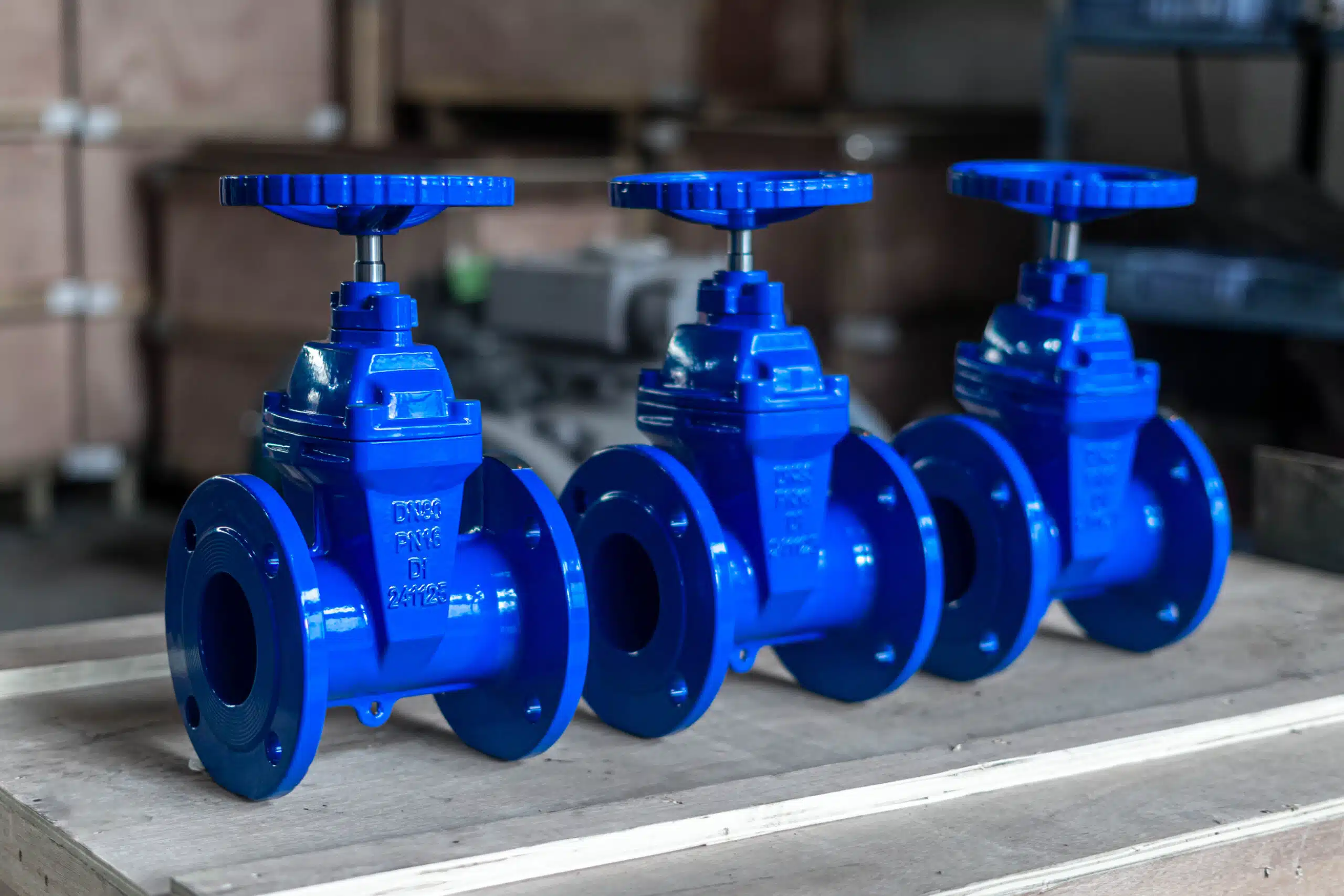
A ductile iron gate valve is a gate valve with a body and bonnet made from ductile iron, also called nodular cast iron or ductile cast iron. In project specifications, RFQ documents, bills of material, and industry usage, it may also appear as a DI gate valve, where “DI” means ductile iron.
This type of valve is mainly used for fully open or fully closed isolation service. It is commonly selected for water supply, wastewater, sewage, irrigation, fire protection, and utility pipelines where buyers need a strong body material, practical coating options, and clear specification data before RFQ.
A ductile iron gate valve should not be selected only by name. Buyers normally need to confirm the valve size, pressure rating, seat design, stem type, end connection, coating, applicable standard, and required drawing or datasheet before procurement. This page helps connect those specification items to common ductile iron gate valve configurations, application limits, and RFQ preparation requirements.
What Is a Ductile Iron Gate Valve?
A ductile iron gate valve is a linear-motion valve that opens or closes flow by raising or lowering a gate or wedge inside the valve body. When the gate is lifted, the flow path opens. When the gate is lowered into the seat area, the valve shuts off the flow.
The key difference between a ductile iron gate valve and many other gate valves is the body material. Ductile iron has better toughness and impact resistance than ordinary cast iron, which makes it suitable for many utility and waterworks applications. However, the exact performance still depends on the complete valve design, including the seat material, coating, pressure class, end connection, and service conditions.
Ductile iron gate valves are often used where the pipeline requires:
- on/off isolation;
- a cost-effective valve body material;
- flanged, mechanical joint, or other project-specific connections;
- resilient seated or metal seated configurations;
- manual or gear-operated operation;
- project drawings and datasheets for approval.
They are not normally used as throttling valves. For flow regulation, another valve type may be more suitable depending on the medium, pressure, and control requirement.
What does DI gate valve mean?
In industrial and waterworks usage, DI gate valve usually means ductile iron gate valve. It is a shortened technical expression used in product titles, project specifications, RFQ documents, bills of material, and distributor listings.
For example, a buyer may describe a requirement as:
| Specification wording | Meaning |
|---|---|
| DI gate valve | Ductile iron gate valve |
| DI NRS gate valve | Ductile iron non-rising stem gate valve |
| DI flanged gate valve | Ductile iron gate valve with flanged ends |
| DI MJ gate valve | Ductile iron gate valve with mechanical joint ends |
| DI resilient wedge gate valve | Ductile iron gate valve with resilient wedge design |
DI should not be treated as a separate valve type. It is a material abbreviation. The valve still needs to be selected by full service conditions and project specifications.
Ductile iron vs cast iron in gate valve bodies
Ductile iron and cast iron are related materials, but they are not the same in valve selection. Cast iron is commonly associated with lower-cost valve bodies, while ductile iron is usually selected when better toughness and impact resistance are required.
| Item | Ductile Iron Gate Valve | Cast Iron Gate Valve |
|---|---|---|
| Main material focus | Ductile iron body and bonnet | Cast iron body and bonnet |
| Typical reason for selection | Selected when the project requires better resistance to handling impact, ground load, pressure fluctuation, or waterworks service stress than ordinary cast iron | Often considered for cost-sensitive general service where the stress level and project specification allow it |
| Common use context | Waterworks, utility, irrigation, sewage, fire protection, industrial water | Low to moderate duty water and general service |
| Selection caution | Still requires coating, seat, pressure, and standard confirmation | More limited toughness; project suitability must be checked against pressure, installation, and service conditions |
| Current page focus | Yes | No, only as material boundary |
A ductile iron gate valve page should not be converted into a cast iron gate valve page. If the project specifically requires cast iron, the material, rating, corrosion environment, and valve design should be reviewed separately.
How Does a Ductile Iron Gate Valve Work?
A ductile iron gate valve works by moving a gate or wedge vertically across the flow path. The gate is connected to the stem, and the stem is operated by a handwheel, operating nut, gear, or actuator depending on the valve design.
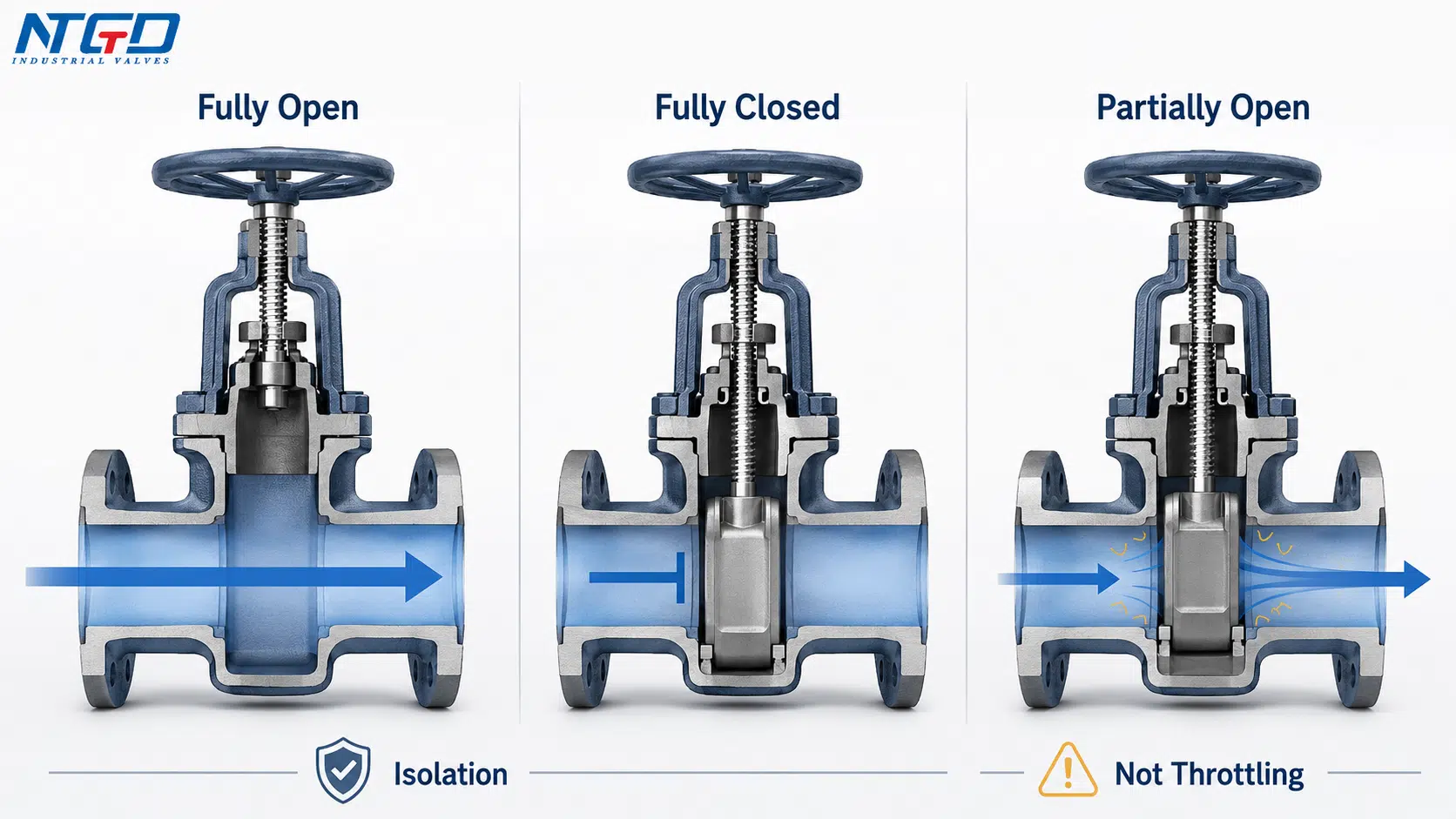
When the valve is opened, the gate moves upward and clears the flow passage. When the valve is closed, the gate moves downward and presses into the seat area to stop flow.
Open and closed positions
| Position | Internal movement | Flow condition | Selection note |
|---|---|---|---|
| Fully open | Gate or wedge is lifted out of the flow path | Flow passes through the valve with low restriction | Suitable for isolation service |
| Fully closed | Gate or wedge is seated against the sealing area | Flow is stopped | Shutoff depends on seat design and valve condition |
| Partially open | Gate remains inside the flow path | Flow is restricted and may become unstable | Not recommended for normal throttling duty |
The general gate valve working principle is simple, but actual sealing performance depends on the seat type, wedge design, stem condition, coating condition, and whether debris is present in the valve.
Why gate valves are not used for throttling
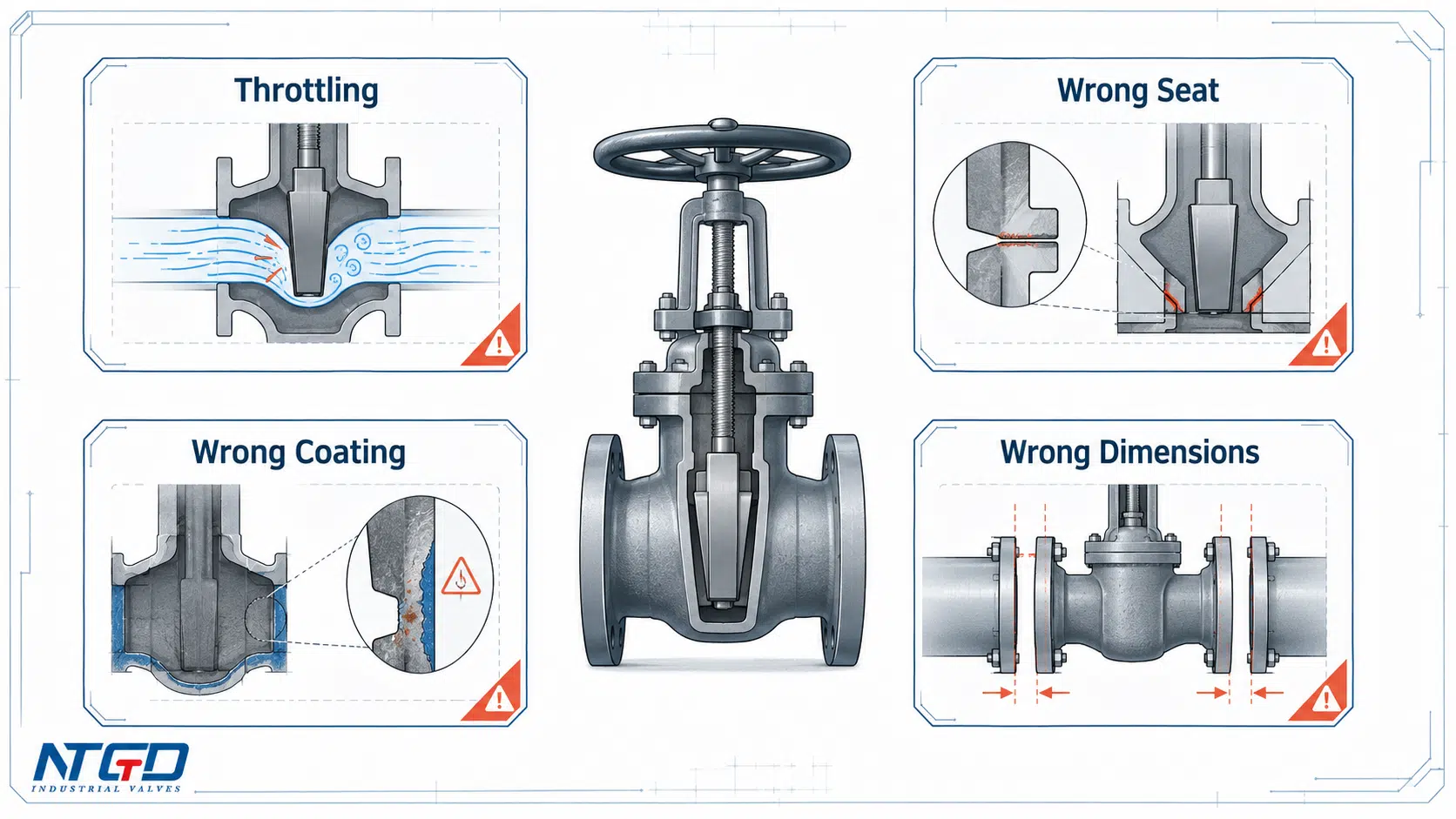
Gate valves are designed mainly for isolation, not continuous flow control. If a ductile iron gate valve is left partially open, the gate and seat may be exposed to vibration, erosion, and uneven flow forces. This can increase wear and reduce sealing performance over time.
For this reason, a ductile iron gate valve is normally specified for:
- fully open service;
- fully closed service;
- infrequent operation;
- pipeline isolation;
- maintenance shutoff.
If the application requires frequent modulation or precise flow control, the valve type should be reviewed before selection.
Main Parts and Construction of Ductile Iron Gate Valves
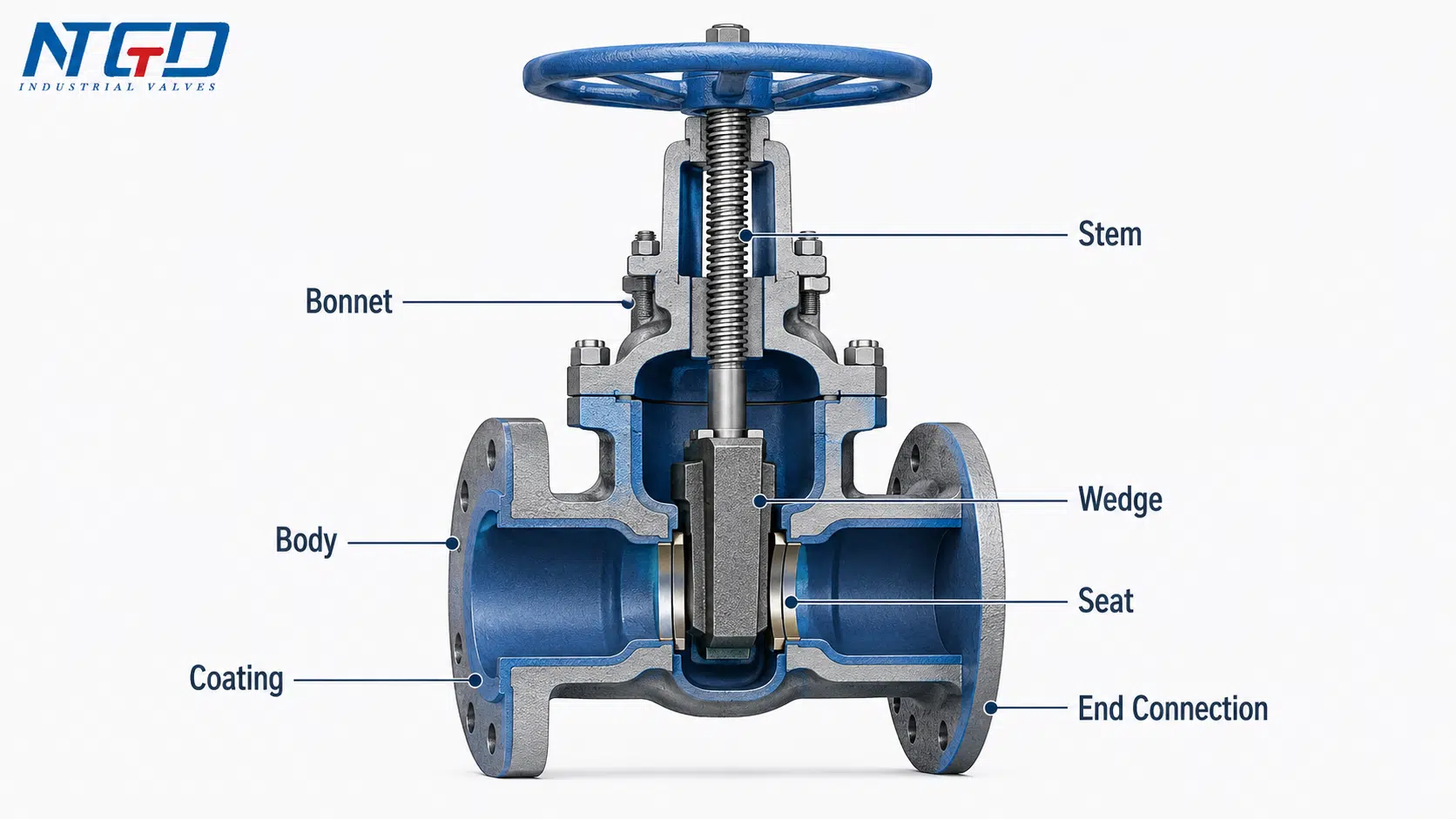
The construction of a ductile iron gate valve affects pressure boundary integrity, sealing performance, operating torque, corrosion protection, installation space, and long-term maintenance.
Main construction parts
| Part | Typical function | Why it matters in selection |
|---|---|---|
| Body | Main pressure-containing shell | Must match pressure rating, end connection, coating, and service medium |
| Bonnet | Covers and protects the upper valve assembly | Affects maintenance access and pressure boundary design |
| Gate / wedge | Moves into or out of the flow path | Determines shutoff behavior and seat contact |
| Seat | Sealing surface against the gate or wedge | Soft seat and metal seat designs suit different services |
| Stem | Transfers handwheel or actuator motion to the gate | Material and design affect corrosion resistance and operating reliability |
| Stem nut / wedge nut | Converts rotation into gate movement | Important for smooth opening and closing |
| Handwheel / operating nut / gear | Manual operating interface | Must match installation location and required operating torque |
| Gasket and packing | Seal bonnet joint and stem area | Important for preventing external leakage |
| Coating | Protects ductile iron surfaces | Especially important in waterworks and buried service |
| End connection | Connects the valve to the pipeline | Flanged, mechanical joint, threaded, or welded ends affect dimensions and installation |
Body and bonnet
The body and bonnet are among the main gate valve parts that define the pressure boundary of the valve. They act as the pressure boundary and protect the internal parts. Their suitability depends on the project pressure class, applicable standard, coating, flange or joint design, and service medium.
Ductile iron can provide better toughness than ordinary cast iron, but the body material alone does not define the full valve capability. The full specification should include seat type, pressure rating, coating, connection standard, and test requirement.
Wedge, seat and sealing materials
The gate or wedge is the moving closure element. In many waterworks ductile iron gate valves, the wedge is commonly covered with EPDM, NBR, or another elastomer to form a resilient seated design. In other designs, metal seating surfaces may be used.
| Sealing direction | Typical feature | Common service context | Selection caution |
|---|---|---|---|
| Resilient seated / resilient wedge | Elastomer-covered wedge, often EPDM or NBR | Water supply, sewage, wastewater, irrigation, fire protection | Seat material must match temperature, medium, potable water requirements, and project specification |
| Metal seated | Metal-to-metal sealing surfaces | Certain higher-temperature or more severe services | Shutoff behavior and maintenance expectations differ from soft seat valves |
| Soft seal / rubber-covered wedge | Similar to resilient seated terminology | Waterworks and utility pipelines | Not suitable for all high-temperature, abrasive, or aggressive media |
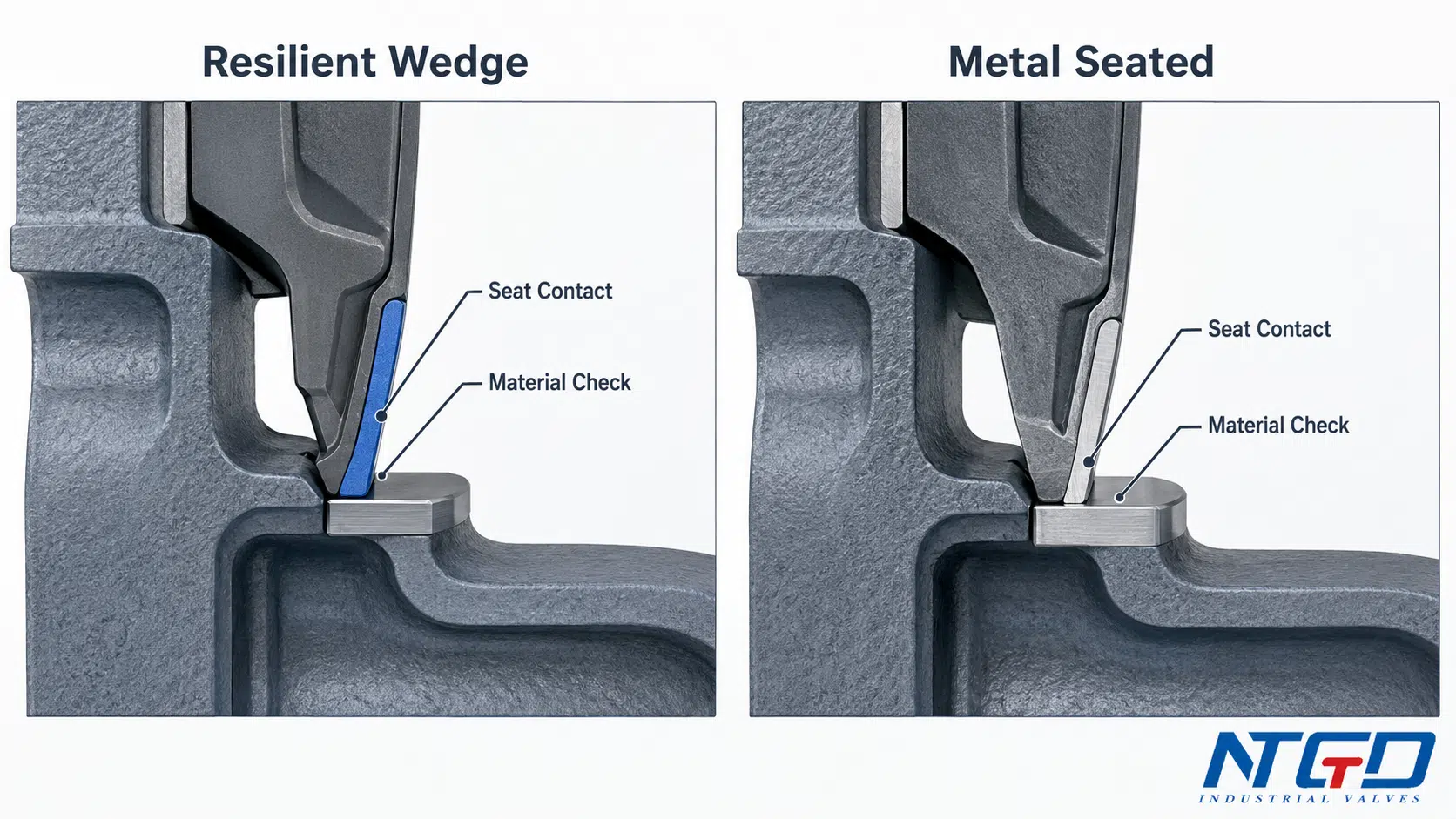
A resilient wedge can improve shutoff behavior in many waterworks services because the elastomer-covered wedge can conform to the seat area better than a rigid metal surface. However, the same material that supports shutoff also creates a selection boundary: EPDM, NBR, and other elastomers must be checked against temperature, medium, water quality requirements, and wastewater conditions before RFQ.
Not every ductile iron gate valve is resilient seated. Resilient seated design is a common configuration, especially in waterworks service, but it should not be treated as the only possible design.
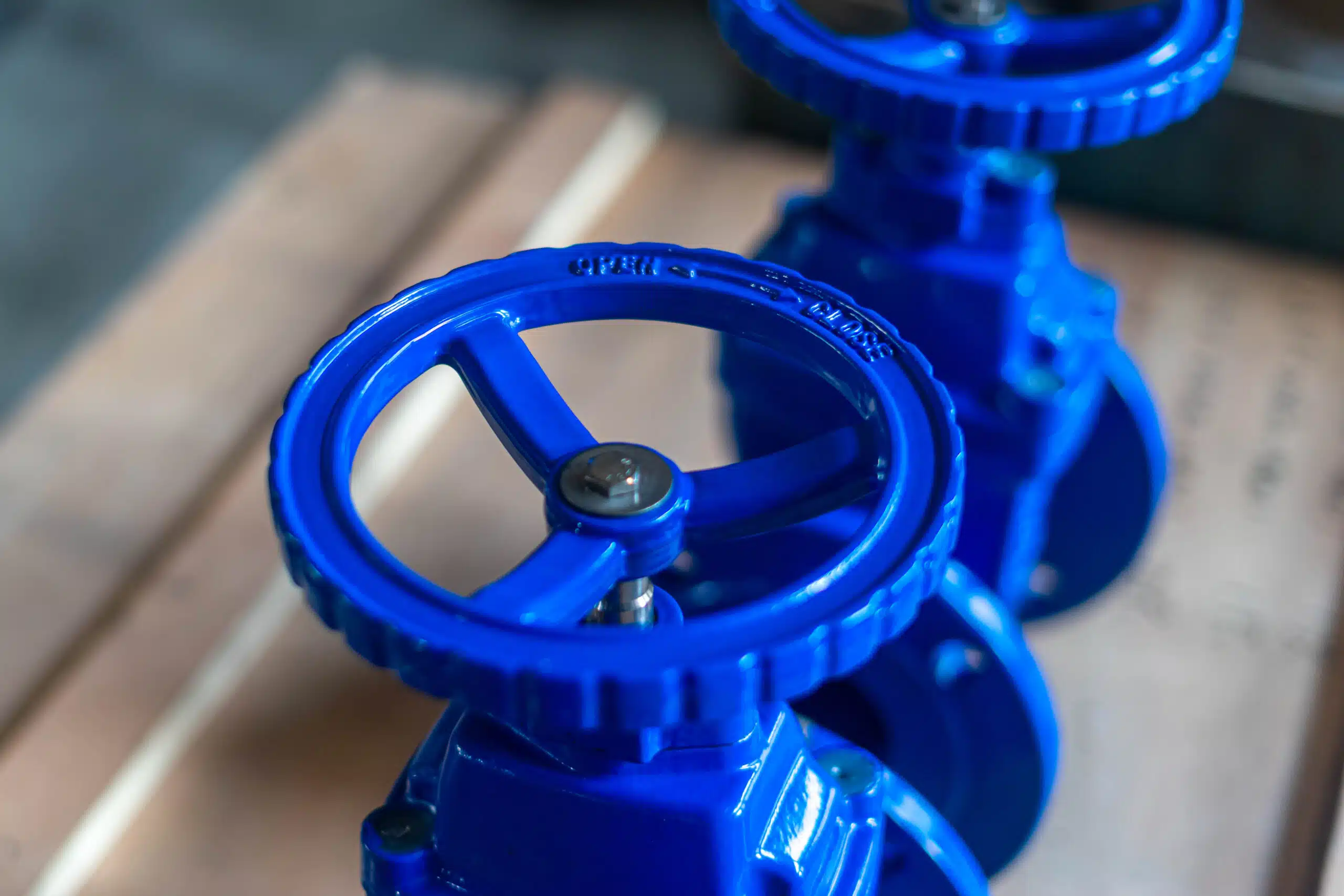
Stem, handwheel and operating parts
The stem connects the operating mechanism to the gate or wedge. In manual ductile iron gate valves, the handwheel or operating nut rotates the stem mechanism to move the gate. In larger sizes or buried service, gear operation or extension stems may be used depending on the installation.
The stem type affects installation and inspection:
- a non-rising stem saves vertical space and is common in buried or compact installations;
- a rising stem or OS&Y design gives visible stem movement and can help indicate valve position;
- an operating nut may be used where the valve is operated with a wrench rather than a handwheel.
Coating and corrosion protection
Ductile iron should not be described as universally corrosion resistant by itself. In practical projects, corrosion protection usually depends on the correct internal and external coating, the service environment, and the approval requirements for the pipeline system.
For RFQ or project approval, the coating requirement should be specified together with:
- service medium;
- buried or above-ground installation;
- internal coating requirement;
- external coating requirement;
- applicable coating standard;
- potable water or wastewater requirement, if applicable.
If the coating is under-specified, the valve body material alone may not provide the expected corrosion protection in buried, wastewater, or aggressive utility service.
Common Configurations of Ductile Iron Gate Valves
Older gate valve articles often list many valve types, but for ductile iron gate valve selection, buyers usually need to understand the most common configuration choices rather than a full gate valve type encyclopedia.
| Configuration | What it means | Common use | Selection note |
|---|---|---|---|
| Resilient seated / resilient wedge | The wedge is covered with elastomer such as EPDM or NBR | Water supply, wastewater, sewage, irrigation, fire protection | Good for many waterworks shutoff duties, but seat material limits must be checked |
| Metal seated | Metal sealing surfaces are used | Certain services where resilient material is not suitable | Shutoff expectation and maintenance may differ |
| Non-rising stem / NRS | Stem does not visibly rise above the handwheel or operating nut | Buried service, compact spaces, waterworks lines | Position indication may require other methods |
| Rising stem / OS&Y | Stem rises as the valve opens | Above-ground systems, fire protection, inspection-friendly installations | Requires more vertical space |
| Flanged ends | Valve connects to flanged pipe ends | Industrial and waterworks pipelines | Flange standard and drilling must match project requirement |
| Mechanical joint ends / MJ | Valve connects using mechanical joint pipe system | Water distribution and underground utility work | Dimensions differ from flanged valves |
| Handwheel operation | Manual operation by handwheel | Accessible above-ground service | Operator access and torque should be considered |
| Operating nut or gear | Used where direct handwheel operation is not practical | Buried, large-size, or high-torque installations | Confirm operation method before RFQ |
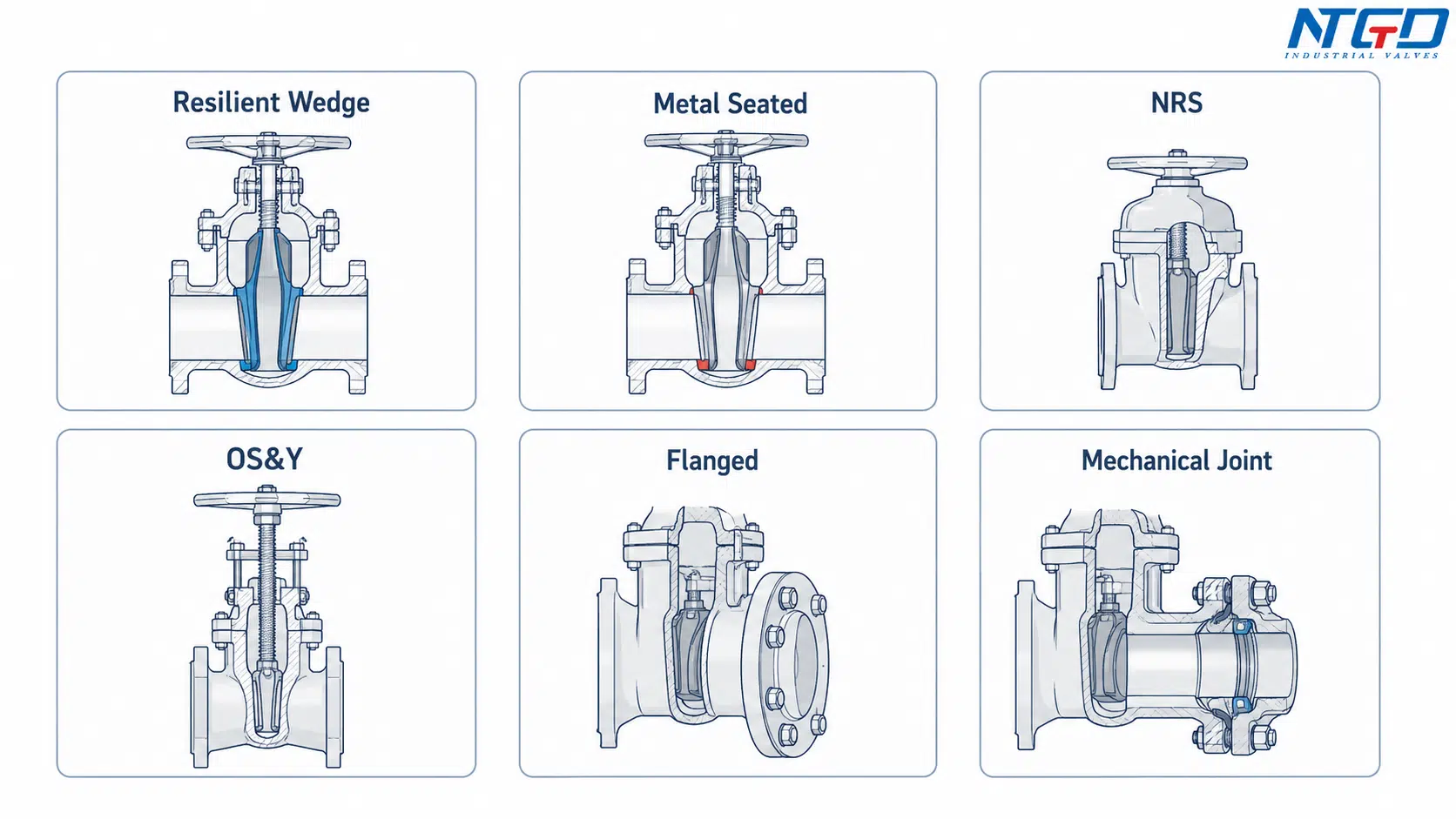
For many waterworks and utility projects, the practical selection question is not only “ductile iron or not,” but which combination of seat design, stem type, end connection, operation method, pressure rating, and installation condition matches the project. Resilient seated designs, NRS and OS&Y stem designs, and flanged or mechanical joint connections are common in many water-related applications, but the final choice still depends on the project standard, pressure class, buried or above-ground installation, and required operation access.
Parallel slide, through conduit, and knife gate valve designs should not dominate a ductile iron gate valve product-support guide. They may be relevant as separate gate valve topics, but the current page should stay focused on ductile iron gate valves and their common waterworks or utility configurations.
Where Ductile Iron Gate Valves Are Used
Ductile iron gate valves are widely used in utility and industrial pipelines where isolation service is required. The strongest application fit is usually water and wastewater pipelines, but the final choice still depends on pressure, temperature, coating, seat material, medium, and installation conditions.
| Application | Why ductile iron gate valves are used | Configuration notes | Caution |
|---|---|---|---|
| Water supply | Strong body material and practical shutoff design for distribution lines | Resilient seated, NRS, flanged or mechanical joint designs are common | Potable water approval requirements, coating, and elastomer material should be confirmed where applicable |
| Sewage and wastewater | Used for isolation in wastewater pipelines and treatment systems | Resilient wedge and coated body designs may be selected | Solids, debris, and chemical exposure may accelerate seat wear or affect shutoff performance |
| Irrigation systems | Suitable for opening or closing water flow in irrigation networks | Flanged or mechanical joint connections may be required | Surge pressure, water hammer, pressure rating, pipe connection, and operation access should be reviewed |
| Fire protection | Gate valves may be used where visible status or reliable isolation is required | OS&Y or NRS designs may be specified depending on system design | Approvals, position indication, and project standards must be checked |
| Industrial water lines | Used for plant water, cooling water, or utility water isolation | Material, coating, and seat selection depend on the medium | Not all industrial media are suitable for standard ductile iron designs |
| Construction projects | Used in temporary or permanent utility infrastructure | Size, pressure class, end connection, and drawing approval are important | Dimensions and installation clearances should be confirmed before ordering |
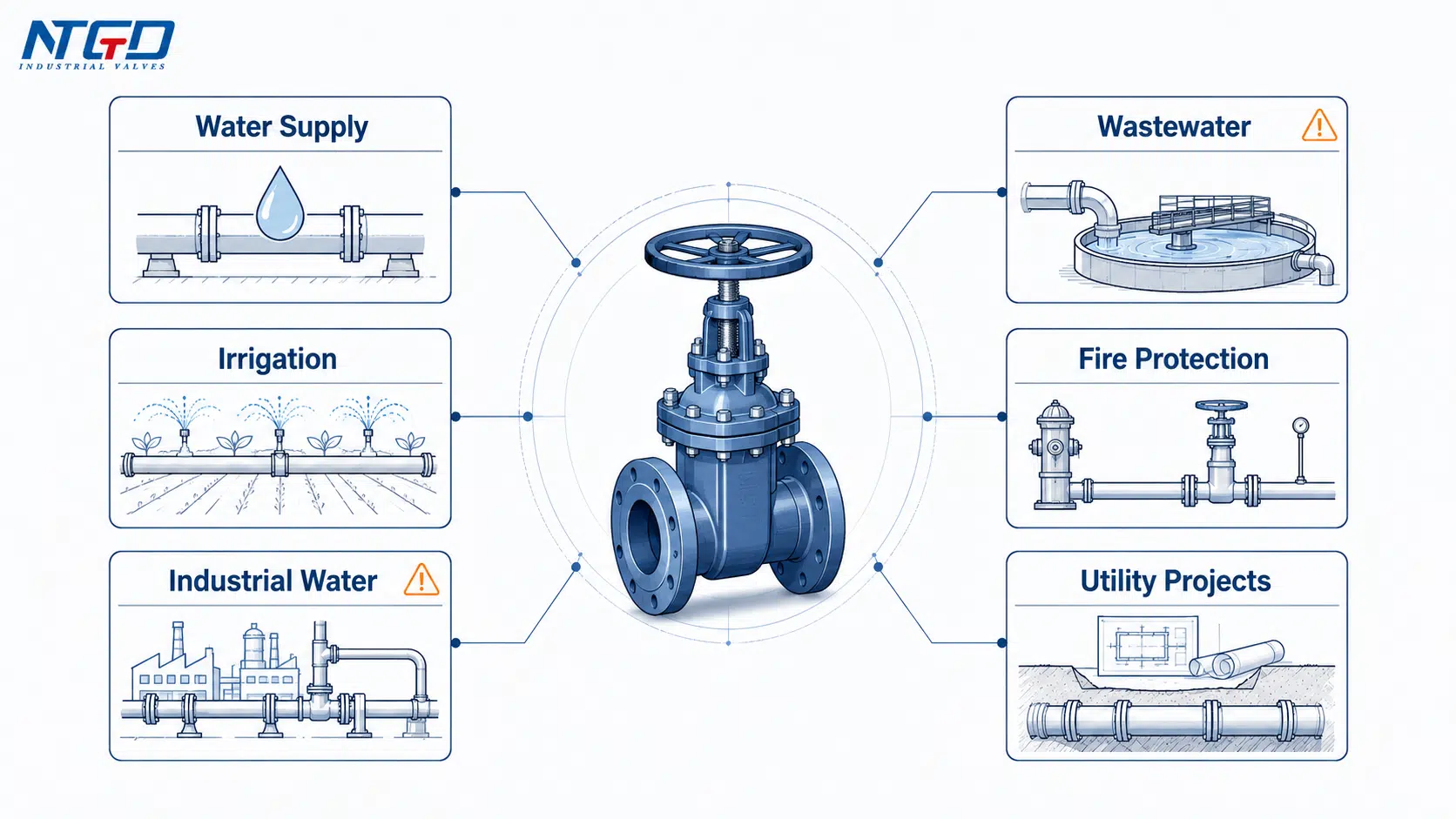
Wrong service assumptions can lead to leakage, premature seat wear, difficult operation, or installation rework. Applications such as crude oil, LNG, high-temperature steam, abrasive slurry, viscous process fluids, chemical service, food service, and pharmaceutical service should not be assumed. These services require a separate valve-type and material review.
Key Specifications to Confirm Before RFQ
A ductile iron gate valve should not be requested only by valve name. The same nominal valve size can have different dimensions, end connections, stem designs, pressure ratings, and seat materials.
The checklist below helps buyers organize the technical information needed for an accurate quotation and keep the RFQ aligned with the broader industrial valve selection process. Confirming these items early can reduce dimensional mismatch, material incompatibility, unnecessary drawing revisions, and project delays.
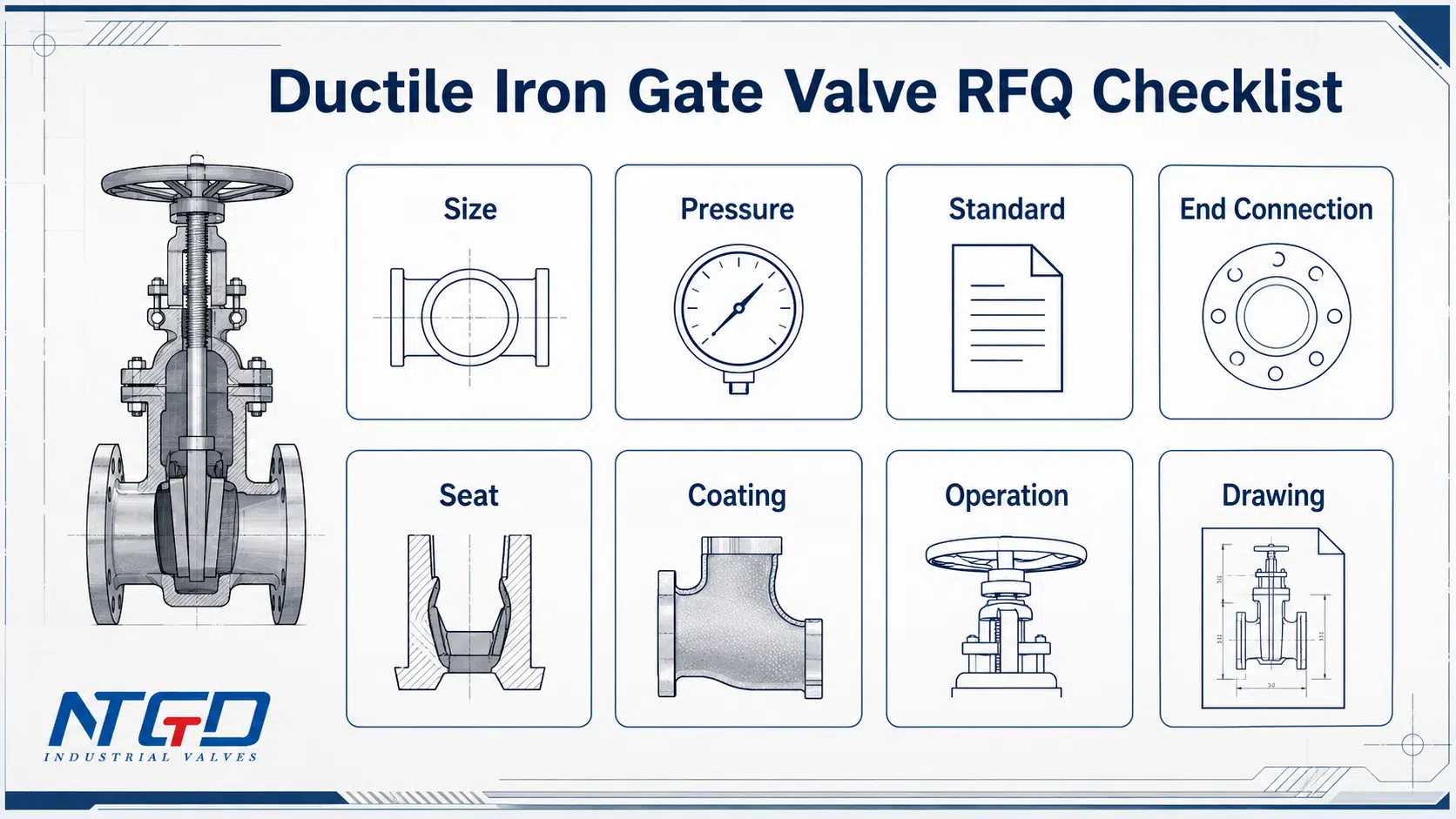
| RFQ item | Why it matters | What to confirm |
|---|---|---|
| Valve size | Determines pipe fit, flow capacity, and installation dimensions | DN / NPS, project pipe size |
| Pressure rating | Defines pressure boundary suitability | PN, Class, working pressure, test requirement |
| Design standard | Controls design, testing, and dimensional expectations | Applicable project or industry standard |
| End connection | Affects installation and dimensions | Flanged, mechanical joint, threaded, welded, grooved, or other |
| Flange standard | Prevents mismatch with pipeline flanges | Face type, drilling, flange class, bolt pattern |
| Face-to-face length | Critical for pipe spool and replacement work | Manufacturer drawing or datasheet |
| Overall height | Important for pits, chambers, and operation clearance | Handwheel, operating nut, stem, gear clearance |
| Operation method | Affects site access and torque | Handwheel, operating nut, gear, actuator-ready design |
| Stem type | Affects space and position indication | NRS, rising stem, OS&Y |
| Seat design | Affects sealing and medium compatibility | Resilient seated, metal seated, EPDM, NBR, bronze or other |
| Body and bonnet material | Confirms pressure boundary material | Ductile iron grade, if required by specification |
| Wedge material | Affects shutoff and service suitability | Ductile iron wedge, EPDM-covered wedge, NBR-covered wedge, metal wedge |
| Coating | Important for waterworks and corrosion protection | Internal coating, external coating, coating standard |
| Medium | Determines material and seat compatibility | Water, wastewater, sewage, irrigation water, industrial water, etc. |
| Temperature | Affects seat and coating suitability | Operating and design temperature |
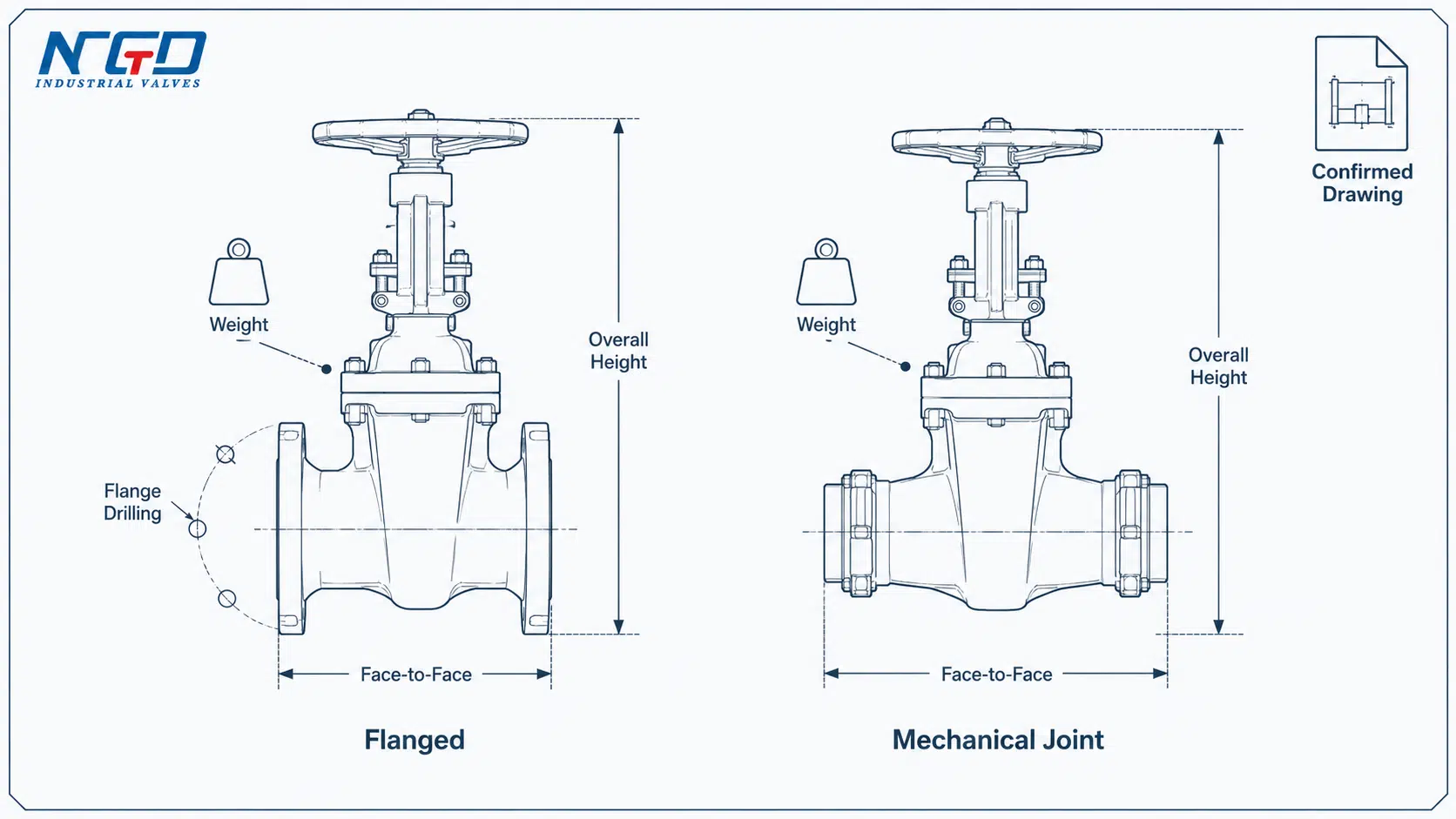
| Drawing or datasheet | Prevents dimensional mismatch | Confirmed dimensional drawing, weight, bolt details, installation data |
AWWA C509 / C515 and other standards
Waterworks ductile iron gate valves may be specified under standards such as AWWA C509 or AWWA C515, depending on the project requirement and valve design. These standards should be treated as specification context, not as a universal label for every ductile iron gate valve.
A project may also reference other regional or industry standards. The correct standard must be confirmed before procurement.
Dimensions and drawing note
Ductile iron gate valve dimensions are not fixed by the valve name alone. They can vary by:
- valve size;
- pressure class;
- end connection;
- flange standard;
- face-to-face requirement;
- stem type;
- operation method;
- manufacturer design.
A 6 inch flanged ductile iron gate valve and a 6 inch mechanical joint ductile iron gate valve may not have the same overall dimensions. For replacement projects, drawing confirmation is especially important because face-to-face length, flange drilling, bolt pattern, overall height, operating clearance, and weight can affect installation.
When replacing an existing valve, a face-to-face length mismatch or flange drilling mismatch may require pipe spool changes or field rework. Before RFQ, provide the existing valve drawing, project datasheet, or measured dimensions, and request a confirmed manufacturer drawing when installation space is limited.
Benefits and Limitations of Ductile Iron Gate Valves
Ductile iron gate valves are useful when their material, seat design, coating, and connection type match the service. They also have clear limitations that should be checked before selection.
| Type | Benefit or limitation | Why it matters | Selection note |
|---|---|---|---|
| Benefit | Better toughness than ordinary cast iron | Helps resist impact and mechanical stress better than standard cast iron | Still verify pressure class, installation condition, and project standard |
| Benefit | Good fit for waterworks isolation | Commonly used in water supply, wastewater, irrigation, and utility service | Confirm coating, seat material, and service approval requirements |
| Benefit | Low flow restriction when fully open | The gate is lifted out of the flow path | Applies when the valve is fully open, not when used as a control valve |
| Benefit | Available in resilient seated designs | Elastomer-covered wedge can support tight shutoff in many water services | Seat material must match temperature, medium, and water quality requirements |
| Benefit | Available in NRS and OS&Y designs | Supports different installation requirements | Choose based on space, operation visibility, and access conditions |
| Benefit | Multiple end connection options | Supports flanged, mechanical joint, and other project needs | Dimensions change with connection type, so drawings should be checked |
| Limitation | Not suitable for throttling | Partial opening can damage seat and wedge surfaces | Use another valve type for control service |
| Limitation | Soft seats have temperature limits | EPDM, NBR, and other elastomers are not universal | Confirm seat material before high-temperature or aggressive service |
| Limitation | Coating-dependent corrosion protection | Ductile iron usually needs proper coating in waterworks service | Do not assume universal corrosion resistance from body material alone |
| Limitation | Not all services are suitable | Abrasive, corrosive, slurry, high-temperature, or chemical media may require another design | Review service conditions before RFQ |
| Limitation | Dimensions must be verified | Same size does not guarantee same dimensions | Request drawings or datasheets before ordering |
A ductile iron gate valve can be a strong and practical choice, but it should not be treated as a universal valve for all services. The most important selection notes are usually seat compatibility, coating requirement, end connection, pressure rating, and installation dimensions.
Troubleshooting and Maintenance Checks
Troubleshooting should start with the actual service conditions, installation status, and valve design. The table below summarizes common problems and checks for ductile iron gate valves. All inspection, disassembly, repair, or replacement work should follow manufacturer instructions, site safety procedures, and the applicable isolation or depressurization requirements.
| Problem | Possible cause | What to check | Typical action |
|---|---|---|---|
| High operating torque | Overtightened gland bolts, stem friction, debris, misalignment | Stem, gland area, packing compression, operation history | Adjust gland bolts according to procedure, clean debris, inspect stem and operating parts |
| Valve does not open | Valve was closed with excessive torque, stem or wedge jammed | Handwheel movement, stem condition, bonnet area, obstruction | Inspect according to manufacturer guidance; avoid forcing operation |
| Valve does not open completely | Foreign material inside valve or mechanical obstruction | Wedge travel, internal cavity, stem movement | Clean and inspect internal parts if service procedure allows |
| Valve does not close completely | Debris on seat, damaged wedge, damaged stem, seat wear | Seat area, wedge surface, stem movement | Remove debris after proper isolation; replace damaged seat or wedge if required |
| Leakage through bonnet joint | Loose bolts, gasket wear, damaged sealing surface | Bonnet bolts, gasket condition, mating surfaces | Tighten correctly or replace gasket after depressurization |
| Leakage through seat | Seat damage, debris, worn resilient material, damaged metal surface | Seat and wedge contact area | Clean, inspect, replace seat or wedge if needed |
| Leakage through stem packing | Loose gland, worn packing, damaged stuffing box | Packing, gland bolts, stem surface | Adjust gland or replace packing according to procedure |
| Difficult field replacement | Wrong dimensions, connection mismatch, limited access | Face-to-face length, flange drilling, MJ dimensions, operating clearance | Confirm drawing before ordering replacement valve |
For safety, inspection or repair should follow site procedure and manufacturer guidance. A valve installed in buried, pit, or confined-space service may require additional safety and access planning.
FAQ About Ductile Iron Gate Valves
What does DI gate valve mean?
DI gate valve usually means ductile iron gate valve. “DI” is a common abbreviation for ductile iron in project specifications, product titles, RFQ documents, and bills of material.
Is a ductile iron gate valve the same as a cast iron gate valve?
No. Ductile iron and cast iron are different materials. Ductile iron usually offers better toughness and impact resistance than ordinary cast iron. However, the final valve selection still depends on pressure rating, coating, seat design, end connection, and service conditions.
Are all ductile iron gate valves resilient seated?
No. Many ductile iron gate valves used in waterworks service are resilient seated or resilient wedge designs, but not all ductile iron gate valves are resilient seated. The choice between resilient seated or metal seated designs depends on the medium, temperature, abrasion risk, and service condition.
When should a resilient wedge ductile iron gate valve be selected?
A resilient wedge ductile iron gate valve is often selected for water supply, wastewater, sewage, irrigation, and utility service where shutoff performance and coated ductile iron construction are important. The seat material, such as EPDM or NBR, must still be checked against the medium, temperature, water quality requirement, and project standard.
What should be confirmed for potable water or water supply service?
Ductile iron gate valves are commonly used in water supply and utility pipelines. For potable water projects, coating, elastomer material, applicable standards, and local approval requirements should be confirmed before procurement.
Do ductile iron gate valve dimensions vary by size and end connection?
Yes. Dimensions depend on valve size, pressure class, end connection, flange standard, face-to-face requirement, stem type, operation method, and manufacturer design. A flanged valve and a mechanical joint valve of the same nominal size may have different dimensions.
What information should be provided before requesting a quotation?
A useful RFQ should include valve size, pressure rating, medium, temperature, end connection, applicable standard, seat material, coating requirement, operation method, quantity, and whether a drawing or datasheet is required.
Why are ductile iron gate valves not recommended for flow control?
They are designed mainly for fully open or fully closed isolation service. Partial opening can expose the gate and seat to vibration, erosion, uneven flow forces, and unstable operation. If the application needs continuous regulation, another valve type should be reviewed.
When should a ductile iron gate valve be repaired or replaced?
Repair or replacement may be needed when the valve cannot fully open or close, operating torque becomes abnormal, seat leakage continues after cleaning, stem packing leakage cannot be corrected, or the valve dimensions no longer match the replacement requirement. If repeated repair is required, comparing repair parts, field labor, downtime, and the fit of a new valve with confirmed dimensions can help determine the practical long-term option.
Conclusion
A ductile iron gate valve is best understood as a product-support selection topic, not only as a definition. The valve body material is important, but the final selection also depends on wedge design, seat material, stem type, coating, end connection, standard, dimensions, and service conditions.
For most waterworks and utility applications, buyers should focus on whether the valve needs resilient seated or metal seated construction, NRS or OS&Y operation, flanged or mechanical joint ends, and confirmed drawings or datasheets before procurement. The safest selection process is to match the complete specification to the pipeline service, rather than selecting only by valve name.
Once the specification list is clear, the next step is to review the valve configuration, drawing requirements, and material boundaries before sending the RFQ.
Light CTA
For a ductile iron gate valve RFQ, prepare the required size, pressure rating, medium, temperature, end connection, standard, seat material, coating requirement, operation method, and drawing or datasheet request.
NTGD’s valve engineers can provide technical support in selecting a suitable ductile iron gate valve configuration and provide product information, drawings, and datasheets for project review. Final valve approval should still be checked against the project specification, site conditions, and engineering requirements.
