
Author Name: Bruce Zheng
Author Role: Co-Founder and Valve Engineer at NTGD Valve
Author Bio: Bruce Zheng is Co-Founder and Valve Engineer at NTGD Valve, focusing on industrial valve selection, application, and technical content for global B2B buyers.
Last Updated: May 28, 2026
Quick Answer: What Standards Apply to Globe Valves?
Short Answer for Engineers and Buyers
Globe valve standards are not a single document. In industrial RFQs, globe valve standards normally refer to a group of design, pressure-temperature, testing, emission, inspection, and documentation requirements used to define whether a valve is suitable for a project.
For most industrial globe valve specifications, buyers commonly need to review standards such as API 623, BS 1873, ASME B16.34, API 598, ISO 5208, API 624, and ISO 15848. These standards do not all control the same thing. Some define design or construction expectations, some support pressure-temperature rating, some guide inspection and testing, and others apply only when low-emission or project-specific requirements are included.
The practical question is not only “which globe valve standard applies?” The more useful question is:
Which standard controls the valve design, which standard controls testing, and which documents must be confirmed before quotation, production, and final acceptance?
For basic valve type and service-fit context before reviewing standards, see NTGD’s globe valve types and selection guide.
Key Globe Valve Standards and Their Functions in a Specification
| Standard / Requirement | Primary Function | What It Controls | Where It Appears in RFQ |
|---|---|---|---|
| API 623 | Design and construction reference | Certain steel globe valve design, construction, testing, inspection, and purchaser information requirements | Design standard, valve construction basis, project specification |
| BS 1873 | Steel globe / globe stop-check valve specification reference | Scope for steel globe valves, globe stop-check valves, end connection context, and specification boundary | Design standard, product specification, project standard requirement |
| ASME B16.34 | Pressure-temperature and valve design framework | Pressure-temperature rating basis, material groups, design framework, class-related review | Rating basis, class confirmation, material and temperature review |
| API 598 | Inspection and pressure testing reference | Shell test, seat test, backseat test, and inspection expectations depending on valve type and project requirement | Testing standard, inspection requirement, pressure test report |
| ISO 5208 | Valve pressure testing / leakage reference | Pressure testing and leakage classification context where specified | Testing requirement, leakage acceptance basis |
| API 624 | Low-emission qualification context | Fugitive emission performance for certain valve packing arrangements where required | Low-emission requirement, project-specific qualification |
| ISO 15848 | Fugitive emission classification context | Emission classification and qualification where specified by the project | Emission class, environmental or project compliance requirement |
| MTR / test report / inspection document | Documentation requirement | Material traceability, pressure test evidence, inspection record | Required documents before shipment or final acceptance |
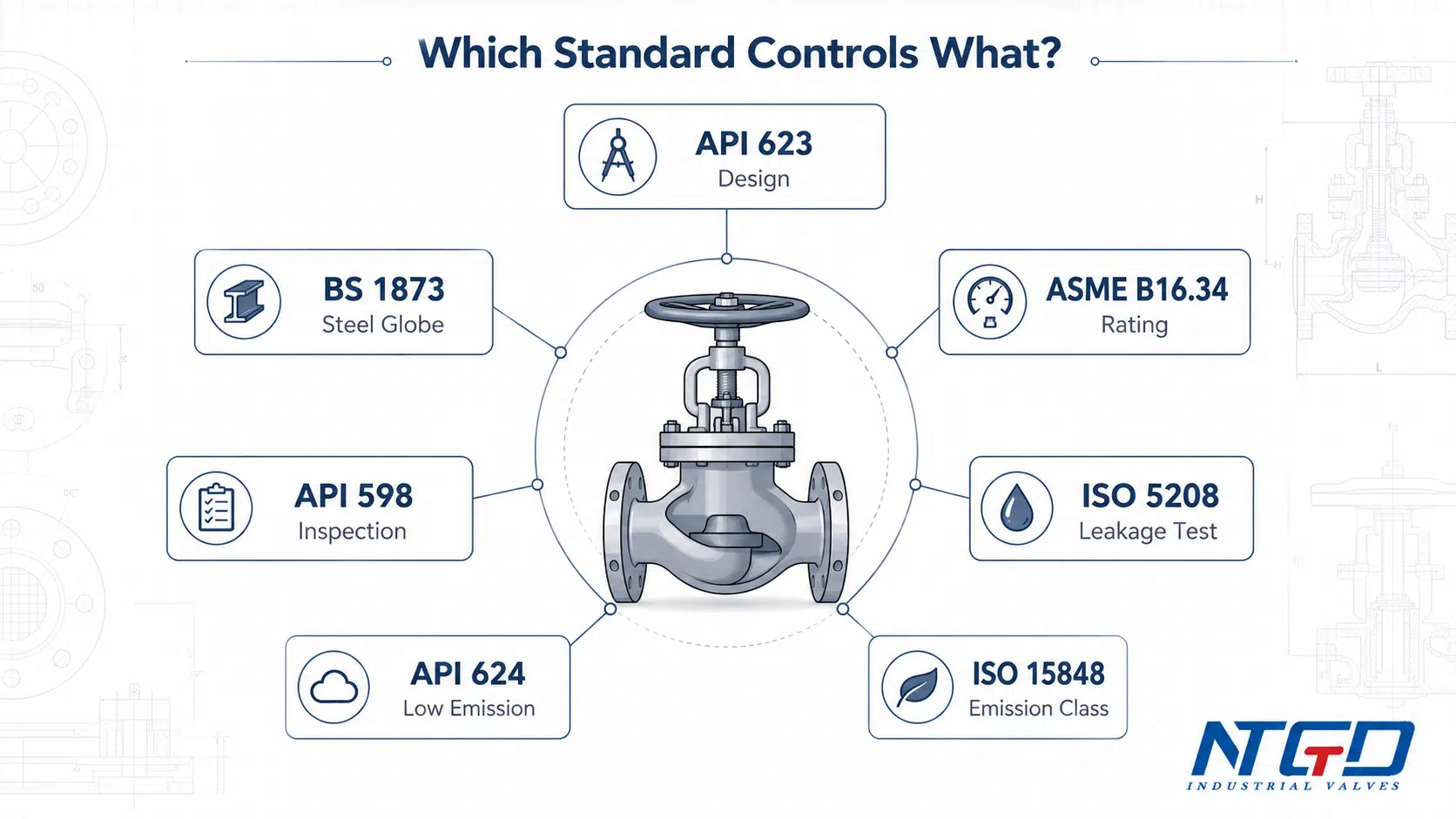
If these standards are listed without clear roles, suppliers may interpret the RFQ differently. That can create repeated quotation clarification, wrong construction assumptions, missing inspection documents, or project acceptance delays.
Standards, Specifications and Test Documents: What Is the Difference?
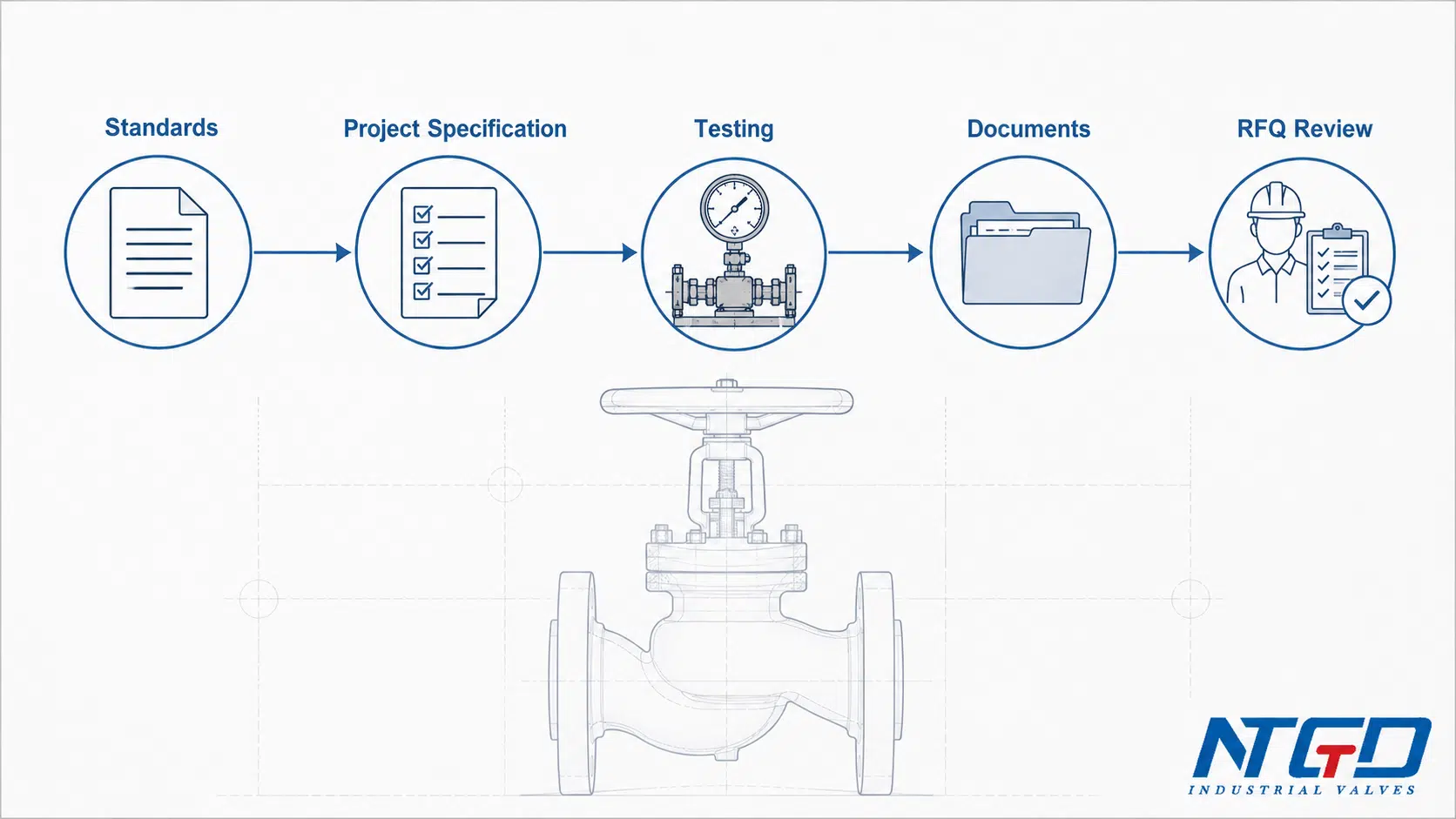
Standard vs Specification
A standard is a technical reference. A specification is the buyer’s project document that tells the supplier how those standards must be applied to one valve order.
For a globe valve, the standard may define the engineering basis, but the project specification must still confirm the service conditions, size, pressure class, body material, trim, end connection, testing, inspection level, and required documents.
| Item | What It Means | Why It Matters in Globe Valve Procurement |
|---|---|---|
| Standard | A recognized technical reference used for design, rating, testing, or qualification | For a globe valve, this may mean confirming whether API 623, BS 1873, ASME B16.34, API 598, or another reference applies |
| Project specification | The buyer’s or EPC’s requirement for a specific order | Defines the exact valve construction, service conditions, documents, and acceptance requirements |
| Manufacturer datasheet | Supplier document describing a specific product design | Useful for confirmation, but it does not replace the buyer’s project specification |
| MTR | Material Test Report | Supports material traceability and verifies supplied material grade |
| Pressure test report | Record of pressure testing performed on the valve | Helps confirm whether testing requirements were performed and documented |
| Inspection document | QA / inspection record requested by the buyer or project | Supports final acceptance, documentation review, and project compliance |
A weak globe valve specification often causes different suppliers to quote different assumptions. Standards must be converted into RFQ fields, not only mentioned in the inquiry title.
Datasheet, MTR, Pressure Test Report and Inspection Document
A datasheet describes a valve. An MTR verifies material traceability. A pressure test report supports pressure test confirmation. An inspection document records QA or inspection status.
For B2B procurement, these documents should be requested before quotation or production, not after the valve is already manufactured. When document requirements are added late, shipment, inspection release, or final acceptance can be delayed.
For detailed valve pressure test procedures by valve type, keep the full method discussion in NTGD’s industrial valve pressure test methods guide rather than expanding it inside this standards overview.
Key Globe Valve Standards and What They Control
When a project specification references a globe valve design standard, API 623 and BS 1873 are usually reviewed as design or construction references, while ASME B16.34 often supports the pressure-temperature rating framework. API 598 and ISO 5208 are more closely related to testing or leakage verification. API 624 and ISO 15848 should be treated as low-emission requirements only when the project calls for them.
Design and Construction Standards
Design and construction standards help define the valve construction basis. They may influence body / bonnet arrangement, wall thickness philosophy, seating details, stem and packing expectations, end connection context, and purchaser information.
API 623 and BS 1873 should not be treated as interchangeable labels. A valve ordered as an API 623 globe valve still needs a complete RFQ with valve size, pressure class, body material, trim, end connection, testing standard, and required documents.
Testing and Inspection Standards
Testing standards do not replace design standards. They help define how the valve should be inspected or pressure tested. For globe valves, API 598 is frequently referenced for inspection and pressure testing, while ISO 5208 may appear where leakage testing or international test classification is required.
Missing or incomplete pressure test reports, MTRs, or inspection documents can delay project acceptance even when the valve itself is technically suitable.
Emission and Project-Specific Requirements
API 624 and ISO 15848 should not be added automatically to every globe valve RFQ. They matter when the project requires fugitive emission control, low-emission packing, environmental compliance, or a specific emission class.
If the project has low-emission requirements, the RFQ should state them clearly. Do not assume that a design standard alone automatically covers all emission requirements.
Which Standard Controls What?
| Requirement Area | Typical Standard / Document | Main Function | Buyer Should Confirm |
|---|---|---|---|
| Globe valve design basis | API 623 / BS 1873 | Defines construction reference for certain steel globe valve designs | Whether the required valve construction matches the selected design standard |
| Pressure-temperature rating | ASME B16.34 | Supports pressure class, material group, and temperature-related rating review | Maximum operating temperature, selected material, and pressure class |
| Inspection and pressure testing | API 598 | Supports valve inspection and pressure testing expectations | Required test type, report format, and acceptance documentation |
| Leakage / pressure testing context | ISO 5208 | Supports pressure test and leakage classification where specified | Whether the project accepts or requires ISO-based testing |
| Low-emission packing qualification | API 624 | Supports low-emission requirement where specified | Whether fugitive emission performance is required |
| Fugitive emission classification | ISO 15848 | Supports emission class and qualification where specified | Required emission class, test basis, and documentation |
| Material traceability | MTR | Verifies supplied material grade and heat traceability | Whether MTRs are required before shipment |
| Final QA / inspection | Inspection report | Confirms inspection and document review | Whether third-party inspection or buyer inspection is required |
API 623 Globe Valves: Scope and Buyer-Relevant Requirements
What API 623 Is Used For
API 623 is commonly used as a design and construction reference for certain steel globe valves used in refinery, petrochemical, and heavy industrial service. In RFQs, the phrase “API 623 globe valve” usually signals that the buyer expects a steel globe valve built to a recognized API design basis.
For external scope confirmation, the API STD 623 standard listing identifies the document as a steel globe valve standard for flanged and butt-welding ends with bolted bonnets.
API 623 should be understood as a design and construction reference, not a complete RFQ by itself. It does not automatically define every material grade, every trim selection, every end connection detail, every low-emission requirement, or every project inspection document.
For this reason, buyers should not assume that API 623 automatically applies to every globe valve, every forged valve, every bellow-seal configuration, or every special alloy service. The actual construction, service conditions, and project specification must be cross-checked before quotation.
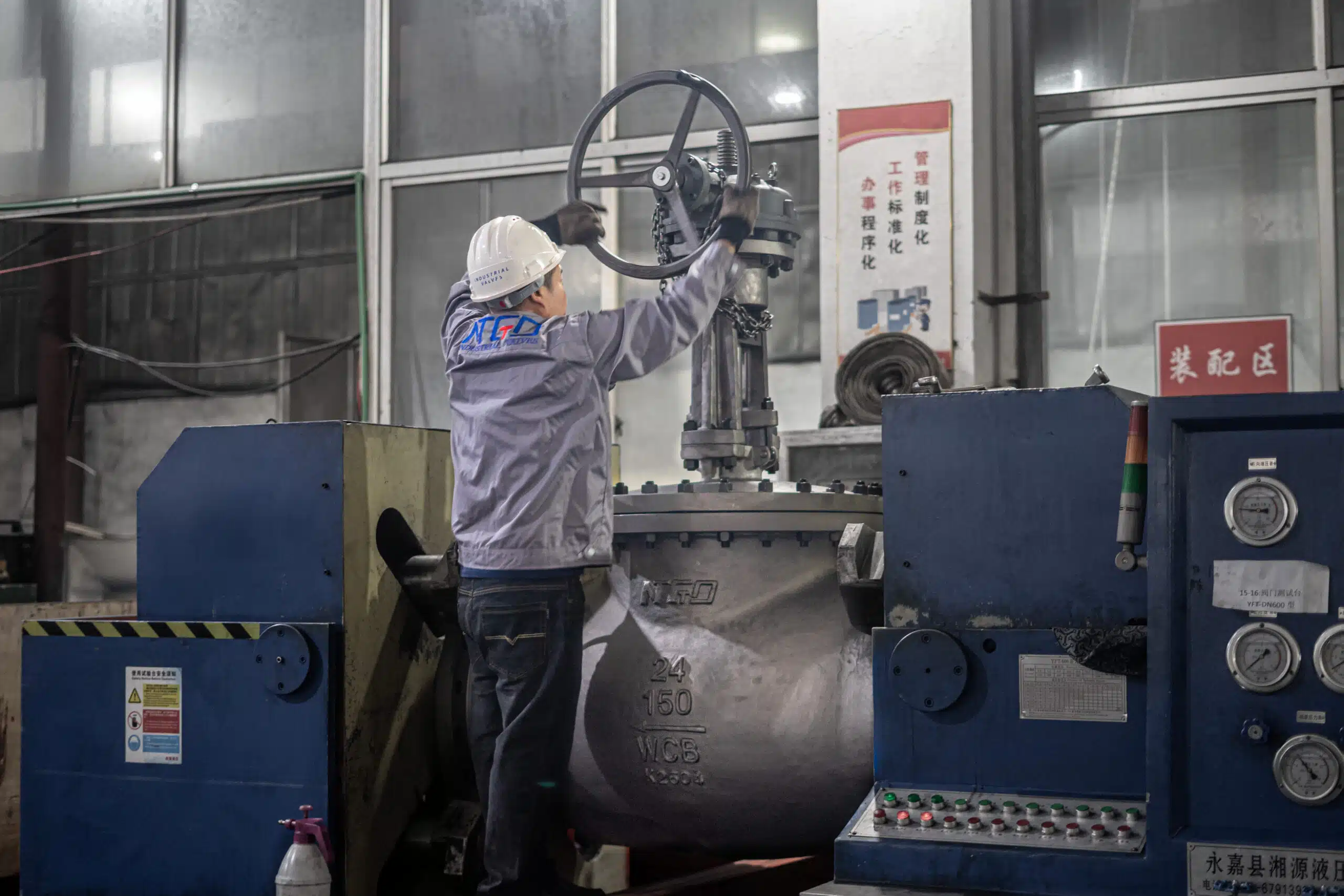
Buyer-Relevant API 623 Checks
| API 623 RFQ Check | Why It Matters |
|---|---|
| Valve construction | Confirms whether the requested valve design matches API 623 expectations |
| Body and bonnet arrangement | Prevents confusion between product configuration and standard reference |
| Size and pressure class | Defines the quotation basis and compatibility with the pipeline specification |
| Material and trim | Affects corrosion, temperature, wear, and sealing suitability |
| End connection | Prevents mismatch with flange, butt-weld, or piping requirements |
| Testing and inspection | Confirms whether pressure testing and inspection documents are required |
| Emission requirement | Clarifies whether API 624, ISO 15848, or other low-emission requirements must be included |
| Purchaser information | Ensures the supplier receives enough information to quote the correct valve |
If API 623 is used outside its suitable scope, the RFQ may produce a valve that appears correct by standard number but does not match the actual construction, material, service, or documentation requirement.
API 623 Is Not the Same as a Bellow-Seal Globe Valve
API 623 is a standard reference. A bellow-seal globe valve is a product design feature used to reduce stem leakage in suitable service conditions.
Some suppliers may offer API 623 bellow-seal globe valves, but the two terms are not the same. If the project requires a bellows seal, low-emission packing, or a specific fugitive emission qualification, the RFQ should state that separately. Do not rely on the API 623 reference alone to communicate a bellow-seal or low-emission requirement.
When the project specifically requires stem leakage control, review the dedicated bellow seal globe valve page as a product-level bridge, not as a replacement for the API 623 standard check.
BS 1873 Globe Valves: Scope and Specification Boundary
What BS 1873 Covers
BS 1873 is commonly referenced for steel globe valves and globe stop-check valves used in petroleum, petrochemical, and related industrial service. It is strongly associated with steel valve construction, flanged or butt-welding end contexts, and project specifications that require a British Standard reference.
The BSI BS 1873 standard page is the preferred external reference for confirming the steel globe and globe stop-check valve scope before quoting a BS 1873 globe valve.
A BS 1873 globe valve specification should not be treated as a generic label for all globe valves. It should not be automatically applied to cast iron, bronze, non-steel, threaded, socket-welded, or small forged valve configurations unless the project specification and applicable standard scope support that choice.
BS 1873 in Real RFQs
In real RFQs, BS 1873 should be translated into clear specification fields:
| RFQ Field | Buyer Should Confirm |
|---|---|
| Valve type | Globe valve, globe stop-check valve, straight pattern, angle pattern, or Y-pattern if required |
| Material | Carbon steel, alloy steel, stainless steel, or other project-required material |
| End connection | Flanged or butt-welding end requirement, including relevant piping standard |
| Pressure class | Required class and rating basis |
| Testing | API 598, ISO 5208, or project-specified inspection requirement |
| Documents | MTR, pressure test report, inspection document, certificate, or buyer-specific QA file |
BS 1873 and API 623 may appear in the same project discussion, but they should not be treated as duplicate standard names. The project specification must clarify which design reference is required and which supporting standards are used for rating, testing, emission, and documentation.
ASME B16.34, API 598, ISO 5208 and Emission Standards
ASME B16.34 as a Pressure-Temperature Framework
ASME B16.34 is not a globe-valve-only standard. Its importance is that it supports valve pressure-temperature ratings, material group considerations, and design framework review for many industrial valves, including globe valves.
ASME describes ASME B16.34 as a broader valve standard covering pressure-temperature ratings, dimensions, materials, testing, and marking, so it should not be treated as a globe-valve-only standard.
For a globe valve RFQ, ASME B16.34 is often used together with a design standard such as API 623 or BS 1873. The design standard helps identify the construction basis, while ASME B16.34 helps verify whether the pressure class, material, and operating temperature are aligned.
API 598 and ISO 5208 for Testing
API 598 is commonly referenced for valve inspection and pressure testing. ISO 5208 may be referenced for pressure testing and leakage classification where an ISO-based testing approach is specified.
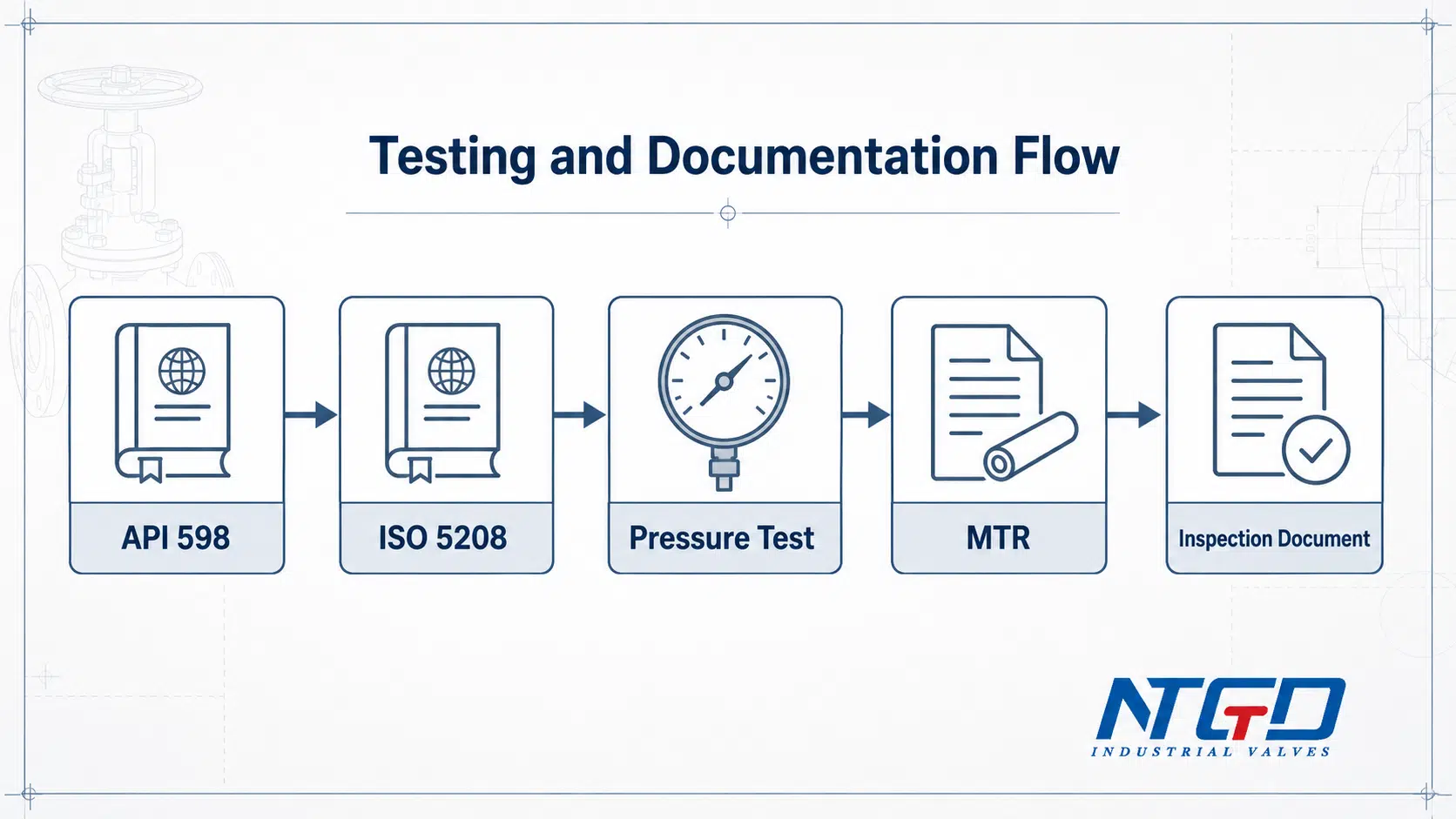
For API-based inspection language, the API STD 598 standard listing supports its role as an inspection and pressure testing reference for multiple valve types, including globe valves.
Where an ISO-based testing requirement is specified, the ISO 5208 standard page supports its role in pressure boundary integrity and valve closure tightness verification for industrial metallic valves.
The important RFQ question is not only “which testing standard applies?” It is also:
- What test reports are required?
- Is seat leakage acceptance specified?
- Is third-party inspection required?
- Must the pressure test report be submitted before shipment?
- Should the inspection document be included in the final documentation package?
API 624 and ISO 15848 for Low-Emission Requirements
API 624 and ISO 15848 should be handled as project-specific emission requirements. They are especially relevant when the valve will be used in services where fugitive emission control is required.
If low-emission performance matters, the RFQ should state the expected emission requirement, packing requirement, test basis, and documentation requirement. Leaving these items unclear can lead to quotation gaps and late-stage compliance discussion.
API 623 vs BS 1873 vs ASME B16.34: Practical Comparison
Comparison by Standard Role
| Standard | Main Role in Globe Valve Specification | Buyer Decision Value | RFQ Risk If Unclear |
|---|---|---|---|
| API 623 | Design and construction reference for certain steel globe valves | Helps define whether API-based globe valve construction is required | Supplier may quote a different construction basis or omit API-specific expectations |
| BS 1873 | Steel globe / globe stop-check valve specification reference | Helps define BS-based steel globe valve scope and end connection context | Supplier may quote a product that does not match the intended BS specification |
| ASME B16.34 | Pressure-temperature and valve design framework | Helps confirm class, material, and temperature compatibility | Selected valve may not align with the required pressure-temperature envelope |
| API 598 | Inspection and pressure testing reference | Helps define testing and reporting expectations | Required pressure test documentation may be missing |
| ISO 5208 | Pressure testing / leakage reference where specified | Helps support leakage or ISO-based test requirements | Leakage acceptance basis may be unclear |
| API 624 / ISO 15848 | Fugitive emission / low-emission requirements | Helps define emission qualification where required | Low-emission requirement may be missed or quoted as an option |
Comparison by Buyer Decision
| Buyer Decision Scenario | Most Relevant Standard / Requirement | Why the Wrong Choice Creates RFQ Risk |
|---|---|---|
| Buyer needs a steel globe valve design basis | API 623 or BS 1873 | A vague standard reference may cause suppliers to quote different construction designs |
| Buyer needs rating confirmation | ASME B16.34 with the selected material and class | Pressure-temperature suitability may be misunderstood |
| Buyer needs final inspection evidence | API 598 / ISO 5208 and inspection documents | Testing may be performed but not documented in the required format |
| Buyer needs low-emission performance | API 624 / ISO 15848 or project-specific emission requirement | Low-emission packing or qualification may not be included |
| Buyer needs procurement clarity | Project specification and RFQ checklist | A standard number alone does not define all order requirements |
Correctly combining these standards reduces RFQ back-and-forth, product mismatch risk, and document review delays.
How to Choose the Right Globe Valve Standard for an RFQ
Start with the Service Conditions
Begin with the service. A globe valve used for refinery, petrochemical, steam, cryogenic, corrosive, high-temperature, or low-emission service may require different standard references and documents.
The RFQ should identify:
- fluid or media;
- design pressure and temperature;
- corrosion or erosion concerns;
- whether throttling or shut-off is the main function;
- whether low-emission packing or bellows seal is required;
- whether buyer inspection or third-party inspection is required.
For steam service, pressure class, temperature, material, and document requirements should be checked against a dedicated steam globe valve specification review instead of being treated as a generic globe valve standard question.
Choosing the wrong design standard can lead to a valve that looks correct in the quotation but does not meet the service, inspection, or documentation requirements.
Confirm Valve Construction and End Connection
The standard reference must match the physical valve construction. Confirm whether the valve is cast steel, forged steel, straight pattern, angle pattern, Y-pattern, globe stop-check type, flanged end, butt-welding end, threaded end, or socket-welded end.
End connection is especially important. Specifying the wrong end connection without confirming the piping standard can lead to flange mismatch, field rework, installation delay, or RFQ rejection.
Match Testing and Documentation Requirements
Testing and document requirements should be stated in the initial RFQ. Do not wait until production is complete to request pressure test reports, MTRs, inspection documents, or emission-related evidence.
A strong RFQ should state:
- design standard;
- pressure-temperature rating basis;
- inspection and pressure testing standard;
- required test reports;
- MTR requirement;
- low-emission requirement if applicable;
- inspection or third-party inspection requirement;
- final documentation package.
What Should Be Included in a Globe Valve Specification?
A globe valve specification should convert standards into orderable information. The more complete the specification, the more accurately the supplier can evaluate design feasibility, material availability, testing requirements, and documentation workload.
Globe Valve Specification / RFQ Checklist
| RFQ Field | Why It Matters | Example Requirement Type | Notes |
|---|---|---|---|
| Design standard | Defines construction basis | API 623 / BS 1873 / ASME B16.34 | Confirm whether the selected standard matches valve construction |
| Size / DN / NPS | Defines valve dimension basis | DN / NPS | Do not use this article as a dimension chart |
| Pressure class | Defines pressure-temperature context | ASME Class requirement | Confirm selected material and operating temperature |
| Material / trim | Affects corrosion, temperature, wear, and sealing suitability | WCB, CF8M, alloy, trim requirement | Confirm media, temperature, and corrosion allowance |
| End connection | Affects piping fit | RF, RTJ, BW, SW, threaded | Confirm flange, welding-end, or piping standard |
| Valve construction | Confirms product configuration | bolted bonnet, pressure seal, globe stop-check, angle, Y-pattern | Do not rely on standard number alone |
| Testing standard | Defines inspection expectation | API 598 / ISO 5208 | Request pressure test report |
| Documents | Supports QA and acceptance | MTR, pressure test report, inspection document | Required before shipment or final acceptance |
| Emission requirement | Project-specific | API 624 / ISO 15848 | Only if required by the project |
| Special service | Prevents missing service-specific requirements | steam, cryogenic, high-corrosion, high-temperature, low-emission | Confirm before quotation |
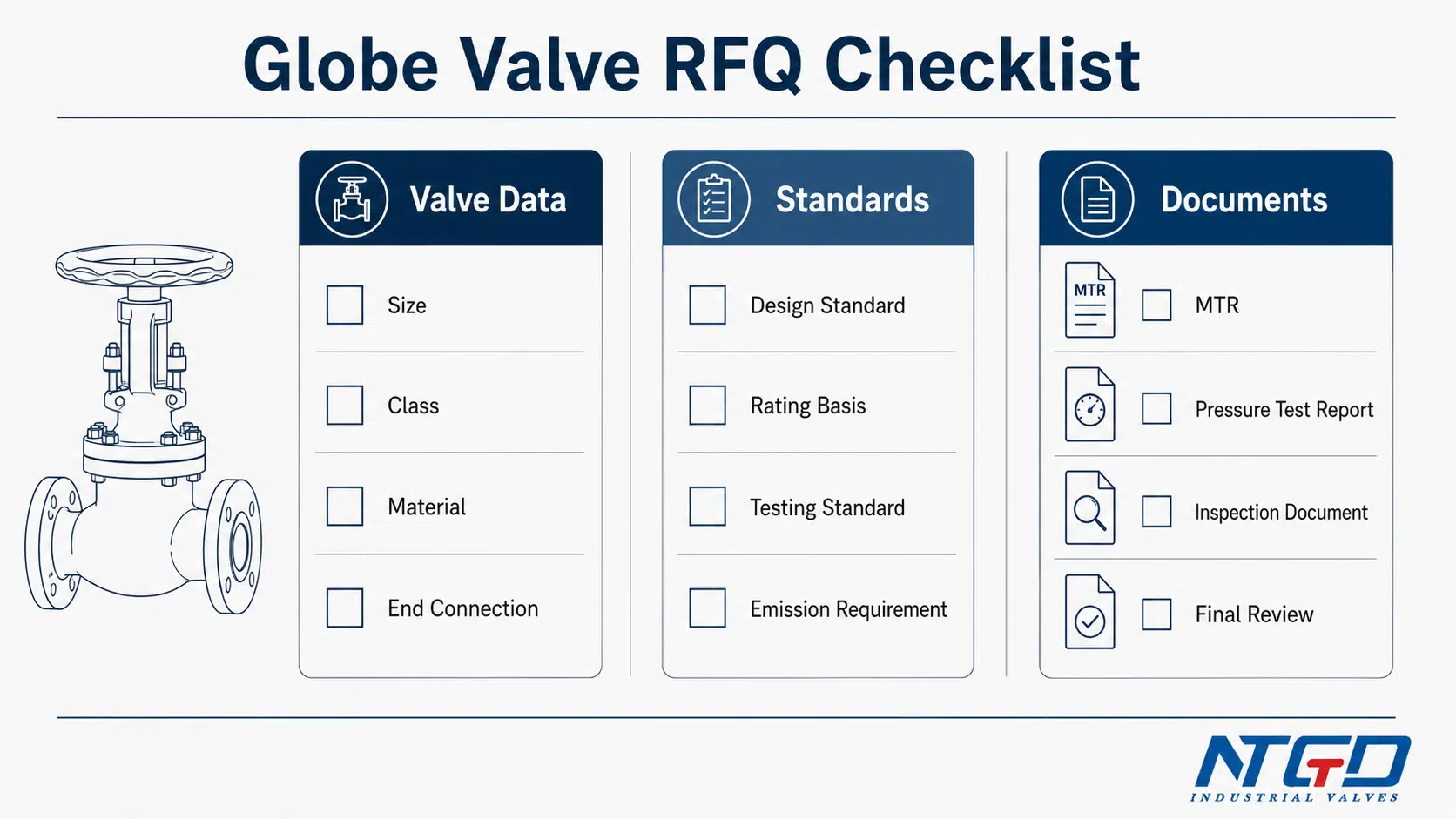
If any field is unclear, it should be reviewed before quotation or production. A clear specification improves supplier response accuracy and reduces the risk of missing tests, missing documents, or incorrect product configuration.
Common Mistakes When Specifying Globe Valve Standards
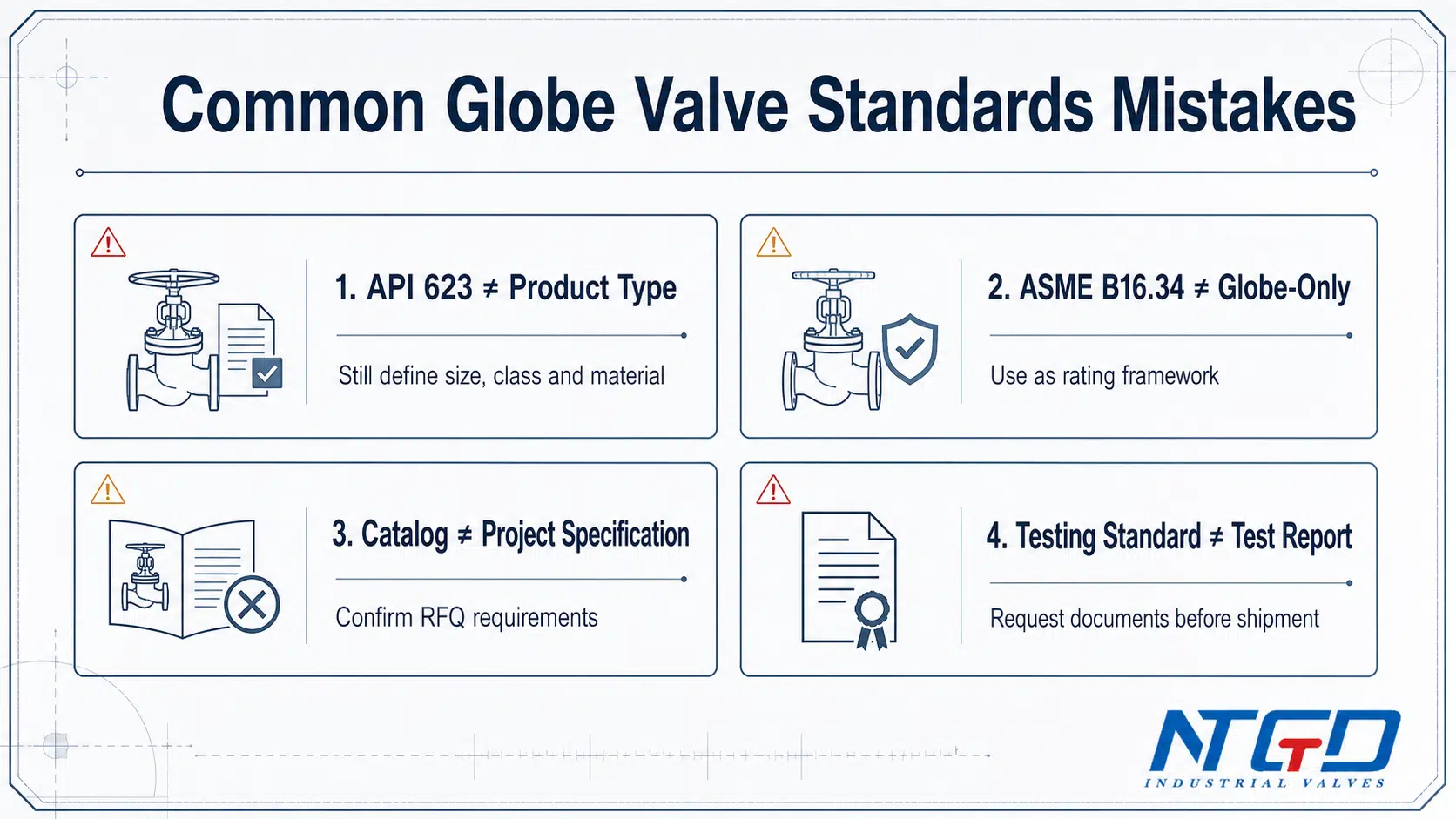
Treating API 623 as a Product Type
API 623 is a standard reference, not a complete product family by itself. A buyer still needs to define size, class, material, end connection, trim, testing, emission requirements, and required documents.
If the project requires a specific product configuration, move from the standard reference to a detailed RFQ. Do not rely on the standard number alone.
Confusing ASME B16.34 with a Globe-Valve-Only Standard
ASME B16.34 is important, but it is not only for globe valves. It supports broader valve pressure-temperature and design framework requirements.
In a globe valve RFQ, ASME B16.34 should be used together with the correct globe valve design reference and the project specification.
Letting API 600 or API 602 Take Over the Globe Valve Standards Discussion
API 600 and API 602 are often referenced in steel valve and small forged valve specification discussions. However, they should not replace the core globe valve standards discussion in this guide.
For globe valve-specific design references, API 623 and BS 1873 remain the main standards discussed here. API 600 and API 602 may appear as boundary references, but they should not pull the RFQ away from the correct globe valve design basis.
If the project requirement is actually about gate valve compliance, route the discussion to NTGD’s API standards for gate valves guide instead of forcing API 600 into a globe valve standards page.
Using a Catalog or Datasheet Instead of a Project Specification
A manufacturer datasheet is useful, but it is not the same as a project specification. A datasheet describes a product. A project specification tells the supplier what the project requires.
If the buyer only sends a catalog page or vague standard number, the supplier may quote a valve that fits the catalog but not the project.
Ignoring Test Reports and Material Documents
Pressure test reports, MTRs, and inspection documents are not minor paperwork. They are part of the final acceptance path in many industrial projects.
If the document package is not defined in the RFQ, the buyer may face additional document requests, shipment delay, or acceptance problems later.
FAQ
1. What standard is used for globe valves?
There is no single standard for all globe valves. Depending on the valve type, material, service, and project specification, a globe valve RFQ may reference API 623, BS 1873, ASME B16.34, API 598, ISO 5208, API 624, ISO 15848, and other project-specific requirements.
2. What is API 623 standard?
API 623 is an American Petroleum Institute standard associated with design and construction requirements for certain steel globe valves used in industrial and refinery-related applications. It should be checked against the actual valve construction, service conditions, purchaser information, and project specification before it is used in an RFQ.
3. What is BS 1873 standard?
BS 1873 is commonly referenced for steel globe valves and globe stop-check valves, especially where flanged or butt-welding end steel valve specifications are required. It should not be treated as a generic standard for every globe valve material, end connection, or construction type.
4. What is the difference between API 623 and BS 1873?
API 623 and BS 1873 are both used in steel globe valve specification contexts, but they come from different standard systems and may be referenced differently depending on the project specification. In practice, the buyer should compare valve construction, end connection, pressure class, material, testing, and purchaser documentation requirements rather than selecting the standard name alone.
5. Can API 623 be used for all steel globe valves?
No. API 623 should not be automatically applied to every steel globe valve. The buyer must confirm whether the valve construction, size, pressure class, material, end connection, service condition, testing requirement, and project specification match the standard reference.
6. Is ASME B16.34 a globe valve standard?
ASME B16.34 is not a globe-valve-only standard. It is a broader valve pressure-temperature and design framework that may support globe valve specifications. It is usually used together with a more specific valve design standard and the project specification.
7. Which testing standard applies to globe valves?
API 598 is commonly referenced for valve inspection and pressure testing. ISO 5208 may be used where ISO-based pressure testing or leakage classification is required. The RFQ should also state what test reports, inspection documents, and acceptance records are required.
8. What should be included in a globe valve specification?
A globe valve specification should include design standard, size, pressure class, material, trim, end connection, service condition, testing standard, required documents, and any special requirements such as low-emission packing, cryogenic service, high-temperature service, or corrosion resistance.
9. Are API 623 globe valves the same as bellow seal globe valves?
No. API 623 is a standard reference. A bellow-seal globe valve is a product configuration or sealing design. If a project requires a bellows seal, low-emission packing, API 624, ISO 15848, or other emission-related requirements, those items should be stated separately in the RFQ.
10. Does BS 1873 apply to all globe valves?
No. BS 1873 should not be applied automatically to all globe valves. Its suitability depends on material, valve construction, end connection, pressure class, service condition, and project specification.
11. Do globe valve standards decide valve material?
A standard may define or reference acceptable material groups, but the final material grade should be selected according to service fluid, temperature, pressure, corrosion allowance, and the project specification. Material choice should be confirmed with the supplier’s datasheet and required MTRs.
Conclusion
Globe valve standards should be used as engineering references, not as loose keywords in an RFQ. API 623, BS 1873, ASME B16.34, API 598, ISO 5208, API 624, and ISO 15848 may all appear in a globe valve specification, but they do not control the same requirements.
A strong RFQ should clarify:
- which design or construction standard applies;
- whether ASME B16.34 is required for pressure-temperature rating review;
- which testing standard and test report are required;
- whether low-emission qualification is required;
- which material, trim, size, pressure class, and end connection are needed;
- which MTR, pressure test report, and inspection documents must be submitted.
The safest approach is to treat the standard number as the starting point, then translate it into a complete globe valve specification.
Application / Specification Support
To avoid specification mismatch, missing documents, quotation delays, or project acceptance issues, NTGD can help review globe valve RFQ requirements before quotation or production.
For a technical review, provide the service conditions, size, pressure class, material, trim, end connection, required standard, testing requirement, and document package. NTGD can then help confirm whether API 623, BS 1873, ASME B16.34, API 598, ISO 5208, API 624, ISO 15848, or other project-specific requirements should be considered for the requested globe valve.
