
Nome do autor: Bruce Zheng
Função do autor: Cofundador e engenheiro de válvulas da NTGD Valve
Biografia do autor: Bruce Zheng é cofundador e engenheiro de válvulas da NTGD Valve, com foco na seleção de válvulas industriais, aplicação e conteúdo técnico para compradores B2B globais.
Última atualização: 7 de julho de 2026
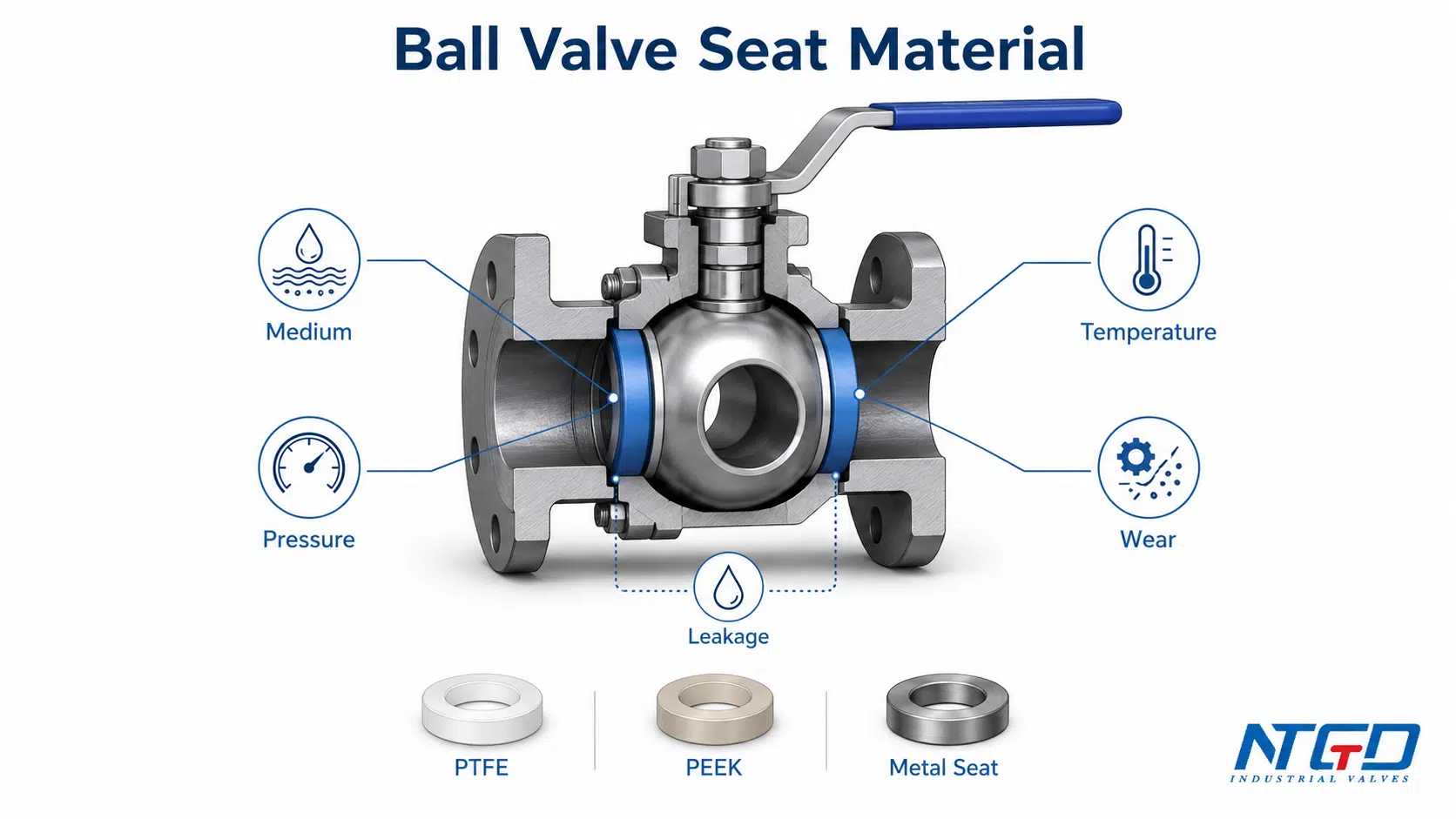
Escolhendo o caminho certo Material da sede da válvula de esfera is not only a material-name decision. The seat is the sealing interface between the ball and the valve body, so the material must match the process medium, operating temperature, pressure condition, differential pressure, cycling frequency, abrasion level, torque limit and leakage expectation.
In clean, moderate services, PTFE or reinforced PTFE seats are often reviewed first. In higher-load or more demanding services, materials such as TFM, PEEK, UHMWPE, PCTFE, Devlon, Nylon or metal seats may be considered. The important point is that these materials do not form a simple “good, better, best” ladder. A material that seals reliably in one service may become a deformation, extrusion, wear or leakage risk when the medium, temperature and pressure load change.
This guide explains common ball valve seat materials, how seat material differs from general seal material, how to read a material comparison table, and what data should be provided before a seat material is selected for an industrial ball valve.
Quick Answer: How to Choose Ball Valve Seat Material
Uma prática ball valve seat material selection guide starts with service conditions, not with a preferred material name. The seat material should be selected according to the most limiting condition in the application: chemical compatibility, temperature, pressure load, abrasion, cycling, torque or leakage expectation.
Start with medium, temperature, pressure and leakage expectation
Before selecting PTFE, RPTFE, PEEK, metal seat or another valve seat material, confirm the following basic conditions:
| Selection input | Why it matters for seat material |
|---|---|
| Process medium | Determines chemical compatibility, swelling risk, contamination risk and corrosion-related limits |
| Temperatura operacional | Affects material stiffness, deformation, creep, aging and sealing stability |
| Pressão e pressão diferencial | Influences seat load, extrusion risk, sealing stress and operating torque |
| Solids or abrasion | Determines whether a soft seat may wear too quickly or whether a harder seat should be reviewed |
| Frequência do ciclo | Affects wear, friction, heat generation and long-term sealing reliability |
| Previsão de vazamento | Determines whether soft-seat shutoff, high-performance polymer or metal seat design should be reviewed |
| Método de operação | Manual, gear, pneumatic or electric operation may be affected by seat friction and torque |
| Projeto da válvula | Floating, trunnion-mounted, split-body, top-entry and other designs may use different seat arrangements |
A good seat selection process asks: what does the seat need to resist, and how will it seal under real operating conditions? If the medium is clean and the pressure load is moderate, a PTFE-family seat may be a reasonable starting point. If the same material is placed into a high-load, particle-containing or thermally unstable service, the main question changes from “will it seal?” to “will it deform, wear or lose shutoff stability?”
No seat material is best for every ball valve service
There is no single best material for all ball valve seats. PTFE may be suitable for many clean services, but it may not be the right answer for every high-temperature, abrasive or high-pressure application. PEEK can be reviewed for more demanding polymer-seat conditions, but it is still not a universal upgrade. Metal seats may be required for severe service, but they usually bring different considerations for torque, coating, lapping, leakage expectation and cost.
A more reliable selection approach is:
- Define the real service condition.
- Identify the most likely failure mode.
- Shortlist possible seat materials.
- Check the valve design and pressure-temperature data.
- Confirm severe or high-risk services through project-specific review.
When to ask for manufacturer confirmation
Manufacturer confirmation becomes especially important when the service involves high temperature, high differential pressure, abrasive particles, frequent cycling, steam, oxygen, vacuum, cryogenic conditions, strong chemicals, slurry, or a strict leakage requirement.
A seat material should not be selected only from a generic compatibility chart. The same material name can behave differently depending on filler content, seat geometry, seat support, ball coating, pressure class, sealing design and operating cycle.
What “Seat Material” Means in a Ball Valve
In a ball valve, the seat is the sealing part that contacts the ball and helps shut off flow when the valve closes. The term may refer to the seat ring, seat insert, or the sealing material installed in the seat area, depending on the valve design.
Ball valve seat, seat ring and seat insert
A ball valve usually has one or two seats that support the ball and form the sealing interface. In many soft-seated ball valves, the seat is made from a polymer material such as PTFE, reinforced PTFE or another engineered polymer. In metal seated ball valves, the sealing surfaces are metallic and may involve hard-facing, coating, grinding or lapping processes.
| Prazo | General meaning in a ball valve | Por que é importante |
|---|---|---|
| Sede da válvula de esfera | The sealing component that contacts the ball | Main topic of this guide |
| Anel do assento | The ring-shaped component that holds or forms the seat | Affects sealing stability and support |
| Seat insert | A replaceable or inserted seat element in some designs | Affects maintenance, material selection and design limits |
| Ball-seat interface | The contact area between ball and seat | Determines shutoff, torque and wear behavior |
| Seat support | The structure behind the seat | Affects extrusion resistance and sealing load |
Este artigo se concentra em seat material for ball valve selection, not on every part of the valve assembly.
How the seat creates sealing contact with the ball
When the ball valve is closed, the ball rotates so the solid side of the ball blocks the flow passage. The seat presses against the ball surface and creates the sealing line. The seat material must be soft or conformable enough to seal, but stable enough to resist pressure load, temperature, wear and media attack.
That balance is the reason seat selection is not only a material list. A material that seals easily may deform under load. A harder material may resist wear better but may require more torque or a different ball surface finish. A metal seat may tolerate severe conditions, but it usually needs a different engineering review than a soft polymer seat.
Why valve design affects seat material selection
The same ball valve seat material may not have the same limit in every valve design. Floating ball valves, trunnion-mounted ball valves, high-pressure valves, full-bore valves, reduced-bore valves and metal seated valves may use different seat support, spring loading, pressure relief or sealing geometry.
In a floating ball valve, the ball movement and differential pressure can increase seat load, so deformation resistance and seat support become more important. In a trunnion-mounted design, the ball is supported differently, and the seat arrangement may change the way pressure load, sealing force and torque are distributed. This does not make one design automatically better for every material, but it means seat material must be reviewed together with the actual valve structure.
For a deeper design-level comparison, see the NTGD guide on trunnion vs floating ball valve design, then return to seat material selection with the actual valve structure in mind.
For this reason, a seat material decision should not be separated from the valve design that supports it.
Ball Valve Seat Material vs Seal Material: Scope Boundary
A frase material de vedação da válvula de esfera is often used broadly, but not every sealing material in a ball valve is a seat material. This distinction is important because a page about ball valve seat materials should not become a general guide to every O-ring, gasket, packing or repair seal.
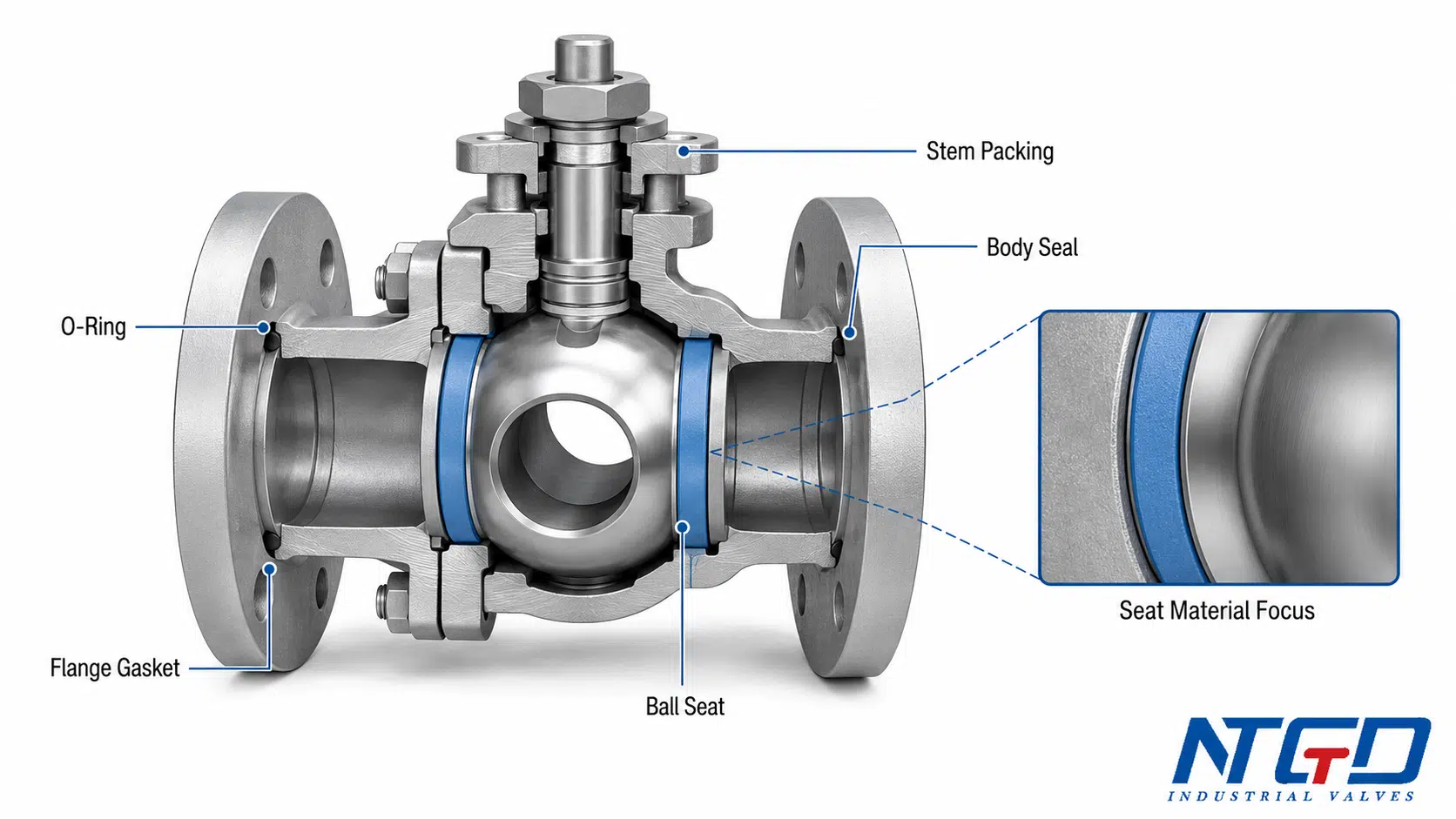
Seat material is not the same as every sealing material
The seat material forms the main sealing contact with the ball. Other sealing materials may seal the stem, body joint, flange connection or auxiliary sealing points. These parts are related to valve sealing, but they are not all part of the ball-seat interface.
| Location / part | Função principal | Typical material group | Main topic in this article? | Observação |
|---|---|---|---|---|
| Ball seat / seat ring | Seals between ball and valve body | PTFE, RPTFE, TFM, PEEK, UHMWPE, PCTFE, Nylon, Devlon, metal seat | Sim | Foco principal |
| Engaxetamento da haste | Seals around the valve stem | PTFE, graphite, packing sets or other packing materials | Light boundary only | Not a stem packing guide |
| Body seal / body gasket | Seals body joint or cover connection | Graphite, PTFE, elastomeric or metallic gasket materials depending on design | Light boundary only | Not the main seat material |
| O-ring | Secondary sealing in some designs | NBR, EPDM, FKM or other elastomers depending on service | Light boundary only | Não é o tópico principal |
| Flange gasket | Seals pipe flange connection | Project-specified gasket material | Não | Belongs to piping / installation scope |
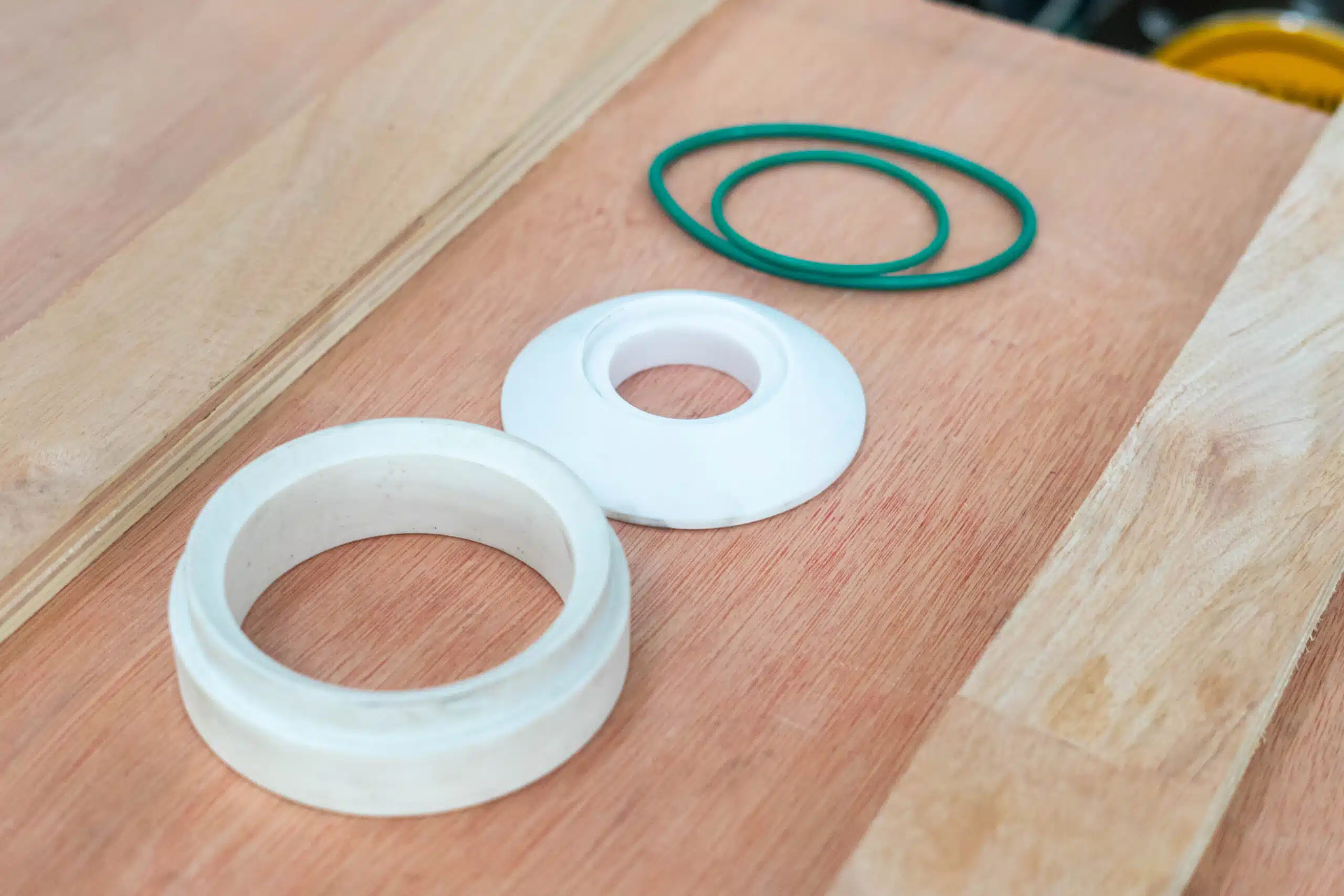
Stem packing, body seal, gasket and O-ring boundaries
Stem packing, body seals and O-rings are important for overall valve sealing, but they answer different engineering questions. A seat material is selected mainly for ball shutoff, pressure load, friction and media contact at the ball-seat interface. Stem packing is selected for stem sealing, temperature, emission requirement and operation. Body gaskets are selected for body joint sealing and pressure boundary integrity.
A common specification error is to use one broad phrase such as “seal material” without stating whether the requirement applies to the ball seat, stem packing, body seal or O-ring. That can lead to an RFQ that looks complete but still leaves the most important sealing interface undefined.
Where NBR, EPDM, FKM / Viton and graphite fit
NBR, EPDM and FKM are usually discussed as elastomeric sealing materials. In ball valve selection, they may appear in O-rings, secondary seals or auxiliary sealing positions depending on the valve design. Graphite may appear in packing or gaskets where higher temperature resistance is required.
These materials should be checked as part of the complete valve sealing package, but they should not take over a ball valve seat and seal material selection guide unless the application specifically requires a full sealing package review.
Common Ball Valve Seat Material Families
Ball valve seat materials can be grouped into soft polymer seats, reinforced or modified polymer seats, high-performance polymer seats, special polymer seats and metal seats. In most industrial ball valves, soft seat ball valve material usually refers to polymer seat families such as PTFE, RPTFE and modified PTFE before the review moves toward high-performance polymers or metal seated designs.
The exact material grade, filler system and design limit must be confirmed by the valve manufacturer, but the following material families are common starting points.
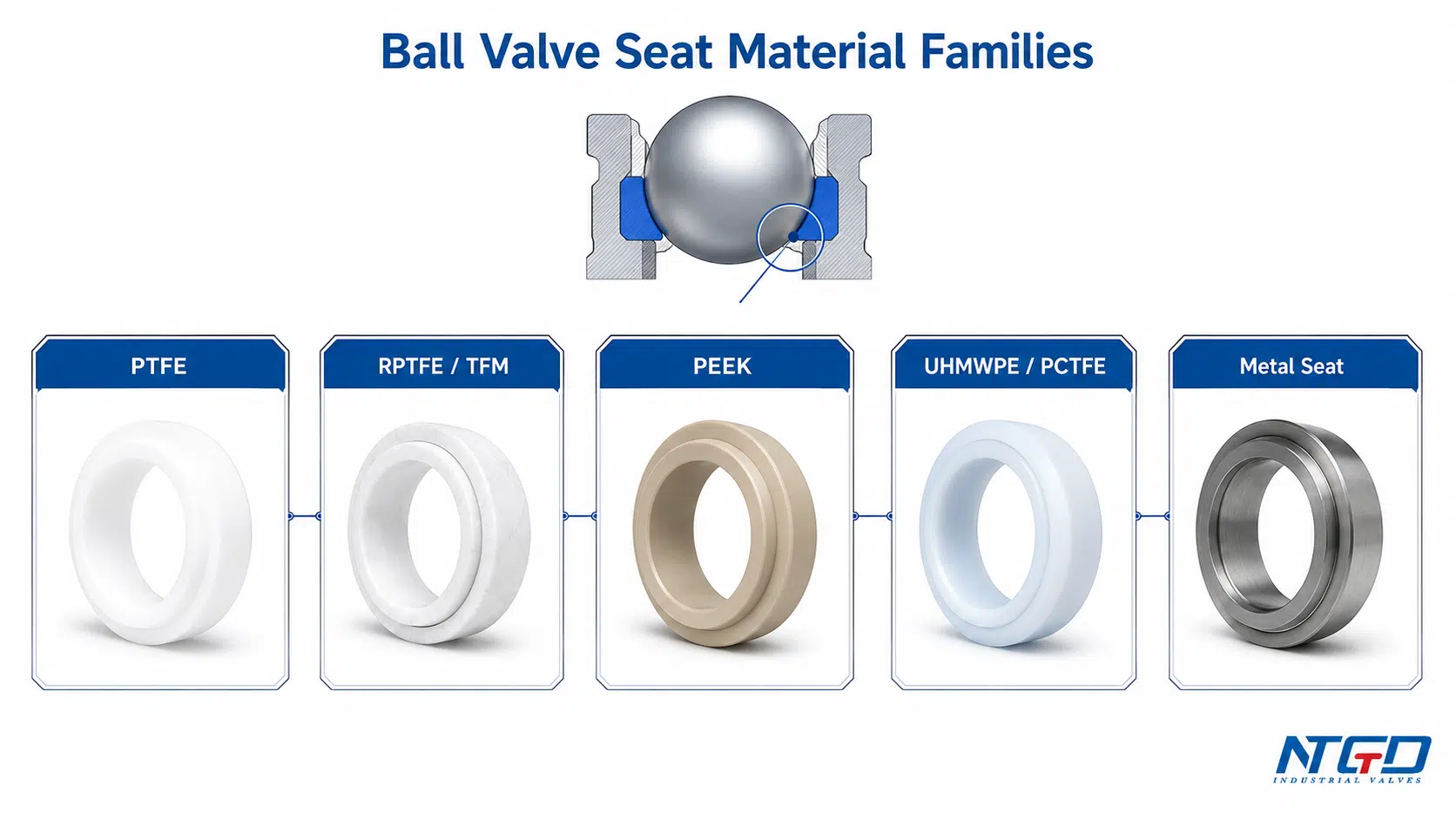
PTFE seat material
PTFE is one of the most common seat materials for industrial ball valves. It is widely used because it offers low friction and broad chemical resistance in many clean services. It is often considered where smooth operation and reliable soft-seat shutoff are required.
Standard PTFE becomes less attractive when the main risk is high differential pressure, abrasive particles, elevated temperature stress or frequent cycling. In those cases, the issue is not only chemical compatibility; the seat may also face cold flow, deformation, extrusion or wear that can reduce shutoff reliability.
RPTFE / reinforced PTFE
RPTFE means reinforced PTFE. Reinforcement is used to improve mechanical strength, deformation resistance or wear behavior compared with unfilled PTFE, depending on the filler and design. RPTFE is often reviewed when a standard PTFE seat may be too soft for the service condition.
Reinforcement can improve mechanical stability, but the filler system must still be compatible with the medium. A reinforced seat that performs well mechanically can still be unsuitable if the filler or compound is not compatible with a strong chemical service.
TFM / modified PTFE
TFM or modified PTFE is used in some valve seat designs where improved performance over conventional PTFE is required. It may be considered for better deformation resistance, sealing stability or surface behavior, depending on the application and material grade.
Modified PTFE should not be selected only because it appears to be an “upgraded PTFE.” The grade, valve design, pressure load and medium still determine whether it is a suitable seat material for the service.
For PTFE-family seats, treat chemical and thermal resistance as material-level guidance only; the official Teflon page on chemical and thermal resistance of fluoropolymers supports PTFE’s broad material behavior but does not replace valve-specific P-T confirmation.
PEEK valve seat material
PEEK is a high-performance engineering polymer that may be reviewed for more demanding ball valve services. It is often considered when higher mechanical strength, higher load capacity or better resistance to deformation is required compared with common soft-seat materials.
A PEEK ball valve seat is not automatically correct for every severe service. If the medium, temperature, valve design or leakage expectation does not match the material and seat geometry, PEEK can still fail or create unnecessary cost and torque concerns. In many projects, PTFE vs PEEK selection should be treated as a focused engineering comparison rather than a quick substitution.
For PEEK seats, use VICTREX PEEK polymer data as material-level evidence, then confirm whether the selected valve design, seat geometry and service conditions support that material.
Nylon, Devlon, Delrin and other engineering polymers
Nylon, Devlon, Delrin and related engineering polymers may be used in certain ball valve seat applications where strength, toughness, wear behavior or operating condition requires a different polymer family. These materials are not interchangeable, and each has its own compatibility and temperature limitations.
They should be reviewed as application-specific options, not as general replacements for PTFE or PEEK.
UHMWPE and PCTFE
UHMWPE and PCTFE may appear in specialized ball valve seat applications. UHMWPE may be reviewed where abrasion behavior or low-friction performance is important, while PCTFE may be considered in certain low-temperature or special-service contexts.
The final decision depends heavily on media compatibility, valve design and service temperature. These materials should normally be confirmed by manufacturer datasheets or project-specific engineering review.
Metal seat material and hard-faced trim
Metal seat material is used when polymer seats cannot handle the service condition or when the application requires a severe-service design. Metal seated ball valves may involve hard-facing, coating, lapping or special ball-seat surface treatment.
A metal seat is not simply a harder version of PTFE. It changes the selection path toward product-specific review, including ball and seat surface treatment, torque, leakage expectation, pressure-temperature rating, testing and inspection. If the service has already moved into metal seated territory, a general material table is only the starting point.
Ball Valve Seat Material Comparison Table
The following table gives a practical comparison of common ball valve seat material families. It is intended as a selection direction, not a universal rating chart. Exact limits must be verified against the valve design, material grade, pressure-temperature data and project specification.
How to read the comparison table
Use the table to shortlist materials, not to finalize a specification. First identify the limiting service condition, then check which material category and service direction may fit that condition. If the service involves particles, for example, do not stop at the PTFE row because PTFE is common; review the limitation column and move the decision toward abrasion resistance, seat support and possible harder material options.
| Seat material family | Seat category | Typical service direction | Principais pontos fortes | Main limitations / cautions | Best used as |
|---|---|---|---|---|---|
| PTFE | Soft polymer seat | Clean general service requiring low friction and soft-seat shutoff | Low friction, common availability, good soft-seat sealing behavior | May deform, creep or wear depending on load, temperature and cycle condition | Baseline soft-seat option |
| RPTFE | Reinforced soft polymer seat | Clean to moderately demanding service where standard PTFE may need more stability | Improved strength and deformation resistance depending on filler | Filler may affect compatibility; exact performance depends on design | Reinforced soft-seat option |
| TFM / modified PTFE | Modified polymer seat | Services needing improved PTFE-type sealing or deformation behavior | Improved sealing stability or deformation behavior in selected designs | Grade-specific; should be checked against material data | Modified PTFE option |
| PEEK | High-performance polymer seat | Higher-load or more demanding polymer-seat applications | Higher strength and stiffness than common soft seats | Not universal; compatibility and operating limits still need review | High-performance polymer option |
| Nylon / Devlon / Delrin | Engineering polymer seat | Specific services needing toughness, support or mechanical strength | Good mechanical properties in selected applications | Compatibility and temperature limits must be checked carefully | Application-specific polymer option |
| UHMWPE | Special polymer seat | Selected services where abrasion behavior or low friction may be useful | Toughness and low-friction characteristics in suitable services | Not suitable for all temperatures or chemicals | Special polymer option |
| PCTFE | Special polymer seat | Selected low-temperature or special-service applications | Dimensional stability in specific service conditions | Service-specific; not a general-purpose seat material | Special-service polymer option |
| Metal seat / hard-faced seat | Assento de metal | Severe service where polymer seats are unsuitable | Better resistance to high severity, abrasion or heat depending on design | Higher torque, different leakage expectation, coating and lapping review required | Severe-service product decision |
Material direction, not universal rating guarantee
A common mistake is to read a material comparison table as a final rating chart. In practice, a seat material’s performance depends on several interacting factors:
- seat geometry;
- seat support;
- ball finish or coating;
- classe de pressão;
- temperatura operacional;
- pressão diferencial;
- limpeza da mídia;
- frequência de ciclo;
- método de atuação;
- testing and leakage requirement.
The same material family may be used differently by different manufacturers. A PTFE seat in one valve design may not have the same service boundary as a PTFE seat in another design.
Why final ratings depend on valve design and P-T data
Pressure-temperature capability is not defined by seat material alone. The body material, pressure class, seat design, seal package, ball support, end connection and testing requirements all influence the final valve rating. For this reason, the material table should be used for early selection only.
Final confirmation should be based on project data, applicable standards, manufacturer datasheets and the exact valve model. Without formal P-T data or manufacturer material documentation, the table should remain a direction-level guide rather than a technical rating table.
When pressure-temperature limits are discussed, keep them tied to the actual valve standard and design; ASME lists B16.34 as covering valve pressure-temperature ratings, materials, testing and marking for applicable valve constructions: ASME B16.34 valve scope.
Service Conditions That Decide Seat Material Selection
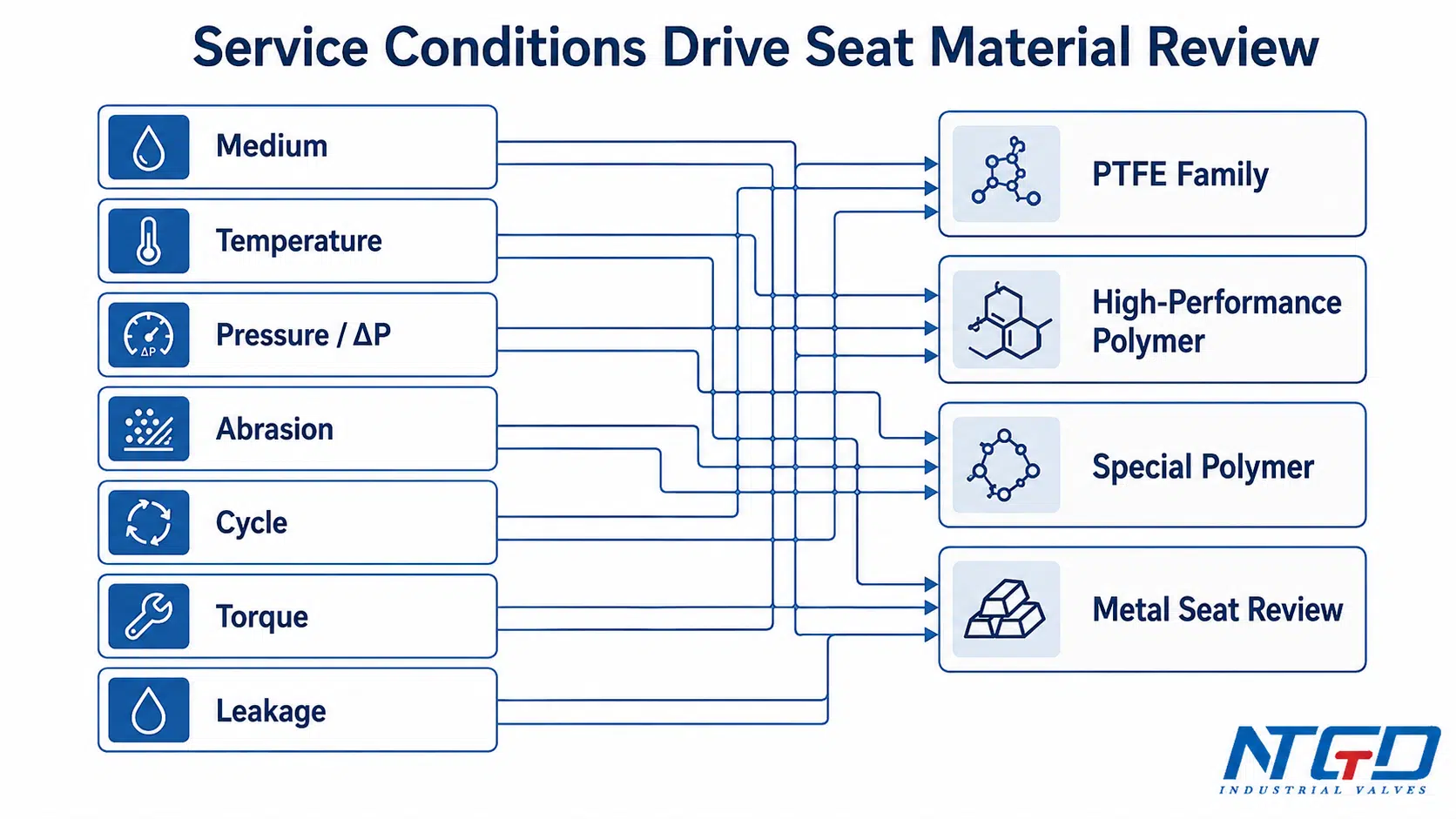
A reliable seat material decision starts by identifying the condition most likely to cause failure. In some services the key issue is chemical attack. In others it is heat, pressure load, abrasion, cycling, torque or leakage requirement.
Service condition vs material direction matrix
The following matrix is a quick fit-check tool. It does not replace manufacturer data, but it helps identify how a service condition changes the material shortlist.
| Condição de serviço | Principal preocupação em relação à seleção | Possible material direction | Typical failure risk if ignored | Data to confirm |
|---|---|---|---|---|
| Clean neutral fluid | Basic sealing, low friction and stable shutoff | PTFE or reinforced PTFE may be reviewed first | Unnecessary over-specification or poor material fit | Medium, temperature, pressure |
| Serviço químico | Chemical resistance, swelling and aging | PTFE-type materials or selected polymers may be reviewed | Swelling, softening, leakage or short service life | Full medium name, concentration, temperature |
| Alta temperatura ou ciclos térmicos | Deformation, creep, aging and sealing stability | Manufacturer-confirmed polymer or metal seat review | Seat deformation, leakage or early failure | Operating and design temperature, cycle pattern |
| High pressure or high differential pressure | Seat load, extrusion and torque | Reinforced polymer, high-performance polymer or special seat support | Extrusion, high torque or poor shutoff | Operating pressure, maximum ΔP, shutoff condition |
| Abrasive or solids-containing medium | Wear at the ball-seat interface | Harder polymer, special design or metal seated review | Scratching, seat wear, leakage and torque increase | Solids type, size, concentration |
| Andar de bicicleta com frequência | Friction, wear and heat generation | Wear-resistant polymer or design-specific review | Seat wear, torque change or unstable sealing | Cycle frequency, automation mode |
| Low torque requirement | Friction and actuation margin | Low-friction soft seat or confirmed torque review | Manual operation difficulty or actuator undersizing | Actuation method, torque margin |
| Strict leakage expectation | Shutoff performance and test requirement | Soft seat, high-performance polymer or tested design review | Failure to meet shutoff requirement | Required test method and leakage expectation |
| Serviço severo | Combined heat, abrasion, pressure, corrosion or cycling | Metal seated or project-specific design review | Rapid wear, leakage, torque issue or short service life | Full service data and inspection requirement |
Media and chemical compatibility
The process medium is usually the first screening factor. A seat material must resist the chemical behavior of the fluid, including concentration, contamination, additives and possible cleaning agents. Chemical compatibility should be checked under actual temperature and pressure conditions, not only at room temperature.
For chemical services where the medium is the limiting condition, cross-check body material, seat material and valve type against the NTGD guide to ball valves for chemical applications.
If chemical compatibility is uncertain, it becomes the first limiting condition. A material with good mechanical strength is still a poor choice if the medium causes swelling, softening or chemical degradation.
Temperature range and thermal cycling
Temperature affects seat material stiffness, expansion, deformation and aging. A material that works in ambient service may not be suitable for elevated temperature or repeated thermal cycling. High temperature may increase creep, deformation or leakage risk. Low temperature may affect flexibility and sealing response.
The most common constraint is not a generic maximum temperature label; it is the combination of temperature, pressure load, cycle condition and seat support in the actual valve design.
Pressure, differential pressure and seat load
Pressure and differential pressure influence the load on the seat. High differential pressure can increase sealing stress, operating torque and extrusion risk for some polymer seats. In severe cases, a stronger polymer, reinforced seat, special seat support or metal seated design may be required.
For soft seats, high differential pressure is often one of the first conditions that forces review toward reinforced or high-performance polymer options. Pressure class alone is not enough; the selector should understand normal operating pressure, maximum differential pressure, pressure direction and whether the valve will be operated under pressure.
Abrasion, solids and dirty service
Abrasive media can damage soft seats quickly. Particles can scratch the ball-seat interface, increase leakage, raise operating torque and shorten service life. In dirty service, the seat material must be reviewed together with ball coating, seat design and flushing or maintenance strategy.
When abrasion is the main constraint, the shortlist often shifts away from standard soft seats toward harder polymers, special seat designs or metal seated constructions. The final direction depends on particle type, particle size, concentration and operating pattern.
Cycle frequency, operation speed and wear
A valve that operates once per month has a different seat wear profile from a valve that cycles frequently. Frequent cycling increases friction, wear and thermal stress at the seat interface. Fast operation can also affect impact and dynamic loading.
Cycle data should be included in the seat material review, especially for automated valves. A seat material that is acceptable for isolation service may not be suitable for repeated operation without a wear and torque review.
Torque, actuation and low-friction requirements
Seat material affects valve torque. Softer or lower-friction materials may reduce operating torque, while high-performance polymers or metal seats may change torque behavior. Torque affects manual operation, gear selection, pneumatic actuator sizing and electric actuator sizing.
For automated ball valves, seat material should be reviewed together with actuator sizing. A seat material change may require a torque review, especially when moving from a soft seat to PEEK or metal seat.
Leakage requirement and shutoff expectation
Soft seats are often selected where tight shutoff is needed, but the actual leakage performance depends on valve design, seat material, ball finish, pressure load and testing method. Metal seats may be used in severe service, but leakage expectations may differ from soft-seated designs.
The project should define the required shutoff performance before finalizing seat material. Do not assume all seat materials will meet the same leakage expectation.
Soft Seat, Hard Polymer Seat and Metal Seat: How to Draw the Boundary
Ball valve seat materials can be viewed as a severity ladder. Soft seats are often used for clean services and tight shutoff. Harder polymers are reviewed when load, temperature or wear conditions increase. Metal seats are usually reviewed when the service exceeds the practical limits of polymer seats or requires severe-service construction.
When soft seat materials are usually considered
Soft seat materials such as PTFE, RPTFE and modified PTFE are usually considered when the service is clean enough, the temperature and pressure condition are within the valve design limits, and tight shutoff with reasonable operating torque is important.
Soft seats are common, but they still require selection discipline. A soft seat can fail if the service contains abrasive solids, excessive heat, high differential pressure or aggressive chemicals outside the material’s compatibility range.
When high-performance polymers such as PEEK may be reviewed
High-performance polymer seats such as PEEK may be reviewed when the application needs higher mechanical strength, higher seat support, better deformation resistance or improved performance under more demanding conditions than common soft seats can handle.
However, PEEK is not simply “better than PTFE” in every case. The right choice depends on media compatibility, operating temperature, pressure load, sealing expectation and valve design. A clean moderate service may not need PEEK, while a higher-load service may justify reviewing it.
When metal seated ball valves become a product-page decision
A metal seat should be reviewed when the service condition is too severe for polymer seats or when the project requires a metal seated ball valve design. Typical reasons may include high temperature, abrasive particles, severe service, erosive flow or special shutoff requirements.
At that point, the next step is not a larger general material table. The decision moves into product-specific review: ball and seat material, hard-facing or coating, lapping, valve structure, actuator torque, pressure-temperature rating and testing requirement.
When the review has already moved to a metal seated design, continue with the metal seated ball valve product page for specification-level checks instead of using the general material table alone.
Why metal seats may affect torque, coating and leakage expectations
Metal seats can improve suitability for severe service, but they may also increase operating torque and change leakage expectations compared with soft seats. The sealing interface may require special surface treatment, coating or lapping. The actuator may need to be sized based on confirmed torque data.
For this reason, a metal seated ball valve should be specified through a complete service review, not only by selecting “metal seat” from a material list.
| Seat group | General fit | Main caution | Routing |
|---|---|---|---|
| Assento macio | Clean or moderate service requiring low friction and tight shutoff | May deform, wear or lose sealing in unsuitable conditions | Current article can explain selection |
| Hard polymer seat | Higher-load polymer-seat service | Must check compatibility, temperature and pressure load | Current article can shortlist |
| Assento de metal | Severe-service or high-severity conditions | Torque, coating, leakage and product design must be reviewed | Product page / project review bridge |
For a deeper seat-type boundary, the NTGD comparison of válvulas de esfera com sede metálica vs. válvulas de esfera com sede macia explains how shutoff duty, media cleanliness, temperature, wear and torque change the seat direction.
PTFE vs PEEK vs Metal Seat: What This Article Should and Should Not Decide
This article explains PTFE, PEEK and metal seat as part of a broader ball valve seat material selection process. It should not replace a focused PTFE vs PEEK comparison or a metal seated ball valve product specification.
PTFE and PEEK as part of a wider material family
PTFE and PEEK are both important ball valve seat materials, but they represent different material families and design purposes. PTFE is often reviewed for low-friction soft-seat sealing in suitable services. PEEK is reviewed when higher mechanical strength or more demanding polymer-seat performance may be required.
The decision should not be made only by asking which material is “better.” The better question is: which material matches the medium, temperature, pressure load, cycle requirement and leakage expectation in this valve design?
Why deep PTFE vs PEEK comparison should be routed separately
A detailed PTFE vs PEEK comparison may include chemical resistance, mechanical strength, temperature behavior, deformation risk, friction, cost and specific service examples. That level of comparison is useful, but it is a separate topic from this broader seat material guide.
In this article, PTFE and PEEK are included in the material family and selection table. A focused PTFE vs PEEK guide should handle the deeper comparison, while this guide should remain the upper-level screening page.
For a deeper material-specific comparison, use the dedicated NTGD guide to PTFE vs PEEK for ball valve seats instead of turning this upper-level selection guide into a two-material comparison.
Why metal seated ball valve specifications belong to product pages
Metal seat selection often depends on valve structure, body and trim material, coating, hard-facing, ball-seat lapping, actuator torque, inspection and testing. These items belong to product-level specification and severe-service engineering review.
This article can explain when metal seats should be reviewed, but once the service data points to a metal seated design, the next decision should move toward product-specific review rather than a general seat material discussion.
For application-heavy severe service, the NTGD article on metal-seated ball valves for extreme conditions can support the next review step after this material-screening page.
Common Risks of Choosing the Wrong Ball Valve Seat Material
A wrong seat material choice can create leakage, torque problems, premature wear or compatibility failure. These problems are often not caused by the material name alone, but by a mismatch between the material and service condition.
Seat leakage or poor shutoff
Seat leakage can occur when the material cannot maintain stable contact with the ball, when the ball surface is damaged, or when the medium attacks or wears the seat. Leakage risk increases when the material is selected without confirming media compatibility, pressure load and temperature.
High torque or actuator sizing problems
Seat material affects friction and sealing load. If the selected material increases torque beyond the expected range, a manual valve may become difficult to operate, or an actuator may be undersized. This is especially important when switching from soft seats to harder polymers or metal seats.
Cold flow, deformation or extrusion risk
Some polymer seats may deform under pressure, temperature or long-term load. Seat support and valve design can reduce this risk, but the material must still be suitable for the operating condition. Deformation can lead to leakage, increased torque or unstable operation.
Wear, abrasion or galling
Dirty or abrasive media can damage the seat surface and ball-seat interface. Soft seats may wear quickly in particle-containing service. Metal seats may resist severe conditions better in some designs, but they also require careful surface treatment and torque review.
Chemical swelling, aging or compatibility failure
Chemical incompatibility can cause swelling, softening, cracking or loss of sealing performance. Compatibility should be checked using the actual medium, concentration, temperature and cleaning procedure. A material that works in one chemical service may fail in another.
Short service life under cycling or thermal fluctuation
Frequent cycling and thermal fluctuation can accelerate wear, fatigue, deformation and sealing instability. For automated valves, seat material should be reviewed together with cycle frequency, actuator type and expected operating pattern.
| If this condition exists | Possível problema | What to check before final selection |
|---|---|---|
| If the medium is not fully defined | Swelling, chemical attack, leakage | Full medium name, concentration, contaminants |
| If operating temperature or thermal cycling is ignored | Deformation, aging, loss of sealing | Operating temperature, design temperature, thermal cycle pattern |
| If differential pressure is high | Extrusion, high torque, leakage | Maximum ΔP and shutoff condition |
| If the medium contains abrasive solids | Wear, scratches, poor shutoff | Solids type, size and concentration |
| If cycle frequency is frequent | Seat wear and torque change | Operation frequency and actuation method |
| If leakage expectation is strict | Wrong seat family or testing expectation | Required shutoff level and inspection method |
| If actuator torque margin is limited | Operation failure or actuator re-selection | Seat friction, valve torque and actuation mode |
| If valve design is not considered | Wrong material assumption | Floating / trunnion design, seat support, P-T data |
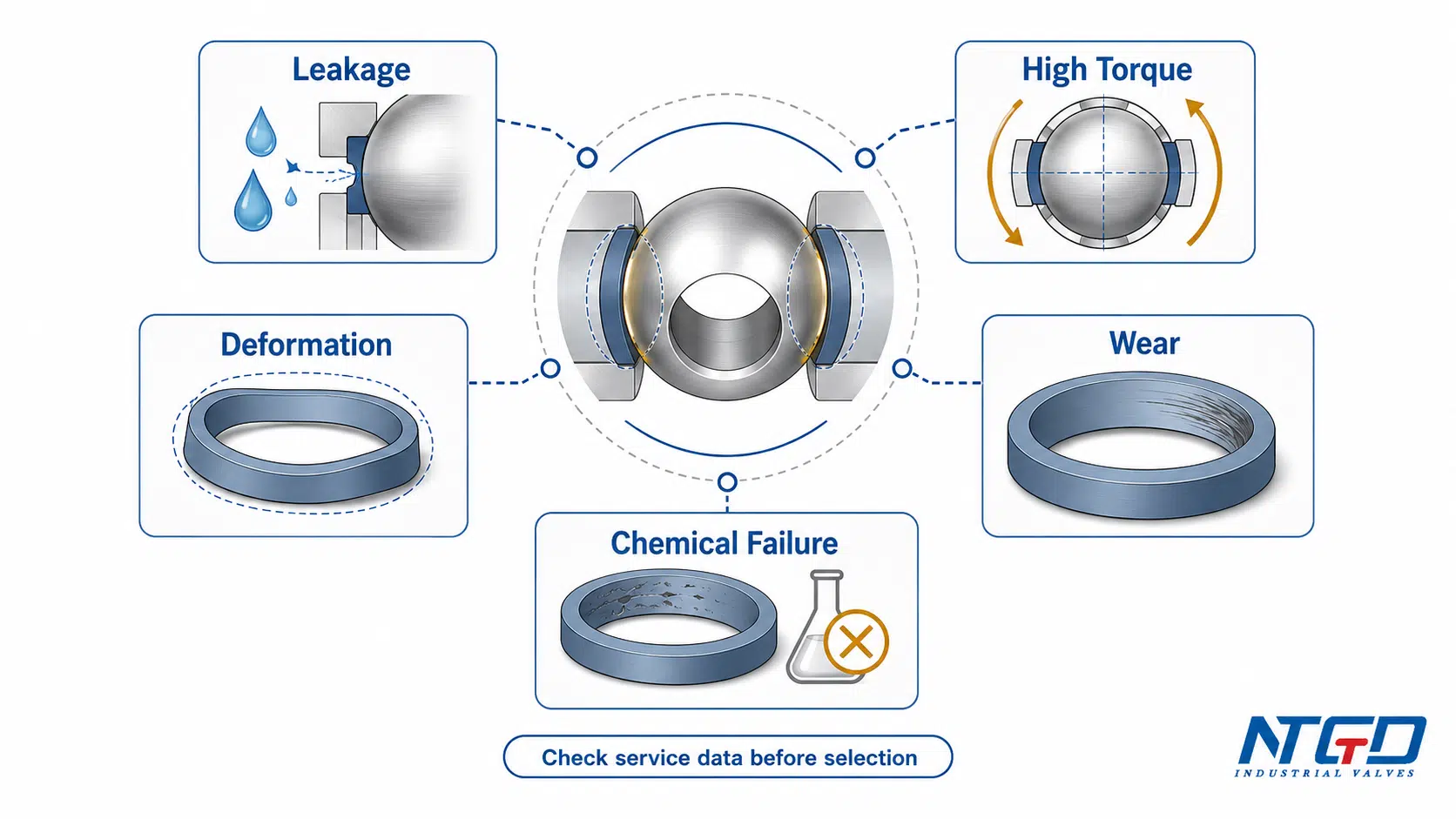
These risks do not only affect sealing performance. They can also force actuator re-selection, increase maintenance frequency, delay project approval or shorten service life. A seat material should therefore be reviewed as part of the full valve application, not as an isolated material choice.
RFQ Data Checklist for Ball Valve Seat Material Review
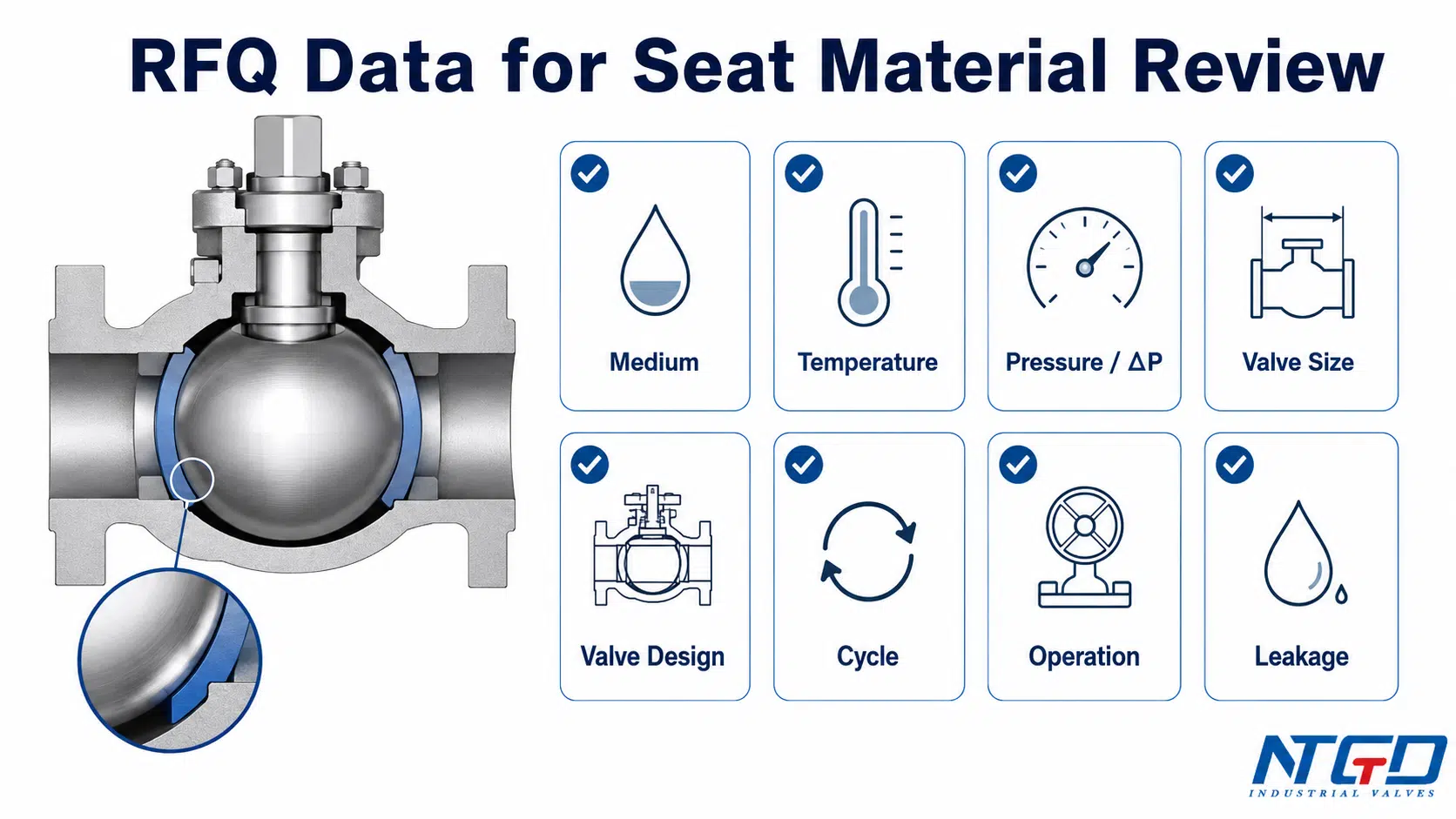
A seat material recommendation is only as reliable as the service data behind it. For industrial ball valve selection, the RFQ should include enough information to check material compatibility, pressure-temperature limits, seat support and operating torque.
Process medium and concentration
Provide the process medium, concentration, impurities, solids, cleaning fluid and any special chemical condition. If the service includes mixed media or batch operation, list each operating condition.
Temperatura operacional e de projeto
Provide normal operating temperature, maximum temperature, minimum temperature and any thermal cycling condition. If steam, heat transfer fluid, cryogenic service or high-temperature cleaning is involved, state it clearly.
Pressure, differential pressure and pressure class
Provide operating pressure, design pressure, shutoff differential pressure, pressure class and pressure direction if relevant. A seat material may behave differently under high differential pressure than under normal flow pressure.
Valve size, valve type and design
Provide valve size, bore type, body type, pressure class, end connection and whether the valve is floating, trunnion-mounted, full bore, reduced bore or metal seated. Seat material selection cannot be separated from valve design.
Operation type, cycle frequency and actuation
State whether the valve is manually operated, gear-operated, pneumatic, electric or hydraulic actuated. Include expected cycle frequency and whether the valve operates under pressure. This helps review torque and wear.
Leakage requirement, inspection and certification
Provide the required leakage expectation, inspection requirement, test method or project specification if available. Do not assume that every seat material or valve design will meet the same shutoff expectation.
Project stage, quantity and documentation requirement
Provide whether the inquiry is for budget review, technical selection, replacement, project bidding or final procurement. Include required certificates, material traceability, test reports or special documentation if the project requires them.
| RFQ data item | Why it matters for seat material review |
|---|---|
| Medium and concentration | Confirms chemical compatibility |
| Faixa de temperatura | Checks deformation, aging and material stability |
| Pressure and ΔP | Checks seat load, extrusion risk and torque |
| Valve size and class | Affects design, seat support and operating torque |
| Valve type and structure | Determines seat arrangement and product design |
| Sólidos / abrasão | Influences soft vs hard polymer vs metal seat review |
| Método de operação | Affects torque and actuator sizing |
| Frequência do ciclo | Influences wear and service life expectation |
| Requisito de vazamento | Determines shutoff and testing expectations |
| Inspection / certification | Confirms project compliance needs |
| Quantity and project stage | Helps align technical review with project stage |
The value of this checklist is not only to collect information. It helps connect the earlier risk review to a practical fit-check: whether the selected material can handle the service, whether the valve design supports that material, and whether the project requires a standard polymer-seat review or a more detailed metal seated / severe-service review.
FAQ About Ball Valve Seat Materials
What are ball valve seats made of?
Ball valve seats may be made from PTFE, reinforced PTFE, modified PTFE, PEEK, UHMWPE, PCTFE, Nylon, Devlon, Delrin or metal seat materials, depending on the valve design and service condition. The seat material must be selected according to medium, temperature, pressure, wear condition and leakage expectation.
How do I choose ball valve seat material?
Start by identifying the most limiting condition in the service: chemical compatibility, temperature, pressure load, abrasion, cycling, torque or leakage expectation. Then use the material comparison table to shortlist a seat family, check the valve design and pressure-temperature data, and request project-specific confirmation if the service is severe or involves steam, abrasive particles, high differential pressure, oxygen, vacuum or strict leakage requirements.
Qual é o melhor material para as sedes das válvulas de esfera?
There is no universal best material for ball valve seats. PTFE may be suitable for many clean services. Reinforced PTFE or modified PTFE may be used where more stability is needed. PEEK may be reviewed for more demanding polymer-seat conditions. Metal seats may be required for severe service. A common mistake is to treat PEEK or metal seat as an automatic upgrade, even when the service does not require it or the valve design does not support it.
What is the difference between seat material and seal material?
Seat material refers to the material at the ball-seat sealing interface. Seal material may also include stem packing, body seals, O-rings and gaskets. These sealing parts are related, but they do not all perform the same function. A ball valve seat material guide should focus on the seat that seals against the ball.
PTFE vs PEEK ball valve seat: which should I choose?
PTFE is often reviewed for clean services needing low friction and soft-seat sealing. PEEK may be reviewed where higher mechanical strength or more demanding polymer-seat performance is required. The choice depends on load, temperature, chemical compatibility, cycle condition, valve design and leakage expectation. A detailed PTFE vs PEEK comparison should be handled as a focused material comparison, not as a one-line substitution.
When should a metal seated ball valve be used?
A metal seated ball valve should be reviewed when the service is too severe for polymer seats, such as abrasive, high-temperature or high-severity conditions. Once the service points to metal seats, the review should include ball and seat material, hard-facing or coating, torque, leakage expectation, testing and product design.
Can PTFE be used for steam or high-temperature service?
PTFE suitability for steam or high-temperature service depends on the valve design, pressure, actual temperature, seat support and manufacturer data. Do not rely on a generic material statement. The service should be checked against the specific valve’s pressure-temperature limits and project specification.
What is the most common ball valve seat material?
PTFE is one of the most common ball valve seat materials for clean, general industrial services because it offers low friction and broad chemical resistance in many applications. However, “common” does not mean “correct for every service.” Higher load, abrasive media, elevated temperature, frequent cycling or strict leakage requirements may require reinforced PTFE, modified PTFE, PEEK, other engineering polymers or a metal seated design.
Conclusão
Ball valve seat material selection is a service-condition decision. PTFE, RPTFE, TFM, PEEK, UHMWPE, PCTFE, Nylon, Devlon and metal seats all have possible roles, but none of them should be selected by material name alone.
A reliable selection process starts by identifying the most restrictive condition in the service, not by choosing the strongest or most expensive material. For soft seats, compatibility, deformation, friction and shutoff behavior usually need close review. For metal seats, the review shifts toward torque, leakage expectation, surface treatment, product design and testing.
For general clean services, soft seats may be suitable. For higher-load or more demanding conditions, reinforced or high-performance polymers may need review. For severe service, metal seated ball valves may become a product-level engineering decision. The key is to match the seat material to the real operating condition and the actual valve design.
Suporte a aplicativos/especificações
If seat material is selected too early, the result can be leakage, high torque, wear, deformation or a shorter service life than expected. A better approach is to prepare the service data first and review the material together with the complete ball valve design.
For an application review, prepare the medium, concentration, temperature range, operating and design pressure, differential pressure, valve size, pressure class, valve design, operation method, cycle frequency, leakage requirement and inspection requirements. With this data, the seat material can be checked against compatibility, pressure-temperature boundary, seat support, torque and project requirements instead of being selected from a generic material list.
