
Author Name: Bruce Zheng
Author Role: Co-Founder and Valve Engineer at NTGD Valve
Author Bio: Bruce Zheng is Co-Founder and Valve Engineer at NTGD Valve, focusing on industrial valve selection, application, and technical content for global B2B buyers.
Last Updated: June 23, 2026
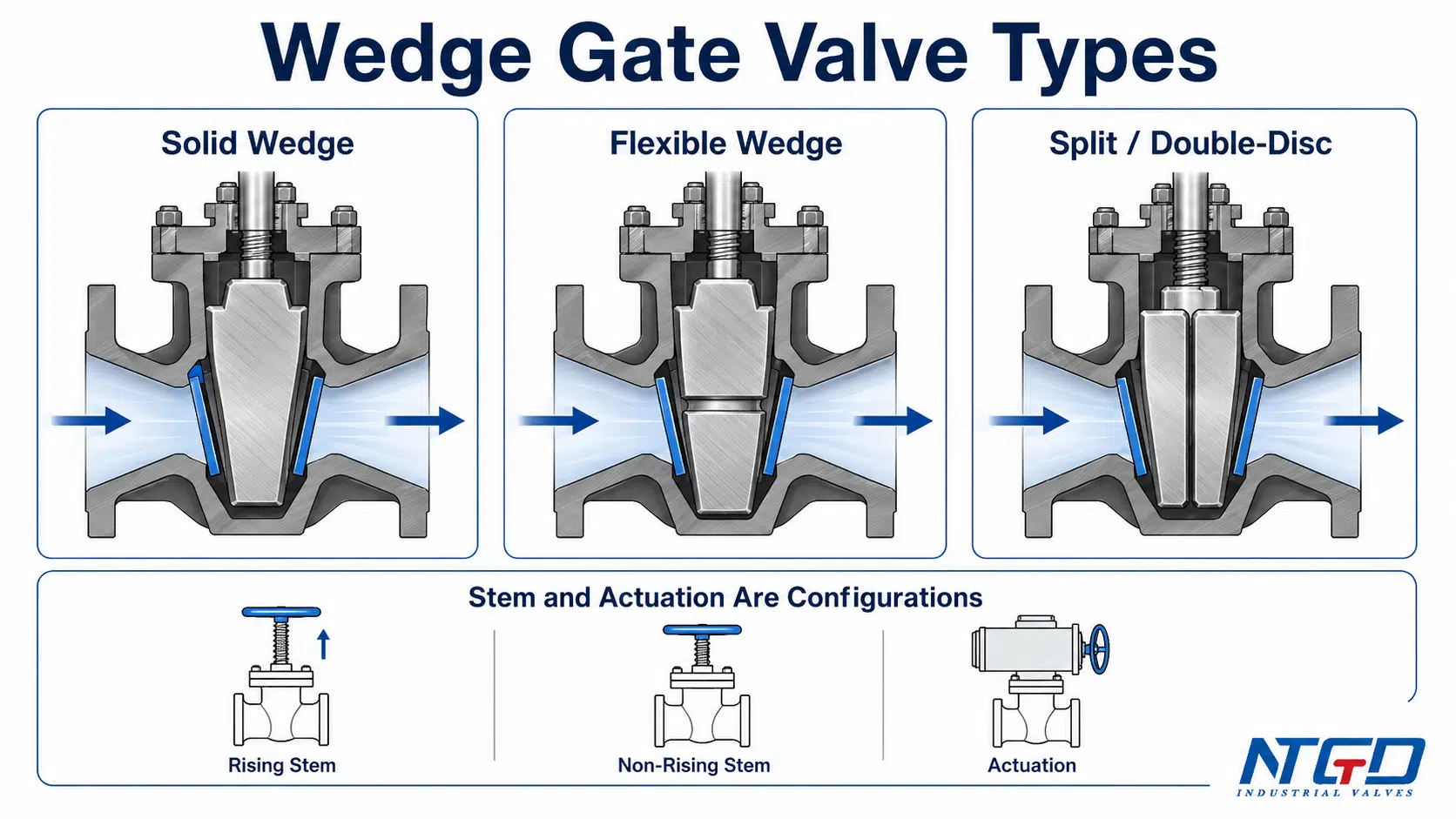
The main types of wedge gate valves are solid wedge gate valves, flexible wedge gate valves, and split wedge or double-disc wedge gate valves. These are the primary gate structure types buyers should review when comparing gate valve wedge types.
Rising stem, non-rising stem, electric actuated, and pneumatic actuated designs are also important, but they describe the stem movement or operator configuration, not the primary wedge design. In practical RFQ review, the wedge design should be confirmed first, then the stem type, actuator type, material, pressure class, end connection, and service conditions.
| Wedge gate valve type | Basic construction | Typical selection direction | Main review point |
|---|---|---|---|
| Solid wedge gate valve | One-piece rigid wedge | Simple shut-off service where seat alignment is stable | Thermal binding and limited compensation |
| Flexible wedge gate valve | One-piece wedge with a groove or flexible section | Services where thermal expansion or minor seat movement may occur | Groove clogging risk in dirty or slurry service |
| Split wedge / double-disc wedge gate valve | Two-piece or double-disc wedge design | Services needing better seat contact compensation | More complex structure and debris sensitivity |
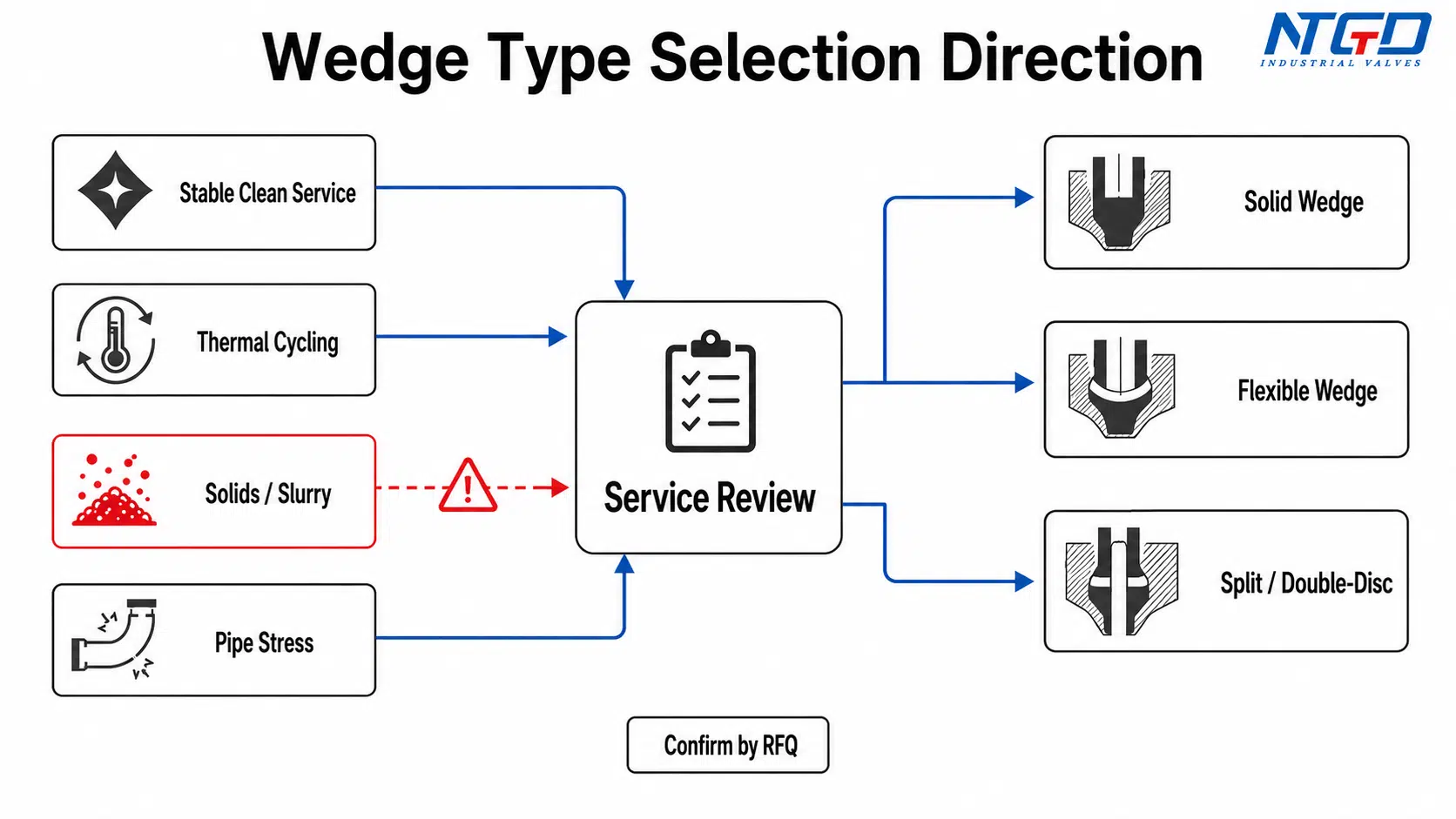
For stable, clean isolation service, a solid wedge is often the first design to review because it is simple and robust. If the service involves thermal cycling, seat alignment movement, or pipe stress, a flexible wedge or split / double-disc wedge may provide better compensation. If the medium contains solids, slurry, crystallizing material, or viscous deposits, the buyer should review whether a wedge gate valve is suitable at all, because grooves and disc interfaces can become deposit-sensitive areas.
What Is a Wedge Gate Valve?
A wedge gate valve is a linear-motion shut-off valve that uses a wedge-shaped gate to open or close the flow path. When the valve is opened, the wedge moves away from the seats and creates a straight-through passage. When the valve is closed, the wedge moves down between two inclined seats and creates sealing contact.
For the complete movement sequence shared by solid, flexible, and split wedge designs, see NTGD’s guide to the general gate valve working principle.
In RFQs, buyers may use shortened or inconsistent terms such as wedge valve, gate wedge valve, or wedge type gate valve. These terms should be clarified because they may describe the valve family, the internal gate structure, or only a buyer’s shorthand. A clear specification should identify the wedge structure, stem design, material, pressure rating, end connection, and operator type.
Why the Wedge Shape Matters
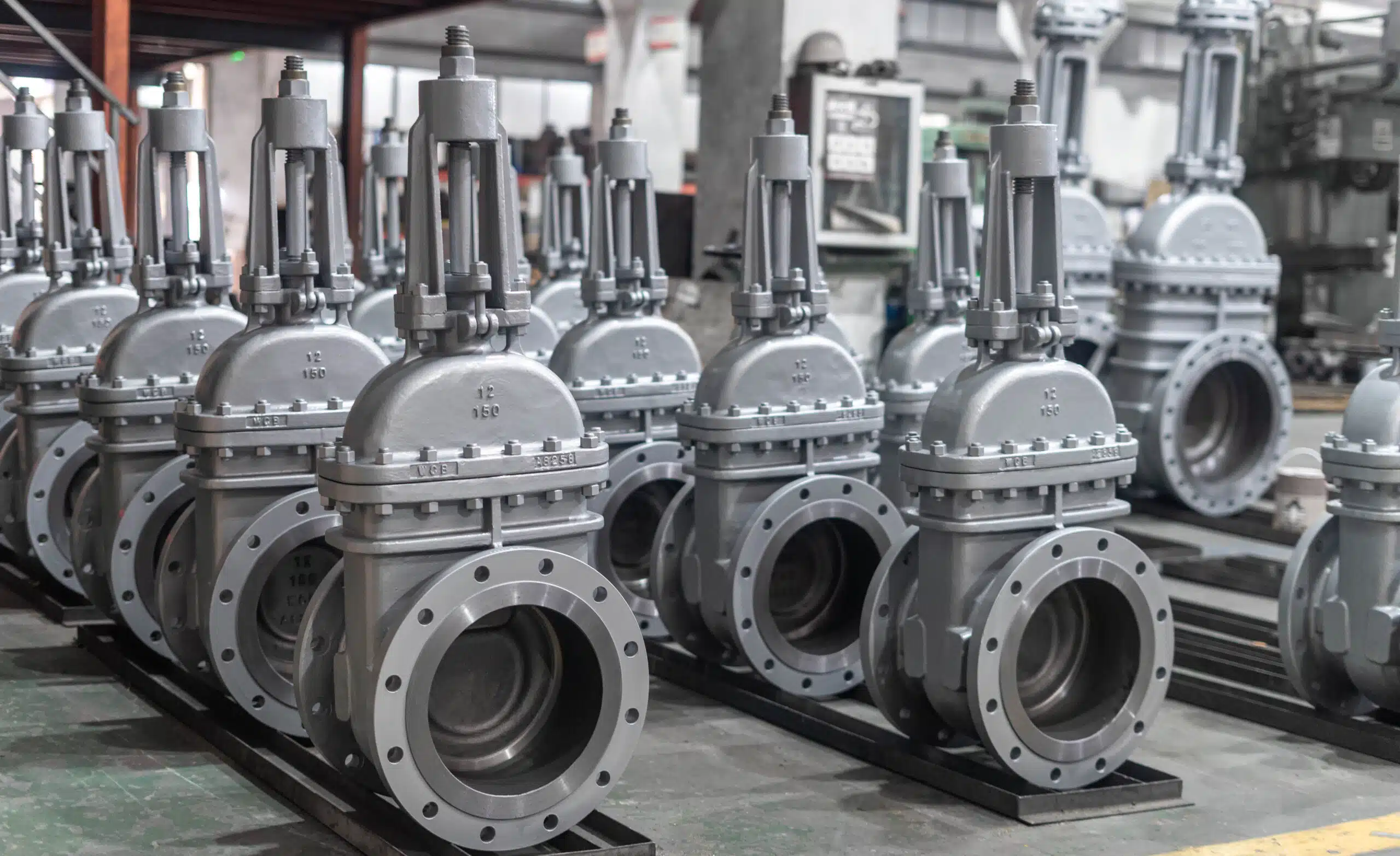
The wedge shape helps the gate press against the valve seats during closure. This can support reliable shut-off in isolation service, but it also means the wedge, body seats, stem force, pressure differential, and service temperature must work together.
A solid wedge, flexible wedge, and split wedge may look similar from outside the valve body, but their internal gate structures respond differently to seat alignment, thermal expansion, pipeline stress, and repeated operation. That is why gate valve wedge types should not be selected only by valve size or pressure class.
Full-Open / Full-Close Isolation Boundary
Wedge gate valves are mainly used for full-open or full-close isolation. They are not normally selected for throttling or frequent regulating service.
Partially open operation exposes the gate and seats to vibration, erosion, uneven wear, and unstable flow forces. In real operation, this can shorten seat life, increase maintenance demand, and make final shut-off less reliable. If a project requires continuous flow regulation, the valve type should be reviewed separately instead of assuming that a wedge gate valve can perform as a control valve.
Main Types of Wedge Gate Valves by Gate Structure
The most useful way to classify types of wedge gate valves is by the gate structure inside the valve. The three main structural groups are:
- Solid wedge gate valve
- Flexible wedge gate valve
- Split wedge or double-disc wedge gate valve
Stem type and actuation should be reviewed later as configuration choices.
Solid Wedge Gate Valve
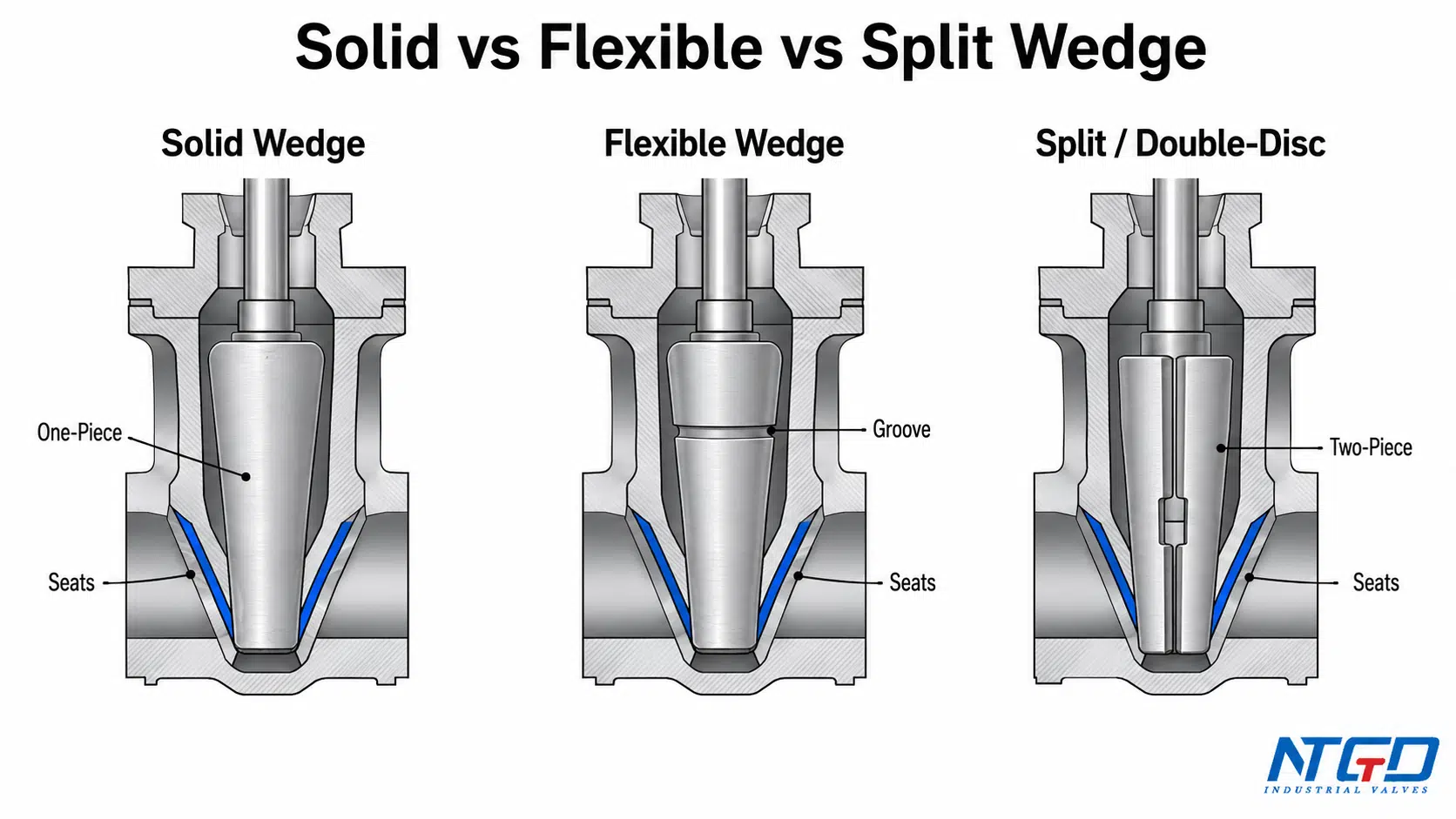
A solid wedge gate valve uses a single-piece rigid wedge. The wedge is machined as one solid disc or gate that moves between the valve seats to close the flow path.
This design is simple, strong, and widely used in many isolation applications. Because the wedge is rigid, it can provide stable shut-off when the valve body, seats, and pipeline alignment remain within the expected design conditions.
A solid wedge valve may be considered when the service is relatively stable and the buyer wants a robust, straightforward shut-off design. For clean service with limited temperature variation and controlled pipe stress, solid wedge construction is often the practical starting point because it avoids additional internal moving interfaces.
However, the same rigid structure also means the wedge has limited ability to compensate for seat angle changes, body distortion, or thermal movement.
The main review point is binding risk. If temperature changes, pressure load, or pipeline stress cause slight seat movement, a rigid wedge may become harder to operate or may not seat evenly. In more severe cases, thermal binding can increase operating torque, stress the stem or seating surfaces, or prevent the valve from fully opening or closing when the system condition changes.
This does not mean a solid wedge is unsuitable in all demanding services, but it does mean the operating temperature, pressure class, material, installation condition, and expected torque should be confirmed before selection.
Use direction: simple and strong shut-off construction for stable clean isolation service.
Review carefully: high-temperature cycling, thermal expansion, seat distortion, pipe stress, and operating torque.
Flexible Wedge Gate Valve
A flexible wedge gate valve uses a one-piece wedge with a groove, cut, or flexible section around the wedge. This design allows slight elastic movement of the seating faces.
The purpose of the flexible design is to help the wedge adapt to small changes in seat alignment. This can be useful when thermal expansion, pipeline stress, or minor body movement may affect the seating surfaces. In many industrial services, a flexible wedge is selected because it offers a balance between simple construction and improved compensation compared with a fully rigid solid wedge.
A flexible wedge gate valve is not the same as a two-piece split wedge. It is still one wedge component, but its geometry allows controlled flexing. This helps reduce the risk of thermal binding in some services, depending on the manufacturer’s design and service conditions.
The main caution is dirty media. The groove or flexible area can become a concern if the medium contains heavy solids, slurry, crystallizing material, or viscous deposits. If particles collect around the groove, the wedge may not move or seat as intended. In services with solids, slurry, crystallizing media, or viscous deposits, buildup around the groove can increase sticking risk and maintenance frequency, so media cleanliness and cleaning conditions should be checked before choosing this design.
When a project specifies a rising stem flexible wedge gate valve, the buyer should confirm the wedge groove geometry, stem configuration, material certificate, and operating conditions in the technical specification. This avoids treating “rising stem,” “flexible wedge,” and “technical specifications” as separate notes that are never checked together.
Use direction: services where seat alignment compensation or thermal movement should be considered.
Review carefully: slurry, heavy solids, viscous fluids, crystallizing media, cleaning access, and groove deposit risk.
Split Wedge / Double-Disc Wedge Gate Valve
A split wedge gate valve uses a two-piece wedge or double-disc construction. The two disc halves can adjust against the seats more independently than a one-piece wedge.
This design is often discussed together with terms such as double-disc wedge gate valve, double disk wedge gate valve, or double wedge gate valve. In many RFQs, these terms may refer to a similar concept, but the exact construction should still be confirmed from the manufacturer’s drawing or datasheet.
The main advantage of a split or double-disc wedge is improved seat contact compensation. Because the wedge is not a single rigid piece, it can help reduce binding and support more even seating under certain operating conditions. This makes the split wedge or double-disc wedge useful to review when seat alignment, thermal movement, or body stress may affect shut-off reliability.
The trade-off is complexity. A split wedge design has more internal interfaces than a solid wedge or simple flexible wedge. It may also be more sensitive to debris, viscous deposits, or dirty service if particles accumulate between the moving parts or near the seating area. If debris or viscous material enters the disc interface, the self-aligning benefit may be reduced, operating movement may become less predictable, and maintenance review becomes more important.
Use direction: services where seat self-alignment and binding reduction are important.
Review carefully: dirty fluids, viscous media, debris accumulation, disc-interface deposits, and maintenance access.
Solid vs Flexible vs Split Wedge Gate Valves
The best wedge design depends on service conditions, not only on the valve name. The table below gives a practical comparison for early selection review.
| Wedge type | Construction | Main advantage | Typical use direction | Main limitation | When to review carefully |
|---|---|---|---|---|---|
| Solid wedge gate valve | Single-piece rigid wedge | Simple, strong, and direct seating | Stable clean isolation service with relatively predictable conditions | Limited compensation for seat or body movement | High temperature cycling, pipe stress, difficult torque, possible binding |
| Flexible wedge gate valve | One-piece wedge with groove or flexible section | Better compensation than a rigid solid wedge | Services with thermal expansion or minor seat alignment concerns | Groove area may collect deposits in dirty service | Slurry, solids, crystallizing media, viscous fluids |
| Split wedge / double-disc wedge gate valve | Two-piece or double-disc wedge | Better self-adjusting seat contact | Services where seat alignment and binding reduction need review | More complex internal construction | Debris, maintenance access, viscous media, detailed drawing confirmation |
A solid vs flexible wedge gate valve comparison should not be reduced to “stronger versus better.” The core trade-off is simplicity versus compensation. A solid wedge favors simple and stable service, a flexible wedge adds limited elastic compensation, and a split / double-disc wedge adds stronger seat alignment compensation but also introduces more internal complexity.
For early selection, the buyer should first ask whether the service is stable and clean. If yes, solid wedge construction may be enough. If temperature movement, seat alignment, or pipe stress is a major concern, flexible or split designs should be reviewed. If the service is dirty, slurry-like, viscous, or crystallizing, all three designs require extra review because deposits can affect the seat area, groove, or disc interface.
The video below provides a visual explanation of solid, flexible, and split wedge gate valve designs. It can help readers understand the internal wedge differences before reviewing the selection matrix.
Terminology Boundary: Split, Double-Disc, Double Disk and Double Wedge
Wedge gate valve terminology is not always used consistently across catalogues, drawings, and RFQs. Before selecting a valve, buyers should confirm whether the wording refers to the wedge structure, stem movement, seat material, or operator type.
Is a Split Wedge the Same as a Double-Disc Wedge?
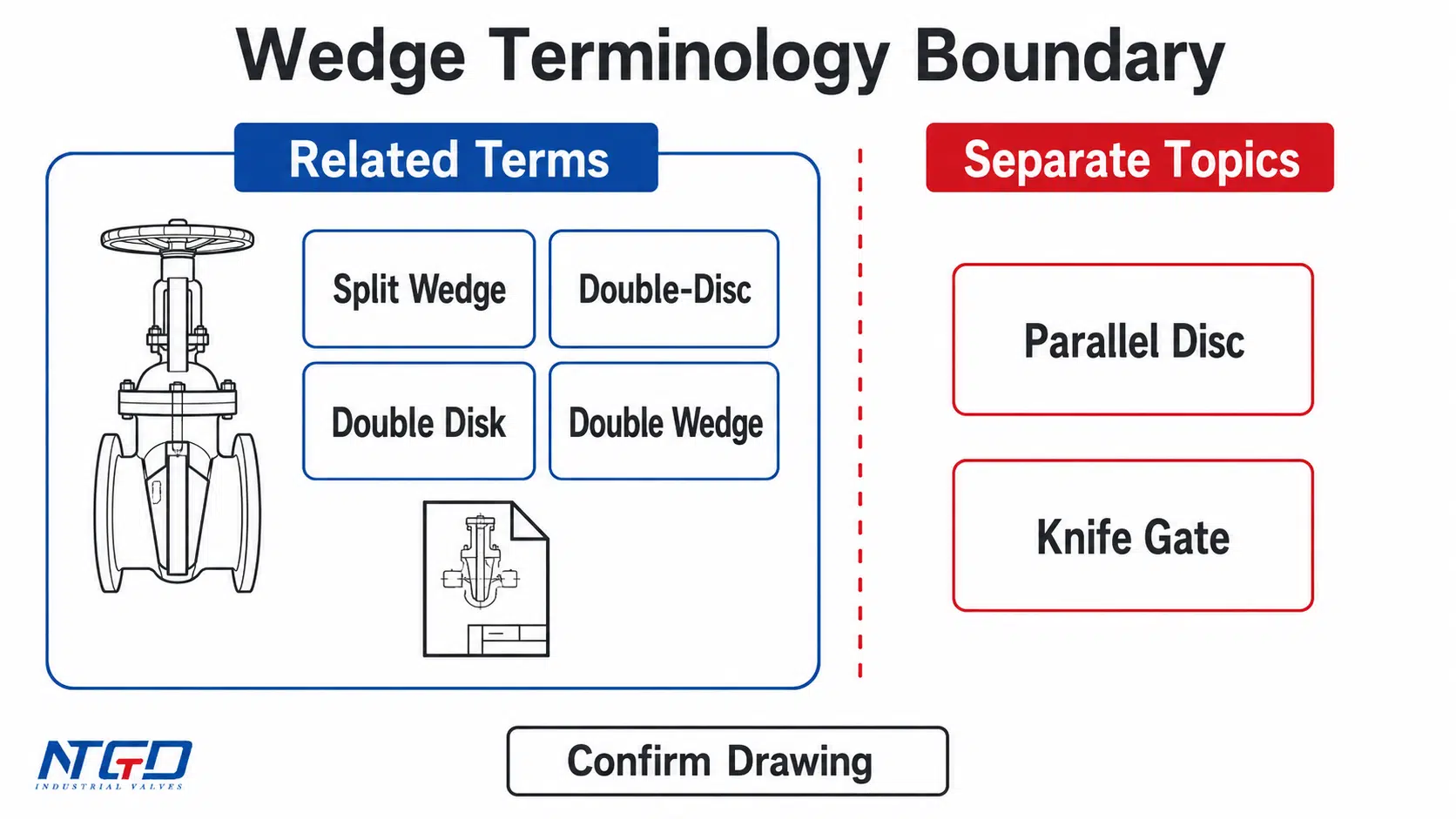
In many industrial discussions, split wedge and double-disc wedge refer to a two-piece wedge concept. The wedge is not a single rigid piece; it uses two disc elements or wedge halves that can help improve seat contact.
However, the exact mechanical arrangement can vary by manufacturer. Some designs may use different guide, hinge, or self-aligning mechanisms. For this reason, the drawing and datasheet should be checked before treating all split wedge and double-disc wedge valves as identical.
Most RFQs can use split wedge and double-disc wedge as related reference terms, but the final confirmation should always come from the manufacturer’s drawing, section view, or datasheet. This avoids a mismatch between the buyer’s wording and the actual internal wedge design being quoted.
Why “Double Wedge Gate Valve” Needs Specification Confirmation
The phrase double wedge gate valve can be ambiguous. In some RFQ conversations, “double wedge” is used informally to describe split wedge or double-disc wedge construction. In other cases, it may be a loose buyer phrase that needs clarification.
A buyer can clarify the RFQ by asking whether the supplier means a two-piece self-aligning wedge, a double-disc wedge, or another gate design. This is especially important when the project has requirements for shut-off reliability, operating torque, high temperature service, or drawing approval.
A clear RFQ should specify whether the project requires:
- Solid wedge
- Flexible wedge
- Split wedge
- Double-disc or double disk wedge
- Parallel disc design
- Resilient wedge design
- Specific stem and operator configuration
Without this clarification, a supplier may quote a valve that matches the general phrase but not the intended gate structure.
Split Wedge vs Parallel Disc Gate Valve
A split wedge gate valve should not automatically be treated as the same as a parallel disc gate valve. A wedge gate valve uses wedge seating geometry, while a parallel disc design follows a different sealing concept.
This difference matters because the sealing principle, seat loading, operating behavior, and suitable service conditions may not be the same. If a buyer uses a parallel disc requirement when the project actually needs wedge seating, the quoted valve may not match the intended shut-off behavior or pressure-service review.
This article focuses on wedge gate valve types. Parallel gate valve design may be relevant for some projects, but it should be reviewed as a separate valve design direction rather than merged into the wedge gate valve classification.
Why Knife Gate Split Gate Is Not the Same Topic
The word “split” can also appear in knife gate valve discussions. That does not mean a split wedge gate valve and a split knife gate design are the same topic.
Knife gate valves are normally selected for different service conditions and body/gate geometries. For wedge gate valve selection, “split wedge” should be interpreted within the context of wedge gate valve construction unless the project specification clearly states otherwise.
Resilient Wedge Gate Valve Boundary
A resilient wedge gate valve is often associated with waterworks or utility service and should not be confused with the industrial metal-seated wedge design categories discussed in this article. If the project specifies resilient wedge construction, the buyer should confirm the applicable service, seating material, standard, and waterworks requirements separately.
Rising Stem vs Non-Rising Stem Wedge Gate Valves
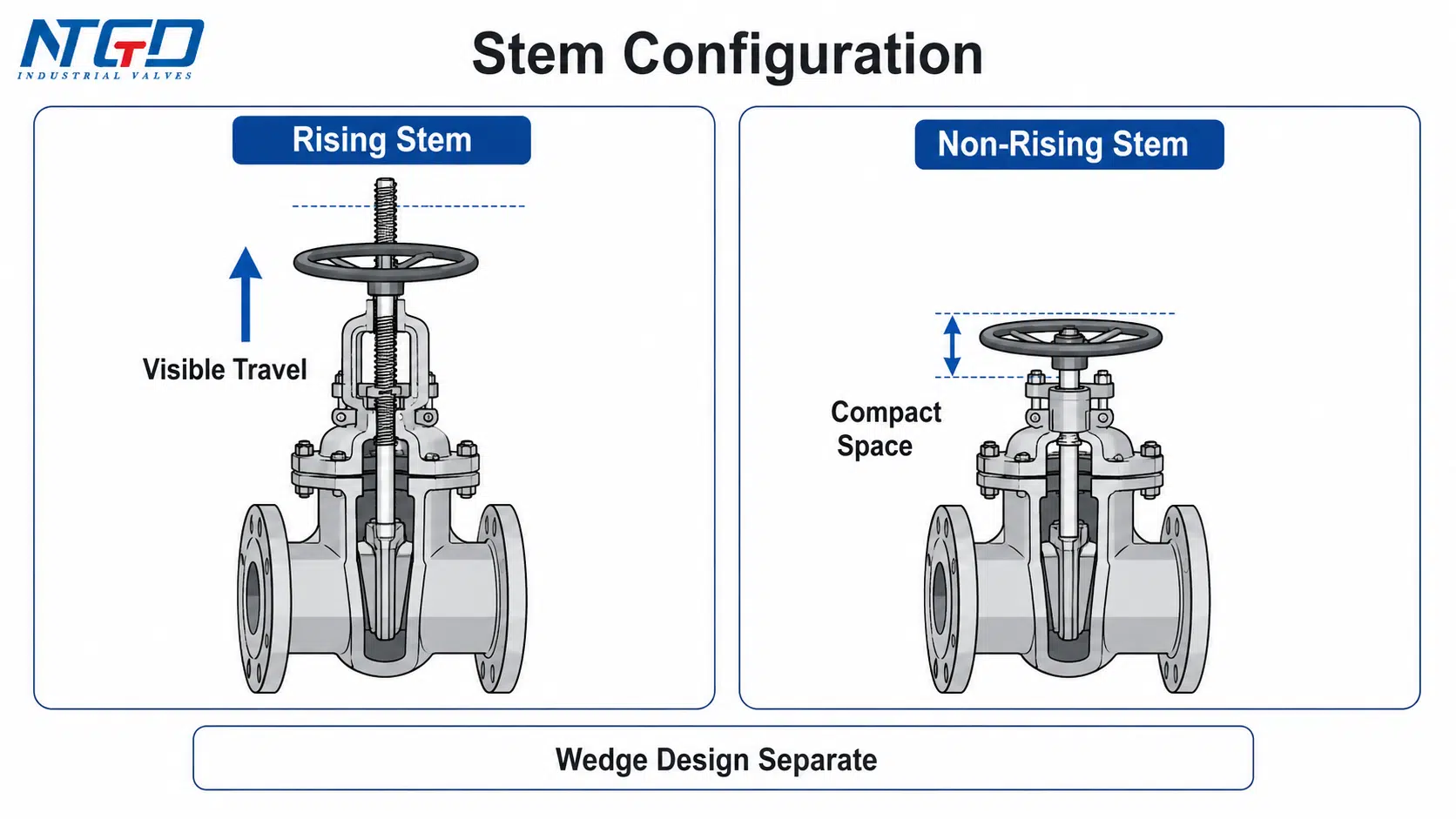
Rising stem and non-rising stem wedge gate valves are important configurations, but they are not the main wedge design types. They describe how the stem moves when the valve opens or closes.
A project may combine stem type with wedge type. For example, a valve may be a rising stem flexible wedge gate valve, or a non-rising stem solid wedge gate valve. The stem description does not replace the need to confirm the wedge structure.
Rising Stem Wedge Gate Valve
A rising stem wedge gate valve has a stem that moves upward as the valve opens. Because the stem position changes visibly, the operator can often identify whether the valve is open or closed by observing the stem travel.
This design can also make stem condition and lubrication access easier to review, depending on the bonnet and yoke arrangement. However, it requires vertical clearance above the valve. It is not ideal where installation space above the handwheel or actuator is limited.
A rising stem wedge gate valve is commonly considered where visual position indication and maintenance access are useful, but the installation envelope must be checked before selection. If the project combines rising stem construction with a flexible or split wedge, the specification should still confirm both the stem movement and the internal wedge structure.
Non-Rising Stem Wedge Gate Valve
A non-rising stem wedge gate valve has a stem that rotates without rising above the valve. The gate moves internally as the stem turns.
This configuration is useful when vertical space is limited. Because the stem does not visibly rise, the valve may require a position indicator or other confirmation method to show open and closed status.
A non-rising stem wedge gate valve should be reviewed carefully in buried, compact, or restricted installations. The buyer should confirm operation access, indication method, corrosion exposure, and maintenance requirements.
Why Stem Motion Is Not the Same as Wedge Design
Stem motion explains how the valve is operated. Wedge design explains how the gate seals against the seats.
These two choices should be handled separately:
| Selection layer | Examples | What it decides |
|---|---|---|
| Wedge design | Solid, flexible, split / double-disc | Internal gate structure and seat compensation |
| Stem type | Rising stem, non-rising stem | Space, visibility, operation, maintenance access |
| Operator type | Manual, gearbox, electric, pneumatic, hydraulic | How torque or force is applied |
| Project data | Size, class, material, medium, temperature | Whether the full configuration fits the service |
Actuation Options for Wedge Gate Valves
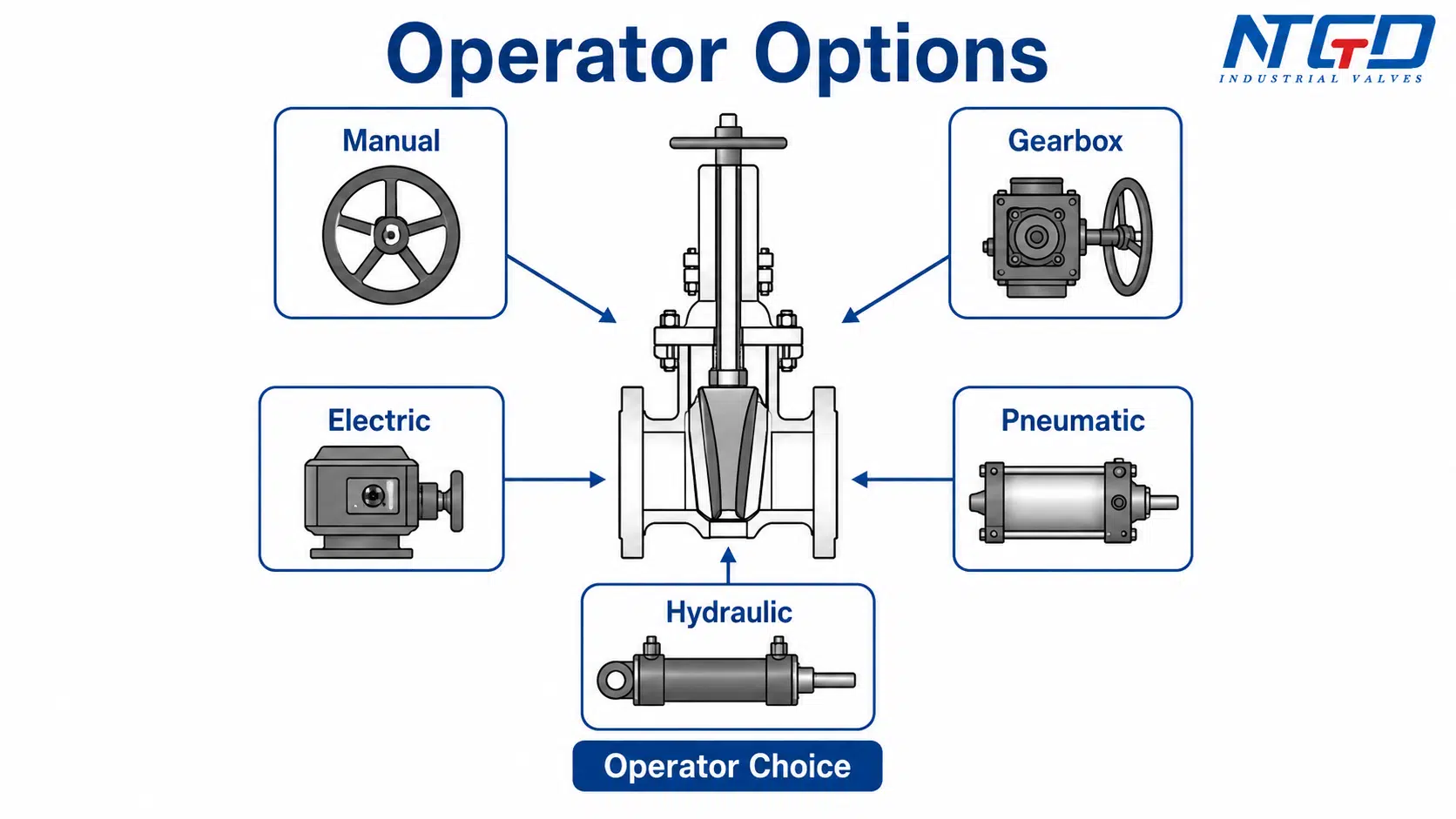
Actuation describes how the valve is operated. It should not be confused with the wedge gate valve type. A solid wedge, flexible wedge, or split wedge design may be supplied with different operator options depending on size, torque, automation requirements, and project specification.
Manual and Gearbox Operation
Manual operation is common for smaller or less frequently operated wedge gate valves. The handwheel drives the stem and moves the wedge between open and closed positions.
For larger sizes, higher pressure classes, or higher operating torque, a gearbox may be used. A gearbox helps reduce handwheel effort and provides more controlled operation. The need for a gearbox should be checked against valve size, pressure differential, stem design, and expected operating frequency.
Electric Actuated Wedge Gate Valve
An electric actuated wedge gate valve uses an electric actuator to operate the valve remotely or as part of an automated system. The actuator converts electrical energy into mechanical movement and applies the torque or thrust needed to operate the stem.
Electric actuation may be selected when the valve must be controlled from a control room, integrated into a plant automation system, or operated where manual access is inconvenient. The actuator should be sized according to the required operating torque or thrust, safety factor, power supply, control signal, environmental condition, and required open/close time.
An electrically actuated wedge gate valve is an operator configuration. It does not identify whether the valve uses a solid wedge, flexible wedge, or split wedge.
Pneumatic Actuated Wedge Gate Valve
A pneumatic actuated wedge gate valve uses compressed air to operate the actuator. The actuator converts air pressure into mechanical movement that drives the valve stem.
Pneumatic actuation may be considered where compressed air is available and fast or remote operation is required. The air supply quality, actuator sizing, fail position, accessories, and control logic should be confirmed during specification review.
A pneumatically actuated wedge gate valve still needs separate confirmation of wedge type, stem type, body material, seat design, and service conditions.
Hydraulic Actuated Wedge Gate Valve
A hydraulic actuated wedge gate valve uses hydraulic pressure to generate the force needed for operation. This may be considered for large valves, high operating loads, or applications where hydraulic power is already part of the system.
The hydraulic system introduces additional review points such as fluid cleanliness, leakage control, power unit design, ambient conditions, and maintenance access. Hydraulic actuation should also be checked against available hydraulic power, control method, emergency operation requirements, leakage control, and maintenance space around the actuator. As with other operators, hydraulic actuation does not define the wedge structure itself.
How to Select the Right Wedge Gate Valve Type
The right wedge gate valve type should be selected by matching the internal wedge design to the service conditions. A buyer should not choose only by valve size, pressure class, or the general phrase “wedge gate valve.”
Temperature and Thermal Expansion
Temperature changes can affect the valve body, seats, stem, and wedge. If the service involves high temperature, thermal cycling, or startup and shutdown changes, the risk of binding should be reviewed.
A flexible wedge or split wedge design may be considered where compensation is needed, but the exact choice depends on the manufacturer’s design, material, pressure class, and service conditions.
Pressure Class and Differential Pressure
Pressure class indicates the valve’s rated pressure boundary, but it does not fully define operating torque or seating behavior. Differential pressure across the valve can affect the force needed to open or close the wedge.
For higher pressure or larger sizes, the buyer should confirm operator sizing, stem design, wedge type, seat design, and whether a gearbox or actuator is required.
Media Cleanliness, Solids and Viscosity
Clean fluids are generally easier for wedge gate valve operation. Dirty fluids, slurry, crystallizing media, or viscous fluids may affect the seat area, wedge movement, and internal clearances.
Flexible wedge grooves and split wedge interfaces should be reviewed carefully if the medium may deposit solids. For dirty service, the buyer should confirm whether a wedge gate valve is suitable at all, or whether another slurry valve selection route should be considered.
Pipeline Stress and Seat Alignment
Pipeline stress can affect valve body alignment and seat contact. If pipe loads, thermal expansion, or installation conditions may distort the valve body, a rigid solid wedge may have less ability to compensate than a flexible or split design.
This does not mean one wedge type is always better. It means the installation condition should be reviewed before the wedge design is finalized.
Operation Frequency and Maintenance Access
Wedge gate valves are normally used for isolation, not frequent regulation. If the valve will be operated frequently, the buyer should review stem wear, packing condition, operating torque, actuator sizing, and access for maintenance.
For manual valves, access to the handwheel or gearbox is important. For actuated valves, access to electrical, pneumatic, or hydraulic components must also be considered.
| Service factor | Solid wedge review | Flexible wedge review | Split / double-disc wedge review | RFQ note |
|---|---|---|---|---|
| Stable clean service | Usually the first review direction when no special compensation is required | Also possible, but may not be necessary | May be unnecessary unless seat compensation is specified | Confirm wedge type and seat material before quotation |
| High temperature or thermal cycling | Review binding risk, operating torque, and seat movement | Often reviewed for thermal compensation | May be reviewed for self-alignment and binding reduction | Compare solid binding risk against flexible or split compensation |
| Solids or slurry | Check seat wear, blockage, and suitability of wedge gate valve design | Check groove clogging risk | Check debris between moving parts or disc halves | Review whether a wedge gate valve is suitable at all if solids content is high |
| Viscous media | Check seating, cleaning, and deposit risk | Check deposit risk around the groove | Check deposit risk around the disc interface | Confirm cleaning access and whether deposits can affect movement |
| Limited installation space | Depends on stem type | Depends on stem type | Depends on stem type | Confirm rising or non-rising stem before selecting the operator |
| Remote operation | Needs actuator sizing | Needs actuator sizing | Needs actuator sizing | Confirm torque / thrust, control logic, and fail-position requirements |
| Buyer unsure of terminology | Needs drawing confirmation | Needs drawing confirmation | Needs drawing confirmation | Request a drawing, datasheet, or section view before final quotation |
As a practical rule, stable clean service usually starts with solid wedge review. Thermal movement or seat alignment concerns push the review toward flexible or split / double-disc designs. Solids, slurry, viscous deposits, or crystallizing media require a stricter fit-check because they can affect the groove, seat area, or disc interface.
Common Selection Mistakes to Avoid
Treating Stem Type as the Main Wedge Type
One common mistake is to treat rising stem and non-rising stem as the main types of wedge gate valves. These are important options, but they describe stem movement. The main wedge design still needs to be confirmed separately.
A correct specification should identify both:
- Wedge structure
- Stem configuration
For example, “rising stem wedge gate valve” is not complete if the project also needs a solid wedge, flexible wedge, or split wedge design. Treating stem type as the main type can lead to repeated RFQ clarification, mismatched datasheets, or a valve quote that solves the space and operation requirement but misses the intended internal wedge design.
Using a Wedge Gate Valve for Throttling
Another mistake is using a wedge gate valve as a throttling valve. In partially open service, the gate and seats can experience unstable flow, vibration, erosion, and wear.
For isolation service, a wedge gate valve may be appropriate. For frequent flow control, the valve type should be reviewed separately. If throttling is required, using a wedge gate valve can increase maintenance demand and reduce shut-off reliability over time.
Ignoring Thermal Binding Risk
Thermal binding can occur when temperature changes affect the valve body, seats, or wedge in a way that makes the gate difficult to move. This is especially important in high-temperature or thermal cycling services.
A common mistake is checking only valve size and pressure class while ignoring startup, shutdown, or temperature gradient conditions. A solid wedge generally has the least compensation for seat or body movement. A flexible wedge adds limited elastic compensation, while a split / double-disc wedge may provide more seat alignment compensation but also adds complexity. The buyer should compare the wedge design against the actual temperature and operating conditions before finalizing the specification.
Ignoring Solids, Slurry or Viscous Media
Dirty service can change the selection direction. Solids may affect seat sealing. Slurry may increase wear. Viscous or crystallizing media may create deposits near grooves, guides, or moving interfaces.
If the service is not clean, the buyer should confirm the medium properties before selecting a wedge gate valve type. In some cases, the correct decision is not simply choosing between solid, flexible, and split wedge designs; it is first confirming whether a wedge gate valve is suitable for the medium.
Confusing Split Wedge with Parallel Disc or Knife Gate Designs
Split wedge terminology can be confused with parallel disc gate valves or knife gate valve designs. These are not the same classification.
The safest approach is to check the drawing, wedge construction, seat arrangement, and valve standard before confirming the type. If the sealing concept is misunderstood, the quoted valve may not match the required shut-off behavior, pressure-service expectation, or maintenance condition.
RFQ Checklist for Wedge Gate Valve Type Selection
A clear RFQ supports industrial valve selection by helping wedge gate valve manufacturers and suppliers identify the correct valve structure instead of quoting only a general wedge valve.
Include the following information when requesting a wedge gate valve:
| RFQ item | Why it matters |
|---|---|
| Valve size | Affects body design, torque, operator selection, and installation space |
| Pressure class | Defines pressure boundary and affects valve construction |
| Body material | Must match pressure, temperature, and media compatibility |
| Wedge type | Confirms solid, flexible, split, or double-disc design |
| Seat / sealing design | Affects shut-off performance and service compatibility |
| Stem type | Confirms rising stem, non-rising stem, OS&Y, or NRS configuration |
| Operator / actuator | Confirms manual, gearbox, electric, pneumatic, or hydraulic operation |
| Medium | Determines corrosion, erosion, clogging, and compatibility risk |
| Temperature | Affects material selection and thermal binding review |
| Solids / viscosity | Helps identify deposit, wear, or movement risk |
| End connection | Must match piping layout and project requirements |
| Applicable standard | Should be verified against the project specification |
| Quantity and tag data | Helps identify project scope and valve location |
| Documentation requirement | Confirms certificates, drawings, inspection records, and test documents |
FAQs About Wedge Gate Valve Types
What are the main types of wedge gate valves?
The main types of wedge gate valves by internal gate structure are solid wedge gate valves, flexible wedge gate valves, and split wedge or double-disc wedge gate valves. This classification is based on the wedge design inside the valve. Rising stem, non-rising stem, electric actuated, and pneumatic actuated designs are configuration layers, not the primary wedge structure types.
What is the difference between a solid wedge and a flexible wedge gate valve?
A solid wedge gate valve uses a one-piece rigid wedge. A flexible wedge gate valve also uses a one-piece wedge, but it has a groove or flexible section that allows slight elastic movement. The flexible design can help compensate for minor seat movement or thermal expansion, while the solid wedge design is simpler and more rigid.
Is a split wedge the same as a double-disc wedge?
In many cases, split wedge and double-disc wedge refer to a two-piece wedge concept. However, the exact internal arrangement can vary by manufacturer. The project drawing or datasheet should be checked before treating the terms as fully identical.
Are rising stem and non-rising stem wedge gate valves different types?
They are different stem configurations, but they are not the primary wedge design types. A rising stem valve shows stem travel as the valve opens, while a non-rising stem valve keeps the stem from moving upward. Either configuration may still need a solid, flexible, or split wedge design.
Can wedge gate valves be used for throttling?
Wedge gate valves are mainly selected for full-open or full-close isolation. They are not normally recommended for throttling or frequent regulating service because partial opening can cause vibration, erosion, seat wear, and unstable operation. In long-term service, this can make the valve harder to shut off reliably and increase maintenance requirements.
Which wedge gate valve type is better for high temperature service?
There is no universal answer, because high temperature selection depends on whether the service is steady or cyclic, how much seat movement may occur, and whether the medium is clean. Steady high temperature with stable alignment may still allow solid wedge review. Thermal cycling, startup / shutdown changes, or seat movement usually push the review toward flexible wedge or split / double-disc wedge designs. Dirty or crystallizing media can limit the suitability of flexible grooves or split disc interfaces, so media cleanliness must be checked together with temperature.
What information should be included in a wedge gate valve RFQ?
A wedge gate valve RFQ should include size, pressure class, material, wedge type, seat design, stem type, operator type, medium, temperature, end connection, applicable standard, quantity, tag data, and documentation requirements. This helps avoid confusion between wedge design, stem configuration, and actuation.
Final Selection Note
For a types of wedge gate valves page, the selection sequence should stay clear: choose the wedge design first, then confirm stem configuration, then confirm operator type, then check the RFQ data and drawing.
A solid wedge is usually reviewed first for stable clean isolation service. A flexible wedge becomes more relevant when limited elastic compensation is useful. A split or double-disc wedge may be considered when stronger seat alignment compensation is needed, but its internal complexity and deposit sensitivity must also be reviewed.
Wrong wedge type selection can lead to repeated RFQ clarification, higher operating torque, unreliable shut-off, or a valve design that does not match the service condition. Before finalizing the RFQ, confirm the internal wedge design and share the service conditions for application review. NTGD Valve can review your size, pressure class, material, medium, temperature, stem type, and operator requirements to help match the wedge gate valve type to the application.
